1. Introduction
A large body of literature has been devoted to quantifying households' behavioral responses (or adaptations) to climate change (for a review, see Di Falco, Reference Di Falco2014). Many studies look for direct evidence of adaptation, such as adoption of different crop varieties, livestock breeds, and water conservation methods (e.g., Bryan et al., Reference Bryan, Deressa, Gbetibouo and Ringler2009; Di Falco and Veronesi, Reference Di Falco and Veronesi2013). Others take an indirect approach and impute households' adaptation from changes in land prices that occur due to climate change based on the Ricardian framework (e.g., Mendelsohn et al., Reference Mendelsohn, Nordhaus and Shaw1994, Reference Mendelsohn, Nordhaus and Shaw1996; Mendelsohn and Neumann, Reference Mendelsohn and Neumann1999; Seo et al., Reference Seo, Mendelsohn and Munasinghe2005).Footnote 1 Studies also combine the direct and indirect approaches (e.g., Kurukulasuriya and Mendelsohn, Reference Kurukulasuriya and Mendelsohn2008; Seo and Mendelsohn, Reference Seo and Mendelsohn2008).Footnote 2
Much of the literature on this issue, however, has been charged with having major methodological limitations. Due to the unavailability of time series data on households' behavioral responses to identifiable shifts, variability, and extreme events in the climate (Smit and Wandel, Reference Smit and Wandel2006; Chambwera and Stage, Reference Chambwera and Stage2010), studies commonly rely on variability in weather across climate zones in cross sectional data (e.g., Deressa et al., Reference Deressa, Hassan, Ringler, Alemu and Yesuf2009). Identification of the effect of climate, under this approach, requires data to be collected across large geographical areas, which can be challenging, especially in developing country contexts. Even with a large cross sectional dataset, adaptations identified by the studies are limited to households' current activities since households' responses over time are not observed. Relatedly, the approach fails to consider adaptations that arise in response to cross-section specific time-varying climate shifts. The indirect approach is deemed particularly inappropriate for studying poor agrarian economies since structural deficiencies in land markets characterize most developing countries. With imperfect land markets, the cross-sectional variance in land prices and climate, which is at the crux of Ricardian approach, underestimates households' adaptation responses to climate change (Shewmake, Reference Shewmake2008). As a result of these limitations, the broader empirical evidence on effect of climate change on poor households' welfare is mixed, and varies depending on how adaptation, which mediates climate change effects on household welfare, features in empirical models of adaptation (Kurukulasuriya and Mendelsohn, Reference Kurukulasuriya and Mendelsohn2008).
We overcome these limitations by using a contingent behavior (CB) approach to examine the adaptation of households to climate change in rural South Africa. The CB approach deploys carefully designed hypothetical scenarios that explain the status quo and a change from the status quo to directly elicit behavioral responses to environmental changes (see Morton et al., Reference Morton, Adamowicz and Boxall1995; Whitehead et al., Reference Whitehead, Phaneuf, Dumas, Herstine, Hill and Buerger2010). The method has been used widely in developed economies in order to assess changes in recreation demand in response to changes in environmental conditions (e.g., Cameron et al., Reference Cameron, Shaw, Ragland, Callaway and Keefe1996; Chase et al., Reference Chase, Lee, Schulze and Anderson1998; Richardson and Loomis, Reference Richardson and Loomis2004; Christie et al., Reference Christie, Hanley and Hynes2007). However, to our knowledge, it has not been applied in climate change studies and in a developing country context.
The CB approach helps overcome the limitations faced by current studies. Specifically, CB exploits variability in climatic conditions incorporated into the study design as future scenarios and, therefore, is not reliant on cross sectional climate variability to identify climate change effects. The approach also allows inclusion of time varying climate variables that do not change across space as covariates in econometric models of adaptation. Drawing on meteorological information and defining the likely climate change scenarios over time, long-run behavioral responses of households to climate can be identified. Most importantly, since the climate change scenarios are embedded into the research design and randomly assigned to the respondents, the CB approach can mitigate problems of reverse causality and selection bias. While there are advantages to the use of a CB approach, a drawback is the reliance on hypothetical responses rather than modelling actual choices. In general, one may expect overstatements of participation in activities if respondents view it in their interest to do so (perhaps because of the possibility of new programs or other technical supports). But within the context of our study site and questions, it is not clear to us that there are incentives to overstate or understate participation, as we did not use technical supports.
We investigate the households' stated adaptations in response to anticipated climate change using data we collected from the Eastern Cape Province of South Africa in 2011. The Eastern Cape Province is predicted to be highly vulnerable to climate change, with the western sections getting hotter and drier, and the coastal zone in the east experiencing an increase in later summer rainfall, floods, and rising sea levels (Pyle, Reference Pyle2007). These changes could change the financial incentives linked to different livelihood activities and, thereby, change household activity portfolios. These changes are also conditioned by wealth, a prevalence of HIV/AIDS, and a lack of access to markets in rural areas where our study site is located (Barnighausen et al., Reference Barnighausen, Tanser, Gqwede, Mbizana, Herbst and Newell2008).
We focus on whether or not households respond to changes in climate by undertaking various on-farm and off-farm livelihood activities. The major on-farm livelihood activities in Eastern Cape include small scale crop farming and rearing livestock (Ncube et al., Reference Ncube, Shackleton, Swallow and Dassanayake2016). The major off-farm activities include permanent local jobs and non-permanent, casual local jobs (Perret, Reference Perret2002). In addition, harvesting of natural resources such as wild food and firewood is common in more rural areas (Shackleton and Shackleton, Reference Shackleton and Shackleton2004). The poor condition of roads and limited access to basic services, such as schools, add to the economic challenges of the local population. Households are located in areas where poor transportation and infrastructure restrict market participation. Failures of labor and credit markets are common.
We model adaptation within a standard agricultural technology adoption framework that considers determinants of a choice between an existing and a new technology (see Hubbell et al., Reference Hubbell, Marra and Carlson2000; Goodhue et al., Reference Goodhue, Klonsky and Mohapatra2010). We pay special attention to accounting for both observed and latent household-level heterogeneity in households' adaptation choices. We investigate how initial household conditions such as human and social capital endowments, health status, risk perceptions, demographic factors and past experiences with livelihood activities, condition the propensities to undertake future livelihood activities in response to various climate change scenarios. We also explore whether unobserved household attributes (such as its entrepreneurial ability) affect households' adaptation choices.
The rest of the paper is organized as follows. In section 2, we briefly describe our data. Section 3 describes our empirical approach and section 4 presents the results of our econometric analysis using the CB model. Section 5 discusses limitations of our approach and the final section concludes.
2. Study site and data collection
Data were collected in villages within the Willowvale area located in the former Transkei in the Eastern Cape Province of South Africa. The Willowvale area consists of low density rural settlements, surrounded by communal areas used for agriculture and grazing. Livelihoods are largely supported by social grants (i.e., pensions and child benefits from government), which make up more than half of household income. Natural resources, livestock, and formal employment make up most of the remaining sources of income, with most returns from these first two activities coming as in-kind income, where households consume their own output. Total amounts of income measured by cash and in-kind amounts of income per household average approximately ZAR10,000 per annum.Footnote 3
Data collection took place in two phases. The first phase, i.e., the baseline survey, was undertaken during January and February of 2011. The sample consisted of 155 households randomly selected within fourteen villages, stratified by the percentage of the population in each village. The data on different types of capital stocks, and household demographics, were collected in the baseline survey.
Constructing climate change scenarios involved characterizing future climate with locally meaningful changes that could potentially influence local behavior. The background studies revealed that the frequency of the occurrence of dry and wet periods can be crucial for crop and livestock production in our study area. Previous studies have also found that households living in similar contexts base their production decisions on events such as rainfall frequency, timing, and intensity (Smithers and Smit, Reference Smithers and Smit1997; Roncoli et al., Reference Roncoli, Ingram and Kirshen2002). Accordingly, as a part of our CB approach, we characterize the future, relative to the present, with two types of climate change scenarios: dry-spells and wet-spells. Following the research of Usman and Reason (Reference Usman and Reason2004) on South Africa's climate, we defined a dry-spell as a period of five consecutive days that receives less than 5 mm of rainfall. A wet-spell, following Hachigonta and Reason (Reference Hachigonta and Reason2006), was defined as a period of five consecutive days which receive more than 20 mm of rainfall.
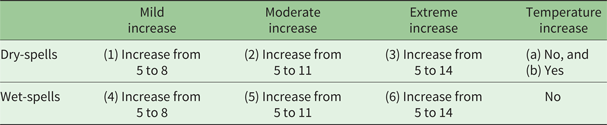
These scenarios were constructed to represent plausible changes in rainfall that could occur during the rainy season in the Willowvale area (i.e., November to March). Based on climate studies (e.g., Reason et al., Reference Reason, Hachigonta and Phaladi2005; Hachigonta and Reason, Reference Hachigonta and Reason2006), we specify a baseline and plausible changes that represent mild, moderate and extreme changes for both dry- and wet-spells in the future. There are two types of dry-spell scenarios: (a) one in which temperature remains normal during the dry periods; and (b) one in which temperature can reach a high of 37°C. We assume that temperature remains as usual during the wet-spells. Relevance and credibility of the definitions of dry- and wet-spells with respect to the context of our study sites were verified with historical data provided by local agricultural extension officers and villagers. Table 1 summarizes these nine climate change scenarios (i.e., scenarios 1–3, a and b, and 4–6).Footnote 4
Climate change scenarios included in the contingent behavior questions

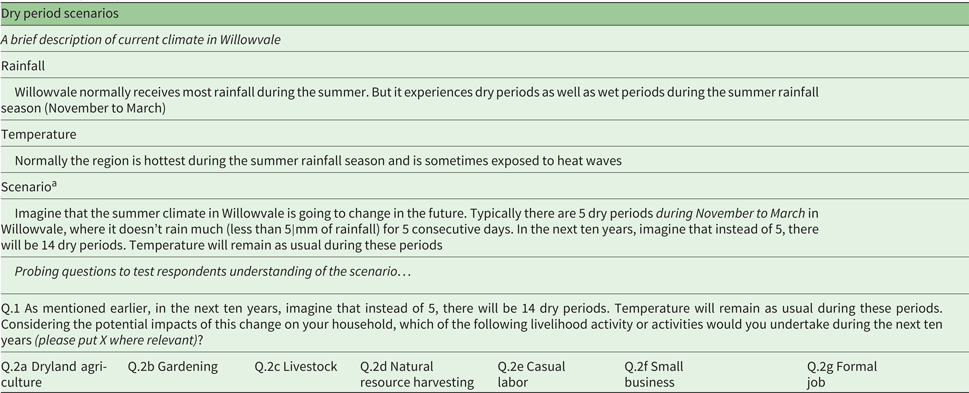
The second phase was undertaken during July and August of 2011 to collect data on household contingent behavior with regard to future climate change and measures of risk aversion. Table 2 shows the questions that we used to collect the contingent behavior data for a given climate scenario. The first section in table 2 shows the information that was given to the respondents regarding the typical climate of the study area, followed by a description of a specific future climate change scenario. For example, for the case illustrated in table 2, the future climate change is specified as an extreme change in the frequency in the occurrence of dry-spells for normal temperature. Follow-up questions were asked to test respondents' comprehension regarding the conditions described by climate change scenarios. We then asked the respondents to choose the livelihood activities that they would adopt in response to the specific climate change scenario.
Sample of questions used to elicit households' stated choices of future livelihood activities

Notes: aA list of scenarios is contained in table 1. The scenario in this question is 3a.
The choice set included seven livelihood activities: dryland agriculture, gardening, natural resource harvesting, casual labor, small business, and formal employment. Dryland agriculture involves non-watered crops that may be in fields not located at the homestead, while gardening involves small watered plots at the homestead. Natural resource harvesting refers to fishing and collecting firewood, poles, wild animals, wild fruits, and other natural resource products. Casual labor and small business may be undertaken either at the villages where households are living, or in cities or towns away from the villages.
These seven livelihood activities were selected based on comprehensive survey data collected on livelihood activities of households during the baseline survey. At the time of the survey, all households were undertaking various combinations of these activities. Behavior in response to future climate changes could take the form of continuing current livelihood activities, and/or dropping or adding one or more activities. The possibility of not working was incorporated into our survey design, since households could avoid selecting any livelihood activities that they did not want to undertake. This message was clearly conveyed to the respondents during each briefing session prior to the survey. The choice set was also informed by informal focus groups and interviews with villagers, which were used to identify plausible livelihood activities undertaken in the past in response to changing climate and extreme weather events. The CB survey was pre-tested among 20 households/individuals.
Out of 155 households that were surveyed during the first phase, 141 households participated in the second phase. Fourteen households were not interviewed due to unavailability of an adult respondent during our visits. These households were scattered across all the villages where we collected data. We tested for systematic differences between the absent households and those who participated in the survey and the results suggested absences were random. Each contingent behavior questionnaire was designed to elicit responses from an adult male and from an adult female in each household. Among the 141 households that we interviewed in the second phase, there were 21 households in which both an adult male and an adult female were available during the survey. Consequently, 162 individuals participated in the survey.Footnote 5 Each respondent answered two randomly assigned CB questions. Accordingly, we have contingent behavior data from 324 observations.
3. Empirical approach
Our empirical approach investigates two major aspects of household responses to future climate change: (1) change in the probabilities of adoption of specific livelihood activities; and (2) change in the number of activities adopted. The former will allow us to compare the differential impacts that climate change may create on households' livelihood activities while the latter will yield us information about whether households intend to diversify in response to climate change risk.
3.1 Factors affecting adoption of specific livelihood activities
We specify a general empirical model of adoption by characterizing the net benefit or utility from a livelihood activity using the latent variable, A*. Specifically,
 $$ A_i^\ast =\alpha + X_i \beta + \varepsilon _i $$
 $$\hbox{with}\;A_i =\left\{ {\matrix{ 1\quad \hbox{if}\;A_i^\ast > 0 \hfill \cr {0\quad \hbox{otherwise},} \hfill \cr } } \right.$$
while A i is an observed variable that indicates whether a household undertakes a particular livelihood activity (A i = 1), if A i * > 0 and 0 otherwise. The X i represent determinants that affect adoption of a livelihood activity through coefficients β. The errors, ε, are assumed to have a standard normal distribution. Our empirical model consists of six probit equations, one for each of the following activities: gardening, livestock, natural resource harvesting, casual labor, small business and formal employment.Footnote 6
Some livelihood activities may be chosen by households based on direct gains to consumption. For example, an individual may choose natural resource harvesting that is used for home consumption. Other activities, such as off-farm employment, may be chosen based on their contribution to cash income. Still other activities, such as gardening, may be undertaken due to their contributions to both the consumption and cash income components of benefits. In our data, we do not observe differences in either expected consumption levels or expected profits due to adoption. We follow Qaim and de Janvry (Reference Qaim and de Janvry2002) and assume that these variables can be explained by observed household characteristics, so that the consumption and profits differences caused by adoption are implicitly embedded in reduced form within the matrix of explanatory variables.
Although we control for observed heterogeneity of households by including X i , adoption decisions may also vary among households due to unobserved household heterogeneity. Households may be heterogeneous in two general ways. First, they can be heterogeneous due to unobserved but not systematic reasons. Second, and more importantly, households may be heterogeneous systematically due to unobservable household covariates, such as household ability in a specific livelihood activity. Therefore, in estimating equation (1), we apply an econometric approach that accounts for the possibility of systematic differences in the unobserved characteristics of households. We control for unobserved heterogeneity using a random parameter probit model. Following Greene (Reference Greene2004), in order to allow for unobserved heterogeneity, the intercept term in equation (1) can be rewritten as:
 $$\alpha _i =\alpha +\Gamma v_i$$
where the random vector v introduces the distribution of the random intercept; α is the mean of the random parameters; and Γ contains the variances of the random parameters. We estimate equation (2) using simulated maximum likelihood methods.Footnote 7
3.2 Factors affecting the number of livelihood activities adopted
The number of livelihood activities chosen by an individual generates a vector of discrete non-negative integers, i.e., a count variable. Accordingly, in analyzing the factors affecting the number of livelihood activities chosen by an individual, we use a Poisson model which is specified as follows:
 $$\hbox{Prob}(Y=Y_i \vert {X_i } )=\displaystyle{{\exp (-\lambda _i )\lambda _i ^{Y_i}}\over{Y_i !}}, \quad \lambda _{\rm i} =\exp (X_i \beta),$$
 $$ Y_i =\hbox{0,1,}\ldots , n, $$
where Y denotes the number of livelihood activities chosen in response i, X
i
represents the explanatory variables, and β's are the parameters to be estimated. The Poisson regression model has a log-linear conditional mean function, λ (i.e.,
 $E\lpar Y_{i}\vert X_{i}\rpar = {\lambda}_{i}\rpar $
(Greene, Reference Greene2008).Footnote
8
We estimate two variants of the basic model specified above. The first model is a pooled estimator of equation (3) with clustered robust-variance estimates at the village level. This model treats two persons from the same household as if they were from two different households. The second model incorporates a random intercept that accounts for the panel nature of the data set. In this case,
 $\lambda _{i} =\exp \lpar X_{i} \beta +v_{i}\rpar \comma \; $
where v
i
is a vector of random effects which are assumed to be i.i.d. N (0,
 $\sigma _{v}^{2}$
).
3.3 Explanatory variables
We describe below our explanatory variables, X
i
, organized into seven categories (X
i
;
 $i = 1{\endash}7\rpar $
; X
1 represents climate change variables that are defined as future scenarios, X
2 represents various measures of capital stocks, X
3 represents a measure of the health status of the household, X
4 represents a measure of risk aversion, X
5 represents demographic factors of households, X
6 accounts for households' previous experience with livelihood activities, and X
7 controls for village fixed effects.
3.3.1 Climate change variables (X1)
In order to identify household adaptations in response to climate change, we include variables that represent future climate change scenarios (X 1). The nine climate change scenarios given in table 1 are constructed with 6 dummy variables. Scenario 1, which represents the least change in the current climate of the study area (i.e., an increase in the number of dry-spells from 5 to 8), is considered as the base case, with scenarios 2 through 6 differentiated with dummy variables. Additionally, there is a high temperature dummy variable that varies among the dry-spell scenarios.Footnote 9
We expect that the impact of the occurrence of dry-spells will vary depending on the livelihood activity in question. The occurrence of dry periods may negatively affect gardens and livestock (Hachigonta and Reason, Reference Hachigonta and Reason2006; Mogotsi et al., Reference Mogotsi, Nyangito and Nyariki2011). However, livestock may be less susceptible to droughts than gardens (Campbell et al., Reference Campbell, Jeffrey, Kozanayi, Luckert, Mutamba and Zindi2002). Accordingly, we expect that households will be less likely to adopt gardening in response to moderate and extreme increases in dry-spells, and less likely to rear livestock in response to an extreme increase in dry-spells. The occurrence of heat waves may increase crop losses and livestock mortality (Sivakumar, Reference Sivakumar2006), and hence, we expect high temperature to negatively affect undertaking gardening and livestock. We expect that the remainder of the activities, which are not directly affected by weather, could increase with dry-spells and higher temperatures, as labour is substituted from agricultural to non-agricultural endeavors (e.g., Roncoli et al., Reference Roncoli, Ingram and Kirshen2001).
Our expectations regarding impacts of wet-spells also vary according to activities, but are somewhat opposite to our expectations regarding dry-spells. Wet climatic conditions may ensure sufficient water available for crops and grasslands. Hence, we expect that households will be more likely to undertake gardening and rearing livestock in response to mild and moderate increases in wet-spells, and correspondingly, be less likely to pursue non-agricultural activities. But, extreme rainfalls may damage both crops and livestock (Porter and Semenov, Reference Porter and Semenov2005; Seo and Mendelsohn, Reference Seo and Mendelsohn2008). Accordingly, for this scenario, we expect a lower probability of undertaking gardening and livestock and a larger probability of undertaking off-farm activities.
Based on our assumptions of the impact of dry-spells and wet-spells on the specific livelihood activities given above, we hypothesize that households will increase the number of livelihood activities in response to a moderate increase in dry-spells and mild and moderate increases in wet-spells. We do not have an a priori assumption on the impact of higher temperatures on the number of livelihood activities adopted.
3.3.2 Capital stock variables (X2)
There are a number of different types of capital stocks (X 2) that could influence households' undertaking of livelihood activities, including human, social, physical, and natural capital. For human capital, we include years of education of household head and a variable that indicates the number of skills, or informal training, available to the household.Footnote 10 For social, physical and natural capital, we include, respectively, an index of social capital, an index of physical capital, and the size of agricultural landholdings. The indices of physical capital and social capital were generated by using principal component analysis (see appendix B of the online appendix for details).
We expect that, depending on the nature of the livelihood activity, some types of capital stocks may be more important than others. For example, studies find that human and social capital are important in finding off-farm employment (e.g., Zhang et al., Reference Zhang, Rozelle and Huang2001). Thus, households with more of these stocks are expected to be more likely to undertake casual labor, small business, and formal employment. Natural and physical capital owned by the household may represent wealth that could be important in undertaking agricultural activities (Doss and Morris, Reference Doss and Morris2001). Accordingly, we expect households with larger landholdings and physical capital stocks to be more likely to undertake gardening and livestock. For all other types of capital and activities, we have no expectations regarding signs of determinants. We expect all types of capital stocks to have positive effects on the number of livelihood activities undertaken.
3.3.3 Household health status (X3)
In order to capture the potential effects of household health status on undertaking future livelihood activities, we include a variable that identifies the presence of a long-term ill person in the household (X 3). Long-term illness such as HIV/AIDS may negatively affect household labor available for agricultural activities (Müller, Reference Müller2004). Therefore, we expect households that have a long-term ill person to be less likely to undertake gardening, and rearing livestock. Further, having a long-term ill person in the household may increase expenditures on food and medicines (Masanjala, Reference Masanjala2007). Under such circumstances, wild foods could provide an alternative source of food (Ncube et al., Reference Ncube, Shackleton, Swallow and Dassanayake2016). Therefore, we expect that households that have a long-term ill person in the household are more likely to undertake natural resource harvesting. In order to cover the additional expenses of an illness, households may also diversify income generating activities (Niehof, Reference Niehof2004). Accordingly, we expect households that have long-term ill persons to have a positive effect on undertaking casual labor and small businesses. Furthermore, due to absenteeism to care for sick family members, we expect having a long-term ill person in the household to have a negative effect on undertaking formal employment. Due to such differential impacts on livelihood activities, we do not have an a priori expectation on direction of the impact of having a long-term ill person in the household on the number of livelihood activities adopted.
3.3.4 Risk aversion (X4)
The literature, both theoretical and empirical, has identified risk aversion as an important factor that affects technology adoption (e.g., Feder (Reference Feder1980), for theoretical, and Knight et al. (Reference Knight, Weir and Woldehanna2003), for empirical literature). Accordingly, we include a measure of the level of risk aversion of survey respondents (X 4) in our models.Footnote 11 Climate change may be associated with different types of risks, such as losses in agricultural production, unstable input and output prices, and health risks. The decision to undertake a livelihood activity may depend on the individual's subjective assessment of the risk of adopting. Such assessments are difficult to ascertain a priori, so we do not have expectations on the effect of risk for most livelihood activities. The one exception is natural resource harvesting. Natural resources are not likely to be as dependent on climate variables, relative to agricultural activities (Campbell et al., Reference Campbell, Jeffrey, Kozanayi, Luckert, Mutamba and Zindi2002). Therefore, undertaking natural resource harvesting is likely associated with less risk, and we expect people with higher risk aversion to be more attracted to this low risk activity. We do not have an a priori expectation on the impact of risk aversion on the impact of the number of livelihood activities adopted.
3.3.5 Household demographic variables (X5)
To control for heterogeneity among households, we include a number of different measures of household demographics (X 5). Household demographics have been shown to be important in influencing the adoption of new technology (Rahm and Huffman, Reference Rahm and Huffman1984; Norris and Batie, Reference Norris and Batie1987) and the adoption of innovations in response to climate change (Bryan et al., Reference Bryan, Deressa, Gbetibouo and Ringler2009; Gbetibouo, Reference Gbetibouo2009). We do not have specific expectations regarding the signs of these variables, but include them as controls and discuss significant relationships that emerge.
3.3.6 Household experience with livelihood activities (X6)
In our random parameter probit models, we include a dummy variable (X 6) that expresses whether households have previously undertaken a livelihood activity that they could also adopt in the future. We expect that familiarity with a given type of activity could positively influence their future probabilities of adoption. Accordingly, for all the livelihood activities considered, we expect that households that have undertaken an activity in the past are more likely to undertake the same activity in the future. In our count models, we include a variable that accounts for the number of livelihood activities that a household has previously undertaken which is expected to have a positive effect on the number of livelihood activities that would be adopted in the future.
3.3.7 Village fixed effects (X7)
We use village fixed effects to control for location specific factors that may affect the choice of livelihood activities. Note that all villages at our study site are contiguous without clear geographical distinctions. Due to multicollinearity resulting from the small number of respondents from some villages, we had to regroup the fourteen villages into three areas. We include dummy variables to represent area 2 and area 3 and use area 1 as the reference category.
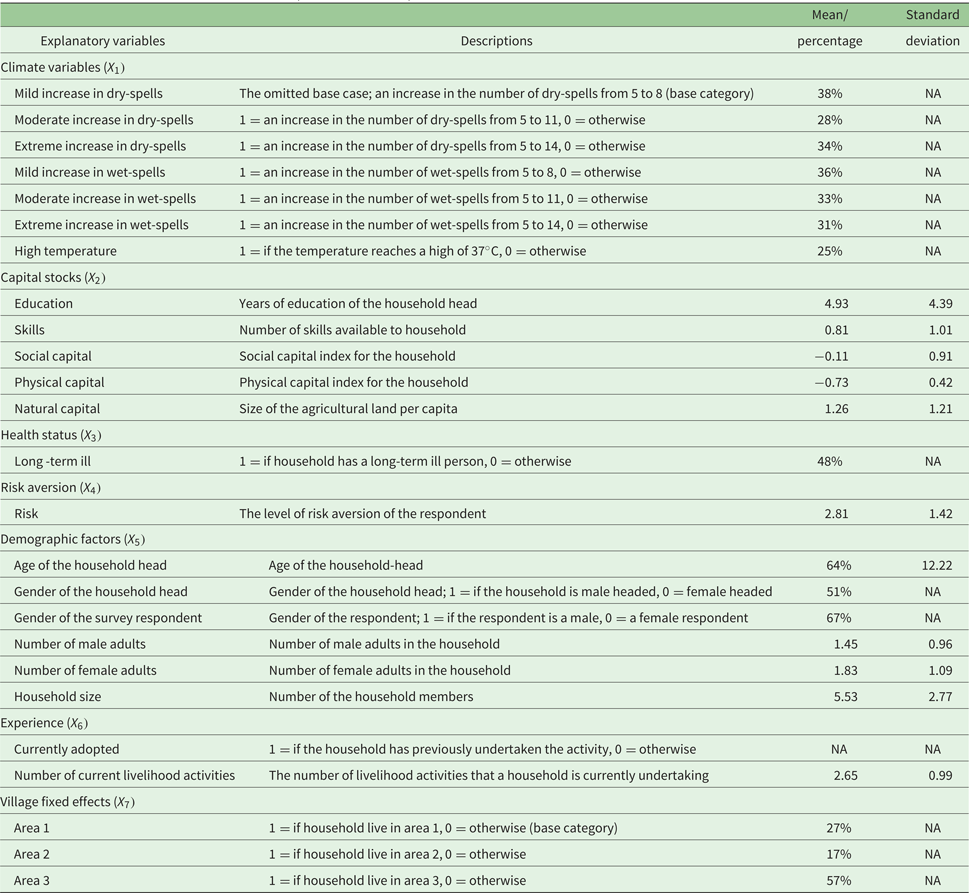
Table 3 summarizes the variables used in our empirical models. The data on climate change scenarios shows the percentage of respondents who answered a specific climate change scenario. For example, 38 per cent of respondents answered the CB question related to a mild increase in dry-spell scenario. The average years of education of the household heads is about four years. About 47 per cent of households have a long-term ill person. On average, households' risk averseness is about 3, which is considered as strongly risk averse in this study. About half of the households are male-headed and about 67 per cent of respondents are men.
Variable definitions and household statistics (n = 151 households)

Notes: Sample size is the number of households interviewed during the first period when household specific information was collected. Gender of the survey respondent has n = 162, as some households had multiple respondents.
4. Results and discussion
4.1 Factors affecting adoption of specific livelihood activities
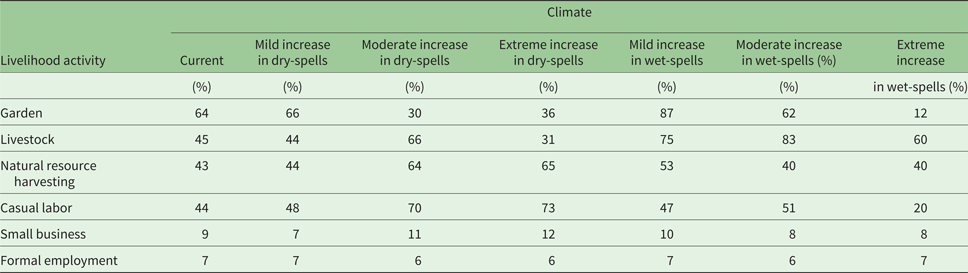
Table 4 shows the percentage of responses indicating current livelihood activities and intentions to undertake future livelihood activities under proposed climate change scenarios.Footnote 12 Households seem to be likely to move out of on-farm activities in response to an increase in dry-spells. For example, the percentage of households that adopt gardening under an extreme increase in dry-spells scenario is about 43 per cent less than the percentage of households that undertake gardening currently. On the other hand, households are more likely to move into off-farm activities in response to an increase in dry-spells. Specifically, the percentage of households that adopt casual labor under an extreme increase in dry-spells scenario is about 65 per cent higher relative to the percentage of households that undertake casual labor currently. Households respond to an increase in wet-spells in the opposite direction. For example, relative to the current climatic conditions, the percentage of households that adopt gardening is about 36 per cent higher while the percentage of households that adopt casual labor is only about 6 per cent higher under a mild increase in wet-spells scenario.
Percentage of responses indicating current livelihood activities and intentions to undertake livelihood activities under different future climatic conditions (n = 324 responses)

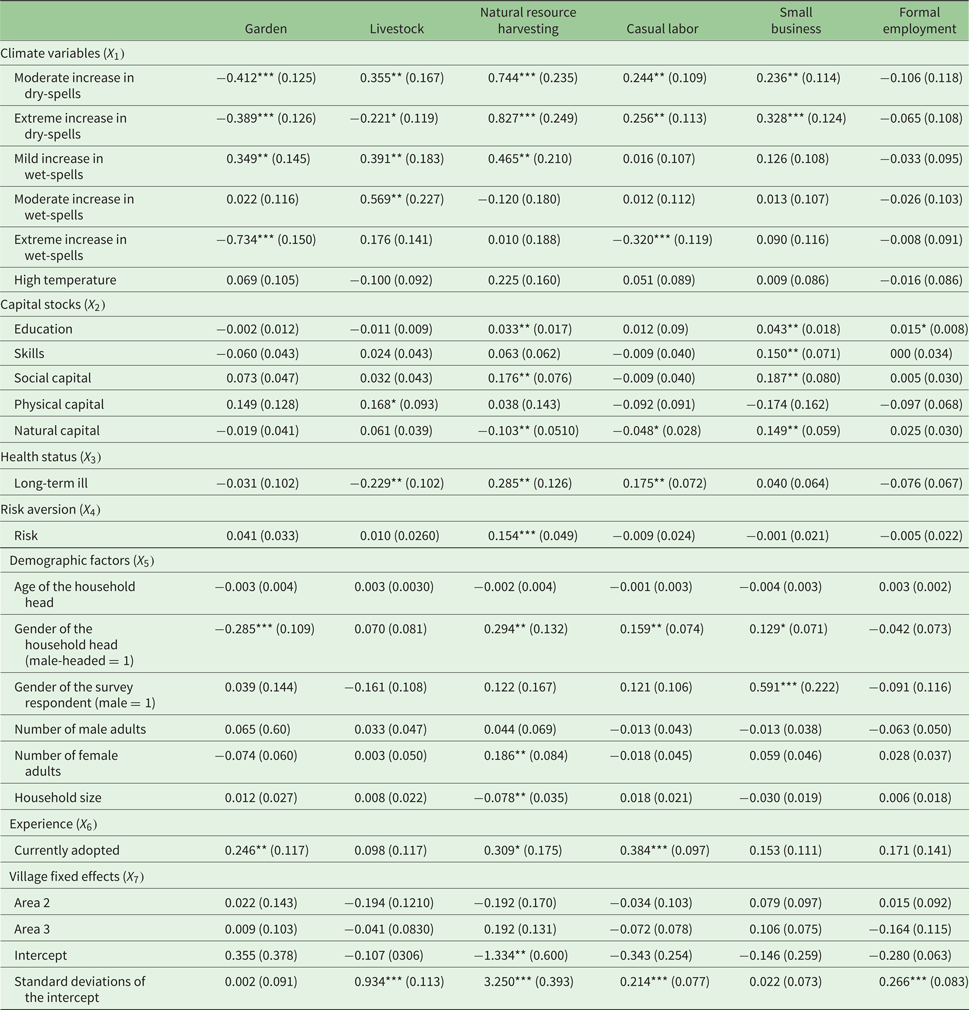
Table 5 reports the marginal effects of the factors affecting probabilities of undertaking livelihood activities estimated using random parameter probit models. Results indicate that the effect of climate variables depends on the specific livelihood activity being undertaken. The two activities expected to be most directly dependent on climate variables were gardens and livestock. For gardens, rainfall is clearly an important factor, as moderate and extreme increases in dry-spells decrease the probability of undertaking this activity by greater than 39 per cent. Conversely, a mild increase in wet-spells increases the probability of gardening by 34 per cent. But if wet-spells increase too much (i.e., are extreme), the impact is a 73 per cent decreased probability of undertaking gardening. For livestock, a moderate increase in dry-spells causes a 35 per cent increase in the probability of this activity. This result may imply that households may shift from gardens to livestock in response to changing climates; similar finding have been reported in other studies (e.g., Seo and Mendelsohn, Reference Seo and Mendelsohn2008). But such substitutability seems to have its limits, as an extreme increase in dry-spells decreases the probability of undertaking livestock. Mild and moderate increases in wet-spells also increase the probability of raising livestock by 39 per cent or greater, while extreme increases are not significant.Footnote 13
Marginal effects of factors affecting undertaking future livelihood activities (random parameter models, n = 24 responses)

Notes: Estimated coefficients for these variables are contained in appendix D of the online appendix. As a sensitivity check, we estimated a model with only the climate variables and the results remained robust with the results given in table 5. *** Significant at the 1% level, ** significant at the 5% level, * significant at the 10% level.
The remaining off-farm livelihood activities were thought to be more indirectly affected by climate change, but could nonetheless be influenced as households substitute among livelihood activities. The results generally support this expectation with the exception of formal employment, where there are no significant effects. For this activity, it appears that such jobs are so rare, as to not be viable substitutes for other current activities. But other activities suggest substitute possibilities. For example, results show that moderate and extreme increases in dry-spells increase the probability of natural resource harvesting, casual labor and small business by 24 to 82 per cent, perhaps as a substitute for decreased gardening and for livestock at extreme dry-spell levels. In contrast, mild and moderate increases in wet-spells are not shown to be significant, suggesting that better returns to gardening and livestock are not sufficient to dissuade off-farm activities. For extreme increases in wet-spells, the probability of undertaking casual labor decreases by 32 per cent. We do not find statistically significant effects of temperature increase during the dry-spells on any livelihood activity.
Education and social capital have positive effects on undertaking natural resources harvesting and small business. In addition, the number of skills that a household possesses positively impacts adoption of small business. In general, these results reflect the importance of human and social capital in the livelihoods of rural households. We find a statistically significant effect of physical capital on the adoption of livestock, while the other measures of capital stock variables do not have significant effects in adopting on-farm activities. Natural capital, measured by the size of agricultural land, has negative effects on the probability of undertaking natural resource harvesting and casual labor. A possible reason is that when a household has a relatively larger land area, it may tend to adopt on-farm activities such as gardening and livestock, and thereby may be less likely to adopt off-farm activities. In contrast, natural capital positively impacts the adoption of small business, suggesting that agricultural lands may be important in starting small business ventures. The lack of significance of some capital stock variables on the adoption of other livelihood activities may result from insufficient variability of these measures in the sample.
The presence of a long-term ill person in a household decreases the probability of raising livestock by 22 per cent, but increases the probability of undertaking natural resource harvesting and casual labor by 28 and 17 per cent respectively. The decrease in the probability of raising livestock may be a reflection of increased capital and labor constraints that households with a long-term ill person may face. An increase in the probability of adoption of natural resource harvesting may suggest that natural resources could play a ‘safety net’ function in rural livelihoods in crisis situations (Shackleton and Shackleton, Reference Shackleton and Shackleton2004). The increase in the probability of participating in the casual labor market suggests that people in HIV/AIDS affected households may tend to work off-farm to earn money to meet the needs of the sick person and the household (Munthali and Ali, Reference Munthali and Ali2000).
Our results also show that the higher the risk aversion of the survey respondent, the greater will be the probability to undertake natural resource harvesting (i.e., a 15 per cent increase in probability for a change in risk aversion category).Footnote 14 This result suggests that natural resource harvesting is associated with a low degree of risk, and may help to increase the food security among households with risk averse individuals.
Considering household demographics, our results show that respondents who live in male-headed households are less likely to adopt gardening, but more likely to adopt natural resource harvesting, casual labor and small business, than those who live in female-headed households. However, male respondents are more likely to adopt small business than female respondents. The number of female adults positively affects the probability of adoption of natural resource harvesting, although household size has a negative effect on the probability of adoption of the same activity. A household's previous exposure to an activity has positive effects on the probabilities of undertaking gardening, natural resource harvesting, and casual labor. As shown in table 5 (bottom row), the standard deviations of the random intercepts are statistically significant in five of the six equations estimated. This result confirms the presence of household specific unobserved heterogeneity (due to the attributes such as entrepreneurial ability) that may directly affect the adoption decisions.
4.2 Factors affecting the number of livelihood activities adopted
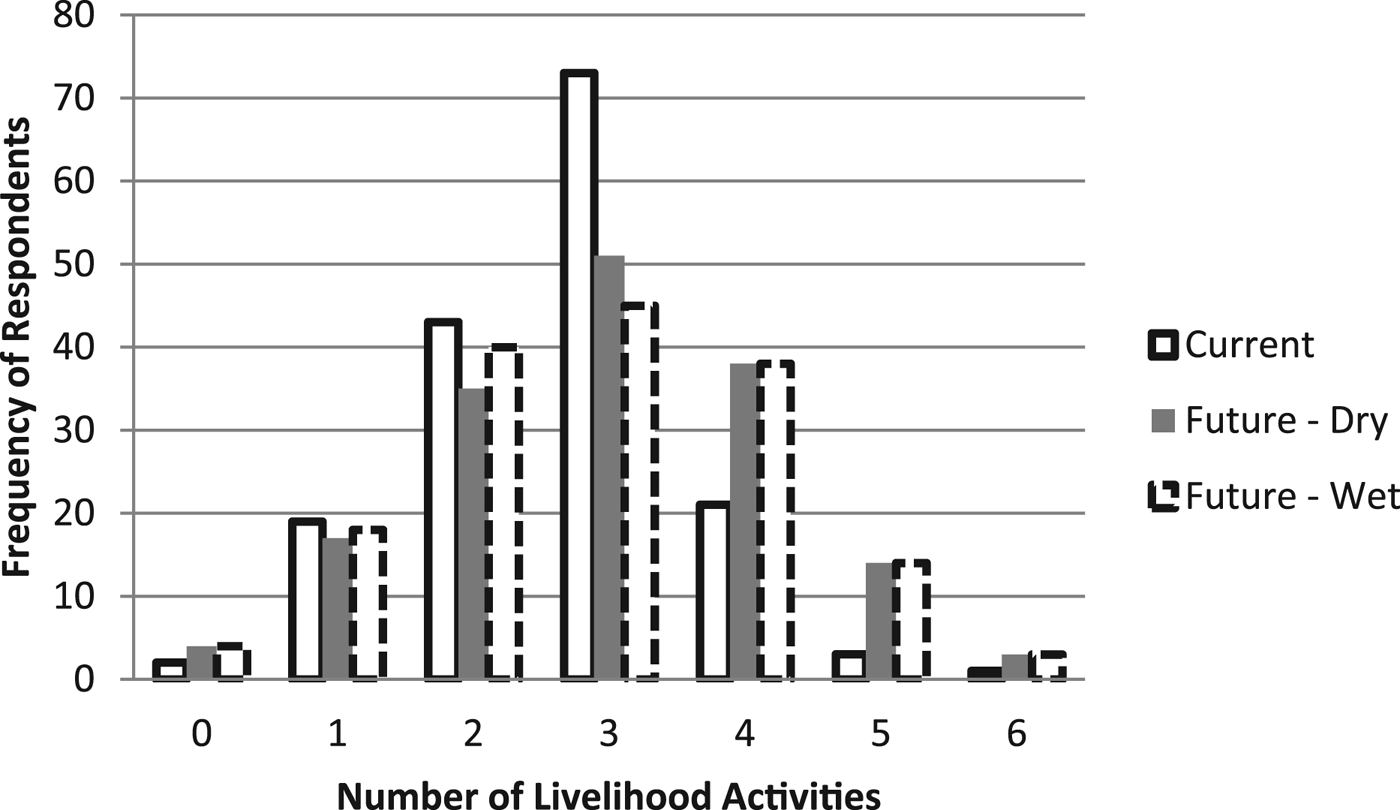
Figure 1 shows the frequencies of the total number of livelihood activities undertaken under current, future dry, and future wet climatic conditions. The future dry and future wet columns represent sums of the livelihood activities that are undertaken in response to all the dry-spell scenarios and wet-spell scenarios, respectively. The highest frequencies of responses tend to be associated with three activities: 73 responses at current climatic conditions, 51 responses under dry future climate, and 45 responses under wet future climate. When 3 or fewer activities are undertaken, there are no pronounced differences between the number of responses in the current situation and numbers in future wet and dry scenarios. However, for situations where 4 or more activities are undertaken, the responses are higher for the future scenarios than for the current situation. For example, 38 respondents choose four livelihood activities under dry future and wet future climatic conditions, while only 21 respondents adopt four livelihood activities under current climate. These results suggest that households expect to diversify their income portfolios in order to ameliorate risks associated with climate change.
Frequency of respondents adopting varying numbers of livelihood activities currently and under future climatic conditions (n = 162 respondents).

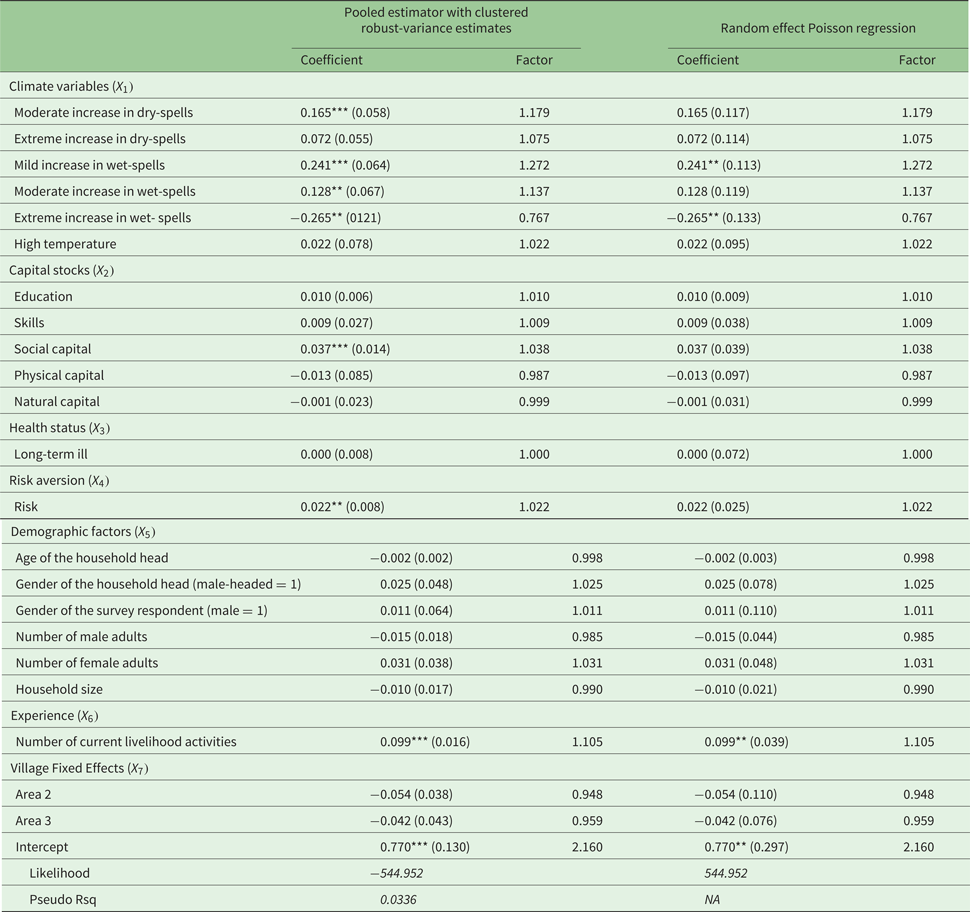
Table 6 shows estimates of pooled and random effect Poisson models. The Wald test results confirm that covariates used are jointly significant in both models. In addition to the coefficients, we also report the factor values [exp (β)] for each covariate. Most of the estimated coefficients are significant with the expected signs and consistent between the two models. The likelihood-ratio test of α = 0, which compares the panel estimator with the pooled estimator shows that the null hypothesis cannot be rejected at the 5 per cent level. Therefore, below we discuss the results from the pooled model with clustered robust-variance estimates at the village level.
Count model estimates of factors affecting the number of future livelihood activities chosen (n = 324 responses)

Notes: *** Significant at the 1% level, ** significant at the 5% level.
A moderate increase in dry-spells increases the expected number of livelihood activities by about 16 per cent or (by a factor of 1.179) relative to the base category. Likewise, mild and moderate increases in wet-spells increase the expected number of livelihood activities by about 24 and 12 per cent respectively. Taken together, these results imply that households are likely to diversity their livelihood portfolios under contrasting changes in climatic conditions. However, extreme increase in wet-spells decreases the expected number of livelihood activities by about 26 per cent relative to the base category, suggesting that households may not be able to undertake on-farm as well as off-farm activities in such climatic conditions. These results are consistent with the results from the random parameter probit models.
The results show social capital has positive effects on the expected number of livelihood activities chosen. Moreover, a unit increase in a respondent's risk aversion increases the expected number of livelihood activities adopted by a factor of one. In addition, the number of livelihood activities currently undertaken by households has a positive impact on the number of expected livelihood activities chosen for the future.
5. Limitations of the study
One concern is whether preferences regarding unfamiliar or complex goods or attributes are well-formed and consistent (Groom et al., Reference Groom, Kontoleon, Swanson and Zerbe2007). We designed the CB survey questions to minimize this problem. We do not econometrically address the possible endogeneity stemming for omitted variables. As shown by Card (Reference Card2001), solutions to endogeneity problems, such as instrumental variable estimation, cannot be used when the effects of the covariates are heterogeneous as is the case in this paper. Under such circumstances, the conceptual foundation of a random parameter model and an instrumental variable model are at odds with each other. This result occurs because when the effects of covariates are heterogeneous, the instruments are likely to be correlated with unobserved individual effects. Therefore, even if the instruments satisfy the conditions for the validity (i.e., instruments are correlated with the endogenous variables and uncorrelated with the un-observables in the outcome equation), they fail to identify causal effects.
6. Conclusions
Despite the increasing importance of understanding household adaptation to climate change, measuring such behavior has proven difficult, as past approaches have faced a number of challenges, including data availability, collinearity and endogeneity. In this paper, we investigate households' decisions regarding livelihood activities in response to future climate change using the CB method; an approach which, to our knowledge, has not been used in this context. Though our approach does suffer from problems associated with hypothetical behavior, it allows us to overcome a number of issues faced by previous models. We use a unique dataset that was collected in South Africa in 2011 that includes measures of risk aversion and several types of capital stocks. Using random parameter models, we econometrically account for unobserved heterogeneity of the households.
Our study suggests a number of features about adaptation that could help align development policy with local efforts. First, results show that households generally respond to an increase in the number of dry-spells by increasing the probability of undertaking off-farm activities (i.e., natural resource harvesting, casual labor, and small business). The results for adaptation to increased wet-spells are markedly different. In contrast to the dry-spell results, if local people are adapting to mild or moderate increases in wet-spells, then people are more likely to pursue on-farm activities such as gardens and livestock. But adaptation is different, yet again, if wet-spells become severe. In this case, there is a decreased probability that households will pursue gardens and casual labor. Further, the results show that households tend to diversify their livelihood portfolios in response to a moderate increase in dry-spells and a mild increase in wet-spells.
Accordingly, policies to facilitate adaptation based on these local tendencies will depend on the specific nature of climate change. If the future climate is dry, policies to support casual labor and small business opportunities would be important. If the future climate is wet, policies to promote gardening and livestock could be helpful. Natural resources (mainly forests) may function as a safety net for households under dry climatic conditions. Therefore, sustainable management of natural resources may help households in responding to future climate change. Further, our study suggests that specific capital stocks are important for facilitating specific livelihood activities.
We also find that the adaptive behavior of households dealing with long-term illness (such as HIV/AIDS) is significantly different than that of other households. Specifically, such households are more likely to not raise livestock (perhaps because livestock has been sold to pay bills) and increase casual labor. The attraction of undertaking natural resource harvesting is augmented if households are risk averse. There are a number of other household specific reasons that influence probabilities of different adaptations towards livelihood activities, with gender of the household head and previous experience with a livelihood activity playing key roles. But despite our numerous controls for such observed household characteristics, we find substantial evidence of unobserved heterogeneity among households. Five of the six models of livelihood activities, those involved with cash payments as opposed to subsistence products, have standard deviations of the intercept significant at the 1 per cent level. These results suggest that there are one or more unobserved attributes of households that influence cash-based livelihood activities. Overall, the results support the importance of using econometric approaches that address concerns of unobserved heterogeneity.
In short, the contingent behavior approach appears to be a promising alternative for avoiding previous methodological problems while generating policy relevant results. Along these lines we find a number of general trends in adaptive behavior that could inform the development of policy, so that local proclivities towards adaptive behavior are facilitated. But these local behaviors contain substantial heterogeneity, some of which may be specifically identified and controlled for in modeling, and some of which remains unobserved. This conclusion suggests that we are likely only going to be confident in the observed portions of adaptive behavior, if we explicitly acknowledge, and model, the presence of unobservables.
Supplementary material
The supplementary material for this article can be found at https://doi.org/10.1017/S1355770X17000328
Acknowledgements
Financial support from the International Development Research Centre (IDRC) for the field surveys is gratefully acknowledged. The authors thank the entire team in the IDRC South Africa project for their various contributions to this paper.