The distinction between community-acquired and truly hospital-acquired infections is important for adequate patient management, to guide infection control activities, and to estimate the economic burden for healthcare facilities. The trend toward “pay for performance”Reference Enthoven 1 – Reference Wenzel 4 may result in lower reimbursements of healthcare-acquired infections (HAIs), particularly in countries where financial reimbursement is based on the prospective diagnosis-related group (DRG) system. With a DRG system, the amount paid to a hospital for a patient is determined in advance and depends only on the diagnosis and major procedures reported at dischargeReference Rosenthal 3 and does not cover additional expenses caused by, for example, HAIs.
The widely accepted US Centers for Disease Control and Prevention (CDC) guidelines defines an HAI, also called nosocomial infection, as an infectious event that is diagnosed >48 hours after hospital admission, or more recently, on or after the third hospital day without evidence that the pathogen was present or incubating on the day of admission.Reference Garner, Jarvis, Emori, Horan and Hughes 5 – Reference Horan, Andrus and Dudeck 7 This definition might overestimate the proportion of infections that are really acquired in the healthcare institution. Due to delayed sampling, lack of universal screening on admission, and variation of incubation periods of infections, some community-acquired infections are not identified within 48 hours after admission and are therefore classified as HAIs although, in fact, they were not acquired in the institution. However, only infections transmitted within the hospital are preventable and present reasonable targets for an infection control program, unlike community-acquired cases or already colonized patients transferred from other institutions for whom diagnosis was delayed >48 hours after admission. The emergence of multidrug-resistant organisms (MDROs) renders this distinction even more important to assess the impact of infection control interventions. For example, MDROs colonizing the gastrointestinal tract (as part of the endogenous flora) of an admitted patient might be below the level of detection unless it is triggered by selective antibiotic pressure. Such a case is not hospital-acquired even if it is detected >48 hours after admission.
The truly preventable proportion of HAIs defined by the CDC is unknown and difficult to assess, but HAIs or colonization with MDROs can provide a good estimate, as has been shown with methicillin-resistant Staphylococcus aureus (MRSA). 10 , Reference Pfaller, Hollis and Sader 11 To estimate the proportion of preventable and non-preventable HAIs among all HAIs according to the CDC definition, we analyzed hospitalized patients with infections or colonization due to MDROs (HAMICs) to determine whether their acquisition occurred in the hospital. In addition to the criteria outlined by the CDC, we utilized a supplementary work-up including clinical, epidemiological, and microbiological data, as well as molecular typing of strains.Reference Fluckiger and Widmer 8 , Reference Widmer and Frei 9 We hypothesized that some cases were considered as HAIs even though patients were already colonized or infected on admission and therefore were not preventable.
METHODS
The study was performed at the University Hospital Basel, an 800-bed tertiary care center in Basel, Switzerland, between 2002 and 2011. All patients with an HAI or colonization due to MDROs according to the CDC definition (CDC-HAMICs) were included in the study and were prospectively assessed using additional epidemiological, microbiological, and molecular typing data.
In our study, we included MDROs that consisted of MRSA, vancomycin-resistant enterococci (VRE) of Van A or Van B type, Gram-negative bacteria expressing extended-spectrum β-lactamase (ESBL), and multidrug-resistant Gram-negative bacteria other than ESBL (non-ESBL MDR) as defined by the CDC. 10 Non-ESBL MDROs included non-carbapenemase-producing pathogens, defined as resistance to all antibiotics in 3 of the following antibiotic classes: (1) β-lactams, including piperacillin/tazobactam or cefepime, (2) aminoglycosides, (3) fluoroquinolones and (4) carbapenems, Stenotrophomonas maltophilia resistant to cotrimoxazole, and other Gram-negative bacteria producing carbapenemases (including metallo-β-lactamase [MBL] or Klebsiella pneumoniae carbapenemase [KPC]).
All patients with an epidemiological link to the index patient (ie, all current or former roommates with a contact time of ≥6 hours or patients with the same medical procedure (eg, endoscopy in the same time period) were screened for corresponding MDRO at the time when MDRO was detected in the index patient. Screening sites of contact patients for MRSA were nose, throat, wounds, as well as catheter and drainage insertion sites. For ESBL and non-ESBL MDR, screening was done by rectal and inguinal swab, from throat, wounds, catheter and drainage insertion sites, urine in case of a permanent urinary catheter, and vagina in pregnant patients. VREs were screened by rectal swab.
All MDROs underwent complete antimicrobial susceptibility testing and molecular typing by pulsed-field gel electrophoresis (PFGE) and additional spa-typing for MRSA as previously published.Reference Pfaller, Hollis and Sader 11 – Reference Lambert, Silversmit and Savey 13
Cases of infection or colonization due to MDROs, whose acquisition could be verified to have occurred in the hospital by our extensive additional work-up, were considered as a preventable healthcare-acquired infection or colonization (p-HAMIC) because they could be targeted by infection control measures. P-HAMIC was defined as a case with a documented exposure and epidemiological link to an index patient, phenotypically identical species with identical antimicrobial susceptibility profile, as well as identical molecular typing results.Reference Fluckiger and Widmer 8 , Reference Widmer and Frei 9 , Reference Fenner, Widmer, Dangel and Frei 14 , Reference Mertz, Frei and Periat 15
If the patient had no identified exposure to a patient colonized or infected with the same organism (no index case) or there was no identical strain by molecular typing, the CDC-HAMIC case was classified as non-preventable (non-p-HAMIC) because there was no evidence of nosocomial transmission.
Data including PFGE and spa-typing for MRSA from these patients were available for the study because this approach was part of the quality assurance program of the hospital. Infection control staff routinely visits all patients with colonization or infection with MDROs 3 times per week, collects demographic data on a case report form, follows patients after discharge to determine whether they were decolonized or transferred to another institution, and initiates screening of contact patients in the hospital.Reference Buehlmann, Frei, Fenner, Dangel, Fluckiger and Widmer 16 , Reference Buehlmann, Bruderer, Frei and Widmer 17 All data are recorded in a standardized database, supplemented with data from the electronic charts, and checked annually for consistency.
Basic infection control standards consisted of (1) regular promotion, training and monitoring of proper use of hand hygiene according to World Health Organization (WHO) and CDC guidelinesReference Siegel, Rhinehart, Jackson and Chiarello 18 , Reference Pittet, Allegranzi, Storr and Donaldson 19 including alcohol-based hand disinfection and (2) stringent environmental cleaning processes with daily hospital cleaning with detergents as well as disinfection of high-risk wards such as the emergency room; operating theatre; transplantation, hematology, or intensive care units; and contact isolation rooms.
Univariate analysis of baseline characteristics was performed with SPSS Statistics for Windows, version 21.0 (IBM, Armonk, NY) as appropriate for parametric and non-parametric values. P values<.05 were considered significant.
The study was approved by the local ethics committee as part of the quality assurance program.
RESULTS
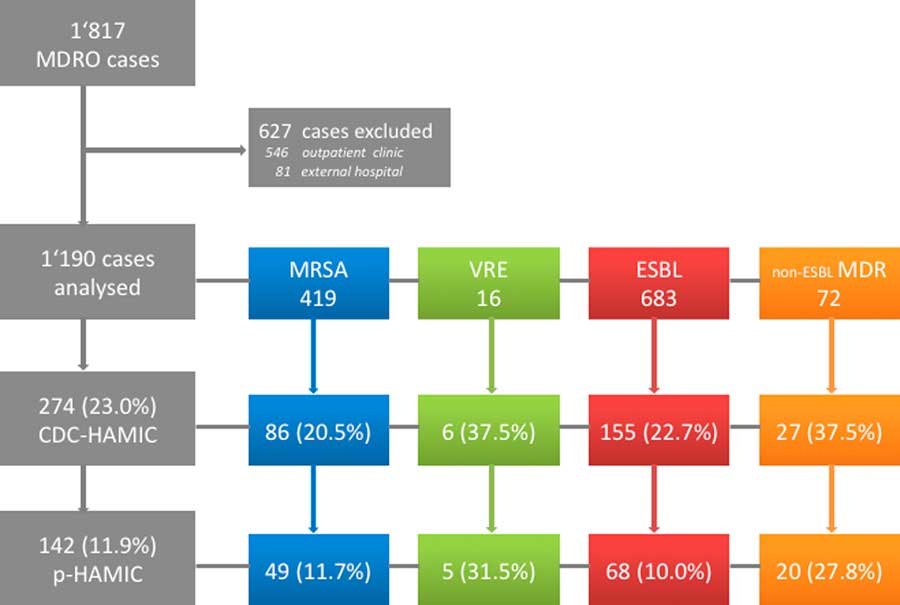
During the study period, 283,840 patients were hospitalized. Among them, 1,817 MDROs cases were recorded, including MRSA, VRE, ESBL, and non-ESBL MDR. In total, 627 cases were excluded because their microbiological results came from external hospitals or laboratories (n=546) or outpatient clinics (n=81). A total of 1,190 patients were fully analyzable. All patients with MDROs were put on contact isolation within 12 hours of receiving the microbiological result. ESBL and MRSA comprised the main portion of all MDROs (84.2%). Specifically, 419 patients had MRSA, 16 had VRE, 683 had ESBL, and 72 had non-ESBL MDROs (Figure 1).
Study overview. CDC-HAMIC, Centers for Disease Control and Prevention definition of cases with healthcare-acquired infections and colonization; p-HAMIC, preventable cases of healthcare-acquired infections and colonization; MDRO, multidrug-resistant organism; MRSA, methicillin-resistant S. aureus; VRE, vancomycin-resistant enterococci Van A or Van B; ESBL, extended-spectrum β-lactamase producing Gram-negative bacteria; non-ESBL MDR, multidrug-resistant Gram-negative bacteria other than ESBL. Percentage in brackets represents the proportion of p-HAMICs and CDC-HAMICs among all analyzed cases.

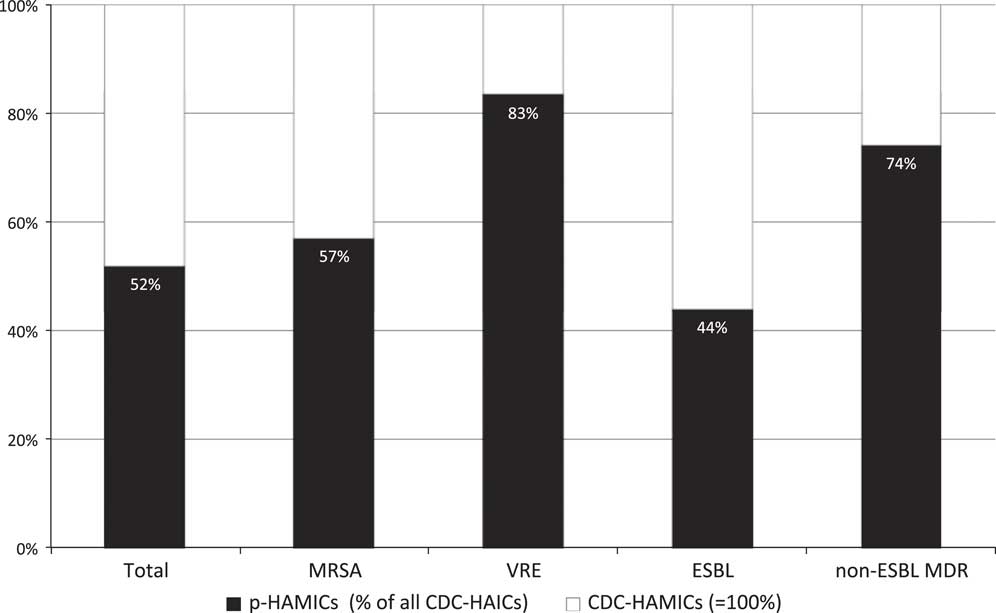
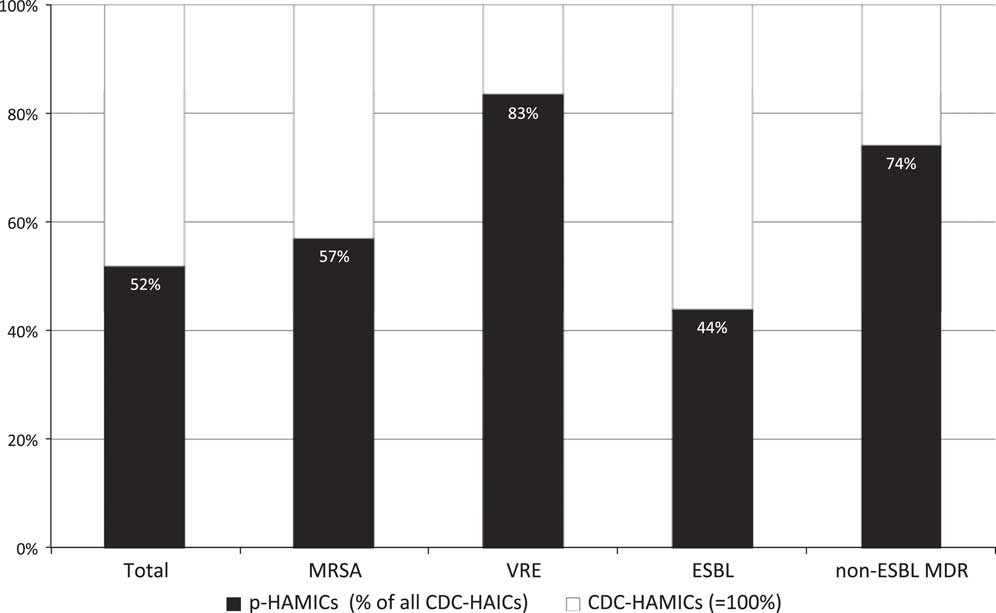
Among the 1,190 patients, 916 (77.0%) had MDROs that were clearly not healthcare-acquired because they had colonization or infection with MDROs known or detected in the first 48 hours after hospital admission.Reference Garner, Jarvis, Emori, Horan and Hughes 5 , 6 A total of 274 cases (23.0%) were classified as CDC-HAMIC. Among them, 142 cases (11.9% of all included patients) showed evidence of nosocomial transmission according to our additional work-up and fulfilled the criteria for p-HAMIC. The remaining 132 cases included no evidence of nosocomial transmission and were reclassified as non–p-HAMIC. For MRSA, 86 (20.5%) cases were CDC-HAMIC and 49 (11.7%) were p-HAMIC; for VRE, 6 cases (37.5%) were CDC-HAMIC and 5 (31.5%) were p-HAMIC; for ESBL, 155 cases (22.7%) were CDC-HAMIC and 68 (10.0%) were p-HAMIC; and for non-ESBL MDROs, 27 cases (37.5%) were CDC-HAMIC and 20 (27.8%) were p-HAMIC (Figure 1). On average, preventable HAMICs comprised only 51.8% of all CDC-HAMICs. Specifically, 57% of MRSA cases, 83.3% of VRE cases, 43.9% of ESBL cases, and 74.1% non-ESBL MDRO cases were determined to have been preventable HAMICs in our study (Figure 2).
Proportion of preventable p-HAMICs among CDC-HAMICs. CDC-HAMIC, Centers for Disease Control and Prevention definition of cases with healthcare-acquired infections and colonization; p-HAMIC, preventable cases of healthcare-acquired infections and colonization; MRSA, methicillin-resistant S. aureus; VRE, vancomycin-resistant enterococci Van A or Van B; ESBL, extended-spectrum β-lactamase producing Gram-negative bacteria; non-ESBL MDR, multidrug-resistant Gram-negative bacteria other than ESBL.
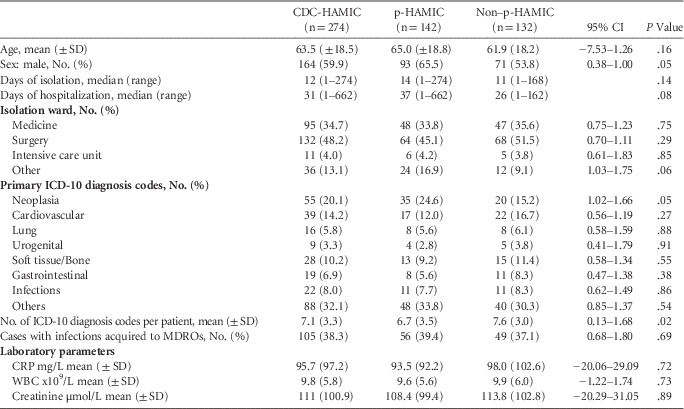
Age, sex, duration of contact isolation and hospitalization, underlying diseases, and laboratory parameters did not significantly differ between p-HAMICs and the reclassified non–p-HAMICs, except for a marginally higher number of International Classificatin of Diseases, 10 th edition (ICD-10)–coded diagnoses in the non–p-HAMIC group (Table 1).
Baseline Characteristics of Patients With CDC-HAMIC, p-HAMIC, and Non–p-HAMIC

NOTE. CDC-HAMIC, Centers for Disease Control and Prevention definition of cases with healthcare-acquired infections and colonization; p-HAMIC, preventable cases of healthcare-acquired infections and colonization; non-p-HAMIC, non-preventable cases of healthcare-acquired infections and colonization; SD, standard deviation; CI, confidence interval; ICD, International Classification of Diseases; CRP, C-reactive protein; WBC, white blood cell count.
DISCUSSION
In our study, only half of the cases of healthcare-acquired infection or colonization with MDROs according to CDC definition included conclusive evidence of its acquisition in the hospital and thus were potential targets for infection control interventions. These estimates were particularly evident with MRSA and ESBL and to a lesser extent also with non-ESBL MDRs. In contrast, VRE demonstrated a higher degree of correlation between CDC and our classification of preventable-HAMIC; thus, we concluded that VRE cases detected after 48 hours of hospital admission were most commonly acquired in the hospital.
The focus on multidrug-resistant pathogens in this study allowed a clear discrimination between in-hospital acquired p-HAMIC and CDC-HAMIC; this distinction is difficult to assess in common HAIs among patients not requiring contact isolation. However, the tremendous effort necessary to prospectively evaluate patients with MDROs detected >2 days after admission is beyond the resources available in routine clinical practice. In addition, such studies are only reasonable in areas with very low prevalence of MDROs, where a clear epidemiological link coupled with similar molecular patterns provides a very strong evidence of cross transmission in the hospital. Such estimates of cross transmission by pathogens are nearly impossible for infections with non-MDROs.
Efforts to control HAIs are required by many authorities; even a zero-risk goal has been set.Reference Pronovost, Needham and Berenholtz 20 HAIs have, in addition to the increase of patient’s morbidity and mortality, a dramatic impact on the economic burden of healthcare systems.Reference Kmietowicz 21 , Reference Orsi, Di Stefano and Noah 22 It is therefore important to emphasize the difference between infections truly acquired in the hospital, which are potentially preventable, and infections detected in the hospital. The extent to which HAIs are avoidable under real-life hospital conditions and what represents the irreducible minimum remain unclear.Reference Harbarth, Sax and Gastmeier 23 The SENIC study suggested that approximately 30% of nosocomial infections according to CDC definition could be prevented by an effective infection control program.Reference Haley, Morgan and Culver 24 According to our results, only 52% of CDC-HAMICs are actually acquired in the hospital; thus, the potential to reduce HAIs might be far less than previously estimated. This finding is particularly important to consider in countries working with a prospective DRG reimbursement system.Reference Rosenthal 3 , Reference Vegni, Panceri, Biffi, Banfi, Porretta and Privitera 25 Insurance companies are not necessarily obliged to pay a healthcare facility for treatment of HAIs or for additional infection control measures of patients colonized with nosocomially acquired MDROs, which can put a hospital in a precarious financial situation. To maximize a hospital’s cost-effectiveness, it is essential to minimize the number of HAIs and also to minimize the patient’s length and expenses of hospital stay. However, only transmission of MDROs within the hospital can be prevented by an infection control program.Reference Vegni, Panceri, Biffi, Banfi, Porretta and Privitera 25
Several limitations of the study should be mentioned. First, our MDRO results cannot be extrapolated one to one to other HAIs such as catheter-related bloodstream infections, pneumonia or surgical-site infections. The documentation of MDROs allows the determination of the preventable proportion of all CDC-HAMICs. However, the CDC definition for HAIs is designed for surveillance purposes rather than for detection of individual clinical cases. Second, the time-consuming process and expensive work-up for each cases, with prospective collection of epidemiological data, molecular subtyping of all strains, and even screening of contact patients when mode of transmission was uncertain, cannot be performed on a routine basis. However, these results provide a good estimate of the proportion of the true hospital-acquired and preventable infections and colonization caused by MDROs among the cases that meet the CDC surveillance definition. Third, we also included cases without infection because the DRG system in Switzerland reimburses for MDROs, independent if infected or only colonized. Fourth, using PFGE to determine whether nosocomial transmission has occurred may underestimate the true burden of HAMICs due to unnoticed colonization of epidemiologically linked patients. However, all contact patients were routinely screened, limiting the number of unrecognized cases. Fifth, microbiological screening to detect environmental contamination, as source of nosocomial transmission, was not routinely conducted. Finally, the results have been generated in one institution, and the ratio between preventable and unpreventable HAMICs, may vary between institutions.
In conclusion, only approximately half of the patients with infection or colonization with MDROs classified as HAMIC by the CDC definition are truly acquired in the hospital and are finally preventable by an infection control program. Relying only on the CDC-definition of HAIs may lead to inaccurate measure of the impact of infection control interventions. In addition, our estimates may also be of interest in countries using a DRG system where the additional costs for treatment of HAIs are not fully reimbursed by insurance payers to healthcare facilities.
ACKNOWLEDGMENTS
Financial support. This study was supported by University Hospital Basel, Basel, Switzerland.
Potential conflicts of interest. All authors report no conflicts of interest relevant to this article.