


Introduction
Internet-delivered Cognitive Behavioural Therapy (ICBT) is a promising method of improving access to cognitive behavioural therapy (CBT) for a variety of mental health conditions (Andersson and Titov, Reference Andersson and Titov2014). In ICBT, structured therapeutic content, divided into weekly lessons, is delivered over the Internet and participants work on offline tasks to facilitate learning. ICBT can be therapist-assisted (also referred to as therapist-guided) through secure messaging or phone calls or it can be entirely self-directed. A recent systematic review by Hedman, Ljotsson, and Lindefors (Reference Hedman, Ljotsson and Lindefors2012) identified 108 ICBT randomized controlled trials and reported large within-group mean effect sizes for symptoms of depression and anxiety (mean d ranged from 0.94-1.94). Using criteria set out by the American Psychological Association, the authors concluded that ICBT for depression, panic disorder, and social phobia should be considered well-established.
Therapist-assistance in the ICBT literature is often described very generally as involving support, encouragement and answering patient questions (e.g. related to homework assignments, course materials). Several reviews of the literature have concluded that therapist-assistance is associated with improved adherence to and efficacy of ICBT (Baumeister, Reichler, Munzinger, and Lin, Reference Baumeister, Reichler, Munzinger and Lin2014; Johansson and Andersson, Reference Johansson and Andersson2012). Despite the frequent inclusion of therapist-assistance in ICBT, little is known about the specific content of therapist messages that are sent to patients. To address this gap in the literature, Paxling et al. (Reference Paxling, Lundgren, Norman, Almlov, Carlbring, Cuijpers and Andersson2013) conducted an important first study in this area that examined therapist behaviours (n = 3 student therapists) in e-mails sent to patients (n = 44) enrolled in an 8-week ICBT program for generalized anxiety disorder. Content analysis of the e-mails identified eight types of therapist behaviours (i.e. deadline flexibility, task reinforcement, alliance bolstering, task prompting, psychoeducation, self-disclosure, self-efficacy shaping, and empathetic utterances). Task reinforcement was associated with greater change in worry at posttreatment, while deadline flexibility was associated with less change in worry. The study is important as it provides an initial framework for understanding therapist-assistance in ICBT.
Building on this study, the purpose of the current study was to examine the generalizability of Paxling et al. (Reference Paxling, Lundgren, Norman, Almlov, Carlbring, Cuijpers and Andersson2013) framework when using ICBT to treat depressive symptoms and when a larger number of therapists, including both registered providers and student therapists, delivered the intervention. In the research literature, there is an implicit assumption that therapist-assistance among ICBT programs is comparable, given that the effects of studies are often synthesized in review papers. The current study offers insight into this assumption and seeks to determine if this framework is applicable to other ICBT programs. If the framework is applicable, it may be useful for advancing research on the role of therapist-assistance in ICBT and also for training purposes. The specific research questions in the present study were as follows: 1) Will therapist behaviours identified by Paxling et al. (Reference Paxling, Lundgren, Norman, Almlov, Carlbring, Cuijpers and Andersson2013) be reliably identified in therapist e-mails to patients receiving ICBT for depressive symptoms? 2) Will any additional categories of therapist behaviours be identified and what will be the relative frequency of these behaviours compared to the original therapist behaviours identified by Paxling et al.? 3) Will the distribution of the original therapist behaviours be comparable to the distribution of therapist behaviours reported by Paxling et al.? and 4) Will therapist behaviours be correlated with improvements in depression and anxiety and therapeutic alliance assessed at midtreatment and posttreatment? We hypothesized that behaviours reported by Paxling et al. would be present in our dataset and that there would be significant associations between at least some of the therapist behaviours and symptom change scores.
Method
Participants
This study was approved by all research ethics boards of the institutions involved. Data were obtained from a previously published open dissemination trial investigating the effectiveness of therapist-assisted ICBT for depressive symptoms (ISRCTN48160673; Hadjistavropoulos et al., Reference Hadjistavropoulos, Pugh, Nugent, Hesser, Andersson and Ivanov2014). Given the interest in examining the relationship between variation in therapist behaviours and patient outcome, we only examined data from patients who completed all 12 modules, and thus had e-mails from their therapists and outcome data over the entire course of treatment. This resulted in analysis of data from 41 out of 83 patients from the trial.
Patients learned about ICBT from healthcare providers, media attention, or Internet-based advertisements. Patients were screened in a central unit and were then assigned to work with a registered provider (n = 12) or supervised graduate student therapist (n = 12) working in one of six clinical settings. Inclusion criteria were: (a) 18 years of age or older; (b) resident of Saskatchewan; (c) computer and Internet access; (d) consent for physician to be notified of participation; (e) stable psychotropic medications for at least a month; (f) not presently receiving other psychotherapy; (g) no problems with psychosis, bipolar disorder, substance-related disorders, or suicide plan or intent; and (h) a Patient Health Questionnaire-9 (PHQ-9; Kroenke, Spitzer and Williams, Reference Kroenke, Spitzer and Williams2001) score above 5, suggesting at least some depressive symptoms.
ICBT program
The ICBT program (Depression Online) was licensed from Swinburne University of Technology National eTherapy Centre in Australia (see Klein, Meyer, Austin and Kyrios, Reference Klein, Meyer, Austin and Kyrios2011 for a review). The program was delivered via secure website and consisted of 12 modules made up of text, graphics, audio, and video. The content of the modules was based on principles of CBT and provided patients with psychoeducation about depression as well as cognitive (e.g. thought identification, thought challenging) and behavioural (e.g. behavioural activation, graded exposure) skills to reduce depressive symptoms. At the beginning of each lesson, patients completed check-in questions and mood ratings; weekly homework assignments were assigned at the end of each module. Modules were released after: 1) a week had elapsed; and 2) patients completed and submitted check-in questions related to the previous module to their therapist. While the program could be completed in 12 weeks, most patients took more than one week per module. There was no cost to participating.
Therapist-assistance
Registered providers in this study consisted of registered psychologists (n = 3) or registered social workers (n = 9); graduate student therapists were either enrolled in a masters (n = 3) or doctoral (n = 9) program in clinical psychology. Prior to treating patients, all therapists attended a one-day workshop on ICBT (Hadjistavropoulos, Thompson, Klein and Austin, Reference Hadjistavropoulos, Thompson, Klein and Austin2012); additional supervision in ICBT was provided by the program director or co-ordinator. This supervision consisted of monitoring delivery of ICBT as well as review of the therapists’ messages. Each week, therapists were instructed to review patient progress on the ICBT program, including submitted homework and messages from patients. Therapists were instructed to e-mail their designated patients via the program website at least once per week. In these e-mails, they were specifically instructed to provide support, encourage patients to apply strategies, and answer questions related to program content. They could send additional e-mails or phone patients if they deemed this clinically beneficial (e.g. patient reported suicidal risk, patient not responding to messages, miscommunication).
Measures
Patient demographics (e.g. age, sex, marital status, education, employment) and clinical variables (e.g. medication taken for depression) were collected at the beginning of treatment. Program-related variables (e.g. number of times program was accessed; number of therapist e-mails received; number of phone calls from therapist) were obtained from the web application. Outcome was assessed using online questionnaires (see below) administered at three time points: pretreatment (after completion of the online consent form), midtreatment (after completion of module 6), and posttreatment (prior to completion of module 12).
PHQ-9
The PHQ-9 (Kroenke et al., Reference Kroenke, Spitzer and Williams2001) assessed nine symptoms of depression on a scale ranging from 0 (not at all) to 3 (nearly every day); responses were summed to produce a total score indicative of depression severity. The PHQ-9 has demonstrated good psychometric properties (Cameron, Crawford, Lawton, and Reid, Reference Cameron, Crawford, Lawton and Reid2008).
DASS-21
The 21-item Depression Anxiety Stress Scales (DASS-21; Lovibond and Lovibond, Reference Lovibond and Lovibond1995) assessed levels of depression, anxiety, and stress. Patients rated the severity of 21 negative emotional symptoms using a scale that ranged from 0 (did not apply to me at all) to 4 (applied to me very much, or most of the time). The DASS-21 has demonstrated good psychometric properties as a clinical outcome measure (Ng et al., Reference Ng, Trauer, Dodd, Callaly, Campbell and Berk2007).
GAD-7
The Generalized Anxiety Disorder 7-item measure (GAD-7; Spitzer, Kroenke, Williams and Lowe, Reference Spitzer, Kroenke, Williams and Lowe2006) assessed symptoms of anxiety. Patients rated the frequency of seven problems over the past 2 weeks using a scale that ranged from 0 (not at all) to 3 (nearly every day) and items were summed to obtain the GAD-7 score. The GAD-7 has demonstrated good psychometric properties (Kroenke, Spitzer, Williams, and Lowe, Reference Kroenke, Spitzer, Williams and Lowe2010).
Therapeutic alliance
The Therapeutic Alliance Questionnaire (TAQ) was administered at the midpoint of the program and before completion of the final module. The TAQ consists of 17 items adapted from the Helping Alliance Questionnaire-II, which is a measure of therapeutic alliance used in face-to-face therapy (Luborsky et al., Reference Luborsky, Barber, Siqueland, Johnson, Najavits, Frank and Daley1996). Patients rated a series of statements on a scale ranging from 1 (strongly disagree) to 6 (strongly agree); items were summed to create a total TAQ score. Patients were informed that the measure would only be used for research purposes and would not be given to therapists. The TAQ has previously been used to assess therapeutic alliance in ICBT (Kiropoulos et al., Reference Kiropoulos, Klein, Austin, Gilson, Pier, Mitchell and Ciechomski2008; Klein et al., Reference Klein, Austin, Pier, Kiropoulos, Shandley and Mitchell2009).
Qualitative analysis
Qualitative analysis was used to examine if we could reliably identify the therapist behaviours described by Paxling et al. (Reference Paxling, Lundgren, Norman, Almlov, Carlbring, Cuijpers and Andersson2013) and also whether additional behaviours were apparent in therapist e-mails to patients. To prepare the data for analysis, therapist e-mails were exported from the website hosting the e-mails and imported into NVivo Version 10, a qualitative data software tool. Consistent with Paxling et al., entire sentences were examined as a single unit of meaning rather than coding individual words in each sentence and e-mails that consisted of concurrent sentences of the same thematic code were conjoined into one unit in order to reduce the number of repetitious codes.
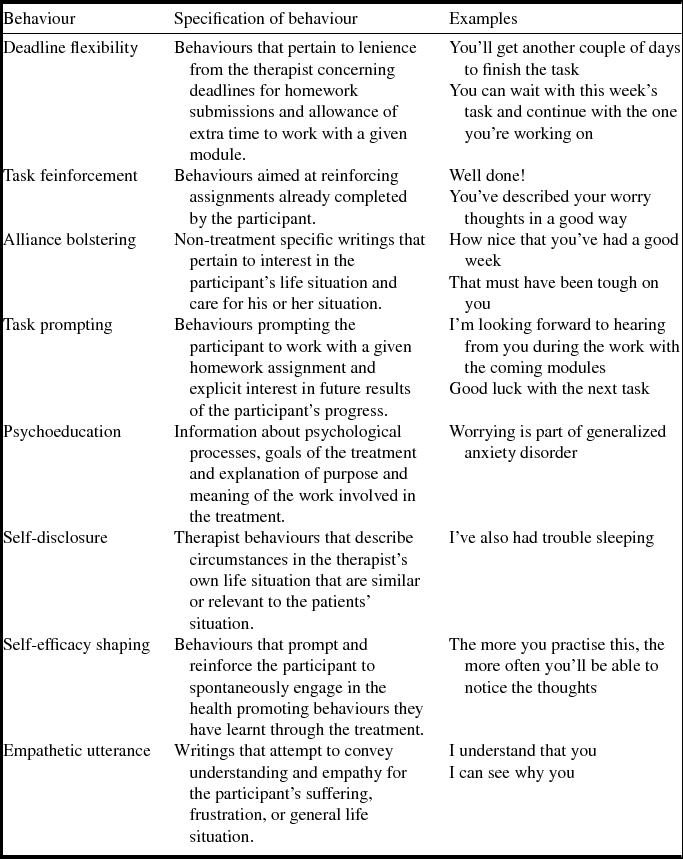
For this study, a directed approach to qualitative content analysis proposed by Hsieh and Shannon (Reference Hsieh and Shannon2005) guided the analysis which involved using both inductive and deductive principles (Elo and Kyngas, Reference Elo and Kyngas2008). Specifically, an initial coding guide (Table 1) was created based on pre-existing categories as defined by Paxling et al. (Reference Paxling, Lundgren, Norman, Almlov, Carlbring, Cuijpers and Andersson2013) and deductive principles were used to identify the presence of such categories in the dataset; inductive principles, however, were also used to create new categories of therapist behaviours as these emerged.
Therapist behaviours in Internet-delivered cognitive behaviour therapy originally identified by Paxling et al. (Reference Paxling, Lundgren, Norman, Almlov, Carlbring, Cuijpers and Andersson2013)

Note: Reprinted from “Therapist Behaviours in Internet-Delivered Cognitive Behaviour Therapy: analyses of e-mail correspondence in the treatment of generalized anxiety disorder,” by B. Paxling, S. Lundgren, A. Norman, J. Almlöv, P. Carlbring, P. Cuijpers and G. Andersson, Reference Paxling, Lundgren, Norman, Almlov, Carlbring, Cuijpers and Andersson2013, Behavioural and Cognitive Psychotherapy, 41, p. 285. Copyright 2013 by the Cambridge University Press.
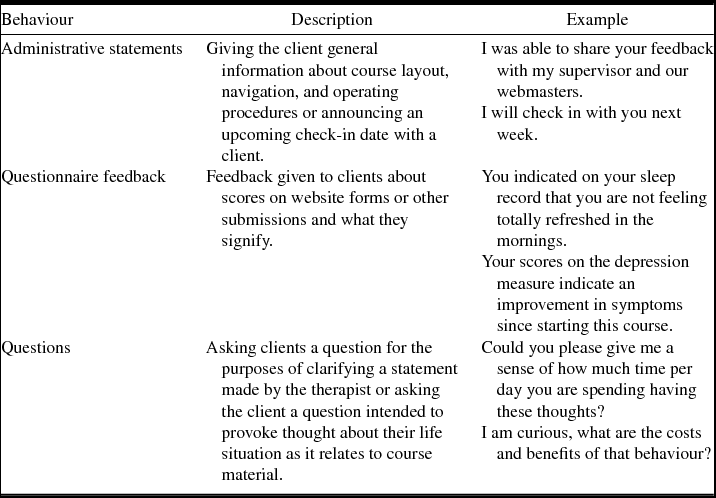
Prior to coding e-mails from the present study, a preliminary qualitative content analysis was conducted on a random set of e-mails (n = 50) from participants who received ICBT for depressive symptoms, but who did not complete the program. These data were not included in the main data set. This approach allowed the coders to iteratively create the coding scheme while preserving the main data set. Reviewing these e-mails, the two coders independently classified the content of therapist e-mails and identified new categories that were not captured by the codes of Paxling et al. (Reference Paxling, Lundgren, Norman, Almlov, Carlbring, Cuijpers and Andersson2013). These new codes were discussed and finalized following meetings with a third researcher and consensus was reached regarding the relevance of the codes. This process served to confirm the presence of the therapist behaviours identified by Paxling et al., but resulted in the creation of three additional codes (Table 2). Therapist e-mails sent to the 41 patients (n = 1013 e-mails) were then examined using the predeveloped coding guide in order to construct a frequency matrix of therapist behaviours. Coders were informed that they could modify the predeveloped coding guide if they felt it was necessary (e.g. by adding codes or changing codes). Coders, however, found that the predeveloped guide was comprehensive and recommended no modifications to the predeveloped guide.
New therapist behaviours in Internet-delivered cognitive behaviour therapy

Interrater reliability was established by having two independent raters (L.H.S.; Y.N.F.) code 10% of the data (i.e. all therapist e-mails sent to 4 randomly selected patients for a total of 106 e-mails). Cohen's Kappa was used to assess interrater reliability using procedures outlined by NVivo. Cohen's Kappa accounts for agreement that can arise from random chance and the weighted Kappa coefficient was also calculated to control for differences in the size of each case (McHugh, Reference McHugh2012). Following all coding, NVivo's query function was used to calculate the total frequency of therapist behaviours for each patient. The frequency score represents the total number of times the therapist displayed the behaviour in e-mails sent to the patient (e.g. total number of alliance building statements sent to patient).
Quantitative analysis
All statistics were conducted using SPSS version 18. To begin, descriptive statistics (mean, standard deviation, percentages) were used to describe the sample in terms of patient background and program-related use. Descriptive statistics were then used to examine the frequency of therapist behaviours in e-mails to patients; this allowed for an examination of the frequency of the new therapist behaviour codes compared to the original eight therapist behaviour codes. Intercorrelations among the therapist behaviours were also examined. A z-test for proportions was used to compare the frequency of the eight original therapist behaviours as found in our study to the frequency of these therapist behaviours reported by Paxling et al. (Reference Paxling, Lundgren, Norman, Almlov, Carlbring, Cuijpers and Andersson2013).
Spearman's rank-order correlation coefficients (Spearman's rho) assessed the correlation between therapist behaviour scores and residual change scores for the PHQ-9, GAD-7 and DASS-21. Residual change scores were calculated with the formula Z2 – (Z1 * R12) and were calculated to measure change from pre to midtreatment and from pre to posttreatment. A positive residual change score signifies deterioration (i.e. time 2 is greater than time 1) and a negative change score signifies improvement (e.g. time 2 score is lower than time 1). Spearman's rho was used because it is a robust test that guards against violations of statistical assumptions. Residual change scores were used because they account for individual differences as well as multiple administrations of measures (Steketee and Chambless, Reference Steketee and Chambless1992). Finally, total therapist behaviour scores were correlated with therapeutic alliance ratings (i.e. TAQ) at midtreatment and posttreatment.
Results
Patient background
Of the 41 patients, the majority were Caucasian (n = 36; 88%), female (n = 27; 66%), married (n = 19; 46%), had some college or university education (n = 33; 80%), and ranged from 19 to 68 years of age (M = 44.8; SD = 12.98). The majority indicated that they were taking antidepressant medication (n = 26; 63%). Examining program-related use, patients logged into the website frequently (M = 60.61; SD = 35.03). On average, patients sent therapists 15.56 (SD = 12.10) e-mails. Therapists sent patients an average of 24.71 (SD = 8.84) e-mails and contacted clients by telephone an average of 1.34 (SD = 1.71) times during the entire program.
Qualitative analysis
A total of 9085 therapist behaviours were identified in the 1013 e-mails sent from therapists to patients. The eight original behaviours identified and described by Paxling et al. (Reference Paxling, Lundgren, Norman, Almlov, Carlbring, Cuijpers and Andersson2013) were reliably identified in the e-mails. In addition, three new behaviours were identified as described in Table 2, which were administrative statements, questionnaire feedback, and questions. These new codes represented unique types of therapist behaviours that were distinct from the eight initial categories described by Paxling et al. Examination of Kappa values on the 10% of e-mails that were coded by both coders indicated that there was strong agreement between raters (Kappa = .86; weighted Kappa = .87). Similar agreement rates were observed (Kappa = .85; weighted Kappa = .86) when carrying out a follow-up check of reliability on five randomly selected therapist e-mails within the data set.
Frequency of and correlations among therapist behaviours
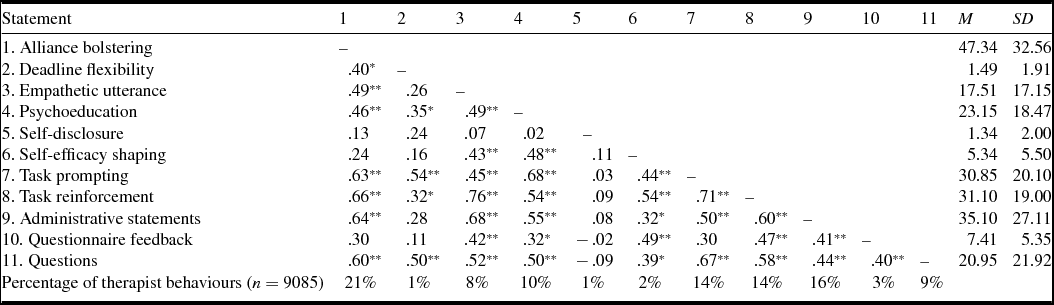
Table 3 shows the frequency of all therapist behaviours in the e-mails to patients. The relative frequency of these behaviours was as follows: alliance bolstering (21%), administrative statements (16%), task reinforcement (14%), task prompting (14%), psychoeducation (10%), questions (9%), empathetic utterances (8%), questionnaire feedback (3%), self-efficacy shaping (2%), deadline flexibility (1%), and self-disclosure (1%). Examination of the frequency of the therapist behaviours suggested that two of the three newly identified behaviours (e.g. administrative statements and questions) were quite frequent in e-mails. Intercorrelations among therapist behaviours were very strong (see Table 3). Self-disclosure, however, was not correlated with other therapist behaviours.
Intercorrelations of therapist behaviours, mean number of therapist behaviours per client (including SD), and relative frequency of therapist behaviours

Note. *p < .05. **p < .01
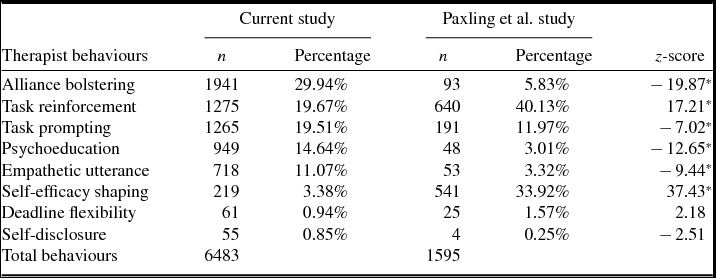
In order to examine whether therapist-assistance in our study was comparable to Paxling et al. (Reference Paxling, Lundgren, Norman, Almlov, Carlbring, Cuijpers and Andersson2013), we examined the frequency of the original eight therapist behaviours reported by Paxling et al. and compared the frequencies of these therapist behaviours observed in our study. This examination revealed statistically significant differences in the distribution of therapist behaviours. As seen in Table 4, alliance bolstering and task reinforcement were common therapist behaviours in e-mails in our setting while task reinforcement and self-efficacy shaping were more common in the Paxling et al. study.
Comparison of percentage of original therapist behaviour categories in current study to Paxling et al. (Reference Paxling, Lundgren, Norman, Almlov, Carlbring, Cuijpers and Andersson2013) study

Notes: Paxling et al. data reprinted from “Therapist Behaviours in Internet-Delivered Cognitive Behaviour Therapy: analyses of e-mail correspondence in the treatment of generalized anxiety disorder,” by B. Paxling, S. Lundgren, A. Norman, J. Almlöv, P. Carlbring, P. Cuijpers and G. Andersson, Reference Paxling, Lundgren, Norman, Almlov, Carlbring, Cuijpers and Andersson2013, Behavioural and Cognitive Psychotherapy, 41, p. 284. Copyright 2013 by the Cambridge University Press.
*p < .01
Correlations between therapist behaviours, outcomes and therapeutic alliance
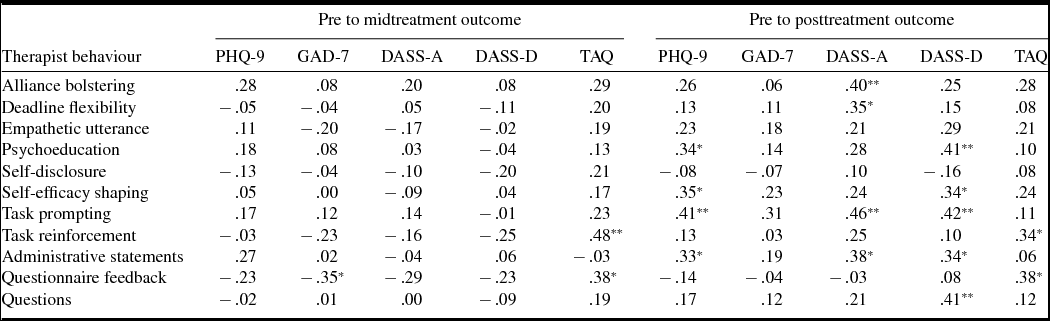
As observed in Table 5, therapist behaviours showed few correlations with change scores from pre to midtreatment. The only exception was that greater questionnaire feedback was associated with reduced GAD-7 scores from pre to midtreatment. On the other hand, therapist behaviours were associated with a number of change scores from pre to posttreatment. Increased PHQ-9 scores from pre to posttreatment were associated with the presence of more administrative statements, psychoeducation, self-efficacy shaping, and task prompting behaviours in therapist e-mails. Similarly, increased DASS-21 depression scores from pre to posttreatment were associated with increased scores on these same therapist behaviours as well as use of more questions in the therapist e-mails. Higher DASS-21 anxiety scores posttreatment were similarly correlated with more task prompting, alliance bolstering, administrative statements, and deadline flexibility in therapist e-mails. These relationships were not observed on the GAD-7. In terms of therapeutic alliance, at midtreatment and posttreatment, TAQ ratings were associated with increased questionnaire feedback and task reinforcement in e-mails to patients.
Correlations between therapist behaviours and residual change scores and therapeutic alliance ratings

Notes: PHQ-9 = Patient Health Questionnaire 9-item scale; GAD-7 = Generalized Anxiety Disorder 7-item scale; DASS-A = anxiety subscale of the 21-item Depression Anxiety Stress Scales; DASS-D = depression subscale of the 21-item Depression Anxiety Stress Scales; TAQ = Therapeutic Alliance Questionnaire.
*p < .05. **p < .01.
Discussion
The inclusion of therapist-assistance in ICBT has been demonstrated to be an important component of this intervention, yet relatively little is known about the nature of therapist-assistance. This lack of information limits comparison across studies, and it is often assumed that therapist-assistance is similarly delivered. In this study, we systematically examined therapist statements in e-mails with patients. We coded and examined the frequency of therapist behaviours in an ICBT program for depressive symptoms and compared our findings to those previously reported by Paxling et al. (Reference Paxling, Lundgren, Norman, Almlov, Carlbring, Cuijpers and Andersson2013), who examined therapist behaviours in ICBT for generalized anxiety. We found evidence of the eight initial therapist behaviours described by Paxling et al. in therapist e-mails in the present study. Three new categories of therapist behaviours also were identified. The findings suggest that while there is overlap in what is referred to as “therapist-assistance” in the studies, there are also some differences. Furthermore, comparison of the original therapist behaviours identified by Paxling et al. (Reference Paxling, Lundgren, Norman, Almlov, Carlbring, Cuijpers and Andersson2013) revealed that although similar behaviours were observed in both studies, the frequency of these behaviours differed substantially. In terms of comparability, self-disclosure and deadline flexibility were infrequent in both samples and task reinforcement was very common in both studies. The most striking difference was that alliance bolstering, psychoeducation and empathic utterances in e-mails were more common in our sample compared to Paxling et al. and task reinforcement and self-efficacy shaping were more common in the Paxling et al. study.
Regarding patient outcomes, exploratory analysis revealed statistically significant correlations between a variety of therapist behaviours and TAQ ratings as well as change scores on the DASS-21 and PHQ-9. There were fewer correlations between therapist behaviours and change scores from pre to midtreatment compared to pre to posttreatment. Examination of the direction of correlations from pre to posttreatment indicated that increased therapist behaviours were associated with worse patient outcomes (i.e. increased symptom severity at posttreatment). Given that correlational analyses do not specify causal relationships, one interpretation of the data is that therapist behaviours were responsive and increased during the course of treatment when patient symptoms were deteriorating. For example, therapists may have increased certain behaviours to assist patients who were demonstrating increased symptom severity at that time. Supporting this interpretation, correlations between change scores and therapist behaviours were not apparent at midtreatment but emerged at posttreatment.
The outcome findings of this study differ from Paxling et al. (Reference Paxling, Lundgren, Norman, Almlov, Carlbring, Cuijpers and Andersson2013) who reported few associations between change scores and therapist behaviours. The one similarity was that in both studies there was a negative association found between deadline flexibility and change scores, such that the greater the deadline flexibility, the less change observed. This association could indicate the importance of keeping patients on task in ICBT in order to improve outcome but could also suggest that greater therapist lenience occurred in response to patients who demonstrated limited progress in the program.
The discrepancies observed between our study and the Paxling et al. (Reference Paxling, Lundgren, Norman, Almlov, Carlbring, Cuijpers and Andersson2013) study could be due to a variety of factors, including differences in the focus of treatment (depression versus anxiety symptoms), the design of the ICBT programs (number of modules), level of therapist involvement (e.g. therapists in our study sent an average of 24.71 e-mails per patient; therapists in the Paxling et al. study sent an average of 11.14 e-mails), or therapist training. As an example, two of the new categories that emerged in our study reflected administrative statements and questionnaire feedback. It is quite possible that this information was given in other ways rather than therapist e-mails in the Paxling et al. program. There is neither agreed upon training modules nor unified guidelines for patient communication that govern ICBT programs. Differences could also reflect that our study focused on therapist behaviours among patients who completed ICBT, whereas Paxling et al. examined all patients regardless of whether they completed treatment. It is not possible to know what accounts for differences between studies, but the findings of the study highlight that it cannot be assumed that therapist-assistance is the same across studies. In the ICBT literature, there is a need for more attention to be given to how therapist-assistance is delivered in order to be able to better understand the role of therapist-assistance and compare studies.
The present study had a number of limitations that represent directions for future research. This study focused on program completers exclusively, which may have unintentionally introduced bias. We focused on program completers only as we were interested in variations in therapist behaviours and how these relate to outcomes and therapeutic assistance. Future research should explore whether therapist e-mails differ for program completers and non-completers and whether therapist behaviours predict patient program completion. It should be noted that the analysis of the relationship between therapist behaviours in e-mails and patient outcomes was highly exploratory. Given the exploratory nature of the analyses statistical corrections were not used to account for the number of correlations conducted in this study. Future research with larger samples is needed to confirm the relationships that were identified in this study. A larger sample would also allow for the examination of behaviour consistency within therapists and an assessment of the factor structure of therapist behaviours, which may be helpful in determining if there are potential unifying factors that underlie certain therapist behaviours.
The study of the relationship between therapist behaviours early in treatment and subsequent module completion represents an interesting future direction. In order to disentangle the causal relationship between therapist behaviours and outcome it would be preferable to measure outcome on a weekly basis, thus allowing for better understanding of whether therapist behaviours precede or follow outcome. Experimental studies would also assist in understanding the impact of therapist behaviours on outcomes, for example, studying the effect of varying therapist behaviours (e.g. degree of deadline flexibility, degree of questionnaire feedback) on outcomes.
There are a number of recommendations that may aid future researchers in understanding therapist-assistance in ICBT. First, it is important for researchers to report the type of training that therapists receive and the instructions that are given related to the delivery of ICBT. Second, it is important to report more details regarding therapist-assistance; while it is not realistic to code all e-mails, it may be feasible to code a sample and report on the relative frequency of varying therapist behaviours. This may help researchers to better compare ICBT programs. These recommendations will help researchers to determine the quality of therapist behaviours in ICBT programs and to determine the extent of program heterogeneity.
Overall, the study findings serve to highlight the importance of conducting additional research on therapist behaviours in ICBT. Therapist-assistance shows variability across studies. Findings also suggest that there are potentially important correlations between the frequency of therapist behaviours and patient outcomes; however, this relationship appears to be complex. Longitudinal and experimental research would facilitate understanding of the relationship between therapist behaviours and patient outcomes.
Acknowledgements
Financial support: This work was supported by funding provided by the Canadian Institutes of Health Research (reference number 101526) and Saskatchewan Health Research Foundation. Funders had no involvement in the study design, collection, analysis, or interpretation of the data. The Depression Online content was licensed from Swinburne University of Technology through Dr Britt Klein and Dr David Austin. The authors would like to acknowledge Marcie N. Nugent and Max Ivanov as well as the many therapists and patients of the Online Therapy Unit.
Conflict of interest: The authors have no conflicts of interest with respect to this publication.



Comments
No Comments have been published for this article.