Romantic relationships are contexts for observing changes in individual functioning. The potential for adult romantic relationships to precipitate enduring psychological or behavioral change has long been recognized by those interested in understanding the factors related to persistence in and desistance from childhood antisocial behavior (Laub & Sampson, Reference Laub and Sampson1993; Quinton, Pickles, Maughan, & Rutter, Reference Quinton, Pickles, Maughan and Rutter1993; Roisman, Aguilar, & Egeland, Reference Roisman, Aguilar and Egeland2004; Rutter, Quinton, & Hill, Reference Rutter, Quinton, Hill, Robins and Rutter1990; Sampson & Laub, Reference Sampson and Laub1990, Reference Sampson and Laub1993; Zoccolillo, Pickles, Quinton, & Rutter, Reference Zoccolillo, Pickles, Quinton and Rutter1992) as well as the correlates of adult adjustment for at-risk youth (Rönkä, Oravala, & Pulkkinen, Reference Rönkä, Oravala and Pulkkinen2002). Noticeably absent from the developmental psychopathology literature, however, is an understanding of adult romantic relationships as moderators of early risk for internalizing-spectrum problems. The present study begins to fill this gap by testing a series of hypotheses derived from an organizational–developmental perspective, which emphasizes the joint significance of early and later interpersonal experiences for predicting individual adaptation (Sroufe, Egeland, Carlson, & Collins, Reference Sroufe, Egeland, Carlson and Collins2005). According to this perspective, romantic experiences may moderate the effects of early caregiving to predict anxious–depressed symptoms in young adulthood.
Interpersonal Origins of Adult Anxious–Depressed Symptoms
Major models of the interpersonal origins of the internalizing problems of anxiety and depression focus on the role of childhood caregiving experiences (Burbach & Bourduin, Reference Burbach and Bourduin1986; Duggal, Carlson, Sroufe, & Egeland, Reference Duggal, Carlson, Sroufe and Egeland2001; Hammen, Reference Hammen1992; Kendler, Gardner, & Prescott, Reference Kendler, Gardner and Prescott2002; Moffitt et al., Reference Moffitt, Caspi, Harrington, Milne, Melchior and Golderberg2007; Toth, Manly, & Cicchetti, Reference Toth, Manly and Cicchetti1992). Multiple psychological and biological processes are implicated in this association. For example, inconsistent or inadequate early caregiving sets into motion maladaptive beliefs concerning the value of the self and the supportiveness of others that can render individuals vulnerable to subsequent internalizing symptoms (Beck, Reference Beck1967; Bowlby, Reference Bowlby1969/1982, Reference Bowlby1980; Brown & Harris, Reference Brown and Harris1978; Hammen, Reference Hammen1992). On a biological level, insensitive or unresponsive early caregiving that fails to modulate the emotional arousal of the infant may perturb the development of the physiological and neurobiological systems that support adaptive emotion functioning later in life (Hofer, Reference Hofer1994; Schore, Reference Schore2001, Reference Schore2005).
Prospective studies document the direct and indirect effects of early caregiving experiences on internalizing symptoms in adulthood. Moffitt et al. (Reference Moffitt, Caspi, Harrington, Milne, Melchior and Golderberg2007), for example, found that maltreatment between the ages of 3 and 11 increases the risk for adult clinical depression and anxiety diagnoses. The adulthood follow-up of the Patterns of Child Rearing sample (Sears, Maccoby, & Levin, Reference Sears, Maccoby and Levin1957) found that early parental warmth positively predicted marital and social functioning at age 41, which in turn predicted concurrent psychological health (Franz, Weinberger, & McClelland, Reference Franz, Weinberger and McClelland1991). Overbeek, Stattin, Vermulst, Ha, and Engels (Reference Overbeek, Stattin, Vermulst, Ha and Engels2007) found that low parent–child relationship quality promoted a pathway toward lower romantic quality in the late thirties, which in turn was associated with greater concurrent anxious–depressed symptoms.
Studies using retrospective methods or the Adult Attachment Interview (AAI; George, Kaplan, & Main, Reference George, Kaplan and Main1985) document similar links between early caregiving and adult internalizing symptomatology. For example, depressed adults retrospectively report lower quality early caregiving compared to a variety of control groups (Burbach & Bourduin, Reference Burbach and Bourduin1986), although this effect may be confounded with mood-related negativity biases (Blaney, Reference Blaney1986). Studies using the AAI, which assesses adults' current state of mind (i.e., secure–autonomous, insecure–dismissing, insecure–preoccupied, or unresolved) with respect to their childhood caregivers, also find that insecure AAI classifications are associated with psychopathology, although there does not appear to be specificity between internalizing disorders and the type of insecurity (van IJzendoorn & Bakermans-Kranenburg, Reference van IJzendoorn and Bakermans-Kranenburg1996). Thus, a number of methodologies suggest that lower quality early caregiving, whether measured prospectively, retrospectively, or representationally using measures such as the AAI, is a risk factor for later internalizing problems.
Romantic Relationships as Moderators of the Effects of Early Caregiving
A developmental psychopathology approach to anxious–depressed symptoms emphasizes the dynamic, transactional process between one's current circumstances and his/her history of adaptations (Bowlby, Reference Bowlby1969/1982; Cicchetti, Reference Cicchetti1984, Reference Cicchetti1989; Hammen, Reference Hammen1992; Sameroff, Reference Sameroff2000; Sroufe et al., Reference Sroufe, Egeland, Carlson and Collins2005). Accordingly, poor-quality early caregiving experiences may launch individuals toward elevated symptoms later in life, but their adaptation to subsequent developmental issues may either accentuate or compensate for this early risk (O'Connor, Reference O'Connor2003; Rutter & Sroufe, Reference Rutter and Sroufe2000). Prior adaptations to developmentally salient issues are not “erased from the tape” (Kagan, Reference Kagan1980, p. 240) but instead are incorporated into the self system as new developmental issues are negotiated while others wane in significance (Erikson, Reference Erikson1963).
Cross-sectional and longitudinal studies from the clinical marital literature document negative associations between adult partners' anxiety and depression and their marital satisfaction and functioning (Brock & Lawrence, Reference Brock and Lawrence2011; Proulx, Helms, & Buehler, Reference Proulx, Helms and Buehler2007; Whisman, Reference Whisman and Beach2001; Whisman, Uebelacker, & Weinstock, Reference Whisman, Uebelacker and Weinstock2004). For example, a meta-analysis of 26 cross-sectional studies of community samples found a moderately sized link between marital quality and depressive symptoms for both men and women (Whisman, Reference Whisman and Beach2001). A more recent study found that husbands' relationship satisfaction and sense of balance and control in the relationship and wives' perceptions of the relationship's emotional intimacy were negatively related to their own anxious–depressed symptoms across a 7-year period (Brock & Lawrence, Reference Brock and Lawrence2011).
Young adult romantic relationships are particularly well suited to redirect pathways initiated early in childhood given the close ties between the developmentally salient psychosocial tasks defining each age (Collins & van Dulmen, Reference Collins, van Dulmen and Huston2006). In Eriksonian (1963) terms, the early childhood issue of hope (i.e., trust vs. mistrust) is particularly relevant to the young adult issue of love (i.e., intimacy vs. isolation) and the formation of close relationships in young adulthood. Continuity between these two developmental achievements, wherein early parenting quality initiates pathways toward later romantic quality, provides evidence for this view (Overbeek et al., Reference Overbeek, Stattin, Vermulst, Ha and Engels2007; Roisman, Collins, Sroufe, & Egeland, Reference Roisman, Collins, Sroufe and Egeland2005; Simpson, Collins, Tran, & Haydon, Reference Simpson, Collins, Tran and Haydon2007).
Although the quality of early caregiving experiences predicts adult romantic outcomes, people who have less favorable early caregiving histories (e.g., attachment insecurity) can and do form secure adult partnerships. Likewise, even those who had high-quality early caregiving can and do form insecure adult partnerships. Early caregiving experiences, however, are not “lost” in light of new experiences. “Early” and “later” interpersonal experiences are systematically related to psychological and behavioral outcomes. One example of this principle comes from studies examining the effects of adults' state of mind with respect to both their early caregiving experiences and their current romantic relationships on romantic functioning. Both representations of early caregiving and current romantic relationships affect romantic functioning in early adulthood (Haydon, Collins, Salvatore, Simpson, & Roisman, Reference Haydon, Collins, Salvatore, Simpson and Roisman2012; Treboux, Crowell, & Waters, Reference Treboux, Crowell and Waters2004), underscoring the idea that configurations of past and present close relationship representations predict unique patterns of thinking, feeling, and behaving.
Similar developmental logic can be applied to understanding the interpersonal antecedents of adult anxious–depressed symptoms. Poor early caregiving experiences may initiate a developmental pathway leading to negative working models of self and others, which in turn may impact interpersonal and cognitive vulnerabilities associated with anxious–depressed symptoms (e.g., excessive reassurance seeking, dependency, or negatively biased social information processing; Hammen, Reference Hammen1992; Haydon et al., Reference Haydon, Collins, Salvatore, Simpson and Roisman2012). If these vulnerabilities surface in low-quality romantic relationships in adulthood, negative cognitions about the self and others may be reinforced, aggravating anxious–depressed symptoms over time (Coyne, Reference Coyne1976; Hammen, Reference Hammen1992). In contrast, those whose poor early caregiving experiences put them at risk for elevated internalizing symptoms in adulthood may be buffered by a high-quality romantic relationship in adulthood. Likewise, positive early caregiving experiences may serve as an “inner resource” that can be used to overcome later difficulties, such as involvement in a low-quality romantic relationship (Bowlby, Reference Bowlby1973, Reference Bowlby1980; Mikulincer & Florian, Reference Mikulincer, Florian, Simpson and Rholes1998; Mikulincer, Shaver, & Pereg, Reference Mikulincer, Shaver and Pereg2003; Sroufe, Egeland, & Kreutzer, Reference Sroufe, Egeland and Kreutzer1990).
The Present Study
The present study was designed to test the hypothesis that young adult romantic relationship experiences would moderate the effects of early caregiving experiences to predict anxious–depressed symptoms across a 9-year period in young adulthood. Participants were 93 individuals for whom prospectively measured early caregiving (ages 12–42 months), young adult romantic relationship quality (age 23), and anxious–depressed symptom (ages 23, 26, and 32) data were available. We derived and tested the following hypotheses related to cross-sectional/intercept effects (i.e., the interaction between early caregiving and age 23 romantic experiences to predict age 23 anxious–depressed symptoms) and slope effects (i.e., changes in symptoms over time).
Intercept hypotheses
We expected that individuals who experienced lower quality early caregiving and also had a lower quality young adult romantic relationship would have the highest initial levels of anxious–depressed symptoms at age 23 (Hypothesis 1). In contrast, we expected that individuals who had higher quality early caregiving and higher quality young adult romantic relationships would have the lowest initial levels of anxious–depressed symptoms (Hypothesis 2).
We also expected the initial anxious–depressed symptoms of individuals whose early caregiving and romantic relationship quality differed to be between the two extreme concordant groups (i.e., the groups that were either both low or both high on early caregiving and young adult romantic quality measures; Hypotheses 3 and 4). These hypotheses are consistent with the notion that: (a) an early history of security (i.e., better caregiving) may serve as an internal resource that insulates these individuals from later difficulties, such as elevations in internalizing symptoms typically associated with poor relationship adjustment (Bowlby, Reference Bowlby1973, Reference Bowlby1980; Mikulincer & Florian, Reference Mikulincer, Florian, Simpson and Rholes1998; Mikulincer et al., Reference Mikulincer, Shaver and Pereg2003; Sroufe et al., Reference Sroufe, Egeland and Kreutzer1990); and (b) positive adult close relationships can compensate for risk factors experienced earlier in development (Rönkä et al., Reference Rönkä, Oravala and Pulkkinen2002).
Slope hypotheses
Although considerable theory and research supports the derivation of the intercept hypotheses (described above), less theory and empirical work has addressed how anxious–depressed symptom levels may change across time as a function of early caregiving and young adult romantic quality. We expected that the symptoms of individuals who experienced lower quality early caregiving and had lower quality young adult romantic relationships would increase over time, given the reciprocal influence between negative close relationship experiences and internalizing symptoms (Coyne, Reference Coyne1976; Hammen, Reference Hammen1991; Hypothesis 5). In contrast, we expected that individuals who had higher quality early caregiving and higher quality young adult romantic relationships would display a relatively flat trajectory of symptoms over time (Hypothesis 6). Because positive adult romantic relationship experiences can compensate for negative early caregiving (Rönkä et al., Reference Rönkä, Oravala and Pulkkinen2002), we also anticipated that the moderate level of anxious–depressed symptoms for individuals who have this particular configuration would decrease over time (Hypothesis 7).
Finally, we anticipated that the moderate level of anxious–depressed symptoms among those who experienced higher quality early caregiving but lower quality young adult romantic relationships would be relatively stable across time (Hypothesis 8), given that a history of positive early caregiving should protect against the longitudinal declines in mental health typically associated with poor-quality romantic relationships (Proulx et al., Reference Proulx, Helms and Buehler2007).
Discriminant prediction and covariates
In addition, we tested the uniqueness and specificity of adult romantic quality as a moderator of early caregiving in predicting anxious–depressed symptoms in two ways. First, we treated participants' competence in the workplace, another salient domain of adaptation that draws upon related but distinct developmental achievements (Collins & van Dulmen, Reference Collins, van Dulmen and Huston2006; Erikson, Reference Erikson1963), as a discriminant moderator of early caregiving to predict anxious–depressed symptoms in adulthood. Second, we statistically controlled for several covariates to further test the specificity of adult romantic quality as a moderator of early caregiving. Gender was controlled based on the well-documented sex differences in internalizing symptoms (Nolen-Hoeksema & Girgus, Reference Nolen-Hoeksema and Girgus1994). Maternal depressive symptoms were included as the best available proxy to control for genetic factors as well as intergenerational continuity in stressful environments that may contribute to elevated anxious–depressed symptoms (Kendler et al., Reference Kendler, Gardner and Prescott2002; Rutter, Silberg, O'Connor, & Simonoff, Reference Rutter, Silberg, O'Connor and Simonoff1999).
Participants' marital status (whether they were married) and child status (whether they had children) during adulthood (at ages 23, 26, and 32) were also controlled in view of past research linking these variables to internalizing problems (Evenson & Simon, Reference Evenson and Simon2005; Pearlin & Johnson, Reference Pearlin and Johnson1977). In addition, participants' cohabitation status and the length of their current romantic relationship at age 23 were also controlled to examine the effects of relationship quality above and beyond other demographic relationship characteristics. Finally, whether participants were with the same romantic partner between ages 23 and 32 was included to control for the potential effects of relationship dissolution on anxious–depressed symptoms (Horwitz, White, & Howell-White, Reference Horwitz, White and Howell-White1996).
Method
Participants
Data for testing these predictions came from the Minnesota Longitudinal Study of Risk and Adaptation (MLSRA; Sroufe et al., Reference Sroufe, Egeland, Carlson and Collins2005), which has followed approximately 165 firstborn children from birth through adulthood. Participants' mothers were originally recruited into the study during the third trimester of pregnancy while they were receiving prenatal care at Minneapolis public health clinics. The analyses in this study are based on a subset of the sample (n = 93, 53% female, 47% male), for whom young adult romantic relationship quality was assessed at age 23. Sixty-eight percent of these participants were White, 22% were of mixed, other, or unknown race, and 10% were Black.Footnote 1
Procedures and measures
Early caregiving composite
The early caregiving variables that assessed emotional supportiveness of the early caregiving environment (between ages 1 and 4) included the number of times that the parent–child attachment relationship was classified as secureFootnote 2 out of two Strange Situation assessments conducted at 12 and 18 months (Ainsworth, Blehar, Waters, & Wall, Reference Ainsworth, Blehar, Waters and Wall1978), maternal supportive presence (minus hostility) at 24 and 42 months during challenging tasks that the participant completed with his/her mother (Erickson, Sroufe, & Egeland, Reference Erickson, Sroufe and Egeland1985; Matas, Arend, & Sroufe, Reference Matas, Arend and Sroufe1978), and maternal verbal and emotional responsivity on the Home Observation for Measurement of the Environment Inventory scale (Caldwell, Heider, & Kaplan, Reference Caldwell, Heider and Kaplan1966) at 30 months. Full descriptions along with reliability and validity information for these measures are reported in Appleyard, Egeland, and Sroufe (Reference Appleyard, Egeland and Sroufe2007). Standardized scores on each of these measures were calculated and then averaged to create a single indicator of early caregiving for participants for whom at least two of the contributing measures were available (n = 91, 98% of the subsample).
Young adult romantic quality (age 23)
At age 23, participants who were in a romantic relationship of 4 months or longer were interviewed about their experiences in that relationship. This relationship length cutoff was used to increase the likelihood that participants had a range of experiences relevant to the types of examples they would be asked to provide during the interview. Participants responded to questions about times when they felt especially close to their partner, whether they could completely be themselves and share anything with their partner, how the couple resolved conflicts, and how committed the relationship was.
The interviews were audiotaped, and trained coders then rated each interview on scales measuring the level of enjoyment, commitment, security, conflict resolution, and overall quality (Collins et al., Reference Collins, Christian, Englund, Patterson, Ruh and Schwichtenberg1999). All scales were rated on 5-point Likert-type scales anchored low to high. Enjoyment assessed the degree to which the participant viewed his/her current romantic relationship as a source of happiness, pleasure, and good feelings. Commitment indexed the degree to which the participant wanted the relationship to be stable and long term, and invested resources in it. Security measured the degree to which the partner was viewed as available, responsive, and fully accepting of the participant in both good and bad times. Conflict resolution tapped the degree to which the couple's strategies for managing conflicts were effective and equitable to both partners. Overall quality assessed the degree to which mutual caring, trust, emotional closeness, self-sacrifice, and sensitivity characterized the relationship as a whole. Interrater reliabilities (intraclass correlations) between the coders were high, ranging from .89 to .94 (M = .92). Intercorrelations (rs) among the scales ranged from .46 to .89 (M = .73). A principal components analysis confirmed that all five variables loaded on a single romantic quality dimension that accounted for 78% of the variance in the scales. Component loadings, which reflect the correlations between the variables and the component, ranged from .79 to .93 (M = .88). Scores on the scales were z-scored and averaged to create an age 23 romantic quality composite.
Anxious–depressed symptoms (ages 23, 26, and 32)
Participants completed the 119-item Young Adult Self-Report for ages 18–30 (Achenbach, Reference Achenbach1997) as part of their 23-year and 26-year assessments, and they completed the 126-item Adult Self-Report (Achenbach, Reference Achenbach2003) as part of their 32-year assessment. Participants rated themselves, their feelings, and their behavior during the past 6 months on a 3-point scale (0–2). Scores on the anxious–depressed subscale were used in the present analyses. According to the Achenbach manuals (1997, 2003), scores on the anxious–depressed subscale discriminate between clinically referred and nonreferred samples, and they are highly and positively correlated with scores on both the depression scale from the Symptom Checklist-90—Revised (Derogatis, Reference Derogatis1977/1994) and the depression scale from the Minnesota Multiphasic Personality Inventory—2 (Butcher, Dahlstrom, Graham, Tellegen, & Kaemmer, Reference Butcher, Dahlstrom, Graham, Tellegen and Kaemmer1989). One, five, and four participants scored in the borderline clinical range (T scores of 65–69) at ages 23, 26, and 32, respectively. No participants scored in the clinical range (T > 70) at ages 23 and 26, but one participant did at age 32.
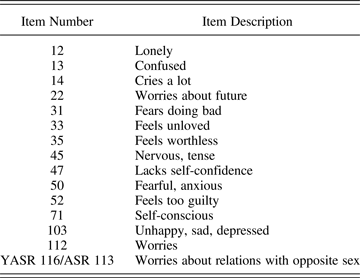
Linear mixed modeling (LMM) requires measurement invariance, meaning that the same dependent measure must be used across time (Edwards & Wirth, Reference Edwards and Wirth2009). Consistent with past literature examining repeated measures of anxious–depressed symptoms across different Achenbach forms (e.g., Edwards, Larsson, Lichtenstein, & Kendler, Reference Edwards, Larsson, Lichtenstein and Kendler2011), the items that loaded on both the Young Adult Self-Report and the Adult Self Report anxious–depressed subscale were summed to create the anxious–depressed symptoms composite. Reliabilities for the resulting 15-item scale at ages 23, 26, and 32 (summarized in Table 1) were high (α23 = 0.90, α26 = 0.89, α32 = 0.90).
Young Adult Self-Report (YASR) and Adult Self-Report (ASR) items included in the anxious–depressed symptom composite
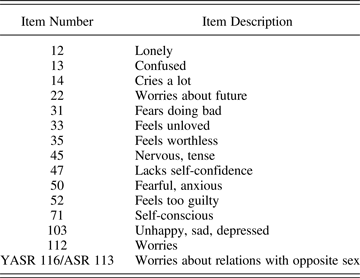
Note: This is an abbreviated version of items from the YASR and ASR. Manual for the Young Adult Self-Report and Young Adult Behavior Checklist, by T. M. Achenbach, Reference Achenbach1997. Burlington, VT: University of Vermont, Department of Psychiatry. Copyright 1997 by T. M. Achenbach. Reproduced with permission. Manual for the Adult Self-Report, by T. M. Achenbach, Reference Achenbach2003, Burlington, VT: University of Vermont, Department of Psychiatry. Copyright 2003 by T. M. Achenbach. Reproduced with permission.
Discriminant predictor and covariates
The following discriminant predictor and covariates were used to test the uniqueness and specificity of young adult romantic relationship quality as a moderator of early caregiving in predicting anxious–depressed symptoms in adulthood.
Work competence (age 23)
At age 23, participants were interviewed and responded to paper-and-pencil questions about their work experiences, including their employment history and their plans for future education/employment. Measures and audiotaped interviews were then coded for the degree to which each participant showed reflectivity about his/her career plans, the degree to which he/she had engaged in exploration of potential career opportunities, and the degree to which his/her thinking about job or career goals showed maturity on separate 5-point unidimensional Likert-type scales. Interrater reliabilities (intraclass correlations) for two raters on these scales ranged from .74 to .84. Scores on these scales were composited to form a work competence index. Past research linking this index to the quality of middle childhood peer competence, but not to the quality of adolescent relationships, provides evidence for its convergent and divergent validity (Collins & van Dulmen, Reference Collins, van Dulmen and Huston2006).
Maternal depressive symptoms (ages 48 months and 7, 8, 16, and 17.5 years)
Participants' mothers reported their own depressive symptoms when the participants were 48 months and 7, 8, 16, and 17.5 years old. The Center for Epidemiological Studies Depression Scale (Radloff, Reference Radloff1977) was administered at the 48-month and 16- and 17.5-year assessments. This 20-item scale asks respondents to rate themselves on a 4-point scale (0–3) according to specific feelings and behaviors during the past week that are characteristic of depression. The Beck Depression Inventory (Beck, Ward, Mendelson, Mock, & Erbaugh, Reference Beck, Ward, Mendelson, Mock and Erbaugh1961) was administered at the 7- and 8-year assessments. The 21-item Beck Depression Inventory asks respondents to rate themselves on a 4-point scale (0–3) on feelings during the past week characteristic of depression. Cronbach alphas for these scales ranged from 0.83 to 0.88 (M = 0.86) A maternal depressive symptoms composite was calculated by z scoring and averaging these measures.
Relationship length and cohabiting status (age 23)
At age 23, participants reported the length of their current romantic relationship (in months) and whether they were living with their current romantic partner, coded 0 (no) or 1 (yes).
Romantic relationship stability between ages 23 and 32
At ages 23 and 32, participants reported their romantic partner's name. Name data were then used to create a dichotomous variable indicating whether the participant was involved with the same partner at ages 23 and 32, coded 0 (no) or 1 (yes). Stability coding was corroborated with relationship length information collected at age 32.
Marital status (ages 23, 26, and 32)
Three dummy variables were coded for whether each participant was married at ages 23, 26, and 32. For each age, a separate marital status variable was coded 0 (unmarried) or 1 (married).
Child status (ages 23, 26, and 32)
Three dummy variables were coded for whether each participant had a biological child at ages 23, 26, and 32. For each age, a separate child status variable was coded 0 (No) or 1 (Yes).
Results
Descriptive statistics and correlations
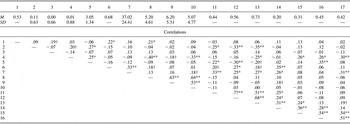
Descriptive statistics and zero-order correlations for all the variables are summarized in Table 2. Anxious–depressed symptoms at each age were positively correlated (rs = .53–.64), as were age 23 romantic quality and work competence (r = .25). Romantic quality was negatively related to anxious–depressed symptoms at ages 23 and 32 but not significantly at age 26. Early caregiving quality, romantic relationship length, work competence, and marital status were not significantly related to anxious–depressed symptoms at any age. Romantic quality was not associated with age 23 marital status, but it was positively associated with age 26 and 32 marital status. Early caregiving was inversely associated with having a child at ages 23, 26, and 32.
Descriptive statistics and zero-order correlations
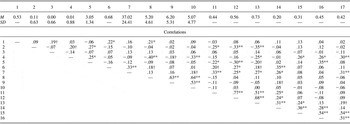
Note: Variable key: 1, gender; 2, early caregiving; 3, maternal depressive symptoms; 4, romantic quality; 5, work competence; 6, living with partner (age 23); 7, relationship length (age 23); 8, anxious-depressed symptoms (age 23); 9, anxious-depressed symptoms (age 26); 10, anxious-depressed symptoms (age 32); 11, child status (age 23); 12, child status (age 26); 13, child status (age 32); 14, marital status (age 23); 15, marital status (age 26); 16, marital status (age 32); 17, relationship stability age 23–32. SDs were not calculated for dichotomous variables and are marked in that row with dashes.
†p < .10. *p < .05. **p < .01.
Analytic plan
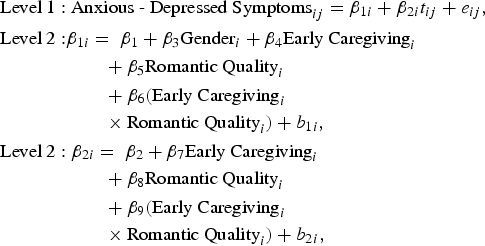
A LMM growth curve framework was used to analyze the data. Analyses were run using the lme4 package (Bates & Maechler, Reference Bates and Maechler2010) in R version 2.11.1 (R Development Core Team, 2010). Percentages of missing data for variables in the study ranged from 2% to 8%. Missing data were multiply imputed (van Buuren & Groothuis-Oudshoorn, Reference van Buuren and Groothuis-Oudshoorn2009). The equation, expressed in hierarchical linear model form, for the primary analysis examining the effects of early caregiving and young adult romantic quality on the intercepts and slopes of anxious–depressed symptoms included one Level 1 and two Level 2 equations:
 $$\eqalign{\hbox{Level 1}\colon &\hbox{ Anxious - Depressed Symptoms}_{ij}={\rm \beta}_{1i} + {\rm \beta}_{2i}t_{ij} + e_{ij}\comma \cr \hbox{Level 2}\colon & {\rm\beta}_{1i}=\;{\rm \beta}_{1}+{\rm \beta}_{3}\hbox{Gender}_{i}+{\rm \beta}_{4}\hbox{Early Caregiving}_{i} \cr & \quad \quad +{\rm \beta}_5 \hbox{Romantic Quality}_{i}\cr & \quad \quad + {\rm \beta}_{6} \lpar \hbox{Early Caregiving}_{i}\cr & \quad \quad \times \hbox{Romantic Quality}_i \rpar +b_{1i}\comma \cr \hbox{Level 2}\colon & \ {\rm \beta}_{2i}=\;{\rm \beta}_{2}+{\rm \beta}_{7} \hbox{Early Caregiving}_{i}\cr & \quad \quad +{\rm \beta}_{8}\hbox{Romantic Quality}_{i} \cr & \quad \quad +{{\rm \beta}_{9}\lpar \hbox{Early Caregiving}_{i}} \cr & \quad \quad \times \hbox{Romantic Quality}_i \rpar +b_{2i}\comma }$$
where β1 is the intercept (the mean anxious–depressed symptom score at age 23), β2 is the slope for the linear time term, β3 is the effect of gender on the intercept, β4 is the effect of early caregiving on the intercept, β5 is the effect of romantic quality on the intercept, β6 is the interaction of early caregiving and romantic quality on the intercept, β7 is the effect of early caregiving on the slope, β8 is the effect of romantic quality on the slope, β9 is the interaction of early caregiving and romantic quality on the slope, b 1i is the random intercept allowing for individual variation around the mean (β1), b 2i is the random slope allowing for individual variation around the mean slope (β2), and β1i and β2i denote the respective participant-specific intercepts and slopes.
A parallel analysis was run to test the discriminant hypothesis that this moderating effect was unique to young adult romantic quality as opposed to work competence. Bayesian weight of evidence (Burnham & Anderson, Reference Burnham and Anderson2004; Raftery, Reference Raftery1995) for the predicted and discriminant models was used to compare relative fit of these nonnested models. This approach involves calculating the Bayesian information criterion (BIC; Schwarz, Reference Schwarz1978), a model fit index derived from probability theory, for each model.Footnote 3 Conclusions about the relative fit of the predicted and discriminant models were made based on guidelines established by Raftery (Reference Raftery1995). The same hierarchical linear modeling equations described above were used again, only work competence was substituted for romantic quality.
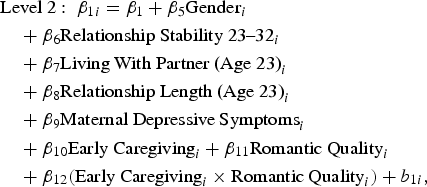
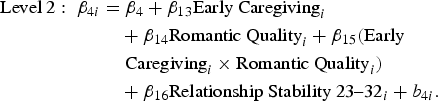
A follow-up LMM was then run to test the robustness of the observed early caregiving and age 23 romantic quality interactions by including the covariates discussed previously. Child and marital status data were available at ages 23, 26, and 32; thus, these variables were incorporated in the Level 1 equation to assess the longitudinal covariation between anxious–depressed symptoms and whether the participant was married and/or had a child. The other control variables were added to the Level 2 equation related to the intercepts, with the exception that the one variable that could change between ages 23 and 32 (i.e., whether the participant was with the same partner during this time period) was also added to the Level 2 equation related to slope in order to test whether it moderated change in anxious–depressed symptoms over time. Thus, the equations were the following:
 $$\eqalign{& \hbox{Level 1} \!\!\colon \;\hbox{Anxious}- \hbox{Depressed Symptoms}_{ij}={\rm \beta}_{1i}\cr & \quad \quad \quad \quad +{\rm \beta}_{2i}\hbox{Marital Status}_{ij} +{\rm \beta}_{3i}\hbox{Child Status}_{ij}+{\rm \beta}_{4i}t_{ij}\cr & \quad \quad \quad \quad +e_{ij}\comma}$$
 $$\eqalign{&\hbox{Level 2}\colon \; {\rm \beta}_{1i}={\rm \beta}_{1}+{\rm \beta}_{5}\hbox{Gender}_{i} \cr & \quad + {\rm \beta}_{6} \hbox{Relationship Stability 23} - 32_{i}\cr & \quad +{\rm \beta}_{7}\hbox{Living With Partner (Age 23)}_{i}\cr & \quad +{\rm \beta}_{8}\hbox{Relationship Length (Age 23)}_{i}\cr & \quad +{\rm \beta}_{9}\hbox{Maternal Depressive Symptoms}_{i}\cr & \quad + {\rm \beta}_{10}\hbox{Early Caregiving}_{i}+{\rm \beta}_{11}\hbox{Romantic Quality}_{i}\cr & \quad +{\rm \beta}_{12}\lpar \hbox{Early Caregiving}_{i}\times\hbox{Romantic Quality}_{i}\rpar +b_{1i}\comma }$$
 $$\hbox{Level 2}\colon \;{\rm \beta}_{2i}={\rm \beta}_{2}\comma $$
 $$\hbox{Level 2}\colon \;{\rm \beta}_{3i}={\rm \beta}_{3}\comma $$
 $$\eqalign{ \hbox{Level 2}\colon \;{\rm \beta}_{4i}=&\;{\rm \beta}_{4}+{\rm \beta}_{13}\hbox{Early Caregiving}_i \cr & +{\rm \beta}_{14}\hbox{Romantic Quality} _{i}+{\rm \beta}_{15}\lpar \hbox{Early} \cr &\ \hbox{Caregiving}_{i}\times\hbox{Romantic Quality} _{i} \rpar \cr & +{\rm \beta}_{16} \hbox{Relationship Stability 23}- 32_{i}+b_{4i}.}$$
In all analyses, continuous variables were centered on their means prior to creating the interaction terms. The results are reported as unstandardized coefficients. Inferences for fixed effects were made using corresponding z values because the N* (i.e., the total number of anxious–depressed symptom observations) was large (N* = 279). The t values obtained for parameters were compared to the critical values under the standard normal distribution (for two-tailed tests, |t| ≥ 1.64 for p ≤ .10; |t| ≥ 1.96 for p ≤ .05; |t| ≥ 2.58 for p ≤ .01).
Focal analyses
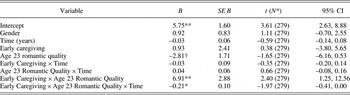
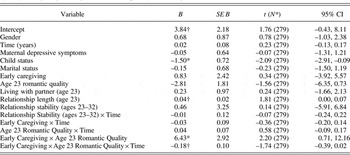
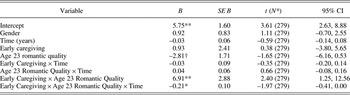
The results for the primary LMM are shown in Table 3. There were no significant (p < .05) main effects for either early caregiving or adult romantic quality on the intercepts or the slopes of anxious–depressed symptoms across adulthood. Furthermore, the parameter for the linear time term was not significant, indicating flat levels of anxious–depressed symptoms over time. These null main effects were qualified by interactions, however. Early caregiving and adult romantic quality significantly interacted to predict intercepts (i.e., age 23 anxious–depressed symptoms; p = .008) and slopes (p = .05) across time.Footnote 4
Linear mixed model predicting anxious–depressed symptoms (ages 23, 26, and 32) as a function of early caregiving and age 23 romantic quality
†p < .10. *p ≤ .05. **p < .01.
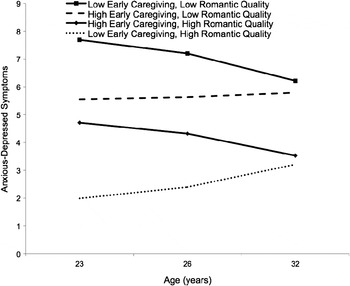
Predicted growth curves for the four configurations of early caregiving and adult romantic quality at one standard deviation above and below the mean on each variable (per the recommendations on plotting and probing interactions between continuous variables discussed in Aiken & West, Reference Aiken and West1991; Cohen & Cohen, Reference Cohen and Cohen1983) are plotted in Figure 1. A dual fan-shaped pattern emerged. The intercept and slope interaction effects were probed using computational tools from Preacher, Curran, and Bauer (Reference Preacher, Curran and Bauer2006). As expected, the highest intercept was observed for participants who experienced both low early caregiving and low adult romantic quality. This value significantly differed from zero (z = 3.80, p < .01). The lowest intercept was observed for those who had low early caregiving and high adult romantic quality, and this value did not differ significantly from zero (z = –0.40, p = .67). The intercept for those who experienced high early caregiving and high adult romantic quality was moderately high and differed significantly from zero (z = 2.93, p < .01). Although the predicted intercept value for those who experienced high early caregiving and low adult romantic quality is greater than the predicted intercept value for the high early caregiving/high adult romantic quality group, it did not significantly differ from zero (z = 1.38, p = .17).
The predicted anxious–depressed symptoms as a function of early caregiving and romantic quality configurations.

There was also a significant interaction between early caregiving and adult romantic quality in predicting slopes. Probing this effect for each of the four configurations revealed that none of the simple slopes of the trajectories differed significantly from zero. In other words, the slopes for configurations of early caregiving and adult romantic quality differ from one another (as indexed by the significant interaction), but none of them significantly differs from zero. These null simple slope effects suggest that the intercept differences described above were maintained across time.
A comparison of the BICs for the model examining adult romantic quality as the moderator of early caregiving (BIC = 1480.67) versus work competence as the moderator of early caregiving (BIC = 1499.86; model results not shown, but available from the first author) indicated a very strong preference for the adult romantic quality model.Footnote 5
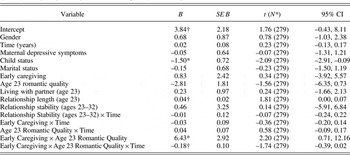
Finally, as shown in Table 4, the intercept interaction effect remained significant after including the covariates. However, the slope interaction effect dropped to marginal significance. In addition, the child status covariate was significant, indicating that having a child was associated with fewer anxious–depressed symptoms at each age. No other covariates were significant.
Linear mixed model predicting anxious–depressed symptoms (ages 23, 26, and 32) as a function of early caregiving and age 23 romantic quality, including control variables
†p < .10. *p < .05.
Discussion
This longitudinal study is one of the first to test the hypothesis that adult romantic relationship experiences alter the impact of prospectively measured early caregiving to predict anxious–depressed symptoms in adulthood. This research builds upon past work linking romantic relationships to persistence and desistance in externalizing behaviors (Laub & Sampson, Reference Laub and Sampson1993; Quinton et al., Reference Quinton, Pickles, Maughan and Rutter1993; Roisman et al., Reference Roisman, Aguilar and Egeland2004; Rutter et al., Reference Rutter, Quinton, Hill, Robins and Rutter1990; Sampson & Laub, Reference Sampson and Laub1990, Reference Sampson and Laub1993; Zoccolillo et al., Reference Zoccolillo, Pickles, Quinton and Rutter1992) and extends it to consider internalizing behavior. The perspective adopted here differs from past studies in that we tested for standard cross-sectional anxious–depressed symptom effects, as well as for whether these effects changed across early adulthood for individuals with certain configurations of early caregiving quality and later adult romantic quality.
In terms of zero-order correlations, early caregiving was not significantly related to anxious–depressed symptoms at any age, which is consistent with prior work indicating that early caregiving experiences are likely to have indirect, rather than direct, effects on later internalizing symptoms (Franz et al., Reference Franz, Weinberger and McClelland1991; Overbeek et al., Reference Overbeek, Stattin, Vermulst, Ha and Engels2007; for an exception see Moffitt et al., Reference Moffitt, Caspi, Harrington, Milne, Melchior and Golderberg2007). Consistent with past research from the clinical marital literature (Brock & Lawrence, Reference Brock and Lawrence2011; Proulx et al., Reference Proulx, Helms and Buehler2007; Whisman, Reference Whisman and Beach2001), young adult romantic quality was inversely related to anxious–depressed symptoms at ages 23 and 32. Young adult romantic quality and age 26 anxious–depressed symptoms were also negatively related, but this effect was not statistically significant.
Our multivariate growth curve analyses showed that young adult romantic relationship quality moderated the effect of early caregiving to predict anxious–depressed symptom intercepts. There were no main effects for early caregiving or romantic quality, as is often the case in the presence of fan-shaped interactions (Cohen, Cohen, West, & Aiken, Reference Cohen, Cohen, West and Aiken2003). There was also a significant slope interaction in the model containing gender as the only covariate; however, probing this effect revealed no significant simple slopes. Thus, there was no support for the hypotheses that symptom levels may change over time for the low early caregiving/low adult romantic quality configuration or the low early caregiving/high adult romantic quality configuration. Instead, the initial differences in anxiety–depression symptoms (described in more detail below) were sustained over the 9-year period.
As expected, the low early caregiving quality/low adult romantic quality group had the highest number of anxious–depressed symptoms. This is consistent with previous research showing that early experiences that put one at risk for psychosocial problems in adulthood tend to be exacerbated within low-quality or problematic adult romantic relationships (Hammen, Reference Hammen1992; Rönkä et al., Reference Rönkä, Oravala and Pulkkinen2002). The low early care/high adult romantic quality group had the fewest symptoms. Although this finding was unexpected in light of the organizational–developmental logic that both early and later close relationships should make equivalent contributions to later functioning, there are parallel findings in other research. For example, individuals who have insecure representations of early caregiving experiences have especially positive self-reported romantic relationship perceptions when their romantic relationships exceed their expectations of close relationship partners (Treboux et al., Reference Treboux, Crowell and Waters2004). Moreover, past research with the MLSRA sample shows that individuals who have insecure attachment histories benefit the most from partners who are especially good at modulating their emotional arousal in the moments following conflict (Salvatore, Kuo, Steele, Simpson, & Collins, Reference Salvatore, Kuo, Steele, Simpson and Collins2011).
These results are also consistent with the idea that those at greatest risk may benefit the most from later supportive environments (Rutter, Reference Rutter1999). For individuals who experienced low-quality early care, a high-quality romantic relationship may violate their expectations for what it means to be in a close relationship, promoting a change in cognitive models and representations of the self and/or close others. Such a shift may be reflected in fewer anxious–depressed symptoms. Romantic relationship processes such as the inclusion of other in the self (Aron, Aron, & Paris, Reference Aron, Aron and Paris1995), partner idealization (Murray, Holmes, & Griffin, Reference Murray, Holmes and Griffin1996), and caregiving (Crowell, Treboux, & Waters, Reference Crowell, Treboux and Waters2002) may also challenge one's previously held ideas of the self and others, decoupling the link between poorer early caregiving and later internalizing symptomatology (Bowlby, Reference Bowlby1988).
We also acknowledge the possibility that individuals who experience the low early care/high adult romantic quality configuration may be psychologically defensive individuals who provide overly favorable views of their romantic relationships and their psychological health. This alternative interpretation seems less plausible because our interview-based measures of romantic quality emphasized participants' ability to provide concrete examples to back up claims about the best features of their relationships, making these measures less prone to self-presentation biases than are standard self-report assessments. We did not observe this moderation effect in the work competence discriminant analysis (given that the work competence measures should also have been prone to self-presentation biases), which reduces the likelihood of this alternative explanation even further.
Turning to people who experienced high early caregiving, we found that individuals who had high early care/high adult romantic quality had a moderate amount of symptoms across time. Although this finding was not anticipated, those who experienced low early care/high adult romantic quality reported very few symptoms, setting up an extreme contrast for the number of symptoms reported by the high early care/high adult romantic quality group. This again maps onto the conceptually related finding that people who hold insecure representations of early caregiving experiences but positive adult romantic experiences have romantic relationship perceptions that are even more favorable than people who hold secure representations of early caregiving and adult romantic experiences (Treboux et al., Reference Treboux, Crowell and Waters2004).
As hypothesized, the intercepts of individuals who had high early caregiving/low adult romantic quality fell between the two extreme anchoring groups. Positive early caregiving experiences appear to have buffered these individuals from the detrimental effects of having a low-quality romantic relationship at age 23. This finding is consistent with the view that positive early caregiving experiences act as an “inner resource” when one confronts future challenges (Bowlby, Reference Bowlby1973, Reference Bowlby1980; Mikulincer & Florian, Reference Mikulincer, Florian, Simpson and Rholes1998; Mikulincer et al., Reference Mikulincer, Shaver and Pereg2003; Sroufe et al., Reference Sroufe, Egeland and Kreutzer1990).
Even though the anxious–depressed symptom levels in the two discordant groups (i.e., the low early care/high adult romantic quality group and the high early care/low adult romantic quality group) can be interpreted in light of existing theories (i.e., the violation of expectation hypothesis on the one hand, the buffering hypothesis on the other), it is difficult to reconcile them under a single framework. For example, according to the violation of expectations perspective, individuals who have positive early experiences should have experienced greater psychological distress (reflected in higher anxious–depressed symptoms) if their adult romantic experiences fail to meet their lofty standards for close relationships (Treboux et al., Reference Treboux, Crowell and Waters2004).
One potential explanation for the different levels of anxiety–depression displayed by the two discordant groups is the degree to which top-down versus bottom-up relationship processes are at play. Individuals who have histories of sensitive, supportive caregiving should make more benevolent, growth-oriented attributions when their relationships are lower in quality (e.g., “We sometimes have trouble resolving conflicts, but things will get better over time if we keep working on it”; e.g., Rusbult, Verette, Whitney, Slovik, & Lipkus, Reference Rusbult, Verette, Whitney, Slovik and Lipkus1991). These favorable interpretations may buffer these individuals from lower quality relationship experiences. These individuals may also receive greater emotional support from their social networks (e.g., family and friends), which in turn buffers them from elevations in internalizing symptoms commonly associated with lower quality romantic relationships. In contrast, individuals who experienced low-quality early caregiving may be especially responsive to “bottom-up” romantic relationship experiences that challenge their previously held views of self and other. Testing these hypotheses is an important direction for future research.
Contrary to our predictions, there was no evidence that anxious–depressed symptoms for the low early care/low adult romantic quality group or the low early care/high adult romantic quality group changed over time. By limiting our assessment to only relatively well-established relationships (minimum length = 4 months, sample average = 37 months), we may have missed the critical period at the beginning of relationships when these changes occur. Future research using more fine-grained assessments of internalizing symptoms that are associated with being involved in a new romantic relationship might be a more sensitive test of this hypothesis (for an example of a daily diary method in this vein, see Eberhart & Hammen, Reference Eberhart and Hammen2010).
As a set, our results call into the question the assumption that the quality of later romantic relationships “matters” to the same degree for all individuals. Our results suggest that the present takes on a different meaning in light of the past. For those who experienced low-quality early caregiving, anxious–depressed symptom levels differed drastically as a function of their young adult romantic quality. However, anxious–depressed symptom levels for those who experienced high-quality early caregiving did not vary as much as a function of their adult romantic relationship quality.
What implications do these findings have for our theoretical understanding of the role of early experience following developmental continuity versus change? Our data provide evidence for an inoculation effect associated with positive early experiences (Schaffer, Reference Schaffer2000; Sroufe et al., Reference Sroufe, Egeland and Kreutzer1990), in that those who experienced high-quality early care appear to be less susceptible (in terms of their anxious–depressed symptom levels) to the effects of their later close relationship experiences. In sharp contrast, our results show that the impact of poor early caregiving on later internalizing symptoms comes into relief only when the quality of later romantic relationship experiences is considered. Identifying the psychological, physiological, and neurobiological mechanisms at the individual and dyadic levels that mediate these inoculation, amplification, and compensation effects are important directions for future research (Coan, Reference Coan, Cassidy and Shaver2008; Sbarra & Hazan, Reference Sbarra and Hazan2008).
Several additional findings highlighted the specificity and uniqueness of our findings. For example, the model testing young adult romantic quality as a moderator of early caregiving in predicting anxious–depressed symptoms provided a much better fit to the data than did a competing model that treated young adult work competence as a moderator. Moreover, the early caregiving by young adult romantic quality interaction effect remained significant when several possible confounds were statistically controlled, including romantic relationship stability in adulthood. Thus, the quality of young adult romantic relationships may set into motion certain intrapersonal changes that are not lost, even if the relationship ends. Moreover, our findings are not solely attributable to major relationship-related life events such as getting married or having a child. This lends further support to the premise that romantic relationships may uniquely alter the consequences of early caregiving for anxious–depressed symptom outcomes (Bowlby, Reference Bowlby1988; Erikson, Reference Erikson1963; Hazan & Shaver, Reference Hazan and Shaver1994).
Limitations
This study has some limitations. To begin with, our sample size was relatively small, and our findings cannot necessarily be generalized to other nonrisk samples. In addition, the number of participants who fell into the ±1SD illustrative groups plotted in Figure 1 was small (range = 1–6). Thus, although our results can be interpreted in light of existing theories (e.g., Bowlby, Reference Bowlby1988) and are conceptually consistent with evidence that later close relationship experiences (or representations of those experiences) may alter the consequences of early close relationship experiences (or representations of them) from both the human and the nonhuman literatures (e.g., Harlow & Suomi, Reference Harlow and Suomi1971; Treboux et al., Reference Treboux, Crowell and Waters2004), replication in larger samples is needed. Furthermore, because our central research question focused on romantic relationships in young adulthood, we did not examine the anxious–depressed symptoms of single participants. Although dropout–control comparisons indicated that our participants were generally representative of the full MLSRA sample, single participants may be different than those who are in established relationships on other, unmeasured variables. Another limitation is the absence of data from participants' romantic relationship partners in early adulthood. Knowing more about participants' partners could provide a much clearer picture of how dyad members affect and are affected by one another.
Conclusions
This longitudinal study is one of few prospective attempts to test whether romantic relationship experiences change the association between early caregiving and later adult anxious–depressed symptoms. We build on prior studies showing that internalizing symptoms and low-quality romantic relationships in adulthood are partly a consequence of poor early caregiving experiences (Burbach & Bourduin, Reference Burbach and Bourduin1986; Conger, Cui, Bryant, & Elder, Reference Conger, Cui, Bryant and Elder2000; Moffitt et al., Reference Moffitt, Caspi, Harrington, Milne, Melchior and Golderberg2007; Overbeek et al., Reference Overbeek, Stattin, Vermulst, Ha and Engels2007; Roisman et al., Reference Roisman, Collins, Sroufe and Egeland2005; Simpson et al., Reference Simpson, Collins, Tran and Haydon2007). We find that low-quality adult romantic relationship experiences may amplify the association between poor early caregiving and adult anxious–depressed symptoms. From a clinical perspective, these individuals may require therapeutic interventions that focus on both their developmentally based and their relationship-based vulnerabilities to experiencing internalizing symptoms. In contrast, our finding that individuals whose lower quality early caregiving experiences put them at greater risk for developing later anxious–depressed symptoms benefitted the most from a high-quality romantic relationship experience in adulthood is optimistic. The relative invariance in adult anxious–depressed symptoms as a function of romantic quality for those who experienced high-quality early caregiving suggests that these individuals may incur less harm when they encounter less favorable romantic relationships.
Longitudinal data provides a unique opportunity to address the critical question of whether cross-sectional effects change over time. Our results indicate that the initial differences in anxious–depressed symptoms associated with early caregiving and adult romantic quality persist over the 9-year period examined here, even after controlling for relationship stability, marriage and child birth, and additional factors. These stability findings, although not entirely anticipated, are a powerful demonstration that configurations of early and later close interpersonal experiences predict enduring patterns of adaptation.
In closing, the present research reaffirms the organizational–developmental principle that individual functioning is best understood as a product of one's developmental history in combination with later life events. The consequence of the quality of early interpersonal experiences on later anxious–depressed symptoms depends in part on the quality of young adult romantic relationships. Such findings contribute to our understanding of the legacy of early experience (Sroufe et al., Reference Sroufe, Egeland and Kreutzer1990) and stimulate new avenues for research on the mechanisms underlying these effects.