“STRIPPED PLURALS” IN SPANISH AND PORTUGUESE
Spanish, together with the rest of the Ibero-Romance languages, marks nominal plural morphologically by affixing /-s/ to all nouns and modifiers, including determiners, quantifiers, pre- and postnominal adjectives, and predicate nominatives and adjectives. Nominal number concord in Spanish affects as many coindexed elements as co-occur in a given construction, and is exceptionless; the only apparent deviations from plural concord appear as the result of interaction with the phonetically grounded process of aspiration or deletion of /s/ in coda position, found in many dialects of Spanish. In more “radical” dialects, reduction of word-final /s/ also extends to word-final prevocalic position: (los amigos ‘the friends’). In all but the phonologically most advanced dialects, aspiration is the more frequent result in preconsonantal and prevocalic contexts, whereas deletion predominates phrase-finally. In such dialects, a combination such as las casas ‘the houses’ may emerge as [lah kasah] or [lah kasa] (less frequently as [la kasa]); in the variant [lah kasa], the plural morpheme is realized only on the first element of the plural DP, which as in this example is usually a determiner, given the most frequent syntactic combinations in Spanish.
Stripped plural DPs: Deletion or insertion?
When Spanish plural /-s/ is effaced through a general process of phonological weakening, retention of some vestige of /-s/ on the first element of a plural DP may be interpreted as deletion of the remaining plural markers. The present study presents data from two ethnolinguistically unique Spanish dialects in which missing plural /-s/ is found in the absence of any phonetically grounded process of consonant reduction. In the following sections it will be suggested that these depleted or stripped plural DPs are not the result of the deletion of previously existing plural markers, but rather represent an emergent system linked to the morphosyntactic evolution of plural determiners. In one case (Afro-Bolivian Spanish), there is clear evidence that stripped plural DPs have evolved from configurations in which no plural /-s/ markers were present at all, in effect representing the insertion of plural /-s/. The second case (highland Afro-Ecuadoran Spanish) appears to reflect a more advanced state of convergence with contemporary Spanish, but stripped plural DPs in this dialect may also have evolved from a previous system lacking plural /-s/ markers. Comparisons with vernacular Brazilian Portuguese are also offered, a variety in which the origin of stripped plural marking remains the subject of debate. Therefore, when discussing Afro-Ecuadoran and Afro-Bolivian Spanish and vernacular Brazilian Portuguese in the following sections, the concept of stripped or depleted plural marking should not be construed as necessarily implying deletion of plural /-s/, but simply of absent plural markers. In other words, a “stripped-down” system, but not necessarily one in which items have been “stripped off.”
Variable plural marking in Puerto Rican Spanish
In dialects with high rates of aspiration/deletion of final /-s/, analysis is complicated by the general variability in the pronunciation of /s/, as well as the difficulty in objectively distinguishing between a weak (voiceless) aspiration and deletion. Poplack (Reference Poplack and Labov1980a, Reference Poplack1980b; re-interpreted by Scherre, Reference Scherre2001) offered a quantitative analysis of data drawn from a quintessentially /s/-aspirating Spanish dialect, Puerto Rican (as represented in a neighborhood of Philadelphia). The results of this study show a preference for retaining some reflex of plural /-s/ in the first position of a string.Footnote 1 However, this is not categorical: “In fact, an opposite effect obtains: one of local redundancy, or a tendency toward concord on the string level.” In other words, “the absence of a marker on the segment preceding the token in question favors deletion on that token, whereas presence of an immediately preceding marker favors retention of marker on that token” (Poplack, Reference Poplack1980b:377). This pattern runs counter to any functionalist hypothesis, which associates retention of the plural marker /-s/ with the need to preserve grammatical distinctions marked solely by final /-s/, and points to a purely linear priming: “One marker leads to more, but zeros lead to zeros” (p. 378). This ultimately means that if plural /-s/ is to be realized at all, it will most probably appear (only) on the first element of a plural DP.
Despite the thought-provoking hint that a restructured plural-marking system might be emerging, there is no evidence that Puerto Rican Spanish or any other /s/-reducing dialect has substantially altered the fundamental morphological process of multiple plural marking. In particular, despite the vast research literature on /s/-weakening on numerous Spanish dialects around the world, no stable restructured or depleted pluralization system has been documented until now.
Variable plural marking in vernacular Brazilian Portuguese
Plural marking in Portuguese is identical to Spanish: final /-s/ (in some dialects realized as [ʃ]) is attached to all appropriate elements (plus some additional allomorphic modifications, depending on the nature of the stem). An exception to this pattern is found in the vernacular Portuguese of most regions of Brazil, which exhibits a rich array of variable plural marking across DPs. Unlike Puerto Rican Spanish, in which aspiration and deletion of /-s/ in coda position is a phonetically grounded process dating back at least to the late medieval period, Brazilian Portuguese does not manifest a general reduction of coda /-s/, although there are some regionalized processes affecting final /s/ (e.g., Scherre & Macedo, Reference Scherre, Macedo, Mollica and Martelotta2000). The quintessential vernacular Brazilian Portuguese (VBP) configuration is the stripped plural, in which the plural marker appears only on the first element (as in Spanish, most frequently a determiner): as casaØ ‘the houses’, os livroØ velhoØ ‘the old books’, where the absence of the expected plural marker /-s/ is indicated by Ø. Variable plural marking in VBP is quite complex and governed by a set of phonetic, morphosyntactic, and sociolinguistic variables, some of which will be enumerated herein.
Assuming for the moment that VBP stripped plurals represent an innovation, the most likely sources are (1) linguistic drift away from the canonical Ibero-Romance patterns, and (2) contact with other languages. A prima facie case could be made for either scenario, based on available historical documentation. The sociolinguistic marginality of most of rural Brazil is well known and has resulted in many other nonstandard retentions or innovations. Naro and Scherre (Reference Naro, Scherre and McWhorter2000, Reference Naro and Scherre2007) presented a case for European Portuguese antecedents, based on nonstandard dialects that have now all but disappeared in Portugal. As for the influence of other languages, the most significant contacts occurred upon the arrival of more than four million sub-Saharan Africans brought as slaves during the colonial period; Bantu languages of the Congo-Angola basin (particularly Kimbundu and to a lesser extent Kikongo) were the most prominent, but languages from West Africa are also documented. Less frequently included in the debate on VBP but worth taking into account is the Tupi-Guaraní-based Lingua Geral ‘general language’, used as a lingua franca by Portuguese colonists during the early colonial period (e.g., Lobato, Reference Lobato and Garcia da Silva2005). Eloquent cases have been made for both the linguistic drift and the (African) language contact hypotheses (e.g., Naro & Scherre, Reference Naro and Scherre2007, vs. Guy, Reference Guy1981, Reference Guy1989; Holm, Reference Holm and Gilbert1987), and the matter awaits an ultimate resolution.
Expanding the search for stripped plural combinations
Although the phonetically grounded reduction of Spanish final /-s/ does not produce consistent restructuring of plural marking, stripped plurals similar to those found in VBP occur in two ethnically distinct and little-studied Afro-Hispanic dialects, both of which are characterized by the absence of phonetically motivated /s/-reduction, combined with the retention of a strong sibilant [s] in word-final position. In one of these dialects, stripped plurals predominate in the speech of the oldest and least educated residents and appear to be the fading vestiges of a once more noncanonical ethnolect (a term referring here to a unique linguistic variety spoken exclusively by the culturally cohesive Afro-Ecuadoran communities). In the other case, stripped plurals are a recent innovation, emerging from an even more highly restructured Afro-Hispanic dialect in which the plural marker /-s/ is absent altogether. Because both dialects are closely tied to colonial African slavery, are confined to ethnically homogeneous Afro-descendent communities, and are spoken in small and historically isolated enclaves, it is possible to extract for individual study many of the variables that remain entangled in the study of VBP. A close examination of variational data representing these Afro-Hispanic dialects yields a plausible model for stripped plural formation as the indirect result of language contact—in the form of imperfect transgenerational transmission or semicreolization (in the sense of Holm, Reference Holm2004).
STRIPPED PLURALS IN VERNACULAR BRAZILIAN PORTUGUESE: OVERVIEW OF PROPOSALS
Before turning to the analysis of stripped plurals in two Afro-Hispanic dialects, it is useful to set the stage with data from vernacular Brazilian Portuguese, the most extensively documented instance of stripped plurals in Romance. Given the similarities between Brazilian Portuguese and Latin American Spanish—in terms of historical events, sociodemographic profiles, and contemporary sociolinguistic configurations—it is not unlikely that the VBP data have some relevance to Afro-Hispanic language.
In view of the sketchy documentation of pre-20th century VBP, the issue of the origins of stripped plurals remains unresolved. To date, proposals have centered around two poles. The first viewpoint is that VBP stripped plurals represent the end result of a random and sporadic process begun in medieval Portugal and carried to an extreme point in colonial and postcolonial Brazil, under conditions of little normative influence and sociolinguistic marginalization. An alternative set of proposals implicates the many contacts with African languages during the colonial period, as well as the significant correlation of other linguistic markers of VBP with the pidginized Portuguese once spoken by Africans and their immediate descendents in Brazil.
A possible Afro-Portuguese source for VBP stripped plurals
Stripped plurals have been documented for the vernacular Portuguese of Angola and Mozambique, but no quantitative data are available (Lipski, Reference Lipski2008b). From the 16th to the early 19th centuries, when there were African-born second-language speakers of Portuguese in Portugal, literary imitations of pidginized Portuguese attributed to Africans contain instances of stripped plurals, for example, the anonymous 17th century poems in Hatherly (Reference Hatherly1990): dos Portugar [os portugueses] ‘the Portuguese’, dus barriga [das barrigas] ‘of the bellies’, us mizélia [as misérias] ‘the miseries’, Turo esses glande prueza [todas essas grandes proezas]‘all those great feats’. From the anonymous letter “‘Rei Angola’ to the ‘Rei Minas’ in 1730” (Tinhorão, Reference Tinhorão1988:191): nossos festa [nossas festas] ‘our celebrations’, os fia dos may [as filhas das mães] ‘the daughters of the mothers’. From the anonymous almanac “Plonostico culioso, e lunario pala os anno de 1819” (Tinhorão, Reference Tinhorão1988:215): os Advertencia [as advertências] ‘the notices’, os Repertoriados [os repertórios] ‘the reports’. Examples such as these, which are frequent in Afro-Portuguese literary imitations (Lipski, Reference Lipski2005), show that stripped plurals were associated with Africanized Portuguese for several centuries, and whereas the accuracy of these texts is often questionable, the frequency with which stripped plurals appear in Portuguese literature suggests that the stereotype was at least partially based in actual Afro-Portuguese speech.
Some researchers have claimed semicreole status for the most noncanonical Brazilian varieties (e.g., Gärtner, Reference Gärtner, Schrader-Kniffki and García2007; Guy, Reference Guy1989; Holm, Reference Holm and Gilbert1987, Reference Holm2004, and the references therein). Within this context, stripped plural marking has been indirectly attributed to contact with African languages, although without further explanation. Guy (Reference Guy1989:232) posed the question of why VBP chooses to mark plural on the first element of a DP, rather than, for example, on the last or on the head noun. He then suggested (p. 233) that contact with Kwa and Bantu languages may be the source of VBP plural marking at the beginning of the DP. Many (but not all) Kwa languages place a plural marker—often derived from the third person plural subject pronoun—at the beginning of the DP. Bantu languages, including Kikongo and Kimbundu, exhibit multiple concordance not unlike that found in Ibero-Romance, but by means of prefixes rather than suffixes, whence Guy's suggestion that Bantu speakers might focus on the beginning of a DP rather than the end for plural marking. Guy (Reference Guy, Curto and Lovejoy2004:131) reiterated that “most of the Africans who came into contact with Portuguese in Brazil would have been inclined by their first languages to look for number information in the first element of a noun phrase. As adult second-language learners, they would also be inclined to avoid agreement (multiple redundant markers across the phrase), and to disfavor use of affixes.” Because Bantu languages mark plural in as many places in the DP as Spanish and Portuguese, it is not immediately obvious why speakers of these languages would necessarily look for number information in the first element of a noun phrase, rather than, for example, gradually extracting the notion of plural from the repetition of plural markers in multiple-segment DPs.
Although contact with African languages has been implicated in the presence of stripped plurals in VBP (and by extension, in Angolan and Mozambican Portuguese), it is not clear precisely how contact with languages that mark plural by means of a preposed plural marker such as a pronoun (e.g., Yoruba) or languages that effect multiple plural concord with prefixes (e.g., Kikongo) could result in the stripped plural configuration found in VBP, where all plural markers are suffixes. Such a claim is based on a vaguely defined notion of “first,” in which the position of a word within a linear string is considered as homologous to the order of morphemes within a word. Creole languages formed in contact with Spanish and Portuguese have typically abandoned the Ibero-Romance plural marking system altogether, and use instead free-standing plural markers generally derived from the substrata: preposed ma in Palenquero, preposed mga in Philippine Creole Spanish, postposed –nan in Papiamentu, preposed ane? in the Gulf of Guinea Portuguese creoles. Cape Verde Crioulo retains some vestiges of the Portuguese plural marking system, but does not exhibit a full range of stripped plural DPs.Footnote 2
VBP stripped plurals as post-European inheritance: The role of parallelism
Naro and Scherre (Reference Scherre, Naro and Ruffino1998, Reference Naro, Scherre and McWhorter2000, Reference Naro and Scherre2007) have presented hitherto unacknowledged examples of missing plural /-s/ in vernacular varieties of European Portuguese (many of which have all but disappeared), although stripped plurals are quite rare in contemporary Portugal. They rejected Guy's proposal and claimed that variable number marking in VBP is inherited from nonstandard European Portuguese, although it may have been extended and accelerated during the less than ideal language learning environments in which African slaves and Native Americans acquired Portuguese. According to Scherre's (2001) analysis, VBP stripped plurals demonstrate the effects of priming based on linear-based parallelism. Once more than one plural /-s/ is realized—for whatever reason—this increases the likelihood of subsequent plural markers, and the same is true for missing plural markers. Variationist studies have demonstrated linear parallel effects on the marking of plural /-s/ in VBP; strings such as SS__ favor a following plural marker, whereas combinations such as SØ__ favor a missing /-s/ (Scherre, Reference Scherre, de Oliveira e Silva and Scherre1998a, Reference Scherre, de Oliveira e Silva and Scherre1998b, Reference Scherre, Grosse and Zimmermann1998c, Reference Scherre2001; Scherre & Naro, Reference Scherre and Naro1991, Reference Scherre and Naro1992, Reference Scherre, Naro and Ruffino1998). These parallel effects have been found in other environments in VBP, including subject-predicate noun/adjective and subject-verb concord, and parallelism has been proposed as a potentially universal trait favoring language production and processing.
Linear parallelism is most clearly observable in strings of three or more potentially pluralizable items (e.g., Scherre, Reference Scherre2001:96); for the most common VBP configuration, dual structures such as determiner + noun, the VARBRUL factor weight is .50, meaning that for all intents and purposes the presence or absence of a plural marker on the second element cannot be predicted from the presence or absence of a plural marker on the first element. Because VBP does not present cases of two-element plural DPs in which plural is unmarked on the first element (Scherre, Reference Scherre2001:101, found only a tiny number), there are no environments of the type Ø___ for comparison. However, there are instances of ØS___, which favor a missing third plural marker with a factor weight of .60, partially contradicting claimed effects of parallelism, which would predict that an immediately preceding S__ would trigger plural marking in the third element. There are, however, other indications of linear parallelism: in the environment SS___, a missing third plural marker is strongly disfavored (factor weight .35), whereas in SØ___ contexts, a missing third plural is highly favored (factor weight .93).
Stripped plurals of the sort SØ […] are the most common type of partial plural, because two-element DPs (determiner + noun) are the most frequent in Portuguese. If one accepts the possibility that partial plural concord is not simply the result of linguistic drift or random fluctuation, but rather the result of imperfect transmission and acquisition in some earlier stage of the language, then the route of approximation to canonical Portuguese requires explanation. If proto-VBP plural DPs marked plural /-s/ (if at all) only on the first element of plural DPs, as assumed in Afro-genetic proposals such as Guy (Reference Guy1989, Reference Guy, Curto and Lovejoy2004), then is the transition from VBP stripped plurals to canonical Portuguese multiple concord the simple result of parallelism—the cumulative effect of more and more plural markers in a given string—or do the intermediate combinations represent transitory or fossilized intermediate stages of development? As a related question, does the gamut of variable configurations in contemporary VBP stem from an original (possibly African-influenced) system in which plural was routinely marked at most once in DPs (on the first element), or is variable plural concord in VBP the result of drift away from the full plural concord system of Portuguese as it arrived from Europe?
Though it may never be possible to determine with certainty the origins of single-exponence plural marking in VBP and African Portuguese dialects, nor the preference for string-initial position as the primary locus of plural marking, the circumstantial evidence can be bolstered by analyzing data from two Spanish dialects in which previous contact with African languages is indisputable, and in which stripped plurals and other partial concord configurations frequently occur. The varieties in question are spoken in communities with homogeneous and ethnically self-aware Afro-descendent populations, and where there exist objectively measurable differences between the language of the Afro-descendents and the speech of neighboring communities lacking the Afro-colonial ethnic component. Both ethnolects are embedded in regional Spanish dialects in which syllable- and word-final /-s/ is tenaciously retained as a sibilant, and in which there is little or no aspiration of /-s/ in coda position, thereby removing the complicating factor of phonetically grounded erosion from the study of reduced plural concord. Moreover, although many regional dialects of Spain aspirate or elide word-final /-s/, there is no documented evidence of variable plural marking in those Peninsular Spanish dialects in which final /-s/ is retained, unlike the examples from Portugal adduced by Naro and Scherre (Reference Naro, Scherre and McWhorter2000, Reference Naro and Scherre2007), which effectively eliminates any possible contribution from European precursors.
THE AFRO-ECUADORAN COMMUNITIES OF CHOTA/MIRA/SALINAS
Highland Afro-Ecuadoran communities
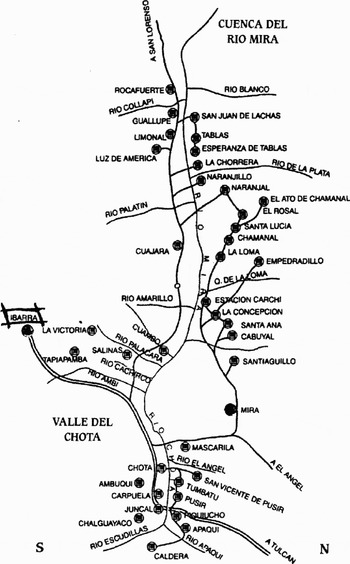
Ecuador has a moderately large population of African origin, the majority of which is concentrated along the northwest coast, in the province of Esmeraldas. A much smaller, but highly concentrated, Afro-Ecuadoran group is found in the northern Andean highlands, where the predominant racial type is indigenous or Euro-mestizo. The Chota River valley (part of the river is known as the Mira) and the neighboring Salinas valley, are located in the north-central provinces of Imbabura and Carchi. The valleys are home to some 35 black communities (Chalá Cruz, Reference Chalá Cruz2006; Folleco, Reference Folleco2009; Pabón, Reference Pabón2007; Peñaherrera de Costales & Costales Samaniego, Reference Peñaherrera de Costales and Costales Samaniego1959). The relative locations of these communities are shown in Figure 1. Although these villages are in no way isolated from neighboring communities in which Euro-mestizo populations predominate, the highland Afro-ChoteñoFootnote 3 settlements have traditionally maintained an almost exclusively Afro-descendent demographic profile and a strong sense of ethnic identity, fueled both by pride and by the results of racial discrimination by other Ecuadorans.
Principal highland Afro-Ecuadoran communities (from Maldonado Chalá, Reference Maldonado Chalá2006; used with permission).

Most younger Chota residents have access to primary and secondary education, and speech patterns are increasingly merging with those of the rest of highland northern Ecuador. More traditional elements continue to appear in highly colloquial speech, among children, workers, and those with little formal education. Older, often illiterate community members continue to manifest linguistic traits that depart significantly from other Ecuadoran varieties, and that are aligned with other Afro-Hispanic varieties throughout the Americas. These features are described in Lipski (Reference Lipski1986, Reference Lipski1987a, Reference Lipski1989, Reference Lipski2008c) and Schwegler (Reference Schwegler1994, Reference Schwegler1996). Of relevance to the present study is the fact that Afro-Choteño Spanish (ACS), like all of highland Ecuadoran Spanish, is characterized by a strongly resistant /-s/ in coda position. Aspiration of /-s/ almost never occurs.Footnote 4 There is no word-internal aspiration or deletion of /-s/ in coda position, as would be expected if there were a systematic process of /s/-reduction as exists in Puerto Rican Spanish (and in coastal Ecuadoran dialects). In ACS, as in VPB, missing word-final /-s/ stands out prominently and can be easily measured and analyzed.
As will be shown in the following paragraphs, the only environment in which word-final /-s/ is consistently missing in ACS is in plural DPs. This behavior is occasionally commented on by the speakers themselves and by their neighbors. For example Ulloa Enríquez (Reference Ulloa Enríquez1995:146), quoting the late Afro-Choteño journalist Simón Borja,Footnote 5 observed of ACS that “De una frase plural, pronuncian en singular la palabra que representa los objetos (ejemplo: los guagua)” [in plural phrases, they pronounce in the singular the word representing the objects, for example los guagua ‘the children’].
The collection of Afro-Choteño data
The Afro-Choteño data are taken from recordings of 66 native Afro-Choteño speakers, born between approximately 1913 and 1940, with the majority born between 1920 and 1930. All were recorded in 2007–2009; the data were compared with earlier recordings made in 1984, including one speaker born in 1900, but these data were not included in the present study. The speakers represent 34 homogeneously Afro-Ecuadoran communities from the Chota/Mira and Salinas valleys. The communities range in size from as few as 10 families (e.g., Apaquí, La Chorrera, Esperanza de Lachas) to over a thousand residents (El Chota). By means of visits to each community, conversations with residents, and suggestions from community activists, potential interviewees were identified. The criteria for inclusion in the present study were minimum age of 65 years; native to the community in which they currently lived, or having arrived before the age of 5; no residence or study outside of the community for more than six months, and no more than primary school education (meaning, in most communities, up to third or fourth grade). Given the considerable demographic movement of Afro-Choteños (principally to Ibarra and Quito, but also to other ACS communities), these criteria yielded only a few speakers per community. In general there is no strict correlation between community size and the number of potential respondents who meet the aforementioned criteria; for example in the largest community (El Chota), the great majority of residents have lived for extended periods outside of the immediate area, whereas in Piquiucho (like El Chota, located on the Pan-American highway), many residents tenaciously remain in their homesteads. All speakers were interviewed by the present writer, in almost all instances with the assistance of a local community member. Whenever possible, the participation of the accompanying community member was encouraged to maximize the possibility for observing in-group speech.Footnote 6 An average of 30 minutes of recorded free conversation from each speaker was extracted to provide the tokens. This yields an average of 94 tokens per respondent; due to the variation in the interviews themselves, the number of tokens per respondent ranged from 65 to 142.
Stripped plurals in Afro-Choteño Spanish: Analyzing variation
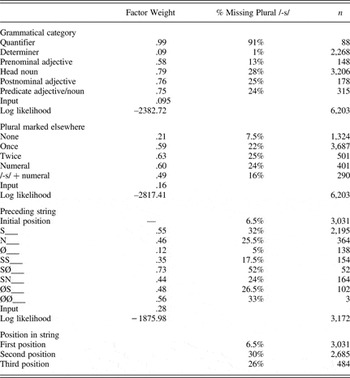
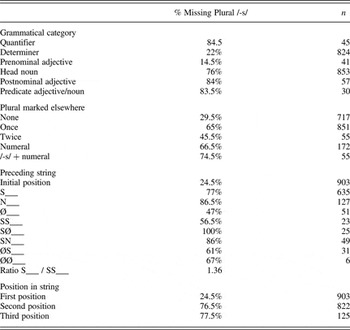
Found variably but consistently among most older Afro-Choteños are stripped plurals, in which the plural marker /-s/ occurs only once, almost always in first position. As in VBP, the first position is usually occupied by a determiner.Footnote 7 Neither stripped plurals nor other instances of missing word-final /-s/ occur in the speech of neighboring communities; therefore this feature can be objectively associated with the Afro-Choteño communities, although any possible Afro-Hispanic origin remains to be determined. Table 1 gives rates of plural marking with /-s/ in ACS (in the second column). The chart demonstrates the strong correlations between first position in the DP, the category determiner, and the requirement that plural /-s/ be marked at least once in plural DPs.
Missing plural /-s/ in Afro-Choteño plural DP Overall missing plural rate: 18% Missing plural rate excluding initial position: 29.5% (n = 3,172)

Three separate analyses; also included in each analysis: plural marked elsewhere; ending in consonant/ending in vowel; for the factor “plural marked elsewhere,” the other factors were position in string and ending in consonant/vowel.
Quantifiers—in particular todos/todas ‘all’—are rarely marked for plural, despite occurring most often in DP-initial position. The number of instances of a multiword plural DP with plural marked nowhere is tiny and well within the range of occasional performance errors,Footnote 8 whereas predicate nominatives and adjectives lacking the plural marker can be unambiguously identified as plural by means of the accompanying copular verb morphology.
Because ACS shows no other systematic loss of syllable- or word-final /-s/, stripped plurals cannot be a concomitant of phonologically motivated /s/-reduction, as in Puerto Rican Spanish. Moreover, the absence of plural /-s/ affects not only nouns and adjectives ending in a vowel, but also consonant-final words, which would ordinarily take the allomorph /-es/: los dos mes(es) ‘two months’, los mayor(es) ‘the older people’, esas curación(es) ‘those cures’, los dotor (doctores) ‘the doctors’, son cosas muy fácil(es) ‘they are very easy things’. Invariant consonant-final plurals are occasionally found among semiliterate speakers in radically final consonant-reducing dialects, where the final consonant has effectively vanished from the phonological representation, for example, in southwestern Spain (Carrasco Cantos, Reference Carrasco Cantos1981:99; Moya Corral, Reference Moya Corral1979:81–84; Salvador Plans, Reference Salvador Plans, Camarasa, Viguera and Plans1987:40). They also occasionally occur in the vernacular Spanish in contact with the Afro-Iberian creole language Palenquero in San Basilio de Palenque, Colombia (Lipski, Reference Lipski2008d; Morton, Reference Morton2005; Schwegler & Morton, Reference Schwegler and Morton2003:115). However, invariant consonant-final plurals are not attested for any variety of Spanish in which phonological processes of word-final consonant reduction are not present, except in a few Afro-Hispanic varieties, including ACS, Afro-Bolivian Spanish, and Afro-Paraguayan Spanish (Lipski, Reference Lipski2008d).
In order to obtain a full analysis of Afro-Hispanic plural formation, and to test a variety of hypotheses as to the factors conditioning the absence of plural markers, several factor groups were coded. In order to compare ACS with the VBP and Puerto Rican Spanish data, the preceding markers were coded as a factor group: S, numeral, SØ, ØS, ØØ, S + numeral. An additional factor, string-initial position (equivalent to “no preceding marker”), was included in this group, as it had been by Poplack (Reference Poplack and Labov1980a, Reference Poplack1980b) for Puerto Rican Spanish, in order to tease apart the relative contributions of linear position, preceding strings, and grammatical category. The preceding strings Ø___ and N___ were also coded. Another factor group was position within the string (first, second, third). Grammatical category was coded in another factor group. In order to separate the possible effects of linear parallelism from the effects of redundant plural marking within the DP, another factor group was whether and how plural was marked elsewhere in the phrase (none, once with /-s/, twice with /-s/, numeral, numeral + once with /-s/).Footnote 9
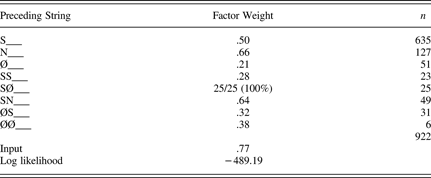
The results of a preliminary VARBRUL analysis (using Goldvarb X) are shown in Table 1. The factor groups representing grammatical category, preceding markers, and position in string are not orthogonal and embody a high number of potential interactions, so ultimately each of these factor groups was analyzed in a separate VARBRUL analysis; in each run, the chosen factor (grammatical category, preceding markers, or string position) was combined with the remaining orthogonal factors. It was determined that the interaction with the factor group “plural marked elsewhere” was minimal, and the corresponding factor weights for this group and for the other groups were nearly identical whether or not the group “plural marked elsewhere” was combined with one of the other three factor groups. Given the considerable redundancy with respect to the factors “initial position” and S___, VARBRUL weights for the factor group “position in string” are not included. Also coded was the factor “ending in consonant–ending in vowel,” but VARBRUL did not choose this factor as significant.
Because the VBP data analyzed in Scherre (Reference Scherre2001) and elsewhere did not include the factor “initial position” in the factor group representing preceding plural markers (see Scherre, Reference Scherre2001:104, for explanation), although the Puerto Rican data presented by Poplack (Reference Poplack and Labov1980a, Reference Poplack1980b) do contain this factor, the VARBRUL run was performed on the ACS tokens with the factor “initial position” not included for this factor group. The factor weight for ACS missing plural /-s/ in the most common string, S___ (with the first element typically being a determiner) (.55), is indicative of a well-defined pattern of two-element stripped plurals in ACS.
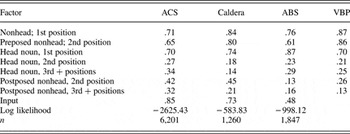
The analysis of the factors conditioning VBP stripped plurals has been expanded to include the interaction of grammatical category (head noun vs. nonhead element) and position within the string (e.g., Scherre, Reference Scherre, Grosse and Zimmermann1998c; summarized in Naro & Scherre, Reference Naro and Scherre2007:38–43). For purposes of comparison, a similar cross-category analysis was performed on the ACS data, and the results are reported in Table 6b, which in order to compare directly, for example, with Naro and Scherre (Reference Naro and Scherre2007:40) show rates of retention of ACS plural /-s/, rather than missing plural markers. As occurred with the VBP data, when VARBRUL was applied to factor groups that included both linear position and the cross-category factors, linear position was not selected as significant.
Delving more deeply into the specific combinations represented by the plural tokens, when determiners occur in first position, the rate of missing plural /-s/ is a mere 1%, first-position nouns lack plural /-s/ 7% of the time; other prenominal modifiers in first position lack plural /-s/ 10% of the time, fronted predicate nominatives/adjectives lack plural /-s/ 24% of the time, and first-position quantifiers lack plural /-s/ 91% of the time. These figures suggest that grammatical function is also playing a key role in missing plural markers, and not simply linear combinations. Reflecting the Andean Spanish dialect zone, ACS exhibits many instances of fronted predicate adjectives and predicate nominatives, and the rate of missing plural markers (24%) is more comparable to the 32% zero plural rate when the same elements occur in the most frequent third position, for example, following a determiner + noun combination.Footnote 10 Some examples are:Footnote 11
(1)
- era[n] bien barato[baratas]las cosa[s]
‘things were really inexpensive’
- éramo tonta[s]las mujeres
‘we women were foolish’
- hasta lavada[s]las cosa[s]
‘until the things were washed’
- eran buena[s]las antigua[s]
‘the old women were good’
- bastante remendado[s]los pantalón[es]
‘the pants [were] all patched up’
- ya está[n] rezada[s]las escrituras
‘the papers are already drawn up’
- grosero[s]eran
‘they were uncouth’
- encadenado [encadenadas]las manos
‘with their hands tied’
- malo[s]eran
‘they were evil’
- hasta malcriado[s]que son
‘as rude mannered as they are’
Determiners in ACS exhibit similarly low rates of missing plural /-s/ in first position (1%) and second position (2%).Footnote 12 These data suggest that determiners lie at the root of plural concord, even when not in first position. Only when determiners are not present do other prenominal modifiers and head nouns decrease the rate of missing plural /-s/, in effect ensuring that plural is marked at least once per plural DP. Prenominal modifiers in second position show a 20% rate of missing plural marker, whereas in first position, the zero plural rate drops to 10%, still higher than the 1% rate for first-position determiners. Head nouns lack plural markers 25% of the time in third position, 32% in second position, but only 7% in first position.
The quintessence of ACS stripped plurals: Caldera vs. the Chota and Salinas valleys
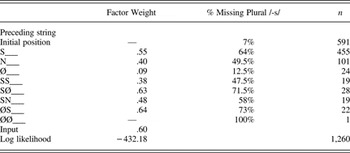
The ACS data represent an aggregate of 34 communities, spanning the entire ACS dialect zone. In each of the communities, the qualitative tendencies are consistent, whereas the actual rate of absence of plural /-s/ varies regionally. The highest percentage of missing plural /-s/ is found in the village of Caldera, at one edge of the ACS dialect region, as shown in Table 2 (and summarized in Table 6b). The average rate of missing plurals in Caldera is 35%, nearly twice the 18% overall figure for the entire ACS corpus; excluding initial position, the rate of missing plurals in Caldera is 60%, well above the 47% average for VBP. In addition to exhibiting higher overall rates of missing plural markers than the ACS averages, the Caldera data reflect the principle of marking plural only once, and in first position, usually involving a determiner. Despite the relatively small number of tokens, the proportional rates of missing plurals are similar to those of the entire ACS corpus, as are the VARBRUL factor weights, further demonstrating a consistent depleted plural system among the ACS communities. The relative factor weights for preceding string in the Caldera data coincide with the entire ACS corpus, and with the VBP figures of Scherre (Reference Scherre2001:96) as regards the tendency for a preceding SS___ to disfavor a missing plural, and for S___ and SØ___ to provide increasingly strong environments for missing plural markers.
Missing plural /-s/ in Caldera n = 1,260 Overall missing plural rate: 35% Missing plural rate excluding initial position: 60% (n = 670)

Also included in analysis: plural marked elsewhere; ending in consonant/vowel.
The entire range of variation in ACS plural marking can be seen in Table 3, which is arranged regionally. Given the small number of tokens per community, and unreliable VARBUL results from these small token sets, only percentages for the most representative context are included. Although some of the individual cells may be suspect due to the size of the token sets, the overall trends across the ACS geographical area can be seen. Table 3 also contains the ratio of the rate for missing plurals in the context S___ to the rate for the SS___ context, as an additional measure of the effects of linear parallelism. These rough figures show an increase in the size of the parallel effect from Caldera, through the Chota Valley communities, providing a hint that linear parallelism effects increase in tandem with approximations to standard Spanish multiple plural marking.
Rates of missing plural /-s/ in various Afro-Choteño communities

Percentages in parentheses indicate very small numbers of tokens (< 5).
aChota Valley communities: El Chota, Mascarilla, Tumbatú, Carpuela, El Juncal, Chalguayaco.
b Mira Valley communities: Santiaguillo, Cuambo, Cabuyal, Est. Carchi, Chamanal, La Loma, Sta. Lucía, Hato de Chamanal, La Concepción, Cuajara, Guallupe, Sta. Ana, Empedradillo, El Rosal, El Naranjal, Naranjito, La Chorrera, San Juan de Lachas, Tablas, Esperanza de Lachas, Luz de América, Rocafuerte.
c Salinas Valley communities: Tapiapamba, La Victoria, Salinas.
Included separately in Table 3 are data from the four oldest speakers of ACS in the village of Caldera, born between 1913 and 1920. Even when compared with other speakers from Caldera, the speech of these four individuals stands out in having a nearly categorical stripped plural system. In the combination S___, the rate of missing plurals is 73%, much higher than for VBP (47%). It is proposed that the speech of these individuals, the last surviving members of a generation that according to oral testimony spoke in a similar fashion, is a prototype of traditional Afro-Hispanic language, which by extrapolation once permeated the entire region, and which correlates with earlier literary representations of Afro-Hispanic stripped plurals. Caldera is a mountain village now only a 15-minute bus ride from the Pan-American Highway (with four scheduled buses per day), but prior to the opening of the dirt road and the availability of motorized transport, several hours' walk from the nearest neighboring Afro-Choteño villages. Caldera is the last Afro-Ecuadoran village at one end of the Chota Valley area, and the site of one of the largest Jesuit haciendas, subsequently taken over by private landowners. Residents of Caldera have a history of resistance and stubborn independence (Coronal Feijóo, Reference Coronel Feijóo and Savoia1988, Reference Coronel Feijóo1991; Rodríguez, Reference Rodríguez1994), and there are numerous residents who have remained in this community for their entire lives. The strong self-identification of Caldereños is reflected in their tenacious retention of the most nonstandard speech forms, including stripped plurals, raising of final atonic mid vowels (found in no other Afro-Choteño dialect and considered to be quintessentially “Caldereño”), partial suspension of adjective-noun gender concord, and analogical verb forms. Stripped plurals are routinely associated with Caldereño speech and are even transcribed as such in narrative accounts:
(2)
a. Entonces los pocu [pocos] que alcanzábamos, alcanzábamos me acuerdo al precio de dieciocho mil […] los demás nos quedamos vacío[s]
‘Then the few of us who managed, I recall that we got a price of 18,000 [sucres] […] the rest of us got nothing’ (Rodríguez, Reference Rodríguez1994:41)
b. Por eso es que la lucha que horita estamos en estos día de acuerdo … se van aquí asentando y nosotru solamente con unas casita y los huasipunguito
‘That's why we agree with the struggle that we're having these days […] they [outsiders] are settling in and we have only a few houses and our little garden plots’ (Rodríguez, Reference Rodríguez1994:47)
c. Yo prefiero sembrar con los ajeno que con los propios
‘I prefer to plant with outsiders than with people from here’ (Rodríguez, Reference Rodríguez1994:56).
The next Afro-Choteño village (leaving aside Apaquí, a settlement of some 10 houses, almost all occupied by immigrants from Caldera) is Piquiucho, an impoverished town on the Pan-American Highway hemmed in by hacienda lands. Despite easy access to travel outside of the region (buses pass on the highway every few minutes), residents of Piquiucho share the Caldereños' resistance to cultural assimilation, and highly vernacular speech patterns prevail in Piquiucho. The heartland Chota Valley communities of El Chota, Carpuela, El Juncal (all on the Pan-American Highway), Chalguayaco (2 km from Juncal), Mascarilla (2 km from Chota) and Tumbatú (near Chota but accessible only by a circuitous route) have been lumped together, given the traditional cohesiveness and demographic intermingling of these groups. The village of El Chota, according to oral tradition, was once the home of maroon slaves, as were some of the surrounding communities, and a strong sense of ethnic identity continues to permeate the central Chota valley towns. Many older speakers in these villages continue to use stripped plurals, although not to the extent found in Caldera and Piquiucho, and younger speakers use proportionally fewer. In these communities, most residents have lived and worked outside of the area, thereby increasing exposure to standard highland Ecuadoran Spanish, and diluting the presence of the traditional dialect within the communities themselves. In this cluster of subdialects, some parallel effects begin to emerge, particularly in the environment SS___, where the presence of two immediately preceding plural markers results in a lower rate of loss of a third plural marker than in the environments S___ and SØ___. Central Chota Valley stripped plurals are occasionally acknowledged in written transcriptions:
(3)
a. Porque ahí en Carpuela … matan pollo duro, caramba que duelen las muela[s]
‘Because here in Carpuela […] they kill tough chickens, damn, it hurts the teeth’ (Coba Andrade, Reference Coba Andrade1980:201)
b. El río del Chota se llevó las casa[s]
‘The Chota River washed away the houses’ (Coba Andrade, Reference Coba Andrade1980:216)
c. él se va pa la loma a traé los chivo[s]
‘He's going to the mountainside to bring the goats’ (Chalá Cruz, Reference Chalá Cruz2006:176)
The villages of the Mira Valley have been grouped together, although some (e.g., Guallupe, Cuajara, Cuambo, Rocafuerte, San Juan de Lachas) lie along the main paved highway linking Ibarra with San Lorenzo on the Pacific coast, whereas others are reached only by precarious dirt roads and limited or no scheduled transportation (Estación Carchi, Santiaguillo, Cabuyal, Chamanal, Hato de Chamanal, Empedradillo, Luz de América, Naranjito, Esperanza de Lachas). Nowadays relatively few of the ACS ethnolinguistic markers (including stripped plurals) are found in these villages, although La Concepción, the parish seat, was once the site of a major Jesuit hacienda (Folleco, Reference Folleco2009; Maldonado Chalá, Reference Maldonado Chalá2006, Medina Vallejo, Reference Medina Vallejo1996). Finally, the Afro-Choteño Salinas Valley villages of La Victoria and Tapiapamba lie on the periphery of the Chota Valley cultural zone and, despite a homogeneous Afro-descendent population, exhibit few vernacular speech traits, including stripped plurals.
Tracing the sources of ACS stripped plurals
The clear gradient behavior of stripped plurals between Caldera and Piquiucho and the heartland Chota Valley communities, taken together with the intertwined history of these communities (many of which were settled by natives of Chota or Caldera), strongly suggests that the Caldera dialect is closest to colonial Afro-Hispanic language, as regards stripped plurals. The combined factors of geographical location, age of speakers, and sociolinguistic marginality point to Caldera as the locus of “pure” stripped plurals, not the result of gradual drift away from prevailing Spanish forms, but rather as an innovation formed in early contacts between Spanish and African languages. There is no evidence to suggest that stripped plurals originated in Caldera and spread to other Afro-Choteño communities; it is simply the case that nowadays the oldest speakers in Caldera exhibit the most prototypical cases. The central Chota Valley communities show a closer approximation to surrounding Spanish dialects, in which plural is marked on all possible elements within the DP. The Afro-Ecuadoran communities in the Mira and Salinas valleys—many of which were founded in the early 20th century by immigrants from other Afro-Choteño villages—may never have had a stable stripped plural configuration as consistent as that found in Caldera and may have acquired the low rate of missing plural markers through contact with other Afro-Choteños. Alternatively, these subdialects may represent the closest approximation to contemporary Ecuadoran Spanish of a once more basilectal Afro-Hispanic dialect of the entire region. At present there is insufficient information to resolve this question.
In the most traditional ethnolinguistic enclaves (Caldera, Apaquí, Piquiucho), linear parallelism (in particular the context SS___) has the weakest proportional effect, and the oldest speakers in Caldera, who exhibit the highest rate of missing plural markers, show the smallest effect of linear parallelism. Across the entire ACS corpus, however, and especially in the Mira and Salinas valleys, a stronger case can be built for the effects of linear parallelism. This seemingly paradoxical situation reflects the fact that a stable stripped plural configuration may have existed in unaltered form for several generations, during the time period in which the Afro-Choteño communities remained socially and culturally isolated. Stripped plurals now coexist in ACS with normal Spanish multiple plural concord. This is consistent with the profile of communities that have undergone major sociolinguistic shifts in little more than a single generation, with the advent of widespread public education, improved transportation and communication, and a large-scale exodus in search of economic opportunities outside of the immediate region, with many return visits. The appearance of linear parallelism effects in communities with a lower proportion of traditional dialect markers may result from the conflation in the token set of normal Spanish multiple-concord plural DPs and traditional ACS stripped plurals, the vast majority of which are two-element determiner + noun combinations. Plural DPs with three or more possible sites for /-s/-marking represent less than 7% of the entire token set; SS___ combinations only 2.5% of the total, Ø___ contexts just 1.6% of the total, and SØ___ environments less than 1%. Given the low frequency of plural DPs with three or more pluralizable elements, it could be possible for the simple juxtaposition of two systems to create the impression of a gradual cline of variation. That there are linear parallelism effects among ACS speakers with lower overall rates of missing plural /-s/ is beyond question. Only for those communities in which the percentage of missing plural /-s/ approaches the values found in VBP—proposed here to represent the prototype of an emergent depleted plural-marking system—is the evidence for linear parallelism less compelling. Because robust linear parallelism effects have been convincingly demonstrated for VBP dialects with higher overall rates of missing /-s/ than in ACS, the precise interaction between overall frequency of missing /-s/ and linear parallel effects in ACS remains a matter for further investigation.
Given that stripped plurals also appear in literary representations of Afro-Hispanic and Afro-Portuguese speech in previous centuries, the question arises as to whether stripped plurals had a single temporal and geographical locus of origin, or whether they arose spontaneously in several different locations. In order to demonstrate the feasibility of this latter possibility, it is instructive to consider data from a contemporary speech community in which a highly restructured Afro-Hispanic language in which nominal plural is not marked with /-s/ at all is evolving in the direction of contemporary Spanish. This language demonstrates an emergent but consistent stripped plural system, indisputably not the result of simple drift away from canonical Spanish plural marking.
TRADITIONAL AFRO-BOLIVIAN SPANISH
Afro-Bolivian communities
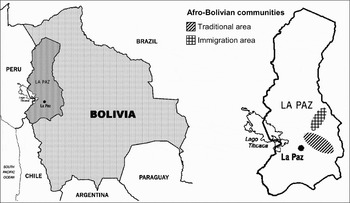
An even more extreme case of stripped plural marking appears in the highly restructured Spanish dialect still spoken in a few isolated Afro-descendent communities in highland Bolivia.Footnote 13 The speech of some of the oldest and most isolated Afro-Bolivians constitutes a fully intact Afro-Hispanic language (spoken alongside highland Bolivian Spanish) that, with the exception of Palenquero, represents the only known survival of a grammatically complete restructured language arising from the acquisition of Spanish by speakers of African languages during the colonial slaving period. Most contemporary Afro-Bolivians live in scattered communities in the provinces of Nor Yungas and Sud Yungas, in the department of La Paz. The region is principally inhabited by an Aymara-speaking indigenous population, together with a considerable mestizo component; black Yungueños live both in villages with Aymara majorities and in scattered mountainside houses on lands once belonging to haciendas. Although there are several thousand Afro-Bolivians scattered throughout the Yungas, only a tiny fraction of this population maintains any usable fluency in the traditional Afro-Yungueño dialect, with a somewhat larger group possessing some passive competence. With the arrival of schools (in Spanish), following the massive social and political reforms that began in 1952, Afro-Bolivians in the Yungas were exposed to national varieties of the language, as well as to the written language. Although community oral histories do not provide a firm chronology for the gradual abandonment of the traditional dialect, extrapolation from numerous interviews and personal testimonials yields the conclusion that by the late 1960s use of the Afro-Yungueño dialect had diminished considerably as the vehicle for spontaneous communication in the Afro-Bolivian communities. Within the region where the traditional Afro-Bolivian dialect is still spoken, the most restructured variety is found in Mururata (population 236, 2000 census) and Chijchipa (population 126). A less restructured subdialect is spoken in the communities of Dorado Chico (population 34) and Tocaña (population 171). Traditional Afro-Bolivian Spanish is justifiably classified as an ethnolect, because it is spoken in contact with other varieties of Spanish (modern highland Bolivian Spanish and Aymara-influenced interlanguage), is spoken only by Afro-Bolivians, and is identified by both Afro-Bolivians and their neighbors as characteristic of Afro-Bolivian communities. Figure 2 shows the general location of these Afro-Bolivian communities.
Location of Afro-Bolivian communities.

The collection of Afro-Bolivian data
The Afro-Bolivian data were collected during the 2004–2007 time period, as part of a longer study reported in Lipski (Reference Lipski2008a). For the present analysis, data were drawn from 35 speakers of the traditional dialect, from the communities of Dorado Chico, Coscoma, and San Joaquín in the Coripata sector of Nor Yungas, and Mururata, Chijchipa, Tocaña, and Santa Bárbara in the Coroico sector. This group represents nearly all of the speakers known to possess active competence in the traditional language,Footnote 14 so that the choice of respondents was neither capricious nor opportunistic, but as close to exhaustive as could be achieved. All but one of the speakers were born between 1918 and 1950. One speaker (from Chijchipa), the only younger individual known to be fluent in the traditional dialect, was born in 1971. All interviews were conducted with the assistance of trusted community members who are native speakers of the traditional dialect.Footnote 15 An average of 30 minutes of recorded speech per speaker was analyzed, yielding a total of 1,850 tokens from plural DPs, an average of 53 tokens per speaker. The average is lower than that obtained from Afro-Choteño speakers, largely due to the use of bare nouns (null determiners), as well as to the slower rate of speech of the traditional Afro-Bolivian dialect.
The structure of the Afro-Bolivian DP
Traditional Afro-Bolivian Spanish is described in detail in Lipski (Reference Lipski2008a) and earlier studies cited in that monograph. In addition to some significant phonological restructuring, the traditional Afro-Bolivian dialect differs from all other monolingual varieties of Spanish worldwide in the structure of DPs and VPs, both of which exhibit morphosyntactic reduction. These grammatical features demonstrate that traditional Afro-Bolivian speech is not really a “dialect” of Spanish but rather a restructured language, consistent with Holm's (Reference Holm2004) definition of “semi-creole.” The traditional Afro-Bolivian DP lacks the usual Spanish grammatical gender concord in nouns and adjectives (only the reflex of the Spanish masculine gender is normally retained). With respect to marking of grammatical plural, the following traits are relevant for the present analysis:
• Invariant plurals; nouns do not take the normal Spanish plural form: lu persona mayó [las personas mayores] ‘the older people’; lu mujé [las mujeres] ‘the women’; lu patrón [los patrones] ‘the landowners’; algunu enfermedá [algunas enfermedades] ‘some illnesses’; lu peón [los peones] ‘the peasants’.
• Absence of definite articles in subject position and as objects of prepositions (required in other Spanish dialects): Ø perro ta flojo [los perros están flojos] ‘dogs are worthless’; Ø patrón huasquiaba Ø mujé [los patrones huasqueaban a las mujeres] ‘the landowners beat the women’; Ø nube ta bien rojo [las nubes están bien rojas] ‘the clouds are very red’; Yo subía un lao di Ø pantalón [yo subía un lado del pantalón] ‘I rolled up one pant-leg’; Ahora Ø custumbre ya pierdió [ahora la costumbre ya se perdió] ‘now that custom has been lost’.
• Plural possessives based on possessive article + lu [found only in Mururata and Chijchipa]: mi lu huahua [mis huahuas] ‘my children’, su lu cosa [sus cosas] ‘his/her/their things’; nustru lu hermano [nuestros hermanos] ‘our sibilings’; Arapata ya tiene su lu carro [Arapata ya tiene sus carros] ‘[the village of] Arapata now has its cars’.
As can be seen from the preceding examples, the basilectal (“deepest”) variety of Afro-Bolivian Spanish does not mark plural with /-s/ at all; all nouns and adjectives remain invariant for number, and only when the plural definite article lu appears is there any overt plural marking. Most contemporary Afro-Bolivian speakers, however, exhibit at least some plural marking with /-s/, most frequently on determiners and other preverbal modifiers, less frequently on head nouns, and quite infrequently on postnominal modifiers and predicate adjectives. Like highland Ecuadoran Spanish, the surrounding highland Bolivian Spanish dialect does not aspirate or delete syllable-final /-s/, but rather retains a strong sibilant articulation. In the traditional Afro-Bolivian dialect, a few words occasionally emerge with aspirated final /-s/, for example, pues ‘well’, but this is not currently a productive phonological rule, and almost never affects plural /-s/, which is either realized as a sibilant [s] or is entirely absent. For this reason, as in the Afro-Choteño dialect, the presence or absence of plural marking with /-s/ can be determined unambiguously.
The transition from basilectal Afro-Bolivian Spanish to modern Spanish entails the gradual replacement of one plural-marking system (involving only the particle lu) by another (marking all elements of the DP by final /-s/).Footnote 16 First to disappear is the invariant marker lu. Together with lu disappear plural demonstratives of the sort eje lu and possessives based on mi lu, su lu, etc. (found only in Mururata, Chijchipa, and Tocaña). The absence of lu coincides with the beginnings of plural marking with final /-s/, beginning with determiners; the genderless hybrid definite article lus occurs frequently at this stage. The plural marker lu never cooccurs in the same phrase with plural marking with final /-s/; the entire corpus only contains a single example of this configuration, lu primos ‘the cousins’.
Stripped plurals in Afro-Bolivian Spanish
In Afro-Bolivian Spanish (ABS), the base line is no plural marking with /-s/, so what is really at stake is the beginning of plural marking. In other words, plural markers are not being omitted, but rather added, in the transition away from a traditional dialect in which no plural marking with /-s/ is present. Once plural marking by final /-s/ begins to appear, /-s/ first appears on the initial element of plural DPs (usually a determiner), then on prenominal adjectives, and finally on postnominal adjectives and predicate adjectives. An exception to this tendency is the behavior of quantifiers such as todo ‘all’, almost always occurring in first position, and which rarely exhibit plural marking with /-s/ in any variety of the traditional dialect. Examples of Afro-Bolivian stripped plural DPs are:
(4)
- en idioma antigo di mis abuelo[s]
‘in the old language of my grandparents’
- los huahua[s] jóven[es]
‘the young children’
- con personas mayó[mayores] pueh
‘with older people, then’
- Había que llevá personas responsable[s]
‘It was necessary to take along responsible people’.
- Los invitao[s]tiene que i poh bailando delante mula.
‘The guests had to go dancing in front of the mules’.
- Tiene un señor aquí, acorda pueh de los baile[s]de los negritu.
‘There is a man here who remembers the black people's dances’.
- Sus mujé[res]lloraba; grave lloraba
‘Their women cried; they cried a lot’.
Stripped plurals appear in published transcriptions of Afro-Bolivian speech, for example in Dorado Chico:
(5)
a. Era unus granitu chiquititu cumu ojito que sabi salí la manu, la pie; in lus intre dedu […]
‘They were some little bumps like little eyes that would break out on the hand, the foot, between the fingers and toes’ (Angola Maconde, Reference Angola Maconde2008:72)
b. Lus jovencita recién casau, han di tené muchu cuidau, cuandu hagan mamá sus wawa
‘Young married women should be very careful, when they nurse their babies’ (Angola Maconde, Reference Angola Maconde2008:100)
Table 4 provides data on 1,850 tokens representing Afro-Bolivian plural DPs and predicate nominatives and adjectives.
Missing plural /-s/ in Afro-Bolivian plural DP n = 1,850 Overall missing plural rate: 51% Missing plural rate excluding initial position: 76.5% (n = 947)

A VARBRUL analysis of the Afro-Bolivian plural tokens, using the same factor groups as for the Afro-Choteño data, is summarized in Table 5; only the factor weights for preceding markers are shown. As with the ACS tokens, the factor “ending in consonant–ending in vowel” was not selected as significant for ABS. Despite the small token set (inevitable due to the very small number of fluent speakers of the traditional dialect), the principal patterns of plural marking can be observed. These results will be compared with ACS and VBP in the following section.
VARBRUL factor weights for Afro-Bolivian missing plural /-s/
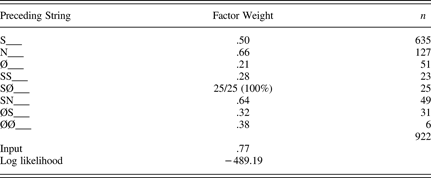
Also included in analysis: plural marked elsewhere; ending in consonant/vowel.
COMPARING THE RESULTS: THE EMERGENCE OF AFRO-HISPANIC STRIPPED PLURALS
Overall similarities
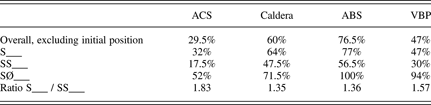
Tables 6a and 6b compare the behavior of preceding strings and the combination of grammatical category and linear position in ACS, ABS, and VBP. Tables 6a and 6b show the considerable qualitative and quantitative similarity of plural marking between VBP and ACS, despite the fact that there is no evidence that ACS derives from any Peninsular or Latin American Spanish precursor dialect in which variable plural marking was already present, even in incipient form. The rate of ACS missing plural markers is considerably lower than in VBP. In VBP (Scherre, Reference Scherre2001:96), the overall rate of zero plurals is 47% (n = 3,713/7,907), whereas in ACS the overall rate of zero plural marking is 18% (n = 1,132/5,071). By excluding initial position, as in the VBP studies, the overall rate of missing plurals in ACS is 29.5%. The relative factor weights for Afro-Choteño Spanish are quite similar to those reported for VBP, especially as regards the relative contributions of the preceding strings SS___, S___, and SØ___, although it will be suggested below that Afro-Hispanic stripped plurals may represent the addition of plural markers to an earlier, even more depleted DP system. Strings of the type SØ___, which favor a missing third plural marker with a factor weight of .95 in VBP, show a proportionately comparable .73 in ACS. The combination SS___ of two preceding plural /-s/ markers is identical to that reported for VBP: .35, and other string factors are similar between the two corpora.
Missing plural /-s/ in Afro-Choteño Spanish (ACS), Caldera (Ecuador), Afro-Bolivian Spanish (ABS), and vernacular Brazilian Portuguese (VBP; Scherre, Reference Scherre2001:94–96)
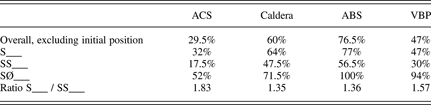
VARBRUL factor weights for retention of plural /-s/ in ACS, Caldera, ABS, and VBP (Naro & Scherre, Reference Naro and Scherre2007:40), combining linear position and grammatical category

Among the Afro-Ecuadoran communities, the Caldera data differ from the ACS corpus as a whole, and pattern with VBP as regards the strong effect of ØS___ on a following missing plural. Even with the small number of tokens, Caldera patterns even more closely to VBP than does ACS as a whole. Rates of missing plurals on nouns on second and third positions in are even higher in Caldera than in the aggregate VBP corpus, and once more underscore the robustness of the ACS stripped plural system.
In ABS, the overall rate of missing plurals is 51%, and the rate of missing plurals not including initial position is 76.5%, which is slightly higher than the 73% rate for the oldest residents of the Afro-Ecuadoran community of Caldera, considerably higher than the 47% overall rate of missing plural /s-/ in VBP, and consistent with the most extreme VBP idiolects. The rate of plural marking on second-position nouns in ABS is considerably lower than in ACS and VBP. The ABS relative factor weights also coincide with the ACS and VBP data in terms of the proportionately increasing contribution of the environments SS___, S___, and SØ___ to plural marking.
Also of interest is the ratio of missing plurals in the environment S___ to missing plural /-s/ in the context SS___. For ABS, the ratio is 1.36, which is close to the 1.35 ratio for Caldera. When compared with the ACS and VBP figures, the ABS data add further support to the notion that linear parallel effects grow proportionately with increasing approximation to canonical multiple plural marking. That the ABS data, which represent the initial stages of plural marking with /-s/, coincide quantitatively with data from the oldest speakers of the most traditional ACS variety (Caldera), also lends support to the proposal that Afro-Ecuadoran stripped plurals evolved in a similar fashion.
Although the categories for nonhead elements in first position in Table 6b do not discriminate among grammatical categories, the ABS data are similar to those of ACS in the differential behavior of first-position elements. Determiners in first position show only a 21% rate of missing plural /-s/, whereas quantifiers show an 84% rate in first position, and fronted predicate nominatives/adjectives lack plural /-s/ at a rate of 83%. That the behavior of predicate nominatives is effectively independent of position is suggested by the fact that plural /-s/ is missing 86% of the time when predicate nominatives occur in second position, and 80% in third position. The only other environment favoring retention of plural /-s/ is for nouns in initial position (n = 30), with a zero plural marking rate of only 13%. Even in this small sample, there is a difference between missing plural /-s/ in first-position nouns when plural is marked elsewhere in the DP (33%) and when there is no other plural marking in the DP (12%).
In partial summary, the behavior of the environments S___ and SS___ shows a remarkable consistency among the data sets from VBP, ACS (including the Caldera subset) and ABS. Moreover, all three dialect zones present the hierarchy of relative factor weights SS___ << S___ << SØ___ as increasingly predictive of a missing plural /-s/. The calculated ratios for missing plurals in the context S___ as opposed to SS___ indicate that the effects of linear parallelism are smallest in the Afro-Hispanic varieties with the highest proportion of missing plural /-s/ and grow as a more canonical plural-marking system is approached. In Table 6b, the similar behavior with respect to the combination of grammatical category and linear position can be verified. Afro-Bolivian Spanish demonstrates a more radically reduced plural-marking system, particularly as regards second-position head nouns, but the overall structures of the three systems are remarkably congruent. Taken together, these comparative figures provide a dramatic demonstration of the cohesiveness of stripped plural systems in three regions separated by considerable geographical and cultural distance and are consistent with the possibility that stripped plural marking in all three cases may have followed a similar trajectory.
Plural marking with /-s/ in Afro-Bolivian Spanish is demonstrably the successor to a traditional system lacking this plural marker altogether, and which is still maintained by a small number of individuals. The partial plural marking results from contact with modern Spanish, which increased dramatically following the end of the linguistic and cultural isolation of the hacienda system. Given the very high rate of stripped plurals among the oldest Afro-Choteño speakers in the most traditional redoubts, a similar conclusion can tentatively be proposed for Ecuador. Both quantitatively (in terms of relative proportions) and qualitatively (behavior of factor combinations), ABS and ACS show considerable congruence, and also pattern closely with VBP. Naro and Scherre (Reference Naro and Scherre2007) have claimed that VBP developed its stripped plural system by expanding upon occasional missing plurals inherited from European Portuguese, effectively going from more to less, rather than going from less to more, adding plural markers to an essentially /-s/-less system, as has been proposed for ABS and ACS. Is it possible to achieve the degree of congruence reflected in Tables 6a and 6b by approaching the target from opposite directions? The growing number of examples of missing agreement configurations in nonstandard European Portuguese uncovered and summarized by Naro and Scherre (Reference Naro and Scherre2007) is impressive, and leaves little doubt that “creole-like” morphosyntactic combinations arrived in Brazil in the mouths of Europeans. At the same time, VBP has achieved a stripped plural-marking system strikingly similar to that of ACS and ABS for which no Peninsular Spanish antecedents can be postulated. Occam's razor (invoked by Naro & Scherre, Reference Naro and Scherre2007:182–184, against an Afro-creole origin for VBP) also cuts both ways (with apologies for the pun): a single source for the stripped plural systems in ACS, ABS, and VBP is preferable to proposing different pathways of evolution. Without making an Afro-creole connection an essential prerequisite for stripped plurals in VBP, it may still be feasible to postulate a comparable scenario for partial plural marking in VBP, ACS, and ABS, in view of the assertion by Naro and Scherre (Reference Naro and Scherre2007:68) that they have yet to find any VBP traits without clear ancestry in Portugal.
It is not the case that simple contact between Spanish or Portuguese and languages that mark plural either through prefixes or via preposed particles will yield stripped plurals such as found in Brazil, Ecuador, and Bolivia, because counterexamples can be found in abundance. Stripped plurals are not characteristic of any of the following contact varieties, despite the fact that the adstrata typically mark plural with prefixes or preposed particles (and with the exception of Paraguay, final /-s/ is never aspirated): Spanish-Guaraní (Paraguay; Lipski, Reference Lipski1994), Spanish-Quechua (Ecuador, Peru, and Bolivia; Lipski, Reference Lipski1994), Spanish-Tagalog (Philippines; Lipski, Reference Lipski1987a, Reference Lipski1987b, Reference Lipski1987c), Spanish-Fang, Bubi, Ndowé (Equatorial Guinea; Lipski, Reference Lipski1985).
There is no evidence that suggests that a single proto-creole variety is the source for both ACS and ABS; only divergences from Spanish generally found in second language learners' speech can be confidently postulated for the origins of ACS and ABS. The fact that stripped plurals appeared independently in each of the dialects points to a common evolutionary pathway that marks the transition from some sort of restructured language to contemporary Spanish. A closer examination of ACS and ABS yields a probable common denominator that may perhaps also shed light on VBP: the consolidation of a system of definite articles.
Afro-Bolivian stripped plurals and null definite articles: An interactive proposal
In Spanish, definite articles are used to signal definite reference (e.g., Leí ellibro/ loslibros que me prestaste ‘I read the book(s) that you lent me’); they are also used for generic reference, particularly in subject position and as objects of prepositions (Soy aficionado de lamúsica/ lasorquestas ‘I am a fan of music/orchestras’; lamúsica moderna es muy popular ‘modern music is very popular’). Bare nouns are never used for definite reference and have restricted distribution for generic reference, in particular not occurring in subject position or as the object of preposition: Los/*Ø perros son mamíferos ‘dogs are mammals’, Él se preocupa por los/*Ø animales ‘He is concerned about animals’. In traditional ABS, generic plural reference—singular and plural—is expressed by bare (singular) nouns, lacking any plural determiner (e.g., definite article) that provide the scaffolding for eventual plural marking with /-s/:
(6)
- Ø perro ta flojo [los perros están flojos]
‘dogs are worthless’
- patrón huasquiaba Ø mujé [los patrones huasqueaban a las mujeres]
‘the landowners beat the women’
- Ø [el] jilacata tiene que está masiendo.
‘The overseer's assistant has [had] to be weeding’.
- Entonce Pascua era pa Ø negro.[la Pascua era para los negros]
‘So then Easter was for black people’.
Afro-Bolivian Spanish also presents numerous cases of bare nouns with clearly definite reference:
(7)
- Ø patrón vivía La Paz [el patrón vivía en La Paz]
‘the hacienda owner lived in La Paz’
- Ø nube ta bien rojo [las nubes están bien rojas]
‘the clouds are very red’
- ahora Ø custumbre ya pierdió [la costumbre se perdió]
‘now that custom has been lost’
- Ø mujé murió Ø año pasao [la mujer murió el año pasado]
‘the women died last year’
- tiene su mujé, Ø mujé aprendió tomá [la mujer aprendió a tomar]
‘he had a wife, the wife learned to drink’
- Yo subía un lao di Ø pantalón [yo subía un lado del pantalón].
‘I rolled up one pant leg’.
When singular definite articles do appear in the most traditional ABS variety, they are usually found in locative constructions lacking a preposition; the “article” actually serves as a portmanteau morpheme, combining definite reference and locative meaning. Arguably in these environments the items in question are not functioning as articles at all and show little integration into the ABS determiner system. In the following examples, the equivalent Spanish locative elements are in brackets:
(8)
- lu gente volvendo [de] lacementerio tiene que cená
‘the people returning from the cemetery have to eat’
- cuando ele fue [a] laguerra
‘when he went off to war’
- Awicha Angelia no vinió [a] lafiesta este año
‘the old Angelia didn't come to the celebration this year’
- ese lu mujé ta [en] lacocina
‘those women are in the kitchen’
- mos durmió [en] elcamino
‘we fell asleep on the road’
- no va entrá [en] elcuarto escuro
‘don't enter (the) dark room’
With very few exceptions, bare nouns with definite reference are singular; plural definite nouns take the definite plural marker lu:
(9)
- lucasa [las casas]
‘the houses’
- lujuamía pobre [las familias pobres]
‘the poor families’
- nojotro ludoliente acompañá nomás
‘we mourners would accompany’
- Nojotro lunegro siempre hacía nustro baile [nosotros los negros siempre hacíamos nuestro baile].
‘We black people always had our dance’.
- su l ucerveza [sus cervezas]
‘her [bottles of] beer’
- eje lumujé ta jay la cocina [esas mujeres están en la cocina].
‘Those women are in the kitchen’.
This system is schematized in Table 7, which is quite similar to the canonical determiner system of Palenquero (e.g., Schwegler, Reference Schwegler, Mihatsch and Sokol2007:62), although the Palenquero plural marker ma is frequently used with plural generic nouns, unlike lu in ABS. Structurally similar systems combining determiners and plural marking are found in Papiamentu, Cape Verde and Guinea Bissau Creole Portuguese, and the Portuguese-derived creoles of the Gulf of Guinea (São Tomé, Príncipe, and Annobón). The ABS definite article system is considerably different from that of Spanish, in that it makes little use of determiners. Lu, although probably derived from the Spanish plural definite article los, in reality behaves more like plural markers in many West African languages than like a Romance article, in terms of its limited distribution and the number of cases in which plural reference is not grammatically marked at all. In Spanish, articles are specified for the features {number}, {gender}, and {definiteness}, and each combination of features corresponds to a distinctly articulated word. All plural articles end in /-s/, which is clearly identifiable as a plural morpheme, while with the exception of the suppletive pair of masculine definite articles el-los, grammatical gender is also easily determinable from the phonological shape of the article. In ABS, lu, when it occurs, simultaneously conveys the notions of plurality and definiteness, and cannot be subdivided into individual morphemes corresponding to these semantic values.
The definite determiner system of traditional Afro-Bolivian Spanish

The reason for the abandonment of the most basilectal determiner system, and for the adoption of prevailing Spanish patterns of plural marking, is presumably a function of greater exposure to modern Spanish, as schools were established in the Afro-Bolivian heartland communities following the 1952 land reforms, and as the surrounding indigenous population, which had previously been monolingual in Aymara, began to acquire and use Spanish. This increasing contact with contemporary Spanish eventually led to full multiple plural marking as well as to gender concord, but stripped plurals have remained as a relatively stable intermediate configuration in Afro-Bolivian communities. The transition between traditional ABS as described in Table 7 and contemporary Spanish clusters around stages of co-occurring configurations, meaning that within spans of discourse in the traditional dialect, any given speaker exhibits use of definite articles and plural marking consistent with one of the stages to be proposed in the following.
The first convergence with Spanish plural-marking with final /-s/ occurs precisely with the replacement of lu—the only element in traditional ABS unambiguously associated with plural reference—by lus/los. By simply adding /-s/ to lu, the contemporary Spanish plural definite article is formed.Footnote 17 In the first stage of the conversion of traditional ABS to a system of multiple plural marking with /-s/, lus/los continues to act as a plural marker unmarked for grammatical gender, in combinations like lus mujé (las mujeres) ‘the women’, todo lus tarde (todas las tardes) ‘every afternoon’, lus cosa (las cosas) ‘the things’, lus mula (las mulas) ‘the mules’, etc. Coexisting with the appearance of the plural determiner lus is the use of lus with generic reference as well as definite reference:
(10)
- Luscasa como ustedeh bajó luscasa fue pos ambo lao frinte a frinte.
‘The houses were, like where you’ walked down, the houses were on either side [of the trail], facing each other’.
- No era pa luspersona mayó.
‘It was not for the elderly’.
- Yo lo hacía como hacía lusmayó.
‘I did it like the older people did’.
- Lo metían como luscamba
‘They [pronounced it] like the cambas [natives of eastern Bolivia]’
Found also at this stage is the emergence of singular definite articles to mark both definite and generic reference, in nonlocative constructions:
(11)
- el[la] viruela jue grave
‘smallpox was terrible’
- elburro cargaba dos tambor
‘the donkey carried two barrels’
- bonito era el[la] voz
‘the voice was beautiful’
- elúltimo [la última] cajita se ha partíu en dos
‘the last box has split in half’
- elviudu tenía que acompañá viuda
‘the widower had to accompany the widow’
- lapelea lus mujé trompeaba igual que lus hombre
‘in fights women used their fists the same as men’
- lagente era gente brutu
‘people were stupid’
The combination of the plural-marked article lus and the use of definite determiners as in (11) is a stable configuration that is found among nearly all ABS speakers and is the most frequent noncanonical Spanish combination for all ABS speakers except for the small group of individuals who fully retain the system of Table 7. At this stage, the ABS definite article system is essentially homologous to that of modern Spanish, except for the general lack of gender concord. The use of articles is considerably more extensive than in the basilectal variety, and the differentiation of singular and plural rises in frequency. It is precisely at this point of transition from the minimal ABS determiner system sketched in Table 7 to the modern Spanish definite article system that the plural marker /-s/ is added to lus, and in the process, the template for an entire range of stripped plurals is created, because head nouns and other modifiers remain unmarked for plural.
If the sequence of stages proposed in the preceding paragraphs is correct, once the ABS article system expanded from a single element combining the notions of plurality and definiteness to a configuration in which {number} and {definiteness} can be separately marked, the quintessential Spanish plural marker /-s/—now analyzed as such—was added to the one element already serving the function of plural marker (and whose phonological shape was a subset of a Spanish plural article), namely lu.
Null articles and stripped plurals in Afro-Choteño Spanish
In Afro-Bolivian Spanish, the emergence of stripped plurals from a previous configuration in which plural /-s/ was not used to mark nominal plural can be extrapolated from data representing speakers of varying levels of proficiency in the traditional dialect. Afro-Choteño Spanish, on the other hand, is morphosyntactically much closer to modern Spanish, and there are currently no known speakers who never mark nominal plural with /-s/, at least on determiners. Thus some speculative reconstruction is in order, based on known historical facts as well as other aspects of contemporary ACS. In the Chota, Mira, and Salinas valleys of Ecuador, some form of pidginized or semicreole Spanish was presumably once spoken, an assertion based not only on available historical accounts but also extrapolating backward from the speech of the oldest uneducated residents. Found in the most vernacular registers of the oldest and least educated ACS speakers are such phenomena as lapses in adjective-noun and subject-verb agreement, elimination and confusion of prepositions, and invariant plurals of the sort los hospital [los hospitales] ‘the hospitals’, los pulmón [los pulmones] ‘the lungs’, sus propiedá [sus propiedades] ‘his lands’, por esos árbol [árboles] ‘by those trees’. All these features, typical of second-language learners' approximations to Spanish, suggest earlier stages of the language further removed from contemporary Spanish patterns. Although there is no direct evidence of an invariant plural marker such as Afro-Bolivian lu or Palenquero ma, there are traces of the omission of singular definite articles with both generic and specific reference, postulated as a precursor to the formation of stripped plurals in ABS. Some ACS examples are:
(12)
- porque Ø [el] próximo pueblo puede ser Salinas
‘Because the next town could be Salinas’.
- material de aquí de [del] Ø lugar
‘material from around here’
- no hay nada de Ø [las] cosas antigua
‘there are none of the old things’
- con todo los de Ø [del] caserío
‘with everyone from the village’
- amarraban con Ø [el] cordoncito
‘they tied [the umbilical cord’ with the little string’
- el patrón no le gustó Ø [la] escuela
‘the landowner didn't like schools’
- pero Ø [el] finado patrón Darío nos daba
‘but the late landowner Darío would give us …’
Such examples, combined with the frequently occurring invariant plural nouns and adjectives ending in a consonant and lacking the usual Spanish plural allomorph –es, as well as the widespread absence of plural marking on nouns and adjectives ending in vowels, point to an earlier stage in which plural was not marked on nouns and adjectives. It is impossible to determine whether ACS ever had a plural determiner lacking final /-s/, such as ABS lu, or whether the Spanish plural determiner los was introduced into a previous articleless system in a single step, but the data point in the direction of Afro-Choteño plurals emerging from the combination definite article-/s/ + noun, as in ABS, thence spreading to other determiners and prenominal adjectives, and later to head nouns, postnominal adjectives, and predicate nouns and adjectives.
Other Afro-Hispanic examples of null definite articles
Bare singular nouns with generic and definite reference appear frequently in literary imitations of Afro-Hispanic speech from Spain and Latin America, from the 15th century to the 20th. Although the frequency with which these combinations recur in texts widely dispersed in both time and space suggests some basis in reality, the racist mockery found in most literary texts (all of which were written by white authors) precludes assigning to such examples the status of historical evidence. In addition to literary imitations, there are several 19th- and 20th-century descriptions (mostly from Cuba) by travelers, priests, and other observers whose descriptions appear to lie closer to factual reality; bare singular nouns are quite frequent in these nonliterary accounts. One of the earliest apparently authentic Cuban bozal imitations comes at the end of the 18th century and is cited even today. At the end of the 18th century, the Spanish priest Duque de Estrada living in Havana published a manual for other priests to teach the Catechism to African-born bozales (now available in the edition of Laviña, Reference Laviña1989). Although both condescending and designed to convince Africans that slavery was the will of God (portrayed as the “great overseer”), the approximations to bozal Spanish coincide with independently verified observations of Afro-Hispanic language. That the Afro-Cuban examples are not simple inventions is revealed by the unpublished correspondence between the Cuban scholar José de la Luz Caballero and the American encyclopedist Francis Lieber, from around 1830.Footnote 18 Lieber queried whether Afro-Cubans spoke a creole language and probed Luz Caballero on the authenticity of Duque de Estrada's account of bozal Spanish. Among other things, Luz Caballero commented on Afro-Cubans' dropping of definite articles: “suprimir el articulo en el acusativo […] y tambien á veces en el nominativo” [eliminate articles in the acusative, and also sometimes in the nominative]. Other examples come from the 20th-century Cuban writer Lydia Cabrera (1899–1991), who frequently heard bozal Spanish in her youth, and whose extensive anthropological writings on Afro-Cuban language and culture reveal meticulous attention to detail.Footnote 19 Another description comes from the Cuban writer Miguel Barnet, who in 1963 interviewed the 104-year-old ex-slave Esteban Montejo (Barnet, Reference Barnet1966). Although Montejo was a native speaker of Spanish, he did recall the speech of older bozales he had known in his youth (possibly including his own African-born father), and thus gave approximations to the Afro-Hispanic pidgin used by African-born blacks in early 19th-century Cuba. A sample of Afro-Hispanic texts (including literary imitations by Rodríguez & Berenguer y Sed, who had personal contact with bozales in 19th-century Cuba), that show bare singular nouns with definite and generic reference is:
(13)
- Ø lifiante mi tierra son mayore
‘elephants from my country are bigger’ (Cuba 20th century; Barnet, Reference Barnet1966)
- ¿ por qué uté no avisa él como son Ø cosa aquí?
‘why don't you tell him how things are here? (Cuba 20th century; Cabrera, Reference Cabrera1975)
- Ø Nengre no sabe que cosa etá hoy nen su bariga
‘The black man doesn't know what is in his stomach today’ (Cuba 20th century; Rodríguez, Reference Rodríguez1969)
- Ø Mayoral se enfada
‘The overseer becomes angry’ (Cuba 18th century; Laviña, Reference Laviña1989)
- Ø Jefe artillero trae alifante grandísimo como montaña. Pone Ø cañón riba Ø alifante.
‘The artillery chief brings elephants, as big as mountains. He puts cannon on the elephants’ (Cuba 20th century; Cabrera, Reference Cabrera1979)
- Ø vegüenza no e pa mí, e pa amo Tomá
‘The shame isn't for me, it is for master Thomas’ (Cuba 20th century; Berenguer y Sed, Reference Berenguer y Sed1929)
- si ustedes miran Ø huevo
‘if you see an egg’ (Cuba 1830; Luz Caballero)
- Ø hombre va á luchar
‘the man is going to fight’ (Cuba 1830; Luz Caballero)
- de repente Ø hocico quemó
‘[she] burned her mouth’; Afro-Peruvian song ‘A sacá camote con el pie’ by Caitro Soto
- allá ta Ø capitulero
‘There is the man from the capital’; Afro-Peruvian song ‘A sacá camote con el pie’ by Caitro Soto
These examples are similar to the ABS and ACS configurations that are postulated to have evolved into stripped plural combinations. Cuban Spanish, even the most vernacular varieties, does not exhibit stripped plurals, if for no other reason than the massive elision of word-final /-s/ in popular speech would obscure their existence. The same is substantially true for the coastal Afro-Peruvian communities where some vestiges of earlier post-bozal speech still linger, although field recordings made in 2007 in Sama las Yaras and other Afro-Peruvian villages in southern Peru did uncover a few clear cases, for example, esas tumba[s] de adelante ‘those gravestones further along’. The same dialect also presents instances of bare singular nouns with generic and definite reference:
(14)
- después de [del] Ø algodón entró [la] Ø plaga
‘after the cotton came the disease’
- Ø [al] ánima ta penando
‘ a soul is suffering’
Against the possibility of an arrested developmental stage
It is unlikely that Afro-Hispanic stripped plurals represent an arrested developmental stage, because Spanish plural marking with /-s/ is fully acquired well before the age of three years (e.g., Lleó, Reference Lleó2006; Marrero & Aguirre, Reference Marrero, Aguirre, Montrul and Ordóñez2003), with no evidence of an intermediate stage in which only articles but not head nouns are marked with /-s/. Marrero and Aguirre (Reference Marrero, Aguirre, Montrul and Ordóñez2003) observed a tendency for plural /-s/ to be marked only once in multiword DPs, but not necessarily on the determiner: “If only one element in the sentence has a marker, we expect it to be the noun. The determiner could also be a good candidate to mark plurality […]” (Marrero & Aguirre, Reference Marrero, Aguirre, Montrul and Ordóñez2003:285), and again “sometimes the relevant morpheme is on the noun, and sometimes on the determiner” (p. 286). Lleó (Reference Lleó2006) was unable to replicate this particular observation, but found only the gradual emergence of plural marking. All the researchers confirm that plural marking on adjectives and other constituents emerges after plural marking on nouns and articles. Although Spanish plural marking develops piecemeal in child speech, definite articles with the same semantic range as in adult speech (albeit usually in reduced phonological form) emerge well before the second year, that is, even before plural marking (e.g., Lleó, Reference Lleó, Weissenborn and Höhle2001),Footnote 20 unlike the scenario proposed for the development of stripped plurals from a simplified article system. In child speech, Spanish plural marking preferentially appears first on nouns ending in a consonant (Lleó, Reference Lleó2006), which take the allomorph /-es/, because even if the [s] is not pronounced the plural reference is unambiguous. Invariant stripped plurals such as los animal [los animales] ‘the animals’, las mujer [las mujeres] ‘the women’, which are frequent in Afro-Hispanic language, are not typical of Spanish child speech.Footnote 21
A possible supplementary account of VBP stripped plurals
The preceding sections have documented the existence of stripped plural configurations in two Afro-Hispanic dialects and have postulated that the system of stripped plurals is the result of the transition from a depleted system of definite articles in which only plural definiteness was marked with an overt determiner to a system of singular and plural definite articles used for both specific and generic reference, as in modern Spanish. Although it is not the primary purpose of the present study to offer a reanalysis of VBP stripped plurals, it is of interest to examine the definite article system of VBP, in search of possible evolutionary common denominators. Vernacular Brazilian Portuguese differs from its standard European counterpart (e.g., Müller & Oliveira, Reference Müller and Oliveira2004) in presenting a much higher proportion of bare nouns, both singular and plural, in contexts where articles would be required in European Portuguese. In particular, VBP substantially coincides with traditional ABS in the use of bare nouns (null definite articles) for all generic and existential uses (e.g., Kester & Schmitt, Reference Kester, Schmitt, Gess and Rubin2005, Lopes, Reference Lopes, Sagarra and Toribio2006):
(15)
- Ø criança [as crianças] gosta de Ø doce [dos doces]
‘Children like sweets’
- eu adoro Ø gato [os gatos]
‘I love cats’
- Ø baleia [as baleias] é mamífero
‘whales are mammals’
- Ø jogador [os jogadores] é chato
‘soccer players are bothersome’
- Ø mulher [as mulheres] tá lendo e Ø homem [os homens] tá escrevendo
‘women are reading and men are writing’
This configuration represents an intermediate point between the depleted ABS system shown in Table 7 and the modern Spanish and (European) Portuguese definite article system. An even more depleted system of definite articles similar to ABS, in which bare nouns are used with definite reference, is found in the semicreole Afro-Brazilian dialect of Helvécia (Ferreira, Reference Ferreira1985:30), for example, quando abri Ø [a] janela ‘when I opened the window’, io sabi Ø [o] dia do ano ‘I know the day of the year’. Although Naro and Scherre (Reference Naro, Scherre and McWhorter2000:237, 249–250) rejected the notion that Helvécia Portuguese can be taken as a prototype for other early Afro-Brazilian speech communities, given the unique circumstances that surround the founding of Helvécia, most differences between Helvécia Portuguese and VBP are questions of degree, not kind, and mostly involve agreement systems. The same usage is occasionally found in other VBP dialects not explicitly linked to an Afro-colonial past, for example, Ø [o] marido num tá em casa ‘the/my husband isn't at home’, Ø [o] marido foi embora ‘the/my husband went away’, Ø [a] agua não veio aquí não ‘I don't see the water’ (Veado, Reference Veado1982:37); Ø [o] patrão trabaia hoje ‘the boss is working today’, Øa] chuva tá caino ‘the rain is falling’ (Amaral, Reference Amaral1920:58).Footnote 22 Although this circumstantial evidence is not sufficient in itself to conclude that stripped plurals in VBP originated in a Brazilian system of depleted definite articles, the similarities with Afro-Hispanic dialects are sufficiently numerous as to leave open the possibility for a similar trajectory for VBP stripped plurals, perhaps assisted by whatever antecedent variable plural marking as was inherited from European Portuguese. If additional data on null definite articles in nonstandard European Portuguese come to light, they would strengthen such a possibility, without the need to invoke an Afro-Brazilian connection. The matter awaits further research to ascertain the possible links between depleted article systems and stripped plurals in VBP.
More on the role of determiners: The contributions of syntactic theory
Marking plural /-s/ on the first available element of a DP is an ideal strategy for providing the semantic information on number in a prominent position. At the same time, in (noncreole) Spanish the most frequent type of DP is the combination determiner + noun. This raises the chicken-and-egg question of whether marking plural on determiners has any special significance, apart from the fact that determiners, when they are present, typically occur in DP-initial position. The relatively small number of plural nouns occurring in the first position of DPs hinders the search for statistically robust conclusions, but the general trends point to a separation between the role of initial position and grammatical category. In Afro-Choteño Spanish, determiners in initial position (n = 2,165) are plural marked 99% of the time, as opposed to 93% plural marking for first-position nouns (n = 444), 76% plural marking for preposed predicate nominatives/adjectives (n = 237), and only 9% of the time for first-position quantifiers (n = 86). Even in second position (n = 103), ACS determiners still retain plural /-s/ 98% of the time, showing the plural marking on determiners is substantially independent of position. The same is not true of head nouns, whose rate of plural marking drops to 68% in second position (n = 2,451) and 75% in third position (n = 311). In ABS, determiners in initial position (n = 778) are marked with plural /-s/ 79% of the time and in second position (n = 46) 59% of the time. Nouns in initial position (n = 30) show an 87% plural marking, dropping to 21% in second position (n = 742), and 27% in third position (n = 81). However, quantifiers in initial position (n = 44) are only marked for plural 16% of the time, whereas 17% of preposed predicate nominatives and predicate adjectives (n = 18) are plural marked. These figures show that determiners enjoy the highest rate of plural marking with /-s/ as compared with other elements that occur in first position (although the differences with respect to initial-position nouns are not always large), which is consistent with the proposal that determiners played a key role in the genesis of Afro-Hispanic stripped plurals.
In contemporary syntactic theory, the determiner—regarded as the head of DP mdash;is regarded as linking the DP to its interpretation at LF (e.g., Enç, Reference Enç1991). In transitional varieties such as partially decreolized ABS and Afro-Choteño Spanish, in which stripped plurals occur, {number} is a singleton morpheme (in the sense of Embick & Noyer, Reference Embick and Noyer2001), which can be instantiated at most once in the syntax. Plural /-s/ is attached to the first element of the DP (usually a determiner, but sometimes a quantifier or other prenominal adjective) rather than, for example, to the head noun itself, because the plural morpheme “must be attached to the head responsible for establishing the link with semantic interpretation” (Costa & Figueiredo Silva, Reference Costa, Figueiredo Silva, Silva and Figueiredo Silva2006:39).Footnote 23 Eventually the singleton marking of number is replaced by Spanish multiple concord, in a process that may include a contribution from linear parallelism, but which almost certainly involves the successive activation of agreement projections on constituents other than the determiner.
According to Munn and Schmitt (Reference Munn, Schmitt, Satterfield, Tortora and Cresti2001, Reference Munn and Schmitt2005), and Schmitt and Munn (Reference Schmitt, Munn, Tamanji, Hirotani and Hall1999, Reference Schmitt and Munn2002), bare singular count nouns in Brazilian Portuguese do not contain the NumP (grammatical number) projection. This is because, according to the authors' interpretation of the “Free Agr Parameter,” in the Romance languages, the agreement projections AgrP (in this case, marking grammatical gender) and NumP (singular-plural) are separate, and either can be missing in specific circumstances. Bare singular nouns in Brazilian Portuguese are regarded as unmarked for number, being neither singular nor plural. Thus, for example, in existential and generic contexts, bare singular nouns can serve as antecedents to singular or plural pronouns.Footnote 24 Under this proposal, bare singular nouns cannot have definite reference, because this would require the projection of NumP. However, in more restructured Romance-derived languages, such as ABS, proto-Afro-Choteño Spanish, and Haitian Creole (Deprez, Reference Deprez2005), bare singular nouns can also have specific reference, that is, even in the absence of NumP. This is consistent with suggestions that in emergent pidgins—including the configurations assumed to have evolved into ACS and ABS—functional projections are often absent. In such a system, no plural marking can occur, by means of final /-s/ or any other method. As the target language structures are approached, in this case the morphosyntactic manifestation of {number}, nouns are specified for number, either singular or plural, and assuming that number (and gender) features percolate from the head N to the Do (Grimshaw, Reference Grimshaw1997, Reference Grimshaw2005:17–23), NumP is projected, allowing for {number} to be instantiated on the determiner. At this stage, because plural is the marked configuration, it is not surprising that only plural determiners appear, and only for specific reference; in all remaining cases, bare singular nouns continue to prevail, although singular definite articles begin to emerge to mark specific reference in the singular. This is essentially the current situation in ABS, as the plural-marked definite determiner lus combines with singular nouns to provide the beginnings of a stripped plural system, whereas bare singular nouns persist for generic (singular and plural) reference, and singular definite articles alternate with bare singular nouns for singular definite reference. A similar configuration may have obtained at an earlier point in Afro-Choteño Spanish, as suggested by the lingering presence of some bare singular nouns, together with numerous stripped plural DPs. Although the application of the Free Agr Parameter to bare nominals does not specifically target restructured or semicreole languages, this approach is consistent with Afro-Hispanic depleted plural marking and suggests a systematic grammatical basis for the emergence of stripped plurals.Footnote 25
SUMMARY AND CONCLUSIONS
A comparative analysis of depleted plural marking in two contemporary Afro-Hispanic dialects has revealed a stable stripped plural configuration of plural determiner + singular noun, in the absence of phonetically grounded weakening of /-s/ in coda position. Both dialects derive from earlier more restructured varieties of Spanish and can ultimately be traced to interlanguages spoken by Africans of varying linguistic backgrounds who acquired Spanish as a second language. Although systematic use of stripped plurals has not been documented for dialects of Spanish not characterized by an ethnically intact Afro-descendent community, there is no compelling evidence to link stripped plurals directly to contact with any specific African languages. The analysis of stripped plurals in ABS points to a correlation between the expansion of the definite article system and the first emergence of plural marking on the determiner (stripped plurals), a conclusion that by extrapolation based on a smaller pool of probative examples, can tentatively be extended to include Afro-Choteño Spanish in Ecuador. In this scenario, stripped plurals represent an intermediate stage resulting from contact-induced interlanguage grammar, rather than the direct product of linguistic collisions between Spanish and African languages. Under the present analysis, it is proposed that Afro-Hispanic stripped plurals are not the result of drift away from canonical Spanish multiple plural marking, but rather an innovation that emerged from earlier interlanguage varieties with even less systematic plural marking with /-s/. It has also been suggested that a similar evolutionary pathway may have contributed to the widespread use of stripped plurals in vernacular Brazilian Portuguese, whether or not an intermediate Afro-Brazilian stage is postulated. The present study embodies a call to arms for the investigation of other isolated sociolects, which embody the potential to shed light on evolutionary processes whose traces have been obliterated in mainstream speech communities.