Introduction
Since the 1980s, New Zealand has experienced continuous reforms of its economic and social welfare system. In economic policy, perceptions of a bloated public sector, endless bureaucracy, and market disincentives were countered by attempts to foster the free-flow of people, products and capital; in social policy fields the shibboleths of public provision and state reliance were met by the promotion of markets and individual and family responsibility. Macro demand management, import and capital controls and the primacy of public purse provision gave way to supply-side solutions focused on incentives, freeing up the labour market, and the enforcement of responsibilities (‘public provision on condition’).
Writers from across the ideological spectrum provided assessments of policy change, weighing access, effectiveness, equity and efficiency in their judgement of policy progress. These discussions focussed on the disassembling and reassembling of the welfare machine through legislation, organisational restructures and new policy missions.
The tack of this paper is to complement the ‘real’ restructuring of welfare delivery mechanisms with a discursive focus, tracing how ‘welfare state’ and ‘welfare’ have been displaced by a ‘social development’ agenda within New Zealand. At the onset, however, it is important to caution against drawing a sharp distinction between the linguistic and the real, given their interrelationship as constituents of welfare worlds. How public and collective provision is described and defined is not an aside to the ‘real’ empirical work of social and policy analysis. As Fox Piven (Reference Fox Piven and Schram1995: xiv) writes: ‘Welfare policies and practices have meanings, and these meanings help to define and organise the social world.’ Vocabularies and linguistic devices inform policy positions and possibilities, setting parameters to what may be spoken within welfare debates and framing how we view them (Schön and Rein, Reference Schön and Rein1994; Hastings, Reference Hastings1999; Finlayson, Reference Finlayson2004; Marston, Reference Marston2004). Language shapes social relationships, and operates to naturalise and to neutralise dissent (Edelman, Reference Edelman1964, Reference Edelman1971, Reference Edelman1988). Wrestling with such discursive strategies reveals the occluded ways in which welfare reform is advancing and may provide opportunities for resistance (Fairclough, Reference Fairclough2000: 167). More fundamentally, such inquiry gives insight into the rhetorical nature of social welfare politics itself (Finlayson, Reference Finlayson2004).
This paper aims to trace the rise, demise and, ultimately, end of welfare within New Zealand, exploring shifts in the vocabulary and concepts across recent decades:
• First, it outlines the growing attention to how language constitutes the boundaries of debate.
• Second, it identifies how vocabulary, language and discourse constitute a valid research agenda.
• Third, the paper interrogates New Zealand developments, tracing the end of welfare and the rise of ‘social development’.
• Fourth, the paper explores the discursive calling of ‘social development’ and its implications for citizenship debates.
Social policy, methodoltry and the linguistic turn
The study of welfare policy emanates from social administration and a focus on describing institutions and their consequences. Inherent to social administration was a rational and optimistic approach to policy design and the belief that social problems were objective, identifiable and open to amelioration. The focus of inquiry was broadly positivistic and institutions and legislation were described, their implementation difficulties and deficiencies noted and changes suggested (Schram, Reference Schram1995; Jacobs and Manzi, Reference Jacobs and Manzi1996).
For critics, such a stance was a-theoretical or even anti-theoretical – guilty of ‘methodoltry’, lacking analytical rigour and attempting to alleviate symptoms whilst ignoring causes.Footnote 1 From the 1960s and early 1970s, a range of structural influences began to challenge such views, while a growing cultural influence attempted to reconceptualise how vocabulary, metaphor and discourse worked vis-à-vis human and policy sciences. Traditionally language was seen as about objects and experience, and observation language was expected to act as a conduit to the truth. In the language turn, language became seen as interactional and constitutive of debates (Ortony, Reference Ortony1984) with vocabularies, concepts and metaphors facilitating investigation of diverse political realities by framing these realities along the way. Metaphors, for example, rather than taking pictures of a world that exists are constitutive of world-making (Kittay, Reference Kittay1987; Hastings, Reference Hastings1999; Schmidt, Reference Schmidt, Scharfe and Schmidt2001a, Reference Schmidtb; also Williams, Reference Williams1976). One tradition, that of problem constructionism, began to engage in a detailed exploration of the mechanisms whereby the social world was ‘problematised’ or ‘normalised’.
In these processes, disadvantage and inequality become reproduced, and failure to understand how theoretical discourse is used in social debate, political analysis and cultural transmission is to collude in the maintenance of systems of inequality, power and control (Shapiro, Reference Shapiro1981; Bourdieu, Reference Bourdieu1991; Fairclough, Reference Fairclough2001). Consequently, vocabulary and language transcend an interest in ‘mere words’ to embrace how the political world is defined, controlled, legitimised and power relations sustained (Fairclough, Reference Fairclough2001: 75). The textual and the social are thus intricately linked and knowledge-power is a fundamental form of critical analysis (Milliken, Reference Milliken1999).
This focus on language has, in effect, thrown a theoretical hand-grenade into the midst of positivist and empirical social sciences and the fallout continues to reverberate through the social and political sciences. In political studies and public policy, the previous neglect of linguistic, discursive and communicative realms was argued to be detrimental to policy analysis (Schön and Rein, Reference Schön and Rein1994; Yanow, Reference Yanow1996; Chilton, Reference Chilton2004). Similarly, those studying social and welfare policy have increasingly sought to grasp the ways competing vocabularies offer insight into how change occurs within policy settings.
Vocabulary and discourse contribute towards an understanding of how the policy process advances, but also how welfare reform is enacted upon individuals, households and communities. Hence, while social and policy sciences emphasise that policy is shaped by actors’ tactics and alliances and in turn shapes families and communities, discourse is a core mechanism through which welfare is restructured and populations are ‘governed’ (Fairclough, Reference Fairclough2000). Bourdieu (Reference Bourdieu1998) argues that neo-liberal discourse is a constituent of how resources are used strategically to further neo-liberal embededdness (also Hay, Reference Hay2004). Debates around the Third Way and the ‘social investment state’ use cultural and conceptual resources to identify how binaries, rhetoric and linguistic devices advance political positions (Powell, Reference Powell2000; Lister, Reference Lister2003; Williams, Reference Williams2004; Dobrowolsky and Jenson, Reference Dobrowolsky, Jenson, Powell, Bauld and Clarke2005). Policy reconstructions move beyond legislative, organisational and financial change to encompass linguistic and discursive strategies. Put simply, language performs ideological work (Marston, Reference Marston2000) and is continuously performing policy work.
Linguistic and discursive resources
Discourse has assumed very different understandings across social science, referring variously to: tight linguistic analysis, processes producing power relations and as a way of outlining the totality of relations constituted by language (Chadwick, Reference Chadwick2000). The first approach may involve close reading of particular utterances but does not necessarily involve an interest in the socio-political context. The third approach – to encompassing a totality of relations – does not necessarily involve close analysis of texts (see also, Hastings, Reference Hastings1998). So, whereas linguistic analysis frequently risks getting too close to the page, adopting too wide a lens may disengage with empirical resources and beget a process of claims-making.
The challenge is to go beyond naïve readings or simple word counts and their positivist leanings, and to avoid unbounded relativism. Retaining an empirical focus and ensuring conceptual and analytical awareness are not mutually exclusive. The range of concerns around language – indexality, binary, stories, metaphors, frames, vocabulary – is intertwined with discursive relations of power, inequality and privilege. These are core social policy interests and as a theoretically informed empirical discipline, it is itself well-placed to guide research. Retaining empirical commitments around collection, organisation and interpretation of data are fundamental. These include comprehensive coverage, systematic interrogation of data and transparency in allowing others to understand and replicate what you have done. The challenge is not simply identifying that there is a discourse (as some descriptive task) but the broader interpretive issue of how it works and how it appeals.
In this light, an important contribution has been Critical Discourse Analysis (CDA), which has emphasised the interrelations of language with power and suggested methodological pathways (Riggins, Reference Riggins and Riggins1997; Fairclough, Reference Fairclough2001; Meyer, Reference Meyer, Wodak and Meyer2001; Marston, Reference Marston2004). The approach describes and analyses texts and links them to their institutional context and social structure (Fairclough, Reference Fairclough2001). In so doing, it identifies the dominance of particular discourses and how they help legitimate activities (Marston, Reference Marston2004: 48). CDA has been introduced to good effect to provide commentary on welfare change. Norman Fairclough (Reference Fairclough2000) for example convincingly unpacks the metaphors and strategies that ‘New’ Labour used to advanced its policy platform after 1997 (also, Marston, Reference Marston2004).
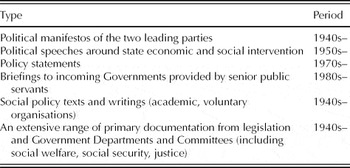
Within the space available here, the attempt is to assemble a corpus and to interrogate it, locating the object to be analysed and the sources used (Jäger, Reference Jäger, Wodak and Meyer2001). The aim is to sample a wide range of documents from the post-war period, exploring how the representation of welfare changed in terms of the vocabulary and subject populations. The interest is the broad patterning across the field of social policy debate and pronouncement post-war rather than single sentences or single documents, which are difficult to take as a reading of a social background (cf. Milliken, Reference Milliken1999) (see Table 1). CDA goes beyond content analysis and explores implied messages, but seeks to do so in a way that is transparent and open to discussion. While a number of similar studies are cross-sectional and examine the operation of new vocabularies, there is value in showing how such vocabularies came into existence and the transitions around welfare representation. Taking a longer-run perspective of discourse illustrates the key paradigm shifts and highlights what is introduced to replace previous understandings.
Source material

The study examined:
• Language use including predicates, keywords, phrases and vocabulary.
• Narratives, binaries and indexes that invoke relations and values.
• Uses of metaphors, myths and naturalisations.
• Pointers that cue readers to make bridging assumptions.
• Changing tenor of debate (philosophical, economic and moral) and the hybrids and patterns that emerge over time.
• Subject positioning within texts (Jacobs and Manzi, Reference Jacobs and Manzi1996; Phillips, Reference Phillips1998; Milliken, Reference Milliken1999; Fairclough, Reference Fairclough2000).
In the first instance, the materials were scanned and assessed for content. Once selected for inclusion within the study, they were read more carefully for the purposes of data extraction. An approach that resembles the ‘framework approach’ for analysing qualitative analysis was useful, allowing a number of summaries to be generated and for a process of ‘charting’ to work within and across the summaries and material. This provided the organisation and reduction of material that could act for a basis of analytical reflection. Quotes and blocks of text and associated aides-memoirs were lifted from the original documents and placed on summary sheets.
Families of related material were explored and tracked through time (e.g. the content of political manifestos, or academic texts). This allowed the study to be alert to temporal shifts in meanings. There was also the possibility to compare across families of meaning (for example, was the language of academic texts different to that being used by senior public servants and politicians; and who or what paradigmatic documents heralded shifts in language at particular points?).
Material was viewed in light of particular pre-existing interests: asking about the meaning and assumptions of state intervention; understandings of responsibility (across state, individual, family and tribe); discussions around social security, financial and in-kind provision, family policy, and unemployment. The following discussion provides analysis of the overall trends and developments. It pinpoints a four-fold shift and explores in greater detail some of the implications of the language being used in contemporary social policy debates within New Zealand.
Tracing the rise and fall of New Zealand's welfare state
Finding the welfare state and social welfare
During the immediate post-war period, the state took responsibility for full employment and social services were no longer viewed as a residual safety net but seen instead as an encouragement to economic growth and development. On closer examination of both political and academic material, it became clear that not only was a system being built but a conceptual edifice was also being established. The ‘welfare state’ entered into use after the war to describe a range of social security and services provision,Footnote 2 and during the 1950s the term became widespread within New Zealand (Labour Party, 1949; Scott, Reference Scott1955).
Across political and public administrative domains, the term carried a number of interrelated meanings and registers: empirically it acted as shorthand for publicly funded services and benefits including old age pensions, family benefits, unemployment benefits, health services and education. Politically it signalled that consensus reigned with an accompanying narrowing of ideological debate around the role of the state and shape of the citizenship contract. Economically it captured a system of Government intervention in the economy, reflecting a commitment and acceptance of Keynesian interventionism and rejection of inter-war fiscal and monetary practice. In social-cultural terms it invoked a sense of community, in effect what Anderson (Reference Anderson1983) refers to as ‘imagined communities’. Such evocations were used to iron over difference and became core to processes of nation-building of Maori, European and migrant populations. Thus, the welfare state was a range of inclusive services, interrelated with a consensual political and economic system, and whose rhetoric sought to appeal to, and embrace, all ‘New Zealanders’.
The welfare state debate became effectively depoliticised and along with a related set of terms became part of a new lexicography. Post-war prosperity delivered a view of economic and social destiny, best expressed in the tide of modernisation theory whose reach extended to New Zealand. To rail against the welfare state (frequently capitalised) was to challenge the notion of progress itself.
Alongside the welfare state the ideas of social welfare and its concomitant commitments was accepted by parties on both the left and right. The study allowed comparison to be made across the political spectrum. On the right the more paternalistic view prevailed of ‘the needs of ‘the aged, the sick, the needy and the handicapped’’ (National Party, 1972, 1981); on the left social welfare invoked a stronger linkage to equality of opportunity (Labour Party, 1972). These two dyads (welfare/state and social/welfare) are important because they captured the settlement that has subsequently been rewritten through policy and discursive means.
Until the 1970s there was support for the welfare state and public provision as broadly desirable and which encompassed education, health, housing as well as income maintenance and pensions (Lawrence, Reference Lawrence1970; Palmer, Reference Palmer1977). The academic and political literature suggests that the symbolism of the welfare state was strong, and that it encompassed a wide range of essential public areas, far beyond financial support. Such complacency became eroded with the (re)emergence of what were seen as complex social problems, rediscovery of poverty and inequality during the 1960s. In the 1970s as a result of new costs and growing challenges to provision, ‘welfare state’ and ‘welfare’ took on negative connotations (a point that other commentators have noted in passing – for example McClure, Reference McClure1998: 207, 258). ‘Social welfare’ continued to refer to the provision of monetary benefits and support services through the 1970s for both universal and targeted services, but this was soon to give way to a politicisation and residualisation of terms.
Economising welfare
The settlement of the post-war period was eclipsed with the election of the Fourth Labour Government (1984–90) that began to deregulate the banking and financial system, transport, energy, with associated corporatisation and privatisation. From the early 1980s theory dominated – market theory, public choice and agency theory – and the focus became a priori economic models as a basis for action. The primary activities of this neoliberal administration up to 1990 were in the economic realm, only after that time did focus shift to the social policy arena. Although the story of state restructuring is well known, without attention to discursive elements there is a danger of ignoring a strategic underside.
Identifying the mechanics of ‘reform’ risks overlooking the important policy work attempted during this period. Referred to here as economising, it incorporated both the desire to reduce public expenditure levels and to translate concerns around spending and provision into a new set of concepts. Proponents sought to conduct policy debates within the confines of a market paradigm. Thus Economic Management (1984), a Treasury Briefing paper setting out the agenda for neoliberal interests, instigated a process of translation in which messy policy problems were stripped of complexity and translated into elegant first principles. In effect, Nozickean economic man was used to people discussion and to imprint a vision of market upon state and civil society. Within this document, and amongst subsequent documents and discussions, the emphasis was on axiomatic workings, assumptions of rational economic actors and producing objective and neutral accounts. In a simple way, this was captured by how the term ‘welfare’ became a dispassionate measurement: ‘A poorly functioning economy limits opportunities for welfare gains’ (Treasury, 1984: 119). Within this vocabulary, particular interests and values were difficult to express. It was not that welfare state, social justice and notions of community were in some way opposed or demonised within this language, but that these terms were incommensurable and simply could not be spoken at all. Within the advancement of the frame, it was solely individual and market concepts that were able to gain any purchase and expression. Economic Management was a fundamental document that presented a particular view about welfare and its direction; the document needs to be read both for what it says, and for what remains unsaid compared to previous welfare discussions.
These economic callings were not, of themselves, strong enough to perform the ideological work being asked of them however. Clearly, the neoliberal strategy influenced by public choice theory was to flood the political terrain with economic concepts and understandings. Whilst this is itself a discursive strategy, it was not wholly successful in securing the consensus required (cf. Schmidt, Reference Schmidt, Scharfe and Schmidt2001a). From the late 1980s, there was growing recognition that policy debates could not be won through a purely economic rationale and by draining debates of emotion. A focus on groups of the undeserving poor: young people, women at home, early retired and Maori and Pacific populations began to complement, and then replace, this previous abstraction. A human face was now being added to the bloated body of state provision.
Within these discursive articulations, both the welfare state and social welfare were increasingly equated with spending on income maintenance and for particular groups. A growing emphasis of the right and the left was how ‘welfare payments’ undermined self-reliance and self-sufficiency and threatened to induce dependency’ (National Party, 1987: 26). By the 1990s there was an important separation underway; in virtually all documents around welfare and social welfare the provision of health, education and income support payments were seen as separate service areas and a selective universalism was being carved off to leave a residual rump.
Moralising welfare
In 1991 the National Government cut the level of welfare benefits with a view to increasing incentives to enter the paid workforce, improving intergenerational equality and bolstering moral responsibility (Kelsey, Reference Kelsey1997: 280). There were stricter waiting periods to re/qualify for benefit receipt, and the Family Benefit was abolished altogether. The reforms were driven by concern about whether economic growth would benefit all sections of the population, and a worry that children in families and the Maori and Pacific population would be left behind as the economy picked up (MoSP, 2001). Hand-in-hand with these reforms was the shift to a language that individualised, blamed and moralised. A campaign was consolidated around themes of a dependency culture and underclass, as well as the fiscal costs that the increased benefit numbers entailed.
Between 1990 and 1999, National administrations sought to use a number of discursive strategies:
Building a brand. From 1994, National administrations sought to develop a ‘Welfare to Well-being’ brand under which its broad objectives could be advanced (Player, Reference Player1994). The investigation of policy documents over time shows a major break with the past with a corporate vision of welfare provision that increasingly adopted vocabulary and concepts drawn from ideas of New Public Sector Management.
Hyphenating and prefixing. Dyads were increasingly those of ‘welfare spending’, ‘welfare cost’, ‘welfare drift’, and ‘welfare dependency’ (National Party, 1990; Treasury, 1996: 100). Similarly, new populations were identified for attention within ‘welfare-dependent communities’ and ‘welfare-dependent families’, and along with ‘benefit dependent’ such terms became seen as explanatory and prescriptive (cf. O'Neill, Reference O'Neill1997). New words including ‘bludger’ and ‘welfarism’ entered the New Zealand vocabulary influenced in large part by American developments. Recognising this discursive change is important because it signals the introduction of frameworks and theoretical understandings that marked a sharp break with New Zealand's social democratic past.
Residualising welfare. Simply, through policy documents and political debates welfare became a term of abuseFootnote 3 and along with ‘beneficiaries’ used exclusively pejoratively.
Binaries. This included the new brand launched around Welfare versus Wellbeing (Player, Reference Player1994; DSW, 1994, 1995, 1996). Equally, welfare was pitched against self-sufficiency, and dependence and independence presented as mutually exclusive.
Cuing of groups as problem groups. Familiar deserving/undeserving distinctions were introduced around the spectre of beneficiaries, the feckless and the work-shy, and these had frequent racialised undertones. Additionally, a new binary was invoked around the beneficiary versus the taxpayer, thereby narrowing coverage of the deserving and centring work as the welfare state was eclipsed by flexible labour markets.
Birthing new terms and enlarging conceptual grab. The term dependency is not new (see Treasury, 1987, 1990, 1993; DSW 1991), however from the mid-1990s it was less descriptive than pseudo-explanatory (even neoliberal critics used welfare dependency as a descriptor until the mid-1990s − see Kelsey and O'Brien, Reference Kelsey and OBrien1995: 9). Through the 1990s and reflecting developments overseas, dependency was presented as long-term reliance on benefits, and served as shorthand for intergenerational cycles of reliance amongst promiscuous and work-shy populations. The notion of dependency moved from being relational to become an individual flaw (cf. Fraser and Gordon, Reference Fraser and Gordon1994). The emergence of dependency as a predatory conceptual framework reached full flight with the Beyond Dependency Conference (held in Auckland, 1997) sponsored by the Department of Social Welfare and whose main invited speakers were international workfare exponents.
Whereas previous attempts to dissolve welfare and the welfare state used economic language, this was a more abrasive attack. Underpinning most reforms was the belief that welfare change should reconfigure institutions and policies (focusing on supports, incentives and sanctions) but also needed to effect a broader cultural project in shifting how welfare, responsibility and citizenship were conceptualised. This involved ‘educating’ the public about issues such as welfare dependency. This latter ambition is best illustrated by the (unsuccessful) attempts to introduce a Code of Social Responsibility towards the end of the 1990s (Davey, Reference Davey2000; Larner, Reference Larner2000). The Code sought to sketch a set of expectations regarding the behaviour and responsibility of individuals, parents, families and communities, whilst remaining silent on state responsibility and obligation. From 1997 ‘social responsibility’ and ‘strengthening families’ emerged as key notions, and have their genealogy in debates around dependency.
Disappearing welfare
The election of a Labour-led Coalition in 1999 ended a succession of National Party administrations and marked the end of a more acerbic moralisation of public welfare provision. Here again, a reading of a range of political speeches and policy documents suggests an important shift in the welfare debate. Schmidt (Reference Schmidt2001b: 252) identifies that the transformative power of discourse occurs when it is absorbed by an opposition party, and, as with Third Way developments elsewhere, New Zealand Labour sought to reconfigure its policy and presentation. In attempts to ‘modernise’ social welfare, Labour's intention has been to align its traditional values with an increasingly changeable and unstable world, including the perceived imperatives of globalisation and the challenges presented by the knowledge economy: ‘A modern welfare state can't be just a safety net, it has to be a trampoline, bouncing its clients back into full and meaningful participation as quickly and effectively as possible’ (Labour Party, 1996: 325).
Labour's project of modernisation has been about changing the organisation and delivery of benefits, as well as the principles of the system itself. Providing flexibility and opportunity have been the leitmotifs of reform (see Clark and Maharey, Reference Clark and Maharey2001). Modernising welfare provision and maintaining government commitment to ‘active labour market’ intervention is presented as the way to harness the new employment realities of global markets, and policy documents draw a sharp distinction between traditional approaches to ‘social welfare’ and the vision of ‘social development’. Pathways to opportunity outlined a set of aims: a simpler system, making work pay and investment in people, supporting families and children, mutual responsibilities, building partnerships, tackling poverty and social exclusion. The occasional reference to the welfare state is now prefixed/hyphenated with ‘reform’, ‘modernisation’ and ‘new’. The change is seen clearly in the organisational renaming from Department of Social Welfare – to the Ministry of Social Policy – to the Ministry for Social Development between 1999 and 2003.
Social development is said to consist of commitments to supporting and caring for vulnerable members of society (social protection), and a notion of social investment. It emphasises cross-sectoral social policy activity focussed on achieving desirable outcomes and the reduction of social exclusion (MoSP, 2001; Bromwell and Hyland, Reference Bromwell and Hyland2007). The ‘social-investment state’ signals a redesigning of the ‘welfare architecture’ with emphasis on education and training to develop human capital, activation policies and welfare to work, enhancing future opportunities rather than tackling current inequalities, and investment in children (Jenson and Saint-Martin, Reference Jenson and Saint-Martin2003: 79; also Esping-Anderson et al., Reference Esping-Andersen2002; Lister, Reference Lister2003; Dobrowolsky and Jenson, Reference Dobrowolsky, Jenson, Powell, Bauld and Clarke2005).Footnote 4
There are two possible readings of ‘investment’: that current investment will lead to future savings; and, second, that current investment leads to benefits and improvements downstream. Much of its appeal however lies in its ambiguity: ‘Government intervention can be conceived as a ‘social investment’ because there are benefits from policy that is well-designed and implemented’ (MoSP, 2001: 6).
The emphasis is upon refocusing state spending and selective advancement of universalism around health and education, which are seen as worthwhile investments of New Zealand public funds. Measures aimed at promoting active labour markets and developing supply-side responses are argued to produce beneficial outcomes downstream, notably paid work. Again, when the attempt is made to look for understandings of welfare and well-being, the investment rationale and expected dividend centre tightly on paid work. In such discussions welfare is further, and quite literally, re-worked out of debate. As with attempted discursive re-drawing of the 1980s, welfare has shifted from being an opportunity (1950s), to being dependency (1990s), to being irrelevant (due to globalised and modern labour markets). The overarching narratives are those of the market, opportunity and work (Maharey, Reference Maharey2001). Employing a long-run perspective enables the analyst to see these things far more clearly than if simple snapshots were used.
The notion of social investment underpins this series of policy developments, but also serves a clear tactical function where a distinction is drawn – irrespective of whether it can be maintained in practice – between good and bad public spending (something also noticed by UK commentators, e.g. Powell, Reference Powell2000).Footnote 5
Social development
Social development is the latest attempt at re-writing New Zealand citizenship, yet arguably it is upon a template that contains many difficulties. As a notion it has a distinctly local origins (a Ministry of Social Development was called for in the early 1970s, and ‘social development’ continued to be accepted parlance, see Kelsey and O'Brien, Reference Kelsey and OBrien1995). It draws upon the traditional appeal of community development within New Zealand, and also hails to the longstanding notions of indigenous advancement. In combining social plus development it attempts to displace economic man with a more interdependent social being. Social development is tailored for New Zealand conditions and potentially has a powerful conceptual grab.
Social development is a carrier of meaning that is normative rather than simply descriptive, and which is both conceptual and theoretical. To that extent it is useful to compare how those commitments sit alongside more traditional commitments of welfare state. The version of social development advanced also draws upon ‘work-focused welfare’ and the economic−social policy fusion of the early 1990s. What was relatively inchoate under National has begun to mature under Labour administrations. And while not denying the positive programme and funding outcomes advanced under the groundcover of social development, there are at least five reasons why, on closer examination of the political and policy literature, ‘social development’ must be handled carefully.
Time. As with the concept of investment, social development is embedded as future opportunities rather than present inequalities. Elevating ‘a lifetime love for learning’ defuses debates around poverty, benefit adequacy and entrenched disadvantage. The focus marginalises retrospective questions such as: where does inequality come from, what is the basis of identity, and what does experience tell us about mobility?
Market. The market drives social development and the contingent citizenship that results is market-determined. With inclusion seen to result from paid work there is a danger of overvaluing citizens in one sphere to the neglect of other forms of productive contribution.
The ‘social’. social development ostensibly captures the role of markets, families, state and community. Yet state responsibility is never outlined fully and appears more about matching individuals with markets than a robust notion of inclusion. Such strategy conflates opportunity and responsibility – projecting that those failing to achieve inclusion under such terms have only themselves to blame (also Dean et al., Reference Dean, Bonvin, Vielle and Farvaque2005: 13).
Development. There are competing conceptualisations of development that emphasise labour market attachment or human capital and within New Zealand the emphasis is upon the former. Development is being stripped of its ‘universalism’ (and fuller notions of human development) to become a residual labour market strategy – parting way with lifelong learning.
Progress as process. Within social development lies a new narrative of progress reminiscent of earlier modernisation theory. Under this ‘new’ modernisation the emphasis is upon individuals as market participants and it is taking part rather than outcome that matters. Mobility is elided with opportunity, and participation given as the sole guarantee that all lives will be lived on an upward slope.
Conclusion
The paper has explored the changing language around state intervention and social responsibility, identifying a four-step change in the post-war period. Given social development is the contemporary articulation of welfare discourse, the paper explored in some detail the impact of such a discourse on emerging citizenship debates. If ‘social development’ is to be more than simply part of the politics and management of depoliticisation (Connolly, 1983; Hay, Reference Hay2004; Burnham, Reference Burnham2001), its presentation and content must attend to these five issues. There are clearly limits around what a renaming can achieve and dangers of engaging in a politics of euphemisms (Schram, Reference Schram1995: 24). However, the extent to which this notion of social development, or any other, can recover lost frames of reference around rights, justice and equality is a war still worth waging.