Pensions gradually developed in most industrialized countries in the nineteenth century, but spread more rapidly in the twentieth century.Footnote 2 They emerged from growing concern over the fate of the elderly.Footnote 3 However, the reality of old people's poor living conditions at the turn of the twentieth century remains in question. For instance, in the United States, some authors stress the high rate of voluntary retirement among the elderly in the nineteenth century, for both farmers and nonfarmers.Footnote 4 Other works argue that many elderly industrial workers were being pushed out of the labor force and forced to stay unemployed or to take inferior jobs.Footnote 5
A major issue is thus the extent to which the elderly had economic resources on which to live. Relying on a large representative sample of the French population, we use probate records to compute the share of individuals who were able to finance their retirement. We find that only a minority were able to rely on their accumulated wealth. First, a large proportion of the French population may have had incomes that were too low for them to put money aside, quite apart from other difficulties they may have encountered, such as work accidents, career interruptions or declining wages as they aged. Both credit and labor-market imperfections led to considerable uncertainty that might have deterred savings and prevented the accumulation of retirement savings. Second, retirement income depended on the evolution of the value of assets between the moment they were accumulated and retirement.Footnote 6 In the case of France, a country that underwent two major wars (1870 and World War I) and two considerable economic shocks (the 1875–1896 and 1929 crises), most people experienced a decline in the value of their portfolio during their retirement period.Footnote 7
At the same time, a growing number of private and public jobs offered contracts that included old-age benefits. More and more elderly were therefore entitled to pension annuities once they retired. In the current article, we compare these pensioners with non-pensioners. Beside pension annuities, one key difference between the two groups is that pensioners had much more stable jobs. We have substantial information on wealth as well as pensions received by individuals in our sample. Thus, we can directly compare the savings behavior of pensioners and non-pensioners. We observe that, after controlling for some structural differences between the two groups, pensioners were more likely to have accumulated some assets. They were also, on average, wealthier. We argue that, as a result of both job tenure and pensions, pensioners had a higher permanent income which explains why they saved more. In fact, long-term employment and old-age pensions created opportunities that allowed individuals who couldn't otherwise been able to save to actually accumulate assets.
LIVING OFF OF ANNUITIES: SAVINGS AND PENSION RIGHTS
According to life-cycle theory, individuals save during their working lives in order to draw on those savings during old age.Footnote 8 They accumulate assets to insure themselves financially against a particular risk, that of living to be old. If individuals can accurately predict the year of their death and have no desire to bequeath wealth to others, they would optimally time the spending to leave themselves with zero wealth on the date of their death. However, many people die unexpectedly and others live long past the date they anticipated. Assuming that people cannot forecast their date of death accurately, we use information on assets at death and access to pensions to get a sense of what income people who were not working would have drawn from their assets and pensions had they lived past the age of their death and had the expected lifespan of someone of their age who was living when they died. This will be a lower- bound estimate of the person's anticipated income while they were alive to the extent that people could accurately forecast their date of death and time the spending of their wealth to reduce it to zero at death.
SAVING ENOUGH MONEY ON WHICH TO LIVE
Under these assumptions, the proportion of the elderly with sufficient wealth to provide for themselves can be estimated from our sample. We have wealth information for more than 25,000 individuals who were over 55 years old when they died. We match this sample with data on life expectancy by cohort and age.Footnote 9 We thus have information on wealth for each deceased person and life expectancy had the person lived. We assume that each individual consumes a fixed annuity every year out of his wealth. We do not include interest on the capital, which will lower the payout slightly given the low contemporary returns on assets. These data allows us to estimate the percentage of individuals with enough assets to live on over their remaining expected life spans.
This percentage is heavily dependent on the target annuity level. We can sketch a simple hierarchy of incomes by considering three benchmarks: one for a middle-class income, and two for the bottom tail of the income distribution. Twice an unskilled laborer's average yearly wage of 2,000 French francs (FF) in 1914 prices is likely a reasonable measure for the middle class.Footnote 10 For the bottom tail, we use 500 FF, half of a laborer's annual wage, as one measure. The 500 FF estimate may indeed be an upper bound for the bottom tail, so we consider the level of living offered by poverty relief. In the United States, for instance, over the same period, Union Army pensions in 1900 came to about one-third of a laborer's income.Footnote 11 In England and Wales, state old-age pensions were even scantier, representing “around one-sixth of the average earnings of an adult male manual worker” in 1908.Footnote 12 The same ratio applies in France where the 1905 Law on mandatory support of the elderly set a maximum support level that varied from 60 FF to 200 FF with a typical maximum of 150.Footnote 13 An income of 60 FF to 200 FF hardly allowed an elderly individual to live independently, except if we assume that his family provided him with housing. Translated into food terms, the statutory maximum support level corresponded to a very poor diet, mostly composed of bread (more than 200 kilograms) with some fat, a few eggs and some wine, but without any meat.Footnote 14
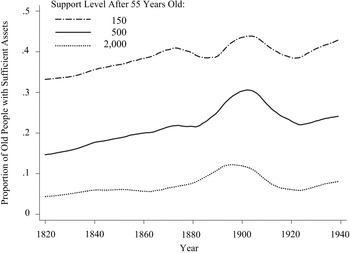
Independently of whether we consider the upper or the lower bounds for the bottom tail, the conclusions remain by and large the same. As can be seen in Figure 1, no more than 40 percent of the elderly in our sample in 1900 had accumulated enough wealth to provide 150 FF per year, fewer than 30 percent had enough to provide 500 FF, and no more than 10 percent could anticipate 2,000 FF per year. These shares all fell after 1900.
Such a situation was not uncommon in industrializing countries at this time. For France, roughly 30 percent of the elderly in our sample died with no wealth at all. In the United States, in 1860 almost a quarter of men older than 55 years old had no wealth.Footnote 15 This proportion may have diminished during the following decades due to rising income, but it remains an important issue in industrializing countries such as France.Footnote 16
PROPORTION OF MALES OVER AGE 55 WITH SUFFICIENT ASSETS TO LIVE OFF OF

PENSION ENTITLEMENT
Given the shares above, many of the elderly had to continue working or rely on other means of support. One was to rely on their families. Falling incomes for the elderly may have been compensated by contributions from other family members, especially children. In the United States, for instance, Brian Gratton appeals to budget studies between 1890 and 1950 and argues that family support ensured adequate provision for parents' old age.Footnote 17 Moreover, there was a substantial amount of coresidence in the United States, at least until the 1920s.Footnote 18 Generally speaking, however, as Chulhee Lee notes, “it is questionable how much of a reduction in own earnings of a person at older ages could have been supplemented by increased earnings of children.”Footnote 19 In France, in particular, where annual incomes were lower than in the United States, and where the number of parents with inadequate savings for retirement increased over this period, it seems unlikely that the family would have been able to compensate for the older generation's lack of resources. Furthermore, there is little evidence to support the claim that family support grew at the end of the nineteenth and the beginning of the twentieth centuries. The few studies available on family support in this period show, at best, a stagnation in coresidence.Footnote 20 At the beginning of the twentieth century, roughly half of the elderly lived with a younger person.Footnote 21
A rising share of the elderly did have access to an occupational pension. In France during the period under survey, workers with pension rights primarily worked in the civil service or large firms. In a standard life-cycle framework, the pension availability would influence the amount of savings by changing both permanent income and the savings motives.Footnote 22
On the one hand, permanent income may have been higher for workers entitled to a pension since they received an income in retirement and may in addition have benefited from more regular income over their careers. Indeed, having a long and mostly uninterrupted career was most often a necessary precondition for pension entitlement. Long-term contracts were a way both to motivate the young to stay in the firm and to encourage workers to perform at a higher level of effort, resulting in higher permanent income.Footnote 23 Since most pensions were offered by very large firms, state-owned firms or the public sector, workers entitled to a pension benefit also may have received additional benefits from quasi-rents due to the productivity gains or to rents accruing to firms that could act like monopolists.Footnote 24
On the other hand, however, workers with pension rights had less incentive to save than someone without pension rights. Since they would benefit from a secure income after they retired, pensioners may have saved less during the active part of their life cycle. The pensioners might have had less of a bequest motive because they did not have to depend on family and friends for help when they were elderly. Finally, since pensioners were employed in more stable jobs, their need for a precautionary buffer stock of savings before retirement should have been smaller, since they faced less unemployment risk and less uncertainty about fluctuations in income. Data from a large survey conducted by the Office du Travail in 1892 on industrial firms shows that yearly turnover was almost 25 percent as a whole and 30 percent in small firms.Footnote 25 These short-run turnover rates in small firms, where pensions were generally not offered, show that industrial employment was more unstable than in the large companies and the public sector where pensions were more common. In the longer run, there is evidence from the census of 1896 that many wage earners, voluntarily or not, left the manufacturing sector quite early to work for themselves. Less than 22 percent of the industrial male labor force was older than 45, while the proportions were 37 percent in the public sector, almost 50 percent in railway companies, and above two thirds in self-employed jobs.Footnote 26
THE SLOW AND TORTUOUS BIRTH OF A PENSION SYSTEM
Neither private nor public institutions had much success in implementing a compulsory saving scheme before the turn of the twentieth century. At the beginning of the nineteenth century, pensions existed almost exclusively for civil servants. Pensions for civil servants were introduced by the Act of the 22nd of August 1790: “Any citizen who has served the state for thirty effective years, either in a military career or in civilian position, is entitled to a pension set at a quarter of the last working wage received, in the case of civilian employees, for a period of at least three years.” The 1853 Law marked the first step on the long road towards a generalized pension system. It unified all of the civil service pension systems, reorganized them, and considerably extended the number of sectors to include school teachers and postmen. Although the initial law was amended many times, its fundamental principles remained the same throughout the period under review.Footnote 27 In 1860 there were 129,000 pensioners from the state, almost equally divided between military and civilian pensioners.Footnote 28 The pension plan for these pensioners was very similar to the 1790 structure and the basic structure was similar throughout the period we study.
In contrast to the situation for state workers, few private companies offered pensions as late as 1900.Footnote 29 According to a large survey on pension schemes in industrial firms, only 5 percent of the workers were employed in firms with a pension scheme.Footnote 30 The proportion grew over the next three decades. In 1929 there were about one million elderly with pensions, roughly one-fifth of the elderly population. There were 608,000 state pensioners, 150,000 with railroad pensions, 80,000 mining pensioners, and 102,000 pensioners from mutual societies.Footnote 31
Many difficulties–both economic and political–slowed down the attempts to extend these schemes. Workers did not trust the companies who promised incomes in old age in return for compulsory deductions from their wages.Footnote 32 They feared that pension agreements gave too much power to bosses by tying the workers to the firm. There was also a considerable risk of losing pensions when firms went bankrupt or managers made arbitrary decisions. Further, the deductions for pensions often meant cuts in immediate take-home pay that workers did not want or simply could not afford. When mandatory deductions were introduced by the Law on Pensions for Workers and Laborers (Retraites Ouvrière et Paysannes) in 1910, both employers and workers protested, and the mandatory rule was given up in 1913.Footnote 33 The invention of a retirement system can thus be seen as the extension of the initial privileges enjoyed by small groups of civil servants and skilled workers. A universal pension system was only introduced after the Second World War.Footnote 34
Despite some common characteristics, there was significant variation across the programs for civil servants, workers in state-owned firms, miners, railway workers, and workers in large industrial firms. State pensions were funded by a 5 percent levy on wages that entered directly into public finances. Employees were eligible for pensions if they had at least 30 years of service and were 60 years old (or less in some activities). In most cases, pension levels were set to half of the mean of the last six years of wages with an upper bound. Workers from arms factories and other state-owned firms had their pensions financed by a 4 percent levy on the wage which was balanced by an equal contribution from the employer. Except for the minimal age of 60 years, there were few other conditions to qualify for a pension. If its value was below a certain threshold (roughly half the yearly wage of an unskilled worker), the state paid the difference provided the worker had worked for 30 years which is most frequently the case.
Large private industrial firms had each engineered their own pension plans. Schneider, one of France's largest iron and steel firms, established a pension system for elderly workers on May 1st 1877 without any levy on wages. Only the company contributed, giving a fixed amount of the wage to the Caisse Nationale des Retraites (3 percent for workers before 40 years old and 4 percent or more after, depending on the type of work). Railway companies all had a similar pension scheme. The only original feature was that eligibility rules were lighter for train workers. Train crews who worked for the Compagnie des chemins de fer de l'Ouest, for instance, could retire at 55 years old after 25 years on the job, while other employees had to be 60 years old with 30 years of work. The pension value could not be below a given threshold and was based on the average wage of the last six years multiplied by 1/60th of the total number of years worked. Finally, mining companies shared the same pension schemes where both workers and the firms each contributed an amount equal up to 4 percent of the worker's wage. Retirement was possible at age 55, after 30 years of work with at least ten years in a row.
Two features of the pension schemes may have influenced saving behavior. First, pension entitlement meant receiving a regular income after retiring from work, and in the core group of pensioners the level of the pension was reasonably high, because replacement rates were also high and based on the best years (the last ones) of the worker's career. In addition, there was often a minimum pension value. So, overall, pensions were quite generous. This core group that encompasses the five groups considered above covers about 95 percent of pensioners.Footnote 35 Second, pension entitlement had another consequence: although heterogeneous, pension rights were grounded on the same key principles. There was a mandatory retirement age–60 years old being the most common, even if a large minority of workers may have gotten a pension as soon as they were 55 or even 50. The programs required a minimal number of years of enlistment. The standard was 30 years, but some occupations considered as hazardous, such as mine workers or train drivers, had lower requirement of 25 or even 20 years worked. The requirements for minimum number of years worked greatly influenced the permanent income of workers eligible for pensions because the pension was available only to workers with very long job tenure with the firm or government. They not only received income after retirement but had higher permanent incomes before retirement because they had far more regular employment.Footnote 36
DATA ON ASSETS AND PENSIONS
To examine the relationship between access to pensions and wealth at death, we use a subsample of the TRA survey.Footnote 37 This survey covers individuals whose last names begin with the letters TRA and who died after 1820. It includes data on their situation at death, including age, marital status, place of residence, and assets. We consider a subset of this survey, consisting of individuals aged 55 or more, which was the standard retirement age in most pension schemes, especially in the private sector.Footnote 38 In the public sector, however, the retirement age differed between branches, with a maximum of 60 in most cases and 55 for the Army.Footnote 39 All of the results that we present are robust to changing the threshold age to 50 or to 60. We also exclude women, as they represent only a minority of the pensioners. Our final sample includes just under 10,000 individuals.
The value of assets at death is based on information gathered by the Fiscal Department (l'Enregistrement) which, in order to levy a modest flat-rate tax on assets for direct-line inheritances, carried out meticulous inquiries into the value and composition of the deceased's assets. These data are complemented by information from birth, marriage, and death registers, especially marriage data.Footnote 40 The Fiscal Department's evaluation of assets was done consistently over the period. In 1901 the tax was shifted from a flat rate to a progressive tax with some deduction of liabilities. This reform does not affect the measurement of assets because the tax was still levied from the first franc and all estates were valued with equal attention by the Civil Servants in the Fiscal Department.Footnote 41 As Adeline Daumard notes for Paris–and there is nothing to suggest that the situation was any different elsewhere in France–“even very modest estates were frequently declared, even when the distribution between heirs was amicable.”Footnote 42
The Fiscal Department had to deal with increasingly varied and sometimes complex assets. However, the instructions given to the data collection officers at various dates indicate that techniques were refined over time and standards remained high. There is no evidence of increase in concealment or of types of assets whose content or size would have systematically escaped the attention of the Registration Department. The instruments used to check and classify the information improved continuously and led, in particular, to the creation in 1865 of the General Directory (Répertoire général), which was designed to centralize the data on all of the real property transactions conducted over individuals' lifetimes. Although the 1901 Act allowed for the valuation of estates net of liabilities, which was not previously possible, the measure used in the analysis is the gross value of the estate to maintain consistency with earlier period.
The Pensioners
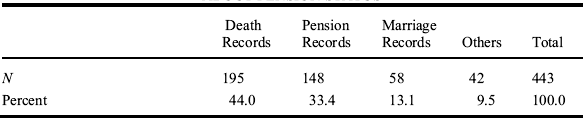
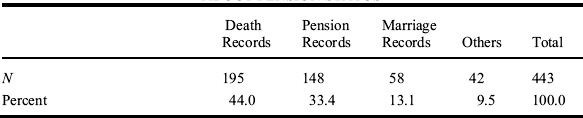
The core of our sample consists of fiscal records, which provide information on wealth. We distinguish between pensioners and non-pensioners in four different ways. First, we consider the occupations declared at the time of death in the estate records. We assumed that school teachers, miners, rail workers, and civil servants were all receiving pensions. Second, we take advantage of the list of public pensioners from 1800 to 1908 in the Bulletins des lois for the relevant years.Footnote 43 These two sources give us 77.4 percent of all pensioners (Table 1). Third, after matching fiscal and marriage records, we consider occupation at marriage and, fourth, we also consider other sources; mainly the occupation at the marriage of the individual's son.
DISTRIBUTION OF THE SAMPLE ACCORDING TO SOURCE FOR INFORMATION ABOUT PENSION STATUS
Sources:
See the text.
To be sure, there was no clear cutoff line between occupations with pension and those without. We chose to consider as pensioners anyone declaring a pension job even if some of them may not have actually received a pension. In the beginning of the nineteenth century, the pensions linked to pension jobs were not always mandatory. Mandatory retirement started in 1853 for state civil servants; in 1894 for miners; and in 1895 for railway workers. However, less than 10 percent of those identified as pensioners in our sample retired during a period when pension were not mandatory in their sector (for instance, 6 percent of school teachers died before 1864, 10 percent of railway workers died before 1895). Age of entitlement also varied over time and by occupation, being mostly around 60 years old as mentioned before. In order not to miss any pensioners, we include all individuals over 55 years old but our results are independent of the choice of the age cutoff. Finally, enlistment length may also undermine receiving a pension. We have no clue on whether the elderly people we identify as pensioners stayed long enough in their occupation to get a pension but most of them certainly did: those identified in the Bulletins des lois were pensioners for certain and those identified based on the occupation at death were very likely to receive a pension. More precisely, a quarter of them are declared “pensioners” (retraités). The others are listed in pension jobs when they died and it is extremely unlikely they entered such jobs late in life.Footnote 44
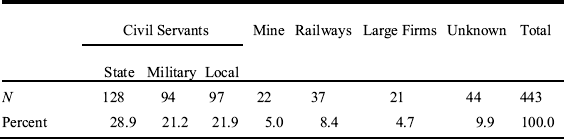
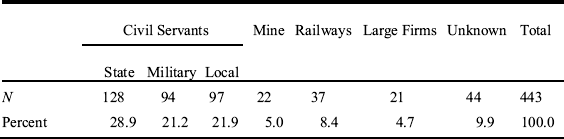
DISTRIBUTION OF PENSIONERS IN THE SAMPLE ACCORDING TO THEIR EMPLOYMENT SECTOR
Sources:
See the text.
To sum up, 45 percent of those we identify as pensioners certainly had a pension (those listed in the Bulletins des lois and those declared “pensioners” (retraités) at their death). For the rest of the sample, we have to choose between two types of error–wrongly consider them as non-pensioners and wrongly consider them as pensioners–but we decided to stay with the more probable of the two: we consider as a pensioner anyone who lists at least one occupation that gives access to a pension. There is little reason to believe that these individuals failed to receive pensions, for most such jobs (in the civil service and in big companies) had access to a pension.Footnote 45
The distribution of pensioners in our sample according to their employment sector reflects the different groups we identified in the previous section as those with pension jobs (Table 2). Seven out of ten pensioners come from the public sector, either in military or civilian occupations, which is a consequence of both the high proportion of public workers in the total of pension jobs in the country and of the fact that we observe pensioners all over the nineteenth century, before railway or mining companies produced a large amount of pensioners. To be sure, our sample probably underestimates workers from large firms in pension jobs. But overall it is covers the various sectors supplying pension jobs.
The combination of these sources tells us which people had occupations or were in industries with access to pensions, or with “pension jobs.” In fact, half the pensioners from one source were also identified as pensioners in another source. Without the state pensioners file, we would have missed about one-third of all pensioners. However, we find no significant differences between the individuals we found and those we missed. More details on robustness checks and matching results between sources are provided in the Appendix.
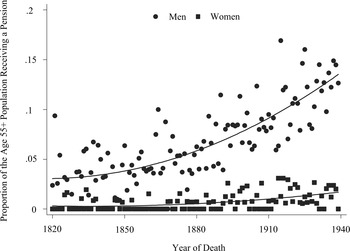
PROPORTION OF THE AGE 55 AND OVER POPULATION WITH “PENSION JOBS”

For a subsample of public-sector pensioners, we know the precise date of retirement and the value of the pension. So the final way to test our results is to consider only this subsample and assume that everyone else is non-pensioner. This does not alter our results. For instance, all of the results presented below hold equally in the sample of public-sector pensioners only.
Over the whole period under consideration (1820–1940), Figure 2 shows that less than 20 percent of elderly men and less than 5 percent of elderly women were in pension jobs. However, the percentage of people with pension jobs in the elderly population increased steadily from 2 percent in circa 1820 to 15 percent on the eve of the Second World War.Footnote 46
This trend for men is consistent with both an increase in the number of workers in occupations that had long been eligible for pension–mainly in the Civil Service, railways, or mining–and an increase in the number of occupations and industries that offered pensions.Footnote 47 Consequently, while the proportion of old people able to live off of their assets fell at the beginning of the twentieth century, the share of those in pension jobs rose slowly. Overall, the trends presented above imply that an increasing proportion of the elderly had jobs with access to pensions. However, the extent to which they were able to live off of the pensions they received depends on their value.
The Value of Pensions
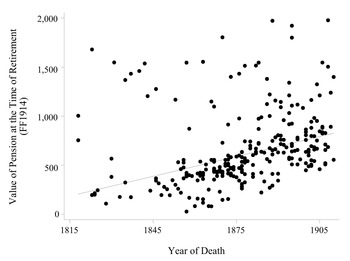
For 278 pensioners, we have information on both their career and the yearly value of their pensions at the time of retirement. As Figure 3 shows, the value of these annuities rose steadily throughout the pre-World War I period. Before 1914 their mean value is slightly more than 800 FF per year. This compares favorably with average incomes at this time, putting pensioners at a position above the bottom earnings deciles. Considering that a 55-year-old had more than fifteen years of life remaining, the present value of pension benefits represented an enormous amount of savings. There is then no doubt that these pensioners were able to live off of their pensions. However, the amount shown in Figure 3 is pension value at the time of retirement. This may subsequently vary during retirement as a result of inflation. Pensions were adjusted for inflation, but this adjustment was both retrospective and irregular, and varied substantially according to the previous sector of employment. Thus, even if pension values were fairly high, they may only imperfectly reflect pensioners' purchasing power. In certain specific years–for example, the high-inflation period following World War I–the real value of pensions was substantially reduced.
THE PENSION-SAVINGS NEXUS
We consider whether the elderly who were in industries and occupations where pensions were available had more assets at death than those in industries where pensions were not available. We analyze individuals with at least 150 francs of savings. As argued above, this amount was barely enough to live on for one year at a reasonable standard. Under this threshold are those who could not live without some additional support. To some extent, this amount represents one year of precautionary savings. We consider the probability of holding assets of over 150 francs, given individual characteristics. To do so, we use a standard probit model where the dependent variable is a dummy equal to one if the individual owns more than 150 francs at the time of death. We regress this variable on a dummy variable for pension receipt and a number of other controls.
THE VALUE OF PENSIONS ACCORDING TO RETIREMENT YEAR

We take into account the control variables that were the most likely to influence the probability of holding assets. Age at death matters greatly as individuals dissaved a little after age 60. Place of residence at the time of death is also important because it was easier to buy a small piece of land in a rural area than an urban real estate. We also control for marital status, something that clearly influenced savings decisions, as married individuals with children were more likely to have bequest motives, and birth cohort, both because wealth distributions changed over time and retirement pensions became more widespread.Footnote 48
In the model 2 specification, we include dummies for the skill level of the person's occupation in one of the regression models as a way to capture part of income heterogeneity.Footnote 49 Moreover, individuals may have inherited at least part of their wealth. For a subsample, we have information on wealth for both the father and his children. In model 3a, we can estimate whether people with pension jobs were wealthier, given the level of their father's wealth.Footnote 50 As this information is limited to a subsample of our data, in model 3b, we run the same estimation on this sample without the father variables to show the impact of the father's wealth within the same subsample. The historical period is also important due to changes in access to pensions, wealth in France, and political changes over time. To check if the effect of pensions changes over time, we run the regression separately on those born before and after 1830 in models 4 and 5.
Even after controlling for these characteristics, we may face a selection bias. If those who choose occupations with pension entitlements do so because they have certain characteristics which are correlated with the propensity to save, then we may wrongly attribute a higher savings rate to pensions. For instance, we might imagine people in pension jobs to be more risk-averse and thus more prone to save for precautionary reasons. It is not clear that people in pension jobs were more risk averse, however, because the very dangerous jobs in mining and the armed forces were offering pensions.
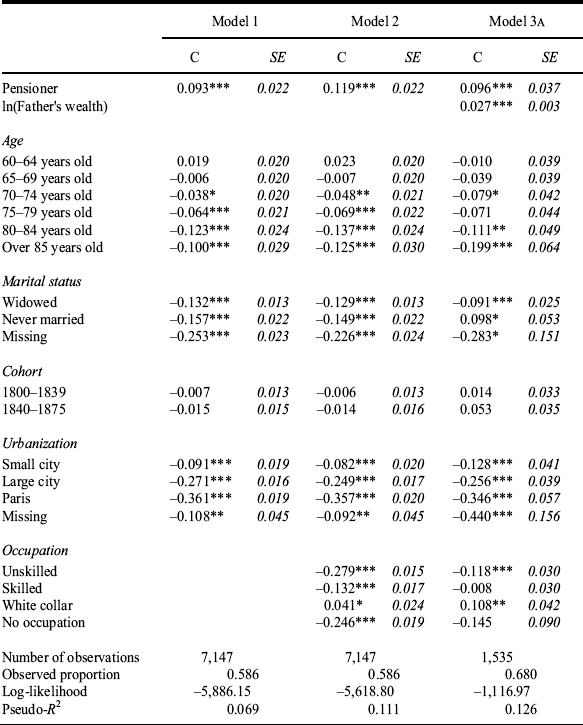
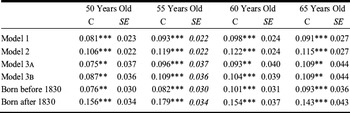
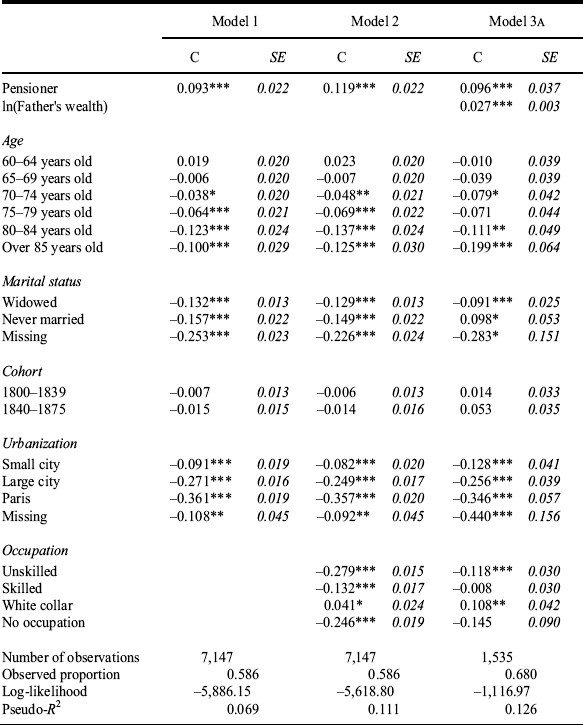
The probit results are shown in Table 3. The marginal effects from the probit analysis reveal a statistically significant relationship between pension jobs and the probability of having at least 150 FF in wealth at death in all models. In model 1, pensioners were 9.3 percent more likely to own assets of over 150 francs. More importantly, the addition of more controls in models 2, 3a, and 3b lead to similar estimates ranging from 9.6 to 11.9 percent.
EFFECTS OF PENSION RECEIPT ON THE PROBABILITY OF HAVING AT LEAST 150 FRANCS AT DEATH – MARGINAL EFFECTS
* = Statistically significant at the 10 percent level.
** = Statistically significant at the 5 percent level.
*** = Statistically significant at the 1 percent level.
Notes:
The figures are marginal effects and their standard errors. Model 3b is model 3a without father's wealth. Both models also include controls for father's age at death and the urban level of his place of residence. The omitted categories are as follows: Age = Between 60 and 64 years old; Marital status = Married; Cohort = Born between 1760 and 1800; Urbanization = Rural; Occupation = Farmer.
The relationship between pension jobs and assets at time of death increased over time. Pension jobs raised the probability of holding more than 150 FF at death by only 8.6 percent for those born before 1830, but raised it by 17.9 percent for those born after that date. The change may reflect two factors. First, pensioners were not hit as hard as others by the fall in asset values at the end of the nineteenth century because they always had their pension.Footnote 51 Second, as time went on, an increasing number of people from lower social groups were in jobs that entitled them to pensions, which gave them easier access to wealth. Thus over the course of French history, not only did more old people receive pensions, but an increasing number of unskilled workers did. This development clearly constituted a major change for those who had no savings to live off of in their old age.
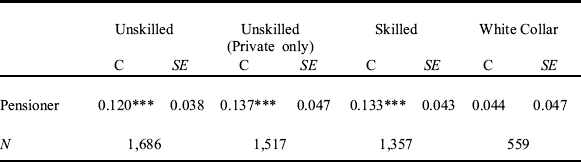
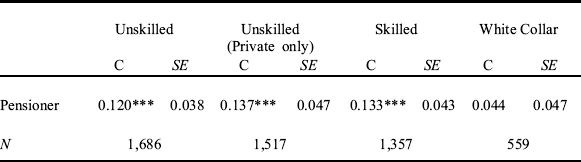
EFFECTS OF BEING PENSIONED BY OCCUPATION
Source
See the text.
To provide further detail on the link between pensions and wealth, we consider this relationship separately for each occupational group in Table 4. Not surprisingly, the relationship is statistically insignificant for the highest occupational group. This is certainly because the pension amount is relatively small compared to this particular group's standard of living. For white-collar workers, assets of over 150 francs were commonplace, so pension receipt likely did little to raise their wealth over 150 FF. However, for the poorest groups in society, the effect is strong and statistically significant. Among unskilled workers, those in pension jobs were 12 percent more likely to own assets; among other workers this figure is similar, at 13.3 percent. This result holds even if we consider only unskilled private workers. Access to savings is undoubtedly favored by access to pensions, but was fairly limited for some social groups before the introduction of pensions. For instance, based on the coefficients in model 2 in Table 3, the average unskilled worker without a pension was 27.9 percent less likely than a farmer to possess assets of over 150 FF at death; a skilled worker was only 13.2 less likely, while a white-collar worker was 4.1 percent more likely to have at least that level of wealth. Pension receipt reduced the gap in access to wealth between the lower and the higher groups of worker. Based on the coefficient for unskilled workers in Table 4, having a pension job raised the probability of dying with at least 150 FF from 27.9 percent below a farmer's probability to 15.9 percent below, which is near the 13.2 percent probability of dying with 150 FF for a skilled worker with no pension.
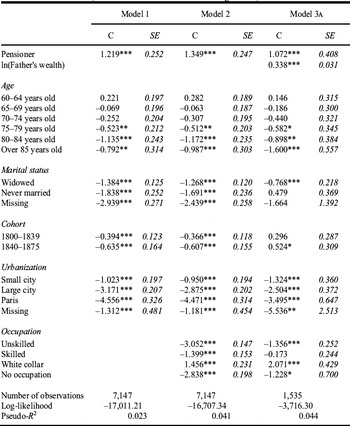
We have compared two groups, the poor and the wealthy, with the cut-point between the two being 150 FF, and we have shown that people with pension jobs had greater access to wealth. A complementary issue is whether the value of accumulated assets differed between the two groups. To see, we estimate a Tobit regression of asset value using the same covariates as in the previous models (Table 5). The value of assets was indeed higher for those with pension jobs. This partly reflects that they were more likely to hold some assets. But it also shows that our results continue to hold when we assume a linear relationship between wealth and pension jobs for people with positive wealth.
The positive relationship between pensions and accumulated wealth is robust to the way in which this relationship is constructed. In particular, it should be noted that a pensioner received the remaining part of his pension proportionally to the number of days between his death and the day he was supposed to receive his pension. So, except for the unusual case when an individual died the day he was supposed to receive his pension, pensioners always had some positive assets. This will bias the estimate had we not take a threshold sufficient to eliminate this effect. As the average pension is around 500 francs and pensions are given by quarter, the average amount left to a pensioner simply because he was a pensioner was likely less than 125 francs. In fact, even though the choice of 150 FF was guided by external arguments from our estimates of the minimum standards of living, our results are insensitive to changes of this threshold to 250 FF or even 500 FF. We have insisted on the threshold model of access to wealth as we consider it to be a decisive consequence of pensions, but our findings are not constrained by the choice of threshold.
Because some individuals in the sample are classified as having pension jobs based on their occupations, it is possible that they receive no pension because they died before they retired or because they did not meet the minimum job tenure requirements to become eligible for a pension. The concern about dying before retirement is serious because the age at which pensioners were eligible for receiving a pension varied between 50 and 65 across firms. As Table 6 makes clear, however, the effect on wealth of having a pension job is robust to the cutoff for when someone was retired and thus receiving a pension. There are no differences in the impact of a pension job on wealth at death based on age. Furthermore, the effect of having a pension job on the probability of holding more assets is slightly lower at earlier ages (around 0.80 against around 0.95). This suggests that the impact of receiving a pension was stronger when pensioners were actually retired and living on their pension annuities, whereas non-pensioners were old and relied solely on falling work income or savings.
EFFECTS OF PENSION RECEIPT ON THE VALUE OF ASSETS (Tobit estimates—asset value is in logarithms)

Notes:
See notes to Table 1.
One might want to push the argument one step further and try to disentangle two effects. The first one derives from the more stable income that the pensioners received during their active life; the other is linked to their receiving a pension. The issue is linked to preretirement savings behavior. Did pension entitlement let individuals refrain from saving when they were still young and working? We observe people dying before age 55 and we can assess whether or not they had a pension job by the same method we use for those over 55 years old. The accuracy of such an operation is less certain since having an occupation offering pensions at age 35 did not guarantee that the person had the same occupation at age 55. However, we can observe the impact of being in a pension job on savings by comparing wealth for people with and without pension jobs who died at ages before and after the official retirement age.
ROBUSTNESS CHECKS: EFFECTS OF PENSION RECEIPT ON THE PROBABILITY OF HAVING AT LEAST 150 FRANCS AT DEATH

Sources:
See the text.
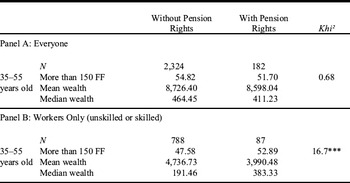
The comparisons in Table 7 offer insight into the effect of being eligible for a pension on savings and wealth accumulation. The people who died before age 55 were not yet receiving pensions, but did know whether or not they would have access to a pension when they were older. Looking at Panel A of Table 7, among those who died before retirement age, people with pension jobs tended to have fewer savings than those in jobs without pensions, but the difference is small and not statistically significant. However, the picture is somewhat different if we consider Panel B, which is restricted to workers. If we focus on workers with at least 150 FF for people who died before age 55, the difference between those with pension jobs and those without is large and significant. Workers with pension jobs also had a higher median wealth, which is consistent with higher savings. Overall, these mixed results make it more difficult to claim that a pension job was associated with reduced saving before retirement.
WEALTH AT DEATH BEFORE AND AFTER 55 YEARS OLD FOR INDIVIDUALS WITH AND WITHOUT PENSION RIGHTS

Source
See the text.
CONCLUDING REMARKS
At the turn of the twentieth century, a majority of the elderly did not have enough wealth at death to live without working or without additional assistance. This share of elderly with low assets rose at the eve of the First World War and during the interwar period. To some extent, a similar phenomenon was seen in eighteenth-century England when old people “were pushed from the margins of independent subsistence into dependent poverty.”Footnote 52 So a growing percentage of individuals had not accumulated sufficient personal savings to support themselves once they stopped work.
Some individuals, however, benefited from either public or private pensions. We compare these individuals to the rest of the population. We show that, among the elderly, those in occupations and industries that offered opportunities for pensions tended to have more savings and were more likely to have personal wealth. The situation we observe in nineteenth-century and early-twentieth-century France may appear at odds with the conclusions of previous works which have claimed that a number of Americans had enough wealth to retire in the nineteenth century.Footnote 53 Part of the difference that we find may be attributed to the fact that American workers on average had higher incomes. However, income distribution also matters and our data from France may help uncover the actual situation for people in the lowest part of the wealth distribution.
In industrializing countries, more or less important segments of population did not accumulate enough wealth to be able to retire either because their income was not high enough to allow them to save or because the incomes were not stable enough to allow them to safeguard for their old age their active life savings. When studying “the savings of ordinary Americans,” George Alter, Claudia Goldin, and Elyce Rotella note that laborers used their savings account “to smooth consumption over the winter months when unemployment and sickness were more common and expenses higher.”Footnote 54 Pension entitlement–associated with job tenure–was a clear answer to this problem as it was a way of forcing people to save. Our findings suggest that the way earnings were given did matter. Had low-paid workers received the amounts deducted for pensions instead as current wages, they might have saved only a fraction of this additional income. In this respect, pensions could be considered as contracts which were beneficial for both workers, who received higher permanent income, and firms, which benefitted from a more stable and better trained workforce. Contrary to what contemporary observers believed, pension entitlement did not deter saving. In fact, it was a way to extend asset ownership to large swathes of society. In particular, it allowed unskilled workers to build up personal savings.
A key point of our work is how the appearance of retirement pensions shaped a new world. The enlargement of pension schemes to a broader part of the labor force offers clues about how pensions influence individual behavior. This article has described a few features of this construction process by highlighting the links between personal economic resources and retirement pensions. But the diversity of resources and their contribution to the survival strategies of the elderly require more in-depth research. One research agenda is to analyze more precisely how pensions changed individual relationships to wealth. What kind of assets did pensioners invest in? Did they have more access to credit because they had a more stable job and the certainty of a lifetime income? Moreover, the rise in pensions occurred at the same time as the development of education and the subsequent rise in the cost of education.Footnote 55 The question remains to be asked whether families would have been able to pay for the latter without the former. In providing access to wealth to a broader share of society, pension systems brought about a change in the use and meaning of wealth. Thus, at the turn of the twentieth century, a major and essential shift occurred in the way in which individuals valued and used wealth.
Appendix
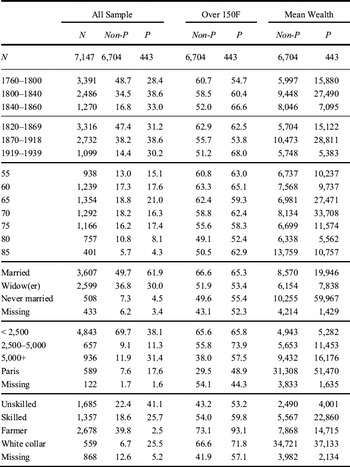
SAMPLE DESCRIPTIVE STATISTICS

Note:
The first column provides the frequency according to the independent variables used in the regressions, and columns 2 and 3 show the distribution of the variable for non-pensioners (Non-P) and pensioners (P) respectively. The two columns entitled “Over 150 F” show the proportion of individuals who owned assets of over 150 francs, while the two columns entitled “Mean Wealth” show the mean value of assets.
Sources:
Compiled from the TRA database.