Introduction
Laryngeal carcinoma is one of the most common forms of head and neck cancer, with an estimated number of 12 370 new cases and 3750 deaths in the USA in 2020.1 About 0.7 per cent of all new cancer cases and 0.6 per cent of all cancer deaths are attributed to laryngeal squamous cell carcinoma (SCC). Although laryngeal SCC incidence has declined because tobacco use has decreased, the 5-year survival rate of 60.6 per cent has not changed significantly over the past years.1
The standard treatment of advanced laryngeal cancer is total laryngectomy with concurrent neck dissection. The loss of laryngeal phonation and the creation of a permanent tracheostoma has shifted the interest of treatment away from this aggressive approach towards an ‘organ preservation’ strategy. Two landmark studies, the Veterans Affairs study and the Radiation Therapy Oncology Group 91–11 study, showed that chemoradiotherapy for advanced-stage laryngeal cancer allowed preservation of the larynx in 64 per cent and 84 per cent of the patients, respectively.Reference Silverman, Puram, Rocco, Old and Kang2 However, a higher rate of long-term mortality, possibly due to the late toxicities, was observed.Reference Silverman, Puram, Rocco, Old and Kang2
Despite the major advances in ‘organ preservation’ strategies, a significant number of patients still experience residual or recurrent disease and will ultimately require salvage partial or total laryngectomy.Reference Wulff, Andersen, Kristensen, Sørensen, Charabi and Homøe3 This type of surgery poses technical difficulties because of post-radiotherapy fibrosis and entails a high rate of post-operative complications. Management of this patient cohort is complex and varies substantially between centres in terms of extent of surgery, prophylactic reconstruction and intensity of follow up.Reference Wulff, Andersen, Kristensen, Sørensen, Charabi and Homøe3–Reference Basheeth, O'Leary and Sheahan5
We present results of salvage total laryngectomy for residual or recurrent disease after radiotherapy or chemoradiotherapy in our department, which represents one of the largest cancer centres in Greece. Specifically, we aimed to evaluate the survival rate and related factors and to identify areas for improvement.
Materials and methods
A systematic retrospective review was conducted for all surgically treated patients with laryngeal cancer in ‘G. Papanikolaou’ Hospital, Thessaloniki, Greece, from 1999 to 2018. Patients who experienced laryngeal SCC recurrence after failure of initial definitive radiotherapy (RT) with or without chemotherapy, showed no evidence of distant disease and underwent salvage total laryngectomy were eligible for inclusion in our study.
Pre-salvage total laryngectomy assessment included detailed clinical ENT examination, computed tomography (CT) scans, magnetic resonance imaging (MRI) of the neck, positron emission tomography (PET)-CT and panendoscopy with biopsy. All laryngectomy procedures were performed by three surgeons, using the same surgical technique. Neck dissection was planned only in cases with clinically or radiologically positive neck nodes. Elective neck dissection in the node negative neck was not performed. Prophylactic coverage of the pharyngoplasty with a flap was not performed. For subglottic tumours or tumours with possible cartilage invasion, a thyroidectomy was performed at the discretion of the surgeon. In cases of a persisting (more than two months) or high volume pharyngocutaneous fistula, a pectoralis major flap was used. Follow-up examination was performed every two to three months for the first two years and four to six months subsequently. Suspected residual or recurrent disease was confirmed by endoscopy and biopsy. The study was conducted in accordance with the Declaration of Helsinki and its subsequent amendments and was approved by the ethical committee of the ‘G. Papanikolaou’ Hospital, Thessaloniki, Greece.
Statistics
Primary endpoints of interest were overall survival, calculated as the number of months from the date of salvage surgery to the date of last follow up or death, and disease-free survival, calculated as the number of months from the date of salvage surgery to the date of tumour recurrence. Descriptive statistics were used to describe the patient population and follow up. Survival was presented using the Kaplan–Meier survival curves method with the log-rank test. Categorical variables were examined by the chi-square test. Wilcoxon and one-way analysis of variance test (three groups) were used to investigate the differences between the groups of patients, and p-values were considered to be statistically significant if below a threshold of 0.05.
Results
Cohort description
Between 1999 and 2018, a total of 658 laryngeal SCC patients were treated at our institution. During the same period, a total of 212 total laryngectomy procedures were performed for primary laryngeal SCC. Among the total number of patients, we identified 31 patients (median age 66 years) with biopsy-proven recurrent laryngeal SCC who required salvage total laryngectomy after failed organ preservation treatment (6.9 per cent of all laryngeal SCC patients and 12.7 per cent of all laryngectomy procedures). Τhe median follow up for the cohort was 45 months.
The most frequent primary tumour site was the glottis (83.8 per cent), followed by the supraglottis (9.7 per cent). Early-stage disease (T1–T2) was identified in 83.9 per cent of patients, and advanced laryngeal cancers (T3–T4) accounted for 16.1 per cent of all cases at initial presentation. Only one patient in the cohort had clinically evident lymph nodes (positive neck node) before primary treatment. The median interval-to-recurrence before salvage total laryngectomy was 12 months. At recurrence, most tumours were advanced (83.9 per cent). Four patients presented with recurrent N1 disease and two patients presented with recurrent N2 disease. All patients underwent neck dissection (19.4 per cent of the cohort). Patients’ characteristics are summarised in Table 1.
Patient and tumour characteristics

*n = 31
Survival data
Overall survival at 2 and 5 years post-salvage total laryngectomy was 71 per cent and 45 per cent, respectively. Disease-free survival at 2 and 5 years post-salvage total laryngectomy was 65 per cent and 42 per cent, respectively. Median overall survival of the patients who received chemoradiotherapy for their primary tumour was 65 months, and the overall survival for those who followed only RT was 55 months.
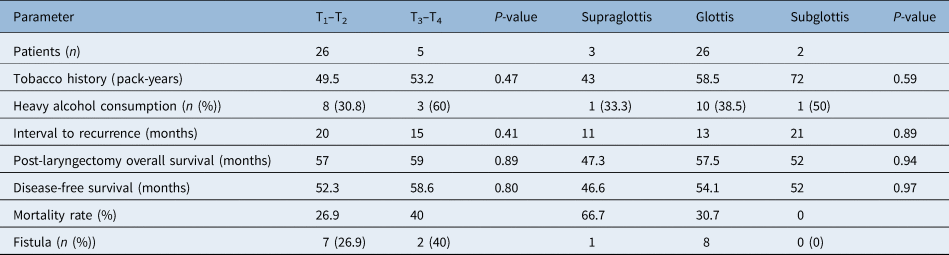
Patients with a history of early primary laryngeal cancer had a tendency for a better overall survival at 5 years than patients with advanced stage cancer (60 per cent vs 38 per cent, respectively; p = 0.89). Patients with supraglottic tumours presented the highest long-term mortality rate (66.7 per cent), and 2 patients with a subglottic tumour were still alive at last follow up. Comparison between early (T1–T2) and advanced (T3–T4) groups and between glottic and non-glottic tumours is presented in Table 2. Overall survival according to the T-stage and the primary subsite are presented with Kaplan–Meier survival curves in Figures 1a and b.
Kaplan–Meier curves. (a) Kaplan–Meier curve of overall survival according to the initial tumour T-stage (95% confidence interval (CI), 0.07483 to 2.1477; p = 0.2858), (b) Kaplan–Meier curve of overall survival according to the primary tumour site (95% CI, 0.1480 to 4.1901; p = 0.7795) and (c) Kaplan–Meier curve of overall survival according to surgical margins (less than 5 mm = close margins and more than 5 mm = free margins); p = 0.4578.

Comparison of patients based on primary tumour stage and subsite

p < 0.05 was considered statistically significant
Five recurrent T2 tumours were upstaged, and one T4 tumour was down-staged (to T3) after pathological examination. Resection margins were negative in 25 patients (80.6 per cent). The median post-salvage total laryngectomy overall survival for negative, close and positive margins was 54, 27 and 22 months, respectively. All three patients with positive margins were treated with post-operative chemotherapy because they had received the maximum dose of radiotherapy to the primary tumour. One patient with positive margins developed metastases to the liver and chest 12 months post-salvage total laryngectomy and died 2 months later. The second patient developed lymph node recurrences bilaterally 12 months post-salvage total laryngectomy. He was still alive at last follow up. The third patient remained disease free at his last follow up, 96 months post-salvage total laryngectomy. Figure 1c depicts the Kaplan–Meier curve of overall survival according to surgical margin status. With regards to neck dissection, 2 of the 6 suspicious neck specimens harboured metastasis (33.3 per cent). These two patients received radiotherapy to the neck. One patient (16.7 per cent) experienced a second recurrence in the neck and died 2 months after completion of radiotherapy, and 1 patient (16.7 per cent) developed distal metastasis in the thorax and died 8 months later.
Patterns of failure
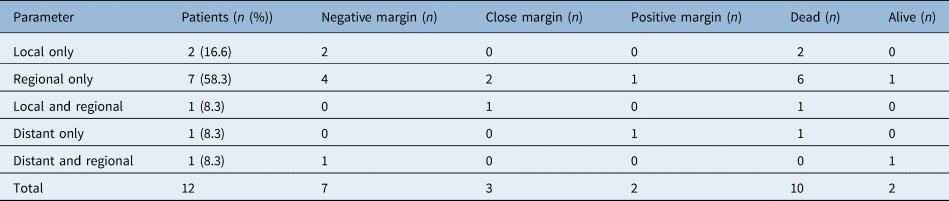
Treatment failed in 12 patients after salvage total laryngectomy (38.7 per cent). The patterns of failure are presented in Table 3. An isolated regional recurrence was the most common type of failure, accounting for 58.3 per cent of cases (7 patients). Six patients had a negative or close margin, and 1 patient had a positive margin. Only one patient with failed neck treatment was still alive during the study period. Five out of 25 patients (20 per cent) with negative resection margins developed neck recurrence. It should be emphasised that none of these patients had undergone neck dissection, based on clinically and radiologically negative neck nodes. Τable 2 provides the details on failures after salvage total laryngectomy.
Patterns of failure

Margins: negative = more than 5 mm and close = less than 5 mm
Complications
No peri-operative death occurred. The most common post-salvage total laryngectomy complication was pharyngocutaneous fistula formation. A total of 9 patients experienced this complication (29 per cent), the vast majority of whom (88.9 per cent) had glottic cancer at initial presentation. Advanced tumours showed a tendency for a post-operative fistula (40 per cent) when compared with the early stage tumours (26.9 per cent; p = 0.32). Four patients needed reconstruction with major pectoralis flap reconstruction. It is worth mentioning that none of the aforementioned patients died from this type of complication. A post-operative haematoma led to an operation theatre procedure in one patient (3.2 per cent). Four patients had a dehiscent wound (12.9 per cent). None of the patients required a long-term gastrostomy.
Discussion
Patients with early-stage laryngeal SCC at initial presentation constituted the majority of our cohort, which is in agreement with other publications.Reference Sandulache, Vandelaar, Skinner, Cata, Hutcheson and Fuller6,Reference Scharpf, Ward, Adelstein, Koyfman and Li7 A considerable number of early-stage laryngeal tumours (16 per cent) fail to respond to treatment for several reasons.Reference Adeel, Faisal, Rashid, Rasheed, Hussain and Malik8 Appropriate planning with daily boosts to avoid under delivery of radiation to the anterior commissure area can significantly reduce the recurrence or residual rate to 2 per cent.Reference Mourad, Hu, Shourbaji, Woode and Harrison9 Tumours with reduced vocal fold mobility (T2) may have paraglottic space involvement missed on CT imaging, and therefore these tumours are under-staged and treated with small radiation fields.Reference Baugnon and Beitler10 Patients who continue to smoke throughout radiotherapy run a higher risk of treatment failure.Reference Browman, Wong, Hodson, Sathya, Russell and McAlpine11 Almost one in three patients in our cohort continued smoking, and this could explain to some degree why radiotherapy failed. Unfortunately, we lack data on compliance to radiotherapy for one patient because treatment was delivered by other institutions.
Our study confirms that recurrent laryngeal cancer, in our setting, represents an aggressive disease. Overall survival at 2 and 5 years post-salvage total laryngectomy was 71 per cent and 45 per cent, respectively. Disease-free survival at 2 and 5 years post-salvage total laryngectomy was 65 per cent and 42 per cent, respectively. A recent evidence-based review of the literature on salvage total laryngectomy outcomes reported 2- and 5-year overall survival rates between 69–76 per cent and 30–70 per cent, respectively.Reference Silverman, Puram, Rocco, Old and Kang2 Two-year disease-free survival rates ranged between 56–72 per cent, and 5-year disease-free survival was estimated to be around 58 per cent.Reference Silverman, Puram, Rocco, Old and Kang2 Our overall survival rates fell well within the reported figures, although the broad limits of the study by Silverman et al. reflect the heterogeneity of the different studies included in the review.
Several factors can affect survival: aggressive biological behaviour, staging at initial presentation, staging at recurrence, subsite, extent and type of radiation, simultaneous prophylactic flaps during salvage total laryngectomy, and elective neck dissections. In order to allow meaningful comparisons, one should combine results of studies with similar populations. Our cohort mostly comprised early-stage glottic tumours (83.9 per cent), which presented within one year with an advanced tumour after failed radiotherapy. No elective neck treatment was performed.
A similar study to ours is that of Ganly et al.Reference Ganly, Patel, Matsuo, Singh, Kraus and Boyle12 All patients had early glottic cancers that failed treatment with radiotherapy, and half of them underwent salvage total laryngectomy suggesting that the recurring tumours were advanced. The 5-year overall survival was 50 per cent, which compares well with our study. Another study including exclusively early glottic cancers failing initial treatment, reported a 5-year overall survival of 64 per cent, which is better overall survival than in our study.Reference Deganello, Meccariello, Bini, Paiar, Santoro and Mannelli13 However, only 38 out of 104 patients had an advanced recurrence (36.5 per cent) compared with 83.9 per cent of our cohort.
Another study with more advanced tumours at primary treatment (28.2 per cent), fewer glottic tumours (71.9 per cent) and hypopharyngeal cancers excluded, reported an even worse 5-year overall survival (41.3 per cent).Reference Wulff, Andersen, Kristensen, Sørensen, Charabi and Homøe3 Regarding the disease-free survival in our study, we observed a comparable two-year rate with other studies, but at five years our disease-free survival was lower than that reported by Birkeland et al.Reference Birkeland, Beesley, Bellile, Rosko, Hoesli and Chinn14 (42 per cent vs 58 per cent). This suboptimal result could possibly be attributed to the different approach to the N0 neck or adverse histological features (the latter is discussed later). Most of our recurrences were regional, presumably because of our conservative management of the N0 stage, whereas Birkeland et al. performed elective dissection (levels II–IV) as well as dissection of paratracheal groups (level VI) in all patients indiscriminately. Inclusion of level VI nodes in the neck dissection for advanced recurrent tumours of the glottis improved overall survival and disease-free survival.Reference Farlow, Birkeland, Rosko, VanKoevering, Haring and Smith15
We observed a tendency of patients with advanced tumours at presentation to show the worst survival outcomes. Advanced stage at presentation, as was the case in our cohort, is related to worse survival outcomes.Reference Wulff, Andersen, Kristensen, Sørensen, Charabi and Homøe3,Reference Mimica, Hanson, Patel, McGill, McBride and Lee4,Reference Scharpf, Ward, Adelstein, Koyfman and Li7 However, other researchers failed to show that compromised survival is associated with the initial stage.Reference Stoeckli, Pawlik, Lipp, Huber and Schmid16 Heterogeneity may again explain the observed conflicting results. A recent, large (244 patients), single-centre study was specifically designed to explore predictors of survival after salvage total laryngectomy.Reference Birkeland, Beesley, Bellile, Rosko, Hoesli and Chinn14 Researchers explored the contribution of initial and recurrent clinical tumour characteristics, initial treatment (radiotherapy or chemoradiotherapy), comorbidities and clinical nodal status at recurrence to survival. They concluded that non-cancer causes of death because of moderate and severe comorbidities, clinically positive nodal status at recurrence and initial staging other than stage I, were the major factors of compromised survival. Patients were more likely to succumb to medical issues rather than their cancer in the first 30 months after salvage total laryngectomy. After this time frame, the probabilities of death were equal between the laryngeal cancer and non-cancer related causes. Patients with mild comorbidities were more likely to die from a post-salvage recurrence.
Histological predictors of survival have also been explored. We have achieved negative margins in 80.6 per cent of our cohort, which is equal to or better than other large studies.Reference Wulff, Andersen, Kristensen, Sørensen, Charabi and Homøe3,Reference Mimica, Hanson, Patel, McGill, McBride and Lee4,Reference Meulemans, Debacker, Demarsin, Vanclooster, Neyt and Mennes17,Reference Hay, Simo, Hall, Tharavai, Oakley and Fry18 Positive or close margins after resection are considered negative prognostic factors,Reference Mimica, Hanson, Patel, McGill, McBride and Lee4,Reference Hay, Simo, Hall, Tharavai, Oakley and Fry18 although there is no universal agreement.Reference Sandulache, Vandelaar, Skinner, Cata, Hutcheson and Fuller6 Indeed 4 out of 6 patients with positive or close margins have died from their cancer in our cohort (66.7 per cent). Scharpf et al. have specifically investigated the pathological variables that may affect survival in an attempt to identify groups for treatment intensification after salvage total laryngectomy.Reference Scharpf, Ward, Adelstein, Koyfman and Li7 They failed to show, in their multivariate model, that margin status has any detrimental effect, but this result may be attributed to the very low rate of their post-surgical positive margins (2 per cent). Their institutional policy was aggressive in achieving negative margins by performing frozen sections and free flap reconstruction if the remaining pharyngeal mucosa was inadequate for primary closure. Other histological predictors of significance are spindle cell histology (both patients with this histological type in our cohort did not survive),Reference Scharpf, Ward, Adelstein, Koyfman and Li7 lymphovascular infiltrationReference Scharpf, Ward, Adelstein, Koyfman and Li7 and perineural invasion.Reference Mimica, Hanson, Patel, McGill, McBride and Lee4 Indeed, we observed a high rate of lymphovascular infiltration and perineural invasion in our cohort (45.2 per cent and 38.7 per cent, respectively), which could contribute to the low 5-year disease-free survival.
The pattern of failures could highlight areas for further improvement. We observed that more than half of our patients who had failed treatment after salvage total laryngectomy (7 out of 12 patients) presented with isolated neck failures, and most of them succumbed to their regional recurrence. Six out of seven patients had early tumours (six glottic and one non-glottic) and were unlikely to have received radiotherapy to the neck. All patients presented with advanced recurrences, and only one patient received neck dissection. The decision to perform neck dissection in the N0 stage neck should be balanced between the risk of increasing the rate of post-operative complications and the benefit of improved survival. However, two recent meta-analyses have failed to show either that neck dissection increases the risk of pharyngocutaneous fistula or that neck dissection provides a clear survival benefit.Reference Gross, Vila, Simon, Rizvi, Zenga and Jackson19,Reference Lin, Lam, Warner and Paleri20 The main argument against an elective neck dissection is that even in advanced recurrences, the rate of pathologically confirmed occult metastases does not exceed 10 per cent, and this is accompanied by an increased risk of complications.Reference Basheeth, O'Leary and Sheahan5,Reference Bohannon, Desmond, Clemons, Magnuson, Carroll and Rosenthal21
One should note that the majority of the studies, including those that fail to show a benefit from neck dissection, do not randomise patients to account for the inherent selection bias.Reference Basheeth, O'Leary and Sheahan5,Reference Sandulache, Vandelaar, Skinner, Cata, Hutcheson and Fuller6,Reference Deganello, Meccariello, Bini, Paiar, Santoro and Mannelli13,Reference Bohannon, Desmond, Clemons, Magnuson, Carroll and Rosenthal21 The lack of benefit from neck dissection could simply reflect the effectiveness of correctly identifying groups that need neck dissection and groups that do not. Both reviews acknowledge that there may be a subset of patients who benefit from neck dissection, but the heterogeneity of studies does not allow subgroup analysis. Therefore, one should individualise the approach to the patient (tumour characteristics, previous treatment, patient wishes, comorbidities) and to the treatment centre (availability of surgical resources). The presence of positive nodes at recurrence warrants neck treatment (surgery plus or minus irradiation if not received at the initial treatment) along with the treatment of the primary disease. However, prognosis is guarded because many of these patients will eventually fail in the neck or distantly.Reference Sandulache, Vandelaar, Skinner, Cata, Hutcheson and Fuller6,Reference Birkeland, Beesley, Bellile, Rosko, Hoesli and Chinn14 Decision making is more complex in the elective treatment of the N0 stage neck. According to Hilly et al.,Reference Hilly, Stern, Horowitz, Leshno and Feinmesser22 the traditional cut-off point (15–20 per cent risk of occult node metastasis) for performing an elective neck dissection in the N0 stage neck in primary laryngectomy will apply to the salvage setting if the expected cure rate after neck dissection exceeds 82 per cent, which is an unrealistic goal. As far as there are no biomarkers to define groups with aggressive biology who would not benefit from a neck dissection, our experience of neck recurrences with very few distant failures dictates that the neck, in our setting, should have received surgical treatment. Even our combined local and regional recurrences could be attributed to the presence of untreated occult paratracheal nodes.Reference Farlow, Birkeland, Rosko, VanKoevering, Haring and Smith15 Elective treatment of the paratracheal basin increases overall survival in advanced recurrences without inducing permanent hypocalcemia.Reference Farlow, Birkeland, Rosko, VanKoevering, Haring and Smith15 The survival benefit is independent of the lateral neck status.
Obviously, early glottic recurrences will not warrant a neck dissection because the rate of occult metastasis or regional failure is very low.Reference Deganello, Meccariello, Bini, Paiar, Santoro and Mannelli13 Supraglottic subsite and advanced recurrences will often show occult metastases in neck dissection specimens (28 per cent and 34 per cent, respectively)Reference Farlow, Birkeland, Rosko, VanKoevering, Haring and Smith15 or will fail more often to the neck if left untreated,Reference Bohannon, Desmond, Clemons, Magnuson, Carroll and Rosenthal21 and therefore an elective neck dissection can be justified. An additional argument for elective neck dissection is that if a neck recurrence occurs after salvage total laryngectomy, therapeutic options are minimal and surgery, in particular, is rarely feasible.Reference Wulff, Andersen, Kristensen, Sørensen, Charabi and Homøe3,Reference Yuen, Wei and Ho23 We could not perform salvage neck surgery in our patients. The recurrences were advanced and the surgical field too fibrotic to attempt a safe procedure. The inclusion of the neck in the primary radiation field produces fibrosis of the neck lymphaticsReference Burge24 but has not prevented neck recurrences in up to 18 per cent of patients.Reference Yuen, Wei and Ho23 Therefore prior radiation of the neck should not be a deterrent from performing a neck dissection. Attempts to detect occult neck metastases with PET-CT, and thus guide the decision to electively treat the neck, have failed because of the high false negative rate.Reference Rosko, Birkeland, Shuman, Prince, Bradford and Wolf25
• This study presents results of salvage total laryngectomy for residual or recurrent disease after radiotherapy or chemoradiotherapy
• Recurrent laryngeal cancer is an aggressive disease with fewer than half of patients surviving beyond five years
• A neck recurrence was the most common pattern of failure that led to death in this cohort
• The most common post-salvage total laryngectomy complication was pharyngocutaneous fistula formation
• Neck dissection including lateral and central compartments is warranted in advanced recurrences, particularly if the neck has not been included in the primary radiation field
• Close surveillance with appropriate imaging after salvage treatment may detect post-salvage recurrences early
Patients experience a high risk of post-operative complications after salvage total laryngectomy, with the most common being pharyngocutaneous fistula formation. A recent meta-analysis reported an overall complication rate of 67.5 per cent, with pharyngocutaneous fistula being the most common (28.9 per cent).Reference Hasan, Dwivedi, Gunaratne, Virk, Palme and Riffat26 The rate of post-salvage total laryngectomy fistula in our study was 29 per cent, which is in agreement with the literature. Chemoradiotherapy at primary treatment,Reference Ganly, Patel, Matsuo, Singh, Kraus and Boyle12 bilateral neck dissection,Reference Basheeth, O'Leary and Sheahan5 prior tracheostomyReference Kim, Roh, Choi, Nam and Kim27 and pre-operative haemoglobin levelsReference Meulemans, Debacker, Demarsin, Vanclooster, Neyt and Mennes17 predispose the patient to fistula formation. Two meta-analyses and one recent study, led by the Microvascular Committee of the American Academy of Otolaryngology Head and Neck Surgery, support the prophylactic use of vascularised tissue (free flaps and regional flaps) in reducing the rate of fistula.28 However, a recent European multicentre study failed to show that a pectoralis major myocutaneous flap (inset or onlay) reduces the rate of clinically evident pharyngocutaneous fistula. It is likely that the success of the reconstruction may depend upon proper post-operative care and surgical technique.Reference Sittitrai, Srivanitchapoom and Reunmakkaew29 We only perform reconstruction when a fistula fails to respond to conservative management.
We acknowledge that the results of our study are liable to certain limitations. Our study is characterised by a small sample size, which could explain the lack of statistical significance in most of the sub-group analyses performed. Additionally, all patients in our cohort received radiotherapy at other institutions and therefore data on the exact radiation fields are missing. As the study spans 20 years, errors in data entry cannot be excluded. Despite these limitations, the study is representative of the head and neck service situation in a country severely hit by the recent economic crisis.
Conclusion
Recurrent laryngeal cancer is an aggressive disease with fewer than half of patients surviving beyond five years. A neck recurrence was the most common pattern of failure that led to death in our cohort. We propose that a neck dissection including the lateral and central compartments is warranted in advanced recurrences, particularly if the neck has not been included in the primary radiation field. Close surveillance, with appropriate imaging, after salvage treatment may detect post-salvage recurrences early and thus permit a surgical approach.
Competing interests
None declared