1. Introduction
Lake Victoria is the world's second largest and Africa's largest fresh water body. The lake faced major problems in the late twentieth century manifested in loss of fish species and decline in catch per unit effort. The open access nature of the lake fisheries combined with rapid population growth, lack of employment opportunities and the lucrative nature of fishing connected to the Nile perch boom have led to an increasing number of fishers and depletion of fish stocks. This decline concerns one-third of the population (or about 30 million people) supported by the lake basin in Kenya, Tanzania, and Uganda (LVFO, 1999). The lake fisheries contribute significantly to the Tanzanian economy in terms of food supply, foreign exchange, and employment opportunities. The contribution to GDP grew from 0.4 per cent in 1993 to 1.8 per cent in 1998 and the Nile perch export value share of total export values rose from 1.4 per cent to 12.7 per cent during the same period (Kulindwa, Reference Kulindwa2001). To secure the livelihoods of the people and to render possible a sustainable management of the lake fisheries, the pressing issues of open access and overcapacity need to be rigorously addressed.
Limiting the number of boats can cap fishing capacity, but capacity will most likely be expanded by other means and will continue to place pressure on fish stocks and dissipate rents. Fishing capacity can increase by expansion in unregulated inputs (Wilen, Reference Wilen1979; Dupont, Reference Dupont1990), via productivity growth (Squires, Reference Squires1992), or by changes in inputs that are hard to observe and control, such as fishing skill (Hilborn and Ledbetter, Reference Hilborn and Ledbetter1985; Kuperan et al., Reference Kuperan, Omar, Jeon, Kirkley, Squires and Susilowati2001). Skipper skill basically comprises all knowledge that influences the productivity of a fishing vessel; skipper skill has been highlighted in a number of recent studies (Kirkley et al. Reference Kirkley, Squires and Strand1998; Kirkley and Squires, Reference Kirkley, Squires and Gréboval1999; Eggert, Reference Eggert2001; Pascoe and Coglan, Reference Pascoe and Coglan2002; Squires et al., Reference Squires, Grafton, Alam and Omar2003). In general skipper skill is an unobservable ‘input’ in the production process, which means that empirical studies have to search for proxy variables such as education and fishing experience. Technical efficiency studies in developing countries are scarce and there are mixed results concerning the usefulness of these particular proxy variables in explaining the role of skipper skills. Kuperan et al. (Reference Kuperan, Omar, Jeon, Kirkley, Squires and Susilowati2001) and Squires et al. (Reference Squires, Grafton, Alam and Omar2003) found the variables to be insignificant and signalled a need for other indicators that can proxy skipper skill and be managed and regulated. Other indicators reflecting motivation or good management of the skipper have been proposed in the literature (see Mundlak, Reference Mundlak1961; Kuperan et al., Reference Kuperan, Omar, Jeon, Kirkley, Squires and Susilowati2001; Squires et al., Reference Squires, Grafton, Alam and Omar2003), but empirical applications are still lacking.
This paper studies technical efficiency and skipper skill using Tanzanian fishery data for the two artisanal fisheries targeting either Nile perch or dagaa in Lake Victoria. The objective is to analyze the relative level of efficiency and to explore potential proxies for skipper skill. The effects of skipper skill are included in technical inefficiency and assess it through simultaneous estimation of a stochastic production (both neutral and non-neutral) frontier functions and an inefficiency function. The results suggest that the Tanzanian artisanal fishers of Lake Victoria are relatively technically efficient and that skipper skill does play a role in the efficiency of the boat. For the Nile perch fishery, efficiency increases with the skippers' experience. The two factors of skippers owning their vessels and revenues being shared after cost deduction imply increased efficiency. For the dagaa fishery, efficiency increases with skippers' education. In both fisheries, efficiency increases if the owner shares 50–50 with the crew. A particularly interesting finding for both fisheries is that local management (Beach Management Units or BMUs) leads to improved efficiency. Development of the BMUs can potentially contribute to necessary limitations of capacity, which would render possible sustainable efficiency improvements for the Tanzanian fishers of Lake Victoria.
2. Lake Victoria fisheries
Lake Victoria is a shared resource of three East African countries: Kenya, Uganda, and Tanzania. The Tanzanian section is the largest of the three, encompassing 49 per cent of the lake's surface; Uganda has 45 per cent and Kenya 6 per cent. To enhance the fisheries of Lake Victoria, an exotic species, Nile perch (Lates niloticus), was introduced to Lake Victoria in the 1950s and experienced an explosive growth in population in the late 1970s (Bundy and Pitcher, Reference Bundy, Pitcher, Pitcher and Hart1995). During the 1980s the Nile perch provided a new source of inexpensive protein for people around the Tanzanian shoreline. Tanzanian fishers christened the Nile perch the ‘saviour’ (Reynolds and Gréboval, Reference Reynolds and Gréboval1988). Though this view of the Nile perch is understandable, the species has also led to the destruction of the lake's ecosystem and thus the disappearance of the native biodiversity. The biological diversity of the lake has declined from an estimated 350–400 species of fish in the earlier years of the twentieth century, to less than 200 at present (Bundy and Pitcher, Reference Bundy, Pitcher, Pitcher and Hart1995). Today there are only three commercially important species: the Nile perch (late niloticus), the sardine-like dagaa (Rastrineobola Argentea), and the Nile tilapia (Oreochromis niloticus), which is also a non-native species. Recent estimates show that Nile perch, dagaa and Nile tilapia constitute 60 per cent, 20 per cent, and 10 per cent respectively of Tanzania's total Lake Victoria landings (Ssentongo and Jlhuliya, Reference Ssentongo and Jlhuliya2000).
The Nile perch is a large, white meaty fish that is exported to Europe, Asia, and North America. Processing and export industries were established in Kenya and Uganda during the 1980s and in Tanzania in the early 1990s (Reynolds et al., Reference Reynolds, Gréboval and Mannini1992). The fish is exported as frozen fillets from processing plants that have been built onshore. The export demand has driven up the price of Nile perch and has led to an increase in capital investments in fish harvesting equipment. The degree to which this demand is felt varies at different parts of the lake, but there is swift expansion in capacity for collecting fish by boat rather than truck, which ensures penetration to beaches in even the more remote areas. Dagaa, on the other hand, is a sardine-like species, which to a large extent is processed domestically for household consumption and animal feed (fishmeals). In addition to local consumption, there is substantial long-distance trade in dagaa. It is shipped to major Tanzanian cities, including Dar-es Salaam, and to neighboring countries such as Burundi, Rwanda, Zambia, and the Democratic Republic of Congo.
Small-scale fishing units generate almost all of the fishing effort on the lake. These fishers use boats or canoes that are fitted with outboard engines or a sail/paddle and take a total crew of two to six people including the skipper. There are generally four major types of fishing units on the Lake: Nile perch and tilapia gill nets, long lines, hook and lines, and dagaa nets. Nile perch is fished with gill nets and also with multi-hook long lines. The focus of this study is on gill net fishers, who tend to move further offshore and reduce mesh sizes in order to maintain their catches. Nets are placed in the late afternoon and retrieved in the morning. Because of concerns with theft, fishers often stay out with the net, sleeping in their boats.
Dagaa is fished at night when the moon is dark using pressure lamps to attract the fish. Several types of gear are used; most commonly short purse seine and mosquito nets. In many of the areas surveyed, wind and weather are the main constraints on the dagaa fishers because lamps are easily lost in rough conditions. Hence the fishers are more dependent on particularly sheltered environments and are thus more limited in the number of fishing areas they can reach from a particular beach. The dagaa fishers’ choices of where to fish are therefore limited to beaches fairly close to one another.
Owners of the boats are sometimes involved in the actual fishing either as skippers or as ordinary crewmembers of their own boats. The crew, including the skipper, is usually paid based on a share of the catch. There are various kinds of remuneration systems used in the Lake Victoria fisheries and we divide them into two major categories. The first category is when the share is allotted before daily operating costs of the boat are deducted (of which fuel is a large component). This share can be 70:30 or 80:20 for owner and crew respectively. The second category is when the crew gets its share after operating costs are deducted. This is generally 60:40 or 50:50 for owner and crew (including the skipper) respectively. The share arrangements above provide different incentives to the skippers and are therefore expected to influence the productivity of the skipper. The most striking difference between the two systems is that crew members (including skippers) who receive their share of revenues after running costs are deducted face the risk of no income at all. In addition to the variation in sharing mechanisms, some skippers receive an extra bonus, which is unknown in size. To capture its potential effect we use a dummy variable.
3. Stochastic production frontier
Aigner et al. (Reference Aigner, Lovell and Schmidt1977) and Meeusen and van den Broeck (Reference Meeusen and van den Broeck1977) simultaneously introduced the stochastic production frontier models. The approach used to obtain measures of technical efficiency is to estimate a stochastic frontier (Kumbhakar and Lovell, Reference Kumbhakar and Lovell2000), where technical inefficiency is measured as the deviation of an individual boat's production from the best-practice production frontier. In this approach, production is assumed to be stochastic because fishing is sensitive to random factors such as weather, resource availability, and environmental influences.
The potential for the misspecification of functional form resulting in biased estimates of technical inefficiency is considered to be a weakness of the stochastic frontier approach relative to non-parametric approaches such as data envelopment analysis (DEA). Another disadvantage of stochastic frontier is that the selection of a distributional form for the inefficiency effects may be arbitrary (Coelli, Reference Coelli1995). However, the disadvantages of DEA relative to stochastic frontier modelling are that it is not stochastic and hence it is not possible to isolate technical efficiency from random noise (Lovell, Reference Lovell, Fried, Lovell and Schmidt1993). Given the inherent stochasticity involved in harvesting a natural resource, such as fisheries, the stochastic frontier approach appears to offer the best method for assessing the efficiency of firms in the fishing industry (Kirkley et al., Reference Kirkley, Squires and Strand1995; see also Campbell and Hand, Reference Campbell and Hand1998).
3.1. Specification of the stochastic frontier
Fishers use inputs x = (x 1, x 2, . . .xJ) to produce a single output Y using a technology described by a well-behaved production function f(x). All fishers may not be technically efficient, Y≤ f(x), which can be expressed as Y = f(x)TE(x;z), where z = (z 1, z 2,. . .zM) is a vector of firm-specific characteristics and TE(x;z) is the output-oriented measure of technical inefficiency defined over the range (0,1]. If we approximate f(x) by the translog function, the stochastic production frontier Y = f(x;β) exp (e) can be expressed in a general form as

with symmetry imposed by βjk = βkj. When βjk = 0 for all j and k this would imply a Cobb– Douglas production function. The error term eit in equation (1) is defined as eit = Vit − Uit, where Vit ~N(0, σ 2v), and U i is a one-sided error term. The noise component Vit is assumed to be independently and identically distributed (i.i.d.) and symmetrically distributed independent of Uit. The term Vit allows random variation of the production function across firms and captures the effects of statistical noise, measurement error, and exogenous shocks beyond the control of the firm. In modeling Uit, it is assumed that the mean of the pre-truncated distribution depends on both input use and firm-specific characteristics. These assumptions result in a non-neutral production frontier model (Battese and Brocca, Reference Battese and Brocca1997; Karagiannis and Tzouvelekas, Reference Karagiannis and Tzouvelekas2005; Omer et al., Reference Omer, Pascual and Russell2007)
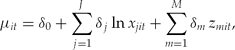
where δ is a vector of parameters to be estimated. The specification in (2) is fairly general and encompasses the non-neutral stochastic production frontier model originally proposed by Huang and Liu (Reference Huang and Liu1994). If δj = 0 (for all j), then (2) is reduced to the neutral technical inefficiency effect model by Battese and Coelli (Reference Battese and Coelli1995). Further, if δj = δm = 0 (for all j and m), we get the Stevenson (Reference Stevenson1980) model. Finally, if δj = δm = δ 0 = 0, we obtain the original model by Aigner et al. (Reference Aigner, Lovell and Schmidt1977). The Uit are non-negative random variables associated with technical inefficiency in production, which are assumed to arise from a normal distribution with mean μi = Zitδ and variance σ 2u which is truncated at zero (i.e. Uit ~ (Zitδ, σ 2u). The one-sided, non-negative random variable, Uit, representing output-oriented technical inefficiency, must be non-negative so that no firm can perform better than the best-practice frontier. Zit defines a (1 × M) vector of explanatory variables associated with the technical inefficiency function (Battese and Coelli, Reference Battese and Coelli1988, Reference Battese and Coelli1995).
If Uit = 0, then ɛit = Vit, suggesting that production lies on the frontier and production is said to be technically efficient. If U it > 0, production lies below the frontier and thus there is evidence of inefficiency. The maximum likelihood estimation of equation (1) provides the estimators for βs and variance parameters σ 2 = σ 2v + σ 2u and γ = σ 2u/σ 2.
The paper employs the neutral production frontier approach by Battese and Coelli (Reference Battese and Coelli1995) and the non-neutral production frontier approach by Huang and Liu (Reference Huang and Liu1994) to analyse the relationship between technical efficiency and input variables such as crew size, net length, and hours fished. The empirical frontier model is stochastic since fishing is sensitive to random factors such as weather, resource availability, and environmental influences (Kirkley et al., Reference Kirkley, Squires and Strand1995). The two main commercially important species are fished using different techniques and we estimate separate models for Nile perch and dagaa. A frontier model with output-oriented technical inefficiencyFootnote 1 is specified as follows

Inputs are L, N, and H. Total output (catch) in kg is denoted by Y which is the catch representing two species, Nile perch and dagaa, which currently dominate the Lake Victoria fisheries’ daily landings. Crew size (L) is the number of crewmembers employed per vessel per trip including the skipper, and the gill net capital stock (N) is measured by its length in meters multiplied by the number of hauls of the gill nets per day. Hours fished (H) measures the length of time gillnets were left active in the water. Distance from the shore to the fishing ground is approximated by hours travelled (DS) and in this case is considered an environmental variable beyond the control of the fishers. It provides for differences in resource conditions that vary by distance from shore and by water depth. We use a motor dummy, (Motor = 1/0), to capture the effects of boats with and without motors. The regional dummies capture the variation in stock abundance, where Mwanza and Mara are dummies for the Mwanza and Mara regions respectively. To avoid a dummy variable trap, Kagera is the reference region. The seasonal dummies, where Peak is the peak season and Normal is the normal season, capture seasonal variation. Off-season is the reference category.
Stock abundance is expected to be a major determinant of harvest across the different sections of the lake. However, for a short panel study like this, it is not possible to have the stock abundance be variable at each point. Stock abundance can vary consistently across fishing grounds and over seasons (or different time periods). We thus use the variable distance from shore to fishing ground (DS), regional and seasonal dummies to capture the spatial difference in stock abundance.Footnote 2
The critique that the traditional two-stage process violates the inherent assumption of equal distribution for the inefficiency effects in both stages was overcome by expressing the inefficiency effects as an explicit function of firm-specific variables and a random term by Battese and Coelli (Reference Battese and Coelli1995).Footnote 3 Huang and Liu (Reference Huang and Liu1994) use firm-specific variables in the inefficiency model of their non-neutral model but also include the inputs. In a small boat fishery it is quite possible that, for instance, crew size may affect also the relative efficiency due to congestion or free riding problems. Hence, in the inefficiency effects as defined by equation (3), we both include firm-specific variables like skipper experience, net age, education of skipper etc. and the inputs crew size, net length, hours of fishing as well as the distance to the fishing ground and seasonality. The input levels are included in the inefficiency model to account for the relationships between scale of operation and the level of technical inefficiency (Tveterås and Battese, Reference Tveterås and Battese2006).
Using our specific Z-variables hypothesized to affect the technical efficiency of boats and the inputs used in the frontier model, the inefficient model can be specified as follows:

where δs are parameters to be estimated. If the coefficients of the inputs are not significantly different from zero, i.e. δ 1–5 = 0, changes in the frontier is independent of changes in the input use and neutral. Hence, the non-neutral specification by Huang and Liu (Reference Huang and Liu1994) formulation is more general than Battese and Coelli's (Reference Battese and Coelli1995) neutral specification (Karagiannis and Tzouvelekas, Reference Karagiannis and Tzouvelekas2005). Further, the marginal products and elasticities of the mean production for different firms are functions of the particular firm-specific variables, specified in the vector of explanatory variables Zit .
Skip-exp is the skipper's number of years as crew leader. We also include the share taken by crew including the skipper (CrewShare), age of the gillnet in years (Netage), education of the skipper in years (Educ) and a number of dummy variables to capture some immeasurable skipper and gear attributes. These include dummy variables for the ownership of the boats (Ownerprc = 1/0), owner being the skipper (Ownerop = 1/0), remuneration system used in the unit (Remun = 1/0), and extra bonus (ExB = 1/0). We also have a dummy variable that captures the effect of local management measures on the efficiency of the vessel (i.e. Beach management units, BMUs = 1/0).
3.2. Elasticities and returns to scale
We provide estimates of the elasticity of mean output with respect to the different explanatory variables. The elasticity of mean output is decomposed into the frontier elasticity and the elasticity of technical efficiency (see Battese and Broca, Reference Battese and Brocca1997) as follows

where f(⋅) is given by equation (3), μ is given by equation (4), and
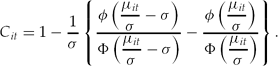
φ and Φ represent the density and distribution functions of the standard normal random variable, respectively. It follows from Battese and Brocca (Reference Battese and Brocca1997) that the elasticity of frontier output with respect to the kth input  is different from the elasticity of TE with respect to the kth input
 . Thus, the elasticity of technical efficiency is zero for the neutral stochastic frontier model, but non-zero for the non-neutral model.
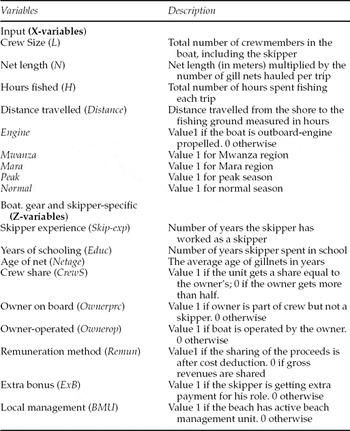
Table 1 provides the description of the variables used in the analysis. Several hypotheses about the model can be tested using generalized likelihood ratio tests. We test these hypotheses both for the neutral and the non-neutral model specifications and finally test the neutral versus the non-neutral specification. The first null hypothesis is whether or not technical efficiency effects are absent, i.e. σ 2u = 0. This null hypothesis is specified as γ = 0, where γ = σ 2/(σ 2v + σ 2), is tested. If the null hypothesis is accepted, this would indicate that σ 2 is zero and hence that the Uit term should be removed from the model described by equation (1) (Battese and Coelli, Reference Battese and Coelli1995), which implies that there are no inefficiency effects in the model and that the model could be efficiently estimated using OLS.Footnote 4 The second null hypothesis is whether or not the functional form of the stochastic production frontier, equation (1), is the Cobb–Douglas form. This null hypothesis, which is tested against the full translog form, is H o: βij = 0 for all i ≤ j = 1,2,3, in equation (1), i.e. all of the input interaction and second-order terms equal to 0. The third null hypothesis is whether or not the technical inefficiency function, equation (3), is influenced by the level of explanatory variables. Under the assumption that the inefficiency effects are distributed as a truncated normal, the hypothesis is that the matrix of parameters, excluding the intercept term δ 0, is null such that, H o: δ 6 = ⋯ = δ 16 = 0. The test of the non-neutral versus the neutral model is given by the null hypothesis H 0: δ 1 = δ 2 ⋯ = δ 5 = 0.
Description of input and skipper-specific variables

3.3. Data
Data were collected between November 2002 and September 2003, from 22 randomly selected fish-landing sites (referred to as beaches throughout the rest of the paper), on the Tanzanian section of Lake Victoria. A total of 500 skippers were interviewed over the three fishing seasons, making a sample size of 1500 observations.Footnote 5 We gathered the data by administering questionnaires. The face-to-face interviews were conducted in collaboration with the staff of the Tanzania Fisheries Research Institute (TAFIRI) in Mwanza which has long working experience in the field and has regular contact with fishers around the lake. The survey was carried out in three regions bordering the lake: Mwanza, Mara, and Kagera.
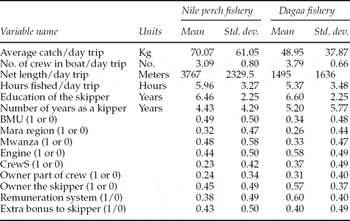
The data were collected by randomly sampling the beaches and the fishermen. The sampling of beaches was done with the help of district fishery officers. Summary statistics of the data are given in table 2. The average skipper has a primary education of six to seven years in school and also has relatively few years of experience as a skipper: four years in Nile perch and five years in dagaa fishery. On average, Nile perch boats carry three crewmembers including the skipper, while dagaa boats tend to carry a larger crew per trip: the average crew number is four. Both fisheries have indicated nearly identical fishing hours.
Summary statistics of the variables

4. Empirical results
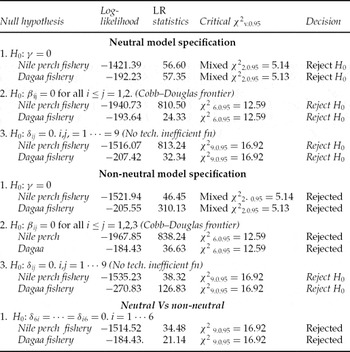
The parameters of the stochastic production frontier model, equation (1), and those for the technical inefficiency model, equation (2), are estimated simultaneously using the maximum-likelihood estimation (MLE) program, FRONTIER 4.1 (Coelli, Reference Coelli1996). We report hypotheses testing concerning model specifications in table 3.
Hypothesis testing of model specification

Note: Mixed χ2v.0.95 values are taken from Kodde and Palm (Reference Kodde and Palm1986: table 1, p. 1246).
We find that all formulated null hypotheses can be rejected at the 5 per cent level irrespective of whether a neutral or a non-neutral specification is preferred. Hence, for both the neutral and the non-neutral models, the stochastic production frontier is appropriate for the sample data (i.e. H 0: γ = 0 is rejected). Similarly, the second null hypothesis that the Cobb–Douglas production function is an adequate representation for the Lake Victoria fisheries data (H 0: βij = 0 for all i ≤ j = 1,2,3) can be rejected, suggesting that the translog production function is the preferred model specification. The hypothesis that the parameters of the inefficiency effects are absent (i.e. H 0: δ 6 = ⋯ δ 16 = 0) is also rejected by the data. This indicates that the majority of skippers in the sample operate below the output-oriented technical inefficiency frontier. This also suggests that the traditional average production function does not adequately represent the production structure of the fishers in the sample. Finally, the null hypothesis, H 0: δ 1 = ⋯ δ 5 = 0) is rejected and provides evidence in favour of the non-neutral specification and that there exists a significant relationship between scale of operation and the level of technical inefficiency. Hence, the results indicate that the more general non-neutral translog stochastic frontier model is an adequate representation of our data. Therefore, the results presented in figures 1–3 and tables 4 and 5 correspond to a non-neutral model.
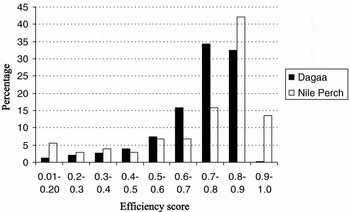
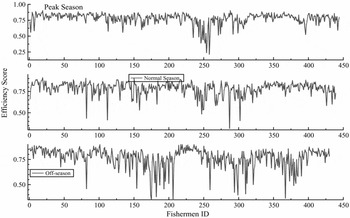
Technical efficiency scores for Nile perch and dagaa fisheries.

Technical efficiency over season for Nile perch fishery.

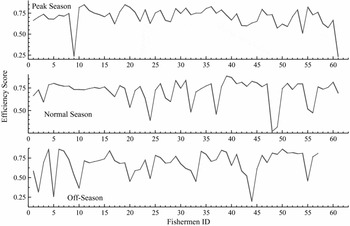
Technical efficiency over season for dagaa fishery.

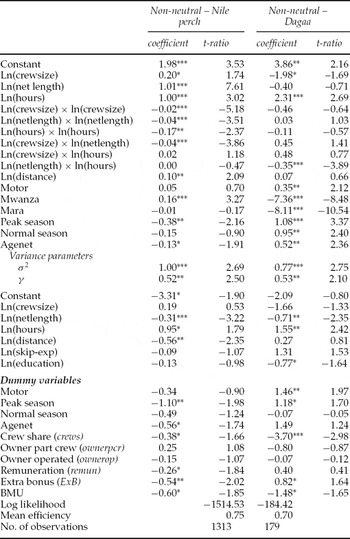
Parameter estimates of stochastic production frontier – Nile perch

Notes: t-statistics in brackets. ***Significant at 1% level; **significant at 5% level; *significant at 10% level.
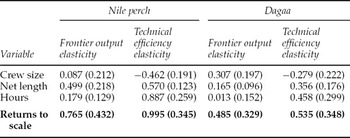
Elasticity parameter estimates with respect to all inputs

Figure 1 shows the distribution of efficiency scores for Nile perch and dagaa fisheries. Our results indicate that over 72 per cent of the fishers in the sample have efficiency scores of over 70 per cent for Nile perch fishery, while for dagaa fisheries about 65 per cent of the samples have efficiency scores over 70 per cent. Similarly about 12 per cent of the fishers are operating below 50 per cent of the efficiency level in Nile perch fishery, while about 14 per cent of the dagaa fishers are operating below the 50 per cent efficiency level.
A limited number of boats display substantially lower levels of technical efficiency in both fisheries. The arithmetic means of the individual efficiency scores are 0.75 for Nile perch and 0.70 for dagaa fishery. These results compare well with Squires et al. (Reference Squires, Grafton, Alam and Omar2003) for the Malaysian gill net fleets of artisan fishers, but are comparatively higher than those found in Kuperan et al. (Reference Kuperan, Omar, Jeon, Kirkley, Squires and Susilowati2001) in the Malaysian Trawl fishery. This comparatively high efficiency score is consistent with Schultz's (Reference Schultz1964) thesis of ‘poor and efficient’ smallholders and peasant farmers in developing country agriculture.
The results suggest that the variance of the one-sided component is 0.52 and 0.53 for Nile perch and dagaa fisheries respectively, indicating that output-oriented technical inefficiency is important in explaining the total variability of the fish harvest.
The seasonal variables, Peak and Normal, were included in the frontier model and the inefficiency models to capture the variations in stock abundance. The elasticity of mean output with respect to the seasonal dummies varies in the two fisheries. The effect of peak season in the Nile perch fishery is significantly negative compared to the reference season, while Normal is not different from the low season. For dagaa, the seasonal effects are as expected, Peak has a positive effect and so has the Normal compared with the reference low season. Analyzing the efficiency score over seasons we found that the mean efficiency was distributed as follows: 0.79, 0.78, 0.77 for peak, normal, and off-seasons respectively for the Nile perch fishery. This implies that most vessels targeting Nile perch in the sample are technically efficient at around 0.77 in all seasons (figure 2). This shows that there might not be any significant variation in Nile perch availability at different times of the year, contrary to what fishers claim. This lack of significant variation could also be explained by the stock being so overfished that there is no longer any clear variation in catch over season, while the dagaa stock is in better shape (Balirwa et al., Reference Balirwa, Chapman, Chapman, Cowx, Geheb, Kaufman, Lowe-McConnell, Seehausen, Wanink, Welcomme and Witte2003) with confirmed expected seasonal effects. Generally in the Nile perch fishery, high efficiency scores dominate for all seasons. These results contrast with those found in Kuperan et al. (Reference Kuperan, Omar, Jeon, Kirkley, Squires and Susilowati2001) for the Malaysian Trawl fishery where the lower efficiency scores dominated the high scores in normal and off-season.
The existence of seasonal effects in the dagaa fishery is also confirmed by a plot on individual vessels basis (figure 3). In the dagaa fishery, the peak season is dominated by high efficiency values and to some extent the same applies for the normal, while the low-season is dominated by relatively low efficiency values.
Table 4 reports the results of the frontier model (top panel) and the inefficiency model (bottom panel) for non-neutral specifications for both Nile perch and Dagaa. Interpretation of the individual parameters of a translog specification may not be particularly meaningful and we focus our discussions more on the output elasticities, which are reported in table 5. The effect of an outboard motor is positive for the dagaa fishery, suggesting that outboard motors improve output relative to those using paddle/sail, while motor appears to have no effect in the Nile perch fishery as parameters are not significantly different from zero. However, the dummy for Mwanza region is also positive and significant, implying that vessels in Mwanza are perfoming better relative to those in the Mara and Kagera regions. Probably the market potential in Mwanza compared to the other two regions could be a possible explanation. Of about 13 processing factories, ten are located in Mwanza region, three in Mara region, and none in Kagera. Seasonal dummy variables are significant and positive in the dagaa fishery, suggesting that fishers targeting dagaa species are performing better in peak and normal seasons compared to off-season. This should be expected since stock abundance is relatively higher in these two seasons.
The technical inefficiency function has the technical inefficiency dependent variable so that a negative sign will indicate an increase in technical efficiency or a decrease in technical inefficiency. A majority of the variables in the technical inefficiency function are significant, especially in the Nile perch fishery. It was interesting to find that some of the input variables in the inefficiency model turn out to be significant in both Nile perch and dagaa specification. Net length is negative and significant, suggesting increasing efficiency in both fisheries, while hours spent fishing is positive and significant, implying decreasing efficiency with long hours fishing. The variable crew size is insignificant in both fisheries. The skipper's fishing skill is often considered to be an important determinant of a boat's catch and efficiency. Among the skipper's attributes, we expect fishing experience to imply better knowledge of fish location, weather patterns, currents and tides, bottom conditions and how to best catch the fish. However, we find that it is the experience as a skipper that matters, while previous experience as a regular crewmember is insignificant.Footnote 6 The result indicates that efficiency increases with skipper experience. In addition to fishing experience, long experience as a skipper generally implies experience from working with different crews and thereby better skills in finding the best crew for the boat.
To capture the efficiency effects of incentives given to the skipper we include dummy variables for extra bonus given to the skipper; a dummy variable indicating whether owner takes equal share with the crew and mode of remunerations system, i.e. whether the share was calculated after or before deducting the daily running cost. The results indicate that extra bonus to the skipper leads to increased efficiency in both fisheries. And also efficiency increases if owner shares 50–50 with the crew. We also find that sharing after deducting operating costs leads to increased efficiency in the Nile perch fishery. A potential explanation is that the risk of receiving zero payment forces the crew to work harder, which is reflected as increased efficiency.
Ownership patterns and particularly owner participation in actual fishing can affect efficiency and incentives. The variable (ownerop) is significant, which indicates that skippers owning their vessels are more efficient than hired skippers. An interesting result is that boat owners without skipper skills are better off hiring a skipper and staying ashore. The presence of an owner on board reduces efficiency; one reason for this is that the boat owner might interfere with the skills of the skipper.
Additional schooling can improve literacy and cognitive skills, which may be important in increasing efficiency by increasing the ability of skippers to adopt technical innovations. The number of years the skipper spent in school was found to be statistically significant, suggesting that additional years of schooling or training could be important in increasing efficiency among the inefficient skippers in the dagaa fishery.
In 1998, the Tanzanian Government through the Lake Victoria Environmental Management project (LVEMP) introduced local management units commonly known as Beach Management Units. These units were established to enhance community participation in the surveillance and management of the lake resources. Though the BMU leaders do not have legal power to arrest anyone, they can point out culprits to the enforcement officials. Their most important task, however, is to help prevent the use of destructive gear. The existence of BMUs has led to increased efficiency in both fisheries, which is possibly explained by fishermen exchanging information and learning from each other at the regular BMU meetings.
The production elasticities for the estimated model should be evaluated at the mean values of relevant data points defined by equation (5). As shown in equation (5), the elasticity of the mean frontier output with respect to the kth input variable has two components: (i) the elasticity of frontier output with respect to the kth input, given by the estimated βk parameters and (ii) the elasticity of TE with respect to the kth input.Footnote 7 The mean frontier output and the efficiency elasticities and the return to scale are presented in table 5. The elasticities are generally low and always below unity, suggesting the low responses of harvests to the scale of fishing inputs. We found that net length is consistently higher in all the fisheries in both frontier output and TE efficiency, while hours fished are higher in TE in both fisheries but relatively low in frontier output. The elasticity of crew size is significant and negative for both fisheries in TE, which suggests that the mean vessel may be subject to input congestion and operates in Stage III of the production function where the isoquant has a positive slope (Kuperan et al., Reference Kuperan, Omar, Jeon, Kirkley, Squires and Susilowati2001). Skippers may be crewing their vessels too heavily for social reasons or may not have adjusted to the given stock level.
The estimated returns to scale are 0.765 and 0.485 in the Nile perch and dagaa fisheries respectively for the frontier output elasticity, while for TE elasticity they are 0.995 and 0.535 in the Nile perch and dagaa fisheries respectively. The returns to scale for frontier output in Nile perch fisheries and for all cases in dagaa fisheries are generally decreasing, influenced mainly by the input congestion, which suggests that input reduction would help boats enjoy increasing returns to scale and some scale economies. This finding supports the finding by Kateregga (Reference Kateregga2005), who reports the results from a translog production function for Nile perch and Nile tilapia using data from the Ugandan section of Lake Victoria where returns to scale is found to be decreasing in all fisheries. We could however notice that the returns to scale is generally higher for TE elasticity in the Nile perch fisheries, which is found to be not significantly different from unity.Footnote 8 Hence we could generally say that harvests in the Nile perch fishery are subject to constant returns to scale. Returns to scale for the dagaa fishery however, is not statistically significant at the conventional level.
Decreasing returns to scale implies that the productivity of inputs declines with large fishing units. In these fisheries, which could be considered as regulated open access, decreasing returns to scale may be expected; this is because there are imperfections in both output and input markets. Furthermore, prices and harvests are highly subject to uncertainty, especially due to the fact that fishers do not have storage facilities, so that whatever is harvested should be sold the same day.
One plausible argument that can be used to explain decreasing returns in these fisheries is that in open access fishing where fluctuations in fisheries are expected to be higher, larger fishing units, presumably with higher incomes, are less risk averse (Eggert and Lokina, Reference Eggert and Lokina2007). The reduction in their risk averseness enables them to use more effort even when production is jeopardized. This is in line with the Arrow–Pratt decreasing absolute risk aversion that has been widely used in explaining behaviour under uncertainty (Block and Heinke, Reference Block and Heinke1973).
Furthermore, the market imperfections and a high level of unemployment within the lake regions and beyond may induce boat owners to hire more labour at low wages. Family managed fishing units, especially in dagaa fishing and also Nile perch in some instances, may have the goal of getting household members involved in the activity so as to keep them employed, rather than aiming at improved productivity. Thus the choice of the crew size the fishing unit opts for may be influenced by factors other than what it expects to reap from fishing.
5. Discussion and conclusion
Lake Victoria fisheries can be regarded as open access with no restrictions on entry or total catch either regionally or nationally. There are no limits on effort and the only measure for preventing stock depletion is a minimum mesh size regulation, which is widely violated by the fishers (Lokina, Reference Lokina2004). The lack of alternative employment opportunities coupled with the open access nature of the fisheries has led to a substantial level of overcapacity both in terms of vessels and in numbers of fishers. This study focuses on the Tanzanian section of Lake Victoria, but the results should also apply to the Kenyan and Ugandan sections where fishers employ comparable technology and harvesting practices, and operate under similar management. There is a great need for the three governments sharing the lake to direct their policies towards resource conservation and support for sustainable livelihoods, including incentives for fishers to diversify into other professions.
The results indicate variation in efficiency, but that boats on average have a relatively high level of efficiency, with the majority being above 77 per cent or more in the Nile perch fishery and 71 per cent in the dagaa fishery. The inefficiency models indicate possibilities for improving performance in both fisheries. For the Nile perch fishery, efficiency increases by years of skipper experience and by years of education of the skipper. Furthermore, efficiency is found to increase with the net length, and distance covered. Also efficiency is found to decrease with hours spent fishing. A number of significant dummy variables indicate increased efficiency when the skipper owns the vessel, if the crew is paid the same share as the owner, and if the revenues are shared after cost deduction. An extra bonus to the skipper increases efficiency, while owners (non-skippers) joining the crew reduces efficiency. For the dagaa fishery, efficiency increases with skipper experience, while efficiency decreases with average gill net age. Efficiency also increases if the crew receives an equal share and if the skipper enjoys an extra bonus. A common feature for both fisheries is that the existence of local management over fish resources, commonly known as Beach Management Units, leads to improved efficiency. These BMUs have as their prime objective the elimination of destructive gear practices, but the repeated meetings with fishers may, for instance, imply information sharing accompanied by learning effects.
From the perspectives of equity and of distribution, improved efficiency is desirable; the results above provide some suggestions for policy. One such idea is if the hired skippers in the Nile perch fishery could buy their vessels, they would likely increase the rate of return. This suggests that improved credit facilities would improve efficiency in Lake Victoria fisheries. Probably it was for these reasons that the government quite recently removed all the import duties and value added tax (VAT) on fishing gear and engines as a move to enable more fishers to own their vessels (URT, 2004). This government move can be seen as an attempt to subsidize the fishing sector in order to maintain employment and make fishers technologically competitive in the face of declining stocks. But improving efficiency when neither effort nor catch is limited could lead to further depletion of stocks. Conclusions about efficiency are subject to biological limits. Given the stock conditions, it is not possible to increase the long-run catch by increasing fishing effort since the practice would lead to depletion. Increased efficiency at the aggregate level is thus only possible if fishing effort is limited. One potential option would be the retirement of a number of boats, preferably those that are least efficient. Improved efficiency would then lead to similar catch levels with a smaller number of boats and fishermen. However, such a prescription is problematic for two reasons. Firstly, it presupposes control at the aggregate level, which is currently not available. Secondly, it requires the decommissioning of a number of boats and the unemployment of a number of fishermen. Theory states that, in the long run, improved stocks and increased profits for the remaining fishermen should in principle be sufficient to compensate those who are forced out of the industry, but there remain serious issues of distribution, enforcement, and monitoring.
In the absence of aggregate control of effort and the exit of less efficient fishermen, we have a different situation. The existing variation in efficiency can be a problematic rather than constructive element. Potentially it contributes to hiding the problem of over-fishing; unsuccessful fishermen will compare themselves to successful fishermen and may see a difference of skill rather than stock decline. The results show that some of the variation in efficiency is due to differences in equipment, skill, or organizational variables such as the structure of incentives and the relationship between the owner and the skipper. These tangible differences can be remedied but the competition for increased efficiency may reinforce overcapacity. One example is that some boats use extremely long, fine-meshed nets and ‘stack’ these nets on top of each other which is a physical sign that such competition already exists. If such a practice spreads throughout all of Lake Victoria, the stocks will be further depleted, while improved landing will only be a temporary phenomenon. It is particularly destructive since the same amount of fish could have been caught if we had fewer fishermen and less capital. Overcapitalisation is thus a big economic burden on very poor fishermen. At the same time, this might easily be an explanation of why we have a low elasticity coefficient in most of the inputs, suggesting that Lake Victoria fisheries might be attracting more inputs than what is strictly necessary given the stock size.
Given the current situation in Lake Victoria fisheries, there is a need for curbing overcapacity. From a theoretical perspective a Warming landing tax is attractive (Warming, Reference Warming1911; Weitzman, Reference Weitzman2002); it would reduce the attraction of the fisheries to new entrants and limit the incentive schemes, which according to our results influence efficiency and potentially restore rents in the long run. However, for a fishery without landing records and total allowable catches, such reform would face tremendous problems. Our results correspond to Squires et al. (Reference Squires, Grafton, Alam and Omar2003), that development aid should focus on human and social capital rather than on vessel and gear upgrade. Pomeroy (Reference Pomeroy1994) and Squires et al. (Reference Squires, Grafton, Alam and Omar2003) hold that strategies for cooperative and community management can help to control fishing activity and promote sustainable fishing practices, while Christy (Reference Christy1999) suggests that limited entry could be beneficial for developing fisheries. In this case BMUs could be a potential starting point of limited entry policy. Almost half of the studied artisans fishing communities in Lake Victoria have BMUs. The current structure of these management units is quite disorganized, as evidenced by a lack of resources and lack of power to enforce the law. Still, these BMUs seem to have a positive effect on mesh size compliance (Lokina, Reference Lokina2004) and efficiency. An overall restructuring would be beneficial for the BMUs to be able to play an effective role in fishery resource management. With such reform the BMUs could potentially carry out a limited entry policy, which would render possible efficiency improvements and sustainable fisheries on Lake Victoria.