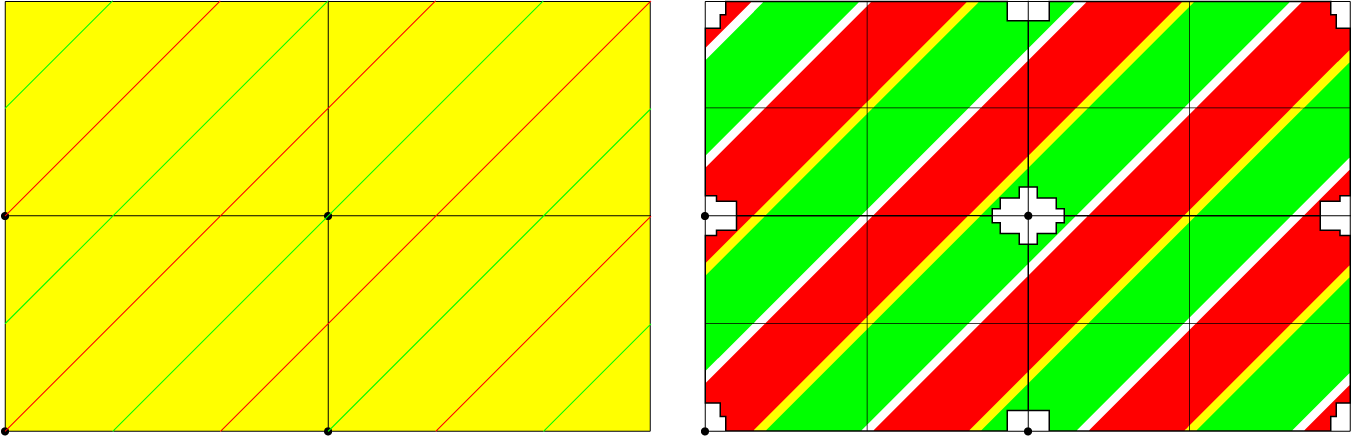
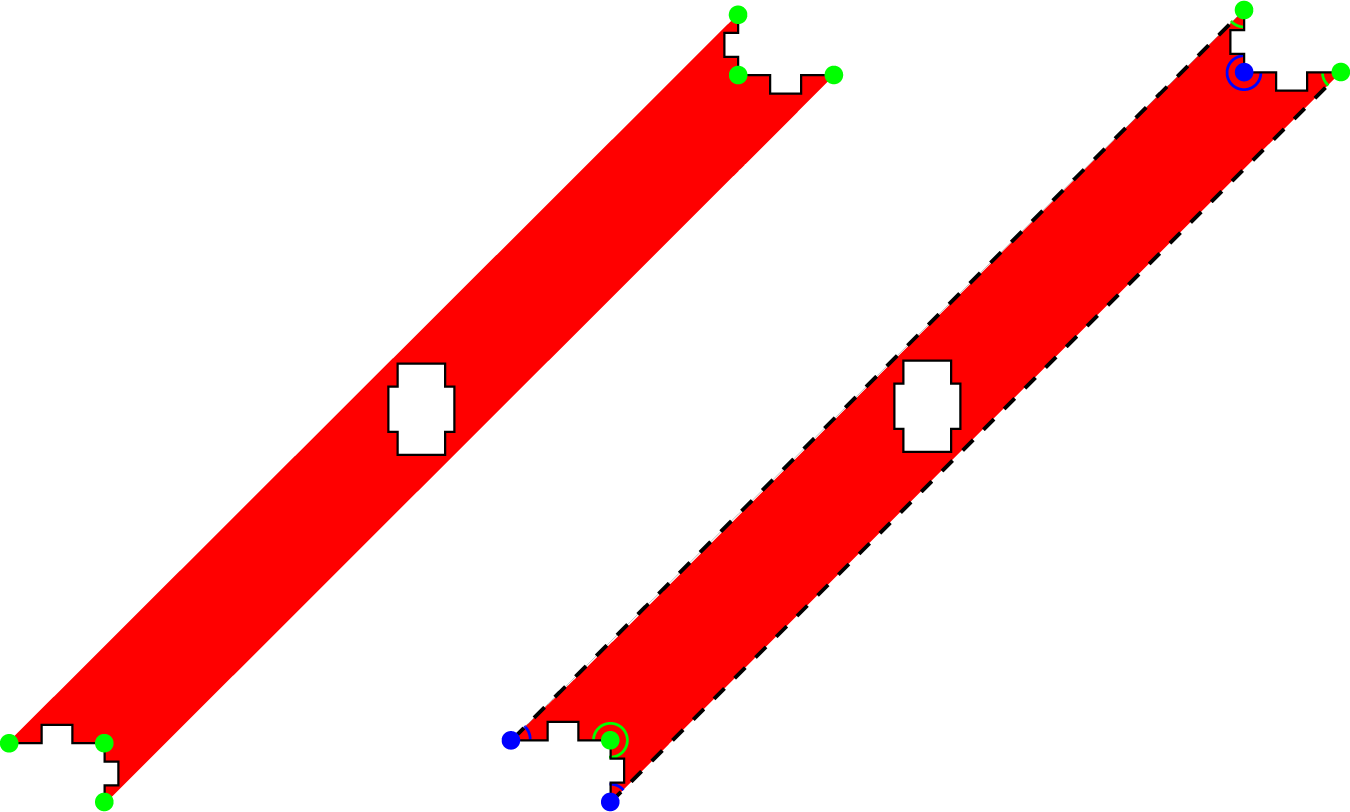
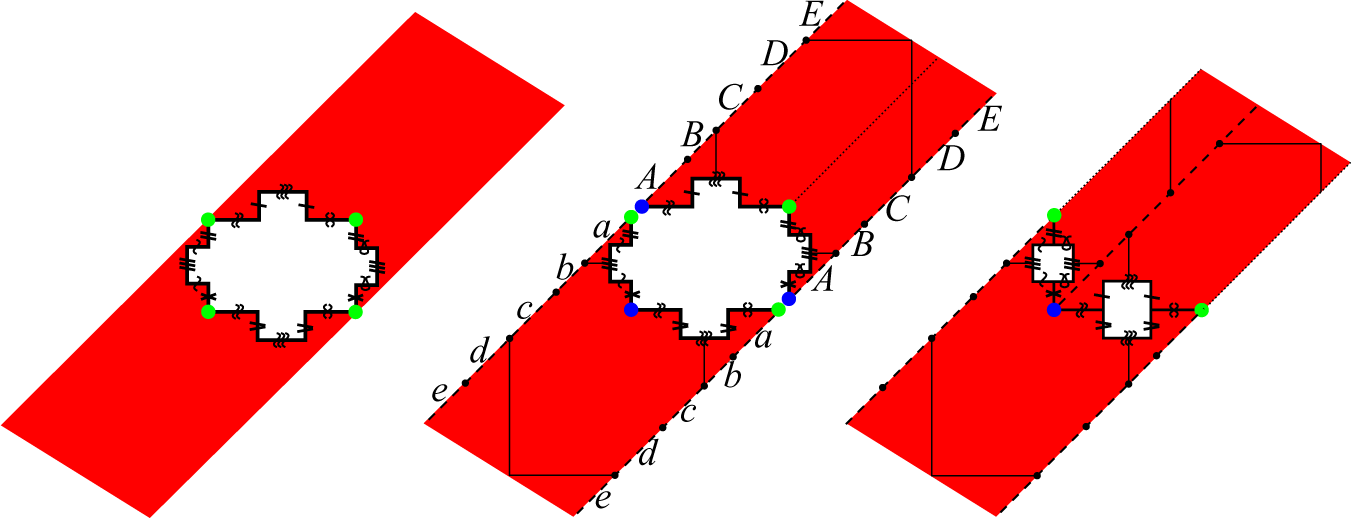
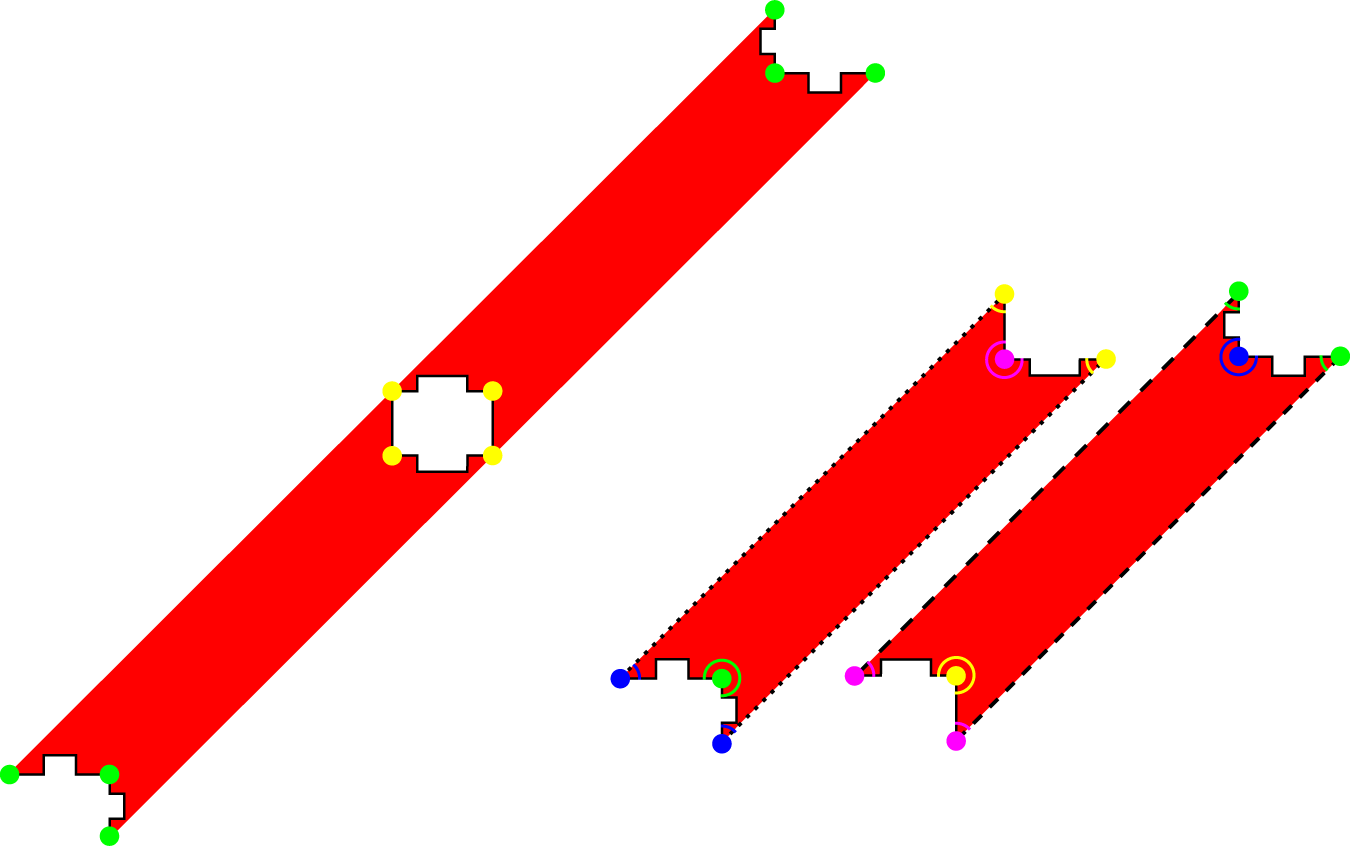
1 Introduction
Mechanical Hamiltonian impact systems (HISs) describe the motion of a particle in a given Hamiltonian field within a billiard table: the Hamiltonian flow determines the particle trajectory in the configuration space till it reaches the billiard boundary, where it reflects elastically, and then it continues with the Hamiltonian flow [Reference Kozlov and Treschev10]. For mechanical Hamiltonian flows with bounded energy surfaces, for small energy, as long as the energy surface projection to the configuration space (Hill region) does not touch the billiard boundary, the HIS reduces to the study of smooth mechanical Hamiltonian systems. At the other extreme, for compact billiard tables and smooth bounded potentials, mechanical HISs limit, at high energy, to the corresponding billiard flow. The theory for intermediate energy values includes local analysis near periodic orbits [Reference Dullin5] and near smooth convex boundaries [Reference Berglund2, Reference Zharnitsky25], and, for some specific classes of HIS, hyperbolic behavior [Reference Liverani12, Reference Wojtkowski20–Reference Wojtkowski22], Liouville integrable [Reference Dragović and Radnović3, Reference Fedorov6, Reference Kozlova11, Reference Pnueli and Rom-Kedar16, Reference Radnović17] and near-integrable [Reference Pnueli and Rom-Kedar15] dynamics were established. A class of quasi-integrable HISs, related to the quasi-integrable dynamics in families of polygonal right-angled corners, was introduced in [Reference Becker, Elliott, Firester, Cohen, Pnueli and Rom-Kedar1].
The analysis of quasi-integrable dynamics in right-angled billiards is related to several deep mathematical fields [Reference Zorich26]. A new family of billiards with quasi-integrable dynamics, consisting of confocal ellipses with confocal barriers, was introduced in [Reference Dragović and Radnović4] (and, if the Birkhoff conjecture is correct, this family and polygonal billiards with rational angles are the only billiards with quasi-integrable dynamics). For such a billiard table, the quasi-integrable dynamics depends on a parameter—the constant of motion associated with the caustic of the trajectories. By a change of coordinates, the dynamics for any given caustic constant is conjugated to the directed motion in a right-angled billiard table [Reference Dragović and Radnović4]. Using tools of homogeneous dynamics, it was established that the flow in an ellipse with a vertical barrier is uniquely ergodic for almost all the caustic parameters [Reference Frączek9]. Developing a different approach, a similar result was established for the more general case of nibbled ellipses [Reference Frączek, Shi and Ulcigrai8]. Our methodology relies on the methods developed in [Reference Frączek, Shi and Ulcigrai8], where it was shown that to prove unique ergodicity, the Minsky–Weiss criterion [Reference Minsky and Weiss14] may be applied to a class of right-angled polygons consisting of staircase polygons.
Here, we examine the dynamics of a horizontal and a vertical oscillator with stable fixed point at the origin that are restricted to lie within star-shaped polygons with only vertical and horizontal boundaries with a kernel that includes the origin (this is a subclass of the HIS introduced in [Reference Becker, Elliott, Firester, Cohen, Pnueli and Rom-Kedar1], and such polygons consist of four staircase polygons considered in [Reference Frączek, Shi and Ulcigrai8]). These two-degrees-of-freedom systems have two conserved integrals, so their motion is always restricted to level sets, yet, in contrast to the smooth case, the motion on the level sets is conjugated, for some of the level sets, to the motion in polygonal right-angled billiards with more than four corners. Thus, the motion on such level sets is not conjugated to rotations [Reference Zorich26], and, since the shape of the polygonal billiard and the direction of motion on it vary, the dynamics may depend sensitively on the value of the conserved integrals, even for iso-energy level sets [Reference Becker, Elliott, Firester, Cohen, Pnueli and Rom-Kedar1]. In the first part of the paper we analyze our class of HISs in non-resonant cases and prove that the motion is uniquely ergodic for almost all iso-energy level sets (in this part we rely on the tools and analysis developed in [Reference Frączek, Shi and Ulcigrai8] for staircase polygons, verifying that the functional dependence of the corners in the induced family of polygons satisfies the necessary conditions of smoothness, independence and monotonicity as in [Reference Frączek, Shi and Ulcigrai8]). In the second part of the paper we study the case of HISs with quadratic resonant potentials in a staircase polygon. Here, ribbons of periodic orbits coexist with quasi-periodic motion (similar to the motion presented in [Reference McMullen13], but in the corresponding HISs). By our new construction, we establish the unique ergodicity of the non-periodic component on a certain set. In §9 we show that these findings imply non-uniform ergodic averages in the configuration space.
1.1 Set-up
Consider integrable Hamiltonian systems with two degrees of freedom (d.o.f.) of the form
 $$ \begin{align} H(p_x,x,p_{y},y)=\frac{p_x^2}{2}+\frac{p_y^2}{2}+V_1(x)+V_2(y), \end{align} $$
where
 $(x,y)$
are the space coordinates,
 $(p_x,p_y)$
are the corresponding momenta and the potentials
 $V_1,V_2:{\mathbb {R}}\to {\mathbb {R}}_{\geq 0}$
are even unimodal
 $C^2$
-maps that tend monotonically to infinity with their argument (without loss of generality we take
 $V_{1}(0)=V_2(0)=0$
: see the precise ‘Deck’ assumption below). The Hamiltonian flow
 $(\varphi _t)_{t\in {\mathbb {R}}}$
of (1.1) describes a particle which oscillates in a potential well. The Hamiltonian flow on a given energy surface E is foliated by the level sets with fixed partial energies
 $(E_{1}=H_{1}(I_1),E_{2}=H_{2}(I_2)=E-E_{1})$
, where
 $I_{i}(E_i)$
is the action of the one-d.o.f. system
 $H_i$
. For a given energy level
 $E\geq 0$
and any
 $0\leq E_{1}\leq E$
let
 $$ \begin{align*} S_{E,E_{1}}\kern1.5pt{:=}\kern1.5pt\bigg\{(p_x,x,p_y,y)\kern1.5pt{\in}\kern1.5pt{\mathbb{R}}^4:\frac{p_x^2}{2}+V_1(x)\kern1.5pt{=}\kern1.5ptE_{1},\frac{p_y^2}{2}+V_2(y)\kern1.5pt{=}\kern1.5ptE-E_{1},(x,y)\kern1.5pt{\in}\kern1.5pt {\mathbb{R}}^2\bigg\}. \end{align*} $$
Then the phase space of the flow
 $(\varphi _t)_{t\in {\mathbb {R}}}$
, is foliated by the invariant sets
 $\{S_{E,E_{1}}:E\geq 0,0\leq E_{1}\leq E\}$
, which are tori for
 $0<E_{1}<E,$
and, for
 $E>0$
and
 $E_1\in \{0,E\}$
, are circles. Denote the restriction of
 $(\varphi _t)_{t\in {\mathbb {R}}}$
to
 $S_{E,E_{1}}$
by
 $(\varphi ^{E,E_{1}}_t)_{t\in {\mathbb {R}}}$
. The smooth flow without reflection is trivially integrable and oscillatory. The projection of
 $S_{E,E_{1}}$
to the configuration space is the projected rectangle [Reference Pnueli and Rom-Kedar16]
 $$ \begin{align} R^{(E,E_1)}=[-x^{\max}(E_{1}),x^{\max}(E_{1})]\times[-y^{\max}(E-E_{1}),y^{\max}(E-E_{1})], \end{align} $$
where
 $V_{1}(x^{\max }(E_{1}))=E_{1}, V_{2}(y^{\max }(E_{2}))=E_{2}, E_2=E-E_1$
. The union of all iso-energy rectangles is the Hill region:
 $\mathcal {D}_{\mathrm {Hill}}(E)=\bigcup _{0\leq E_{1}\leq E} R^{(E,E_1)}=\{(x,y)|V_{1}(x)+V_{2}(y)\leqslant E\}$
(see [Reference Pnueli and Rom-Kedar16] for more general formulation).
Denote by
 $\omega _{i}(E_i)={2\pi }/{T_{i}(E_i)}$
the frequency in each degree of freedom, where
 $T_{i}(E_i)$
is the period of oscillation. The standard transformation to action angle coordinates
 $(I_{i},\theta _i)$
in each degree of freedom renders (1.1) into the form
 $H(p_x,x,p_y,y)=H_{1}(I_{1})+H_2(I_2)$
and in these coordinates the flow is simply
 $$ \begin{align*} (\varphi^{E,E_1}_t)&=\big(I_{1}(E_{1}),\theta_1(t)=\omega_{1}(E_1)t+\theta_1(0),\\ & \quad{}I_{2}(E-E_{1}),\theta_2(t)=\omega_{2}(E-E_1)t+\theta_2(0)\big). \end{align*} $$
Recall that
 $\omega _{i}(I_i)=H_{i}^{\prime }(I_{i})={dE_{i}}/{dI_{i}}$
and that the Hamiltonian is said to satisfy the twist condition if
 $\det ({\partial ^{2}H}/{\partial I_{i} \partial I_j})=\prod \omega _{i}^{\prime }(I_i)\neq 0$
and to satisfy the iso-energy non-degeneracy condition if
 $$ \begin{align*} \begin{vmatrix}\dfrac{\partial^{2}H}{\partial I_{i} \partial I_j} & \dfrac{\partial H}{\partial I_{i} } \\ \dfrac{\partial H}{\partial I_{j} } & 0 \\ \end{vmatrix}= \begin{vmatrix}\omega_{1}^{\prime}(I_1) & 0 & \omega_1(I_1) \\ 0 & \omega_{2}^{\prime}(I_2) & \omega_2(I_2)\\ \omega_1(I_1) & \omega_{2}(I_2) & 0\\ \end{vmatrix}=-\omega_{1}^{\prime}(I_1)\omega_2^{2}(I_2)-\omega_1^{2}(I_1)\omega_{2}^{\prime}(I_2)\neq0. \end{align*} $$
The character of the smooth flow
 $(\varphi_t^{E,E_1})$
on the level set
 $S_{E,E_1}$
depends on the frequency ratio on this level set. If
 $$ \begin{align*} \Omega=\Omega(E,E_1)=\frac{\omega_{1}(E_1)}{\omega_{2}(E-E_1)}=\frac{H^{\prime}_{1}(I_{1}(E_1))}{H^{\prime}_{2}(I_{2}(E-E_1))} \end{align*} $$
is rational then the flow is periodic (the resonant case), and if
 $\Omega $
is irrational then it is quasi-periodic (the non-resonant case). Recall that
 $({d}/{dE_{1}})\Omega (E,E_1)\neq 0$
if and only if the iso-energy non-degeneracy condition is satisfied.
Remark 1.1. Notice that if both potentials
 $V_1$
,
 $V_2$
are quadratic then the frequencies
 $\omega _1$
,
 $\omega _2$
are constant and
 $V_1(x)=\tfrac {1}{2}\omega ^2_1x^2$
,
 $V_2(y)=\tfrac {1}{2}\omega ^2_2y^2$
. Therefore
 $\Omega =\omega _1/\omega _2$
does not depend on
 $E,E_1$
and
 $V_1=\Omega ^2 V_2$
.
Now, assume that the particle is confined to a bounded polygonal room
 $P\subset {\mathbb {R}}^2$
whose walls consist of vertical and horizontal segments. When the particle meets the wall it reflects elastically. More precisely, if a trajectory meets a vertical segment at
 $(p_x,x,p_y,y)$
then it jumps to
 $(-p_x,x,p_y,y)$
and continues its movement in accordance with the Hamiltonian flow solving
 $$ \begin{align} \frac{dp_x}{dt}=-V_1^{\prime}(x), \quad\frac{dx}{dt}=p_x,\quad \frac{dp_y}{dt}=-V_2^{\prime}(y), \quad\frac{dy}{dt}=p_y. \end{align} $$
Similarly, if a trajectory meets a horizontal segment at
 $(p_x,x,p_y,y)$
then it jumps to
 $(p_x,x,-p_y,y)$
and continues its movement with (1.3); see [Reference Becker, Elliott, Firester, Cohen, Pnueli and Rom-Kedar1] for the general construction, a mechanical example and the description of the resulting dynamics on energy surfaces, and [Reference Pnueli and Rom-Kedar16] for the global structure of energy surfaces of such systems.
In particular, since all the walls are either horizontal or vertical, the partial energies are preserved under these reflections, so the motion remains restricted to level sets:
 $$ \begin{align*} S^{P}_{E,E_{1}}:=\{(p_x,x,p_y,y)\in{\mathbb{R}}^4:H_{1}(x,p_x)=E_1,H_{2}(y,p_y)=E-E_{1},(x,y)\in P\}. \end{align*} $$
Denote the restriction of the impact Hamiltonian flow
 $(\varphi _t)_{t\in {\mathbb {R}}}$
to
 $S^{P}_{E,E_{1}}$
by
 $(\varphi ^{P,E,E_{1}}_t)_{t\in {\mathbb {R}}}$
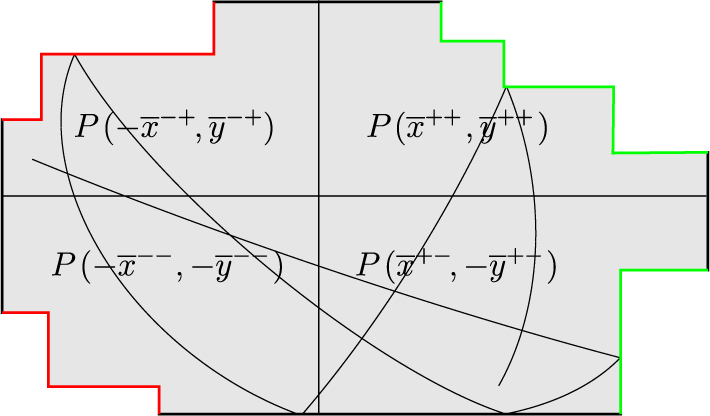
, see, for example, a trajectory segment projected to the configuration space in Figure 1. Notice that if a particle hits any corner of P then it dies. Namely, the flow is fully defined for regular trajectories and is only partially defined on the set which corresponds to all forward and backward images of corner points.
The living space of the particle.

We are interested in studying the topology of the level set
 $S^{P}_{E,E_{1}}$
and the invariant measures of
 $(\varphi ^{P,E,E_{1}}_t)_{t\in {\mathbb {R}}}$
when the total and partial energies
 $E,E_{1}$
vary. In particular, we ask when the flow is uniquely ergodic. Recall that the flow
 $(\varphi ^{P,E,E_{1}}_t)_{t\in {\mathbb {R}}}$
is uniquely ergodic if (i) each of its orbits is forward or backward infinite and (ii) if there exists a probability measure
 $\mu _{E,E_1}$
on
 $S^P_{E,E_1}$
such that, for every continuous map
 $f:S^P_{E,E_1}\to {\mathbb {R}}$
and any
 $(p_x,x,p_y,y)\in S^P_{E,E_1}$
for which the
 $(\varphi ^{P,E,E_1}_t)_{t\in {\mathbb {R}}}$
-orbit of
 $(p_x,x,p_y,y)$
is either forward or backward infinite,
 $$ \begin{align*} \lim_{T\to\pm\infty}\frac{1}{T}\int_{0}^Tf(\varphi_{ t}(p_x,x,p_y,y))dt=\int_{S^P_{E,E_1}}f\,d\mu_{E,E_1}, \end{align*} $$
where the
 $+$
(respectively,
 $-$
) sign is taken if the
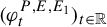 $(\varphi ^{P,E,E_1}_t)_{t\in {\mathbb {R}}}$
-orbit of
 $(p_x,x,p_y,y)$
is forward (respectively, backward) infinite. In our case the measure
 $\mu _{E,E_1}$
is equivalent to the Lebesgue measure on
 $S^P_{E,E_1}$
.
To formally determine the living space, P, of the particle, by following [Reference Frączek, Shi and Ulcigrai8], denote by
 $\Xi $
the set of sequences
 $(\overline {x},\overline {y})=(x_i,y_i)_{i=1}^k$
of points in
 ${\mathbb {R}}^2_{>0}$
such that
 $$ \begin{align*} 0<x_1<x_2<\cdots<x_{k-1}<x_k\quad\text{and}\quad 0<y_k<y_{k-1}<\cdots<y_2<y_1. \end{align*} $$
For every
 $(\overline {x},\overline {y})\in \Xi $
set
 $k(\overline {x},\overline {y}):=k$
and denote by
 $P(\overline {x},\overline {y})$
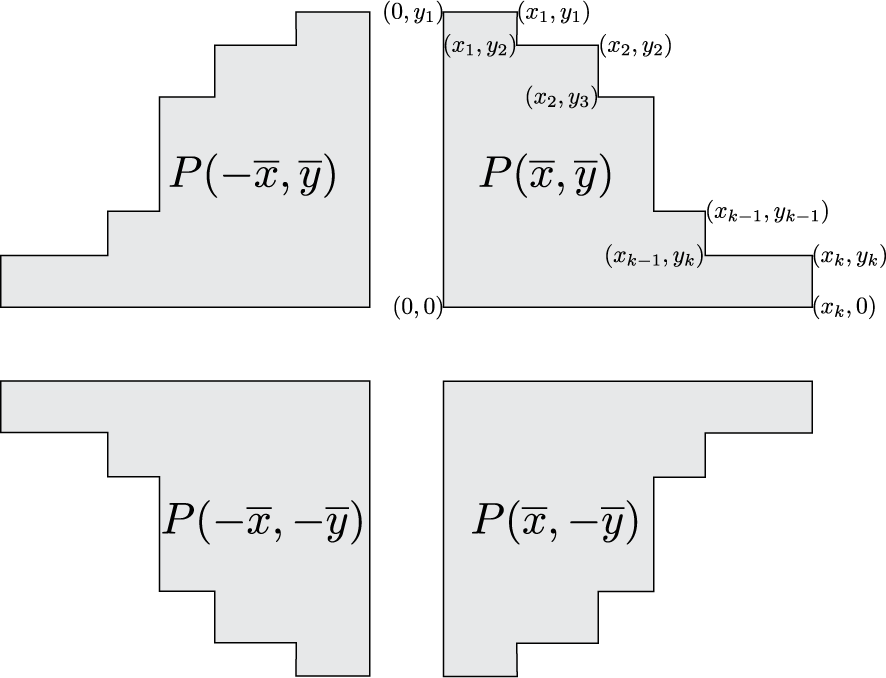
the right-angled staircase polygon on
 ${\mathbb {R}}^2$
with consecutive vertices:
 $$ \begin{align*} (0,0),(0,y_1),(x_1,y_1),(x_1,y_2),\ldots,(x_{k-1},y_{k-1}),(x_{k-1},y_{k}),(x_k,y_k),(x_k,0); \end{align*} $$
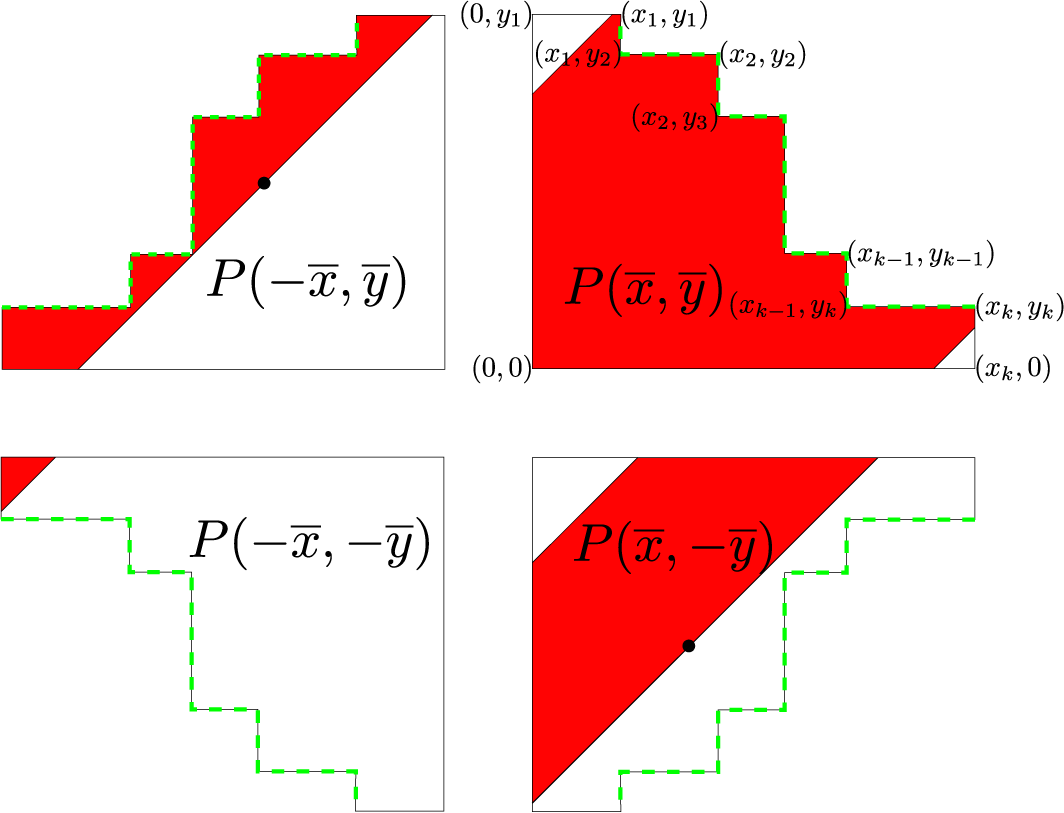
see Figure 2.
Staircase polygons
 $P(\overline {x},\overline {y})$
,
 $P(-\overline {x},\overline {y})$
,
 $P(\overline {x},-\overline {y})$
,
 $P(-\overline {x},-\overline {y})$
.

Denote by
 $\Gamma $
the four-element group generated by the vertical and the horizontal reflections
 $\gamma _v, \gamma _h:{\mathbb {R}}^2\to {\mathbb {R}}^2$
. The polygons of the form
 $$ \begin{align*} P(\overline{x},\overline{y}), \; P(-\overline{x},\overline{y})\kern1.5pt{=}\kern1.5pt\gamma_v P(\overline{x},\overline{y}),\; P(\overline{x},-\overline{y})\kern1.5pt{=}\kern1.5pt\gamma_h P(\overline{x},\overline{y}),\; P(-\overline{x},-\overline{y})\kern1.5pt{=}\kern1.5pt\gamma_v\circ\gamma_h P(\overline{x},\overline{y}) \end{align*} $$
are called staircase polygons; see Figure 2. The numbers
 $x_1,\ldots , x_{k-1}$
are called staircase lengths, and
 $y_2,\ldots , y_k$
are called staircase heights of the staircase polygon
 $P(\pm \overline {x},\pm \overline {y})$
. The number
 $x_{k}$
is called the width and
 $y_1$
is called the height of
 $P(\pm \overline {x},\pm \overline {y})$
.
We assume that the living space P of the particle is the union of four staircase polygons determined by the four sequences
 $(\overline {x}^{\varsigma _1\varsigma _2},\overline {y}^{\varsigma _1\varsigma _2})\in \Xi $
,
 $\varsigma _1,\varsigma _2\in \{\pm \}$
:
 $$ \begin{align*} P(\overline{x}^{++},\overline{y}^{++}), \; P(-\overline{x}^{-+},\overline{y}^{-+}),\; P(\overline{x}^{+-},-\overline{y}^{+-}),\; P(-\overline{x}^{--},-\overline{y}^{--}), \end{align*} $$
such that
 $$ \begin{align*} y^{++}_1=y^{-+}_1,\ y^{+-}_1=y^{--}_1,\ x^{++}_{k(\overline{x}^{++}, \overline{y}^{++})}=x^{+-}_{k(\overline{x}^{+-},\overline{y}^{+-})},\ x^{-+}_{k(\overline{x}^{-+}, \overline{y}^{-+})}=x^{--}_{k(\overline{x}^{--},\overline{y}^{--})}. \end{align*} $$
The space of all such polygons we denote by
 $\mathscr {R}$
. It is the set of star-shaped polygons with a kernel that includes the origin and with only vertical and horizontal boundaries. When the sequences
 $(\overline {x}^{\varsigma _1\varsigma _2},\overline {y}^{\varsigma _1\varsigma _2})$
are identical (independent of
 $\varsigma _1,\varsigma _2$
), the polygon is symmetric to reflections. Our analysis applies to both the general and the symmetric cases (Figure 5 shows symmetric polygons whereas all other figures are related to the general case).
The corners
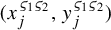 $(x^{\varsigma _1\varsigma _2}_{j},y^{\varsigma _1\varsigma _2}_{j})$
are
 $90^{\circ }$
corners, henceforth called convex corners, and
 $(x^{\varsigma _1\varsigma _2}_{j},y^{\varsigma _1\varsigma _2}_{j+1})$
are
 $270^{\circ }$
corner, henceforth called concave corners. The four-dimensional vector
 $\{k(\overline {x}^{\varsigma _1\varsigma _2},\overline {y}^{\varsigma _1\varsigma _2})\}_{ \varsigma _1,\varsigma _2\in \{\pm \}}$
is called the topological data of the polygon P, whereas the set of four vectors,
 $\{(\overline {x}^{\varsigma _1\varsigma _2},\overline {y}^{\varsigma _1\varsigma _2}), \varsigma _1,\varsigma _2\in \{\pm \}\}$
, is called the numerical data of the polygonFootnote
†
P.
The level set topology of
 $S^{P}_{E,E_{1}}$
is determined by the properties of
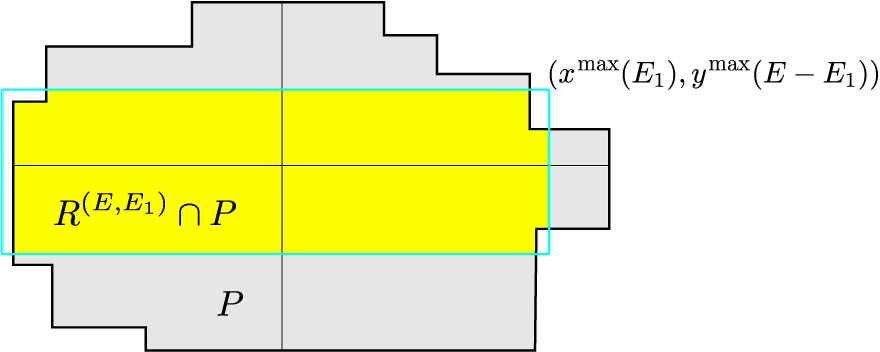
 $R^{(E,E_{1})}\cap P$
(see Figure 3) and can be found under mild conditions on the potential.
Theorem 1.2. Assume
 $V_1,V_2:{\mathbb {R}}\to {\mathbb {R}}_{\geq 0}$
are
 $C^2$
unimodal potentials (satisfying condition (♢) below). Let P be any polygon in
 $\mathscr R$
. Then for any
 $E>0$
, for
 $E_{1}\in (0,E)$
, the genus of the level set
 $(E_{1}, E-E_1)$
,
 $S^{P}_{E,E_{1}}$
, is given by
 $1$
plus the number of concave corners in
 $R^{(E,E_{1})}\cap P$
:
 $$ \begin{gather*} g(E,E_1)=1+\sum_{\varsigma_1,\varsigma_2\in\{\pm\}}\#\{1\leq k<k(\bar{x}^{\varsigma_1\varsigma_2},\bar{y}^{\varsigma_1\varsigma_2}):V_1(x^{\varsigma_1\varsigma_2}_k)<E_1<E-V_2(y^{\varsigma_1\varsigma_2}_{k+1})\}. \end{gather*} $$
Specifically, for
 $E> 0$
the interval
 $E_{1}\in (0,E)$
is divided into a finite number of segments on which the level sets have a constant genus. This partition is non-trivial for
 $E>{\min } _{\varsigma _1,\varsigma _2,k}V_1(x^{\varsigma _1\varsigma _2}_k)+V_2(y^{\varsigma _1\varsigma _2}_{k+1}) $
. Close to the end points of
 $(0,E)$
the genus is
 $1$
, whereas for E sufficiently large there exists an interval of level sets,
 $E_{1}\in I_{\max }$
with genus
 $g_{\max }=\sum _{\varsigma _1,\varsigma _2\in \{\pm \}}k(\bar {x}^{\varsigma _1\varsigma _2},\bar {y}^{\varsigma _1\varsigma _2})-3$
and on which for almost all
 $E_{1}$
values the motion is uniquely ergodic.
A projected rectangle and the staircase polygon. Cyan—the projected rectangle. Yellow—the polygon
 $R^{(E,E_{1})}\cap P$
includes three concave corners, thus, by Theorem 1.2,
 $g(E,E_{1})=4$
.

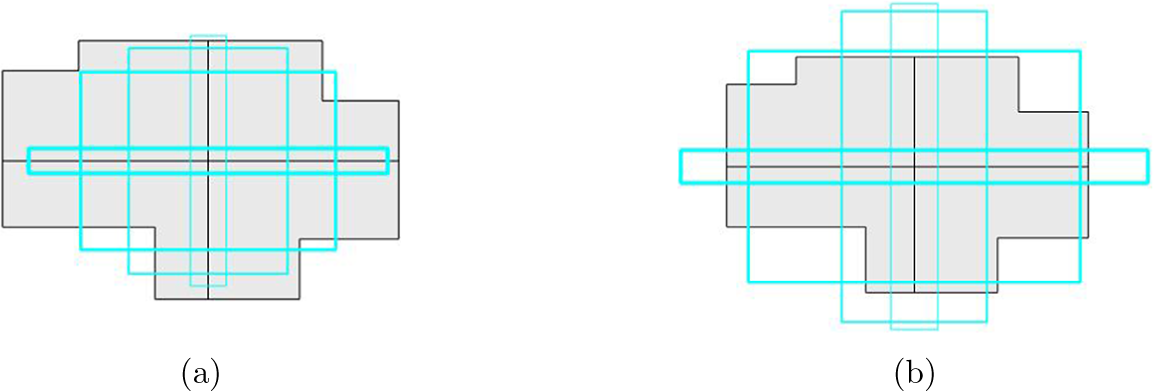
Figures 3 and 4 provide the geometrical interpretation of this theorem in the configuration space, where several iso-energy rectangles are plotted on top of an asymmetric staircase polygon P. Figure 4 demonstrates that the number of concave corners that are included in
 $R^{(E,E_{1})}\cap P$
can vary at a fixed energy. Figures 5 and 6 demonstrate the division of the intervals
 $E_{1}\in [0,E]$
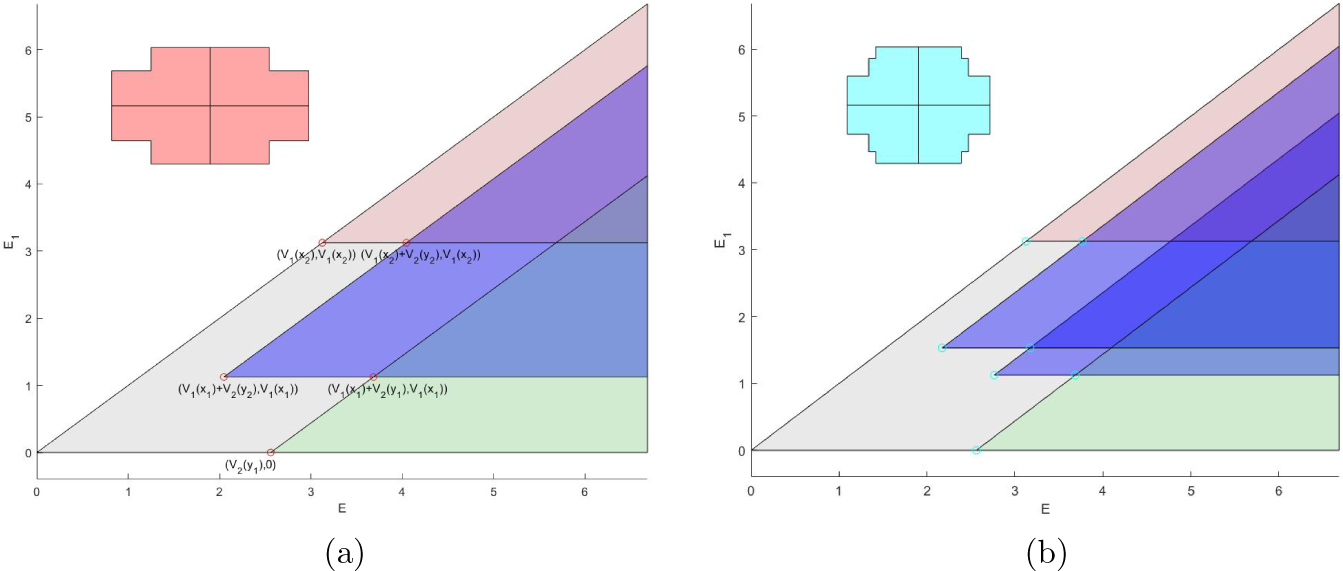
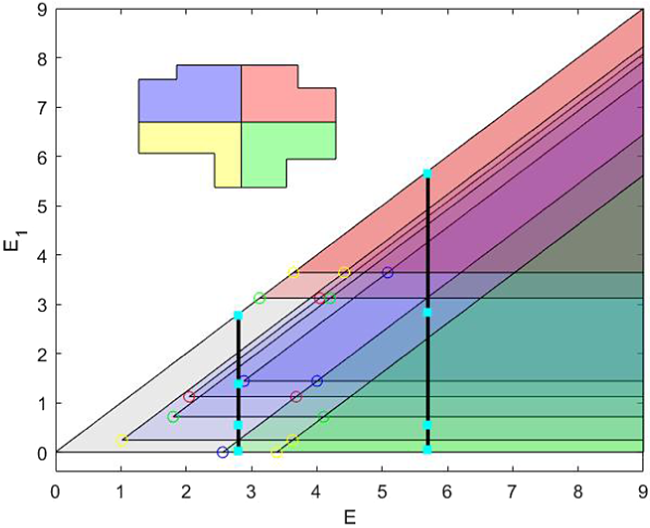
of iso-energy level sets into a finite number of intervals, each having level sets with a fixed genus. The figures show how this division depends on the energy E. In these plots, called impact energy-momentum bifurcation diagrams (IEMBDs; see [Reference Pnueli and Rom-Kedar15, Reference Pnueli and Rom-Kedar16]) the regions in the
 $(E,E_{1}) $
plane at which level sets include impacts with certain parts of the boundaries are shown. Figure 5 shows these plots for symmetric polygons and Figure 6 shows it for the asymmetric polygon of Figure 4. The gray wedge in each IEMBD corresponds to all allowed level sets (since
 $E_{1}\in [0,E]$
). A family of iso-energy level sets corresponds to a vertical line in this plot. The projected rectangles of the iso-energy level sets shown in Figure 4 at two energies correspond to the cyan squares on the two vertical black lines of Figure 6. Each blue colored wedge in the IEMBD corresponds to level sets that include impacts with a concave corner of one of the polygons
 $P(\overline {x}^{\varsigma _{1},\varsigma _{2}}, \overline {y}^{\varsigma _{1},\varsigma _{2}})$
. If j polygons have the same concave corner we say that this wedge has multiplicity j, so in Figure 5 each concave corner has multiplicity 4. The pink (respectively, light-green) regions correspond to level sets that impact the extreme vertical (respectively, horizontal) boundaries of a polygon. Regions that are in the complement to the blue wedges correspond to level sets with genus 1 (so, in particular, small and large (
 $E_{1}\approx E$
) values are included in this set). Regions that are in
 $ k_g$
shaded blue wedges (counting multiplicities) have genus
 $ k_g+1$
. Thus, the regions in the intersection of all the blue wedges have the maximal genus
 $g_{\max }$
. The intersection of this region with the two pink and two light green wedges corresponds to level sets that, for almost all
 $E_{1}$
, have uniquely ergodic dynamics with the very mild assumption (condition (♢)) on the potentials. As described next, with stronger assumptions on the potentials we prove unique ergodicity for almost all level sets in the allowed region, whereas for quadratic resonant potentials the IEMBD provides a more delicate division to segments as will be explained in §1.4.
The intersection of a star-shaped polygon (gray) with four iso-energy projected rectangles (cyan) at (a)
 $E=2.7$
and (b)
 $E=5.7 $
energy values. By Theorem 1.2, the genera of the corresponding iso-energy level sets for the four
 $R^{(E,E_{1})}$
rectangles shown are, for increasing
 $E_{1}$
(a)
 $ g(E=2.7,E_1)=\{1,2,4,1\}$
(b)
 $ g(E=5.7,E_1)=\{1,2,5=g_{\max },1\}$
. The potentials here are quadratic with
 $\omega _{1}=1,\omega _{2}=0.8\sqrt {2}$
.

Impact energy-momentum bifurcation diagram: (a) for a symmetric cross (one concave corner with multiplicity
 $4$
); (b) symmetric two-step cross (two concave corners each with multiplicity
 $4$
). Here, due to symmetry, each blue wedge corresponds to four overlapping wedges, so
 $R^{(E,E_{1})}\cap P$
includes
 $4k$
concave corners if and only if
 $(E,E_{1})$
is in a region covered by
 $4k$
overlapping shaded blue regions. Only for these regions is the level sets genus greater than
 $1$
. The pink (respectively, light-green) regions correspond to level sets that impact the extreme vertical (respectively, horizontal) sides.

Impact energy-momentum bifurcation diagram for the asymmetric cross shown in Figure 4 (four distinct concave corners). The colored circles correspond to the energies of the corners of the corresponding colored staircase polygons shown in the inset. All corners have distinct partial energies, so
 $R^{(E,E_{1})}\cap P$
includes k concave corners if and only if
 $(E,E_{1})$
is in a region covered by k overlapping blue regions. Only for these regions is the level sets genus greater than
 $1$
. The pink (respectively, light green) regions include extremal vertical (respectively, horizontal) boundaries. The two vertical lines indicate the energies
 $E=2.7,5.7 $
and the cyan squares on these lines correspond to the
 $E_{1}$
values of the rectangles shown in Figure 4.

1.2 Deck potentials
To study the properties of the invariant measures of the flow
 $(\varphi ^{P,E,E_{1}}_t)_{t\in {\mathbb {R}}}$
we need additional assumptions on the potentials. For all
 $z_0\in {\mathbb {C}}$
and
 $r>0$
define the ball centered at
 $z_0$
and the droplet emanating from
 $z_0$
by
 $$ \begin{align*}B(z_0,r)=\{z\in {\mathbb{C}}:|z-z_0|<r\}\quad\text{and}\quad C(z_0,r)=\bigcup_{s\in(0,1]}sB(z_0,r)\quad\text{if}\;r<|z_0|.\end{align*} $$
We define a special class of even potentials
 $V_1,V_2$
denoted by
 $\textit {Deck}$
. An even
 $C^2$
-map
 $V:{\mathbb {R}}\to {\mathbb {R}}$
belongs to
 $\textit {Deck}$
if
 $$ \begin{align} &V(0)=V^{\prime}(0)=0,\quad V^{\prime}(x)>0\quad \text{for all}\ x>0\quad \text{and}\quad \lim_{x\to+\infty}V(x)=+\infty; \end{align} $$
 $$ \begin{align} &V:(0,+\infty)\to(0, +\infty)\ \text{is an analytic map.} \end{align} $$
Then
 $V:(0,+\infty )\to (0, +\infty )$
has a holomorphic extension
 $V:U\to {\mathbb {C}}$
on an open neighborhood
 $U\subset {\mathbb {C}}$
of
 $(0,+\infty )$
, and we have that:
 $$ \begin{align} &\text{for every } E>0 \text{ there exist } 0<r<E \text{ and a bounded open set } U_{E}\subset U \nonumber\\ &\text{such that } V:U_E\to V(U_E) \text{ is biholomorphic with } C(E,r)\subset V(U_E); \end{align} $$
 $$ \begin{align} \text{there exists}\ C_{E}>0 \ \text{such that} \ \bigg|\frac{V^{\prime\prime}(z)V(z)}{(V^{\prime}(z))^2}\bigg|\leq C_E\quad \text{for all}\ z\in U_E. \end{align} $$
The class
 $\textit {Deck}$
contains all unimodal analytic maps (that is, satisfying (♢)); see Proposition A.1. Further examples of
 $\textit {Deck}$
potentials which are not analytic at
 $0$
(such as
 $V(x)=|x|^m\exp (-1/|x|)$
) are presented in Appendix A. The Deck assumption ensures that the period depends analytically on the energy. Additionally, we will most often assume that
 $V\in \textit {Deck}$
also satisfies
 $$ \begin{align} \frac{V(x)V^{\prime\prime}(x)}{(V^{\prime}(x))^2}\geq \frac{1}{2}\quad \text{for all}\ x>0,\ \text{or} \end{align} $$

Condition (☺) is equivalent to V being the square of a convex function, and ensures that the period is a decreasing function of the energy, while condition (☼) means additionally not being a quadratic function, so the period is strictly decreasing with the energy; see Lemmas 4.4 and 4.5. For example, all non-trivial non-quadratic even polynomials with non-negative coefficients are Deck and satisfy (☼), whereas
 $V(x)=x^{2}-\sqrt {2}x^4+x^6=(x+x^3)^2-(2+\sqrt {2})x^4$
is Deck but does not satisfy (☺) (cf. Proposition A.4).
1.3 Main results for non-quadratic Deck potentials
The main result (Theorem 1.3) says that for every energy level
 $E>0$
and typical (almost every, a.e.) partial energy
 $E_{1}\in [0,E]$
the local flow
 $(\varphi ^{P,E,E_{1}}_t)_{t\in {\mathbb {R}}}$
is uniquely ergodic whenever at least one potential is not a quadratic function or both are quadratic functions and non-resonant (that is, in this latter case
 $\Omega (E,E_1)$
, which by Remark 1.1 does not depend on E and
 $E_1$
, is irrational).
Theorem 1.3. Assume
 $V_1,V_2:{\mathbb {R}}\to {\mathbb {R}}_{\geq 0}$
are
 $\textit {Deck}$
potentials satisfying (☺). Let P be any polygon in
 $\mathscr R$
. Suppose that:
(α) at least one potential
 $V_1$
or
$V_2$
satisfies (☼); or
(β) both
$V_1,V_2$
are quadratic maps such that
$V_1=\Omega ^{2} V_2$
with
$\Omega $
irrational.


Then for every energy level
 $E>0$
and a.e.
 $E_1\in [0,E]$
the restricted Hamiltonian flow
 $(\varphi ^{P,E,E_1}_t)_{t\in {\mathbb {R}}}$
is uniquely ergodic.
Notice that for small energy (that is, satisfying (1.4)), and, in fact, for all the gray areas in the IEMBD figures (Figures 5 and 6), the motion does not impact the polygon walls and the above theorem trivially holds as the motion on most of the tori is of irrational rotation (in the non-quadratic case,
 $(\alpha )$
, the iso-energy non-degeneracy condition holds since
 $\omega _{i}^{\prime }(I_i)\geqslant 0,i=1,2$
, and at least for one oscillator the inequality is strict). The non-trivial statement is that even when impacts occur (the pink, light-green and blueish regions in the IEMBD figures), the flow is usually uniquely ergodic. By the definition of unique ergodicity, the theorem tells us that for most level sets time averages are equivalent to phase-space averages for every initial condition on these level set. The complementary set could have periodic and quasi-periodic motion coexisting on the same level set as in [Reference Becker, Elliott, Firester, Cohen, Pnueli and Rom-Kedar1, Reference McMullen13].
1.4 Linear oscillators case
We study separately the case when
 $V_1$
and
 $V_2$
are quadratic. This boundary case (in the class of
 $\textit {Deck}$
potentials satisfying ☺) is significantly different from the general case. In the quadratic case we have
 $V_1=\Omega ^{2} V_2$
, and we consider rational
 $\Omega $
so the harmonic motion is resonant.
If the energy level E is low enough then the impacting resonant quadratic flow,
 $(\varphi ^{P,E,E_1}_t)_{t\in {\mathbb {R}}}$
, does not reach the boundary and the motion is trivially identical to the resonant periodic linear oscillator motion (the gray area in the IEMBD figures, before any of the blue wedges emerge).
Proposition 1.4. For energies satisfying
 $$ \begin{align} E\leq{\min}\{V_1(x^{\varsigma_1\varsigma_2}_k)+V_2(y^{\varsigma_1\varsigma_2}_{k+1}):\varsigma_1,\varsigma_2\in\{\pm\},0\leq k\leq k(\bar{x}^{\varsigma_1\varsigma_2},\bar{y}^{\varsigma_1\varsigma_2})\}, \end{align} $$
where
 $x^{\varsigma _1\varsigma _2}_0=y^{\varsigma _1\varsigma _2}_{k(\bar {x}^{\varsigma _1\varsigma _2},\bar {y}^{\varsigma _1\varsigma _2})+1}=0$
, the restricted Hamiltonian flow
 $(\varphi ^{P,E,E_1}_t)_{t\in {\mathbb {R}}}$
is identical to
 $(\varphi ^{E,E_1}_t)_{t\in {\mathbb {R}}}$
for all
 $E_1\in [0,E]$
, and for the impacting resonant quadratic flow it corresponds to periodic motion.
On the other hand, a non-trivial statement, with a proof which is similar to that of Theorem 1.3, is that if the energy level E is high enough so that at least one of the extremal horizontal or vertical boundaries is reached by orbits in
 $S^P_{E,E_1}$
for all
 $E_1\in [0,E]$
then
 $(\varphi ^{P,E,E_1}_t)_{t\in {\mathbb {R}}}$
is uniquely ergodic for a.e.
 $E_1$
(energies beyond which the segment
 $[0,E] $
is covered by the union of the pink and light green wedges in the IEMBD figures, such as
 $E \approx 5.7 $
in Figure 6; see also the corresponding projected rectangles in Figure 4(b)).
Theorem 1.5. If
 $$ \begin{align} E \geq{\underset{\varsigma_1,\varsigma_2\in\{\pm\}}\min}V_1(x_{k(\bar{x}^{\varsigma_1\varsigma_2},\bar{y}^{\varsigma_1\varsigma_2})}^{\varsigma_1\varsigma_2}) +{\underset{\varsigma_1,\varsigma_2\in\{\pm\}}\min}V_2(y_1^{\varsigma_1\varsigma_2}) \end{align} $$
then the impacting resonant quadratic flow
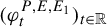 $(\varphi ^{P,E,E_1}_t)_{t\in {\mathbb {R}}}$
is uniquely ergodic for a.e.
 $E_1\in [0,E]$
.
Studying the case of intermediate E is much more complex and requires new methods. Then the
 $E_{1}$
interval
 $[0,E]$
splits into at most countably many intervals so that for every interval I from this partition we have three possible scenarios:
-
(ue) the flow
$(\varphi ^{P,E,E_1}_t)_{t\in {\mathbb {R}}}$
is uniquely ergodic for a.e.
$E_1\in I$
; -
(cp) the flow
$(\varphi ^{P,E,E_1}_t)_{t\in {\mathbb {R}}}$
is completely periodic for all
$E_1\in I$
; -
(coex) for a.e.
$E_1\in I$
the phase space of
$(\varphi ^{P,E,E_1}_t)_{t\in {\mathbb {R}}}$
splits into two completely periodic cylinders and two uniquely ergodic components.


For
 $E>0$
let
 $\mathcal {J}_E$
denote a partition (into open intervals) of the
 $E_{1}$
-interval
 $[0,E]$
determined by the numbers
 $$ \begin{align*}V_1(x^{\varsigma_1\varsigma_2}_k), E-V_2(y^{\varsigma_1\varsigma_2}_k)\quad\text{for all }\varsigma_1,\varsigma_2\in\{\pm\},1\leq k\leq k(\bar{x}^{\varsigma_1\varsigma_2},\bar{y}^{\varsigma_1\varsigma_2}).\end{align*} $$
In the IEMBD figures,
 $\mathcal {J}_E$
corresponds to the partition of the vertical interval
 $[0,E]$
by the colored wedges. Now we formulate two results relating to the cases (cp) and (ue). For low energies, there are intervals of
 $E_{1}$
values for which no impacts occur (these are the gray regions in the IEMBD figures).
Proposition 1.6. Suppose that
 $I\in \mathcal J_E$
is an interval such that for every
 $\varsigma _1,\varsigma _2\in \{\pm \}$
there exists
 $1\leq {l}^{\varsigma _1\varsigma _2} \leq {k}(\bar {x}^{\varsigma _1\varsigma _2},\bar {y}^{\varsigma _1\varsigma _2})$
such that
 $$ \begin{align} I\subset \bigcap_{\varsigma_1,\varsigma_2\in\{\pm\}}[E-V_2(y^{\varsigma_1\varsigma_2}_{{l}^{\varsigma_1\varsigma_2}}),V_1(x^{\varsigma_1\varsigma_2}_{{l}^{\varsigma_1\varsigma_2}})]. \end{align} $$
Then the impacting resonant quadratic flow
 $(\varphi ^{P,E,E_1}_t)_{t\in {\mathbb {R}}}$
is completely periodic for every
 $E_1\in I$
.
Denote by
 $I_{\mathrm {nonimp}}(E)$
the collection of
 $E_1$
intervals on which no impacts occur:
 $$ \begin{align} I_{\mathrm{nonimp}}(E)=\bigcup_{\substack{ 1\leq {l}^{++} \leq {k}(\bar{x}^{++},\bar{y}^{++})\\ 1\leq {l}^{+-} \leq {k}(\bar{x}^{+-},\bar{y}^{+-})\\ 1\leq {l}^{-+} \leq {k}(\bar{x}^{-+},\bar{y}^{-+})\\ 1\leq {l}^{--} \leq {k}(\bar{x}^{--},\bar{y}^{--}) }} \bigcap_{\varsigma_1,\varsigma_2\in\{\pm\}}[E-V_2(y^{\varsigma_1\varsigma_2}_{{l}^{\varsigma_1\varsigma_2}}),V_1(x^{\varsigma_1\varsigma_2}_{{l}^{\varsigma_1\varsigma_2}})]. \end{align} $$
For sufficiently large
 $E $
this set is empty, whereas for sufficiently small
 $E,\ I_{\mathrm {nonimp}}(E)= [0,E]$
. For intermediate values
 $I_{\mathrm {nonimp}}(E)$
may be composed of several disjoint intervals (e.g. the gray segments for
 $E=3 $
in Figure 5).
When at least one of the extremal boundaries is reached (the union of the pink and light green wedges in the IEMBD figures), similar to the general case of Theorem 1.3, we again get unique ergodicity for a.e.
 $E_{1}$
.
Theorem 1.7. For every energy level
 $E>0$
and almost every
 $$ \begin{align*} E_1\in \Big[0,E-{\underset{\varsigma_1,\varsigma_2\in\{\pm\}}\min}V_2(y_1^{\varsigma_1\varsigma_2})\Big] \cup \Big[{\underset{\varsigma_1,\varsigma_2\in\{\pm\}} \min}V_1(x_{k(\bar{x}^{\varsigma_1\varsigma_2},\bar{y}^{\varsigma_1\varsigma_2})}^{\varsigma_1\varsigma_2}),E\Big] \end{align*} $$
the impacting resonant quadratic flow
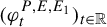 $(\varphi ^{P,E,E_1}_t)_{t\in {\mathbb {R}}}$
is uniquely ergodic.
Now assume that
 $I\in \mathcal J_E$
is an interval such that impacts occur and not with the extremal boundaries (pure blue regions in the IEMBD figures):
 $$ \begin{align} I\subset I_{\mathrm{intimp}} =\Big(E-{\underset{\varsigma_1,\varsigma_2\in\{\pm\}}\min}V_2(y_1^{\varsigma_1\varsigma_2}),{\underset{\varsigma_1,\varsigma_2\in\{\pm\}}\min}V_1(x_{k(\bar{x}^{\varsigma_1\varsigma_2},\bar{y}^{\varsigma_1\varsigma_2})}^{\varsigma_1\varsigma_2})\Big)\backslash I_{\mathrm{nonimp}}(E). \end{align} $$
This case presents non-uniform ergodic properties and requires new constructions. Assume that
 $\Omega =n/m$
with m, n coprime natural numbers. Let
 $\{\textit {red, green}\}$
be a partition of the
 $(\varsigma _1,\varsigma _2)$
set
 $\{++,+-,-+,--\}$
into two-element set so that
 $$ \begin{align} \textit{green} =(\textit{pair}1, \textit{pair}2)=\left\{ \begin{array}{@{}ll} \{++,+-\}&\text{ if } m \text{ is odd and } n \text{ is even,}\\ \{++,-+\}&\text{ if } m \text{ is even and } n \text{ is odd,}\\ \{++,--\}&\text{ if } m \text{ and } n \text{ are odd.} \end{array}\right. \end{align} $$
Recall that a billiard in a rectangle can be reflected three times so that the billiard flow is conjugated to the directed flow on the torus. By rescaling we can always consider the flow to be in the direction
 $45^{\circ }$
. Denote the left lower corner of the original rectangle by
 $(--)$
, the upper left corner by
 $(-+)$
, the lower right corner
 $(+-)$
and the upper right corner by
 $(++)$
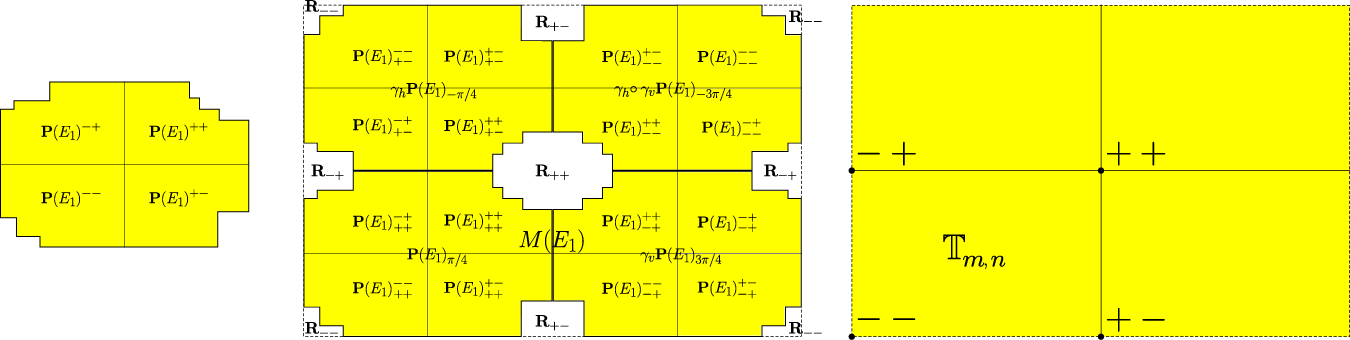
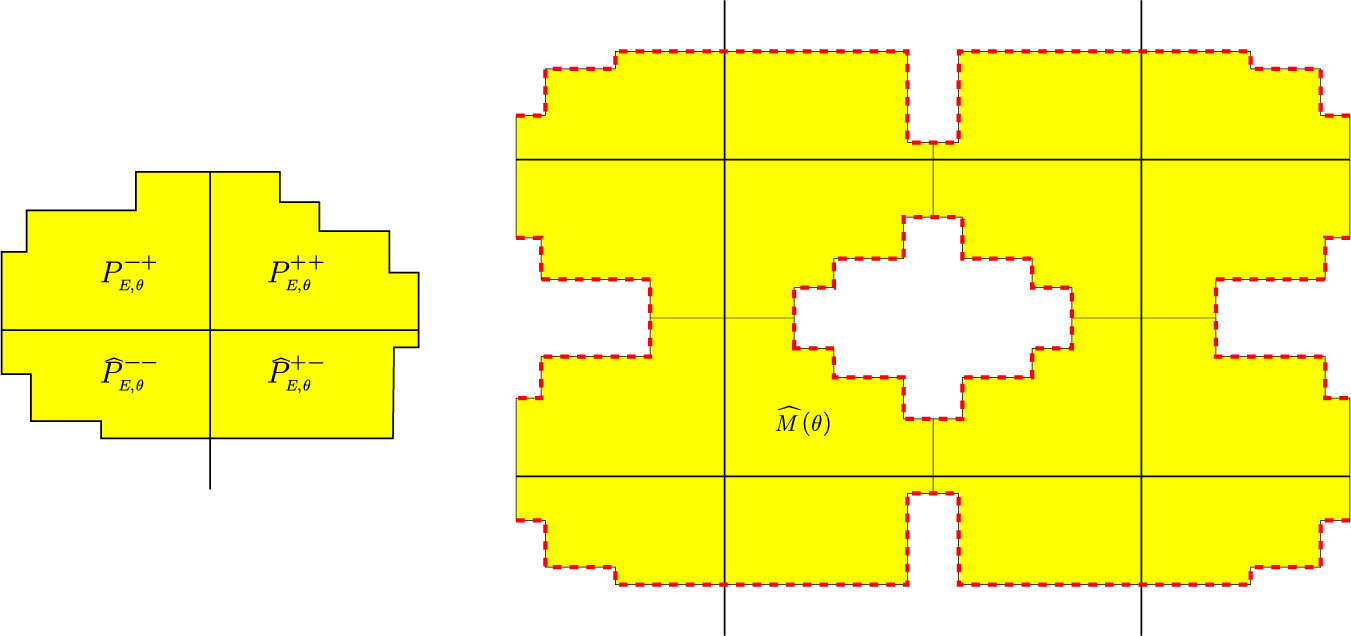
(see Figure 7). In the rational situation, when the impacts from the boundary of the polygon P are ignored, the torus is filled with periodic orbits. We will see that the partition corresponds to having two periodic orbits of the scaled torus which connect the
 $\textit{pair}1$
and
 $\textit {pair}2$
corners. These colored periodic orbits induce coloring of the staircase non-extremal boundaries of
 $P(\overline {x}^{\varsigma _1\varsigma _2},\overline {y}^{\varsigma _1\varsigma _2})$
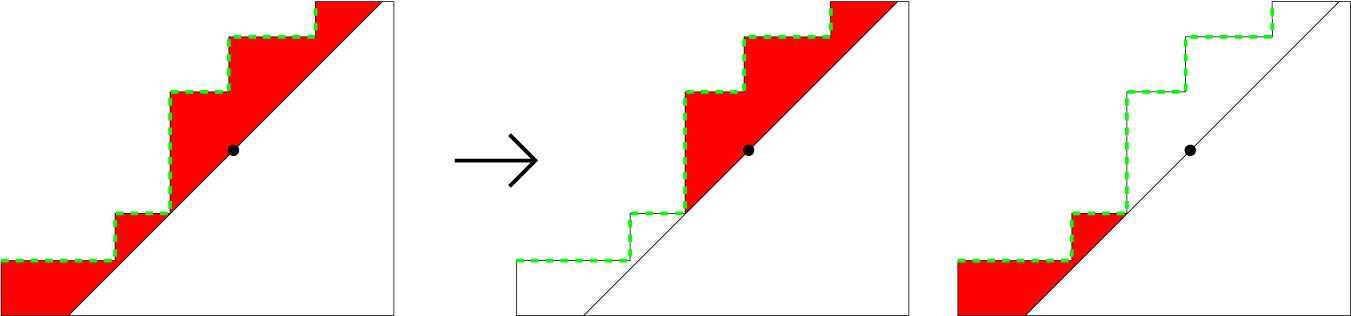
, which we call colored sides (see Figure 1, with coloring induced by taking m odd and n even as in the figures of §7).
The billiard table
 $\mathbf {P}(E_1)$
, the translation surface
 $M(E_1)$
and the marked torus
 ${\mathbb {T}}_{m,n}$
.

Next for every
 $colour\in \{\textit {green, red}\}$
let
 $$ \begin{align*} \delta^{colour}(E_1): =\max_{\substack{\varsigma_1\varsigma_2\in colour\\ 1\leq k< {k}(\bar{x}^{\varsigma_1\varsigma_2},\bar{y}^{\varsigma_1\varsigma_2})\\ V_1(x_k^{\varsigma_1\varsigma_2})<E_1<E-V_2(y_{k+1}^{\varsigma_1\varsigma_2})}} \!\bigg(m\arccos\sqrt{\frac{V_1(x_k^{\varsigma_1\varsigma_2})}{E_1}}+n\arccos\sqrt{\frac{V_2(y_{k+1}^{\varsigma_1\varsigma_2})}{E-E_1}}\bigg). \end{align*} $$
We will see that
 $\delta ^{colour}(E_1)$
is related to the measure of orbits that impact the colored sides of the polygon (see details in §7). Since
 $\delta ^{\textit {green}}(E_1)+\delta ^{\textit {red}}(E_1)=\pi $
for at most countably many
 $E_1\in I$
(see Lemma 7.2), the interval I has a partition into open intervals of two kinds
 $\mathcal U^+_I$
and
 $\mathcal U^-_I$
so that
 $$ \begin{align} \begin{split} \delta^{\textit{green}}(E_1)+\delta^{\textit{red}}(E_1)>\pi&\quad\text{for all } E_1\in J \text{ if } J\in \mathcal U^+_I, \\ \delta^{\textit{green}}(E_1)+\delta^{\textit{red}}(E_1)<\pi&\quad\text{for all } E_1\in J \text{ if } J\in \mathcal U^-_I. \end{split} \end{align} $$
We will see that in the first case, there are no non-impacting orbits, whereas in the second case there are also periodic orbits which do not impact any colored side. In this latter case, the impacting orbits can be divided into two separate sets, the red/green set, consisting of orbits impacting the red/green sides.
The following theorem asserts that in the first case, for almost all
 $E_{1}$
, all orbits are equidistributed, whereas in the second case, for almost all
 $E_{1}$
, all orbits that impact the red/green sides are equidistributed among the red/green set.
Theorem 1.8. Let
 $I\subset I_{\mathrm {intimp}}$
(see (1.8)) and divide I into the subintervals
 $ \mathcal U^{\pm }_I $
satisfying (1.10). If
 $J\in \mathcal U^+_I$
then the impacting resonant quadratic flow
 $(\varphi ^{P,E,E_1}_t)_{t\in {\mathbb {R}}}$
is uniquely ergodic for a.e.
 $E_1\in J$
. If
 $J\in \mathcal U^-_I$
then the phase space of the flow
 $(\varphi ^{P,E,E_1}_t)_{t\in {\mathbb {R}}}$
splits for all
 $E_1\in J$
into four components, two of which are completely periodic and for a.e.
 $E_1\in J$
the two other components are uniquely ergodic.
This result completes the description of invariant measure of the restricted Hamiltonian flow
 $(\varphi ^{P,E,E_1}_t)_{t\in {\mathbb {R}}}$
for every
 $E>0$
and almost every
 $E_1\in [0,E]$
, when
 $V_1$
,
 $V_2$
are quadratic potentials with
 $V_1=\Omega ^{2} V_2$
and
 $\Omega $
is rational. We discuss the non-trivial implications of this theorem on ergodic averages of the impacting resonant quadratic flow in §9.
1.5 Strategy of the proof
In §3, using a standard change of coordinates (as observed in [Reference Becker, Elliott, Firester, Cohen, Pnueli and Rom-Kedar1]), we construct an isomorphism between the restricted Hamiltonian flow
 $(\varphi ^{P,E,E_1}_t)_{t\in {\mathbb {R}}}$
and the directional billiard flow in direction
 $\pm \pi /4,\pm 3\pi /4$
on a polygon
 $\mathbf P_{E,E_1}\in \mathscr R$
. For every
 $E>0$
this gives a piecewise analytic curve
 $E_1\in [0,E]\mapsto \mathbf P_{E,E_1}\in \mathscr R$
of billiard flows on polygons in
 $\mathscr R$
. More precisely, this curve is analytic on every interval
 $I\in \mathcal J_E$
. The unique ergodicity problem for curves of this type was recently studied by the first author in [Reference Frączek, Shi and Ulcigrai8]. In fact, a slight modification of [Reference Frączek, Shi and Ulcigrai8, Theorem 4.2] (see Theorem 5.1 below) is applied to curves
 $[0,E]\ni E_1\mapsto \mathbf P_{E,E_1}\in \mathscr R$
to show unique ergodicity
 $(\varphi ^{P,E,E_1}_t)_{t\in {\mathbb {R}}}$
for a.e.
 $E_1\in [0,E]$
whenever at least one potential
 $V_1$
or
 $V_2$
is not a quadratic function or both are quadratic functions with
 $\Omega $
irrational, see Theorem 1.3, and Theorem 5.3 in §5. Theorem 5.1 relies on the analysis of functions indicating the length and height of steps and the width and height of staircase polygons that make up the polygon
 $\mathbf P_{E,E_1}$
, when the parameter
 $E_1$
varies. The relevant results involving these functions necessary for applications of Theorem 5.1 are presented and proved in §4.
The case when
 $V_1$
,
 $V_2$
are quadratic with
 $V_1=\Omega ^{2} V_2$
and
 $\Omega $
is rational needs a more subtle version of Theorem 5.1; this is Theorem 7.8. Recall that any directional billiard flow on any right-angled polygon is isomorphic to the translation flow on a translation surface obtained using a so-called unfolding procedure from the polygon. This leads to the study of analytic curves of translation surfaces and their translation flows in a fixed direction. Theorem 7.8 gives a criterion for unique ergodicity of the translation flow for almost every translation surface lying on such a curve (this theorem is set in an abstract framework to allow other applications). While the idea of the proof of Theorem 7.8 is similar to [Reference Frączek, Shi and Ulcigrai8, Theorem 4.2], it needs more subtle reasoning, as it involves a new type of partition of the translation surface into polygons with sides that can be parallel to the direction of the flow. This is the main innovation in relation to the approach used in Theorem 5.1 (and in [Reference Frączek, Shi and Ulcigrai8]). Another important novelty is the use of so-called distinguished sides of partitions. The key assumption of Theorem 7.8 is that every orbit of the directional flow (finite or half-infinite or double-infinite) hits a distinguished side, and the key construction in proving Theorem 1.8 is of a glued surface for which this assumption holds.
2 Oscillations in one dimension
Assume that
 $V_{1}(x):{\mathbb {R}}\to {\mathbb {R}}_{\geq 0}$
is an even
 $C^2$
-potential satisfying (♢). Then
 $x^{\max }(E_{1}):[0, +\infty )\to [0,+\infty )$
, the inverse of the positive branch of
 $V_1$
, is continuous and
 $C^2$
on
 $(0, +\infty )$
with
 $x^{\max }(0)=0$
and
 $(x^{\max })^{\prime }(E_{1})>0$
for
 $E_{1}>0$
. Similar definitions apply to
 $y^{\max }(E_{2})=y^{\max }(E-E_{1})$
.
Fix an energy level
 $E_1\kern0.7pt{>}\kern0.7pt 0$
. The particle oscillates in the interval
 $[\kern-0.1pt-x^{\max }(E_{1}\kern-0.1pt),x^{\max }(E_{1}\kern-0.1pt)\kern-0.1pt]$
, wandering between the ends back and forth. We change the space coordinate to obtain a new isomorphic model of the oscillation in which the mass point moves periodically with speed
 $\omega _{1}(E_1)>0$
on the interval
 $ \psi _1\in [-{\pi }/{2},{\pi }/{2}]$
:
 $$ \begin{align} \frac{d\psi_1}{dt}=\operatorname{sgn}(p_x)\omega_{1}(E_1),\quad\:\psi(0)=0,\quad\:\psi_1(\pm x^{\max}(E_{1}))=\pm\frac{\pi}{2}. \end{align} $$
We call these coordinates action-angle-like coordinates, as they are simply related to the transformation to action angle coordinates; see [Reference Becker, Elliott, Firester, Cohen, Pnueli and Rom-Kedar1]. Using the symmetry of
 $V_{1}$
and the notation
 $p_{x}(E_{1},x)=\pm \sqrt {2}\sqrt {E_1-V_{1}(x)}$
to denote the dependence of
 $p_x$
on position and energy, we have
 $$ \begin{align} \psi_{1}(x,E_{1})=\frac{2\pi}{T_{1}(E_1)}\int_0^{x}\frac{1}{|p_{x}(E_{1},s)|}ds=\omega_{1}(E_1)\int_0^{x}\frac{1}{\sqrt{2}\sqrt{E_1-V_{1}(s)}}ds, \end{align} $$
where
 $T_{1}(E_1)$
and
 $\omega _{1}(E_1)$
are respectively the period and frequency of the periodic flow on the
 $E_{1}$
level set, that is,
 $$ \begin{align} \frac{1}{4}T_{1}(E_1)=\frac{\pi }{2\omega_{1}(E_1)}=\int_0^{x^{\max}(E_{1})}\frac{1}{|p_{x}(E_{1},s)|}ds=\int_0^{x^{\max}(E_{1})}\frac{1}{\sqrt{2}\sqrt{E_1-V_{1}(s)}}ds \end{align} $$
satisfies equation (2.1). Now suppose additionally that our oscillator meets an elastic barrier at a point
 $x^{\mathrm {wall}}>0$
. Then its trajectories are described by equations (1.3) if
 $x\leq x^{\mathrm {wall}}$
according to the rule that if a trajectory meets a point
 $(p_{x},x^{\mathrm {wall}})$
then it jumps to
 $ (-p_{x},x^{\mathrm {wall}})$
and continues its movement in accordance with (1.3). Thus, if
 $x^{\mathrm {wall}}<x^{\max }(E_{1})$
the particle oscillates in the interval
 $[-x^{\max }(E_{1}), x^{\mathrm {wall}}]$
and after changing the space coordinate to the action-angle-like coordinate
 $\psi _{1}$
it oscillates with speed
 $\omega _{1}(E_1)$
on the interval
 $ \psi _1\in [-{\pi }/{2},\psi _{1}(x^{\mathrm {wall}},E_{1})]$
with elastic reflections from the ends. The maps
 $\psi _{2}(y,E_{2})$
and
 $T_{2}(E_2)$
are similarly defined.
3 From oscillations in dimension two to billiards on polygons
Recall that the motion in configuration space on a given level set is restricted to the polygon
 $ P\cap R^{(E,E_{1})}$
. Using the transformation
 $\psi=(\psi_1,\psi_2) $
, we find the topological and numerical data of the corresponding polygon in the
 $\psi $
space.
We consider the Hamiltonian flow (1.3) restricted to the polygon
 $P\in \mathscr R$
:
 $$ \begin{align*} P=P(\overline{x}^{++},\overline{y}^{++}) \cup P(-\overline{x}^{-+},\overline{y}^{-+})\cup P(\overline{x}^{+-},-\overline{y}^{+-}) \cup P(-\overline{x}^{--},-\overline{y}^{--}), \end{align*} $$
where
 $(\overline {x}^{\varsigma _1\varsigma _2},\overline {y}^{\varsigma _1\varsigma _2})\in \Xi $
for
 $\varsigma _1,\varsigma _2\in \{\pm \}$
and we are interested in the properties of the flow restricted to iso-energy level sets
 $E_{1},E_{2}=E-E_1$
which we denote by
 $(\varphi ^{P,E,E_1}_t)_{t\in {\mathbb {R}}}$
. Fix
 $E>0$
and
 $0<E_1<E$
. By the definition of
 $S^P_{E,E_1}$
the level set is contained in
 $$ \begin{align*}{\mathbb{R}}^2\times R^{(E,E_1)}={\mathbb{R}}^2\times[-x^{\max}(E_{1}),x^{\max}(E_{1})]\times[-y^{\max}(E-E_{1}),y^{\max}(E-E_{1})] .\end{align*} $$
Let us consider new coordinates on
 $R^{(E,E_1)}$
given by
 $$ \begin{align*} \psi(x,y) & =(\psi_{1}(x,E_{1}),\psi_{2}(y,E-E_{1})) \end{align*} $$
and notice that
 ${d\psi (x(t),y(t))}/{dt}=(\operatorname {sgn}(p_x(t))\omega _{1}(E_1),\operatorname {sgn}(p_y(t))\omega _{2}(E-E_1))$
. It follows that the flow
 $(\varphi ^{P,E,E_1}_t)_{t\in {\mathbb {R}}}$
in the new coordinates coincides with the directional billiard flow on
 $$ \begin{align*}\mathbf{P}_{E,E_1}:=\psi (P\cap R^{(E,E_1)})\end{align*} $$
so that the directions of its orbit are
 $(\pm \omega _{1}(E_1),\pm \omega _{2}(E-E_1))$
. As
 $P\cap R^{(E,E_1)}\in \mathscr R$
and
 $\psi $
sends vertical/horizontal segments to vertical/horizontal segments, we have
 $\mathbf {P}_{E,E_1}\in \mathscr R$
, namely,
 $$ \begin{align*}\mathbf{P}_{E,E_1}=\mathbf{P}^{++}_{E,E_1}\cup \mathbf{P}^{+-}_{E,E_1}\cup \mathbf{P}^{-+}_{E,E_1}\cup \mathbf{P}^{--}_{E,E_1}\end{align*} $$
Notice that the numbers of corner points in each quadrant of
 $P\cap R^{(E,E_1)}$
and of
 $\mathbf {P}_{E,E_1}$
are identical, whereas their dimensions are related by the transformation
 $\psi $
(which depends on
 $E_{1}$
and E). We need to find these dimensions to determine the properties of the flow.
It is convenient first to rescale
 $\mathbf {P}_{E,E_1}$
so that the directional motion occurs in the standard directions
 $(\pm\pi/4,\pm 3\pi/4)$
. Thus we scale
 $$ \begin{align*}\hat \psi_{1}(x,E_{1})=\frac{\psi_{1}(x,E_{1})}{\omega_{1}(E_1)},\quad\hat \psi_{2}(x,E-E_{1})=\frac{\psi_{2}(y,E-E_{1})}{\omega_{2}(E-E_1)};\end{align*} $$
then
 $\mathbf {P}_{E,E_1}$
is scaled to
 $ \hat {\mathbf {P}}_{E,E_1}$
and for notational convenience we henceforth omit the hats. After the rescaling,
 $$ \begin{align} \psi_{1}(x,E_{1})=\int_0^{x}\frac{1}{\sqrt{2}\sqrt{E_1-V_{1}(s)}}ds\quad \text{for } E_1\geq V_1(x), \end{align} $$
so
 $\psi _{1}(x^{\max }(E_{1}),E_{1})=\tfrac {1}{4}T_1(E_1)$
and, similarly,
 $\psi _{1}(x,V_{1}(x))=\tfrac {1}{4}T_1(V_{1}(x)).$
The topological and numerical data of the polygon
 $\mathbf {P}_{E,E_1}\in \mathscr R$
for any
 $E>0$
and
 $E_1\in (0,E)$
, that is, the number of corners it has in each quadrant and their locations in the scaled
 $\psi $
plane, are found by computing the sequences
 $\bar \Psi _{i}^{\varsigma _1\varsigma _2}(E,E_1)$
(
 $i=1,2$
) of the corner points of
 $\mathbf {P}^{\varsigma _1\varsigma _2}_{E,E_1}$
.
By the definition of staircase polygons and condition (♢), the sequence
 $\{V_1 ({x}_j^{\varsigma _1\varsigma _2})\}_{j=1}^{k(\bar {x}^{\varsigma _1\varsigma _2},\bar {y}^{\varsigma _1\varsigma _2})}$
is monotonically increasing and
 $\{V_2({y}_j^{\varsigma _1\varsigma _2})\}_{j=1}^{k(\bar {x}^{\varsigma _1\varsigma _2},\bar {y}^{\varsigma _1\varsigma _2})}$
is monotone decreasing. Hence, the number of convex corners of
 $\mathbf {P}^{\varsigma _1\varsigma _2}_{E,E_1}$
, that is, the length of
 $\bar \Psi _{i}^{\varsigma _1\varsigma _2}(E,E_1)$
, is
 $\max \{1,\overline {k}^{\varsigma _1\varsigma _2}(E,E_1)-\underline {k}^{\varsigma _1\varsigma _2}(E,E_1)+1\}$
, where
 $$ \begin{align} \overline{k}^{\varsigma_1\varsigma_2}(E,E_1)&=\left\{ \begin{array}{@{}l} {\min}\{1\leq k\leq k(\bar{x}^{\varsigma_1\varsigma_2},\bar{y}^{\varsigma_1\varsigma_2}): V_1({x}_k^{\varsigma_1\varsigma_2})\geq E_1 \} \\ k(\bar{x}^{\varsigma_1\varsigma_2},\bar{y}^{\varsigma_1\varsigma_2})\ \text{ if } V_1({x}_k^{\varsigma_1\varsigma_2})<E_1 \text{ for } 1\leq k\leq k(\bar{x}^{\varsigma_1\varsigma_2},\bar{y}^{\varsigma_1\varsigma_2}), \end{array} \right.\\ \underline{k}^{\varsigma_1\varsigma_2}(E,E_1)&=\left\{ \begin{array}{@{}l} \max\{1\leq k\leq k(\bar{x}^{\varsigma_1\varsigma_2},\bar{y}^{\varsigma_1\varsigma_2}):V_2({y}_k^{\varsigma_1\varsigma_2})\geq E-E_1\}\nonumber\\ 1 \text{ if } V_2({y}_k^{\varsigma_1\varsigma_2})< E-E_1 \text{ for } 1\leq k\leq k(\bar{x}^{\varsigma_1\varsigma_2},\bar{y}^{\varsigma_1\varsigma_2}). \end{array} \right. \end{align} $$
The first line in the definition of
 $\overline {k}^{\varsigma _1\varsigma _2}(E,E_1)$
says that
 $\overline {k}^{\varsigma _1\varsigma _2}(E,E_1)-1$
counts the number of widths (of
 ${x}_k^{\varsigma _1\varsigma _2}$
) in the interior of the projected rectangle
 $R^{(E,E_1)}$
, and similarly the first line in the definition of
 $\underline {k}^{\varsigma _1\varsigma _2}(E,E_1)$
says that
 $\underline {k}^{\varsigma _1\varsigma _2}(E,E_1)$
counts the number of heights strictly outside
 $R^{(E,E_1)}$
.
If
 $\underline {k}^{\varsigma _1\varsigma _2}(E,E_1)\geq \overline {k}^{\varsigma _1\varsigma _2}(E,E_1)$
then
 $\mathbf {P}^{\varsigma _1\varsigma _2}_{E,E_1}$
is a rectangle. The boundaries of this rectangle do not correspond to impacts if and only if one of the convex corners has larger partial energies than
 $(E_1,E-E_1)$
:
 $$ \begin{align} &\text{if }V_1({x}_l^{\varsigma_1\varsigma_2})\geq E_1,\ V_2({y}_l^{\varsigma_1\varsigma_2})\geq E-E_1\quad\text{for some }1\leq l\leq k(\bar{x}^{\varsigma_1\varsigma_2}, \bar{y}^{\varsigma_1\varsigma_2})\nonumber\\ &\text{then }\underline{k}^{\varsigma_1\varsigma_2}\geq l\geq \overline{k}^{\varsigma_1\varsigma_2}\quad \text{and}\quad \mathbf{P}^{\varsigma_1\varsigma_2}_{E,E_1}=P\big( \tfrac{1}{4}\varsigma_1T_{1}(E_1), \tfrac{1}{4}\varsigma_2T_{2}(E-E_1)\big). \end{align} $$
Otherwise, we have
 $\underline {k}^{\varsigma _1\varsigma _2}(E,E_1)\leq \overline {k}^{\varsigma _1\varsigma _2}(E,E_1)$
and
 $$ \begin{align*}\mathbf{P}^{\varsigma_1\varsigma_2}_{E,E_1}=P(\varsigma_1 \bar\Psi_{1}^{\varsigma_1\varsigma_2}(E,E_1),\varsigma_2\bar\Psi_{2}^{\varsigma_1\varsigma_2}(E,E_1)),\end{align*} $$
where the vectors
 $( \bar \Psi _{1}^{\varsigma _1\varsigma _2}(E,E_1),\bar \Psi _{2}^{\varsigma _1\varsigma _2}(E,E_1))$
, given by
 $$ \begin{align*} {\bar\Psi}_{1}^{\varsigma_1\varsigma_2}(E,E_1)=\{\Psi_{1,k}^{\varsigma_1\varsigma_2}(E,E_1)_{}\}_{k=\underline{k}^{\varsigma_1\varsigma_2}}^{\bar{k}^{\varsigma_1\varsigma_2}},\quad \bar\Psi_{2}^{\varsigma_1\varsigma_2}(E,E_1)=\{\Psi_{2,k}^{\varsigma_1\varsigma_2}(E,E_1)_{}\}_{k=\underline{k}^{\varsigma_1\varsigma_2}}^{\bar{k}^{\varsigma_1\varsigma_2}}, \end{align*} $$
are found from the sequences
 $(\bar {x}^{\varsigma _1\varsigma _2},\bar {y}^{\varsigma _1\varsigma _2})$
by the
 $(E,E_1)$
-dependent
 $\psi $
transformation of the corner points that are inside
 $\mathbf {P}^{\varsigma _1\varsigma _2}_{E,E_{1}}$
. Since, for
 $k<\bar {k}^{\varsigma _1\varsigma _2}$
, the unconstrained horizontal motion exceeds
 ${x}_k^{\varsigma _1\varsigma _2}$
(as
 $V_1({x}_k^{\varsigma _1\varsigma _2})< E_{1}$
) we have
 $$ \begin{align} {\Psi}_{1,k}^{\varsigma_1\varsigma_2}(E,E_1)=\psi _{1}({x}_k^{\varsigma_1\varsigma_2},E_{1}),\quad \underline{k}^{\varsigma_1\varsigma_2}\leqslant k<\bar{k}^{\varsigma_1\varsigma_2}. \end{align} $$
The last value of
 $ \bar \Psi _{1}^{\varsigma _1\varsigma _2}(E,E_1)$
depends on whether
 $R^{(E,E_{1})}$
intersects the extremal vertical side of
 $P^{\varsigma _1\varsigma _2}$
(in the
 $(x,y)$
plane):
 $$ \begin{align} \Psi_{1,\bar{k}^{\varsigma_1\varsigma_2}}(E,E_{1})=\begin{cases}\psi _{1}({x}_{\bar{k}^{\varsigma_1\varsigma_2}}^{\varsigma_1\varsigma_2},E_{1}) & \text{ if }\ V_1({x}_{\bar{k}^{\varsigma_1\varsigma_2}}^{\varsigma_1\varsigma_2})< E_1, \\ \tfrac{1}{4}T_1(E_1) & \text{ if }\ V_1({x}_{\bar{k}^{\varsigma_1\varsigma_2}}^{\varsigma_1\varsigma_2})\geq E_1. \end{cases} \end{align} $$
Similarly, since for
 $k>\underline {k}^{\varsigma _1\varsigma _2} $
the unconstrained vertical motion exceeds
 ${y}_k^{\varsigma _1\varsigma _2}$
(since
 $E-E_{1}>V_2({y}_k^{\varsigma _1\varsigma _2})$
) we have
 $$ \begin{align} \quad{\Psi}_{2,k}^{\varsigma_1\varsigma_2}(E,E_1)=\psi _{2}({y}_k^{\varsigma_1\varsigma_2},E-E_{1}),\quad \underline{k}^{\varsigma_1\varsigma_2}< k\leqslant\bar{k}^{\varsigma_1\varsigma_2}. \end{align} $$
The first value of
 $ \bar \Psi _{2}^{\varsigma _1\varsigma _2}(E,E_1)$
depends on whether
 $R^{(E,E_{1})}$
intersects the extremal horizontal side of
 $P^{\varsigma _1\varsigma _2}$
(in the
 $(x,y)$
plane):
 $$ \begin{align} \qquad\Psi_{2,\underline{k}^{\varsigma_1\varsigma_2}}(E,E_1)&=\begin{cases}\psi _{2}({y}_{\underline{k}^{\varsigma_1\varsigma_2}}^{\varsigma_1\varsigma_2},E-E_{1}) & \text{ if }\ V_2({y}_{\underline{k}^{\varsigma_1\varsigma_2}}^{\varsigma_1\varsigma_2})< E-E_1, \\ \tfrac{1}{4}T_2(E-E_1) & \text{ if }\ V_2({y}_{\underline{k}^{\varsigma_1\varsigma_2}}^{\varsigma_1\varsigma_2})\geq E-E_1. \end{cases} \end{align} $$
Summarizing, the above computations show that the topological data of the polygon
 $\mathbf {P}_{E,E_{1}}$
are given by
 $\{\max \{1,\overline {k}^{\varsigma _1\varsigma _2}(E,E_1)-\underline {k}^{\varsigma _1\varsigma _2}(E,E_1)+1\}\}_{\varsigma _1,\varsigma _2\in \{\pm \}}$
and the numerical data by
 $ \{(\bar \Psi _{1}^{\varsigma _1\varsigma _2}(E,E_1),\bar \Psi _{2}^{\varsigma _1\varsigma _2}(E,E_1))\}_{\varsigma _1,\varsigma _2\in \{\pm \}}$
.
3.1 Regions of fixed topological data
Next, we show that the topological data of the polygons corresponding to iso-energy level sets are fixed on a finite number of intervals of
 $E_1$
values, and this partition depends piecewise smoothly on E (so the topological data are fixed in certain parallelograms of the IEMBD; see Figure 6).
Let
 $X,Y$
denote the collection of widths and heights of the steps in all quadrants:
 $$ \begin{align*} X&:=\{x_k^{\varsigma_1\varsigma_2}:\varsigma_1, \varsigma_2\in\{\pm\},1\leq k\leq k(\bar{x}^{\varsigma_1\varsigma_2},\bar{y}^{\varsigma_1\varsigma_2})\}\subset{\mathbb{R}}_{>0},\\ Y&:=\{y_k^{\varsigma_1\varsigma_2}:\varsigma_1, \varsigma_2\in\{\pm\},1\leq k\leq k(\bar{x}^{\varsigma_1\varsigma_2},\bar{y}^{\varsigma_1\varsigma_2})\}\subset{\mathbb{R}}_{>0}. \end{align*} $$
For any
 $E>0$
let us consider the partition
 $\mathcal {J}_E$
(into open
 $E_{1}$
-intervals) of the interval
 $[0,E]$
determined by the numbers
 $$ \begin{align*}V_1(x), E-V_2(y)\quad\text{for all }x\in X\text{ and }y\in Y.\end{align*} $$
Then for every
 $I\in \mathcal {J}_E$
, by equation (3.2) the numbers
 $\overline {k}^{\varsigma _1\varsigma _2}_I=\overline {k}^{\varsigma _1\varsigma _2}(E,E_1)$
and
 $\underline {k}^{\varsigma _1\varsigma _2}_I=\underline {k}^{\varsigma _1\varsigma _2}(E,E_1)$
do not depend on
 $E_1\in I$
. Therefore, the numerical data
 $E_1\in I\mapsto \mathbf P_{E,E_1}\in \mathscr R$
represent a smooth (as shown in §4, analytic if
 $V_1,V_2\in \textit {Deck}$
) curve of polygons in
 $\mathscr {R}$
.
Remark 3.1. Fix
 $I=(E_{\min },E_{\max })\in \mathcal {J}_E$
. Then the sets
 $$ \begin{align} X_I:=\{x\in X:V_1(x)<E_1\}\quad \text{and}\quad Y_I:=\{y\in Y:V_2(y)<E-E_1\} \end{align} $$
do not depend on the choice of
 $E_1\in I$
.
Summarizing, in view of (3.4)–(3.7), for any
 $E_1\in I$
and
 $\varsigma _1,\varsigma _2\in \{\pm \}$
:
-
• each staircase length of
$\mathbf {P}^{\varsigma _1\varsigma _2}_{E,E_1}$
is of the form
$\psi _{1}(x,E_1)$
for some
$x\in X_I$
; -
• each staircase height of
$\mathbf {P}^{\varsigma _1\varsigma _2}_{E,E_1}$
is of the form
$\psi _{2}(y,E-E_1)$
for some
$y\in Y_I$
; -
• if
$E_{{\min }}>V_1(x_{{k}(\bar {x}^{\varsigma _1\varsigma _2},\bar {y}^{\varsigma _1\varsigma _2})}^{\varsigma _1\varsigma _2})$
then the width of
$\mathbf {P}^{\varsigma _1\varsigma _2}_{E,E_1}$
is of the form
$\psi _{1}(x,E_1)$
for some
$x\in X_I$
, otherwise the width of
$\mathbf {P}^{\varsigma _1\varsigma _2}_{E,E_1}$
is of the form
$\tfrac {1}{4}T_1(E_1)$
; -
• if
$E_{\max }<E-V_2(y_{1}^{\varsigma _1\varsigma _2})$
then the height of
$\mathbf {P}^{\varsigma _1\varsigma _2}_{E,E_1}$
is of the form
$\psi _{2}(y,E-E_1)$
for some
$y\in Y_I$
, otherwise the height of
$\mathbf {P}^{\varsigma _1\varsigma _2}_{E,E_1}$
is of the form
$\tfrac {1}{4}T_2(E-E_1) $
.





The IEMBD figures (Figures 5 and 6) provide a graphical representation of the above summary: the intersection of the wedge boundaries with a vertical line provides the partition to the intervals
 $\mathcal {J}_E$
, each blue wedge corresponds to a region in which another step in the staircase (a concave corner) is included, and the pink (respectively, light green) wedges correspond to regions in which the corresponding staircase polygon widths (respectively heights) are of the form
 $\psi _1(x,E_1)$
(respectively,
 $\psi _2(y,E-E_1)$
). Notice that the dependence of the above partition of
 $\mathcal {J}_E$
is piecewise smooth in E: it changes exactly at the singular E values
 $E^{sin}=\{E:E=V_{1}(x)+V_2(y),x\in X,y\in Y\}$
, namely, at the energy values where the wedges in the IEMBD figures emanate from and/or start to intersect each other.
4 Properties of numerical data in a given topological region
In this section we present some basic properties of the functions
 $\psi _{1}(x,E_{1}),T_1(E_{1})$
, defined by equations (3.1), (2.3) as functions of
 $E_{1}$
(so
 $T_1:(0, +\infty )\to {\mathbb {R}}_{>0}$
and
 $\psi _{1}(x,\cdot ):[V_{1}(x), +\infty )\to {\mathbb {R}}_{>0}$
). We show that when
 $V_{1}:{\mathbb {R}}\to {\mathbb {R}}_{\geq 0}$
is an even
 $C^2$
-potential satisfying (♢) the function
 $\psi _{1}(x,E_{1})$
is analytic and that when
 $V_1$
is a
 $\textit {Deck}$
potential the function
 $T_1(E_{1})$
is analytic (the same properties apply to
 $\psi _{2}(y,E_{2}),T_2(E_{2})$
with corresponding assumptions on
 $V_{2}$
).
Proposition 4.1. Suppose that
 $V_{1}:{\mathbb {R}}\to {\mathbb {R}}_{\geq 0}$
is a
 $\textit {Deck}$
potential. Then the map
 $T_{1}:(0, +\infty )\to {\mathbb {R}}_{>0}$
given by (2.3) is analytic and
 $$ \begin{align} \frac{1}{4}T_{1}^{\prime}(E_1)=\frac{1}{E_1\sqrt{2}}\int_0^{x^{\max}(E_1)}\frac{1}{\sqrt{E_1-V_{1}(x)}}\bigg(\frac{1}{2}-\frac{V_{1}^{\prime\prime}(x)V_{1}(x)}{(V_{1}^{\prime}(x))^2}\bigg)dx. \end{align} $$
Proof Using integration by substitution twice, we have
 $$ \begin{align} \frac{\sqrt{2}}{4}T_{1}(E_1)&=\int_0^{x^{\max}(E_1)}\frac{1}{\sqrt{E_1-V_{1}(x)}}dx=|_{u=V_{1}(x), x=x^{\max}(u)} \int_0^{E_1}\frac{(x^{\max})^{\prime}(u)}{\sqrt{E_1-u}}du \nonumber\\ &=|_{ s=u/E_1} \sqrt{E_1}\int_0^{1}\frac{(x^{\max})^{\prime}(E_1 s)}{\sqrt{1-s}} ds. \end{align} $$
Let us consider an auxiliary map
 $A:(0, +\infty )\to {\mathbb {R}}_{>0}$
defined by
 $$ \begin{align} A(E_1)=\sqrt{\frac{1}{8E_1}}T_{1}(E_1)=\int_0^{1}\frac{(x^{\max})^{\prime}(E_1 s)}{\sqrt{1-s}} ds \end{align} $$
for
 $E_1>0$
. We will show that A is analytic, which obviously implies the analyticity of
 $T_{1}(E_1)$
for
 $E_1>0$
. To this end, we first establish some properties of the function
 $x^{\max }$
and its holomorphic extension.
Suppose that
 $V_{1}:{\mathbb {R}}\to {\mathbb {R}}_{\geq 0}$
is a
 $\textit {Deck}$
potential. In view of (♡),
 $V_{1}:(0,+\infty )\to (0, +\infty )$
has a holomorphic extension
 $V_{1}:U\to {\mathbb {C}}$
on an open neighborhood
 $U\subset {\mathbb {C}}$
of
 $(0,+\infty )$
such that
 $V_{1}^{\prime }(z)\neq 0$
for every
 $z\in U$
. Then
 $V_{1}$
is locally invertible and its inverse functions are holomorphic (that is,
 $V_{1}$
is locally biholomorphic). A more subtle assumption on the domain of biholomorphicity is formulated in (♣). By (♣), for every
 $E_{0}>0$
there exist
 $0<r<E_{0}$
and a bounded open set
 $U_{E_{0}}\subset U$
such that
 $V_{1}:U_{E_{0}}\to V_{1}(U_{E_{0}})$
is biholomorphic with
 $C(E_{0},r)\subset V_{1}(U_{E_{0}})$
. Then
 $z^{\max }=V_{1}^{-1}:V_{1}(U_{E_{0}})\to U_{E_{0}}$
is a holomorphic extension of
 $x^{\max }:(0,E_{0}+r)\to {\mathbb {R}}$
.
Fix any
 $E_{0}>0$
. By the above, there exists
 $0<r<E_{0}$
such that the inverse map
 $z^{\max }$
is analytic on
 $ C(E_{0},r)$
. As
 $$ \begin{align} \frac{(z^{\max})^{\prime\prime}(z)}{(z^{\max})^{\prime}(z)}=-\frac{V_{1}^{\prime\prime}(z^{\max}(z))}{(V_{1}^{\prime}(z^{\max}(z)))^2}\quad\text{for every }z\in V_{1}(U_{E_{0}}), \end{align} $$
by the assumption (♠), it follows that
 $$ \begin{align} \bigg|\frac{(z^{\max})^{\prime\prime}(z)z}{(z^{\max})^{\prime}(z)}\bigg|\leq C_{E_{0}}\quad\text{for every }z\in C(E_{0},r). \end{align} $$
Assume that
 $z\in B(E_{0},r)$
and
 $s\in (0,1]$
. Then
 $$ \begin{align*} \bigg|\log\frac{|(z^{\max})^{\prime}(z s)|}{|(z^{\max})^{\prime}(E_{0} s)|}\bigg|&=\bigg|\log |(z^{\max})^{\prime}(z s)|-\log{|(z^{\max})^{\prime}(E_{0} s)|}\bigg|\\ &=\bigg|\int_0^1\frac{d}{dt}\log{|(z^{\max})^{\prime}((E_{0}+(z-E_{0})t) s)|}dt\bigg|\\ &\leq\int_0^1\bigg|\frac{{d}/{dt}|(z^{\max})^{\prime}((E_{0}+(z-E_{0})t) s)|}{|(z^{\max})^{\prime}((E_{0}+(z-E_{0})t) s)|}\bigg|dt\\ &\leq\int_0^1\frac{|(z^{\max})^{\prime\prime}((E_{0}+(z-E_{0})t) s)||z-E_{0}||s|}{|(z^{\max})^{\prime}((E_{0}+(z-E_{0})t) s)|}dt. \end{align*} $$
In view of (4.5), it follows that
 $$ \begin{align*} \bigg|\log\frac{|(z^{\max})^{\prime}(z s)|}{|(z^{\max})^{\prime}(E_{0} s)|}\bigg|& \leq C_{E_{0}}\int_0^1\frac{|z-E_{0}||s|}{|(E_{0}+(z-E_{0})t) s|}dt\leq C_{E_{0}}\int_0^1\frac{|z-E_{0}|}{E_{0}-|z-E_{0}|t}dt\\ &=C_{E_{0}}\log\frac{E_{0}}{E_{0}-|z-E_{0}|}\leq C_{E_{0}}\log\frac{E_{0}}{E_{0}-r}. \end{align*} $$
Hence
 $$ \begin{align} |(z^{\max})^{\prime}(z s)|\leq \bigg(\frac{E_{0}}{E_{0}-r}\bigg)^{C_{E_{0}}} (z^{\max})^{\prime}(E_{0} s)=\widehat{C}_{E_{0}} (z^{\max})^{\prime}(E_{0} s) \end{align} $$
for all
 $z\in B(E_{0},r)$
and
 $s\in (0,1]$
.
We now show that the map A defined by (4.3) has a holomorphic extension
 $A:B(E_{0},r)\to {\mathbb {C}}$
around
 $E_0$
which is given by
 $$ \begin{align*} A(z)=\int_0^{1}\frac{(z^{\max})^{\prime}(z s)}{\sqrt{1-s}} ds\quad\text{for }z\in B(E_{0},r). \end{align*} $$
By (4.6),
 $$ \begin{align*}\bigg|\frac{(z^{\max})^{\prime}(z s)}{\sqrt{1-s}}\bigg|\leq \widehat{C}_{E_{0}}\frac{(z^{\max})^{\prime}(E_{0} s)}{\sqrt{1-s}}\end{align*} $$
for all
 $z\in B(E_{0},r)$
and
 $s\in (0,1)$
. Therefore,
 $|A(z)|<\widehat {C}_{E_{0}}|A(E_{0})|$
, so, since
 $A(E_{{0}})$
is finite for positive
 $E_{0}$
,
 $A:B(E_{0},r)\to {\mathbb {C}}$
is well defined.
We now show that
 $A:B(E_{0},r)\to {\mathbb {C}}$
is holomorphic. For every parameter
 $s\in (0,1)$
let us consider the map
 $\Phi _s:B(E_{0},r)\to {\mathbb {C}}$
given by
 $$ \begin{align*}\Phi_s(z):=\frac{(z^{\max})^{\prime}(z s)}{\sqrt{1-s}},\end{align*} $$
so that
 $A(z)=\int _0^1\Phi _s(z)ds$
. The map
 $\Phi _s$
is holomorphic with
 $$ \begin{align*}\Phi^{\prime}_s(z):=\frac{(z^{\max})^{\prime\prime}(z s)s}{\sqrt{1-s}}.\end{align*} $$
In view of (4.5) and (4.6), we obtain
 $$ \begin{align} |\Phi^{\prime}_s(z)|&=\bigg|\frac{(z^{\max})^{\prime\prime}(z s)s}{\sqrt{1-s}}\bigg|\leq \frac{C_{E_{0}}}{|z|}\bigg|\frac{(z^{\max})^{\prime}(z s)}{\sqrt{1-s}}\bigg|\nonumber\\ &\leq \frac{C_{E_{0}}\widehat{C}_{E_{0}}}{E_{0}-r}\frac{(z^{\max})^{\prime}(E_{0} s)}{\sqrt{1-s}}=\frac{C_{E_{0}}\widehat{C}_{E_{0}}}{E_{0}-r}\Phi_s(E_{0}) \end{align} $$
for all
 $z\in B(E_{0},r)$
and
 $s\in (0,1)$
. Since
 $A(E_{0})$
is finite,
 $A(z)=\int _0^1\Phi _s(z)\,ds$
is holomorphic and
 $$ \begin{align*}A^{\prime}(z)=\int_0^1\Phi^{\prime}_s(z)\,ds=\int_0^1\frac{(z^{\max})^{\prime\prime}(z s)s}{\sqrt{1-s}}\,ds.\end{align*} $$
Using integration by substitution as in (4.2) (but in reverse order), we obtain, for real
 $E_{1}>0$
,
 $$ \begin{align*} A^{\prime}(E_1)&=\int_0^1\frac{(x^{\max})^{\prime\prime}(E_1 s)s}{\sqrt{1-s}}\,ds=\frac{1}{E_1\sqrt{E_1}}\int_0^{E_1}\frac{(x^{\max})^{\prime\prime}(u)u}{\sqrt{E_1-u}}\,du\\ &=\frac{1}{E_1\sqrt{E_1}}\int_0^{x^{\max}(E_1)}\frac{(x^{\max})^{\prime\prime}(V_{1}(x))V_{1}(x)V_{1}^{\prime}(x)}{\sqrt{E_1-V_{1}(x)}}\,dx. \end{align*} $$
Therefore, by (4.4), we have
 $$ \begin{align*} A^{\prime}(E_1)=-\frac{1}{E_1\sqrt{E_1}} \int_0^{x^{\max}(E_1)} \frac{1}{\sqrt{E_1-V_{1}(x)}}\frac{V_{1}^{\prime\prime}(x)V_{1}(x)}{(V_{1}^{\prime}(x))^2}\,dx. \end{align*} $$
Finally, it follows that
 $$ \begin{align*} \frac{1}{4}T_{1}^{\prime}(E_1)&=\frac{d}{dE_1}\bigg(\sqrt{\frac{E_1}{2}}A(E_1)\bigg)=\frac{1}{2\sqrt{2}\sqrt{E_1}}A(E_1)+\sqrt{\frac{E_1}{2}}A^{\prime}(E_1)\\&= \frac{1}{E_1\sqrt{2}}\int_0^{x^{\max}(E_1)}\frac{1}{\sqrt{E_1-V_{1}(x)}}\bigg(\frac{1}{2}-\frac{V_{1}^{\prime\prime}(x)V_{1}(x)}{(V_{1}^{\prime}(x))^2}\bigg)dx.\\[-45pt] \end{align*} $$
Proposition 4.2. Suppose that
 $V_{1}:{\mathbb {R}}\to {\mathbb {R}}_{\geq 0}$
is a continuous potential such that
 $V_{1}:{\mathbb {R}}_{\geq 0}\to {\mathbb {R}}_{\geq 0}$
is strictly increasing and
 $V_{1}(0)=0$
. Then for every
 $x>0$
the map
 $\psi _{1}(x,\cdot ):(V_{1}(x), +\infty )\to {\mathbb {R}}_{>0}$
given by (3.1) is analytic and, for every
 $E_1>V_{1}(x)$
and
 $n\geq 1$
,
 $$ \begin{align} \frac{d^{n}}{dE_{1}^n}\psi_{1}(x,E_1)=\frac{(-1)^n(2n-1)!!}{2^{({2n+1})/{2}}}\int_0^{x}\frac{1}{(E_1-V_{1}(y))^{({2n+1})/{2}}}dy. \end{align} $$
Additionally, if
 $V_{1}\in \textit {Deck}$
, for every
 $E_1>V_{1}(x)$
,
 $$ \begin{align} \frac{d}{dE_{1}}\psi_{1}(x,E_1)= &\,\frac{1}{E_1\sqrt{2}}\int_0^{x}\!\frac{1}{\sqrt{E_1\!-\!V_{1}(y)}}\bigg(\frac{1}{2}\!-\!\frac{V_{1}^{\prime\prime}(y)V_{1}(y)}{(V_{1}^{\prime}(y))^2}\bigg)dy \nonumber\\ &- \frac{1}{E_1\sqrt{E_1\!-\!V_{1}(x)}\sqrt{2}}\frac{V_{1}(x)}{V^{\prime}_{1}(x)} \end{align} $$
and
 $$ \begin{align} \lim_{E_1\searrow V_{1}(x)}\frac{d}{dE_{1}}\psi_{1}(x,E_1)=-\infty. \end{align} $$
Proof Take any
 $E_{0}>V_{1}(x)$
and let
 $0<r<E_{0}-V_{1}(x)$
. Then for every
 $y\in [0,x]$
the map
 $\Phi _y:B(E_{0},r)\to {\mathbb {C}}$
given by
 $\Phi _y(z)={1}/{\sqrt {z-V_{1}(y)}}$
is holomorphic with
 $$ \begin{align*}\Phi^{\prime}_y(z)=-\frac{1}{2}\frac{1}{(z-V_{1}(y))^{3/2}}\quad\text{for every }z\in B(E_{0},r).\end{align*} $$
Since for all
 $y\in [0,x]$
and
 $z\in B(E_{0},r)$
we have
 $$ \begin{align*}|\Phi^{\prime}_y(z)|=\frac{1}{2}\frac{1}{|z-V_{1}(y)|^{3/2}}\leq\frac{1}{2(E_{0}-V_{1}(x)-r)^{3/2}},\end{align*} $$
it follows that
 $\psi _{1}(x,\,\cdot \,):B(E_{0},r)\to {\mathbb {C}}$
given by
 $\psi _{1}(x,z)=\int _0^{x}({\Phi _y(z)}/{\sqrt {2}})\,dy$
is holomorphic and
 $$ \begin{align*}\frac{d}{dz}\psi_{1}(x,z)=\int_0^{x}\frac{\Phi^{\prime}_y(z)}{\sqrt{2}}\,dy=-\frac{1}{2\sqrt{2}}\int_0^{x}\frac{1}{(z-V_{1}(y))^{3/2}}dy\end{align*} $$
for every
 $z\in B(E_0,r)$
. This gives the analyticity of
 $\psi _{1}(x,\cdot ):(V_{1}(x), +\infty )\to {\mathbb {R}}_{>0}$
given by (3.1) and (4.8) for
 $n=1$
. Repeating the same reasoning for higher-order derivatives, we obtain
 $$ \begin{align*}\frac{d^{n}}{dE_{1}^n}\psi_{1}(x,E_1)=\int_0^{x}\frac{\Phi^{(n)}_y(E_1)}{\sqrt{2}}\,dy=\frac{(-1)^n(2n-1)!{\kern-2pt}!}{2^{({2n+1})/{2}}}\int_0^{y_0}\frac{1}{(E_1-V_{1}(y))^{({2n+1})/{2}}}dy.\end{align*} $$
In order to show (4.9) we first notice that, using integration by substitution as in (4.2), for every
 $E_1>V_{1}(x)$
we obtain
 $$ \begin{align*} \sqrt{2}\psi_{1}(x,E_1)&=\int_0^{x}\frac{1}{\sqrt{E_1-V_{1}(y)}}dy =\int_0^{V_{1}(x)}\frac{(x^{\max})^{\prime}(u)}{\sqrt{E_1-u}}du\\ &=\sqrt{E_1}\int_0^{V_{1}(x)/E_1}\frac{(x^{\max})^{\prime}(E_1 s)}{\sqrt{1-s}} ds. \end{align*} $$
In view of (4.7) and
 $\int _0^t({(x^{\max })^{\prime }(E_1 s)}/{\sqrt {1-s}}) ds<\int _0^1({(x^{\max })^{\prime }(E_1 s)}/{\sqrt {1-s}}) ds=A(E_1)<+\infty $
for every
 $0\leq t<1$
and
 $E_1>0$
, using arguments similar to those in the proof of Proposition 4.1, for every
 $E_1>V_{1}(x)$
we obtain
 $$ \begin{align*} \sqrt{2}\frac{d}{dE_{1}}\psi_{1}(x,E_1)&=\frac{\psi_{1}(x,E_1)}{E_1\sqrt{2}}-\sqrt{E_1}\frac{(x^{\max})^{\prime}(V_{1}(x))}{\sqrt{1-V_{1}(x)/E_1}}\frac{V_{1}(x)}{E_1^2}\\&\qquad+\sqrt{E_1}\int_0^{V_{1}(x)/E_1}\frac{(x^{\max})^{\prime\prime}(E_1 s)s}{\sqrt{1-s}} ds\\ &=\frac{1}{E_1}\int_0^{x}\!\frac{1}{\sqrt{E_1\!-\!V_{1}(y)}}\bigg(\frac{1}{2}\!-\!\frac{V_{1}^{\prime\prime}(y)V_{1}(y)}{(V_{1}^{\prime}(y))^2}\bigg)dy \\&\qquad -\frac{1}{E_1\sqrt{E_1\!-\!V_{1}(x)}}\frac{V_{1}(x)}{V_{1}^{\prime}(x)}. \end{align*} $$
In view of (♠), for every
 $x>0$
we have
 $$ \begin{align*} \bigg|\frac{V_{1}^{\prime\prime}(y)V_{1}(y)}{(V^{\prime}_{1}(y))^2}\bigg|\leq C_{x}\quad\text{for every }y\in(0,x].\end{align*} $$
Therefore for every
 $E_1>V_1(x)$
we have
 $$ \begin{align*} \bigg|\int_0^{x}\!\frac{1}{\sqrt{E_1\!-\!V_{1}(y)}}\bigg(\frac{1}{2}\!-\!\frac{V_{1}^{\prime\prime}(y)V_{1}(y)}{(V_{1}^{\prime}(y))^2}\bigg)dy\bigg|&\leq \bigg(\frac{1}{2}+C_{x}\bigg)\int_0^{x}\!\frac{1}{\sqrt{V_1(x)\!-\!V_{1}(y)}}\,dy\\ &=\frac{\sqrt{2}}{4}\bigg(\frac{1}{2}+C_{x}\bigg)T_{1}(V_1(x))<+\infty. \end{align*} $$
As
 $$ \begin{align*}\lim_{E_1\searrow V_1(x)}\frac{1}{E_1\sqrt{E_1-V_1(x)}}\frac{V_1(x)}{V_{1}^{\prime}(x)}=+\infty,\end{align*} $$
this gives (4.10).
Suppose that
 $V_1,V_2:{\mathbb {R}}\to {\mathbb {R}}_{\geq 0}$
are even
 $C^2$
-potentials satisfying (♢). Let E,
 $x_0$
,
 $y_0$
be positive numbers such that
 $V_1(x_0)+V_2(y_0)<E$
. In view of Proposition 4.2,
 $\psi _1(x_0,\cdot ):(V_1(x_0),+\infty )\to {\mathbb {R}}_{>0}$
and
 $\psi _2(y_0,E-\cdot ):[0,E-V_2(y_0))\to {\mathbb {R}}_{>0}$
are analytic. If additionally
 $V_1,V_2\in \textit {Deck}$
then
 $$ \begin{align} \lim_{E_1\searrow V_1(x_0)}\frac{d}{dE_1}\psi_1(x_0,E_1)=-\infty,\quad\lim_{E_1\nearrow E-V_2(y_0)}\frac{d}{dE_1}\psi_2(y_0,E-E_1)=+\infty. \end{align} $$
Moreover, by Proposition 4.1,
 $T_1,T_2(E-\cdot ):(0,E)\to {\mathbb {R}}_{> 0}$
are also analytic.
Proposition 4.3. Let
 $V_1,V_2:{\mathbb {R}}\to {\mathbb {R}}_{\geq 0}$
be two
 $\textit {Deck}$
potentials. Fix an energy level
 $E>0$
. Assume that
 $0<x_1<\cdots <x_N$
and
 $0<y_1<\cdots <y_K$
are such that
 $V_1(x_N)+V_2(y_K)<E$
. Then, for any sequence
 $(\gamma _j)_{j=0}^{N+K+1}$
with
 $\sum ^{N+K}_{j=1}|\gamma _j|\neq 0$
, for all but countably many
 $E_1\in [V_1(x_N),E-V_2(y_K)]$
, we have
 $$ \begin{align} \gamma_0\,T_1(E_1)\kern1.5pt{+}\sum_{j=1}^N\gamma_j\,\psi_1({x_j},E_1)\kern1.5pt{+}\sum_{j=1}^K\gamma_{N+j}\,\psi_2({y_j},E-E_1)\kern1.5pt{+}\kern1.5pt\gamma_{N+K+1}\,T_2(E\kern1.5pt{-}\kern1.5pt E_1)\neq 0. \end{align} $$
Proof Suppose, contrary to our claim, that (4.12) does not hold for uncountably many
 $E_1 \in (V_1(x_N),E-V_2(y_K))$
. Since
 $T_1$
,
 $T_2(E-\cdot )$
,
 $\psi _1({x_j},\cdot )$
for
 $1\leq j\leq N$
, and
 $\psi _2({y_j}, E-\cdot )$
,
 $1\leq j\leq K$
, are analytic on
 $(V_1(x_N),E-V_2(y_K))$
, we have
 $$ \begin{align} \gamma_0\,T_1(E_1)+\sum_{j=1}^N\gamma_j\,\psi_1({x_j},E_1)+\sum_{j=1}^K\gamma_{N+j}\,\psi_2({y_j},E-E_1)+\gamma_{N+K+1}\,T_2(E\kern1pt{-}\kern1pt E_1)\kern1pt{=}\kern1pt 0 \end{align} $$
for all
 $E_1\in (V_1(x_N),E-V_2(y_K))$
. Without loss of generality we can assume that
 $\gamma _N$
or
 $\gamma _{N+K}$
is non-zero. To simplify the writing, since
 $T_{1}$
and
 $T_{2}$
are also analytic functions, we denote
 $\psi _1({x_0},\cdot ):=T_1(\cdot )$
and
 $\psi _2({y_{K+1}},\cdot ):=T_2(\cdot )$
.
Suppose that
 $\gamma _N\neq 0$
. In view of Propositions 4.1 and 4.2, the maps
 $\psi _1({x_j},\cdot )$
for
 $0\leq j\leq N-1$
and
 $\psi _2({y_j},\cdot )$
for
 $1\leq j\leq K+1$
are analytic on
 $(V_1(x_{N-1}),E-V_2(y_K))$
, in particular at
 $V_1(x_N)$
. As
 $\gamma _N\neq 0$
, if (4.13) holds, the limit
 $$ \begin{align*} \lim_{E_1\searrow V_1(x_N)}\frac{d}{dE_1}\psi_1({x_N},E_1)&=-\sum_{j=0}^{N-1}\frac{\gamma_j}{\gamma_N}\frac{d}{dE_1}\psi_1({x_j},E_1)|_{E_1=V_{1}(x_N)}\\ &\quad -\sum_{j=1}^{K+1}\frac{\gamma_{N+j}}{\gamma_N}\frac{d}{dE_1}\psi_2({y_j},E-E_1)|_{E_1=V_{1}(x_N)} \end{align*} $$
is finite. On the other hand, by (4.11), the limit of
 $\lim _{E_1\searrow V_1(x_N)}({d}/{dE_1})\psi _1({x_N},E_1)$
is
 $-\infty $
. This contradiction completes the proof when
 $\gamma _N\neq 0$
.
If
 $\gamma _{N+K}\neq 0$
, then a contradiction follows from similar arguments based on studying the left-hand-side limit of
 $({d}/{dE_1})\psi _2({y_K},E-E_1)$
at
 $E- V_2(y_K)$
. This completes the proof.
We note that the sequence
 $(y_{k })$
in the above proposition is not the original numerical data sequence of the staircase polygons (which have reverse ordering)—this proposition is later on used for the elements of the set
 $Y_I$
(see (3.8)) arranged in the required ordering.
Lemma 4.4. Suppose that
 $V_1,V_2:{\mathbb {R}}\to {\mathbb {R}}_{\geq 0}$
are even
 $C^2$
-potentials satisfying (♢). Then for any
 $x_0,y_0>0$
we have
 $$ \begin{align} &\frac{d}{dE_1}\psi_1({x_0},E_1)<0\quad\text{for all } E_1>V_1(x_0), \end{align} $$
 $$ \begin{align} &\frac{d}{dE_1}\psi_2({x_0},E-E_1)>0\quad\text{for all } E_1\in(0,E-V_2(y_0)). \end{align} $$
Assume additionally that
 $V_1, V_2\in \textit {Deck}$
and satisfy (☼). Then for
 $i=1,2$
we have
 $$ \begin{align} \frac{V_i(x)V_i^{\prime\prime}(x)}{(V_i^{\prime}(x))^2}> \frac{1}{2}\quad\text{for all but countably many } x>0 \end{align} $$
and
 $$ \begin{align} &\frac{d}{dE_1}T_1(E_1)<0\quad\text{for every } E_1>0, \end{align} $$
 $$ \begin{align} &\frac{d}{dE_1}T_2(E-E_1)>0\quad\text{for every } E_1\in(0,E). \end{align} $$
Proof Inequalities (4.14) and (4.15) follow immediately from (4.8). Inequality (4.16) follows immediately from the analyticity of
 $V_i$
and (☼). Finally, (4.17) and (4.18) follow immediately from (4.1) and (4.16).
Lemma 4.5. Let
 $V_1:{\mathbb {R}}\to {\mathbb {R}}_{\geq 0}$
be a
 $\textit {Deck}$
potential. Then
 $V_1$
satisfies (☺) if and only if
 $V_1^{1/2}$
is convex. The following three conditions are equivalent:
-
(b)
${V_1(x)V_1^{\prime \prime }(x)}/{(V_1^{\prime }(x))^2}= \tfrac 12$
for all
$x>0$
; -
(c)
$V_1(x)=\tfrac 12\omega _{1}^{2}x^2$
for some
$\omega _1>0$
.


Moreover, if
 $V_{1}(x)=\tfrac 12\omega _{1}^{2}x^2$
then
 $$ \begin{align*}T_1(E_1)=\frac{2\pi}{\omega _{1}}\quad\text{and}\quad \psi_1({x_0},E_1)=\frac{1}{\omega _{1}}\arcsin\frac{\omega _{1}x_0}{\sqrt{2E_1}}=\frac{1}{\omega _{1}}\arcsin\sqrt{\frac{V_1(x_0)}{E_1}}.\end{align*} $$
Proof The first part of the lemma follows directly from the formula (derived by taking derivatives of
 $(V_1^{1/m}(x))^{m}$
),
 $$ \begin{align} \frac{V_1(x)V_1^{\prime\prime}(x)}{(V_1^{\prime}(x))^2}=\frac{m-1}{m}+\frac{V_1^{1/m}(x)(V_1^{1/m})^{\prime\prime}(x)}{m((V_1^{1/m})^{\prime}(x))^2}, \end{align} $$
that holds for all
 $m\in {\mathbb {N}}$
and
 $x>0$
. Since
 $V_1(x)$
,
 $V_1^{\prime }(x)$
,
 $V_1^{1/m}(x)$
and
 $(V_1^{1/m})^{\prime }(x)$
are positive for all
 $x>0$
, we have
 $$ \begin{align*}\frac{V_1(x)V_1^{\prime\prime}(x)}{(V_1^{\prime}(x))^2}\geq \frac{m-1}{m}\quad\text{for all } x>0\end{align*} $$
if and only if the map
 $V_1^{1/m}$
has non-negative second derivative on
 ${\mathbb {R}}\setminus \{0\}$
.
The implications (c)
 $\Rightarrow $
(b)
 $\Rightarrow $
(a)
 $\Rightarrow $
(b) are obvious. To prove (b)
 $\Rightarrow $
(c) suppose that
 $V_1V_1^{\prime \prime }=\tfrac 12V_1^2$
. Then
 $$ \begin{align*}\frac{d}{dx}\log (V_1^{\prime}(x))=\frac{V_1^{\prime\prime}(x)}{V_1^{\prime}(x)}=\frac{1}{2}\frac{V_1^{\prime}(x)}{V_1(x)}=\frac{d}{dx}\log \sqrt{V_1(x)}.\end{align*} $$
Hence, for some
 $C>0$
we have
 $V_1^{\prime }(x)=C\sqrt {V_1(x)}$
. Thus
 $$ \begin{align*}\frac{d}{dx}\sqrt{V_1(x)}=\frac{1}{2}\frac{V_1^{\prime}(x)}{\sqrt{V_1(x)}}=\frac{C}{2}.\end{align*} $$
As
 $V_1(0)=0$
, it follows that
 $V_1(x)=({C}/{2})^2x^2=\tfrac 12\omega _{1}^{2}x^2$
. The form of the maps
 $T_1(E_1)$
and
 $\psi _1({x_0},E_1)$
when
 $V_1(x)= \tfrac 12\omega _{1}^{2}x^2$
follows from direct computations.
The following lemma is the counterpart of Proposition 4.3 in the case where all
 $\gamma _j$
for
 $1\leq j\leq N+K$
are zero.
Lemma 4.6. Assume
 $V_1,V_2:{\mathbb {R}}\to {\mathbb {R}}_{\geq 0}$
are
 $\textit {Deck}$
potentials satisfying (☺) and
 $\gamma _0$
,
 $\gamma _{N+K+1}$
are real numbers with
 $|\gamma _0|+|\gamma _{N+K+1}|\neq 0$
. If at least one potential
 $V_1$
or
 $V_2$
satisfies (☼) (that is, is not quadratic) then
 $$ \begin{align} \gamma_0\,T_1(E_1)+\gamma_{N+K+1}\,T_2(E-E_1)\neq 0 \quad\text{for all but countably many } E_1\in(0,E). \end{align} $$
If both potentials
 $V_1$
and
 $V_2$
are quadratic and
 $$ \begin{align} \gamma_0\,T_1(E_1)+\gamma_{N+K+1}\,T_2(E-E_1)= 0\ \quad\text{for some }\ E_1\in(0,E), \end{align} $$
then
 $\gamma _{0}/\gamma _{N+K+1}=-\Omega $
.
Proof Suppose that
 $V_1$
is not quadratic and (4.20) does not hold. Since
 $T_1(\cdot )$
and
 ${T_2(E-\cdot )}$
are analytic and take only positive values, we have
 $$ \begin{align*}\gamma_0\,T_1(E_1)+\gamma_{N+K+1}\,T_2(E-E_1)= 0 \quad\text{for all } E_1\in(0,E),\end{align*} $$
both
 $\gamma _{0}$
and
 $\gamma _{N+K+1}$
do not vanish, and
 $\gamma := -\gamma _{N+K+1}/\gamma _0>0$
. It follows that
 $$ \begin{align*}\frac{d}{dE_1}T_1(E_1)=\gamma\frac{d}{dE_1}T_2(E-E_1) \quad\text{for all } E_1\in(0,E).\end{align*} $$
On the other hand, by Lemma 4.4,
 $({d}/{dE_1})T_1(E_1)>0$
and
 $({d}/{dE_1})T_2(E-E_1)\leq 0$
for all
 $E_1\in E$
. This gives a contradiction.
Suppose that
 $V_i(x)=\tfrac {1}{2}\omega _i^2x^2$
for
 $i=1,2$
and (4.21) holds. Since
 $T_{i}={2\pi }/{\omega _{i}}$
, equation (4.21) implies
 ${\gamma _0}/{\omega _1}+{\gamma _{N+K+1}}/{\omega _2}=0$
, so
 $$ \begin{align*} \frac{\gamma_0}{\gamma_{N+K+1}}=-\frac{\omega_1}{\omega_2}=\Omega.\\[-42pt] \end{align*} $$
Recall that for n real-valued
 $C^{n-1}$
-functions
 $f_1, \ldots , f_n$
on an interval I their Wronskian at
 $x\in I$
is defined by
 $$ \begin{align*} \mathscr{W}(f_1,\ldots,f_n)(x)=\det[f_i^{(j-1)}(x)]_{1\leq i,j\leq n}. \end{align*} $$
We will also deal with the bracket
 $$ \begin{align*} [f,g](x)=\mathscr{W}(g,f)=f^{\prime}(x)g(x)-f(x)g^{\prime}(x) \end{align*} $$
for
 $C^1$
-maps
 $f,g:I\to {\mathbb {R}}$
.
Proposition 4.7. Let
 $V_1,V_2:{\mathbb {R}}\to {\mathbb {R}}_{\geq 0}$
be even
 $C^2$
-potentials satisfying (♢). Assume that
 $0<x_1<\cdots <x_N$
and
 $0<y_1<\cdots <y_K$
are such that
 $V_1(x_N)+V_2(y_K)<E$
. Then for all
 $E_1\in (V_1(x_N), E-V_2(y_K))$
we have
 $$ \begin{align} \mathscr{W}(\psi_1({x_1},E_1),\ldots,\psi_1({x_N},E_1),\psi_2({y_1},E-E_1),\ldots,\psi_2({y_K},E-E_1))\neq 0. \end{align} $$
Proof Since
 $\mathscr {W}$
is an alternating linear form, for all
 $E_1\in (V_1(x_N), E-V_2(y_K))$
we have
 $$ \begin{align*} &{\mathscr{W}}(\psi_1({x_1},E_1),\ldots,\psi_1({x_N},E_1),\psi_2({y_1},E - E_1),\ldots,\psi_2({y_K},E - E_1)) \\ &\quad={\mathscr{W}}(\psi_1({x_1},E_1),\psi_1({x_2},E_1)-\psi_1({x_1},E_1),\ldots,\psi_1({x_N},E_1)-\psi_1({x_{N-1}},E_1),\\ &\,\qquad\psi_2({y_1},E\!-\! E_1),\psi_2({y_2},E\!-\! E_1)-\psi_2({y_1},E- E_1),\ldots,\psi_2({y_K},E - E_1) \\ &\qquad- \psi_2({y_{K-1}},E - E_1)). \end{align*} $$
Moreover, in view of (4.8) (in Proposition 4.2), we have
 $$ \begin{align*} &\frac{d^k}{dE_1^k}(\psi_1({x_j},E_1)-\psi_1({x_{j-1}},E_1))= \frac{(-1)^k(2k-1)!{\kern-2pt}!}{2^{({2k+1})/{2}}} \int_{x_{j-1}}^{x_j}\frac{1}{(E_1-V_{1}(s_j))^{({2k+1})/{2}}}ds_j,\\ &\frac{d^k}{dE_1^k} (\psi_2({y_j},E-E_1)-\psi_2({y_{j-1}},E-E_1))\\ &\qquad\qquad = \frac{(2k-1)!{\kern-2pt}!}{2^{({2k+1})/{2}}}\int_{y_{j-1}}^{y_j}\frac{1}{(E-E_1-V_{2}(u_j))^{({2k+1})/{2}}}du_j. \end{align*} $$
Hence
 $$ \begin{align*} &\mathscr{W}(\psi_1({x_1},E_1),\psi_1({x_2},E_1)-\psi_1({x_1},E_1),\ldots,\psi_1({x_N},E_1)-\psi_1({x_{N-1}},E_1),\\ &\psi_2({y_1},E\!-\! E_1),\psi_2({y_2},E\!-\! E_1)-\psi_2({y_1},E\!-\! E_1),\ldots,\\ &\psi_2({y_K},E\!-\! E_1)\!-\!\psi_2({y_{K-1}},E\!-\! E_1))\\&=\frac{\prod_{n=1}^{N+K-1}(2n-1)!{\kern-2pt}!}{2^{(N+K)^{2}/2}}\int_{0}^{x_1}\ldots\int_{x_{N-1}}^{x_N}\int_{0}^{y_1}\ldots\int_{y_{K-1}}^{y_{K}}\det C\,ds_1\cdots ds_N\, du_1\cdots du_K, \end{align*} $$
where
 $C=[c_{jk}]_{1\leq j,k\leq N+K}$
is an
 $(N+K)\times (N+K)$
-matrix given by
 $$ \begin{align*} c_{jk}=\left\{ \begin{array}{@{}lll} \displaystyle\frac{(-1)^{k-1}}{(E_1-V_1(s_j))^{({2k-1})/{2}}}&\text{ if }&1\leq j\leq N,\\ \displaystyle\frac{1}{(E-E_1-V_2(u_{j-N}))^{({2k-1})/{2}}}&\text{ if }&N+1\leq j\leq N+K. \end{array} \right.\end{align*} $$
Fix
 $$ \begin{gather*} s_1\in(0,x_1),\, s_2\in(x_1,x_2),\ldots, s_N\in(x_{N-1},x_N),\\ u_1\in(0,y_1),\, u_2\in(y_1,y_2),\ldots, u_K\in(y_{K-1},y_K). \end{gather*} $$
Then
 $$ \begin{gather*} V_1(s_j)<V_1(s_{j^{\prime}})\quad\text{if }1\leq j<j^{\prime}\leq N,\quad V_2(u_j)<V_2(u_{j^{\prime}})\quad\text{if }1\leq j<j^{\prime}\leq K,\text{ and }\\ V_1(s_j)+V_2(u_{j^{\prime}})\leq V_1(x_N)+V_2(y_K)<E\quad\text{if }1\leq j\leq N\text{ and }1\leq j^{\prime}\leq K. \end{gather*} $$
By the Vandermonde determinant formula, we have
 $$ \begin{align*} \det C=&\prod_{j=1}^N\frac{-1}{\sqrt{E_1-V_1(s_j)}}\prod_{1\leq j<j^{\prime}\leq N} \bigg(\frac{-1}{E_1-V_1(s_{j^{\prime}})}-\frac{-1}{E_1-V_1(s_j)}\bigg)\\ &\cdot\prod_{j=1}^K\frac{1}{\sqrt{E-E_1-V_2(u_j)}}\prod_{1\leq j<j^{\prime}\leq K} \bigg(\frac{1}{E-E_1-V_2(u_{j^{\prime}})}-\frac{1}{E-E_1-V_2(u_j)}\bigg)\\ &\cdot \prod_{\substack{1\leq j\leq N\\ 1\leq j^{\prime}\leq K}} \bigg(\frac{1}{E-E_1-V_2(u_{j^{\prime}})}+\frac{1}{E_1-V_1(s_{j})}\bigg)\\ =&\, (-1)^{{N(N+1)}/{2}}\prod_{j=1}^N\frac{1}{(E_1-V_1(s_j))^{N+K-\frac{1}{2}}} \prod_{j=1}^K\frac{1}{(E-E_1-V_2(u_j))^{N+K-\frac{1}{2}}}\\ &\cdot\prod_{1\leq j<j^{\prime}\leq N}(V_1(s_{j^{\prime}})-V_1(s_j)) \prod_{1\leq j<j^{\prime}\leq K}(V_2(u_{j^{\prime}})-V_2(u_j))\\ &\cdot\prod_{\substack{1\leq j\leq N\\ 1\leq j^{\prime}\leq K}}(E-V_1(s_j)-V_2(u_{j^{\prime}})) \end{align*} $$
where, by the assigned intervals of
 $s_j,s_{j^{\prime }},u_j,u_{j^{\prime }}$
, all elements under the product signs are well defined and positive. It follows that
 $$ \begin{align*}&(-1)^{{N(N+1)}/{2}}\mathscr{W}(\psi_1({x_1},E_1),\ldots,\psi_1({x_N},E_1),\\&\quad\psi_2({y_1},E-E_1),\ldots,\psi_2({y_K},E-E_1))> 0\end{align*} $$
for all
 $E_1\in (V_1(x_N), E-V_2(y_K))$
.
Remark 4.8. Since all maps
 $\psi _1({x_1},\cdot ),\ldots ,\psi _1({x_N},\cdot ),\psi _2({y_1},E-\cdot ),\ldots ,\psi _2({y_K},E-\cdot )$
are analytic on the interval
 $(V_1(x_N),E-V_2(y_K))$
(see Proposition 4.2), condition (4.22) implies that for any sequence
 $(\gamma _j)_{j=1}^{N+K}$
of one or more non-zero real numbers we have
 $$ \begin{align} \sum_{j=1}^N\gamma_{j}\psi_1({x_j},E_1)+\sum_{j=1}^k\gamma_{j+N}\psi_2({y_j},E-E_1)\neq 0 \end{align} $$
for all but countable many
 $E_1\in [V_1(x_N),E-V_2(y_K)]$
. Notice that Proposition 4.3 also implies equation (4.23), but under the stronger Deck conditions on the potentials.
5 General criterion for unique ergodicity and its application
Now consider an interval
 $I $
of
 $E_1$
values on which the topological data are fixed, so that the numerical data on I, as proved above, depend smoothly on
 $E_1$
. More generally, let
 $I\ni E_1\mapsto \mathbf {P}(E_1)\in \mathscr {R}$
be a
 $C^{\infty }$
curve of polygonal billiard tables in
 $\mathscr {R}$
, that is,
 $$ \begin{align*}\mathbf{P}(E_1)=\bigcup_{\varsigma_1,\varsigma_2\in\{\pm\}} P(\overline{x}^{\varsigma_1\varsigma_2}(E_1), \overline{y}^{\varsigma_1\varsigma_2}(E_1)), \end{align*} $$
where
 $x_k^{\varsigma _1\varsigma _2},y_k^{\varsigma _1\varsigma _2}:I\to {\mathbb {R}}_{>0}$
are
 $C^{\infty }$
maps for all
 $\varsigma _1,\varsigma _2\in \{\pm \}$
,
 $1\leq k\leq k(\overline {x}^{\varsigma _1\varsigma _2},\overline {y}^{\varsigma _1\varsigma _2})$
. Let us consider two finite sets of real
 $C^{\infty }$
maps on I given by
 $$ \begin{align*} \mathscr{X}_{\mathbf{P}}:&=\{x_k^{\varsigma_1\varsigma_2}(\cdot): \varsigma_1,\varsigma_2\in\{\pm\},1\leq k\leq k(\overline{x}^{\varsigma_1\varsigma_2},\overline{y}^{\varsigma_1\varsigma_2}) \},\\ \mathscr{Y}_{\mathbf{P}}:&=\{y_k^{\varsigma_1\varsigma_2}(\cdot): \varsigma_1,\varsigma_2\in\{\pm\},1\leq k\leq k(\overline{x}^{\varsigma_1\varsigma_2},\overline{y}^{\varsigma_1\varsigma_2}) \}. \end{align*} $$
Theorem 5.1. (Cf. [Reference Frączek, Shi and Ulcigrai8, Theorem 4.2])
Suppose that:
-
(i) for any choice of integer numbers
$n_{\mathbf {x}}$
for
$\mathbf {x}\in \mathscr {X}_{\mathbf {P}}$
and
$m_{\mathbf {y}}$
for
$\mathbf {y}\in \mathscr {Y}_{\mathbf {P}}$
such that not all of them are zero, we have (5.1)
$$ \begin{align} \sum_{\mathbf{x}\in\mathscr{X}_{\mathbf{P}}}n_{\mathbf{x}}\mathbf{x}(E_1)+\sum_{\mathbf{y}\in\mathscr{Y}_{\mathbf{P}}}m_{\mathbf{y}}\mathbf{y}(E_1)\neq 0\quad\text{for a.e. }E_1\in I; \end{align} $$
-
(ii+−) for all
$\mathbf {x}\in \mathscr {X}_{\mathbf {P}}$
and
$\mathbf {y}\in \mathscr {Y}_{\mathbf {P}}$
we have
$\mathbf {x}^{\prime }(E_1)\geq 0$
and
$\mathbf {y}^{\prime }(E_1)\leq 0$
for all
$E_1\in I$
, and for at least one
$\mathbf {x}\in \mathscr {X}_{\mathbf {P}}$
or
$\mathbf {y}\in \mathscr {Y}_{\mathbf {P}}$
the inequality is sharp for a.e.
$E_1\in I$
; or -
(ii−+) for all
$\mathbf {x}\in \mathscr {X}_{\mathbf {P}}$
and
$\mathbf {y}\in \mathscr {Y}_{\mathbf {P}}$
we have
$\mathbf {x}^{\prime }(E_1)\leq 0$
and
$\mathbf {y}^{\prime }(E_1)\geq 0$
for all
$E_1\in I$
, and for at least one
$\mathbf {x}\in \mathscr {X}_{\mathbf {P}}$
or
$\mathbf {y}\in \mathscr {Y}_{\mathbf {P}}$
the inequality is sharp for a.e.
$E_1\in I$
.


Then for a.e.
 $E_1\in I$
the billiard flow on
 $\mathbf P(E_1)$
in directions
 $\pm \pi /4,\pm 3\pi /4$
is uniquely ergodic.
Proof We show that the above conditions imply some intermediate steps of [Reference Frączek, Shi and Ulcigrai8, Theorem 4.2] which are used to show that the results of [Reference Frączek, Shi and Ulcigrai8, Theorem 2.16] about unique ergodicity on surfaces imply the unique ergodicity on the related polygons.
First, we take the reference function in [Reference Frączek, Shi and Ulcigrai8, Theorem 4.2] to be a constant (
 $\ell =1$
). Second, condition (i) in [Reference Frączek, Shi and Ulcigrai8, Theorem 4.2] is used to prove the above condition (5.1) which is then used to prove that condition (i) in [Reference Frączek, Shi and Ulcigrai8, Theorem 2.16] holds. Hence, by the same reasoning as in [Reference Frączek, Shi and Ulcigrai8, Theorem 4.2] assumption (i) implies assumption (i) of [Reference Frączek, Shi and Ulcigrai8, Theorem 2.16].
Third, similarly, conditions (ii) in [Reference Frączek, Shi and Ulcigrai8, Theorem 4.2] are used to prove the above conditions (ii) which are then used to prove that condition (ii) in [Reference Frączek, Shi and Ulcigrai8, Theorem 2.16] holds. Hence, by the same reasoning as in [Reference Frączek, Shi and Ulcigrai8, Theorem 4.2] assumption (ii) implies assumption (ii) of [Reference Frączek, Shi and Ulcigrai8, Theorem 2.16].
We conclude that by [Reference Frączek, Shi and Ulcigrai8, Theorem 2.16] the billiard flow on
 $\mathbf P(E_1)$
in directions
 $\pm \pi /4,\pm 3\pi /4$
is uniquely ergodic for a.e.
 $E_{1}\in I$
.
Remark 5.2. Notice that, by the proof of [Reference Frączek, Shi and Ulcigrai8, Theorem 2.16], condition (i) in that theorem implies the absence of vertical saddle connections for almost every parameter, hence the minimality of the vertical flow. As our assumption (i) implies condition (i) of [Reference Frączek, Shi and Ulcigrai8, Theorem 2.16], condition (i) gives the minimality of the billiard flow on
 $\mathbf P(E_1)$
in directions
 $\pm \pi /4,\pm 3\pi /4$
for a.e.
 $E_{1}\in I$
.
Assume
 $V_1,V_2:{\mathbb {R}}\to {\mathbb {R}}_{\geq 0}$
are two
 $\textit {Deck}$
potentials satisfying (☺). Recall that, by Lemma 4.5, if
 $V_i$
does not satisfy (☼), then
 $V_i$
is quadratic. The following result is an extended version of Theorem 1.3.
Theorem 5.3. Assume
 $V_1,V_2:{\mathbb {R}}\to {\mathbb {R}}_{\geq 0}$
are
 $\textit {Deck}$
potentials satisfying (☺). Let P be any polygon in
 $\mathscr R$
. Suppose that:
-
(α) at least one potential
$V_1$
or
$V_2$
satisfies (☼); or -
(β) both
$V_1,V_2$
are quadratic maps such that
$V_1=\Omega ^{2} V_2$
and
${\Omega }$
is irrational.


Then for every energy level
 $E>0$
and almost every
 $E_1\in [0,E]$
the restricted Hamiltonian flow
 $(\varphi ^{P,E,E_1}_t)_{t\in {\mathbb {R}}}$
is uniquely ergodic.
Suppose that:
-
(γ) both
$V_1,V_2$
are quadratic maps such that
$V_1=\Omega ^{2} V_2$
and
${\Omega }$
is rational.


Then for any
 $E>{\min }\{\max _{\varsigma _1,\varsigma _2\in \{\pm \}}V_2(y_1^{\varsigma _1\varsigma _2}),\max _{\varsigma _1,\varsigma _2\in \{\pm \}}V_1(x_{k(\bar {x}^{\varsigma _1\varsigma _2},\bar {y}^{\varsigma _1\varsigma _2})}^{\varsigma _1\varsigma _2})\}$
and almost every
 $$ \begin{align*} E_1\in \Big[0,E-\max_{\varsigma_1,\varsigma_2\in\{\pm\}}V_2(y_1^{\varsigma_1\varsigma_2})\Big] \cup \Big[\max_{\varsigma_1,\varsigma_2\in\{\pm\}}V_1(x_{k(\bar{x}^{\varsigma_1\varsigma_2}, \bar{y}^{\varsigma_1\varsigma_2})}^{\varsigma_1\varsigma_2}),E\Big]\end{align*} $$
the restricted Hamiltonian flow
 $(\varphi ^{P,E,E_1}_t)_{t\in {\mathbb {R}}}$
is uniquely ergodic.
Proof We fix an energy
 $E>0$
. First note that we can restrict our attention to any subinterval
 $I\in \mathcal J_E$
. As we already have observed, for every
 $E_1\in I$
the flow
 $(\varphi ^{P,E,E_1}_t)_{t\in {\mathbb {R}}}$
is topologically conjugated to the billiard flow in directions
 $\pm \pi /4,\pm 3\pi /4$
on the polygon
 $\mathbf P(E_{1}):=\mathbf P_{E_{1},E}=\psi (P\cap R^{(E_{1},E)})\in \mathscr R$
. Moreover, by Remark 3.1 and Propositions 4.1 and 4.2, we have
 $$ \begin{align} \mathscr X_{\mathbf{P}}&\subset\{\psi_{1}(x,E_1):{x}\in X_I\}\cup\big\{\tfrac{1}{4}T_{1}(E_1)\big\},\nonumber\\[-5pt]\\[-4pt] \mathscr Y_{\mathbf{P}}&\subset\{\psi_{2}(y,E-E_1):{y}\in Y_I\}\cup\big\{\tfrac{1}{4}T_{2}(E-E_1)\big\} \nonumber\end{align} $$
and the curve
 $I\ni E_1\mapsto \mathbf P(E_1)\in \mathscr R$
is analytic.
Cases (
 $\alpha $
) and (
 $\beta $
). Assume that the sets
 $\mathscr X_{\mathbf {P}}$
,
 $\mathscr Y_{\mathbf {P}}$
do not satisfy condition (i) in Theorem 5.1. In view of Proposition 4.3, there exists a rational positive number
 $\gamma>0$
such that
 $T_{2}(E-\cdot )=\gamma T_{1}(\cdot )$
(since condition (i) involves integer coefficients). However, by Lemma 4.6 this is impossible if (
 $\alpha $
) is satisfied. If (
 $\beta $
) is satisfied then, by Lemma 4.6, we have
 $\gamma =-{\Omega }$
which contradicts the irrationality of
 $\Omega $
.
In summary, it follows that either under assumption (
 $\alpha $
) or (
 $\beta $
), condition (i) of Theorem 5.1 holds.
Now we verify (in both cases (
 $\alpha $
) and (
 $\beta $
)) that condition (ii
 $_{-+}$
) of Theorem 5.1 holds. First suppose that (
 $\alpha $
) holds. Then, by Lemma 4.4, for all
 $\mathbf {x}\in \mathscr {X}_{\mathbf {P}}$
and
 $\mathbf {y}\in \mathscr {Y}_{\mathbf {P}}$
and for every
 $E_1\in I$
we have:
-
•
$\mathbf {x}^{\prime }(E_1)<0$
and
$\mathbf {y}^{\prime }(E_1)\geq 0$
, if
$V_1$
satisfies (☼); -
•
$\mathbf {x}^{\prime }(E_1)\leq 0$
and
$\mathbf {y}^{\prime }(E_1)>0$
, if
$V_2$
satisfies (☼),


so we have (ii
 $_{-+}$
) of Theorem 5.1.
Suppose that (
 $\beta $
) holds. Then
 $T_{1}^{\prime }(E_1)=T_{2}^{\prime }(E-E_1)=0$
for every
 $E_1\in I$
. Assume first that there is at least one impact for the level sets in I, so
 $\mathscr {X}_{\mathbf {P}}\neq \{\tfrac 14T_{1}\}$
or
 $\mathscr {Y}_{\mathbf {P}}\neq \{\tfrac 14T_{2}\}$
. Then, by Lemma 4.4, for all
 $\mathbf {x}\in \mathscr {X}_{\mathbf {P}}\setminus \{\tfrac 14T_{1}\}$
and
 $\mathbf {y}\in \mathscr {Y}_{\mathbf {P}}\setminus \{\tfrac 14T_{2}\}$
we have
 $\mathbf {x}^{\prime }(E_1)<0$
and
 $\mathbf {y}^{\prime }(E_1)>0$
for every
 $E_1\in I$
, so we also have (ii
 $_{-+}$
) of Theorem 5.1, whenever the union of these sets is non-empty.
In summary, in both these cases the unique ergodicity of
 $(\varphi ^{P,E,E_1}_t)_{t\in {\mathbb {R}}}$
for a.e.
 $E_1\in I$
follows directly from Theorem 5.1.
Finally, when (
 $\beta $
) holds and
 $\mathscr {X}_{\mathbf {P}}=\{\tfrac 14T_{1}\}$
and
 $\mathscr {Y}_{\mathbf {P}}=\{\tfrac 14T_{2}\}$
the motion on all level sets in I occurs with no impacts at all, that is, the motion corresponds to the billiard flow on the rectangle
 $\mathbf {P}_I=\mathbf {P}(E_1)$
in directions
 $\pm \pi /4,\pm 3\pi /4$
and since
 $\Omega $
is irrational, the motion is also uniquely ergodic for all
 $E_{1}\in I$
.
Case (
 $\gamma $
). We consider a subinterval
 $I\in \mathcal J_E$
such that impacts occur with either all the horizontal boundaries of P (the intersection of all light green wedges in the IEMBD figures) or with all the vertical boundaries of P (the intersection of all pink regions in the IEMBD figures):
 $$ \begin{align*} I\subset \Big[0,E-\max_{\varsigma_1,\varsigma_2\in\{\pm\}}V_2(y_1^{\varsigma_1\varsigma_2})\Big] \ \quad\text{or}\quad I\subset \Big[\max_{\varsigma_1,\varsigma_2\in\{\pm\}} V_1(x_{k(\bar{x}^{\varsigma_1\varsigma_2},\bar{y}^{\varsigma_1\varsigma_2})}^{\varsigma_1\varsigma_2}),E\Big]. \end{align*} $$
Then in the first case we have
 $Y_I=Y$
, and in the second case
 $X_I=X$
and
 $$ \begin{align} \mathscr Y_{\mathbf{P}}\subset\{\psi _{2}(y,E-E_1):{y}\in Y\} \quad\text{or}\quad \mathscr X_{\mathbf{P}}\subset\{\psi _{1}(x,E_1):{x}\in X\}, \end{align} $$
respectively (see Remark 3.1). Suppose that condition (i) in Theorem 5.1 does not hold. Then in the first case we have
 $$ \begin{align*}k\frac{1}{4}T_{1}(E_1)+\sum_{{x}\in X_I}n_x\psi _{1}(x,E_1)+\sum_{{y}\in Y_I}m_y\psi _{2}(y,E-E_1)=0,\end{align*} $$
whereas in the second case we have
 $$ \begin{align*}\sum_{{x}\in X_I}n_x\psi _{1}(x,E_1)+\sum_{{y}\in Y_I}m_y\psi _{2}(y,E-E_1)+k\frac{1}{4}T_{2}(E-E_1)=0\end{align*} $$
on a subset of positive measure, where
 $|k|+\sum _{x\in X_I}|n_{x}|+\sum _{y\in Y_I}|m_{y}|\neq 0$
. It follows that in both cases at least one
 $n_x$
,
 $x\in X_I$
, or
 $m_y$
,
 $y\in Y_I$
, is non-zero. This contradicts the conclusion of Proposition 4.3.
Finally, we check that condition (ii
 $_{-+}$
) in Theorem 5.1 is satisfied when (
 $\gamma $
) holds. For every
 $E_1\in I$
, by Lemma 4.4, for all
 $\mathbf {x}\in \mathscr {X}_{\mathbf {P}}\setminus \{\tfrac 14T_{1}\}$
and
 $\mathbf {y}\in \mathscr {Y}_{\mathbf {P}}\setminus \{\tfrac 14T_{2}\}$
we have
 $\mathbf {x}^{\prime }(E_1)<0$
and
 $\mathbf {y}^{\prime }(E_1)>0$
. Moreover, by (5.3), when (
 $\gamma $
) holds, at least one of these sets is non-empty. Hence we also have (ii
 $_{-+}$
) in Theorem 5.1 holds. Finally, the unique ergodicity of
 $(\varphi ^{P,E,E_1}_t)_{t\in {\mathbb {R}}}$
for a.e.
 $E_1\in I$
follows directly from Theorem 5.1. This completes the proof.
Corollary 5.4. Suppose that
 $V_1,V_2$
are quadratic so that
 $V_1=\Omega ^{2} V_2$
and
 ${\Omega }$
is rational. If the energy is sufficiently large,
 $$ \begin{align} E\geq\max_{\varsigma_1,\varsigma_2\in\{\pm\}}V_1(x_{k(\bar{x}^{\varsigma_1\varsigma_2},\bar{y}^{\varsigma_1\varsigma_2})}^{\varsigma_1\varsigma_2}) +\max_{\varsigma_1,\varsigma_2\in\{\pm\}}V_2(y_1^{\varsigma_1\varsigma_2}), \end{align} $$
then the flow
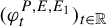 $(\varphi ^{P,E,E_1}_t)_{t\in {\mathbb {R}}}$
is uniquely ergodic for a.e.
 $E_1\in [0,E]$
.
This is a weaker version of Theorem 1.5 and it will be helpful in the proof of Theorem 1.5.
To conclude this section we give the following partial result, which is met with very slight assumptions on potentials
 $V_1$
and
 $V_2$
.
Proposition 5.5. Suppose that
 $V_1,V_2:{\mathbb {R}}\to {\mathbb {R}}_{\geq 0}$
are even
 $C^2$
-potentials satisfying (♢). Assume that
 $$ \begin{align*} E>\max_{\varsigma_1,\varsigma_2\in\{\pm\}}V_1(x_{k(\bar{x}^{\varsigma_1\varsigma_2},\bar{y}^{\varsigma_1\varsigma_2})}^{\varsigma_1\varsigma_2}) +\max_{\varsigma_1,\varsigma_2\in\{\pm\}}V_2(y_1^{\varsigma_1\varsigma_2}), \end{align*} $$
and let
 $$ \begin{align*}E_1\in I:=\Big[\max_{\varsigma_1,\varsigma_2\in\{\pm\}}V_1(x_{k(\bar{x}^{\varsigma_1\varsigma_2},\bar{y}^{\varsigma_1\varsigma_2})}^{\varsigma_1\varsigma_2}), E-\max_{\varsigma_1,\varsigma_2\in\{\pm\}}V_2(y_1^{\varsigma_1\varsigma_2})\Big].\end{align*} $$
Then the flow
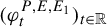 $(\varphi ^{P,E,E_1}_t)_{t\in {\mathbb {R}}}$
is uniquely ergodic for a.e.
 $E_1\in I$
.
Proof The argument used at the beginning of the proof of (
 $\gamma $
) in Theorem 5.3 shows that
 $$ \begin{align*} \mathscr X_{\mathbf{P}}\subset\{\psi _{1}(x,E_1 ):{x}\in X\} \quad \text{and}\quad \mathscr Y_{\mathbf{P}}=\{\psi _{2}(y,E-E_1 ):{y}\in Y\}. \end{align*} $$
Notice that Proposition 4.7 combined with Remark 4.8 shows that condition (i) in Theorem 5.1 is satisfied. The negativity of the derivative for all maps from
 $\mathscr X_{\mathbf {P}}$
and the positivity of the derivative for all maps from
 $\mathscr Y_{\mathbf {P}}$
follow directly from Lemma 4.4. Thus the application of Theorem 5.1 again completes the proof.
The interval
 $I $
in Proposition 5.5 corresponds to the case of impacts with all boundaries of P (the intersection of all the colored wedges in the IEMBD figures), and, as will be shown in §6.2, this corresponds to motion on a surface of genus
 $g_{\max }$
.
6 Topological data revisited
6.1 Short introduction to translation surfaces
Since our main criterion for unique ergodicity (Theorem 7.8) is formulated in the framework of translation surfaces, in this section we give a short introduction to this subject. For further background material we refer the reader to [Reference Viana19, Reference Yoccoz23, Reference Zorich26].
A translation surface
 $(M,\omega )$
is a compact connected orientable topological surface M, together with a finite set of points
 $\Sigma $
(called singular points) and an atlas of charts
 $\omega =\{\zeta _{\alpha }:U_{\alpha }\to {\mathbb {C}}:\alpha \in \mathcal {A}\}$
on
 $M\setminus \Sigma $
such that every transition map
 $\zeta _{\beta }\circ \zeta ^{-1}_{\alpha }:\zeta _{\alpha }(U_{\alpha }\cap U_{\beta })\to \zeta _{\beta }(U_{\alpha }\cap U_{\beta })$
is a translation, that is, for every connected component C of
 $U_{\alpha }\cap U_{\beta }$
there exists
 $v_{\alpha ,\beta }^C\in {\mathbb {C}}$
such that
 $\zeta _{\beta }\circ \zeta ^{-1}_{\alpha }(z)=z+v^C_{\alpha ,\beta }$
for
 $z\in \zeta _{\alpha }^{-1}(C)$
. All points in
 $M\setminus \Sigma $
are called regular. For every point
 $x\in M$
the translation structure
 $\omega $
allow us to define the total angle around x. If x is regular then the total angle is
 $2\pi $
. If
 $\sigma $
is singular then the total angle is
 $2\pi (k_{\sigma }+1)$
, where
 $k_{\sigma }\in {\mathbb {N}}$
is the multiplicity of
 $\sigma $
. Then
 $$ \begin{align} \sum_{\sigma\in\Sigma}k_{\sigma}=2g-2, \end{align} $$
where g is the genus of the surface M.
For every
 $\theta \in {\mathbb {R}}/2\pi {\mathbb {Z}}$
let
 $X_{\theta }$
be a tangent vector field on
 $M\setminus \Sigma $
which is the pullback of the unit constant vector field
 $e^{i\theta }$
on
 ${\mathbb {C}}$
through the charts of the atlas. Since the derivative of any transition map is the identity, the vector field
 $X_{\theta }$
is well defined on
 $M\setminus \Sigma $
. Denote by
 $(\psi ^{\theta }_t)_{t\in {\mathbb {R}}}$
the corresponding local flow, called the translation flow on
 $(M,\omega )$
in direction
 $\theta $
. The flow preserves the measure
 $\unicode{x3bb} _{\omega }$
which is the pullback of the Lebesgue measure on
 ${\mathbb {C}}$
. We distinguish the vertical flow
 $(\psi ^v_t)_{t\in {\mathbb {R}}}$
, that is, for
 $\theta =\pi /2$
.
For every
 $\theta \in {\mathbb {R}}/2\pi {\mathbb {Z}}$
and a translation surface
 $(M,\omega )$
denote by
 $(M,e^{i\theta }\omega )$
the rotated translation surface, that is, the new charts in
 $e^{i\theta }\omega $
are defined by postcomposition of charts from
 $\omega $
with the rotation by
 $\theta $
. Then the flow
 $(\psi ^{\theta }_t)_{t\in {\mathbb {R}}}$
on
 $(M,\omega )$
coincides with the vertical flow
 $(\psi ^v_t)_{t\in {\mathbb {R}}}$
on
 $(M,e^{i(({\pi }/{2})-\theta )}\omega )$
.
A saddle connection in direction
 $\theta $
is an orbit segment of
 $(\psi ^{\theta }_t)_{t\in {\mathbb {R}}}$
that goes from a singularity to a singularity (possibly the same one) and has no interior singularities. A semi-infinite orbit of
 $(\psi ^{\theta }_t)_{t\in {\mathbb {R}}}$
that goes from or to a singularity is called a separatrix. Recall that if
 $(M,\omega )$
has no saddle connection in direction
 $\theta $
, then the flow
 $(\psi ^{\theta }_t)_{t\in {\mathbb {R}}}$
is minimal, that is, every orbit (which can be semi-infinite or double-infinite) is dense in M; see [Reference Yoccoz23].
6.2 From billiards to translation surfaces
Formally the directional billiard flow on
 $\mathbf {P}(E_1)=\mathbf P_{E,E_1}$
in directions
 $\pm \pi /4, \pm 3\pi /4$
acts on the union of four copies of
 $\mathbf {P}(E_1)$
, denoted by
 $\mathbf {P}(E_1)_{\pi /4}$
,
 $\mathbf {P}(E_1)_{-\pi /4}$
,
 $\mathbf {P}(E_1)_{3\pi /4}$
,
 $\mathbf {P}(E_1)_{-3\pi /4}$
. Each copy
 $\mathbf {P}(E_1)_{\vartheta }$
for
 $\vartheta \in \{\pm \pi /4$
,
 $\pm 3\pi /4\}$
represents all unit vectors flowing in the same direction
 $\vartheta $
. After applying the horizontal or vertical reflection (or both) to each copy separately, we can arrange all unit vectors to flow in the same direction
 $\pi /4$
. More precisely, after such transformations, all unit vectors in
 $\mathbf {P}(E_1)_{\pi /4}$
,
 $\gamma _h\mathbf {P}(E_1)_{-\pi /4}$
,
 $\gamma _v\mathbf {P}(E_1)_{3\pi /4}$
and
 $\gamma _h\circ \gamma _v\mathbf {P}(E_1)_{-3\pi /4}$
flow in the same direction
 $\pi /4$
. By gluing corresponding sides of these four polygons, we get a compact connected orientable surface
 $M(E_1)$
with a translation structure inherited from the Euclidean plan; see Figure 7. Moreover, the directional billiard flow on
 $\mathbf {P}(E_1)$
in directions
 $\pm \pi /4$
,
 $\pm 3\pi /4$
is conjugate to the translation flow
 $(\psi ^{\pi /4}_t)_{t\in {\mathbb {R}}}$
in direction
 $\pi /4$
on the translation surface
 $M(E_1)$
. This is an example of the use of the so-called unfolding procedure from [Reference Fox and Kershner7, Reference Zemljakov and Katok24]. Additionally, the surface
 $M(E_1)$
has a natural partition into
 $16$
staircase polygons
 $\{\mathbf {P}(E_1)^{\varsigma _1\varsigma _2}_{\sigma _1\sigma _2}: \varsigma _1,\varsigma _2,\sigma _1,\sigma _2\in \{\pm \}\}$
so that
 $$ \begin{gather*} \mathbf{P}(E_1)^{\varsigma_1\varsigma_2}_{++}=\mathbf{P}(E_1)^{\varsigma_1\varsigma_2}_{\pi/4},\quad \mathbf{P}(E_1)^{\varsigma_1\varsigma_2}_{+-}=\gamma_h\mathbf{P}(E_1)^{\varsigma_1\varsigma_2}_{-\pi/4},\\ \mathbf{P}(E_1)^{\varsigma_1\varsigma_2}_{-+}=\gamma_v\mathbf{P}(E_1)^{\varsigma_1\varsigma_2}_{3\pi/4},\quad \mathbf{P}(E_1)^{\varsigma_1\varsigma_2}_{--}=\gamma_h\circ \gamma_v\mathbf{P}(E_1)^{\varsigma_1\varsigma_2}_{-3\pi/4}. \end{gather*} $$
Proof of Theorem 1.2
The translation surface
 $M(E_1)$
defined above is formed by cutting out four polygons, denoted by
 $\mathbf R^{++},\mathbf R^{+-},\mathbf R^{-+},\mathbf R^{--}$
, from the torus and gluing their opposite sides (see the white polygons in the middle part of Figure 7).
Let us consider corners of a removed polygon
 $\mathbf R^{\varsigma _1\varsigma _2}$
. Notice that convex corners (of
 $\mathbf {P}(E_1)^{\varsigma _1\varsigma _2}$
) give rise to regular points whereas concave corners give rise to singular points of multiplicity
 $2$
. Indeed, each convex corner is a point on
 $M(E_1)$
with total angle
 $2\pi $
(the pink point in Figure 8), whereas each concave corner is a point on
 $M(E_1)$
with total angle
 $4({3\pi }/{2})=6\pi $
(the blue point in Figure 8). In view of equation (6.1), it follows that the genus
 $g(E,E_1)$
of
 $M(E_1)$
(and equivalently the genus of the level set
 $S^P_{E,E_1}$
) is the number of concave corners in
 $P\cap R^{(E,E_{1})}$
plus 1:
Singularities of
 $M(E_1)$
.

 $$ \begin{align*} g(E,E_{1})&=1+\sum_{\varsigma_1,\varsigma_2\in\{\pm\}}\max\{0,(\overline{k}^{\varsigma_1\varsigma_2}(E_1)-\underline{k}^{\varsigma_1\varsigma_2}(E_1))\}\\ &=1+\sum_{\varsigma_1,\varsigma_2\in\{\pm\}}\#\{1\leq k<k(\bar{x}^{\varsigma_1\varsigma_2},\bar{y}^{\varsigma_1\varsigma_2}):V_1(x^{\varsigma_1\varsigma_2}_k)<E_1<E-V_2(y^{\varsigma_1\varsigma_2}_{k+1})\}. \end{align*} $$
Moreover,
 $$ \begin{align*} g(E,E_1)&\leq 1+\sum_{\varsigma_1,\varsigma_2\in\{\pm\}}(k(\bar{x}^{\varsigma_1\varsigma_2},\bar{y}^{\varsigma_1\varsigma_2})-1)\\ &=\sum_{\varsigma_1,\varsigma_2\in\{\pm\}}k(\bar{x}^{\varsigma_1\varsigma_2},\bar{y}^{\varsigma_1\varsigma_2})-3=:g_{\max} \end{align*} $$
and the equality holds if and only if
 $\overline {k}^{\varsigma _1\varsigma _2}(E_1)=k(\bar {x}^{\varsigma _1\varsigma _2},\bar {y}^{\varsigma _1\varsigma _2})$
and
 $\underline {k}^{\varsigma _1\varsigma _2}(E_1)=1$
for any
 $\varsigma _1,\varsigma _2\in \{\pm \}$
. If
 $$ \begin{align*} E_{1}\in\Big[0,{\underset{\varsigma_1,\varsigma_2\in\{\pm\}}\min}V_1(x_{1}^{\varsigma_1\varsigma_2})\Big]\cup\Big[\max_{\varsigma_1,\varsigma_2\in\{\pm\}}(E-V_2(y_{k(\bar{x}^{\varsigma_1\varsigma_2},\bar{y}^{\varsigma_1\varsigma_2})}^{\varsigma_1\varsigma_2})),E\Big],\end{align*} $$
then the polygon
 $\mathbf {P}_{E,E_{1}}$
is a rectangle, so, for all E, close to the end points of the
 $E_{1}$
-interval, the genus of
 $M(E_1)$
is 1. Suppose that
 $$ \begin{align*} E>\max_{\varsigma_1,\varsigma_2\in\{\pm\}}V_1(x_{k(\bar{x}^{\varsigma_1\varsigma_2},\bar{y}^{\varsigma_1\varsigma_2})}^{\varsigma_1\varsigma_2})+\max_{\varsigma_1,\varsigma_2\in\{\pm\}}V_2(y_1^{\varsigma_1\varsigma_2}).\end{align*} $$
Then, for
 $$ \begin{align*} E_1\in I_{\max}:=\Big[\max_{\varsigma_1,\varsigma_2\in\{\pm\}}V_1(x_{k(\bar{x}^{\varsigma_1\varsigma_2},\bar{y}^{\varsigma_1\varsigma_2})}^{\varsigma_1\varsigma_2}), E-\max_{\varsigma_1,\varsigma_2\in\{\pm\}}V_2(y_1^{\varsigma_1\varsigma_2})\Big] \end{align*} $$
we have
 $$ \begin{align*} g(E,E_1)=g_{\max}. \end{align*} $$
In view of Proposition 5.5, the flow
 $(\varphi ^{P,E,E_1}_t)_{t\in {\mathbb {R}}}$
is uniquely ergodic for a.e.
 $E_1\in I_{\max }$
. Notice that in general, the interval of
 $E_{1}$
values for which
 $g(E,E_1)=g_{\max }$
is larger than
 $I_{\max }$
as the maximal genus interval includes cases at which all concave corners of the polygon
 $P $
are inside
 $R^{(E,E_1)}$
yet not all of its extremal boundaries are inside
 $R^{(E,E_1)}$
.
7 The case when
$V_1$
and
$V_2$
are quadratic and
$\Omega $
is rational


In this section we deal with the remaining case when both potentials
 $V_1$
and
 $V_2$
are quadratic with
 $V_1=\Omega ^2 V_2$
,
 $\Omega $
rational and the energy E is not too high, that is, condition (5.4) does not hold. The rationality of
 $\Omega $
enables the appearance of periodic orbits and some coexistence of periodic orbits with uniquely ergodic components.
First we focus on the case when the energy is low.
Proof of Proposition 1.6
As I satisfies (1.6), in view of (3.3),
 $R^{(E,E_1)}\cap P$
is a rectangle for every
 $E_1\in I$
so that its width and height are
 $\tfrac {1}{2}T_{1}(E_1)$
and
 $\tfrac {1}{2}T_{2}(E-E_1)$
. Since
 $T_1$
and
 $T_2$
are constants with
 $T_{2}/T_{1}=\Omega $
rational, the flow
 $(\varphi ^{P,E,E_1}_t)_{t\in {\mathbb {R}}}$
is isomorphic to the translation flow in a rational direction on the standard torus
 ${\mathbb {R}}^2/{\mathbb {Z}}^2$
, so it is completely periodic for all
 $E_1\in I$
.
Proof of Proposition 1.4
Equation (1.4) implies that for every
 $\varsigma _1,\varsigma _2\in \{\pm \}$
we have
 $$ \begin{align*} E\leq V_1(x^{\varsigma_1\varsigma_2}_k)+V_2(y^{\varsigma_1\varsigma_2}_{k+1})\quad\text{for every }0\leq k\leq k(\bar{x}^{\varsigma_1\varsigma_2},\bar{y}^{\varsigma_1\varsigma_2}). \end{align*} $$
Hence, for all
 $E_{1}\in [0,E]$
,
 $R^{(E,E_1)}\cap P$
is a rectangle (with no intersections of P boundaries), so as above the motion is periodic.
Propositions 1.4 and 1.6 describe completely all intervals
 $I\in \mathcal J_E$
for which the (cp) scenario can appear (the pure gray regions in the IEMBD figures). We now focus on the description of all intervals for which the (ue) or (coex) scenario occurs. They are presented in Theorems 1.7 and 1.8. Unfortunately, Theorem 5.1 is not effective enough to prove these theorems. Their proofs (presented in §8) need a more subtle version of Theorem 5.1, which we give in Theorem 7.8 in §7.4. Theorem 7.8 helps to prove the coexistence of periodic orbits with uniquely ergodic components for intermediate energies. To implement this plan we must now go deeper into the proof of [Reference Frączek, Shi and Ulcigrai8, Theorem 2.16] and into the framework of translation surfaces.
In the rational case there is no problem with verifying condition (ii
 $_{-+}$
) in Theorem 5.1. Verifying condition (i) in Theorem 5.1 is impossible. Indeed, by Remark 5.2, condition (i) implies the minimality of the billiard flow (every orbit is dense) for almost every parameter
 $E_1$
. Because of the existence of a periodic orbit, condition (i) cannot be met.
Suppose that
 $\Omega =n/m$
for some coprime natural numbers m and n. Then
 $V_1(x)=n^2c^2x^2/2$
and
 $V_2(y)=m^2c^2y^2/2$
for some
 $c>0$
. In view of Lemma 4.5, we have
 $T_{1}(E_1)={2\pi }/{n{c}}$
and
 $T_{2}(E-E_1)={2\pi }/{m{c}}$
, so
 $$ \begin{align*} \frac{1}{4}T_{1}(E_1)=mC\frac{\pi}{2}\quad\text{and}\quad\frac{1}{4}T_{2}(E-E_1)=nC\frac{\pi}{2}\quad\text{for }C=\frac{1}{mn{c}}. \end{align*} $$
Moreover,
 $$ \begin{align*} \psi_{1}(x,E_1)&=mC\arcsin\sqrt{\frac{V_1(x)}{E_1}}\quad\text{for }E_1\geq V_1(x),\\ \psi_{2}(y,E-E_1)&=nC\arcsin\sqrt{\frac{V_2(y)}{E-E_1}}\quad\text{for }E_1\leq E- V_2(y). \end{align*} $$
Suppose that
 $$ \begin{align} E<{\underset{\varsigma_1,\varsigma_2\in\{\pm\}}\min}V_1(x^{\varsigma_1\varsigma_2}_{k(\bar{x}^{\varsigma_1\varsigma_2},\bar{y}^{\varsigma_1\varsigma_2})})+{\underset{\varsigma_1,\varsigma_2\in\{\pm\}}\min}V_2(y^{\varsigma_1\varsigma_2}_{1}). \end{align} $$
For higher energies, Theorem 1.5 yields the (ue) scenario for the interval
 $[0,E]$
. In fact, by Theorem 1.7, for
 $E>{\min }\{{\min }_{\varsigma _1,\varsigma _2\in \{\pm \}}V_2(y_1^{\varsigma _1\varsigma _2}),{\min }_{\varsigma _1,\varsigma _2\in \{\pm \}} V_1 (x_{k(\bar {x}^{\varsigma _1\varsigma _2},\bar {y}^{\varsigma _1\varsigma _2})}^{\varsigma _1\varsigma _2})\}$
, the same conclusion occurs in the intervals
 $$ \begin{align*} \Big[0,E-{\underset{\varsigma_1,\varsigma_2\in\{\pm\}}\min}V_2(y_1^{\varsigma_1\varsigma_2})\Big]\text{ and } \Big[{\underset{\varsigma_1,\varsigma_2\in\{\pm\}}\min} V_1(x_{k(\bar{x}^{\varsigma_1\varsigma_2},\bar{y}^{\varsigma_1\varsigma_2})}^{\varsigma_1\varsigma_2}),E\Big], \end{align*} $$
where at least one of the extremal sides of P intersects
 $ R^{(E,E_{1})}$
. Therefore, we focus our attention on
 $I\in \mathcal J_E$
such that
 $$ \begin{align} I\subset I_{\mathrm{intimp}}=\Big(E-{\underset{\varsigma_1,\varsigma_2\in\{\pm\}}\min}V_2(y_1^{\varsigma_1\varsigma_2}),{\underset{\varsigma_1,\varsigma_2\in\{\pm\}}\min}V_1(x_{k(\bar{x}^{\varsigma_1\varsigma_2},\bar{y}^{\varsigma_1\varsigma_2})}^{\varsigma_1\varsigma_2})\Big)\setminus I_{\mathrm{nonimp}}. \end{align} $$
So now we consider level sets that do impact some parts of the polygon’s sides but none of its extremal sides, namely, the width of the polygon
 $\mathbf {P}_{E,E_1}$
is
 $\tfrac 12T_{1}(E_1)$
, its height is
 $\tfrac 12T_{2}(E-E_1)$
and
 $\mathbf {P}_{E,E_1}$
is not a rectangle. Then the width of
 $M(E_1)$
is
 $T_{1}(E_1)=2\pi mC$
and its height is
 $T_{2}(E-E_1)=2\pi nC$
. Let us consider the translation torus
 $$ \begin{align*} {\mathbb{T}}_{m,n}={\mathbb{R}}^2/(2\pi mC{\mathbb{Z}}\times 2\pi nC{\mathbb{Z}}) \end{align*} $$
with four marked Weierstrass points
 $(0,0),(\pi mC,0),(0,\pi nC),(\pi mC,\pi nC)$
labeled by
 $--,+-,-+,++$
respectively; see Figure 7. Then
 $M(E_1)$
can be treated as
 ${\mathbb {T}}_{m,n}$
with four polygons cut out. In this
 $E_{1}$
interval at least one removed polygon is non-empty. Removed polygons (even trivial) are denoted by
 $\mathbf {R}^{--},\mathbf {R}^{+-},\mathbf {R}^{-+},\mathbf {R}^{++}$
as in Figure 7, that is,
 $\mathbf {R}^{\varsigma _1\varsigma _2}$
is associated with the polygon
 $\mathbf {P}(E_1)^{\varsigma _1\varsigma _2}$
. Each removed polygon
 $\mathbf {R}^{\varsigma _1\varsigma _2}$
has only vertical and horizontal sides, is vertically and horizontally symmetric and its center of symmetry coincide with the marked point
 $\varsigma _1\varsigma _2$
; see Figure 7. Moreover, the opposite sides of each removed polygon are identified in
 $M(E_1)$
.
We equip the translation torus
 ${\mathbb {T}}_{m,n}$
with the quotient taxicab metric d (the sum of horizontal and vertical distances). Denote by
 $e^{i\pi }:{\mathbb {T}}_{m,n}\to {\mathbb {T}}_{m,n}$
the hyperelliptic involution that fixes each marked point, that is,
 $e^{i\pi }$
is the rotation by
 $\pi $
.
Let us consider periodic orbits in direction
 $\pi /4$
on
 ${\mathbb {T}}_{m,n}$
passing thorough all four marked points. There are exactly two such periodic orbits,
 $\textit {red}$
and
 $\textit {green}$
, each of them containing two marked points (their pairing depends on the parity of m and n); see Figure 9. As all marked points are labeled by
 $++,+-,-+,--$
, this gives a partition
 $\{\textit {red, green}\}$
of
 $\{++,+-,-+,--\}$
into two two-element subsets, according to this correspondence. This is exactly the partition defined by (1.9).
Two periodic orbits (
 $\textit {red}$
and
 $\textit {green}$
) on
 ${\mathbb {T}}_{m,n}$
and the corresponding cylinders on
 $M(E_1)$
.

For every
 $\underline {k}^{\varsigma _1\varsigma _2}(E_1)\leq k< \overline {k}^{\varsigma _1\varsigma _2}(E_1)$
let
 $$ \begin{align*} D_{E,E_{1}}(x_k^{\varsigma_1\varsigma_2},{y_{k+1}^{\varsigma_1\varsigma_2}}):=\tfrac{1}{4}T_{1}(E_1)-\psi_1(x_k^{\varsigma_1\varsigma_2},E_1) +\tfrac{1}{4}T_{2}(E-E_1)-\psi_2({y_{k+1}^{\varsigma_1\varsigma_2}},E-E_1). \end{align*} $$
Then
 $D_{E,E_{1}}(x_k^{\varsigma _1\varsigma _2},{y_{k+1}^{\varsigma _1\varsigma _2}})$
is the maximal distance of the four corners of
 $\mathbf {R}^{\varsigma _1\varsigma _2}$
associated with
 $(x_k^{\varsigma _1\varsigma _2},{y_{k+1}^{\varsigma _1\varsigma _2}})\in P^{\varsigma _1\varsigma _2}\cap R^{(E,E_1)}$
from the segment of the orbit in direction
 $\pi /4$
passing through the marked point
 $\varsigma _1\varsigma _2$
(the center of
 $\mathbf {R}^{\varsigma _1\varsigma _2}$
) in the time interval
 $(-{\min }\{m,n\}C\pi ,{\min }\{m,n\}C\pi )$
. Indeed, for this segment, we can consider the taxicab metric on
 ${\mathbb {R}}^2$
; then the distance of a point
 $(x_1,y_1)$
from the line
 $\{(x_0+t,y_0+t):t\in {\mathbb {R}}\}$
is equal to
 $$ \begin{align*} {\underset{t}\min}|x_1-x_0-t|+|y_1-y_{0}-t|=|x_1-x_0-(y_{1}-y_{0})|. \end{align*} $$
Shifting the center of
 $\mathbf {R}^{\varsigma _1\varsigma _2}$
to
 $(({\sigma _{1}}/{4})T_{1}(E_1),({\sigma _{2}}/{4})T_{2}(E-E_1))$
with
 $\sigma _{1},\sigma _2\in \{\pm \}$
, one of the corners considered is
 $(\sigma _{1}\psi _1(x_k^{\varsigma _1\varsigma _2},E_1),\sigma _{2}\psi _2({y_{k+1}^{\varsigma _1\varsigma _2}},E-E_1))$
and then its distance from the corresponding orbit segment is
 $$ \begin{align*} &\bigg|\bigg(\frac{\sigma_{1}}{4}T_{1}(E_1)-\sigma_{1}\psi_1(x_k^{\varsigma_1\varsigma_2},E_1)\bigg)-\bigg(\frac{\sigma_{2}}{4}T_{2}(E-E_1)-\sigma_{2}\psi_2({y_{k+1}^{\varsigma_1\varsigma_2}},E-E_1)\bigg)\bigg|\\ &\quad\leq D_{E,E_{1}}(x_k^{\varsigma_1\varsigma_2},{y_{k+1}^{\varsigma_1\varsigma_2}}) \end{align*} $$
and equality is realized when
 $\sigma _{1}=-\sigma _{2}$
.
By the definition of
 $\delta ^{colour}$
, for every
 $colour\in \{\textit {red, green}\}$
and
 $E_1\in I$
we have
 $$ \begin{align*} &C\delta^{colour}(E_1): =\max_{\substack{\varsigma_1\varsigma_2\in colour\\ \underline{k}^{\varsigma_1\varsigma_2}(E_1)\leq k< \overline{k}^{\varsigma_1\varsigma_2}(E_1)}} C\bigg(m\arccos\sqrt{\frac{V_1(x_k^{\varsigma_1\varsigma_2})}{E_1}}+n\arccos\sqrt{\frac{V_2(y_{k+1}^{\varsigma_1\varsigma_2})}{E-E_1}}\bigg)\\ &=\max_{\substack{\varsigma_1\varsigma_2\in colour\\\underline{k}^{\varsigma_1\varsigma_2}(E_1)\leq k< \overline{k}^{\varsigma_1\varsigma_2}(E_1)}}\!\! C\bigg(m\bigg(\frac{\pi}{2}-\arcsin\sqrt{\frac{V_1(x_k^{\varsigma_1\varsigma_2})}{E_1}}\bigg)+n\bigg(\frac{\pi}{2}-\arcsin\sqrt{\frac{V_2(y_{k+1}^{\varsigma_1\varsigma_2})}{E-E_1}}\bigg)\!\bigg)\\ & =\max_{\substack{\varsigma_1\varsigma_2\in colour\\ \underline{k}^{\varsigma_1\varsigma_2}(E_1)\leq k< \overline{k}^{\varsigma_1\varsigma_2}(E_1)}}\!\! \big(\tfrac{1}{4}T_{1}(E_1)-\psi_1(x_k^{\varsigma_1\varsigma_2},E_1)+\tfrac{1}{4}T_{2}(E-E_1)-\psi_2({y_{k+1}^{\varsigma_1\varsigma_2}},E-E_1)\big)\\ & =\max_{\substack{\varsigma_1\varsigma_2\in colour\\ \underline{k}^{\varsigma_1\varsigma_2}(E_1)\leq k< \overline{k}^{\varsigma_1\varsigma_2}(E_1)}}D_{E,E_{1}}(x_k^{\varsigma_1\varsigma_2},{y_{k+1}^{\varsigma_1\varsigma_2}}). \end{align*} $$
Therefore
 $C\delta ^{colour}(E_1)$
measures the maximal distance of points in removed polygons
 $\mathbf {R}^{colour}:=\bigcup _{\varsigma _1\varsigma _2}\mathbf {R}^{\varsigma _1\varsigma _2}$
from the corresponding segments of the
 $colour$
periodic orbit. Let us consider two closed cylinders R and G in
 ${\mathbb {T}}_{m,n}$
that consist of points distant from the
 $\textit {red}$
or
 $\textit {green}$
periodic orbit by no more than
 $C\delta ^{\textit {red}}(E_1)$
or
 $C\delta ^{\textit {green}}(E_1)$
, respectively. Then R and G are two closed cylinders in direction
 $\pi /4$
consisting of periodic orbits passing through removed polygons whose centers lie on the
 $\textit {red}$
or
 $\textit {green}$
periodic orbit, respectively. Denote by
 $\partial R$
and
 $\partial G$
the boundary of R and G, respectively. Since all removed polygons are
 $e^{i\pi }$
-invariant, so the cylinders
 $R$
and
 $G$
are also
 $e^{i\pi}$
invariant.
Remark 7.1. Note that the distance between
 $\textit {red}$
and
 $\textit {green}$
periodic orbits is
 $\pi C$
. Recall that
 $M(E_1)={\mathbb {T}}_{m,n}\setminus (\mathbf {R}^{\textit {green}}\cup \ \mathbf {R}^{\textit {red}})$
, where the opposite sides of removed polygons are identified. We consider two cases.
Case 1. If
 $C\delta ^{\textit {red}}(E_1)+C\delta ^{\textit {green}}(E_1)<\pi C$
, that is,
 $E_1\in J\in \mathcal U_I^-$
, then
 ${\mathbb {T}}_{m,n}\setminus (R\cup G)$
is non-empty and consists of two open cylinders in direction
 $\pi /4$
,
 $yellow$
and
 $white$
on Figure 9. Since
 $yellow$
and
 $white$
cylinders do not meet the removed polygons, they correspond to periodic cylinders Y and W on the translation surface
 $M(E_1)$
. Moreover, the flow
 $(\psi _t^{\pi /4})_{t\in {\mathbb {R}}}$
on
 $M(E_1)$
has two more invariant sets,
 $R\backslash \mathbf {R}^{\textit {red}}$
and
 $G\backslash \mathbf {R}^{\textit {green}}$
, which are traces of the corresponding cylinders from
 ${\mathbb {T}}_{m,n}$
. The sets
 $R\backslash \mathbf {R}^{\textit {red}} ,G\backslash \mathbf {R}^{\textit {green}}\subset M(E_1)$
are translation surfaces with boundary and we will analyze them later. Notice that all
 $(\psi _t^{\pi /4})_{t\in {\mathbb {R}}}$
-orbits on
 $R\backslash \mathbf {R}^{\textit {red}}$
and
 $G\backslash \mathbf {R}^{\textit {green}}$
meet the boundary of
 $\mathbf {R}^{\textit {red}}$
and
 $\mathbf {R}^{\textit {green}}$
, and both
 $\partial (R\backslash \mathbf {R}^{\textit {red}})$
,
 $\partial (G\backslash \mathbf {R}^{\textit {green}})$
consist of saddle connections for
 $(\psi _t^{\pi /4})_{t\in {\mathbb {R}}}$
on
 $M(E_1)$
.
Case 2. If
 $C\delta ^{\textit {red}}(E_1)+C\delta ^{\textit {green}}(E_1)\geq \pi C$
, that is,
 $E_1\in J\in \mathcal U_I^+$
, then
 $R\cup G$
fills the whole torus
 ${\mathbb {T}}_{m,n}$
. Therefore all
 $(\psi _t^{\pi /4})_{t\in {\mathbb {R}}}$
-orbits on
 $M(E_1)$
meet the boundary of either
 $\mathbf {R}^{\textit {red}}$
or
 $\mathbf {R}^{\textit {green}}$
or both.
7.1 Periodic cylinders (case 1)
We first note some non-degeneracy properties. Recall that each removed set,
 $\mathbf {R}^{colour}$
, is composed of two removed polygons
 $\mathbf {R}^{\varsigma _1\varsigma _2}$
,
 $\varsigma _1\varsigma _2\in colour$
, which are associated with the
 $\mathbf {P}^{\varsigma _1\varsigma _2}(E_{1}), \varsigma _1\varsigma _2\in colour$
. We first note that saddle connections between different corners of one removed polygon
 $\mathbf {R}^{\varsigma _1\varsigma _2}$
rarely occur. We then note that only when there is a degeneracy between the polygons
 $P^{\varsigma _1\varsigma _2}$
can it happen that saddle connections between the two different removed polygons persist for all
 $E_{1}\in I$
. Finally, we note that only rarely do the periodic cylinders degenerate to a line.
Lemma 7.2. Let
 $colour\in \{\textit {red,green}\}$
.
-
(1) For every
$\varsigma _1\varsigma _2\in colour$
and for all but countably many
$E_1\in I$
we have for at most one
$$ \begin{align*} C\delta^{colour}(E_1)=D_{E,E_{1}}(x_k^{\varsigma_1\varsigma_2},{y_{k+1}^{\varsigma_1\varsigma_2}}) \end{align*} $$
$1\leq k< k(\bar {x}^{\varsigma _1\varsigma _2},\bar {y}^{\varsigma _1\varsigma _2})$
.
-
(2) If
$\varsigma _1\varsigma _2$
,
$\varsigma ^{\prime }_1\varsigma ^{\prime }_2$
are different elements of a
$colour$
and (7.3)for uncountably many
$$ \begin{align} \begin{aligned} C\delta^{colour}(E_1)&=D_{E,E_{1}}(x_k^{\varsigma_1\varsigma_2},{y_{k+1}^{\varsigma_1\varsigma_2}})=D_{E,E_{1}}(x_l^{\varsigma_1^{\prime}\varsigma_2^{\prime}},{{y_{l+1}^{\varsigma_1^{\prime}\varsigma_2^{\prime}}}}) \end{aligned} \end{align} $$
$E_1\in I$
, then
$(x_k^{\varsigma _1\varsigma _2},y_{k+1}^{\varsigma _1\varsigma _2})=(x_l^{\varsigma ^{\prime }_1\varsigma ^{\prime }_2}, y_{l+1}^{\varsigma ^{\prime }_1\varsigma ^{\prime }_2})$
.
-
(3) Moreover,
for all but countably many
$$ \begin{align*}\delta^{\textit{red}}(E_1)+\delta^{\textit{green}}(E_1)\neq\pi \end{align*} $$
$E_1\in (0,E)$
.


In addition, all three properties are met on an open set.
Proof (1) Suppose, contrary to our claim, that there exist
 $k\neq l$
such that
 $$ \begin{align*}D_{E,E_{1}}(x_k^{\varsigma_1\varsigma_2},{y_{k+1}^{\varsigma_1\varsigma_2}})=D_{E,E_{1}}(x_l^{\varsigma_1\varsigma_2},{y_{l+1}^{\varsigma_1\varsigma_2}})\end{align*} $$
holds for uncountably many
 $E_1$
. Then
 $$ \begin{align*} \psi_1(x_k^{\varsigma_1\varsigma_2},E_1)+\psi_2({y_{k+1}^{\varsigma_1\varsigma_2}},E-E_1)=\psi_1(x_l^{\varsigma_1\varsigma_2},E_1)+\psi_2({y_{l+1}^{\varsigma_1\varsigma_2}},E-E_1) \end{align*} $$
for uncountably many
 $E_1$
, which contradicts Proposition 4.3.
(2) Suppose that (7.3) holds for uncountably many
 $E_1$
. Then, similarly,
 $$ \begin{align*}\psi_1(x_k^{\varsigma_1\varsigma_2},E_1)+\psi_2({y_{k+1}^{\varsigma_1\varsigma_2}},E-E_1)=\psi_1(x_l^{\varsigma_1^{\prime}\varsigma_2^{\prime}},E_1)+\psi_2(,{{y_{l+1}^{\varsigma_1^{\prime}\varsigma_2^{\prime}}}},E-E_1)\end{align*} $$
for uncountably many
 $E_1$
. By Proposition 4.3, it follows that
 $x_k^{\varsigma _1\varsigma _2}=x_l^{\varsigma ^{\prime }_1\varsigma ^{\prime }_2}$
and
 $y_{k+1}^{\varsigma _1\varsigma _2}=y_{l+1}^{\varsigma ^{\prime }_1\varsigma ^{\prime }_2}$
.
(3) Now suppose, contrary to our claim, that for uncountably many
 $E_1$
,
 $$ \begin{align*} C\delta^{\textit{red}}(E_1)+C\delta^{\textit{green}}(E_1)=D_{E,E_{1}}(x_k^{\varsigma_1\varsigma_2},{y_{k+1}^{\varsigma_1\varsigma_2}})+D_{E,E_{1}}(x_l^{\varsigma_1^{\prime}\varsigma_2^{\prime}},{y_{l+1}^{\varsigma_1^{\prime}\varsigma_2^{\prime}}})=C\pi \end{align*} $$
for some
 $\varsigma _1\varsigma _2\in \textit {red}$
,
 $\varsigma ^{\prime }_1\varsigma ^{\prime }_2\in \textit {green}$
,
 $1\leq k< k(\bar {x}^{\varsigma _1\varsigma _2},\bar {y}^{\varsigma _1\varsigma _2})$
and
 $1\leq l< k(\bar {x}^{\varsigma ^{\prime }_1\varsigma ^{\prime }_2},\bar {y}^{\varsigma ^{\prime }_1\varsigma ^{\prime }_2})$
. Then, since
 $\tfrac {1}{4}T_{1}=mC({\pi }/{2}),\tfrac {1}{4}T_{2}=nC({\pi }/{2})$
, we have
 $$ \begin{align*} &\psi_1(x_k^{\varsigma_1\varsigma_2},E_1)+\psi_2({y_{k+1}^{\varsigma_1\varsigma_2}},E-E_1)+\psi_1(x_l^{\varsigma_1^{\prime}\varsigma_2^{\prime}},E_1)+\psi_2(y_{l+1}^{\varsigma_1^{\prime}\varsigma_2^{\prime}},E-E_1)\\ &\quad=C\pi(m+n-1)=\frac{m+n-1}{2m}T_{1}(E_1) \end{align*} $$
holds on an uncountable subset. This again contradicts Proposition 4.3.
Finally, the complement of the set of
 $E_1$
s for which all three properties hold is a closed set—the set of zeros for finitely many continuous maps.
By Lemma 7.2, for every
 $E>0$
satisfying (7.1) and for every
 $I\in \mathcal J_E$
satisfying (7.2), there are two families
 $\mathcal U^+_I$
and
 $\mathcal U^-_I$
of open subintervals of I such that:
-
• for every
$E_1 \in \bigcup _{J\in \mathcal U^+_I}J\cup \bigcup _{J\in \mathcal U^-_I}J\subset I$
all conclusions of Lemma 7.2 hold; -
•
$\delta ^{\textit {red}}(E_1)+\delta ^{\textit {green}}(E_1)>\pi $
for all
$E_1\in J$
if
$J\in \mathcal U^+_I$
; -
•
$\delta ^{\textit {red}}(E_1)+\delta ^{\textit {green}}(E_1)<\pi $
for all
$E_1\in J$
if
$J\in \mathcal U^-_I$
.


Notice that by Lemma 7.2,
 $\bigcup _{J\in \mathcal U^+_I}J\cup \bigcup _{J\in \mathcal U^-_I}J\subset I$
has at most countable complement in I. The following result fully describes the dynamics of the flow
 $(\psi ^{\pi /4}_t)_{t\in {\mathbb {R}}}$
on
 $M(E_1)$
for a.e.
 $E_1\in I$
. This gives full information about the dynamics of the flow
 $(\varphi ^{P,E,E_1}_t)_{t\in {\mathbb {R}}}$
on
 $S^P_{E,E_1}$
for a.e.
 $E_1\in I$
.
Theorem 7.3. If
 $J\in \mathcal U^+_I$
then the flow
 $(\psi ^{\pi /4}_t)_{t\in {\mathbb {R}}}$
on
 $M(E_1)$
is uniquely ergodic for a.e.
 $E_1\in J$
. If
 $J\in \mathcal U^-_I$
then the flows
 $(\psi ^{\pi /4}_t)_{t\in {\mathbb {R}}}$
on
 $(R\setminus \mathbf {R}^{\textit {red}})\setminus \partial (R\setminus \mathbf {R}^{\textit {red}})\subset M(E_{1})$
and on
 $(G\setminus \mathbf {R}^{\textit {green}})\setminus \partial (G\setminus \mathbf {R}^{\textit {green}})$
are uniquely ergodic for a.e.
 $E_1\in J$
and are periodic on the complement of these sets with motion that does not impact the polygon P.
Since the flow
 $(\psi ^{\pi /4}_t)_{t\in {\mathbb {R}}}$
on
 $M(E_1)$
is isomorphic to the flow
 $(\varphi ^{P,E,E_1}_t)_{t\in {\mathbb {R}}}$
on
 $S^P_{E,E_1}$
, Theorem 1.8 is a direct consequence of Theorem 7.3. To prove this result we need a more subtle version of [Reference Frączek, Shi and Ulcigrai8, Theorem 2.16] applied to
 $(\psi ^{\pi /4}_t)_{t\in {\mathbb {R}}}$
on some completions
 $\overline {R}(E_1)$
of
 $(R\setminus \mathbf {R}^{\textit {red}})\setminus \partial (R\setminus \mathbf {R}^{\textit {red}})\subset M(E_{1})$
and
 $\overline {G}(E_1)$
of
 $(G\setminus \mathbf {R}^{\textit {green}})\setminus \partial (G\setminus \mathbf {R}^{\textit {green}})$
as described below. We formulate a slightly more general construction in §§7.2–7.4 and then return to the proof of Theorem 7.3 in §8.
7.2 Construction of completion for
$J\in \mathcal U^-_I$

Suppose that
 $E_1\in J$
for some
 $J\in \mathcal U_I^-$
, so
 $\delta ^{\textit {red}}(E_1)+\delta ^{\textit {green}}(E_1)<\pi $
. From now on we proceed only with the set
 $(R\setminus \mathbf {R}^{\textit {red}})\setminus \partial (R\setminus \mathbf {R}^{\textit {red}})$
, but the following construction of completion obviously works with
 $(G\setminus \mathbf {R}^{\textit {green}})\setminus \partial (G\setminus \mathbf {R}^{\textit {green}})$
. Property (1) of Lemma 7.2 implies that for
 $E_{1}\in J\in \mathcal U^-_I$
, the boundary of the two removed polygons has one or two intersection points with
 $\partial (R\setminus \mathbf {R}^{\textit {red}})$
in
 $M(E_1)$
.
We assume first that there is only one intersection, then we show that for two intersections the construction of completion is almost the same. Denote by
 $r\in M(E_1)$
the single intersection point (the green point in the left-hand part of Figure 10). The total angle around r in
 $R\setminus \mathbf {R}^{\textit {red}}$
is
 $4\pi $
. Recall that
 $R\setminus \mathbf {R}^{\textit {red}}$
is a translation surface with the boundary and its boundary consists of two saddle connection starting and ending at the point r. Both saddle connections have the same direction
 $\pi /4$
and the same length. In the completion
 $\overline {R}(E_1)$
we separate the beginning from the end of the saddle connections, their beginning we denote by
 $r_b$
(the blue point in the right-hand part of Figure 10) and their end by
 $r_e$
(the green point in the right-hand part of Figure 10), and then we glue the intervals thus obtained (the dashed lines in the right-hand part of Figure 10), creating a kind of cylinder where its lower boundary is connected to the upper boundary through the inner green and inner blue corners. The resulting object
 $\overline {R}(E_1)$
is a compact translation surface such that the total angle around
 $r_b$
and
 $r_e$
is
 $2\pi $
, so they became regular points; see Figure 11.
The subset
 $R\setminus \partial R$
of
 $M(E_1)$
and its completion
 $\overline {R}(E_1)$
.

This figure shows the construction of
 $\overline {R}(E_1)$
around removed polygons. In particular, it indicates the rules for gluing segments with the same labeling. The rightmost part of the figure shows the resulting surface after gluing the segments labeled with capital letters.

If
 $\partial (R\setminus \mathbf {R}^{\textit {red}})$
has two intersection points,
 $r_1,r_{2}\in M(E_{1})$
with the removed polygons (the green and the yellow point in the left-hand part of Figure 12), by property (1) of Lemma 7.2, each one of them must belong to a distinct removed polygon. By property (2) of Lemma 7.2, the two points are symmetric (they have the same critical energies
 $(V_{1}(x_{k}),V_{2}(y_{k+1}))$
). Thus, on the surface, they correspond to corners of the two removed polygons that are at identical horizontal and vertical distances from the removed polygon center. Hence,
 $r_{2}$
is exactly at the middle point of the line connecting
 $r_{1}$
to itself (
 $r_2=\psi ^{\pi /4}_{mnC\pi }r_1$
, and similarly
 $r_1=\psi ^{\pi /4}_{mnC\pi }r_2$
). We carry out the separation procedure for both intersection points
 $r_1$
and
 $r_2$
. Since all four saddle connection creating
 $\partial (R\setminus \mathbf {R}^{\textit {red}})$
have the same length (dotted and dashed lines in Figure 12), we can finalize gluing the pairs of relevant intervals on the boundary. In this way we get rid of two singular points by creating four regular points (the green, blue, yellow and magenta points in the right-hand part of Figure 12).
The subset
 $R\setminus \partial R$
of
 $M(E_1)$
and its completion
 $\overline {R}(E_1)$
in the case of two intersection points.

Remark 7.4. Every
 $(\psi _t^{\pi /4})_{t\in {\mathbb {R}}}$
orbit on
 $\overline {R}(E_1)$
hits the boundary of a removed polygon.
7.3 Partitions of translation surfaces into polygons
In this section we recall some basic concepts introduced in [Reference Frączek, Shi and Ulcigrai8] and modify them so that the completion surface, which has natural partition into polygons with vertical and distinguished sides, can be treated with these tools. We begin with the definition of a proper partition. An example of such a partition, after rotation by
 $\pi /4$
, is shown in the right-hand part of Figure 9. The sets
 $R\setminus \mathbf {R}^{\textit {red}}$
and
 $G\setminus \mathbf {R}^{\textit {green}}$
are naturally partitioned by vertical and horizontal separating segments. They yield proper partitions of the rotated (by
 $\pi /4$
) surfaces
 $\overline {R}(E_1)$
and
 $\overline {G}(E_1)$
. More details are presented at the beginning of §7.4.
Definition 7.1. Let
 $(M,\omega )$
be a compact translation surface with singular points at
 $\Sigma $
. A finite partition
 $\mathcal {P}=\{P_{\alpha }:\alpha \in \mathcal A\}$
of M is called a proper partition if the following assertions hold.
-
(i) Every
$P_{\alpha }$
,
$\alpha \in \mathcal A$
is closed connected subset of M and
$\bigcup _{\alpha \in \mathcal A}P_{\alpha }=M$
. -
(ii) For every
$\alpha \in \mathcal A$
there exists a chart
$\zeta _{\alpha }:U_{\alpha }\to {\mathbb {C}}$
in
$\omega $
such that:-
(a) the interior of
$P_{\alpha }$
is a subset of
$U_{\alpha }$
; -
(b)
$\zeta _{\alpha }(\operatorname {Int}P_{\alpha })$
is the interior of a compact connected polygon
$\widetilde {P}_{\alpha }\subset {\mathbb {C}}$
; -
(c)
$\zeta ^{-1}_{\alpha }:\operatorname {Int}\widetilde {P}_{\alpha }\to \operatorname {Int}{P}_{\alpha }$
has a continuous extension
$\overline {{\zeta }^{-1}_{\alpha }}:\widetilde {P}_{\alpha }\to {P}_{\alpha }$
.
Then
${P}_{\alpha }$
is called a polygon and the
$\overline {{\zeta }^{-1}_{\alpha }}$
-image of any side/corner in
$\widetilde {P}_{\alpha }$
is called a side/corner of
${P}_{\alpha }$
; in particular, a side s of
${P}_{\alpha }$
is called vertical if
$(\overline {{\zeta }^{-1}_{\alpha }})^{-1}(s)$
is vertical. -
-
(iii)
$\overline {{\zeta }^{-1}_{\alpha }}:\widetilde {P}_{\alpha }\setminus \{\text {vertical sides}\}\to {P}_{\alpha }\setminus \{\text {vertical sides}\}$
is a homeomorphism, its inverse we denote by
$\bar {\zeta }_{\alpha }:{P}_{\alpha }\setminus \{\text {vertical sides}\}\to \widetilde {P}_{\alpha }\setminus \{\text {vertical sides}\}$
. -
(iv) If
$P_{\alpha }\cap P_{\beta }\neq \emptyset $
then it is the union of common sides and corners of the polygons
$P_{\alpha }$
,
$P_{\beta }$
. -
(v) If
$\sigma \in P_{\alpha }\cap \Sigma $
then
$\sigma $
is a corner of
$P_{\alpha }$
. -
(vi) If a common side of the polygons
$P_{\alpha }$
,
$P_{\beta }$
is vertical then its ends are regular points in
$(M,\omega )$
.


Notice that we modify the corresponding definition in [Reference Frączek, Shi and Ulcigrai8] to allow polygons with vertical boundaries. Non-vertical sides always connect different tiles, whereas vertical sides can glue within a single tile or with other tiles having vertical boundaries. When vertical sides of a single polygon are glued, this polygon becomes cylindrical under the completion procedure, so the function
 $ \overline {{\zeta }^{-1}_{\alpha }}$
is not one to one on this polygon vertical boundary, thus in condition (iii) the vertical boundaries are excluded. This condition is needed since in some cases vertical boundaries of the same polygon are glued together (see Figure 11). Conditions (v) and (vi) are imposed for convenience so that the singularities in
 $P_{\alpha }$
do not belong to glued vertical boundaries.
Definition 7.2. (Cf. [Reference Frączek, Shi and Ulcigrai8])
Given a proper partition
 $\mathcal {P}=\{P_{\alpha }:\alpha \in \mathcal A\}$
of the translation surface
 $(M,\omega )$
, let:
-
•
${\mathbf {D}}={D}(\omega ,\mathcal P)$
be the set of all non-vertical sides in
$\mathcal P$
; -
•
$\mathbf {B}=B(\omega ,\mathcal P)$
be the set of pairs
$(\sigma ,\beta )\in \Sigma \times \mathcal A$
for which
$\sigma \in P_{\beta }$
and there exists a vertical (upward) orbit segment in
$P_{\beta }$
which begins in
$\sigma $
; -
•
$\mathbf {E}=E(\omega ,\mathcal P)$
be the set of pairs
$(\sigma ,\alpha )\in \Sigma \times \mathcal A$
for which
$\sigma \in P_{\alpha }$
and there exists a vertical (upward) orbit segment in
$P_{\alpha }$
which ends in
$\sigma $
.


The sets
 $\mathbf {D},\mathbf {B},\mathbf {E}$
code some topological properties of the partition.
-
• Let
$s_{\alpha \beta }\in \mathbf {D}$
be a common side of
$P_{\alpha }$
and
$P_{\beta }$
and suppose that every vertical (upward) orbit through the side
$s_{\alpha \beta }$
passes from
$P_{\alpha }$
to
$P_{\beta }$
. Then the displacement
$\mathfrak {D}_{\omega }(s_{\alpha \beta }):=\bar {\zeta }_{\alpha }(x)-\bar {\zeta }_{\beta }(x)$
does not depend on the choice of
$x\in s_{\alpha \beta }$
. -
• For every
$(\sigma ,\beta )\in \mathbf {B}$
let
$\mathfrak {B}_{\omega }(\sigma ,\beta )=- \bar {\zeta }_{\beta }(\sigma )$
. -
• For every
$(\sigma ,\alpha )\in \mathbf {E}$
let
$\mathfrak {E}_{\omega }(\sigma ,\alpha )= \bar {\zeta }_{\alpha }(\sigma )$
.


Notice that the corners arising from the regularized points of the completion surface are not in
 $\mathbf {B}$
or
 $\mathbf {E}$
.
Definition 7.3. Let
 $\{(M,\omega _{E_1})\}_{E_1\in J}$
be a family of translation surfaces. We call
 $J\ni E_1\mapsto ((M,\omega _{E_1}),\mathcal P(E_1))$
a
 $C^{\infty }$
-curve of translation surfaces equipped with proper partition if there is a finite open cover
 $(U_{\alpha })_{\alpha \in \mathcal A}$
of
 $M\setminus \Sigma $
such that:
-
•
$\mathcal P(E_1)=\{P_{\alpha }(E_1):\alpha \in \mathcal A\}$
is a proper partition of
$(M,\omega _{E_1})$
into polygons for every
$E_1\in J$
; -
•
$\operatorname {Int}P_{\alpha }(E_1)\subset U_{\alpha }$
for every
$\alpha \in \mathcal A$
and
$E_1\in J$
; -
• for every
$\alpha \in \mathcal A$
the polygons
$\widetilde {P}_{\alpha }(E_1)$
,
$E_1\in J$
are diffeomorphic and the coordinates of their sides/corners vary
$C^{\infty }$
-smoothly with
$E_1\in J$
; -
• if
$J\ni E_1\mapsto s_{\alpha \beta }(E_1)\subset P_{\alpha }(E_1)\cap P_{\beta }(E_1)$
is a
$C^{\infty }$
-curve of common sides and
$s_{\alpha \beta }(E_{10})$
is vertical for some
$E_{10}\in J$
, then
$s_{\alpha \beta }(E_1)$
is vertical for all
$E_1\in J$
.


For every
 $C^{\infty }$
-curve
 $\mathcal {J}:E_1\in J\mapsto ((M,\omega _{E_1}),\mathcal P(E_1))$
the topological data of the partitions, in particular the sets
 $D(\omega _{E_1},\mathcal P(E_1))$
,
 $B(\omega _{E_1},\mathcal P(E_1))$
,
 $E(\omega _{E_1},\mathcal P(E_1))$
, do not depend on
 $E_1\in J$
. Therefore, we write
 $\mathbf {D}$
,
 $\mathbf {B}$
and
 $\mathbf {E}$
for short, for all
 $E_1\in J$
.
Let us distinguish a non-empty subset of sides
 $\textbf{{D}}^*\subset \mathbf {D}$
. They correspond to sides with impacts. We will deal with four finite families in
 $C^{\infty }(J,{\mathbb {C}})$
:
 $$ \begin{align*} \mathscr D &:=\{\mathfrak{D}_{\omega_{E_1}}(s_{\alpha\beta}):s_{\alpha\beta}\in \mathbf{D}\},\quad \mathscr D^* :=\{\mathfrak{D}_{\omega_{E_1}}(s_{\alpha\beta}):s_{\alpha\beta}\in \textbf{{D}}^*\},\\ \mathscr B &:=\{\mathfrak{B}_{\omega_{E_1}}(\sigma,\alpha):(\sigma,\alpha)\in \mathbf{B}\},\quad \mathscr E :=\{\mathfrak{E}_{\omega_{E_1}}(\sigma,\alpha):(\sigma,\alpha)\in \mathbf{E}\}. \end{align*} $$
Recall that for any pair
 $f,g\in C^1(J)$
their bracket is defined by
 $[f,g]=f^{\prime }g-fg^{\prime }$
.
Theorem 7.5. Suppose that
 $\mathcal {J}:J\ni E_1\mapsto ((M,\omega _{E_1}),\mathcal P(E_1))$
is a
 $C^{\infty }$
-curve of translation surfaces equipped with proper partition and that there exists a distinguished set
 $\mathbf{{D}}^*$
such that:
-
(*) for every
$E_1\in J$
every vertical orbit in
$(M,\omega _{E_1})$
hits at least one side in
$\mathbf{{D}}^*$
.


Let
 $\ell :J\to {\mathbb {R}}_{>0}$
be a
 $C^{\infty }$
-map. Suppose that
 $(\mathcal {J},\mathbf{{D}}^*,\ell ) $
satisfy the following assumptions.
-
(i) Consider any sequence
$(n_h)_{h\in \mathscr D}$
in
${\mathbb {Z}}_{\geq 0}$
such that
$n_h>0$
for some
$h\in \mathscr D^*$
. Assume that for any
$f\in \mathscr B$
,
$g\in \mathscr E$
such that the map
$f+g+\sum _{h\in \mathscr D}n_hh$
is non-zero, we have
$$ \begin{align*} \operatorname{Re} f(E_1)+\operatorname{Re} g(E_1)+\sum_{h\in \mathscr D} n_h\operatorname{Re} h(E_1)\neq 0\quad \text{for a.e. }\ E_1\in J. \end{align*} $$
-
(ii+)
$[\operatorname {Re} h,\ell ](E_1)\geq 0$
for all
$h\in \mathscr D$
and
$E_1\in J$
with
$$ \begin{align*} \sum_{h\in \mathscr D}[\operatorname{Re} h,\ell](E_1)> 0 \quad \text{for a.e. } E_1\in J, \text{ or} \end{align*} $$
-
(ii−)
$[\operatorname {Re} h,\ell ](E_1)\leq 0$
for all
$h\in {\mathscr D}$
and
$E_1\in J$
with
$$ \begin{align*} \sum_{h\in \mathscr D}[\operatorname{Re} h,\ell](E_1)< 0 \quad \text{for a.e.}\ E_1\in J. \end{align*} $$


Then the vertical flow
 $(\psi ^v_t)_{t\in {\mathbb {R}}}$
on
 $(M,\omega _{E_1})$
is uniquely ergodic for a.e.
 $E_1\in J$
.
Proof Note that Theorem 7.5 is a more general version of [Reference Frączek, Shi and Ulcigrai8, Theorem 2.16] and their proofs are similar, as explained next. The difference between them is that [Reference Frączek, Shi and Ulcigrai8, Theorem 2.16] prohibits the existence of vertical sides in
 $\mathcal {P}(E_1)$
and assumes that
 $\textbf{{D}}^*=\mathbf {D}$
, that is, all sides are distinguished. Then the assumption
 $(*)$
about hitting the sides is obviously fulfilled.
The proof of [Reference Frączek, Shi and Ulcigrai8, Theorem 2.16] consists of two parts:
-
(I) showing that condition (i) (together with the two restrictions listed above) implies the absence of vertical saddle connections in
$(M,\omega _{E_{1}})$
for a.e.
$E_1\in J$
; -
(II) showing that assumption (ii
$_{\pm }$
) implies that the corresponding piecewise constant function defined by Minsky and Weiss [Reference Minsky and Weiss14],
$L_{E_1}:I\to {\mathbb {R}}$
, for the return map to any horizontal section, takes non-negative/non-positive values with at least one positive/negative value (cf. [Reference Frączek, Shi and Ulcigrai8, Theorem 2.4], a copy of [Reference Minsky and Weiss14, Theorem 6.2]) for a.e.
$E_1\in J$
.


In view of [Reference Frączek, Shi and Ulcigrai8, Corollary 2.8] (a direct consequence of [Reference Minsky and Weiss14, Theorem 6.2]), both properties (the absence of saddle connections and some positivity/negativity of
 $L_{E_1}$
) give the unique ergodicity of
 $(\psi ^v_t)_{t\in {\mathbb {R}}}$
on
 $(M,\omega _{E_1})$
for a.e.
 $E_1\in J$
.
We follow the same lines. As the current part (II) of the proof does not differ from the corresponding part in the proof of [Reference Frączek, Shi and Ulcigrai8, Theorem 2.16], we focus only on showing that the current assumption (i) implies the absence of vertical saddle connections.
If
 $\gamma $
is a vertical saddle connection in
 $(M,\omega _{E_1})$
then
 $$ \begin{align*} \langle \omega_{E_1},\gamma\rangle=\int_{\gamma}\omega_{E_1}=i\tau_{\gamma}, \end{align*} $$
where
 $\tau _{\gamma }>0$
is the length of
 $\gamma $
. Indeed,
 $\omega _{E_{1}}$
is the holomorphic
 $1$
-form (Abelian differential) on
 $(M,\omega _{E_1})$
which is given by
 $dz $
in the local coordinates on
 $M\setminus \Sigma $
. By [Reference Frączek, Shi and Ulcigrai8, Theorem 2.12], if
 $\gamma $
is a piecewise linear curve with ends at
 $\Sigma $
, avoids vertical sides and corners of
 $\mathcal {P}(E_1)$
, and passes upward through the non-vertical sides of
 $\mathcal {P}(E_1)$
, then
 $$ \begin{align*} \langle\omega_{E_{1}},\gamma \rangle =f_{\gamma}(E_1)+g_{\gamma}(E_1)+\sum_{s_{\alpha\beta}\in\mathbf{D}}n_{s_{\alpha\beta},\gamma}h_{s_{\alpha\beta}}(E_1), \end{align*} $$
with:
-
•
$f_{\gamma }(E_1)=\mathfrak {B}_{\omega _{E_1}}(\sigma _+,\alpha )$
, where
$\sigma _+\in \Sigma \cap P_{\alpha }(E_1)$
is the beginning of
$\gamma $
, so
$f_{\gamma }\in \mathscr B$
; -
•
$g_{\gamma }(E_1)=\mathfrak {E}_{\omega _{E_1}}(\sigma _-,\beta )$
, where
$\sigma _-\in \Sigma \cap P_{\beta }(E_1)$
is the end of
$\gamma $
, so
$g_{\gamma }\in \mathscr E$
; -
• for every
$h_{s_{\alpha \beta }}\in \mathscr D$
of the form
$h_{s_{\alpha \beta }}(E_1)=\mathfrak {D}_{\omega _{E_1}}(s_{\alpha \beta })$
for some
$s_{\alpha \beta }\in \mathbf {D}$
,
$n_{s_{\alpha \beta },\gamma }$
is the crossing number, that is, the number of hits of the side
$s_{\alpha \beta }$
by the curve
$\gamma $
.


Clearly, if
 $\gamma ^{\prime },\gamma ^{\prime \prime }$
are homologous in
 $H_1(M,\Sigma ,{\mathbb {Z}})$
, then
 $\langle \omega _{E_{1}},\gamma ^{\prime } \rangle =\langle \omega _{E_{1}},\gamma ^{\prime \prime } \rangle $
.
For any vertical saddle connection that avoids vertical sides and corners of
 $\mathcal {P}(E_1)$
, we obtain immediately that
 $$ \begin{align} i\tau_{\gamma}=\langle\omega_{E_{1}},\gamma\rangle=f_{\gamma}(E_1)+g_{\gamma}(E_1)+\sum_{s_{\alpha\beta}\in\mathbf{D}}n_{s_{\alpha\beta},\gamma}h_{s_{\alpha\beta}}(E_1). \end{align} $$
Moreover, by assumption
 $(*)$
, such a connection always crosses one distinguished side,
 $s_{\alpha \beta }\in \mathbf {D}^{*}$
, at least once, so the crossing number is positive,
 $n_{s_{\alpha \beta },\gamma }>0$
.
We show that a similar formula holds even when the saddle connection
 $\gamma $
runs along vertical sides or meets some corner points of
 $\mathcal {P}(E_1)$
. For such connections, the crossing numbers through vertical sides and corners are ill defined, yet, as we show next, small deformations of
 $\gamma $
provide the same value for the saddle connection length. Indeed, by assumption (vi) of Definition 1, we can find a piecewise linear curve
 $\gamma ^{\prime }$
homologous with
 $\gamma $
(in
 $H_1(M,\Sigma ,{\mathbb {Z}})$
) such that
 $\gamma ^{\prime }$
does not meet any vertical side or corner of
 $\mathcal {P}(E_1)$
,
 $\gamma ^{\prime }$
passes upward though the non-vertical sides of
 $\mathcal {P}(E_1)$
, and
 $\gamma ^{\prime }$
is very close to
 $\gamma $
. Then, for any such
 $\gamma ^{\prime }$
we have
 $$ \begin{align} i\tau_{\gamma}=\langle\omega_{E_{1}},\gamma\rangle=\langle\omega_{E_{1}},\gamma^{\prime}\rangle=f_{\gamma^{\prime}}(E_1)+g_{\gamma^{\prime}}(E_1)+\sum_{s_{\alpha\beta}\in\mathbf{D}}n_{s_{\alpha\beta},\gamma^{\prime}}h_{s_{\alpha\beta}}(E_1). \end{align} $$
Again, by assumption
 $(*)$
, there exists at least one side
 $s_{\alpha \beta }\in \mathbf {D}^{*}$
such that
 $\gamma $
crosses this side. Hence, since
 $\gamma ^{\prime }$
is close enough to
 $\gamma $
,
 $n_{s_{\alpha \beta },\gamma ^{\prime }}>0$
.
Summarizing, in view of (7.4) and (7.5), for any vertical saddle connection in
 $(M,\omega _{E_1})$
there exist
 $f\in \mathscr {B}$
,
 $g\in \mathscr {E}$
and a sequence
 $(n_h)_{h\in \mathscr {D}}$
in
 ${\mathbb {Z}}_{\geq 0}$
such that
 $n_h>0$
for some
 $h\in \mathscr {D}^*$
and
 $$ \begin{align} i\tau_{\gamma} =f(E_1)+ g(E_1)+\sum_{h\in \mathscr D} n_h h(E_1). \end{align} $$
Hence, if a vertical saddle connection exists at
 $E_{1}$
, by assumption (i), we have
 $$ \begin{align*}\operatorname{Re} f(E^{\prime}_1)+\operatorname{Re} g(E^{\prime}_1)+\sum_{h\in \mathscr D} n_h\operatorname{Re} h(E^{\prime}_1)\neq 0\quad \text{for a.e. }\ E^{\prime}_1\in J.\end{align*} $$
On the other hand, by (7.6), we have
 $$ \begin{align*} 0=\operatorname{Re} f(E_1)+\operatorname{Re} g(E_1)+\sum_{h\in \mathscr D}n_h\operatorname{Re} h(E_1). \end{align*} $$
This gives the absence of vertical saddle connections for a.e.
 $E_1\in J$
, which completes the proof.
The above theorem proves unique ergodicity for almost all
 $E_{1}$
once the triplet
 $(\mathcal {J},\textbf{{D}}^*,\ell ) $
satisfying assumptions
 $(*),\mathrm{(i)},\mathrm{(ii)}$
is found.
7.4 Construction of the
$(\mathcal {J},\mathbf{{D}}^*,\ell ) $
triplet for resonant staircase dynamics

We construct a proper partition to the
 $(\psi ^{\pi /4}_t)_{t\in {\mathbb {R}}}$
flow on
 $\hat M(E_1)$
, where
 $\hat M(E_1)$
is either
 $M(E_1)$
for
 $J\in \mathcal U^+_I$
or on the completions
 $\overline {R}(E_1)$
and
 $\overline {G}(E_1)$
for
 $J\in \mathcal U^-_I$
.
The set of distinguished sides,
 $\textbf{{D}}^*$
, is naturally defined by the sides of the removed polygons
 $\mathbf {R}^{colour}$
. Assumption
 $(*)$
follows from the division of the
 $E_{1}$
interval into the segments
 $J\in \mathcal U^{\pm }_I$
and the completion construction. The function
 $\ell $
is taken to be constant as in previous sections. The main challenge is to compute the functional form of
 $\mathcal {J}$
. We first construct a tiling and show that it induces specific computable rules that satisfy assumptions (i) and (ii).
Recall that
 $ M(E_1)$
is composed of
 $16$
tiles, each of which corresponds to a staircase polygon
 $\mathbf {P}(E_1)^{\varsigma _1\varsigma _2}_{\sigma _1\sigma _2}= P(\sigma _1\overline {x}^{\varsigma _1\varsigma _2}(E_1),\sigma _2\overline {y}^{\varsigma _1\varsigma _2}(E_1))$
; see Figure 7. For
 $J\in \mathcal U^+_I$
these tiles will be used as the proper partition of
 $ M(E_1)$
. The translation surfaces
 $\overline {R}(E_1)$
and
 $\overline {G}(E_1)$
have natural partition which arises as the intersection of tiles of
 $M(E_1)$
with the strip
 $R\setminus \mathbf {R}^{\textit {red}}$
(or
 $G\setminus \mathbf {R}^{\textit {green}}$
) (see Figure 9). To calculate
 $\mathcal {J}$
, we divide these tiles into those having distinguished sides, called distinguished, and those not having distinguished sides, called non-distinguished. To ease notation, we omit the dependence on
 $\varsigma _1,\varsigma _2$
and on
 $E_{1}$
when they are inessential.
More precisely, we define these tiles so that they satisfy the following properties of basic polygons.
Definition 7.4. The class of basic polygons, denoted by
 $BP$
, consists of polygons of the form
 $P(\sigma _1\overline {x},\sigma _2\overline {y})\cap B$
, where
 $B\subset {\mathbb {R}}^2$
is a strip or a half-strip in direction
 $\pi /4$
. For any staircase polygon
 $P(\sigma _1\overline {x},\sigma _2\overline {y})$
its distinguished sides are all sides of concave corners (having one end of the form
 $(\sigma _1 x_l,\sigma _2 y_{l+1})$
for
 $1\leq l<k(\overline {x},\overline {y})$
; see the green dashed sides in Figure 13). We deal with three types of basic polygons:
-
• basic polygons containing distinguished sides called distinguished (we denote the set of such polygons by
$BP^*$
); -
• the set
$BP\setminus BP^*$
containing only basic polygons, for which B is a strip disjoint from all distinguished sides (see the lower part of Figure 13); -
• the set
$SBP^*\subset BP^*$
containing distinguished basic polygons for which B is a half-strip.


New basic polygons.

Additionally, basic polygons satisfy the following properties.
-
(1) The sides in direction
$\pi /4$
of basic polygons in
$BP^*\setminus SBP^*$
are disjoint from the distinguished chain; see the upper right part of Figure 13. -
(2) To describe the elements of
$SBP^*$
, let us consider a distinguished basic polygons with a side in direction
$\pi /4$
that touches the distinguished chain in a single concave corner (without crossing the chain); see the upper left part of Figure 13. Then the distinguished basic polygon is split into two smaller polygons so that each of them is connected when the touch point is removed. Namely, if
$P(\sigma \overline {x},-\sigma \overline {y})\cap B\in BP^*$
and the boundary of B intersect
$P(\sigma \overline {x},-\sigma \overline {y})$
at a corner
$(\sigma x_l,-\sigma y_{l+1})$
(see Figure 14), this corner point breaks the basic polygon
$P(\sigma \overline {x},-\sigma \overline {y})\cap B$
into two smaller distinguished basic polygons in
$SBP^*\subset BP^*$
as in Figure 14. Each of these smaller polygons is of the form
$P(\sigma \overline {x},-\sigma \overline {y})\cap B^{\pm }$
, where
$B^{\pm }$
is a half-strip.Figure 14Breaking procedure.
-
(3) The sides in direction
$\pi /4$
may have additional artificial corners (black dots in Figure 13) that split such sides into smaller sides.


On every basic polygon
 $P(\sigma _1\overline {x},\sigma _2\overline {y})\cap B$
(B is a strip or half-strip) we deal always with local coordinates inherited from local coordinates on
 $P(\sigma _1\overline {x},\sigma _2\overline {y})$
. We call
 $x_{k(\overline {x},\overline {y})}$
the formal width of the basic polygon
 $P(\sigma _1\overline {x},\sigma _2\overline {y})\cap B$
and
 $y_{1}$
its formal height.
Notice that by properties (1) and (2) the sides in direction
 $\pi /4$
do not cross the distinguished chain. By item (1) of Lemma 7.2 the above constructed tiles of the surfaces
 $\overline {R}(E_1)$
and
 $\overline {G}(E_1)$
satisfy this property and the above definition so they are basic polygons.
We will deal with a family
 $\mathcal S$
of compact translation surfaces equipped with partitions into basic polygons described above.
Definition 7.5. We say that
 $((M,\omega ),\mathcal {P})$
belongs to
 $\mathcal S$
if the following statements hold:
-
(i)
$(M,\omega )$
is a compact translation surface. -
(ii)
$\mathcal {P}=(P_{\alpha })_{\alpha \in \mathcal A}$
is partition of M such that the rotated partition
$e^{i\pi /4}\mathcal {P}$
is a proper partition of the rotated translation surface
$(M,e^{i\pi /4}\omega )$
in the sense of Definition 1 (with
$e^{i\pi /4}\widetilde {P}_{\alpha }$
tiles); -
(iii) For every
$\alpha \in \mathcal A$
the corresponding polygon
$\widetilde {P}_{\alpha }\in BP$
. Denote by
$\mathcal {A}^*\subset \mathcal {A}$
the set of
$\alpha \in \mathcal A$
such that
$\widetilde {P}_{\alpha }\in BP^*$
. The polygons
$P_{\alpha }\in \mathcal {P}$
for
$\alpha \in \mathcal A^*$
are called distinguished. -
(iv) The set
$\mathcal {A}^*$
(or equivalently, the subset of distinguished polygons in the partition
$\mathcal {P}$
) is divided into
$4$
-tuples or
$6$
-tuples as follows:-
• if
$P_{\alpha _{++}}$
,
$P_{\alpha _{+-}}$
,
$P_{\alpha _{-+}}$
,
$P_{\alpha _{--}}$
form a
$4$
-tuple, then there exists
$(\bar {x},\bar {y})\in \Xi $
such that
$\widetilde P_{\alpha _{\sigma _{1}\sigma _{2}}}=P(\sigma _{1}\overline {x},\sigma _{2}\overline {y})\cap B_{\sigma _{1},\sigma _{2}}\in BP^*$
, where
$B_{\sigma _{1},\sigma _{2}}$
is a strip for
$\sigma _1,\sigma _2\in \{\pm \}$
; -
• if
$P_{\alpha _{++}}$
,
$P_{\alpha _{+-}^+}$
,
$P_{\alpha _{+-}^-}$
,
$P_{\alpha _{-+}^+}$
,
$P_{\alpha _{-+}^-}$
,
$P_{\alpha _{--}}$
form a
$6$
-tuple, then there exists
$(\bar {x},\bar {y})\in \Xi $
such that
$\widetilde P_{\alpha _{\sigma \sigma }}=P(\sigma \overline {x},\sigma \overline {y})\cap B_{\sigma ,\sigma }\in BP^*$
, where
$B_{\sigma ,\sigma }$
is a strip for
$\sigma \in \{\pm \}$
, and
$\widetilde P_{\alpha _{\sigma ,-\sigma }^{\varsigma }}=P(\sigma \overline {x},-\sigma \overline {y})\cap B^{\varsigma }_{\sigma ,-\sigma }\in SBP^*$
, where
$B_{\sigma ,-\sigma }^{\varsigma }$
is a half-strip for
$\varsigma ,\sigma \in \{\pm \}$
, and the
$SBP^*$
polygons
$\widetilde P_{\alpha _{\sigma ,-\sigma }^{+}}$
,
$\widetilde P_{\alpha _{\sigma ,-\sigma }^{-}}$
arise from a polygon
$P(\sigma \overline {x},-\sigma \overline {y})\cap B_{\sigma ,-\sigma }\in BP^*$
in the breaking procedure described in item (2) of Definition 4, that is, the strip
$B_{\sigma ,-\sigma }$
splits into two half-strips
$B_{\sigma ,-\sigma }^+$
and
$B_{\sigma ,-\sigma }^-$
. For convenience (see (v)) we denote
$P_{\alpha _{\sigma ,-\sigma }}:=P_{\alpha _{\sigma ,-\sigma }^{+}}\cup P_{\alpha _{\sigma ,-\sigma }^{-}}$
for
$\sigma \in \{\pm \}$
, yet, note that this is a slight abuse of notation as in this case
$\alpha _{+-}$
and
$\alpha _{-+}$
do not belong to
$\mathcal {A}$
.
-
-
(v) The distinguished vertical sides of
$P_{\alpha _{++}}$
(respectively,
$P_{\alpha _{+-}}$
) are glued with the corresponding sides of
$P_{\alpha _{-+}}$
(respectively,
$P_{\alpha _{--}}$
) and the distinguished horizontal sides of
$P_{\alpha _{++}}$
(respectively,
$P_{\alpha _{-+}}$
) are glued with the corresponding sides of
$P_{\alpha _{+-}}$
(respectively,
$P_{\alpha _{--}}$
). -
(vi) All singular points in
$(M,\omega )$
come only from the concave corners of polygons in the partition
$\mathcal {P}$
(by definition, such polygons have to belong to
$BP^*$
). -
(vii) The formal widths of all basic polygons in
$\mathcal P$
are identical, henceforth denoted by
$w>0$
. Similarly, their formal heights are identical and denoted by
$h>0$
. -
(viii) Note that for every vertical/horizontal common side
$s_{\alpha \beta }$
of
$P_{\alpha }$
and
$P_{\beta }$
such that every orbit through the side
$s_{\alpha \beta }$
in direction
$\pi /4$
passes from
$P_{\alpha }$
to
$P_{\beta }$
, the displacement (of local coordinates) for
$s_{\alpha \beta }$
is given by the difference of the local charts
$\mathfrak {D}_{\omega }(s_{\alpha \beta })=\bar {\zeta }_{\alpha }(x)-\bar {\zeta }_{\beta }(x)$
for any
$x\in s_{\alpha \beta }$
(by the flat translation structure it does not depend on the choice of
$x\in s_{\alpha \beta }$
). We assume that if
$s_{\alpha \beta }$
is a non-distinguished vertical side in
$\mathcal P$
then
$\mathfrak {D}_{\omega }(s_{\alpha \beta })$
is
$0$
or
$2w$
, and if
$s_{\alpha \beta }$
is a non-distinguished horizontal side in
$\mathcal P$
then
$\mathfrak {D}_{\omega }(s_{\alpha \beta })$
is
$0$
or
$2hi$
.


Remark 7.6. Notice that, in view of condition (v), if
 $s_{\alpha \beta }$
is a distinguished vertical side in
 $\mathcal P$
(so
 $s_{\alpha \beta }$
comes from a distinguished side of
 $P(\sigma _1\overline {x},\sigma _2\overline {y})\cap B\in BP^*$
) then
 $\mathfrak {D}_{\omega }(s_{\alpha \beta })=2 x_l$
for some
 $1\leq l<k(\bar {x},\bar {y})$
. Similarly, if
 $s_{\alpha \beta }$
is a distinguished horizontal side in
 $\mathcal P$
then
 $\mathfrak {D}_{\omega }(s_{\alpha \beta })=2 y_li$
for some
 $1< l\leq k(\bar {x},\bar {y})$
.
With the above remark, we see that the form of
 $\mathfrak {D}_{\omega }$
for all vertical and horizontal sides in
 $\mathcal {P}$
is fully defined by items (v) and (viii). Next we examine the form of
 $\mathfrak {B}_{\omega }$
and
 $\mathfrak {E}_{\omega }$
.
Suppose that
 $\sigma \in P_{\beta }$
is a singularity in
 $(M,\omega )$
and
 $\sigma $
is the beginning of an orbit segment in direction
 $\pi /4$
contained in
 $P_{\beta }$
. By (vi),
 $\widetilde P_{\beta }=P(\sigma _1\overline {x},\sigma _2\overline {y})\cap B_{\sigma _1\sigma _2}\in BP^*$
and
 $\bar {\zeta }_{\beta }(\sigma )=\sigma _1x_l+i\sigma _2y_{l+1}$
for some
 $1\leq l<k(\overline {x},\overline {y})$
. However, the point
 $x_l+iy_{l+1}\in P(\overline {x},\overline {y})\cap B_{++}$
cannot be the starting point of any orbit segment in direction
 $\pi /4$
in the polygon
 $P(\overline {x},\overline {y})\cap B_{++}$
. It follow that at least one
 $\sigma _1$
or
 $ \sigma _2$
is
 $-$
, so
 $\mathfrak {B}_{\omega }$
, which consists of the values
 $-\bar {\zeta }_{\beta }(\sigma )$
, is of the form
 $x_l+iy_{l+1},x_l-iy_{l+1},-x_l+iy_{l+1}$
.
A similar argument shows that if
 $\sigma \in P_{\alpha }$
is a singularity in
 $(M,\omega )$
and
 $\sigma $
is the end of an orbit segment in direction
 $\pi /4$
contained in
 $P_{\alpha }$
, then
 $\widetilde P_{\alpha }=P(\sigma _1\overline {x},\sigma _2\overline {y})\cap B_{\sigma _1\sigma _2}\in BP^*$
,
 $\bar {\zeta }_{\alpha }(\sigma )=\sigma _1x_l+i\sigma _2y_{l+1}$
for some
 $1\leq l<k(\overline {x},\overline {y})$
and at least one
 $\sigma _1$
or
 $ \sigma _2$
is
 $+$
, so
 $\mathfrak {E}_{\omega }$
, which consists of the values
 $\bar {\zeta }_{\alpha }(\sigma )$
, is of the form
 $x_l+iy_{l+1},x_l-iy_{l+1},-x_l+iy_{l+1}$
.
Next we examine how the numerical data appear in the rotated partition. Suppose that
 $((M,\omega ),\mathcal P)\in \mathcal S$
and let us consider the rotated surface
 $(M,e^{\pi i/4}\omega )$
. The flow
 $(\psi _t^{\pi /4})_{t\in {\mathbb {R}}}$
on
 $(M,\omega )$
is equivalent to the vertical flow on
 $(M,e^{\pi i/4}\omega )$
and the rotated partition
 $e^{\pi i/4}\mathcal P=(e^{\pi i/4}P_{\alpha })_{\alpha \in \mathcal A}$
(that is, all local coordinated are rotated by
 $\pi /4$
) is a proper partition of
 $(M,e^{\pi i/4}\omega )$
into polygons in the sense of Definition 1. Denote by
 $\mathbf D^*=D^*(e^{\pi i/4}\omega ,e^{\pi i/4}\mathcal P)$
the set of sides coming from distinguished sides in the partition
 $\mathcal {P}$
of
 $(M,\omega )$
.
Remark 7.7. In view Definition 7.5 and Remark 7.6, we have:
-
• if
$s_{\alpha \beta }$
is a vertical/horizontal non-distinguished side in
$e^{\pi i/4}\mathcal P$
then
$$ \begin{align*} \mathfrak{D}_{e^{\pi i/4}\omega}(s_{\alpha\beta})=\left\{ \begin{array}{l} 0\quad\text{ or }\\ e^{\pi i/4}2w=\sqrt{2}(w+iw)\quad\text{or }\\ e^{\pi i/4}2hi=\sqrt{2}(-h+ih); \end{array}\right.\end{align*} $$
-
• if
$s_{\alpha \beta }$
is a distinguished side in
$e^{\pi i/4}\mathcal P$
then for some
$$ \begin{align*}\mathfrak{D}_{e^{\pi i/4}\omega}(s_{\alpha\beta})=\left\{ \begin{array}{l} e^{\pi i/4}2x_k=\sqrt{2}(x_k+ix_k)\quad\text{or }\\ e^{\pi i/4}2y_li=\sqrt{2}(-y_l+iy_l) \end{array}\right.\end{align*} $$
$1\leq k< k(\bar {x},\bar {y})$
or
$1< l\leq k(\bar {x},\bar {y})$
;
-
• if
$(\sigma ,e^{\pi i/4}P_{\beta })\in B(e^{\pi i/4}\omega ,e^{\pi i/4}\mathcal P)$
then for some
$$ \begin{align*} \mathfrak{B}_{e^{\pi i/4}\omega}(\sigma,e^{\pi i/4}P_{\beta})&=-e^{\pi i/4}\bar{\zeta}_{\beta}(\sigma)\\ &=\left\{ \begin{array}{l} e^{\pi i/4}(x_l+iy_{l+1})=\frac{\sqrt{2}}{2}((x_l-y_{l+1})+i(x_l+y_{l+1}))\quad\text{or }\\ e^{\pi i/4}(x_l-iy_{l+1})=\frac{\sqrt{2}}{2}((x_l+y_{l+1})+i(x_l-y_{l+1}))\quad\text{or }\\ e^{\pi i/4}(-x_l+iy_{l+1})=\frac{\sqrt{2}}{2}((-x_l-y_{l+1})+i(-x_l+y_{l+1})) \end{array}\right. \end{align*} $$
$1\leq l< k(\bar {x},\bar {y})$
;
-
• if
$(\sigma ,e^{\pi i/4}P_{\alpha })\in E(e^{\pi i/4}\omega ,e^{\pi i/4}\mathcal P)$
then for some
$$ \begin{align*} \mathfrak{E}_{e^{\pi i/4}\omega}(\sigma,e^{\pi i/4}P_{\alpha})&=e^{\pi i/4}\bar{\zeta}_{\alpha}(\sigma)\\ &=\left\{ \begin{array}{l} e^{\pi i/4}(x_l+iy_{l+1})=\frac{\sqrt{2}}{2}((x_l-y_{l+1})+i(x_l+y_{l+1}))\quad\text{or }\\ e^{\pi i/4}(x_l-iy_{l+1})=\frac{\sqrt{2}}{2}((x_l+y_{l+1})+i(x_l-y_{l+1}))\quad\text{or }\\ e^{\pi i/4}(-x_l+iy_{l+1})=\frac{\sqrt{2}}{2}((-x_l-y_{l+1})+i(-x_l+y_{l+1})) \end{array}\right. \end{align*} $$
$1\leq l< k(\bar {x},\bar {y})$
.


Definition 7.6. A curve
 $\mathcal {J}:E_1\in J\mapsto ((M,\omega _{E_1}),\mathcal P(E_1))\in \mathcal S$
, where
 $\mathcal S$
is defined by Definition 5, is called a
 $C^{\infty }$
-curve in
 $\mathcal S$
if the rotated curve
 $E_1\mapsto (M,e^{\pi i/4}\omega _{E_1}, e^{\pi i/4}\mathcal P (E_1))$
is a
 $C^{\infty }$
-curve of translation surfaces equipped with proper partitions in the sense of Definition 3.
We next show that each such curve
 $\mathcal {J}$
determines two sets of functions
 $\mathscr X$
and
 $\mathscr Y$
which help to verify the assumptions of Theorem 7.5. By assumption, the topological data of
 $\mathcal {J}(E_1)$
do not change for
 $E_1\in J$
, so, for every
 $\alpha \in \mathcal A$
we have
 $P_{\alpha }(E_1)=P(\sigma _1^{\alpha } \bar {x}^{\alpha }(E_1),\sigma _2^{\alpha } \bar {y}^{\alpha }(E_1))\cap B^{\alpha }(E_1)$
, where
 $k^{\alpha }:=k(\bar {x}^{\alpha }(E_1),\bar {y}^{\alpha }(E_1))$
does not depend on
 $E_1\in J$
and the map
 $$ \begin{align*}J\ni E_1\mapsto (\bar{x}^{\alpha}(E_1),\bar{y}^{\alpha}(E_1))\in {\mathbb{R}}_{> 0}^{k^{\alpha}}\times {\mathbb{R}}_{> 0}^{k^{\alpha}}\end{align*} $$
is of class
 $C^{\infty }$
. Moreover, there are two
 $C^{\infty }$
-maps
 $w,h:J\to {\mathbb {R}}_{>0}$
such that
 $$ \begin{align*}y^{\alpha}_1(E_1)=h(E_1)\quad\text{and}\quad x^{\alpha}_{k^{\alpha}}(E_1)=w(E_1)\quad\text{for all }E_1\in J\text{ and }\alpha\in\mathcal{A}.\end{align*} $$
Let us consider two finite families of real
 $C^{\infty }$
maps on J:
 $$ \begin{align*}\mathscr X=\{x^{\alpha}_l:\alpha\in\mathcal A,1\leq l<k^{\alpha}\},\quad \mathscr Y=\{y^{\alpha}_l:\alpha\in\mathcal A,1< l\leq k^{\alpha}\}.\end{align*} $$
Theorem 7.8. Let
 $J\ni E_1\mapsto ((M,\omega _{E_1}),\mathcal P(E_1))\in \mathcal S$
be a
 $C^{\infty }$
-curve in
 $\mathcal {S}$
so that:
-
(*) for every
$E_1 \in J$
every
$(\psi _t^{\pi /4})_{t\in {\mathbb {R}}}$
-orbit on
$(M,\omega _{E_1})$
hits some distinguished side of the partition
$\mathcal P(E_1)$
.


Suppose that:
-
(i) for any choice of integer numbers
$n_{\mathbf {x}}$
for
$\mathbf {x}\in \mathscr {X}$
and
$m_{\mathbf {y}}$
for
$\mathbf {y}\in \mathscr {Y}$
such that not all of them are zero and any
$n_{w},m_{h}\in {\mathbb {Z}}$
, we have
$$ \begin{align*} \sum_{\mathbf{x}\in\mathscr{X}\cup\{w\}}n_{\mathbf{x}}\mathbf{x}(E_1)+\sum_{\mathbf{y}\in\mathscr{Y}\cup\{h\}}m_{\mathbf{y}}\mathbf{y}(E_1)\neq 0\quad\text{for a.e. }E_1\in J; \end{align*} $$
-
(ii+−) for every
$E_1\in J$
we have
$\mathbf {x}^{\prime }(E_1)> 0$
for all
$\mathbf {x}\in \mathscr {X}$
,
$\mathbf {y}^{\prime }(E_1)< 0$
for all
$\mathbf {y}\in \mathscr {Y}$
,
$w^{\prime }(E_1)\geq 0$
and
$h^{\prime }(E_1)\leq 0$
; or -
(ii−+) for every
$E_1\in J$
we have
$\mathbf {x}^{\prime }(E_1)< 0$
for all
$\mathbf {x}\in \mathscr {X}$
,
$\mathbf {y}^{\prime }(E_1)> 0$
for all
$\mathbf {y}\in \mathscr {Y}$
,
$w^{\prime }(E_1)\leq 0$
and
$h^{\prime }(E_1)\geq 0$
.


Then for a.e.
 $E_1\in J$
the flow
 $(\psi _t^{\pi /4})_{t\in {\mathbb {R}}}$
on
 $(M,\omega _{E_1})$
is uniquely ergodic.
Proof We apply Theorem 7.5 to the curve
 $E_1\mapsto ((M,e^{\pi i/4}\omega _{E_1}),e^{\pi i/4}\mathcal P(E_1))$
of translation surfaces equipped with partitions into polygons and to the reference function
 $\ell =1$
. Denote by
 $\mathbf D^*$
the set of rotated distinguished sides coming from distinguished basic polygons in
 $\mathcal P(E_1)$
. By assumption
 $(*)$
, for every
 $E_1\in J$
every vertical orbit in
 $(M,e^{\pi i/4}\omega _{E_1})$
hits at least one side in
 $\mathbf D^*$
, and condition
 $(*)$
in Theorem 7.5 is verified.
In view of Remark 7.7 we have:
-
• every map in
$\mathscr B$
and
$\mathscr E$
is of the form (7.7)for some
$$ \begin{align} \tfrac{\sqrt{2}}{2}(\mathbf{x}-\mathbf{y}+i(\mathbf{x}+\mathbf{y}))\quad\text{or}\quad\; \tfrac{\sqrt{2}}{2}(\mathbf{x}+\mathbf{y}+i(\mathbf{x}-\mathbf{y}))\quad\text{or}\quad\; \tfrac{\sqrt{2}}{2}(-\mathbf{x}-\mathbf{y}+i(-\mathbf{x}+\mathbf{y})) \end{align} $$
$\mathbf {x}\in \mathscr {X}$
and
$\mathbf {y}\in \mathscr {Y}$
;
-
• every map in
$\mathscr D^*$
is of the form (7.8)for some
$$ \begin{align} {\sqrt{2}}(\mathbf{x}+i\mathbf{x})\quad\text{or}\quad {\sqrt{2}}(-\mathbf{y}+i\mathbf{y}) \end{align} $$
$\mathbf {x}\in \mathscr {X}$
or
$\mathbf {y}\in \mathscr {Y}$
;
-
• every map in
$\mathscr D\setminus \mathscr D^*$
is of the form (7.9)
$$ \begin{align} 0\quad\text{or}\quad {\sqrt{2}}(w+iw)\quad\text{or}\quad {\sqrt{2}}(-h+ih). \end{align} $$


We now verify condition (i) in Theorem 7.5 for the curve
 $E_1\mapsto ((M,e^{\pi i/4}\omega _{E_1}), e^{\pi i/4} \mathcal P(E_1))$
. Suppose, contrary to our claim, that there are
 $f\in \mathscr B$
,
 $g\in \mathscr E$
and a sequence
 $(n_h)_{h\in \mathscr D}$
in
 ${\mathbb {Z}}_{\geq 0}$
such that
 $n_h>0$
for some
 $h\in \mathscr D^*$
and
 $$ \begin{align*}\operatorname{Re} f+\operatorname{Re} g+\sum_{h\in \mathscr D} n_h\operatorname{Re} h= 0\ \quad\text{on a subset of } J \text{ of positive measure.}\end{align*} $$
In view of (7.7)– (7.9), we have
 $$ \begin{align*}\sigma_1^B\mathbf{x}_B-\sigma_2^B\mathbf{y}_B+\sigma_1^E\mathbf{x}_E-\sigma_2^E\mathbf{y}_E+ \sum_{\mathbf{x}\in\mathscr X}2n_{\mathbf{x}}\mathbf{x}-\sum_{\mathbf{y}\in\mathscr Y}2m_{\mathbf{y}}\mathbf{y} +2n_{w}w-2m_{h}h=0\end{align*} $$
on a subset of positive measure with:
-
•
$n_{\mathbf {x}}\in {\mathbb {Z}}_{\geq 0}$
for
$\mathbf {x}\in \mathscr X\cup \{w\}$
and
$m_{\mathbf {y}}\in {\mathbb {Z}}_{\geq 0}$
for
$\mathbf {y}\in \mathscr Y\cup \{h\}$
such that at least one
$n_{\mathbf {x}}$
,
$\mathbf {x}\in \mathscr X$
or
$m_{\mathbf {y}}$
,
$\mathbf {y}\in \mathscr Y$
is positive; -
•
$\mathbf {x}_B,\mathbf {x}_E\in \mathscr X$
and
$\mathbf {y}_B,\mathbf {y}_E\in \mathscr Y$
; -
•
$(\sigma _1^B,\sigma _2^B),(\sigma _1^E,\sigma _2^E)\in \{(1,1),(1,-1),(-1,1)\}$
.


If follows that
 $$ \begin{align} \sum_{\mathbf{x}\in\mathscr X}{n}_{\mathbf{x}}+\sum_{\mathbf{y}\in\mathscr Y}m_{\mathbf{y}}>0 , \quad\sigma_1^B +\sigma_2^B\geq 0\quad\text{and}\quad\sigma_1^E+\sigma_2^E\geq 0. \end{align} $$
Moreover,
 $$ \begin{align} \sum_{\mathbf{x}\in\mathscr X}\widetilde{n}_{\mathbf{x}}\mathbf{x}-\sum_{\mathbf{y}\in\mathscr Y}\widetilde m_{\mathbf{y}}\mathbf{y} +2n_{w}w-2m_{h}h=0 \end{align} $$
on a subset of positive measure, where
 $$ \begin{align*} \widetilde{n}_{\mathbf{x}}=2n_{\mathbf{x}}+\sigma_1^B\delta_{\mathbf{x},\mathbf{x}_B}+\sigma_1^E\delta_{\mathbf{x},\mathbf{x}_E},\quad \widetilde{m}_{\mathbf{y}}=2m_{\mathbf{y}}+\sigma_2^B\delta_{\mathbf{y},\mathbf{y}_B}+\sigma_2^E\delta_{\mathbf{y},\mathbf{y}_E}. \end{align*} $$
Notice that at least one
 $\widetilde n_{\mathbf {x}}$
for
 $\mathbf {x}\in \mathscr X$
or
 $\widetilde m_{\mathbf {y}}$
for
 $\mathbf {y}\in \mathscr Y$
is non-zero. Indeed, by the definition of
 $\widetilde {n}_{\mathbf {x}}$
and
 $\widetilde {m}_{\mathbf {y}}$
and using (7.10), we have
 $$ \begin{align*}\sum_{\mathbf{x}\in\mathscr X}\widetilde{n}_{\mathbf{x}}+\sum_{\mathbf{y}\in\mathscr Y}\widetilde m_{\mathbf{y}}= \sum_{\mathbf{x}\in\mathscr X}2{n}_{\mathbf{x}}+\sum_{\mathbf{y}\in\mathscr Y}2m_{\mathbf{y}}+\sigma_1^B +\sigma_2^B+\sigma_1^E+\sigma_2^E>0.\end{align*} $$
Hence, we have (7.11) on a subset of positive measure with at least one
 $\widetilde n_{\mathbf {x}}$
,
 $\mathbf {x}\in \mathscr X$
or
 $\widetilde m_{\mathbf {y}}$
,
 $\mathbf {y}\in \mathscr Y$
is positive. This contradicts assumption (i) of the theorem. It follows that condition (i) in Theorem 7.5 holds for the curve
 $E_1\mapsto ((M,e^{\pi i/4}\omega _{E_1}),e^{\pi i/4}\mathcal P(E_1))$
.
We now show that the assumption (ii
 $_{+-}$
) of the theorem implies that condition (ii
 $_+$
) in Theorem 7.5 holds for the curve
 $E_1\mapsto ((M,e^{\pi i/4}\omega _{E_1}),e^{\pi i/4}\mathcal P(E_1))$
. In view of (7.8) and (7.9), every
 $h\in \mathscr D$
is of the form
 $$ \begin{align*}0\quad \text{or}\quad \sqrt{2}(\mathbf{x}+i\mathbf{x})\quad \text{or}\quad \sqrt{2}(-\mathbf{y}+i\mathbf{y})\quad \text{or}\quad \sqrt{2}(w+iw)\quad \text{or}\quad \sqrt{2}(-h+ih)\end{align*} $$
for some
 $\mathbf {x}\in \mathscr X$
or
 $\mathbf {y}\in \mathscr Y$
. It follows that
 $$ \begin{align} [\operatorname{Re} h,\ell](E_1)=\tfrac{d}{dE_1}\operatorname{Re} h(E_1) =\left\{ \begin{array}{@{}ll} 0&\text{or}\\ \sqrt{2}\mathbf{x}^{\prime}(E_1)&\text{or}\\ -\sqrt{2}\mathbf{y}^{\prime}(E_1)&\text{or}\\ \sqrt{2}w^{\prime}(E_1)&\text{or}\\ -\sqrt{2}h^{\prime}(E_1).& \end{array} \right. \end{align} $$
In view of assumption (ii
 $_{+-}$
), we have
 $[\operatorname {Re} h,\ell ](E_1)\geq 0$
for all
 $h\in \mathscr D$
and
 $E_1\in J$
and
 $[\operatorname {Re} h,\ell ](E_1)> 0$
for all
 $h\in \mathscr D^*$
and
 $E_1\in J$
, which gives condition (ii
 $_+$
) in Theorem 7.5.
The proof that the assumption (ii
 $_{-+}$
) of the theorem implies condition (ii
 $_-$
) in Theorem 7.5 also follows directly from (7.12).
We finish the proof by applying Theorem 7.5 to
 $E_1\mapsto ((M,e^{\pi i/4}\omega _{E_1}),e^{\pi i/4}\mathcal P(E_1))$
. This yields the unique ergodicity for the flow
 $(\psi _t^{v})_{t\in {\mathbb {R}}}$
on
 $(M,e^{\pi i/4}\omega _{E_1})$
for a.e.
 $E_1\in J$
. Thus, the flow
 $(\psi _t^{\pi /4})_{t\in {\mathbb {R}}}$
on
 $(M,\omega _{E_1})$
is uniquely ergodic for a.e.
 $E_1\in J$
.
8 The proof of Theorems 7.3, 1.8, 1.7 and 1.5
Proof of Theorem 7.3
Assume that
 $J\in \mathcal U_I^+$
. Then we use the natural partition
 $\mathcal P(E_1)$
of the translation surface
 $ M(E_1)$
into
 $16$
staircase polygons
 $\{P(E_1)^{\varsigma _1\varsigma _2}_{\sigma _1\sigma _2}:\varsigma _1,\varsigma _2,\sigma _1,\sigma _2\in \{\pm \}\}$
, shown in Figure 7, for every
 $E_1\in J$
. It follows that the corresponding curve
 $\mathcal {J}$
has the following properties:
-
•
$\mathcal P(E_1)$
is a partition into basic polygons, see Figure 7; -
• every element of
$\mathcal P(E_1)$
is a staircase polygon, that is, has no sides in direction
$\pi /4$
; -
• the width of every polygon in
$\mathcal P(E_1)$
is
$\tfrac {1}{4}T_1(E_1)$
and its height is
$\tfrac {1}{4}T_2(E-E_1)$
; -
• at least one removed polygon in
$M(E_1)$
is non-trivial (
$J\subset I\subset I_{\mathrm {intimp}}$
); -
• every
$(\psi ^{\pi /4}_t)_{t\in {\mathbb {R}}}$
-orbit on
$M(E_1)$
hits the boundary of some removed polygon (see Remark 7.1).


Denote by
 $\mathbf D^*$
all sides in
 $\mathcal P(E_1)$
which are part of the boundary of removed polygons. By Remark 3.1,
 $\mathcal {J}$
is a
 $C^{\infty }$
-curve in
 $\mathcal S$
,
 $J\ni E_1\mapsto (M(E_1),\mathcal P(E_1))\in \mathcal {S}$
, where
 $$ \begin{gather*} \mathscr X=\{\psi_1(x,E_1):x\in X_I\},\quad\mathscr Y=\{\psi_2(y,E-E_1):y\in Y_I\},\\ \quad w(E_1)=\tfrac{1}{4}T_1(E_1)\quad \text{and}\quad h(E_1)=\tfrac{1}{4}T_2(E-E_1). \end{gather*} $$
As for every
 $E_1 \in J$
every
 $(\psi _t^{\pi /4})_{t\in {\mathbb {R}}}$
-orbit on
 $M(E_1)$
hits some side in
 $\mathbf D^*$
, condition
 $(*)$
of Theorem 7.8 is satisfied. Condition (i) in Theorem 7.8 follows directly from Proposition 4.3 and condition
 $(\mathrm{i}_{-+})$
in Theorem 7.8 follows directly from Lemma 4.4 and the fact that both
 $T_1$
and
 $T_2$
are constant. This gives the unique ergodicity of the flow
 $(\psi _t^{\pi /4})_{t\in {\mathbb {R}}}$
on
 $M(E_1)$
for a.e.
 $E_1\in J$
.
Assume next that
 $J\in \mathcal U_I^-$
. Without loss of generality we deal only with
 $(\psi _t^{\pi /4})_{t\in {\mathbb {R}}}$
restricted to
 $(R\setminus \mathbf R^{\textit {red}})\setminus \partial (R\setminus \mathbf R^{\textit {red}})$
. The same arguments apply to the set
 $(G\setminus \mathbf R^{\textit {green}})\setminus \partial (G\setminus \mathbf R^{\textit {green}})$
. We will prove the unique ergodicity of
 $(\psi _t^{\pi /4})_{t\in {\mathbb {R}}}$
on
 $\overline {R}(E_1)$
for a.e.
 $E_1\in J$
, which implies the unique ergodicity on
 $(R\setminus \mathbf R^{\textit {red}})\setminus \partial (R\setminus \mathbf R^{\textit {red}})$
. For every
 $E_1\in J$
let
 ${\mathcal P}_R(E_1)$
be a partition of
 $\overline {R}(E_1)$
such that each polygon in
 ${\mathcal P}_R(E_1)$
is a connected component of the intersection of a polygon from
 $\mathcal P(E_1)$
(the partition of
 $M(E_1)$
used in the first part of the proof) and
 $\overline {R}(E_1)$
(see Figures 9–11). Then
-
• every polygon in
${\mathcal P}_R(E_1)$
is a basic polygon (see Figures 9 and 11); -
• the ends of every side in direction
$\pi /4$
are regular points in
$\overline {R}(E_1)$
(see the construction of
$\overline {R}(E_1)$
in §7.2); -
• the formal width of every basic polygon in
${\mathcal P}_R(E_1)$
is
$\tfrac {1}{4}T_1(E_1)$
and its formal height is
$\tfrac {1}{4}T_2(E-E_1)$
; -
• the set
$\mathbf D^*$
of distinguished sides is non-empty; -
• every
$(\psi ^{\pi /4}_t)_{t\in {\mathbb {R}}}$
-orbit on
$\overline {R}(E_1)$
hits
$\mathbf D^*$
(see Remark 7.4).


Therefore,
 $J\ni E_1\mapsto (\overline {R}(E_1),{\mathcal P}_R(E_1))\in \mathcal {S}$
is a
 $C^{\infty }$
-curve in
 $\mathcal S$
such that
 $$ \begin{gather*} \mathscr X\subset\{\psi_1(x,E_1):x\in X_I\},\quad\mathscr Y\subset\{\psi_2(y,E-E_1):y\in Y_I\},\\ \quad w(E_1)=\tfrac{1}{4}T_1(E_1)\quad \text{and}\quad h(E_1)=\tfrac{1}{4}T_2(E-E_1). \end{gather*} $$
and at least one set
 $\mathscr X$
or
 $\mathscr Y$
is non-empty. As for every
 $E_1 \in J$
every
 $(\psi _t^{\pi /4})_{t\in {\mathbb {R}}}$
-orbit on
 $\overline {R}(E_1)$
hits
 $\mathbf D^*$
, condition
 $(*)$
of Theorem 7.8 is satisfied by the curve
 $E_1\mapsto (\overline {R}(E_1),{\mathcal P}_R(E_1))$
. Condition (i) in Theorem 7.8 follows directly from Proposition 4.3 and condition
 $(\mathrm{i}_{-+})$
in Theorem 7.8 follows directly from Lemma 4.4 and the fact that both
 $T_{1}$
and
 $T_{2}$
are constant. This gives the unique ergodicity of the flow
 $(\psi _t^{\pi /4})_{t\in {\mathbb {R}}}$
on
 $\overline {R}(E_1)$
for a.e.
 $E_1\in J$
, which completes the proof.
Proof of Theorem 1.8
In §3 we showed that the flow
 $(\varphi _{t}^{P,E,E_1})$
is topologically conjugated to the directional billiard flow in the billiard table
 $\mathbf {P}_{E,E_1}$
in the standard directions
 $(\pm\pi/4,\pm 3\pi/4)$
. This flow is conjugated to the flow
 $(\psi _t^{\pi /4})_{t\in {\mathbb {R}}}$
on the translational
 $M(E_{1}) $
(see §6.2). Thus, Theorem 1.8 is a direct consequence of Theorem 7.3.
Proof of Theorem 1.7
As in the proof of the first part of Theorem 7.3 (when there was no need for the completion procedure), we construct a surface and partition on which Theorem 7.8 can be applied. Some subtle adjustments are necessary since a straightforward application of the procedure leads to basic polygons with different heights or widths. Suppose that
 $I\in \mathcal J_E$
such that
 $$ \begin{align*}I\subset \Big[0,E-{\underset{\varsigma_1,\varsigma_2\in\{\pm\}}\min}V_2(y_1^{\varsigma_1\varsigma_2})\Big] \cup \Big[{\underset{\varsigma_1,\varsigma_2\in\{\pm\}}\min}V_1(x_{k(\bar{x}^{\varsigma_1\varsigma_2}, \bar{y}^{\varsigma_1\varsigma_2})}^{\varsigma_1\varsigma_2}),E\Big].\end{align*} $$
In view of part (
 $\gamma $
) of Theorem 5.3 we can assume that I is not contained in
 $$ \begin{align*}\Big[0,E-\max_{\varsigma_1,\varsigma_2\in\{\pm\}}V_2(y_1^{\varsigma_1\varsigma_2})\Big] \cup \Big[\max_{\varsigma_1,\varsigma_2\in\{\pm\}}V_1(x_{k(\bar{x}^{\varsigma_1\varsigma_2}, \bar{y}^{\varsigma_1\varsigma_2})}^{\varsigma_1\varsigma_2}),E\Big].\end{align*} $$
So we need to consider three cases:
 $$ \begin{align*} \begin{split} I \subset I_1 &=\Big[E-\max_{\varsigma_1,\varsigma_2\in\{\pm\}}V_2(y_1^{\varsigma_1\varsigma_2}), E-{\underset{\varsigma_1,\varsigma_2\in\{\pm\}}\min}V_2(y_1^{\varsigma_1\varsigma_2})\Big]\\ &\quad\cap\Big[0,{\underset{\varsigma_1,\varsigma_2\in\{\pm\}}\min}V_1(x_{k(\bar{x}^{\varsigma_1\varsigma_2},\bar{y}^{\varsigma_1\varsigma_2})}^{\varsigma_1\varsigma_2})\Big), \\\end{split} \end{align*} $$
$$ \begin{align} I \subset I_2&=\Big[{\underset{\varsigma_1,\varsigma_2\in\{\pm\}}\min}V_1(x_{k(\bar{x}^{\varsigma_1\varsigma_2},\bar{y}^{\varsigma_1\varsigma_2})}^{\varsigma_1\varsigma_2}),E-{\underset{\varsigma_1,\varsigma_2\in\{\pm\}}\min}V_2(y_1^{\varsigma_1\varsigma_2})\Big], \\I \subset I_{3}&=\Big[{\underset{\varsigma_1,\varsigma_2\in\{\pm\}}\min}V_1(x_{k(\bar{x}^{\varsigma_1\varsigma_2},\bar{y}^{\varsigma_1\varsigma_2})}^{\varsigma_1\varsigma_2}),\max_{\varsigma_1,\varsigma_2\in\{\pm\}}V_1(x_{k(\bar{x}^{\varsigma_1\varsigma_2},\bar{y}^{\varsigma_1\varsigma_2})}^{\varsigma_1\varsigma_2})\Big]\nonumber\\&\quad\cap\Big(E-{\underset{\varsigma_1,\varsigma_2\in\{\pm\}}\min}V_2(y_1^{\varsigma_1\varsigma_2}),E\Big].\nonumber \end{align} $$
First we consider
 $I\subset I_{1}$
, where impacts occur with one extremal horizontal boundary but not with the other. Without loss of generality, we assume that the upper staircase polygons are taller than the lower ones, so the impact occurs with the lower extremal horizontal boundary:
 $$ \begin{align} \max_{\varsigma_1,\varsigma_2\in\{\pm\}}V_2(y_1^{\varsigma_1\varsigma_2})=V_2(y_1^{++})=V_2(y_1^{-+})>{\underset{\varsigma_1,\varsigma_2\in\{\pm\}}\min}V_2(y_1^{\varsigma_1\varsigma_2})=V_2(y_1^{+-})=V_2(y_1^{--}). \end{align} $$
In view of Remark 3.1, and equations (8.1) and (8.2), for every
 $E_1\in I_{1}$
the height of
 $\mathbf P^{++}_{E,E_1}$
and
 $\mathbf P^{-+}_{E,E_1}$
is
 $h=\tfrac {1}{4}T_2(E-E_1)$
and the height of
 $\mathbf P^{+-}_{E,E_1}$
and
 $\mathbf P^{--}_{E,E_1}$
is
 $\psi _2({y_1^{+-}},E-E_1)=\psi _2({y_1^{--}},E-E_1)<h$
, and the width of any
 $\mathbf P^{\varsigma _1\varsigma _2}_{E,E_1}$
is
 $w=\tfrac {1}{4}T_1(E_1)$
. It follows that the natural partition
 $\mathcal P(E_1)$
of
 $M(E_1)$
into staircase polygons formally does not give an element in the class
 $\mathcal S$
since not all polygons have the same heights (part (vii) of Definition 5). To to get rid of this problem we artificially increase the polygons
 $\mathbf P^{+-}_{E,E_1}$
and
 $\mathbf P^{--}_{E,E_1}$
to
 $\widehat {\mathbf P}^{+-}_{E,E_1}$
and
 $\widehat {\mathbf P}^{--}_{E,E_1}$
by adding a vertical segment as the first step in these polygons as in Figure 15, so, formally:
 $$ \begin{gather*} \widehat{\mathbf P}^{+-}_{E,E_1}=P((0,\bar{\Psi}_1^{+-}(E,E_1)),-(h,\bar{\Psi}_2^{+-}(E,E_1))),\\ \widehat{\mathbf P}^{--}_{E,E_1}=P(-(0,\bar{\Psi}_1^{--}(E,E_1)),-(h,\bar{\Psi}_2^{--}(E,E_1))) \quad\text{if }\\ {\mathbf P}^{+-}_{E,E_1}=P(\bar{\Psi}_1^{+-}(E,E_1),-\bar{\Psi}_2^{+-}(E,E_1)),\ {\mathbf P}^{--}_{E,E_1}=P(-\bar{\Psi}_1^{--}(E,E_1),-\bar{\Psi}_2^{--}(E,E_1)). \end{gather*} $$
Now, collecting these extended polygons, we denote by
 $\widehat {\mathbf P}_{E,E_1}$
the extension of the polygon
 ${\mathbf P}_{E,E_1}$
by one vertical interval so that
 $\widehat {\mathbf P}_{E,E_1}$
is the union of
 ${\mathbf P}^{++}_{E,E_1}$
,
 ${\mathbf P}^{-+}_{E,E_1}$
,
 $\widehat {\mathbf P}^{+-}_{E,E_1}$
and
 $\widehat {\mathbf P}^{--}_{E,E_1}$
; see Figure 15. Let
 $\widehat M(E_1)$
be the object arising after applying the unfolding procedure to the degenerated polygon
 $\widehat {\mathbf P}_{E,E_1}$
; again see Figure 15. Formally,
 $\widehat M(E_1)$
is the translation surface
 $M(E_1)$
with two vertical loops attached. The directional flow on
 $\widehat M(E_1)$
in direction
 $\pi /4$
coincides with the flow
 $(\psi _t^{\pi /4})_{t\in {\mathbb {R}}}$
on
 $M(E_1)$
. Moreover,
 $\widehat M(E_1)$
has a natural partition
 $\widehat {\mathcal P}(E_1)$
into basic polygons, eight of which are degenerated having additional vertical segments. Let us consider the
 $C^{\infty }$
-curve
 $I\ni E_1\mapsto (\widehat M(E_1),\widehat {\mathcal P}(E_1))$
. Since for every
 $E_1\in I\subset I_{1}$
all sides of
 $\widehat {\mathcal P}(E_1)$
are vertical or horizontal and every
 $(\psi ^{\pi /4}_t)_{t\in {\mathbb {R}}}$
-orbit in
 $\widehat M(E_1)$
hits
 $\mathbf D^*$
(the red dashed sides in Figure 15) and does not hit the additional vertical loops, we can apply the same arguments as those presented in Theorem 7.8 to this curve with
 $$ \begin{gather*} \mathscr X=\{\psi_1(x,E_1):x\in X_I\},\quad\mathscr Y=\{\psi_2(y,E-E_1):y\in Y_I\},\\ \quad w(E_1)=\tfrac{1}{4}T_1(E_1)\quad \text{and}\quad h(E_1)=\tfrac{1}{4}T_2(E-E_1). \end{gather*} $$
The final argument is the same as in the proof of the first part of Theorem 7.3.
The extended billiard table
 $\widehat {{\mathbf P}}_{E,E_1}$
and
 $\widehat M(E_1)$
.

Similar arguments apply to the case of
 $I\subset I_{3}$
, where one adds horizontal segments to the staircase polygons to achieve a fixed width for all of them.
Finally, for the case of
 $I\subset I_{2}$
, adding both horizontal and vertical segments completes the proof.
Proof of Theorem 1.5
Note that Theorem 1.5 is a simple consequence of Theorem 1.7 and part (
 $\gamma $
) of Theorem 5.3 as
 $$ \begin{align*} [0,E]=\Big[0,E-\max_{\varsigma_1,\varsigma_2\in\{\pm\}}V_2(y_1^{\varsigma_1\varsigma_2})\Big] \cup I_{1}\cup I_2 \cup I_3 \cup \Big[\max_{\varsigma_1,\varsigma_2\in\{\pm\}}V_1(x_{k(\bar{x}^{\varsigma_1\varsigma_2},\bar{y}^{\varsigma_1\varsigma_2})}^{\varsigma_1\varsigma_2}),E\Big]. \end{align*} $$
This finishes the proof of the chain of results announced in the Introduction.
9 Non-uniform ergodic averages in the configuration space
We show first that in the common case, when unique ergodicity of the motion on level sets is established, it induces a smooth measure for ergodic averages in the configuration space. On the other hand, we show that when unique ergodicity holds only on the red/green sets (as established in Theorem 1.8 for resonant quadratic potentials), it induces a non-smooth measure in the configuration space. Notably, here we do not assume that the potentials are quadratic, yet we do assume that the level set is resonant and is partitioned into periodic ribbons and green and red invariant sets, with unique ergodicity established on the green and red sets.
Fix the energies
 $0<E_1<E$
and let us consider the invariant set
 $S_{E,E_1}^P$
. Denote by
 $\pi :S_{E,E_1}^P\to R^{(E,E_1)}\cap P$
the projection on the configuration space. For every
 $(x,y)\in R^{(E,E_1)}\cap P$
and
 $\sigma _1,\sigma _2\in \{\pm \}$
let
 $$ \begin{align} p^{\sigma_1\sigma_2}(x,y)=(\sigma_1\sqrt{2}\sqrt{E_1-V_1(x)},\sigma_2\sqrt{2}\sqrt{E-E_1-V_2(y)}). \end{align} $$
For every
 $\sigma _1,\sigma _2\in \{\pm \}$
let
 $$ \begin{align*}S_{E,E_1}^{\sigma_1\sigma_2}=\{(x,y,p^{\sigma_1\sigma_2}(x,y)):(x,y)\in R^{(E,E_1)}\cap P\}.\end{align*} $$
Then
 $S_{E,E_1}^{\sigma _1\sigma _2}$
is naturally identified (via
 $\pi $
) with the configuration space
 $R^{(E,E_1)}\cap P$
and
 $S_{E,E_1}^P$
is the union of
 $S_{E,E_1}^{\sigma _1\sigma _2}$
for
 $\sigma _1,\sigma _2\in \{\pm \}$
so that
 $(x,y,p^{\sigma _1+}(x,y))$
and
 $(x,y,p^{\sigma _1-}(x,y))$
are identified when
 $(x,y)$
lies on a horizontal side of
 $R^{(E,E_1)}\cap P$
and
 $(x,y,p^{+\sigma _2}(x,y))$
and
 $(x,y,p^{-\sigma _2}(x,y))$
are identified when
 $(x,y)$
lies on a vertical side of
 $R^{(E,E_1)}\cap P$
. On
 $S_{E,E_1}^P$
we have unique probability Liouville measure
 $\mu _{E,E_1}$
such that
 $\mu _{E,E_1}$
restricted to
 $S_{E,E_1}^{\sigma _1\sigma _2}$
is identified with the measure
 $\tfrac {1}{4}g(x,y)dxdy=\tfrac {1}{4}d\psi _{1}d\psi _{2}$
on
 $R^{(E,E_1)}\cap P$
, where, by equation (3.1),
 $$ \begin{align*}&g(x,y)\\&\quad=\frac{1}{\sqrt{(E_1-V_1(x))(E-E_1-V_2(y))}}\frac{1}{\int_{R^{(E,E_1)}\cap P}({dsdu}/{\sqrt{(E_1-V_1(s))(E-E_1-V_2(u))}})}.\end{align*} $$
For every
 $(x,y)\in R^{(E,E_1)}\cap P$
,
 $\sigma _1,\sigma _2\in \{\pm \}$
and
 $t\in {\mathbb {R}}$
let
 $$ \begin{align*}(x_t^{\sigma_1\sigma_2},y_t^{\sigma_1\sigma_2}):= \pi(\varphi_t^{P,E,E_1}(x,y,p^{\sigma_1\sigma_2}(x,y))).\end{align*} $$
Suppose that the flow
 $(\varphi _t^{P,E,E_1})_{t\in {\mathbb {R}}}$
is uniquely ergodic. Then for an observable in the configuration space, namely every continuous map
 $f:R^{(E,E_1)}\cap P\to {\mathbb {R}}$
and all
 $(x,y)\in R^{(E,E_1)}\cap P$
and
 $\sigma _1,\sigma _2\in \{\pm \}$
, we have
 $$ \begin{align*} &\lim_{T\to\pm\infty}\frac{1}{T}\int_{0}^Tf(x_t^{\sigma_1\sigma_2},y_t^{\sigma_1\sigma_2})\,dt= \lim_{T\to\pm\infty}\frac{1}{T}\int_{0}^Tf\circ\pi(\varphi_t^{P,E,E_1}(x,y,p^{\sigma_1\sigma_2}(x,y)))\,dt\\[4pt] &\quad=\int_{S_{E,E_1}^P}f\circ\pi\, d\mu_{E,E_1}=\sum_{\sigma_1,\sigma_2\in\{\pm\}}\int_{S_{E,E_1}^{\sigma_1\sigma_2}}f\circ\pi\, d\mu_{E,E_1}\\[4pt] &\quad=\sum_{\sigma_1,\sigma_2\in\{\pm\}}\int_{R^{(E,E_1)}\cap P}f(x,y)\frac{g(x,y)}{4}\,dx\,dy=\int_{R^{(E,E_1)}\cap P}f(x,y)g(x,y)\,dx\,dy. \end{align*} $$
It follows that every infinite semi-orbit in the configuration space
 $R^{(E,E_1)}\cap P$
is equidistributed with respect to the measure
 $g(x,y)dxdy$
. This measure has smooth density exploding to
 $+\infty $
on the boundary of
 $R^{(E,E_1)}$
.
Now consider the case of level sets with coexistence of periodic and uniquely ergodic behavior for
 $(\varphi _t^{P,E,E_1})_{t\in {\mathbb {R}}}$
(for example,
 $E_{1} \in J\in \ \mathcal U^-_I$
of Theorem 1.8). Namely, assume that the phase space
 $S_{E,E_1}^P$
splits into two completely periodic (connected) components and two uniquely ergodic components, and assume each of these components has a positive width as in Theorem 1.8. In this case there are three types of averages one needs to consider: averages on periodic orbits, and averages over the green/red sets. We show next that the colored averages induce non-smooth measures in the configuration space.
Denote the uniquely ergodic component corresponding to the subset
 $(R\setminus \mathbf R^{\textit {red}})\setminus \partial (R\setminus \mathbf R^{\textit {red}})$
of the surface
 $M(E_1)$
by
 $S_{E,E_1}^{\textit {red}}$
(and similarly, for
 $(G\setminus \mathbf R^{\textit {green}})\setminus \partial (G\setminus \mathbf R^{\textit {green}})$
, by
 $S_{E,E_1}^{\textit {green}}$
). Recall that the surface
 $M(E_1)$
has a partition into four star-shaped polygons
 $\mathbf P(E_1)_{\sigma _1\sigma _2}$
:
 $$ \begin{gather*}\mathbf P(E_1)_{++}=\mathbf P(E_1)_{\pi/4},\quad \mathbf P(E_1)_{+-}=\gamma_h\mathbf P(E_1)_{-\pi/4},\\ \mathbf P(E_1)_{-+}=\gamma_v\mathbf P(E_1)_{3\pi/4},\quad \mathbf P(E_1)_{--}=\gamma_h\circ\gamma_v\mathbf P(E_1)_{-3\pi/4} \end{gather*} $$
(see Figure 7). Since the surface
 $M(E_1)$
and the invariant set
 $R\setminus \mathbf R^{\textit {red}}$
are
 $e^{i\pi }=\gamma _h\circ \gamma _v$
invariant, we have
 $$ \begin{align}\begin{split} \gamma_h\circ\gamma_v(\mathbf P(E_1)_{--}\cap(R\setminus \mathbf R^{\textit{red}}))=\mathbf P(E_1)_{++}\cap(R\setminus \mathbf R^{\textit{red}}),\\ \gamma_v(\mathbf P(E_1)_{-+}\cap(R\setminus \mathbf R^{\textit{red}}))=\gamma_h(\mathbf P(E_1)_{+-}\cap(R\setminus \mathbf R^{\textit{red}})) \end{split}\end{align} $$
(see Figure 9). Moreover, all four sets have the same Lebesgue measure since the removed parts have identical measures in each set. Since the boundary of
 $\mathbf P(E_1)_{++}\cap (R\setminus \mathbf R^{\textit {red}})$
consists of linear segment in direction
 $\pi /4$
and the boundary of
 $\gamma _h(\mathbf P(E_1)_{+-}\cap (R\setminus \mathbf R^{\textit {red}}))$
consists of linear segment in direction
 $-\pi /4$
, the sets differ.
In fact, by the same argument, we notice that
 $\mathbf P(E_1)_{++}\cap (R\setminus \mathbf R^{\textit {red}})$
intersects the horizontal folding of all the other invariant sets:
 $\gamma _h(\mathbf P(E_1)_{+-}\cap (G\setminus \mathbf R^{\textit {green}}))$
as well as the periodic ribbons
 $\gamma _h(\mathbf P(E_1)_{+-}\cap W)$
and
 $\gamma _h(\mathbf P(E_1)_{+-}\cap Y)$
. The periodic ribbons map one to the other under
 $\gamma _h\circ \gamma _v$
(rotation by
 $\pi $
), as these correspond to the same periodic orbits in configuration space with opposite directions of motion along the orbit.
By the construction of the isomorphism between
 $S_{E,E_1}^P$
and
 $M(E_1)$
, we have
 $$ \begin{align}\begin{split} S_{E,E_1}^{\textit{red}}\cap S_{E,E_1}^{++}&=\psi^{-1}(\mathbf P(E_1)_{++}\cap((R\setminus \mathbf R^{\textit{red}})\setminus\partial(R\setminus \mathbf R^{\textit{red}}))),\\ S_{E,E_1}^{\textit{red}}\cap S_{E,E_1}^{+-}&=\psi^{-1}\circ \gamma_h(\mathbf P(E_1)_{+-}\cap((R\setminus \mathbf R^{\textit{red}})\setminus\partial(R\setminus \mathbf R^{\textit{red}}))),\\ S_{E,E_1}^{\textit{red}}\cap S_{E,E_1}^{-+}&=\psi^{-1}\circ \gamma_v(\mathbf P(E_1)_{-+}\cap((R\setminus \mathbf R^{\textit{red}})\setminus\partial(R\setminus \mathbf R^{\textit{red}}))),\\ S_{E,E_1}^{\textit{red}}\cap S_{E,E_1}^{--}&=\psi^{-1}\circ \gamma_h\circ\gamma_v(\mathbf P(E_1)_{--}\cap((R\setminus \mathbf R^{\textit{red}})\setminus\partial(R \setminus \mathbf R^{\textit{red}}))).\end{split}\end{align} $$
Every set
 $S_{E,E_1}^{\textit {red}}\cap S_{E,E_1}^{\sigma _1\sigma _2}$
is identified via the projection
 $\pi $
with a subset
 $P_{E,E_1}^{\textit {red},\sigma _1,\sigma _2}\subset R^{(E,E_1)}\cap P$
. In view of (9.2) and (9.3), we have
 $$ \begin{align*}P_{E,E_1}^{\textit{red},--}=P_{E,E_1}^{\textit{red},++},\quad P_{E,E_1}^{\textit{red},-+}=P_{E,E_1}^{\textit{red},+-},\quad P_{E,E_1}^{\textit{red},+-}\neq P_{E,E_1}^{\textit{red},++}\end{align*} $$
and all four sets have the same
 $\mu _{E,E_1}$
-measure, denoted by
 $\tfrac {1}{4}\mu ^{\textit {red}}$
(
 $\mu ^{\textit {red}}:=\mu _{E,E_1}( S_{E,E_1}^{\textit {red}})$
). As
 $(\varphi _t^{P,E,E_1})_{t\in {\mathbb {R}}}$
is uniquely ergodic on
 $S_{E,E_1}^{\textit {red}}$
, for every
 $(x_0^{\sigma _1\sigma _2},y_0^{\sigma _1\sigma _2})=(x_{0},y_{0}, p^{\sigma _1\sigma _2}(x_0,y_0))\in S_{E,E_1}^{\textit {red}}$
and any continuous function
 $f:R^{(E,E_1)}\cap P$
we have
 $$ \begin{align*} &\lim_{T\to\pm\infty}\frac{1}{T}\int_{0}^Tf(x_t^{\sigma_1\sigma_2},y_t^{\sigma_1\sigma_2})\,dt= \lim_{T\to\pm\infty}\frac{1}{T}\int_{0}^Tf\circ\pi(\varphi_t^{P,E,E_1}(x,y,p^{\sigma_1\sigma_2}(x,y)))\,dt\\ &\quad=\int_{S_{E,E_1}^{\textit{red}}}f\circ\pi\, \frac{d\mu_{E,E_1}}{\mu^{\textit{red}}}=\sum_{\sigma^{\prime}_1,\sigma^{\prime}_2\in\{\pm\}}\int_{S_{E,E_1}^{\textit{red}}\cap S_{E,E_1}^{\sigma^{\prime}_1\sigma^{\prime}_2}}f\circ\pi\, \frac{d\mu_{E,E_1}}{\mu^{\textit{red}}}\\ &\quad=\sum_{\sigma^{\prime}_1,\sigma^{\prime}_2\in\{\pm\}}\int_{P_{E,E_1}^{\textit{red},\sigma^{\prime}_1,\sigma^{\prime}_2}}f(x,y)\frac{g(x,y)}{4\mu^{\textit{red}}}\,dx\,dy\\ &\quad=\int_{R^{(E,E_1)}\cap P}f(x,y)g(x,y)\frac{\chi_{P_{E,E_1}^{\textit{red},++}}(x,y)+\chi_{P_{E,E_1}^{\textit{red},+-}}(x,y)}{2\mu^{\textit{red}}}\,dx\,dy. \end{align*} $$
It follows that if
 $(x,y)\in P_{E,E_1}^{\textit {red},\sigma _1,\sigma _2}$
, then each of its infinite
 $\sigma _1\sigma _2$
-semi-orbits in the configuration space
 $R^{(E,E_1)}\cap P$
is equidistributed on
 $P_{E,E_1}^{\textit {red},++}\cup P_{E,E_1}^{\textit {red},+-}\subset R^{(E,E_1)}\cap P$
with respect to the measure
 $g(x,y)({\chi _{P_{E,E_1}^{\textit {red},++}}(x,y)+\chi _{P_{E,E_1}^{\textit {red},+-}}(x,y)})/{2\mu ^{\textit {red}}}dxdy$
. The same phenomenon is observed also on the green component. Since
 ${P_{E,E_1}^{\textit {red},++}}\neq {P_{E,E_1}^{\textit {red},+-}}$
, the resulting measure is only piecewise smooth. Thus, we have three types of measures, the green and red measures which are piecewise smooth and the continuum of singular measures supported on the periodic orbits. The denominator
 $\chi _{P_{E,E_1}^{\textit {red},++}}(x,y)+\chi _{P_{E,E_1}^{\textit {red},+-}}(x,y)$
is equal to 1 on the configuration points at which the red measure has common support with one of the other measures, and equal to 2 at points where only the red measure is supported. We have established that the area of both of these sets is positive.
10 Some open problems
10.1 Non-uniform ergodic properties along nonlinear resonant curves
We considered curves parameterized by
 $E_1$
on a given energy surface and proved either unique ergodicity for almost all
 $E_1$
on each such surface or, for resonant linear oscillators, a more exciting division to subintervals, where in some cases periodic and uniquely ergodic flows coexist. More generally, we can consider any curve in the energy space,
 $(E(E_{1}),E_1),\ E_1\in J$
, such that the topological data on this curve are fixed and the numerical data are properly non-degenerate and monotone, and apply the same tools to the resulting curve. In particular, inspired by Theorem 1.8, one would like to study the dynamics along resonant curves. For example, consider curves of the form
 $n T_1(E_1)= m T_2(E_{2}^{{n}/{m}}=E^{{n}/{m}}(E_{1})-E_1)$
for some
 $m,n\in \mathbb {N}$
, and for which at least one oscillator is non-harmonic. Such curves are of interest, as simulations show that similar to the smooth case, under perturbations, they produce resonant islands of the impact flow. Along the corresponding curves, splitting similar to the resonant linear oscillators case (Theorem 1.8) is expected to emerge. Indeed, the construction of such curves and its division to segments
 $ \mathcal U^{\pm }_I $
is similar to the construction in the proof of Theorem 1.8. Yet, we are unable to verify the conditions of Theorem 7.8 for the general case and leave this to future work.
10.2 Quasi-integrable dynamics with other types of potentials and other types of right-angled polygons
The framework introduced in [Reference Becker, Elliott, Firester, Cohen, Pnueli and Rom-Kedar1, Reference Pnueli and Rom-Kedar16] allows us to study a larger class of quasi-integrable HISs for which the ergodic properties are yet to be established. Major differences are expected to arise when one or both of the potentials have local maxima (that is, are not unimodal). Then the period dependence on energy is singular and non-monotone and the scaled translation surfaces can be non-compact. Thus, the ergodic properties for this case are unknown.
When the right-angled polygon is either non-star-shaped, or even when it is star-shaped but its kernel does not include the origin, our current methodologies are insufficient to prove unique ergodicity. Indeed, the main example presented in [Reference Becker, Elliott, Firester, Cohen, Pnueli and Rom-Kedar1], of impacts of oscillators from a single step, is included here, for symmetric potentials, if and only if the step belongs to a single quadrant [Reference Becker, Elliott, Firester, Cohen, Pnueli and Rom-Kedar1]. Then for any fixed E we can consider the star-shaped polygon which is composed of three sufficiently large rectangles (with respect to E) and a one-step staircase polygon. Then the right-angled polygons,
 $P \cap R^{(E,E_{1})}$
, always belong to
 $\mathscr {R}$
. When the step crosses any of the axes [Reference Becker, Elliott, Firester, Cohen, Pnueli and Rom-Kedar1], the kernel of the corresponding star-shaped polygon does not include the origin, so, presently, it cannot be analyzed with our tools. Similarly, when additional finite barriers and beams are introduced (see in [Reference Becker, Elliott, Firester, Cohen, Pnueli and Rom-Kedar1]), the right-angled polygons
 $P \cap R^{(E,E_{1})}$
do not always belong to the class
 $\mathscr {R}$
, and the current results hold only for segments of level sets of this type.
Acknowledgements
The authors would like to thank the University of Sydney for their hospitality during the conference ‘Workshop on Mathematical Billiards’, Sydney, 24–27 June 2019. This meeting was the beginning of the authors’ collaboration on the project that resulted in the present paper. The first author would like to thank Sasha Gomilko for help in fixing some analytical issues. Research partially supported by the Narodowe Centrum Nauki Grant 2017/27/B/ST1/00078 and by ISF Grant 1208/16.
A Appendix. Examples of
$\textit {Deck}$
potentials

Proposition A.1. If
 $V:{\mathbb {R}}\to {\mathbb {R}}_{\geq 0}$
is an even analytic map satisfying (♢), then
 $V\in \textit {Deck}$
.
Proof Conditions (♢) and (♡) result directly from the assumptions. Thus for every
 $E_0>0$
we need to find a complex neighborhood
 $U_{E_0}$
on which V is biholomorphic and with image under V including a droplet of
 $E_0$
(condition (♣)), and on which condition (♠) is satisfied.
Let
 $U\subset {\mathbb {C}}$
be an open neighborhood of
 $[0,+\infty )$
and
 $V:U\to {\mathbb {C}}$
be a holomorphic extension of
 $V:[0,+\infty )\to [0, +\infty )$
. As
 $V(0)=V^{\prime }(0)=0$
, we have
 $m>1$
such that
 $$ \begin{align*}V(0)=V^{\prime}(0)=\cdots=V^{(m-1)}(0)=0\quad\text{and}\quad\;V^{(m)}(0)\neq 0.\end{align*} $$
As V is even, m is also even. In view of [Reference Sansone and Gerretsen18, §3.12.5], there exists biholomorphic
 $V_*:B(0,\varepsilon )\to V_*(B(0,\varepsilon ))$
such that
 $$ \begin{align*}V_*^m(z)=V(z)\quad\text{for every }z\in B(0,\varepsilon)\quad\text{and}\quad V_*(x)=V(x)^{1/m}\quad\text{for every } x\in [0,\varepsilon).\end{align*} $$
Therefore, there exist
 $\widetilde {U}\subset U$
an open neighborhood of
 $[0,+\infty )$
and
 $V_*:\widetilde {U}\to {\mathbb {C}}$
a holomorphic extension of
 $V^{1/m}:[0,+\infty )\to [0,+\infty )$
so that
 $V^{\prime }_*(z)\neq 0$
for every
 $z\in \widetilde {U}$
.
Take any
 $E_0>0$
. Then there exists
 $R=R_{E_0}>0$
such that
 $[-R,x^{\max }(E_0)+R]\times [-R,R]\subset \widetilde {U}$
and
 $V_*$
on
 $[-R,x^{\max }(E_0)+R]\times [-R,R]$
is injective. Indeed, suppose, contrary to our claim, that for all
 $R>0$
the rectangle
 $[-R,x^{\max }(E_0)+R]\times [-R,R]$
is not a subset of
 $\widetilde {U}$
. Then there exists a sequence
 $(z_n)_{n\geq 1}$
in
 ${\mathbb {C}}$
such that
 $z_n \in [-1/n,x^{\max }(E_0)+1/n]\times [-1/n,1/n]$
and
 $z_n\notin \widetilde {U}$
. Passing to a subsequence, if necessary, we have
 $z_n\to x\in [0, x^{\max }(E_0)]$
and
 $x\notin \widetilde {U}$
, contrary to
 $[0,+\infty )\subset \widetilde {U}$
.
Next, suppose, contrary to our claim, that for every
 $R>0$
the map
 $V_*$
on the rectangle
 $[-R,x^{\max }(E_0)+R]\times [-R,R]$
is not injective. Then there are two sequences
 $(z_n)_{n\geq 1}$
and
 $(z^{\prime }_n)_{n\geq 1}$
in
 ${\mathbb {C}}$
such that
 $z_n,z^{\prime }_n \in [-1/n,x^{\max }(E_0)+1/n]\times [-1/n,1/n]$
,
 $z_n\neq z^{\prime }_n$
and
 $V_*(z_n)=V_*(z^{\prime }_n)$
. Passing to subsequences, if necessary, we have
 $z_n\to x\in [0,x^{\max }(E_0)]$
,
 $z^{\prime }_n\to x^{\prime }\in [0,x^{\max }(E_0)]$
and
 $V(x)^{1/m}=V(x^{\prime })^{1/m}$
. Since
 $V:[0,+\infty )\to [0, +\infty )$
is strictly increasing, we have
 $x=x^{\prime }$
. This contradicts local invertibility of
 $V_*$
around
 $x\in \widetilde {U}$
.
Summarizing,
 $$ \begin{align*}V_*:[-R,x^{\max}(E_0)+R]\times[-R,R]\to V_*([-R,x^{\max}(E_0)+R]\times[-R,R])\end{align*} $$
is biholomorphic. Since, by definition
 $V(x^{\max }(E_0))=E_0$
, so
 $$ \begin{align*}V_*([0,x^{\max}(E_0)])=V^{1/m}([0,x^{\max}(E_0)])=[0,V^{1/m}(x^{\max}(E_0))]=[0,E_0^{1/m}],\end{align*} $$
the set
 $V_*((-R,x^{\max }(E_0)+R)\times (-R,R))$
is an open neighborhood of
 $[0,E_0^{1/m}]$
. Let
 ${\mathbb {C}}_+=\{z\in {\mathbb {C}}: \operatorname {Re} z> 0\}$
. Denote by
 $\overline {{\mathbb {C}}}_+\ni z\mapsto z^{1/m}\in \overline {{\mathbb {C}}}_+$
the power complex map so that on
 ${\mathbb {C}}_+$
it is a holomorphic extension of the real power map. Then there exists
 $0<r<E_0$
such that
 $\overline {C(E_0,r)}^{1/m}\subset V_*((-R,x^{\max }(E_0)+R)\times (-R,R))$
, where
 $C(E_0,r) $
is the droplet emanating from
 $E_0$
. This follows from
 $\bigcap _{r>0}\overline {C(E_0,r)}^{1/m}=[0,E_0^{1/m}]$
. Let us consider
 $z^{\max }$
, the complex extension of
 $x^{\max }(E)$
on
 $$ \begin{align*}z^{\max}:V((-R,x^{\max}(E_0)+R)\times(-R,R))\cap\overline{{\mathbb{C}}}_+\to{\mathbb{C}}\end{align*} $$
defined by
 $$ \begin{align*}z^{\max}(E):=V^{-1}_*(E^{1/m})\end{align*} $$
(E is a complex variable in the proof). Then
 $V_{*}(z^{\max }(E))=E^{1/m}$
; in particular,
 $V_{*}(x^{\max }(E))=E^{1/m}$
for real positive E. Define
 $$ \begin{align} \begin{aligned} U_{E_0}:\!&=z^{\max}(V((-R,x^{\max}(E_0)+R)\times(-R,R))\cap{{\mathbb{C}}}_+)\\ &\subset (-R,x^{\max}(E_0)+R)\times(-R,R)\subset\widetilde{U}\subset U. \end{aligned} \end{align} $$
Since we showed that for every
 $E_0>0$
and
 $R=R_{E_0}>0$
there exists
 $0<r<E_0$
such that
 $\overline {C(E_0,r)}^{1/m}\subset V_*((-R,x^{\max }(E_0)+R)\times (-R,R))$
, we obtain that
 $$ \begin{align*}{C(E_0,r)}\subset V((-R,x^{\max}(E_0)+R)\times(-R,R))\cap {\mathbb{C}}_+.\end{align*} $$
Moreover, for every
 $E\in V((-R,x^{\max }(E_0)+R)\times (-R,R))\cap {\mathbb {C}}_+$
we have
 $$ \begin{align*}V(z^{\max}(E))=V^m_*(V^{-1}_*(E^{1/m}))=E.\end{align*} $$
It follows that
 $V:U_{E_0}\to V(U_{E_0})$
is biholomorphic and
 ${C(E_0,r)}\subset V(U_{E_0})$
, so condition (♣) holds.
As
 $V_*:[-R,x^{\max }(E_0)+R]\times [-R,R]\to V_*([-R,x^{\max }(E_0)+R]\times [-R,R])$
is biholomorphic, there exists
 $c_{E_0}>0$
such that
 $$ \begin{align*}\bigg|\frac{V_*^{\prime\prime}(z)V_*(z)}{(V_*^{\prime}(z))^2}\bigg|\leq c_{E_0}\quad\text{for all}\;z\in [-R,x^{\max}(E_0)+R]\times[-R,R].\end{align*} $$
Since
 $V_*^m=V$
, we have
 $$ \begin{align*}V^{\prime}(z)=mV_*(z)^{m-1}V_*^{\prime}(z),\;V^{\prime\prime}(z)=m(m-1)V_*(z)^{m-2}(V_*^{\prime}(z))^2+mV_*(z)^{m-1}V_*^{\prime\prime}(z).\end{align*} $$
Hence, by (A.1), for every
 $z\in U_{E_0}$
we have
 $$ \begin{align*}\bigg|\frac{V^{\prime\prime}(z)V(z)}{(V^{\prime}(z))^2}\bigg|=\bigg|\frac{m-1}{m}+\frac{V_*^{\prime\prime}(z)V_*(z)}{m(V_*^{\prime}(z))^2}\bigg|\leq C_{E_0}:=\frac{c_{E_0}}{m}+1,\end{align*} $$
so condition (♠) also holds.
Lemma A.2. The function
 $V:{\mathbb {R}}\to {\mathbb {R}}_{\geq 0}$
given by
 $V(x)=|x|e^{-1/|x|}$
for
 $x\neq 0$
and
 $V(0)=0$
is a convex
 $\textit {Deck}$
potential.
Proof First note that the conditions (♢) and (♡) are obviously satisfied. We focus only on (♣) and (♠).
Let us consider its holomorphic extension
 $V:{\mathbb {C}}\setminus \{0\}\to {\mathbb {C}}$
given by
 $V(z)=z\exp (-1/z)$
. Let
 $I:{\mathbb {C}}\setminus \{0\}\to {\mathbb {C}}\setminus \{0\}$
,
 $I(z)=1/z$
. Then
 $V=I\circ \widetilde {V}\circ I^{-1}$
on
 ${\mathbb {C}}\setminus \{0\}$
, where
 $\widetilde {V}:{\mathbb {C}}\to {\mathbb {C}}$
is the holomorphic map
 $\widetilde {V}(z)=z\exp (z)$
. Since the map
 $[0,\pi /2)\ni y\mapsto y\tan (y)\in [0,+\infty )$
is strictly increasing with
 $\lim _{y\to \pi /2}y\tan (y)=+\infty $
, there exists
 $y_0\in (0,\pi /2)$
such that
 $y_0\tan (y_0)=1$
. Then
 $y\tan (y)<1$
for all
 $y\in (-y_0,y_0)$
. Therefore
 $$ \begin{align*}\operatorname{Re} \widetilde{V}^{\prime}(z)>0\quad\text{for all } z\in A=\{z\in{\mathbb{C}};\;\operatorname{Re} z> 0,\;|\operatorname{Im} z|<y_0\}.\end{align*} $$
Indeed, if
 $z=x+iy$
with
 $x>0$
and
 $|y|<y_0$
, then
 $$ \begin{align*}\operatorname{Re} \widetilde{V}^{\prime}(z)=\operatorname{Re} [(z+1)\exp(z)]=e^x((x+1)\cos y-y\sin y)>0.\end{align*} $$
It follows that
 $\widetilde {V}$
on the half strip A is injective. Indeed, suppose, contrary to our claim, that
 $\widetilde {V}(z_1)=\widetilde {V}(z_2)$
for distinct
 $z_1$
,
 $z_2$
in A. Then
 $$ \begin{align*}0=\operatorname{Re}\frac{\widetilde{V}(z_2)-\widetilde{V}(z_1)}{z_2-z_1}=\int_0^1\operatorname{Re} \widetilde{V}^{\prime}(z_1+t(z_2-z_1))\,dt>0.\end{align*} $$
As
 $\widetilde {V}^{\prime }(z)\neq 0$
for every
 $z\in A$
, the restriction
 $\widetilde {V}:A\to \widetilde {V}(A)$
is biholomorphic. Moreover,
 $\widetilde {V}(A)$
is an open domain located between the three curves
 $\{iye^{iy}:y\in (-y_0,y_0)\}$
,
 $\{(x+iy_0)e^{x+iy_0}:x>0\}$
and
 $\{(x-iy_0)e^{x-iy_0}:x>0\}$
. Next, we show that
 $$ \begin{align} \mathcal{S}_{y_0}:=\{z\in{\mathbb{C}}\setminus\{0\}:\operatorname{Arg}(z)\in (-y_0,y_0)\}\subset \widetilde{V}(A). \end{align} $$
Indeed, suppose that
 $z\in \mathcal {S}_{y_0}$
, that is,
 $\operatorname {Re} z>0$
and
 $|{\operatorname {Im} z}/{\operatorname {Re} z}|<\tan (y_0)$
(recall that
 $y_0\in (0,\pi /2) $
). Take
 $x\geq 0$
such that
 $$ \begin{align*}\operatorname{Re}[(x+iy_0)e^{x+iy_0}]=\operatorname{Re} z=\operatorname{Re}[(x-iy_0)e^{x-iy_0}].\end{align*} $$
Then it is enough to show that
 $$ \begin{align*}\operatorname{Im}[(x+iy_0)e^{x+iy_0}]>\operatorname{Im} z>\operatorname{Im}[(x-iy_0)e^{x-iy_0}]=-\operatorname{Im}[(x+iy_0)e^{x+iy_0}],\end{align*} $$
or equivalently
 $$ \begin{align*}\bigg|\frac{\operatorname{Im} z}{\operatorname{Re} z}\bigg|<\frac{\operatorname{Im}[(x+iy_0)e^{x+iy_0}]}{\operatorname{Re}[(x+iy_0)e^{x+iy_0}]}.\end{align*} $$
By assumption, we need to show that
 $$ \begin{align*}\tan(y_0)=\frac{\operatorname{Im} e^{iy_0}}{\operatorname{Re} e^{iy_0}}<\frac{\operatorname{Im}[(x+iy_0)e^{x+iy_0}]}{\operatorname{Re}[(x+iy_0)e^{x+iy_0}]}.\end{align*} $$
It follows from
 $$ \begin{align*}&\operatorname{Im}((x+iy_0)e^{x+iy_0})\operatorname{Re} e^{iy_0}-\operatorname{Re}((x+iy_0)e^{x+iy_0})\operatorname{Im} e^{iy_0}\\ &\quad=\operatorname{Im}[(x+iy_0)e^{x+iy_0}\overline{e^{iy_0}}]=y_0e^x>0 \end{align*} $$
and
 $\operatorname {Re} e^{iy_0}>0$
,
 $\operatorname {Re}((x+iy_0)e^{x+iy_0})=\operatorname {Re} z>0$
. This gives
 $z\in \widetilde {V}(A)$
, and hence (A.2) holds.
Let
 $U:=I^{-1}(\widetilde {V}^{-1}(\mathcal {S}_{y_0}))$
. By (A.2), U is an open subset of
 $I^{-1}(A)\subset {\mathbb {C}}_+$
which contains the half-line
 $(0,+\infty )$
. Since
 $I(\mathcal {S}_{y_0})=\mathcal {S}_{y_0}$
and
 $\widetilde {V}:A\to \widetilde {V}(A)$
is biholomorphic, the map
 $V:U\to \mathcal {S}_{y_0}$
is biholomorphic. Since
 $\mathcal {S}_{y_0}$
is a symmetric angular sector, for every
 $E>0$
there exists
 $0<r<E$
such that
 $C(E,r)\subset \mathcal {S}_{y_0}$
. Hence V satisfies (♣) with
 $U_E=U$
. Moreover, for every
 $z\in {\mathbb {C}}\setminus \{0\}$
we have
 $$ \begin{align} V^{\prime}(z)=\bigg(1+\frac{1}{z}\bigg)\exp(-1/z)\quad\text{and}\quad V^{\prime\prime}(z)=\frac{1}{z^3}\exp(-1/z), \end{align} $$
and hence
 $$ \begin{align*} \frac{V(z)V^{\prime\prime}(z)}{(V^{\prime}(z))^2}=\frac{1}{(1+z)^2}. \end{align*} $$
As
 $U\subset I^{-1}(A)\subset {\mathbb {C}}_+$
, it follows that
 $|{V(z)V^{\prime \prime }(z)}/{(V^{\prime }(z))^2}|\leq 1$
for
 $z\in U$
, so (♠) holds with
 $U_E=U$
and
 $C_E=1$
.
The convexity of V follows from (A.3).
Lemma A.3. If
 $V:{\mathbb {R}}\to {\mathbb {R}}_{\geq 0}$
is a
 $\textit {Deck}$
potential, then
 $V^m:{\mathbb {R}}\to {\mathbb {R}}_{\geq 0}$
is a
 $\textit {Deck}$
potential for every
 $m\in {\mathbb {N}}$
.
Proof As usual, the only challenge in the proof is to show (♣) and (♠). Assume that
 $V:U\to {\mathbb {C}}$
is a holomorphic extension of
 $V:(0,+\infty )\to (0,+\infty )$
such that
 $(0,+\infty )\subset U$
is open. Let
 $U_m:=V^{-1}(\mathcal {S}_{\pi /m})$
. Then
 $V^m:U_m\to {\mathbb {C}}$
is a holomorphic extension of
 $V^m:(0,+\infty )\to (0,+\infty )$
such that
 $U_m$
is open.
Take any
 $E_0>0$
. As V satisfies (♣) and (♠), there exist
 $0<r<E_0^{1/m}$
, an open
 $U_{E_0^{1/m}}\subset U$
and
 $C_{E_0^{1/m}}>0$
such that
 $V:U_{E_0^{1/m}}\to V(U_{E_0^{1/m}})$
is biholomorphic,
 $$ \begin{align} C(E_0^{1/m},r)\subset V(U_{E_0^{1/m}}),\quad C(E_0^{1/m},r)\subset \mathcal{S}_{\pi/m} \end{align} $$
and
 $$ \begin{align} \bigg|\frac{V^{\prime\prime}(z)V(z)}{(V^{\prime}(z))^2}\bigg|\leq C_{E_0^{1/m}} \quad\text{for all }z\in U_{E_0^{1/m}}. \end{align} $$
Taking
 $U_{E_0}^m:=U_{E_0^{1/m}}\cap U_m$
, we have
 $V^m:U_{E_0}^m\to V^m(U_{E_0}^m)$
biholomorphic and
 $C(E_0^{1/m}, r)^m\subset V^m(U_{E_0^{1/m}})$
. Then there exists
 $0<r_m<E_0$
such that
 $$ \begin{align*}C(E_0,r_m)\subset C(E_0^{1/m},r)^m.\end{align*} $$
In view of (A.4), it follows that
 $$ \begin{align*}C(E_0,r_m)\subset (V(U_{E_0^{1/m}})\cap \mathcal{S}_{\pi/m})^m\subset V^m(U_{E_0^{1/m}}\cap U_m)=V^m(U_{E_0}^m),\end{align*} $$
which gives (♣) for
 $V^m$
. Moreover, by (A.5), for every
 $z\in U_{E_0}^m\subset U_{E_0^{1/m}}$
we have
 $$ \begin{align*}\bigg|\frac{(V^m)^{\prime\prime}(z)V^m(z)}{((V^m)^{\prime}(z))^2}\bigg|=\bigg|\frac{m-1}{m}+\frac{V^{\prime\prime}(z)V(z)}{m(V^{\prime}(z))^2}\bigg|\leq \frac{C_{E_0^{1/m}}}{m}+1,\end{align*} $$
which gives (♠) for
 $V^m$
.
Example A1. In view of Lemmas A.2 and A.3, for every
 $m\geq 2$
the function
 $V_m:{\mathbb {R}}\to {\mathbb {R}}_{\geq 0}$
given by
 $V_m(x)=|x|^me^{-1/|x|}$
for
 $x\neq 0$
and
 $V_m(0)=0$
is also a
 $\textit {Deck}$
potential. Indeed, it immediately follows from
 $V_m(x)=\tfrac {1}{m^m}V_1^m(mx)$
. Moreover,
 $V_m$
satisfies the key condition (☼). Indeed, by (A.3), for every
 $x>0$
we have
 $$ \begin{align*}\frac{(V_m)^{\prime\prime}(x)V_m(x)}{((V_m)^{\prime}(x))^2}=\frac{m-1}{m}+\frac{V_1^{\prime\prime}(x)V_1(x)}{m(V_1^{\prime}(x))^2}>\frac{m-1}{m}\geq \frac{1}{2}.\end{align*} $$
Proposition A.4. Let
 $V:{\mathbb {R}}\to {\mathbb {R}}_{\geq 0}$
be an analytic even unimodal potential. If V satisfies (☺) then
 $V^{\prime \prime }(0)\geq 0$
and
 $V^{(4)}(0)\geq 0$
. Conversely, if
 $V^{(2m)}(0)\geq 0$
for all
 $m\geq 1$
then V satisfies (☺).
Proof By the proof of Proposition A.1, there exists an analytic map
 $V_*:{\mathbb {R}}\to {\mathbb {R}}$
such that
 $V(x)=(V_*(x))^2$
for all
 $x\in {\mathbb {R}}$
. Moreover,
 $V_*({\mathbb {R}}_{\geq 0})={\mathbb {R}}_{\geq 0}$
and
 $V_*$
is even or odd. Suppose that V satisfies (☺), that is,
 $V_*:{\mathbb {R}}_{\geq 0}\to {\mathbb {R}}_{\geq 0}$
is convex. Recall that
 $$ \begin{align*} V^{\prime\prime}=2V_*V^{\prime\prime}_*+2(V^{\prime}_*)^2,\quad V^{(4)}=2V_*V^{(4)}_*+8V^{\prime}_*V^{\prime\prime\prime}_*+6(V^{\prime\prime}_*)^2. \end{align*} $$
Assume that
 $V_*$
is even. Then
 $V_*(0)=V^{\prime }_*(0)=V^{\prime \prime \prime }_*(0)=0$
, and hence
 $$ \begin{align*} V^{\prime\prime}(0)=0,\ V^{(4)}(0)=6(V^{\prime\prime}_*(0))^2\geq 0. \end{align*} $$
Assume that
 $V_*$
is odd. Then
 $V_*(0)=V^{\prime \prime }_*(0)=0$
and
 $$ \begin{align*}V_*(x)=V^{\prime}_*(0)x+O(x^2),\quad V^{\prime\prime}_*(x)=6V^{\prime\prime\prime}_*(0)x+O(x^2).\end{align*} $$
By assumption,
 $V_*(x)\geq 0$
and
 $V^{\prime \prime }_*(x)\geq 0$
for all
 $x\geq 0$
, so
 $V^{\prime }_*(0)\geq 0$
and
 $V^{\prime \prime \prime }_*(0)\geq 0$
. It follows that
 $$ \begin{align*} V^{\prime\prime}(0)=2(V^{\prime}_*(0))^2\geq 0,\quad V^{(4)}(0)=8V^{\prime}_*(0)V^{\prime\prime\prime}_*(0)\geq 0, \end{align*} $$
which completes the proof of the first part.
Now suppose that
 $V:{\mathbb {R}}\to {\mathbb {R}}_{\geq 0}$
is analytic and even such that
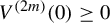 $V^{(2m)}(0)\geq 0$
for all
 $m\geq 1$
. As V is even, we also have
 $V^{(2m-1)}(0)=0$
for all
 $m\geq 1$
. By definition, we need to show that the analytic map
 $$ \begin{align*}W(x)=V(x)V^{\prime\prime}(x)-\frac{1}{2}(V^{\prime}(x))^2\end{align*} $$
takes only non-negative values. As W is analytic and even, it is enough to prove that
 $W^{(2m)}(0)\geq 0$
for all
 $m\geq 0$
. By the general Leibniz rule, since
 $V(0)=0$
and
 $V^{(2k+1)}(0)=0$
for
 $k\geq 0$
, we have
 $W(0)=V(0)V^{\prime \prime }(0)-\tfrac {1}{2}(V^{\prime }(0))^2=0$
and for
 $m\geq 1$
,
 $$ \begin{align*} W^{(2m)}(0)&=\sum_{k=0}^{2m}\binom{2m}{k}V^{(k)}(0)V^{(2m-k+2)}(0)-\frac{1}{2}\sum_{k=0}^{2m}\binom{2m}{k}V^{(k+1)}(0)V^{(2m-k+1)}(0)\\ &=\sum_{k=1}^{m}\binom{2m}{2k}V^{(2k)}(0)V^{(2m-2k+2)}(0) \\ &\quad-\frac{1}{2}\sum_{k=1}^{m}\binom{2m}{2k-1}V^{(2k)}(0)V^{(2m-2k+2)}(0)\\ &=\frac{1}{2}\sum_{k=1}^{m}\bigg(\binom{2m}{2k}+\binom{2m}{2k-2}-\binom{2m}{2k-1}\bigg)V^{(2k)}(0)V^{(2m-2k+2)}(0). \end{align*} $$
Moreover, we have
 $$ \begin{align*} &\binom{2m}{2k}+\binom{2m}{2k-2}-\binom{2m}{2k-1}\\&\quad={}\binom{2m-1}{2k}+\binom{2m-1}{2k-1}+\binom{2m-1}{2k-2}+\binom{2m-1}{2k-3} -\binom{2m-1}{2k-1}-\binom{2m-1}{2k-2}\\ &\quad{}=\binom{2m-1}{2k}+\binom{2m-1}{2k-3}\geq 0. \end{align*} $$
Since
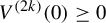 $V^{(2k)}(0)\geq 0$
for all
 $k\geq 0$
, it follows that
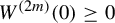 $W^{(2m)}(0)\geq 0$
for all
 $m\geq 0$
, which completes the proof.