


Introduction
Anxiety and mood disorders are among the most prevalent psychiatric conditions that require treatment, and their associated problems are the most relevant symptoms leading to patient referral to psychiatric units. Psychopharmacological treatment is highly common for these patients, but noncompliance and/or drug-resistance can reduce its effectiveness (Trivedi et al., Reference Trivedi, Rush, Wisniewski, Nierenberg, Warden and Ritz2006). Given these considerations, developing effective psychological interventions as an alternative or complement to pharmacological treatment is a clear need. There is evidence that cognitive behaviour therapy (CBT) can provide benefit as a complementary support for pharmacological treatment (Wiles et al., Reference Wiles, Thomas, Abel, Ridgway, Turner and Campbell2013). A drawback to the implementation of CBT in publicly-funded healthcare systems is its typical one-to-one delivery and consequent relatively high cost. There are a range of psychosocial treatments whose characteristics may overcome some of these drawbacks. Relaxation-based approaches have some efficaciousness across a range of clinical conditions, and can be applied in group settings (McGillivray and Evert, Reference McGillivray and Evert2014). For example, Applied Relaxation, and Behavioural Relaxation Training, have been shown to be effective in a number of settings. Additionally, Relaxation Response Skills Training (RRST) has been employed for the treatment of a broad set of clinical conditions in which stress is a common factor (Benson, Beary and Carol, Reference Benson, Beary and Carol1974). RRST is a self-regulatory integrated approach to stress reduction and emotion management that includes relaxation training, cognitive restructuring (learning to identify problematic thoughts such as catastrophizing and over-generalization), mindfulness (focusing attention on the present moment and accepting feelings), and meditative techniques (e.g. focusing concentration on a single object). As this procedure can be applied easily in a group setting, it was thought worthwhile to document its impact on outcomes of depressed and anxious patients who had displayed drug-resistance.
Method
Participants
The participants were 40 consecutively referred patients (11 male and 29 female), with a diagnosis of an anxiety (16: 14 Generalized Anxiety Disorder, 1 Adjustment Disorder, 1 Anxiety Disorder No Specification) or depressive (24: 16 Anxious Depressive Syndrome, 5 Major Depressive Recurrent, 1 Dysthymic Disorder, 1 Bipolar Disorder II, 1 Bipolar disorder No Other Specification) disorder; they had a mean age of 48.50 (± 13.15; range = 19–69) years. The patients were only partially responsive to pharmacological treatment (21 SSRI; 19 SNRI) with: (i) no more than 50% improvement on the Hamilton Depression or Anxiety scales; (ii) no symptom reduction/remission over 75% on the Hamilton Scales; (iii) the same symptoms for more than 6 months; (iv) two cycles of drug treatment; and (v) pharmacological treatment for 3 months.
Measures
Symptom Checklist 90 (SCL-90) is a self-report instrument evaluating psychopathological symptoms. It produces a Global Severity Index (GSI) for overall psychological distress (internal reliability, α = .97).
Hamilton Depression and Anxiety Scales (HAMD; HAMA) are clinician-rating scales that indicate depression and anxiety (α = .97).
Beck Depression Inventory (BDI) is a self-report questionnaire that assesses the clinical symptoms of depression (α = .92).
Spielberger Trait Anxiety Inventory (STAI-T) is a self-report questionnaire that assesses trait anxiety (α = .93).
Procedure and intervention
Patients were taught a variety of techniques as part of the RRST programme, including: relaxation (using the relaxation response procedure), cognitive restructuring techniques, mindfulness, and meditative techniques (see extended version for more detail). Training was delivered in 8-weekly, 2-hour group sessions (with a 10min break in the middle); with a one-hour individual assessment session at intake, and a one-hour posttreatment individual assessment session. Each session was run by two co-therapists: a psychologist and a psychiatrist. < tex − math/ > During Session 1, the participants were taught about the concepts of stress, coping, and the role of breathing in helping reduce stress. In this and in subsequent sessions the time was split approximately evenly between didactic education and discussion and practice of the targeted skills. In Session 2, there was a focus on the psychophysiology of stress and relaxation, followed by an introduction to a number of relaxation exercises. In Session 3, there was an introduction to the psychophysiology of emotions, followed by instruction and training in a mindfulness exercise (typically focused breathing). In Session 4, there were life-style and physical activity assessments, followed by the introduction of a meditation exercise. In Session 5, there were lessons on life style and nutrition, followed by a contemplation exercise. Session 6 included a stress and cognitive structuring exercises, followed by further instruction and practice of relation exercises. Session 7 focused on resilience and protective factors related to anxiety and depression, followed by a relaxation exercise. Finally, Session 8 dealt with resources about relapse prevention and further relaxation exercises. During the first individual assessment session, patients were given the psychological tests. They then participated in the 8-week RRST programme. Following completion of the intervention, the patients were again given the tests.
Results
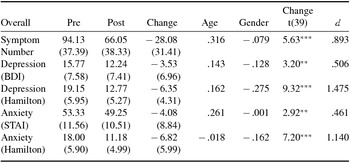
All patients completed the programme (i.e. attended all 8 sessions). Table 1 shows the mean numbers of symptoms (SCL-90), depression scores (BDI and Hamilton), and anxiety scores (STAI and Hamilton), for the sample pre and postintervention, and the mean change (posttreatment minus pretreatment scores) across the programme. Table 1 also shows the significance of this change assessed by a paired t-test (due to the number of tests a Bonferonni correction, .05/5 = .01, should be applied when considering the significance of these data), and the effect size (d) for this value. Inspection of the preintervention scores shows that the mean number of symptoms was higher than the suggested clinical cut-off, as were the self-rated (BDI) and clinician-rated (HAMD) depression scores. Similarly, the mean self-rated (STAI) and clinician-rated (HAMA) anxiety scores were higher than the cut-off point for the presence of anxiety. After treatment, all scores had decreased below the respective cut-off points for moderate clinical severity. These reductions were statistically significant for all the measures, with there being large effect-sized decreases for the overall symptoms, and for clinician-rated depression and anxiety. Table 1 displays correlations between both age and gender and change scores. In no cases were the changes in the outcome variables significantly related to the potential predictors, all ps > .06.
Mean (standard deviations) for overall symptoms (SCL-90), depression (BDI), and anxiety (STAI) for the sample pre and posttreatment, as well as the mean change score (post minus pre) and the correlations between the change score and the participants age (Pearson) and gender (point biserial)

*p < .05; ** p < .01; *** p < .001
Discussion
That the RRST programme was successful with patients who had previously demonstrated little change in their symptomatology through the use of pharmacological interventions is encouraging, and adds to the number of psychological supports that may be considered for this patient group (Wiles et al., Reference Wiles, Thomas, Abel, Ridgway, Turner and Campbell2013). The treatment had good patient acceptability, with none of the cohort dropping out. This is a striking feature of the data, and it is unclear whether this aspect is specific to the therapists/setting employed here, or would generalize to other settings. Additionally, the overall symptoms showed moderate improvement. The effect sizes and the levels of reliable and clinically-significant change for this treatment are somewhat lower than those seen for group-based CBT for non-drug resistant patients (Nakao et al., Reference Nakao, Fricchione, Myers, Zuttermeister, Baim and Mandle2001), but they are comparable with those reported of the impact of CBT on drug-resistant patients (Wiles et al., Reference Wiles, Thomas, Abel, Ridgway, Turner and Campbell2013); the moderate effect sizes of the current study were broadly similar to those seen in previous studies of psychological support for drug-resistant patients (Wiles et al., Reference Wiles, Thomas, Abel, Ridgway, Turner and Campbell2013). However, these improvements were the result of group-based rather than individual sessions, which may offer benefit in terms of cost-effectiveness. The results of the study could be developed by further work, including the use of a control group, measurement of the target behaviours taught in the programme, inter-rater agreement on the clinician measures, and the addition of a longer-term follow up assessment. Additionally, it should be noted that the programme is complex, and it might be that not all components are needed. That depression decreased more than anxiety is paradoxical given relaxation reduces arousal, and it may be that social support is a major active component of this procedure. However, the current preliminary results suggest that this short-term RRST offers a simple and cost-effective way to augment management for the most common psychiatric disorders, as complementary intervention in the case of patients less responsive to the drug treatment.
Acknowledgements
Ethical considerations. The authors assert that all procedures contributing to this work comply with the ethical standards of the relevant national and institutional committees on human experimentation and with the Helsinki Declaration of 1975, and its most recent revision. Permission for the research was granted by the Ethics Committee of the hospital at which the work was conducted.
Conflict of Interest: The authors have no conflict of interest with respect to this publication.
Supplementary material
An extended version is also available online under the Brief Clinical Report Supplementary Materials tab in the table of contents. Please visit http://dx.doi.org/10.1017/S1352465816000400.




Comments
No Comments have been published for this article.