1. THE COMMERCIALISATION OF RURAL PRODUCTS: MOVING BEYOND TRADITIONAL STEREOTYPES
Around the beginning of the nineteenth century, the German agronomist Johann von Schwerz travelled through the northern departments of Napoleonic France, in preparation for his work on Belgian agriculture. One day, he visited Saint-Nicolas, a town midway between Antwerp and Ghent, of which he gave the following account:Footnote 1
The following serves to give the German reader an idea of the prosperity to which arable farming can elevate a people. It was on a Thursday. An incredibly large crowd gathered on the square. On all sides, booths were erected. What I saw was a large, and undoubtedly widely renowned annual fair. Everything I could imagine, and all that a modest world citizen could wish for, was available here. Peddlers and merchants; plumbers, goldsmiths and clockmakers, antique sellers and booksellers, were all seen together. Should I tell? I was walking somewhat proudly among the mass of people: proudly, because I too am a farmer. Long live arable farming!, I thought, and truly, here is where it is alive… What appeared most beautiful to me, was the large quantity of cereals, offered for sale in clean and fine bags. Each bag carried the name and village of the farmer in red lettering. I was also charmed by the large number of attractive carts and the light and beautifully painted wagons, in which tenants and farmers with their wives and daughters arrived at the market in their Sunday clothes … I saw no dirt and no beggars… But behold! What I thought to be a famous annual fair, was nothing but the ordinary weekly market of Saint-Nicolas.
Although von Schwerz hardly mentioned markets or trade in the remainder of his work, he was clearly impressed by what he saw in Saint-Nicolas: many sellers of diverse consumer goods, large volumes of agricultural produce, and seemingly prosperous farmers, gathering there every week. In the historiography of Flemish rural society, such markets have also appeared, but as in the work of von Schwerz, they have hardly ever been the main topic. Consequently, little is yet known about the role of urban weekly markets, or trade in general, in the Flemish countryside in the past.Footnote 2
Internationally, the debate on the commercialisation of the countryside and the position of rural producers with regards to ‘the market’, in the abstract sense of the term, has long been conducted on the basis of opposing stereotypes. Rural producers have been seen as either entrepreneurial farmers, eager to participate in ‘the market’, or risk-averse peasants who shunned ‘the market’. In institutional accounts of economic growth only the removal of obstacles or the reduction of transaction costs are needed to encourage rural producers to participate in markets. Thus Stephan Epstein wrote that ‘there is no reason why peasants should avoid markets, although the degree of involvement will be tempered by market inefficiencies, susceptibility to exogenous shocks like warfare, access to credit, information costs and the like’.Footnote 3 However, according to Brennerian Neo-Marxist accounts of the origins of economic growth, rural producers need to be coerced into market dependence. Robert Brenner believes ‘peasants naturally wished to avoid the risk of dependence upon the market for sales or purchases’ and ‘marketed only physical surpluses’.Footnote 4
Both accounts have their merits. By referring to barriers to market participation, institutional accounts explain why rural producers did not participate in markets before those barriers were lowered or removed. By referring to coercive forces, Brennerian Neo-Marxist accounts explain why rural producers were driven towards the market. However, the grey area in between, where rural producers are neither blocked from market access, nor coerced into complete market dependence, remains unexplored.
Still, in recent years a number of researchers, in Flanders as well as elsewhere, have investigated how rural producers dealt with exchange. Their work has resulted in several new contributions that present a more nuanced view of peasants, farmers and markets. This article hopes to contribute to this body of research. In particular, it hopes to shed more light on three aspects: first, the nature of the goods exchanged – whether these goods were foodstuffs, other agricultural products or the output of rural industries; second, the circumstances in which rural producers participated in exchange – that is, whether as producers they were capable of self-sufficiency or not; and, finally, the nature of the markets – whether exchange was intra-local or extra-local, personal or impersonal.
These aspects are also discussed in recent contributions to the debate. To begin with, rural producers have been found to have participated in exchange. This was not usually an ‘anonymous market’, however; rather, these exchanges were often among rural producers, within a limited geographical range, based on personal reciprocal relationships, on credit and with little use of hard currency. Philip Hoffman has found evidence of this in early modern France, as has Thijs Lambrecht for the Flemish countryside.Footnote 5 People in the countryside exchanged goods, labour, land, credit or services amongst themselves, making these ‘markets’ interlocked or interlinked, which, as has been emphasised in the field of development studies, helped to overcome certain market imperfections and permitted a more efficient use of resources by reducing transaction costs.Footnote 6 Every transaction was valued in monetary terms, which, according to Hoffman, distinguishes it from barter, yet transactions were not paid in cash but were concluded on credit. Because these exchanges did not go in one direction but were reciprocal, it was easier to settle accounts once a year instead of paying on each occasion. Creditors and debtors, landlords and tenants, masters and servants, developed ‘personal relationships of reciprocity’, to prevent either from taking advantage of the other, and to maintain future access to what each party had to offer the other.Footnote 7 The geographical scope of these local exchange networks was very limited. They ‘typically embraced a village and neighbo[u]ring communities, or perhaps a town and surrounding hamlets’.Footnote 8
Recent research has also questioned the idea that it was mainly the larger farms that were the more commercial. As Maurice Aymard has already observed, it is ‘impossible to accept a static model opposing an auto-consuming “peasant economy” of small and medium sized family holdings against the dynamic speculations of the largest farms, resolutely oriented towards sale’.Footnote 9 On the contrary, only for the larger farms, not the smaller ones, was subsistence an option. The most commercial behaviour could be expected from smallholders, often the majority of the population, since they were forced to seek out alternatives to subsistence production.Footnote 10
Given that the majority of households needed alternatives to subsistence production, it should not be surprising to find evidence of the exchange of output, land, labour or credit.Footnote 11 However, Paul Warde has warned that, given the circumstances in which exchange took place, such evidence cannot be used to support the idea of the peasant as an ‘eager entrepreneur’, ready to ‘engage in specialization, innovation, risk-taking, and to consequently generate economic growth’, nor can it be used ‘against models of an autarkic peasant household oriented towards subsistence or maintenance of the family holding’.Footnote 12 Instead, he has defended a more pragmatic view of the relationship between rural producers and markets and has emphasised that to claim peasants were not profit maximisers is neither to argue that the concept of profit was unknown to them, nor that they did not seek to take advantage from it.
However, to conclude from the above that smallholders mainly participated in markets while large farmers merely produced for subsistence would be equally rash. Research by both Thijs Lambrecht and Reinoud Vermoesen on Flemish rural society has not only shown that small and large rural producers both participated in exchanges with villagers but, more specifically, that in their exchanges, the small and large rural producers depended on each other.Footnote 13 The dependence of smallholders in inland Flanders on the market was particularly expressed through their dependence on the ‘peasant-supporting’ larger farmers.Footnote 14 According to Lambrecht, by selling their labour to local large farmers, smallholders shielded themselves from market forces, and the labour market was ‘in some respect an insurance rather than a threat to the household economy’.Footnote 15 Similarly, Vermoesen showed that at least part of the commercial output of smallholders was brought into larger trading networks by the large farmers, who acted as intermediaries.Footnote 16 As such, the large farmers were both a means of access to the market and, at the same time, a buffer against market forces. In these reciprocal exchange relationships, the negative aspects of interlinked markets, where one group often finds itself in a position of dependence upon the other, become clear. In the case of Flanders, interlinking markets enabled the large farmers to benefit more from the efforts of smallholders.
Given the limited geographical scope of these exchange networks, when they are considered at the level of the village or group of villages, self-sufficiency or even autarky seems to reappear. This is not commercialisation in the way Niels Grüne has defined it, ‘the increasing extent to which farm produce was marketed on a supra-local level instead of being consumed in the household or sold to fellow villagers often within the scope of reciprocal relationships’.Footnote 17 The latter can be labelled as personal intra-local exchange, the former as impersonal extra-local exchange; two different things.
With regards to extra-local trade, smallholders may have been more involved than large farmers. In the Baden Palatinate between the middle of the eighteenth and middle of the nineteenth centuries, as studied by Grüne, grain held an important position in the fields, yet tobacco was also an important crop, cultivated by smallholders in particular.Footnote 18 While most of the tobacco crop left the villages, most of the surplus grain produced by the larger farmers in those villages did not. Instead, most of it was apparently exchanged within the village, most likely within reciprocal exchange networks. Similarly, in early seventeenth-century Württemberg, Warde found that those who harvested larger volumes of oats and spelt did not necessarily sell a larger proportion of it.Footnote 19 The larger farmers did not sell a notably larger proportion of their oats harvest than smallholders, presumably because they had more horses to feed. More importantly, Warde found that the proportion of the net spelt harvest marketed actually tended to be smaller for the larger holdings, rather than the reverse, presumably because the larger holdings needed to feed more servants and labourers.
Finally, recent research has indicated that essential foodstuffs were less likely to be sold than other products. Warde believes that producers preferred to sell those crops on which they were less dependent for subsistence, since he found that producers were more inclined to sell oats than spelt. He sees this ‘differentiated propensity to sell in regard to different grains’ as evidence of ‘a clear preference to cover subsistence needs first’.Footnote 20 Similarly, elsewhere rural producers were generally more likely to sell their wheat than to sell their rye, a differentiation which may even have increased with the introduction of the potato, or in some regions, maize.Footnote 21 Commercialisation and subsistence could therefore be goals pursued within one and the same holding. A limited number of products with a large commercial importance, such as industrial crops or wheat, could be found next to a wider range of products with a much more limited commercial importance such as rye, potatoes or maize, not only on a regional level, but even on the level of the individual holding. Rural producers could be commercially active without specialising in commercial products.
If anything, recent research has shown that the commercialisation of rural products and producers was considerably more complex and less straightforward than previously thought. This study hopes to complement and refine the existing insights. Previous research on the role of exchange in Flemish rural society in the modern period has focused on intra-local exchange networks. In this article, emphasis will be placed on the importance of extra-local exchange in the nineteenth century, using trade at urban weekly markets as an indicator. In Saint-Nicolas, according to the account of von Schwerz, market trade seems to have been substantial. To test whether market trade did indeed play an important role in the Flemish rural economy, the case of Saint-Nicolas will be compared with that of Oudenaarde, another Flemish town.
This study will show Oudenaarde and Saint-Nicolas to be two entirely different cases: extra-local trade was much more sizeable in the region of Saint-Nicolas than in the region of Oudenaarde. The remainder of this article will seek to explain these differences in terms of the socio-economic structure of rural society in Flanders. In that respect too, the two regions diverged; Saint-Nicolas was an atypical case within the Flemish rural economy, functioning along entirely different lines from Oudenaarde, giving the Saint-Nicolas region an entirely different dynamic of development, of which a greater degree of commercialisation was only one aspect. Developments in Oudenaarde and Saint-Nicolas are reminiscent of the ‘peasant’ and ‘specialisation’ models, respectively, of Jan de Vries. In the peasant model, households produce both agricultural and non-agricultural goods, do not bring regular surpluses to urban markets or act as purchasers of urban goods. In the specialisation model, one group of households concentrates on agriculture, they regularly supply markets and at the same time act as buyers of non-agricultural goods, while another group of non-agricultural producers, who grow in numbers and often migrate to nearby towns, provides goods and services to the agricultural sector.Footnote 22 While in recent years De Vries has increasingly pointed to rising demand for new consumer goods as the main explanation for the commercialisation and specialisation of household activities, this article will in contrast point to the socio-economic structure of rural society as one of the main factors.Footnote 23
2. RURAL PRODUCTION AND MARKETS IN THE REGIONS OF OUDENAARDE AND SAINT-NICOLAS
This section will measure and compare the involvement of rural producers in extra-local exchange in two regions in Flanders, Oudenaarde and Saint-Nicolas, in the nineteenth century. This involvement will be measured by looking at trade at urban weekly markets, which were still the main outlet for rural produce. As rural industries played an important role in the Flemish countryside, not only the output of agriculture but also that of rural industries should be considered.
Oudenaarde and Saint-Nicolas are two towns located in ‘Historical Flanders’, the ancient county of Flanders, located in the north-west of present-day Belgium. In his analysis of Flemish rural society from the Middle Ages until the nineteenth century, Erik Thoen has distinguished two different regions within Flanders, inland Flanders and coastal Flanders, each having its own specific ‘social agrosystem’. Coastal Flanders, also known as ‘the polder area’ was characterised by very large polder farms, whereas in inland Flanders smallholdings predominated, with a ‘significant minority’ of larger farms.Footnote 24 By the nineteenth century, leasehold predominated in both regions.Footnote 25
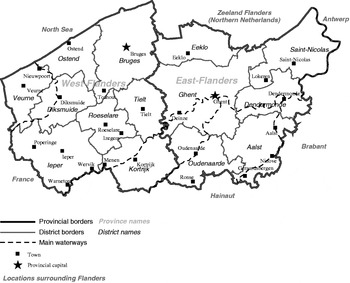
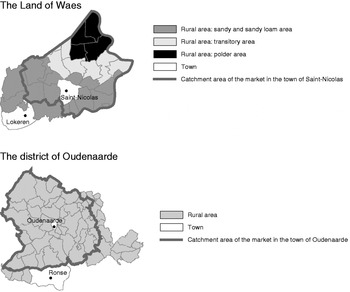
Although the towns of Oudenaarde and Saint-Nicolas and their respective hinterlands are both part of inland Flanders, they occupy different positions within it (see Figure 1). The region of Oudenaarde lies deep in inland Flanders, whereas the region of Saint-Nicolas, also known as the ‘Land of Waes’ (Land van Waas), lies on the border between inland and coastal Flanders. Part of coastal Flanders or the polder area stretched out into a small part of the Land of Waes, where it differed markedly from the rest of the region that consisted of sandy and sandy loam soil (see Figure 2). Both regions more or less correspond to the administrative districts of Oudenaarde and Saint-Nicolas that were established in 1818 in the province of East-Flanders.Footnote 26 The catchment areas of the markets held in Oudenaarde and Saint-Nicolas, i.e. the villages from where supplies were usually carried to the respective markets, were somewhat smaller than the districts.
East- and West Flanders.

The regions of Oudenaarde and Saint-Nicolas. Note: in this paper, the Saint-Nicolas region (also known as the Land of Waes) includes the administrative district of Saint-Nicolas, extended with the municipalities Moerbeke-Waas and Waasmunster; the Oudenaarde region is equal to the administrative district of Oudenaarde.

There were few profound differences in arable production between the two regions.Footnote 27 Throughout the nineteenth century, around three-quarters of the arable land in both regions was devoted to basic food crops, namely bread grains, summer grains and potatoes. With the onset of the Agrarian Depression at the end of the nineteenth century, the importance of cereal production started to decline. Throughout the century, around 10 per cent of the arable land was occupied by industrial crops, with flax particularly prominent around Saint-Nicolas.
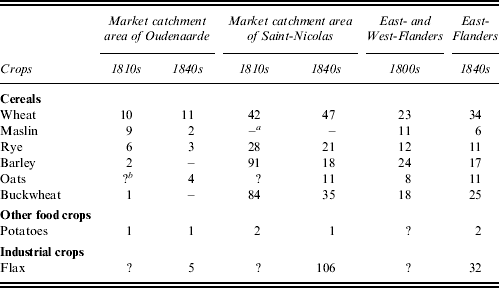
However, although arable production was fairly similar in both regions, there were enormous differences in the proportion of output sold at the weekly markets in the towns of Oudenaarde and Saint-Nicolas. The proportions can be calculated by, first, determining the catchment areas of both markets, second, estimating the total arable production within these catchment areas, and finally, comparing these with the volume traded at each market. The results are shown in Table 1 for the beginning and middle of the nineteenth century. It is not useful to repeat this exercise for the end of the century as the importance of urban markets for the sale of arable produce, certainly cereals, started to decline after the middle of the nineteenth century. The catchment areas were determined from information based on two sources from the 1820s: in that decade, the list of villages that supplied the markets of Oudenaarde and Saint-Nicolas was drawn up for the mercuriales which, recorded every week, listed not only prices but also the volume of sales, as well as for the Assize of Bread.Footnote 28 The total arable production for the middle of the nineteenth century was derived from village-level data collected in 1846.Footnote 29 Approximate figures for the beginning of the century were estimated by applying regional production trends between 1812 and 1846 to the figures for 1846. Finally, volumes traded were taken from the mercuriales of both towns.Footnote 30
Percentage of total arable output sold in the market, Oudenaarde, Saint-Nicolas and Flanders, first half of the nineteenth century
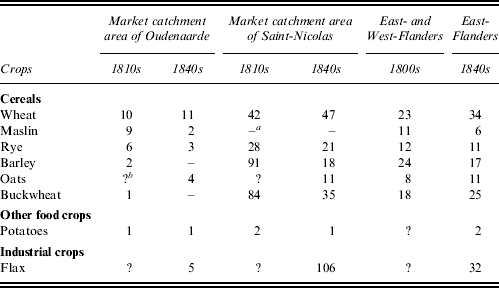
a Not sold in the market indicated by ‘–’.
b Insufficient information on production or trade indicated by ‘?’.
Sources: catchment areas defined based on material from: Memoriaal administratif van Oost-Vlaanderen, vol. 25 (1829), 45–8 and Public Records Office Beveren, East-Flanders Dutch Fund, 792 (789/1–3) and 800 (789/4). Production data within catchment areas based on: Agriculture recensement général, 1846 for the 1840s, and own calculations for the 1810s, by applying trends determined by Martine Goossens, The economic development of Belgian agriculture: a regional perspective, 1812–1846 (Leuven, 1993), 341–4 in the ‘French’ districts Oudenaarde and Dendermonde onto production data of the 1840s. Sold quantities based on the mercuriales of the towns, gathered by Wouter Ronsijn, ‘De donderdagmarkt van Oudenaarde, 1750–1900: een reconstructie van anderhalve eeuw prijzen en handelsvolume’, Handelingen van de Geschied- en Oudheidkundige Kring van Oudenaarde 49 (2012) and Wouter Ronsijn, ‘De donderdagmarkt van Sint-Niklaas, 1720–1900. Een reconstructie van meer dan anderhalve eeuw prijzen en handelsvolume’, Annalen van de Koninklijke Oudheidkundige Kring van het Land van Waas 115 (2012), 111–55. Market data for East- and West-Flanders, 1800s: Willy Vanderpijpen, ‘De landbouw en de landbouwpolitiek in het Leie- en Scheldedepartement (1794–1814)’ (unpublished PhD thesis, Vrije Universiteit Brussel, 1983), 125. Market data for East-Flanders, 1840s: Memorial administratif de la Flandre Orientale.
When it came to the commercialisation of arable production, Table 1 immediately makes clear that Oudenaarde and Saint-Nicolas were two entirely different regions. In Oudenaarde, an almost insignificant fraction of the grain harvest was brought to the urban market, although the percentages of cereal crops brought were generally slightly higher at the beginning than in the middle of the nineteenth century. Wheat was the only cereal of any commercial significance, with about 10 per cent of the output sold at the market. In contrast, in Saint-Nicolas a sizeable part of the grain output was sold in the market in the town. The high figures for barley and buckwheat in the 1810s for this town might be due to exceptional measures against the smuggling trade, as a result of which cereals from Zeeland Flanders which would otherwise have been shipped along the River Scheldt were now brought to the market in Saint-Nicolas. Nonetheless, the other estimates shown in Table 1, for both the 1810s and the 1840s, show that all cereals had a considerable commercial importance there. In Saint-Nicolas cereals primarily destined for human consumption such as wheat, rye and buckwheat were not excluded from market trade, quite the contrary. Around the middle of the nineteenth century, almost half of the wheat harvest from the catchment area was sold in the market in the town. Compared with the average figures for East- and West-Flanders in the 1800s and East-Flanders in the 1840s (shown in Table 1), the region of Saint-Nicolas usually sold an above-average proportion of the grain it produced, whereas Oudenaarde sold a below-average proportion.
As with arable farming, there were few profound differences between the two regions in the size of the livestock sector.Footnote 31 Cattle were more important in the ‘Land of Waes’, while smaller livestock species such as pigs were more important in the Oudenaarde region. Around Oudenaarde, the livestock sector clearly began expanding well before the Agrarian Depression. Around Saint-Nicolas, this process only began once the Depression had set in, but proceeded much more rapidly than was the case in Oudenaarde.
Livestock products were also sold in the weekly markets of both Oudenaarde and Saint-Nicolas. In the 1840s, an estimated 21 per cent of the potential butter production in the catchment area of Oudenaarde was brought to the market in the town.Footnote 32 Although the equivalent proportion for Saint-Nicolas was only 11 per cent, this lower figure was probably compensated for by a considerable amount of the butter produced in the catchment area of Saint-Nicolas being sold at the market in nearby Beveren.Footnote 33 At the same time the sale of livestock and livestock products was expanding in Oudenaarde, a monthly cattle market having been established in the town in 1835.Footnote 34 After the middle of the century, the mercuriales of the town started to record the sale of eggs, rabbits, piglets and hams, most of which showed an upward trend.Footnote 35 However, changes in Saint-Nicolas at the end of the nineteenth century were more impressive. A weekly cattle market was erected there in 1890.Footnote 36 More importantly, by that time, the sale of butter in the market of Saint-Nicolas had expanded to as much as 77 per cent of the potential production within the catchment area of the town, compared with only 29 per cent in Oudenaarde.
As well as agriculture, cottage industries were also important in the Flemish countryside, in particular the domestic linen industry.Footnote 37 For many rural households, these industrial activities were vital as secondary, or even primary, sources of income. Although there were exceptions, spinning was typically a female occupation and weaving typically a male one. Flemish linen cloth had been mainly sent to Spain in the eighteenth century and to France in the first half of the nineteenth. However, over the course of the nineteenth century, increasing competition from modern mechanical cotton production meant the end of the traditional linen industry, which, by the 1830s, was undeniably in trouble, and shortly after the middle of the century had virtually disappeared.
The regions of Oudenaarde and Saint-Nicolas were both involved in the linen industry, though in different ways. The main activities of the industry, spinning and weaving, were important in Oudenaarde. Censuses indicate that here, there were 59 looms per 100 households in the 1760s, and 44 looms per 100 households in the 1840s.Footnote 38 Not surprisingly, the region of Oudenaarde was among those struck hard by the collapse of the linen industry.Footnote 39 In the region of Saint-Nicolas, the preparation of flax for further processing, involving the jobs of retting, scutching and heckling, was the main activity, while there was hardly any spinning or weaving. Not only was the amount of flax grown in this region proportionately larger than in Oudenaarde, raw flax was also imported from neighbouring regions to be prepared in the Land of Waes. This explains why more flax was sold in the market of Saint-Nicolas than was grown in its catchment area, as indicated by Table 1. Despite the collapse of the linen industry in the first half of the nineteenth century, the preparation of raw flax later remained important in the Land of Waes.Footnote 40
The differences between the two regions were also visible in their markets.Footnote 41 The town of Oudenaarde held an important market for linen cloth where more than 20,000 pieces of cloth were sold each year of the 1820s. After this the market went into steep decline, and by the 1850s no more than a few thousand pieces were sold per year. By the 1870s the linen market in Oudenaarde had disappeared. Saint-Nicolas, on the other hand, was an important market for scutched flax. In the early 1820s, almost one million kilograms of flax were sold in the flax market of the town each year. After a considerable decline in the 1830s, the volume of annual trade expanded until record levels were reached in the 1860s and 1870s, with up to three or four million kilograms sold. Over the course of the nineteenth century, this flax was increasingly exported to England and France.Footnote 42
After the linen industry collapsed in Oudenaarde, few alternative industrial activities arose to replace it in the rural areas of the region.Footnote 43 In the Land of Waes, however, several other rural industries existed, such as the production of clogs, lace and baskets, as well as peat digging and brick making. The goods produced were not only destined for local needs; bricks made in the region contributed to the buildings of nearby Antwerp as the town expanded, clogs and lace were exported to the Netherlands, while by the end of the century baskets were sent as far away as England and America.Footnote 44
To reiterate, despite similarities there were considerable differences between the two regions being studied. The rural economy of Saint-Nicolas was not only more commercial, but also more diverse than that of Oudenaarde. In the region of Oudenaarde, extra-local exchange was mainly limited to linen cloth. Probably in response to the loss of the linen industry, the sale of livestock and livestock products expanded in the town after the middle of the nineteenth century, but little grain was brought to the market in the town. In the region of Saint-Nicolas, by contrast, not only was flax important, but so too were several other products of rural industry. Particularly striking is that, in Saint-Nicolas, grains for human consumption, namely wheat, rye and buckwheat, were an important feature of extra-local trade.
3. HOLDINGS, HOUSEHOLDS AND LABOUR
In seeking to explain the differences in commerce between the regions of Oudenaarde and Saint-Nicolas, this section will investigate the rural social structure of both regions: the size of holdings, the access of households to holdings, and the possibilities for agricultural employment on the holdings of others. This investigation will provide a basis for the following sections, where an explanation for the differences between the two regions will be formulated.
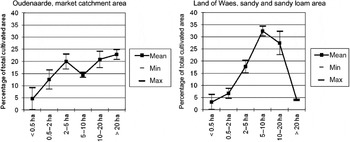
At the root of the divergent patterns shown by the two regions lies the different size distribution of their agricultural holdings. Figure 3 compares the distribution of holdings by size in the middle of the nineteenth century in the catchment area of Oudenaarde with that for the area of the Land of Waes which had sandy and sandy loam soil. As Figure 2 shows, the latter area excludes both the polder area, where an entirely different size distribution of holdings predominated, and the area of transition in between.Footnote 45 The percentage of the cultivated area in each region occupied by holdings of a particular size better indicates the importance of holdings of a given size than the absolute number of holdings would; however, due to the nature of the source used, no exact percentages, only a range, can be given.Footnote 46 The size categories into which holdings are grouped reflect the labour requirements of the holdings, as well as their potential to provide subsistence needs. In general, a holding of two hectares is considered to be the threshold size necessary for subsistence in nineteenth-century Flanders, although such a holding probably provided little more than the bare minimum for existence.Footnote 47 Households exploiting a holding of fewer than five hectares would have had a considerable labour surplus at their disposal, which could be deployed elsewhere to obtain an additional income. The larger the holding, the more household labour was absorbed and the greater the amount of external labour needed. Holdings of more than 20 hectares in extent had a high demand for external labour.Footnote 48
Percentage of the total cultivated area, cultivated on holdings of particular sizes in hectares (ha) in the catchment area of the market of Oudenaarde and in the area of the Land of Waes with sandy and sandy loam soils, 1846. Note: the towns of Oudenaarde, Saint-Nicolas and Lokeren are excluded. (Source: Agriculture recensement général, 1846 (agricultural census of 1846).)

In the middle of the nineteenth century, there was a striking difference in the distribution of holdings by size between the two regions. Figure 3 clearly shows that farming in the region of Oudenaarde was polarised in terms of holding size. Much of the soil was either cultivated by those working smaller holdings of between 0.5 and 5 hectares, or those with holdings of more than 10 hectares. One-fifth, or possibly even a quarter, of the area was tilled on farms of more than 20 hectares. The importance of medium-sized holdings was fairly limited. On the sandy and sandy loam soils of the Saint-Nicolas region, by contrast, medium-sized holdings of roughly 5 to 20 hectares clearly predominated, and hardly any land was cultivated on farms larger than 20 hectares. Similar indicators from the eighteenth century, as well as an agricultural census taken at the end of the nineteenth century, show that the size distribution of land holdings was fairly stable in both regions throughout the period under study.Footnote 49
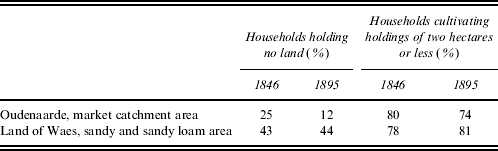
Assuming that each holding corresponded to one household, Table 2 shows, for the middle and the end of the nineteenth century, the proportion of households within the catchment area of Oudenaarde and in the area of the Land of Waes with sandy and sandy loam soils that had holdings of under two hectares, and those which held no land at all. In both regions, about four-fifths of all households did not cultivate a holding large enough for subsistence and in the sandy and sandy loam area of the Saint-Nicolas region, two-fifths of households had no holding at all. In the region of Oudenaarde, access to smallholdings improved somewhat by the second half of the nineteenth century. In the sandy and sandy loam area of the Land of Waes, in contrast, there was hardly any change.
Percentage of households without any holding, and cultivating holdings of two hectares in extent or less in the catchment area of the market of Oudenaarde and in the area of the Land of Waes with sandy and sandy loam soils, 1846 and 1895a
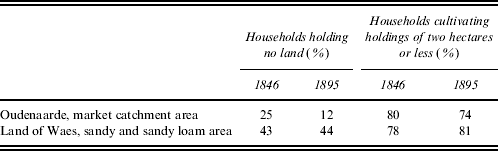
a Households cultivating holdings of two hectares or less include those holding no land. The towns of Oudenaarde, Saint-Nicolas and Lokeren are excluded. The number of households in 1895 is calculated as the average of the figures for 1890 and 1900.
Sources: Agriculture recensement général, 1846, 1895 (agricultural censuses of 1846 and 1895); Population recensement général, 1846, 1890, 1900 (population censuses of 1846, 1890 and 1900).
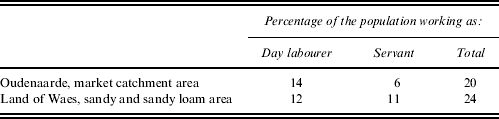
Since most households did not cultivate a farm of sufficient size to allow the household to subsist independently, most households in both regions needed additional sources of income, and employment on other farms – ‘external’ agricultural employment – was one of the main means by which such income could be earned. The two main forms of agrarian labour were domestic service and day labour. Table 3 shows, according to a population census of 1800, the proportion of the population who were active as day labourers and farm servants in the two regions.Footnote 50 In total, about one-fifth to a quarter of the population in both regions were so employed. Within the catchment area of Oudenaarde, day labour was the main form of external agricultural employment, while in the sandy and sandy loam area of the Land of Waes, both forms of work were important. The values in Table 3 indicate that external agricultural employment was somewhat more important for the inhabitants of the Saint-Nicolas region than for those of the Oudenaarde region. This is not surprising, considering that a larger proportion of households in the Saint-Nicolas region were landless.
Percentage of the total population working as day labourers and farm servants in the catchment area of the market of Oudenaarde and in the area of the Land of Waes with sandy and sandy loam soils, 1800a
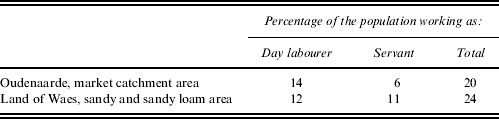
a The towns of Oudenaarde, Saint-Nicolas and Lokeren are excluded. The census results are not preserved for all communes. The sample that is preserved covers 55 per cent of the population of the catchment area of Oudenaarde and 88 per cent of the population of the sandy and sandy loam area of the Land of Waes.
Source: Ludwine Deschuyteneer, ‘ “Les journaliers et les domestiques”. De rurale arbeidsorganisatie in het Scheldedapertement op het einde van het Ancien Régime’ (unpublished masters thesis, Ghent University, 2009), 93–102.
Although a considerable part of the population was active as day labourers or farm servants in both regions, local employment opportunities in agriculture were much more limited in Saint-Nicolas than in Oudenaarde. Based on the agricultural census taken in 1846, it is possible to calculate how many days of external agricultural labour were used on average per cultivated hectare.Footnote 51 The need for agricultural labour, beyond that performed by households on their own farms, was much greater in the Oudenaarde region than in the Saint-Nicolas region. For every hectare cultivated within the catchment area of the market of Oudenaarde, 47 days of external agricultural labour were used, compared with only 20 such days in the sandy and sandy loam area of the Land of Waes. The explanation for this difference is straightforward: a large part of the labour needs of the medium-sized farms that predominated in the latter area was met by the households that cultivated them. The demand for agricultural labour in the Oudenaarde region mostly came from larger farms, and these were virtually absent in most of the Saint-Nicolas region.
In summary, a sizeable part of the population in both regions could not live on the produce of the holdings they cultivated, and, therefore, a sizeable proportion of all households needed to find additional sources of income in order to cope. Rural industries were one option, external agricultural labour another. Households in the Oudenaarde region could find work on the large, local farms that needed much external labour. For households in the Saint-Nicolas region, although external agricultural employment was also important, there were very few large farms on which to work.
4. MEDIATED MARKET DEPENDENCE IN OUDENAARDE
In light of recent research on the rural economy of inland Flanders, it is hardly surprising to find that such a small proportion of agricultural produce was sold at the weekly market held in Oudenaarde. Work by Lambrecht and Vermoesen, based on probate inventories and the account books of farmers, has brought to light the fact that smallholders did not depend on an anonymous market but rather, through interlinked markets, on the ‘peasant-supporting’ large farmers.Footnote 52 Because holdings were polarised with respect to size, a considerable part of arable output was able to circulate within reciprocal intra-local exchange networks, rather than through anonymous extra-local exchange networks. As a result, the market dependence of smallholders was not direct, but ‘mediated’.
Large farmers sold food such as grain to smallholders, particularly at the time when, for many, the remains of the previous harvest were running out while the new harvest was still growing. Villagers could also lease plots from local large farmers. Vermoesen found that there was a tendency for urban landowners to lease out their rural possessions mostly to the larger farmers, while the latter, in turn, mainly leased out land to local smallholders. Finally, large farmers used their horses and implements to perform services, especially ploughing, for smallholders. Horses were not usually found on holdings of below five hectares.Footnote 53 For holdings of about two hectares or more, it was more efficient to have the land ploughed by a large farmer, than to dig it manually with a spade. Other services performed by large farmers included the transport of manure to the fields and of output to the markets.
In return for all this, landless households and smallholders supplied larger farmers with labour. They disposed of a considerable surplus of labour that they could put to use either by sending their children to work as live-in servants, or by performing day labour on local large farms. In inland Flanders, according to Lambrecht, day labourers were ‘mainly recruited from within the village and peasantry with less than 5 hectares of land at their disposal’.Footnote 54
The place of the linen industry in this model still remains unclear. The reciprocal relationships between smallholders and large farmers rested mainly on the capacity of large farms to absorb a substantial amount of both male and female labour. However, that capacity was still limited, and as population numbers grew, the labour supply increasingly surpassed the needs of large farms. Spinning by women and weaving by men, mainly performed within households with little or no land, developed to employ the surplus labour. On the one hand, it is possible that both the raw material and the outputs from the industry still circulated within the reciprocal relationships between smallholders and large farmers, as stressed by Vermoesen.Footnote 55 Indeed, local large farmers may sometimes have performed the role of putting-out merchants, by supplying part of the raw material, flax and yarn. They may also have accepted linen cloth instead of labour in return for the goods and services they provided. On the other hand, Thoen believes that ‘the growing importance of rural industry tended to loosen the ties between smallholders and large farms in inland Flanders’.Footnote 56 In that case, the market dependence of spinsters and weavers would have been more direct, rather than being mediated by large farmers. All of this depends on how sizeable the flows of raw materials and outputs between the spinsters and weavers on the one hand, and the large farmers on the other hand, actually were.
Only a small amount of money circulated in this type of economy. Goods that were exchanged among smallholders and large farmers were valued according to their market price. Likewise, the price of labour was expressed through wages. Still, little was paid in cash; most was exchanged on credit. Once every year, balance sheets were drawn up and accounts settled. The rural economy in the vicinity of Oudenaarde was therefore monetised, but not monetarised.
To summarise, while a considerable proportion of households near Oudenaarde depended on exchange, their needs were met to a large extent by their reliance on reciprocal relationships with local large farmers, rather than on an anonymous market. These relationships operated on credit, not money. This was ‘mediated market dependence’. Most of these transactions did not extend beyond the village, which explains why so little output, apart from linen cloth, was brought to the weekly market of Oudenaarde.
5. UNMEDIATED MARKET DEPENDENCE IN SAINT-NICOLAS
The case of Saint-Nicolas was profoundly different. Here, extra-local commercial activities clearly played a more important role in the rural economy. Moreover, a substantial market for grain destined for human consumption existed in this region. Several elements point towards the predominance of medium-sized farms with a limited need for external labour as the main explanation. Because small rural producers did not find large farms nearby on which they could work, they sought out alternative sources of additional income, which earned them cash instead of credit. With that cash, an internal monetarised market for grain could develop.
The main solution in response to the absence of local employment opportunities was seasonal migration.Footnote 57 There was much need for external labour on the large polder farms of nearby coastal Flanders. The latter region extended into a small part of the Land of Waes, but most of it was located in Zeeland Flanders, across the border with the Netherlands, and, large numbers of temporary day labourers were required there from April to September, with many being recruited from the Saint-Nicolas region.
Because of their geographical separation, there were few reciprocal relationships between the seasonal labourers and the large polder farmers who employed them. As Bas van Bavel remarks for the Guelders River area and Holland, ‘the wage relationship seems to have been less personal than it was elsewhere, or sometimes even impersonal, partly because of the much wider area of recruitment of the labourers’.Footnote 58 Nonetheless, the migrant labourers were still paid partly in kind. It was common for polder farmers to sublet land (prepared, manured but unsown or unplanted) to their seasonal labourers as part of their wage, on which the latter grew flax and potatoes.Footnote 59 The remainder of their wage, however, was effectively paid out in coins, in contrast to the Oudenaarde region, where wages often merely figured in the account books of the large farmers, being effectively paid out in kind. Wages in the polder area were also higher than in the rest of the Land of Waes.
The limited availability of local employment opportunities on farms in the Land of Waes also stimulated the search for activities besides agriculture which could be undertaken closer to home, and led to the diverse rural industries in the region. These industries, many of which sold their products outside the Land of Waes and often outside Flanders, were also an important source of cash for the region. The main rural industry was the preparation of flax, which mostly employed smallholders called vlassers. In this industry, too, monetary relationships played an important role.
There were two ways the vlassers had access to flax besides that grown on their own plots.Footnote 60 First, they could harvest and prepare the standing flax of nearby medium-sized farmers. For this they were not paid in money, but with ‘the third stone’; that is, they could keep one-third of the scutched flax and flax seed. Second, the vlassers could obtain additional flax by growing it on sublet plots, mainly located in the Dutch polders. According to Prosper Thuysbaert, as soon as the flax was removed from such plots, the Dutch polder farmer had to be paid for it, suggesting that the vlassers had to have had the necessary cash to hand, even before they had prepared and sold their flax.Footnote 61 Over time the vlassers increasingly relied on flax merchants who delivered green flax to them for preparation; in this way they could work as day labourers on the polder farms in summertime and as day labourers for the flax merchants in wintertime. On the whole, monetary relationships, rather than credit relationships, played a central role in the preparation of flax. Not only did the vlassers require money for their dealings with the Dutch polder farmers, they also obtained a considerable amount of money from the sale of their scutched flax.
The different forms of cash income amongst smallholders and landless labourers in the Saint-Nicolas region created an internal, monetarised market for grain. The smallholders and labourers needed cash to buy grain because the predominance of medium-sized farms amongst the local landholdings prevented them from developing the sort of credit relationships with large farmers that existed in the Oudenaarde region.
This does not mean that reciprocal relationships did not exist in the Saint-Nicolas region, but they were of a different nature to those in the Oudenaarde region, and probably less extensive. Instead of reciprocal relationships between small and large farmers, the medium-sized farmers of the Saint-Nicolas region developed such relationships among themselves. Surprisingly, during the months of peak labour demand, even the medium-sized holdings were reportedly confronted with a local labour shortage because in those months local day labourers went to work on the polder farms for higher wages.Footnote 62 The labour needs of medium-sized farms were met by other medium-sized farmers, not in exchange for grain, in which they were likely to be self-sufficient, but in exchange for ploughing and harrowing services. Recent research on the village of Sinaai, in the sandy area of Saint-Nicolas, at the end of the seventeenth century has shown that services involving the use of horses were particularly likely to be performed by medium-sized farmers for each other.Footnote 63 As a result, in the Saint-Nicolas region, much less grain circulated within reciprocal relationships, leaving more available to be sold for cash. Selling a greater amount of grain for cash made the medium-sized farmers more sensitive to price developments, which may explain why in this region the shift to livestock and livestock products in response to the drop in grain prices at the end of the nineteenth century was more noticeable than in Oudenaarde.
The presence of households that earned cash to meet their additional subsistence needs, as well as medium-sized farmers with grain surpluses available for sale, gave rise to an extensive, monetarised grain trade in the Land of Waes. A considerable part of that trade passed through the weekly market in Saint-Nicolas, which explains why the sale of grain destined for human consumption was so important there. The market not only served the needs of the town, but also those of the surrounding countryside; contemporaries considered it to be ‘the market of the Land of Waes’.Footnote 64
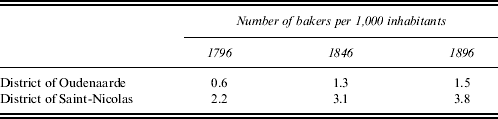
Rather than being bought by final consumers, the grain sold in the market of Saint-Nicolas was bought by intermediaries from both the town and its hinterland. The existence of an extensive, monetarised grain trade stimulated the development of this intermediary sector. Millers and bakers specialised in transporting and processing grain, and were the main visitors to the grain market in the town.Footnote 65 Increasingly, surplus-producing households sold their grain to them, either in the countryside or at the market, and households unable to produce all their needs themselves bought flour from the millers or bread from the bakers. As Table 4 shows, the number of bakers relative to the population in the rural areas of the Saint-Nicolas district was significantly larger than the equivalent figure for Oudenaarde throughout the nineteenth century. Although the number of bakers grew relative to the population in both regions, by the end of the nineteenth century, the figure for Oudenaarde was still far below that for Saint-Nicolas a century before.
The number of bakers per 1,000 inhabitants in the districts of Oudenaarde and Saint-Nicolas, 1796, 1846 and 1896a
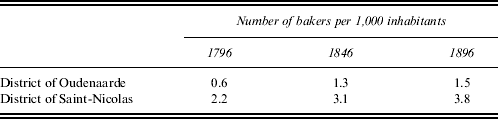
a The towns of Oudenaarde, Ronse, Saint-Nicolas and Lokeren are excluded.
Source: 1796: Lieve Jaspers and Carine Stevens, ‘Arbeid en tewerkstelling in Oost-Vlaanderen op het einde van het Ancien Regime. Een socio-professionele en demografische analyse’, Kultureel jaarboek voor de provincie Oost-Vlaanderen. Bijdragen 23 (1985), 106–7; 1846 and 1896: Industrie recencement général, 1846, 1896 (industry censuses of 1846 and 1896).
The result was that rural producers in the Saint-Nicolas region, whether landless labourers, smallholders or medium-sized farmers, were directly involved in the market. In contrast to Oudenaarde, in the Saint-Nicolas region market dependence was ‘unmediated’, that is, it was more direct and less dependent on credit between neighbours. Of the two regions, Saint-Nicolas was the more commercialised and more monetarised.
6. TWO PATHS OF RURAL DEVELOPMENT
The case of Oudenaarde confirms the explanation put forward by Thoen for the tardy industrial development of Flanders.Footnote 66 Oudenaarde missed most of the industrial revolution in the nineteenth century, as did many other Flemish towns.Footnote 67 According to Thoen, the Flemish ‘commercial survival economy’, the rural economy of inland Flanders where subsistence agriculture was combined with commercial activities, hindered industrialisation, mainly because it remained capable of absorbing the growing rural labour supply by employing labour on large farms and in cottage industries. He also argued that this economy functioned quite well until the middle of the nineteenth century, and as long as that was the case, there was little reason for rural dwellers to leave their villages to seek out urban employment. At the same time, he believes, rural demand was too limited to stimulate the production of industrial goods. However, in the Land of Waes the rural economy was profoundly different; rural society was unable to retain labour even when its supply was growing, and demand for consumer goods was more substantial. As a result, the Saint-Nicolas region, the Land of Waes, followed an entirely different path of rural development from that of the Oudenaarde region, as the rural society of the region contributed to its commercialisation, urbanisation and industrialisation as cash incomes created not only a market for grain, but for goods and services in general. A considerable part of the cash incomes of seasonal labourers, vlassers and others ended up in the pockets of the medium-sized farmers who sold grain. As a universal means of exchange, the cash that circulated in the Saint-Nicolas region gave access to a wider range of consumer goods and services than did the credit through which the rural economy of the Oudenaarde region operated.
The services sector in general was more developed in the rural areas of the Saint-Nicolas district than in similar areas of Oudenaarde. The greater number of bakers, relative to the population, was only one aspect of this. Data for 1796 show that about 37 individuals per 1000 inhabitants practised a service profession in the countryside near Saint-Nicolas, compared with only 23 in Oudenaarde.Footnote 68 As well as bakers, the relative number of tailors, shoemakers and innkeepers was higher in the Saint-Nicolas region. Members of the medical professions were also found there more frequently, and the number of butchers relative to the population considerably exceeded that of Oudenaarde, although this may have been due mainly to the high concentration of butchers in one village, Sinaai.Footnote 69 The relative number of millers, smiths and wagon makers was, however, only slightly higher in the Saint-Nicolas region.
Another consequence of the monetarised purchasing power of rural dwellers in the Land of Waes was that a market for consumer goods developed in the region. Discussion of measures against smuggling in the second half of the eighteenth century indicates that there must have been a substantial demand for consumer goods in rural areas of the Land of Waes.Footnote 70 Thuysbaert saw this as an indication of the prosperity of the region.Footnote 71 Consumer goods were sold in the urban market of Saint-Nicolas as well as in nearby rural markets. Around the middle of the nineteenth century, itinerant stallholders travelled each day from Saint-Nicolas to the nearby rural markets; 30 of them attended the market in Beveren every week, for example.Footnote 72 The importance of the trade in consumer goods to the town of Saint-Nicolas explains why, at the beginning of the nineteenth century, von Schwerz confused the weekly market of Saint-Nicolas with an important annual fair.
Furthermore, the fact that the Land of Waes was a more monetarised economy explains why there were relatively more rentiers in this region than in most other regions of Flanders. In 1796, the number of rentiers relative to the total population in rural areas of the Saint-Nicolas district was far greater than that in all other districts in the province, except for neighbouring Eeklo. That year, of all heads of households in the countryside near Saint-Nicolas, 2.7 per cent lived off interest, compared with only 0.1 per cent in the countryside in the district of Oudenaarde.Footnote 73 Thuysbaert confirmed that land in Saint-Nicolas was not only owned by large landowners or industrialists, but also by rentiers in the villages. The latter were often former farmers who had retired from the land, occupied a small house and were living off the rents from their lands.Footnote 74
Finally, the limited employment opportunities in the rural areas of most of the Land of Waes not only stimulated seasonal labour migration and the development of different rural industries, but also encouraged migration to the towns, contributing to the urbanisation of the region. Population numbers in the town of Saint-Nicolas grew from about 8,000 inhabitants in 1774 to more than 31,000 in 1900. In comparison, the number of inhabitants of the town of Oudenaarde only grew from approximately 4,000 in 1772 to about 6,200 in 1900.Footnote 75 In the town of Saint-Nicolas relatively rapid urbanisation went hand in hand with the development of modern industry; industrialisation started as early as the second half of the eighteenth century, and was consolidated in the nineteenth century. By the end of the nineteenth century, population density was also high in the rural areas to the south-east of the Land of Waes, along the Scheldt river, where rural industries other than flax preparation were prominent, and modern industries had also arisen.Footnote 76
7. CONCLUSIONS
Exchange was an important aspect of the rural economy in Flanders, as it was elsewhere in the nineteenth century. However, there were considerable regional differences with regards to the size and shape of exchange. In the Oudenaarde region as, presumably, in the rest of inland Flanders, a considerable part of rural production circulated within reciprocal exchange networks, which seldom extended beyond the village and its immediate surroundings. More impersonal, extra-local trade that would, more strictly speaking, be considered as commercialisation was clearly more important in the Land of Waes, which was an atypical case in Flanders. There, the possibilities for intra-local trade were much more limited, due to the specific size-structure of holdings, and this set in motion a series of processes, one of which was the commercialisation of foodstuffs, which gave the region an entirely different dynamic of development than the rest of inland Flanders.
The shape exchange took in any particular region was not the result of either opportunities or imperatives, but rather of the interaction between both. Participation in exchange was not limited to those groups for whom it was an imperative, such as landless labourers and smallholders, but also included those for whom participation was merely an opportunity – the farmers with medium-sized or large farms. However, the groups were not involved in exchange to the same degree. Medium-sized and large farmers did not need to participate in exchange but did so because they benefitted. The medium-sized farmers of the Saint-Nicolas region were self-sufficient, but still sold significant amounts of their output to increase their cash incomes. The large farmers in the Oudenaarde region used their hold on a substantial part of the land to gain access to cheap sources of labour and to increase their hold on rural society in general. However, both of these groups participated in exchange, in response to the involvement of those for whom participation was an imperative; they benefitted from the labour supply or cash incomes of landless labourers and smallholders. These latter groups were clearly more deeply involved in the labour market as well as in rural industries, because they had little other choice. However, in the Oudenaarde region their market dependence was less direct, being ‘mediated’ by the local large farmers, who to a certain extent also shielded them against market forces. Smallholders and landless labourers in the Saint-Nicolas region could not rely on large farmers, leaving their market dependence ‘unmediated’.
The idea that rural producers valued protection against market forces cannot be dismissed; although involved in the market they did not voluntarily plunge themselves into complete market dependence. This is evident not only from their participation in protective reciprocal relationships which mediated their market dependence in the Oudenaarde region, but also in their ‘differentiated propensity to sell’, visible in both regions, and similar to that found by Warde in Württemberg. First, there was a marked distinction between the treatment of foodstuffs and that of non-foodstuffs. In both regions, the output of rural industries, such as scutched and heckled flax in Saint-Nicolas, or cloth in Oudenaarde was, as in the case of tobacco in the study carried out by Grüne of the Baden Palatinate, of greater commercial importance than foodstuffs. Second, there was also a notable distinction among foodstuffs. Wheat, which was more highly valued, was more likely to be sold in both regions than were other grains destined for human consumption. This confirms the conclusion made by Warde that rural producers preferred to cover their subsistence needs first, and to sell those goods on which their subsistence depended less.Footnote 77
Finally, this study has highlighted the difficulty of categorising the rural economy as oriented either towards subsistence or towards the market. The latter is the case when households ‘separate production decisions from consumption decisions’.Footnote 78 However, in both regions, agriculture was mainly oriented towards primary food production; crops which could not be used for subsistence were only cultivated to a limited extent. By choosing to produce food, agricultural producers not only covered their subsistence needs directly, but they also made a rational commercial decision. While bread grains may not have been the most lucrative choice, they were potentially as much a commercial crop as flax, for example, and could either be sold in the market or exchanged within intra-local exchange networks. Households were not confronted with a choice between either commercial or subsistence production, but could pursue both simultaneously. Therefore, ‘ambiguous’ terms such as Thoen's ‘commercial survival economy’ or Grüne's ‘commercial subsistence farming’ reflect reality rather better than terms implying a sharp divide between ‘commerce’ and ‘subsistence’.Footnote 79 While the idea that rural producers preferred to cover their subsistence needs first should not be dismissed, the indication that most of them did so is neither evidence of an ‘anti-market mentality’ nor of the desire to ‘keep the market at arms length’, but rather of a preference for not having to take unnecessary risks.
ACKNOWLEDGEMENTS
The author would like to thank Eric Vanhaute for his support and encouragement, and the anonymous referees for their useful suggestions.