1. Introduction
In this article we analyse changes in possession marking in Tének (also Teenek, Huastec), a Mayan language spoken in Mexico, in the context of ongoing changes in culture patterns in Tének communities. In particular, we investigate the role of semantic, pragmatic and sociolinguistic factors: we show that possession marking in modern Tének is not only sensitive to semantic factors but also the socio-cultural background of Tének speakers, including such factors as age as well as the degree of social mobility and exposure to Spanish. In addition, we interpret these developments in terms of ongoing simplification in Tének morphology.
As is well-known, possession belongs to grammatical categories that are sensitive to social and cultural factors.Reference Bally 1 , Reference Seiler 2 This sensitivity is especially noticeable in situations involving linguistic, cultural and social change. An instructive example is provided by Mesoamerican languages, where the distinction between alienable and inalienable possession is an areal trait.3,4 Thus, traditionally in Tének only alienable possession is marked with the suffix -il, which is attached to the possessed noun, as opposed to unmarked inalienable possession. The analysis of our data from the variety spoken by young and socially-mobile Tének speakers shows that the distinction between alienable and inalienable possession marking is disappearing, with the marker of alienable possession being extended to contexts traditionally lacking overt possession marking. The changes in possession marking discussed here allow us therefore to observe the role of the social and demographic context, as the expression of possession can be attributed not only to language contact with Spanish but also to the loss of a culture-specific interpretation of this grammatical category among bilingual Tének speakers who are more exposed to Spanish and the mestizo culture. As a result, possession marking in modern Tének can be interpreted as a complex case of convergence, i.e. language change resulting from long-term influence in an area where languages of different groups or families are spoken. On the one hand, as mentioned above, it is a feature shared by other Mesoamerican languages; on the other hand, the changes in Tének are an example of a type of morphosyntactic change occurring in parallel in the indigenous languages as a result of Spanish influence.
This article is structured as follows. By way of an introduction, in Section 2 we give an overview of possessive marking in Tének and in Section 3 we discuss the methodology of the study. Then in Section 4 we analyse the role of semantic, pragmatic and sociolinguistic factors in the choice of alienable and inalienable possession in Tének. Finally, in Section 5 we interpret ongoing changes in possession marking in Tének in the context of earlier work on the semantics of possession and the role of social and demographic factors in the maintenance and loss of morphosyntactic complexity. Conclusions are given in Section 6.
2. Possessive Constructions in Tének
2.1. Tének: An Overview
Tének is the northernmost Maya language spoken in the Mexican states of San Luis Potosí and Veracruz. Due to migration, Tének is now also spoken in urban zones outside the traditional Tének region, such as in the city of Monterrey. There are a number of mutually intelligible varieties of Tének. The Ethnologue distinguishes San Luis Potosí Huastec (Potosino Huastec), Southeastern Huastec (Huasteco de San Francisco Chontla), Huasteco de Tantoyuca and Huasteco de Veracruz.Reference Lewis, Simons and Fennig 5 The total number of speakers above 3 years old is estimated at around 174,000. 6 Typologically, Tének is an SVO language with ergative/absolutive case alignment and relatively little affixation. It has an average vowel and consonant inventory. Tének is not a typical Maya language, which can be attributed to the fact that it has been located outside the Maya zone for a significant amount of time and therefore has been influenced by Mixe-Zoque, Totonac and Otomanguean languages, and also Nahuatl after the conquest of the Huasteca region by the Aztecs. At the same time, the majority of Tének speakers are bilingual in Spanish. Tének is one of the 68 languages recognized as a national language of Mexico. In a number of Tének communities both in San Luis Potosí and Veracruz, bilingual education in Spanish and Tének has been introduced in preschool and primary school education. Tének has a limited presence in the linguistic landscape of the Huasteca region with some information panels and shop names written in the language. Tének is still used as a preferred language of communication in some families although it is losing its ground due to an ongoing shift to Spanish, which is considered a more prestigious and useful language. The younger generation of the Tének people have become more socially mobile, with many people migrating outside the Tének zone to Monterrey, Mexico City and the United States. As a result, the domains of use of Tének have been restricted over the last two decades.
2.2. Possession in Tének
The semantics of possession in Tének reflects the categories distinguished in other Mesoamerican languages: among inalienable nouns we find body parts, kinship terms, environmental nouns such as ‘air’ and ‘water’ as well as terms denoting part–whole relations. A typical possessive construction consists of a ‘set A’ (ergative) pronoun, a possessed noun, together with the possessive suffix, as shown in (1):
-
(1) Possessive construction in Tének Reference Edmonson 7
set A (ergative) pronoun + (modifier) + possessed noun + (possessive suffix -il (-al)) (Ref. 8, p. 349)
The distinction between inalienably and alienably possessed nouns is illustrated in (2): while in (a) the alienably possessed noun pik’o ‘dog’ occurs with the possessive suffix -il, in (b) the inherently possessed noun u dham ‘my nose’ occurs without the suffix.
-
(2) Possessive construction in Tének (Ref. 8 , p. 349)

The expression of possession in Tének is subject to semantic, morphological and phonological criteria. Edmonson (Ref. 8, pp. 350–369) distinguished seven types of stem modification, on the basis of which she classified nouns in Tének into seven classes. These include:
-
(a) addition of the possessive suffix -il/-al, together with lengthening of the final vowel in bisyllabic stems, e.g. hom ‘incense’ versus Ɂu homil ‘my incense’, bakan ‘tortilla’ versus Ɂu baka:nil ‘my tortilla’; possessive constructions in this class involve temporary ownership;
-
(b) nouns in which the base form functions as the possessed form; such nouns are unpossessed with, for example, an absolutive suffix, as in Ɂu Ɂiȼik’ ‘my fingernail’ versus Ɂiȼik’lek ‘fingernail’; possessive constructions in this class indicate an inherent, inalienable or part–whole relationship involving, e.g. body parts, traditional items of clothing, kinship terms (excluding children), names and inherent qualities such as strength;
-
(c) lengthening of the final vowel of the base form, e.g. lek’ab ‘tongue’ versus Ɂu lek’a:b ‘my tongue’; such constructions involve similar relationships as in (b), with the exception of items of clothing and kin terms;
-
(d) addition of the suffix -li:l/-la:l, as in haɁ ‘water’ versus Ɂin haɁli:l Ɂan lana:š ‘lit. its water, the orange’ (i.e. its juice); these constructions involve a part–whole relationship;
-
(e) addition of the suffix /-V:l/, with the suffix vowel mirroring the final vowel of the base form, as in Ɂiȼ ‘chilli’ Ɂin Ɂiȼi:l ‘its (plant’s) chilli’; these constructions also involve a part–whole relationship;
-
(f) two nouns in Edmonson’s sample with identical possessed and unpossessed forms, e.g. ka:w ‘word’ versus Ɂu ka:w ‘my word’;
-
(g) nouns which are always possessed and never take absolutive and possessed suffixes, e.g. Ɂu k’ima:Ɂ ‘my home’.
A noun can be used in different types of possessive constructions, thus allowing speakers to focus on a different type of semantic relation. This is illustrated in (3), where the noun wiȼ ‘flower’ occurs in (b) in the relation of ownership and in (c) in a part–whole relationship.
-
(3) Re-categorization in possessive constructions (Ref. Reference Edmonson 7 , p. 365)

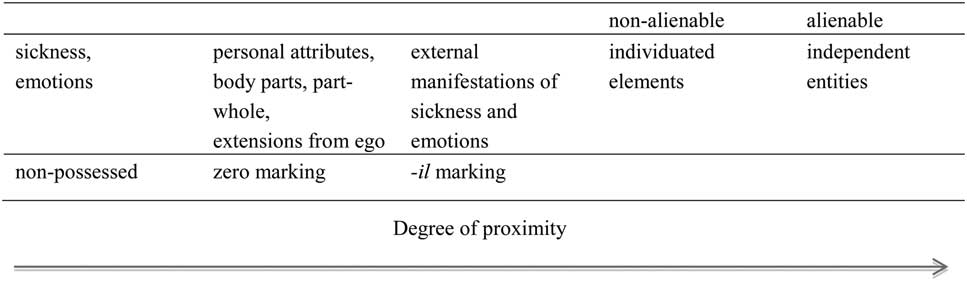
The semantics of possession in Tének has been reinterpreted by MaldonadoReference Maldonado 9 based on data from the Veracruz variety. In view of the lack of full consistency and predictability of possession marking if analysed exclusively in terms of the alienable versus inalienable distinction, Maldonado attributed the choice of possession marking to the degree of proximity between the possessor and possessum. The basic contrast occurs between intrinsic relationships (with zero marking) and extrinsic relationships (marked with a possessive suffix). As illustrated in Figure 1, the scale of proximity proposed by Maldonado ranges from unpossessed entities such as sickness that are too intrinsic to ego to be possessed, through personal attributes and body parts which are definable but dependent on the possessor, and which receive zero marking, through external manifestations of, for example, sickness, which occur with overt marking in consequence of greater dependency, and finally other individuated entities which also occur with overt marking unless overridden by a culturally-defined relationship.
Scale of proximity (Ref. 10, p. 21).

Maldonado’s interpretation thus points to the role of both individuation and culturally-defined conceptual proximity between the possessor and possessum in the choice of possession marking. The role of semantic, pragmatic and cultural factors will also be examined in this paper based on the analysis of selected semantic fields and types of semantic relations. The discussion in Section 4 will thus allow for such factors as age, gender, fluency in Tének, social mobility, exposure to Spanish and the mainstream culture as well as attitude to the heritage language. In addition, special attention will be paid to differences between possession marking in the speech of younger Tének speakers and the traditional patterns investigated by Edmonson 8 and Maldonado. 10
3. Methodology
3.1. Study
The data for this study were collected during fieldwork in Mexico in the summer of 2015 and through online correspondence with Tének native speakers. A questionnaire including 56 possessive phrases in Spanish was distributed (in person or online) among Tének speakers, who were asked to translate the phrases into Tének. 10 The phrases were based on examples given in Edmonson 8 and Maldonado 10 in order to compare traditional and modern patterns in possession marking. 11 The following semantic domains were represented in the questionnaire: kinship terms, body parts, part–whole relationships, extensions from ego, bodily manifestations, manifestations of sickness and emotions, independent entities, inherent cultural relationship items, Spanish loanwords and environmental nouns. Most possessive phrases were of the type ‘my …’ and the remaining few were of the type ‘his/her …’. In most cases some clarification or/and context were provided to avoid ambiguity. For example, the following context was provided for the phrase ‘my necklace’: ‘if you are a woman and this necklace is part of your daily costume, you wear it every day’. Apart from the elicitation of possessive phrases also grammatical judgement tests of invented phrases in Tének were applied in data collection.
3.2. Speakers
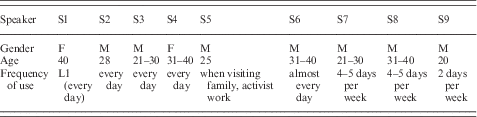
The total number of Tének speakers who participated in the study was nine (two females and seven males). The speakers were between 20 and 40 years old. Their mother tongue is Tének and they are all bilingual as a result of Spanish instruction at school. They are all speakers of the Potosino variety, thus originating or living in the municipalities of Tancanhuitz, San Antonio, Tampamolón, Aquismón, Xilitla and Ciudad Valles in the state of San Luis Potosí. All of the consultants but one female claimed they had lived outside the Tének area in order to work or study. They had the following occupations: students (2), local government employees (2), language activist (1), housewives (2), museum employee (1) and retailer (1). Most of the speakers spoke Tének almost on a daily basis. All but one female residing in a remote village had daily access to mobile phones and the Internet. The information about the speakers is summarized in Table 1.
Tének speakers participating in the study.

As regards individual speakers, Speaker 1 (S1) was the only consultant not to have moved outside her village; she used Tének as her preferred medium of daily communication. Speakers S2, S3 and S4 claimed that they used Tének every day but Spanish was their dominant language. Speaker 5 was studying at a university in a different state but he often used Tének as a language activist in revitalization projects. In contrast, the remaining speakers (S6, S7, S8, S9) said they did not speak Tének every day (4–5 times a week); these speakers displayed the highest degree of social mobility as well as the highest exposure to Spanish and the mainstream mestizo culture.
3.3. Data Analysis and Limitations
As noted in earlier discussions, investigating possession involves several methodological problems (Ref. Reference Campbell, Kaufman and Smith-Stark4, pp. 84–85; Ref. Reference de Vidas13, pp. 26–28).Reference Chappell and McGregor 12 In particular, these include the detailed knowledge of the cultural context that is required in the analysis of such a culturally-sensitive category. In the context of this study, such issues include also the role of another language, i.e. Spanish in data collection and dialectal differences. As mentioned above, the data were collected by means of elicitation and judgements of grammatical correctness. A potential drawback of elicitation concerns, however, the possible effect of Spanish as the language in which the questionnaire was provided: in contrast with data collected from natural speech, data collected in writing may have been influenced to a greater degree by Spanish as the speakers’ primary language of literacy. In addition, while this study aims at a comparison with the usage reported in Edmonson 8 and Maldonado, 10 differences between modern and traditional usage may be obscured by dialectal differences as well as the different status of the Potosino and the Veracruzano varieties. Thus, while Maldonado (Ref. 10, p. Reference Campbell, Kaufman and Smith-Stark4) stressed that possession marking in the two varieties ‘indicate[s] the same tendencies’, there is a considerable geographic distance (about 100 km) between the two Tének groups. Despite the fact that the two Tének-speaking regions are now connected by roads and there is a regular bus service facilitating contact, the interaction between the two varieties is limited because of the mountainous terrain and the resulting long travel time, and recently also the activity of the drug cartels operating in the region. In addition, the two varieties may be subject to contrasting sociolinguistic factors.Reference de Vidas 13 Whereas the Tének from the state of San Luis Potosí still preserve their culture and rituals in such traditional items of female clothing as petob or dhayem, the culture of the Tének from the state of Veracruz has been influenced to a greater degree by the Nahua and mestizo cultures. Therefore, in view of such issues as the use of Spanish in the questionnaire, the variation found in contemporary varieties as well as the small number of speakers consulted, this study should be complemented with a follow-up analysis in order to provide a more representative account of possession marking in Tének.
4. Semantics of Possession in Modern Tének
4.1. Introduction
In this section we will present the results of the study, focusing in turn on the expression of possession in modern Potosino Tének within the following semantic fields and relations: sickness and emotions, kinship terms, body parts and part–whole relations, degree of autonomy, extensions from ego, environmental nouns and the inner–outer contrast. Finally, we will comment on the variation in the presence of possessive marking on Spanish loanwords in Tének.
4.2. Sickness and Emotions
As indicated by Edmonson 8 and Maldonado, 10 the expression of possession in nouns denoting types of sickness and emotions is subject to variation, which is reflected in our data. For example, as shown in (4), the noun for ‘sadness’ is used in (a) without overt marking, while ‘happiness’ in (b) is used with overt marking:
-
(4) Emotions

Maldonado (Ref. 10, pp. 18–20) attributes the contrast to the different manifestation of the two emotions: while sadness is considered to be intrinsic to ego, the presence of overt marking in ‘my happiness’ is said to reflect the external physical manifestation associated with happiness.
4.3. Kinship Terms
Similarly to the traditional system, kinship terms in our data lack overt marking. The exceptions in both the traditional and modern varieties include the nouns u kwitól ‘my child’ and in kimaathil ‘his wife’. The two types of marking are illustrated in (5):
-
(5) Kinship terms

4.4. Body Parts and Part–Whole Relations
As in the case of kinship terms, nouns in part–whole relations involving both animates and inanimates as well as body parts occur without overt marking in both traditional and modern Tének. The three types of possessive constructions are illustrated in (6):
-
(6) Body parts and part-whole relations

While the native word ich’aamal ‘deer’ is used in (b), one speaker (S7) used the Spanish loanword venado, as in tulék venado (meat deer) ‘the deer’s meat’. The absence of the possessive suffix is in this case motivated not only semantically (the flesh of the deer is treated as an inherent part of the animal) but also by the fact that traditionally no overt marking is used in possessive phrases with Spanish loanwords (Ref. 8, p. 372). However, the examples given in the following sections indicate that possessive marking on Spanish loanwords is subject to variation; we return to this issue in Section 4.9.
4.5. Degree of Autonomy
As regards bodily manifestations such as saliva, spit, sweat and mucus, Maldonado (Ref. 8,: pp. 9–10) attributed the different patterns in possessive constructions to a different degree of individuation. For example, while sweat on the body of a person is considered intrinsic to ego and thus no overt possession marking is used, sweat dripping from one’s body is considered to be extrinsic to ego and so conceptually autonomous, thus requiring the possessive marker, as illustrated in (7) below.

In our study we found no evidence for the presence of overt possession marking in such ‘autonomous objects’. All speakers but one (S4) consistently treated the noun tsak’ib ‘sweat’ as inalienable, regardless of whether it referred to sweat on the body or dripping from it, thus using the form illustrated in example (7a) above.
4.6. Extensions from Ego
Culture-specific personal attributes such as clothing, ornaments and household items are traditionally considered inalienable in Tének culture. Such items can be considered as extensions from ego and as such treated as conceptually dependent (inalienable) in relation to the possessor. For example, the traditional female decorative poncho called dhayem (also sometimes referred to using the Nahuatl loanword quechquemitl) is considered dependent on its owner and thus overt marking is absent in possessive phrases, as in u dhayem ‘my quechquemitl’. A similar pattern can be observed in the case of other culturally-important items such as u ki’ma’ ‘my home’ and u ow ‘my necklace’. If possessive marking is used, there is a subtle distinction in meaning, as in u way-tal ‘my bed’ (the one I use every night) as opposed to u tsey-il ‘my sick bed’. Maldonado (Ref. 10, p. Reference Olko17) suggests in this context that whether an item is considered alienable or inalienable depends on the ‘cultural prototypic representation of the Huastec everyday life, endeavours and traditional activities’.
Our data from modern Tének shows a consistent lack of overt marking in u ki’ma’ ‘my home’ but variation in possession marking for other objects which could be considered extensions from ego and thus conceptually dependent on the possessor. These include the nouns for ‘necklace’ and ‘quechquemitl’, as shown in (8):
-
(8) Necklace and quechquemitl

In the case of the phrase ‘my necklace’ only one speaker (S6) marked possession with the suffix -il, while five speakers translated the phrase as u ow. (Two speakers could not provide the translation of the phrase into Tének at all.) Further inconsistencies were found in the translation of the phrase ‘my quechquemitl’ (or ‘my poncho’). Most of the speakers translated the phrase as u dhayemil, i.e. with the marker -il, so it could be argued that they do not consider this item of clothing as an intrinsic part of a Tének woman’s clothing. Interestingly, only three consultants (two females and the language activist) translated the phrase as u dhayem, with no overt marking. It can be suspected that only females translated the phrase according to the traditional pattern because it is only women who wear a quechquemitl. This case of variation in possessive marking can thus be attributed to ongoing cultural change in the perception of culturally significant items.
4.7. Non-possessed Nouns: Environmental Nouns
Environmental nouns such as ‘air’ and ‘water’ cannot appear in possessive constructions in many languages, including Mayan languages. However, such nouns can be possessed in certain contexts, as in the noun po ‘moon’ used with reference to the menstrual cycle in Q’eqchi’, a Mayan language spoken in Guatemala and Belize (Ref. Reference Trudgill15, p. Reference Trudgill15).Reference Kockelman 14 While in traditional Tének such nouns occurred without possessive marking, in modern Tének environmental nouns are frequently marked for possession, as illustrated in (9) below.
-
(9) Environmental nouns

This was also the case in the translations provided by the most fluent speakers (S1, S2 and S3); only one speaker (S8) translated the phrases ‘my air’ and ‘my world’ with no overt possession marking.
4.8. Inner–Outer Contrast
The distinction between alienably and inalienably possessed objects is also found in consumed objects such as food, chewing gum and cigarettes. According to Maldonado (Ref. 10, p. Reference de Vidas13), possession marking in the case of such objects is predictable: ‘the closer the relation between possessor and possessum, the stronger the possibility of having a zero marker, while the occurrence of -il will coincide with the degree of possessum/possessor individuation’. Thus, in (10) below the possessed noun ‘cigarette’ occurs in (a) with no overt marking in the sense of ‘my cigarette (that I’m smoking)’ since it is considered dependent on the possessor, whereas in (b) the noun occurs with the possessive suffix in the sense of ‘my cigarette (in my pocket)’ to indicate the independent, extrinsic nature of the object.
-
(10) Cigarettes in traditional Tének (Ref. 10 , p. Reference de Vidas 13 )

According to Maldonado (Ref. 10, p. Reference Kockelman14), an analogous contrast occurs in k’axik’ ‘chewing gum’, where gum which is being chewed is considered intrinsic to the possessor and thus unmarked for possession, while chewing gum that is not being consumed, e.g. that is kept in one’s pocket, occurs with the possessive marker.
Although such an inner–outer contrast is described by Maldonado (Ref. 10, p. Reference de Vidas13) as consistent, it is no longer found in modern Tének. As illustrated in (11) below in (a), the speakers, including the most fluent ones, used overt possessive marking regardless of whether the cigarette in question was being smoked or not. It is worth noting that the speaker who uses Tének the least frequently (S9) used a Spanish loanword in his translation (in (b)). It can thus be said that in both cases the speakers treat a cigarette as an independent object.
-
(11) Cigarettes in modern Tének


Likewise, all speakers but one used possessive marking in the phrase ‘my chewing gum’, regardless of whether the object in question was being consumed or not. All these speakers used in this context the Spanish loanword chicle ‘chewing gum’, as in u chiclej-il (A1 chewing.gum-poss) ‘my chewing gum (that I’m chewing or that I have in my pocket)’. It was only Speaker S3 who translated both phrases as u pem (A1 chewing.gum), using in this context the noun for a type of rubber tree.
4.9. Spanish Loanwords
Finally, the last type of lexical context analysed in our study involves Spanish loanwords. According to Edmonson (Ref. 8, p. 372), traditionally no explicit marking was applied in Tének in possessive phrases with Spanish loanwords, as in u ani:yo (A1 ring) ‘my ring’ (cf. Sp. anillo ‘ring’) and u pri:mo (A1 cousin) ‘my cousin’ (cf. Sp. primo ‘cousin’). As indicated by the examples given above (cf. cigarrillo ‘cigarette’, chicle ‘chewing gum’ mentioned in the previous section), our data show a considerable amount of variation in the marking of Spanish loans, with a tendency toward using the possessive suffix. In addition, Spanish loanwords marked with the possessive suffix, as in u anilloj-il (A1 ring-poss) ‘my ring’, were judged in grammaticality tests as correct by most consultants, including the most fluent speakers (S1 and S2). In contrast, since language activists and people involved in heritage language pedagogy tend to have a more puristic approach to grammar and vocabulary, it comes as no surprise that Speaker S5 (the language activist) translated the following phrases without possessive marking: u anillo (A1 ring) ‘my ring’, u primo (A1 cousin) ‘my cousin’. Finally, it should be noted that only one speaker (S3) translated the phrase ‘my cousin’ using the traditional Tének equivalent, as in u itsak’ (A1 cousin) ‘my cousin’, thus using the unmarked possessive form found in both traditional and modern Tének (cf. 4.3 above).
5. Discussion
In conclusion, the examples of possessive constructions discussed above indicate an ongoing change in the semantics of possession in Tének. Two main patterns can be identified in comparison with the traditional usage reported by Edmonson 8 and Maldonado. 10 On the one hand, there is no overt marking in both traditional and modern varieties in the case of kinship terms as well as body parts and part-whole relations. On the other hand, all the remaining lexical contexts show that the possessive marker is used in constructions traditionally requiring zero marking, either almost fully consistently, as in nouns for consumed objects (cf. §4.8) or with some variation involving certain lexical items, as in ‘extensions from ego’ (cf. §4.6). The only exception to these two general patterns involves nouns for bodily manifestations such as sweat, which in contrast to traditional usage do not occur in different possessive constructions depending on the degree of autonomy from ego (cf. §4.5).
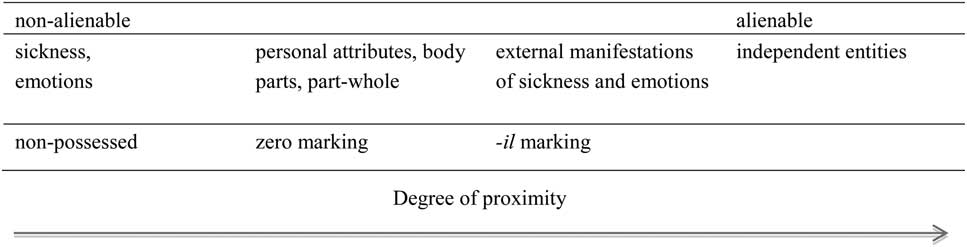
These changes suggest an ongoing re-analysis in the semantics of possession in Tének. In particular, the ‘scale of proximity’ proposed by Maldonado 10 (cf. Section 2.2 above) does not apply to modern Tének. In view of the variation summarized above, including the loss of contrasts involving ‘extensions from ego’ and the inner versus. outer contrast in consumed objects, a modified scale of proximity can be proposed, as shown in Figure 2.
Scale of proximity in modern Tének.

The differences in the expression of possession between traditional and modern Tének can also be interpreted in terms of simplification. According to Trudgill,Reference Trudgill 15 simplification involves the following changes in the morphosyntax: loss of irregularity, increase of transparency, loss of syntagmatic and paradigmatic redundancy as well as the loss of morphological categories. While the developments discussed here do not involve the loss of morphological expression but rather an extension of the possessive marker to new lexical contexts, they can be interpreted in terms of the loss of irregularity, with the absence of overt possessive marking being largely restricted to two semantic fields, i.e. kinship terms as well as body parts and part–whole relations. If the possessive suffix is further extended in Tének to these two semantic fields, this will result in the loss of the distinction between alienable and inalienable possession.
These changes in the morphosyntax of Tének can be further related to language contact with Spanish and the changing cultural and social patterns. The influence of Spanish on Mesoamerican languages is well-documented, as illustrated by, for example, Field’sReference Field 16 study of borrowing and typological change in Nahuatl under the influence of Spanish as well as Olko’sReference Olko 17 discussion of ongoing language shift in Nahuatl communities. In this case we are dealing with a re-analysis in the distribution of a native pattern which can be attributed to the lack of an analogous pattern in possession marking in Spanish.
A more subtle and satisfying explanation of the ongoing changes in Tének should however take into account the socio-cultural context, where morphological innovations in possession marking are attributed to contact with the mainstream mestizo culture and the resulting changes in the lifestyle of the Tének people. As a result of the migration to cities in search of work or study opportunities as well as the greater integration with the mainstream culture through compulsory education and easy access to mass media and mobile phones, the Tének people are now becoming a globalized and socially mobile society that is increasingly exposed to Spanish and the mestizo culture. Apart from the geographical disintegration of the Tének communities resulting from migrations, this ethnic and language group is also losing its cultural uniformity. The changes in culture manifest themselves in a range of innovations including for instance clothing, as in the use of Western clothes instead of traditional ponchos for women, and objects of everyday use, as in the use of cheap plastic instead of clay kitchenware. Whereas in the past a Tének person would have fewer personal items but a stronger, almost emotional attachment to them, now a younger Tének is more likely to possess more pieces of Western-style clothing and other personal items with which they have a more instrumental and less emotional relation.
The ongoing cultural, social and demographic changes affecting the Tének communities thus concern the key factors proposed by TrudgillReference Field 16 as pivotal in determining the emergence, maintenance and loss of morphosyntactic complexity. These include community size, type of social network (loose versus dense), degree of social stability, amount of shared information as well as the degree and type of contact with other communities. In view of the culturally-sensitive nature of possession, three factors are particularly relevant to the contact situation discussed here and its effect on the alienable versus inalienable distinction in Tének, i.e. the degree of social stability, the type of social network and the amount of shared information. Thus, the complex semantic and pragmatic factors underlying the choice of a possessive construction in traditional Tének, as described by Edmonson 8 and Maldonado, 10 can only be maintained in a society characterized by social stability, dense social networks and a large amount of shared information and social knowledge. Together with other ‘mature phenomena’, i.e. linguistic features that ‘presuppose a non-trivial prehistory’ (Ref. Reference Givón19, p. Reference Seiler2)Reference Dahl 18 such as evidentials and large pronominal systems, the alienability distinction is therefore typical of ‘societies of intimates’, which are described by GivónReference Givón 19 , Reference Givón 20 as societies characterized by stability, cultural uniformity and informational homogeneity. In contrast, such complex morphosyntactic phenomena are less likely to occur in ‘societies of strangers’, i.e. larger communities characterized by increasing mobility as well as language and dialect contact. In particular, the expression of inalienable possession is less likely to be maintained in a society characterized by a lower degree of social stability, increasingly loose social networks and a decreasing amount of shared information.
The grammatical expression of possession as a form of morphosyntactic complexity is thus sensitive to cultural and social factors at both individual and community level. This type of intimate relation that people have with personal objects was interpreted by BallyReference Seiler 2 in his seminal 1926 paper on the expression of inalienability in terms of the ‘personal domain’ (sphère personnelle). The personal domain includes elements that are regarded as integral parts of a person such as the body and its parts, the individual’s soul, voice and name as well as items with a habitual relationship to a person such as clothes, familiar objects, utensils, family and friends. Within his functional explanation of grammatical phenomena, Bally relates the personal domain to the social function of language and attributes the extent of its expression to social patterns. In particular, such social patterns include the density of communication as well as the number and complexity of social relations, which are at least partly analogous to two factors discussed by Trudgill, i.e. the amount of shared information and the density of social networks. The contrasts in the expression of the personal domain that are illustrated by Bally between informal, colloquial speech and rural varieties as opposed to formal, written language and urban varieties are thus comparable with the developments discussed above in the increasingly socially mobile Tének communities, since in both cases the scope of the personal domain is restricted as a result of changes in communicative channels and social contacts. As we have shown, kinship terms and part–whole relations as the most intrinsic type of inalienable possession are the least affected by socio-cultural change and language contact. In contrast, changes in possession marking are most visible in culturally sensitive parts of the system, including extensions from ego and the inner–outer contrast in consumable items. In such types of possessive constructions, translations conforming to the traditional system were more likely to be given by speakers who still lived in the Tének villages, and who were the least socially mobile and also less exposed to Spanish.
6. Conclusions
Our study shows considerable variation in possession marking in Tének and the lack of consistency with respect to the criteria proposed in earlier research. Objects considered dependent in relation to the possessor, and therefore lacking overt morphological marking in traditional Tének were by our consultants often overtly marked for possession. While traditional patterns of possession marking have been lost in the speech of the younger generation in the case of extensions from ego and individuated items, possession marking for body parts, kinship terms and part–whole relations conforms to the traditional system. These types of possession are universally inalienable in languages that distinguish between alienable and inalienable possession: they appear to be more basic, less culture specific, and, as a result, more resistant to change. Cultural manifestations and individuated items, on the other hand, are more culture specific and characteristic of a given language and community. At the same time, these categories are the most likely to be affected by cultural and social change as well as language contact, as illustrated in our case by the loss of traditional patterns of possession in Tének as a result of intensified exposure to Spanish and the mestizo culture among the young Tének speakers.
The complex nature of possession and the ongoing changes in its expression in ‘small’ indigenous languages point to a great need for further research on these topics. In the context of this study, several methodological issues have already been discussed in Section 3.3. In particular, the use of Spanish in the elicitation questionnaire may have influenced the conceptual categorization of nouns among Tének speakers, and, as a result, it may have affected the choice of possessive construction. At the same time, the tendency that can be observed in possession marking in modern Tének involves a more frequent use of the possessive suffix -il, which in terms of morphological expression is characteristic of Tének rather than Spanish. In Spanish a possessive construction comprises of a possessive pronoun and a noun with an optional plural suffix. Therefore, we are inclined to suspect that the use of Spanish as the contact language in the elicitation process may have had less influence than it would appear. All in all, we do acknowledge the need for a more extensive study of possession in Tének and other Mesoamerican languages that is based on natural spoken and written language and takes into consideration the changing external context in order to determine the role of cultural and social factors in the expression of grammatical phenomena.
Acknowledgements
The authors would like to express their gratitude to the consultants who helped with the data collection and analysis in this study, most of whom wanted to remain anonymous. A special thank you is directed to Luis Flores Martínez and Rubisel Santiago Rosa for their time and valuable comments on Tének grammar. We would also like to thank Danny Law, Magnus Pharao Hansen, Lucero Melendez, Anuschka van’t Hooft and Rita Eloranta as well as the three anonymous reviewers and the participants of the session on endangered languages at the 45th Poznań Linguistic Meeting for their helpful comments and suggestions.
Elwira Sobkowiak has an MA in Language Documentation and Description from the School of Oriental and African Studies (SOAS). Currently she is a PhD student at the Institute for Interdisciplinary Studies at the University of Warsaw, Poland (PhD thesis topic: Language contact in the Huasteca Potosina, Mexico). Her areas of study include language contact, linguistic typology, language revitalization and the Mesoamerican linguistic area.
Marcin Kilarski is an associate professor in the Faculty of English at Adam Mickiewicz University in Poznań, Poland. His main areas of research include linguistic typology, morphology, language contact and the history of linguistics, with a focus on North American Indian languages and the languages of South-East Asia. His publications include the monograph Nominal Classification: A History of its Study from the Classical Period to the Present (Amsterdam and Philadelphia: John Benjamins, 2013).