INTRODUCTION
Filter-feeding bivalves of the infauna and epifauna accomplish a relevant ecological role, influencing their surrounding environment by consuming suspended particulate matter (seston), as well as by biodeposition activity (Jørgensen, Reference Jørgensen1990). Bivalve gills are structures responsible to filter suspended particulates and to transport them towards the alimentary canals by the action of frontal cilia (Morton, Reference Morton, Saleuddin and Wilbur1983; Ward et al., Reference Ward, Beninger, MacDonald and Thompson1991; Ward & Shumway, Reference Ward and Shumway2004). In these organisms, pumping rate, as well as the capturing of suspended particulates, are a function of gill size, and, more specifically, of their filtering area (Hughes, Reference Hughes1969). The size of gills and labial palps has different functional roles in suspensivore and detritivore bivalves. A strong relationship between the size of gill/palps of suspensivore bivalves shows that water pumping plays a relevant role in food acquisition (Møhlenberg & Riisgard, Reference Møhlenberg and Riisgard1979; Meyhöfer, Reference Meyhöfer1985; Jones et al., Reference Jones, Richards and Southern1992). In the meantime, a weaker relationship between gill/palp size observed in facultative detritivores suggests a lower capacity of food acquisition by the gills and a role of the labial palps in the pre-ingestive particle selection (Theisen, Reference Theisen1977; Kiorboe & Møhlenberg, Reference Kiorboe and Møhlenberg1981). Therefore, as other authors have agreed (Pohlo, Reference Pohlo1967; Kuznetsov et al., Reference Kuznetsov, Kozak and Ishibashi1980; Drent et al., Reference Drent, Luttikhuizen and Piersma2004), the values associated with a strong or weak relationship of gill/palp size can be associated with the importance of the pumping capacity to use seston as a nutritional source; and also, to the necessity of sediment feeders or infaunal filter feeders to select particles before ingesting them, since they live in environments exposed to processes of resuspension of bottom particles. Compton et al. (Reference Compton, Kentie, Storey and Veltheim2008) suggest that the relative sizes of gill and labial palp of bivalves are indicators of the functional traits that can be used to compare feeding resources between species. During the last decade, new techniques have been developed to study feeding mechanisms in filter-feeding bivalves, complementing existing research on the feeding physiology of bivalves. Video endoscopy is one of these techniques, as it permits to observe directly bivalve anatomy without significantly altering behaviour, to localize structures, and to gather information about the course taken by food through feeding structures (Ward et al., Reference Ward, Beninger, MacDonald and Thompson1991). In vivo endoscopic examinations of bivalves have confirmed the mechanisms used to capture particles by these suspension feeders, which, in the case of particle transport through the ventral canal, occurs by mucus cords (Beninger et al., Reference Beninger, Ward, MacDonald and Thompson1992).
In the south of Chile, many filter-feeding bivalve species inhabit estuaries and tidal flats, where it is common to observe large fluctuations in concentration and quality of suspended particulate matter. Such variations are caused mostly by the combined action of tides and waves that resuspend bottom sediments (Winter et al., Reference Winter, Toro, Navarro, Valenzuela and Chaparro1984; Navarro et al., Reference Navarro, Clasing, Urrutia, Asencio, Stead and Herrera1993; Velasco & Navarro, Reference Velasco and Navarro2002). Several species of bivalves are often found in these environments, such as the clams Mulinia edulis (King, 1831) and Venus antiqua (King & Broderip, 1835), the stout Tagelus dombeii (Lamarck, 1818) and the mussel Mytilus chilensis (Hupé, 1854). Mulinia edulis is an infaunal bivalve that inhabits the low intertidal zone, an environment characterized by high mud contents and frequent resuspension events. Venus antiqua and Tagelus dombeii are also infaunal bivalves, and they inhabit the middle intertidal zone, characterized by the presence of more heterogeneous sediments, with sand, mud and gravel including bivalve shells (Clasing et al., Reference Clasing, Brey, Stead, Navarro and Asencio1994). As far as Mytilus chilensis is concerned, the species inhabits the upper-mid intertidal zone, an area exposed to lower seston fluctuations because sediments are significantly larger and, therefore, they have a lower probability of resuspension (Velasco & Navarro, Reference Velasco and Navarro2002). Mytilus chilensis is also present in the culture-rafts of Yaldad Bay, under permanent submersion and, given the area depth (approximately 20 m), a low resuspension regime of the substrate. The present study involves these four sympatric species of filter-feeding bivalves inhabiting different levels of the intertidal and subtidal (suspended culture) zone and relates their feeding activity with the morphometric characteristics of their gills and labial palps as well as characteristics of their habitat, sediment in particular.
MATERIALS AND METHODS
Animal sampling and habitat characterization
Specimens of four species of bivalve of broad size-range were collected from Yaldad Bay, south of Chile (43°08′S 73°44′W), an area characterized by tidal flats of approximately 1 km2 of low tide and a tidal range higher than 5 m (Clasing et al., Reference Clasing, Brey, Stead, Navarro and Asencio1994). This zone is characterized by heterogeneous sediments such as mud, sand, gravel and shell particles, where salinity varies between 24 and 31‰ and temperature between 9 and 16°C (Navarro et al., Reference Navarro, Clasing, Urrutia, Asencio, Stead and Herrera1993).
Acclimatization and specimen analysis
Collected specimens were kept in humid conditions while transported to the laboratory; they were separated according to their species, placed in different aquaria, and acclimated for one week before taking measurements. During this period, they were kept at a constant temperature of 12°C and 30‰ salinity. Food was administered continuously with a peristaltic pump and its concentration was kept similar to the experimental conditions. Water samples (five replicates) were taken in each sampling site for seston analysis and known volumes were filtered with previously treated Whatman GF/C glass-fibre filters of 47mm diameter. Filters with collected particulate matter were washed with an isotonic ammonium formiate solution to eliminate marine salts and, afterwards, dried at 80°C for 48 hours, weighed, and then burned at 450°C for three hours and weighed again. The above allowed determination of the organic and inorganic fractions of the seston. Sediment samples were taken from each site and characterized by their texture. Portions of gravel, sand, and mud were wet-sieved with 0.5 phi meshes. Organic matter of the sediment was calculated by weight difference after its combustion.
Gill area and labial palps weight
Twenty specimens of broad size-range (20–60 mm length) were selected from each species. Gill laminae and labial palps from the remaining soft tissues were dissected. Gill laminae were placed on slides and recorded using a Pixera camera mounted over a stereomicroscope. Gill area was measured on the recorded images using the computer program Scion Image using a graduated object as a reference. Due to the difficulty in relaxing the palps and estimate their area with precision, their dry weight was estimated. For the purpose, palps were placed in previously weighed aluminium capsules and dried for 48 hours at 80°C and weighed again.
Physiological measurements and endoscopy
Clearance rate was measured in 12 individuals from each species, including a broad size-range (20–60 mm length). A static system was used, implementing 12 experimental aquaria with water volumes between 600 and 2000 ml, depending on bivalve sizes. An empty aquarium was included as control, to discard possible cellular sedimentation. Homogenization of experimental medium was realized by air diffusers and the experimental specimens were left at rest for 1 hour before initiating measurements to allow them to open their valves and begin filtering. To start the clearance measurements, each aquarium was provided with a concentration of 20 × 106 cells/l of the microalgae Isochrysis galbana. This cellular concentration was checked with a particle size analyser Elzone 180XY equipped with a 120 µm diameter counting tube. The time interval between measurements was determined in function of the feeding activity of each species and the experiment lasted between 4 to 6 hours. Clearance rate was determined according to Coughlan (Reference Coughlan1969).
The endoscopic examination was realized with an Olympus OTV-S4 system, a rigid optic of 1.7 mm diameter and a xenon light source. This system was connected to a video camera, to a monitor, and to a video recorder to keep an account of movement and subsequently estimate the transport velocity of food particles. In order to do this, five animals (replicates) from each species (40–50 mm length) were exposed to a concentration of Isochrysis galbana of 20 × 106 cells/l and the distance travelled by the food particles within the gill ventral groove was quantified. During the endoscopic observations, the experimental individuals were fixed to plastic panels to keep them in a suitable position for the introduction of the endoscope at an angle of approximately 45°. In order to introduce the endoscope in the pallial cavity of Mulinia edulis, Venus antiqua and Mytilus chilensis, the valves were perforated on one side and the animals acclimated for 4 days to allow recovery. In the case of Tagelus dombeii, the valves did not require perforation because they do not close completely, leaving enough space to introduce the endoscope and go through the pallial cavity. Transport velocity was calculated following a food particle through the gill ventral groove and counting the filaments crossed by the particle in a set amount of time. Gill filaments and the space between them were measured with a graduated microscope eyepiece. This information allowed the estimation of the transport velocity by means of the relationship between time and distance travelled by the particles.
Standardization
To compare clearance rate, gill area, and labial palps weight for the different species, results were standardized to animals of 1.0 g dry tissue weight, using the formula of Bayne et al. (Reference Bayne, Hawkins and Navarro1987):

where Y: standardized value; WeightS: standard weight; Weightreal: real weight; b: regression exponent between physiological or anatomical measurements and weight of experimental animal; Yreal: value obtained in the experiments.
Statistical analysis
Homogeneity of variance was confirmed by means of Bartlett's test. Comparisons of the clearance rates and anatomical measurements (gill area and palps weight) between the different species were carried out with ANOVA, followed by a post-hoc Tukey test, with a significance level of P < 0.05 (Snedecor & Cochran, Reference Snedecor and Cochran1980). The relations between clearance rate and gill area and between palps weight and sediment mud, were carried out using a power regression analysis. The analyses were realized with the program Stadistica v 6.0.
RESULTS
Analysis of suspended particulate matter
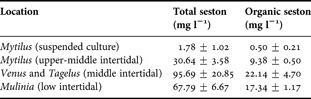
Analysis of variance showed significant differences (P < 0.05) between suspended particulate matter of the different environments inhabited by the bivalves studied (Table 1). The water column of Mytilus chilensis culture-rafts presented significantly lower levels (P < 0.05) of total and organic seston when compared to the zones inhabited by natural populations of Mytilus chilensis and the infaunal bivalves Venus antiqua, Tagelus dombeii and Mulinia edulis.
Suspended particulate matter (seston) at different locations inhabited by the species of bivalves.

Sediment analysis
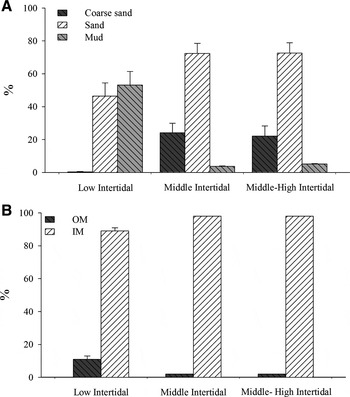
There were significant differences (P < 0.05) between sediment fractions at each sampling site. The low intertidal zone inhabited by Mulinia edulis, recorded mud values higher than 50%, the rest of the sediment corresponded to fine sand without gravel. In the case of Venus antiqua and Tagelus dombeii, which inhabit the middle intertidal zone, and of Mytilus chilensis, which inhabits the upper-middle intertidal zone, the sediment displays a high percentage of sand with values close to 70%, whereas gravel reaches values close to 20% and mud of 10% (Figure 1A). There are differences on the percentages of organic matter between the three sampling sites, where the low intertidal zone, inhabited by Mulinia edulis, results significantly higher (P < 0.05) compared to the other two zones of Yaldad bay tidal flats (Figure 1B).
Sediment analysis at each sampling site. (A) Sediment fractions; (B) organic and inorganic content. Values are means ± standard error.

Gill area and labial palps weight
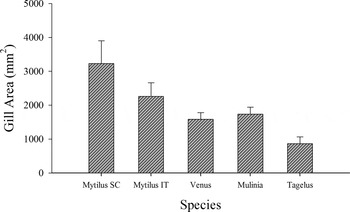
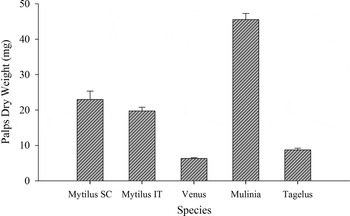
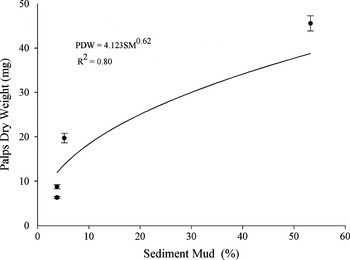
Gill area of standardized specimens (1.0 g dtw) of Mytilus chilensis originating both from cultures and natural banks was significantly higher than the other three infaunal species. Mulinia edulis and Venus antiqua did not show significant differences (P > 0.05) in gill areas, whereas Tagelus dombeii presented values significantly lower (P < 0.05) than the other species studied (Figure 2). Mulinia edulis showed the heaviest palps, with values significantly different from the other three species. On the other hand, Mytilus chilensis did not show significant differences between specimens originating from culture-rafts or natural mussel beds. Neither Venus antiqua nor Tagelus dombeii showed significant differences in the weight of their labial palps (Figure 3). There was a tight correlation between the weight of labial palps and mud content in the sediment; in fact, an increase in size of these organs was associated with an increase of mud content in the substrate inhabited by the species studied (Figure 4).
Gill area in bivalve species of standard size (1.0 g dtw). SC, suspended culture; IT, intertidal. Values are means ± standard error.

Palps dry weight in bivalve species of standard size (1.0 g dtw). SC, suspended culture; IT, intertidal. Values are means ± standard error.

Relationship between sediment mud content and palps dry weight in bivalve species of standard size (1.0 g dtw).

Clearance rate
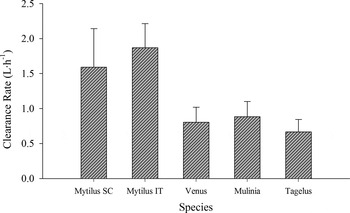
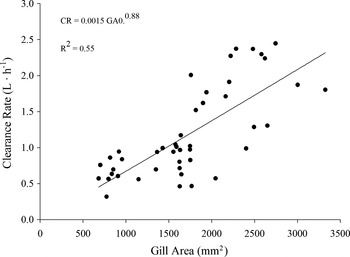
No significant differences were found (P > 0.05) when comparing clearance rate between individuals of Mytilus chilensis originating from culture rafts (subtidal) to those from the natural banks (intertidal). Also, no significant differences (P > 0.05) were observed between clearance rate of the infaunal species Mulinia edulis, Venus antiqua and Tagelus dombeii (Figure 5). Nevertheless, there are significant differences (P < 0.05) when comparing clearance rates of Mytilus from culture-rafts and the upper-mid intertidal zone to those of the infaunal bivalves. These results suggest a significant relationship between clearance rate and gill area for the different species studied (Figure 6). The highest clearance rate was recorded in Mytilus chilensis from natural banks, which reached 1.87 ± 0.34 l h−1 for specimens of standard size (1.0 g dry tissue weight). The lowest clearance rate was recorded in Tagelus dombeii, with 0.67 ± 0.18 l h−1 in specimens of standard size.
Clearance rate in bivalve species of standard size (1.0 g dtw). SC, suspended culture; IT, intertidal. Values are means ± standard error.

Relationship between clearance rate and gill area in bivalve species of standard size (1.0 g dtw).

Particle transport velocity
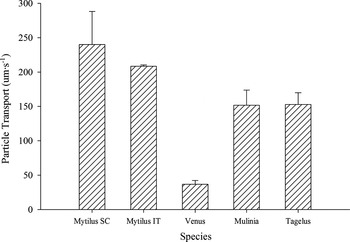
It was determined by endoscopy that specimens of cultured and intertidal Mytilus chilensis showed significantly higher values in particle transport velocity when compared to the infaunal species. The clam Venus antiqua resulted to be the species with the lowest value (Figure 7). None of the species studied displayed particle transport in the dorsal groove.
Transport particle velocity in bivalve species of standard size (1.0 g dtw). SC, suspended culture; IT, intertidal. Values are means ± standard error.

DISCUSSION
A tight relationship was found between filtering capacity and gill area; the same is true for labial palps weight with percentage of mud contained in the sediment inhabited by the different bivalves species studied. According to Meyhöfer (Reference Meyhöfer1985) and Jones et al. (Reference Jones, Richards and Southern1992), feeding capacity in filter-feeding bivalves is strictly related to the gill system size. Concurring with the authors mentioned above, the epibenthic species Mytilus chilensis displayed high clearance rates, as well as particle transport velocity, which would be related to the larger gill size of this species compared to those belonging to the infauna. Similar results were described by Bacon et al. (Reference Bacon, MacDonald and Ward1998), which compared the epifaunal bivalve Placopecten magellanicus with the infaunal species Mya arenaria and obtained significantly higher values for the clearance rate of P. magellanicus. Kiorboe & Møhlenberg (Reference Kiorboe and Møhlenberg1981) demonstrated that infaunal species are characterized by smaller gill size and more developed labial palps, which would make them more efficient in selecting particles in environments characterized by resuspension events. According to the above, larger labial palps of Mulinia edulis may be related to the surrounding environment, which is characterized by abundant fine sand and a high percentage of mud with high resuspension capacity. Thus, Mulinia's palps should be capable of processing large quantities of suspended particulate matter, with the dual purpose of either gathering it towards the mouth or to clean the gills, eliminating particle excess by means of pseudofaeces. Venus antiqua and Tagelus dombeii display smaller palps; this relates to their surrounding environment, characterized by sediments difficult to resuspend such as large quantities of gravel and coarse sand. Mytilus chilensis from culture-rafts is not exposed to resuspension of particulate matter and the food it receives is mostly made up of microalgae, and, since particles concentration does not exceed the threshold of pseudofaeces production, this food is probably entirely ingested. The present study confirms the hypothesis proposed by Drent et al. (Reference Drent, Luttikhuizen and Piersma2004) and Compton et al. (Reference Compton, Kentie, Storey and Veltheim2008), according to which gill and labial palp size could represent functional traits that can be used to compare the use of food resources between sympatric species of suspensivore bivalves of the infauna and epifauna. By means of video endoscopy, it was observed that particle transport could be demonstrated only in the gill ventral groove, and cords containing particles embedded in mucus were identified. Such a way of transport seems to be common in species with homorhabdic gills (e.g. Mytilus edulis, Beninger et al., Reference Beninger, St-Jean, Poussart and Ward1993; Mya arenaria and Mytilus edulis, Ward et al., Reference Ward, Beninger, MacDonald and Thompson1991, Mytilus edulis and Mytilus trossulus, Ward et al., Reference Ward, Levinton and Shumway2003). The endoscopic analysis demonstrated a lower particle transport velocity in the infaunal species and significant higher values in the epifaunal bivalve Mytilus chilensis. The above could possibly be explained by the higher filtration activity of Mytilus given its larger gill area and the necessity to process more food per unit time. The particle transport velocities measured in this study for the infaunal species and for the epibenthic Mytilus chilensis are lower than those described by Ward et al. (Reference Ward, Beninger, MacDonald and Thompson1991). Nevertheless, both studies agree that transport velocity is higher in epibenthic species; which is coupled with the higher filtering capacity needed by Mytilus chilensis to live in an environment with reduced seston load, which, in turn, determines smaller labial palps because the species does not need to process high quantities of particulate matter (i.e. pseudofaeces production, particles selection). It is possible to conclude that filtering capacity in bivalves is determined mostly by gill size and, also, that labial palp size shows a high relationship with the amount of mud contained in the sediment present in environments occupied by these species.
ACKNOWLEDGEMENTS
We wish to thank to G. Urrutia and V. Garrido for technical assistance during the experiments. This work was financially supported by the National research grant FONDECYT 1000427 (to J.M.N.).