Introduction
Whether and how much commercial fishing should be undertaken in the Southern Ocean around Antarctica has been a source of international debate. In contrast to many of the world's fisheries, commercial exploitation in the Southern Ocean is more tightly regulated, with catch levels and overall management overseen by the international Commission for the Conservation of Antarctic Marine Living Resources (CCAMLR). Despite appreciable oversight, concerns exist about the paucity of knowledge on the natural histories of fished species, making it challenging to abide by Article II of the CCAMLR, which requires the protection of related and dependent species through ‘rational use’ of a given fishery resource (summarized in Brooks et al. Reference Brooks, Ainley, Abrams, Dayton, Hofman, Jacquet and Siniff2018).
In the Ross Sea, one of Earth's least disturbed marine ecosystems (Halpern et al. Reference Halpern, Walbridge, Selkoe, Kappel, Micheli and D'Agrosa2008), commercial fishing for the Antarctic toothfish Dissostichus mawsoni Norman began in the 1996–97 summer. Based on somewhat speculative stock assessments, the management objective allows the Ross Sea stock's spawning biomass to be reduced to 50% of the pre-fishing level over a 35 year time horizon. Although the original stock size assessment in the Ross Sea region has a high level of uncertainty (summarized in Abrams et al. Reference Abrams, Ainley, Blight, Dayton, Eastman and Jacquet2016), Parker et al. (Reference Parker, Mormede, Devries, Hanchet and Eisert2016) estimated that, by 2014, the decrease was halfway to the management objective (i.e. at 75% original spawning biomass ~20 years after initiation of the fishery). The fishery targets areas where the largest fish occur because it is a highly competitive fishery with intense pressure for each vessel to attain full loads before sea ice drives them away, with the ice-free season being only a few months. Whether a reduction of toothfish biomass in the Ross Sea region could precipitate larger, unforeseen consequences in the ecosystem depends on the role that toothfish play as both predator and prey in the marine food web. To reduce the likelihood of deleterious effects, CCAMLR's ecosystem-based approach is supposed to take into account the role of the target species in the ecosystem and to set catch limits based on the species’ relative importance (Constable et al. Reference Constable, de la Mare, Agnew, Everson and Miller2000). Species that are believed to play a critical role in the ecosystem are managed more conservatively than species upon which higher trophic levels are not known to depend. Whereas Antarctic krill Euphausia superba Dana may only be depleted to 75% of the pre-fishery spawning biomass, because many species demonstrably subsist on it, the CCAMLR decision rule for toothfish is much less conservative, based on the supposition, summarized by Constable et al. (Reference Constable, de la Mare, Agnew, Everson and Miller2000, p. 785), that:
Toothfish, as a large predator, is unlikely to constitute much of the diet of seals and birds (SC-CAMLR, 1997). Therefore, the species is considered in a single-species context and the second criterion [spawning biomass reduction] is applied at the 50% level rather than at the 75% level …
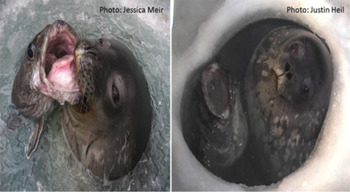
Here, we present information that questions the justification for CCAMLR's decision rule with respect to levels of take of Antarctic toothfish in the Ross Sea, relative to its ecological importance. Our evidence, in addition to that offered in other studies (e.g. Testa et al. Reference Testa, Siniff, Ross, Winter, Seigfried, Condy and Laws1985, Salas et al. Reference Salas, Nur, Ainley, Burns, Rotella and Ballard2017, Lauriano et al. Reference Lauriano, Pirotta, Joyce, Pitman, Borrell and Panigada2020), confirms that toothfish are being preyed upon by Weddell seals Leptonychotes weddellii Lesson and other predators in appreciable numbers, contrary to CCAMLR's supposition. Our finding indicates that toothfish may indeed be ecologically important prey, especially for the Weddell seal, an iconic, endemic and key component of the high-latitude Southern Ocean (Fig. 1) (Laws Reference Laws and Llano1977). Although we do not currently have data to directly estimate the impact of reduced toothfish abundance on seal population size, such an effect would be predicted by the food web models that have been used to estimate ecosystem-level effects in the Antarctic (e.g. Pinkerton & Bradford-Grieve Reference Pinkerton and Bradford-Grieve2014).
Weddell seals with large Antarctic toothfish in McMurdo Sound. Only the trunk musculature is consumed. Photographs courtesy of Jessica Meir 2008 and Justin Heil 2009.

Antarctic toothfish
The Antarctic toothfish is the largest member of the largely endemic Antarctic fish suborder Notothenioidei, reaching 210 cm total length (TL), 120 kg weight, achieving maturity at 17 years and living to > 39 years of age (Hanchet et al. Reference Hanchet, Dunn, Parker, Horn, Stevens and Mormede2015). The species’ natural history and ecology were known in general terms before commercial extraction began (e.g. Kock Reference Kock1992, Eastman Reference Eastman1993). Additional details have been provided by subsequent work (summarized in Hanchet et al. Reference Hanchet, Dunn, Parker, Horn, Stevens and Mormede2015, Ashford et al. Reference Ashford, Dinniman and Brooks2017), but major gaps remain. Antarctic toothfish principally occur south of the Southern Boundary of the Antarctic Circumpolar Current, apparently inhabiting nearly all continental shelf and slope waters around the Antarctic continent, where they occur both in the water column and in demersal habitats. As large predators and opportunistic scavengers, they consume a wide variety of smaller fishes and invertebrates. Lacking a swim bladder, juveniles and smaller sub-adults are negatively buoyant and apparently occur primarily near or on the substrate. By ~100 cm TL, the accumulation of lipids in muscle and subcutaneous tissue facilitates neutral buoyancy, allowing the fish to move higher in the water column, where they exploit pelagic prey such as the Antarctic silverfish Pleuragramma antarcticum Boulenger (Near et al. Reference Near, Russo, Jones and deVries2003). As discerned from the benthic long-line fishery in the Ross Sea, concentrations of the oldest, largest toothfish are found in the deeper troughs and over the continental slope, with smaller fish (i.e. the juveniles, sub-adults and pre-spawning adults) more abundant on the banks of the continental shelf. The species spawns in association with the sea mounts north of the Ross Sea; tagging has revealed movements, including some fish tagged in south-east McMurdo Sound, which have resulted in recapture in the northern Ross Sea region (Ainley et al. Reference Ainley, Nur, Eastman, Ballard, Parkinson, Evans and Devries2013, Hanchet et al. Reference Hanchet, Dunn, Parker, Horn, Stevens and Mormede2015; see below).
Although an appreciable amount is known about spatial variation in abundance among juvenile, sub-adult and adult toothfish in the Ross Sea (Hanchet et al. Reference Hanchet, Dunn, Parker, Horn, Stevens and Mormede2015, Ashford et al. Reference Ashford, Dinniman and Brooks2017), virtually nothing is known about temporal variation in the species’ prevalence among any size/age class at any one location. Only one long-term time series exists, with catch per unit effort (CPUE) determined over 39 years in south-eastern McMurdo Sound, Ross Sea (by DeVries in Ainley et al. Reference Ainley, Nur, Eastman, Ballard, Parkinson, Evans and Devries2013). In that study, by using fishing with baited hooks spaced along a vertical set line under extensive shore-fast sea ice at about the same location in spring each year, over bottom depths < 500 m (range 414–495 m; Fig. 2), it was determined that sizes of fish (sub-adults and adults) and CPUE remained relatively steady from 1972 until 1997 (or at least did not trend downwards). After that period, both sub-adults and adults exhibited a steep decrease, continuing to the end of the annual scientific fishing effort in 2011 (see fig. 8 in Ainley et al. Reference Ainley, Nur, Eastman, Ballard, Parkinson, Evans and Devries2013). That study's authors hypothesized that the apparent decrease in toothfish prevalence in southern McMurdo Sound, at the southern periphery of the species’ range, was due to increasing effects of the toothfish fishery in the northern Ross Sea after its initiation in 1996–97. Until 2009, the commercial fishery operated close to McMurdo Sound. Subsequent collections within the vicinity of the historic McMurdo Sound scientific fishing locality by other researchers revealed a continuation of the trend of low catch rate at least into 2017 (Parker et al. Reference Parker, Mormede, Devries, Hanchet and Eisert2016; Cziko, Cheng & DeVries, unpublished data 2012–18; see below).
South-eastern McMurdo Sound, showing southern boundary of Erebus Bay, DeVries/Cheng/Cziko fishing sites (1972–2018) in the vicinity of the 400–500 m isobaths and fishing sites of Parker et al. (Reference Parker, Mormede, Devries, Hanchet and Eisert2016) from 2014. Also shown is the average catch per fishing session during 1982 of Testa et al. (Reference Testa, Siniff, Ross, Winter, Seigfried, Condy and Laws1985) in a grid of fishing sites that were of increasing distance from Erebus Bay where Weddell seals are highly concentrated during the scientific fishing season (October to November). Up to a few dozen seals also typically occur off the southern end of Hut Point Peninsula, between Scott Base and McMurdo Station (see Fig. 3).

Similarly, little is known about toothfish behaviour or spatiotemporal variability in toothfish abundance over the Ross Sea shelf; the limited knowledge on both stems from incidental observations from the commercial fishery, the long-term study in McMurdo Sound by DeVries (see above) and in situ observation by seal-mounted cameras and drop/towed benthic cameras (summarized in Ainley et al. Reference Ainley, Nur, Eastman, Ballard, Parkinson, Evans and Devries2013, Hanchet et al. Reference Hanchet, Dunn, Parker, Horn, Stevens and Mormede2015). These observations revealed that although toothfish occur regularly on or near the sea floor, larger, neutrally buoyant fish also occur throughout the water column, perhaps especially under heavy ice cover. For example, the McMurdo Sound time series effort targeted primarily fish within ~100 m of the bottom, as indicated by the regularity at which they were caught there, but toothfish were also caught near the surface. The shallower occurrence of large toothfish was further confirmed by video cameras placed on Weddell seals (Fuiman et al. Reference Fuiman, Davis and Williams2002, Davis et al. Reference Davis, Fuiman, Madden and Williams2013), in which seals encountered toothfish, under the ice, just 12 m from the surface. Both the toothfish and their main prey in the water column, the lipid-rich and neutrally buoyant Antarctic silverfish (Eastman Reference Eastman1985), appear to occur higher in the water column when the light level is lowest (Fuiman et al. Reference Fuiman, Davis and Williams2002). On the basis of micronekton net surveys along the Antarctic Peninsula, Robison (Reference Robison2003) concluded that silverfish employed such diel vertical migration to reduce the risk of predation by visual predators, such as seals and birds. Unfortunately, little is known about the spatial abundance of sub-adult and adult silverfish in the Ross Sea, although a good deal is known about smaller/younger classes (e.g. Vacchi et al. Reference Vacchi, Pisano and Ghigliotti2017).
Weddell seals
The Weddell seal is a large and relatively abundant true seal with a circumpolar Antarctic distribution (Laws Reference Laws and Llano1977, Siniff et al. Reference Siniff, Garrott, Rotella, Fraser and Ainley2008). They are frequently observed, as they favour shore-fast ice near many research bases, where they find and maintain access holes and give birth to young on the ice, and they were taken as food by several historic expeditions (LaRue et al. Reference LaRue, Salas, Nur, Ainley, Stammerjohn and Barrington2019, O'Connor Reference O'Connor2019). The species is known to prey on a diverse range of fishes and invertebrates, including toothfish (Burns et al. Reference Burns, Trumble, Castellini and Testa1998, Ainley & Siniff Reference Ainley and Siniff2009, Goetz et al. Reference Goetz, Burns, Hückstӓdt, Shero and Costa2016).
In contrast to the paucity of information on Antarctic toothfish, the Weddell seal is one of the better-known pinnipeds (and Antarctic vertebrates in general) owing to > 50 years of research on its behaviour, physiology, demography and ecology, primarily undertaken in southern McMurdo Sound (e.g. Stirling Reference Stirling1969a, Cameron & Siniff Reference Cameron and Siniff2004, Proffitt et al. Reference Proffitt, Garrott, Rotella, Siniff and Testa2007, Rotella et al. Reference Rotella, Paterson and Garrott2016). Erebus Bay, in south-eastern McMurdo Sound, is one of the species’ most populous breeding haul-outs anywhere in Antarctica (LaRue et al. Reference LaRue, Salas, Nur, Ainley, Stammerjohn and Barrington2019). There, the number of pups produced annually has been up to 760, all of which have been tagged for the past 40 years (Ainley et al. Reference Ainley, LaRue, Stirling, Stammerjohn and Siniff2015). In the spring (late September into October), female Weddell seals haul out to pup near breathing holes, self-maintained by abrading the land-fast sea ice at persistent, predictable cracks; their procumbent canine and lateral incisors have evolved to facilitate the maintenance of such holes, particularly in seasonally isolated locations such as Erebus Bay (Figs 2 & 3) (Stirling Reference Stirling1969b). Pups grow quickly, and most are weaned in December. Following weaning, adults and juveniles disperse more widely throughout McMurdo Sound and its vicinity (e.g. Testa Reference Testa1994, Goetz Reference Goetz2015), with the breeders having to undergo a period of hyperphagia to recover the 40% of mass lost during breeding (discussed in Salas et al. Reference Salas, Nur, Ainley, Burns, Rotella and Ballard2017). During winter, at least during the 1960s, 200–300 seals remain in McMurdo Sound, compared to > 2500 during those years in spring (Smith Reference Smith1965).
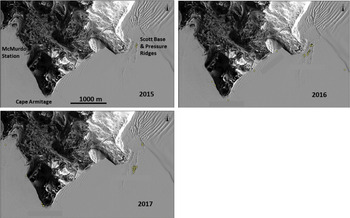
Distribution of seals around Cape Armitage, the southern tip of Hut Point Peninsula, in south-eastern McMurdo Sound. Haul-out sites to the west and south of Observation Hill are closest to the scientific fishing areas (< 3 km). Dots indicate seals detected within 1 week of 1 December during 2015–17. We present the data on the same base image in each panel (24 November 2017) to emphasize the consistency in the seal locations. In these 3 years, 5, 23 and 28 seals were counted, respectively (vs typically 31–32 seals in the mid-1960s; I. Stirling, unpublished data 1966–68).

Though Weddell seals have occurred in large numbers in McMurdo Sound for as long as humans have monitored them (Smith Reference Smith1965, Stirling Reference Stirling1969a, Reference Stirling1971), the number of seals has fluctuated over time (Chambert et al. Reference Chambert, Rotella and Garrott2012, Ainley et al. Reference Ainley, LaRue, Stirling, Stammerjohn and Siniff2015). Variation in seal numbers is probably due in part to inter-annual and longer-term variation in local and regional environmental conditions (Siniff et al. Reference Siniff, Garrott, Rotella, Fraser and Ainley2008), which could affect the proportion of seals pupping, breeding success rates and recruitment into the population (Proffitt et al. Reference Proffitt, Garrott, Rotella, Siniff and Testa2007, Rotella et al. Reference Rotella, Paterson and Garrott2016). However, superimposed on this natural variation in the seal population has been the toll from the human take of Weddell seals (over 2000), used as food for sled dogs at a local research station. The human-caused reduction in the seal population occurred over several decades, from 1966 to 1984 (Stirling Reference Stirling1971, Ainley et al. Reference Ainley, LaRue, Stirling, Stammerjohn and Siniff2015) and, according to Testa & Siniff (Reference Testa and Siniff1987), led to an initial increase in the production of pups. Numbers then stabilized at a lower level, but by the late 1990s, a dramatic increase in Weddell seal numbers was well underway (Fig. 4) (Ainley et al. Reference Ainley, LaRue, Stirling, Stammerjohn and Siniff2015).
Weddell seal abundance in south-eastern McMurdo Sound, 1963–2018. Seal abundance index (vertical bars) is defined as the number of adult females as indicated by pups born in Erebus Bay scaled to the highest year (1966, 760 pups); seal numbers are not shown in later years if no toothfish catch per unit effort data were available; El Niño years are shown in colour. El Nino event strength classification is from https://ggweather.com/enso/oni.htm, based on data from the National Oceanic and Atmospheric Administration climate prediction centre. The iceberg B15 event (heavy ice cover in McMurdo Sound) is also shown (see Siniff et al. Reference Siniff, Garrott, Rotella, Fraser and Ainley2008).

The relationship between Antarctic toothfish and Weddell seals
The relationship between Antarctic toothfish and the Weddell seal is complex. Both are large mesopredators that compete for the same fish prey, principally Antarctic silverfish, when both predators are high in the water column (cf. Eastman Reference Eastman1985, Ainley & Siniff Reference Ainley and Siniff2009, Salas et al. Reference Salas, Nur, Ainley, Burns, Rotella and Ballard2017). Silverfish, like toothfish, are one of the few notothenioids that occur in the water column (Eastman Reference Eastman1993). On the other hand, as indicated by repeated observations, the seals also prey on toothfish, with apparently no limit to the size/age class of toothfish that the seal consumes, other than the exclusion of eggs, larvae and juveniles, which occur far off the shelf in the Ross Gyre, where Weddell seals are absent (cf. Goetz Reference Goetz2015, Hanchet et al. Reference Hanchet, Dunn, Parker, Horn, Stevens and Mormede2015). Indeed, seals take even very large toothfish, perhaps more than half the length of the predatory seal (Fig. 1). Their relationship as interspecific competitor and prey-predator is termed ‘intraguild predation’ (Polis et al. Reference Polis, Myers and Holt1989), a food web module that has received considerable attention and for which changes in the abundance of any of the players can lead to non-linear consequences (Fig. 5) (Holt & Polis Reference Holt and Polis1997, Abrams & Fung Reference Abrams and Fung2010). While toothfish can be critically important to the seals in terms of energy provided (Salas et al. Reference Salas, Nur, Ainley, Burns, Rotella and Ballard2017), toothfish being removal by seals potentially increases Antarctic silverfish prevalence, providing an offsetting positive effect (see below). Commercial fishing for toothfish decreases the supply of one of the seals’ primary foods, especially as the largest fish are targeted by the fishery (see above; Salas et al. Reference Salas, Nur, Ainley, Burns, Rotella and Ballard2017). However, in the longer term, the fishery may increase or decrease the seal population, depending on the population response of silverfish and the ability of silverfish to substitute for toothfish in the seals’ diet. Concurrently, the dynamics of the seal population may produce unexpected changes in the toothfish population. The theoretical work on intraguild predation referenced above suggests that currently unknown details of the ecology of toothfish, seals and silverfish are required to predict the direction of response of any of the species to continued commercial exploitation of toothfish. Further extending this intraguild food web scenario, killer whales Orcinus orca L. prey on both the toothfish and the seal, as well as perhaps the silverfish (Fig. 5) (reviewed in Pitman et al. Reference Pitman, Fearnbach and Durban2018, and also Lauriano et al. Reference Lauriano, Pirotta, Joyce, Pitman, Borrell and Panigada2020).
Trophic interactions involving silverfish among the guilds (black lines) of large vertebrate predators in the south-western Ross Sea, highlighting the importance of two lipid-rich notothenioid fish, especially Antarctic toothfish, a member of the guild. Blue dots at the origins of the arrows indicate prey species that are competed for and consumed by the species at the arrowheads. The thicker black line denotes the asymmetrical intraguild predation (Polis et al. Reference Polis, Myers and Holt1989) between Weddell seals and toothfish, meaning that the non-reciprocal predation favours the seals as toothfish and their predation are reduced. Maximum lengths of species are also provided.

There has, however, been limited quantification of the importance of toothfish and silverfish in the diet and population dynamics of the seals. To regain condition following breeding, Weddell seals prey on both silverfish and toothfish because of their high energy density, especially so for toothfish (Salas et al. Reference Salas, Nur, Ainley, Burns, Rotella and Ballard2017). While ample evidence exists for the extent of seal predation on silverfish given vertebrae and otoliths found in scats (e.g. Testa et al. Reference Testa, Siniff, Ross, Winter, Seigfried, Condy and Laws1985, Burns et al. Reference Burns, Trumble, Castellini and Testa1998), only indirect evidence is available on the contribution of toothfish in the seal diet. This is because the seals eat only the lipid-rich trunk musculature (summarized in Ainley & Siniff Reference Ainley and Siniff2009), leaving no evidence of predation in the scat. However, a number of observations in McMurdo Sound indicate the regular occurrence of large toothfish in the seals’ diet during spring to summer, including recordings by seal-mounted cameras of seals pursuing toothfish and regular observations of seals consuming or caching captured toothfish at cracks or holes in the sea ice (Fig. 1) (e.g. summarized in Ainley & Siniff Reference Ainley and Siniff2009, Kooyman Reference Kooyman, Llano and Schmitt2013). Recent stable isotope analysis of McMurdo Sound Weddell seals revealed high δN15 values for some individuals, which also indicates consumption of toothfish (Goetz et al. Reference Goetz, Burns, Hückstӓdt, Shero and Costa2016). The latter study also indicated the high importance of silverfish to the seal diet.
Additional lines of evidence indicate that toothfish are an important food source for Weddell seals in the Ross Sea. First, at isolated holes or cracks away from Erebus Bay, seals have been observed to take ~70 kg of toothfish per day, which would equate to an average of 0.8–1.2 large toothfish per day (Fig. 1) (Ponganis & Stockard Reference Ponganis and Stockard2007 and references therein). Second, in a study designed to fish a grid of locations in south-eastern McMurdo Sound using a vertical set line during October to December, Testa et al. (Reference Testa, Siniff, Ross, Winter, Seigfried, Condy and Laws1985) found that the CPUE of toothfish decreased as a function of distance from a populous seal haul-out in Erebus Bay (Fig. 2); a similar finding was reported for silverfish CPUE. Third, both Testa et al. (Reference Testa, Siniff, Ross, Winter, Seigfried, Condy and Laws1985) and Ainley et al. (Reference Ainley, Nur, Eastman, Ballard, Parkinson, Evans and Devries2013) further noted that, within a given spring to summer period, scientific CPUE of toothfish in December decreases compared to October to November. They hypothesized that this pattern could be a result of seal predation, following the spatial expansion of the seal population throughout McMurdo Sound in late November upon completion of pupping/breeding in Erebus Bay (Smith Reference Smith1965).
Questions addressed in the present study
Assuming that Weddell seals prey extensively on toothfish, one would expect, as a follow-up to Testa et al. (Reference Testa, Siniff, Ross, Winter, Seigfried, Condy and Laws1985), the prevalence of toothfish in the water column to show a negative correlation with the number of breeding adult seals at a local scale. This should be increasingly evident in recent years: Testa et al. (Reference Testa, Siniff, Ross, Winter, Seigfried, Condy and Laws1985) found no effect of bottom depth at the fishing site on CPUE, whereas in recent years, toothfish CPUE is very low at locations of shallow depths (cf. Ainley et al. Reference Ainley, Ballard, Eastman, Evans, Nur and Parkinson2016, Parker et al. Reference Parker, Mormede, Devries, Hanchet and Eisert2016). Thus, the volume of ocean habitat in which Weddell seal can find toothfish appears to have become more limited, unless seals increase their foraging effort (i.e. dive deeper) (Beltran et al. Reference Beltran, Testa and Burns2017). Variation in toothfish prevalence in south-eastern McMurdo Sound as indexed by scientific CPUE could thus result from 1) inter- and intra-annual differences in local conditions (e.g. favourability of sea-ice conditions/cracks in the sea ice near deeper toothfish habitat) that restrict or enable seal dispersion throughout the Sound and/or 2) variation in the absolute numbers of fish and/or adult seals in the Erebus Bay population, which may vary due to natural fluctuations (e.g. in long-term breeding success) or anthropogenic influences (e.g. recovery from human take or climate change). With more seals, there is greater intraspecific competition for toothfish, which is manifested in the reduction in scientific CPUE. Competition can be in the form of consumption (i.e. seals removing fish) or interference (i.e. seal behaviour causing fish to move away from seal foraging habitat). No information is currently available that can determine which phenomenon is at play.
In this paper, observations of a short-term, seasonal event in spring 2018 provided the inspiration to re-analyse the long-term toothfish catch data from a new perspective. On surveys conducted from 3 to 6 December 2018 (hike around Observation Hill forming Cape Armitage; Fig. 3), unexpectedly low numbers of seals were hauled out on a stretch of coast closest to the scientific fishing sites (< 3 km; Figs 2 & 3) and along which Weddell seals are often observed (Smith Reference Smith1965, Stirling Reference Stirling1971, Ainley et al. Reference Ainley, LaRue, Stirling, Stammerjohn and Siniff2015, LaRue et al. Reference LaRue, Salas, Nur, Ainley, Stammerjohn and Barrington2019). The low numbers of seals observed (8 seals) vs more typical numbers (e.g. 23 and 24 seals on similar dates in 2016 and 2017, confirmed by satellite count) ostensibly occurred due to the ‘tightness’ of the sea-ice cracks in 2018 (DeVries, Cziko & Rotella, personal observation 2018; ‘tightness’ means that many of the usual cracks were narrow or closed). Note that high counts around the Cape in 2016 and 2017 are similar to those in December early in the period of seal exploitation (e.g. 31–32 seals in 1966–67; I. Stirling, unpublished data 1996). Such tight crack conditions have occurred at times in the past (e.g. in 2015, n = 5 seals; see below, and also see Siniff et al. Reference Siniff, Garrott, Rotella, Fraser and Ainley2008). As one would expect if seals substantially prey upon toothfish within range of their local haul-out area, the scientific CPUE for toothfish in the vicinity should be affected annually: with lots of seals, there should be low catch, and vice versa.
Based on this line of reasoning, we hypothesized that the high CPUE during the earlier portion of the 39 year time series (1975 onward; documented in Ainley et al. Reference Ainley, Nur, Eastman, Ballard, Parkinson, Evans and Devries2013) could have been an effect of a decreased abundance of seals in the southern McMurdo Sound owing to their take for dog food (Ainley et al. Reference Ainley, LaRue, Stirling, Stammerjohn and Siniff2015). The subsequent increase in the number of Weddell seals in south-eastern McMurdo Sound, as indicated by pup counts in Erebus Bay (there being no Cape Armitage time series), could be a significant factor contributing to the decrease in CPUE since the late 1990s (see Ainley et al. Reference Ainley, Nur, Eastman, Ballard, Parkinson, Evans and Devries2013). If true, an inverse relationship between seal and toothfish abundance would substantiate the view that seals are important predators of toothfish and that toothfish may play an important role in the seals’ diet (Goetz et al. Reference Goetz, Burns, Hückstӓdt, Shero and Costa2016, Salas et al. Reference Salas, Nur, Ainley, Burns, Rotella and Ballard2017).
Methods
To determine the correlation between toothfish and seal abundance, we compared the annual toothfish CPUE (toothfish/10 hooks/session; data in Ainley et al. Reference Ainley, Nur, Eastman, Ballard, Parkinson, Evans and Devries2013: their fig. 8, and additional, new data presented here) and a seal abundance index based on the annual total number of pups produced in Erebus Bay, located to the north, adjacent to the fishing site (Figs 2 & 4) (Ainley et al. Reference Ainley, LaRue, Stirling, Stammerjohn and Siniff2015; J.J. Rotella, unpublished data 2012–18). While the scientific fishing time series began in 1972, we could not use the first 3 years of catch data owing to insufficient detail on effort (Ainley et al. Reference Ainley, Nur, Eastman, Ballard, Parkinson, Evans and Devries2013), and thus, our analysis extends from 1975 to 2018. In regard to the 2014 CPUE detailed in Parker et al. (Reference Parker, Mormede, Devries, Hanchet and Eisert2016), we did not include their data in our analysis because their fishing was conducted at depths substantially shallower and deeper than was the case during the 1975–2011 time series. Because fishing in 2012, 2017 and 2018 was conducted at comparable locations and depths compared to the 1975–2011 time series, we included those 3 years (see below).
To assess the association between toothfish and seal abundance, we analysed variation in the CPUE index in relation to variation in the pup index; all analyses used Stata 16 (www.stata.com/company). Each index was scaled to vary from 0 to 1, with 1 corresponding to the maximum value observed (see above). Because the data constitute a time series, we used the Breusch-Godfrey test to test for autocorrelation of residuals. If present, we then analysed the relationship with the Prais-Winsten procedure, which allows for a first-order autoregression and provides estimates of the first-order autoregression correlation coefficient (ρ). We used the Akaike information criterion to determine whether higher-order terms should be included or whether log-transformation should be applied to either variable (pup index or toothfish CPUE). To exclude the possibility that the observed association between the seal pup index and toothfish CPUE simply reflects confounding due to linear trends in year for the two variables (i.e. CPUE declining with year, the pup index increasing with year), we analysed CPUE using the Prais-Winsten procedure, with pup index and year as predictor variables. This allowed us to analyse CPUE in relation to number of pups, while controlling for year. Once we established a ‘final model’, we used the skewness/kurtosis test for normality to test whether model residuals were normally distributed to conform with the assumptions of the Prais-Winsten procedure.
Results
Seal numbers showed distinct trends over the 55 year time series (Fig. 6). Early in the census period, during 1963–75, the seal abundance index was > 0.60 for 62% of the years (8/13 years); during 1976–2006, it was > 0.60 for only 13% of the years (4/31); and most recently, during 2007–18, it has been > 0.60 for 89% of the years (8/9). In other words, by the late 2010s, the Erebus Bay Weddell seal breeding population was approximating the 1960s numbers (Fig. 4). An increase in the seal index was especially apparent during 1997–2000. Thereafter, growth was generally upward, but highly variable, such as during the severe reduction that occurred during the B-15 iceberg episode in 2001–05, when the fast ice in Erebus Bay was unable to break out as usual and so became multi-year, leading to fewer negotiable cracks for air/water access by the seals (see Siniff et al. Reference Siniff, Garrott, Rotella, Fraser and Ainley2008). When the iceberg ceased blocking entrance to southern McMurdo Sound and the fast ice again became annual (2006), the seal population recovered, indicating that the partial emigration from Erebus Bay was only temporary. Factors that might explain interannual variation in seal numbers in Erebus Bay are being analysed independently (J.J. Rotella and students, analysis underway).
Catch per unit effort (CPUE) of toothfish fishing at the DeVries 400–500 m-depth fishing site, 1975–2018 (Ainley et al. Reference Ainley, Nur, Eastman, Ballard, Parkinson, Evans and Devries2013 and unpublished data 2012–18), compared to the index of seal prevalence in southern McMurdo Sound during the fishing season (see Fig. 4). Both toothfish CPUE and the seal abundance index have been scaled relative to the maximum value in the time series, such that 1.0 = maximum. Dotted lines are hypothetical connections between widely spaced data points.

Toothfish CPUE was also variable. During the early period, there were no data, but during 1975–2006, CPUE was > 0.20 in all years. Thereafter it < 0.20 in all years, and nearly 0 in most. For instance, in 17 vertical sets of 15 hooks each deployed during 7 November–4 December 2012, 4 fish were caught (only 2 in the water column), and in 5 sets of 10 hooks during 23–30 November 2017, only 1 fish was caught (Cziko, Cheng & DeVries, unpublished data 2012–18). Before 1997, many dozens would be caught at this site with such an effort (as noted in the ‘Introduction’ section). In contrast, on 23 November 2018, 7 toothfish were caught at this site using 11 hooks, and at a nearby site that was also relatively shallow (depth < 500 m), 14 fish were caught in 2 sets of 11/12 hooks.
Toothfish CPUE was found to be negatively correlated with seal abundance for the years 1975–2018. The time series analysis indicated that seal abundance explained 51% of the variation in toothfish CPUE (Prais-Winsten test here and in the following: F(1, 22) = 23.25, P < 0.001, adjusted R 2 = 0.497), with increased seal abundance coinciding with decreased CPUE (Fig. 7). Because CPUE and the seal index were both correlated with year (P = 0.041 and P = 0.002, respectively), we fit a multivariable model that controlled for year. In this way, we excluded the possibility that the observed association was solely due to confounding (i.e. that the two indices were correlated with each other simply because one index decreased over time and the other increased). Fitting a first-order autoregressive model and controlling for year, CPUE was significantly related to the seal index (Table I) (P = 0.004). This model demonstrated significant autocorrelation (ρ = +0.608, χ2(1) = 4.83, P = 0.028). Residuals of the model were consistent with the assumption of normality (P > 0.8, skewness/kurtosis test). By controlling for year, these results demonstrate that annual variation around the year trend for CPUE is associated with annual variation around the year trend for seal abundance.
Toothfish and seal abundances are inversely correlated. Linear regression relating toothfish catch per unit effort (CPUE) index (see Fig. 6) to the seal abundance index (Fig. 4) in south-eastern McMurdo Sound, 1975–2018. The line of best fit is shown (Prais-Winsten first-order autoregressive model, P < 0.001; see text).

Time series analysis of the catch per unit effort index in relation to seal abundance index and year. Results shown for Prais-Winsten first-order autoregression (n = 24 years; see text for additional results). Both indices have been scaled (1 = maximum).

We note that 2018 is an outlier: toothfish CPUE was very high. In part, this reflected reduced seal abundance compared to previous recent years (2010–17; see above for a more detailed description of the paucity of seals in 2018), but the seal abundance index clearly cannot explain all of the variation seen in toothfish CPUE. We also note that the significance of the association between toothfish CPUE and seal abundance was not due to 2018: if we omit that year from the analysis, then the significance of the relationship and the R 2 values are greater. This is the case whether or not the analysis controlled for year.
Discussion
The inverse relationship between toothfish CPUE and seal abundance examined on a temporal basis complements the results of Testa et al. (Reference Testa, Siniff, Ross, Winter, Seigfried, Condy and Laws1985) on a spatial basis and supports the idea that seal predation leads not just to toothfish depletion in space and not just to a within-season depletion (Testa et al. Reference Testa, Siniff, Ross, Winter, Seigfried, Condy and Laws1985, Ainley et al. Reference Ainley, Nur, Eastman, Ballard, Parkinson, Evans and Devries2013), but to variation among years as well, at least within the foraging range of areas where large numbers of seals haul out. Erebus Bay is adjacent to the fishing site (Fig. 2). In one dive, seals can travel more than 1 km, remaining submerged for > 80 min (usual dive averages 8–12 min); their preferred foraging depth is 400–600 m, but depth changes seasonally, at times averaging as shallow as ~100 m (summarized in Goetz Reference Goetz2015, Beltran et al. Reference Beltran, Kilpatrick, Breed, Adachi, Takahashi and Naitoin press). Thus, it appears that in the initial years of scientific toothfish fishing, when the numbers of seals in the vicinity of the fishing site were relatively low, this led to high CPUE levels in the fishing at the relatively shallow (< 500 m), annually used fishing site (Fig. 2). Indeed, Testa et al. (Reference Testa, Siniff, Ross, Winter, Seigfried, Condy and Laws1985) found no effect of depth on fishing success, which is not the case in recent years (Ainley et al. Reference Ainley, Ballard, Eastman, Evans, Nur and Parkinson2016). In years with the typical number of seals present during October to November, few if any toothfish can be caught where depths are < 400 m, and success has decreased from earlier years where depths are < 500 m (Ainley et al. Reference Ainley, Ballard, Eastman, Evans, Nur and Parkinson2016). Other than the recently increased number of seals during the breeding season in south-eastern McMurdo Sound, the only other factor that has changed, and that could affect toothfish prevalence, is the commercial fishery.
Our results are not from a pre-planned experiment, as in the 1 year Testa et al. (Reference Testa, Siniff, Ross, Winter, Seigfried, Condy and Laws1985) study (which set the fishing lines in a grid at fixed distances from the seal colony at various depths; see also Ashford et al. Reference Ashford, Dinniman and Brooks2017). Nevertheless, while correlation does not demonstrate causation, no factors other than fish depletion by predation and the fishery seem likely to contribute to the complementary trends in seal and toothfish indices in McMurdo Sound. Potential alternative explanations are assessed below.
Alternative explanatory hypotheses
Virtually nothing is known about the factors that might affect toothfish prevalence in McMurdo Sound, other than, as we demonstrate, predation (which includes the fishery). Other than level of predation from seals, annual variation in local or regional oceanographic conditions, local extraordinary events and impacts from the toothfish fishery all may contribute to variation in toothfish abundance in McMurdo Sound. Variation in seal numbers in Erebus Bay, at least on an annual basis, has been found to correspond to the occurrence of El Niño (Cameron & Siniff Reference Cameron and Siniff2004), during which occupation by seals of Erebus Bay is reduced (Proffitt et al. Reference Proffitt, Garrott, Rotella, Siniff and Testa2007). That would be the most immediate consequence of changes in fast-ice conditions, especially the ‘tightness’ (fewer/narrow cracks) and greater ice thickness/free-board of cracks (Stirling Reference Stirling1969a, Siniff et al. Reference Siniff, Garrott, Rotella, Fraser and Ainley2008, Chambert et al. Reference Chambert, Rotella and Garrott2012). Higher free-board makes it more difficult for seals, especially pups, to extend their bodies upwards sufficiently to haul out efficiently. The tightness of cracks would also require more effort by seals to maintain breathing holes. The characteristics of cracks would be affected by winds (Kim et al. Reference Kim, Saenz, Scanniello, Daly and Ainley2018). During the 2018 spring (the year that inspired our analysis), El Niño was affecting climate (https://ggweather.com/enso/oni.htm). In that spring, pup production was 25% lower than it was on average during 2010–17 (Fig. 4). Of the 16 years of scientific fishing during 1975–97, the 4 years having the highest CPUE were El Niño years (1976–79 and 1983; for the El Niño record, see https://ggweather.com/enso/oni.htm), and all but 1976 were years of low seal abundance relative to neighbouring non-El Niño years (Fig. 4). Similar to 2018, in 2015 (a major El Niño year), a count of seals initially investigated around Cape Armitage during the first days of December was very low (Fig. 3) (5 seals via satellite count).
Other oceanographic or meteorological factors could be involved in the patterns we report. For example, toothfish prevalence in southern shelf and McMurdo Sound waters might be affected by the strength of current flow that could facilitate toothfish movement through deeper troughs from the shelf break further south (Ashford et al. Reference Ashford, Dinniman and Brooks2017). To date, though, no data exist to quantify annual variation in such a phenomenon, nor to link it to recurring phenomena such as El Niño. On the other hand, toothfish are major predators, including even on other toothfish (Eastman Reference Eastman1993, Petrov & Tatarnikov Reference Petrov and Tatarnikov2010), and thus they compete with each other for resources. Toothfish patterns of occurrence may reflect the dynamic balance between local production on the one hand and predation and fishing acting to remove toothfish on the other. In addition, due to density-dependent competition, toothfish may depart the area through northward migration assisted by the predominant current on the western side of McMurdo Sound and the Ross Sea (Ashford et al. Reference Ashford, Dinniman and Brooks2017, Kim et al. Reference Kim, Saenz, Scanniello, Daly and Ainley2018) or by moving higher in the water column.
In regards to the fishery, one hypothesis offered to explain the decreasing CPUE and size of toothfish caught at the DeVries fishing site after 2001 was that the availability of fish was being negatively affected by the commercial catch. Fishers targeted the largest fish, including those just outside of McMurdo Sound, through 2008–09 (Ainley et al. Reference Ainley, Nur, Eastman, Ballard, Parkinson, Evans and Devries2013). The hypothesis stated that the vertical distribution of toothfish in the water column is dynamic, changing with the density of toothfish in order to reduce competition for silverfish, as well as to reduce the possibility of encountering other toothfish and cannibalism. This distribution can be further characterized as a ‘cloud’ (or, better, a ‘ground fog’) of fish (the large, neutrally buoyant ones) that rises above the bottom. Removing large fish from the population, and thus reducing the overall abundance of toothfish in Ross Sea waters, would reduce the pressure for the toothfish ‘cloud’ to expand upwards (see Ainley et al. Reference Ainley, Ballard, Eastman, Evans, Nur and Parkinson2016). At the same time, a major portion of the toothfish population, and especially the negatively buoyant, smaller ones, would remain confined to the bottom and the deepest segment of the water column, competing for resources there (e.g. Parker et al. Reference Parker, Mormede, Devries, Hanchet and Eisert2016). This would place them beyond the shallower depths sampled at the DeVries fishing site (see also Ashford et al. Reference Ashford, Dinniman and Brooks2017).
Finally, an explanation offered by Parker et al. (Reference Parker, Mormede, Devries, Hanchet and Eisert2016) for the low abundance of toothfish in southern McMurdo Sound after the late 1990s was blockage of toothfish movement by mega-icebergs (B-15, C-16) that were hung up on submerged pinnacles of the Beaufort Island caldera from 2001 to 2005, just north of McMurdo Sound. However, the depth in that area other than over the pinnacles is 1000 m, and the iceberg draft was only 250 m (Macayeal et al. Reference Macayeal, Okal, Thom, Brunt, Kim and Bliss2008). The icebergs caused surface ice to be retained in McMurdo Sound, increasing ice age, thickness and free-board and decreasing cracks, resulting in very low numbers of Weddell seals (Fig. 4) (Siniff et al. Reference Siniff, Garrott, Rotella, Fraser and Ainley2008, Chambert et al. Reference Chambert, Rotella and Garrott2012). With so few seals, toothfish would have experienced reduced predation. Regardless, if the icebergs themselves had a negative impact on toothfish numbers, CPUE should have recovered by 2006 after the icebergs had departed, whereas in 2007–14, CPUE became especially low.
Parker et al. (Reference Parker, Mormede, Devries, Hanchet and Eisert2016), on the basis of their research, suggested that the fishing industry had not reduced fish prevalence in McMurdo Sound after all. They cited the results of pre-recruit benthic longline surveys (data from CCAMLR reports unavailable to the public) and claimed that no change in the prevalence of Ross Sea bottom-dwelling fish had ever occurred (but based only on results from benthic longlines). However, by using a vertical set line, Parker et al. (Reference Parker, Mormede, Devries, Hanchet and Eisert2016) had so little scientific fishing success at the DeVries fishing site (fishing near the bottom above 324–505 m bottom depths) during 2014 (see above) that they moved their fishing site to deeper waters (> 607 m bottom depth), where they were ultimately successful. Ainley et al. (Reference Ainley, Ballard, Eastman, Evans, Nur and Parkinson2016), in response to the findings of Parker et al. (Reference Parker, Mormede, Devries, Hanchet and Eisert2016), reviewed toothfish scientific catch data in McMurdo Sound as a function of fishing depth and hypothesized that, over the years, the growing seal population might play a major role in depleting fish at shallow to increasingly great depths. As noted, the seals forage to depths of as much as 600 m when pressed, although they normally prefer depths of < 300 m (Goetz Reference Goetz2015, Beltran et al. Reference Beltran, Kilpatrick, Breed, Adachi, Takahashi and Naitoin press). A depth of 600 m is slightly shallower than the bottom depth of Parker et al.'s (Reference Parker, Mormede, Devries, Hanchet and Eisert2016) most successful fishing location. The results of the present analysis confirm that seal predation is negatively correlated with toothfish availability at the depths where the seals forage most intensively (i.e. in the upper reaches of the ‘cloud’); if true, this helps explain the results in Parker et al. (Reference Parker, Mormede, Devries, Hanchet and Eisert2016), as well as those of Ainley et al. (Reference Ainley, Nur, Eastman, Ballard, Parkinson, Evans and Devries2013). It is still unclear to what degree seal population recovery and/or the fishery are responsible for the toothfish depletion evidenced in the scientific CPUE data.
Toothfish fishery management implications
The evidence presented in this paper identifies the Weddell seal as a strong candidate to be included in CCAMLR's Ecosystem Monitoring Program (CEMP), which is used to manage various fisheries (Constable Reference Constable2002). The concentration of Weddell seals in Erebus Bay is not unique, as there are other aggregations of seals distributed along the Victoria Land and Marie Byrd Land coasts of the Ross Sea, identified most recently by LaRue et al. (Reference LaRue, Salas, Nur, Ainley, Stammerjohn and Barrington2019). One of the findings of the latter study is that Weddell seals tend to associate with locations adjacent to deep water (i.e. where greater access to the upper reaches of the toothfish (and silverfish) ‘cloud’ is possible). Notably, further north from McMurdo Sound in the Ross Sea, the numbers of Weddell seals, as assessed by satellite, have decreased from the levels of the 1960s to 1970s (determined from ground counts), with changes in habitat (i.e. prevalence of fast ice, which is critically important to the seals) not being involved at all (Ainley et al. Reference Ainley, LaRue, Stirling, Stammerjohn and Siniff2015). Those locations are fairly close to the major toothfish fishing ground of the continental slope, and thus the question arises as to whether there is a connection to the seal trends. In addition, there is an infusion of seals during January to February into the southern McMurdo Sound from outside McMurdo Sound (Smith Reference Smith1965), but in recent years, many fewer seals appear to moult in southern McMurdo Sound than in the 1960s to the 1970s (Ainley et al. Reference Ainley, LaRue, Stirling, Stammerjohn and Siniff2015). Is the fishery involved in that trend?
While Parker et al. (Reference Parker, Mormede, Devries, Hanchet and Eisert2016) called for continued monitoring of toothfish along the lines of the DeVries dataset (see also the proposal in Ashford et al. Reference Ashford, Dinniman and Brooks2017), their study in 2014 proved to be a single-year effort. On the basis of increasing evidence supporting the importance of toothfish to Weddell seals (as well as killer whales; Lauriano et al. Reference Lauriano, Pirotta, Joyce, Pitman, Borrell and Panigada2020), we agree with Parker et al. (Reference Parker, Mormede, Devries, Hanchet and Eisert2016) that CCAMLR, through the CEMP, should be moving towards a serious effort to monitor the ‘ecological relationships between harvested, dependent and related populations’ (quote from CCAMLR Article II) with respect to the Ross Sea Antarctic toothfish fishery and Weddell seals. Given the presence of intraguild predation in the toothfish food web (including seals, killer whales and silverfish), continued fishing of toothfish towards the 50% reduction management objective, without further research on the seal-toothfish relationship, has the potential to produce unexpected and unintended effects. These could even include a rapid decrease in the toothfish population, which would then have far-reaching implications for Ross Sea food web structure and dynamics, as well as the fishing industry itself. Setting a lower toothfish extraction objective and/or keeping track of seal numbers in the Ross Sea would bring the fishery closer to compliance with Article II of the CCAMLR, improving its precautionary approach to further management (cf. Croxall & Nicol Reference Croxall and Nicol2004, Constable Reference Constable2011).
Acknowledgements
Helpful comments on the manuscript were supplied by K.T. Dugger, Cassandra Brooks, Kim Goetz, Arthur L. DeVries and C.-H. Christina Cheng. Thanks to Jessica Meir and Justin Heil for use of their photographs. Satellite imagery was provided by the Polar Geospatial Center, University of Minnesota. We thank three anonymous reviewers for their comments, which immensely helped us to improve this paper.
Author contributions
All authors participated fully in the critical thinking, writing and rewriting that went into producing this paper.
Financial support
Preparation for this work was principally provided by National Science Foundation grant PLR 1543541 to DGA. Weddell seal data collection was most recently supported by NSF grants ANT 1141326 and 1640481 to JJR, R.A. Garrott and D.B. Siniff, and prior NSF Grants to JJR, R.A. Garrott, D.B. Siniff and J.W. Testa. Acquiring toothfish catch data was most recently supported by NSF Awards OPP 1142158 (to C.-H. Christina Cheng and Arthur L. DeVries), OPP 1645087 (to C.-H. Christina Cheng and J. Catchen) and OPP 1644196 (to PAC and Arthur L. DeVries), and prior NSF grants to Arthur L. DeVries and C.-H. Christina Cheng.
Details of data deposit
The data and analysis procedures can be found at https://github.com/nadavnur/Importance_of_toothfish_to_seals.