The patient care environment serves as a reservoir for microorganisms, which may contribute to pathogen transmission and healthcare-associated infections (HAIs).Reference Weber, Anderson and Rutala 1 Studies have shown an increased risk of acquiring multidrug-resistant organisms (MDROs) or Clostridioides (formerly Clostridium) difficile during hospitalization if the prior occupant of the hospital room was colonized or infected with these pathogens.Reference Shaughnessy, Micielli and DePestel 2 – Reference Nseir, Blazejewski, Lubret, Wallet, Courcol and Durocher 4 Environmental cleaning and disinfection may interrupt this transmission of pathogens, ultimately reducing the risk of HAIs.Reference Datta, Platt, Yokoe and Huang 5 , Reference Anderson, Chen and Weber 6 Establishing programs to optimize environmental cleaning is endorsed by the Centers for Disease Control and Prevention (CDC).Reference Guh and Carling 7 Educational programs and similar interventions have been associated with initial improvements in cleaning by environmental services workers (ESWs),Reference Datta, Platt, Yokoe and Huang 5 but these improvements have often not been sustained.Reference Carling, Parry and Rupp 8 , Reference Rupp, Fitzgerald, Sholtz, Lyden and Carling 9
Understanding the facilitators of and barriers to optimal cleaning and disinfection is critical to improve environmental cleanliness in healthcare. In 2015, a knowledge, attitudes, and practices (KAP) survey was administered to frontline ESWs at 5 acute-care hospitals in New York City.Reference Bernstein, Salsgiver and Simon 10 Nearly three-fourths of participants (72%) expressed interest in more education, and KAP gaps were identified. These gaps included knowledge of appropriate cleaning products and hand hygiene procedures and understanding the mechanisms of pathogen transmission in hospitals. The survey also identified several challenges and barriers commonly encountered by ESWs during their daily work. In addition, a quantitative assessment of practices performed at these same hospitals demonstrated opportunities to improve daily cleaning of occupied patient rooms.Reference Bernstein, Salsgiver and Simon 11
The objectives of this study were to develop, implement, and evaluate the impact and sustainability of an educational program for frontline ESWs that addressed previously identified KAP gaps related to infection prevention and provided strategies to reduce or eliminate challenges and barriers that ESWs frequently encounter.
Methods
Setting and participants
The study was conducted in 5 acute-care hospitals within a hospital network in New York City. The hospitals included 2 tertiary-care academic hospitals, an academic pediatric and women’s hospital, and 2 community hospitals (Table 1). All ESWs were employees of the participating hospitals, and ESWs from 4 of the 5 hospitals were members of a service workers’ union. All 5 hospitals followed the same Infection Prevention and Control (IP&C) and Environmental Services (EVS) policies and provided similar training on the technical aspects of cleaning and disinfection to new ESW at the time of employment. All ESWs employed at participating hospitals at the time of the study were eligible to participate. Attendance was strongly encouraged among those ESW whose responsibilities included primarily cleaning and disinfection of inpatient locations. The study was approved by the institutional review boards at the participating facilities prior to data collection.
Characteristics of Participating Hospitals

Note. ESW, environmental service worker.
a The “total ESW” count includes those ESWs who worked in inpatient settings. Those whose responsibilities included only outpatient and/or non–patient-care areas (eg, administrative offices) were excluded.
b These data reflect participation in the 5 initial educational modules.
Educational program for ESWs
This educational program was designed by the research study team in collaboration with other members of the infection prevention and control department and EVS leadership; it aimed to reduce KAP barriers and challenges experienced by ESWs. Topics included in the modules were identified through a KAP survey completed by ESWs at the study sites,Reference Bernstein, Salsgiver and Simon 10 observations of frontline ESWs conducted by the study team, discussions with frontline ESW and EVS leaders, and objective assessments of the thoroughness of environmental cleaning.Reference Bernstein, Salsgiver and Simon 11
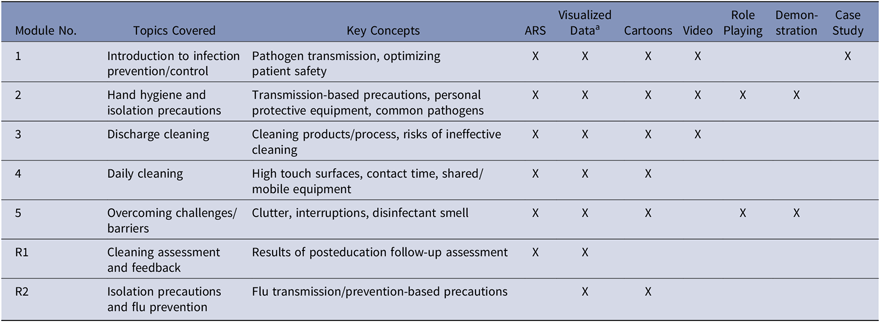
During program development, an emphasis was placed on utilizing adult learning theories to facilitate comprehension, learning, and behavior and culture change among the ESW participants. Thus, Knowles’ 4 principles of andragogy were utilized.Reference Knowles and Malcolm 12 These principles include the need for (1) the learners’ involvement in planning and evaluating their instruction; (2) learning activities based on the experiences of participants; (3) immediate relevance and impact on the learner’s job and personal safety; and (4) problem-centered rather than content-oriented education. To accommodate these principles, educational topics (Table 2) were paired with concrete infection prevention rationales and supportive data. The program sought to provide useful information and to equip ESWs with strategies to overcome common challenges faced during their work, such as visitor crowding in hospital rooms and patient refusal of cleaning. Once an initial curriculum was developed, the materials were shared with EVS leaders and their feedback was incorporated into the final version of the curriculum.
Topics Addressed and Tools Used in Educational and Refresher Modules for Environmental Service Workers

Note. ARS, audience response system; R, refresher presentation.
a Includes visual elements, such as charts and graphs, which allow individuals to see trends and patterns in data.
The final 5-part program was titled “Cleaner is Safer—ESW on the Frontline of Infection Prevention.” Audience participation and engagement was encouraged by asking participants to answer questions anonymously using an audience response system (ARS), role playing, and demonstrations. Graphics and videos were used rather than written text, whenever possible, to illustrate ideas and concepts, and local data were provided, when applicable. Medical jargon was avoided. Efforts were made to accommodate the range of ESW education levels. The program focused on ESW empowerment and team building between ESWs and the IP&C department. At the beginning of each module, key information provided during previous modules was reviewed as both a reminder to those who had attended and an opportunity to provide the information to those who had not been able to attend the previous session(s).
The 5 modules were presented to frontline ESWs at each hospital between July 2016 and March 2017. Modules were delivered in-person by study personnel, in English, over ~30–35 minutes. Each module was presented to each of 3 ESW shifts at each hospital during existing ESW departmental meetings ~4–8 weeks apart to minimize workflow disturbances. In addition, one or more infection preventionists and/or hospital epidemiologists at each participating hospital attended the sessions, whenever possible. Two subsequent “refresher sessions” were provided during the following year (September–December 2017 and December 2017–March 2018) to foster ongoing relationships, knowledge gain, and behavior change. Participant feedback was solicited throughout sessions to adjust content and clarity of subsequent modules.
Evaluation of the education program
The education program was evaluated using Kirkpatrick’s 4-Level Training Evaluation Model, which captures reaction (level 1), learning (level 2), behavior (level 3), and results (level 4).Reference Kirkpatrick and Kirkpatrick 13 Qualitative and quantitative assessments were conducted. Anonymous in-session ARS questions and post-session written evaluations for each module collected data on participants’ reactions and self-identified learning.
Behavior change was evaluated by serial quantitative assessments of the thoroughness of daily cleaning of occupied patient rooms. Daily cleaning was selected based on survey responses and the results of quantitative assessments of daily cleaning that demonstrated substantial challenges and opportunities related to cleaning of occupied patient rooms. These assessments were performed using the 3M CleanTrace Hygiene Management System (3M, Saint Paul, MN). For this ATP detection assay, sampling was conducted using a standardized protocol in which ~16 square inches of each surface were swabbed by the study team in accordance with manufacturer recommendations. A surface was determined to have “passed” the cleanliness test if the relative light unit (RLU) value was <250. Sampling of 6 HTSs (ie, bedrail, callbox, over-bed table, toilet flush, toilet seat, and visitor chair) was conducted before and immediately after daily cleaning of occupied patient rooms. Individual ESW were not aware of the sampling. Although EVS leadership was aware that sampling was being conducted, they were not informed of the specific schedule or locations of sampling. Verbal permission was obtained from patients before sampling HTSs in their hospital rooms.
During each sampling period, daily cleaning pass rates were calculated using data from only those surfaces that “failed” (RLU ≥ 250) the cleanliness test prior to daily cleaning to prevent inflating the cleaning pass rates. Baseline data were collected in 2015, prior to the education intervention, by sampling 24 rooms (1–2 rooms from each of 9 intensive care units [ICUs] and 8 non-ICUs) across the 5 participating hospitals. Both pediatric and adult units were sampled. The same sampling strategy was used to reassess the thoroughness of cleaning in May 2017, ~3 months (median, 2.9 months) after the fifth educational module was delivered, and again 1 year after the fifth education module had been delivered.
Although recognized to be multifactorial in etiology, hospital-onset C. difficile infections (CDI) and methicillin-resistant Staphylococcus aureus bloodstream infections (MRSA BSI), as defined by the CDC’s National Healthcare Safety Network (NHSN), 14 were used as indicators of patient-centered results associated with the educational program. Surveillance for CDI and MRSA BSI was conducted throughout the study period by infection preventionists at the 5 participating hospitals as part of routine surveillance activities. Testing for C. difficile was performed using molecular assays (ie, PCR) at all participating hospitals throughout the study period. Standardized infection ratios (SIRs) for hospital-onset CDI and hospital-onset MRSA BSI for the preintervention (January–December 2015, January–September 2016), intervention (October 2016–March 2017), and postintervention (April 2017–March 2018) periods were calculated and compared using NHSN methods. 14
Statistical analysis
Data from in-session ARS questions and postsession written evaluation forms were described with percentages and frequencies. We performed χ2 tests and paired t tests, when appropriate (SAS Institute, Cary, NC). In addition, noninferiority tests were performed to determine whether the effect of the education program on daily cleaning was sustained. A noninferiority margin of 20% was used. P values < .05 were considered statistically significant.
Results
The average attendance for each of the 5 educational modules was 357 (range, 303–391). The combined attendance for all sessions was 1,740. Attendance among ESWs who were working on the day of the scheduled presentations was >80%; however, attendance among all employed ESW ranged from ~30% to 50% (Table 1). During the project period, ESW turnover rates at the participating hospitals ranged from 6.2% to 10.2%. Most participants rated the modules as ‘excellent’ or ‘very good’ (99%), agreed the modules were ‘definitely’ useful (92%), and that they would ‘definitely’ recommend the modules to their coworkers (90%). Most (95%) agreed that the suggestions for overcoming challenges and barriers were useful in their everyday work.
Program evaluation: Reaction and learning
Responses to learning questions indicated that as a result of attending the relevant module, most participants better understood how patients develop infections (98%), were more comfortable donning and doffing personal protective equipment (PPE) (91%), were more confident in their ability to perform hand hygiene (96%), were more confident using the hospital’s cleaning protocol (92%), and better understood the importance of disinfecting HTS (96%). Overall, reactions to the educational program and self-identified learning were similar across all hospitals (data not shown).
Program evaluation: Behavior
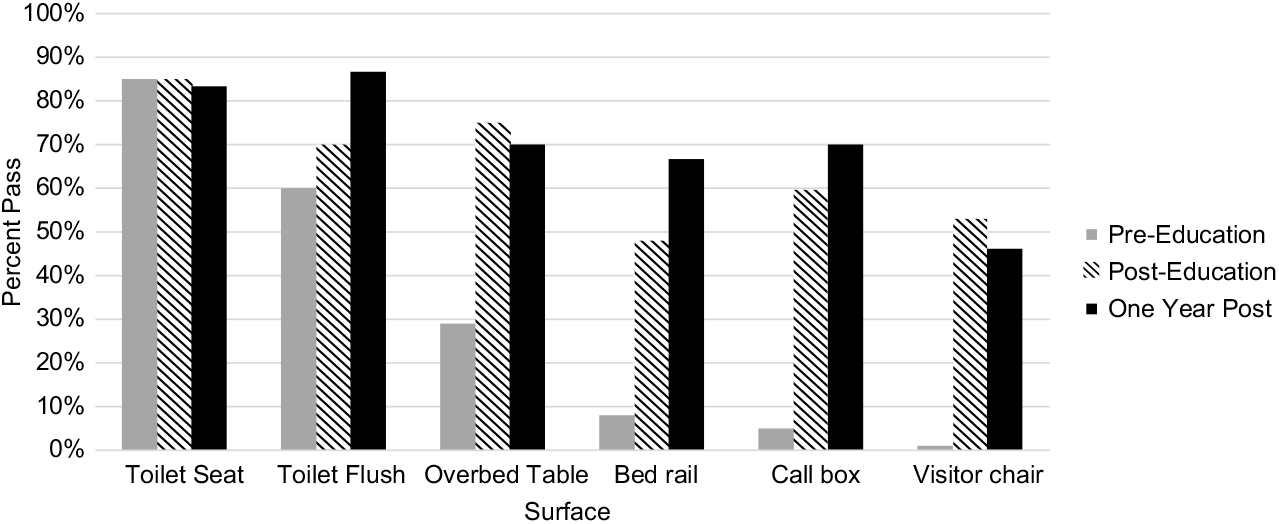
The thoroughness of cleaning of HTSs in occupied patient rooms significantly increased following the intervention, and this improvement was sustained 1 year after the educational program was completed (Fig. 1). Prior to the educational program, the overall cleaning pass rate for HTSs was 26%, ranging from 0% for visitor chairs to 85% for toilet seats. Approximately 3 months after the educational program was completed, the overall cleaning pass rates for HTSs had increased to 62% (P < .001), ranging from 48% to 85% among the 6 HTSs. The absolute changes in pass rates by HTS ranged from 0% to a 53% increase. Statistically significant improvements in cleaning pass rates of the 4 HTSs close to patients (ie, overbed tables, bed rails, call boxes, and visitor chairs) were detected, (P < .01 for all 4 surfaces); these HTSs had the lowest pass rates (0–29%) prior to the educational program. One year following the educational program, the overall pass rate was 68%, ranging from 46% to 87% for individual HTSs. Noninferiority testing demonstrated that HTS pass rates 1 year after the program concluded were not worse than those achieved 3 months after the program concluded (P < .001).
Assessment of the thoroughness of high-touch surface cleaning in occupied patient rooms before, immediately after, and 1 year after an educational program for environmental service workers. The 3M CleanTrace hygiene management system was used to sample and test surfaces before and immediately after daily, occupied patient room cleaning. A standardized sampling protocol was used. A surface was determined to have “passed” the cleanliness test if the relative light unit (RLU) value was <250.

At 1 year after the initial educational intervention, all 5 participating hospitals had HTS daily cleaning pass rates that were higher than preintervention pass rates observed in the facility. Hospitals A, B, and C had statistically significant improvements of 73%, 39%, and 64%, respectively, over time. The improvements observed at hospitals D and E, 14% and 16%, respectively, were not statistically significant, but these 2 hospitals had higher baseline HTS pass rates than the other 3 hospitals.
Program evaluation: Patient outcomes
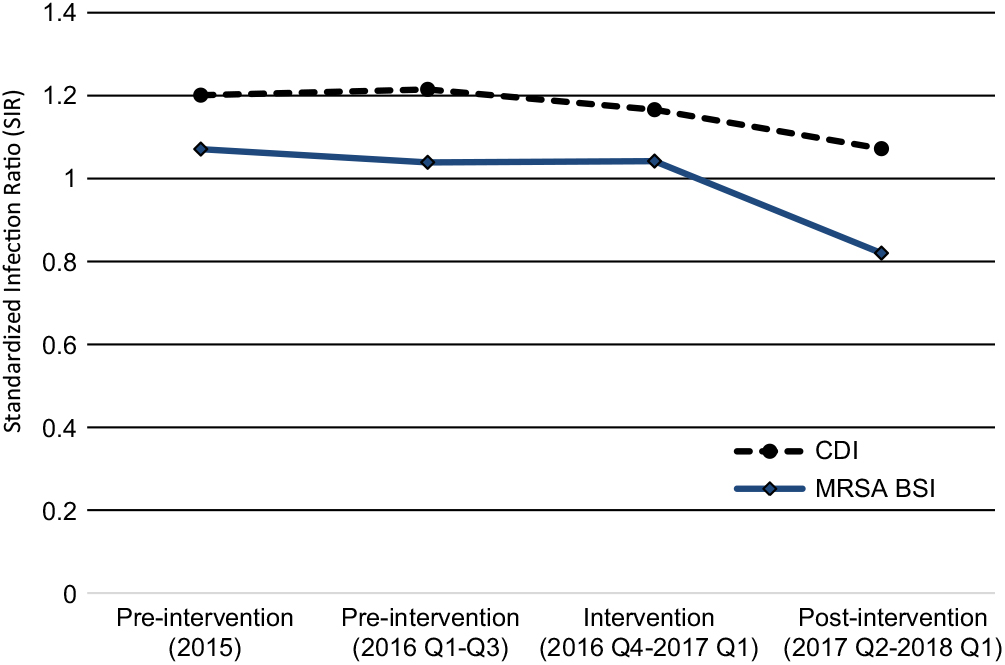
An 11% decrease in the hospital-onset CDI SIR was observed (P = .03) in association with the educational program (Fig. 2). A 23% decrease in the MRSA BSI SIR was observed, but this decrease was not statistically significant (P = .22).
Standardized infection ratio (SIR) for hospital-onset Clostridium difficile infection (CDI) and for methicillin-resistant Staphylococcus aureus bloodstream infection (MRSA BSI), January 2015–March 2018.
Discussion
Our novel education and culture change program was well accepted by frontline ESWs. It resulted in self-reported learning and was temporally associated with improvements in the thoroughness of daily cleaning of HTS in occupied patient rooms and with significantly decreased rates of hospital-onset CDI. Notably, the improvements in cleaning of HTSs were sustained for 1 year after completion of the educational program. Although several previous studies have demonstrated improvement in the thoroughness of cleaning HTSs in hospitals following educational interventions and feedback of performance data to ESWs,Reference Carling, Parry and Rupp 8 , Reference Ray, Deshpande and Fertelli 15 – Reference Carling and Herwaldt 18 the initially observed improvements were often not sustained after the conclusion of the focused intervention(s).Reference Carling, Parry and Rupp 8 , Reference Rupp, Fitzgerald, Sholtz, Lyden and Carling 9
Compared with previously published environmental cleaning improvement projects, our study includes a number of unique features, some of which may have contributed to sustainability. First, the frontline ESWs and their leadership team were involved in content development via participation in a KAP surveyReference Bernstein, Salsgiver and Simon 10 and informal discussions as well as leadership participation in development of the educational modules. These conditions may have helped to gain buy-in from participants and to ensure that content addressed topics of relevance, including a discussion of strategies to overcome commonly encountered barriers to optimal adherence to cleaning protocols. Second, whereas most previous studies have focused on discharge cleaning, we also focused on daily cleaning of occupied patient rooms. This focus on daily cleaning was chosen because baseline data showed substantially greater opportunities for improvement and more barriers experienced by ESWs when compared to discharge cleaning (eg, ESWs were reluctant to clean HTSs close to patients).Reference Bernstein, Salsgiver and Simon 10 , Reference Bernstein, Salsgiver and Simon 11 Third, our educational program was conducted stepwise over ~9 months and utilized the existing structure and schedule for EVS departmental meetings, potentially reducing the logistic challenges of scheduling and workflow disruption. This collaboration improved relationships between the study team and ESWs, allowed follow-up of ESW concerns and facilitated culture change. Fourth, we sought participant feedback during and after each session and provided opportunities for open discussions and questions. We used participant feedback along the way to adjust our teaching strategies and identify additional content to include in subsequent modules. Fifth, we evaluated the intervention using the Kirkpatrick model, which includes 4 levels: reaction, learning, behavior, and results. Thus, we were able to more fully assess the educational program’s impact. Finally, we introduced “refresher sessions” after the 5-part educational intervention to reinforce and enhance learning, to educate newly hired individuals and those who had missed previous sessions, to provide ongoing feedback and acknowledgement, to identify and address persistent or new challenges and barriers, and to maintain the relationships between hospital infection prevention and control departments and EVS personnel that had been enhanced during the development and delivery of the initial educational modules by the study team.
A number of limitations should be acknowledged. Although ESW attendance at each of the presentations was high (>80%), we were not able to provide sessions to accommodate the work schedule of all ESWs. This limitation was partially addressed by providing a brief recap of previously covered topics at the beginning of each educational module. Although the study was conducted in 5 different hospitals of variable size and with different patient and ESW populations, the participating hospitals were all part of the same hospital system and followed the same infection prevention and EVS policies and protocols. Thus, the findings may not be generalizable to other hospitals, including those with higher or lower rates of ESW turnover than were encountered at the participating hospitals during the project period and those that have contracted rather than hospital-employed ESWs, or to other types of healthcare facilities (eg, long-term care facilities). Although we identified and addressed the needs of ESWs at our hospital system (eg, KAP gaps and commonly encountered challenges and barriers), much of the education provided and the barriers and challenges addressed in the modules are likely relevant to other facilities. The reduction in CDI that occurred in temporal association with the intervention cannot be definitively attributed to the intervention. Other quality improvement and infection prevention efforts to reduce CDI, including antimicrobial stewardship activities (eg, expanded use of a postprescription review and feedback strategy) and monitoring and feedback of data regarding cleaning of portable noncritical medical equipment by clinical staff, were ongoing at the participating hospitals throughout the study period.
Overall, the results of this study are encouraging and suggest that an education and culture change intervention designed specifically for frontline ESWs that addressed locally identified knowledge, attitude, and practice gaps and common barriers to implementation of best practices was well received by participants, resulted in increased knowledge, and was associated with improved daily cleaning of occupied patient rooms. The intervention was also temporally associated with decreased rates of CDI. The focus on optimizing the thoroughness of daily cleaning and the observed outcomes of the study are supported by another recent study that demonstrated environment-to-patient bacterial transfer during occupancy of hospital rooms, resulting in both asymptomatic carriage and symptomatic infection with pathogens such C. difficile and vancomycin-resistant enterococci.Reference Chen, Knelson and Gergen 19 Additional research is needed to assess the longer-term effects and sustainability of this type of intervention as well as its effectiveness in other hospitals and other types of healthcare facilities, such as skilled nursing and long-term care facilities.
Author ORCIDs
David P. Calfee 0000-0002-4647-790X
Acknowledgments
The NYSDOH provided research support but was not involved in study design, conduct, analysis, nor reporting. The data and conclusions reported here do not necessarily represent the opinions, interpretations or policies of the State of New York. The authors thank the frontline environmental services workers and infection preventionists at the participating facilities.
Financial support
This study was funded by the New York State Department of Health (NYSDOH grant no. C028680) as a part of the Healthcare-Associated Infection Prevention Project.
Conflicts of interest
All authors report no conflicts of interest relevant to this article.