Introduction
Approximately 3 million newborns die globally each year (Dickson et al., Reference Dickson, Simen-Kapeu, Kinney, Huicho, Vesel and Lackritz2014; Bhutta et al., Reference Bhutta, Das, Bahl, Lawn, Salam and Paul2014) with three-quarters dying in the first week of life (Lawn et al., Reference Lawn, Cousens and Zupan2005). Almost 99% of all newborn deaths take place in developing countries, and many of these deaths are preventable (Akseer et al., Reference Akseer, Lawn, Keenan, Konstantopoulos, Cooper and Ismail2015).
In Ghana, neonatal mortality dropped from 32 deaths per 1000 live births in 2008 to 24 deaths per 1000 live births in 2018 (Ghana Statistical Service et al., 2014; World Bank, 2019). However, these overall numbers mask extreme regional variability. According to the most recent Ghana Demographic Health Survey (DHS), the Ashanti Region has a newborn mortality rate of 42 per 1000 live births – the highest rate in the nation (Ghana Statistical Service et al., 2014).
The leading clinical causes of neonatal mortality in Ghana are well known, and include birth asphyxia, complications from prematurity, congenital malformations and neonatal sepsis (Annan & Asiedu, Reference Annan and Asiedu2018; Owusu et al., Reference Owusu, Lim, Makaje, Wobil and SameAe2018). However, local beliefs in traditional illnesses – as opposed to those defined by Western providers – have been shown to delay care-seeking and contribute to poor outcomes (Okyere et al., Reference Okyere, Tawiah-Agyemang, Manu, Deganus, Kirkwood and Hill2010). Other studies have corroborated this finding, showing that it is not uncommon for community members to attribute newborn illnesses to the ‘evil eye’ – a local illness known as asram or spiritual causes, resulting in delayed care-seeking and poor management of sick newborns (Mohan et al., Reference Mohan, Iyengar, Agarwal, Martines and Sen2008; Thairu & Pelto, Reference Thairu and Pelto2008; Mrisho et al., Reference Mrisho, Schellenberg, Mushi, Obrist, Mshinda, Tanner and Schellenberg2008; Bell et al., Reference Bell, Arku, Bakari, Oppong, Youngblood, Adanu and Moyer2020).
What is not known, however, is what community members think are the causes of pregnancy losses and newborn deaths. This exploratory, qualitative study sought to improve the understanding of the knowledge, attitudes and beliefs regarding neonatal deaths in the Ashanti Region of Ghana.
Methods
Study Setting
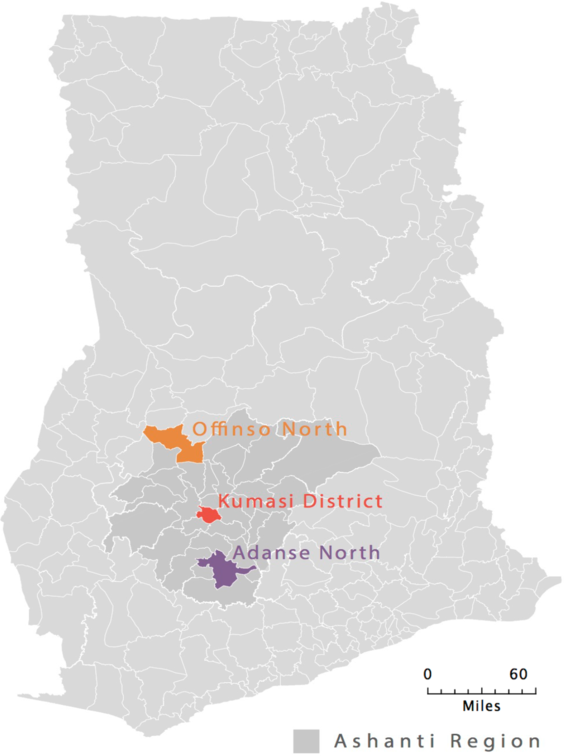
This cross-sectional, community-based exploratory qualitative study was conducted in three districts in the Ashanti Region: Kumasi Metropolitan Area, Adanse North and Offinso North (Fig. 1). Kumasi is the second-largest city in Ghana and the Kumasi Metropolitan area is the largest of the 30 districts of the Ashanti Region. Kumasi has ten sub-metropolitan areas, including Bantama, where the study was conducted. Bantama (estimated population >500,000) accounts for nearly a quarter of the total Kumasi district population. The Adanse North district (estimated population nearly 120,000) is located 55 km south of Kumasi. Apart from the Akans, which are the predominant ethnic group of the Adanse North district, there are several other ethnic groups, including the Ewes and Krobos. This district is made up of 118 communities with six health facilities. The Offinso North district (estimated population 61,614) is located 101 km north-west of Kumasi, and is the farthest of the proposed districts from the Kumasi Metropolis. There are 87 communities in Offinso North and a growing number of migrants from northern Ghana.
Map of Ghana showing the study sites.

These three districts were purposely chosen to create a diverse sample of respondents, representing rural and urban districts, stable and migrant populations and agrarian and professional occupations. Respondents from Kumasi Metro were considered ‘urban’ for the purposes of analysis, and those from Adanse North and Offinso North were considered ‘rural’.
Identifying participants
Researchers worked with public health nurses (PHNs), community health nurses (CHNs) and opinion leaders in each district to create a diverse sampling frame within the three districts, consciously trying to identify families from different socioeconomic strata, of different ages, residing in rural vs urban locales, employed in different occupations, practising different religions and being of different ethnicities – all of whom had first- or second-hand experience with a miscarriage, stillbirth or newborn death. There was no time limit placed on such experiences, meaning that some respondents had experienced recent losses while others had experienced losses many years prior to the study. Awareness of such events was possible due to the small community sizes, the power of local networks and the prominent role community health nurses play in the communities.
Exact recruitment procedures varied across the three districts. In Kumasi Metro, CHNs identified participants during their outreach services and home visits. Opinion leaders, such as assembly-men and assembly-women and local ‘queen mothers’, also informed community members about the study and were able to identify participants. Additional participants were identified from the hospital and churches. Most interviews were conducted in the participant’s home, and the focus groups were conducted at the government school after hours. In the Adanse North district, most participants reached out to CHNs and volunteered to participate after hearing there was a study being conducted in the community from the first female interviewed. Most interviews and all focus groups were conducted at the health centre. In the Offinso North district, all participants were identified by the public health nurse, and interviews were conducted both at the health facility and in the community.
Across all sites, participants were recruited for either focus groups or individual interviews, depending upon what was most convenient for the participant.
Interview tool
Interviews and focus group discussions relied upon a semi-structured interview tool with detailed probes to guide the discussion. The interview tool was developed by the study team, based in part on qualitative interview guides implemented during previous studies in Ghana (Moyer et al., Reference Moyer, Aborigo, Kaselitz, Gupta, Oduro and Williams2016; Oppong et al., Reference Oppong, Bakari, Bell, Bockarie, Adu and Turpin2019; Geerlings et al., Reference Geerlings, Kaselitz, Aborigo, Williams, Youngblood and Avrakotos2019). The tool covered such areas as events surrounding the death of a baby, participant’s thoughts on the cause of death and rituals conducted after the death of the child. After repeated mention of asram in the first few focus group discussions, additional items were added that asked specifically about community knowledge and beliefs regarding asram, its prevention and its treatment.
Interviewers
Interviews and focus group discussions were conducted by three trained research assistants (RAs). All were Ghanaian men; two were staff of the Ghana Health Service in the field of health information and one was an unemployed public health graduate. All RAs participated in a rigorous 2-day study training session that included nearly 15 hours of instruction and mock interviews.
Data collection
Research assistants conducted 60- to 90-minute in-depth interviews and focus group discussions using open-ended prompts to generate discussion about knowledge, attitudes and beliefs regarding neonatal mortality in the community. They also completed a short checklist on participant demographics.
All interviews were conducted in the local language (Twi) or English and audio-recorded for verbatim transcription. Interviews were transcribed into English for analysis, leaving intact key words or phrases in Twi that were difficult to translate. Attributions for quotes from in-depth interviews are given using unique ID numbers and individual demographic characteristics; those from focus group discussions are given using the unique ID of the focus group with either the participant’s demographics if the transcript was clear enough to determine which respondent was speaking, or an aggregate of the group’s demographic characteristics (e.g. 25- to 34-year-old women, reflecting the age range of women in the focus group).
Data analysis
Three of the authors (AB, JW, CAM) read each transcript and worked together to create a preliminary coding structure and codebook. Transcripts were entered into NVivo 10.0 qualitative software. Three coders used the codebook to conduct focused coding. Coders included one of the investigators and two master’s level researchers. The coding team met regularly to discuss the meaning and application of codes. New themes that had arisen and themes in need of revision were discussed and the codebook was updated accordingly. After the first round of data coding was completed, a second layer of coding was conducted following the Attride-Stirling model of qualitative analysis, in which the researchers looked to distinguish between basic themes, organizing themes and global themes (Attride-Stirling, Reference Attride-Stirling2001).
Results
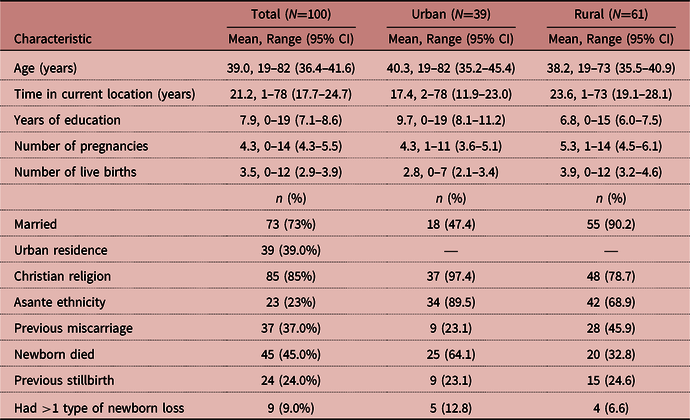
A total of 100 participants were recruited and successfully interviewed across the three study districts: 39 in Kumasi, 30 in Adanse North and 31 in Offinso North. Eighty women participated in the focus group discussions and 20 completed individual in-depth interviews. Table 1 shows the demographic characteristics of the participants. All women had lost a baby in the past, either during pregnancy or after delivery. Nearly a quarter (24%) reported a previous stillbirth, 37% reported a previous miscarriage and 45% reported losing a baby who was born alive. Of the 100 respondents, 9% (n=9) experienced more than one type of loss.
Demographics characteristics of purposely sampled women who had first- or second-hand experience of newborn loss (N=100)

Across individual interviews and focus group discussions, the local illness of asram was cited as a leading cause of death of newborns. Every participant in this study reported hearing of, knowing someone or having a child become ill with asram. While women gave varying information on symptoms, method of acquiring and treatment, all participants agreed that asram was common, and often fatal.
In this region, we have a disease called asram. It kills most of our babies. (Adanse North FGD 108, rural women)
Asram is really killing us here. (Offinso North FGD 058, rural women)
[Asram] is like HIV, the baby would be very small and some grow into [a] skeleton. (Kumasi FGD 012, urban women)
Four overarching themes emerged from the data about asram: 1) asram is not a hospital sickness; 2) there is both a fear of traditional healers as a source of asram, as well as a reliance upon them to cure asram; 3) there are rural/urban differences in perceptions of asram; and 4) asram may serve as a mechanism of social control of pregnant women and new mothers.
Asram is not a hospital sickness
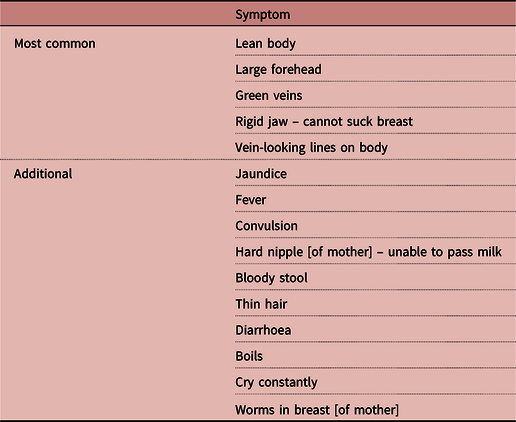
Respondents described asram as an illness that can be contracted during pregnancy or after birth that primarily affects newborns. Asram can manifest itself through a variety of symptoms, including pronounced green veins, a small or shrunken body, an enlarged head and the inability to breastfeed. Table 2 illustrates commonly reported symptoms associated with asram.
Symptoms of asram reported by the sample women

When asked to describe asram, respondents used phrases such as ‘devilish disease’, ‘witchcraft’ and ‘evil doers’.
I believe it’s a spiritual disease that someone can give to you…. this is not a hospital disease. (Adanse North FGD 107, rural women)
It is a satanic disease that witches use to kill babies. (Offinso North, FGD 58, rural women)
Asram is passed from individuals with evil intent – even those without evil intent who may not know they carry asram themselves – to either pregnant women or their newborns. Typically, asram can be passed to a pregnant woman when she eats outside or in public, bathes at night or when she exposes too much skin. Asram can be passed to a baby when an evil-doer lays eyes on the baby, hears the baby cry or passes by the baby’s bedding or washed clothing.
Treatment for asram typically involves identifying the person who cursed the mother or baby, and seeking traditional herbal medicine to offset the effects.
You know there are certain diseases which cannot be cured at the hospital. You have to allow the parents to seek for solution elsewhere. (Adanse North, FGD 107, rural women)
Fear of, and reliance on, traditional healers
Traditional healers are an important part of treating asram. Yet they are also seen as the potential root cause of the illness. It is unclear whether herbalists infect women out of ill will, or whether they hope to prompt women to come to them for treatment, since asram can only be treated with traditional medicines.
The herbalist will intentionally be plot[ting] against a pregnant [woman], so the moment the pregnant woman even greets the herbalist, she will attack the baby in the womb with the asram. (Offinso North FGD 057, rural women)
…someone in your vicinity whom you did not visit for medicine when you were pregnant… that person can infect you so that you come and see him/her. (Adanse North, FGD 109, rural women)
Such sentiments were not universal, however. One respondent explained that since traditional healers deal with asram, they are careful not to be near new mothers so they do not accidentally infect their babies.
This herbalist who treats asram for people… if you meet her at the river she will never assist you to carry your water because she does not want to infect your baby with it. (Offinso North, FGD 57, rural women)
What I know [is] that anyone that has a cure for asram has that disease. But some of them are God fearing and would not infect your kids. But others would infect you so that you come to them for cure. (Adanse North, FGD 109, rural women)
Regardless, the majority of participants explained that a baby must be taken to an herbalist to be cured from asram.
If you don’t go [get] herbal medication the baby will die… the baby will be alive only with the application of herbal medicine. (Kumasi, FGD 011, urban women)
However, none of the participants was able to explain how herbalists cured asram, stating that the methods they used were a secret.
As we said, these same traditional medicines, when you know the type you will go and pluck it yourself the next time you experience that. So they will not let you know. (Adanse North, FGD 109, rural women)
Some people have the herbs for asram, they can just look at the baby and know the type of asram so as to be able to give the particular herbs for that asram. (Offinso North, FGD 58, rural women)
A few participants noted that they might be able to treat asram at a clinic but that most people go to herbalists.
For me I think maybe you might find a cure in the hospital too, but I have mostly witness the traditional medicine more at times for the treatment. (Adanse North, IDI102, rural woman)
Rural/urban differences in perceptions of asram
Although asram was described throughout interviews and focus groups in all study areas, most of those who were sceptical about asram came from urban settings. For example, one urban respondent described her husband as not believing in asram:
My second born had the disease but my husband did not allow me to use herbal medicine on him, and disease disappear(ed) itself. I think it is the African people who have a lot of belief(s) that every disease is asram. I have never heard the doctors say asram, it is only in the local community. (Kumasi FGD 012, urban woman)
Another urban respondent described hearing about asram, but not believing in it.
Personally I don’t believe in that. People do believe in those things… whatever sickness that is attached to a newborn is asram. That is how people perceive it to be. But me, I don’t believe that. (Kumasi, urban woman)
Two urban health care providers were also interviewed, both of whom used the third person to describe asram, in contrast to rural participants, who relayed personal experiences with asram.
In our Akan community here they attribute everything to asram. If the baby cannot be put on [the] breast, [it] is asram. If the baby is not kept well, [it] is asram. Even if the cord becomes infected, if a baby has a temperature, they attribute a lot of things [to asram]. (Kumasi 006, urban midwife)
I have heard stories of a lot of women what were pregnant, they felt it was asram… before you know it maybe she dies or her baby dies … they [feel] like the woman has been cursed or something… I am not saying these things don’t exist but I feel there is always a medical aspect… (Kumasi 007, urban doctor)
Note that there were also rural respondents who were not convinced that asram was real.
Asram as a mechanism of social control
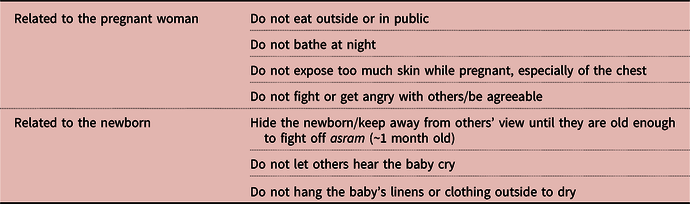
Table 3 gives a list of behaviours respondents recommended women do for themselves or their babies to avoid becoming infected with asram. These include not eating outside or in public, not bathing at night, not exposing too much skin, and maintaining a positive disposition.
There are some pregnant women who eat along the road or outside their homes and herbalist(s) who treat asram can attack you with it through the food you are eating. (Offinso North, FGD 58, rural women)
If a pregnant woman dresses in such a way that exposes some vital parts of her body, if a herbalist who treats asram sees such women, they can easily [transfer] the asram through that vital part to the baby in the womb. Some vital part of the pregnant woman …[are]… behind the knee, part of the stomach showing, part of the breast showing, and other parts. (Offinso North, FGD 57, rural women)
Like I said earlier, a pregnant woman should not stress herself so much, and so I protect myself. I don’t do hard labour, I do not fight, I don’t talk unnecessary, I don’t easily get angry at others, and this helped me by the grace of God. I have had these three children and none has been affected by asram. (Adanse North, IDI105, rural woman)
Recommended behaviours reported by sample women to avoid asram

Women are also advised to keep their babies quiet and out of sight of strangers to avoid asram.
Someone can stand behind your window when the baby is crying and give the baby that disease. (Adanse North, FGD107, rural 23- to 47-year old married women)
…when you’ve given birth and your child is indoors when someone hears of the cry he/she can give it to the child. (Kumasi IDI004, urban woman)
You need to hide your baby from asram. When you deliver a baby you need to constantly cover the baby with cloth so that an evil person will not notice the baby. (Adanse North, IDI101, rural woman)
Many of the behaviours listed as protective against asram could be seen as promoting good behaviour by pregnant women and new mothers. Dressing modestly, keeping the baby quiet, minimizing contact with strangers and maintaining an agreeable disposition are all behaviours that maximize harmony within the household and the community.
Discussion
These findings, among a diverse sample of women of all ages from rural and urban areas of Ghana who had experienced stillbirths, miscarriages and newborn loss, illustrate the strength of local beliefs regarding the source of newborn illness. All respondents – even those sceptical about asram – described the ubiquitous nature of asram as an explanation for why newborns fall ill in the Ashanti Region of Ghana. While beliefs in asram appeared to be more pronounced among rural respondents, there were many urban respondents who agreed with respondents from rural areas about their attributions. Interestingly, the prevention and avoidance of asram requires pregnant women and new mothers to dress modestly, act agreeably, keep their newborns quiet and minimize their interactions with strangers – all behaviours that could be seen as implementing social control mechanism over a vulnerable population.
The results of this community-based study are similar to those of another qualitative study conducted in tertiary care teaching hospitals in Kumasi, Accra, and Cape Coast (Bell et al., Reference Bell, Arku, Bakari, Oppong, Youngblood, Adanu and Moyer2020). In that study, mothers attributed their newborns’ illnesses to the ‘evil eye’, and prevention involved mothers covering themselves while pregnant and keeping the baby out of view of strangers (Bell et al., Reference Bell, Arku, Bakari, Oppong, Youngblood, Adanu and Moyer2020). Such seeming overlap between asram and the evil eye aligns with research conducted in the peri-urban areas outside Ghana’s capital city, which described how the evil eye is perceived to cause asram (Dako-Gyeke et al., Reference Dako-Gyeke, Aikins, Aryeetey, McCough and Adongo2013). That study’s participants described asram as the physical manifestation of evil spiritual attacks on a pregnant woman. To use epidemiological terms, the evil eye is the infectious agent, while asram is the disease outcome seen among newborns.
The present findings align with studies conducted elsewhere in sub-Saharan Africa that indicate a commonly held belief that keeping babies indoors is one method of preventing conditions similar to asram. It is believed that the baby is vulnerable to malevolent people and spirits when he/she is outside, and thus it is important to keep them indoors and protected (Mrisho et al., Reference Mrisho, Obrist, Schellenberg, Haws, Mushi and Mshinda2009; Tuncalp et al., Reference Tuncalp, Hindin, Adu-Bonsaffoh and Adanu2012). This assumption can discourage pregnant women from attending antenatal care (if they are worried about being exposed to the evil eye themselves) or postnatal care after delivery (if they are worried about exposing the baby to asram). Similar observations have been made in India and Bangladesh, where cultural practices such as keeping both the baby and mother indoors have been found to be a cause of delayed care-seeking behaviour and poor newborn outcomes (Winch et al., Reference Winch, Alam, Akther, Afroz, Ali and Ellis2005; Mohan et al., Reference Mohan, Iyengar, Agarwal, Martines and Sen2008). Interestingly, this pattern can reinforce beliefs in asram: if fear of asram keeps mothers and babies indoors, care-seeking for illness can be delayed, thus leading to worse newborn outcomes when care is eventually sought, which can reinforce the belief that asram is to blame for the poor outcomes.
This study has several important implications for practice. First, it is known that obtaining prompt health care plays a major role in determining the outcome of sick newborns, and delayed care-seeking behaviour can put babies at a higher risk of death (Olusanya et al., Reference Olusanya, Ogunlesi and Slusher2014). In the present study, however, most women interviewed described asram as a condition that does not require hospitalization and that it should be managed by local healers using traditional herbal medicine. Women said that if they were allowed to go home and see the traditional healer, their newborns would survive. Future research and programmatic efforts are necessary to help bridge the gap between local understanding of newborn illness and prompt biomedical treatment to ensure newborns’ best chances of survival. In addition, the treatment provided by traditional healers can include bathing the baby with herbs and leaving the baby to air-dry (Okyere et al., Reference Okyere, Tawiah-Agyemang, Manu, Deganus, Kirkwood and Hill2010), putting a newborn at risk of hypothermia and running contrary to thermal care recommendations (Kumar et al., Reference Kumar, Shearer, Kumar and Darmstadt2009). While there may be ways to integrate traditional and Western treatments, such issues need to be explored in a way that does not immediately alienate and denigrate traditional beliefs. The chasm between local beliefs and Western recommendations is not new (Engmann et al., Reference Engmann, Adongo, Aborigo, Gupta, Logonia and Affah2013; Hill et al., Reference Hill, Hess, Aborigo, Adongo, Hodgson, Engmann and Moyer2014) yet must be addressed if we are serious about reducing neonatal mortality.
This study included a wide range of respondents, across both urban and rural settings, all of whom experienced the loss of a newborn. To the authors’ knowledge, this is the first study of its kind to ask such participants their thoughts about the perceived aetiology of their newborn’s death. Nonetheless, the study had several limitations. First, the interviews did not include traditional healers to ascertain their knowledge on sick newborns. It is possible that traditional healers may have provided an alternative perspective, and future research should include herbalists and other local providers amongst the sampling frame. In addition, it was not possible to compare respondents’ descriptions of their experiences with what actually happened to their newborns via medical records or chart reviews, including cause of death or a comparison of those treated at the hospital versus those treated by a traditional healer. This exploratory study indicates there is a need for future research that includes such factors in the data collection protocol. Finally, while differences between rural and urban respondents were observed, it was not possible to tease out the potential confounders of education or wealth, given that rural respondents are generally less wealthy and less educated than their urban counterparts.
Nonetheless, this study illustrates the importance of understanding local attribution for newborn illness, as attribution is likely to drive the type of care sought. In this setting, asram is seen as a ubiquitous cause of newborn illness, and traditional care is the treatment of choice. Future work is needed to sensitize traditional and Western providers to the issues surrounding asram, including determining creative ways that the two disparate groups might be able to work together. Future work is also needed to empower community health workers to assist in the appropriate triage and management of sick newborns in Ghana.
Funding
This research was funded by the Hauslohner Fund, established through Global REACH at the University of Michigan Medical School. The funder had no role in the design, implementation or evaluation of this research.
Conflicts of Interest
The authors have no conflicts of interest to declare.
Ethical Approval
Investigators obtained permission to conduct focus groups and interviews in the communities from community leaders. Interviewers took each participant through a verbal informed consent process. This study was reviewed and approved by the Ghana Health Service Ethical Review Board and exempted from ongoing review by the University of Michigan IRB.