





1. Introduction
In modern democracies, many voters lack basic political knowledge – from the names, credentials, and policy platforms of candidates to which party controls the government and even the fundamental structure of their own political system. Such ignorance plausibly explains many of the bad decisions democracies make, prompting a range of proposals to mitigate its harmful effects. These include simple measures to make it easier for voters to acquire political information to more radical calls to remove ignorant voters from the electorate (§2). Such proposals are expensive, contentious, and in some cases morally dubious. They are worth pursuing only if they would actually improve democratic governance. We argue in this paper that there are compelling reasons to doubt they will.
The problem is that voter ignorance comes in many forms, and existing remedies may target the wrong ones. The literature identifies three kinds of politically relevant ignorance: ignorance about candidates and their platforms, about the economics and social science needed to evaluate policy, and about the basic structure of government (§3). Various proposals aim to ameliorate one or more of these. But there is a fourth kind of ignorance – one that public choice economists have long recognized, but that philosophers have overlooked – which may do more to explain bad democratic outcomes than the other three. We call it deep legislative ignorance. It is ignorance of the intricate details of the bills, regulations, and administrative rules actually implemented by governments (§4).
Which kinds of ignorance do existing remedies actually address? To answer this, we introduce a new conceptual framework (§5). Political knowledge, we argue, varies along two dimensions: how difficult it is to acquire and how transient it is. Mapping different kinds of political knowledge onto this framework reveals a striking result; although existing proposals can remedy other forms of voter ignorance, they do nothing to combat deep legislative ignorance specifically (§6).
A troubling implication follows. If deep legislative ignorance is the primary driver of bad democratic policy – as public choice theory gives us reason to suspect – then the entire portfolio of remedies that political philosophers have proposed is superfluous (§7). That is, existing proposals may literally make no progress toward better democratic governance. Political philosophers who are concerned with voter ignorance may, in short, be looking in the wrong direction entirely. We end the paper by offering some rough thoughts on how to think about the problem of voter ignorance going forward.
2. Three solutions to voter ignorance
Voters in modern democracies are ignorant. Ilya Somin (Reference Somin2013: 17) summarizes the empirical literature: “the reality that most voters are often ignorant of even very basic political information is one of the better-established findings of social science. Decades of accumulated evidence reinforces this conclusion.” For example, only 19 percent of Americans can name the three branches of government, only 25 percent know the length of a Senator’s term, and only 30 percent know the substance of the Supreme Court’s landmark Roe v. Wade decision (Carpini and Keeter Reference Carpini and Keeter1996: 70–71). Social scientists explain this ignorance by arguing that it is rational (Downs Reference Downs1957). Being informed is costly, and the chances of changing the outcome of an election through voting are miniscule. Informing yourself so that you can vote well fails to pass a cost–benefit test; it is rational to be ignorant.Footnote 1
Democracy means that the people rule, but the empirical literature on voter ignorance suggests they might not be up to the task. What to do? There are a few different responses. One says voter ignorance actually is not a problem. Through a variety of different mechanisms – the Condorcet jury theorem, the Hong-Page theorem, deliberation, and so on – democracies transform ignorant votes into good policies (Schwartzberg Reference Schwartzberg2015). Although much is compelling in this literature, we set it to the side and focus on those who believe voter ignorance is a serious problem to be addressed.
Responses fall into three camps. First is what we call the epistocratic voting strategy, which addresses the problem of voter ignorance by either removing ignorant voters from the electorate or by keeping them in the electorate but attenuating the impact of their votes in some way. There are several ways to do this.
The simplest is restricted suffrage (Brennan Reference Brennan2016: 211–212; Jones Reference Jones2020: 106). According to this proposal, all individuals are required to pass a suffrage exam or acquire some relevant education credential before they can vote. Another example is plural voting (Brennan Reference Brennan2016: 213; Mill Reference Mill, Philp and Rosen2015: 292–293). Everyone gets to vote, but more votes are given to those who possess political knowledge, demonstrated by passing an exam or achieving some relevant education credential. The most complicated epistocratic voting strategy is enlightened preference voting (Ahlstrom-Vij Reference Ahlstrom-Vij2022; Brennan Reference Brennan2016: 220–222). Using complex statistical techniques, this voting method aims to simulate how an electorate would vote were everyone fully informed. This simulation, not the actual votes cast, decides the election.Footnote 2
We call the second camp the voter empowerment strategy. The idea here is that we incentivize voters to inform themselves by increasing the benefits of being informed. Recall the standard explanation for voter ignorance; the costs of being informed are high, but the benefits are low. If the benefits of being informed increase, then acquiring political information may become rational.
The most straightforward approach to voter empowerment involves providing monetary incentives to voters to pass a civics exam (Lupia Reference Lupia2016: 174–177; Somin Reference Somin, Samaržija and Cassam2023: 299–300). Other proposals are more involved. For instance, one prominent strategy makes it easier for people to “vote with their feet” – that is, to leave one political jurisdiction and enter another (Friedman Reference Friedman2019: 317; Somin Reference Somin2013: 122). The standard rational choice explanation for voter ignorance is that a single vote is unlikely to be decisive. But an individual’s decision to move jurisdictions is inherently decisive; it directly changes his/her circumstances. This ability to take decisive action increases the incentive to acquire political information, as voters can actually act on what they learn. Opportunities for foot voting can be expanded through institutional structures such as federalism and polycentricity (Somin Reference Somin2020: 45–66) as well as economic redistribution to make relocation more affordable (Friedman Reference Friedman2019: 334).
A final voter empowerment strategy devolves power to the local level. Fewer voters make up the electorate in local elections, which means the probability that a single vote decides the election increases. Given the increased value of a single vote, the hope is that voters will be more willing to acquire political information to ensure they vote well. Although many of the Confucian meritocrats are skeptical of democracy, they are more sanguine about its prospects at lower levels of government (Bai Reference Bai2020: 70–71; Bell Reference Bell2015: 168–175). This is due (in part) to the fact that voters are more likely to be informed in local elections (Bai Reference Bai2020: 70).
The third and final camp we call the voter education strategy. Instead of increasing the benefits of being informed – as the voter empowerment strategy does – this approach reduces the costs. If being informed is cheap enough, voters will inform themselves, even if the benefits of doing so are not substantial.
Marie Collins Swabey (Reference Swabey1931) was an early advocate of this. She recommended “the development of a great national bureau of publicity,” whose job is “the collection of information on all socially important subjects and its dissemination to the country at large by means of the various scientific and artistic devices of the day” (Swabey Reference Swabey1931: 106). The agency’s job would be to publicize important political information in easily digestible formats. In a similar vein, Giavazzi and Kapelner (Reference Giavazzi and Kapelner2024: 728) argue that the state should do things like offer “informative classes on issues relevant to voting and public decision-making or upcoming ballots.”Footnote 3 Others advocate we pursue voter education not through a new bureaucracy or state-run classes, but with more palatable journalism (Carpini and Keeter Reference Carpini and Keeter1996: 275; Dewey Reference Dewey2016: 204; Lupia Reference Lupia2016: 63).
3. The varieties of voter ignorance
Voter ignorance, many worry, threatens democracy. But ignorance of what, exactly? Most voters do not know all the elements of the periodic table or the details of Kant’s epistemology, but it is hard to see how ignorance of these matters threatens democracy. Other forms of ignorance plausibly do cause problems, however. We need a precise account of what exactly voters need to know for democracy to function well.
Jason Brennan describes one kind of knowledge that he and others (e.g., Gibbons Reference Gibbons2021: 196; Somin Reference Somin2013: 18) think crucial for democracy to function well:
Knowing the answers to the easy questions is not enough to be well informed about politics. To be well informed, citizens also need to know the candidates’ policy platforms, how candidates are likely to vote in Congress, what policies the candidates are likely to support, whether these votes are likely to matter or not, and how much influence the candidates are likely to have if they win. (Brennan Reference Brennan2016: 28)
Call this electoral knowledge. It is knowledge of the basic facts of an upcoming election: who is running for office, their credentials, what policies they support, what party currently controls the government, and so on. Electoral ignorance can lead to bad outcomes. If voters do not know what the candidates stand for, they may accidentally vote for someone who promises to prosecute an unjust war or encroach on civil liberties.
Brennan highlights another kind of knowledge he and others (e.g., Gibbons Reference Gibbons2021: 192; Somin Reference Somin2013: 51) think important:
To know whom to vote for, one needs to know more than what candidates stand for, what the candidates have done in the past, or what they intend to do in the future. A well-informed voter needs to be able to assess whether the candidates’ preferred policies would tend to promote or impede the voter’s favored outcomes. So, for example, suppose I know candidates Smith and Colbert both want to improve the economy, but Smith favors free trade, and Colbert favors protectionism. I can’t make a reasonable choice between them unless I know whether free trade or protectionism is more likely to improve the economy; to know that, I need to know economics. (Brennan Reference Brennan2016: 28)
Call this social scientific knowledge. It is knowledge of the social sciences needed to assess candidates’ policy platforms: the economic impact of immigration, free trade, price floors and ceilings, and more. Voters’ social scientific ignorance can lead to bad outcomes. For example, if voters do not know free trade is good for economic growth, then they might mistakenly vote for a protectionist.
Somin highlights a third type of political knowledge he and others (e.g., Galston Reference Galston2001) think is essential for democracy to function well:
… many voters are ignorant not just about specific policy issues but about the basic structure of government and how it operates. Majorities are ignorant of such basic aspects of the U.S. political system as who has the power to declare war, the respective functions of the three branches of government, and who controls monetary policy. A 2006 Zogby poll found that only 42 percent of Americans could even name the three branches of the federal government: executive, legislative, and judicial. (Somin Reference Somin2013: 19)
Call this civic knowledge. For voters in the USA, this includes knowledge of the three branches of government, how officials are selected to these branches, and more. If civic ignorance is widespread, voters “cannot easily assign credit and blame for policy outcomes to the right office-holders” (Somin Reference Somin2013: 19). A civically ignorant voter might blame their governor for overturning Roe v. Wade, for example.
Do these three types exhaust the kinds of voter ignorance that threaten democracy? No. In the next section we introduce a fourth kind – one the philosophical literature has largely ignored – that warrants concern.
4. Deep legislative ignorance
Philosophers concerned with voter ignorance worry about electoral, civic, and social scientific ignorance, arguing they explain many democratic failures. Many social scientists offer a different account, however. Although voter ignorance still plays an important role in explaining why democracies adopt bad policies, it is a different kind of ignorance than philosophers typically emphasize.
Public choice theory is a branch of economics that applies the tools and methods of economics to the study of politics (Buchanan Reference Buchanan1999b: 48). Before the public choice revolution, economists focused their attention on market failures, or cases where markets fail to deliver efficient outcomes. After the public choice revolution, economists began also focusing on government failures, or cases where governments fail to deliver efficient outcomes (Buchanan Reference Buchanan1999a). Public choice theorists rarely emphasize electoral, social scientific, and civic ignorance among voters as significant causes of government failure. They blame rent seeking (Lindsey and Teles Reference Lindsey and Teles2019; Tullock Reference Tullock2005). Rent seeking is behavior aimed at capturing economic benefits by influencing government rather than engaging in productive activities in the market. For example, a firm seeks rents when it asks for regulations that it can more easily comply with than its competitors, effectively limiting its competition. An association of business owners, such as corn farmers, seek rents when they lobby for corn subsidies.
Individuals and organizations seek rents in many ways. Sometimes they do so by contributing to political candidates’ electoral campaigns (Morton and Cameron Reference Morton and Cameron1992; Munger and Denzau Reference Munger and Denzau1986). This is essentially a quid pro quo: we help you get elected, you give us favorable legislation. Interest groups engage in organized grassroots lobbying by alerting and informing their members to pressure legislators (Lohmann, Reference Lohmann1998; Olson Reference Olson1971). Coordinated by an interest group, all the corn farmers call their representatives and say: “if you don’t vote for the corn subsidy, we’ll vote for your challenger in the next election.” There is also regulatory capture (Dal Bó Reference Dal Bó2006; Stigler Reference Stigler1971). Regulators know the firms they regulate are potential future employers and so regulate these firms with this in mind. Finally, think tanks and interest groups often help understaffed legislators write policy (Hall and Deardorff Reference Hall and Deardorff2006). The aid they provide is biased, of course.
Most policies that result from rent seeking are unpopular. Few think firms should face less competition and that corn farmers should receive lavish subsidies. So, why are they passed? The answer is that voters are ignorant, but a different kind of ignorance than electoral, social scientific, or civic. In particular, voters are ignorant of the specific details of the policies passed by legislatures and the regulations issued by administrative agencies. Many bills passed by Congress are over 1,000 pages. The pandemic relief bill passed in December 2020 was close to 6,000 pages (Broadwater et al. Reference Broadwater, Drucker and Ruiz2020). It is easy to hide special legislative favors in these bills. The average voter will never read them (indeed, legislators who vote for them do not read them). Moreover, executive agencies issue several thousand new regulatory rules each year (Carey Reference Carey2019: Figure 1). The average voter cannot apprise themselves of even a handful, thus allowing for regulations that hand out special favors. Call knowledge of the intricate details of the policies and regulations passed by governments deep legislative knowledge. To succeed, rent seeking depends on deep legislative ignorance.
Deep legislative ignorance can lead to bad policies. For example, voters suffer from sugar tariffs that raise the price of a household staple and cause other market distortions because they simply do not know that the tariff exists; sugar tariffs are typically amended to farm bills in the eleventh hour at the behest of lobbyists (Grier et al. Reference Grier, Grier and Mkrtchian2023). As another example, housing affordability is becoming a pressing issue in the USA (Kogelmann Reference Kogelmann2026a). Housing continually grows more expensive because strict zoning policy makes the supply of housing inelastic. Land use policy is made at local community meetings that few people even know are happening. Those who participate and shape housing policy are thus a vastly unrepresentative sample of the population (Einstein et al. Reference Einstein, Glick and Palmer2020).
Like electoral, social scientific, and civic ignorance, deep legislative ignorance among voters is rational. Although each special interest policy and regulation might cost a voter less than $100 per year in higher prices or taxes, learning about even a single policy or regulation would take hours of research. To learn about every single policy or regulation would be an extraordinarily difficult task even for somebody with no other responsibilities. Because the cost of becoming informed exceeds the benefit, voters rationally choose to remain uninformed about most policies and regulations that harm them in small ways. This rational ignorance, combined with the strong incentives of the beneficiaries to lobby for these special favors, explains why democracies often implement bad policies.
5. Political knowledge: a new conceptual framework
The union of electoral, social scientific, civic, and deep legislative knowledge constitutes a diverse set. We now introduce a novel way to carve it up. This new conceptual scheme for classifying political knowledge reveals the strengths and limits of the epistocratic voting, voter empowerment, and voter education strategies.
Political knowledge can vary across two dimensions that have received insufficient attention. First, political knowledge varies in terms of how difficult it is to acquire. Some political facts – like the three branches of government or a candidate’s core policy positions – require minimal time investment and cognitive effort. They can be grasped quickly, with little mental strain. Acquiring other forms of political knowledge is more difficult. Social scientific facts are an example. Anyone who has taught introductory economics to undergraduate students knows just how much repetition it takes for them to understand comparative advantage. Comparative advantage is a relatively elementary concept; think of how much work it would take for the average voter to learn the concepts, theories, and facts taught in graduate-level economics courses.
Second, political knowledge can vary in terms of how transient it is. Here we refer to how long the information is useful to the voter. Information that is very transient may be useful to her only for the next few weeks; durable information will help her vote for the rest of her life. Information about the basic structure of government (i.e., civic knowledge) is extremely durable because it changes infrequently. Much social scientific knowledge, such as supply and demand, is also very stable. On the flipside, examples of political information that are highly transient include electoral knowledge (which changes with every cycle) and deep legislative knowledge (which changes with the implementation of every new bill or regulation).
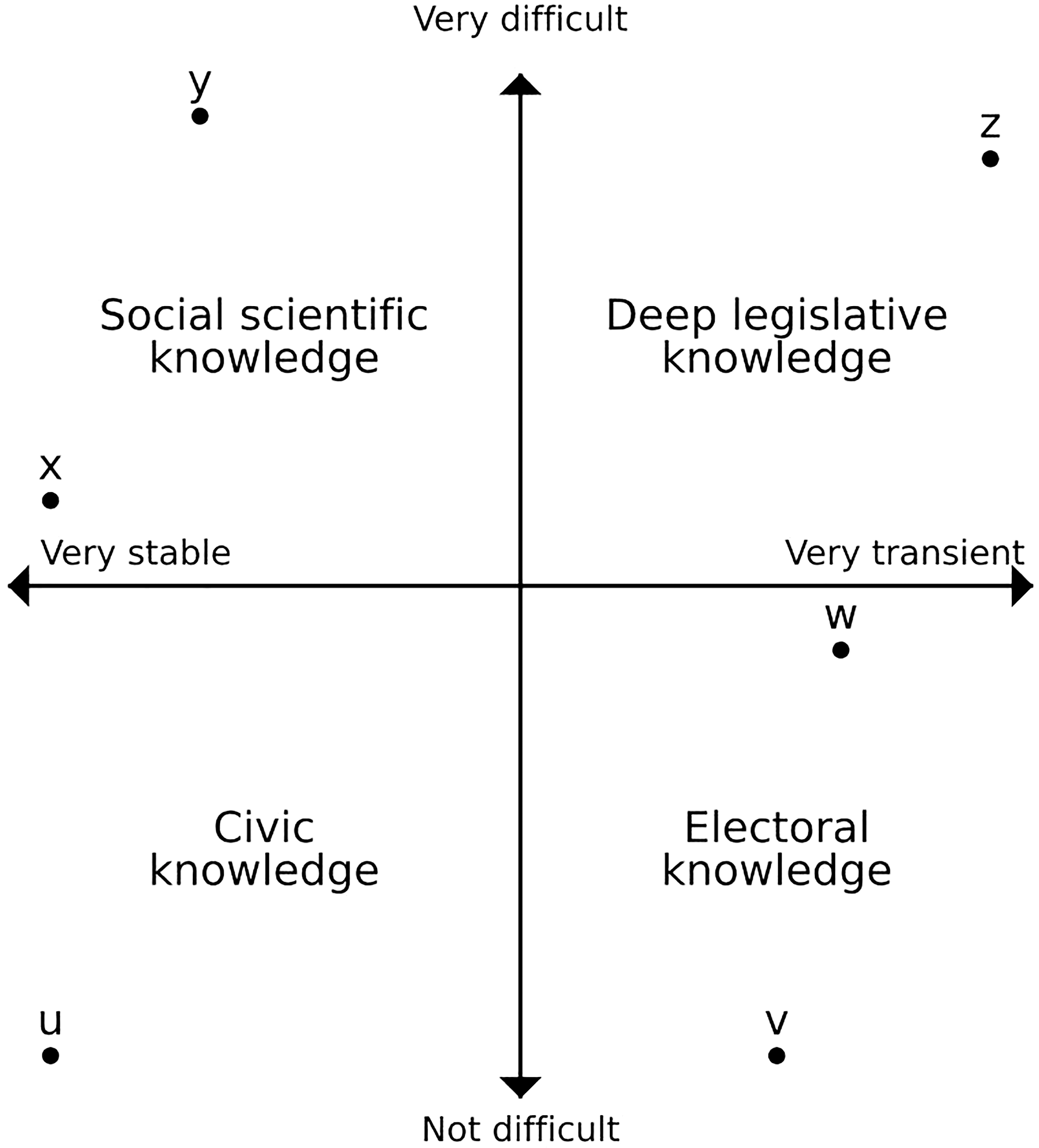
These distinctions are shown in Figure 1. Each point on the plane represents a piece of political knowledge. The y-axis represents the difficulty of acquiring political information, with positions further north indicating greater difficulty of acquisition and positions further south indicating greater ease. The x-axis represents the temporal persistence of political information, with points further east indicating more transient knowledge and points further west indicating more durable knowledge.
Visual representation of the varieties of political ignorance.

Different categories of political knowledge tend to (but do not always) cluster in distinct regions of the plane. Civic knowledge predominantly occupies the south-west quadrant, characterized by its stability and accessibility. Point u, for instance, represents knowledge of the three branches of government – a fundamental concept taught in high school civics that has remained constant throughout American history. Electoral knowledge, by contrast, typically clusters in the south-east quadrant, being similarly accessible but highly transient. An example is point v, which represents knowledge of the party affiliations of who is running in the next election.
Social scientific knowledge is often more difficult to acquire than civic and electoral knowledge, yet much of it is considerably durable. This positions it primarily in the north-west quadrant. Point x, which represents the basic theory of supply and demand, is an example. It is tricky to learn but stands the test of time. Deep legislative knowledge, occupying the north-east quadrant, presents both maximal difficulty and transience. The complexity of following Congressional proceedings, parsing 1000-page bills, and tracking continuous legislative developments makes this knowledge particularly challenging to acquire. Moreover, the information changes fast; once a spending bill is passed, legislators start on the next one. An example is point z, which is all the details of the Coronavirus Aid, Relief, and Economic Security (CARES) Act of 2020.
Although this conceptual framework groups different types of political knowledge into general regions, variation exists within each category. Not all civic knowledge shares the same level of durability and accessibility, not all electoral knowledge is equally transient or readily acquired, and so on. Point y, the Modigliani–Miller theorem, demonstrates this variation. Although it falls within the social scientific category like point x, it occupies a distinct position. Its location further north reflects its greater complexity – most readers will probably need to Google the theorem and will probably find its meaning and implications obscure. Its slight eastward shift from x acknowledges that although it remains an important theoretical contribution, it lacks the foundational status of supply and demand.
When we describe these tendencies – civic knowledge clustering in the south-west, deep legislative knowledge in the north-east, and so on – we are not suggesting rigid boundaries or absolute classifications. Exceptions defy these patterns. Point w, representing New York City’s (NYC’s) 2024 crime rate, illustrates this. Although it constitutes social scientific knowledge, it diverges from the typical north-west positioning. Although interpreting these statistics requires more sophistication than understanding basic civic facts or electoral information – placing it north of points u and v – it is less demanding than mastering theoretical principles such as supply and demand. Its transient nature, reflected in its eastern position, stems from the fact that its relevance diminishes as newer statistics emerge.
6. The scope of existing solutions
Whether a proposal to mitigate the harms of voter ignorance is ultimately effective depends on (i) what kinds of ignorance it can remedy and (ii) which kinds actually cause the various problems we face in modern democracies. We now explore these issues in greater detail. We begin in the current section by asking: what kinds of voter ignorance do our three strategies successfully mitigate?
6.1. Epistocratic voting
Epistocratic voting strategies either remove from the electorate or limit the influence of ignorant voters. Suffrage exams are the preferred method. We imagine something like this: whenever someone registers to vote, they must take an exam. How they score determines whether they can vote or how their vote is weighted (depending on which version of epistocratic voting we adopt), like how individuals must take and pass a driving test before they are issued a driver’s license. Like a driving test, we do not imagine this happening frequently. Perhaps it happens once every ten years.
With infrequent exams, it is only reasonable to test political knowledge on the western side of the plane (mostly civic and social scientific knowledge), which represents relatively stable information. If we give out licenses to vote for the next ten years, then we should ensure voters have the information they need to vote well for that time period, not only for the next six months. Driving tests ask about stable traffic laws, not which roads are currently closed. Furthermore, exams will be most effective when they focus on the south-west quadrant specifically – civic knowledge – although some very basic social scientific knowledge can be included as well (e.g., supply and demand). This is because problems arise as we move north and test information that is increasingly difficult.
When exams test difficult knowledge, the number of people who do well on the exam decreases, and the electorate shrinks. Small electorates, though, negatively impact voters’ incentives. Most tend to vote for what they think is in the national interest (Brennan Reference Brennan2016: 227). The explanation for why is that the instrumental value of voting selfishly is negligible in large electorates due to low decisiveness, so expressive preferences are incentivized (Brennan and Lomasky Reference Brennan and Lomasky1997). But in small electorates, the higher probability of decisiveness increases the expected payoff of selfish voting, outweighing expressive motives. This is supported by experimental evidence (Feddersen et al. Reference Feddersen, Gailmard and Sandroni2009). To prevent selfish voting, suffrage exams cannot test political knowledge that is too far north.
We thus have an argument for why epistocratic voting is most effective at targeting political knowledge in the south-west quadrant; infrequent testing means testing knowledge too far east is pointless, whereas concerns about small electorates means testing knowledge too far north is dangerous. We think the point about small electorates and selfish voting is difficult to contest, but there is a simple reply to our other point: increase the frequency of exams! If they occur more frequently, then we can test political knowledge further east, expanding the scope of voter ignorance that epistocratic voting can successfully address. For example, we could have a suffrage exam every election.
There are problems with this proposal. First, it would be difficult to implement in many electoral systems. Although frequent suffrage exams might be feasible in systems with fixed election dates (like the USA, where a November 3, 2026 election allows extensive planning for October testing), they pose serious implementation challenges in parliamentary systems. In these systems, elections can be triggered suddenly when governments lose confidence votes, sometimes occurring just weeks after being called. This uncertainty makes it difficult to develop, organize, and administer suffrage exams, given the significant time needed to determine exam content and handle logistics.
Second, frequent testing is costly. Developing rigorous exams, training administrators, securing testing facilities, and managing scoring systems all require resources (Kogelmann and Carroll Reference Kogelmann and Carroll2024: 10–11).Footnote 4 Although a test every ten years is manageable, conducting exams every two years or annually would multiply expenses.
Third, frequent exams may distort the political process. Determining the content of suffrage exams will inevitably spark intense political conflict, with politicians striving to craft tests that advantage their own voters and disadvantage others. Defenders of epistocratic voting recognize this (Brennan Reference Brennan2016: 223).Footnote 5 Such battles over test content would be far less destructive if fought once in a generation rather than every two years. The problem becomes even more acute when considering whether to test electoral knowledge. Questions probing civic and social scientific knowledge – identifying the three branches of government or explaining supply and demand – may generate modest controversy. But including questions about an upcoming election – such as the precise nature of Trump’s proposed immigration policy or the performance of the Biden administration – can trigger political warfare.
Frequent exams, for these reasons, are a nonstarter. But if exams are infrequent, then they cannot test much of the eastern part of the plane. And because we do not want to shrink the size of the electorate too much, they cannot test much of the northern part, either. Consequently, epistocratic voting can only remedy civic ignorance and some relatively low-level social scientific ignorance.
6.2. Voter empowerment
Voter empowerment strategies attempt to remedy voter ignorance by increasing the benefits of acquiring political knowledge. However, with all three voter empowerment strategies – paying voters to pass exams, devolving issues to the local level, and increased opportunities for foot voting – there are limits to how rewarding we can make the acquisition of political information. As a result, voter empowerment strategies will only be able to remedy some types of voter ignorance.
Consider first proposals to offer voters monetary incentives to score highly on political knowledge exams. These exams are typically envisioned by their proponents as applying to civic knowledge (i.e., the south-west quadrant). We grant that offering each voter a modest sum of money – say, $1,000 – could incentivize some of them to acquire information in the south-west quadrant. Yet the scope of this approach remains inherently constrained. Note first that it would make little sense to test knowledge on the eastern side of the plane unless tests were frequent. But as we noted in our analysis of epistocratic voting strategies, frequent suffrage exams come with many downsides. These arguments apply, mutatis mutandis, to frequent incentivized knowledge tests as well.
In response, we can offer exams testing knowledge in the north-west part of the plane (i.e., social scientific knowledge). This knowledge is difficult to acquire, however, so the benefits given to voters must be substantial to incentivize them. At some point, as we move sufficiently north, “only infeasibly large amounts of money” could prompt voters to acquire such knowledge (Gibbons Reference Gibbons2023: 15). How much would you need to pay a typical voter to learn the kind of material found in an advanced undergraduate-level economics course? Significantly more than $1,000 is our guess. Incentivizing voters to acquire moderate to advanced social scientific knowledge likely fails to pass a cost–benefit analysis. For these reasons, this voter empowerment strategy works best to incentivize knowledge acquisition in the south-west quadrant (i.e., civic knowledge), and perhaps some southern parts of the north-west quadrant (i.e., low-level social scientific knowledge).
Now consider the proposal to devolve more issues to the local level. Fewer people vote in local elections, so the probability that a single vote is decisive increases. The hope is that increased decisiveness incentivizes voters to cast their ballots with greater care than they do in national elections, leading them to acquire political information. The logic of the argument is directionally correct – all else equal, increased decisiveness should result in more informed voters – but it is an empirical question just how decisive a vote must be to incentivize knowledge acquisition. Empirically, research shows that the US voters demonstrate similar levels of voter ignorance in both local and national elections (Carpini and Keeter Reference Carpini and Keeter1996: 208; Shaker Reference Shaker2012: 532). Under current conditions, increased decisiveness in local elections fails to encourage information acquisition.
The proposal, though, is to devolve more issues to local elections to increase their importance. Perhaps the problem is not insufficient decisiveness at the local level, but rather that local issues are not high stakes enough to motivate voters to acquire information. Even if a vote had a 100% chance of being decisive, the person casting the vote might remain uninformed about issues they consider trivial – for instance, what biology textbook to adopt for an eighth-grade science class.
This response faces two challenges. First, whether the current problem with ignorance in local elections stems from low decisiveness or low stakes remains unclear; it could be that adding more important issues to the local level will not matter if the level of decisiveness remains insufficient. This is an empirical question we cannot address. Second, even supposing the issue is low stakes, there are limits to what issues can be devolved to the local level. Many issues – such as monetary policy, national defense, etc. – have significant spillover effects that make local control impractical. Indeed, it is unclear to us which (if any) high-stakes issues could be devolved to lower levels of government without creating significant negative externalities. For these reasons, we are skeptical this voter empowerment strategy can incentivize any political knowledge acquisition at all.
Turn now to foot voting. This strategy says that if we increase individuals’ opportunities to exit political jurisdictions and enter new ones, voters will search for and acquire information that may be relevant to their decision to move to another jurisdiction. Exactly what knowledge individual voters acquire depends on what motivates their search for a new jurisdiction. In some cases, they will be motivated for non-political reasons, such as warmer weather, proximity to family, etc. In these cases, we should not expect foot voting to lead to the acquisition of any political knowledge.
In other cases, political considerations will motivate a voter to exit one jurisdiction for another. A voter might be unhappy with the quality of public schools in her district. Before she moves, she will spend a great deal of time researching schools in nearby jurisdictions that are feasible for her to move to, given her other constraints. Because her decision to move, unlike voting, will have a definite impact on her life, the benefits of acquiring information about rival school districts are immense. She will not be deterred from acquiring information in the northern area of the plane. If she needs to read some technical social science comparing school performance, she will. If she needs to look up a few provisions in an education bill, she will. We also see no reason for her to focus only on durable information. If transient information on the eastern part of the plane is relevant to her decision, she will acquire it.
From what we have said so far, one might think that foot voting incentivizes knowledge acquisition of the whole plane. This is incorrect. In principle, it can incentivize knowledge acquisition anywhere on the plane, but in practice it will incentivize knowledge acquisition only in the narrow domain relevant to the voter’s decision of whether to exit her current jurisdiction. The voter’s motive to find better schools can lead her to acquire very narrow bits of highly technical social scientific and deep legislative knowledge, and it may motivate her to acquire narrow bits of electoral knowledge as well. But this approach will not lead her to acquire any other political knowledge. If her decision to exit is based on school quality, she has no reason to learn about trade policy or foreign affairs.
What does this mean for the problem of voter ignorance more generally? Our voter will be able to vote well when it comes to issues of education policy, but not on much else. If confronted with two candidates, perhaps she can reliably pick the one with a better education policy, but she may still pick someone with disastrous foreign or trade policy. Foot voting thus encourages the acquisition of narrow pockets of political information all over the plane, but not much beyond that.
6.3. Voter education
Voter education strategies remedy voter ignorance by lowering the costs of acquiring political knowledge. In principle, such measures could focus on all four kinds of political knowledge. They are most promising for information in the southern part of the plane, where the information is already relatively accessible and could be made even more so with the right presentation. For example, social media accounts can create infographics that explain the three branches of government or introduce political candidates. Voter education strategies, however, are likely to be ineffective for the northern regions of the plane. Specifically, we argue that the necessary simplification that educational strategies entail come with serious costs for these kinds of political information.
First, there are limits to how much we can simplify complex information. Consider comparative advantage. Although a bureau or journalist could state that most economists believe that free trade benefits all parties, explaining why it does requires understanding opportunity costs, the effects of the division of labor, the importance of extensive markets, and more. Our students struggle with these concepts after weeks of study. They cannot be reduced to soundbites without loss of meaning.
Second, simplification of complex information is more prone to distortion by political bias. Decisions about what details to omit and how to present information can be driven by partisan motives rather than educational goals. These partisan motives can be conscious or latent. For example, when explaining trade policy, a politically motivated bureau or journalist might emphasize job losses in specific industries while omitting data about overall consumer benefits from lower prices. These kinds of misleading presentations depend on these issues’ inherent complexity. It is more difficult to explain the three branches of government or the powers of Congress in a biased manner.
Third, there are limits to how much we can simplify large volumes of information. This is especially relevant for deep legislative knowledge. A social media summary of a 1,000-page bill must necessarily omit most of the bill’s content. And as with complex information, summaries of large amounts of information can be misleading, whether deliberately or not. An infographic summary of a 1,000-page healthcare reform bill, for instance, might highlight insurance subsidies for one demographic while omitting increased costs for others, or it could emphasize the reduced price of healthcare without mentioning that the bill would also shrink a patient’s network of available doctors.
Voter education strategies may have some positive impact on the southern part of the plane, increasing voters’ civic and electoral knowledge. However, we are skeptical it can remedy voter ignorance in the northern part, failing to increase voters’ social scientific and deep legislative knowledge.
7. Remedying voter ignorance: a reassessment
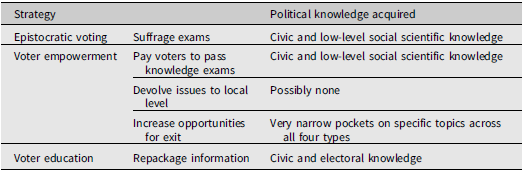
The prior section examined the kinds of voter ignorance that our three strategies can mitigate. The results are summarized and shown in Table 1. The first thing to note is that some of our strategies are substitutes. For example, limiting the influence of ignorant voters and paying voters to pass knowledge exams address the same kinds of ignorance. A second implication is that some of our strategies are complements. For example, paying voters to pass knowledge exams and repackaging political information jointly address a wider swath of voter ignorance than either strategy addresses on its own. But the key takeaway is that some forms of voter ignorance – most notably moderate to advanced social scientific ignorance and deep legislative ignorance – are not addressed by any existing strategy. Even if all strategies were implemented simultaneously, substantial voter ignorance would remain, which could result in significant policy failures.
The efficacy of proposed strategies.

Table 1. Long description
A table with two columns and five rows comparing political knowledge acquired through different strategies. The columns are labeled ‘Strategy’ and ‘Political knowledge acquired’. The rows are as follows: Row 1: Epistocratic voting; Suffrage exams; Civic and low-level social scientific knowledge. Row 2: Voter empowerment; Pay voters to pass knowledge exams; Civic and low-level social scientific knowledge. Row 3: Voter empowerment; Devolve issues to local level; Possibly none. Row 4: Voter empowerment; Increase opportunities for exit; Very narrow pockets on specific topics across all four types. Row 5: Voter education; Repackage information; Civic and electoral knowledge.
However, would not eliminating civic, electoral, and low-level social scientific ignorance yield substantial benefits? It is hard to say, for we do not know which forms of voter ignorance are responsible for which policy failures. Almost any bad policy, after all, admits multiple causal explanations. Consider an example. Many who worry about voter ignorance also embrace free trade, decrying protectionism (Brennan Reference Brennan2016: 145, 156, 193; Somin Reference Somin2013: 59). For the sake of argument, we grant this is the correct normative position. Many democracies do indeed place restrictions on free trade, however. Why?
Electoral ignorance might explain it. Voters might not know the details of candidates’ trade policies. They might not know which parties tend to support free trade and which parties are protectionist. As a recent example of this, if you search “Trump tariff” using Google trends, you find a spike in people searching for this term immediately after Trump won the 2024 Presidential Election on November 5, 2024, suggesting that many voters did not know the details of Trump’s trade policies before the election. Social scientific ignorance can also explain it. Voters might have false beliefs about free trade. They might believe free trade is bad for growth, but the opposite is true.
Or maybe deep legislative ignorance explains it. Domestic industry seeks protection from international competition. In exchange for campaign contributions, politicians implement protectionist policies. Voters do not know about this because the tariff is buried in a 1,000-page bill that they never read. Moreover, when they pay higher prices on the protected goods, it is not clear to them why this is happening; they are ignorant that a tariff on those goods exists. Finally, civic ignorance might explain it. Voters might not understand how trade policy is made. As a result, they vote for a presidential candidate who says he will impose tariffs, believing he lacks the authority to do so. In fact, the chief executive has significant unilateral powers over trade, delegated by Congress.
Which forms of voter ignorance are responsible for which policy failures is therefore often unclear. Nor is it clear how to empirically resolve this ambiguity. This is a different task from simply measuring voter ignorance, as ignorance can be present without being causally efficacious. Voters may be ignorant of the economics of free trade, for example, but in a counterfactual world in which they possess that knowledge, they might still support protectionist politicians for entirely different reasons (e.g., due to their deep legislative ignorance). To establish that a particular form of ignorance causes a particular policy failure, we would need to show not merely that the ignorance exists, but that mitigating it would change political outcomes. We are unaware of any empirical work that accomplishes this, and we struggle to see what empirical strategy could reliably do so.
Thus, we simply do not know how much good would result from implementing existing strategies to mitigate civic, electoral, and low-level social scientific ignorance. It is possible these reforms would eliminate many bad democratic policies. It is possible they would have a small effect. Indeed, it is possible that even if all existing solutions were implemented simultaneously, they would literally make no progress toward good policy.
This uncertainty should make us hesitant to pursue the proposed reforms to mitigate voter ignorance because they are not costless. Many proposals – such as suffrage exams, paying voters to acquire information, or creating new bureaucratic institutions – would be expensive to implement. Others, such as increased federalism or devolving policy decisions to lower levels of government, may generate undesirable side effects. Excessive interjurisdictional competition, for example, could trigger a “race to the bottom.” Finally, some proposals – particularly those that exclude certain individuals from the electorate – carry significant moral costs (Kogelmann and Carroll Reference Kogelmann and Carroll2024: 12–13). Bearing these costs (and others) to secure what may be little to no benefit seems difficult to justify.
What, then, should we do? We see three options. The first is to develop policies that ensure voters acquire moderate to advanced social scientific knowledge as well as deep legislative knowledge. If such policies could be devised and implemented alongside existing strategies, then all major forms of voter ignorance would be mitigated. In that case, we would no longer need to worry that existing strategies fail because they target the wrong forms of ignorance. By eliminating all forms of voter ignorance, we would eliminate the uncertainty surrounding which forms of ignorance are causally responsible for bad policy. The difficulty here is that this strategy requires that we identify policies that are actually capable of remedying moderate to advanced social scientific ignorance and deep legislative ignorance. At present, we have no plausible proposals for accomplishing this.
The other two paths forward begin from a different premise: that we should abandon the project of trying to mitigate voter ignorance. Given that we do not know how to mitigate some forms of voter ignorance – moderate to advanced social scientific ignorance and deep legislative ignorance – perhaps the better approach is to design political institutions that do not depend on informed voters to function well.
One way to do this is to eliminate voters. This is the approach taken by Confucian meritocrats, who argue that political leaders should be selected through nondemocratic mechanisms such as examinations (Bai Reference Bai2020: 75), records of public service (Bell Reference Bell2015: 104), or peer selection (Chan Reference Chan2014: 108). Lottocrats adopt a different selection mechanism but arrive at a similar conclusion. They argue that political leaders should be selected by lot rather than through elections (Guerrero 2014; Reference Guerrero2024; Landemore Reference Landemore2026). These approaches are not without their own difficulties. A variety of objections have been raised against both Confucian meritocracy (e.g., Bagg Reference Bagg2018; He and Warren Reference He and Warren2020; Mang Reference Mang2020) and lottocracy (e.g., Kogelmann Reference Kogelmann2026b; Lafont and Urbinati Reference Lafont and Urbinati2024; Landa and Pevnick Reference Landa and Pevnick2025). At the very least, though, because political leaders are not chosen by voters, the quality of voter beliefs is irrelevant to the functioning of the system. This is the voter elimination strategy.
A second approach retains elections but seeks to design institutions – particularly at the constitutional level – that encourage political actors to behave in broadly desirable ways, or at least prevent them from behaving in especially harmful ways. This is the approach favored by many public choice economists who, recall from §4, motivated our interest in deep legislative ignorance (Brennan and Buchanan Reference Brennan and Buchanan2000). Because voters cannot be relied upon to possess the knowledge necessary to reward good and punish bad behavior, public choice theorists argue that constitutional rules should be designed so that political actors have incentives to behave appropriately regardless of how voters cast their ballots. Some examples:Footnote 6
-
• Constitutionally ban the state from passing legislation that targets specific industries, allowing only economy-wide regulation (Buchanan and Congleton Reference Buchanan and Congleton2003). For example, tariffs for specific industries – such as sugar – are impermissible; the state can only legislate a general tariff rate.
-
• Constitutionally limit the size and scope of government through devices such as balanced-budget requirements or caps on government spending as a percentage of gross domestic product (GDP) (Buchanan Reference Buchanan1995).
-
• Constitutionally require politicians to rely only on public services – such as public schools and public hospitals – whenever they are available (López-Guerra Reference López-Guerra2017).
-
• Constitutionally tie politicians’ compensation to certain country-wide performance indexes, such as GDP growth, literacy rates, the Gini coefficient, or others (Juarez-Garcia and Schaefer Reference Juarez-Garcia and Schaefer2023).
-
• To limit the undue influence of donors and special interest groups, constitutionally require legislators to vote by secret ballot when they vote on legislation (Kogelmann Reference Kogelmann2021: Ch. 2).
This is only a small sample of the many ways constitutions can be designed to encourage desirable political behavior in the face of ignorant voters. Like the voter elimination strategy, this approach sidesteps the problem of voter ignorance by reducing the extent to which political outcomes depend on the quality of voter beliefs. Rather than attempting to create informed voters, it seeks to render voter ignorance less consequential. This is the constitutional insulation strategy.
Given the failure of the epistocratic voting, voter empowerment, and voter education strategies to address the varieties of voter ignorance, we believe that the two alternatives just described – the voter elimination and constitutional insulation strategies – deserve the bulk of political philosophers’ attention. Both approaches abandon the attempt to create a sufficiently informed electorate and instead seek to design political institutions that can function well despite widespread political ignorance among the population. The only other option, one we do not think is especially promising, is to identify ways to mitigate the forms of ignorance that currently resist existing remedies: namely, moderate to advanced social scientific ignorance and deep legislative ignorance.
Acknowledgments
Adam Gibbons received funding from the Early Career Scheme of the University Grants Committee (UGC) of Hong Kong for the project “Why not Epistocracy?” (ECS Project Number 23607124). The authors used AI tools for copyediting. The substance of the article – its thesis, arguments, examples, and so on – was developed solely and entirely by the authors.

 Open access

