Implications
Dairy cattle farming in organic production system aims on alternative breeding goals achieved by alternative breeding strategies. This aim is due to substantial differences with regard to the general herd management, demands of organic producers and demands of consumers. Bulls preferred in organic herds either can be selected from conventional breeding programs, or they can be directly selected within the organic population. The small population size of organic populations has detrimental impact on accuracy of selection in progeny testing programs. Implementation of genomic selection specifically within organic populations revealed the potential to increase genetic gain, to use natural service bulls with moderate accurate genomic breeding values, and to focus on novel traits that are not routinely recorded in conventional populations.
Introduction
Population structure, breeding strategies and breeding goals might differ in organic production systems. Especially for organic or low input dairy cattle farming, new functional health traits play an important role (Rozzi et al., Reference Rozzi, Miglior and Hand2007). Examples are temperament and other behavior traits, feed intake and a broad variety of health traits including the compound traits claw disorders, mastitis and metabolism, which are generally not yet used for official national genetic evaluations. However, due to the comparatively small population size, implementation of an own or independent organic progeny testing program for novel traits is associated with reduced genetic gain and with negative impact on economic evaluation criteria, for example lower discounted return and lower discounted profit (Hunt et al., Reference Hunt, Burnside, Freeman and Wilton1974). In consequence, organic dairy cattle farmers have continued with the use of semen from progeny tested sires or from young bulls from conventional dairy cattle breeding programs. Allowing gene flow from high input to low input environments might be associated with genotype by environment (G×E) interactions (König et al., Reference König, Dietl, Raeder and Swalve2005). Furthermore, only a few routinely recorded indicator traits are used to improve dairy cattle health by breeding. For example, somatic cell count (SCC) has been used in conventional breeding programs as an indicator trait for mastitis over decades, but genetic correlations between somatic cell score and clinical mastitis only range between 0.60 and 0.70 (e.g. Emanuelson et al., Reference Emanuelson, Danell and Philipsson1988).
Genomic selection (GS) offers new perspectives for the inclusion of novel functional traits in organic dairy cattle breeding programs. For health traits, large calibration groups of progeny tested bulls with highly accurate estimated breeding values (EBV) do not exist. Large data sets with health phenotypes (e.g. directly recorded clinical mastitis) are only available from Scandinavia (Heringstad et al., Reference Heringstad, Klemetsdal and Ruane2000) for Norwegian Red, and from Austria (Egger-Danner et al., Reference Egger-Danner, Fuerst-Waltl, Obritzhauser, Fuerst, Schwarzenbacher, Grassauer, Mayerhofer and Koeck2012) for dual purpose Simmental cows. For those scarcely recorded traits, older proven bulls as used in ‘conventional’ Holstein–Friesian or Brown Swiss reference populations, do not have reliable EBVs based on daughter records. As a solution, Buch et al. (Reference Buch, Kargo, Berg, Lassen and Sørensen2011) suggested to set up calibration groups of cows, and to use phenotypes instead of conventional sire EBVs as dependent variables for deriving genomic estimated breeding values (GEBV). With this strategy, for the same number of animals in the reference population, accuracies of GEBV were higher compared with the use of sires with lowly reliable EBV. Consequently, some breeding programs started to implement reference groups of cows for novel traits. One example strongly related to the current study, is the reference group including almost 1200 Brown Swiss cows mostly from organic farms in Switzerland within the framework of the ‘LowInputBreed’ project.
In contrast to restrictions regarding the use of some reproduction biotechnologies such as embryo transfer (Nauta et al., Reference Nauta, Groen, Veerkamp, Roep and Baars2005), the molecular tool of GS is generally accepted in organic dairy cattle breeding schemes. As a side effect, the implementation of GS will benefit natural service bulls. Natural service bulls are frequently used in organic dairy cattle farming, because artificial insemination (AI) conflicts with natural mating behavior, and is as such considered by some organic organizations to have negative impact on animal welfare and integrity (Rutgers et al., Reference Rutgers, Grommers and Colenbrander1996). When implementing GS, accuracies of GEBVs of natural service bulls will be competitive with accuracies of GEBVs of sires offered for AI worldwide.
In summary, improvement of novel traits in small organic populations can be realized via (i) selecting bulls from conventional breeding programs, but taking into account G×E interactions, (ii) implementing an own organic genomic breeding program and using genotyped bulls for AI or (iii) implementing an own organic genomic breeding program, and using genotyped natural service bulls only. In the present study, these breeding strategies were compared by applying stochastic simulations and evaluating true breeding values (TBV) and inbreeding coefficients of selected bulls and their offspring in the next generation.
Material and methods
Stochastic simulation
Analogous to a previous study (Wensch-Dorendorf et al., Reference Wensch-Dorendorf, Yin, Swalve and König2011), which assessed the general effect of pre-selection in genomic breeding programs, the QMSim program (Sargolzaei and Schenkel, Reference Sargolzaei and Schenkel2009) was used to simulate a dairy cattle population including 150 000 cows. Using QMSim, populations with 20 generations under selection were simulated. Replacement rates for AI sires and cows were 50% and 25%, respectively. Selection and culling criteria for both males and females were EBV. Within the fraction of selected males and females, random mating was applied.
A considerable part of the simulation of breeding program designs was conducted by first applying QMSim. In a 2nd step, we modified the QMSim output and enhanced the simulation process via own programming to study specific scenarios with relevance to organic breeding. For studying aspects of breeding program designs in various scenarios, GEBV were ‘imitated’ using a strategy as proposed by Wensch-Dorendorf et al. (Reference Wensch-Dorendorf, Yin, Swalve and König2011) for saving computing time and reducing working memory. In detail, TBV from the QMSim output and pre-defined correlations between TBV and GEBV referred to accuracy of GEBV (r mg) were used to calculate GEBV by applying the following formula (1):
 $$\eqalignno{GEBV_{i} =\left( {\left( {{\rm 1}{\minus}r^{{\rm 2}} _{{{\rm mg}}} } \right)^{{{\scale60%{\vskip-8pt1}{\hskip-2.1pt\vskip-5.7pt\rot160/}{\scale60%{\hskip-3pt\vskip-3pt2}}}}} RND{\plus}r_{{{\rm mg}}} \cdot {\rm }TBV_{i} /{\rm s}{\rm .d}{\rm .}\left( {TBV_{t} } \right)} \right)\cr \quad\ \ \times {\rm s}{\rm .d}{\rm .}\left( {TBV_{t} } \right)$$
where GEBV i is the GEBV of animal i, r mg is the accuracy of the genomic breeding value altered in the range from 0.5 to 1.0, TBV i is the TBV of animal i, s.d. (TBV t ) is the standard deviation of TBV in generation t, and RND is a random variable sampled from n(0, 1).
Formula (1) was also used to consider the aspect of G×E interactions by altering genetic correlations (r g) of the same trait between the conventional and the organic environment. For bulls selected in the conventional population, and subsequently used in the organic population, TBV were modified (mTBV) by altering r g in the range from 0.5 to 1.0. Alteration of TBV reflects the physiological background of G×E interactions, that is the change of an animals’ true genetic value with altered gene effects on the trait of interest in changing environments. Consequently, formula (2) for calculating mTBV was:
 $$\eqalignno{mTBV_{i} =\left( {\left( {{\rm 1}{\minus}r^{{\rm 2}} _{{\rm g}} } \right)^{{{\scale60%{\vskip-8pt1}{\hskip-2.1pt\vskip-5.7pt\rot160/}{\scale60%{\hskip-3pt\vskip-3pt2}}}}} RND{\plus}r_{{\rm g}} \cdot {\rm }TBV_{i} /{\rm s}{\rm .d}{\rm .}\left( {TBV_{t} } \right)} \right)\cr \quad\ \ \times {\rm s}{\rm .d}{\rm .}\left( {TBV_{t} } \right)$$
with parameters as defined above.
TBV for progeny of bulls (pTBV) in the organic population were calculated according to formula (3):
 $$\eqalignno{pTBV_{i} ={\rm 0}{\rm .5 (}TBV_{{\rm b}} {\plus}TBV_{{\rm d}} {\rm )}\cr {\plus}\sqrt {{\rm 0}{\rm .5}{\minus}{\rm 0}{\rm .25}\,{\rm ( }F_{{\rm b}} {\plus}F_{{\rm d}} {\rm )}} \sigma _{{\rm a}} \cdot RND$$
where pTBV i is the TBV of progeny i in the organic population; TBV b is TBV of bull b (when directly selected in the organic population) or mTBV (when selected in the conventional population) of progeny i, TBV d is the TBV of dam d of progeny i; F b and F d are inbreeding coefficients of sire and dam of progeny i, respectively; σ a is the standard deviation of additive genetic variance of the trait in question, and RND the random variable sampled from n(1, 0). Simulation was performed for a low heritability trait (h 2=0.05), and for a moderate heritability trait (h 2=0.30).
Breeding program scenarios
With the aim of studying the impact of genotyped natural service sires on both evaluation criteria, genetic gain and inbreeding coefficient, we assigned cows and bulls to individual herds. This was done to fulfill the restriction of matings to bulls recruited from the same herd only. Cows in the conventional population were distributed to 2976 different herds with an average herd size of 50 cows per herd. A total of 1200 organic cows were distributed to 60 different organic herds with an average herd size of 20 cows per herd, depicting the current organic and low-input population structure of the Brown Swiss breed in Switzerland (Yin et al., Reference Yin, Bapst, von Borstel, Simianer and König2012). In total, five different breeding strategies were defined to select bulls for their use in the organic population (Table 1). All strategies followed a young bull program as defined for example by Oltenacu and Young (Reference Oltenacu and Young1974), which implies a comparison of scenarios for identical generation intervals. The chosen breeding scenarios reflect the practical background, concerns and limitations of breeding in organic production systems. First, our simulation depicted the disadvantage of a small organic population size. Scenarios labeled O_* imply to select young bulls directly and only within organic herds. In addition to the small population size, organic farming is characterized by smaller herd sizes (Yin et al., Reference Yin, Bapst, von Borstel, Simianer and König2012) than conventional herds. Scenarios labeled C_* imply selection of bulls from conventional progeny testing programs or conventional genomic breeding programs. A major question when selecting bulls from conventional breeding programs for the organic use addresses the existence of any G×E interactions. The 2nd concern of organic breeders addresses the use of reproductive biotechnologies, and the preference of breeders to use natural service bulls instead of AI sires. Comparative scenarios are labeled using the endings *_AI (selected young bulls are used for AI in the organic population) or *_NS (natural matings of selected bulls are restricted to cows from the same organic herd). A 3rd topic addresses the use of data from molecular origin for GS applications in organic breeding programs. Despite concerns, organic breeders also see the prospects to improve novel functional traits when implementing calibration groups of cows. Here, we distinguished scenarios between the selection of young bulls based on conventional EBVs labeled as *_EBV_*, or based on GEBVs labeled as *_GEBV_*. As illustrated in Table 1, main characteristics of breeding program scenarios were as follows: in the 1st two scenarios (C_EBV_AI and C_GEBV_AI), five young bulls were selected in the 2976 conventional herds. Corresponding selection criterions were EBV and GEBV, respectively. Afterwards, selected bulls were used for AI in the organic population. Selected young bulls in scenario C_EBV_AI were sons of influential proven sires with on average 500 daughters per sire. Without daughter information at this point of selection, the EBV of the young bull can be interpreted as a pedigree index. This scenario reflects the traditional situation, meaning that young bulls without daughter records were used for ~30% of inseminations in conventional progeny testing programs. G×E interactions in the first and second scenario were mimicked by altering genetic correlations in the same between two production systems in the range from r g=0.5 to 1 in increments of 0.1. The last three scenarios (O_GEBV_AI, O_GEBV_NS and O_EBV_NS) were carried out by selecting bulls directly in the small organic population and neglecting G×E interactions, that is fixing the genetic correlation to r g=1. In scenario O_GEBV_AI, five young bulls were selected for their use in an organic AI program only in the organic population based on GEBV. In scenario O_GEBV_NS and scenario O_EBV_NS, the selection criterion for natural service bulls within herds were GEBV and EBV, respectively. The five selected AI bulls were used with equal frequencies in the organic production system, but the selected natural service bulls were mated with cows of the particular herd only. To account for practical circumstances, matings between close relatives (bull – dam, bull – grand dam, bull – full-sib, bull – half-sib) were not carried out. This implies the availability of at least two selected natural service bulls per herd. A further detailed comparison was made between scenario O_GEBV_NS and an identical genomic scenario, but without mating restrictions (O_GEBV_NS_II). Evaluation criteria were average TBV of selected bulls (when the bull was directly selected in organic environment), mTBV (when the bull was selected in the conventional population) and the average pTBV of their progeny in the next generation. In addition to TBVs, inbreeding coefficients of bulls and their progeny were monitored. For this objective, the software package ‘Pedigreemm,’ (subroutine of the R 2.11.1-version by Bates and Vazquez, Reference Bates and Vazquez2009), was used.
Characteristics of the five simulated breeding program scenarios

EBV=conventional estimated breeding value; GEBV=genomic estimated breeding value.
×: accuracy is not available for the scenario (i.e. a scenario without GEBV).
1 All bulls were selected for the use in the organic population.
2 Genetic correlation in the same trait between the conventional and the organic production systems for representing G×E interactions.
Results and discussion
TBV of selected bulls and their progeny
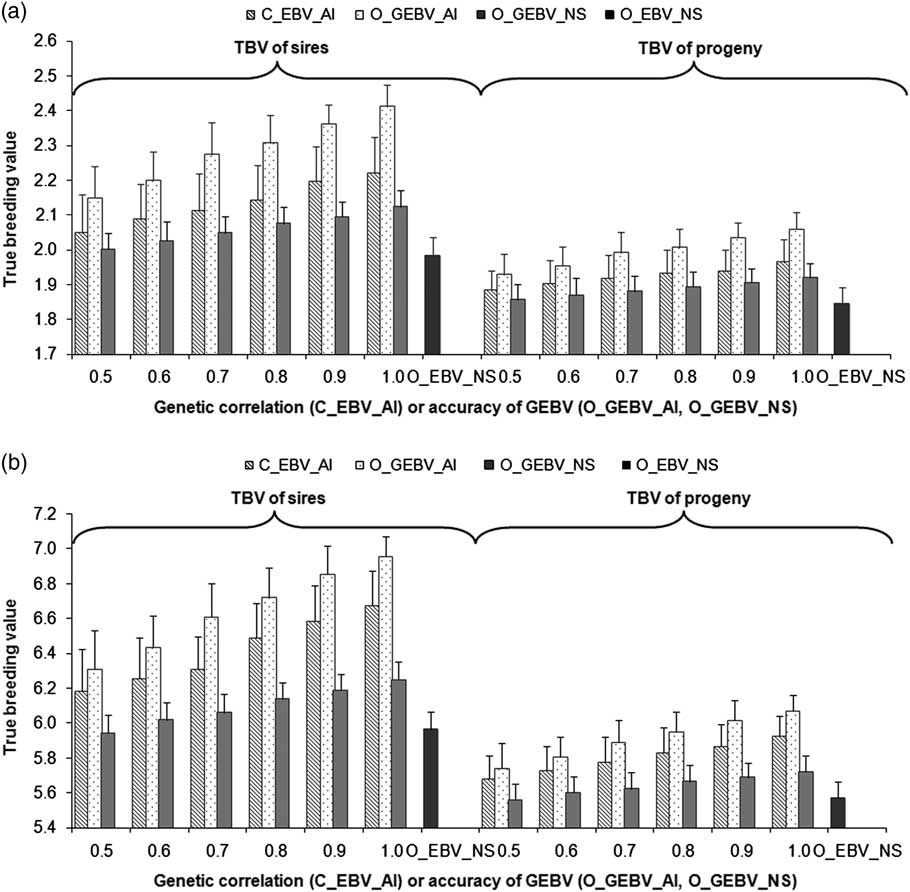
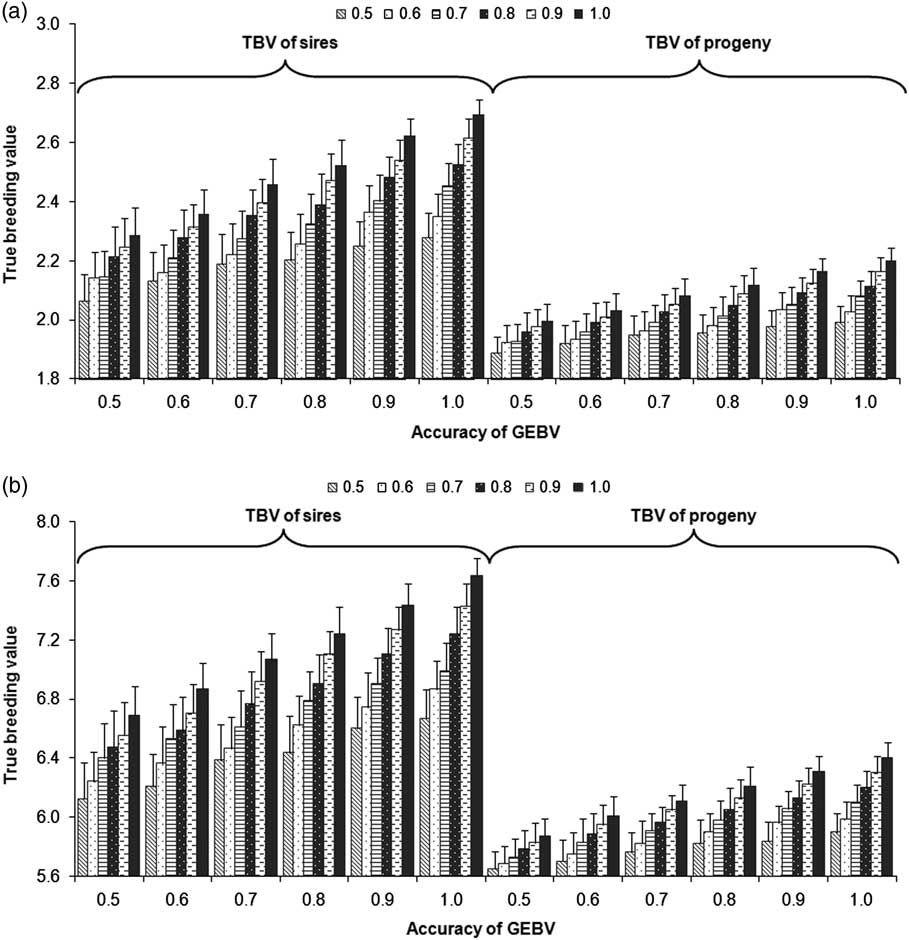
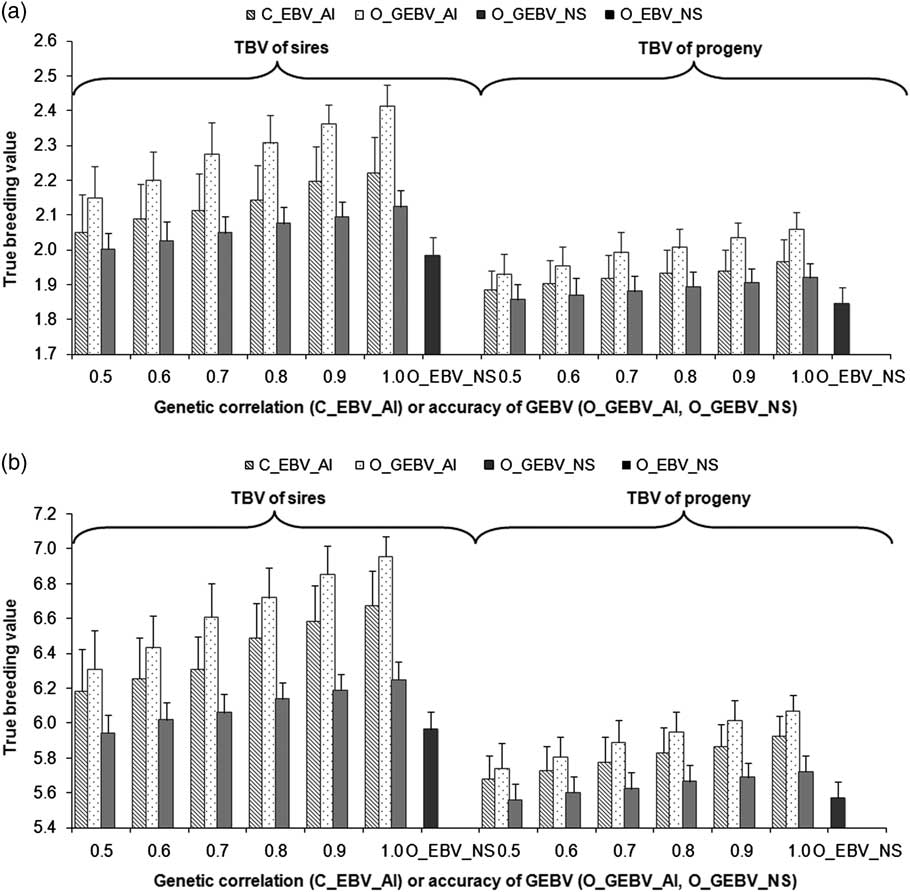
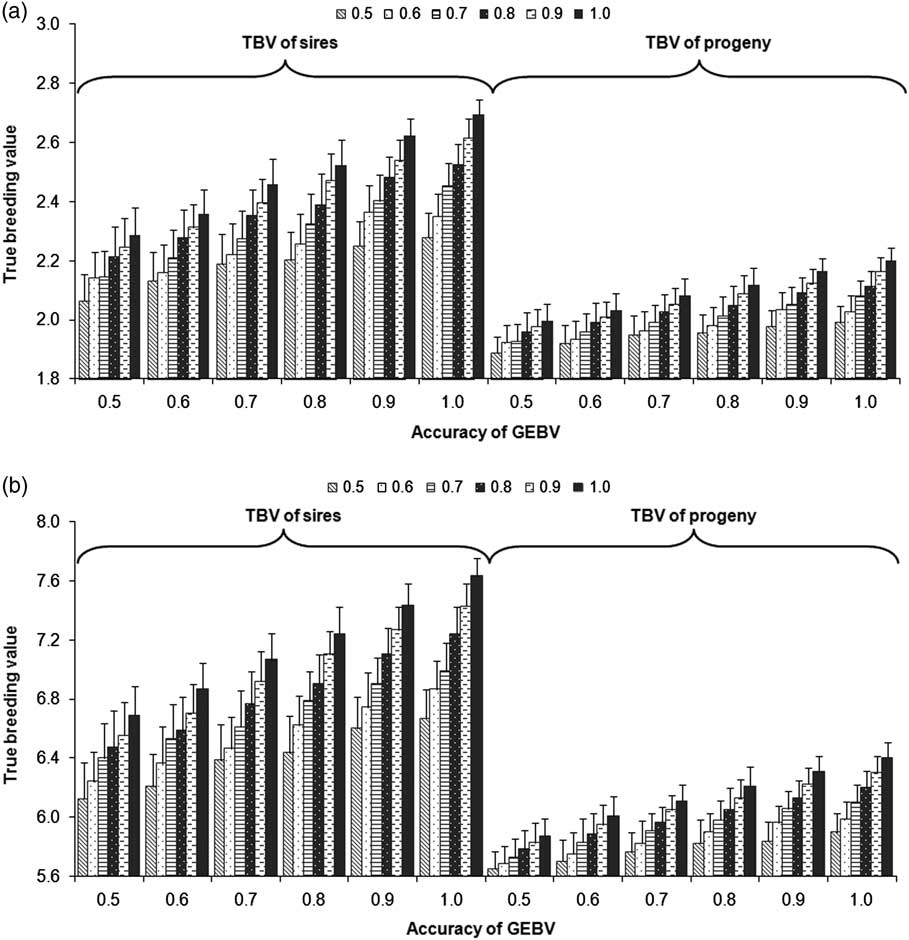
A comparison of average TBV and average mTBV (hereafter generally named average TBV) of selected bulls and their progeny after one round of matings with organic cows for four different scenarios (C_EBV_AI, O_GEBV_AI, O_GEBV_NS and O_EBV_NS, respectively) is given in Figure 1a for h 2 =0.05, and in Figure 1b for h 2=0.30. Results of the more complex scenario C_GEBV_AI are shown in Figure 2a, for h 2 =0.05 and Figure 2b for h 2 =0.30. Same trends of increasing average TBV with increasing r mg or increasing r g are depicted for the low and the moderate heritability trait, for bulls as well as for their progeny. As expected, genetic gain, expressed in TBV, was higher for the trait with higher heritability. In order to ease interpretation of results, it should be noted that s.d. of TBV for all male selected candidates in the last generation was s.d.=0.20 for h 2=0.05, and s.d.=0.49 for h 2=0.30. For h 2=0.05 and r mg⩾0.7, or h 2=0.3 and r mg⩾0.8, scenario O_GEBV_AI revealed highest TBV (Figure 1a and b). Hence, from a more practical point of view and with a focus to improve low heritability functional traits, selecting five bulls with an accuracy of GEBV of value 0.7 or higher directly in the organic population, and afterwards used via AI, will ensure highest genetic gain. Average TBV from scenario O_GEBV_AI for r mg=0.7 was even higher compared with a young bull program in the conventional population, that is when neglecting G×E interactions (r g=1.0). For identical r mg, and when directly selecting young bulls in the organic population, the ‘genomic AI scenario’ (O_GEBV_AI) always revealed higher genetic gain compared with the ‘genomic natural service bull scenario’ (O_GEBV_NS).
Average and standard deviation of the true breeding value of selected bulls and their progeny for four different scenarios (C_EBV_AI, O_GEBV_AI, O_GEBV_NS, O_EBV_NS as explained in Table 1) for h 2=0.05 (a) and for h 2=0.30 (b).
Average and standard deviation of the true breeding value of selected bulls and their progeny for scenario C_GEBV_AI (explanation: Table 1) for h 2=0.05 (a) and h 2=0.30 (b). r g=genetic correlation in the same trait between conventional and organic production system.
For both heritabilities and all breeding scenarios, average TBV of bulls were throughout higher than pTBV of their progeny. Selecting just five bulls out of 74 400 selection candidates in the conventional population, but also out of 600 candidates in the organic population, imply very high selection intensities of i=4.05 and 2.73, respectively. The strong relationship between such an intensive selection of young bulls for AI and their TBV was shown by König et al. (Reference König, Yin, Wensch-Dorendorf and Swalve2011). Several theoretical investigations supported the dominant role of the male pathways of selection in dairy cattle breeding programs (e.g. Van Tassel and Van Vleck, Reference Van Tassel and Van Vleck1991). However, sires were selected based on EBVs or GEBVs for a single trait, whereas in practical breeding programs, realized selection intensities are lower than expected selection intensities due to a multitude of additional phenotypic selection criteria, which not necessarily reflect the genetic value of selection candidates (König et al., Reference König, Lessner and Simianer2007). Only a strong focus of selection on one target trait resulted in realized selection intensities on the cow-sire pathway close to theoretical expectations. One classical example is the rigorous selection on SCC when graduating cow sires in Sweden (Powell et al., Reference Powell, Sanders and Normann2003). Selection intensity of cows in the present study was low (i=0.55) comparing to sires. Hence, cows with lower genetic merit were used for matings with young bulls. Consequently, average pTBV of offspring were lower than TBV of their bulls.
Natural service bull scenarios (O_GEBV_NS and O_EBV_NS) were generally not competitive with breeding scenarios based on AI (C_EBV_AI and C_GEBV_AI). Only for pronounced G×E interactions between the organic and the conventional population (r g=0.5), and highly accurate GEBV (r mg⩾0.9), the average TBV in scenario C_EBV_AI was lower than in scenario O_GEBV_NS. However, the low genetic correlation in the same trait between production systems and the very high accuracy of GEBV are not consistent with practical results. König et al. (Reference König, Dietl, Raeder and Swalve2005) gave an overview on estimates of genetic correlations in same traits across countries, or between different production systems within countries. Pronounced indications for G×E interactions for production traits with r g=0.5 or lower were only found for countries characterized by substantial, climatic differences, for example Kenya v. United Kingdom (Ojango and Pollot, Reference Ojango and Pollot2002). When grouping herds into different subsets according to average production levels or intra-herd-variances within countries, lowest genetic correlations were in the range from 0.75 to 0.80 (e.g. Calus et al., Reference Calus, Groen and de Jong2002). Estimates of genetic correlations for low heritability reproduction traits (days open, days to 1st service and number of services per conception) between the two environments were high and not significantly different from unity (Kearney et al., Reference Kearney, Schutz and Boettcher2004).
Accuracy of GEBV is moderate to high when GS is based on a large set of bulls in a calibration group. For new traits especially in rare breeds or in small, low input populations, large calibration groups of sires with highly reliable conventional EBV do not exist. The only alternative would be to base GS on a calibration group of cow phenotypes, but 1st results revealed comparably low values for r mg. Veerkamp et al. (Reference Veerkamp, Berry, Wall, de Haas, McParland, Coffey and Calus2011) used 1841 genotyped cows and 194 genotyped sires. Accuracies of direct genomic values ranged from 0.40 to 0.58 for milk, fat and protein yield. In the study by Verbyla et al. (Reference Verbyla, Calus, Mulder, de Haas and Veerkamp2010), 527 genotyped Dutch Holstein–Friesian heifers with records for rare phenotypes were the base for estimating direct genomic values for energy balance. The small number of phenotypes in the calibration group resulted in a low value of r mg=0.29. Those first results, and the general dependency of r mg on the number of phenotypes in the calibration group (e.g. Goddard, Reference Goddard2009), should be kept in mind when comparing average TBV of selected bulls from the ‘organic genomic breeding strategies’ O_GEBV_AI and O_GEBV_NS to the ‘conventional selection strategy’ C_EBV_AI conducted in the conventional population (Figure 1a and b).
In addition to the size of the calibration group, the heritability of the trait is a crucial parameter determining accuracy of genomic evaluations. Heritability also has a strong impact on the accuracy of conventional EBV. Correlations between EBV and TBV for proven sires in the conventional population with on average 500 daughter records were 0.90 for h 2=0.30, and 0.75 and for h 2=0.05. For GEBV and pre-defined values of r mg, the number of animals required in a calibration set decreases with increasing heritabilities (e.g. Goddard, Reference Goddard2009). The use of dense single nucleotide polymorphism (SNP) chips (e.g. 777 K SNP chip) for moderate heritability traits offer the possibility to transfer estimates of SNP effects to other populations or even to other breeds. Rolf et al. (Reference Rolf, McKay, McClure, Decker, Taxis, Chappl, Vasco, Gregg, Kim, Schnabel and Taylor2010) outlined this concept for highly heritable meat quality traits in beef cattle, but this strategy might be difficult to be realized for low heritability health traits in dairy cattle. Assuming high values of r mg in combination with high genetic correlations between environments, highest average TBV were achieved in scenario C_GEBV_AI (Figure 2a and b). When comparing scenarios O_GEBV_AI (Figure 1a) with C_GEBV_AI (Figure 2a) for same values of r mg, higher average TBV were realized when selecting bulls in the large conventional population, and when assuming r g in a range between 0.70 and 1.0. The relative simple selection scenario O_EBV_NS, that is selection of natural service bulls in the organic population based on EBV (=pedigree index), resulted in lowest average TBV. Selection according to EBV was only comparable to scenario O_GEBV_NS for a low accuracy of r mg=0.5 for GEBV (Figure 2a and b).
Inbreeding coefficients of selected bulls and their progeny
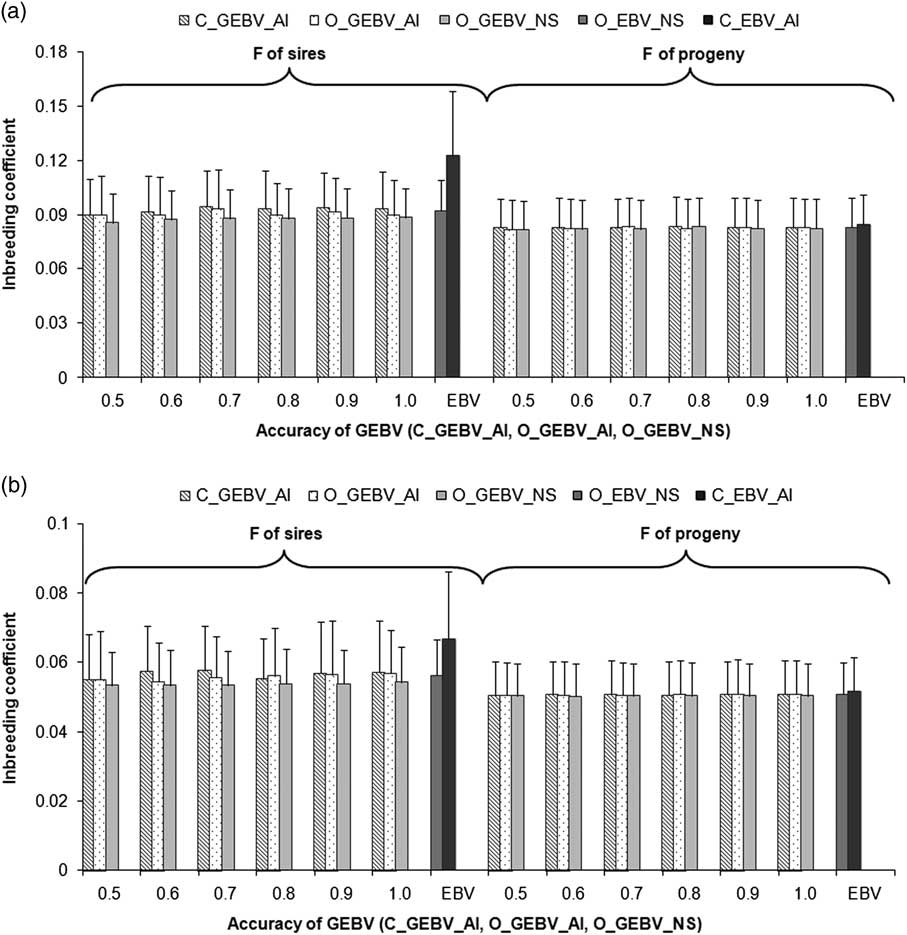
Mean values and s.d. of inbreeding coefficients of selected bulls and their progeny for all five scenarios C_EBV_AI, C_GEBV_AI, O_GEBV_AI, O_GEBV_NS and O_EBV_NS are shown in Figure 3a for h 2 =0.05, and Figure 3b for h 2 =0.30. Taking the average over all scenarios, inbreeding coefficients of selected bulls were 0.092 (s.d.=0.019) for h 2=0.05 and 0.056 (s.d.=0.012) for h 2=0.30. For all scenarios, higher inbreeding coefficients were observed for the low heritability trait. Owing to the higher weight on family v. individual information, also Strandén et al. (Reference Strandén, Mäki-Tanila and Mäntysaari1991) noted that inbreeding accumulated most rapidly when selection was focused on a low heritability trait.
Average and standard deviation of inbreeding coefficients of selected bulls and their progeny for five different scenarios (C_EBV_AI, C_GEBV_AI, O_GEBV_AI, O_GEBV_NS, O_EBV_NS as explained in Table 1) for h 2=0.05 (a) and h 2=0.3 (b).
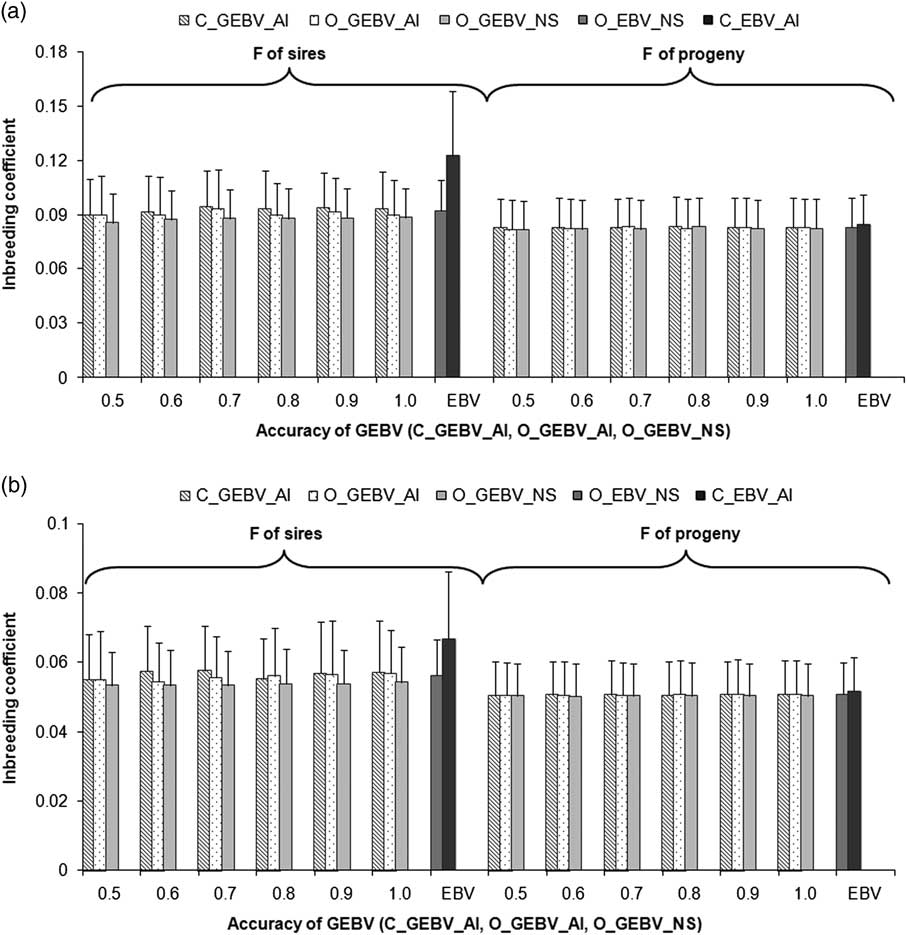
In the present study, GS scenarios (C_GEBV_AI, O_GEBV_AI, O_GEBV_NS) resulted in lower inbreeding coefficients of selected bulls compared with the conventional scenario C_EBV_AI (Figure 3a and b). For example, for h 2=0.05, inbreeding coefficients of selected bulls were 0.09 for scenarios C_GEBV_AI, O_GEBV_AI and O_GEBV_NS, and 0.12 for scenario C_EBV_AI. Compared with the conventional breeding programs, also Lillehammer et al. (Reference Lillehammer, Meuwissen and Sonesson2011) found that genomic breeding schemes have the potential to reduce the rate of inbreeding by increasing genetic gain. Daetwyler et al. (Reference Daetwyler, Villanueva, Bijma and Woolliams2007) summarized that genome-wide selection achieves high accuracies in predicting Mendelian sampling terms, which allows for a better differentiation between sibs.
In conventional dairy cattle breeding programs in Germany, pedigree indices were used as the main criterion for bull dam selection regarding the young category ‘heifers without own performance.’ Analyses of top lists of potential bull dams revealed many heifers with similar or even identical genetic background (König, Reference König2001). In the present study, EBV was the selection criterion for natural service bulls within herds, and for selecting five young bulls in the conventional population. A total of 120 selected natural service bulls in organic herds depict a broad genetic diversity. Consequently, realized inbreeding coefficients in scenario O_EBV_NS were lower compared with scenario C_EBV_AI. However, inbreeding coefficients were slightly higher for scenario O_EBV_NS than for the comparable genomic natural service bull scenario O_GEBV_NS.
Compared with the inbreeding coefficients of bulls in a starting phase of GS, the development of inbreeding or genetic relationships in the long term is of crucial relevance. In the next generation after one round of matings, inbreeding coefficients of conventional and GS strategies were almost identical, but on a lower level than in selected sires. This result applies to both the low (Figure 3a) and the moderate heritability trait (Figure 3b). Inbreeding coefficients in selected groups of elite animals, that is bull dams and bull sires, are generally higher than in milking cows in the population (König and Simianer, Reference König and Simianer2006). Nevertheless, intensively selected elite bulls and elite cows determine accumulation of inbreeding in the long term. In genomic breeding programs, results for inbreeding should be seen in close relation to generation intervals. GS has the potential for improving the rate of genetic gain per generation. Owing to the substantial shortening of generation intervals in genomic breeding programs, rate of inbreeding per year will increase. Availability of high throughput marker data contributes to an efficient selection of individuals with low inbreeding coefficients, but for controlling inbreeding in a long-term perspective, genomic relationships among selection candidates should be used in mating designs that are specified by breeding organizations. In addition to those concerns, the evaluation criterion ‘inbreeding’ is less meaningful, especially when applying cross-breeding strategies in organic farming systems (de Haas et al., Reference de Haas, Smolders, Hoorneman, Nauta and Veerkamp2013).
Albeit using the same selection criterion for scenarios O_GEBV_AI and O_GEBV_NS, inbreeding coefficients were slightly higher for O_GEBV_AI, because five bulls were selected v. 120 bulls for O_GEBV_NS. The result is in agreement with Pryce et al. (Reference Pryce, Goddard, Raadsma and Hayes2010). They found that the number of selected bulls has a major impact on levels of inbreeding. Moreover, creation of sub-lines as done in scenario O_GEBV_NS may also reduce inbreeding substantially, along with a slight decrease in genetic gain (Terawaki et al., Reference Terawaki, Suzuki and Fukui1998).
Sub-scenario for genotyped natural service bulls
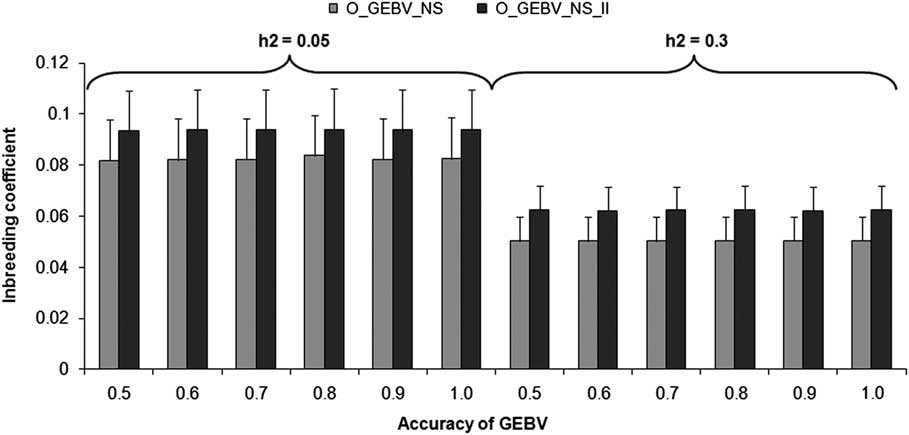
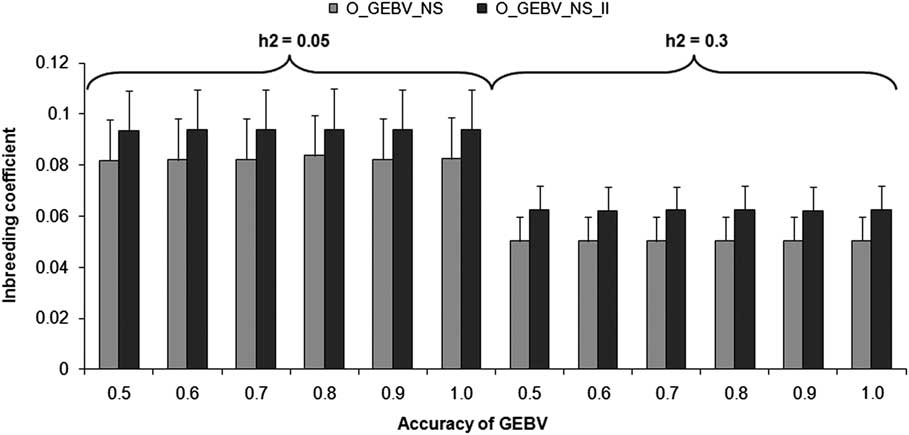
Organic dairy cattle farmers prefer a breeding system with a strong focus on cow families (Baars, Reference Baars2002). Female offspring from influential cow lines are used for replacements within farms, and male offspring are used as natural service bulls. On the maternal side, the scientific reason underlining the importance of cow families or maternal lineage is due to cytoplasmic effects, that explain a small fraction of the phenotypic variance of the trait (e.g. Albuquerque et al., Reference Albuquerque, Keown and Van Vleck1998). The argument for using natural service bulls grown up in the own herd is based on farm environment adaptation. However, always using natural service bulls from the same cow family in the herd makes it difficult to avoid matings between close relatives. That is the main reason for a detailed comparison of scenario O_GEBV_NS (no matings between close relatives) with scenario O_GEBV_NS_II (matings between close relatives may occur). Inbreeding coefficients for progeny of selected bulls from both scenarios with h 2=0.05 and 0.30 are shown in Figure 4. For identical heritabilities and same values for r mg, no differences in TBV between these two selection strategies were observed. In contrast, inbreeding coefficients differed between scenarios. In detail, inbreeding coefficients from scenario O_GEBV_NS_II were 13.69% and 23.91% higher compared with scenario O_GEBV_NS using h 2=0.05 and 0.30, respectively. Hence, we see potential for realizing identical genetic gain by restricting mating designs, which points to the application of ‘optimum genetic contribution’ in the genomic era (e.g. Schierenbeck et al., Reference Schierenbeck, Pimentel, Körte, Reents, Reinhardt, Simianer and König2011).
Average and standard deviation of inbreeding coefficients for progeny of selected bulls for scenario O_GEBV_NS (explanation: Table 1) for h 2=0.05 and 0.30. (Scenario O_GEBV_NS_II is identical compared with scenario O_GEBV_NS, but matings between close relatives were allowed).
Breeding strategy in small organic populations
For novel phenotypes or scarcely recorded traits, especially in small populations, the most promising strategy for improving genetic gain will be realized via the implementation of own GS strategies. A possible approach might be the application of scenario O_GEBV_AI. For realistic values with regard to G×E and accuracies of GEBV, average TBV of selected bulls from scenario O_GEBV_AI was of similar magnitude compared with selection scenarios in the conventional population. Organic breeding focuses on improvements of animal health and product quality, and, in doing so, direct selection on the trait of interest, instead of using indicator traits, will ensure sufficient selection response. Conventional breeding on health traits currently is mostly based on population wide recorded indicator traits, for example SCC for clinical mastitis, or conformation traits for claw disorders. EBVs of those ‘conventional indicator traits’ are used in large reference populations for the estimation of SNP effects. Pimentel and König (Reference Pimentel and König2012) verified results for selection response in the genomic era by applying selection index calculations and concluded: genetic gain was substantially higher when using GEBVs of the trait of interest instead of using GEBVs of indicator traits. Organic breeders could take the lead in breeding on dairy cattle health when implementing a calibration group for novel traits as pre-requisite for GS. Also GEBVs for novel health traits with sufficient reliability increase competiveness of natural service bulls, and consequently the competiveness of organic breeding programs. In the present study, costs for different breeding strategies were not taken into account. However, implementation of an own organic genomic breeding program might be cheaper than implementing an own organic progeny testing program, which includes a large amount of fixed costs due to necessary capacities for test bulls and waiting bulls. Additionally, König et al. (Reference König, Simianer and Willam2009) showed that costs for genotyping are of minor importance in a genomic breeding program when applying a comprehensive cost calculation, for example considering costs for performance testing or herdbook registration. Generally, organic populations with a small effective population size have a high risk for accumulating inbreeding. GS has the potential to combine both genetic gain and acceptable rates of inbreeding, but it is imperative to utilize new instruments on the genomic level to control inbreeding, and to restrict the unlimited use of outstanding sires. The use of marker data includes further advantages to improve genetic evaluations of organic populations. Yin et al. (Reference Yin, Pimentel, von Borstel and König2014) used the genomic relationship matrix for a longitudinal data study to predict performances of cows in ‘extreme environments’. Such an extreme or harsh environment, which was characterized by a lack of phenotypes, might be an ecological production system. Not only the lack of phenotypes, but also a lack of pedigree information favours the application of marker-based methodology. Sanders et al. (Reference Sanders, Bennewitz and Kalm2006) used molecular microsatellite markers to identify pedigree errors in the German Angeln dairy cattle population. High throughput SNP marker data not only contributes to pedigree error identification, but also to setting up complete genomic-based relationship matrices in small populations for genomic evaluations.
Our simulation provided a broad grid of results for a variety of parameter constellations and combinations. The idea of a simulation is to depict results from a variety of breeding strategies. However, before making a definite breeding decision by choosing a distinct breeding program scenario, it is imperative to having knowledge about genetic parameters and biological-technical coefficients within the organic population. Pros and cons for distinct breeding strategies might also differ between traits, for example due to differences in genetic (co)variances within and across production systems.
Conclusions
This is a first study addressing the aspects of natural service bulls and G×E interactions in genomic breeding programs, which has strong relevance for the optimization of organic breeding program designs. For making decisions on the optimal strategy, crucial parameters are genetic correlations in the trait of interest measured in different production systems, and accuracies of GEBVs. When selecting bulls in the larger conventional population based on GEBV, a higher TBV of bulls and their offspring compared with the organic genomic breeding programs were only realized by neglecting G×E interactions and assuming genetic correlations in the same trait between different production systems close to one. For health traits, we expect genetic correlations between conventional and organic environment below the critical ‘G×E threshold’ determined by r g=0.80. Hence, we support the idea of implementing an own organic genomic breeding program. A breeding concept based on genotyped natural service bulls is competitive with a conventional breeding program if sufficiently accurate GEBV (r mg⩾0.80) of genotyped natural service bulls and just moderate genetic correlations between conventional and organic production systems (e.g. r g=0.5) exist. Furthermore, we showed that selection of natural service bulls based on GEBV resulted in lower inbreeding coefficients than conventional selection strategies in the large conventional population, or selecting natural service bulls in the organic population based on pedigree indices.
Acknowledgments
The authors gratefully acknowledge co-funding from the European Commission, under the Seventh Framework Programme for Research and Technological Development, for the Collaborative Project LowInputBreeds (Grant agreement No 222623). However, the views expressed by the authors do not necessarily reflect the views of the European Commission, nor do they in any way anticipate the Commission’s future policy in this area.