Introduction
Care for older people in Sweden has been described as the best in the world in terms of resources, levels of staffing and quality (Organisation for Economic Co-operation and Development 2013). Still, scandals have been a prominent part of public debates on care for many decades, primarily involving cases where people suffering from dementia have been mistreated in nursing homes. A review of nursing home scandals reveals that problems have been framed in quite different ways, with different types of character, causes, consequences and solutions, and a variety of agents have been singled out as morally responsible (Jönson Reference Jönson2006; Lloyd et al. Reference Lloyd, Banerjee, Harrington, Jacobsen and Szebehely2014; Palm Reference Palm2013; Stenshamn Reference Stenshamn2013). It is also striking that (a) claims makers draw conclusions and act on the basis of dramatised media reports although such reports may have little to do with what has actually occurred at a care facility, and (b) interpretations that are supposedly based on thoroughness and on facts – in expert reports and court investigations, for instance – are also highly dependent on particular frames for interpretation and include comments on how the problem has been described in other arenas. The aim of this article is to analyse different ways of framing nursing home scandals in Sweden, to discuss the relations between existing frameworks and to identify ways of framing the problem that are absent in the current debates.
Mistreatment in nursing homes and other care facilities has primarily been studied on the institutional and interpersonal level, i.e. in studies on the prevalence, definitions and dynamics of abuse and mistreatment in residential care (Collin Shaw Reference Collin Shaw1998; Sandvide et al. Reference Sandvide, Åström, Norberg and Saveman2004; Ulsperger and Knottnerus Reference Ulsperger and Knottnerus2008). Researchers have also drawn attention to the way scandals have resulted in attempts to regulate the nursing home industry (Clough Reference Clough1999; Lloyd et al. Reference Lloyd, Banerjee, Harrington, Jacobsen and Szebehely2014; Meagher and Szebehely Reference Meagher and Szebehely2013). In this article, I will apply a theoretical framework that makes possible an analysis of how mistreatment at nursing homes is framed at different interconnected levels of society. This approach has the potential to link the acts and interpretations of individuals to public debates and policy making, for instance in the analysis of how individuals and organisations use and develop established ways of interpreting, preventing and acting with respect to the problem.
The article will describe three ‘debates’ on mistreatment in Sweden, where competing ways of framing the problem have appeared and where the roles of different agents have been contested: (a) a debate where staff are cast as either perpetrators or victims, (b) a debate on privatisation and profit as the motive for neglect of care recipients, and (c) a debate on deserving and non-deserving recipients of socially provided care centred around populist claims. The term ‘debate’ refers to a situation where different positions on a particular issue are known and expressed as arguments and counter-arguments in particular contexts (Billig Reference Billig1996).
In the article I will discuss gains and risks associated with frames that have been used to interpret mistreatment in nursing homes as scandalous and will propose the introduction of an alternative frame in which mistreatment in care for older people is regarded as involving scandalous cases of ageism. This anti-ageism frame would provide older people with a lead role in the drama – not just as victims but as stakeholders in relation to the problem. The study is based on the Swedish context, but the approach that is outlined is relevant for the study of scandals in other countries, and the examples and dynamics are likely to be similar.
Theory
A scandal is a heated public debate – and the role of media is central – where an agent is accused of violating norms or moral values. Theories on scandals emphasise the importance of claims-making activities and, in particular, of accusations that a particular agent is responsible for causing or not solving the problem (Butler and Drakeford Reference Butler and Drakeford2005; Lull and Hinerman Reference Lull and Hinerman1997). In order to understand the character of nursing home scandals, I will rely on a version of frame analysis that has been developed within theories on social movements and claims-making activities. Frame analysis was introduced by Goffman (Reference Goffman1974) as a way of understanding how individuals make sense of reality through the contextualising process of framing. Theories within social movement research have developed frame analysis into approaches that focus on how claims-making activities and public debates provide people with coherent frames, sometimes labelled interpretive packages, that are used to interpret and act upon social problems (Gamson Reference Gamson1992; Gamson and Modigliani Reference Gamson and Modigliani1989; Jönson Reference Jönson2006; Loseke 2003; Snow and Benford Reference Snow, Benford, Klandermans, Kriesi and Tarrow1988). Researchers have focused on the discursive formation of problems in different arenas and have shown how media images, expert opinions and popular knowledge are used to make sense of problematic events and form collective identities in relation to them (Bacchi Reference Bacchi2009; Gamson Reference Gamson1992; Sasson Reference Sasson1995).
In the analysis of scandals I will investigate how mistreatment in nursing homes has been characterised and discussed as coherent packages of interdependent components, that is, causes, consequences, solutions, responsible agents and illustrations/examples. The theoretical approach that is used in the article bridges analytical and normative aims, in the sense that the analysis of social problems enables researchers to pose questions on alternative representations that may question, disrupt and replace existing problem frames (Bacchi Reference Bacchi2009; Gamson Reference Gamson1992).
Data and method
Data for the study that this article is based on consists of media reports and official investigations on cases of mistreatment, supplemented by interviews with informants involved in providing or monitoring nursing home care. Two types of media studies were conducted based on (a) media reports available from the Swedish media database Retriever during the period of 1990–2013 and (b) television documentaries on cases of nursing home scandals, including 600 comments in an internet debate at the webpage of the National Broadcasting Corporation of Sweden following two television documentaries on scandalous care. Using a case study approach (Yin Reference Yin2003), two scandals were followed as they developed through media reports and in investigations by authorities. This methodology was used to investigate interactive flow and tensions between arenas, for instance how experts position their standpoints against perceived scapegoating in media. In these cases, document analysis and observations during court hearings were supplemented by interviews with key informants. The study includes a contrasting data-set, consisting of nine semi-structured interviews with representatives of nine different organisations involved in nursing home care in Florida, in relation to scandals that appeared in the year 2000.
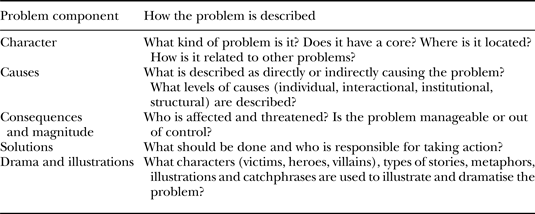
Qualitative content analysis was used to interpret data (Bryman Reference Bryman2008). A repeated reading of a sample of media reports made it possible to modify the analytical tool of the study into questions that guided the analysis (Table 1). The analysis focused on the internal coherence and the external resonance of the frames that were identified – how they have been used and what they accomplish (Gamson Reference Gamson1992; Jönson Reference Jönson2006).
Summary of analytical tool – ways of framing scandalous nursing home care

While the presentation of ‘debates’ will touch upon a number of points of view, only coherent frames that specifically concern mistreatment in care for older people as a public concern will be summarised. Some claims were not developed into coherent frames, for instance when staff were just condemned or labelled as evil. In addition, some coherent frames did not focus on the problem of mistreatment, for instance when accusations against for-profit care providers were described as exaggerated and politically motivated.
Ethical considerations
The study was conducted in accordance with Swedish ethical guidelines and Sweden's Act Concerning the Ethical Review of Research Involving Humans. The majority of data was collected from media sources. Interviews did not collect sensitive personal data and only publicly available investigations and open court hearings were used in the cases that were followed.
Formal care for older people in Sweden
Residential care facilities in Sweden are formally labelled special housing for the elderly. In this article, I will use the internationally established concept of nursing homes.
All care services for older people in Sweden (from home care to nursing homes) are covered by Sweden's Social Services Act. Ageing-in-place, i.e. a preference to provide home-based care, has been the leading principle of Swedish elder-care since the 1950s. The general threshold for moving into a care facility has been raised during the last decades and, as a result, those moving into residential care now have increased care needs and the majority are suffering from dementia. In 2011, 14 per cent of older people (80+) lived in residential care compared with 20 per cent in 2000 (NBHW: Socialstyrelsen 2012).
The responsibility for nursing homes was moved from the health-care sector to municipal social services in 1992, and thus from a medical model to a social care model. Facilities are not referred to as institutions and there have been efforts to introduce amenities that are typical for a regular apartment. With very few exceptions, the residents have private rooms with en-suite bathroom and most often a kitchenette. In policy documents residents are referred to as tenants and the rooms in a care facility are referred to as apartments, even if they are located on a corridor of a former traditional institution. With reference to the status of residents, relatives are welcome to visit at any time (NBHW: Socialstyrelsen 2012).
Municipalities are the traditional providers of nursing home care in Sweden and before the 1990s for-profit care was a marginal phenomenon. In 1993, the liberal/conservative government – the government headed by the political party called Moderaterna, or the Moderates – introduced a law that made it possible for municipalities to invite private entrepreneurs to serve as providers of care for older people (Meagher and Szebehely Reference Meagher and Szebehely2013). In 2013, about 25 per cent of nursing homes were run by for-profit corporations.
Debate 1: Staff as perpetrators or victims
In January 2002, Swedish media reported extensively on an upsetting case of verbal abuse in a residential care facility. Based on a feeling that his mother was being abused, the adult son of a 94-year-old woman who suffered from dementia hid a voice-activated recorder in his mother's room. The recording revealed that the night staff used degrading and threatening language: ‘Spread your legs! You have done that before haven't you?’, ‘Now you're in for trouble’. The secret tape-recoding was the sensational aspect that evoked particular interest in the media – it was played or cited in all reports. The two nursing assistants were condemned and fired from their jobs, and the public hatred against them was so intense that they had to move to other cities. The municipality that ran the facility fended off the public outrage by condemning the nursing assistants.
When one looks beyond the sensational aspects, the scandal illustrates patterns that are common when public debates concern mistreatment that occurs at facilities that are operated by local municipalities. In such cases, causes of mistreatment are frequently attributed to the moral character of the persons who were directly involved at the scene of events: the staff. The actions of staff are scrutinised and staff members are in some cases labelled and treated as perpetrators.
Baumann (Reference Baumann and Best1989) argues that, in ways similar to child abuse, cases of elder abuse have the capacity to evoke a particular rage since the offender is perceived as a person who has violated a relationship of trust. In Swedish media this is manifested by reports that characterise mistreatment as intentional, as acts that are evil and that are beyond comprehension. In a study on media reports on nursing homes in Irish media, Phelan (Reference Phelan2009) argues that the use of emotive language victimises individuals and agencies responsible for the provision of care. This attribution of bad motives is central in processes of scapegoating, a process that serves to direct blame towards a particular group or individual (Burke Reference Burke1962). Since scapegoating reduces complex problems to simple solutions – getting rid of the rotten apples that foul the barrel – it has not been possible to summarise arguments in any coherent frame.
In the case where two nursing assistants were tape-recorded, the municipality appointed an independent consultant agency to investigate the incident. The consultants positioned their investigation with respect to what they perceived to be scapegoating of staff in relation to a problem that was caused by failures of the organisation. According to the consultants, this scapegoating enabled members of the public to deny that care facilities are inherently problematic settings where frailty, confusion and conflict are part of everyday life. The consultants argued that the improper comments that appeared on the tape could in fact be a way for staff to defuse tensions in a violent and stressful situation, an argument that was later used by the nursing assistants and accepted as a reasonable cause by a local court. The real cause of the problem was said to be the organisation of care work, the lack of leadership and the stressful working conditions in care for older people. Similar descriptions of the problem appeared in newspaper articles and in a television documentary, where the nursing assistants were cast as victims of public scapegoating. Based on the conclusion by the consultants, that the abuse was partly caused by working conditions, a local court decided that the municipality had to re-employ the two nursing assistants.
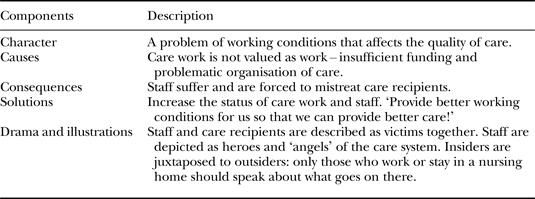
A review of reports on scandalous care shows that this way of describing the problem is common, by itself or as a defence against attempts to scapegoat staff. Arguments frequently appear as a consistent package of claims that I will label a staff-centred frame. Problematic working conditions and low status of care work are described as the character of the problem and the link to mistreatment of care recipients is expressed in the typical statement on its solution: provide the staff with better working conditions so that they are better able to care for their residents. The frame is summarised in Table 2.
The staff-centred frame
The staff-centred frame rests on an assumption that care recipients and care staff have a mutual interest; they are jointly affected by working conditions and what is good or bad for staff is good or bad for residents in nursing homes. The idea about a mutual interest is also expressed in statements among staff members that sympathy, loyalty and solidarity towards care recipients are the only reasons for not leaving care work. A report that uses a feminist perspective on the problem of elder abuse provides an example of how the interest of staff and residents are conflated and how descriptions of causes prompt particular solutions (Johansson Reference Johansson2002). According to the report, abuse in formal care is a case where the society is the offender while staff and care recipients are victims. The report suggests that the risk of abuse increases when staff is affected by cutbacks, and argues:
An excessive burden of responsibility for care, stress, despair, fatigue and burnout among staff are likely to trigger abuse against older care recipients. When care workers are perpetrators, the likely cause is a lack of knowledge, guidance and experience, but also understaffing at facilities. (Johansson Reference Johansson2002: 17–18)
The staff-centred frame has had a prominent position, not only during scandals but as a way of approaching the entire issue of care services for older people in Sweden.
Increased resources and better working conditions as the solution
In the case where a 94-year-old woman was abused, the report by the consultants provided the municipality with a solution that is typical of the staff-centred frame:
The only solution that seems reasonable is to see to it that the staff has a work situation, a work environment, supervision, and competence that collectively enable them to feel well, to have the strength to care for residents and their relatives, to feel that they are seen, heard and appreciated as professionals, and thus to become inspired to want to learn more. (Jönson Reference Jönson2006:139)
The staff-centred frame has the capacity to counter scapegoating by locating the problem outside the moral character of individual care workers and by employing complex reasoning on the significance of the resources for and the organisation of care services for older people. Consequently, some scandals in Sweden have resulted in increased government funding instead of surveillance and policing regulations (Jönson Reference Jönson2006). This frame is backed by theories on care work as relational, and by feminist theories that acknowledge the role of (working-class) women as providers of care (Eliasson-Lappalainen Reference Eliasson-Lappalainen1995; Meagher and Szebehely Reference Meagher and Szebehely2013). Its ideas resonate with a traditional ideological position on the Swedish welfare state provided by unions and the Social Democratic Party (Hort Reference Hort2014). The staff-centred frame makes a strong case for providing the system of care with sufficient resources and, given the strong relationship between staffing levels and the quality of care (Harrington Reference Harrington2001, Reference Harrington, Meagher and Szebehely2013), this is an important contribution.
In addition to acknowledging the role of staff, the staff-centred frame has the capacity to hinder custodial practices and ‘us versus them’ thinking among staff. The frame constructs a ‘we in here’ view that emphasises loyalty and solidarity among care recipients and staff as a group. There is, however, a risk that this idea may be used to conceal conflicts of interest, that it may marginalise relatives of care recipients (as outsiders who complain=degrade care work) and that the wellbeing of care recipients may be presented as secondary to the wellbeing of staff. A second risk is that the frame has the capacity to provide a basis for justifications of and excuses for immoral acts (Tomita Reference Tomita1990). Claims that particular cases of abuse or mistreatment are caused by the problematic working conditions of staff rarely refer to specific knowledge about the case. Conclusions are instead deduced from general experience and from the frame itself. The investigation by the consultants in relation to the tape-recorded abuse of the 94-year-old woman singled out stress and working conditions as the cause of the incident, but the conclusion did not refer to the particular situation at the facility where the abuse had occurred and referred instead to the general state of care for older people in Sweden.
Debate 2: Profit as motive for mistreatment
In 1992, the media reported that a care recipient was unable to shower for two months at a facility that had been taken over by a for-profit company. When commenting on this incident, a Social Democratic newspaper stated that ‘what has happened to D [the care recipient] and her fellow sisters and brothers illustrates the hazards of liberal/conservative politicians’ eagerness to introduce privatisations'. The newspaper described the event as ‘a brutal but useful reminder of what happens in a society where policies retreat before market forces' (cited in Hadenius and Weibull Reference Hadenius and Weibull1992).
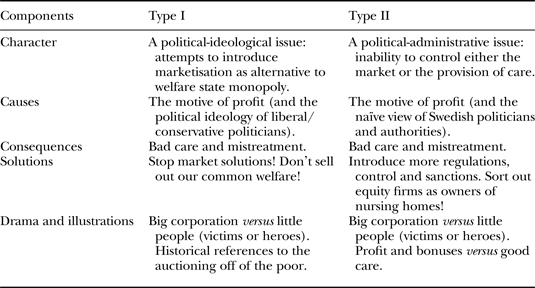
For-profit nursing homes constitute a minor part of the system of formal care in Sweden, but have figured prominently as villains in nursing home scandals since the 1990s. Scandals at privately run care facilities have, to a large extent, been framed as part of a clash between traditional Social Democratic ideology and liberal/conservative aims to reform the welfare state by introducing for-profit service providers. Within this debate, liberal/conservative politicians have been accused of auctioning off frail elders to the lowest bidder and making care for older people ‘a commodity of merchandise’ (Pockettidningen R Reference Pockettidningen1996:4). This version of a market-critical frame is summarised as Type I in Table 3.
Two versions of the market-critical frame
During the latest series of scandals that appeared in 2011–2013, accusations about mistreatment developed into a debate on profit margins and ownership. The large corporation accused of providing bad care was owned by a private equity firm (Lloyd et al. Reference Lloyd, Banerjee, Harrington, Jacobsen and Szebehely2014). It also turned out that the corporation manipulated its structure to avoid paying tax; money that was meant for frail care recipients was used instead to enrich international capitalists. The corporation lost its contract with the local municipality and later changed its name in an attempt to dissociate its facilities from the scandal.
The scandal of 2011–2013 marked a shift in the way solutions were framed. Claims that for-profit care should be prohibited in general were less prominent, and critics focused on the fact that the nursing home where the scandal occurred was operated by a particularly ‘immoral’ owner. In contrast to related debates during the 1990s, solutions in 2011–2013 were to a greater extent phrased in terms of more regulations, sanctions and stricter control of care services for older people (Type II in Table 3). In 2013, the government introduced a new authority – The Inspection for Health Care and Care – to increase control and to investigate suspected cases of mistreatment within the systems of care.
There is an interesting parallel between scapegoating and defence of staff and for-profit corporations in the sense that some claims makers have argued that the possibility of portraying for-profit corporations as big and driven by the motive to make a profit has been used to create a moral drama. In 1992, two university professors were commissioned by a nursing home corporation to study a particular scandal and concluded that the accusations against the corporation were false or exaggerated and served to dramatise the ideal type of relationship between a mistreated care recipient and a large corporation aiming to make a profit (Hadenius and Weibull Reference Hadenius and Weibull1992). Details of the scandal of 2011–2013 were reviewed in a book published by the think-tank Timbro (Stenshamn Reference Stenshamn2013), which has a liberal view of the market, and in a series of articles in the magazine Dagens Samhälle ([Today's Society], 2012–2013). The claim in books, reports and articles that have been produced during the aftermath is that accusations against for-profit care providers are themselves based on foul motives – ideology or a search for sensationalism within media and revenge/conflict among staff who report on mistreatment (Stenshamn Reference Stenshamn2013). Defenders of for-profit care have argued that no mistreatment actually occurred at facilities involved in the scandals or that the problems were temporary and minor. The reframing of the problem during the aftermath may explain why scandals have resulted in loss of contracts whereas efforts towards marketisation have not been abandoned.
Regulation and control as the solution
What opponents and proponents of marketisation have come to agree upon in Sweden is that increased regulation and control are needed to regulate care for older people (Lloyd et al. Reference Lloyd, Banerjee, Harrington, Jacobsen and Szebehely2014). Swedish authorities have been described as gullible and unprepared to deal with care providers who cut costs to make a profit (Palm Reference Palm2013). This change in the perception of nursing homes is similar to a shift that occurred in the United States of America (USA) some 40 years ago, when for-profit corporations became dominant care providers (Miller et al. Reference Miller, Tyler, Rozanova and Mor2012). Mistreatment at for-profit facilities evokes particular outrage since it is perceived to be caused by corporate greed, but the solution in Sweden is becoming more administrative and less ideological.
While the market-critical frame highlights the need to control care, there is a risk that regulation and control will be presented as the only solutions to the problem. Referring to the situation in Canada, Banarjee (Reference Banarjee, Meagher and Szebehely2013) argues that authorities have fallen into a ‘regulatory trap’ by introducing an ineffective system of standards that focuses on documentation and decreases the flexibility that is necessary in care work. The regulatory trap may even develop into a punitive trap that frames problems as the results of egoistic motives, first among corporations and second among managers and staff, and identifies control, threats and punishment as prime solutions. This version of the problem is visible in the USA (Jönson Reference Jönson2006; Palm Reference Palm2013). Lloyd et al. (Reference Lloyd, Banerjee, Harrington, Jacobsen and Szebehely2014) suggest that the control route that Sweden has now embarked upon in order to prevent mistreatment in nursing homes is of dubious value, given the fact that the detailed regulations in countries like Canada and the USA have not been a successful way of preventing mistreatment in nursing homes.
Debate 3: Populist claims
In an internet discussion following a television documentary on mistreatment in nursing home care, a viewer suggested that ‘Sweden harbours too many welfare recipients and immigrants who don't pay tax. Let's clean up the welfare swamp so that our elderly who have built the country get the care they deserve’.
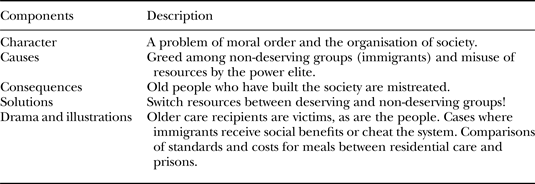
When nursing home scandals erupt, newspapers will receive letters arguing that resources which are spent on immigrants, convicts, recipients of social assistance and ‘corrupt politicians’ should be redirected towards the older population. Other comparisons refer to older people as being treated ‘worse than animals’. This way of framing the problem is usually labelled populism and at its core is the construction of the people as worthy but betrayed by the power elite who devote resources to ‘unworthy’ causes (Westlind Reference Westlind1996). In Sweden, as in several other European countries, a populist frame that describes older people as deserving has been developed by nationalist parties and pensioners' parties (Nilsson Reference Nilsson2008). The frame is summarised in Table 4.
The populist frame
It is possible to find populist traits in both the staff-centred frame and the market-critical frame in the suggested conflict of interest between the people and the elites of politics and big business. The juxtaposition of ‘in here’ and ‘out there’ that is typical of the staff-centred frame is sometimes developed into a juxtaposition between ‘down here’ and ‘up there’. This rhetoric has to some extent been used in media reports, but has rarely been translated into serious attempts to act upon the problem. Pensioners' parties in Sweden have referred to the unjust treatment of older people as compared with less-deserving groups but have failed to attract larger numbers of members.
Redirection of resources as the solution
The populist frame refers to older people as particularly deserving; they have ‘built the society’ and should be provided with good care for this reason. This argument is a fundamental principle within a moral economy that embodies a contract between generations (Johnson Reference Johnson, Bond, Coleman and Peace2003). As contrasted with frames that direct moral indignation towards acts of staff or for-profit care providers, this claim focuses on the social position of older people.
But a closer look at comments that depict older people as particularly deserving reveals that the claim is mostly used to portray and scapegoat ‘non-deserving’ groups like immigrants/refugees, convicts and members of the power elite. The intergenerational contract is rarely invoked and proposed solutions – for instance to switch resources between convicts and nursing home residents or to refuse to harbour immigrants – do not appear as serious attempts to solve a problem in long-term care. Unsurprisingly, politicians, experts and media representatives have so far ignored or condemned such solutions. The moral charge referring to older people as a special population has been corrupted by populism and placed outside the established political landscape (Jönson and Nilsson Reference Jönson and Nilsson2007). It should be noted, however, that the populist/nationalist party The Sweden Democrats announced an attempt to attract female voters for the 2014 election by broadening its programme. The party called for ‘more hands’ in care work and suggested better opportunities for care workers to choose full-time employment (Sverigedemokraterna 2013). The programme aims to bring into a populist frame claims that have gained success within the Social Democratic welfare state.
Identifying a missing frame
The mapping of different frames and their use makes it possible to pose questions about identities, agency and discursively constructed subject positions relating to categories of people that are affected by the problem (Bacchi Reference Bacchi2009). An analysis that focuses on these aspects reveals that existing debates tend to place older care recipients out of focus; they are rarely positioned as stakeholders in relation to the issue and the debates are not really about them. The dynamics of accusations and defence have put the spotlight on staff, for-profit corporations, and categories like politicians or immigrants receiving social assistance. Below, I will show that an additional frame that relates mistreatment to the phenomenon of ageism has the capacity to replace, complement and balance existing ways of reasoning about the problem and that a reframing of mistreatment could be modelled on existing frames used within disability policies.
During the last decades, several researchers have argued that gerontology would gain from adopting theories and models developed within the field of disability studies and that the active consumers and activists of the disability movement could be a role model for older people in long-term care (Krassioukova-Enns and Ringaert Reference Krassioukova-Enns and Ringaert2012; Naue and Kroll Reference Naue and Kroll2010; Putnam Reference Putnam2011). Policies, activism and research within the disability field have focused on the exclusion of and discrimination against people who suffer from impairments. According to the social model, disability is not a personal characteristic but an experience that is caused by the way society is organised. The problem is characterised in terms of discrimination: people with impairments are being excluded from and deprived of full social citizenship. Solutions refer to arrangements that would make real the social rights of people with impairments (Charlton Reference Charlton2000; Tideman Reference Tideman2000). Related thoughts on elder abuse as a matter of human rights and citizenship have been developed by critical gerontologists (Biggs, Phillipson and Kingston Reference Biggs, Phillipson and Kingston1995; Phelan Reference Phelan2008).
As a thought experiment I will introduce a frame for older people and suggest that cases of mistreatment could be regarded as scandalous since they show that older people are victimised by an ageist society and treated more badly than they would have been if they were younger and in need of help. Theoretically, this suggestion rests on the assumption that claims-making activities are not simply the result of mutual interests among members of particular groups but also a matter of frameworks for identity and action being available (Gamson Reference Gamson1992). Oldman (Reference Oldman2002: 804) has argued that the social model could be used to frame arrangements for older people in need of care and act as ‘an intellectual basis for a social movement of older people’ and there is an interesting relation between the social model and theories on ageism, in particular in the claim that society constructs problems of older people as caused by the process of ageing rather than the organisation of society (Kane and Kane Reference Kane and Kane2005; Levin and Levin Reference Levin and Levin1980).
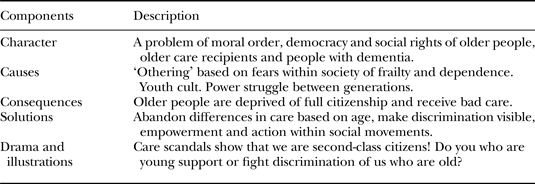
The frame that is summarised in Table 5 is tentative and the components are merely sketched. For instance, it only includes two out of many explanations of the problem of ageism (compare with Palmore Reference Palmore1990).
Ageism as the problem: an anti-ageism frame
An anti-ageism framework could be used to counter-balance and complement existing ways of framing scandalous care by suggesting that the solution to the problem is to make real the social rights of older care recipients. The broad identities that the frame introduces could enable pensioners' organisations and older people to fight for common rights.
Realising social rights as the solution
In debates on the role of staff, attempts to question the claim that the improvement of working conditions is the only way of improving the situation of care recipients are usually interpreted in accordance with the established rhetorical tension – as an attempt to downgrade care work and scapegoat staff. An anti-ageism frame would change the dynamic of this debate. It would introduce older people as primary stakeholders while staff are provided a more peripheral role, as part of a society that disables or enables care recipients. Feminist scholars like Noddings (Reference Noddings1984) have, quite rightly, argued that justice in care work is relationally determined and cannot be measured according to universal and impartial standards. But there is a need to balance this position with an ethic that frames care as an enabling or disabling practice. This way of describing relations is already established in disability policies and expressed by the disability rights movement in claims that the function of professional helpers is to realise the social rights of people with impairments and catchphrases like ‘nothing about us without us’ (Charlton Reference Charlton2000; Egard Reference Egard2011). Proponents of the anti-ageism frame could actually argue that to improve the status of older people and older care recipients would improve the status of care work and that this would benefit staff. Within research on dementia, the proposed frame connects to recent attempts to develop a critical gerontological perspective (Innes and Manthorpe Reference Innes and Manthorpe2012).
An anti-ageism frame could contribute to the debate on marketisation with the argument that older people are deprived of a position as stakeholders in present attempts to introduce market solutions in nursing home care. Swedish care providers win contracts to run a nursing home through a process of bidding that does not involve the people who live at a particular facility. Several researchers have argued that older people and their organisations need to act like consumers in order to reach the goals the disability movement has achieved (Naue and Kroll Reference Naue and Kroll2010; Krassioukova-Enns and Ringaert Reference Krassioukova-Enns and Ringaert2012). These activities would be facilitated through the presence of an interpretive frame that is inspired by the social model. A new version of the market-critical frame could direct attention to the tendency to construct care needs among older people as a financial issue rather than as an issue concerning quality of life and social rights.
Finally, an anti-ageism frame has the potential of channelling some moral indignation that appears as less constructive within existing debates on mistreatment in nursing homes. The populist claim that juxtaposes older people who have built the society with non-deserving populations could be reframed as a failure among younger people to honour the intergenerational contract. This way of framing scandalous care has a greater potential for actually improving care arrangements.
Discussion
In this article, I have used an approach from social movement studies to analyse nursing home scandals in Sweden. The main finding was that Swedish nursing home scandals tend to place older people and older care recipients out of focus. Through the use of reasoning and examples that have been developed within the social model of disability policies, an alternative/competing frame was identified and used to discuss a reframing of scandals as a matter of ageism and a failure to make real the rights of older care recipients.
How mistreatment should be framed depends on the circumstances of the particular case, but scandals operate according to dynamics that do not necessarily touch down in the details. A general understanding of the problem is often used to guide interpretations of cases of mistreatment, not only in public debates but also when experts develop informed positions. Given this, it is important to understand how prominent frames for interpretation are composed and used. This enables an in-depth understanding of how different explanations tend to get locked up in predisposed debates (Billig Reference Billig1996). Even scandals that primarily reflect the potential to create a moral drama have real consequences and result in policies that are possible to evaluate as more or less constructive.
Why has so little interest been devoted to the legal and human rights of older people within the context of care? Why are cases of neglect within formal care not reported as cases of age discrimination? Following the approach of this study, the answer to these questions lies in the absence of an interpretive framework that relates care practices to the problem of ageism. Other ways of framing have become dominant.
A review of Swedish research and policy texts shows that while the aim to provide younger persons with impairments with social rights has been a joint project among social movements, policy makers, researchers and providers of help, this framework has not been used within the field of elder-care (Erlandsson Reference Erlandsson2014). The capacity of the social model to frame activities at the individual level as part of an enabling or disabling society is of particular interest for the field of elder-care. The model has provided analytical links between macro, meso and micro levels of society and made it possible to frame the social position of people with impairments through concepts like citizenship, justice, social rights, equality, independence, discrimination, participation/integration and normalisation. My suggestion is that researchers within the field of ageing studies should develop tools for a similar project, and nursing home scandals provide an entry point for such research.
Acknowledgements
The study was carried out as part of the research programme ‘Individualized Care and Universal Welfare: Dilemmas in the Age of Marketization’ and supported by a grant from the Swedish Research Council for Health, Working Life and Welfare and headed by Marta Szebehely. Useful comments were provided by Rosmari Eliasson-Lappalainen, Tove Harnett, Ulla Melin Emilsson and Shirley Näslund.