The belief that political orientations are reliably transmitted from parents to children is a key pillar of the study of political behavior.Footnote 1 The consistently positive correlations between parent and offspring political orientations, along with the finding that political identities are acquired before children grasp the policy content of issues and parties, has led to the view that parents drive the transmission process through value promotion, role modeling, nurturance, information control, resources and more broadly structuring the child's environment (Alwin and Krosnick Reference Alwin and Krosnick1991; Jennings and Niemi Reference Jennings and Niemi1968; Jennings and Niemi Reference Jennings and Niemi1974; Jennings and Niemi Reference Jennings and Niemi1981; Niemi and Jennings Reference Niemi and Jennings1991). Social networks, education, peers, religion, media and life events also shape children's political orientations (Huckfeldt and Sprague Reference Huckfeldt and Sprague1987; Klofstad Reference Klofstad2010; Lewis-Beck et al. Reference Lewis-Beck2008; McDevitt and Chaffee Reference Mcdevitt and Chaffee2002; Verba, Schlozman and Brady Reference Verba, Schlozman and Brady1995). However, parental influences are believed to remain on the frontline of forging the attitudes and identities of successive generations, and their influence – in conjunction with other socializing agents – persists throughout the life course (Sears Reference Sears, Wheeler and Shaver1983).
The overwhelming majority of past and current research on political socializationFootnote 2 employs ‘direct-transmission’ approaches that treat concordance between self-reported parent and child orientations as evidence of parent-to-child transmission (Andolina et al. Reference Andolina2003; Gimpel et al. Reference Gimpel, Lay and Schuknecht2003; Hooghe and Boonen Reference Hooghe and Boonen2013; Jennings and Niemi Reference Jennings and Niemi1968; Jennings, Stoker and Bowers Reference Jennings, Stoker and Bowers2009; Langton Reference Langton1969; Rico and Jennings Reference Rico and Jennings2016). In this view, parent–child agreement on political orientations is natural, expected and occurs in a majority of households; parents drive the learning process while children have a minor role, and a majority of children know – and want to adopt – their parents' orientations (Campbell et al. Reference Campbell1960; Roest, Dubas and Gerris Reference Roest, Dubas and Gerris2009; Tedin Reference Tedin1974). Jennings and colleagues provide recent examples of this position, asserting that ‘The direct-transmission model is robust, as it withstands an extensive set of controls’ (Jennings, Stoker and Bowers Reference Jennings, Stoker and Bowers2009).Footnote 3 So entrenched is this view that it is assumed ‘…the traditional approach to transmission, relying as it does on a strict one-to-one reproduction of parental attitudes, is overly demanding and thereby underestimates parental influence’ (Beck and Jennings Reference Beck and Jennings1991). Child agency is rarely included in empirical analyses of political orientations,Footnote 4 and differences between parents and children are typically viewed as errors in the transmission process thought to result from extrafamilial experiences, dysfunction in family relations, communication issues or a lack of socialization by parents (Glass, Bengtson and Dunham Reference Glass, Bengtson and Dunham1986; Huckfeldt and Sprague Reference Huckfeldt and Sprague1991; Jennings and Niemi Reference Jennings and Niemi1968; Jennings and Niemi Reference Jennings and Niemi1981). To the extent that child perception has been examined, it has been treated either as a somewhat unreliable proxy for parent attitudes (Beck and Jennings Reference Beck and Jennings1991; Gniewosz et al. Reference Gniewosz2008; Niemi Reference Niemi1974), a measure of the political environment in the home (Beck and Jennings Reference Beck and Jennings1975), or a conditioning factor that is more a function of parental than child behavior (Tedin Reference Tedin1974; Westholm Reference Westholm1999).
Modern explorations of value transmission in general, however, conceptualize transmission as an interactive process in which both parents and offspring exhibit individual differences in the perceptual and motivational facilities they use to make sense of their social environment and to guide behavior (Roest, Dubas and Gerris Reference Roest, Dubas and Gerris2009). That is, the direct-transmission approach contrasts with the greater social and psychological sciences that emphasize the role of parents and children in the transmission process (Cashmore and Goodnow Reference Cashmore and Goodnow1985; Grusec Reference Grusec1992; Grusec and Goodnow Reference Grusec and Goodnow1994; Knafo and Schwartz Reference Knafo and Schwartz2003; Stattin et al. Reference Stattin2015).
This latter perspective, which we label the perception-adoption approach, operationalizes transmission as a multi-step process in which children must first perceive parental values, correctly or incorrectly, and then decide, knowingly or unknowingly, whether or not to adopt those perceived values. By articulating transmission as a function of both the parent and the child, research in this vein finds that the strongest predictor of value congruence is the child's perception of parental values, that the child's perception is often inaccurate, that perception is highly dependent on the child even when parents are communicative and issues are salient, and that children are very often unwilling to align with parental values even when they know them.Footnote 5
Until recently the role of the child in the parent-to-child transmission process was largely overlooked in the study of political socialization. This is not to say that perception or child agency in political socialization was never discussed, but rather that this line of work occurred sporadically and at the fringe of the discipline. All but a handful of studies treated children's misperceptions or failure to adopt parental values as a statistical nuisance or error on the part of the parents’ behavior.Footnote 6 This changed when Ojeda and Hatemi (Reference Ojeda and Hatemi2015) introduced the theory and findings from perception-adoption approaches to the study of political identity.Footnote 7 Their results, in some ways, turned the general view regarding the transmission of political orientations on its head by finding that offspring's perceptions are one of the most important parts of the transmission process and that transmission is not actually occurring in many instances in which direct-transmission approaches would make it appear that it is. As a result, their study now raises questions about the role of critical predictors identified through the last half-century of direct-transmission research. That is, most of what we know about what facilitates the transmission of political orientations from parent to child has been conducted using a one-step direct-transmission approach. Extant research indicates that the successful transmission of political orientations depends on communication, the climate of the home, value salience and other parent–child dynamics, but we do not know if these factors improve a child's understanding of their parent's orientations and/or if they influence their motivations to adopt such orientations.
The current study addresses this lacuna and makes three important contributions to the study of political socialization. First, it builds upon Ojeda and Hatemi (Reference Ojeda and Hatemi2015) by fully articulating the logic of the perception-adoption approach and demonstrating that it is almost always preferable to the direct-transmission approach when assessing if and how transmission occurs. Secondly, we empirically verify this logic using three separate datasets, including one of the most important studies of political socialization, the Youth-Parent Socialization Study, which remains a centerpiece of the direct-transmission approach. Thirdly, and more importantly, we transition from examining the role of child perception on the rate of transmission to identifying what factors hinder or facilitate the transmission process and how. That is, we articulate how family factors, environments and child characteristics – including education, closeness, parental value strength and politicization of the home – insert themselves into the transmission process by either improving a child's understanding of their parent's orientations or influencing a child's motivations to adopt such orientations. Our findings nuance in some instances, and reverse in others, the findings from countless studies that relied on the direct-transmission approach but did not incorporate the child's perception or role in the adoption of parental values.
The Logic of Perception Adoption
The process of value transmission between parent and child can be operationalized in two broad steps: (1) children must perceive their parent's political attitudes, and then (2) choose whether to adopt or reject the perceived orientation when formulating their own positions. In this view, displayed as the bottom part of Figure 1, transmission is a function of both parent and child, as neither the correct perception nor adoption of parental orientations alone reflects actual transmission; children can correctly perceive attitudes they do not adopt, or adopt attitudes that they do not correctly perceive.Footnote 8 The model also recognizes that the processes of value perception and adoption can be guided by different factors, by the same factors to different degrees, or in opposing directions by the same factors. This aspect of the model is represented in Figure 1 by the conditioning factors that facilitate or hinder the perception and adoption steps. Finally, the curved arrow at the bottom of the figure allows for the possibility that the transmission of orientations circumvents the child's perception and thus occurs unintentionally, implicitly or indirectly.Footnote 9
Barriers or facilitators of perception, Barriers or facilitators of adoption

According to the direct-transmission approach, depicted in the top part of Figure 1, transmission occurs when the parent and child are concordant (for example, both are Democrats); this logic is problematic however, because it conflates false positives and negatives. Children who accurately perceive and adopt their parents' party identification (for example, my parents are Democrat and I want to adopt my parents’ views so I'm a Democrat) are treated the same as children who misperceive and reject their parents' party identification (for example, my parents are Republican [when they are in fact Democrat] and I want to reject my parents’ views so I'm a Democrat). The same is true for the reverse.
While prior scholarship introduced the distinct roles of perception and adoption in the transmission process (for a review, see Ojeda and Hatemi Reference Ojeda and Hatemi2015), explaining why the logic of perception-adoption is crucial to the study of political socialization more broadly has remained unaddressed. Here we present both a theoretical case and empirical analyses to address this lacuna and demonstrate how the perception-adoption approach best captures the influence of family environment and parent–child characteristics in the transmission process. Specifically, we show that a one-step approach to transmission will almost always obscure how the family environment and parent or child characteristics inform the transmission process (that is, the moderating components of the models in Figure 1). In addition, the one-step model may also lead to incorrect conclusions about the effect of these factors. This logic is illustrated in Table 1 which articulates the nineteen possible scenarios where the one-step approach and the perception-adoption approach either converge or diverge in their assessment of how family and individual characteristics affect the transmission process.
Evaluating the potential effect of moderating variables in each approach

Note: these effects refer to the degree to which some hypothetical familial or child characteristic enhances the concordance between:
parent self-reported PID and child self-reported PID in the direct transmission model
parent self-reported PID and child perception of parent PID in the perception-adoption model
child perception of parent PID and child self-reported PID in the perception-adoption model
The symbols in the table are used in the following way:
‘Null’ means the hypothetical effect is not significant regardless of its direction
‘+’ means the hypothetical effect is positive and significant
‘−’ means the hypothetical effect is negative and significant
The hypothetical results for the direct transmission model assume no ‘false positive’ transmission; under these conditions, the effect from the direct transmission model should be an average of the effects from the perception step and adoption step in the perception-adoption model.
In only three of the nineteen scenarios analyzed do the results of the direct-transmission approach (that is, parent–child concordance) comport with the perception-adoption approach. In the remaining sixteen scenarios, the direct-transmission approach yields a result that is either partially or wholly different from that produced by the perception-adoption approach. For example, in the fourth scenario in Table 1, the direct-transmission approach indicates that a factor has no effect on transmission, while the perception-adoption approach shows that it influences the perception step but not the adoption step. This discrepancy between approaches arises because the null effect from the adoption step drowns out the significant effect from the perception step when combined in the direct-transmission approach. In this instance, as is true of the other scenarios in which there is divergence, the direct-transmission approach inaccurately reflects the transmission process because it hides an effect or obscures where the effect comes from.
Furthermore, even for the three of nineteen scenarios for which the direct-transmission approach could be used does not mean it should be used. Although the results from the direct-transmission approach for these three scenarios are compatible with those from the perception-adoption approach, this cannot be known a priori, so a perception-adoption approach would still be required to verify that the results are in fact convergent. Thus, the direct-transmission approach can at best, and still only unreliably, provide a combined, aggregate-level estimate of any given factor's effect and is justifiable only in very limited situations.
Reassessing The Conditions of The Transmission Process
The logic underpinning the perception-adoption approach reveals that any study of the factors that condition the intergenerational transmission of political orientations must take seriously the role of the child. Without bringing the child's perception into the process, how various factors affect the transmission process can only be unreliably assumed from direct-transmission estimates. In fact, as we discuss below, the political socialization literature is often inconsistent in its discussion of how these factors operate in the transmission process. We focus on four factors – parent–child closeness, household politicization, parental value strength and child education – and treat competing claims about how each operates as testable hypotheses with the perception-adoption approach.
Some studies consider politicization to improve both perception and motivation to adopt through information availability or familial persuasiveness (Beck and Jennings Reference Beck and Jennings1991); others appear to conceptualize their impact as largely perceptual (Jennings, Stoker and Bowers Reference Jennings, Stoker and Bowers2009). The same inconsistency applies to parent–child closeness. Some studies argue that closeness reflects a child's desire to be more like their parents (Jennings and Langton Reference Jennings and Langton1969; Miklikowska Reference Miklikowska2016). Other studies, however, argue that closeness matters because it leads to better communication and therefore better perception (Pratt et al. Reference Pratt2008). The majority of developmental studies finds that children who grow up in a family that promotes feelings of acceptance and support are more likely to want to adopt parental values because of positive identification (eager to be similar to parents) and approval seeking (wanting to please parents) (Grusec, Goodnow and Kuczynski Reference Grusec, Goodnow and Kuczynski2000; Knafo and Assor Reference Knafo and Assor2007; Roest, Dubas and Gerris Reference Roest, Dubas and Gerris2009). Perhaps most interesting is the near uniform belief that transmission is more successful when parents have clear, consistent and strong views; here the assumption is that value and message consistency improve child perception (for a review, see Jennings, Stoker and Bowers Reference Jennings, Stoker and Bowers2009). Yet, however ingrained these assumptions are, they remain largely untested. This is critical because such assumptions do not hold in the study of other social values and behavior outside of politics. Rather, prior studies show that consistency can be important to both child perception and/or motivation to adopt parental values, depending on the trait (Knafo and Assor Reference Knafo and Assor2007).
Even when parent–child communication is ideal, topics are salient and households are politically active, the effects on transmission are weaker than the theories suggest, absent in some instances and even negative in others. Higher levels of politicization have been found to improve transmission in some studies, but to reduce it in others (Dinas Reference Dinas2014; Jennings, Stoker and Bowers Reference Jennings, Stoker and Bowers2009). This makes sense because more communication could just as easily lead to argument or agreement (Huckfeldt, Johnson and Sprague Reference Huckfeldt, Johnson and Sprague2004), and as Dinas (Reference Dinas2014) demonstrates, higher politicization can lead to greater exposure to different social contexts and experiences leading away from parental views. The same is true of closeness; some find closeness significantly improves transmission (Jennings and Langton Reference Jennings and Langton1969; Niemi, Ross and Alexander Reference Niemi, Ross and Alexander1978), while others do not (Achen Reference Achen1975; Janoski and Wilson Reference Janoski and Wilson1995; Jennings and Niemi Reference Jennings and Niemi1968). This inconsistency could be an artifact of the direct-transmission approach if parent–child interaction increases perceptual accuracy but leads to the motivation to reject those perceived orientations.
Equally problematic are scenarios in which the direct-transmission approach indicates that a factor has no effect when it actually does. These scenarios emerge when a null effect in the perception step conceals a significant effect in the adoption step or vice versa, or if child and familial factors have opposing and offsetting effects on each step in the transmission process. This is an important consideration, given the number of null or inconsistent empirical findings regarding well-theorized predictors of political socialization. Take, for example, the role of educational attainment; it has been found to be an important predictor of just about every political value, yet it is conspicuously inconsistent when it comes to parent–child transmission. The lack of consistent effects appears to be at odds with both the theoretical and empirical research, particularly given the role of education in sophistication and interpreting political orientations (Delli Carpini and Keeter Reference Delli Carpini and Keeter1997; Dudley and Gitelson Reference Dudley and Gitelson2002), ‘reflecting the joint the effects of opportunity, motivation, and ability’ (Highton Reference Highton2009).
Despite all of these concerns, it could be argued that there is no need to advance or build upon the direct-transmission approach since it should reveal the ‘final’ effect of familial and child factors on transmission. According to this view, even if a particular factor has opposing and offsetting effects on perception and adoption, then its null effect still reflects its consequences on overall transmission. This would only be true if children perfectly perceived parental orientations. Indeed, the scenarios outlined in Table 1 are done under the best possible conditions for the direct-transmission approach because they ignore the fact that children's perceptions of parental orientations are not perfect. In general, children's values are more strongly related to perceptions of parents' values than actual parents' values (Barni et al. Reference Barni2011; Cashmore and Goodnow Reference Cashmore and Goodnow1985; Knafo and Schwartz Reference Knafo and Schwartz2003). Children only accurately identify parents' beliefs on religious, educational and family values 50–71 per cent of the time (Alessandri and Wozniak Reference Alessandri and Wozniak1987; Kerckhoff and Huff Reference Kerckhoff and Huff1974; Okagaki and Bevis Reference Okagaki and Bevis1999). Children can be more often right than wrong depending on the domain, but these numbers are far below what would be required to count parent–child correlations as evidence of transmission. For example, children's perceptions of parental values and a parent's actual self-reported values only correlate between 0.32 and 0.58 on attitudes about equality, freedom, power, achievement, self-direction, benevolence, tradition, conformity and security (Knafo and Schwartz Reference Knafo and Schwartz2004; Prioste et al. Reference Prioste2015; Whitbeck and Gecas Reference Whitbeck and Gecas1988; White and Matawie Reference White and Matawie2004). Because of this misperception, the effect of familial and child factors on transmission will never just be the sum of their effects. That is, the mechanics of the transmission process is obfuscated by the direct-transmission approach even with perfect perception, and will become increasingly obscured as misperception increases.
Data, Measures and Analytic Strategy
The analyses are composed of two parts. First, we confirm prior research that shows perception and adoption are independent steps in the transmission process and that rates of transmission are far below the rates reported by direct-transmission approaches once accounting for the child's perception.Footnote 10 The second and perhaps most novel part of the analyses delineates how critical predictors of transmission – including parent–child closeness, value salience, child education and politicization – influence the perception and adoption steps of the transmission process.
The data for the analyses come from three studies: the Youth-Parent Socialization Study (YPSS), the Health and Lifestyles Study (HLS) and the National Longitudinal Survey of Youth (NLSY). These studies are unique because they include familial cross-reports (that is, parent on self, child on self, and child on parent). This distinctive and rare feature allows us to test the pathways of the perception-adoption model. Collected between the years of 1965–1997, the YPSS is widely considered a gold standard of data in political socialization research and follows over 1,600 graduating high school seniors from the class of 1965 (across ninety-seven public and private high schools) and their parents across four waves. Subsequent interviews in 1973, 1982 and 1997 reduced the sample size to just under 1,000 respondents and their parents. Germane to this article is the 1973 wave (children are 7–8 years out of high school); both parents and children report their own party identification and children cross-report the party identification of their parents.
The HLS surveyed over 28,000 individuals from 8,636 families in the United States in 1986–1992 (Eaves, Eysenck and Martin Reference Eaves, Eysenck and Martin1989; Truett et al. Reference Truett1994). The primary focus of the study was on health, but it also contains information on party identification, making it a valuable replication set. The 1988 wave of this study included self- and cross-reports on party identification between family members for a subsample of the respondents.
Finally, the NLSY includes 12,686 respondents who were born in 1957–1964 and first interviewed in 1979 (aged 14–22). Respondents were re-interviewed every year until 1994 and then every other year thereafter. Children born to the female respondents in the 1979 wave were interviewed beginning in 1986. Of particular relevance to this study is the 2006 wave in which the NLSY paired with the American National Election Study, and both mothers and children were asked self-report and cross-report questions on party identification.
Together, the studies provide robustness through replication.Footnote 11 The large sample sizes combined with the breadth and depth of measures, including those related to the family environment and parent–child interaction, allow us to test how various features affect each step of the transmission process. Differences in the cohorts and the granularity with which variables are measured means that replicated findings are robust to temporal and measurement factors. The YPSS wave that contains cross-reports is from the 1970s with the children in young adulthood (aged 25–26 years), the HLS is from the 1980–90s with children from adolescence to late adulthood (16–79), and the NLSY is from the 2000s with children from adolescence to middle adulthood (14–37). All procedures contributing to this work comply with the ethical standards of the relevant national and institutional committees on human subjects and with the Helsinki Declaration of 1975, as revised in 2008.
Measures
We focus on party identification due to its centrality to the study of political socialization and because it offers a critical test compared to other political values that are less subject to intergenerational transmission. As Niemi, Hedges and Jennings (Reference Niemi, Hedges and Jennings1977) state, ‘…no other political outlook seems more likely to be passed on from parents to children’. Party identification was also equivalently measured in all three studies, making it ideal for comparison. Self-reported and cross-reported party identification (PID) in the YPSS is measured on a seven-point scale of strong Republican to strong Democrat by asking respondents three questions: ‘Generally speaking, do you usually think of yourself as a Republican, Democrat, Independent, or what? (If Republican or Democrat) Would you call yourself a strong (R or D) or a not very strong (R or D)? (If Independent or other) Do you think of yourself as closer to the Republican or Democratic party?’ PID self-reports in the NLSY use the YPSS question format, except the cross-report on the mother asks only the first of these questions. We therefore collapse self-reported PID into three-point scales so that all PID measures in the NLSY are equivalent. PID in the HLS is measured on a five-point scale by asking respondents ‘What is your political affiliation?’ with response options of always support Republicans, usually support Republicans, varies, usually support Democrats, and always support Democrats. Although this question wording departs slightly from the other two measures of PID, the replication of results across studies ensures that our findings are not artifacts of question wording. The distribution of child self-reports, parent self-reports, and child parent-reports are reported in the online appendix.
We examine the influence of four variables previously identified as important in the transmission and political socialization process: parent–child closeness, value strength, education and politicization. Closeness refers to the child's level of perceived social support, value strength refers to the ideological extremity of parental attitudes, child education refers to the highest level of schooling completed by the child, and politicization refers to the level of political activity in the household. We control for sex, ethnicity, age, education, family income and the parent's education. Descriptive statistics for all variables and detailed information on question wording, response options, scale construction and correlations for all variables by study are reported in the online appendix.
Analytic Strategy
We begin by testing the hypothesis that the perception-adoption approach will both differ from and provide a more complete explication of transmission than direct-transmission approaches. In particular, we estimate two regression models:
 $${\bf Direct-Transmission}\colon \;{\rm Child}\,{\rm PID} = \beta _0 + \beta _1 \times {\rm Parent}\;{\rm PID} + \beta _2 \times {\rm Controls}$$
 $$\eqalign{{\bf Perception-Adoption}\colon \;{\rm Child}\;{\rm PID} = &\beta _0 + \beta _1 \times {\rm Perception}\;{\rm of}\;{\rm PID} \cr & \quad + \beta _2 \times {\rm Parent}\;{\rm PID} + \beta _3 \times {\rm Controls}} $$
The direct-transmission model reproduces the traditional approach and provides a point of comparison to prior studies. The perception-adoption model builds on the direct-transmission model by including the child's perception of the parents' PIDs. Using a Sobel-Goodman test, these models allow us to estimate the percentage of the effect of the parent's PID that is mediated through the child's perception and the percentage of the effect that occurs through indirect transmission.
Having affirmed the importance of the child's perception, we then test the main hypothesis – that separating transmission into two steps clarifies the role of predictors. We do so by examining the moderating influences of parent–child closeness, value strength, child education and household politicization on the transmission process. To do this, we expand the regression models by decomposing transmission into separate perception and adoption models, so that we now have three regressions in total and add interactions between PID and each of the four proposed moderating variables (parent–child closeness, parental value strength, child education and household politicization):
 $$\eqalign{{\bf Direct \,\,Transmission}\colon & \cr \hbox{Child PID} = &\beta _1 \times \hbox{Parent PID} + \beta _2 \cr & \times \hbox{Moderating Variable} + \beta _3 \times \hbox{Parent PID} \cr & \times \hbox{Moderating Variable} + \beta _4 \times {\rm Controls}} $$
 $$\eqalign{{\bf Perception \,\,Step}\colon & \cr \hbox{Child Perception of PID} = &\beta _1 \times \hbox{Parent PID} + \beta _2 \cr & \times \hbox{Moderating Variable} + \beta _3 \times \hbox{Parent PID} \cr & \times \hbox{Moderating Variable} + \beta _4 \times {\rm Controls}} $$
 $$\eqalign{{\bf Adoption}\;{\bf Step}\colon & \cr {\rm Child}\;{\rm PID} = &\beta _1 \times {\rm Perception}\;{\rm of}\;{\rm PID} \cr & + \beta _2 \times {\rm Moderating}\;{\rm Variable} \cr & + \beta _3 \times {\rm Perception}\;{\rm of}\;{\rm Parent}\;{\rm PID} \cr & \times {\rm Moderating}\;{\rm Variable} + \beta _4 \times {\rm Controls}} $$
In each model, the moderating variable – included as a constitutive term and part of an interactive term – indicates whether the primary relationship of interest (that is, direct transmission, perception or adoption) changes across its values. Consistent with the logic we outlined in Table 1, these equations determine the degree to which the direct-transmission model accurately captures or conceals the microprocesses underpinning transmission.
The models are specified as ordinal regressions in the YPSS and as mixed effect ordinal regressions in the HLS and NLSY. We cluster standard errors by family in the YPSS, rather than used mixed effects as is the case with the HLS and NLSY, since most YPSS families have just one observation. How we account for the influence of the two parents also varies. The YPSS randomly surveyed either one or two parents, so we model the effect of the parent on the child irrespective of whether the parent is a mother or father in order to avoid dropping households in which only one parent was surveyed. However, we account for the influence of the ‘other’ parent by controlling for the reporting parent's perception of their spouse's PID and by including a dummy variable indicating whether the mother or father is the reporting parent. The HLS surveyed both parents, and so we include self-reports and the children's cross-reports of both parents. The interactive effects in the models with interaction terms, however, are estimated separately for each parent while still controlling for the other parent's PID. Because the age range of the HLS includes offspring in late adulthood, unlike the YPSS and NLSY, we also estimated separate models that included only younger children in the sample (those in young adulthood); we do not find any substantive differences between these results and the ones of the full sample, which we report below. The NLSY surveys mothers, so our analyses do not include information about fathers. The control variables are the same across datasets with a few exceptions. The child's age is excluded from YPSS models since the sample lacks age variance. Ethnicity is excluded from the HLS models because the sample is predominantly Caucasian. Ultimately these differences in the modelling strategies add complexity to the analyses but reflect the appropriate method given the idiosyncrasies of each study.
Results
We begin by examining perception and adoption across the three studies. In a two-step approach, transmission occurs when a child correctly perceives and then adopts their parent's PID; this differs from a direct-transmission approach, which considers transmission to have occurred when the child's self-reported PID matches the parent's self-reported PID, regardless of whether the child actually knows their parents' orientations. Figure 2 plots the percentage of respondents that perceives or misperceives, and adopts or rejects, their parents' PIDs, and reveals that fewer than half of all children correctly perceive and adopt their parent's party identification, a finding that confirms Ojeda and Hatemi's (Reference Ojeda and Hatemi2015) prior work. By this standard, transmission fails to reach the 50 per cent mark in most instances (the average across the studies is plotted as a gray dotted line). Rather, large numbers of children correctly perceive and reject (average is 23 per cent), misperceive and adopt the misperception (16 per cent), or misperceive and reject the misperception (12 per cent), resulting in either a dissimilar (43 per cent) or incidentally similar (8 per cent) party identification between the parent and child.
Percentage of children who, Perceive and adopt, Perceive and reject, Misperceive and adopt, Misperceive and reject, mothers, fathers, Average level of trait-to-trait transmission, Average level of true transmission

In the same way that our two-step approach provides a more fine-grained understanding of transmission, it also better distinguishes between children who do not experience transmission. Although 51 per cent of children on average do not experience transmission (underestimated as 43 per cent in the direct-transmission model), these children are not a homogenous whole. Nearly half reject a correct perception, a third adopt a misperception, and still another quarter reject a misperception. Compared to a perception-adoption approach, in these data, the direct-transmission model returns 8 per cent false positives (that is, those believed to experience actual transmission but do not) and 20 per cent false negatives (that is, those said to experience true rejection when in fact they have experienced false transmission or false rejection). Importantly, these estimates are consistent across studies regardless of temporal, cohort and measurement differences.
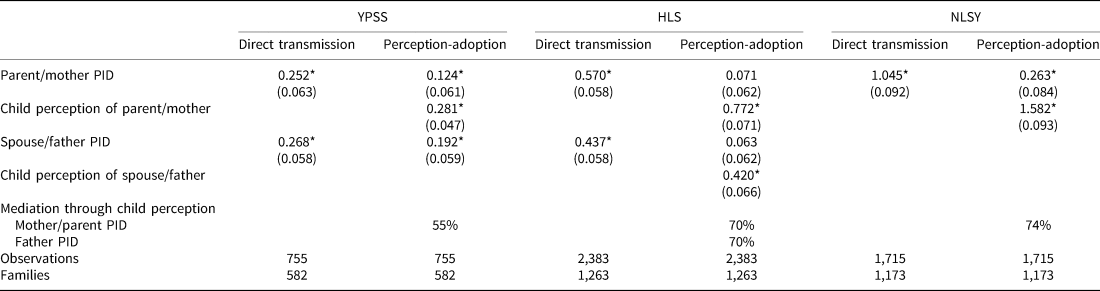
Table 2 presents the results of the multivariate regressions for the direct-transmission and perception-adoption models. Consistent with prior research, the results of the direct-transmission model find a strong linkage between parent and child PID. However, the results from the perception-adoption model indicate that this effect is almost entirely mediated through the child's perception – a finding suspected long ago by Acock and Bengtson (Reference Acock and Bengtson1980). The effect of the child's perception of the parent's PID is larger than that of the parent's self-reported PID. The latter is either strongly attenuated or not statistically significant in all models.
A comparison of direct transmission to perception-adoption

Note: data come from the Youth-Parent Socialization Study (YPSS), the Health and Lifestyles Study (HLS) and the National Longitudinal Study of Youth (NLSY). Models are ordered logistic regression, cell entries are estimated coefficients, and standard errors are listed in parentheses. A table of results that include controls for the child's sex, race, age, education, the parent's sex, education, value strength, family income, parent–child closeness and household politicization is reported in the Appendix. *p < 0.05 (two-tailed)
Mediation analyses reveal that most of the parent's effect on their child occurs through the child's perception. At the lower end are YPSS parents; about 55 per cent of their influence occurs through the child's perception. The percentage is higher in the two more contemporary studies: about 70 per cent for HLS mothers and fathers and 74 per cent for NLSY mothers. These results suggest that parents indirectly influence children – anywhere from 26 to 45 per cent of the parents' effect is not mediated through the child's perception – but they clearly demonstrate the importance of the child. While parents can circumvent children, it is more often the case that children, knowingly and unknowingly, are at the helm of determining their political identification. Altogether these findings offer a more comprehensive assessment of the role of the child in the transmission of party identification and confirm suspicions voiced in prior research.
How Do Key Predictors Influence Transmission?
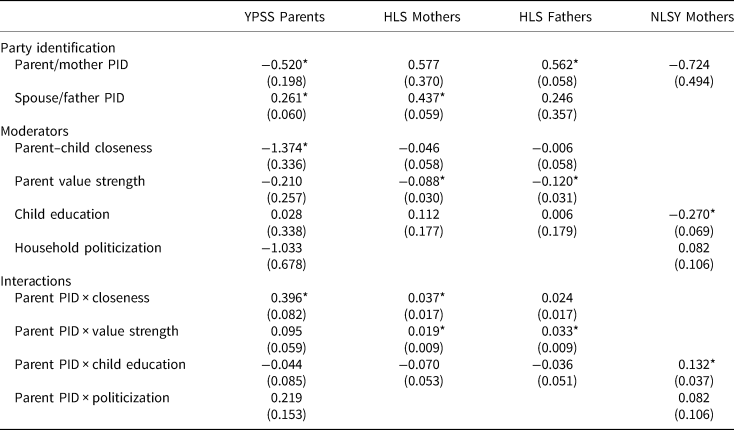
The preceding analyses affirm the independent roles of perception and adoption on value transmission and thereby allow us to proceed to the heart of this study: using the logic of the perception-adoption approach to elucidate the effect of core predictors of value formation including parent–child closeness, value strength, child education and household politicization. We show that in some cases their influence is entirely different than what the extant literature has assumed. To begin, we report the results from the direct-transmission models in Table 3. These models reproduce the traditional approach to understanding political socialization and show that parent–child closeness and parental value strength generally have positive and significant effects on the transmission of party identification, while the effect of education is inconsistent across studies and the effect of politicization is consistently indistinguishable from zero. That is, through the direct-transmission lens, whether transmission occurs does not seem to depend on the child's education or the politicization of the household.
Examining the factors that moderate Direct Transmission of parental PID

Note: data come from the Youth-Parent Socialization Study (YPSS), the Health and Lifestyles Study (HLS) and the National Longitudinal Study of Youth (NLSY). The dependent variable is the child's self-reported party identification. Models are ordered logistic regression, cell entries are estimated coefficients and standard errors are listed in parentheses. A table of results that include controls for the child's sex, race, age, education, and the parent's sex and education are reported in the Appendix. *p < 0.05, †p < 0.10 (two-tailed)
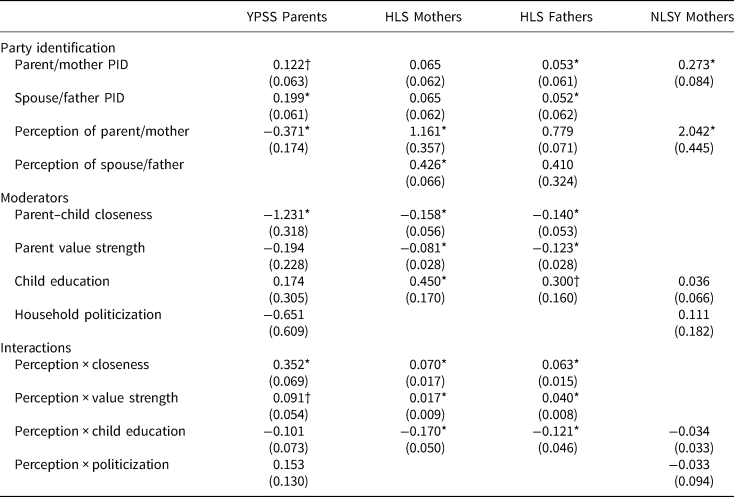
We see markedly different results, however, when we disaggregate the direct-transmission model into perception and adoption steps. Table 4 reports the results of the perception models and Table 5 reports the results of the adoption models. For parent–child closeness and parental value strength, the direct-transmission models uniformly agree that they enhance transmission. However, when we look at the perception and adoption steps separately, we observe that parent–child closeness and parental value strength have statistically significant and positive effects on adoption, but not on perception. When children perceive themselves to be closer to their parents or when their parents espouse stronger attitudes, they are more likely to adopt whatever PID they believe their parents to be but are no better at accurately identifying what their parents' actual political identities are. Figure 3 plots the conditional effect of parent–child closeness on the predicted probability of perceiving a Republican parent. For both the YPSS and the NLSY, the results show that there is a stronger association between parent self-report and child perception when children perceive more social support from parents.
Probability of perceiving a (strong) Republican parent, Predicted probability (x2), Low politicization (x2), High politicization (x2)

Examining the factors that moderate Perception of parental PID

Note: data come from the Youth-Parent Socialization Study (YPSS), the Health and Lifestyles Study (HLS) and the National Longitudinal Study of Youth (NLSY). The dependent variable is the child's self-reported party identification. Models are ordered logistic regression, cell entries are estimated coefficients and standard errors are listed in parentheses. A table of results that include controls for the child's sex, race, age, education, and the parent's sex and education are reported in the Appendix. *p < 0.05, †p < 0.10 (two-tailed)
Examining the factors that moderate Adoption of parental PID

Note: data come from the Youth-Parent Socialization Study (YPSS), the Health and Lifestyles Study (HLS) and the National Longitudinal Study of Youth (NLSY). The dependent variable is the child's self-reported party identification. Models are ordered logistic regression, cell entries are estimated coefficients and standard errors are listed in parentheses. A table of results that include controls for the child's sex, race, age, education, and the parent's sex and education are reported in the Appendix. *p < 0.05, †p < 0.10 (two-tailed).
As we noted earlier, previous studies have not identified a consistent effect of child education on the transmission of party identification, a conclusion confirmed by the results of the direct-transmission models here. Only one of the four studies – the NLSY – has a statistically significant (if small) effect of education in the direct-transmission model. The perception and adoption models reveal that this ‘non-effect’ appears to be the result of opposing and offsetting influences of education on the independent perception and adoption steps. The perception models reveal positive but largely non-significant effects of education on perceptual accuracy, while the adoption models reveal that education has negative and somewhat statistically significant effects on whether children adopt perceived parental orientations. It therefore seems that education does not significantly improve perceptual ability but may lead children to reject their parents’ assumed party affiliations.
The bottom right panel of Figure 3 presents the results for politicization. Consistent with the extant literature, direct-transmission models produce mixed results. In both cases, the effect is positive but it is only significant in the NLSY (the HLS contained no measure of politicization). From the direct-transmission results, we might conclude that politicization has little or unclear effects on transmission. However, again, separating the perception and adoption steps clarifies how politicization facilitates and hinders the transmission process: politicization uniformly improves the child's perceptual accuracy, while it has no significant role on the child's motivation to adopt their parent's orientations. In households where parents are politically active, children are better at identifying their PID than in households where parents are not politically active. Figure 4 presents the conditional effects of politicization on the adoption step, showing that there is a stronger association between the child's perception and self-report in households that are highly politicized.
Probability of identifying as strong/always Republican, Not close (x2), Very close (x2), Predicted probability (x2)

Taken together, these findings provide evidence that the perception-adoption approach provides a powerful tool to identify how the family environment and child attributes influence the transmission process. In the case of parent–child closeness, the direct-transmission model showed an effect but obscured its source, while the perception-adoption approach showed that closeness leads to the better adoption of perceived orientations. With politicization, the inconsistent findings from the direct-transmission model were shown to be quite consistent for improving child perceptions. Regarding education, the direct-transmission model indicated an overall null effect while the perception-adoption model revealed a significant effect on adoption. Each of these analyses illustrates a unique way in which the perception-adoption approach improves our understanding of how family environments and child characteristics affect the transmission process.
Discussion
Contemporary political socialization research overwhelmingly relies on self-reported parent–child concordance as evidence of transmission. Lack of data, parsimony and path dependence are perhaps the most notable reasons for the continued reliance on this approach. A nascent line of political socialization research has shown that a two-step approach to parent–child transmission provides a more detailed understanding of the process. The current study develops this approach further, and makes several substantial contributions to the study of political socialization.
First, we present a theoretical case and empirical method for identifying the rate at which parents transmit their political party identifications to their children by using a model that separates transmission into distinct perception and adoption steps. Using one of the most important studies of political socialization, our perception-adoption approach provides confirmatory evidence that relying on self-report parent–child concordance (that is, the direct-transmission approach) overstates transmission because it treats those who correctly perceive and adopt the same as those who misperceive and reject, and treats those who misperceive and adopt the same as those who correctly perceive and reject. The number of false positives and false negatives is considerable: across samples, on average, 28 per cent of children misperceived their parents' values and 35 per cent rejected whatever they perceived parents to be. The perception of parental values, not the parent's actual values, is therefore the most important determinant of party identification.
Most importantly, our results relying on a perception-adoption approach resolve several inconsistencies in prior empirical research. Past research relying on a direct-transmission approach finds that higher education has no consistent role in value transmission. Using a perception-adoption approach, however, we find that higher education leads to higher rates of child rejection of parental party identification. This makes sense insofar as education might improve children's ability to detect and process information about a parent's party identification, but also leads to more independent thinking; new information appears to change one's views (also see Dinas Reference Dinas2014). This finding presents an interesting conundrum for parents: if parents want to give their children the most opportunities in life, then guiding them to higher education is important, but doing so is more likely to result in children seeking out new information that may contradict their parents’ values, which on average leads to a higher chance that their children will reject their parent's party identification (for a complementary argument, see Mendelberg, Mccabe and Thal Reference Mendelberg, Mccabe and Thal2017). A similar pattern was found for family cohesiveness and parental value strength, but with opposite effects. Children who are closer to their parents and whose parents hold more extreme attitudes are no more likely to know their parent's party identification, but they are more likely to adopt whatever party identification they believe their parents have. These findings also correct previous assumptions that considered value salience to lead to better perception.
An opposite pattern was found for politicization. In a direct-transmission model a politically active home environment only sometimes increased transmission, which is consistent with some reports but contrasts with others (Dinas Reference Dinas2014; Beck and Jennings Reference Beck and Jennings1991; Jennings, Stoker and Bowers Reference Jennings, Stoker and Bowers2009). When separating transmission into perception and adoption steps, however, the evidence consistently shows that politicization affects perception but not adoption. Extant research has shown that parent–child concordance increases when attitudes and party identification align. That is, children tend to take on their parent's attitudes when they receive more consistent messages. Yet, prior scholarship did not know exactly why.
The perception-adoption approach used here provides some explanation of how this happens. In more politicized homes – homes in which political discussion is more common – children are more likely to know their parents' party identification; more extreme (and thus more consistent) attitudes lead children to adopt that party identification. In this way, the current study brings together previously thought-to-be inconsistent findings; politicization improves perception, while other research has found that the times (Beck and Jennings Reference Beck and Jennings1975), age of children (Klofstad Reference Klofstad2010), and additional proximal factors, such as the media, affect adoption. The perception-adoption approach clarifies the important role of familial factors, and helps make sense of previously inconsistent results. Theoretical approaches and empirical analyses that consider parent–child concordance as evidence of transmission, or those that treat orientations as simply imposed by parents, would benefit from advancing approaches that include the child's perception and motivation to adopt parental behaviors, family and social environments, and the interaction between these forces.
Despite the advances offered in this study, much work remains to be done. While we have been able to demonstrate the important contribution of child perception on political socialization, we cannot rule out the possibility that other factors may account for part of the parent–child similarity that we find is dependent on accurate perception. Our mediation tests and use of moderators of both perception and adoption make a convincing case, but some part of this relationship could reflect a child projecting their own values onto parents (Stattin and Kim Reference Stattin and Kim2018). Future research should take up the issue of projection, including when (and to what degree) children project their own values onto parents, when parents project onto children, and how this projection shapes the socialization process.
In order to address the complexity of causality in familial transmission, further consideration of institutional constraints, differences in political context, assortative mating, religion, ethnicity, conflicts, economic factors, genetic influences, global and local events, cohort effects,Footnote 12 and so forth are needed. Our findings call for exploring how this perception-adoption connects and interacts with these factors and raise more questions than they answer. For example, how does the perception-adoption approach travel to other countries? Political institutions can structure the degree to which partisanship and ideology are passed from parents to children (Westholm and Niemi Reference Westholm and Niemi1992). It seems likely that the child's perception is especially pivotal to the ‘indirect’ effect partisan transmission has on ideological transmission, but that its importance will vary based on the stability and structure of the party system. Our findings on party identification in the United States may differ across political systems and value domains.
It remains unknown how the perception-adoption approach changes our understanding of other political orientations besides party identification, including attitudes and ideologies. Given that political identities are so salient in modern political life, party identification in the US context is the trait for which we should expect the least amount of misperception and therefore represents a conservative test of our approach. Assessing whether children know their parent's views on, for instance, racial stereotypes, defense attitudes, social policy views, overall ideologies – and, of great importance to democracies, civic mindedness, participation and political engagement – will expand our understanding of attitude formation in adolescence, young and later adulthood, and the role of perception in this process (Barni et al. Reference Barni2011; Miklikowska Reference Miklikowska2016; Roest, Dubas, and Gerris Reference Roest, Dubas and Gerris2009; Valentino and Sears Reference Valentino and Sears1998).
The interaction of dispositional, emotional and cognitive aspects of the child and parent, including matches and mismatches in personality, are also important considerations, yet little is known about how these facilitate the perception and adoption of parental orientations. Indeed, the potential role of biological factors merits further attention. Although prior studies have found little genetic underpinning for party identification in the United States (Hatemi et al. Reference Hatemi2009),Footnote 13 there is substantial evidence that individual differences in physical and psychological perception as well as the correlates of adoption – including closeness, bonding, strength of attitudes and personality – are genetically influenced (Donaldson and Young Reference Donaldson and Young2008). That is, these influences may indirectly operate on transmission. In other words, including perception when estimating genetic influences may further inform, nuance or perhaps alter prior research on the subject. Cohort effects, including how the processes of perception and adoption in society have changed, are of great interest. The rise of social media, the proliferation of technology, the continued increase in political polarization, and the changing role of parents may change children's perceptual accuracy and the nature of adoption.
A critical next step is to address bidirectional influences, which are increasingly prevalent, particularly in first-generation immigrant families (Benish-Weisman, Levy and Knafo Reference Benish-Weisman, Levy and Knafo2013; Perez-Brena, Updegraff and Umaña-Taylor Reference Perez-Brena, Updegraff and Umaña-Taylor2015). So far, we have focused on the parent-to-child process, but a growing literature is concentrating on child-driven discussions in which the child's experiences bring new information into the home and allow parents to become more politically aware (Knafo and Galansky Reference Knafo and Galansky2008; McDevitt and Chaffee Reference Mcdevitt and Chaffee2002). Decisions about turning out to vote, party identification, efficacy, trust and attitudes do not operate in vacuum: when children are motivated and exposed to new issues, they can create discussion in the family, updating parental awareness, which can lead to increased parental political activism and voting. All of these possibilities remain to be addressed in a perception-adoption context.
One final implication of the perception-adoption approach focuses on value transmission beyond parent–child dynamics. The vast majority of models of how attitudes, beliefs, identities and behaviors spread within social networks rely on trait-to-trait analyses (Huckfeldt, Johnson and Sprague Reference Huckfeldt, Johnson and Sprague2004). However, if the spread of these values in a social network is at all similar to that of the family, then those models are equally subject to the same limitations as direct-transmission approaches, and a perception-adoption model would be incredibly valuable. Future explorations will bear these out.
Conclusion
The logic of the perception-adoption approach developed here made several advances in our understanding of the political socialization process. We found that the transmission of party identification from parents to children occurs less than half the time on average, which is qualitatively different than the generally accepted portrayal of transmission. While parents may be the most important socializing agent in the lives of children, we confirm that a majority of parents do not transmit their partisan identities to their children. The majority of parental influences, whether active or passive, are mediated through the child's perception; only a small amount of parental influence, whether through the promotion of values, structuring the child's environments or otherwise, circumvents the child's perceptions. This finding demonstrates that children play a major role in their own political socialization, a finding that has important consequences for the study of party identification and the transmission and development of values more broadly.
Moreover, our results provide novel evidence that a perception-adoption approach offers a more detailed account of the processes that influence transmission. Previous research relying on direct-transmission approaches found that parental values, politicization, educational attainment and other predictors of value transmission often produce inconsistent findings. Even when the findings are consistent, they say little about how family environment or child characteristics operate on the transmission process. We offer an approach that allows scholars to assess which factors influence the perception step and which influence the adoption step. In doing so, we find more consistency in how parental values, politicization, educational attainment and other predictors of value transmission shape the transmission process.
Supplementary material
Data replication sets are available in the Harvard Dataverse at: https://doi.org/10.7910/DVN/2KE1XF (Hatemi and Ojeda Reference Hatemi and Ojeda2019) and online appendices at: https://doi.org/10.1017/S0007123419000516.