Tropical forests can provide forest dwellers with a sizable proportion of their dietary needs. Yet, many development and conservation organizations tend to disregard these opportunities, promoting market-oriented reforms that aim at introducing cash crops and markets for non- timber forest products (NTFPs) in the name of poverty alleviation and/or biodiversity conservation. In so doing, they help relegate wild food plants to the position of food for the poor (De Beer & McDermott Reference De Beer and McDermott1996; Neumann & Hirsch Reference Neumann and Hirsch2000), reserve food in case of famine (Takasaki et al. Reference Takasaki, Barham and Coomes2004), or food supplementing that produced on farm plots (Ousseynou & Tieguhong Reference Ousseynou and Tieguhong2004). This comment discusses the economic rationale for the consumption of wild edible plants by forest-dwelling communities, comparing the results obtained from two methods of evaluation. The paper is based on one month of fieldwork during December 2004 carried out by the author together with Theresa Wong and two specially-trained research assistants in Thung Yai Naresuan Wildlife Sanctuary (Western Thailand).
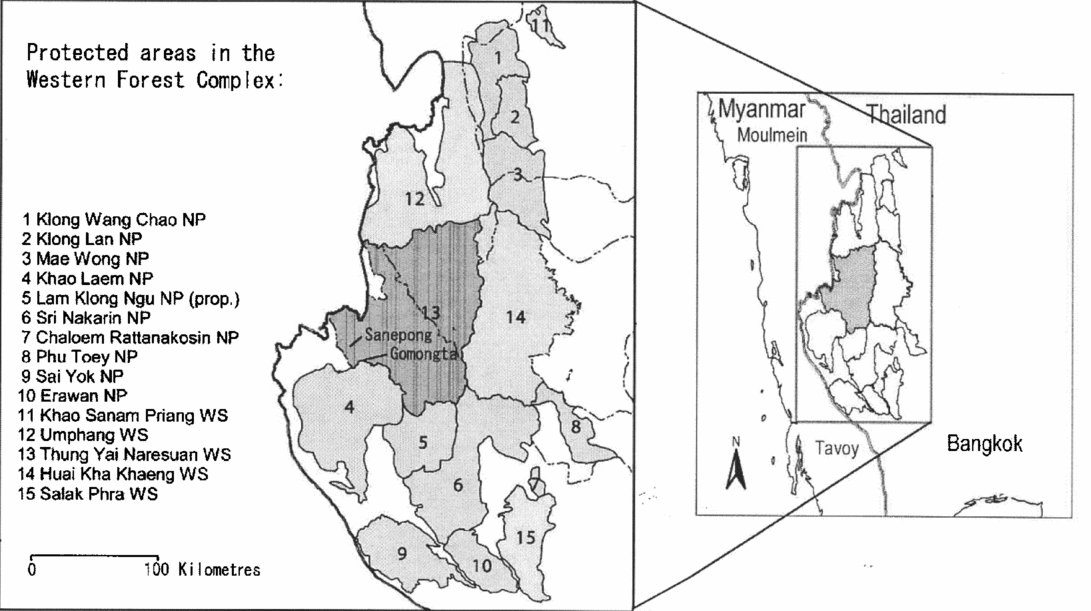
Thung Yai Naresuan is located along the Thai-Burmese border in an area covering some 3600 km2. It forms the core of the ‘Western Forest Complex’ (WFC), which is Thailand's largest forest area, covering about 18 700 km2 (Fig. 1). The Wildlife Sanctuary was declared a World Heritage Site by UNESCO in 1991 (Delang Reference Delang2006a). Inhabited for over 200 years by the Pwo Karen people, the area designated as Wildlife Sanctuary is now home to approximately 3500 people. After an initial attempt to remove the Pwo Karen from the area failed because of international activism and the latter's reputation as good forest stewards, the Thai government desisted; however, it outlawed hunting, the sale of wild edible plants and shortened the length of the fallow period to five years.
The Western Forest Complex, Thailand. Source: Delang (Reference Delang2006b).

Two villages were included in the fieldwork, namely Gomongta (approximately 150 households or 840 people) and Sanepong (about 90 households or 440 individuals). The average of 5.33 members per household is used in the present analysis. Both villages are located approximately one hour by motorcycle on dirt road from Sangkhlaburi, the capital of the sub-district and the nearest market. A total of 35 households in the two villages were selected through systematic sampling, whereby one in every seven households was selected for interview. The interviews were semi-structured, and the interviewees were asked about the wild food plants they gather from the forest, the frequency of extraction, the quantity extracted during the previous year, seasonal variations and the habitat from which the wild edible plants are gathered. This method might lack precision, since the accuracy of information diminishes when people are asked to recall past events, especially quantitatively (Bernard et al. Reference Bernard, Killworth, Kronenfeld and Sailer1984). The most accurate method to estimate the types and quantity of products extracted from the forest is to identify and weigh or measure them each day, as they enter the village (Stearman Reference Stearman1990). However, taking daily measurements would have involved a 12-month long fieldwork to include seasonal variation, for which insufficient time was available. The market of Sangkhlaburi was surveyed to determine the kind, quantities and prices of the food plants on sale.
Both men and women collected food plants, while children usually did not. A total of 134 different wild food plants were recorded. Special care was employed to avoid the double-counting of the same plant to which the villagers had given different vernacular nomenclature. Sometimes these food plants were sold or exchanged within the village, but this was very rare. Our data show that, irrespective of age or gender, each individual was consuming 273 g of wild edible plants a day. Some wild food plants, usually spices, which are eaten often in small quantities, were planted near the house for convenience. These are not included in the analysis.
I compare estimates of the economic value of non-marketed wild food plants derived from two methods (see Delang Reference Delang2006b) to evaluate the economic rationale of forest dwellers who continue consuming wild edible plants in spite of the availability of commercial alternatives.
The first method estimates the value of wild food plants by considering the opportunity cost of the time expended gathering them (Godoy et al. Reference Godoy, Lubowski and Markandya1993). Accurate estimates are complicated by the fact that people often collect wild food plants on the way back from the field or other forest-based activities, and participant observation is not always accepted (Godoy et al. Reference Godoy, Lubowski and Markandya1993). When the purpose of the trip is exclusively to gather food plants, the Karen usually gather these near the river, which is at the edge of the village. To address this problem, we measured the distance (in minutes) between the village and the place where the wild edible plants were gathered (Delang Reference Delang2006a): (1) near the river (20 minutes to and from the village), (2) in old-growth forests (40 minutes), (3) in the mountain (40 minutes), (4) in the swiddens or fallowed swiddens (70 minutes), and (5) everywhere (40 minutes). During each trip, people collected two types of wild edible plants on average, each edible plant typically lasting for three meals. Of the three methods used to estimate the monetary value of time (Peters et al. Reference Peters, Gentry and Mendelsohn1989; Godoy et al. Reference Godoy, Brokaw and Wilkie1995; Wollenberg & Nawir Reference Wollenberg, Nawir, Wollenberg and Ingles1998), I use the local wage rate, paid to agricultural workers for an 8-hour work-day, which was US$ 2.11 (all US$ values converted from Thai baht at current exchange rate) at time of fieldwork. This method overestimates the value of the wild edible plants and essentially measures their maximum value because (1) wage work is more unpleasant than gathering edible plants in the forest, thus people would accept lower compensation for the latter, and (2) most people do not make the trips to the forest exclusively to gather wild food plants. The second method considered the amount of money that the Karen were able to save by not buying domesticated food crops in the market, and used the prices of marketed food plants to estimate the value of wild food plants with similar characteristics (Godoy et al. Reference Godoy, Lubowski and Markandya1993). The Karen grouped the part plants they ate into six categories. A survey was carried out in the market of Sangkhlaburi, the closest town to the fieldwork area where edible plants were sold, where the prices of all the edible plants on sale (n = 46) were recorded. The edible plants were grouped into the six categories of plant parts used by the Pwo Karen and the average price was calculated: (1) leaves (US$ 0.66 kg−1), (2) stem (US$ 0.66 kg−1), (3) roots and tubers (US$0.39 kg−1), (4) fruit (US$ 0.39 kg−1), (5) flower (US$1.32 kg−1) and (6) bamboo shoots (US$ 0.39 kg−1).
Value of wild edible plants
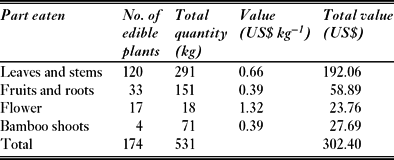
Using the opportunity cost of the time spent in gathering them, the value of the wild edible plants was very small. A member of each Karen household made a total of 190 trips to the forest, spending a total of 14.59 days (7005 minutes), which would be valued at US$ 30.79 with the local wage rate of US$ 2.11 a day (Table 1). On the other hand, using the money saved by not buying market food crops, the 531 kg of wild edible plants gathered by the Karen would have cost US$ 302.40 per household per year (Table 2).
Number of plants, quantity and value of plants extracted from each habitat per household per year. The total number of cases is more than the 134 wild edible plants extracted because some wild edible plants are gathered in more than one habitat. The ‘number of trips’ refers to that made to each habitat during one year to collect the wild edible plants, and is based on the fact that people gather an average of two wild edible plants a time and the assumption that the two plants are gathered in the same habitat.

Parts, quantity and value of the plant eaten, per household per year. The total number of cases is more than the 134 wild edible plants extracted because many wild edible plants are eaten as different parts.

At least four conclusions can be drawn from this study. First, to the Karen, eating wild edible plants seems to be a much more efficient method of subsistence than working for cash. Each household unit would have to expend 143.32 days of labour a year to earn the US$ 302.40 that it saves by gathering wild food plants for 14.59 days.
Second, as the opportunity cost of time increases, the economic advantage of gathering wild edible plants over the purchase of commercial crops decreases. Thus, it makes sense for wealthy people to replace wild edible plants with commercial crops, as empirical studies have shown to be the case. However, it is only with a hypothetical daily wage rate of US$ 20.73 or above, almost ten times the present value, that it becomes economically rational for the Karen to purchase rather than gather food plants. This draws attention to the probable existence of other factors (such as taste preferences and the stigma associated with forest products) in explaining the gradual drop in the consumption of wild food plants as people become wealthier. This has potentially important implications for development work, if the higher incomes brought about by development polices are used for the purchase of commercial crops, rather than channelled into productive investments.
Third, the choice of valuation method is important, and can have significant policy implications. The first method points to the wild edible plants having a very low value, and can be used to argue that the Karen may easily put up with restrictions on their collection. The second method can be used to argue the opposite point. Thus, when forest policies are based on estimates of the values of wild edible plants or other NTFPs, it is important to make clear which method of analysis was used, and what that method shows.
Fourth, assuming a 1.5-km gathering radius around each village on the basis of interviews with the villagers, and subtracting 0.32 ha per person for the production of rice, we arrive at a total value of the wild edible plants of US$ 7.36 ha−1 yr−1 using the first method, and US$ 72.20 ha−1 yr−1 using the second. This range is compatible with previous evaluations of rainforest foods (Costanza et al. Reference Costanza, d'Arge, de Groot, Farber, Grasso, Hannon, Limburg, Naeem, O'Neill, Paruelo, Raskin, Sutton and van den Belt1997). Although in addition to wild edible plants, other benefits should be included to capture the total benefits of the forest to the Karen, such as water supply, medicinal plants, wildlife, domestic animals fed with wild food plants, construction material and fuel wood, the Karen seem able to retain only a small proportion of the total benefits provided to humanity by tropical forests, estimated to be of US$ 2006 ha−1 yr−1(Costanza et al. Reference Costanza, d'Arge, de Groot, Farber, Grasso, Hannon, Limburg, Naeem, O'Neill, Paruelo, Raskin, Sutton and van den Belt1997). It is possible to argue in favour of compensating the Karen for their conservational use of the forest.
Acknowledgements
The Japanese Society for the Promotion of Science financed this research. I thank Yoko Hayami, Theresa Wong and the people of Sanepong and Gomongta for their help.