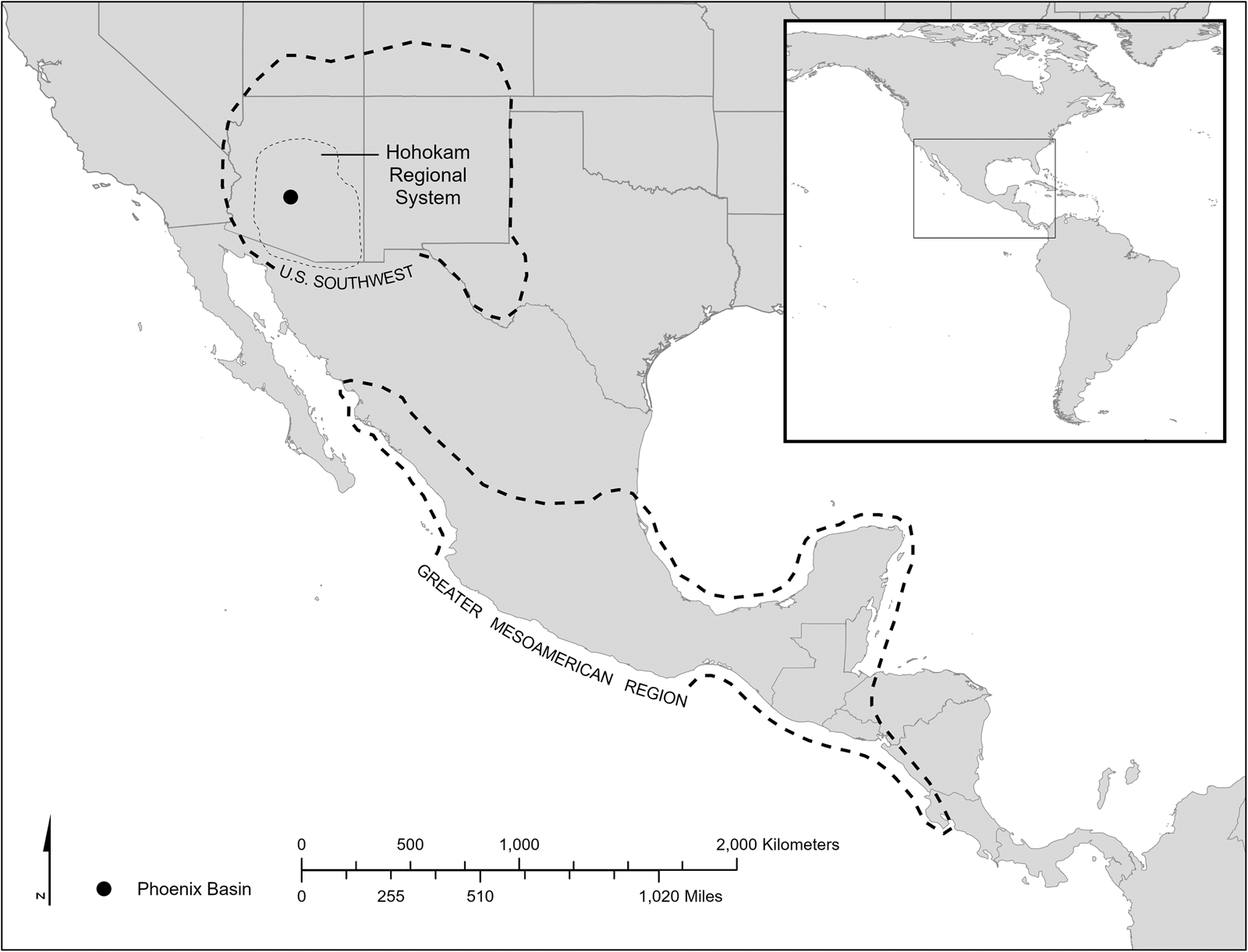
Interaction between prehispanic peoples of greater Mesoamerica and those of the southwestern United States (U.S. SW) has long been a topic of interest to researchers working in both regions (Figure 1). Such interactions are evidenced by the movement of objects (e.g., cacao, copper bells), materials (e.g., marine shell), and ideas (e.g., ballcourts, palettes) across the landscape. Several studies have examined the presence of what Nelson (Reference Nelson and Lekson2006) calls “interaction markers” in the U.S. SW (e.g., Di Peso et al. Reference Di Peso, Rinaldo and Fenner1974; Haury Reference Haury1976), but few (e.g., Crown and Hurst Reference Crown and Hurst2009) have sought to determine whether nonlocal objects were included in predictable associations, accompanied by original meanings, and/or used in traditional ways. The adoption of such a nuanced approach better equips us to infer the social, political, and ritual roles of interaction markers in the U.S. SW, and the degree to which those roles are similar to the traditional use of these objects in greater Mesoamerica.
Regions discussed in this article.

Although frequently discussed collectively, different interaction markers encountered in the U.S. SW came from geographically distinct portions of Mesoamerica (McGuire Reference McGuire1980:5–6)—that is, people in the U.S. SW appear not to have adopted entire belief systems. Instead, they incorporated various attributes of several cultural areas to the south into their existing sociopolitical structures. In a few cases, however, societies in the U.S. SW do appear to have adopted not only nonlocal objects, materials, and ideas but also their original Mesoamerican roles and contexts. A prime example involves cylinder vessels and cacao.
Cylinder vessels and cacao appeared first in Mesoamerica and were used together in formalized rituals (Dreiss and Greenhill Reference Dreiss and Edgar Greenhill2008; Prufer and Hurst Reference Prufer and Jeffrey Hurst2007). Both later appear in the U.S. SW—at Chaco Canyon—in special contexts as markers of long-distance interaction (Crown and Hurst Reference Crown and Hurst2009; Pepper Reference Pepper1920). Just as in the Maya Lowlands, Chacoan cylinder vessels and cacao are found together and with evidence of similar usage, suggesting that some people living at Pueblo Bonito were not only receiving nonlocal goods but also incorporating elements of nonlocal ceremonial activity (Crown and Hurst Reference Crown and Hurst2009:2112; see also Hays-Gilpin and Hill Reference Hays-Gilpin, Hill and Hegmon2000; James Reference James2000; McGuire Reference McGuire, Glowacki and Keuren2011; Parsons Reference Parsons1933).
In many cases, however, interaction markers are not found in predictable associations or deposited in ways that suggest the adoption of nonlocal practices. For example, scarlet macaws, which were brought into the U.S. SW from Mesoamerica (Crown Reference Crown2016:332–333), were used and deposited in strikingly different ways. This includes dissimilarities in accompanying artifact assemblages and the contexts in which the macaws were buried (Rizo Reference Rizo1998; Suarez Reference Suarez2013). In contrast to the transregional parallels in cacao ceremonialism (Crown and Hurst Reference Crown and Hurst2009), the macaw evidence demonstrates that some interaction markers took on distinctively northern roles.
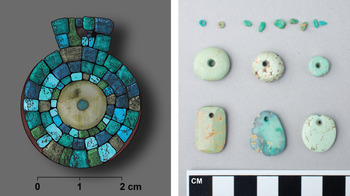
To further develop an understanding of interaction markers and the degree to which they suggest shared meaning and practice, we examine the spatial distribution, contextual deposition, and morphology of blue-green stone mosaics. By “blue-green stone,” we refer to turquoise and similarly colored minerals—a term not unlike “cultural turquoise,” used by others (e.g., Hedquist Reference Hedquist2017; Weigand et al. Reference Weigand, Harbottle, Sayre, Earle and Ericson1977). Mosaics are composite artifacts that incorporate shaped tiles (tesserae) of stone, shell, or other materials (Figure 2). These tesserae are affixed to a backing of some kind, such as shell, wood, or basketry. Some mosaics are covered entirely with tesserae, forming a plated surface, whereas others have limited coverage. Tesserae are sometimes affixed to the backing's uppermost surface, a technique referred to as “onlay.” At other times, the tesserae are set into carved channels or recessed beds in the backing, a method called “inlay.” The definition of “mosaic” used in this article does not include artifacts with a single tessera, but instead requires at least two adjacent tiles.
Sample of artifact types included in this analysis. Left: Blue-green stone mosaic from Grand Canal. Digital illustration by Will Russell (after Mitchell Reference Mitchell and Mitchell1989:460:Figure 10.5); Right: Turquoise beads, nuggets, and pendants. (Color online)

To assess the degree to which Mesoamerican practices associated with mosaics were either retained or modified, we must identify and characterize the ways in which these artifacts were used and deposited in each region. Although patterns of distribution and deposition have been discussed broadly for Mesoamerican mosaics (e.g., King et al. Reference King, Carocci, Cartwright, McEwan and Stacey2012; McEwan et al. Reference McEwan, Middleton, Cartwright and Stacey2006; Weigand and Harbottle Reference Weigand, Harbottle, Ericson and Baugh1993), neither broad nor detailed studies assessing mosaic use in the U.S. SW have been conducted. With this article, we seek to begin developing an understanding of the practices associated with—and the value attributed to—mosaics in the U.S. SW by investigating patterns of distribution and deposition at sites associated with Hohokam Canal System 2, located in the Phoenix Basin of central Arizona. This research forms a foundation from which to conduct similar studies focused at different social, spatial, and temporal scales, the cumulative findings of which will elucidate patterns of mosaic use across the U.S. SW.
We infer and interpret the social use of mosaics through analyses of spatial distribution and contextual deposition. We then assess the social significance of mosaics by comparing the distribution, deposition, and form of mosaics to those of other blue-green stone artifacts (sensu Lesure Reference Lesure and Robb1999). These objectives are accomplished using spatial analysis, statistical assessments, and morphological comparison.
Analyses reveal limited spatial distribution of mosaics across the sites of Canal System 2 and deposition within a narrow range of contexts. Mosaic-specific patterns differ from those of other blue-green stone artifacts, which are associated with every site in the sample and occur in a broader range of depositional contexts. Combined with assessments of morphology, the data suggest that mosaics held greater social value than other blue-green stone items and functioned within some type of vertical (i.e., hierarchical) social relationship, in which access to mosaics was restricted to certain social, political, and/or ritual groups, indicating a degree of social inequality.
Patterns of distribution and deposition and the morphological attributes of mosaics associated with Canal System 2 differ from those observed in Mesoamerica, which suggests that mosaic-related practices were likely adapted to complement existing Hohokam traditions. A diachronic, multiscalar analysis of mosaic distribution, deposition, and morphology at sites throughout the U.S. SW is necessary to create a comprehensive understanding of overarching patterns of (and variation in) mosaic use at different sociospatial scales.
Blue-Green Stone Mosaics in Mesoamerica
The craft of mosaic making in Mesoamerica is deeply rooted and enduring, and it incorporates diverse materials. Some of the earliest mosaics documented are associated with sites in the Olmec region. Here, small mosaics of an undescribed medium were deposited with bone fragments and red pigment in an Early Preclassic tomb at Teopantecuanitlán, an Early to Middle Preclassic (1400–500 BC) site located in modern-day Guerrero (McEwan et al. Reference McEwan, Middleton, Cartwright and Stacey2006:15). During the Middle Preclassic (900–600 BC), three dramatic serpentine pavements, each constructed from several hundred large blocks, were laid out and then buried on the principal platform of La Venta (McEwan et al. Reference McEwan, Middleton, Cartwright and Stacey2006:14–15). By the Middle Formative period (ca. 600 BC), mosaic mirrors were being made in the Maya region (Healy and Blainey Reference Healy and Blainey2011:230). Mosaics of blue-green stone appear by the Late Formative period, when small jade mosaics in the shapes of a bat head and a human head were deposited in a burial dated to AD 100–200 at Tak'alik Ab'aj in modern Guatemala (Schieber de Lavarreda Reference Schieber de Lavarreda, Laporte, Arroyo, Escobedo and Mejía2003:790).
Blue-Green Stone Mosaics
Blue-green stone mosaics take many forms in Mesoamerica, such as masks, knife handles, pendants, discs, and shields (McEwan et al. Reference McEwan, Middleton, Cartwright and Stacey2006:10; Miller Reference Miller, Wren, Kristan-Graham, Nygard and Spencer2018:186–187). To decorate them, artisans used small, skillfully shaped tesserae to create intricate designs. Most mosaics have flat tesserae that form a plated surface, with various shades of blue-green used to create designs and depth. In some cases, however, individual tesserae or groups of tesserae were fashioned to form miniature figures, such as dancers, deities, and rulers (e.g., Feest Reference Feest, King, Carocci, Cartwright, McEwan and Stacey2012:Figure 7). The surfaces of these tesserae were often carved with even finer detail, representing elements such as heads, appendages, clothing, and headdresses. Tesserae of different blue-green hues were selected to separate such figures visually from their background (Feest Reference Feest, King, Carocci, Cartwright, McEwan and Stacey2012:110).
Early on, jade was the most popular blue-green stone used in mosaic making. By the end of the Late Classic period (900 CE), however, turquoise use increased, and by the Early Postclassic (AD 1000–1250), it had become the principal stone used (McEwan et al. Reference McEwan, Middleton, Cartwright and Stacey2006:18–19). A wide range of materials was used alongside blue-green stone to create the beautifully crafted designs, figures, and scenes depicted. Some of these include gold, tortoiseshell (Frazier and Ishihara-Brito Reference Frazier and Ishihara-Brito2012:825), marine shell, feathers, jet, and pigment (McEwan et al. Reference McEwan, Middleton, Cartwright and Stacey2006:30–31). Similar to the use of varying blue-green stone hues to create design elements, other mosaic materials were carefully selected to create depth, design, and character features (Cartwright et al. Reference Cartwright, Stacey, McEwan, King, Carocci, Cartwright, McEwan and Stacey2012:12). For example, shell and pigment were used to create teeth, fangs, and gums (Cartwright et al. Reference Cartwright, Stacey, McEwan, King, Carocci, Cartwright, McEwan and Stacey2012:12–13; McEwan et al. Reference McEwan, Middleton, Cartwright and Stacey2006:30–37). Tesserae were adhered to mosaic backs using a variety of resins and beeswax.
Distribution and Deposition of Blue-Green Stone Mosaics
Although the spatial distribution and contextual deposition of Mesoamerican mosaics are discussed broadly (e.g., McEwan et al. Reference McEwan, Middleton, Cartwright and Stacey2006:8–19), systematic analyses of such patterns have not yet been conducted to investigate variability across the region. Consequently, the patterns of distribution and deposition of Mesoamerican mosaics used for comparison in the current study are the broad patterns observed in a review of previous literature rather than patterns revealed from a targeted study. Mosaic artifacts crafted with blue-green stone are found throughout Mesoamerica. In most cases for which provenience is recorded, these mosaics are typically deposited in places of sociopolitical power and/or ceremonial importance—such as prominent public architecture—and often in a manner that prevents them from being viewed after deposition. For example, a large mosaic disc was buried as a dedicatory offering during the final stage of construction of the Templo Mayor of the Aztecs (McEwan et al. Reference McEwan, Middleton, Cartwright and Stacey2006:61). In cases where mosaics are deposited in interments, they are included in the mortuary assemblages of high-status individuals, such as priests and rulers.
The widespread distribution of mosaics, their association with public ceremony, and their deposition in or near public architecture indicate that they functioned within some type of horizontal social structure in Mesoamerican society—that is, within relationships existing between people of the same hierarchical level or in the context of events to which everyone has access, regardless of social inequalities that exist in other sociopolitical or religious contexts. Interments with high-status individuals, however, demonstrate that blue-green stone mosaics also played a role in vertical (i.e., hierarchical) social structure.
Mesoamerican societies have a strong and ancient tradition of mosaic making that predates the production of mosaics in the U.S. SW by centuries. Based on timing of appearance and similarities in manufacturing techniques, it is demonstrable that mosaic making in this part of the world originated in greater Mesoamerica and disseminated northward, where it was eventually adopted by some societies in the U.S. SW. For example, the earliest mosaic pieces in the Ancestral Pueblo region of the U.S. SW date to Basketmaker III/Pueblo I period contexts (AD 500–920; Mathien Reference Mathien1997:1143, 1152), whereas mosaics are found in much earlier contexts in Mesoamerica, such as Burial 1 (ca. AD 100–200) at the Maya site of Tak'alik Ab'aj (Schieber de Lavarreda Reference Schieber de Lavarreda, Laporte, Arroyo, Escobedo and Mejía2003:791). Below, we ask whether this process of adoption involved the craft technology alone (cf. Suarez Reference Suarez2013), or whether blue-green stone mosaics carried similar meanings and filled similar roles for cultural groups in the U.S. SW to what they did in Mesoamerica (cf. Crown and Hurst Reference Crown and Hurst2009).
If the Hohokam adopted not only the craft of mosaic making from Mesoamerica but also the practices associated with the objects, we expect mosaics to be (1) geographically widespread; (2) associated with public architecture of ceremonial importance, such as ballcourts, platform mounds, and plazas; (3) deposited in a way that prevents further viewing of the mosaic when associated with public contexts; and (4) deposited with high-status individuals when associated with interments. To test these expectations as well as assess the social use and value of mosaics in Hohokam society, we analyze the distribution and deposition of mosaics associated with sites in Canal System 2 and compare their morphology to that of other blue-green stone objects.
Inferring Social Practice and Value
Although meanings associated with an object are rarely preserved in the archaeological record, patterns of spatial distribution and deposition can speak to an object's use and significance (Lesure Reference Lesure and Robb1999:25; Mattson Reference Mattson2016:126; Mills Reference Mills2004:238; Mills and Walker Reference Mills and Walker2008; VanPool and Newsome Reference VanPool and Newsome2012:259; Walker Reference Walker1999, Reference Walker, Mills and Walker2008). Because an object's use and value are dependent on its cultural setting and may change throughout the object's life cycle (Kopytoff Reference Kopytoff and Appadurai1986:68; Thomas Reference Thomas1991; Walker Reference Walker1999, Reference Walker, Mills and Walker2008), strict correlates between specific objects, roles, and values cannot be drawn. Thus, multiple lines of evidence and a diachronic perspective are necessary to create well-informed interpretations of an object's use and value through time. Following Lesure (Reference Lesure and Robb1999), we investigate the function and value of mosaics in Hohokam society—specifically, communities within Canal System 2—using four lines of evidence:
(1) The spatial distribution of mosaics
(2) The range of depositional contexts of mosaics
(3) The morphology (e.g., uniqueness of appearance) of mosaics
(4) A comparison of patterns of distribution, range of depositional contexts, and morphology of mosaics to those of other blue-green stone artifacts within Canal System 2
We use patterns of the distribution and deposition of mosaics to infer the kind(s) of social relationships—specifically, horizontal, vertical, or both—within which mosaics may have functioned. We then investigate the social significance of mosaics by comparing their distribution, deposition, and morphology to those of non-mosaicked objects made of similar materials (Figure 2). Finally, we compare the inferred use and value of mosaics within Canal System 2 to patterns observed in greater Mesoamerica to investigate the degree to which practices associated with mosaics remained intact as the technology of mosaic making dispersed northward.
Kinds of Social Relationships
Social relationships are categorized in different ways and with varying levels of specificity. One fruitful distinction is that between horizontal and vertical relationships. Horizontal relationships occur between structurally similar individuals or groups, such as family members or clans, and vertical relationships are hierarchical, such as those occurring between political or ritual elites and commoners (Lesure Reference Lesure and Robb1999:26; Mattson Reference Mattson2016:127).
Differences in spatial distribution and depositional context are particularly important in assessing whether an object functioned within horizontal and/or vertical social relationships (Hedquist Reference Hedquist2017:41–42; Lesure Reference Lesure and Robb1999:32). Generally, artifacts that operate within horizontal social structures have similar distributions across an area and are encountered in a wide range of depositional contexts. This is because use is not restricted to certain social groups. One example would be the ubiquitous pottery vessel, found in houses, middens, ritual structures, and burials. Objects functioning within vertical social structures exhibit high levels of distributional variability, and they are encountered in a narrower range of contexts because their use is limited to certain social groups. A Hohokam example would be the copper bell, which was relatively rare, spatially concentrated, and found almost exclusively in ritual contexts. An object may function within both realms of social structure—either simultaneously or sequentially—as a result of changing circumstances, possessors, assemblages, and intent (Lesure Reference Lesure and Robb1999:32; Mattson Reference Mattson2016:128). A bone awl, for example, could be fashioned as a mundane, utilitarian object operating within a horizontal social structure. If it is later used during a sodality initiation or buried with a venerated elder, however, it can transition to use in a vertical structure (see Walker Reference Walker1999, Reference Walker, Mills and Walker2008).
Assessing Relative Value
Because an object's perceived value is dependent on the way it compares to other objects, a gradation of values can be used to assess the significance of an object by differentiating it from (and, often, ranking it among) other objects of similar composition or form (Lesure Reference Lesure and Robb1999:27; Mattson Reference Mattson2016:128). Indicators of social value include rarity, size, texture (MacGregor Reference MacGregor1999), color, sound (Hosler Reference Hosler1994:227), luster (Spielmann Reference Spielmann2002:200), origin, form, and craftsmanship (Helms Reference Helms1993; Lesure Reference Lesure and Robb1999:30). Similarities and differences help to place an object within a range of values (Lesure Reference Lesure and Robb1999:30), and the object's position on this spectrum can aid in inferring its social roles and degree of significance within social reproduction.
We use the aspect “specificity” to assess the position of mosaics relative to other blue-green stone objects on a gradient of values. Specificity is an evaluation of an object's appearance: unique, easily identifiable objects have high specificity, whereas objects with a common appearance have low specificity. Highly specific items are typically associated with high labor and resource costs (Lesure Reference Lesure and Robb1999:30)—consequently, a higher value. Objects that play a role in social display and prestige are often elaborated and individualized at the expense of efficient production, because such goods are valued primarily for their sign value (Costin Reference Costin and Schiffer1991:37).
Caution must be observed, however, when using specificity to establish an object's position on a gradation of values because items that are not unique in appearance may gain value through time or by other means (Weiner Reference Weiner1985:214). Our considerations of spatial distribution and range of depositional context types help us assess whether differences in specificity indeed indicate that mosaics had a value different from non-mosaicked blue-green-stone objects.
Assessing the value of mosaics and their function within Hohokam society better equips us to evaluate the degree to which practices associated with mosaic use in Mesoamerica were adopted along with the craft technology. The current analysis focuses on 10 sites located within Hohokam Canal System 2.
The Hohokam Regional System
The Hohokam Landscape
The Hohokam regional system (sensu Wilcox Reference Wilcox, Rice, Wilcox, Rafferty and Schoenwetter1979) stretches south from central Arizona to northern Sonora, and east from the Great Bend of the Gila River almost into New Mexico (Figure 1). The Hohokam cultural sequence is separated into four major periods: Pioneer (AD 450–750), Colonial (AD 750 to 900–950), Sedentary (AD 900–950 to 1125–1150), and Classic (AD 1125–1150 to 1450). Although maize agriculture first reached the Hohokam region as early as 2000 BC, it was not until around AD 450 that larger, more permanent settlements were constructed (see Doyel Reference Doyel1979; Mabry Reference Mabry, Doyel, Fish and Fish2000; Waters and Ravesloot Reference Waters and Ravesloot2001). Prior to the Classic period, people lived in pithouses that were arranged in courtyard groups (Howard Reference Howard, Doyel, Fish and Fish2000; Mabry Reference Mabry1998) and cremation was the primary method of mortuary treatment (Beck Reference Beck, Rakita, Buikstra, Beck and Williams2005; McGuire Reference McGuire1992).
During the late Colonial and Sedentary periods (i.e., AD 700–1070), Hohokam society adopted (and/or adapted) several distinctly Mesoamerican traits (e.g., Maldonado Cárdenas Reference Maldonado Cárdenas, Niederberger and Reyna Robles2002; Mathiowetz et al. Reference Mathiowetz, Schaafsma, Coltman and Taube2015; Wallace Reference Wallace and Wallace2014). These include the importation of objects (e.g., copper bells, conch trumpets), fauna (e.g., scarlet macaws, thick-billed parrots), artifact styles (e.g., palettes, censers), and feature types (e.g., ballcourts, platform mounds). This influx of Mesoamerican attributes coincided with the largest expansion of Hohokam society, as measured by the spatial distribution of large-scale irrigation, ballcourts, and red-on-buff pottery. The Classic period is marked by the disuse of ballcourts (Abbott Reference Abbott2006; Wilcox Reference Wilcox, Scarborough and Wilcox1991), a transition from living in pithouses to aboveground adobe compounds (Bayman Reference Bayman2001), and a shift in mortuary focus from cremation to inhumation (Crown and Fish Reference Crown and Fish1996).
Canal Irrigation
In many a sense, the core of the Hohokam regional system was in the Phoenix Basin, which comprises a valley traversed by the lower Salt River and middle Gila River. Here, Hohokam farmland was irrigated by a large and intricate network of canals. This network is divided into several canal systems that played central roles in Hohokam society and daily life (Abbott Reference Abbott and Abbott2003a; Howard Reference Howard2006; Nicholas and Neitzel Reference Nicholas, Neitzel, Fish and Fish1984; Rice Reference Rice1998). As used here, the term “canal system” refers to a primary canal—which drew water directly from the river—its subsequent branches, the settlements situated along these waterways, and any concomitant sociospatial organization or sense of collective identity. We assume some level of mutually beneficial cooperation within and between villages in the same canal system. At the same time, the nuances of water management systems suggest a certain amount of competition within canal systems (see Abbott Reference Abbott and Abbott2003a, Reference Abbott and Abbott2003b, Reference Abbott2006; Abbott et al. Reference Abbott, Smith and Gallaga2007; Hill et al. Reference Hill, Clark, Doelle and Lyons2004; Howard Reference Howard, Scarborough and Isaac1993; Hunt et al. Reference Hunt, Guillet, Abbott, Bayman, Fish, Fish, Kintigh and Neely2005; Nicholas and Neitzel Reference Nicholas, Neitzel, Fish and Fish1984; Rice Reference Rice1998).
Canal System 2
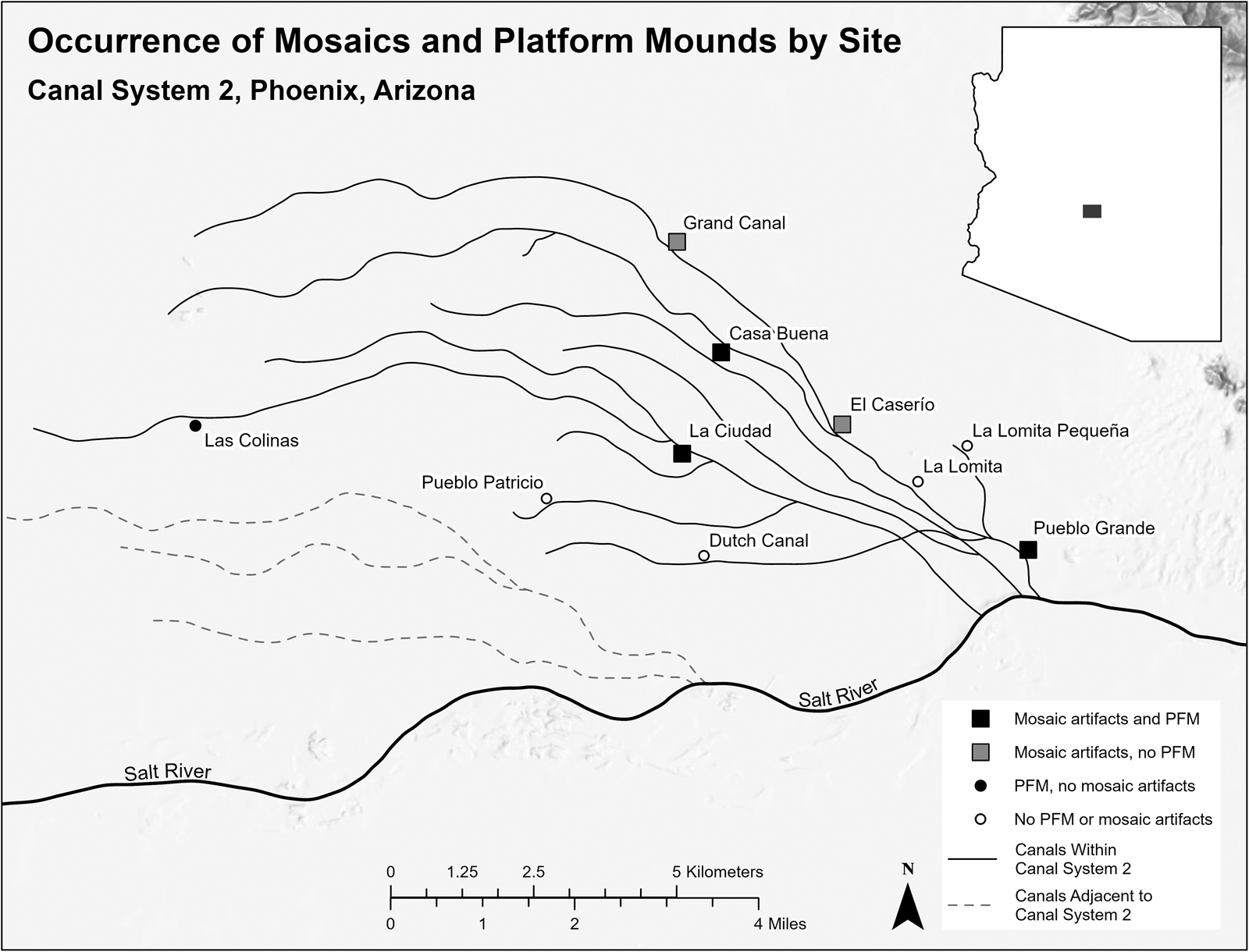
Canal System 2 (Figure 3) was one of the largest Hohokam canal systems, drawing water from the lower Salt River in what is now the city of Phoenix (see Ackerly et al. Reference Ackerly, Howard and McGuire1987; Masse Reference Masse1981; Midvale Reference Midvale1968; Turney Reference Turney1929). The largest of the system's villages, Pueblo Grande, sat near the primary headgate (Abbott, ed. Reference Abbott2003; Andrews and Bostwick Reference Andrews and Bostwick2000; Woodbury Reference Woodbury1960) and is preserved today as a city park and museum. For the present exercise, we use data from 10 sites within Canal System 2 (listed in order of proximity to the canal headgate): Pueblo Grande (AZ U:9:1 [ASM]; Downum Reference Downum1993), La Lomita (AZ U:9:67 [ASM]; Mitchell Reference Mitchell1990), La Lomita Pequeña (AZ U:9:66 [ASM]; Mitchell Reference Mitchell1988), El Caserío (AZ T:12:49 [ASM]; Mitchell, ed. Reference Mitchell1989a), Dutch Canal (AZ T:12:62 [ASM]; Henderson Reference Henderson2003), La Ciudad (AZ T:12:1 [ASM]; Wilcox Reference Wilcox1987), Casa Buena (AZ T:12:37 [ASM]; Howard Reference Howard1988), Grand Canal (AZ T:12:14 [ASU] and AZ T:12:16 [ASU]; Mitchell, ed. Reference Mitchell1989b), Pueblo Patricio (AZ T:12:42 [ASM]; Cable et al. Reference Cable, Hoffman, Doyel and Ritz1985; Hackbarth Reference Hackbarth2012), and Las Colinas (AZ T:12:10 [ASM]; Schroeder Reference Schroeder2009). Many of these are multicomponent, with deposits dating from the Pioneer through the Classic periods.
Site-level relationships between platform mounds (PFM) and mosaics within Canal System 2.

Sample
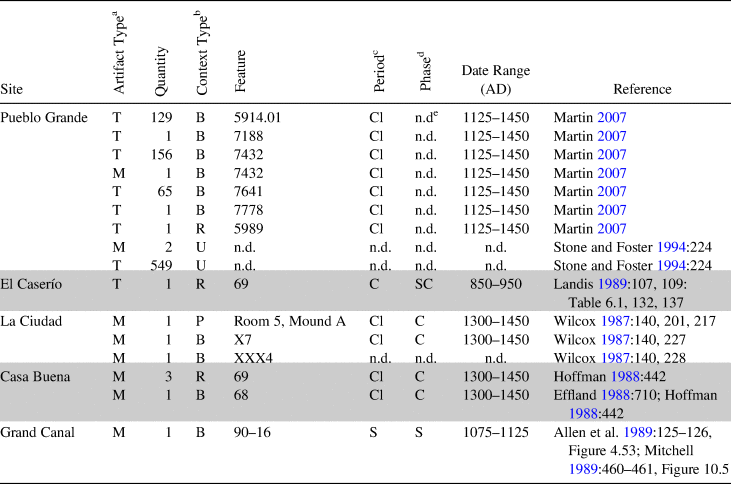
Our mosaic sample comprises 11 intact mosaics and 903 disarticulated tesserae (Table 1), representing 39.4% of Canal System 2's blue-green stone assemblage. Our non-mosaic blue-green stone sample comprises 2,318 objects, including 1,846 beads, 296 pendants, 5 pigment deposits, 31 other worked pieces, 90 unworked pieces, and 50 pieces of turquoise for which the artifact form was not documented in the literature reviewed (Supplemental Table 1).
Sample of Mosaic Artifacts.

a M = mosaic; T = tessera(e)
b R = residential structure (i.e., pithouse; house-in-pit); B = burial; P = platform-mound room; U = unprovenienced
c C = Colonial; S = Sedentary; Cl = Classic
d E/S = Estrella/Sweetwater; SC = Santa Cruz; S = Sacaton; C = Civano
e n.d. = no data (i.e., this information was not reported in the reference cited)
Methods
Assessing Kinds of Social Relationships
We use ArcGIS to visualize the spatial distribution and assess the density of mosaic artifacts throughout Canal System 2. Based on initial impressions, we first consider a potential association between (a1) sites with platform mounds and (b1) the deposition of mosaics. We test this association using a two-tailed Fisher's exact test (a = 0.05). We then evaluate a potential correlation between (a2) proximity to the primary canal's headgate and (b2) quantity of mosaic artifacts. This comparison is quantified using Spearman's rank-order correlation coefficient. Because the sample includes both intact mosaics and disarticulated tesserae, we assign point values for artifacts. In this way, a deposit consisting of an intact mosaic has more weight than one consisting of a single tessera. Deposits of 1–25 disarticulated tesserae receive 2 points, those with 26–50 tesserae get 4, deposits of 51–75 get 6, those with 76–100 get 8, and an intact mosaic is valued at 10 points. Finally, we use descriptive statistics to discuss the range of types of deposits in which mosaics are found.
Assessing Relative Value
We use ArcGIS to visualize the spatial distribution of non-mosaicked blue-green stone artifacts, and we assess a potential correlation between (a3) proximity to the primary canal's headgate and (b3) artifact quantity using Spearman's correlation coefficient. We use descriptive statistics to discuss the range of contexts in which mosaics are found. Finally, we evaluate the value of mosaics relative to non-mosaicked objects by comparing patterns of distribution and deposition, and morphological specificity.
Results
Spatial Distribution and Contextual Deposition of Mosaics
Mosaicked artifacts were recovered from 5 of the 10 sites (50%): Pueblo Grande, El Caserío, La Ciudad, Casa Buena, and Grand Canal (Figure 3). The Fisher's exact test (Supplemental Table 2) shows no meaningful association between (a1) platform-mound sites and (b1) mosaic deposition (p = 0.5238). We also find no direct relationships between (a2) a village's proximity to the primary headgate and (b2) mosaic quantity, as indicated by the results of the Spearman's test (rs = −0.18749; p = 0.603986).
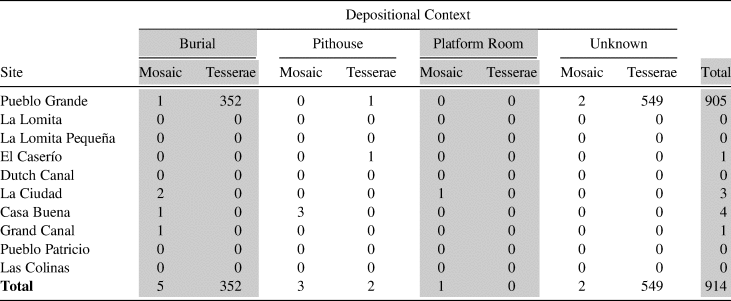
Provenience data are available for 9 of the 11 intact mosaics (81.8%) and 353 of the 903 disarticulated tesserae (39.1%). These all were encountered in one of three types of depositional contexts: burials, domestic pithouses, and platform-mound rooms (Table 2).
Number of Mosaics by Site and Depositional Context.

Spatial Distribution and Contextual Deposition of Non-Mosaic Blue-Green Stone
Non-mosaicked blue-green stone artifacts were encountered at all 10 of our sample sites (Supplemental Table 1). Results of the Spearman's test indicate that there is no direct relationship between (a3) a village's distance from the primary headgate and (b3) the quantity of these artifacts (rs = 0.15152; p = 0.67607).
Provenience data are known for 1,587 of the 2,318 non-mosaicked objects (Supplemental Table 3). These appear in seven depositional contexts: burials (n = 1,420; 89.4%), various extramural deposit types (n = 66; 4.2%), platform-mound rooms (n = 45; 2.8%), residential structures (n = 42; 2.6%), the modern site surface (n = 7; 0.4%), trash contexts (n = 6; 0.4%), and a canal (n = 1; 0.06%).
Comparison of Artifact Specificity
Mosaics are visibly more unique and require more complex construction methods than do other blue-green stone objects, such as pendants or beads. All such artifact types require grinding or otherwise working the stone to create the desired shape. To form the tightly plated surface of a mosaic, however, more time and care might be spent shaping tesserae than would be spent shaping beads or pendants. Mosaic making also involves more manufacturing steps, such as the shaping of a mosaic backing, the mixing of an adhesive, and the arrangement and application of the tesserae. These factors make mosaics more costly than other blue-green stone items in terms of time, skill, and the range of materials used to create the final product, all of which also likely indicate specialization in their production (Costin Reference Costin and Schiffer1991:40).
The high labor and resource costs as well as the unique appearance of mosaics give them a higher specificity than other blue-green stone objects, which may indicate that they held a higher social value (Costin Reference Costin and Schiffer1991:37)—provided that this interpretation is supported by other lines of evidence (e.g., spatial distribution, range of depositional contexts, rarity).
Discussion
Hohokam Mosaics versus Other Blue-Green Stone Objects
Mosaics have a limited distribution throughout Canal System 2—being present at half of the sites included in the study—and occur in a relatively narrow range of deposit types. Rather than being associated with public deposition, mosaics are almost exclusively associated with burials and residential structures (Table 2), placing them within the realm of individual or household ownership. The combination of a distributional pattern that is not widespread (Figure 3), deposition in a small range of context types, and the highly specific morphology of mosaics implies that they functioned primarily within the vertical realm of social structure, playing a role in establishing, displaying, or justifying one's social status.
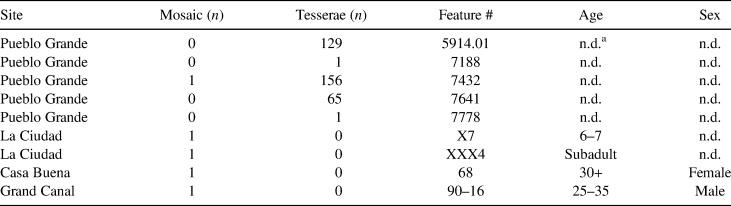
Age and sex demographics are reported for four of the five interments that include complete mosaics and none of five interments that include disarticulated tesserae (Table 3). Of those interred, two are subadults, one is an adult male, and one is an adult female. These data hint that although mosaic access seems to have been restricted to certain social classes, mosaic access does not seem to have been restricted to a particular age or sex demographic. This is an extremely limited sample, however. Demographic data from interments at Pueblo Grande would improve our analysis of mosaic use within Canal System 2, and eventual comparison to data from other portions of the Hohokam regional system and the U.S. SW will further reveal whether mosaics were preferentially associated with people of a particular age group or sex.
Age and Sex Demographics for Interments with Mosaics.

a n.d. = no data
In contrast to the mosaic data, non-mosaicked blue-green stone objects are present at all 10 sites included in the study, they occur in a broader range of contexts, and they are less morphologically specific than mosaics. Taken together, these factors indicate that such objects were not as socially valuable as mosaics were, and they likely played a role in horizontal social relationships. This is not to say that these artifacts did not also function within vertical social structure, however. Most non-mosaicked objects (89.5%) are found in burials, which suggests individual ownership. The data used do not indicate what percentage of Canal System 2 burials are represented, but if relatively few interments throughout the canal system contain blue-green stone, function within vertical social structure is implied. Calculation of the percentage of burials that include blue-green stone and a compositional analysis of those mortuary assemblages can provide information about whether it was a relatively common burial item and, if not, whether interments that included it had richer assemblages than those that did not. If that is the case, then all blue-green stone objects—both mosaicked and non-mosaicked—played a role in hierarchical social structure, but mosaics were comparatively rare and more socially valuable, and they do not seem to have functioned in a horizontal social structure within Canal System 2.
Neither of the object categories analyzed has a meaningful relationship with platform-mound sites, proximity to the canal system's main headgate, or the site located at the headgate—Pueblo Grande. Although there is a notable concentration of all types of blue-green stone objects at Pueblo Grande, complete mosaics are most heavily concentrated at sites located along the center of the canal system, including La Ciudad, Casa Buena, and Grand Canal. Other blue-green stone artifacts also occur in relatively large quantities at these sites.
A preliminary assessment of data from sites throughout the Hohokam regional system indicates that the Canal System 2 dataset is representative of the region in some respects, but it varies in others. Throughout the region, mosaics are relatively rare and make up a small portion of the overall blue-green stone assemblage. Of the 55 sites outside of Canal System 2 for which we have compiled data so far, mosaic artifacts are associated with 14 sites (25.45%). As with Canal System 2, mosaics occur in a narrow range of deposit types, and they are preferentially associated with mortuary and residential contexts.
Also similar to Canal System 2, non-mosaicked blue-green stone artifacts are more prevalent than mosaics, and they occur in a much broader range of depositional contexts. However, they are associated with just 32 of the 55 sites—or 58.18% compared to the 100% occurrence observed in the current analysis.
Two interesting differences noted between Canal System 2 mosaics and those of the larger region concern the caching of mosaics and the diversity of materials used in their construction. None of the references consulted for Canal System 2 explicitly discuss the mosaic deposits as being caches. Some deposits described for other parts of the regional system, however, are recorded as such. For example, at Casa Grande (AZ AA:2:1 [ASM] and AZ AA:2:61 [ASM], located 1 mi [1.6 km] from the Gila River and approximately 40 mi [64.4 km] southeast of Pueblo Grande), a cache deposited between the most recent floor surface and an earlier floor in Room E of Compound A contained two mosaic birds and a mosaic turtle or toad (first reported by Huffman as a turtle [Reference Huffman1925:83] but later by Fowler and Wilcox as a toad [Reference Fowler and Wilcox2003:191]). The larger of the two birds was propped up against the turtle/toad, and the smaller bird mosaic, two turquoise pendants, and nearly 1,000 shell beads were positioned in the pocket between them (Huffman Reference Huffman1925:82–84). A closer examination of caches that include mosaics may reveal nuances in the social use and value of mosaics throughout the region.
Intraregional diversity in materials used for mosaic construction also merits detailed investigation. Material diversity is relatively low within the Canal System 2 sample. Of the eight mosaics for which backing material is reported, seven are shell, and one is argillite or tufa. Tesserae are described in detail for six of the 11 mosaics. All include turquoise, the Grand Canal mosaic has a shell facing (Figure 2; Mitchell Reference Mitchell and Mitchell1989:460:Figure 10.5), and a mosaic from Pueblo Grande includes a rectangular argillite tessera at the center (Stone and Foster Reference Stone, Foster and Foster1994:224:Figure 6.7).
Our preliminary analyses reveal a potentially greater material diversity for mosaics found in other parts of the regional system. For example, the two bird-shaped mosaics in the Casa Grande cache have wood backings (Huffman Reference Huffman1925:83). At Los Muertos (AZ U:9:56 [ASM], located in Canal System 1, approximately 7 mi [11.3 km] southeast of Pueblo Grande), the turquoise and red marine-shell inlay of a conus tinkler mosaic are contrasted by black and red pigments to create a geometric design (Haury Reference Haury1945:158, Frontispiece d). At Hodges Ruin (AZ AA:12:18 [ASM], located in the Tucson Basin, approximately 100 mi [160.9 km] southeast of Pueblo Grande), a deposit containing a disarticulated turquoise mosaic also included mica chips, which may have been incorporated in the design (Kelly et al. Reference Kelly, Officer and Haury1978:108). A systematic analysis of material types used throughout the Hohokam regional system may reveal meaningful intraregional differences in mosaic manufacture and can provide further information about a mosaic's value by assessing factors that contribute to cost, such as the use of nonlocal materials.
Hohokam Mosaics versus Mesoamerican Mosaics
From a technological perspective, mosaics were crafted similarly in the two larger regions. Flakes of blue-green stone were ground into flat, polygonal tiles that fit together. These were embedded in or affixed to various backings to collectively create a plating effect. Backings were made of shell, stone, wood, bone, and basketry. Tesserae of other materials—such as iron pyrite, galena, and shell—were used alongside blue-green stone to create designs.
Despite these interregional similarities in basic manufacturing, several details of production differ from one region to the next. Whereas most (but not all) U.S. SW mosaics occur as pendants (including earrings), Mesoamerican mosaic forms—which include discs, shields, knives, masks, and skulls—are more diverse (compare Jernigan [Reference Jernigan1978] and McEwan et al. [Reference McEwan, Middleton, Cartwright and Stacey2006]). In general, Mesoamerican mosaicked artifacts are larger than those to the north, providing greater surface area for decoration. Mesoamerican artisans tended to use far smaller—and many more—tesserae. Feest (Reference Feest, King, Carocci, Cartwright, McEwan and Stacey2012:106) estimates that a particular mosaic shield, about 35 cm in diameter, included up to 30,000 tesserae. Given the larger backings and smaller tesserae, Mesoamerican artisans could (and did) create designs that are far more intricate than those of U.S. SW mosaics. In some Mesoamerican cases, such as the one detailed by Feest (Reference Feest, King, Carocci, Cartwright, McEwan and Stacey2012), individual tesserae were fashioned into miniature figures themselves, such as priests, dancers, deities, or rulers. Their surfaces were carved with even finer detail, representing elements such as heads, headdresses, and appendages. Tesserae of different colors were selected to separate such figures visually from their background (Feest Reference Feest, King, Carocci, Cartwright, McEwan and Stacey2012:110).
In contrast, U.S. SW artisans used smaller surface areas and larger tesserae, preventing them from achieving the same level of complexity or realism. Whereas Mesoamerican mosaics incorporate differences in tessera color and shape to construct secondary and even tertiary motifs, the representational aspects of U.S. SW mosaics almost always rely on the shape of the backing. This means that a frog mosaic in the U.S. SW is recognizable as a frog because its backing is carved into the shape of a frog, not because tesserae form a frog shape against a backdrop of differently colored tesserae.
There also seem to have been thematic differences. Whereas many of the Mesoamerican mosaics depict anthropomorphic characters, which likely include deities and rulers, U.S. SW mosaics are almost entirely geometric or zoomorphic in nature.
Despite their portability, Mesoamerican mosaics were typically deposited in contexts where the artifacts would never again be visible, such as architectural dedications or high-status burials, and many mosaics are deposited in association with public architecture. A good example is at Tula, where a mosaic disc was deposited at the base of a post in the Palacio Quemado, a major public hall (Gamboa and Manuel Reference Gamboa Cabezas2007). Such contexts and the events during which the mosaics were deposited were likely accessible to people of various social statuses, indicating a role for mosaics in horizontal social structure. This calls to mind recent work on social memory and forgetting. Mills (Reference Mills, Mills and Walker2008:81), for example, describes the function of certain ritual objects as a means for constructing memories through their production and deposition—sometimes including destruction of the object—rather than through their preservation. The inclusion of mosaics in the mortuary assemblages of elite individuals indicates that they also played an important role in vertical social structure.
In contrast, the data from Canal System 2 indicate that Hohokam mosaics functioned within vertical but not horizontal social structure, at least in this particular portion of the Hohokam regional system. Mosaics in the U.S. SW are not distributed widely throughout the region, and analysis of Canal System 2 data demonstrates that they are not commonly deposited in association with significant public architecture. All but one of the mosaic deposits are associated with burials or pithouses. In an example of the latter context, three complete mosaics were found on the burned floor of a pithouse at Casa Buena. This deposit could be interpreted as ceremonial, but it is difficult to determine whether such a ceremony would have been open to the whole community or attended by a select group of individuals. The perceived lack of a regular role in public ceremony and deposition, along with the stylistic and manufacturing differences discussed above, differentiate mosaic use by communities in Canal System 2 from that of communities in greater Mesoamerica.
Perhaps these differences are indicative of the nature of the craft technology's spread. If the craft of mosaic making gradually disseminated northward from Mesoamerica through northern Mexico and into the U.S. SW over the course of centuries, it may be more likely that social uses associated with mosaics were adapted for local use as the technology progressively spread from one cultural area to another. It is also possible that mosaic making was introduced to the U.S. SW through several different instances—some involving direct interaction between peoples of the U.S. SW and Mesoamerica, and others not. A diachronic study of the appearance of mosaic making throughout northern Mexico and the U.S. SW can elucidate the trajectory of the technology's spread and, in turn, help detect isolated occurrences of the introduction of mosaic making to the U.S. SW that may represent instances of direct interaction between peoples of Mesoamerica and the U.S. SW.
This study contributes to larger discussions regarding the nature of such interregional interactions and the degree of influence Mesoamerican communities had on those to the north. Although the presence of Mesoamerican objects, materials, and ideas in the U.S. SW is indicative of direct interaction between peoples of the larger regions, the degree to which such interaction is indicative of Mesoamerican influence is a different matter. Even though some studies find that nonlocal objects were used by US SW communities in ways that are similar to ways in which they were used in Mesoamerica, implying the incorporation of some aspects of Mesoamerican ritual into local belief systems (e.g., Crown and Hurst Reference Crown and Hurst2009), others find that the use of nonlocal objects was adapted to fit into existing sociopolitical and ritual traditions (Suarez Reference Suarez2013). The former scenario indicates a degree of Mesoamerican influence on a U.S. SW society, whereas the latter is indicative of interaction without substantial influence. Further studies focusing on the degree to which Mesoamerican practices associated with objects, materials, and ideas stayed intact as they were adopted by communities to the north can help elucidate the nature of interactions between prehispanic populations in the U.S. SW and Mesoamerica as well as the degree of influence resulting from the interactions.
Conclusions
Patterns of distribution and deposition along with the assessment of morphological traits suggest that blue-green stone mosaics associated with sites in Canal System 2 (1) had a high social value relative to non-mosaicked blue-green stone objects and (2) functioned within vertical social relationships—in which access to mosaics was restricted to certain social, political, and/or ritual groups—indicating a degree of social inequality. Although their use in creating, reinforcing, or justifying an individual's social status is similar to their use in Mesoamerica, an apparent lack of use in a horizontal social structure, differences in morphology and manufacturing techniques, and a more limited geographic distribution indicate that mosaic use was largely adapted to complement existing Hohokam social, political, and ritual structures.
These conclusions should be tested using diachronic, multiscalar analyses of mosaic distribution, deposition, and morphology at sites throughout the Hohokam regional system and the U.S. SW. Such analyses are necessary for creating a comprehensive understanding of overarching patterns of (and variation in) mosaic use at different sociospatial scales, and they will help us to understand how mosaic use in the U.S. SW is (dis)similar to that observed in Mesoamerica.
Acknowledgments
Our gratitude goes to the past and present interns as well as the anonymous sponsor of the Connections and Impacts of Northern and West Mexican Cultures project. Your contributions to data collection made this study possible. Thanks also to those who provided feedback on the research topic and article: Patricia L. Crown, Hannah Mattson, Emily L. Jones, Xi Gong, Yan Lin, Genevieve Woodhead, Lexi O'Donnell, Jana Valesca Meyer, and three anonymous reviewers. Your commentary improved the quality of our research and the resulting publication. Thanks to Karen Price, Kari Schleher, and Diane Tyink with the Hibben Center for Archaeology Research at the University of New Mexico for your assistance with photographing archaeological materials and permission to publish the photo. No permit was required to conduct this research.
Data Availability Statement
Artifacts counts, contextual information, and the date ranges associated with archaeological materials were procured from published references and publicly available datasets, which are noted in Table 1 (mosaic artifacts) and Supplemental Table 1 (non-mosaicked artifacts).
Supplemental Materials
For supplemental material accompanying this article, visit https://doi.org/10.1017/aaq.2020.111.
Supplemental Table 1. Sample of Non-Mosaicked Artifacts.
Supplemental Table 2. Fisher's Exact Analysis of Mosaic / Platform-Mound Site Association.
Supplemental Table 3. Number of Non-Mosaicked Blue-Green Stone Artifacts by Site and Depositional Context.