Introduction
Many would argue that the central concern of political science has been “who wins?” (Lasswell Reference Lasswell1936). This is reflected in Lasswell’s famous definition of politics as “who gets what, when, and how?” To answer this question often requires an examination of the participants in the so-called competition. In a similar vein, how party capability influences judicial behavior has interested scholars and practitioners of judicial decision making (Galanter Reference Galanter1974; McGuire Reference McGuire1998; Kritzer Reference Kritzer2003). Party capability theory assumes that litigants with certain characteristics (e.g., prior litigation experience and substantial financial resources) have several advantages when facing less capable litigants and these advantages may influence judicial behavior.Footnote 1
Despite all the studies that have empirically examined party capability, it is surprising how little is actually known about its effects on judicial decision making. Few studies, if any, have comprehensively explored the causal mechanisms underlying the theory. Because of the importance of the US courts of appeals and their participants (judges and attorneys), we fill the gap in the literature. To do this we empirically examine the causal mechanisms underlying party capability in these intermediate courts and include the perspectives of court of appeals judges. This approach will allow us to understand the extent to which the “haves’” success is attributable to their lawyers, the extent to which the general success of the haves is primarily a function of the success of the “government gorilla,” whether the observed advantages are actually due to ideology, and the ways in which repeat player haves are able to control which cases are appealed to the appellate courts.
First, advocates of party capability theory generally assume that the haves are more likely to hire attorneys with high levels of expertise. But there is little actual evidence that haves employ better attorneys. We begin our inquiry by testing this conventional wisdom. Next, we test whether litigants represented by attorneys with higher levels of expertise than opposing counsel are more likely than other litigants to be supported by judges. From here we test whether repeat player haves possess other advantages that increase their chances of winning when facing off against nonrepeat player “have-nots,” even after controlling for the effects of attorney quality. In what follows, we test several alternative causal mechanisms underlying party capability theory. For example, we assess the extent to which Kritzer’s (Reference Kritzer2003) theory of the dominance of the government gorilla provides an adequate explanation of the previous findings on party capability. Specifically, what is the extent of the US advantage? Are other parties with resource advantages similarly successful? Next, is the success of relatively higher-status litigants due to ideological predispositions of judges to outcomes that benefit the haves in society? Finally, we discuss the degree to which the advantages of party capability are a function of the ability to select more winnable cases.
By examining several causal mechanisms in one setting, we attempt to distinguish between the different theoretical linkages. This is particularly important given the overlap between various explanations. Using original and existing data, we examine the influence party capability has on case outcomes from a quantitative and qualitative perspective. Rather than simply providing another analysis that demonstrates that repeat player haves are more successful than the have-nots, we explore the potential casual mechanisms that produce those higher success rates.
To summarize, we first lay out the basic party capability theory, summarize the existing literature, and then develop and test series of hypotheses resulting from our summary of the literature integrated with insights drawn from our interviews with more than 60 US courts of appeals judges.
The Basics of Party Capability Theory
Most party capability studies have built on the theoretical foundation established by Galanter’s (Reference Galanter1974) seminal work. Galanter used the simplest terms to define two types of advantaged litigants: haves and repeat players. “Haves” are parties with more resources and repeat players have more litigation experience. While the two categories do not completely overlap—Galanter discusses the recidivist criminal as the perfect example of the have-not repeat player—they are likely highly correlated. The ideal repeat player, however, has resources and experience (Galanter Reference Galanter1974, 98). At the most basic level, the key insight of Galanter is that when haves face have-nots in court, the former tend to win more frequently than other litigants.
Among other advantages, repeat players have the institutional knowledge and resources to preemptively change the rules. Galanter (Reference Galanter1974) and later Kritzer (Reference Kritzer2003) explain how governments have an obvious advantage in this context. Experience also benefits the repeat player to the extent that it develops a favorable relationship with other institutional actors in the legal system. One aspect of this relationship is the enhanced credibility of the repeat player, which must act sincerely or risk future sanctions from judges. This reciprocal relationship works as follows: given the probability that repeat players will reappear before the judge, they are less likely to present facts and legal rules in an overly biased fashion; knowing this, and having repeatedly observed this pattern of behavior in prior interactions, the judge’s trust in the repeat player increases; therefore, judges, in need of information, attach greater weight to facts and interpretations of rules presented by repeat players (Galanter Reference Galanter1974).Footnote 2 As such, to the extent that facts and rules influence the judges, the increased credibility resulting from litigation experience will influence legal outcomes (McGuire Reference McGuire1995).
Party capability in appellate courts. While Galanter developed his theories to explain behavior at the trial court level, the underlying logic, including the importance of resources and experience, has been extended to appellate courts. Party capability theory has been tested in many contexts, including the US Supreme Court (Ulmer Reference Ulmer1985; Sheehan, Mishler, and Songer Reference Sheehan1992) and courts of appeals (Songer, Sheehan, and Haire Reference Songer1999), as well as state supreme courts (Wheeler et al. Reference Wheeler1987; Songer, Kuersten, and Kaheny Reference Songer2000). The basic hypothesis has also been extended to courts in other nations, including England (Atkins Reference Atkins1991), Canada (McCormick Reference McCormick1993), Australia (Smyth Reference Smyth2000), and the Philippines (Haynie Reference Haynie1994).
Using the taxonomy derived by Galanter (Reference Galanter1974, 107), these studies almost always assign parties to one of several categories based on organizational characteristics. Typically, governmental units are lumped into one or more categories, as are individual persons, business associations, and interest groups (e.g., Sheehan et al. Reference Sheehan1992; Songer and Sheehan Reference Songer1992). The categories are ordered on the basis of an assumed hierarchy of financial resources and litigation experience. While the number and order of the categories often vary across studies, most place the largest governmental litigants at the top of the hierarchy, with individual persons at the bottom. An assortment of the other categories usually occupies the middle of the ranking, though the number and order vary among studies. While the party typology measure is valuable for its efficiency—it is a relatively easy measure to construct reliably, and it is a valid measure of the combination of advantages that constitute the overall concept—it does have its limitations.Footnote 3 Specifically, by itself, one cannot parcel out the various posited advantages of the repeat player. In other words, it does not enable us to examine many of the causal linkages between repeat player status and litigation outcomes. In the remainder of this article, we seek to test some of the most interesting relationships suggested but not systematically tested by Galanter.
Identifying the Causal Linkages between Litigant Status and Success
To identify some of the key mechanisms that may lead to the success of repeat players, we relied on two sources: previous studies using a party capability framework (including the original work of Galanter [Reference Galanter1974]) and interviews with 60 US courts of appeals judges, including at least one from every circuit.Footnote 4 We organize the analysis and discussion around several questions related to litigant status and success.Footnote 5 In each instance we explain the view from the bench and then follow with an empirical examination of the hypotheses set out.
Do Haves Hire Better Attorneys?
When asked directly, almost none of the judges indicated that they were familiar with any of the social science literature on party capability theory described above. But when asked who won and why, they often gave answers based on their experience that echoed many of the themes in the social science literature on party capability theory.
The judges we interviewed appeared to think that hiring the best attorneys was a key to the success of government and other repeat players. Judge B maintained that while not all government lawyers were wonderful, the average was high. He said, “we are overpopulated with lawyers and they vary a lot in ability, but the government almost always has a good lawyer, and so on average the quality of the government attorney is better than the opposition.” But he suggested that if you looked at cases involving the government versus major corporations, “I bet you would find a different result.” Judge T elaborated the same theme noting that the average quality of government lawyers is high compared to the average of private parties. But he quickly added, “this is not to say that government lawyers are better than those in the elite law firms—but it is true as a generalization compared to all of the other lawyers we see.” Other judges gave a slightly more nuanced view, noting that government lawyers were not always better than their opponents, but that on average they were better. For instance, Judge T said that “government lawyers, their average is better than their adversary. Some are very good, very few are bad or below par.” On the other hand, one judge suggested that government lawyers compared favorably even to lawyers from elite law firms. Judge N asserted that “the fact is that the quality of the government lawyers is simply better” in many cases. “Even ‘tall building’ law firms often have their hands full when up against career Justice lawyers.”
In the sample we examined, discussed in the analysis below, we find evidence supporting a more nuanced view, though always in the manner suggested by the judges. For example, the federal government tends to have more attorneys (such as assistant US attorneys [AUSAs]) with prior federal appellate litigation experience, those attorneys representing large corporations at oral arguments (US mean experience is 56.6 cases, with a median of 19, compared to a mean of 10.6 and median of 5 for attorneys representing multinational and/or international corporations). However, supporting Judge T’s contention that US counsel is not always superior to corporate legal representation, more than 10% of the orally arguing attorneys representing large corporations are more experienced than the median federal oral litigator. Similarly, well over 10% of the federal orally arguing attorneys have less experience than the median corporate orally arguing counsel.
Interestingly, the US advantage does not extend to other aspects of appellate legal representation. For instance, 30.4% of orally arguing attorneys representing large corporations attended elite law schools, compared to 24.3% of orally arguing federal attorneys.
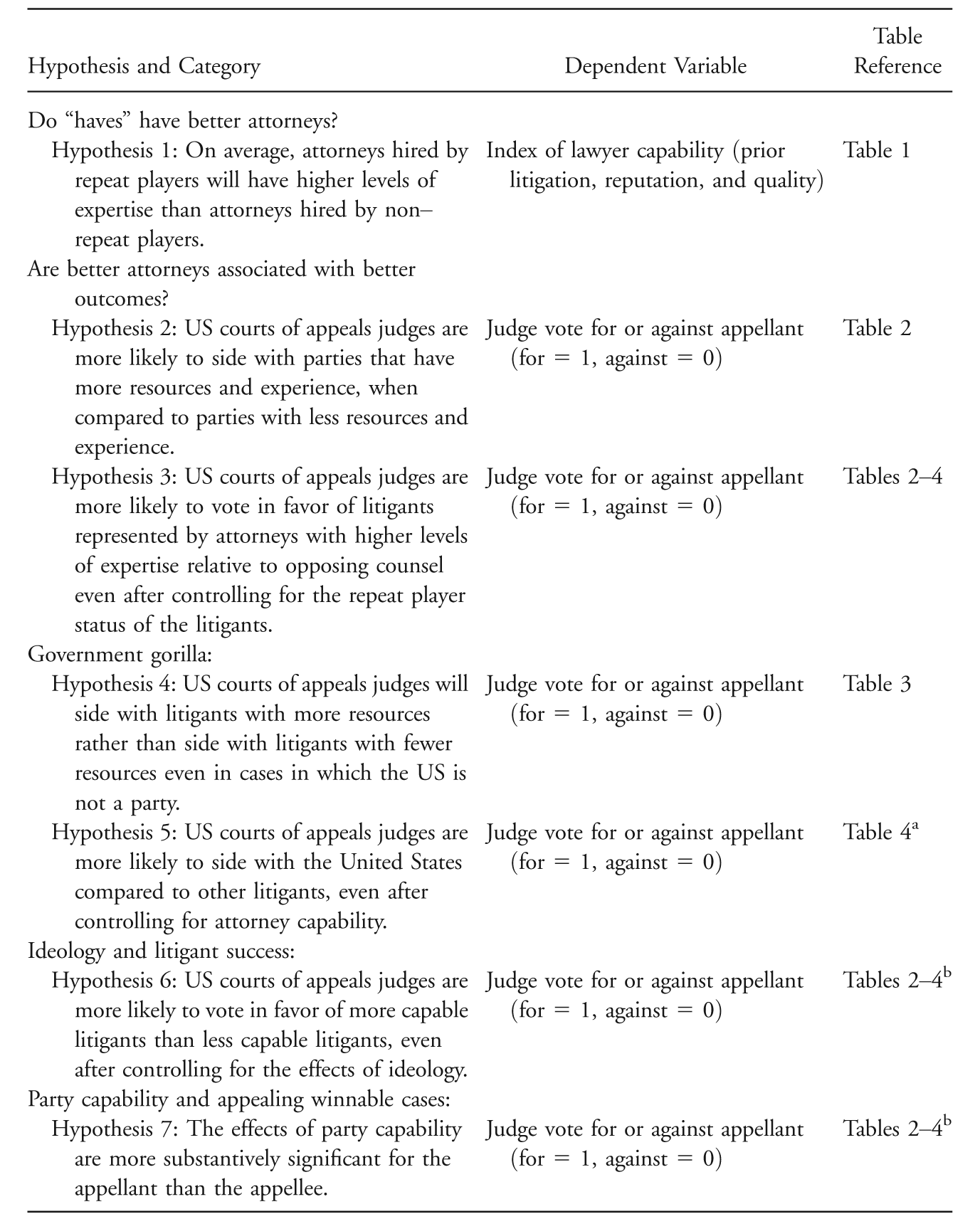
In summary, several authors of party capability theory (e.g., Galanter Reference Galanter1974; Sheehan et al. Reference Sheehan1992), and especially the judges interviewed, emphasized that repeat players (especially the government and corporations that hire attorneys from the elite law firms) are represented by the best attorneys. Thus, they both assume that one of the advantages enjoyed by the repeat players is that they employ better attorneys. But to date, no one has actually tested whether this is true. On the basis of the literature and judge interviews, we hypothesize that, on average, attorneys hired by repeat players will have higher levels of expertise than attorneys hired by nonrepeat players.
Empirics: Attorney Expertise as a Function of Party Capability
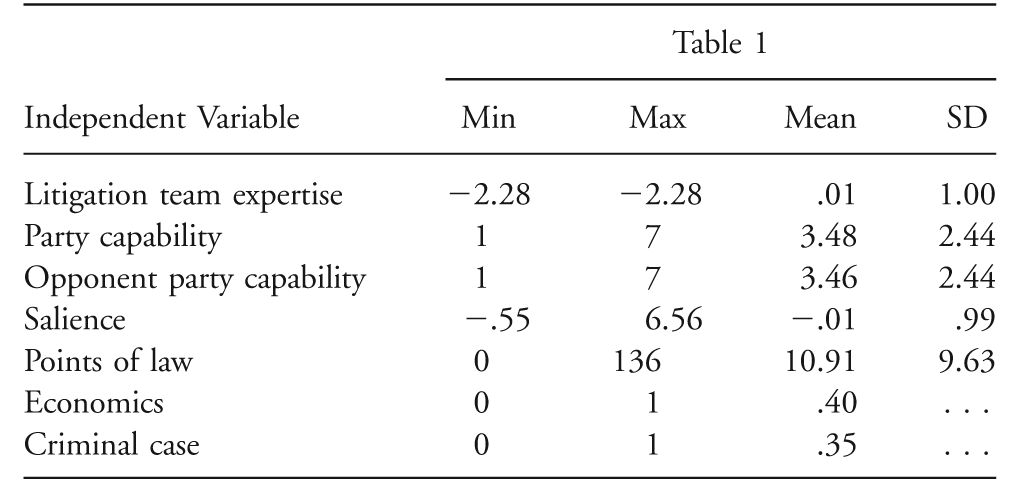
To test whether more capable litigants employ more capable legal representation, we use data from the 1997–2002 update to the US Court of Appeals Database (Kuersten and Haire Reference Kuersten2002).Footnote 6 We used the smaller data set because it made it possible to collect information on the attorneys’ names and backgrounds (a time-consuming data collection endeavor). Indeed, as noted above, most studies rely solely on the litigant typologies to measure party capability for this very reason (see Sheehan et al. Reference Sheehan1992; Songer et al. Reference Songer1999).Footnote 7 For each case, there are two observations: one for the appellant and one for the appellee. Table B1 in appendix B provides an overview of the descriptive statistics.
The dependent variable is an index of lawyer capability created from three separate indicators of litigation team experience and quality. Separate measures are created for the capability of the lawyers for the appellant and the appellee.
Prior litigation experience of the orally arguing attorney is the first of three different measures of legal team capability. It is a variable that has been employed in a variety of studies examining several different courts, including the US Supreme Court (e.g., McGuire Reference McGuire1995, Reference McGuire1998; Johnson, Wahlbeck, and Spriggs Reference Johnson2006; McAtee and McGuire Reference McAtee2007; Corley Reference Corley2008; Szmer and Ginn Reference Szmer2014), the Supreme Court of Canada (Szmer, Johnson, and Sarver Reference Szmer2007; Kaheny, Szmer, and Sarver Reference Kaheny2011), and the US courts of appeals (Haire, Lindquist, and Hartley Reference Haire1999; Szmer et al. Reference Szmer2013). Theoretically, prior experience helps the attorneys develop process expertise, which should enhance the ability of the advocate to construct and present more persuasive arguments (Szmer Reference Szmer2005).
To generate the experience variable, we first identified the names of the orally arguing attorneys for each side. To derive this, we started with the Federal Court Cases: Integrated Data Base on Appellate Terminations, produced by the Federal Judicial Center, to identify whether the case was orally argued. Among those cases that were argued, we then tried to identify the orally arguing attorney, usually identifiable from the published decision in LexisNexis. In the remaining cases, we used the US Administrative Office of the Court’s Public Access to Court Electronic Records database to identify the name of the attorney that presented the oral argument (in approximately 40 cases we could not identify the name of the orally arguing attorneys). We then searched the LexisNexis US Courts of Appeals database for cases with the names of the attorney in the “counsel” field of the US courts of appeals with a date restraint limiting the search to cases decided prior to the decision date of the case at hand. Since there is reason to believe that there are diminishing marginal gains to increasing levels of experience (e.g., see Johnson et al. Reference Johnson2006), the actual attorney experience variable reflects the natural log of the total number of prior US courts of appeals cases in which the particular attorney was listed as a counsel for one of the litigants.Footnote 8
Beyond prior litigation experience, recent studies have also used the reputation of the orally arguing attorney’s law school alma mater as a proxy measure of capability (e.g., Johnson et al. Reference Johnson2006; Sarver, Kaheny, and Szmer Reference Sarver2008; Szmer, Sarver, and Kaheny Reference Szmer2010; Szmer and Ginn Reference Szmer2014). Presumably, law school prestige, due in part to the selectivity of the admissions process, at least roughly reflects the part of expertise that is a function of intelligence and drive. Our measure of law school prestige, gathered primarily from the Martindale-Hubbell Lawyer Index and supplemented by law firm websites, is a dichotomous variable, classifying schools as either elite or nonelite. We borrowed our operationalization from Slotnick (Reference Slotnick1983), who identified 15 prestigious schools through a composite measure of a variety of different law school rankings.Footnote 9
Our third measure of the quality of legal representation is the number of attorneys employed by the litigant, a measure utilized in a few recent studies (e.g., Szmer et al. Reference Szmer2007, Reference Szmer2010, Reference Szmer2013; Haire and Moyer Reference Haire2008). Presumably, larger litigation teams have several advantages over smaller teams, including enhanced abilities to anticipate and respond to counterarguments (a particularly important component of appellate advocacy), increased research power, and the ability to conduct preparatory moot court sessions. Because of the possible diminishing marginal gains from larger litigation teams, our measure is the natural log of the number of lawyers representing the side according to the published decision.Footnote 10
Of course, all three measures of the quality of legal representation used to create the dependent variable are proxies, which only roughly reflect the underlying, latent concept. As such, it is appropriate to combine all three measures into an index, which should reduce the measurement error. To do so, we generated factor scores from principal components factor analyses of all three indicators.Footnote 11 Higher values of the index indicate higher levels of litigation team expertise.
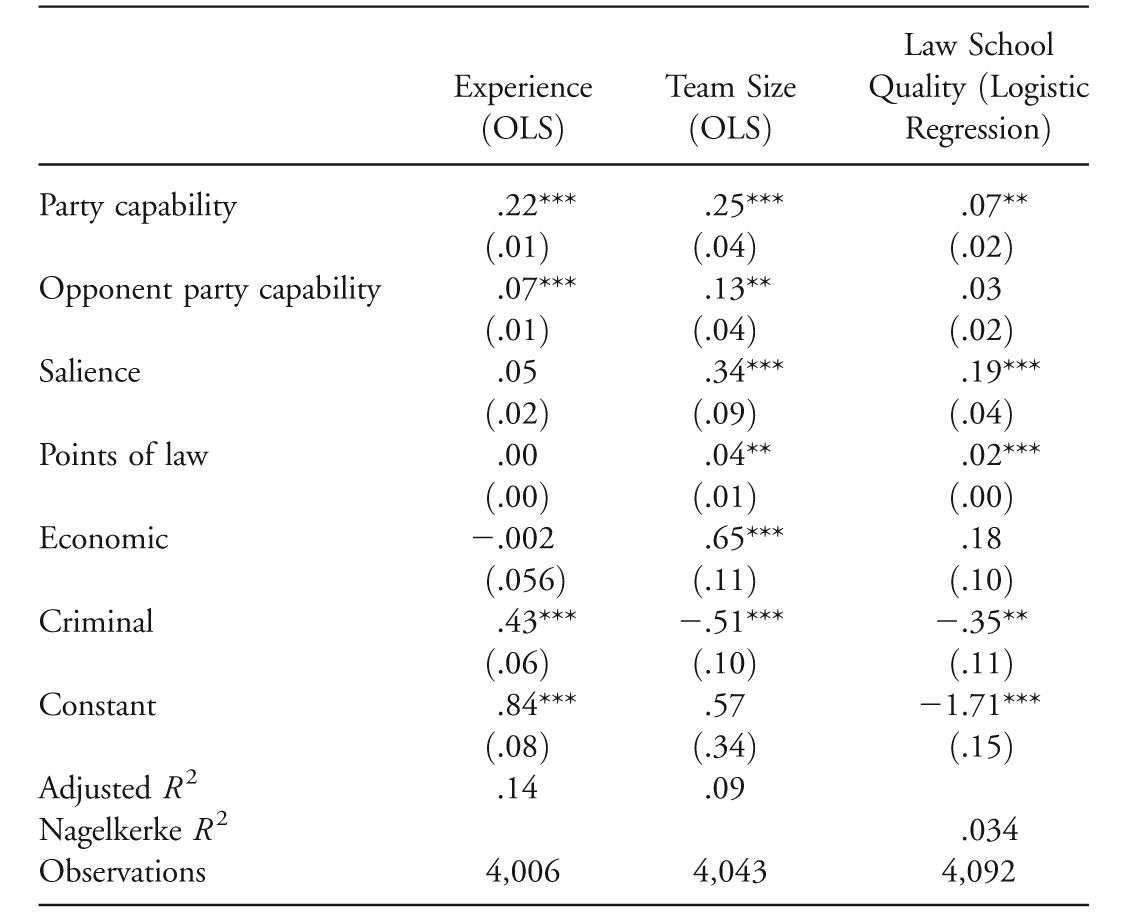
Since the dependent variable is continuous, we estimated the coefficients using ordinary least squares (OLS) regression. We regressed the attorney expertise index on party capability, as well as a variety of case-level factors. The unit of analysis is the party in the case, so there are two observations per case. Given the structure of the data, we clustered the standard errors by case.
The main independent variable, party capability, was constructed using the typical hierarchy used in many prior studies (e.g., Sheehan et al. Reference Sheehan1992; Songer and Sheehan Reference Songer1992; Songer et al. Reference Songer1999). The proxy measure is based on the assumption that certain classes of litigants (e.g., governments, businesses) have more resources and experience than other classes (e.g., person) because of differences in organizational characteristics. Using this method, we assigned litigants the following values: 1 = individual person, 2 = associations, 3 = small business, 4 = local government, 5 = big business,Footnote 12 6 = state government, and 7 = US government.Footnote 13 We included two variables: the capability of the party that employed the attorney (party capability) and the capability of the opposing party. The former reflects the main independent variable, while the latter is included in this model as a control (presumably the perceived quality of the opponent influences the decision to hire one’s own counsel). We expect that both variables will be positively correlated with the dependent variable.
We also included a variety of case-level covariates. Three of them reflect salience and/or complexity: the total number of amicus briefs filed in support of either side, prior publication by the district court in the Federal Supplement, and points of law, operationalized as the number of headnotes in the West Federal Reporter version of the decision.Footnote 14 The results of a principal components factor analysis of the three indicators suggested that amicus support and prior publication reflected a single dimension, while the points of law measure appeared to tap into a separate dimension.Footnote 15 We think the first dimension reflects salience, while the points of law measure is a proxy for legal complexity.
Additionally, we included two issue area dummy variables: economics and criminal.Footnote 16 The reference category includes civil rights and civil liberties cases and those that are not easily categorized. We expect that the economics variable will be positive, as the financial aspects of these cases tend to attract quality counsel. Conversely, intermediate criminal appeals tend to be fairly pro forma, such that they attract private counsel with lower levels of capability.
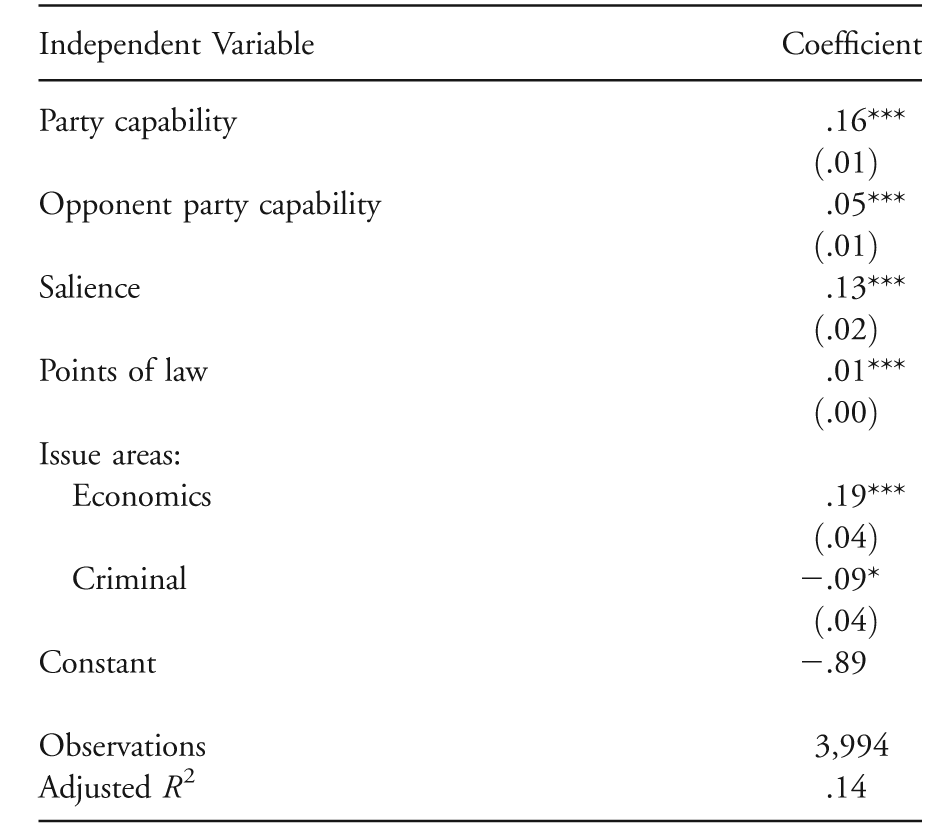
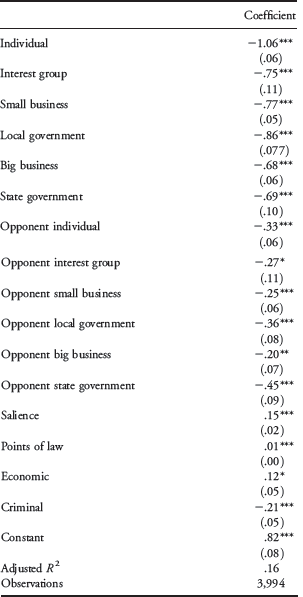
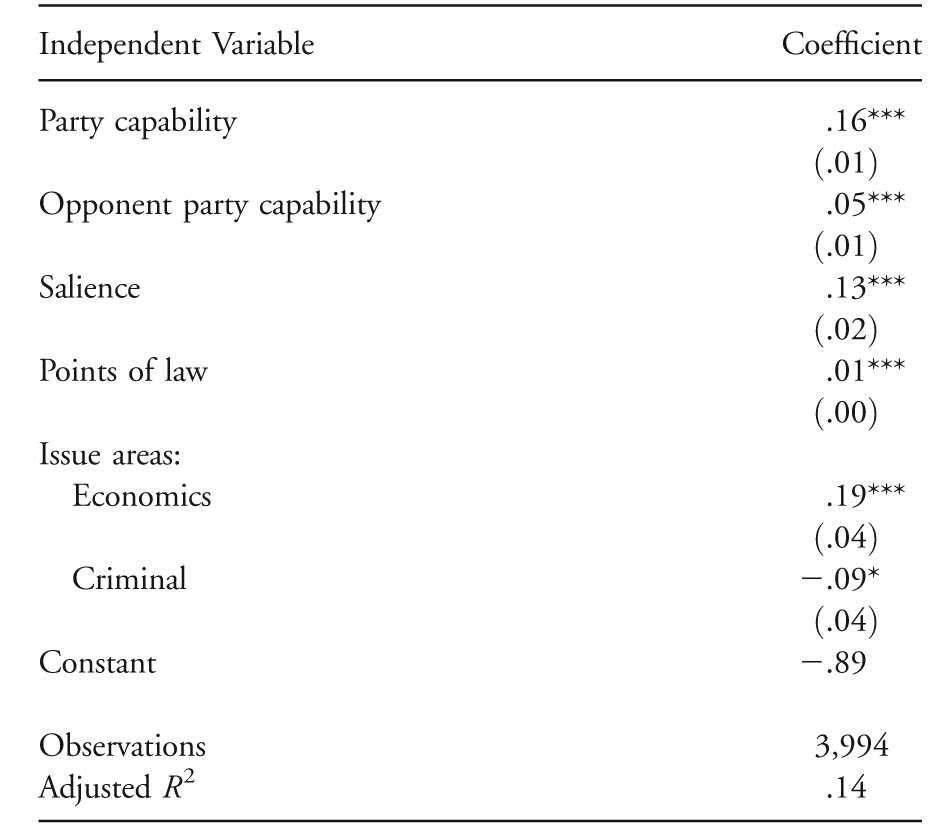
The model estimates, presented in table 1, support our hypothesis. The party capability variable was statistically significant and positive. In other words, litigants with more resources appear to hire more capable counsel, even after controlling for opponent’s party capability, case salience, points of law, and issue area. These results support one of the never before tested assumptions made by Galanter: one of the advantages of the repeat player haves is that they are able to hire more experienced and capable counsel than their have-not opponents. All the controls were statistically significant and positive, as expected. Because we find evidence that the haves hire more capable attorneys, we next examine whether the quality of the legal representation means more legal success.
OLS Model of Attorney Expertise as a Function of Party Capability, US Courts of Appeals, 1997–2002
Note.—Robust clustered standard errors are in parentheses.
* p < .05 (one-tailed test).
** p < .01.
*** p < .001.
Are Better Lawyers Associated with Better Outcomes?
Assuming that repeat players are, on average, more likely to hire expert counsel, does this advantage translate into litigation success? Most of the party capability literature assumes it does, but there is little hard evidence of the effect of quality attorneys. Presumably, like repeat players, litigators with more experience are more credible (McGuire Reference McGuire1995). Additionally, they may construct more persuasive arguments (Haire et al. Reference Haire1999; Szmer et al. Reference Szmer2007). Studies of the US Supreme Court have shown that expert counsel are more likely to present better oral arguments (Johnson et al. Reference Johnson2006) and have language contained in their briefs borrowed by the author of opinion of the court (Corley Reference Corley2008).
While the prior empirical evidence offers limited support for the notion that attorneys influence the decisions of appeals court judges, these studies were all limited in scope. Haire et al. (Reference Haire1999) examined only product liability cases, while Szmer et al. (Reference Szmer2013) looked at cases in which women attorneys faced a male opponent. Haire and Moyer’s (Reference Haire2008) analysis utilized bivariate statistics to examine the success of appellants as a function of litigation team size, but they did not examine appellee team size.
Moreover, virtually all of the judges interviewed agreed that good lawyers are a key reason for litigant success. When we probed for the judges’ views as to why the national government won so frequently, the answers sounded very much like a seminar on party capability theory. First, judge after judge suggested that a key to government success was that their lawyers, on average, were simply better than most of the lawyers appearing in their court. We heard many variations of this same basic theme throughout our interviews. Judge WW said it directly: “Part of the reason for the government’s high win rate is the skill level—the government’s lawyers are simply better.” Or as Judge GG put it, “The US government tends to win more often partly due to attorney skill. The attorneys at the federal level are top notch.” Judge C agreed. “I guess I would say that often the quality of the advocacy seems higher from government attorneys—the government often has attorneys who are experts in a particular area of litigation.” As a result, according to Judge G, US attorneys almost always present you with a well-constructed case. Judge D was even more effusive in his praise for government lawyers, saying, “government attorneys tend to be of extremely good quality; in general government briefs are especially good—and effective advocacy definitely makes a difference on outcomes. The quality of the government argument often gives them a tremendous advantage over their opponents.” Judge SS summed up: “The government lawyers—AUSAs—that argue cases before our court are usually quite good. I imagine part of this has to do with preparation and being comfortable in the courtroom even if it is an appellate courtroom. Also to be an AUSA you have to have your wits about you and need to be highly competent, so naturally this will carry over to how successful you are in court and case dispositions.”Footnote 17
And finally, several judges suggested that, on average, the government lawyers were more credible than many of their opponents, and as a result, they (the judges) trusted their presentations more than those of some of their opponents. Judge DD summed up the view expressed by several judges when he said, “For me I appreciate the candidness of the assistant US attorneys, and I mean often they will outright identify arguments that are on both sides of the issue and you begin to feel more comfortable that they don’t have a dog in it. I don’t mean they don’t care but they don’t have an agenda.”
Thus, while both the literature on party capability and the judges generally assume that having good attorneys is one of the advantages of the repeat players, they are also credited with a number of other advantages resulting from both their superior financial resources and their experience as repeat players (e.g., influencing the development of procedural and substantive rules, the fiscal flexibility and savvy to be able to pursue winnable litigation/appeals, and enhanced credibility). Nonetheless, the current state of the literature leaves unresolved the extent to which there are advantages of repeat players that exert an impact of outcomes that is independent of the effect of having better attorneys. We seek to clarify the potential independent effects of attorney expertise and other advantages of repeat players by simultaneously evaluating two related questions. First we posit that US courts of appeals judges are more likely to side with parties that have more resources and experience, when compared to parties with less resources and experience.
Related to the question above, whether better lawyers are associated with better outcomes, we ask whether judges are more likely to support “repeat players” after controlling for the repeat player status of the litigants. If so, we suggest that US courts of appeals judges are more likely to vote in favor of litigants represented by attorneys with higher levels of expertise relative to opposing counsel even after controlling for the repeat player status of the litigants.
Empirical Assessment of Party Capability and Attorney Capability on Judicial Decision Making
Having provided evidence that both Galanter and the judges we interviewed were correct in their expectation that repeat players would hire more capable attorneys, we next investigated whether relative party and attorney capability advantages actually mattered. First, we regressed judges’ votes on litigation team expertise. We then ran a model that included both the attorney measure and party capability typology, to test whether party capability influence was due to more than just relative advantages in the quality of legal representation—and vice versa. In the same model, we also examined whether the influence of party capability exists after controlling for ideology. Then we estimated the same model in cases in which the United States was not a litigant to determine whether the party capability advantage was limited to the government gorilla. Finally, we tested whether the US advantage in this context was purely a function of attorney capability by including dummy variables for US participation as a litigant with and without the litigation team expertise measure.
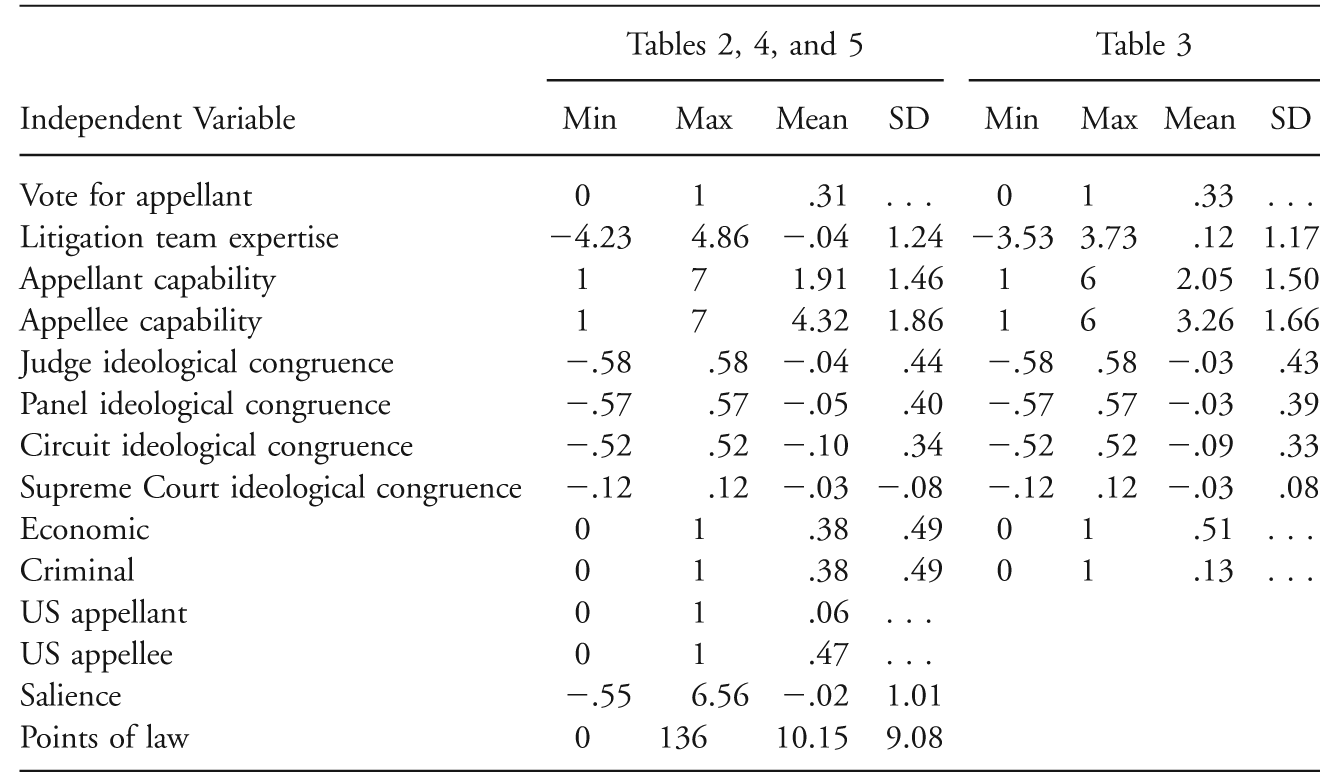
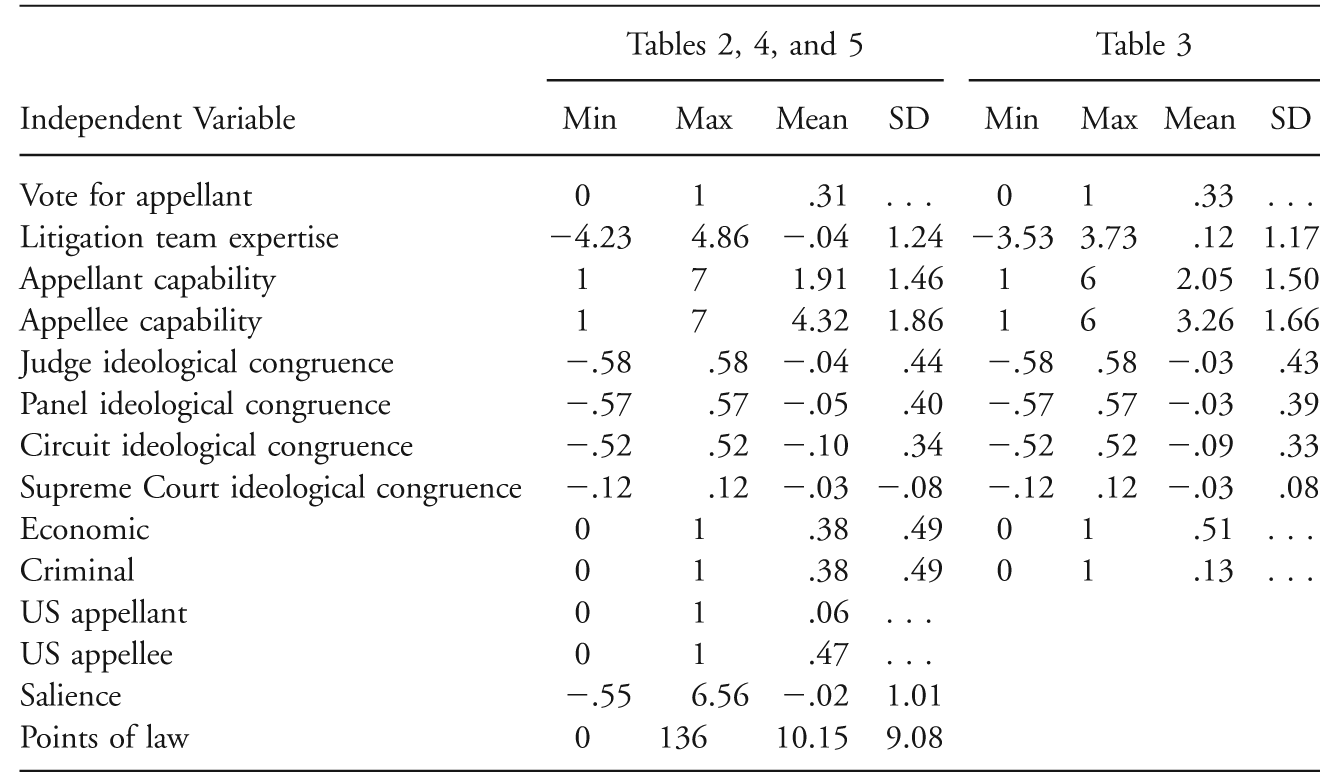
In contrast to the first model, where the unit of analysis was the side (appellant or appellee) in the case, the unit of analysis is now the judge’s vote in the case. In other words, with three-judge panels, there are three observations for each case.Footnote 18 Our dependent variable is the vote for (1) or against (0) the appellant. Given that the variable is dichotomous, we estimated the model using logistic regression. Since we have multiple observations for each judge and circuit, we estimated standard errors clustered by judge and included circuit-level fixed effects. Table B2 in appendix B provides an overview of the descriptive statistics used for models 2–4.
Since we are interested in both the overall effects of attorney quality on judicial decision making and the degree to which attorney quality mediates the effects of party capability, we estimated two models (both presented in table 2). First, we estimated the model including litigation team expertise but not a measure of litigant status. This should capture the overall effects of attorney quality. Next, we included both main independent variables in the model of judge votes to determine whether party capability has an effect on appellate decision making beyond the indirect effect associated with the ability to hire better legal representation.
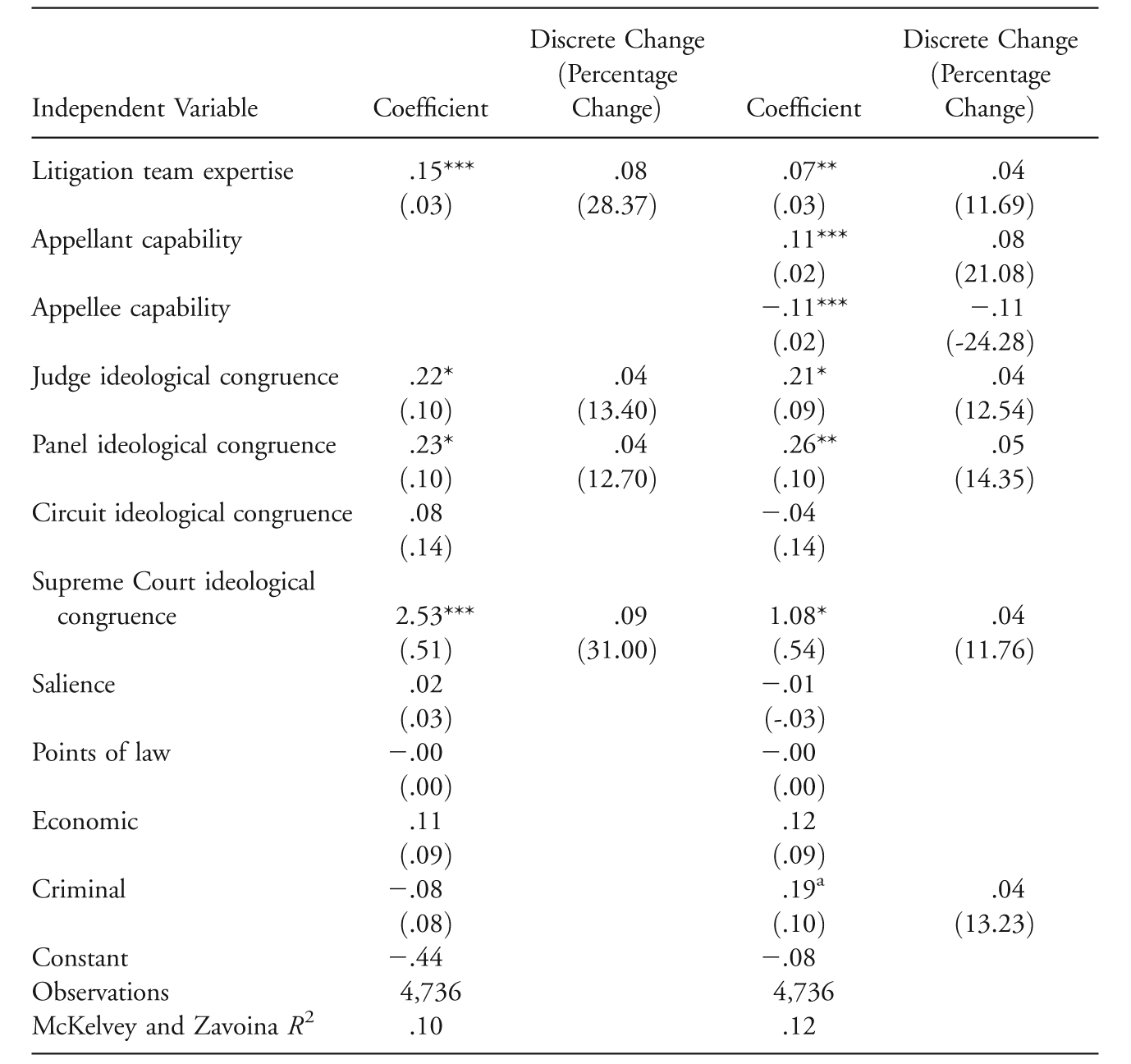
Likelihood of a Judge Vote in Favor of the Appellant as a Function of Attorney Capability and Party Capability, 1997–2002
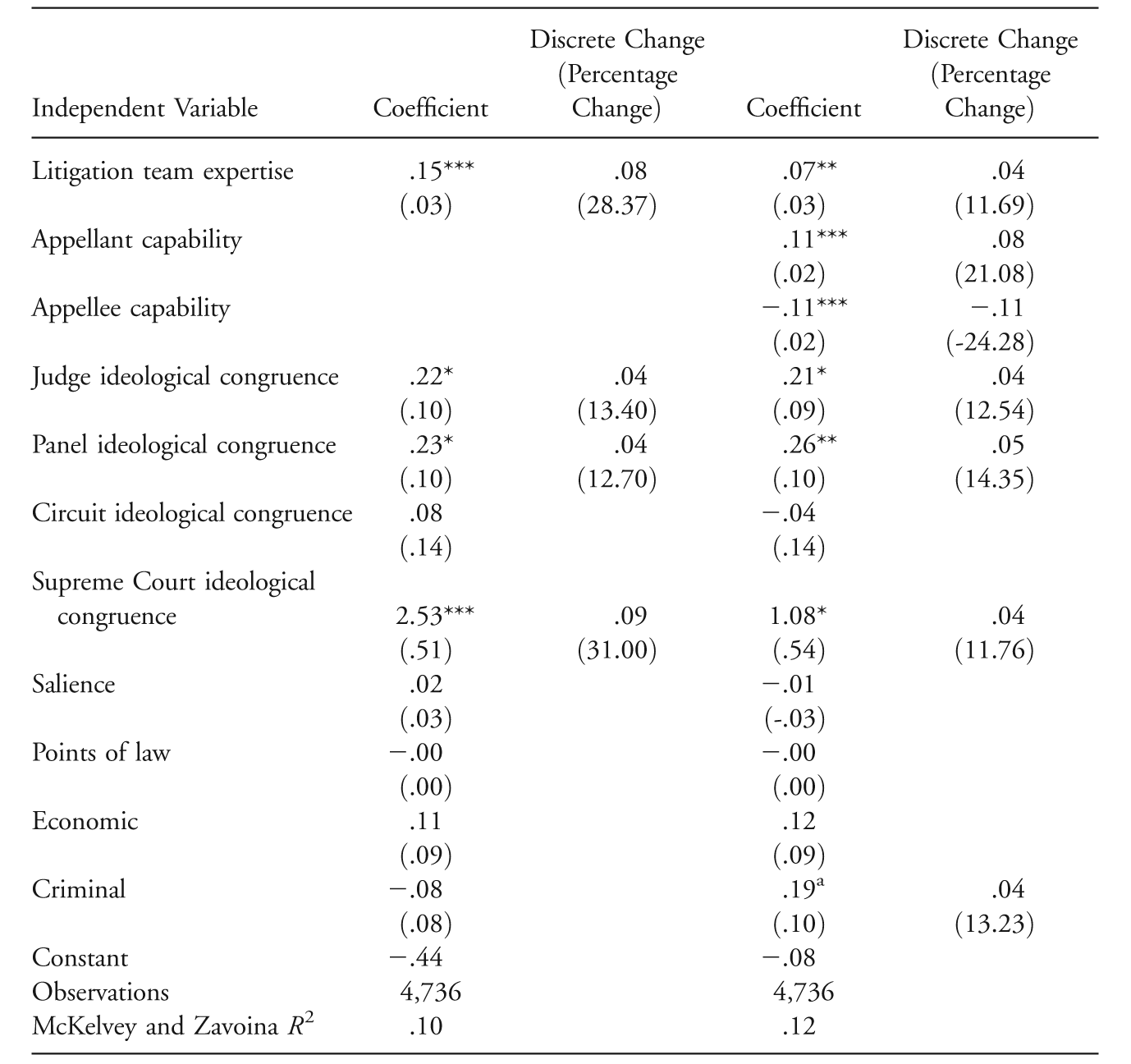
Note.—Discrete changes are differences in the predicted probability a judge sides with the appellant when X is set to two values (continuous variables: standard deviation ± mean; appellant/appellee capability: rounded standard deviation ± median) and the other covariates are held constant at the appropriate measure of central tendency. Percentage changes are discrete changes divided by the predicted probability when X is set to the lower value, multiplied by 100. Robust clustered standard errors are in parentheses.
* p < .05 (one-tailed test).
** p < .01.
*** p < .001.
a Two-tailed test: p < .05; the sign is in the unexpected direction.
Litigation team expertise was computed using the index that we previously discussed. However, to account for the nature of the adversarial system, the variable in table 2 is actually the difference between litigation team expertise for the appellant and the appellee.Footnote 19 We expected a positive coefficient reflecting the increased likelihood of a vote for an appellant when it is represented by a higher-quality litigation team than its foe.
Using conventions described earlier, we included party capability measures for the appellant and appellee.Footnote 20 Given our theory and the coding of the dependent variable, we expected to find a positive coefficient for the appellant party capability measure, a negative coefficient for the appellee’s capability, and a positive coefficient for the difference between the appellant and appellee.
In addition, we controlled for the effects of judicial policy preferences. There are at least four different sets of preferences that could affect US courts of appeals judge decision making. Most obviously, judges are likely to be influenced by their own ideologies. However, court of appeals judges work in three-judge panels, with a collegial environment and norms of consensus (Hettinger, Lindquist, and Martinek Reference Hettinger2006; Bowie, Songer, and Szmer Reference Szmer2014). It is possible that the median panel judge will then exert the most influence over the panel decision and therefore the individual panelists’ votes. Similarly, the three panelists are also members of a larger circuit, and their decision is subject to influence by possible en banc review. Therefore, we might expect that the individual panelist will consider the circuit median preferences when deciding cases (McNollgast 1995; Van Winkle Reference Van Winkle1997; Cross and Tiller Reference Cross1998; Giles, Walker, and Zorn Reference Giles2006). Additionally, our interviews confirmed previous studies that noted the importance of circuit law for the decision making of appeals court judges. Given this importance, any statistical congruence between the ideology of the circuit and the votes of individual judges might reflect the influence of circuit law on the decision calculus of individual judges (reflecting the assumption that over time the general tenor of circuit law will reflect the ideological preferences of the judges on the circuit). Finally, because of the prospect of review by the Supreme Court, some have suggested that the judges are also influenced by the preferences of the high court for fear of reversal (Songer, Segal, and Cameron Reference Songer1994; McNollgast 1995; but see Bowie and Songer [Reference Bowie2009], which challenges this assertion for three reasons, including the statements of an overwhelming majority of the judges the authors interviewed).Footnote 21
We measure the judge’s ideology using a variant of the Giles, Hettinger, and Pepper (Reference Giles2001; GHP) scores, which are generated using Poole and Rosenthal’s (Reference Poole1997) Common Space Nominate scores for the parties involved in the judicial selection process for appeals court judges: the appointing president and the home state senators from the president’s party. Like the GHP scores, when the home state senators for the vacancy are not from the president’s party, the judges’ ideology is coded as the president’s Nominate score. However, our measure differs when senatorial courtesy is in play. While the GHP measure uses the average Nominate scores of the senators from the president’s party representing the state of the vacancy, our measure uses the mean of the values for the senators and the president (thus accounting for the dual roles of the senators and the president in senatorial courtesy regimes). Higher positive scores indicate increasing conservatism while lower negative scores indicate increasing liberalism. The actual variable, judge ideological congruence, takes into account the preferences of the judge and the preferred outcome of the litigants. The measure is equal to the judge ideology score if the appellant preferred a conservative outcome; it is negative one times the judge ideology score if the appellant preferred a liberal outcome. Similarly, the panel and circuit ideological congruence variables are also constructed using the preferences of the appellant and the judge ideology scores of the median panelists and active circuit judge, respectively. We also operationalized the Supreme Court ideological congruence variable using the appellant’s preferred outcome and the median justice’s ideology using the same logic; only the high court justices’ ideologies were measured using the Judicial Common Space scores.Footnote 22
The first model in table 2 tests our expectation that appellate judges are more likely to side with litigants represented by more capable litigation teams. The results provide strong supporting evidence. As expected, the coefficient for the litigation team size variable is positive and statistically significant at the .001 level. Moreover, the effects are also substantively significant. The discrete changes presented in table 2 are the differences in the predicted probability that the judge sided with the appellant when the independent variable is held to two different values (one standard deviation above and below the appropriate measure of central tendency) while the other covariates are set to their appropriate measure of central tendency. The discrete change for litigation team expertise is .08. In other words, the probability of a judge vote for the appellant is .08 greater when the relative litigation team advantage of the appellant is one standard deviation above the mean, compared to when the relative advantage is one standard deviation below the mean. In relative terms, when the otherwise typical appellant has a litigation team expertise advantage that is one standard deviation above the mean, the probability of a judge vote for the appellant is 28.37% greater than when the similarly situated appellant has a litigation team advantage that is one standard deviation below the mean.
Next, to determine the relative effects of party capability after accounting for advantages stemming from the ability to employ higher-quality litigation teams, we added the two party capability variables to the model.Footnote 23 The results strongly support the prediction that judges are more likely to side both with parties with more resources and with parties represented by counsel with more experience relative to their opponents. As expected, the coefficients for the party capability variables are both significant, and the signs are in the predicted directions; as appellant capability increases, the judge is more likely to vote in favor of the appellant; as the appellee capability increases, the judge is less likely to side with the appellant. The significant and positive litigation team expertise coefficient evidences the tendency of judges to side with appellants with more capable litigation teams compared to their opponents.
Furthermore, all three constructs appear to have substantively significant effects on the judges. For the appellant capability measure, we compared the predicted probability of a vote for the appellant when the appellant was a local government, compared to when the appellant was an individual person. On average, the probability of a vote for a state/local government appellant is more than 21% higher than the vote for an individual person appellant (the “percentage change” noted in table 2).
For appellees, the median category was a 5 (big business) with a standard deviation that rounds to 2. As such, we calculated the discrete change when the appellee was the US government compared to a small business appellee. The probability of a pro-appellant vote in the average case drops by almost 25% (from .45 to .34) when the appellant has to face the United States—compared to a typically situated appellant facing a small business.Footnote 24
Finally, when the litigation team expertise variable, reflecting the relative quality of the appellant’s legal team compared to its opponent, is one standard deviation above the mean, the typically situated appellant is almost 12% more likely to win compared to when the expertise variable is a standard deviation below the mean. In summary, both the quality of the litigation teams on each side and the other differences in party capability (e.g., representing differences in other litigation resources and repeat player status) independently increase the chances for litigation success. Next we address possible alternative causal mechanisms underlying the observed success of the haves in appellate ligation.
Investigating Alternative Explanations of Party Capability
Scholars have posited additional explanations for the tendency of judges to side with more capable litigants. Perhaps some of the observed advantages stem from the success of government litigants? Or maybe the haves win more because judge ideologies tend to align with the goals of litigants with more resources? Or do more capable parties win because they pursue more winnable cases? We discuss and explore each of these alternatives in the subsequent sections.
The Government Gorilla
When asked who tended to win most frequently in their courts, all but three of the judges indicated that they believed that the federal government won more frequently than other categories of litigants. Kritzer (Reference Kritzer2003) contends that this success of the national government is largely the by-product of the control over the institutional rules that govern litigation. Moreover, Kritzer posits that governments often have the power to create, organize, and staff the court systems within their jurisdiction, which leads to regime loyalty. Kritzer goes further, contending that the national government is the truly dominant litigant, in large part because of this ability to choose the rules that govern the court, as well as the judges that staff it.
A few of the judges echoed the scholarly argument reflected in Kritzer’s (Reference Kritzer2003, 349–50) contention that “it is almost too obvious to say that government makes rules for its own advantage, but it is probably a central aspect of government’s advantage.” Judge F expressed this view most clearly, arguing that “Congress wrote the laws to favor the national government—both burdens of proof and standards of review often favor the government.”
Other judges picked up on this theme, also echoed by Kritzer (Reference Kritzer2003, 358–61), that supposedly neutral norms regarding deference often favor the government in litigation. For instance, Judge E agreed, maintaining that in administrative law, especially after Chevron, “we are sometimes directed as a matter of law to give deference to the administrative decision. And in criminal law you are generally not inclined to overturn the jury’s decision unless there was a serious error.”
Additionally, the national government sometimes wins because of its institutional position. As Judge D noted, “government attorneys are able to speak for the public interest with legitimacy in a way that is usually not possible for other litigants. A government lawyer’s appeal can be a plea to serve the public interest that may give them an edge with judges; and these appeals to the public interest are bolstered by the fact that all judges are aware of the way that the government screens cases and will not bring cases if it believes there is not a strong argument.”
There are several additional explanations for government hegemony. A large body of work has focused on the success of the US government in Supreme Court litigation (Caplan Reference Caplan1987; Segal Reference Segal1988, Reference Segal1990; Salokar Reference Salokar1992; Black and Owens Reference Black2012). Most studies conclude that the solicitor general’s tremendous success is a function of the enhanced credibility of the office (e.g., Caplan Reference Caplan1987; Salokar Reference Salokar1992). Others, like McGuire (Reference McGuire1998), contend that the source of the solicitor general’s advantage lies in the experience and expertise of the attorneys, though Black and Owens (Reference Black2012) find that the advantage goes well beyond attorney experience.
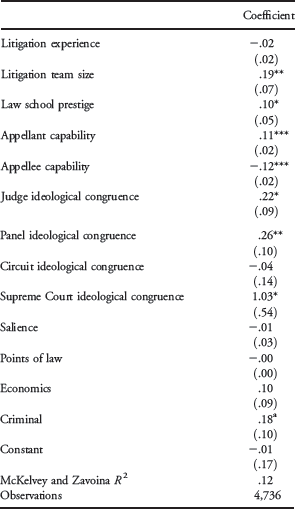
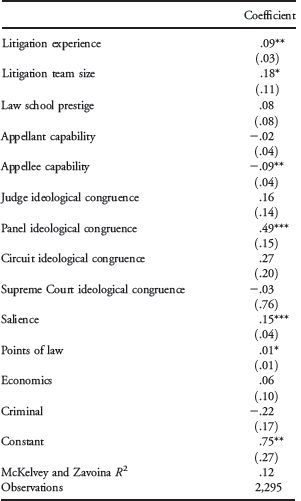
We estimated three models to test aspects of the government gorilla hypothesis. The model in table 3 replicates the analyses from table 2 using all cases in our sample in which the United States did not participate as a party. This allows us to examine the degree to which the party capability advantage extends to other types of litigants.
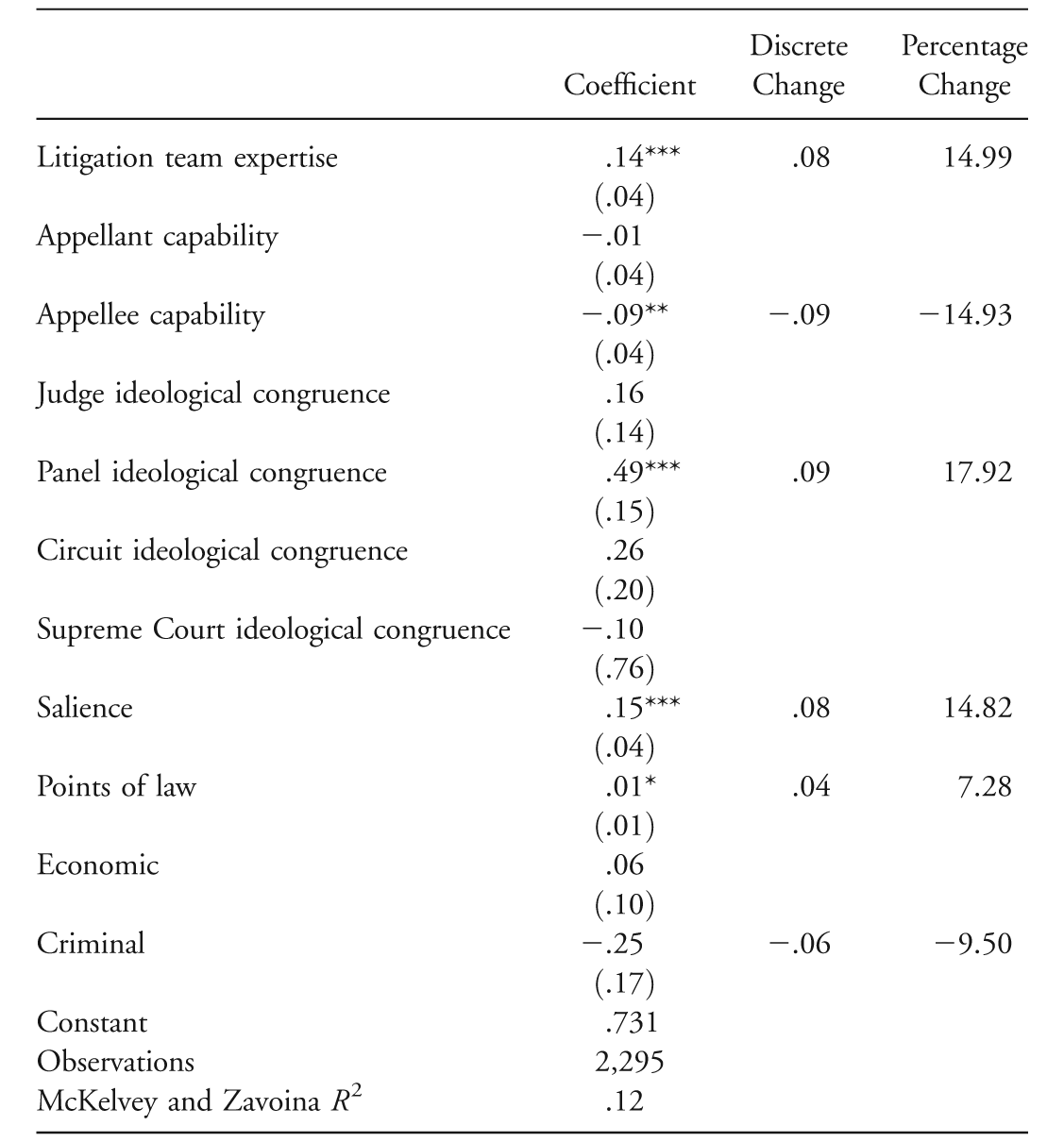
Likelihood of a US Circuit Judge Vote in Favor of the Appellant as a Function of Attorney Capability and Party Capability, in Cases in Which the United States Is Not a Litigant, US Courts of Appeals, 1997–2002
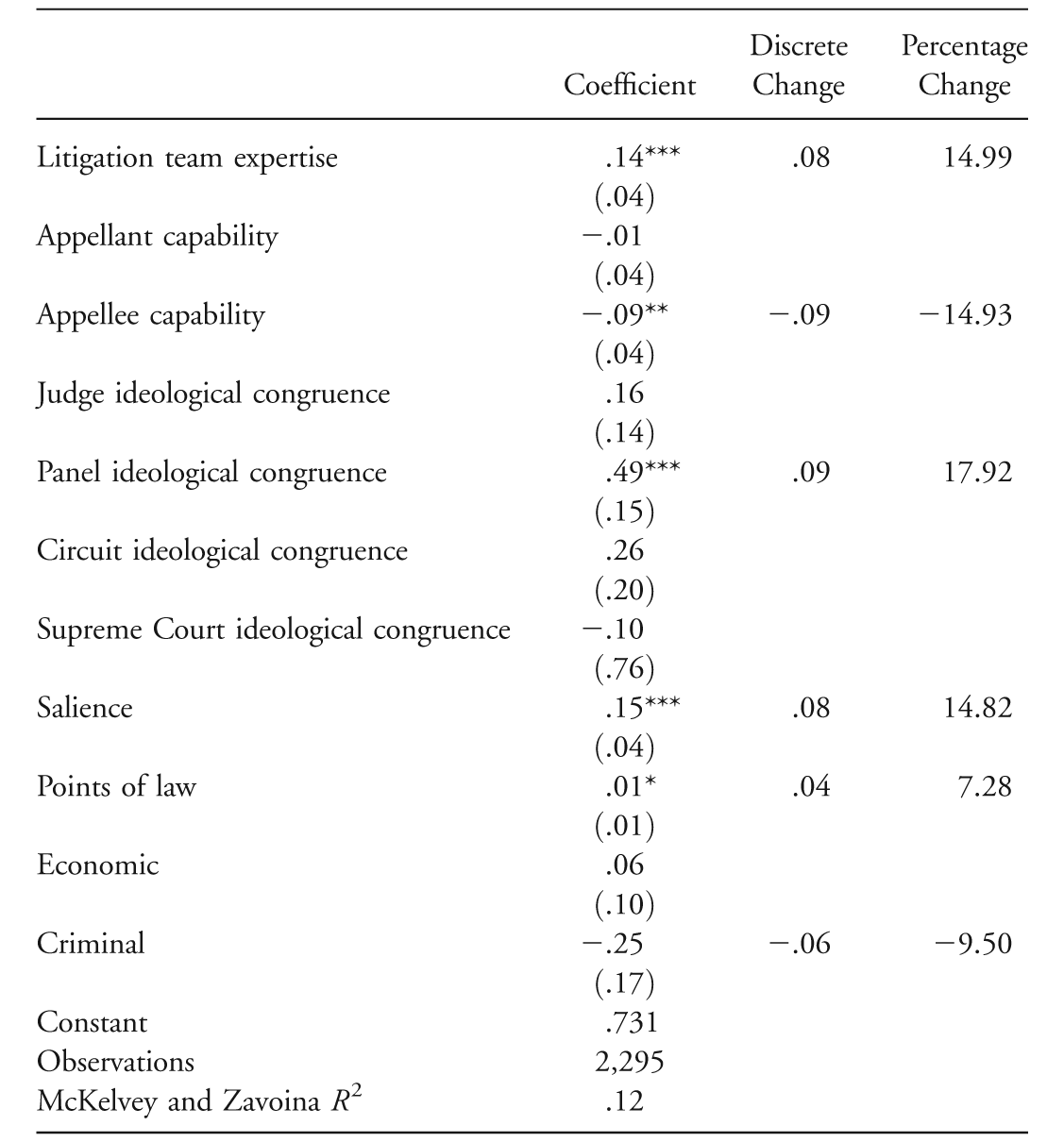
Note.—Robust clustered standard errors are in parentheses.
* p < .05 (one-tailed test).
** p < .01.
*** p < .001.
The results suggest that party capability plays a role in cases without the United States but is weaker when the United States is not a party. The coefficient for appellee capability is significant in the hypothesized direction (negative), and litigation team expertise is significant and positive, as anticipated. Both of these findings suggest that party resources matter even when the United States is not a party. On the other hand, the negative coefficient for the appellant capability variable is neither significant nor in the posited direction. However, with respect to substantive effects, the appellee capability variable effects are still robust: a discrete change of −0.09 and a percentage change of just under 15%. Moreover, the effects of litigation team expertise appear stronger in this model.
This mixed bag suggests some support for Kritzer’s government gorilla theory. When we exclude cases in which the United States is a litigant from the model, the effects of party capability are less significant—both statistically and substantively. But it is also clear that non-US party capability still matters—but to a lesser degree.
Our results in table 3 also clearly show that lawyer expertise matters even for nongovernmental litigants. The coefficient is positive and statistically significant, and if anything, the effect sizes are slightly stronger in the sample without the United States (discrete change of 0.08 vs. 0.04; percentage changes of 14.99 and 11.69, respectively).
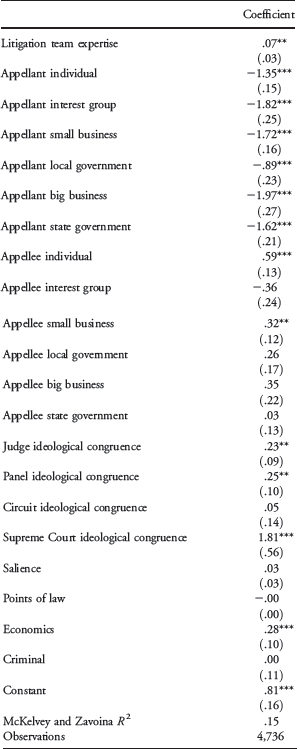
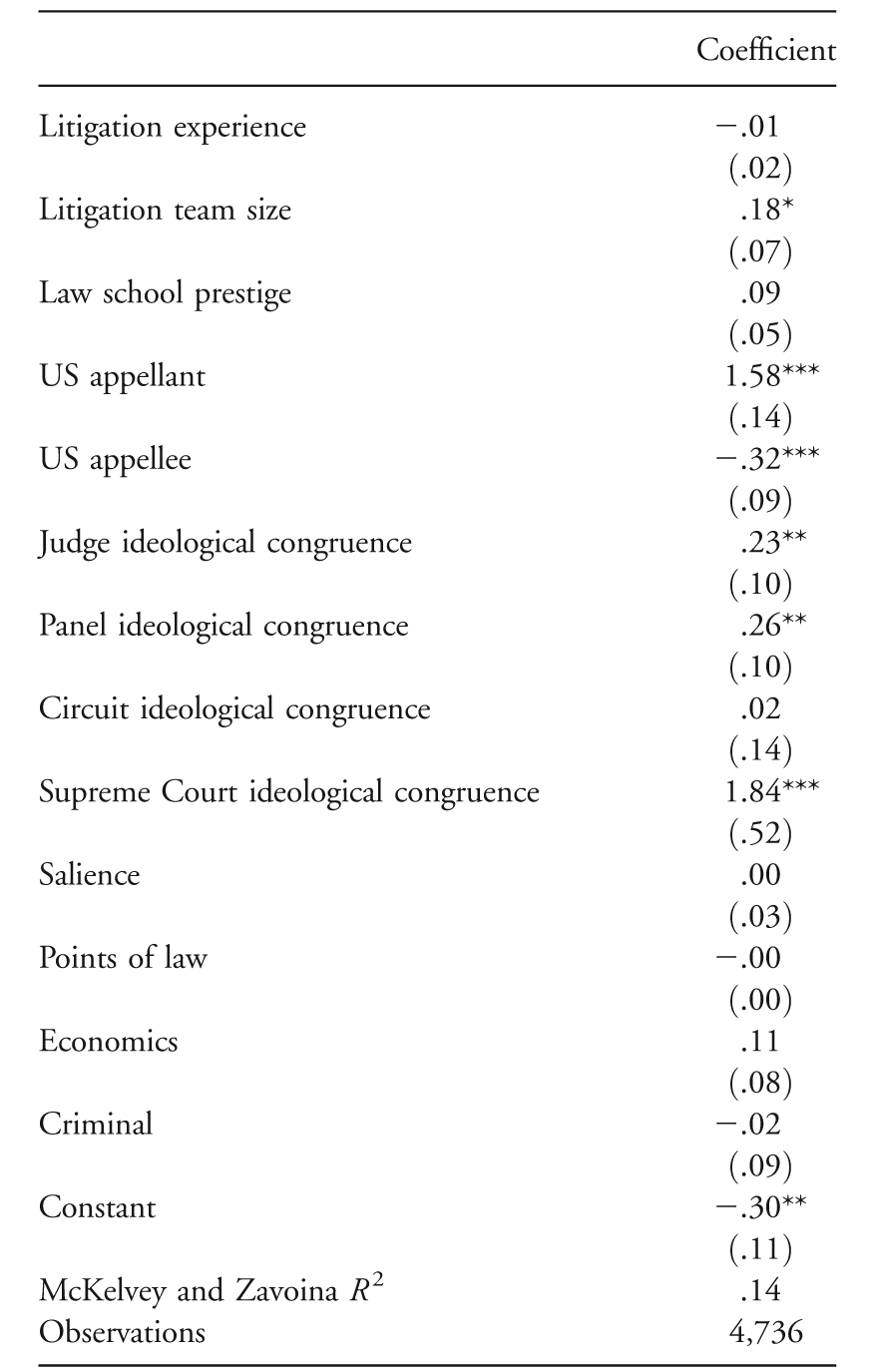
The analyses in table 4 uses the entire sample but replace the appellant and appellee capability typology variables with two dummy variables: the US appellant and US appellee.Footnote 25 The excluded category is when the United States is not a party to the cases. This allows us to test the likelihood of the appellant winning when the United States is the appellant compared to situations in which some other litigant is appealing against the United States or when the United States is not a party to the case.
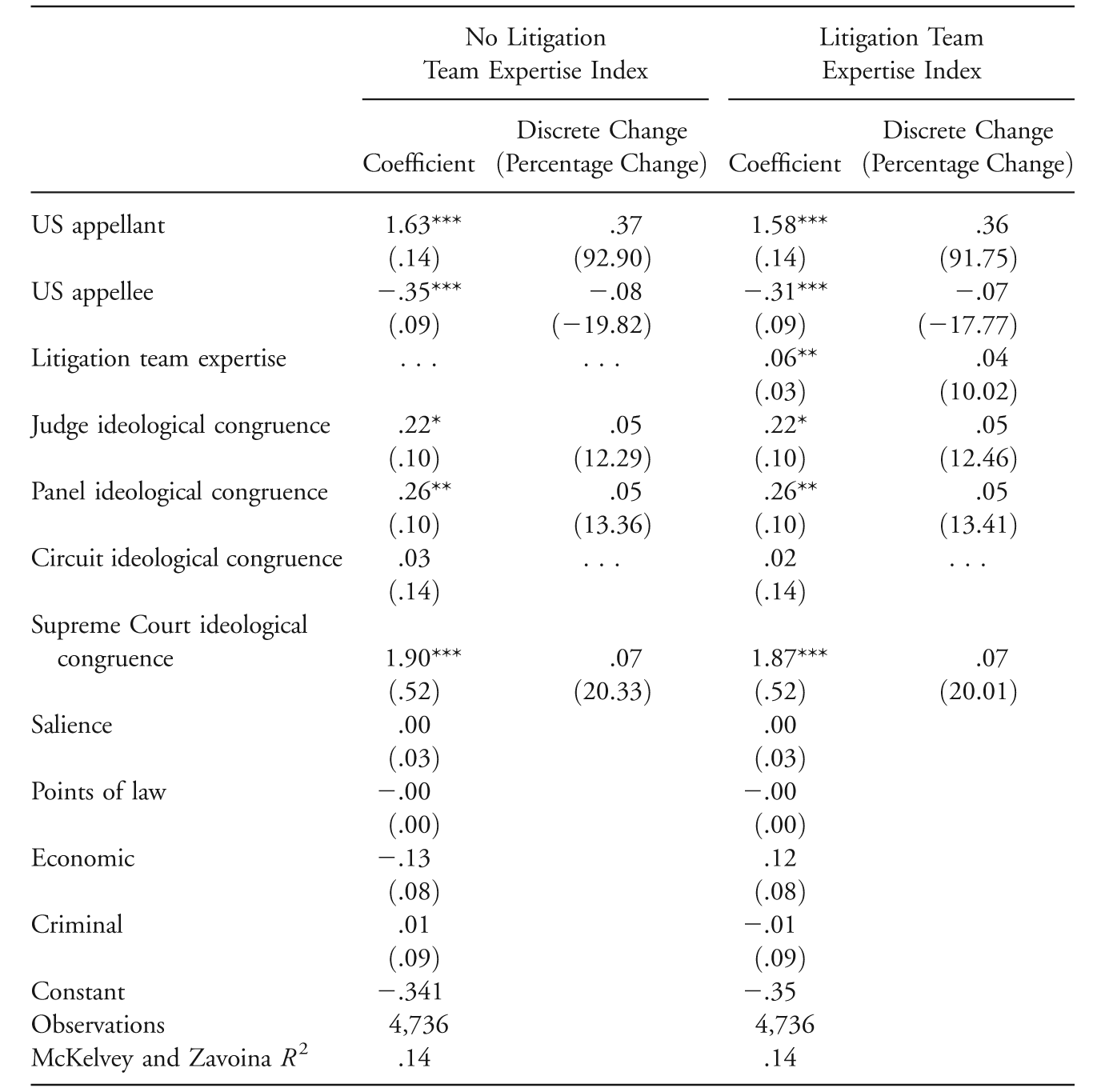
US Influence on US Circuit Court Judges’ Votes for the Appellant, 1997–2002
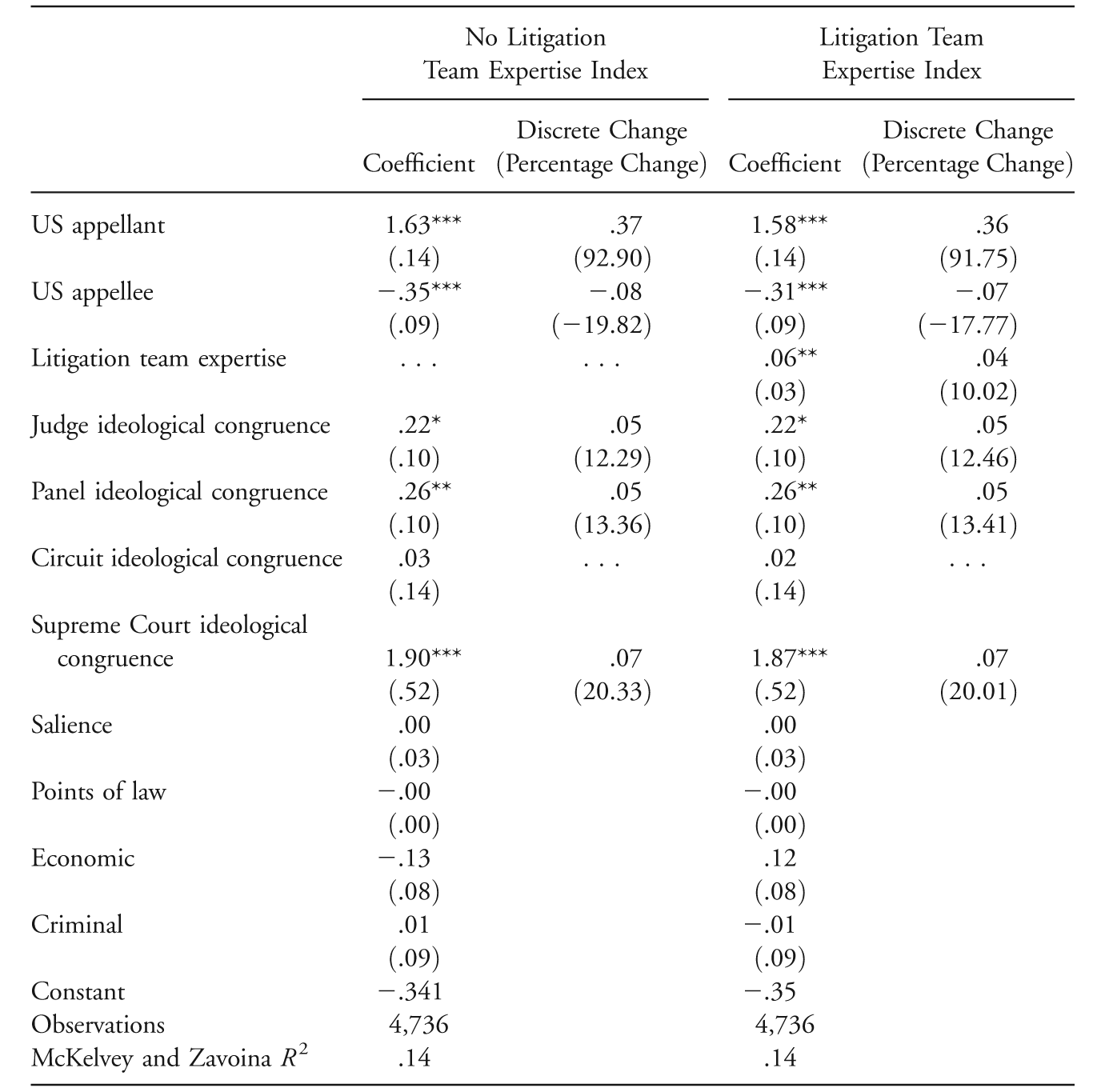
Note.—Robust clustered standard errors are in parentheses.
* p < .05 (one-tailed test).
** p < .01.
*** p < .001.
The results generally support the hypothesis that courts of appeals judges are more likely to side with the United States when it is the appellant, compared to cases in which either the government is the appellee or the government is not a party. This reinforces the view of the judges and the speculations of earlier studies that part of the advantage of the US government is its selectivity in deciding which cases to appeal. While the US appellant and appellee dummy variables are both highly statistically significant, we observed dramatic differences in the effect size estimates (discrete and percentage changes). On average, a circuit court judge is over 90% more likely to side with the United States as an appellant compared to a non-US appellant in a typical case. This is more than four times higher in magnitude than the discrete changes for the US appellee variables, even with the significant controls (judge, panel, and Supreme Court ideological congruence).
By controlling for litigant expertise, table 4 also allows us to determine whether McGuire’s (Reference McGuire1998) findings in the Supreme Court context (which suggests that any observed advantages held by the United States as a litigant disappear after controlling for lawyer expertise) are also present in the courts of appeals. The results suggest that McGuire’s thesis may be relevant only for the Supreme Court. The US government dummy variables are both statistically significant in the expected directions (when the United States is the appellant, the judge is more likely to decide for the appellant compared to cases in which the United States is not a party; conversely, when the United States is the appellee, the judge is less likely to vote against the appellant compared to instances in which the United States is not involved in the appeal) whether or not we include the litigation team expertise measure. Similarly, the discrete changes are barely affected by the inclusion of the lawyer capability measure in the second model. That is, even though the superior attorneys of the United States appear to contribute to the government’s success, the strong advantage enjoyed by the United States remains even when one controls for attorney capability and expertise.
This could be a function of the additional aspects of the government advantage we previously discussed, including tendencies to defer to the government and the role that government has in fashioning procedural and substantive rules that govern the litigation process. Or it could be that McGuire’s (Reference McGuire1998) findings in his US Supreme Court study may not be transferable to the US courts of appeals because of institutional differences in the process by which the government participates in litigation at these two levels. Unfortunately, while it appears that the US advantage does extend beyond its control of which cases to appeal and the expertise of its attorneys, we do not have the data needed to test some of the other suggested bases of government success.
Does Ideology Explain Litigant Success?
Sheehan et al. (Reference Sheehan1992) contend that most of the observed advantages of repeat players, at least at the US Supreme Court level, are a function of ideological attachments to certain types of litigants (or at least the policies that these litigants tend to advocate). For example, conservatives are pro–state government and business, while liberals tend to support individuals and the national government. Indeed, after they controlled for ideology, much of the observed party capability effect disappeared. While they suggest that this is an artifact of the attitudinal nature of Supreme Court decision making, which is encouraged by the institutional structure of the high court, studies suggest that the US intermediate appellate court judges are also partially ideological actors (Goldman Reference Goldman1975; Songer et al. Reference Songer2000; Hettinger, Lindquist, and Martinek Reference Hettinger2004).Footnote 26 For example, while the Supreme Court is not subject to review by a higher court, the courts of appeals, while technically subject to review, are practically courts of last resort because of the reduced Supreme Court caseload and the burgeoning court of appeals dockets (Howard Reference Howard1981; Songer et al. Reference Songer2000; Klein Reference Klein2002; Bowie et al. Reference Bowie2014).
Interestingly, while several of the judges admitted that in a few cases, their decisions were influenced by what social scientists might label their political values (the judges themselves usually used different terms, like “sense of justice in the case”), no judge took the position that the observable advantages of repeat players stem from ideological adherence to policies that tend to favor certain types of groups. Consequently, our next hypothesis tests the difference in perspective between the judges and empirical social scientists as to whether the advantages of repeat players are eliminated when one controls for judicial ideology. We posit that US courts of appeals judges are more likely to vote in favor of more capable litigants than less capable litigants—even after controlling for the effects of ideology.
We use the models presented in tables 2–4 to assess this alternative explanation for party capability success. We find evidence that the effects of party status and attorney capability are strong in spite of the controls for ideology. Consistent with previous work on the effects of ideology in appellate courts, in tables 2 and 3, almost all the relevant ideology variables are statistically significant. Only circuit-level ideological congruence appears to have no effect on judge support for the appellant once controls for party capability variables are included in the model. In the model examining cases in which the United States is a party, only panel and circuit ideology are significant at the .1 level. Also, interestingly, all the ideology discrete changes are lower than the effects of the party and attorney capability variables and similar in magnitude to the effects of lawyer expertise. Thus, these results reaffirm previous findings of the significance of the ideological preferences of appeals court judges on their voting choices while simultaneously demonstrating that in contrast to the findings on the Supreme Court noted above, there are strong party capability effects on the courts of appeals even after one controls for the effects of ideology.
Selection Effects: Party Capability and Appealing Winnable Cases
As Kritzer (Reference Kritzer2003) and several judges suggest, repeat players are more likely to win at least in part because they are more likely to pursue appeals only when they believe they have a high probability of success. Presumably, many of the posited advantages of party capability indirectly augment the ability of the haves to more accurately assess the likelihood of success, including an enhanced understanding of the litigation process resulting from prior litigation experience, the presence of in-house counsel, and the financial resources to employ expert outside legal counsel. Litigants with more resources are also better positioned to absorb losses (Galanter Reference Galanter1974). For example, a large corporation can absorb a $10 million verdict against the company when it predicts a likely defeat on appeal. This strategy is particularly enticing to the repeat player with resources, because it may be deterred from pursuing appeals likely to result in precedents that are, in the long term, against the repeat player’s interest (Galanter Reference Galanter1974). Note that while the general “selection effect” theory applies broadly to all types of haves, the judges’ discussions all focused on the advantages that stem from the ability of one litigant to appeal winnable cases: the United States.
Although the judges rarely used the word “strategic” in their remarks, they clearly understood that the US government often gained advantages by its ability to strategically decide when and where to appeal and when to accept losses in the trial courts. Judge D perhaps summed up this common perspective of the judges most directly. He said, “in civil cases the government selects the cases carefully.Footnote 27 It manages its docket, choosing which cases to settle, which to drop after a loss at trial, and which to fight all the way. As a result, it only takes to the court of appeals the cases that are favorable to the government.” Judge J agreed, saying, “The US gets to pick and choose the cases it brings to us in ways that other lawyers don’t; the US manages its docket much more consciously.”
This perception that the government wins in large part because it manages its docket so well was repeated in slightly different ways by most of the judges. Judge K said that the government’s success has “more to do with the way the government manages its docket.” Judge N agreed, saying, “the Justice Department does a good job of screening which cases are appealed.” Judge L noted that “the biggest reason the government wins so frequently is their self-screening of cases to appeal; for example they will only appeal a social security award when they think the award was outrageous; so as a general rule they just bring better cases than most litigants.” Judge TT stated that “part of the reason I suppose is that the government is doing their job and they usually don’t waste time on frivolous issues.” And Judge G suggested that although the quality of government lawyers was typically high, it was not the most important basis of the government’s success. He maintained that “US attorneys almost always present you with a well-constructed case; but screening is probably more important than the quality of argument because public defenders often do a good job of arguing, as do some of the attorneys for private litigants.”
As previously discussed, the selection effect advantage stems from both resources and experience. If there is an advantage from selecting more winnable cases, we would expect to observe substantively greater advantages for higher-status appellants since they are the side responsible for the decision to appeal. Conversely, in contrast to the Supreme Court process, appellees can do very little (beyond settling, plea-bargaining, and dismissing cases) to avoid appeals. As such, in our prior models, the coefficients for the appellant’s party capability and the United States as an appellant should be statistically significant and exhibit more substantive significance than the coefficients for the corresponding appellee variables.
Interestingly, we find little difference between appellant and appellee party capability in the model including all types of litigants (presented in table 2). If anything, contrary to expectations, the appellee party capability variable has a higher estimate of substantive significance.Footnote 28 Moreover, when we exclude the United States from the model (table 3), the results clearly contradict the selection effect hypothesis. The coefficient for appellant party capability is not statistically distinct from zero. In other words, there is no evidence of any advantage stemming from increased status of the appellant among nonnational litigants. Interestingly, the negative coefficient for the appellee party capability variable is statistically significant in the hypothesized direction. In other words, contrary to our expectations, the appellant party capability advantage is not only substantively and significantly lower than the corresponding advantage for appellees; we find no evidence of an advantage for nonnational appellants. We do, however, find an advantage for higher-status appellees in this context. This suggests, at least among litigants other than the United States, that there are some party capability advantages, but they have little, if anything, to do with the tendency to select more winnable cases.
Nevertheless, we do find evidence supporting the judges’ contention that part of the success of the US government is due to its selectivity in deciding which cases to appeal. In the models presented in table 4, the substantive effect estimates for the United States as an appellant are between four and a half and five times greater than the estimated effects of the United States as an appellee. This is particularly striking given that the United States is much more likely to face the weakest litigant class (individuals) when it is an appellee. Specifically, when the United States is an appellee, in approximately 79% of the cases, the opponent is an individual. Conversely, as an appellant the United States faces an individual three-fifths of the time. Finally, even when cases involving individual litigants are excluded (model not reported), the effects of the United States as an appellant are still much greater than the effects of the United States as an appellee.
Conclusion
At one level the analyses presented provide simply one more confirmation of the now well-established theory of party capability. Our results show that in the most recent period for which data are available, the “haves” tend to win consistently in the courts of appeals when they face “have-nots,” just as they have in previous decades in these same courts and as they have in most other courts in the common law world. However, in contrast to prior studies examining party capability, we focus more precisely on several potential causal mechanisms underlying the party capability theory. For example, the advantage of the haves clearly stems in part from their tendency to hire better litigation teams compared to less capable opponents. As in some prior studies, we find strong evidence that parties represented by relatively higher-quality counsel are more successful. Moreover, in contrast to prior studies, we find that parties with more resources are generally more likely to hire better counsel than litigants with lower levels of resources.
Perhaps while unfamiliar with the social science literature on party capability, the judges we interviewed overall seem to support and agree with the foundations of this theory. We also find support for some of the hypotheses we developed on the basis of the judges’ interviews. For instance, several judges suggested that the US government’s advantages stemmed in part from the ability to participate in winnable cases. Our analysis suggests that judges tend to side with the United States more when it initiated the litigation (as either the appellant or the plaintiff). The widespread views among appellate court judges that the law matters and that the ability to effectively marshal arguments on the basis of the law also matters receive strong support.
Furthermore, the results speak to previous theories about the special role of the national government. As Kritzer (Reference Kritzer2003) posited, the United States is clearly the most dominant litigant. In our model without the United States, the effects of party capability were still present but weaker. Additionally, while the empirical and interview findings suggest that the US advantage is in part due to the ability to select more winnable cases, we find no evidence that this causal mechanism applies to nonnational high-status litigants.
We also found that two party capability findings from studies of the US Supreme Court were not transferable to the US courts of appeals. Unlike McGuire’s (Reference McGuire1998) test of party and attorney capability in Supreme Court litigation, US success as a litigant is due to more than just the quality of its representation before the courts of appeals. Also, in contrast to previous findings on the Supreme Court (Sheehan et al. Reference Sheehan1992), we find that on the courts of appeals, repeat player status and attorney capability are important even after controlling for the effects of ideology.
Overall, the study leverages rich qualitative data to lay out these often overlapping hypotheses. Then we use the quantitative analyses to disentangle many of these causal linkages to better understand party capability theory in general and in the US courts of appeals. However, paradoxically, as we discuss in some detail, the typology measure of party capability is obviously limited. We tend to assume the relative resources, experience, and credibility of the categories without directly measuring them. We believe that studies like ours that also include measures of the quality of the party’s legal representatives are improvements (e.g., see McGuire’s [Reference McGuire1995] Supreme Court study), and we believe this is the first US court of appeals study to do so. However, while admittedly time-consuming, we call on future studies of party capability theory to move beyond the typologies and the measures of attorney capability to include direct measures of party experience and/or resources.
Appendix A
Overview of Hypotheses and Their Associated Dependent Variables

a The data to test hypothesis 5 include all cases in our sample in which the United States did not participate as a party. See the text for additional details.
b The data to test hypotheses 6 and 7 include all cases in our sample but replace the appellant and appellee capability typology variables with two dummy variables: the US appellant and US appellee. See the text for more details.
Appendix B Descriptive Statistics
Descriptive Statistics for the Model of Attorney Expertise Presented in Table 1
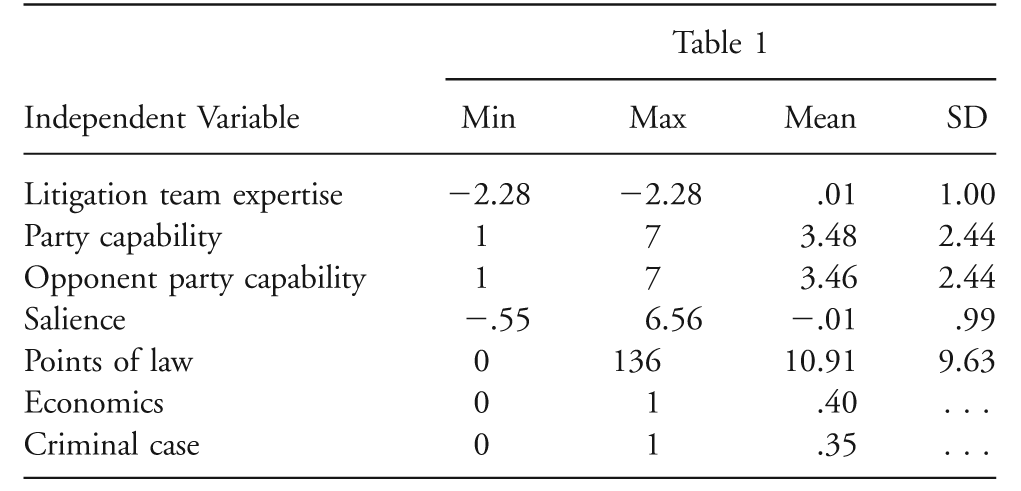
Descriptive Statistics for the Models of the Likelihood of a Judge Vote in Favor of the Appellant
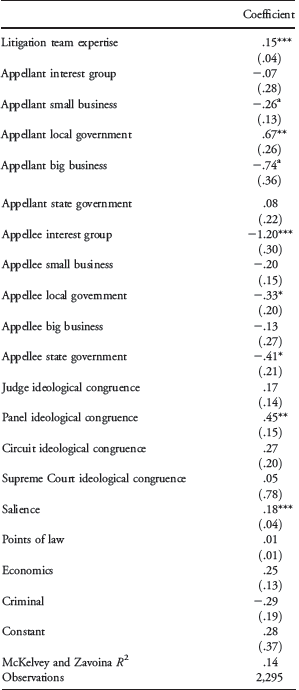
Model of Attorney Quality as a Function of Party Capability, 1997–2002: Different Versions of Attorney Expertise without Index
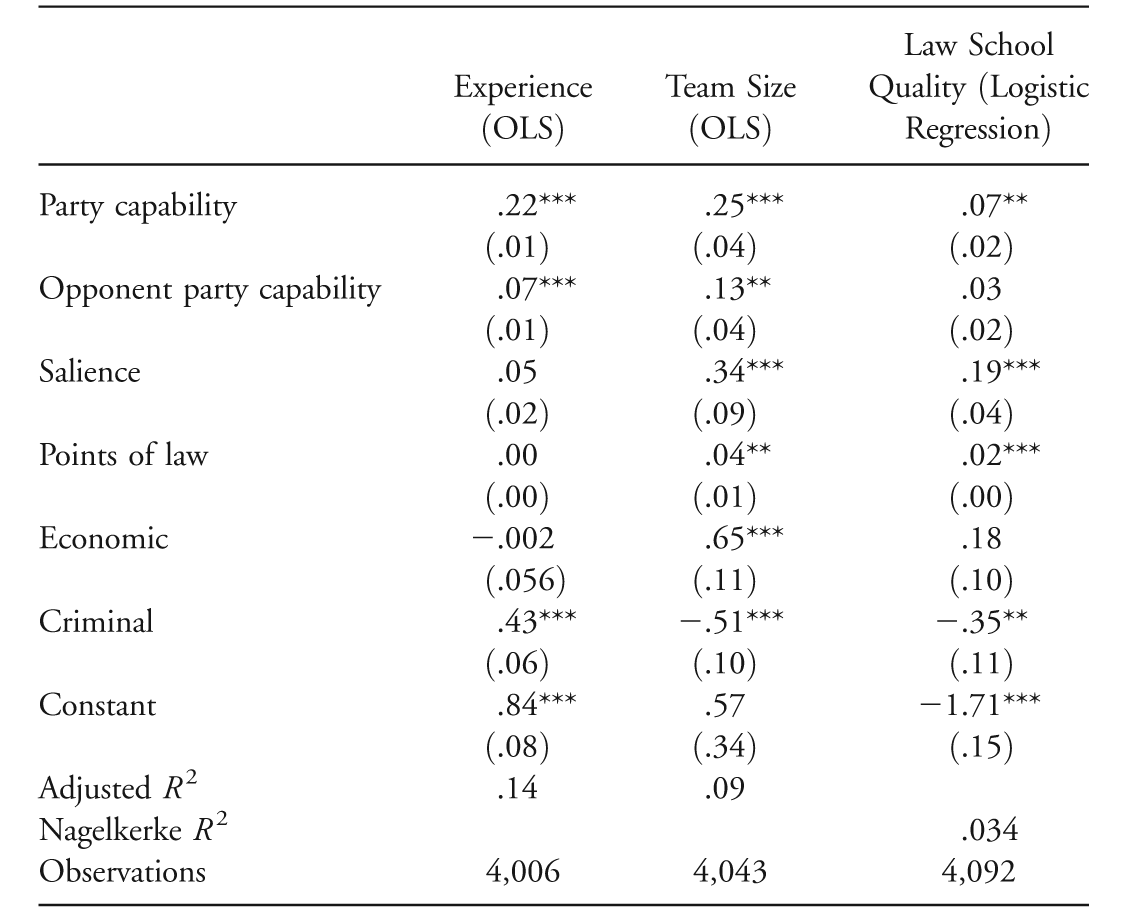
Note.—Robust clustered standard errors are in parentheses.
* p < .05.
** p < .01.
*** p < .001.
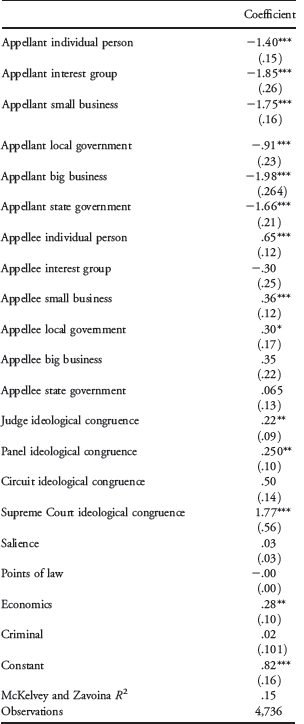
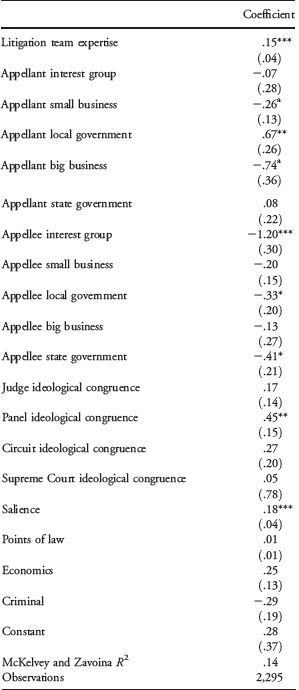
Model of Attorney Quality as a Function of Party Capability, 1997–2002: Different Measures of Attorney Quality Party Capability Dummy Variables
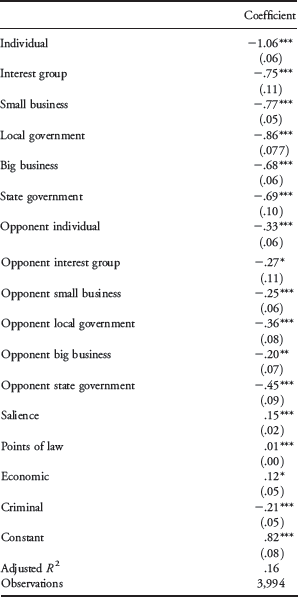
Note.—United States is the reference category. Robust clustered standard errors are in parentheses.
* p < .05.
** p < .01.
*** p < .001.
Model of Likelihood of a Judge Vote in Favor of the Appellant as a Function of Attorney Capability and Party Capability, 1997–2002: Different Versions of Attorney Expertise without Index
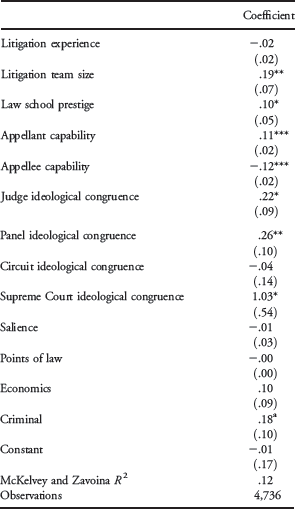
Note.—Robust clustered standard errors are in parentheses.
* p < .05 (one-tailed test).
** p < .01.
*** p < .001.
a Two-tailed test: p < .05; sign is in the unexpected direction.
Model of Likelihood of a Judge Vote in Favor of the Appellant as a Function of Attorney Capability and Party Capability, 1997–2002: Party Capability Dummy Variables
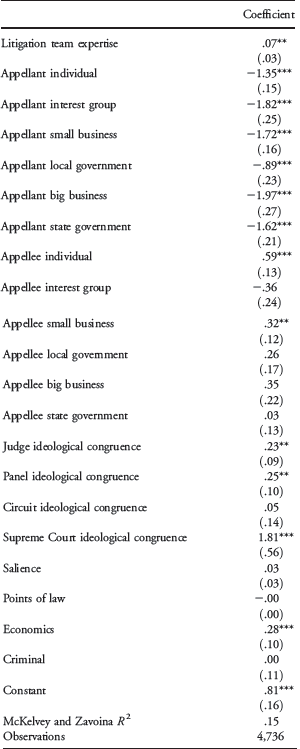
Note.—United States is the reference category. Robust clustered standard errors are in parentheses.
* p < .05 (one-tailed test).
** p < .01.
*** p < .001.
Logistic Regression US Influence on Likelihood of Judge Vote for Appellant, No Litigation Team Expertise Measure: Party Capability Dummy Variables
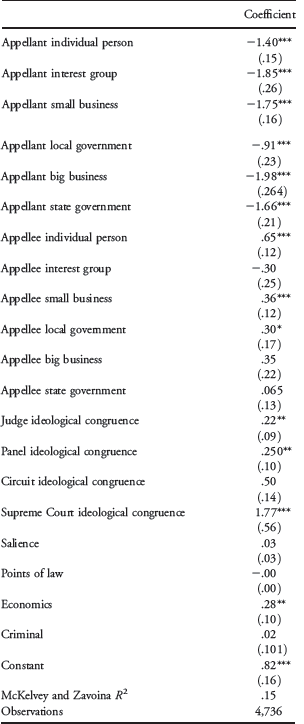
Note.—Robust clustered standard errors are in parentheses.
* p < .05 (one-tailed test).
** p < .01.
*** p < .001.
Logistic of US Influence on Likelihood of Judge Vote for Appellant with Litigation Team Expertise Measure: Different Versions of Attorney Expertise without Index
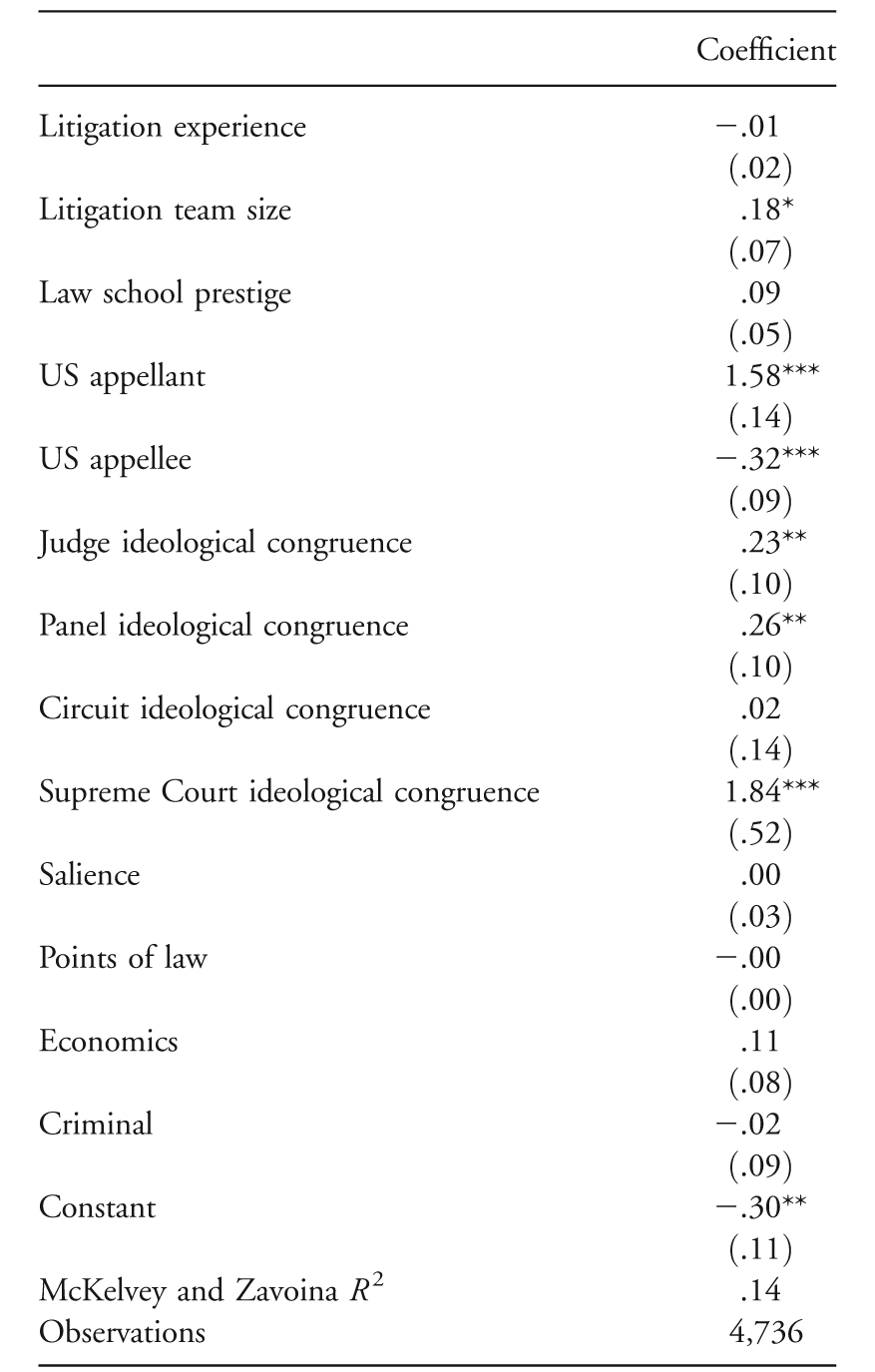
Note.—Robust clustered standard errors are in parentheses.
* p < .05 (one-tailed test).
** p < .01.
*** p < .001.
Logistic Regression of Likelihood of Judge Vote for Appellant, Cases without the United States as Litigant: Different Versions of Attorney Expertise without Index
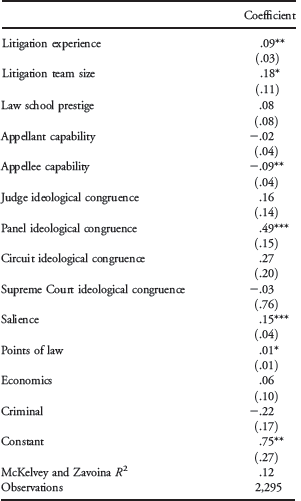
Note.—Robust clustered standard errors are in parentheses.
* p < .05 (one-tailed test).
** p < .01.
*** p < .001.
Logistic Regression of Likelihood of Judge Vote for Appellant, Cases without the United States as Litigant: Party Capability Dummy Variables
Note.—United States is the reference category. Robust clustered standard errors are in parentheses.
* p < .05 (one-tailed test).
** p < .01.
*** p < .001.
a Two-tailed test: p < .05; the sign is in the unexpected direction.