Discontinuity between suitable aquatic and terrestrial habitats forces many amphibian species with aquatic larvae to undertake risky breeding migrations through disturbed environments, potentially contributing to population declines by reducing survival of adults and juveniles (Becker et al. Reference BECKER, FONSECA, HADDAD, BATISTA and PRADO2007). The north-western region of the state of São Paulo, Brazil, is characterized by fragments of mesophytic semideciduous forest and savanna, surrounded by a matrix of pasture, plantations and urban areas with only 4% of the remaining original vegetation of the state (Ribeiro et al. Reference RIBEIRO, METZGER, MARTENSEN, PONZONI and HIROTA2009). Currently, 36 anuran species have been recorded in this region, corresponding to almost 15% of the state's species (Araújo et al. Reference ARAÚJO, TOLEDO, GARCIA and HADDAD2009). The anuran species of this region are associated with open environments or are widely distributed in the different Brazilian biomes (Duellman Reference DUELLMAN and Duellman1999). Silva & Rossa-Feres (Reference SILVA and ROSSA-FERES2007) showed the importance of forest fragments in this region for 12 anuran species that breed in pools located in a pasture matrix.
Therefore, because anuran species of this region rely on forests fragments when not reproducing, and because the dry season is an important factor that may limit anuran migration through a pasture matrix, we hypothesized that: (1) breeding pools near forest fragments (hereafter proximal pools) would have greater species richness and abundance than breeding pools farther from forest fragments (hereafter distant pools) because proximity decreases risks associated with dehydration and predation during breeding migrations; and (2) temporal distribution of anuran species in proximal pools would be longer than in distant pools because the climate conditions (e.g. moisture) associated with proximal pools would be favoured by proximity to the forest fragment.
This study was conducted in Icém (20°22′S; 49°15′W), north-west of the state of São Paulo, Brazil. In this region, the mesophytic semideciduous forest, one of the subtypes of the Atlantic Forest Domain (sensu Ab'Saber Reference AB'SABER1977), has largely been replaced by a matrix of pasture with sparse trees, used for extensive cattle-farming systems. The climate is characterized as hot and humid tropical (http://mapas.ibge.gov.br/clima) with two well-defined climatic seasons: rainy season, between October and March, and a pronounced dry season, between April and September, receiving only 15% of the total annual precipitation, that varies between 1100 and 1250 mm (SD: ± 225 mm) (Barcha & Arid Reference BARCHA and ARID1971).
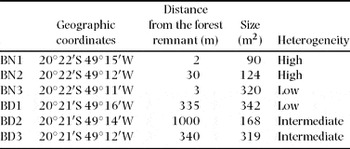
We selected six breeding pools in a pasture matrix. They were assigned to one of two categories according to distance from forest fragments: (1) three pools near forest fragments (maximum distance 30 m from edge of fragments) and (2) three pools distant from forest fragments (minimum distance 335 m from edge of the forest fragments). The proximal pools were associated with three small fragments (3, 7 and 9 ha), separated 1–4 km apart, while distant pools were associated with three different fragments (6, 8 and 20 ha), separated 0.7–4.5 km apart. To minimize the variation in the characteristics of breeding pools, all selected pools were temporary or semi-permanent and did not contain fish. Breeding ponds were characterized according to size and dominant vegetation within and around breeding pools (Table 1).
Descriptors of the breeding pools studied in Icém, São Paulo state, Brazil. Low heterogeneity = no vegetation in the pool, dominance of low herbaceous plants on the banks; intermediate heterogeneity = little vegetation in the breeding pool interior, banks with low and erect herbaceous vegetation; high heterogeneity = more than 30% of the breeding pool interior with vegetation, banks with low and erect herbaceous plants and shrubs/trees. BN = breeding pool near forest remnants, BD = breeding pools distant from forest remnants.

Anuran communities were sampled every 2 wk during the rainy season (September 2004–March 2005) and monthly during the dry season (April–August 2005), totalling 19 samples in each breeding pool. Surveys of vocalizing adult males were conducted at a point on the pool edge, between 19h00 and 24h00. Larvae were sampled between 15h00 and 18h00 with a hand net (mesh size of 3 mm2). At each sampling date, relative humidity was recorded in each breeding pool, with a thermohygrometer (Tonka HT-100).
To compare species richness (sum of adult and larvae) between proximal and distant pools we fitted generalized linear models (GLMs) to the data using the GLM function implemented in the NLME package. Since our data were not overdispersed, the analyses were carried out with Poisson distribution and log link function. To determine the optimal model, we started with a model in which the fixed component contained all explanatory variables. We used Akaike's information criterion, corrected for small sample sizes (AICc, Burnham & Anderson Reference BURNHAM and ANDERSON1998), to select explanatory variables that were driving total species richness. We used Akaike weights to evaluate model-selection uncertainty.
To compare abundance patterns and species evenness between proximal and distant pools, we used rank–abundance curves (Feinsinger Reference FEINSINGER2001). For each group we plotted the relative abundance of each species on a logarithmic scale against the rank order of the species from the most to the least abundant. To verify if the distant pools have some effect on the species abundance over the months in which they vocalized, we fitted generalized linear mixed models (GLMMs) to the data using the lmer function implemented in the LME4 package. Here the monthly observations were the repeated measures and were considered as a random effect. The model selection was the same as described above for GLM. GLM and GLMM analyses were carried out using R version 2.10.1 (R developmental core tem, 2010, available at: http://www.Rproject.org).
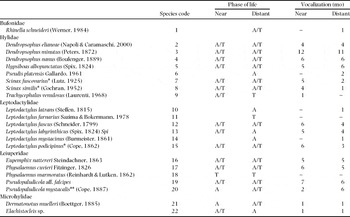
We recorded adults of 20 species and tadpoles of 19 species, totalling 22 species of anuran in the six breeding pools sampled (Table 2). None of the explanatory variables, distance from breeding pools (likelihood ratio test, χ2 = 0.30, df = 1, P = 0.58; ΔAICc = 4.7), breeding pool size (χ2 = 0.56, df = 1, P = 0.45; ΔAICc = 4.4), habitat heterogeneity (χ2 = 0.29, df = 1, P = 0.59; ΔAICc = 4.7) and fragment size (χ2 = 0.17, df = 1, P = 0.67; ΔAICc = 4.8), was considered a good predictor of total species richness.
Anuran species list recorded in breeding pools localized at different distances from forest fragments in Icém, São Paulo state, Brazil, from September 2004 to August 2005. Phase of life: A = adult and T = Tadpole. Vocalization = number of months that anuran species were recorded in vocalization activity at breeding pools. *Anuran species with temporal distribution longer, at least 3 mo longer, in breeding pools near than distant from forest fragments. **Anuran species with temporal distribution longer, at least 3 mo longer, in breeding pools distant than near from forest fragments.

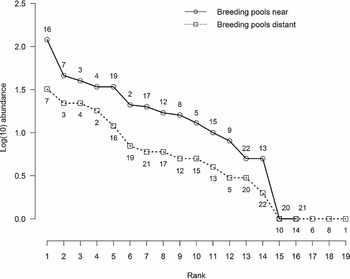
Hierarchical position of species (e.g. changes in species dominance at different distances from forest fragments) did not differ among proximal and distant pools (Figure 1). The first six most dominant species in the rank–abundance curves were the same in both proximal and distant pools. On the other hand, species in proximal pools were more abundant than those of distant pools (Figure 1). Fifteen species occurred in both proximal and distant pools (Table 2). From these species, the model that included distance of breeding pools as variable was the most parsimonious (ΔAICc = 0.0) in explaining the abundance distribution for Scinax similis (χ2 = 9.13, df = 1, P = 0.002; AICc weight = 0.69), S. fuscovarius (χ2 = 11.9, df = 1, P < 0.001; AICc weight = 0.97) and Leptodactyus fuscus (χ2 = 9.35, df = 1, P = 0.002; AICc weight = 0.35). Furthermore, three species, S. fuscovarius, S. similis and L. podicipinus vocalized for a longer period of time, at least 3 mo longer, in proximal pools than in distant one (Table 2).
Curves for abundance of anurans in vocalization activity at breeding pools located near (○) and distant (□) from forest fragments in Icém, São Paulo state, Brazil. Species codes are given in Table 2. The relative abundance of each species (sum of anuran abundance recorded for pools at each distance) recorded in vocalization activity was plotted on a logarithmic scale against the species rank ordered from most to least abundant. The species abundance for each pool was considered as the greatest abundance recorded from among the 12 repeat samples (from September 2004 to August 2005) by listening for calling males around the margins of temporary pools (sensu Scott & Woodward Reference SCOTT, WOODWARD, Heyer, Donnelly, McDiarmid, Hayek and Foster1994).

Population size of amphibians is determined not only by the aquatic habitat but also by the suitability of the terrestrial habitat area (Gibbons Reference GIBBONS2003, Rittenhouse & Semlitsch Reference RITTENHOUSE and SEMLITSCH2007). Forest fragments are less disturbed habitats compared to agricultural and urban areas, facilitating anuran migration from areas used for breeding, to those used for shelter, feeding and aestivation (Gibbons Reference GIBBONS2003, Silva & Rossa-Feres Reference SILVA and ROSSA-FERES2007), because altered environments probably constitute barriers to their movements (Becker et al. Reference BECKER, FONSECA, HADDAD, BATISTA and PRADO2007, Gibbs Reference GIBBS1998). Of the three most abundant species in proximal pools, two were recorded by Silva & Rossa-Feres (Reference SILVA and ROSSA-FERES2007) using the forest fragments as shelter and/or foraging areas. Prado (Reference PRADO2009) in a study with pitfall traps installed in 18 forest fragments in the same region, recorded 15 species of terrestrial anurans known to occur in this region in the interior of forest fragments. These results reinforce the use of forest fragments even for anuran species that breed in pools outside forest fragments.
Several temperate-zone studies recorded higher anuran richness in breeding pools near forest fragments than those without nearby forest fragments (Herrmann et al. Reference HERRMANN, BABBITT, BABER and CONGALTON2005, Laan & Verboom Reference LAAN and VERBOOM1990). In contrast to these studies, where species composition was a mix of forest-associated and open-habitat species, the species recorded in north-western São Paulo can be considered typical of open areas and tolerant to anthropogenic modifications (Duellman Reference DUELLMAN and Duellman1999). The species recorded in the interior of forest fragments are the same species breeding at pools in open habitats (Prado Reference PRADO2009, Silva & Rossa-Feres Reference SILVA and ROSSA-FERES2007). Therefore, the distance from breeding pools to forest fragments should not influence species composition, but the abundance and period of vocalization of species in proximal and distant pools during the rainy season. Silva (unpubl. data) in the same region verified that anuran abundance was greater in experimental pools installed near forest fragments than in those installed farther from forest fragments. High temperature and lower soil moisture in open areas restrict the occurrence of anurans, which experience high rates of evaporative water loss and mortality due to desiccation or increased mortality from predators (DeManyadier & Hunter Reference DEMAYNADIER and HUNTER1999, Rothermel & Semlitsch Reference ROTHERMEL and SEMLITSCH2002). Consequently, proximity of breeding pools from forested patches and more suitable micro-climatic conditions provided by forest fragments enable some species to continue vocalizing compared to breeding pools distant from them.
The persistence and metapopulation structure of many semi-aquatic species (e.g. many amphibians and reptiles) is dependent on both aquatic environments and terrestrial corridors (Lima & Gascon Reference LIMA and GASCON1999, Marsh & Trenham Reference MARSH and TRENHAM2001). Here we found that proximal pools had higher values of relative air humidity than distant ones (t = 2.23, P = 0.03), which represents a plausible mechanism leading to changes in species abundances between proximal and distant pools. The maintenance of sink populations (distant pools) by source population (proximal pools) may be particularly important for persistence of anurans inhabiting distant pools in open areas, because individuals using distant pools in one year may not be present in the same breeding pool in the next year, due to high mortality rate during migration between areas used for reproduction and shelter. As a result, these areas may present a high recolonization rate by new individuals coming from proximal pools each reproduction season. Though metapopulation dynamics are not tested here, relative species abundance patterns suggest an important influence of landscape context on amphibian community structure.
There are relatively few studies of Neotropical anurans that examine the landscape factors affecting structure of communities. Lima & Gascon (Reference LIMA and GASCON1999) in the Amazon Basin verified that linear remnants could function as corridors for some anuran species since they increased landscape connectivity. Becker et al. (Reference BECKER, FONSECA, HADDAD, BATISTA and PRADO2007) demonstrated that even anuran species that usually avoid open habitats in the Brazilian Atlantic Forest are forced to cross inhospitable matrix habitats when breeding sites are not present within forest fragments. Our results have important implications for understanding the pattern of abundance and temporal occurrence of anurans on savanna landscapes. Even small forest fragments influence population parameters (abundance and temporal occurrence) of open-area anurans. The differences in abundance among species in proximal and distant pools emphasize the importance of conservation and species-specific management strategies considering a combination of aspects of the life history and behavioural characteristics of species (Cushman Reference CUSHMAN2006). We suggest that the preservation of breeding pools located near small forest fragments in agricultural landscape will harbour a higher number of individuals than those distant ones and consequently, will contribute to the maintenance of more viable anuran populations.
ACKNOWLEDGEMENTS
We are grateful to James E. Arrigoni Jr. for the help with the writing review and suggestions on the manuscript and to BIOTA/FAPESP for the financial support (2004/04820-3). Fernando R. da Silva thanks FAPESP for the grant (2004/12223-5). Denise C. Rossa-Feres thanks CNPq.