

Introduction
DHA is an essential omega-3 fatty acid that the body cannot efficiently produce by itself and must be taken in through diet. DHA is delivered to infants via their mother through the placenta during pregnancy and from breast milk or enriched formula after birth. When infants are weaned, a nutritional gap is created. Dietary sources of DHA such as salmon and mackerel are not commonly found on the plates of children, which can lead to less than optimal levels of DHA intake. (McNamara et al., Reference McNamara, Able, Jandacek, Rider, Tso, Eliassen, Alfieri, Weber, Jarvis, Delbello, Strakowski and Adler2010) The diet of the pregnant mother can have long-lasting health implications for her child. An unhealthy diet or nutrient deficiency during pregnancy creates a higher risk of diabetes, heart disease, and cancer to the child later in life.
USDA research shows that only 25% of children in America are regularly consuming the daily amount of DHA recommended by experts. The opportunity exists to fill this nutritional gap with naturally DHA-enriched foods that are without additives and with no ‘fishy’ taste which is commonly found in DHA-added products currently on the market (Van, Reference Van Elswky1997).
While most people believe that fish produce their own DHA, in fact it is the algae in their food that makes them a rich source of DHA. By substituting algae, the base of the marine food chain, as a natural source of DHA, farmers have the opportunity to return essential fatty acids back into the diet. Animals receive similar health benefits to those seen in humans when taking a fish oil supplement.
Microalgae can accrue high concentrations of omega-3 and omega-6 fatty acids. A specific commercial strain, Schizochytrium spp. (All-G-Rich®), has been found to contain at least 14% DHA. Microalgae supplementation can be used as a potentially safe, sustainable alternative to fish oil in chicken diets to provide DHA-enriched eggs to help resolve human dietary insufficiencies (McNamara et al., Reference McNamara, Able, Jandacek, Rider, Tso, Eliassen, Alfieri, Weber, Jarvis, Delbello, Strakowski and Adler2010). Daily intake of omega-3 fatty acid should be in the range of 140 mg/day to 667 mg/day (Lemahieu et al., Reference Lemahieu, Bruneel, Termote-Verhalle, Muylaert, Buyse and Foubert2013). However, a few countries reach the human intake of only 250 mg per day; therefore, the need for producing enriched food products with omega-3 fatty acids has emerged. Eggs are a good potential source of n-3 fatty acids because they can be easily enriched with omega-3 PUFA through dietary modifications of the laying hens (Ahmad et al., Reference Ahmad, Ahsan-ul-Haq, Yousaf and Nawaz2010). The following trial was conducted to examine the influence of feeding DHA from algae t laying hens on egg omega-3 levels.
Materials and methods
Animals and diets
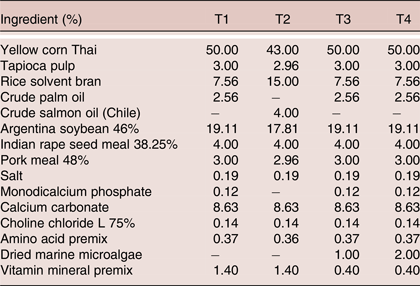
A total of 480 layers of Babcock B380 breed at the same age of 28 weeks were used to determine the effect of feeding rations rich in omega-3 fatty acids from fish oil and high fat microalgae on the egg quality and the egg fatty acid profile. Laying hens were randomly allocated to four groups of 120 birds fed either a negative control diet (T1), a positive control diet supplemented with 4% salmon fish oil (T2) or treatment diets containing 1% (T3) or 2% (T4) microalgae (Schizochytrium spp.; Alltech Inc., Nicholasville, KY, USA; Table 1).
Feed formulation of each treatment group

The layers were housed with three or four hens per cage arranged in a randomised controlled block design at the poultry research farm at Kasetsart University, Thailand. There were 30 layers per replication providing four replications per treatment (n = 120). They were fed ad libitum, twice a day with ad libitum drinking water. Light was provided for 16 hours per day in the house for stimulating egg production throughout the eight week trial. The trial was run according to standard ethical procedures of Kasetsart University, Thailand.
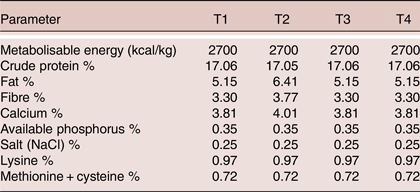
The diets were produced at the feed mill of Betagro Agro Group, Bangkok, Thailand. The control diet and the treatment diet (with crude salmon oil or microalgae included) were formulated to be isonitrogeneous at 17% crude protein (Table 1). Samples of all diets were collected at the start of the trial for DHA level analysis (GC, Internal Lab, Alltech Inc., USA). The chemical composition of the diets fed to the layers is presented in Table 2. Diets were within accepted parameters for all variables measured with the exception of the fat and the fibre percentages for the fish oil group (T2), whereby there was an increased fat and fibre percentages.
Nutrient specification of each treatment group

Data collection
Egg production and feed intake was recorded every day. Egg samples were selected every two weeks for egg quality analysis, including Haugh units, egg yolk colour, and shell thickness. A total of 10 fresh egg samples per replication (40 eggs per group) were sampled at the start of trial and at four and eight weeks and tested for fatty acid profile (by gas chromatography) at the Food and Nutrition Laboratory, Institute of Nutrition, Mahidol University, Nakornpathom, Thailand. The composite egg data from 10 eggs of each replication (four pooled data of each treatment/week) were used to assess egg weight, yolk, albumen, shell and fatty acid profile including DHA.
Statistical analysis
The data were analysed by means of split-plot ANOVA with one between factor and one repeated measures factor. The effects of each diet, interactions, the effect of time, and the time-factor interactions were analysed. Confidence limits were set at 95% (P < 0.05). All statistical analyses were performed using SPSS (version 21) using the General Linear Model (GLM) routine with the repeated measure procedure.
Results and discussion
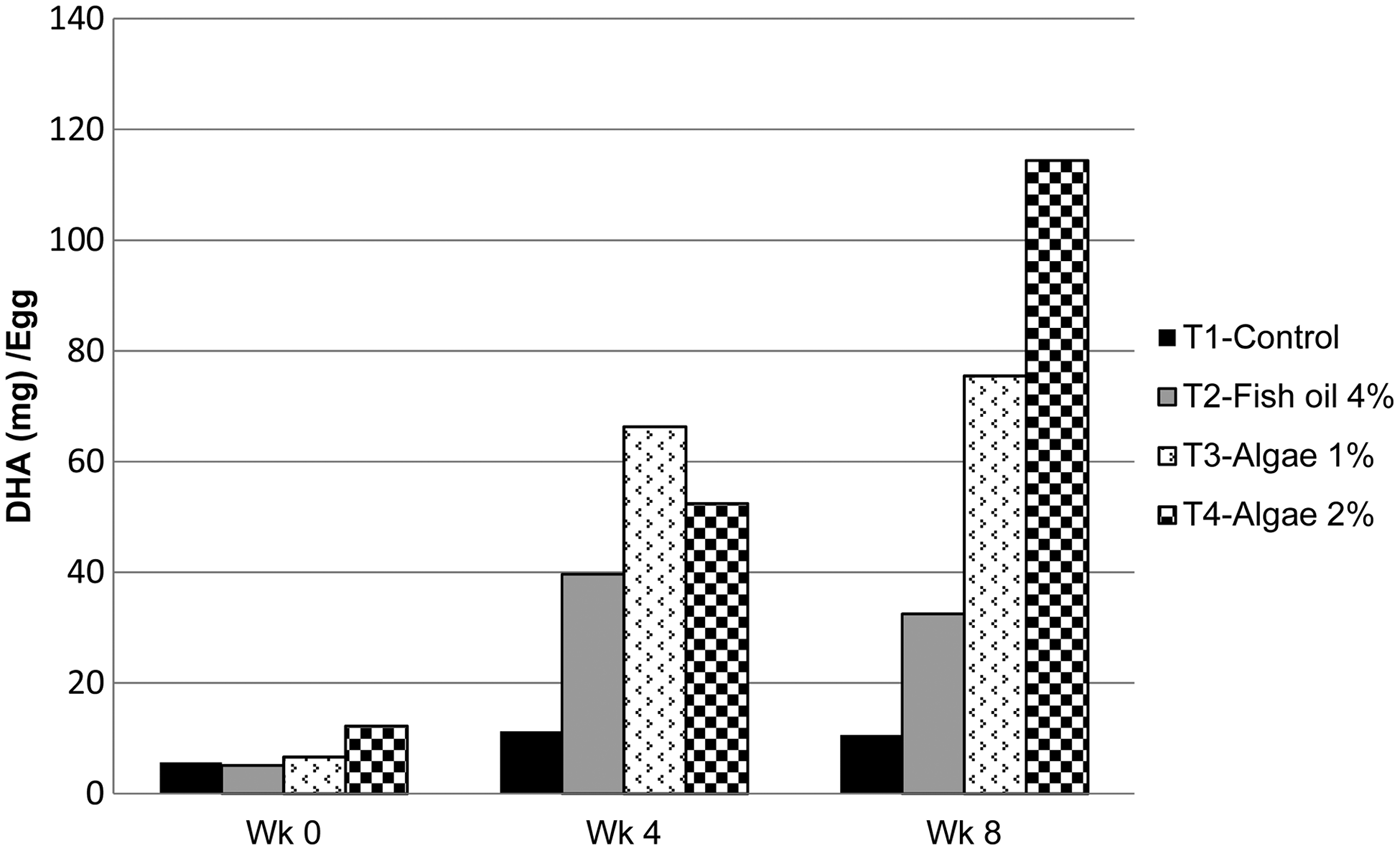
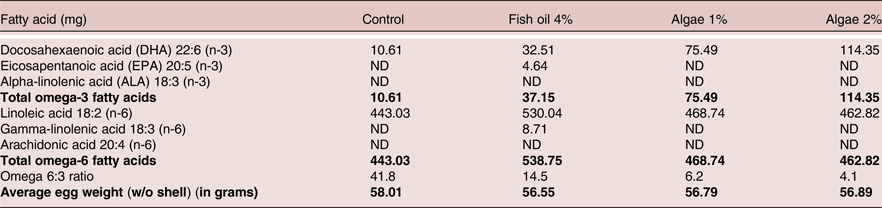
Supplementation of fish oil at 4% or microalgae in the range of 1–2% in layer diets resulted in increased DHA level in the egg yolk after four weeks of feeding, and DHA concentration was found to have increased at the end of the eight week study. The overall performance of the layers, in terms of feed intake, egg production, egg weight, egg mass, albumin height, and Haugh unit of the eggs, was not affected by feeding fish oil or microalgae for eight weeks. The average egg weight (without shell) for all the groups was in the range of 56.55–58.01 g. Fish oil has previously been shown enrich EPA, especially DHA, in the egg yolk (Van Elswyk, Reference Van Elswky1997). Adding 4% fish oil to the hen diets for eight weeks increased yolk DHA from 10.61 ± 1.30 mg in the control group, to 32.51 ± 4.72 mg per egg. However, eggs from the hens fed with 1% or 2% of microalgae had a higher DHA level per egg (1% algae = 75.49 ± 18.75 mg, 2% algae = 114.35 ± 16.66 mg), which was significantly higher (P < 0.05) compared to the control group and the fish oil group (Figure 1).
The DHA(mg) per egg.

Fish oil is commonly used in animal feed as a source of omega-3 fatty acid, and 4% inclusion in feed is currently being used to produce enriched eggs. However fish oil typically contains more EPA than DHA so the DHA levels in the eggs sampled from the current trial was lower than eggs from hens fed algae. The results of the present study are in agreement with the findings of previous researchers (Van et al., Reference Van Elswky, Dawson and Sams1995) who reported that 3% of dietary menhaden oil increased yolk DHA to 252 mg/egg, and Ceylan et al., Reference Ceylan, Ciftci, Mizrak, Kahraman and Efil2011 showed that fish oil significantly (P < 0.01) increased DHA in yolk. Although the use of fish oil has a positive effect on the fatty acids in the egg, high levels in the diet has raised concerns with regard to the sensory quality of the egg (Lawlor et al., Reference Lawlor, Gaudette, Dickson and House2010; Van, Reference Van Elswky1997) where eggs from hens offered above 1.5% fish oil in feed have a fishy odour or taste. As a result researchers have attempted to find alternatives for fish oil as a source of omega-3 fatty acids in the feed. The microalgae Schizochytrium contains over 50% fat and contains 25–28% DHA whereas fish oil contains only 6–9%. Abril et al. (Reference Abril, Barclay and Abril1999) used dried algae to produce eggs containing 220 mg of DHA without lowering the egg production yield. A similar study by Songarj et al. (Reference Songarj, Ruangpamit and Attamangkune2013) demonstrated that DHA in the egg yolk significantly increased in a dose dependant manner when Schizochytrium spp. was included in hens diet (p < 0.01) after 28 days of supplementation.
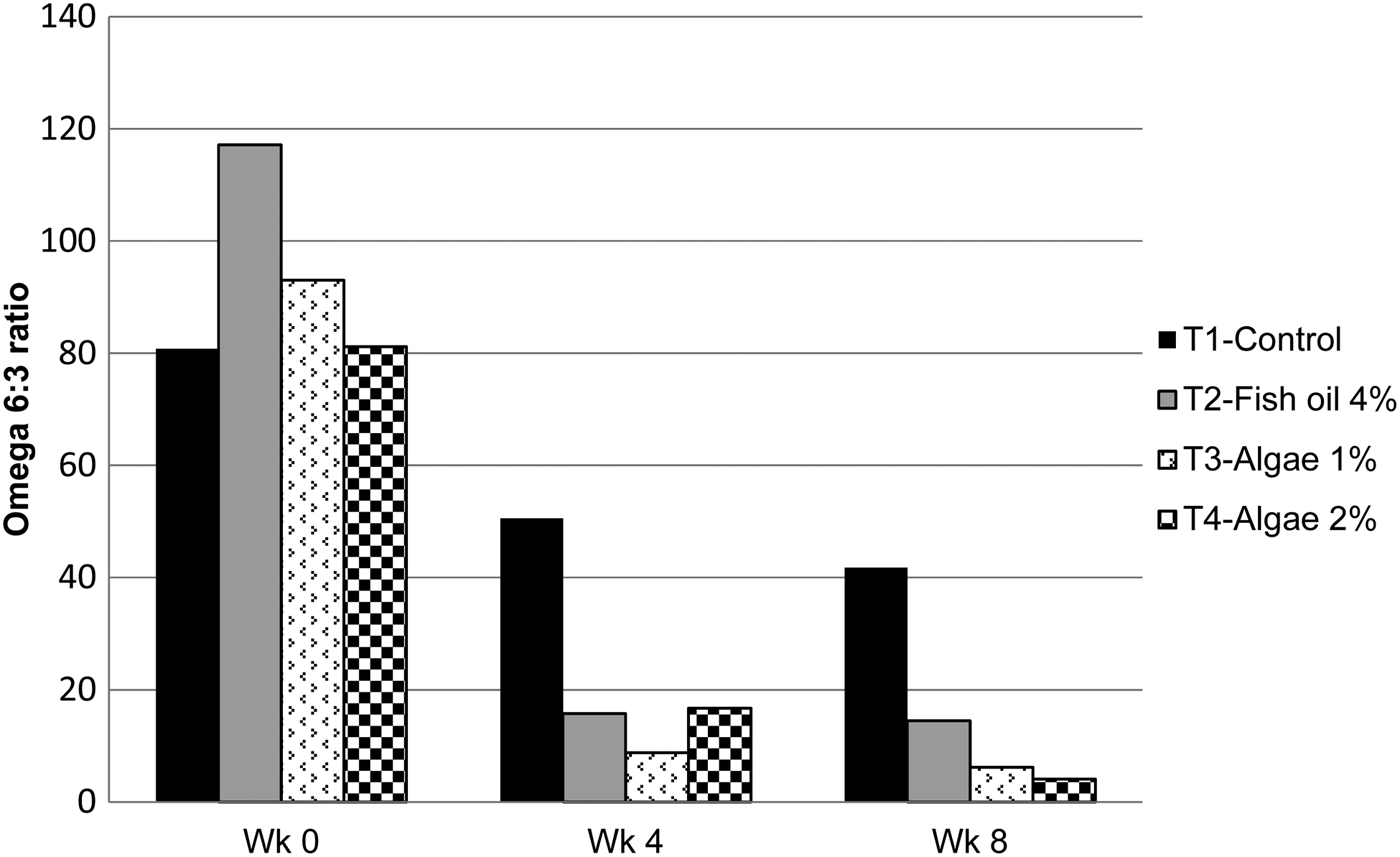
The omega 6:3 ratio determines whether a diet is healthy or not, as many human and animal diets are too high in omega-6 fatty acids (Yannakopoulos et al., Reference Yannakopoulos, Tserveni-Gousi, Yannakakis and Yamoustaris2005). Epidemiology and dietary intervention studies have concluded that while an exceptionally high omega 6:3 ratio promotes the development of many chronic diseases, a reduced omega-6:omega-3 ratio can prevent or reverse these diseases. This study found that adding fish oil and microalgae to the diets of layers decreased the omega 6:3 ratio in eggs (Table 3). Before feeding the supplemented feed to the hen, the ratio was not significantly different, but the ratio was found to have significantly reduced (P < 0.05) after four weeks in eggs from hens fed 4% fish oil or 1–2% microalgae. The ratio at eight weeks was observed to have decreased to 14.5:1 for the fish oil supplemented group, but the ratios were much lower at 6.2:1 and 4.1:1 in the eggs from hens fed with 1% and 2% microalgae, respectively (P < 0.05) compared to the control and fish oil diet groups (Figure 2). These results are consistent with the findings of Herber et al., (Reference Herber and Van Elswyk1996), in which it was reported that feeding hens with algae-containing diets produces eggs with elevated n-3 fatty acids and decreased n-6 fatty acids. Supplementation with omega-3 fatty acids from microalgae promoted a qualitative change in the fatty acid profile in the egg yolk and reduced the n-6/n-3 ratio to a more beneficial level with regard to human nutritional needs (Simopoulos, Reference Simopoulos2002) to within the approved ratio for humans which is currently stated to be between 4:1 and 10:1 (Mazalli et al., Reference Mazalli, Faria, Salvador and Ito2004).
The omega 6:3 ratios of the egg with different treatment groups.

Major fatty acids in one egg at eight weeks from layers fed control diet, or diets containing fish oil 4% or microalgae 1% or 2%

The linoleic acid C18:2 (n-6) level in eggs from hens fed the control diet was 443.03 mg compared to those fed 4% fish oil (530.04 mg), 1% microalgae (468.74 mg) or 2% microalgae (462.82 mg). The total omega-6 fatty acid levels in the egg were not significantly different between the groups. However, the levels of the omega-3 fatty acid, especially DHA C22:6 (n-3), were significantly different when the feed of the layers were supplemented with microalgae, compared to the control diet. The inclusion of 1% and 2% microalgae in the diet for eight weeks increased the level of DHA per egg to 75.49 mg and 114.35 mg, respectively.
After eight weeks of supplementation with fish oil or microalgae, the DHA deposition in the egg yolk was increased, especially for eggs from hens fed 2% microalgae. Eggs from hens fed 4% fish oil had a DHA level of 232.50 ± 31.19 mg/100 g of egg yolk or 57.45 ± 8.24 mg/100 g of whole egg, resulting in 32.51 ± 4.72 mg/egg (Table 4). However, to claim success in developing DHA-enriched egg according to the European Union Guidelines (2010), at least 180 mg/100 g whole egg is needed. Feeding 2% of microalgae promoted DHA deposition to 825.00 ± 125.27 mg/100 g egg yolk (or 201.50 ± 30.16 mg/100 g whole egg) which were significantly different (P < 0.05) from the egg results obtained from the control group or hens supplemented with 4% fish oil. The incorporation of yolk n-3 fatty acid by up to 200 mg/yolk is significant as this amount of n-3 FA is comparable with that found in a 100 g serving of lean cold-water fish (Van, Reference Van Elswky1997).
The concentrations of DHA in the egg after eight weeks of feeding

a,bMeans not sharing a superscript letter are significant different (P < 0.05).
The panel of the European Union Food Safety Authority (2010) considers that the intake of EPA and DHA of 250 mg/day in humans is required to obtain the claimed effect as regards eye, brain, and heart health. Supplementation with 2% microalgae can increase the DHA concentration to 114.35 ± 16.66 mg/egg (Table 4). Two of the eggs from microalgae supplemented hens eggs per day would supply the equivalent of >228 mg DHA.
Efficiency of DHA incorporation from feed to egg depends on type of ingredients used. The conversion efficiency was calculated to determine the level of DHA incorporation into the egg yolk. The total amount of supplemented feed DHA/100 g feed was corrected for the mean feed intake of the respective groups. The efficiency of DHA deposition in the egg by supplementation with 4% fish oil was 38% compared to 58% and 42%, respectively, from the 1% and the 2% microalgae groups (Table 5). Lemahieu et al. (Reference Lemahieu, Bruneel, Termote-Verhalle, Muylaert, Buyse and Foubert2013) recently studied the effect of supplementation of feed with different omega-3 rich microalgae species on the enrichment of eggs of laying hens, and reported similar conversion efficiencies ranging from 10% to 43%. Additionally, higher doses of microalgae yielded poorer conversion efficiency than lower doses.
DHA conversion efficiency from feed containing different supplement sources

Conclusions
There is a growing demand from human consumers for food products of superior health quality. It is possible to increase the omega-3 content of eggs through the enrichment of the layers’ diet with fish oil or algae. However, the maximum quantity of fish oil that can be used in the diet of the layers is limited due to the risk of production of eggs with a fishy flavour (Ahn et al., Reference Ahn, Sunwoo, Wolfe and Sim1995). Also, fish oil has limitations as regards its ability to reach >100 mg of DHA/egg. Feeding 2% of the microalgae Schizochytrium spp. in the diet of hens resulted in an increase of DHA to levels above 100 mg/egg. Moreover, this supplementation can reduce the omega 6:3 ratio in the egg yolk to within the optimal ratio. Therefore, specific microalgae supplementation of laying hen diets is a potentially safe, sustainable way to create functional, DHA-enriched eggs to correct human dietary deficiencies.
Acknowledgments
The author is grateful for the support regarding lab analysis cost from Alltech Inc, Nicholasville, KY, USA. We would also like to thank the Betagro Agro-Group Company for the laying hens and the feed supplied, and the staff at the Layer Research Center, Kasetsart University, for their assistance with the project.
Declaration of interest
None.
Intellectual property
All-G-Rich®, a microalgae supplement product, Alltech Inc., 3031 Catnip Hill Pike, Nicholasville, Kentucky, USA, 40356.