Introduction
In temperate zones greater warming is occurring in winter and spring (Bonsal et al. Reference Bonsal, Zhang, Vincent and Hogg2001; Robeson Reference Robeson2004; Schwartz et al. Reference Schwartz, Ahas and Aasa2006). At the northern edge of agricultural regions in the northern hemisphere, milder winters and an earlier start to the growing season could have both positive and negative consequences for crops and their insect pests. For insects, milder winters may lead to higher rates of overwintering survival (Bale and Hayward Reference Bale and Hayward2010) and changes in the timing of spring activity (Porter et al. Reference Porter, Parry and Carter1991). An early termination of winter dormancy and resumption of active growth and development could result in population build-up, leading to pest infestations and outbreaks (Fand et al. Reference Fand, Kamble and Kumar2012; Murdock et al. Reference Murdock, Taylor, Flower, Mehlenbacher, Montenegro and Zwiers2013; Ju et al. Reference Ju, Zhu, Gao, Zhou and Li2015). However, insects that emerge too early also risk starvation, if the synchrony between the herbivore and its host plant is disrupted (Porter et al. Reference Porter, Parry and Carter1991; Inouye Reference Inouye2008; Murdock et al. Reference Murdock, Taylor, Flower, Mehlenbacher, Montenegro and Zwiers2013), or freezing, if there is a sudden temperature drop after acclimation to warm temperatures (Augspurger Reference Augspurger2013; Bjerke Reference Bjerke, Karlsen, Høgda, Malnes, Jepsen and Lovibond2014).
This combination of warming with projected increases in temperature fluctuations could actually increase the occurrence of below-freezing temperature events at the beginning of the growing season, which can have very different implications to freezing temperatures during winter (Inouye Reference Inouye2000; Gu et al. Reference Gu, Hanson, Mac Post, Kaiser, Yang and Nemani2008; Augspurger Reference Augspurger2013). Early season frost events are characterised by a brief exposure to sub-zero temperatures both preceded and followed by periods of warm temperatures within the thermal threshold of development (Inouye Reference Inouye2000). While climate projections do not show a clear overall increase in spring frost events (Eccel et al. Reference Eccel, Rea, Caffarra and Crisci2009; Intergovernmental Panel on Climate Change 2014), analysis of historical occurrences of spring frost demonstrate that frost risk varies regionally, with evidence of an increase in several regions across the United States of America (Gu et al. Reference Gu, Hanson, Mac Post, Kaiser, Yang and Nemani2008) and Europe (Augspurger Reference Augspurger2013).
Responses of insects to low temperature are generally classified into three main categories: freeze tolerant, freeze avoidant, or chill susceptible (Bale Reference Bale1993; Sinclair Reference Sinclair1999; Sinclair et al. Reference Sinclair, Coello Alvarado and Ferguson2015). Insects that can withstand extracellular ice formation are considered freeze tolerant, whereas freeze-avoidant species take measures to lower their freezing temperature to prevent ice formation in the tissues, and are chill susceptible if they are killed by cold exposure unrelated to freezing (Bale Reference Bale1993; Sinclair Reference Sinclair1999; Lee Reference Lee2010). Cold-hardiness strategies are not necessarily fixed, and many species will switch strategies within and between life stages (Salt Reference Salt1961; Sinclair Reference Sinclair1999; Lee Reference Lee2010). Dormant life stages may be adapted to survive extended periods of time at sub-zero temperatures, whereas active life stages may be sensitive to even short periods of chilling above the freezing point of their body fluids (Zachariassen Reference Zachariassen1985; Carrillo et al. Reference Carrillo, Cannon, Wilcke, Morey, Kaliyan and Hutchison2005; Boardman et al. Reference Boardman, Grout and Terblanche2012).
Freezing of body tissues typically happens as a result of an interaction between water molecules and a nucleating agent, around which ice can form (Salt Reference Salt1966; Worland et al. Reference Worland, Block and Rothery1993). The temperature at which the bodily fluids of an insect freeze is known as the supercooling point (Lee Reference Lee2010). While this can be a good indicator for determining which strategy an insect employs (Sinclair et al. Reference Sinclair, Coello Alvarado and Ferguson2015), it is not always a reliable indicator of cold tolerance (Baust and Rojas Reference Baust and Roias1985; Renault et al. Reference Renault, Salin, Vannier and Vernon2002) as most insects die from chill injury at temperatures above their supercooling point (Lee Reference Lee1991, Reference Lee2010; Bale Reference Bale1993; Sinclair et al. Reference Sinclair, Vernon, Klok and Chown2003). The temperature at which a given proportion of the population is killed after an acute exposure of fixed duration is referred to as the lower lethal temperature (Wagner et al. Reference Wagner, Doak, Sformo, Steiner and Carlson2012), and better reflects the risk of lethal chilling injury (Bale et al. Reference Bale, Masters, Hodkinson, Awmack, Bezemer and Brown2002; Sinclair et al. Reference Sinclair, Vernon, Klok and Chown2003; Bürgi and Mills Reference Bürgi and Mills2010; Lee Reference Lee2010). Combined with knowledge of the supercooling point, the lower lethal temperature can be used to indirectly estimate a cold tolerance strategy (Sinclair et al. Reference Sinclair, Coello Alvarado and Ferguson2015).
The eyespotted bud moth, Spilonota ocellana (Denis and Schiffermüller) (Lepidoptera: Tortricidae) has caused significant economic losses in apple (Malus pumila Miller; Rosaceae) orchards across the Northern Hemisphere (Gilliatt Reference Gilliatt1932; Leroux et al. Reference Leroux, Paradis and Hudon1963; MacLellan Reference MacLellan1978). It also attacks other crops including blueberry (Vaccinium Linnaeus; Ericaceae) (Gillespie Reference Gillespie1985), cherry (Prunus Linnaeus; Rosaceae) (Oatman et al. Reference Oatman, Brooks and Legner1962), and plum (Prunus Linnaeus; Rosaceae) (Madsen and Borden Reference Madsen and Borden1949). In the early 1900s, S. ocellana was reported in Canada in Vancouver and Victoria (Brittain Reference Brittain1912; Venables and Brittain Reference Venables and Brittain1913) and Nova Scotia (MacLellan Reference MacLellan1978), but rarely found in the Okanagan Valley (Brittain Reference Brittain1912). More recently, growers in the northern parts of the Okanagan Valley have been experiencing problems managing eyespotted bud moth (Madsen and Downing Reference Madsen and Downing1968; McBrien and Judd Reference McBrien and Judd1998, Reference McBrien and Judd2004; McBrien et al. Reference McBrien, Judd and Borden1998); however, S. ocellana has not been a concern for growers further south in the Similkameen Valley and southern parts of the Okanagan despite it being observed on nursery stock being brought into the region over the past two decades. A major contributor to variations in climate in this region is the moderating effect of an extensive network of lakes in the Okanagan Valley, compared with the narrow rivers or canals that run through the adjacent Similkameen Valley and parts of the south Okanagan (Belliveau et al. Reference Belliveau, Smit and Bradshaw2006). As a result, frost risk is greater in the southern regions where the growing season starts earlier (Rayne et al. Reference Rayne, Forest and Friesen2009).
Spilonota ocellana is a pest in apple orchards in the spring, when newly emerged larvae burrow into developing buds; and in the summer, when freshly hatched larvae can injure fruit by fastening leaves to the apple surface, producing shallow feeding excavations (MacLellan Reference MacLellan1979). Spilonota ocellana larvae overwinter on tree branches within a thick silken hibernaculum near dormant buds (Porter Reference Porter1924). Larvae emerge from their hibernacula as fourth to sixth instars and start feeding immediately (Porter Reference Porter1924; McBrien and Judd Reference McBrien and Judd2004). They complete their development in shelters formed from leaves and floral parts held together with silk (Porter Reference Porter1924; MacLellan Reference MacLellan1978). Feeding and leaf shelters can introduce ice nucleators either into the gut, or externally, which increase the potential for freezing to occur (Salt Reference Salt1953; Bale et al. Reference Bale, Masters, Hodkinson, Awmack, Bezemer and Brown2002). Emerging from winter dormancy and resuming activity early in the growing season could increase the vulnerability of S. ocellana larvae to unexpected freezing temperatures. MacPhee (Reference MacPhee1964) has reported S. ocellana as “marginally cold hardy”, which by the current classification would indicate a freeze-avoidant strategy. However, its actual cold-temperature thresholds have not been determined.
The objective of this study was to determine the cold tolerance of S. ocellana at the beginning of the growing season when active, feeding larvae are most likely to experience a sudden frost after periods of warm weather. Through measurement of the supercooling point and lower lethal temperature, we also report on the cold tolerance response of spring instars in relation to factors that may contribute to variation in response such as leaf shelters, exposure duration, and larval weight.
Methods and materials
Insect collection and rearing conditions
Spilonota ocellana larvae were field-collected from three organic orchards in the Similkameen Valley, British Columbia, Canada (49.039530, −119.703530) where infestation levels had been high in the previous year (2012). In May 2013, emergent spring larvae were collected in leaf feeding shelters and kept at 18 °C and ambient light conditions. In 2014 pruned wood was collected in early spring (late March to early April) and transferred to 18 °C and ambient light conditions to initiate emergence (similar to methods of McBrien and Judd Reference McBrien and Judd2004). After emergence from their overwintering hibernacula, individual larvae were moved to 59-mL plastic cups (Solo Cup Company, Lake Forest, Illinois, United States of America) and provided with fresh apple leaves collected from organic orchards for food and nesting material. Apple leaves were surface sterilised with a 2% bleach solution and rinsed before introduction and were replenished every two to three days. Instar was determined based on the distribution of head capsule sizes (Gilliatt Reference Gilliatt1932). Experimental larvae were restricted to fourth, fifth, and sixth instars, the main life stages that emerge in the spring in this region (McBrien and Judd Reference McBrien and Judd2004).
Supercooling point
The supercooling point was measured using surface-contact thermometry in a thermo-controlled freezer (Tenny Jr. Programmable Freezer; Tenny, South Brunswick, New Jersey, United States of America). Individual larvae were placed in a longitudinal groove (1.0×0.5×0.4 cm) cut into 4×3×0.4 cm polystyrene rectangles that were covered with a solid square of polystyrene to restrict movement of larvae away from the thermocouple plate. Samples were cooled at a rate of 4 °C/hour from 10 °C. This rate of cooling was used as it represents a fast, but ecologically realistic, change in temperature over daily time scales (see Terblanche et al. Reference Terblanche, Deere, Clusella-Trullas, Janion and Chown2007; Rezende et al. Reference Rezende, Tejedo and Santos2011; Sinclair et al. Reference Sinclair, Coello Alvarado and Ferguson2015 for discussion). The supercooling point, defined as the temperature of spontaneous freezing, is measured as the lowest temperature immediately preceding the latent heat of crystallisation, which manifests as an exotherm and is indicative of internal ice formation (Lee and Denlinger Reference Lee and Denlinger1985). In 2013, the supercooling point was measured on two dates (7 and 8 May; n=27) with larvae in leaf shelters, larvae removed from leaf shelters and leaf shelters alone. Exotherms of leaf shelters alone were measured in order to determine if freezing leaf material would release exotherms in the absence of larvae, and, if so, whether these could be distinguished from larval exotherms. In 2014, the supercooling points of larvae (n=81) were measured on five dates (7, 9, and 22 April and 2 and 9 May 2014). Any larvae that lost contact with the thermocouple plate were removed from the final analysis. Instar and wet mass were also recorded in 2014.
Influence of instar and acclimation on lower lethal temperatures
Before chilling treatments, larvae were maintained at 18 °C. To determine if pre-exposure temperature would have a significant effect on larval survival, on the first sampling date half the larvae were moved to 21 °C (n=36) or 10 °C (n=36) for 24 hours before being chilled. For the remaining sampling dates, all larvae were kept at 21 °C for 24 hours before chilling treatments. Minimum treatment temperatures for removal were selected based on the previously determined supercooling point of larvae and included −4.5 °C (n=54), −6 °C (n=18), −7 °C (n=18), −7.9 °C (n=18), −8.7 °C (n=18), and −9.5 °C (n=54). Individual larvae in 59-mL plastic cups were stacked in groups of nine and placed in plastic bags inside the thermo-controlled freezer. Temperature was ramped down by 4 °C/hour based on the air temperature inside an individual cup measured with copper-constantin thermocouples. Cups with larvae were removed from the freezer after each target temperature was held for one minute and returned to 4 °C for one hour. They were then provided with fresh leaf material and transferred to an incubator set at 21 °C with a 16:8 (light:dark) photoperiod. The experiment was repeated on three sampling dates in 2014 (9 and 22 April, and 2 May 2014). A group of control larvae was removed at 3 °C (n=18) on each date to determine any experimental effects in the absence of exposure to sub-zero temperatures. Mortality was assessed after 24 hours. Death was defined as lack of responsiveness when larvae were probed with a fine-tipped paintbrush.
Impact of exposure time on survival
On 29 April 2014, larvae in plastic cups (as in previous experiment) were placed in one of three programmable freezers where temperature was ramped down to −4 °C, −6 °C, or −8 °C for one, two, or four hours (n=9 larvae in each temperature×time treatment combination). Larvae were maintained at 21 °C for 24 hours before cooling. Estimation of survival was based on the same procedure as lower lethal-temperature experiments.
Statistical analyses
In 2013, the supercooling-point temperature data for larvae within leaf shelters, removed from leaf shelters, and empty leaf shelters were compared using a single factor analysis of variance (ANOVA), with date as a blocking variable. In 2014, additional information on instar (head capsule width) and wet weight were collected from each larva after supercooling points were measured. Larval wet weight was log10 transformed to meet the assumptions for parametric analysis. Date was excluded from the analysis as larval size and date were correlated.
Larval survival at each minimum temperature was compared using a generalised linear model (GLM) with a binomial error distribution and logit link function. In all, 99% of larvae survived the control treatment (3 °C) and this treatment was not included in the final analysis. Mean lower lethal temperatures for 10, 50, and 90% mortality of larvae were obtained from the final, minimal GLM using the inverse prediction option in JMP. All means were compared post-hoc with χ 2 pairwise contrast test (GLM models) or using Tukey’s honest significance test (ANOVA). All statistical analyses were carried out using JMP version 11.2 (SAS Institute Inc., Cary, North Carolina, United States of America). Normality of the residuals for parametric analyses was determined using a Shapiro–Wilk goodness of fit test. An α of 0.05 was used to determine significance.
Results
Supercooling point of larvae and the effect of leaf shelter and instar
The mean supercooling point (±standard error) of larvae taken out of the leaf shelters was −8.2 °C (±0.4) and was not significantly different from larvae in leaf shelters (−8.6±0.3 °C) or the leaf shelters alone (−8.6±0.8 °C) (F(2,46)=0.190, P=0.8276). The mean combined supercooling point of larvae in leaf shelters and those removed was −8.4±1.7 °C, with a range from −5.2 °C to −14.3 °C.
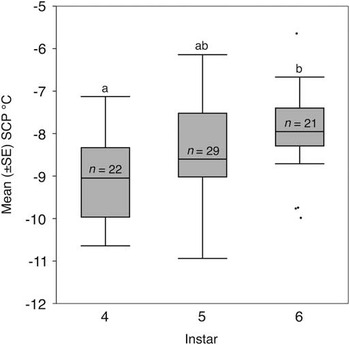
In 2014, supercooling points increased significantly with instar (F(2,63)=7.585, P=0.001) (Fig. 1). As expected, log10 wet weight differed significantly among instars (F(2,62)=122.92, P<0.0001), increasing from 1.3±0.1 mg for fourth instars, to 6.6±0.9 mg for fifth instars, and finally 13.4±1.4 mg for sixth instars and was positively related to increasing supercooling point (F(1,63)=8.744, P=0.004).
Mean (±standard error (SE)) supercooling point (SCP) temperatures (°C) of fourth to sixth spring-emerged instars of Spilonota ocellana. Different letters above each bar represent significant differences between least-square means at P<0.05.

Lower lethal temperature of Spilonota ocellana larvae
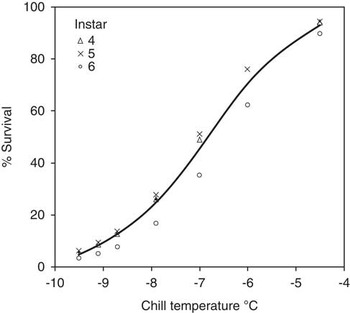
Larval survival decreased significantly with lower chilling temperatures (χ
2
3=102.789, P<0.0001); however, there was no evidence of an effect of instar (instar:
 $${\rm \chi }_{3}^{2} $$
=3.913, P=0.1413; insect×temperature: χ
2
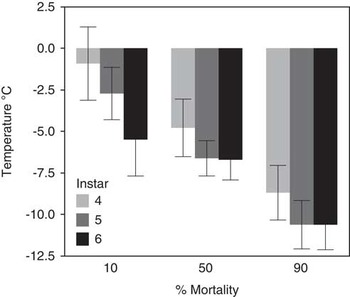
5=1.173, P=0.403) (Fig. 2). Mean predicted lower lethal temperatures to reach 10, 50, and 90% mortality of S. ocellana larvae were −5.1±0.8 °C, −7.3±0.4 °C, and −9.4±0.1 °C, respectively (Fig. 3). In all, 99% survival was observed for the control treatment (3 °C).
Survival of Spilonota ocellana larvae exposed to sub-zero temperatures (°C): −4.5 (n=54), −6 (n=18), −7 (n=18), −7.9 (n=18), −8.7 (n=18), −9.5 (n=54). The solid line represents the fitted generalised linear model; points represent the mean survival of different larval instars.

Estimate of the mean (±standard error) lower lethal temperature for 10, 50, and 90% mortality of Spilonota ocellana fourth, fifth, and sixth instars (n=9 per treatment).

Acclimation of larvae at different temperatures for 24 hours preceding the chilling treatment made no difference to survival (χ 2 1=0.356, P=0.5508). Mean survival for larvae acclimated to 10 °C and 21 °C before chilling treatment was 67±8.9 and 74±8.9%, respectively (n=36 for each temperature).
Impact of exposure time on survival
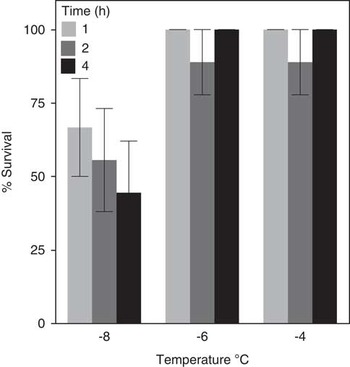
Sub-zero chilling temperatures had a significant effect on survival of larvae (χ 2 2=7.139, P<0.0282). There was no evidence that length of exposure (one, two, or four hours) altered survival (exposure time: χ 2 2=0.908, P=0.635; exposure time×temperature: χ 2 4=3.735, P=0.4429) (Fig. 4). Mortality was significantly greater for larvae in the −8 °C treatment (χ 2 1=13.846, P=0.0001), compared with the −6 °C and −4 °C treatments where nearly all larvae survived at all time exposures (Fig. 4).
Mean (±standard error) survival of Spilonota ocellana larvae after one, two, or four hours (h) of exposure to −8 °C, −6 °C, or −4 °C (n=9 larvae for each temperature-time combination).

Discussion
With a lower lethal temperature of −7.3±0.4 °C and mean supercooling point ranging from −9.1±0.2 °C (fourth instar) to −7.9±0.2 °C (sixth instar), we conclude that feeding, late instar larvae of S. ocellana are chill susceptible. The supercooling point was lowest in the youngest instar tested; this has also been found in other species of Lepidoptera such as the light brown apple moth, Epiphyas postvittana (Walker) (Lepidoptera: Tortricidae), and species of Coleoptera, such as the leaf beetle Aulacophora nigripennis (Motschulsky) (Coleoptera: Chrysomelidae) (Watanabe and Tanaka Reference Watanabe and Tanaka1997; Bürgi and Mills Reference Bürgi and Mills2010). Water loss or dehydration can lower supercooling points by concentrating solutes and thereby lowering freezing points (Sømme Reference Sømme1982; Zachariassen Reference Zachariassen1985). Larger instars are clearly heavier, which might indicate a higher water content resulting in a higher supercooling point; however, this remains to be tested. The physiological mechanisms behind the cold tolerance of S. ocellana are not known. In Québec, Canada, diapausing larvae are reported to survive temperatures down to −28 °C in the winter (MacPhee Reference MacPhee1964), therefore it is clear that the physiological mechanisms by which larvae tolerate cold during the winter diapause are lost as a result of spring events such as feeding and moulting (Salt Reference Salt1953; Sømme Reference Sømme1982; Zachariassen Reference Zachariassen1985). Spilonota ocellana larvae were rarely found outside their leaf shelters and feeding tubes (J.A.S., personal observation). Leaf shelters are likely to be moister than winter hibernacula, and covered with foreign materials that may serve as nucleating agents (Salt Reference Salt1953; Layne et al. Reference Layne, Lee and Huang1990). However, chilling larvae within a detached leaf shelter had no effect on supercooling point, so these offer no discernible frost protection or inoculation points.
In contrast to supercooling-point temperatures, we found that the lower lethal temperatures to achieve 50% mortality in the population (LLT50) did not differ among instars. This corresponds with observations of active larvae of E. postvittana (Bürgi and Mills Reference Bürgi and Mills2010). By contrast, Knight and Croft (Reference Knight and Croft1986) found that both field-collected and laboratory-reared overwintering third instars of the orange tortrix moth, Argyrotaenia citrana (Walsingham) (Lepidoptera: Tortricidae) were significantly more tolerant to freezing temperatures than fifth instars. Prior exposure (24 hours) to two ecologically relevant daytime temperatures (10 °C and 21 °C) had no discernible effect on the ability to survive and we conclude that moderate daytime temperatures do not elicit a hardening response in S. ocellana larvae.
Our LLT50s were determined after only one-minute exposure at the low temperature. We chose this as the duration of exposure to minimum temperatures during a spring frost tends to be brief, particularly when freezing occurs after a period of warming. We did investigate slightly longer exposures (up to four hours) at temperatures approaching the mean supercooling point (−8.4±0.2 °C), and overlapping the LLT50 (−7.3±0.4 °C) to assess the impact of exposure time. Within our experiment, while temperature had a significant effect on survival, exposure duration did not. However, there was evidence of a possible trend towards increased mortality as exposure time at the lowest temperature sampled (−8 °C) increased from one to four hours, indicating that longer exposures are more important at temperatures approaching the supercooling point. Based on our results, and in the context of a spring frost, we conclude that the lowest minimum temperature will be more important than the amount of time spent at that temperature; however, LLT50 should be assessed over a wider range of realistic exposure times.
Further investigation of the ability of S. ocellana larvae to acclimate or acclimatise to lower temperatures, or over longer periods of time could reveal more about their phenotypic plasticity in response to cold. Cooler temperatures combined with a longer pre-exposure period than those used might have elicited a more gradual hardening response, as there are many examples of species acclimating after days or weeks at low temperatures (Milonas and Savopoulou-Soultani Reference Milonas and Savopoulou-Soultani1999; Andreadis et al. Reference Andreadis, Milonas and Savopoulou‐Soultani2005; Košťál et al. Reference Košťál, Korbelová, Rozsypal, Zahradníčková, Cimlová and Tomčala2011). Further, it will be necessary to determine whether single, or repeated freeze events have sub-lethal effects on the long-term fitness of the bud moth (Chidawanyika and Terblanche Reference Chidawanyika and Terblanche2011; Marshall and Sinclair Reference Marshall and Sinclair2012). Further study on the long-term effects of diurnal acclimation temperature and exposure to sub-zero temperatures on S. ocellana larvae will provide better understanding of the impacts of spring frost on population fluctuations.
Acknowledgements
Financial support was provided by Cawston Cold Storage and the Natural Sciences and Engineering Research Council of Canada (NSERC) Industrial Post-Graduate Scholarship to J.A.S. and an NSERC Discovery Grant to J.S.C. Equipment and additional resources provided by the Summerland Research and Development Centre, British Columbia. Special thanks to Linda Edwards and Brian Mennell and the organic growers of the Similkameen Valley for workspace, field sites, and support throughout the study, and to Robert Brownlee and Sean Kutcha for help with experimental design and freeze equipment. The authors would also like to thank the reviewers and associate editor for their comments and Dave Gillespie and Tony Williams for help with design and feedback during this study.