Text comprehension is a complex process in which textual contents are organized and integrated with previously acquired world knowledge to build a coherent mental representation of the meaning of the text (e.g., Gernsbacher, Reference Gernsbacher1994; Kintsch, Reference Kintsch1998). This process of meaning construction is articulated in various phases and involves numerous cognitive and linguistic components, each of which has the potential to give rise to individual differences in text comprehension (Hannon & Daneman, Reference Hannon and Daneman2001). Work on the role played by the various linguistic and cognitive components of text comprehension (multicomponent approaches) has focused on reading comprehension in school-age children (for a review, see Cain & Oakhill, Reference Cain, Oakhill, Cain and Oakhill2007). This work has considered and lent support to the theory that higher level components, such as inferential skills, as well as lower level cognitive and linguistic components, such as word knowledge and verbal working memory, are involved in reading comprehension. The role of other lower level linguistic components such as morphosyntactic knowledge, which is necessary to understand the meaning of sentences, has been analyzed less frequently, and the analysis performed has led to mixed results. We carried out two studies aimed at analyzing the role played by morphosyntactic knowledge, evaluated using a task for the listening comprehension of sentences, in Italian preschoolers' listening comprehension of texts. The role of relevant lower level components, namely, word knowledge and verbal working memory (Study 1), and higher level components, namely, the ability to use linguistic context (Study 2), was also taken into account.
In the current investigation, the role of the above-mentioned components is mainly described with reference to the existing literature on the comprehension of written texts, because research on listening text comprehension in young children is scarce (e.g., Oakhill & Cain, Reference Oakhill, Cain, Cain and Oakhill2007; van den Broek et al., Reference van den Broek, Kendeou, Kremer, Lynch, Butler, White, Paris and Stahl2005). However, the study of listening text comprehension, which develops from the third/fourth year of age, is relevant because, together with decoding skills, it contributes to reading comprehension (Hoover & Gough, Reference Hoover and Gough1990). Listening text comprehension depends on the same general comprehension components involved in reading comprehension (e.g., Kendeou, Bohn-Gettler, White, & van den Broek, Reference Kendeou, Bohn-Gettler, White and van den Broek2008; Kendeou, van den Broek, White, & Lynch, Reference Kendeou, van den Broek, White and Lynch2009). Therefore, investigating the contribution of these components to preschoolers' text comprehension is relevant to the study of later reading comprehension development, and to the early identification of text comprehension difficulties (Catts, Fey, Zhang, & Tomblin, Reference Catts, Fey, Zhang and Tomblin1999; Muter, Hulme, Snowling, & Stevenson, Reference Muter, Hulme, Snowling and Stevenson2004; Nation, Cocksey, Taylor, & Bishop, Reference Nation, Cocksey, Taylor and Bishop2010).
THE RELATION BETWEEN SENTENCE AND TEXT COMPREHENSION
Text comprehension requires the processing of textual information at different levels: word, sentence and text or discourse. At the sentence level, the comprehender has to use morphosyntactic knowledge to work out the syntactic structure of sentences and identify their meaning. The understanding of linguistic information, both at word and sentence level is necessary, although not sufficient, for text understanding; therefore, the existence of a relationship between sentence- and text-level comprehension may be expected. To date, however, few studies have investigated the relation between sentence comprehension and text comprehension and, more importantly, the studies that do exist have reported mixed and contradictory results. As a consequence, the role played by sentence comprehension in text comprehension is not clear (Cain & Oakhill, Reference Cain, Oakhill, Cain and Oakhill2007). In the following sections, studies on the relation between sentence and text comprehension are presented, and the factors that might explain the contradictory results obtained are considered.
WORK ON SELECTED GROUPS OF CHILDREN (GROUPS OF CHILDREN WITH GOOD OR POOR TEXT COMPREHENSION)
In general, good and poor comprehenders were identified using standard tests of reading or listening text comprehension and decoding skills, and compared using either age-equivalent scores (Stothard & Hulme, Reference Stothard, Hulme, Cornoldi and Oakhill1996) or standard scores (Nation, Clarke, Marshall, & Durand, Reference Nation, Clarke, Marshall and Durand2004) or raw scores (Cain, Patson, & Andrews, Reference Cain, Patson and Andrews2005). The two groups are characterized by comparable age-appropriate decoding skills and different text comprehension ability.
Stothard and Hulme (Reference Stothard, Hulme, Cornoldi and Oakhill1996; see also Stothard & Hulme, Reference Stothard and Hulme1992) considered groups of good and poor comprehenders (7- to 8-year-olds) and found sentence comprehension to be associated with reading comprehension. The performance of poor comprehenders was compared to that of two control groups, one of age-matched controls with equivalent decoding skills and a younger group matched for comprehension, on one of the most widely used tests of sentence comprehension: the Test for the Reception of Grammar (TROG; Bishop, Reference Bishop1983). The TROG measures a range of morphosyntactic concepts (e.g., gender, personal pronouns, comparatives, and so on) and requires the child to indicate which picture out of four corresponds to a sentence read by the experimenter. In this study, poor comprehenders performed significantly worse on the TROG than age-matched controls; rather, they performed at a similar level to younger children matched for text comprehension level. The authors concluded that the difficulties poor comprehenders had in sentence comprehension might mirror their lower word knowledge; the poor comprehenders had lower verbal IQs than the age-matched controls. The implication of this interpretation is that word knowledge is an important predictor of reading comprehension, and in order to evaluate the role played by the ability to understand sentences in text comprehension, the role of word knowledge also has to be taken into account.
Results obtained by Nation et al. (Reference Nation, Clarke, Marshall and Durand2004) and Cain, Patson, et al. (Reference Cain, Patson and Andrews2005) seem to support the interpretation proposed by Stothard and Hulme (Reference Stothard, Hulme, Cornoldi and Oakhill1996). Nation et al. (Reference Nation, Clarke, Marshall and Durand2004) compared the performance of 8-year-old poor comprehenders with fluent and accurate reading skills and normal nonverbal ability to that of a control group matched for age and decoding ability, on different measures of morphosyntax that involved expressive oral language skills (recalling sentences and past tense elicitation tasks). Results showed that poor comprehenders performed not as well than good comprehenders on tests of morphosyntax as well as in tasks assessing word knowledge (Word Definitions and Similarities from the British Ability Scales). Therefore, as in Stothard and Hulme (Reference Stothard, Hulme, Cornoldi and Oakhill1996), it may be concluded that difficulties with morphosyntax are mediated by difficulties with word knowledge. Cain, Patson, et al. (Reference Cain, Patson and Andrews2005) considered performances of good and poor comprehenders, aged 8 and 9 years, on a reduced version of the TROG, finding comparable performance for the two groups. This result provides evidence of the absence of a direct relation between listening text comprehension and sentence comprehension. In this study, the two groups were matched for receptive vocabulary (British Picture Vocabulary Scale) and word reading ability, suggesting that when differences in word knowledge are controlled for, no differences in comprehension at the sentence-level emerge (see also Yuill & Oakhill, Reference Yuill and Oakhill1991).
WORK ON UNSELECTED GROUPS OF CHILDREN
Roth, Speece, and Cooper (Reference Roth, Speece and Cooper2002), analyzed the relation between oral language development and early reading development in unselected groups of children followed from kindergarten (5–6 years) to second grade (7–8 years). The main aim of the study was to identify parsimonious models of reading comprehension using a broad range of oral language and reading ability measures. Both first and second graders' text comprehension was related to a measure of receptive morphosyntactic knowledge (comprehension of word classes, grammatical morphology, and sentence structures) evaluated in kindergarten, which however did not specifically account for reading comprehension.
In another longitudinal study, Oakhill, Cain, and Bryant (Reference Oakhill, Cain and Bryant2003) analyzed the contribution of several theoretically relevant components, among which sentence comprehension, in accounting for reading comprehension in primary school children at the age of 7–8 and 8–9 years (Time 1 and Time 2, respectively). Sentence comprehension was evaluated using the TROG, and results showed that it accounted for reading comprehension after controlling for age, nonverbal, and verbal intelligence (Wechsler Intelligence Scale for Children) and receptive vocabulary (British Picture Vocabulary Scale), when children were 8–9 but not when they were 7–8 years old. Explanations brought forward for this discrepancy in the results were the existence of possible developmental differences in the influence of sentence comprehension on text comprehension and the absence of appropriate controls for individual differences in verbal working memory. Oakhill and colleagues (Reference Oakhill, Cain and Bryant2003) hypothesized that the items that discriminated between good and poor comprehenders had a high processing component, and therefore, verbal working memory, which in turn is linked to reading comprehension (e.g., Cain, Reference Cain2006; Carretti, Borella, Cornoldi, & De Beni, Reference Carretti, Borella, Cornoldi and De Beni2009; Seigneuric, Ehrilch, Oakhill, & Yuill, Reference Seigneuric, Ehrlich, Oakhill and Yuill2000), might explain individual differences in the older age group. Indeed, a much higher correlation between the TROG and verbal working memory was found at Time 2 (r = .42) than at Time 1 (r = .28). This interpretation supported the importance of taking into account the role of verbal working memory when examining the role of sentence comprehension in text comprehension.
Goff, Pratt, and Ong (Reference Goff, Pratt and Ong2005) analyzed the relation between reading comprehension and sentence comprehension, controlling for the influence of various measures of visuospatial and verbal memory in an unselected group of third to fifth graders (age range from 7–8 to 10–11 years). The authors found differences with respect to the results reported by Oakhill et al. (Reference Oakhill, Cain and Bryant2003) for children aged 7–8 years; sentence comprehension, evaluated using the TROG, predicted reading comprehension after controlling for the role of memory and other control variables (age, nonverbal intelligence, receptive vocabulary).
THE RELATION BETWEEN SENTENCE AND TEXT COMPREHENSION: WHAT CAN WE CONCLUDE?
The literature presented above reports a mixed set of results concerning the relation between text and sentence comprehension. The lack of consistency between studies on the role of sentence comprehension is difficult to explain, considering that most of them used the same standardized assessment of morphosyntactic knowledge, the TROG. However, the inconsistency might be accounted for by (a) the different group selection criteria (Cain & Oakhill, Reference Cain, Oakhill, Cain and Oakhill2007); (b) the existence of developmental differences in the influence of sentence comprehension on text comprehension, given that the above-mentioned studies considered children of different ages (Oakhill et al., Reference Oakhill, Cain and Bryant2003); and (c) the control variables taken into account in the evaluation of the relation between sentence and text comprehension. In sum, the different results of the studies depend on the fact that the role of word knowledge and verbal working memory were controlled for; this observation suggests that the role of possible mediators has to be considered in order to evaluate the contribution of sentence comprehension to text comprehension.
STUDY 1
The present study was aimed at analyzing the role played by listening sentence comprehension in listening text comprehension by preschoolers, taking into account the role of word knowledge and verbal working memory as possible mediators. To our knowledge, this is the first study that has specifically focused on these abilities in preschool children. In order to analyze the relation between listening sentence and text comprehension, we adopted a standardized Italian test similar to the TROG (see the Materials and Procedure Section), which is widely used by researchers and speech and language therapists. Word knowledge was evaluated using multiple indicators that include measures of receptive vocabulary and more complex aspects such as verbal intelligence; these measures were used in previous works and were shown to be related to reading and listening text comprehension in groups of both school-age and preschool children (e.g., Florit, Roch, Altoè, & Levorato, Reference Florit, Roch, Altoè and Levorato2009; Kendeou et al., Reference Kendeou, Bohn-Gettler, White and van den Broek2008; Oakhill et al., Reference Oakhill, Cain and Bryant2003). Verbal working memory was evaluated using a backward word-span task, a measure of the ability to store and process linguistic information in memory. We adopted a measure of verbal working memory, rather than one of short-term memory (i.e., a measure of the ability to store information in memory), in accordance with the model proposed by Daneman and Carpenter (Reference Daneman and Carpenter1980). In this model working memory is responsible for text processing and is considered as a unitary system that carries out both storage and processing functions of linguistic information. The backward word span task has been shown to specifically predict listening text comprehension in preschoolers (Florit et al., Reference Florit, Roch, Altoè and Levorato2009). Moreover, it is worth noting that short-term memory has been shown to be involved in sentence repetition, whereas it plays a minor role in sentence comprehension in children aged 4 and 5 years (Willis & Gathercole, Reference Willis and Gathercole2001).
Method
Participants. One hundred sixty-two children aged 4 to 5 years, 11 months (5;11) (mean age = 4;9, SD = 6 months) participated in the study. Fifty-six percent of the participants were male. The children attended kindergartens located in the north of Italy and came mainly from families living in middle and lower socioeconomic catchment areas. All of the children spoke Italian as their first language. According to their teachers, none of these children had cognitive impairments or language difficulties, and none of them had been referred to the National Health Services for treatment.
Materials and procedure. The present study is part of a cross-sectional project in which listening text comprehension and various cognitive and linguistic component skills were evaluated using standardized and experimental measures. In the present study, listening text comprehension of short stories (dependent variable), sentence comprehension (predictor), word knowledge and verbal working memory (control variables) were evaluated in three sessions of about 20 min each. Skills evaluated in the first session were listening text comprehension (first story) and listening sentence comprehension; the second session tested word knowledge and working memory; the third session tested listening text comprehension (second story) and receptive vocabulary. The tasks presented in each session were set in advance but the order of presentation was counterbalanced. The tasks used to evaluate the above mentioned skills were administered individually by the first author, who has a PhD in developmental psychology. They are described below.
LISTENING TEXT COMPREHENSION. The Test for Listening Comprehension—TOR 3–8 (TOR 3–8; Levorato & Roch, Reference Levorato and Roch2007) was used, which was designed for children between 3 and 8 years of age. It has been standardized for Italian children (N = 1,700) and evaluates listening text comprehension without involving expressive skills; for this reason it is particularly suitable for young children. The test consists of two short stories of equal difficulty and length, which are read individually to each participant. Comprehension was evaluated using 10 questions per story, half of which were based on explicit information (textual questions) whereas the others required inferences to be generated (inferential questions). The questions were followed by a multiple choice task: after having listened to the questions, the children were asked to respond by choosing the correct answer out of four possibilities. The answers were read by the experimenter, who also pointed to the corresponding picture: a set of four pictures was presented for each question. In order to avoid overburdening memory resources and in order to guarantee the children remained attentive, the tester interrupted the reading at two preestablished points to ask questions that were either explicitly or implicitly related to the preceding part of the story. The test has different forms for children of different ages. The two stories appropriate for the age of our participants were 144 and 170 words long, respectively. The two stories were presented in two different sessions and the administration of each story required about 10 min. One point was credited for each correct answer. The measure considered in the current study was the sum of the correct answers for the two stories (range = 0–20). Raw scores can be converted into scaled scores (M = 10, SD = 2).
The concurrent validity (i.e., correlations between the stories of the TOR 3–8), ranges from 0.55 to 0.60. The test–retest reliability ranges from 0.65 to 0.66. The internal reliability, ranges from 0.52 to 0.72, which is not low considering that two types of questions (textual and inferential) were used to assess comprehension.
LISTENING SENTENCE COMPREHENSION. The Prova di Valutazione della Comprensione Linguistica (PVCL; Test for the Evaluation of Linguistic Comprehension; Rustioni & Associazione “La Nostra Famiglia,” Reference Rustioni1994) was used to evaluate listening sentence comprehension. The test was standardized on children between the ages of 3;6 and 8 inclusive and is similar in structure and procedure of administration to the TROG (Bishop, Reference Bishop1983).
Sentences contained salient morphosyntactic cues, such as gender and number agreement, conjunction, negation, different types of phrasal structures (i.e., relative, passive, temporal). The children, who were presented with the form of the test appropriate for their age, were required to choose which picture from among a set of four correctly represented the sentence spoken by the experimenter. One point was credited for each correct answer and the percentage of correct answers was the total raw score. Raw scores can be converted into weighted scores ranging from 0 to 100; these scores evaluate children's overall performance taking into account not only the number of correct answers but also the level of difficulty of each item. Children's performance may be classified into seven levels (from a nonsufficient level to a very good level) based on this weighted score.
WORD KNOWLEDGE. In order to assess children's word knowledge the following tests were used (e.g., Cain, Oakhill, & Bryant, Reference Cain, Oakhill and Bryant2004):
1. Two subtests from the Verbal Scale of the Wechsler Intelligence Scale for Preschool and Primary School (Wechsler, Reference Wechsler, Orsini and Picone1967; Italian standardization by Orsini & Picone, 1996): vocabulary and similarities. A composite score (VIQ) was estimated by computing mean scaled scores for vocabulary and similarities subtests (cf. Cain & Oakhill, Reference Cain and Oakhill2006). The reliabilities for the vocabulary and similarities subtests were 0.87 and 0.80, respectively.
2. The Peabody Picture Vocabulary Test—Revised (PPVT-R; Dunn & Dunn, Reference Dunn and Dunn1981, standardized for Italian speakers by Stella, Pizzoli, & Tressoldi, Reference Stella, Pizzoli and Tressoldi2000), which evaluates receptive vocabulary. The test was standardized on children between the ages of 3 and 12 inclusive. The reliability for the PPVT-R is 0.88.
VERBAL WORKING MEMORY. A backward word span was used to evaluate verbal working memory. The backward word span requires the simultaneous storage and processing of information in memory because the children had to repeat word lists in reverse order. The task consisted of 20 lists of words (four lists of two words each, four of three words each, etc., up to a maximum of four lists of six words each). The words were bisyllabic concrete nouns taken from a database of the child language: they belonged to different semantic domains and had the same frequency of use in children's vocabulary (Marconi, Ott, Pesenti, Ratti, & Tarella, Reference Marconi, Ott, Pesenti, Ratti and Tarella1994). Testing ceased when the child was unable to repeat three out of the four lists of a certain length. One point was credited for each list of words correctly repeated. Two measures were computed for each participant: (a) the number of lists correctly repeated (possible range from 0 = when children were not able to repeat the first list of two words to 20 = when children correctly repeated all lists of words); (b) the memory span, that is, the maximum list length (i.e., numbers of words) for which the child was able to correctly repeat three lists of words out of four (possible range from 1 = when children were unable to repeat three lists formed by two words to 6 = when children were able to repeat three lists formed by six words). Practice trials preceded the experimental trials to ensure comprehension of the task. The reliability for the backward word span task, which was assessed by calculating the Cronbach α value over lists of words, is 0.66. This value is in line with those reported in English and Italian studies that included children of the same age as our participants (Alloway, Gathercole, & Pickering, Reference Alloway, Gathercole and Pickering2006; see also Alloway, Gathercole, Willis, & Adams, Reference Alloway, Gathercole, Willis and Adams2004; Florit et al., Reference Florit, Roch, Altoè and Levorato2009).
Results
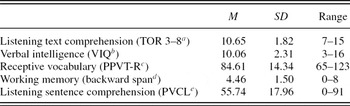
Descriptive statistics. All the children completed the tasks. Table 1 shows the descriptive statistics for the whole group of children.Footnote 1 Standard or scaled scores are reported where available. Raw scores were used in all the analyses presented in the following paragraphs.Footnote 2
Performance statistics for group children

Note: TOR 3–8, Test for Listening Comprehension, Ages 3–8; VIQ, verbal IQ; PPVT-R, Peabody Picture Vocabulary Test—Revised; PVCL, Prova di Valutazione della Comprensione Linguistica (Test for the Evaluation of Linguistic Comprehension).
a Scaled scores: M = 10, SD = 2.
b Scaled scores: M = 10, SD = 3.
c Standard scores: M = 100, SD = 15.
d Number of lists of words correctly repeated (possible range = 0–20).
e Standard scores ranging from 0 to 100.
Only information not presented in Table 1 is highlighted in the present paragraph. The average score on the test of sentence comprehension (PVCL) corresponds to medium-level performance. Considering individual performance, 70% of the participants performed at a medium level (i.e., performance at the medium–low, medium, and medium–high levels) whereas the remaining 30% performed at lower or higher levels (i.e., performance at the insufficient, scarce or good, and very good levels). The average performance on the receptive vocabulary task (PPVT-R) laid at the lower boundary of the range appropriate for age, and the standard deviation was comparable to that of the national standardization sample. This result suggested that the range of performance was normal and unrestricted. Performance similar to that reported by our participants on the PPVT-R was obtained by a group of children from low-income families in the United States (Storch & Whitehurst, Reference Storch and Whitehurst2002). The PPVT-R is very sensitive to socioeconomic and cultural level (e.g., Campbell, Dollaghan, Needleman, & Janosky, Reference Campbell, Dollaghan, Needleman and Janosky1997; see also Le Normand, Parisse, & Cohen, Reference Le Normand, Parisse and Cohen2008, who analyzed the effect of sociocultural factors on lexical development in 4-year-olds) and, although we do not have access to detailed information about the socioeconomic and cultural indicators of our participants, we may hypothesize that our data are affected by their socioeconomic status. On the memory task, the average backward word span was 2.22. Table 1 reports the number of series correctly repeated on average, which was used in the following analyses because it is a more sensitive measure of the level reached by each child than memory span. The task did not suffer from floor effects and performance was in line with results obtained in studies involving both English and Italian children of the same age as our participants (Alloway et al., Reference Alloway, Gathercole and Pickering2006; Florit et al., Reference Florit, Roch, Altoè and Levorato2009).
The role of age and gender. A set of correlational analyses was carried out in order to analyze the relation between gender and age and among listening text comprehension (TOR 3–8), receptive vocabulary (PPVT-R), verbal intelligence (VIQ), working memory (backward word span), and sentence comprehension (PVCL). No statistically significant correlations were found between the gender of participants and the component skills considered in the present study (p > .05). Statistically significant correlations were found between age and all the other variables (r = .29–.57, p < .05), with the exception of the sentence comprehension task (PVCL; p >.05). In the latter task different forms were used for different age groups, and therefore a significant correlation with age was not expected.
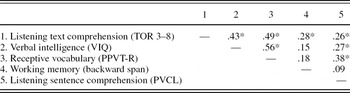
Correlations between listening text comprehension, word knowledge, working memory, and sentence comprehension. Table 2 shows the correlations between listening text comprehension, word knowledge, and verbal working memory and sentence comprehension, controlling for the effect of age.
Correlations between listening text comprehension, verbal intelligence, receptive vocabulary, working memory, and listening sentence comprehension (controlling for age)

Note: TOR 3–8, Test for Listening Comprehension, Ages 3–8; VIQ, verbal IQ; PPVT-R, Peabody Picture Vocabulary Test—Revised; PVCL, Prova di Valutazione della Comprensione Linguistica (Test for the Evaluation of Linguistic Comprehension).
* A significance level of .005 was adopted (Bonferroni correction: .05/10 = .005).
The correlation between listening text comprehension and sentence comprehension, although significant, was lower than that reported in previous studies carried out mainly with older children (e.g., Goff et al., Reference Goff, Pratt and Ong2005; Oakhill et al., Reference Oakhill, Cain and Bryant2003; Roth et al., Reference Roth, Speece and Cooper2002). Listening text comprehension was related to both control variables, that is word knowledge and verbal working memory, in line with findings reported in the literature on preschoolers and school-age children (e.g., Florit et al., Reference Florit, Roch, Altoè and Levorato2009; Goff et al., Reference Goff, Pratt and Ong2005; Kendeou et al., Reference Kendeou, Bohn-Gettler, White and van den Broek2008; Oakhill et al., Reference Oakhill, Cain and Bryant2003; Roth et al., Reference Roth, Speece and Cooper2002). In sum, performance on the tasks that evaluated linguistic comprehension at word, sentence, and text level correlated with each other.
Previous work suggested that the relation between sentence and text comprehension might be mediated by control variables. This possibility is also suggested by our results, which showed a correlation between sentence comprehension and word knowledge. The next analysis explored the relation between listening comprehension of text and sentences, taking into account the contribution of the control variables, namely, word knowledge and verbal working memory.
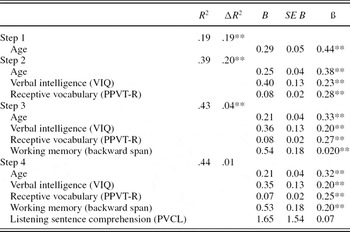
Listening text comprehension: The contribution of sentence comprehension. In order to analyze the specific role played by sentence comprehension in text understanding, a fixed-order hierarchical multiple regression analysis with the number of correct answers on the TOR 3–8 as the dependent variable was carried out. We established a priori the order in which the different components were entered in the model; age was entered in the first step to test for its effect on listening text comprehension, word knowledge, namely, verbal IQ and receptive vocabulary, in the second step, working memory in the third step and sentence comprehension in the fourth step. In the fifth step, we tested for interactions between age and sentence comprehension to identify any possible moderation effect of age on the relation between sentence and listening text comprehension. In order to control for multicollinearity and to facilitate the interpretation of the results, the variables sentence comprehension and age were standardized (M = 0, SD = 1) and z scores were used to calculate the interaction terms (Aiken & West, Reference Aiken and West1991).
The interaction between age and sentence comprehension did not explain a significant amount of variance (p = .10): Age did not operate as a moderator in the relation between sentence and listening text comprehension, which was stable between 4 and 6 years. Consequently, we tested a more parsimonious model in which this interaction was excluded. This model is presented in Table 3.
Fixed-order hierarchical multiple regression analysis with listening text comprehension as the dependent variable; listening sentence comprehension as predictor; and age, verbal intelligence, receptive vocabulary, and working memory as control variables

Note: VIQ, verbal IQ; PPVT-R, Peabody Picture Vocabulary Test—Revised; PVCL, Prova di Valutazione della Comprensione Linguistica (Test for the Evaluation of Linguistic Comprehension).
** p < .01.
The model accounted for 44% of variance in listening text comprehension. The final model (Step 4) showed that performance on TOR 3–8 improved between 4 and 6 years. Word knowledge and verbal working memory were significant predictors of listening text comprehension. However, the ability to understand sentences was not a specific contributor to listening text comprehension in the age range considered.
Discussion
Study 1 aimed at investigating the relation between listening comprehension of text and sentences in preschool children. In this study the role of possible mediators, namely, word knowledge (verbal intelligence and receptive vocabulary) and verbal working memory, was considered. Although a significant correlation was found between listening sentence and text comprehension, the ability to understand sentences did not account for additional variance in preschoolers' listening text comprehension over and above word knowledge and working memory, a finding in line with those of Oakhill et al. (Reference Oakhill, Cain and Bryant2003) and Stothard and Hulme (Reference Stothard, Hulme, Cornoldi and Oakhill1996). In other words, even though a text is constituted by sentences, the ability to identify syntactic relations between the constituents of sentences did not explain individual differences in listening text comprehension. Instead, the role played by sentence comprehension is mediated by basic semantic, lexical and cognitive components. These mediators explained individual differences in listening text comprehension, in line with previous studies on text understanding in preschoolers (Florit et al., Reference Florit, Roch, Altoè and Levorato2009; Kendeou et al., Reference Kendeou, Bohn-Gettler, White and van den Broek2008). In sum, these findings showed that the morphosyntactic knowledge necessary for understanding isolated sentences does not play a crucial role in establishing the meaning of a text, at least when word knowledge and verbal working memory are taken into account. However, it is also worth noting that previous studies have found that sentence comprehension affects text comprehension only from 8 to 9 years (Oakhill et al., Reference Oakhill, Cain and Bryant2003). Our results, which showed a weak relation between listening sentence and text comprehension as well as the absence of a specific effect of the former on the latter, suggested the existence of a developmental trend in the relation between the two skills. As children grow, the ability to understand sentences and the ability to understand texts become more related.
Multicomponent approaches of text comprehension emphasize that the construction of a coherent mental representation of the text is based not only on lower level components but also on higher level integrative processes. The comprehension of sentences in a text might be affected by these higher level components. A text is not constituted by a set of isolated sentences, but by sentences that are related and embedded in a meaningful linguistic context. Moreover, the ability to use linguistic context is related to text comprehension via its influence on the comprehension of sentences in a text (Cain & Oakhill, Reference Cain, Oakhill, Nunes and Bryant2004). Therefore, it is possible to hypothesize that partially different component skills might be used in the understanding of isolated sentences and sentences integrated within a text. These component skills include the ability to use linguistic context, which corresponds to the ability to use semantic information provided by the context in order to understand complex linguistic information, such as sentences. Strictly speaking, the meaning of a sentence embedded in a meaningful context is not constructed per se, but is related to the meaning of the preceding sentences in the text, which in turn is the result of the integration of explicit information in the text and previously acquired world knowledge.
The ability to use linguistic context has been analyzed mainly with reference to word reading ability (e.g., Nation & Snowling, Reference Nation and Snowling1998), new vocabulary acquisition (e.g., Cain, Oakhill, & Lemmon, Reference Cain, Oakhill and Lemmon2004) and the comprehension of multiword linguistic expressions such as idioms. Studies on children from 5 to 9 years of age have shown that the comprehension of transparent or decomposable idioms benefited from the presence of context that also supported their semantic analysis (i.e., the ability to analyze the internal semantics of a sentence), suggesting an early sensitivity to the ability to use context in sentence comprehension (e.g., Cain, Towse, & Knight, Reference Cain, Towse and Knight2009; Levorato & Cacciari, Reference Levorato and Cacciari1999). Moreover, studies on groups of good and poor comprehenders have reported a clear relation between the ability to use the context of a story in idiom understanding and reading comprehension (e.g., Cain, Oakhill, & Lemmon, Reference Cain, Oakhill and Lemmon2005; Cain & Towse, Reference Cain and Towse2008; Levorato & Cacciari, Reference Levorato and Cacciari1992; Levorato, Nesi, & Cacciari, Reference Levorato, Nesi and Cacciari2004; Levorato, Roch, & Nesi, Reference Levorato, Roch and Nesi2007; Nesi, Levorato, Roch, & Cacciari, Reference Nesi, Levorato, Roch and Cacciari2006).
In order to further clarify the nature of the relation between listening comprehension of texts and of sentences, we tested the hypothesis that the use of the linguistic context to construct the meaning of sentences contributes to text comprehension. A second study was carried out in which the same sentences presented in isolation in the first study were accompanied by a brief linguistic context.
STUDY 2
Based on the hypotheses that preschool children use partially different skills in understanding sentences in context and out of context and that the use of a linguistic context contributes to text meaning construction, we carried out a second study with the same children who participated in the first one. In the second study, the sentence comprehension test (PVCL) was modified by embedding each target sentence in a brief linguistic context consisting of about three simple sentences placed before the target sentence. The children's performance on this task was analyzed with reference to (a) performance on the test of sentence comprehension out of context (PVCL), in order to analyze the role of context in sentence comprehension, and (b) performance on the TOR 3–8, in order to analyze its relation with listening text comprehension.
Based on the literature discussed in the previous section (e.g., Cain et al., Reference Cain, Towse and Knight2009; Levorato et al., Reference Levorato, Roch and Nesi2007), we hypothesized that (a) preschoolers show an early sensitivity to the use of context in sentence comprehension and (b) preschoolers' ability to use context in sentence comprehension contributes to their listening text comprehension.
Method
Participants. The 162 children aged 4 to 5;11 who participated in the first study also took part in the second study. Additional details on the characteristics of the participants may be found in the first study.
Materials and procedure.
SENTENCE COMPREHENSION IN CONTEXT. In order to evaluate the ability to understand sentences in context, the same items of the PVCL used in the first study were embedded in a meaningful linguistic context of two or three sentences, in which the sentence to be understood was the final one (for an example of the material presented in this task see Appendix A). As in the original version of the PVCL, children were required to identify which picture out of four correctly represented the target sentence. One point was credited for each correct answer and the percentage of correct answers was the total raw score. The test was administered to the children approximately 2 weeks after the first study in one session of about 15 min. We believe that a 2-week lapse between the two sessions in which the sentences of the PVCL were presented out of context and in context was sufficient to exclude memory effects as well as possible effects due to developmental changes.
A group of 25 undergraduate students who did not know the final aim of the research, participated in a preliminary investigation aimed at evaluating the probability of choosing the correct answer after reading the context that preceded each target sentence. The students were not presented with the PVCL sentences themselves, but only with a brief text (i.e., the linguistic context, see Appendix A) and the set of four pictures related to each target sentence. They were then asked to choose the picture that fit the text. It emerged that the choice of each of the four pictures was equiprobable and the choices that were appropriate to the target sentence were as probable as any other (p > .05). We are therefore confident that the linguistic context used did not in itself provide any indications that would lead the participants to identify the figure corresponding to the target sentence.
Results
The effect of linguistic context. All the participants completed the PVCL in context. A paired t test on the performance (proportion of correct answers) on the test of sentence comprehension out of context (PVCL; M = 0.56, SD = 0.18, range = 0–0.91) and on the test of sentence comprehension in context (PVCL in context; M = 0.67, SD = 0.17, range = 0.17–1) was computed to compare performance on the two tasks. Preschoolers performed better on the test of comprehension of sentences in context than on the test of comprehension of sentences out of context, t (161) = 7.95, p < .001, d = 0.63, which corresponds to a medium effect size.
Correlations between listening text comprehension and comprehension of sentences in and out of context. The correlations between listening text comprehension (TOR 3–8), comprehension of sentences in and out of context (PVCL in context and PVCL) were computed. The effect of age was controlled for because a preliminary analysis showed a significant correlation between sentence comprehension in context and age (r = .32, p < .01). Here we only report the new data which emerged in Study 2. Significant correlations were found between listening text comprehension and the ability to understand sentences in context, and between the latter variable and the ability to understand sentences out of context (r = .39 and r = .46, respectively, p < .017; Bonferroni correction 0.05/3 = 0.017).
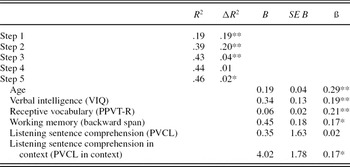
Listening text comprehension: Whether the ability to use context is a specific contributor. In order to analyze whether the ability to use linguistic context to understand sentences contributed to listening text comprehension, we carried out a fixed-order hierarchical multiple regression analysis. The dependent variable was the number of correct answers on the TOR 3–8. This analysis was similar to the one carried out in the first study; the only difference was that the ability to understand sentences in context (PVCL in context) entered the model at the fifth step, after all the predictors considered in the first study (age, verbal IQ and receptive vocabulary, working memory, and the ability to understand sentences out of context—PVCL). A significant effect of the ability to understand sentences in context over and above the other predictors would mean that the ability to use context to understand sentences has an impact on listening text comprehension between 4 and 6 years of age. Finally, in the sixth step we entered the interaction between age and the ability to use context in sentence comprehension to test for a possible moderation effect of age on the relation between the ability to use linguistic context and listening text comprehension. In the interaction term (a) the measure of the ability to use context was constituted by the standardized residuals computed in a separate regression analysis, in which the ability to understand sentences in and out of context were the dependent and independent variables respectively; and (b) the variable age, as in the previous study, was standardized (M = 0, SD = 1) and z scores were used (Aiken & West, Reference Aiken and West1991).
The interaction between age and the ability to use linguistic context was not significant (p = .22), showing that the role played by this ability in listening text comprehension is stable between 4 and 6 years. Consequently, we tested a more parsimonious model in which this interaction was excluded. This model is presented in Table 4.
Fixed-order hierarchical multiple regression analysis with listening text comprehension as the dependent variable; the ability to understand sentences in context as predictor; and age, verbal intelligence, receptive vocabulary, working memory, and listening sentence comprehension as control variables

Note: VIQ, verbal IQ; PPVT-R, Peabody Picture Vocabulary Test—Revised; PVCL, Prova di Valutazione della Comprensione Linguistica (Test for the Evaluation of Linguistic Comprehension).
*p < .05. **p < .01.
The model accounted for 46% of the variance in listening text comprehension. The ability to understand sentences in context explained an additional 2% of variance, which was significant, over and above predictors entered in the first four steps.
Discussion
The second study of the present paper was aimed at testing the hypotheses that partially different skills are used by preschoolers when they are required to process sentences in or out of context and that the ability to use context accounts for individual differences in listening text comprehension. In order to test for these hypotheses, children who took part in the first study were presented with the same sentences used in that study but embedded in a meaningful context.
Children's ability to understand sentences improved when the target sentence was embedded in a brief linguistic context. This result indicates the children's early sensitivity to the use of linguistic context in sentence understanding and is in line with work that analyzed the role of context in the comprehension of ambiguous expressions (e.g., Cain et al., Reference Cain, Towse and Knight2009; Levorato & Cacciari, Reference Levorato and Cacciari1999). Better performance on the test of sentence comprehension in context was presumably due to the additional semantic information provided by the context, which made the sentence more plausible and meaningful.
These results of the correlational analyses showed that, as expected, performance on the comprehension of sentences in context was related to both text comprehension and the ability to understand the same sentences out of context. The crucial result of the second study emerged from the regression analysis: the ability to use the linguistic context to understand sentences, differently from the ability to understand isolated sentences, contributed to explain individual differences in preschoolers' listening text comprehension. Taken together, these findings showed that the ability to exploit contextual information contributes to text understanding and is related to listening text comprehension via its influence on sentence comprehension (Cain & Oakhill, Reference Cain, Oakhill, Nunes and Bryant2004). Young children, at an even earlier age than verified in previous work, are able to use semantic information provided by the context and to apply integrative processes in order to understand sentences.
CONCLUSIONS
The relation between text and sentence comprehension has been scantily analyzed in school-age children, and, to date, a common conclusion on the role played by sentence comprehension in text comprehension has not been reached. It was argued that the mixed results obtained in previous studies arise from the numerous factors that might affect the relation, specifically lower level components that may mediate the relation between sentence and text understanding. The two studies reported in the present paper focused on the relationship between listening text comprehension and sentence comprehension in preschoolers; the first study took into account the relevant lower level components (i.e., word knowledge and verbal working memory) that may affect the relation, and the second study tested an additional, still unexplored, hypothesis that considered the role of a higher level component, namely, the ability to use linguistic context as a possible mediator. The present investigation, therefore, not only extended the analysis of the components involved in text comprehension to younger children, but elaborated on the data presented in the literature regarding the relation between sentence and text comprehension, exploring innovative explanations.
The overall pattern of results suggested that listening text comprehension ability is related to lexical/semantic, cognitive, and pragmatic abilities, whereas syntactic knowledge does not play a specific role. Study 1 showed that the role played by the ability to understand isolated sentences was mediated by lower level lexical/semantic and cognitive components, and Study 2 showed that the comprehension of sentences embedded in a text was mediated by a higher level pragmatic component, that is, the ability to use linguistic context. The use of context can be considered a higher level component of text comprehension similar to the other components in which a relevant role is played by the involvement of top-down processes. In these processes previously acquired world knowledge is used in order to enrich the explicit linguistic information. The processing of the information provided by the context implies that the meaning of a sentence is integrated with the reader/listener's previous knowledge and previously processed sentences, whose meaning, in turn, has already been integrated with both world knowledge and the preceding parts of the text (Kintsch, Reference Kintsch1998). Thanks to these processes, the sentence is integrated into a global coherent semantic representation of the linguistic information, which makes the sentence plausible and meaningful. In this perspective, the results that emerged in the current study are in line with those showing that children as young as 4 are able to engage in inferential and integrative processes that contribute to text understanding (Kendeou et al., Reference Kendeou, Bohn-Gettler, White and van den Broek2008).
The importance of higher level integrative processes for the comprehension of sentences embedded in a text is also supported by findings that groups of good and poor comprehenders showed difficulties in specific areas of morphosyntactic knowledge, such as the understanding of anaphoric devices and intersentence conjunctions (Cain, Patson, et al., Reference Cain, Patson and Andrews2005; Yuill & Oakhill, Reference Yuill and Oakhill1991). These morphosyntactic elements are devices of cohesion and coherence that promote the identification of the connections between different parts in a text and the construction of its overall meaning. Consistently with this interpretation, in the present study it was found that intrasentence syntactic elements, which are not crucial for text cohesion and coherence, did not explain individual differences in text understanding.
The findings of this study have clear applications in education. These results emphasize the importance of educational practices and interventions aimed at improving the ability to use semantic information provided by the context or, in other words, the ability to acquire new information from context to inform meaning at word, sentence, and text, or discourse level. These practices and interventions should focus on the context as a source of relevant information and on the ability to apply previous knowledge in the processing of linguistic information. To date, support for teaching methods aimed at improving the ability to acquire new information, such as vocabulary knowledge, through the use of context come from studies on school-age children. For instance, Nash and Snowling (Reference Nash and Snowling2006) reported that a method based on the use of context was more effective than a method based on the use of word definitions in improving vocabulary knowledge and reading comprehension in 7- to 8-year-olds with poor vocabulary knowledge. One potential explanation for the greater efficiency of the context method was that presenting a word in context provided more semantic, syntactic, and pragmatic information, which in turn created well-specified semantic representations of the word's meaning. The results of the present paper extend previous literature on the use of context in vocabulary acquisition and comprehension of ambiguous expressions in school-age children (e.g., Cain et al., Reference Cain, Towse and Knight2009; Cain, Oakhill, et al., Reference Cain, Oakhill and Lemmon2004; Levorato & Cacciari, Reference Levorato and Cacciari1999) showing that 4- to 6 year-olds are able to use semantic information provided by the context, and suggest that practices and interventions of this kind might also be suitable for younger children.
The consistency of the findings emerged in the present study, in particular, in the second study, should be confirmed in future research where another set of sentences, very closely matched in terms of morphosyntactic complexity with those used in the out of context condition, are used in the in context condition. This manipulation could represent an appropriate control to exclude memory or exposure effects.
To conclude, the results of the present paper support multicomponent models of text comprehension, whose validity have been previously tested mainly for reading comprehension in school-age children, for listening text comprehension in preschool children as well. The results of the present paper are in line with the following claims: (a) text comprehension is not a unitary but rather a complex construct that involves many different lower and higher level components that allow the processing of textual information at word, sentence, and text or discourse level; and (b) the processing of linguistic information at word, sentence, and text, or discourse level affects the processing at a different level in both a bottom-up and top-down manner (e.g., Cain & Oakhill, Reference Cain, Oakhill, Nunes and Bryant2004; Kintsch, Reference Kintsch2005). These conclusions suggest that it is important to follow the development of text comprehension starting from the first phases of its acquisition in order to identify the components of the process and to evaluate their role at different points of development. This investigation could also shed light on the causes of individual differences in reading comprehension, considering that listening comprehension skills acquired by children during preschool years facilitate the acquisition of later written language comprehension (Kendeou et al., Reference Kendeou, Bohn-Gettler, White and van den Broek2008; Nation et al., Reference Nation, Cocksey, Taylor and Bishop2010). With regard to this point, future early training or intervention studies on the different components involved in listening text comprehension may clearly identify which components are causally implicated in the development of text comprehension (Oakhill & Cain, Reference Oakhill, Cain, Cain and Oakhill2007).
APPENDIX A
Example of one context used in Study 2 ending with a target sentence
Linguistic context:
It is evening. The dog wants its puppies to go to sleep.
Target sentence from the PVCL (test of sentence comprehension out of context):
The dog goes into the doghouse after the puppies go in.
ACKNOWLEDGMENTS
The authors thank the teachers and children for participating in this study. The study was financed by a Grant PRIN 2005119758_005 (to M.C.L.).