quippe Byzantium fertili solo, fecundo mari, quia uis piscium in metapontum erumpens et obliquis subter undas saxis exterrita omisso alterius litoris flexu hos ad portus defertur.
For Byzantium is favoured with fertile soil and teeming seas, since a multitude of fish, bursting out (of the Pontus?) and spooked by rocks slanting beneath the water, leave off the curve of the opposite shore and are wafted to these harbours.
That is the text of the second Medicean and all of its descendants. For centuries now the unfitness of the words in metapontum has been obvious to editors. J. Lipsius conjectured innumera Pontum (1585), G. Brotier innumera Ponto (1771), N. Bach and G.A. Ruperti immensa Pontum (each in 1834).Footnote 1 F. Ritter returned to the problem again and again, first proposing immensa Ponto (1834), then immensum Ponto, i.e. ‘immensa multitudine’ (1848), and finally in meatu Ponti (1863).Footnote 2 Bach's and Ruperti's remedy is clearly the most efficient. Modern editorsFootnote 3 agree in printing uis piscium immensa (i.e. inmēsa) Pontum erumpens, ‘an immense multitude of fish, bursting out of the Pontus'. Neat, but perhaps unnecessary. My object here is to defend the text of the manuscripts.
The starting point is Sallust's famous excursus on the Black Sea, inserted somewhere in the third book of his Histories amid discussion of Lucullus' early operations against Mithridates. One of the surviving fragments refers to fish ‘bursting out’ of the Pontus (3.66):
qua tempestate uis piscium Ponto erupit … Footnote 4
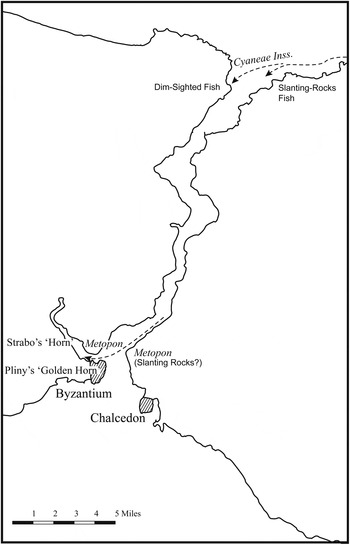
That Sallust was describing the entry of fish into the Thracian Bosporus may be inferred from the close imitation of his words in the Annals.Footnote 5 Tacitus is contrasting the natural advantages enjoyed by Byzantium with her economic degradation in the time of Claudius. He mentions a Delphic oracle given to the city's prospective founders—that they should ‘seek a seat opposite to the land of the blind’, to Chalcedon, that is, which had been built on the inferior Asian side of the strait—and then says, quippe Byzantium … fecundo mari, etc. There was in fact a town called Metapontum, but it was located in southern Italy. Each of two opposite headlands on the Bosporus was denominated Metopon (i.e. μέτωπον, ‘forehead’), but those are situated towards the southern end of the strait just north of Byzantium, more than fifteen miles from the spot where the fish exit the Pontus (Figure 1).
The Bosporus

By contrast, the phrase uis piscium immensa seems beyond reproach. It is true that Sallust's uis lacks a similar adjective, but the omission is less common. When uis denotes ‘a vast number’, as it appears to do in both passages, the sense is regularly reinforced by an adjective like magna. Footnote 6 Thus, describing mullet on the Mediterranean coast of Gaul, Pliny says, innumera uis mugilum stato tempore angustis faucibus stagni in mare erumpit (HN 9.29).Footnote 7 Tacitus himself has immensam … uim mortalium (Ann. 4.62.2).Footnote 8 Surely, then, if we required a cure, immensa Pontum would be the right one. But the transmitted text may well be sound. Divide as follows, uis piscium in meta Pontum erumpens, and translate ‘a multitude of fish, bursting out of the Pontus at the turn’.Footnote 9 However briefly and abstractly, Tacitus appears to have likened the shoal to charioteers rounding the bend of the Circus Maximus, say, and ‘spinning out’ at the turning post. Virgil had prepared the way with lines describing the rounding of Sicily (Aen. 3.699-700):
a clear extension of previous racing imagery (3.429-30):
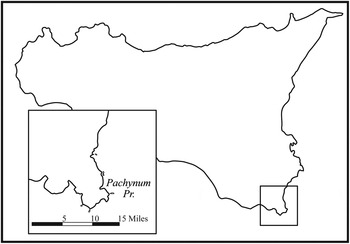
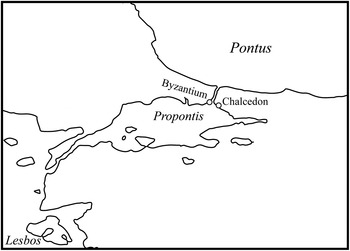
In our passage, the feature corresponding to the southern cape of Sicily with its ‘apex’ at the promontory of Pachynum (Figure 2) is the peninsula extending for about forty miles from the Asian mainland to the Bosporus (Figure 3).
Sicily and the Promontory of Pachynum

The Bosporus and Surrounding Regions

More particularly, the phrase obliquis … saxis resembles Virgil's evocation of the turning post, proiecta … saxa. Tacitus seems to have intended the racing metaphor as a gibe at contemporary explanations of the ‘diversion’ of fish from the Asian shore. Nothing about that interpretation is self-evident, of course, but the purpose of this paper is to make it plausible. Before addressing the author's motivations or even reviewing the pertinent aspects of Roman chariot-racing, we must first consider a few ancient theories about Pontic fishes. If these seem trifling and far-fetched, unworthy of the serious attention of a great historian—so much the better.
I. THE BONITO
The closest antecedent to Tacitus' fish story is supplied by Strabo, a citizen of Pontic Amaseia. The fish he describes has been identified as the bonito, or ἀμία, a ‘sort of small tunny … about 15–25 inches long … the mainstay of the Black Sea fishery’,Footnote 10 but Strabo himself uses a generic term, πηλαμύς, which was also applied to the ‘true tunny’ in its first year.Footnote 11 Strabo's account of the pelamydes' migration is our only previous source for the oracle mentioned by TacitusFootnote 12 and likewise includes the detail of the startling rock (7.6.2):
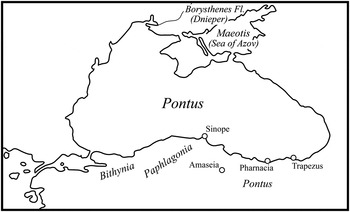
These fish are hatched in the marshes of Lake Maeotis [i.e. the Sea of Azov, Figure 4], and when they have gained a little strength they rush out (ἐκπίπτει) through the mouth of the lake in schools (ἀγεληδόν) and move along the Asian shore (φέρεται παρὰ τὴν Ἀσιανὴν ᾐόνα) as far as Trapezus and Pharnacia. It is here that the catching of the fish first takes place, though the catch is not considerable, for the fish have not yet grown to their normal size. But when they reach Sinope, they are mature enough for catching and salting. Yet, when once they touch the Cyaneae [i.e. the Symplegades, Figure 1] and pass by these, the creatures take such a fright at a certain white rock which projects from the Chalcedonian shore (ἐκ τῆς Χαλκηδονιακῆς ἀκτῆς λευκή τις πέτρα προσπίπτουσα φοβεῖ τὸ ζῷον) that they forthwith turn to the opposite shore. There they are caught by the current, and since at the same time the region is so formed by nature as to turn the current of the sea there to Byzantium and the Horn at Byzantium, they naturally are driven together thither and thus afford the Byzantines and the Roman people considerable revenue. But the Chalcedonians, though situated near by, on the opposite shore, have no share in this abundance, because the pelamydes do not approach their harbours; hence the saying that Apollo … ordered [the men who founded Byzantium] … to ‘make their settlement opposite the blind’.Footnote 13
Given all the people who depended on Byzantine salt fish—not just those connected with the fishery on the Bosporus but overseas consumers as wellFootnote 14 —it would not be surprising if more than one explanation had been advanced to account for the lucrative ‘diversion’ of pelamydes from the Asian shore. Strabo himself seems to conflate two of these. Thanks to the white rock, the fish ‘forthwith turn to the opposite shore’, but the rock by itself is not enough, and it is ultimately by the action of the current that they ‘are driven together thither’.Footnote 15 Aristotle offers what looks like a third explanation when he says the migrating fish enter the Bosporus along the European shore. Provided he envisions the same approach to the strait as Strabo, we still have a transit to the farther shore, but now at the very head of the channel. Again, the unexpected behaviour has provoked a curious theory: ‘Some say they do this’, says Aristotle, ‘since they see more clearly with their right eye, though they are naturally dim-sighted [i.e. in both eyes]’.Footnote 16 The fish, that is, rely on the shore to guide their progress, but when given a choice, as in the Bosporus, prefer the right shore. All this is too much for Pliny. After translating Aristotle's remarks, and so conveying the fish to Europe, Pliny says (HN 9.50) they are spooked by the same rock we find in Strabo and Tacitus,
a rock of remarkable whiteness (saxum miri candoris) shining through the water from the bottom to the surface near Chalcedon on the Asian side. Suddenly frightened by the sight of this, they always direct their course in a headlong shoal (praecipiti … agmine) to the opposite promontory of Byzantium, which for this reason is called the Golden Horn.Footnote 17
Ancient theorists were clearly eager to identify the lucky charm to which Byzantium owed its fabled fisheries. Was it the white rock?—or a timely current?—or some subtle defect in the fish themselves? As we shall see, there is reason to suppose that Tacitus, so far from elevating one theory over the others, is lampooning the theoretical process itself. He would probably be amused to learn that the white rock has escaped the detection of modern investigators.Footnote 18
The Pontus

In any case, it is not surprising that Sallust treated the fish's entry into the Bosporus (Ponto erupit). We cannot know, of course, how much attention he devoted to the pelamydes or whether he touched on more than one theory of their arrival at Byzantium, but it seems safe to assume that each of the ‘facts’ noticed in Tacitus’ single sentence had been noticed before, perhaps in richer detail, by his predecessor.Footnote 19 Tacitus' particular contribution, more conspicuous for its Sallustian foil, would have consisted in the irony supplied by the phrase in meta.
II. THE RACETRACK
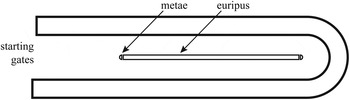
The track of a Roman circus (Figure 5) was defined by a central barrier, the euripus, at either end of which, detached from the barrier itself,Footnote 20 stood a conspicuous turning post or, more properly, a high semicircular platform surmounted by three cones.Footnote 21 Each of the cones was called a meta, though both numbers, meta and metae, could denote the structure as a whole.Footnote 22
Simplified Plan of the Circus Maximus

Without a doubt, the Asian side of the Bosporus falls somewhat short of this scheme. Although the long projection suggests the end of the euripus,Footnote 23 closer inspection of the ‘turn’ reveals unsuitably jagged contours (Figure 1). And the mysterious white rock, which ought to have fronted the entire coastline, could in fact have occupied only a small part, perhaps the tip of the headland Metopon. These shortcomings become less important, though, when one considers that Tacitus' conceit presumes the vantage of a panoramic map (compare Figure 3).Footnote 24 So too with Virgil's metas … Pachyni. Even if it was the tiny island at the tip of the promontory that gave the poet the idea of a turning post (Figure 2, inset),Footnote 25 it would be hard for a Sicilian fisherman, say, to take in the full grandeur of the ‘turn’ (longos … circumflectere cursus). That was left to the Roman schoolboy contemplating a map, whether a schematic outline drawn by his teacher or some more ambitious representation on the wall of a portico.Footnote 26
Tacitus' phrase in meta seems to have essentially the same meaning as the more common ad metas: ‘in the stretch of track by the meta’ or, in this context, ‘at the turn’. Unlike the gently graduated bends prescribed by modern racecourses, the circus track wound round the meta in hairpin fashion. That meant drivers reached the apex of the turn at nearly the same time as they burst from the straightaway (compare in meta Pontum erumpens). The image of the meta itself would have been suggested by the detail of the projecting rock (Strabo's λευκή τις πέτρα προσπίπτουσα, Pliny's saxum miri candoris). Tacitus' substitution of the plural (obliquis … saxis) was perhaps a deliberate ‘improvement’. Further inspiration might have come from Virgil's ship race (Aen. 5.159):
Note also the lines, shortly thereafter, in which the helmsman Menoetes loses his nerve (5.164–5):
Tacitus' expression, again, is very similar: obliquis subter undas saxis exterrita … hos ad portus defertur.
To sum up, then, we have great numbers of fish approaching the Bosporus along the circus-like bend of Asian shore (Strabo's παρὰ τὴν Ἀσιανὴν ᾐόνα) and travelling not haphazardly but in shoals (Strabo's ἀγεληδόν, Pliny's praecipiti … agmine). Observe that in the Tacitean passage both of these phenomena are implied, after uis piscium, by the single phrase omisso alterius litoris flexu. The creatures, therefore, are not mobbing the entrance to the strait from every direction. They are proceeding rather in a semi-orderly swarm—and in a counter-clockwise direction—like charioteers.
Now comes the trouble in the turn. For charioteers as well, the meta marked the portion of the track where accidents were most likely to occur.Footnote 27 It was not simply a question of g-forces. The turn was the place where the most intense manoeuvring took place, with every driver vying for the inner position. The object was to approach the meta as closely as possible, to graze it even, without actually striking it.Footnote 28 To pursue an outside line was a shameful weakness.Footnote 29 And yet the driver who misjudged his distance from the post, or who in his effort to move closer ended up colliding with a rival chariot, ran the risk of crashing or careening off the track—which is something like the fate of our fishes.Footnote 30 The horses themselves contributed to the problem because they could sense the dangers of an upcoming turn and were easily spooked at the meta (compare obliquis … saxis exterrita).Footnote 31 In the Greek tradition this phenomenon was traced to a spirit known as a taraxippos, or ‘horse-confounder’, which was associated at several major hippodromes with some object by the side of the track where accidents frequently occurred. At Olympia the object was a circular altar (on a straightaway, perhaps near the turn) at which drivers offered sacrifices and prayed for success. At Nemea it was a reddish rock that loomed from behind one of the turning posts. The intensity of its fiery glare struck terror into the horses (Paus. 6.20.19).Footnote 32 The Romans had no taraxippoi as such,Footnote 33 but they must have been familiar with the underlying problem. Even apart from its startling effect, the shimmering rock on the Chalcedonian bank would have recalled the metae of the Circus Maximus: the Emperor Claudius found these compounded of wood and tufa, and left them sheathed in gold.Footnote 34
A final observation concerns the participle exterritus. Tacitus uses exterreo thirty-seven times, in all but two cases (not surprisingly) with people as ‘the ones terrorized’. Besides the present application to fish (uis piscium … exterrita), the only other animal instance occurs in the Agricola, at the mons Graupius. The surviving British charioteers have fled, but empty chariots, swept along by their spooked teams, still present a hazard (36.3):
ac saepe uagi currus, exterriti sine rectoribus equi, ut quemque formido tulerat, transuersos aut obuios incursabant.
The horses fly off at odd angles ‘each as his panic bore him’—again, not unlike our fishes. The ‘horsiness’ of the participle exterriti Footnote 35 would have impressed itself the more deeply on Tacitus because he is quoting here from a similar situation in Sallust's Histories (fr. 1.139):Footnote 36
equi sine rectoribus exterriti aut saucii consternantur …
The Sallustian context is uncertain, but the scene may have been like the one in the Agricola, especially if consternantur is deponent, as Priscian (who quotes these words) maintains.Footnote 37
III. THE HISTORIAN
The elements of our fish circus are now in place: the central barrier, the turn, the close grouping of the pack, its counter-clockwise progress, not only the meta itself—both in shape and in radiance—but also its associated terrors and, finally, some crucial mishap, whether a timid ‘refusal’ or centrifugal lunge. Contemporary Romans would have been all the more ready to accept the likeness given that one of the lap-counting devices in the Circus Maximus was a row of seven dolphins.Footnote 38 But we have still to enlist the cooperation of Tacitus himself. What could have impelled such a hard-headed and discerning author, a Roman consular, to perpetrate such a piece of silliness—and at the expense of a historian whom he admired and emulated?Footnote 39 Part of the answer has been suggested above. Except to the credulous masses and a select group of enlightened professors, these skittish fishes must have seemed silly to begin with. As one of Athenaeus' banqueters says of Aristotle's ichthyologic researches, ‘from what Proteus or Nereus risen from the depths did he learn what fish do or how they sleep and pass their time?’ (8.352d-e). Tacitus could have visited Byzantium around the time he served as proconsul of Asia (112/113), but he is the last man to have searched for the ‘slanting rocks’. In all things sceptical, he has simply given frivolity a push. A similar vein of mockery runs through his account of the phoenix (Ann. 6.28.1–6), whose alleged appearance in a.d. 34 ‘occasioned much discourse and debate among the learned men of the Egyptians and the Greeks’. After reviewing ‘with deferential gravity’ the five-hundred year cycle of this precious fowl, the historian avows
that he cannot help sharing the doubts of those who impugned the authenticity of the manifestation in the days of Tiberius Caesar. It exhibited none of the signs or behaviour as prescribed by an ancient tradition. A phoenix was unique among all birds, by form and feather. There were pictures of it. Tacitus goes on to recount in poetic language the demise of the phoenix: the bird renewed, rising from the nest and dutifully transporting the remains of his parent to the temple of the Sun, a long journey, laden with fragrant fuel. Plain prose follows: ‘it is not disputed that the bird in question is seen in Egypt, from time to time’.Footnote 40
A further incentive to ironic subversion lay in the diction of the Sallustian model: qua tempestate uis piscium Ponto erupit. Tacitus' repetition of the phrase uis piscium seems to exploit a different, and highly poetic, sense of the combination uis + genitive, ‘the strength of someone/something’. Compare such periphrases as Πατρόκλοιο βίην (Il. 17.187) and ἲς Ὀδυσῆος (Il. 23.720). More to the point, compare μένος ἡμιόνοιϊν (Od. 7.2), σθένος ἡμιόνων (Pind. Ol. 6.22) and similarly σθένος ἵππιον (Pyth. 2.12). Expressions of this sort did not require an aggrandizing adjective or even the plural number for the genitive. Νote, for instance, Cicero's equi uis (Aratea 57 [291]) and Lucretius' fortis equi uis (3.8, 3.764). On the other hand, when the genitive is plural, the notions of ‘strength’ and ‘multitude’ are sometimes hard to disentangle. So in Lucretius (2.263–5):
Given such antecedents and his own sardonic turn, it would not be surprising if Tacitus had detected a certain unintended humour in Sallust's uis piscium. Unsupported by an adjective like magna, the phrase resembles a heroic periphrasis.Footnote 42 Similarly, though the archaic qua tempestate is at home in Sallust and Tacitus,Footnote 43 it is also eminently poetic. One thinks of verses like qua tempestate Helenam Paris innuptis iunxit nuptiis (Incertae Fabulae 80 R2) and Amphitryoniades qua tempestate iuuencos | egerat a stabulis, o Erythea, tuis (Prop. 4.9.1–2). Even erupit, though the verb is elsewhere used in just this way of shoals of fish,Footnote 44 might have seemed to be consistent with the ‘high-flown tone’. Beside Lucretius' prorumpere equorum | uim cupidam, compare Virgil's stirring cavalry charge, subito erumpunt clamore furentisque | exhortantur equos (Aen. 11.609–10). In the end, though Sallust's individual words may be prosaic enough in themselves, their use in combination unleashes a certain poetic grandiosity. Tacitus' parodic impulse led him to exaggerate the effect in his own version of events, importing not just in meta but probably also the poetically tinged subter (which neither he nor Sallust uses elsewhere)Footnote 45 and the humorous exterriti (the occasion of an exasperated charge that he was interested in ‘fish-psychology’).Footnote 46 But the clearest indication of the historian's intent is his otherwise gratuitous change of Sallust's Ponto erupit to Pontum erumpens. The construction of erumpo with the accusative in this sense is rare and distinctly poetic. Virgil has et fortis Achates | et pater Aeneas iamdudum erumpere nubem | ardebant (Aen. 1.579–81), and the only instance separating Virgil from Tacitus is the close imitation of Valerius Flaccus, nebulamque erumpit Iason (5.465).Footnote 47 First Aeneas, then Jason, then fish. The bathos is intentional.Footnote 48
For zealous fans and fastidious refugees alike, the Roman world was saturated in the imagery of the circus. The paths of the stars and the planets, the voyages of seafarers, the progress of empires, professional careers and artistic endeavours, the very course of life itself were all susceptible of representation by racetracks and turning posts,Footnote 49 and no one could regard an object of even faintly conical proportions without being tempted to compare it to the iconic meta. Footnote 50 The conjecture immensa has reigned in our editions for so long now—and with such sober good sense—as almost to have achieved the sanction of ‘tradition’. It may bear repeating, therefore, after the new-fangled interpretation of the foregoing pages, that the aim from the start has been strictly conservative. The manuscripts read in meta.Footnote 51