Introduction
Necrotising otitis externa is a serious infection of the temporal bones and surrounding soft tissues. The condition was first described by Meltzer in 1959,Reference Meltzer and Kelemen1 and the first case series of the condition was published by Chandler in 1968.Reference Chandler2 Chandler termed the condition ‘malignant external otitis’ to describe its aggressive nature, and one 1977 series described it as having a mortality rate of over 50 per cent.Reference Meyerhoff, Gates and Montalbo3 Although the mortality rate for necrotising otitis externa has apparently decreased since 1977, it remains a serious condition which may present to physicians in several specialities. Accurate diagnosis is imperative.
Necrotising otitis externa typically affects elderly diabetic men.Reference Rubin and Yu4, Reference Giamarellou5 However, it is not limited to these patients, and has been reported in children and in immunocompromised patients.Reference Coser, Stamm, Lobo and Pinto6, Reference Ress, Luntz, Telischi, Balkany and Whiteman7 The frequency with which the condition is diagnosed appears to be increasing; it has been suggested that an increased index of clinical suspicion is responsible for this.Reference Rubin Grandis, Branstetter and Yu8
Pseudomonas aeruginosa has been reported as the responsible organism in over 90 per cent of cases of necrotising otitis externa.Reference Rubin and Yu4 However, a number of other organisms have also been isolated, notably staphylococcus species,Reference Keay and Murray9 aspergillus species,Reference Munoz and Martinez-Chamorro10 candida species,Reference Bae, Lee, Park, Bae, Ma and Kim11 and, more rarely, organisms such as Malassezia sympodialis Reference Chai, Auret, Christiansen, Yuen and Gardam12 and Klebsiella pseumoniae.Reference Yang, Kuo and Young13
Since the initial description of necrotising otitis externa, several attempts have been made to stage the progress of the disease. Most of these efforts have been based on histological assessmentReference Benecke14 or imaging methods.Reference Stokkel, Boot and van Eck-Smit15, Reference Kwon, Han, Oh, Song and Chang16 Symptoms arising from the facial nerve and other cranial nerves had previously been used as predictors of prognosis.Reference Chandler17–Reference Soudry, Joshua, Sulkes and Nageris19 Thus far, attempts to accurately predict which patients will have a poor outcome have been unsatisfactory. As the condition is rare, clinicians need to have a useful way of predicting potential outcome in order to guide treatment and to avoid serious complications.
In this study, we gathered data on signs and symptoms of necrotising otitis externa from previously published cases, and used rigorous statistical techniques to correlate these with outcomes. In this way, we aimed to develop a clinically useful prognostic scoring system.
Materials and methods
The Medline and Institute for Scientific Information (ISI) Web of Knowledge databases were searched for the years 1966 to 2007 to identify published cases of necrotising otitis externa. Synonymous terms were included in the search strategy. The initial literature search yielded 104 abstracts warranting further appraisal. Overall, 58 papers were included in the analysis.Reference Chandler2, Reference Coser, Stamm, Lobo and Pinto6, Reference Ress, Luntz, Telischi, Balkany and Whiteman7, Reference Keay and Murray9–Reference Yang, Kuo and Young13, Reference Stokkel, Boot and van Eck-Smit15, Reference Kwon, Han, Oh, Song and Chang16, Reference Aldous and Shinn20–Reference Okpala, Siraj, Nilssen and Pringle67 Inclusion was considered if papers contained sufficient case data within the published article concerning age, sex, presenting features, further symptoms, clinical signs or investigations, and outcome of suspected cases. Papers were excluded from analysis if they were not in the English language, did not contain sufficient information concerning the cases, were of the case series type (unless individual outcome was ascertainable from the published data), or were not deemed to clinically describe necrotising otitis externa. For the purposes of the analysis, osteomyelitis of the skull base was deemed a separate clinical entity from necrotising otitis externa, unless causal progression from the condition was stated in the paper. (A full list of exclusion criteria is available from the authors upon request.)
Primary analysis concerned the prognostic value of a number of stated symptoms and clinical findings, including culture status. Secondary analysis included the assessment of investigations and treatments used in individual cases, including antibiotic medications, hyperbaric oxygen therapy, various imaging modalities and surgical treatments. Where cases included secondary analysis objectives, these were recorded also.
Case data were collected from each included paper, and these data were checked again at a later date for completeness. Data were then categorised and entered into analysis using binary coding (e.g. ‘1’ for presence of a symptom and ‘0’ for its absence). Analysis of the data was completed using a (forced entry) binary logistic regression model (using the Statistical Package for the Social Sciences version 16.0 software). Outcome was categorised as either complete resolution, resolved with a significant complication (leading to morbidity) or death from the disease. For analysis, the latter two groups were combined as one ‘poor outcome’ category. A stepwise logistic regression model was created which included all of the variables, to initially assess which variables may influence outcome.
Data assessed as potential prognostic factors included: hearing loss; facial nerve involvement; other cranial nerve involvement; non-cranial nerve neurological signs; evidence of significant external auditory canal granulations, erythema or oedema; periauricular pain or cellulitis (including significant temporomandibular joint involvement); bilateral symptomatology; Pseudomonas aeruginosa culture; staphylococcus species culture; aspergillus species culture; candida species culture; multiple organisms cultured; or any positive fungal organism culture. Patient age, diabetic status, immunological status and gender were also included for use in the adjusted models. For each variable, crude odds ratios were calculated using binary logistic regression, models adjusted for age, gender and diabetes status were calculated, and, finally, models adjusted for age, gender, diabetes and the presence of bilateral symptoms were calculated. The latter analysis was to assess for the influence of bilateral symptoms on the other variables. Otalgia and otorrhoea were only included in the analysis to assess their potential impact on other symptoms, as their presence was considered potentially mandatory for diagnosis.
Statistical analysis was undertaken using a logistic regression model. This was to allow the inclusion of multiple factors into the analysis to ‘adjust’ for the potentially confounding effects of variables such as age and gender. Whilst this method was felt to be justifiable in our analysis, it has a number of intrinsic problems which need to be addressed. The number of cases in our sample is potentially restrictive in such an analysis, as the model assumes an infinite number of samples from the normal population. We allowed for this by combining outcome groups into the largest that could representatively be made, and by rigorous testing of model validity by Hosmer and Lemeshow tests and by plots of Cook's statistic versus predicted probabilities. By only including previously identified potential risk factors in our analysis, we avoided the possibility of over-fitting of the model.
Results and analysis
The total number of cases in the series was 133. The mean average age in the series was 60.09 years, and the median age 66 years. The 25th and 75th percentiles were 53 and 75 years, respectively. Males made up 68 per cent of cases included in the series, and females 32 per cent. For two cases, there was insufficient published data to ascertain gender. Of the cases included in the analysis, 94 had confirmed diabetes or were diagnosed with diabetes mellitus at presentation. The remaining 39 cases were found not to have diabetes, or were not tested for it. Insufficient data were available to further sub-classify cases as well controlled or poorly controlled diabetes. Immunocompetency status was assessed from published data for each of the cases included in the analysis: 22 cases were classified as immunocompromised in some way, while the remaining 111 were classified as immunocompetent or unspecified. Neither diabetic nor immunocompetency status was found to have any effect on individual outcome.
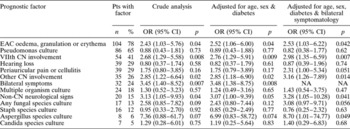
A wide range of micro-organisms were recorded in the case data. The individual organisms were classified separately when possible, or classified by group when not. When multiple organisms were cultured, all of the stated organisms in the published data were recorded. The names of some of the organisms, particularly from the older data, were updated in keeping with modern naming conventions. Pseudomonas aeruginosa was by far the most commonly recorded cultured organism, making up 59.31 per cent of all cultured organisms in the entire series. The next most common organism was Staphylococcus aureus, making up 9.66 per cent of all cultured organisms (Table I).
Results of logistic regression analysis

Pts = patients; diabetes = diabetic status; OR = odds ratio; CI = confidence intervals; EAC = external auditory canal; CN = cranial nerve; staph = staphylococci
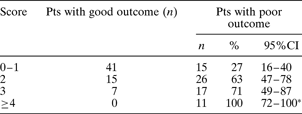
The following six factors were found to have a statistically significant effect on outcome: facial nerve involvement; other cranial nerve involvement; non-cranial nerve neurological signs; evidence of significant external auditory canal granulations, erythema or oedema; bilateral symptoms; and positive aspergillus culture.
These factors were used as the basis for the scoring system. For the scoring model, each of the identified variables gave a ‘score’ of one, cumulative up to a maximum of six. The data gathered from the initial analyses were then reassessed and scores obtained for each of the cases in the series. Outcome was then correlated with score based on these measurements (Table II).
Prognostic factors included in scoring model, and relation to poor outcomes

* For age, sex and diabetes status. †See Discussion for explanation of inclusion. OR = odds ratio; CI = confidence intervals; pts = patients; CN = cranial nerves; EAC = external auditory canal
Discussion
This study identified several factors seemingly indicative of a poorer outcome for patients with necrotising otitis externa. From this, we constructed a scoring system to facilitate clinical prediction of outcomes. A prognostic factor score of one was associated with a poor outcome in 27 per cent of cases, whereas a score of four or more was associated with a poor outcome in 100 per cent of cases (Table III).
Prognostic scoring model
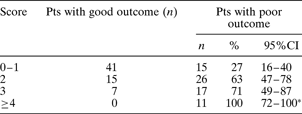
* 97.5% CI one-sided. Pts = patients; good outcome = complete resolution without significant complication; poor outcome = significant complication or death as a result of necrotising otitis externa; CI = confidence intervals
The wealth of existing observational data was reviewed, combined and sensitively analysed. This method may be transferable to the study of other rare diseases for which more conventional methods of analysis prove impracticable. However, we must accept and acknowledge the limitations of this method.
Firstly, this was a retrospective, observational analysis of case data, and thus was not as robust at excluding confounding factors and eliminating potential bias, compared with prospective data collection methods. For example, our analysis was heavily skewed by the potential for publication bias. If only those cases which were different from normal were published, then our analysis was not representative of the normal disease population, but rather a subset representing those with unusual disease presentation or process. Equally, if only those cases with a positive result were published (e.g. in studies assessing new treatment methods or attempting to establish the validity of an existing treatment), our analysis would be overly optimistic in terms of outcomes.
We included adjustment for positive aspergillus species culture, even though the association between this factor and outcomes had only borderline statistical significance. It has been suggested that necrotising otitis externa due to aspergillus may be associated with a delay in diagnosis,Reference Shelton, Antonelli and Hackett68 and that immunocompromised patients may have aspergillus-mediated disease.Reference Rubin Grandis, Branstetter and Yu8 The epidemiology of necrotising otitis externa is changing, with more presentations amongst the immunocompromised.Reference Rubin Grandis, Branstetter and Yu8, Reference Hern, Almeyda, Thomas, Main and Patel46, Reference Lasisi, Bakare and Usman69 In the future, it is probable that more patients will present with disease due to aspergillus, as the human immunodeficiency virus positive and acquired immunodeficiency syndrome positive populations increase. Insufficient evidence exists, either from this analysis or from the literature, to ascertain whether patients with aspergillus necrotising otitis externa truly have a worse prognosis than those with disease caused by other organisms. However, on the balance of probabilities, it seems likely that they do (in this series, 87.5 per cent of those with aspergillus had a poor outcome). Aspergillus species culture was thus included in the scoring system.
The emergence of quinolone-resistant pseudomonas is a growing problem,Reference Rubin Grandis, Branstetter and Yu8, Reference Bernstein, Holland, Porter and Maw55, Reference Berenholz, Katzenell and Harell70 and introduces difficulties regarding adequate treatment of this potentially lethal condition. At present, there is insufficient information to justify inclusion of resistant pseudomonas as a variable in the current scoring system. However, if the growing trend in resistant organisms continues, this may become a factor to consider in the prognostic scoring of necrotising otitis externa.
• Necrotising otitis externa is a rare, aggressive infection of the temporal region generally affecting elderly, diabetic men, and is often caused by Pseudomonas aeruginosa
• The condition usually presents with severe otalgia, otorrhoea and hearing loss, but symptoms may also include cranial nerve involvement as the disease spreads
• Most cases respond to fluoroquinolone antibiotics, but a high index of suspicion is needed to effectively treat atypical organisms such as aspergillus species
• Data from 41 years of case literature were analysed to identify clinical signs, symptoms or findings statistically related to patient outcomes
• Using these data, a four-point scoring model predicting poorer patient prognosis was constructed
In this study, the secondary analysis included an investigation of which treatments may affect outcome. The only treatment which was suitable for this analysis was hyperbaric oxygen therapy. We found no evidence that hyperbaric oxygen had any significant effect on any outcome measure. Whilst this finding is in keeping with the Cochrane review on this subject,Reference Phillips and Jones71 the authors accept that retrospective, observational studies are not the appropriate method for evaluating treatments. A number of studies have found hyperbaric oxygen to have a positive effect;Reference Mader and Love31, Reference Narozny, Kuczkowski, Stankiewicz, Kot, Mikaszewski and Przewozny54, Reference Narozny, Kuczkowski and Mikaszewski72 however, there have been no truly decisive studies proving its efficacy. It is the opinion of the authors that insufficient evidence exists to either prove or disprove the rational use of this treatment for necrotising otitis externa, and further research is thus needed into this contentious area.
Conclusion
In this article, we have introduced a method of analysing published case data to ascertain prognostic factors strongly associated with poor outcome for patients with necrotising otitis externa. From this analysis, it was possible to construct a rational scoring system for patients, based on a number of easily identifiable clinical characteristics. It is hoped that this will better equip clinicians to treat patients with suspected necrotising otitis externa. Whilst this type of analysis has recognised limitations, future studies of the effectiveness of this scoring model may show that such analysis is reliable and transferable to other areas of medical science.
Acknowledgements
The authors extend many thanks to Professor Glyn Lewis from the Department of Academic Medicine and Psychiatry, University of Bristol, UK, for his valuable input.