Albinism results from discontinuous genetic variation generated by the inability of or absence of genes that determine the production of the dark pigment melanin in skin cells (Griffiths et al., Reference Griffiths, Miller, Suzuki, Lewontin and Gelbart2002). In most fish, the absence of colours is related to mutations of the tyrosinase family of genes, where the skin of albinos lack melanin and eye development is affected (Wang et al., Reference Wang, Hou, Zhang, Zhao, Jiang, Sun, An and Li2007). There are also cases of albinism that are the result of chromatic anomalies with total or partial depigmentation (Sazima & Pombal Jr, Reference Sazima and Pombal1986). There are several reports of instances of albinism in fish (e.g. Sazima & Pombal Jr, Reference Sazima and Pombal1986; Teixeira & Araújo, Reference Teixeira and Araújo2002; Bottaro et al., Reference Bottaro, Ferrando, Gallus, Girosi and Vacchi2005; Brito & Caramaschi, Reference Brito and Camaraschi2005; Reum et al., Reference Reum, Paulsen, Pietsch and Parker-Stetter2008).
The pacuma toadfish Batrachoides surinamensis (Bloch & Schneider, 1801) is a tropical benthic fish, widely distributed from Honduras to Bahia, Brazil (Cervigón, Reference Cervigón1991; Carvalho-Filho, Reference Carvalho-Filho1999). Individuals of this species can be found at the mouth of rivers (Leopold, Reference Léopold2004), being abundant in the estuaries (Cervigón, Reference Cervigón1991; Almeida et al., Reference de Almeida, Castro, Paz, Ribeiro, Barbosa, Ramos, Isaac, Martins, Haimovici and Andriguetto2006).
In the State of Maranhão, B. surinamensis is captured by fishermen with hooks made of wires that remove them from their burrows (J.L.S. Nunes, personal observations), but are rarely captured with other types of traps (Almeida et al., Reference de Almeida, Castro, Paz, Ribeiro, Barbosa, Ramos, Isaac, Martins, Haimovici and Andriguetto2006; Piorski et al., Reference Piorski, Serpa and Nunes2009).
The solitary habit of this species, associated with the benthic way of life, slow movements, camouflage coloration and general cryptic habits fit well in its foraging behaviour, as this fish ambushes its prey which are mainly fish, small molluscs and crustaceans.
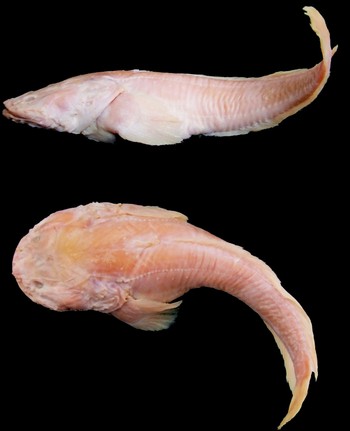
The total albino pacuma toadfish reported herein is 320 mm in total length and a total weight of 460 g (Figure 1). It was caught in September 2002 in the estuary of the Pau Deitado, rural zone of the Ilha do Maranhão, north-eastern Brazil. Its morphological features agree well with the diagnostic characteristics of Batrachoides surinamensis (Menezes & Figueiredo, Reference Menezes and Figueiredo1998).
Lateral and dorsal views of the albino pacuma toadfish Batrachoides surinamensis.

According to Bottaro et al. (Reference Bottaro, Ferrando, Gallus, Girosi and Vacchi2005) the occurrence of albinism is more common in bony fish than in cartilaginous fish for two reasons: (1) the low tendency of albinism in the Chondrichthyes; and (2) the low frequency of captures for this group (as well as its much lesser species richness compared with the former group), thus reducing the probability of such records.
Sazima & Pombal Jr (Reference Sazima and Pombal1986) and Brito & Caramaschi (Reference Brito and Camaraschi2005) state that albinism in tropical fish is more common among nocturnal and/or cryptobiotic species than among diurnal or non-cryptobiotic ones. Additionally, the first two authors state that albinism would not influence the foraging and reproduction of nocturnal and/or cryptobiotic fish species, and that predation risk by visually-oriented predators is small even for albinotic fish with such habits, as most nocturnal predators do not rely on vision. Delgado et al. (Reference Delgado, Carvalho, Sousa, Ferreira and Aveiro2009) report an albino adult female of Trichiuridae with evidence of recent spawning (several trichiurid species are nocturnal), which strengthens this statement of Sazima & Pombal Jr (Reference Sazima and Pombal1986). Thus, as it occurs with other cryptic fish, albinism in B. surinamensis seemingly is no great handicap in the life of this fish, as the individual reported here is an adult (as indicated by its total length).