




No CrossRef data available.
Article contents
Neuropsychological effects of pediatric obstructive sleep apnea
Published online by Cambridge University Press: 01 November 2004
Abstract
Obstructive sleep apnea (OSA) is a fairly common nocturnal breathing disorder, affecting 2–4% of individuals. Although OSA is associated with medical morbidity, its most functionally disruptive effects in adults appear to be neuropsychological in nature. Research on the neuropsychological effects of pediatric OSA has been limited. This study compared the neuropsychological functioning of school-aged children with OSA to that of healthy children. The primary goal was to clarify the presence and pattern of neuropsychological morbidity associated with pediatric OSA. Sleep was assessed with parent-report questionnaires and laboratory sleep studies. Neuropsychological functioning was assessed by formal tests and parent- and teacher-report questionnaires. Data indicated OSA-related cognitive and behavioral impairment that was particularly marked on measures of behavior regulation and some aspects of attention and executive functioning. Minimal effects were observed on measures of intelligence, verbal memory, or processing speed. Exploratory analyses failed to indicate any clear relationship between neuropsychological functioning and objective indexes of hypoxia or sleep disruption, though the sample was small. These data add to a growing literature which suggests that significant neuropsychological deficits are associated with pediatric OSA. Findings suggest a pattern of neuropsychological morbidity that is similar but not identical to that seen in adult OSA. (JINS, 2004, 10, 962–975.)
Information
- Type
- SYMPOSIA ARTICLE
- Information
- Journal of the International Neuropsychological Society , Volume 10 , Issue 7 , November 2004 , pp. 962 - 975
- Copyright
- © 2004 The International Neuropsychological Society
INTRODUCTION
Obstructive sleep apnea (OSA) is a frequent and insufficiently recognized condition that is associated with upper airway obstruction during sleep. In this condition, breathing during sleep is marked by periods of significant restriction or cessation in airflow, often interrupted by brief arousals from sleep, during which normal respiration is restored. OSA is characterized by intrathoracic pressure swings, increased respiratory effort, sleep fragmentation, and intermittent hypoxemia and hypercarbia (D. Gozal, 2001). The estimated prevalence is around 2–4% from the preschool years through mid-adulthood (e.g., Gislason & Benediktsdottir, 1995; Young et al., 1997). On the population level, this represents an enormous number of cases. OSA has been associated with systemic and pulmonary hypertension, cardiovascular and cerebrovascular disease, arrhythmias, and hormonal abnormalities in adults (Doran et al., 2001; Harding, 2000; Punjabi et al., 2002) and cardiovascular alterations and hormonal abnormalities in children (Amin et al., 2002; D. Gozal, 2001). However, many of the most functionally disruptive effects are neuropsychological rather than medical (Beebe & Gozal, 2002). This study examines the neuropsychological morbidity of pediatric OSA.
Among adults, OSA has long been linked to excessive daytime sleepiness, and recent reviews highlight a pattern of neuropsychological deficits (Beebe & Gozal, 2002; Beebe et al., 2003b). In a meta-analysis of 25 studies, OSA was found to have a negligible impact on psychometric intelligence and verbal functioning, but a striking effect on attention/vigilance and a moderate to marked impact upon executive functioning. Data were mixed with regard to memory functioning, probably related to methodological differences across studies (Beebe et al., 2003b).
Among children, snoring, a hallmark but nonspecific symptom of OSA, has been linked to poor academic performance, inattentiveness, aggression, and hyperactivity (e.g., Ali et al., 1993; Chervin et al., 2003; Gottlieb et al., 2003; D. Gozal, 1998; Urschitz et al., 2003). Children who have been referred for adenotonsillectomy because of suspected OSA also often display hyperactivity, aggression, and rebelliousness (Goldstein et al., 2000; Stradling et al., 1990). Recently, studies using overnight sleep studies (polysomnography or PSG) have shown that children with verified OSA display inattention, poor academic achievement, aggression, and overall behavioral maladjustment more often than their peers (Friedman et al., 2003; Lewin et al., 2002; Owens et al., 2000a; but see Kaemingk et al., 2003, for dissenting findings). Conversely, hyperactive children display far more clinical symptoms of OSA (Chervin et al., 1997; Simonds & Parraga, 1984), though evidence using PSG has been mixed (O'Brien et al., 2003).
Only a few investigators have used neuropsychological tests with children with OSA. Some have reported diminished intellectual skills (Friedman et al., 2003), but others have reported no relationship between OSA and intelligence in children (Kaemingk et al., 2003; Lewin et al., 2002; Owens et al., 2000a). Memory findings also have been mixed, with some reporting diminished memory (Kaemingk et al., 2003; Rhodes et al., 1995), but contrary findings from others (Owens et al., 2000a). In line with adult data, reports have suggested impairment on tests of attention and executive functioning among children with OSA (Archbold et al., 2004; D. Gozal et al., 2001b; Owens et al., 2000a), though the data have been limited. Finally, Lewin et al. (2002) noted mild but significant mental slowing within a small sample of children with untreated OSA compared to children with treated OSA and to healthy controls.
Evidence from treatment studies further supports a link between pediatric OSA and neuropsychological functioning. Adenotonsillectomy is effective in treating breathing problems in most children with OSA and seems to contribute to academic, intellectual, and behavioral improvements post treatment (Ali et al., 1996; Friedman et al., 2003; Goldstein et al., 2000; D. Gozal, 1998). However, in the only published study of long-term outcome, Gozal and Pope (2001) reported poorer academic performance among currently nonsnoring teenagers who had snored as young children than among those who had not snored when they were younger.
The mechanism by which OSA may impart neuropsychological morbidity remains unclear. Two potential contributors have received the most attention: intermittent hypoxia and sleep disruption (Beebe & Gozal, 2002). Rat pups exposed to intermittent hypoxia during sleep show more learning and behavior problems, as well as greater evidence of neural death, than their mature counterparts (D. Gozal et al., 2001a; E. Gozal et al., 2001; Row et al., 2002). There are few naturalistic studies of children with recurrent or prolonged hypoxia (which differs substantially from acute anoxia) past the neonatal period, because few childhood diseases result in significant recurrent or prolonged hypoxia. However, one such disease, sickle cell anemia, has yielded relevant findings. Even in the absence of clinical stroke, children with sickle cell who have low hematocrit levels or diminished cerebral blood flow are at elevated risk for poor cognitive functioning and gray matter abnormalities, suggesting that chronic hypoxia is a key risk factor in this population (Kral et al., 2003; Steen et al., 1999). Though it is risky to generalize from the animal research or from research on one disorder (sickle cell) to another (OSA), there is reason to believe that intermittent hypoxia may contribute to neuropsychological deficits in pediatric OSA.
Alterations in level of alertness and performance on repetitive cognitive tasks can be induced in healthy adults by experimentally disrupting sleep (e.g., Martin et al., 1999). Studies of acute total sleep deprivation of healthy adults have further suggested substantial declines in decision-making, judgment, and emotion regulation (cf. Harrison & Horne, 2000). We are aware of no published studies of experimental sleep disruption in healthy children. However, a handful of studies have examined the effects of sleep restriction, which include slowed reaction time, subjective and objective sleepiness, inattentive behaviors, irritability, and noncompliance (Fallone et al., 2000, 2001; Sadeh et al., 2003). Moreover, correlational studies have linked diminished sleep time, delayed or inconsistent sleep onset, and restlessness during sleep to cognitive and behavioral disturbances in children (Gruber et al., 2000; Picchietti & Walters, 1999; Sadeh et al., 2002). The causal role of pediatric sleep disturbance in creating or exacerbating neurobehavioral dysfunction is further supported by clinical cases and group research in which this dysfunction is ameliorated following a sleep intervention (Bergman, 1976; Minde et al., 1994; Walters et al., 2000).
Correlational studies on adults with OSA have revealed relationships between cognitive functioning and both sleep arousals and hypoxic episodes. However, most of these studies have employed large correlation matrices without statistical correction, and many presented contradictory findings (Engleman et al., 2000). The picture is even less clear for children with OSA, many of whom have normal sleep architecture (Goh et al., 2000) and display no excessive daytime sleepiness on conventional measures (D. Gozal et al., 2001c). Kaemingk and colleagues' (2003) recent epidemiological study of children yielded a matrix of 165 correlations between PSG indexes and cognitive test scores, of which only 18 reached the .05 level of significance, and no correlation exceeded .22 in magnitude. Friedman et al. (2003) found no significant relationship between intellectual functioning and indexes of sleep disruption or hypoxia.
Although advancing rapidly, research on pediatric OSA continues to have significant limitations. Only a handful of studies of neuropsychological functioning have used the diagnostic gold standard of PSG; those that did often relied heavily upon parent report of the child's behavioral functioning, rather than objective test data. Only three groups (Archbold et al., 2004; O'Brien et al., 2003; Owens et al., 2000a) have assessed executive functioning, despite evidence that this domain is sensitive to OSA in adults (Beebe et al., 2003b) and the recent publication of a theoretical model that suggests that executive functioning is particularly vulnerable (Beebe & Gozal, 2002). Although producing rigorous research, Gozal and O'Brien's team has focused on 5–7-year-old children, raising questions about the generalizability of findings to older children. Neither Archbold's nor Owens' studies used a control group, comparing clinical scores only to published norms. Indeed, few studies of pediatric OSA have attempted to account for demographic variables when recruiting a control group or interpreting their findings, a design flaw which also pervades the adult research (Beebe et al., 2003b).
This study compared the neuropsychological functioning of school-aged children with OSA to that of community-recruited healthy controls. The primary goal was to clarify the presence and pattern of neuropsychological morbidity evident in school-aged children with OSA. It was hypothesized that children with OSA would demonstrate cognitive impairment on objective tests and behavioral impairment reported by parents and teachers. In line with the adult literature, it was further hypothesized that children would have greater impairment of attention and executive functioning than intellectual functioning, memory, or general mood. The secondary goal of this study was to further explore the relationship between neuropsychological functioning and various PSG-defined sleep indexes in children.
METHODS
Research Participants
Forty-nine children participated in this study. Of these, 32 children aged 6–12 were recruited from consecutive referrals to a regional pediatric sleep center for overnight PSG because of clinical symptoms of OSA (e.g., chronic loud snoring). Following prior research (Amin et al., 2002; Owens et al., 2000a), this clinical sample was divided into three groups: children with an apnea + hypopnea index (AHI) < 1 during PSG were defined as simple snorers (n = 17); those with an AHI of 1–5 were defined as having mild OSA (n = 9); those with an AHI > 5 were defined as having moderate to severe OSA (n = 6). Because the definition of childhood OSA remains controversial (Rosen, 2004), analyses were also re-run using two alternative grouping strategies: AHI < 1 (n = 17) versus AHI > 1 (n = 15) and apnea index < 1 (n = 24) versus > 1 (n = 8). However, the overall findings, including multivariate effects, did not differ substantially from the three-group results reported here.
In addition to these clinically derived groups, a community control group was comprised of 17 age- and gender-matched children who were recruited via door-to-door solicitation in the neighborhoods in which a clinical child lived (cf. Fitzgerald et al., 1993). A pair of research associates drove to the home of a child in the clinical sample, then began to canvass the nearby neighborhood, starting approximately 1–2 blocks away (or as close as possible in rural areas) and focusing on dwellings that were similar in nature (e.g., house vs. apartment) to that of the index clinical child. At each home, they summarized the rationale and methods of the study, provided a descriptive brochure, and asked if the adult answering the door knew of any children of the same sex and aged within 1 year of the index child whose parents might be interested in participating. At no point was the index child identified by the research associates. Once an interested parent was identified, the associates asked preliminary screening questions regarding child health and asked if the first author could call to discuss the project further. In most cases, one or more interested parents could be found within a few hours. However, sometimes a control child could not be located, primarily due to a lack of comparable dwellings nearby, lack of children in the neighborhood, or later refusal, no-show, or inability to contact parents who had initially said they were interested. The result was a control group that was smaller than the total clinical sample and could not be matched one-to-one with clinical patients, but could be analyzed as a group.
Exclusion criteria for all children included neurological comorbidity (e.g., history of head injury with loss of consciousness), craniofacial syndromes, conditions involving daytime hypoxia, and prior treatment for OSA (e.g., adenotonsillectomy). Children who were found to have developmental delay (estimated IQ < 60) during the study were dropped from analyses due to concerns regarding the validity of neuropsychological tests. Children who used psychiatric medications were excluded, with a key exception: those taking psychostimulants were included if their parents agreed to discontinue medication 48 hr prior to PSG and 24 hr prior to cognitive testing. The rationale for including the latter group was that it was comprised of children who had been diagnosed with attention-deficit/hyperactivity disorder (ADHD). ADHD does not have reliable medical markers, but rather is defined by the very behaviors that have been associated with the clinical symptoms of pediatric OSA in prior research. As such, following Owens et al. (2000a), it was felt that excluding these children would artificially suppress meaningful effects and risk nonrepresentativeness in the clinical sample. Thus, they were included, but were not taking medication at the time they were assessed. These exclusion criteria were applied to children in both the clinical and control groups to promote comparability (i.e., to avoid spurious effects that were due to different entry criteria across groups). In addition, children included in the control group could not snore regularly or loudly, nor display other breathing difficulties during sleep, per parent report on a standardized sleep questionnaire (Owens et al., 2000b).
Procedure
Parents were contacted via telephone or seen during a clinic visit by the first author, who explained the procedures that would be used and answered any parent questions. Formal parent consent and child assent to participate were obtained at the time the family arrived for neuropsychological evaluation. Each family was compensated $40 for participating, plus teachers received $5 for returning questionnaires. All procedures were approved by the local Institutional Review Board.
Polysomnograph (PSG)
Children in the clinical group underwent inpatient full-night clinical PSG with a parent or guardian present. Children were not deprived of sleep prior to the PSG and were not given any sedative, though parents were asked to withhold naps and caffeine that day. The following PSG parameters were monitored using a computerized system (Astro-Med Grass System; Heritage, West Warwick, RI): Electroencephalogram (EEG; C3-A2, C4-A1, O1-A2, O2-A1), right and left electroculogram (EOG), submental electromyogram (EMG), tibial EMG, electrocardiography (ECG), nasal/oral airflow through a three pronged thermistor, end-tidal CO2 (at the nose via infrared capnometry), snoring microphone, O2 saturation by pulse oximeter, oximeter pulse waveform, actigraphy to measure limb movements, infrared video monitoring, and rib cage and abdominal volume changes (computer-assisted respiratory inductance plethysmograph). All data were digitized and stored on compact disk for later reference.
Sleep staging was scored according to standardized criteria (Rechtschaffen & Kales, 1968). Consistent with conventional standards (American Thoracic Society, 1996; Marcus et al., 1992; Uliel et al., 2004), obstructive apneas were defined as a greater than 80% decline in airflow over two breaths, despite continued chest/abdominal wall movement. Obstructive hypopneas were defined as a decrease of 50–80% in airflow that lasted at least two breaths, was accompanied by paradoxical respiration, and was either associated with oxyhemoglobin desaturation (≥4%) or followed by arousal. Arousals were coded by American Sleep Disorders Association standards (American Sleep Disorders Association, 1992). Desaturation was defined as oxyhemoglobin decline of at least 4%. The obstructive apnea index (AI), apnea + hypopnea index (AHI), respiratory arousal index (RAI) and desaturation index (DI) were each computed as the sum of relevant events divided by hours slept during PSG.
Children who do not snore regularly and whose parents have not witnessed breathing pauses are at extremely low risk for OSA (Chervin et al., 2000). Given this, and because of concerns that asking community parents to have their child come in for an overnight evaluation would result in poor recruitment rates and substantial recruitment bias, control subjects did not undergo PSG.
Neuropsychological tests (dependent measures)
All children underwent a 1.5 hr cognitive evaluation, begun approximately between 2:00 and 4:00 p.m. to minimize circadian effects. Children in the clinical group were tested either the afternoon prior to the PSG or on a day other than that immediately following the PSG (MDN = 6 days post PSG). Performance was converted to age-referenced standard scores (higher = better) based upon published norms.
Intelligence was screened using the two-subtest composite of the Vocabulary and Block Design subtests of the Wechsler Intelligence Scale for Children (WISC–III; Sattler, 2001; Wechsler, 1991).
Verbal memory was screened by the Verbal Learning subtest of the Wide Range Assessment of Memory and Learning (WRAML; Sheslow & Adams, 1990), a validated memory battery for children. An Immediate Memory index was based on the sum of the child's recall after each of four list-learning trials. The Delayed Memory index was determined by his or her free recall about 10 min later.
Processing speed was assessed by the Word Reading and Color Naming trials of the Stroop Test (Golden, 1978). Often used solely as comparisons for the Color-Word trial (see below), these are timed tasks for overlearned skills, and may thus be considered measures of simple processing speed. To ensure adequate reading skills, these tasks were given only to children aged 8 and up.
Attention and executive functions were assessed with the following instruments. The Digit Span subtest from the WISC-III asks the test-taker to repeat back strings of digits, first forward, then in reverse. This working memory task is highlighted in influential and empirically derived models of attention (Mirsky, 1996). Exploratory analysis of the forward and backward trials separately yielded the same results as the combined task, so we report results only on the latter. The Gordon Diagnostic System (GDS; Gordon, 1983) is a validated measure of visual vigilance. For the GDS vigilance task, the test-taker is asked to push a button whenever they see a predefined number pair flash in sequence, but to inhibit responding to other stimuli. Omission errors reflect diminished vigilance, while commission errors reflect poor inhibition. The NEPSY Visual Attention subtest (Korkman et al., 1998) requires the test-taker to scan an array of pictures and to mark only those that match a predetermined target. Such cancellation tasks have a long-standing history in the measurement of selective attention and inhibition (Lezak, 1995). The NEPSY Verbal Fluency subtest requires rapid generation of novel words that start with a given letter or fall in a given category. Such tests, which require mental flexibility in shifting within phonemic (first letter) and semantic (category) groups, also have an established history in the measurement of executive functioning (Lezak, 1995). These measures were given to all participants.
Two additional measures were administered only to children aged 8 and over because of concerns about their validity in younger children. The Color-Word Interference score from the Stroop Test (Golden, 1978) compares the test-taker's performance when naming the color of the ink in which a different color word is printed (e.g., “red” printed in blue ink) to their performance on simpler word-reading and color-naming trials. The Interference score, which is thought to reflect selective attention and inhibition, has a rich history in the examination of outcome following brain injury (Lezak, 1995). Finally, the Wisconsin Card Sorting Test (WCST; Heaton et al., 1993) requires the child to match a series of designs with target or key designs, based on corrective feedback. The perseverative errors, nonperseverative errors, and percent conceptual indexes from the WCST have been validated as measures of mental flexibility and visual reasoning (Heaton et al., 1993).
Parent and teacher behavior questionnaires (dependent measures)
Two questionnaires were completed by each child's caregiver during the neuropsychological evaluation, and analogous forms were mailed with a postage-paid return envelope to the teacher who was judged by the family to know the child best. The Behavioral Assessment Scale for Children (BASC) is a broad measure of psychopathology which has been extensively validated (Reynolds & Kamphaus, 1992). The following subscales were recorded: Hyperactivity, Conduct Problems, Aggression, Attention, Depression, and Anxiety. The Behavior Rating Inventory for Executive Functions (BRIEF) is the only validated questionnaire measure of daily behaviors associated with executive dysfunction in children (Gioia et al., 2000). All eight subscales were entered into analyses: inhibit, shift, emotional control, initiation, working memory, planning/organization, organization of materials, and self-monitoring. Raw scores were compared against published age-based norms, with higher scores indicating worse reported functioning.
Descriptive information
To better describe the clinical symptoms of subjects, parents completed the Child Sleep Habits Questionnaire (CSHQ; Owens et al., 2000b), and raw scores on the Sleep-Disordered Breathing and Sleepiness subscales were computed. Finally, parent questionnaires yielded information regarding medical history and the demographic features of ethnicity/race, yearly family income, and highest parental education. Such demographic features are rarely considered in sleep research, despite their known relationship with cognitive test performance in the United States (Beebe et al., 2003b).
RESULTS
All analyses were conducted with SPSS for Windows Release 11.5.0 (SPSS Incorporated, Chicago). Because of concerns about statistical power and subtle but meaningful effects, a significance threshold of .05 was retained unless otherwise stated.
Preliminary Analyses
The distributions of all dependent (cognitive and behavioral) measures were first inspected for outliers and deviations from normality. Because the distribution of GDS commission errors was severely skewed, it was truncated at 3 standard deviations from the mean, assigning that value to four outlying scores (2 simple snorers, 1 mild OSA, 1 moderate–severe OSA). No other transformations appeared necessary, as deviations from normalcy were mild. Two subjects were examined closely because of their relatively marked degree of OSA (AHI = 15, 35), but were retained because they appeared similar to others in the Moderate–severe OSA group in demographic characteristics and dependent measure scores.
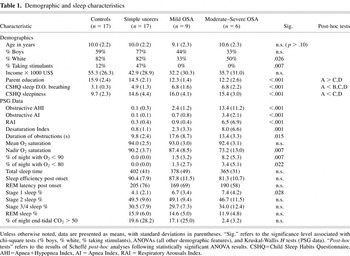
Next, the three clinical groups and the control group were compared on demographic characteristics (Table 1). Analysis of variance (ANOVA) indicated no differences across groups in age or family income [F(3,46) < 1.7, p > .10], and chi-square indicated no differences across groups in gender composition [χ2(3) = 3.7, p > .10]. However, ANOVA with Scheffé post-hoc tests indicated a significant difference across groups in parental education [F(3,46) = 8.2, p < .001], with children in the two OSA groups having parents with less education than those in the control group. Moreover, despite the fact that the clinical sample as a whole did not differ from controls in ethnic composition, Fisher's Exact p =.20, an ethnicity effect was found when the clinical sample was divided into three groups [χ2(3) = 10.2, p = .017]. The mild and moderate OSA groups had about twice the proportion of minorities as the other two groups. Overall, 13 of 15 minorities were African American; one was Asian American (mild OSA) and one was Hispanic (control). To determine the potential impact of these demographic differences on cross-group analyses, ethnicity and parent education were correlated with each dependent measure using point-biserial (ethnicity dichotomized to white vs. minority) or Pearson's correlations (education), with a two-tailed alpha set at .01 because of the large number of analyses. Both ethnicity and parent education correlated with the WISC–III Vocabulary, Block Design, and IQ scores (r > .43, p < .003), but not with any other dependent measure. As such, ethnicity and parent education were entered as covariates in cross-group analyses involving the WISC–III, but not those involving other variables.
Demographic and sleep characteristics

Finally, although we had complete data for all neuropsychological tests, some questionnaire data were missing. Three parents (6%; 2 mild OSA, 1 control) failed to complete questionnaires adequately (e.g., skipping items). All three had a high school education or less and headed low-income minority families. It is not clear what effect, if any, these missing data had on parent questionnaire analyses. Eleven sets (22%) of teacher questionnaires were not returned after two mailings. Chi-square and independent-groups t tests indicated no difference in subjects whose teachers did or did not return questionnaires on any of the following variables (ps > .30): study group, age, ethnicity, sex, family income, parent education, and behavioral functioning on parent-report questionnaires.
Comparisons of Sleep Across Groups
As seen in Table 1, ANOVA indicated a clear difference in parent-reported symptoms of sleep-disordered breathing and sleepiness (F > 8.3, p < .001), with the two OSA groups faring worst and the control group scoring very similar to published norms (Owens et al., 2000b). Because of marked skew on PSG data, Kruskal-Wallis H tests were used to compare the clinical groups on PSG indexes. These indicated that, in addition to the grouping index of AHI, the clinical groups differed in AI, RAI, percent of sleep spent in Stage 1 (very light sleep), and multiple indexes of O2 saturation [χ2(2) > 8.2, p < .05]. Overall, these data indicate a clear progression in sleep pathology across the groups.
Primary Goal: Clarify the Presence and Pattern of Neuropsychological Morbidity in Pediatric OSA
Cross-group comparisons
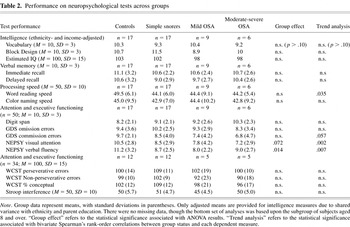
Table 2 compares the mean performance across groups on neuropsychological tests. The main analyses were multivariate in nature, but univariate results are provided for completeness of presentation. Five sets of main analyses were conducted, with the dependent measures grouped on conceptual and pragmatic grounds. The first dealt with intelligence, and involved a multivariate analysis of covariance (MANCOVA) with Vocabulary and Block Design as dependent measures, and ethnicity and parent income as covariates. The multivariate effect of group was nonsignificant [F(6,86) = 1.1, p > .20]. Because Estimated IQ was derived from these subtests, it was not entered into the MANCOVA, but no significant effect was found on univariate ANCOVA. The second main analysis, which examined memory, involved a multivariate analysis of variance (MANOVA) with the WRAML Immediate and Delayed recall indexes as dependent measures. The effect of group was nonsignificant [F(6,90) = 0.7, p > .20]. The third analysis examined processing speed via a MANOVA with the Stroop Word Reading and Color Naming indexes as dependent measures; this was also nonsignificant [F(6,62) = 1.0, p > .20].
Performance on neuropsychological tests across groups

The fourth main analysis examined attention and executive functioning within the full sample. A MANOVA with Digit Span, GDS omissions and commissions, and the NEPSY subtests yielded a significant multivariate effect [F(15,114) = 1.9, p = .027]. Follow-up ANOVAs indicated that this was largely due to a group difference in Verbal Fluency [F(3,45) = 4.0, p = .014], and a smaller effect on the Visual Attention subtest [F(3,45) = 2.5, p = .072]. The fifth main analysis examined attention and executive functioning on tests administered to ages 8 and up (n = 35). A MANOVA with the three WCST indexes and Stroop Interference index as dependent variables was nonsignificant [F(12,74) = 1.3, p > .20].
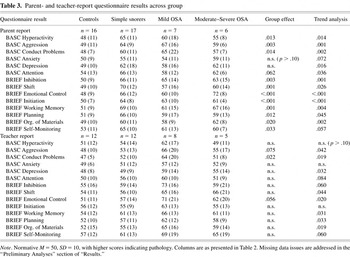
Table 3 presents group comparisons on parent- and teacher-report questionnaires. To account for reporter variance, two MANOVAs were conducted, one each with parent-report and teacher-report scales as dependent variables. As above, univariate effects are also presented. The multivariate effect on parent report was significant [F(42,87) = 2.1, p = .002]. Follow-up ANOVAs indicated that parents reported few differences across groups in mood or attention. However, they endorsed marked differences in impulsivity, aggression, appropriate task initiation, and ability to adapt to change, as well as smaller differences on other indexes of behavior regulation and executive functioning. The multivariate effect on teacher report did not reach significance [F(42,63) = 1.3, p > .10], but univariate analyses suggested group differences in aggression, conduct, and emotional control similar to those reported by parents.
Parent- and teacher-report questionnaire results across group

Trend analyses
MANOVA combines related dependent measures into a more reliable test of effects, but it treats the independent variable as categorical. Across groups in this study, a rank order may be assumed, with the controls at one end of the sleep-disordered breathing spectrum, and the moderate-severe OSA group at the other. Given this, we conducted a trend analysis, comprised of a series of one-tailed Spearman rank-order correlations between the sample grouping and each dependent measure. The results of this analysis are summarized in the final column of Tables 2 and 3. On cognitive tests, the trend analyses confirmed categorical findings and further suggested effects on the GDS commission index, re = −.23, p = .057, and word reading speed, re = −.31, p = .035. Trend analyses also largely confirmed categorical findings on parent-report questionnaires, and revealed several modest relationships between teacher-reported functioning and severity of sleep-disordered breathing, rs = .28–.34, p = .044–.019.
Secondary Goal: Explore the Relationship between Neuropsychological Functioning and Sleep
This goal was considered secondary because of the modest size of the clinical sample upon whom PSG data were available. Rank-order correlations were run between each PSG index listed in Table 1 and each dependent measure. This resulted in a matrix of 748 correlations. In an attempt to minimize false-positive (Type I) errors without extremely restricting statistical power, we set a two-tailed significance threshold of .005. Nine effects exceeded this threshold, more than twice as many as would be predicted by chance if all effects were independent. Though many of the observed correlations may have been spurious, it is noteworthy that five related to the percent of time spent in slow-wave sleep. Higher percentages of slow-wave sleep were associated with better teacher-reported emotional control, initiation of activities, working memory, planning and organization, and organization of materials, |rs| = .56–.74, p = .004–.00002. Scatterplots indicated that these five correlations were not clearly affected by extreme or outlier scores. No other PSG index significantly correlated with more than one dependent measure.
DISCUSSION
These data were consistent with some, but not all, of our predictions. Pediatric OSA was associated with diminished verbal fluency and visual attention, as well as greater levels of parent-reported behavior problems and executive functioning deficits. Further, there was evidence of a subtler effect of OSA on impulse control and teacher-reported behavior and executive functions. In this study, pediatric OSA had no reliable effect on overall intelligence or verbal memory, and its effect on mood was relatively small. However, not all findings matched expectations; in particular, many tests of attention and executive functioning failed to yield group effects. Finally, exploratory analyses failed to indicate a clear relationship between measures of neuropsychological functioning and 17 objective sleep indexes.
Lack of Effects of OSA on Intelligence, Verbal Memory, or Basic Processing Speed
Due to the modest sample size, it is risky to accept the null hypothesis that pediatric OSA does not affect conventionally defined intelligence, verbal memory, or basic processing speed. Our statistical power to detect anything other than a very large effect was less than .70 in multivariate analyses (Stevens, 1992). Even so, to our knowledge, no published study has reported below average IQ (i.e., measured intelligence markedly below published norms) in children with OSA. Some have reported a lower IQ among children with sleep-disordered breathing than controls (Friedman et al., 2003; Kennedy et al., 2004; Lewin et al., 2002), but in each case the controls were of above average intelligence. Volunteer control groups are often non representative of the general population, necessitating close demographic matching or post-hoc statistical accounting for demographic differences across groups. More importantly, each of these studies found normal intelligence among children with OSA when compared to age-based norms. This is in agreement with present findings, as well as those from the recent study by Kaemingk et al. (2003), who reported no significant IQ difference between children with OSA and controls in the largest relevant study to date. Thus, to date there is little evidence that OSA causes gross intellectual deficit in school-aged children. This is consistent with the adult literature, in which there have been variable findings across studies, but which has suggested that, overall, adults with OSA show minimal effect on psychometrically defined intellectual ability (Beebe et al., 2003b).
The prediction of a minimal effect on memory was based upon adult data, which has only inconsistently reported effects (Beebe et al., 2003b). Similarly, memory findings in children have been mixed. Rhodes et al. (1995) reported below-average memory performance compared to controls and to norms in a very small sample (n = 5) with severe OSA (M AHI = 33). Using larger samples with less severe sleep pathology, objectively normal memory scores were obtained by several groups (Kaemingk et al., 2003; Kennedy et al., 2004; Owens et al., 2000a), though two of the three reported that controls scored even higher. Present data did not yield evidence of OSA-related memory impairment. Indeed, the moderate–severe OSA group and the control group had similar scores on a verbal list-learning task, performing slightly better than published norms.
Mental processing speed was investigated in this study because there is preliminary evidence of mental slowing in children with OSA (Lewin et al., 2002). The ability to rapidly process simple stimuli is particularly important when examining attention and executive functioning, as slowed responding may preclude the application of higher-level attention or executive skills (Lezak, 1995; Verstraeten & Cluydts, 2004). Present data did not indicate a marked effect on basic processing speed, though there was a subtle trend towards difficulties in the clinical groups that may be worthy of further investigation.
Findings on Tests of Attention and Executive Functioning
Although attention and executive functioning have been suggested as areas of specific weakness in adult OSA (Beebe & Gozal, 2002; Beebe et al., 2003b), these domains are quite heterogeneous. As such, it was probably simplistic to expect a homogeneous effect in children. Present findings were mixed, and may help to highlight a specific pattern of deficit. The NEPSY Visual Attention and Verbal Fluency subtests displayed the strongest relationship to OSA. To our knowledge, only Owens and colleagues (Owens et al., 2000a) have reported scale-specific data on similar measures among children with OSA; these children displayed an unusual rate of impairment compared to norms on cancellation tasks, but had relatively normal scores on a measure of verbal fluency. Cancellation tasks such as the NEPSY Visual Attention subtest are believed to assess selective attention, scanning, and inhibition (Baron, 2004; Lezak, 1995). Verbal fluency task performance is also multiply determined, reflecting lexical retrieval and organization, mental flexibility, working memory, and inhibition (Baron, 2004). As timed tasks, both share a processing speed component, but the above finding of minimal processing speed effects adds confidence to the interpretation of NEPSY findings as indicators of deficit in at least selected aspects of attention and executive functioning.
Trend analyses further suggested OSA-related deficits in impulse control/behavioral inhibition, as measured by the commissions index of the GDS (Baron, 2004; Gordon, 1983), though unusually high variability in the clinical subjects' scores likely affected analyses. Impressively, the moderate–severe OSA group averaged over 1 standard deviation from published norms on this index, despite the fact that it had been truncated at 3 standard deviations from the mean. Two other groups have reported that children who are clinically referred because of concerns about breathing during sleep performed poorly on continuous performance tests (CPT) similar to the GDS, despite having relatively mild findings on PSG (Archbold et al., 2004; Kennedy et al., 2004). Present data are generally in agreement with these prior findings, but suggest that impulsivity is more prominent than poor sustained attention among school-aged children with OSA.
No significant effects were found on the Digit Span subtest of the WISC–III. Prior studies of children with sleep-disordered breathing have been mixed, with some reporting a weakness on measures of immediate memory span (Blunden et al., 2000) and others finding no such effect (Kaemingk et al., 2003). Similarly mixed findings were reported in a review of the adult literature presented at a recent conference (Beebe et al., 2003a). Diminished working memory (the ability to mentally manipulate and update multiple pieces of information at once) has been linked to OSA (Beebe & Gozal, 2002). However, this effect may be less marked than first supposed or digit span tasks may lack sensitivity.
Finally, present data did not yield significant effects on the Stroop Interference index or indexes from the WCST. The sample sizes were small, however, with as few as 5 children in one group. To our knowledge, no published research has given the WCST or Stroop to children with OSA. These instruments have been used clinically with children ages 8 and up, but some have suggested that the constructs measured in children differ from those in adults (Baron, 2004). Among adults with OSA, WCST findings have varied from substantial (Naegele et al., 1995) to minimal (Redline et al., 1997). Stroop interference trial findings have similarly varied across studies of adult OSA (Beebe et al., 2003a), and few authors have accounted for processing speed when interpreting their data.
Effects on Parent- and Teacher-Report Questionnaires
Office-based tests of attention and executive functioning have been criticized as correlating poorly with a child's actual functioning in daily life (“ecological validity”; e.g., Silver, 2000). As a result, parent- and teacher-report questionnaires have been developed to more closely reflect a child's actual daily functioning, albeit from the subjective perspective of the reporter (Gioia et al., 2000). In this study, a substantial gap emerged between the clinical and control groups on parent reports of impulsivity, conduct problems, and the metacognitive skills of self-initiation of activities, working memory, planning, organization, and self-monitoring. The groups did not differ as clearly in parent-reported attention problems. This dissociation between marked impulsivity/conduct problems and fewer problems sustaining attention reported by parents converges with the finding of greater effects on a GDS index of impulse control than sustained attention. Although there are frequent allusions to ADHD in the pediatric sleep literature, it may be that, among grade school children with sleep-disordered breathing, problems with behavior regulation are more common and/or more severe than attention problems per se. However, this finding requires replication. Moreover, given that this behavioral presentation of children is quite different from that of adults (e.g., less impulsivity in adults), neurodevelopment may play a substantial moderating role in determining the behavioral phenotype associated with OSA (Beebe & Gozal, 2002).
Parents reported few differences across groups on BASC anxiety and depression subscales, but reported a marked effect on the BRIEF emotional control subscale. Whereas the BASC scales were intended to measure relatively stable aspects of emotional functioning (Reynolds & Kamphaus, 1992), the BRIEF emotional control subscale measures more dynamic aspects of emotion regulation, such as the tendency to overreact to minor events (Gioia et al., 2000). The latter skills are much more closely tied to executive functioning, consistent with theoretical models of the impact of OSA on cognition and behavior (Beebe & Gozal, 2002). However, these dissociations in parent-reported functioning involve comparisons of relative effect size. In fact, parents reported a wide variety of concerns.
The simple snoring group often displayed more parent-reported pathology than the two OSA groups, a counterintuitive finding that is nevertheless consistent with results from other clinic-referred samples (Lewin et al., 2002; Owens et al., 2000a). In clinic, we have seen astute parents whose main concerns were behavioral, not medical, but who had sought sleep evaluation after being exposed to the recent popular press on the possible behavioral impact of OSA. As a group, such children would be assumed to have less sleep pathology than those whose parents sought out medical assistance because of primary concerns about sleep. Indeed, all of the children in our clinical sample who had been prescribed stimulants fell in the simple snoring group, raising questions about a possible referral/acquisition bias in that group. Alternatively, an anonymous reviewer of this paper questioned whether the children taking stimulants failed to develop compensatory strategies, and therefore looked worse when medication-free (parents and teachers were asked to rate “unmedicated” behaviors whenever possible). A third and equally intriguing possibility was raised by O'Brien et al. (2003) who used parent questionnaires to classify community-recruited children as having significant ADHD (>2 SDs above norms), mild ADHD (1–2 SDs above norms), or “controls” (<1 SD above norms). The significant ADHD group scored equivalent to controls on PSG indexes of breathing obstruction, sleep disruption, and blood oxygenation, but the mild ADHD group showed a higher rate of PSG abnormalities. Thus, snoring may be a risk marker for behavioral pathology, but severe psychopathology may not be solely attributed to OSA.
To our knowledge, the current study was the first to collect teacher-report data on children with PSG-verified sleep pathology. Such data can be of critical importance, as teachers are typically unaware of a child's medical/sleep status, and may therefore be less prone to rating bias. Moreover, teachers see children in a different setting than do parents, providing unique information (Gioia et al., 2000; Reynolds & Kamphaus, 1992). Statistical tests that treated the groups as categorical yielded few effects on teacher-report measures, but tests that assumed a rank ordering of the groups indicated a broader picture. Teachers of children with sleep-disordered breathing tended to report difficulties with behavior regulation, mental flexibility, emotional control, and metacognitive skills. These effects were generally in line with those on parent report. Moreover, examination of the teacher-report data in Table 3 indicates a number of areas of apparent concern, especially in the mild OSA group, that may not have been detected in categorical analyses due to low statistical power. It will be important to conduct future research in larger samples and to consider teacher input, rather than relying exclusively upon parent-report or office-based tests.
Correlations Between PSG and Neuropsychological Data
Present data did not reflect a clear correlation between any neuropsychological index and 17 PSG indexes of sleep architecture, severity of hypoxia, or frequency of obstructive events, hypoxic events, or sleep disruption. Although our sample was small, it is important to note that numerous studies of adults, including some with substantial sample sizes, have failed to produce a clear picture of the causes of neuropsychological dysfunction in OSA (cf. Engleman et al., 2000). In pediatric studies, some have reported small correlations between AHI and neuropsychological outcome (D. Gozal et al., 2001b; Kaemingk et al., 2003), but others have reported that habitually snoring children are at higher risk for adverse behavioral outcomes regardless of AHI (Blunden et al., 2000). Various authors have suggested that percent of REM sleep, percent of Stage 1 sleep, movement-related arousals, or hypoxia may account for the adverse effects of pediatric OSA (Chervin et al., 2002; Kaemingk et al., 2003; O'Brien et al., 2003; Picchietti & Walters, 1999), but findings have conflicted. Present data hinted at a relationship between slow-wave sleep and behavioral symptoms, but this finding requires replication.
Our lack of correlational results underscores the finding that there was considerable overlap in the cognitive and behavioral functioning of children who were labeled simple snorers using conventional criteria versus those labeled as having OSA. On a pragmatic level, such findings raise questions about the utility of conventional PSG indexes in diagnosing OSA or predicting morbidity. We maintain that PSG remains the gold standard in diagnosing OSA, and note that medical morbidity can be predicted by conventional PSG indexes in children (e.g., Amin et al., 2002). However, we concur with Lewin et al. (2002) that more sophisticated indexes may need to be developed to capture the aspects of OSA that predict neuropsychological dysfunction in children. Beyond the biological insult or challenge posed by sleep pathology, it is also likely that a number of factors influence morbidity, including developmental stage, duration of symptoms, and sources of personal or environmental reserve (Dennis, 2000). As noted earlier, the pediatric research literature has been progressing rapidly, and we look forward to further clarity on these issues in the coming years.
Design Limitations and Strengths
Conclusions that can be drawn from the present study are tempered by several design limitations. Two of these, sample size and potential referral bias, have been discussed already. In addition, although the time of day during which testing occurred was controlled, we did not gather data on the child's sleep schedule in the days leading up to the evaluation. Of greater note, although control subjects were screened for clinical signs of OSA, they did not undergo PSG. It is unlikely that any controls displayed significant sleep-disordered breathing, but entering normal PSG values into analyses may have expanded the range of scores and helped to detect subtle correlations between PSG indexes and neuropsychological test data. Conversely, even in our clinical sample, severe OSA was rare; only 2 subjects had an AHI over 10. Children with very severe pathology may display greater degree and breadth of morbidity.
Despite efforts to recruit a control sample that was demographically matched to the clinical sample, this matching was only partially successful. Controls were reasonably matched to simple snorers, but children with OSA were more likely to be minorities (especially African Americans), with less-educated and less wealthy parents. African American children are at elevated risk for OSA (Rosen et al., 2003), suggesting that the lack of match between controls and OSA subjects in the present study may reflect natural variation in the incidence of OSA across demographic groups. Within the region in which this study took place, being a minority dramatically increases the risk for lower parent education and family income, so these variables may also have been impacted by epidemiological factors. Such disparities highlight the importance of considering demographic information when studying the neuropsychological effects of pediatric sleep disorders such as OSA.
Indeed, the present study's consideration of demographic information beyond age and gender was a strength. In addition, this study used a wider range of executive functioning tests than have been previously reported in studies of pediatric OSA, incorporating these with measures of reported executive functioning in daily life. The inclusion of teacher reports of daytime functioning is unprecedented in the published OSA research literature, and adds an important dimension to the understanding of these children. Finally, this study is one of only a handful of controlled studies that have included both objective measures of sleep (PSG) and neuropsychological functioning. In doing so, this research allowed for more confident and detailed interpretation of the neuropsychological functioning, especially the attention and executive functioning, of children with objectively defined OSA.
Conclusions and Future Directions
These data add to the growing research literature on the neuropsychological effects of OSA. Among school-aged children, it appears that OSA contributes to significant neuropsychological morbidity, most notably in the areas of selective attention, mental flexibility, impulse control, behavior and emotional regulation, and metacognition. This cognitive profile shares points of similarity and dissimilarity with adult findings, suggesting further examination of developmental and neurodevelopmental moderators of the effects of OSA. Beebe and Gozal (2002) proposed several ways in which development may moderate the neuropsychological impact of OSA, but these await direct test. Indeed, certain populations (e.g., adolescents), have been all but ignored in the OSA literature.
Even as the short-term effects of pediatric OSA and its treatment become better established, longer-term follow-up studies are badly needed. Studies of the short-term impact of adenotonsillectomy evoke considerable optimism. However, the only long-term study to date has suggested that academic deficits persist long after the resolution of sleep-disordered breathing (D. Gozal & Pope, 2001). For now, sleep medicine clinicians are advised to make a detailed inquiry about the behavioral, adaptive, and scholastic functioning of children who present with symptoms of OSA. Standardized behavioral questionnaires, such as the BASC and BRIEF, may be helpful tools in this process. In cases where a PSG returns borderline results, treatment may be warranted if there is evidence of significant daytime pathology. Conversely, mental health and educational professionals should make detailed inquiries into the nocturnal functioning of children who are struggling during the day. Structured questionnaires such as the CSHQ may be helpful, though at this point no pediatric sleep questionnaire has published norms that are well stratified by age, and sleep questionnaires should not be considered diagnostic, especially with respect to OSA (American Academy of Pediatrics Section on Pediatric Pulmonology, 2002). When significant concerns about sleep arise, referral to an appropriate pediatric sleep specialist is warranted.
The physiological mechanism that underlies neuropsychological deficits in OSA remains uncertain, and will likely be elucidated in the coming years. Neuroanatomical models have been forwarded that implicate prefrontal cortical systems (Beebe & Gozal, 2002), the hippocampus (D. Gozal et al., 2001a), and subcortical systems including the basal ganglia (Aloia et al., 2003). It is risky to make localization statements based upon the mean neuropsychological test performance in a group of children. Even so, present data are more consistent with prefrontal and subcortical models than others that have been proposed, but this conclusion is advanced very tentatively. The impact may be multifocal, with some neural systems affected by different features of OSA or at different degrees of severity. To our knowledge, no published pediatric OSA research has yet capitalized on recent advances in structural or functional neuroimaging or quantitative electroencephalography that have begun to be used in adult sleep research. Ultimately, it will be the convergence of cognitive, behavioral, and physiological data that clarifies the morbidity associated with this relatively common sleep disorder.
ACKNOWLEDGMENTS
The authors thank the Cincinnati Children's Hospital Medical Center Neuropsychology Team and the anonymous reviewers for their helpful comments on earlier drafts of this paper. Grant support for this work was provided by the University of Cincinnati Research Council and a Cincinnati Children's Trustee Award to the first author. Portions of these findings were presented at the June, 2004 meeting of the Associated Professional Sleep Societies, Philadelphia, PA.
References
REFERENCES
Ali, N.J.,
Pitson, D.J., &
Stradling, J.R.
(1993).
Snoring, sleep disturbance, and behaviour in 4–5 year olds.
Archives of Diseases in Childhood,
68,
360–366.Google Scholar
Ali, N.J.,
Pitson, D.J., &
Stradling, J.R.
(1996).
Sleep disordered breathing: Effects of adenotonsillectomy on
behaviour and psychological functioning.
European Journal of Pediatrics,
155,
56–62.Google Scholar
Aloia, M.S.,
Ilniczky, N.,
Di Dio, P.,
Perlis, M.,
Greenblatt, D.W., &
Giles, D.E.
(2003).
Neuropsychological changes and treatment compliance in older adults
with sleep apnea.
Journal of Psychosomatic Research,
54,
71–76.Google Scholar
American Academy of Pediatrics Section on Pediatric
Pulmonology.
(2002).
Clinical practice guideline: Diagnosis and management of childhood
obstructive sleep apnea syndrome.
Pediatrics,
109,
704–712.Google Scholar
American Sleep Disorders Association.
(1992).
EEG arousals: Scoring rules and examples: A preliminary report from
the Sleep Disorders Atlas Task Force of the American Sleep Disorders
Association.
Sleep,
15,
173–184.Google Scholar
American Thoracic Society.
(1996).
Standards and indications for cardiopulmonary sleep studies in
children.
American Journal of Respiratory and Critical Care Medicine,
153,
866–878.Google Scholar
Amin, R.S.,
Kimball, T.R.,
Bean, J.A.,
Jeffries, J.L.,
Willging, J.P.,
Cotton, R.T.,
Witt, S.A.,
Glascock, B.J., &
Daniels, S.R.
(2002).
Left ventricular hypertrophy and abnormal ventricular geometry in
children and adolescents with obstructive sleep apnea.
American Journal of Respiratory and Critical Care Medicine,
165,
1395–1399.Google Scholar
Archbold, K.H.,
Giordani, B.,
Ruzicka, D.L., &
Chervin, R.D.
(2004).
Cognitive executive dysfunction in children with mild
sleep-disordered breathing.
Biological Research for Nursing,
5,
168–176.Google Scholar
Baron, I.S.
(2004).
Neuropsychological evaluation of the child.
New York:
Oxford University Press.
Beebe, D.W.,
Aloia, M.,
Wells, C.,
Groesz, L., &
Nichols, A.
(2003a).
Sleep apnea affects attention and executive functioning: A closer
look [Abstract].
Journal of the International Neuropsychological Society,
9,
184.Google Scholar
Beebe, D.W. &
Gozal, D.
(2002).
Obstructive sleep apnea and the prefrontal cortex: Towards a
comprehensive model linking nocturnal upper airway obstruction to
daytime cognitive and behavioral deficits.
Journal of Sleep Research,
11,
1–16.Google Scholar
Beebe, D.W.,
Groesz, L.,
Wells, C.,
Nichols, A., &
McGee, K.
(2003b).
The neuropsychological effects of Obstructive Sleep Apnea (OSA): A
meta-analysis of norm-referenced and case-controlled data.
Sleep,
26,
298–307.Google Scholar
Bergman, R.L.
(1976).
Treatment of childhood insomnia diagnosed as
“hyperactivity.”
Journal of Behavior Therapy and Experimental Psychiatry,
7,
199.Google Scholar
Blunden, S.,
Lushington, K.,
Kennedy, D.,
Martin, J., &
Dawson, D.
(2000).
Behavior and neurocognitive performance in children aged 5–10
years who snore compared to controls.
Journal of Clinical and Experimental Neuropsychology,
22,
554–568.Google Scholar
Chervin, R.D.,
Dillon, J.E.,
Archbold, K.H., &
Ruzicka, D.L.
(2003).
Conduct problems and symptoms of sleep disorders in children.
Journal of the American Academy of Child and Adolescent Psychiatry,
42,
201–208.Google Scholar
Chervin, R.D.,
Dillon, J.E.,
Bassetti, C.,
Ganoczy, D.A., &
Pituch, K.J.
(1997).
Symptoms of sleep disorders, inattention, and hyperactivity in
children.
Sleep,
20,
1185–1192.Google Scholar
Chervin, R.D.,
Giordani, B.,
Ruzicka, D.L.,
Marriott, D.J.,
Weatherly, R.A.,
Marcus, C.L.,
Dillon, J.E.,
Huffman, J.L., &
Layne, J.R.
(2002).
Polysomnographic findings and behavior in children scheduled for
adenotonsillectomy or hernia repair [Abstract].
Sleep,
25(Suppl.),
A431.Google Scholar
Chervin, R.D.,
Hedger, K.M.,
Dillon, J.E., &
Pituch, K.J.
(2000).
Pediatric sleep questionnaire (PSQ): Validity and reliability of
scales for sleep-disordered breathing, snoring, sleepiness, and
behavioral problems.
Sleep Medicine,
1,
21–32.Google Scholar
Dennis, M.
(2000).
Childhood medical disorders and cognitive impairment: Biological
risk, time, development, and reserve. In
K.O. Yeates,
M.D. Ris, &
H.G. Taylor (Eds.),
Pediatric neuropsychology: Research, theory, and practice (pp.
3–22).
New York:
Guilford.
Doran, J.,
Esnaola, S.,
Rubio, R., &
Iztueta, A.
(2001).
Obstructive sleep apnea-hypopnea and related clinical features in a
population-based sample of subjects aged 30 to 70 yr.
American Journal of Respiratory and Critical Care Medicine,
163,
685–689.Google Scholar
Engleman, H.M.,
Kingshott, R.N.,
Martin, S.E., &
Douglas, N.J.
(2000).
Cognitive function in the sleep apnea/hypopnea syndrome (SAHS).
Sleep,
23(Suppl. 4),
S102–S108.Google Scholar
Fallone, G.P.,
Acebo, C.,
Arnedt, J.T.,
Seifer, R., &
Carskadon, M.A.
(2001).
Effects of acute sleep restriction on behavior, sustained attention,
and response inhibition in children.
Perceptual and Motor Skills,
93,
213–229.Google Scholar
Fallone, G.P.,
Seifer, R.,
Acebo, C., &
Carskadon, M.A.
(2000).
Prolonged sleep restriction in 11- and 12-year-old children: Effects
on behavior, sleepiness, and mood [Abstract].
Sleep,
23(Suppl. 2),
A28.Google Scholar
Fitzgerald, H.E.,
Sullivan, L.A.,
Ham, H.P.,
Zucker, R.A.,
Bruckel, S.,
Schneider, A.M., &
Noll, R.B.
(1993).
Predictors of behavior problems in three-year-old sons of
alcoholics: Early evidence for the onset of risk.
Child Development,
64,
110–123.Google Scholar
Friedman, B.C.,
Hendeles-Amitai, A.,
Kozminzki, E.,
Leiberman, A.,
Friger, M.,
Tarasuik, A., &
Tal, A.
(2003).
Adenotonsillectomy improves neurocognitive function in children
with obstructive sleep apnea syndrome.
Sleep,
26,
999–1005.Google Scholar
Gioia, G.A.,
Isquith, P.K.,
Guy, S.C., &
Kenworthy, L.
(2000).
BRIEF—Behavior Rating Inventory of Executive Function.
Odessa, FL:
Psychological Assessment Resources.
Gislason, T. &
Benediktsdottir, B.
(1995).
Snoring, apneic episodes, and nocturnal hypoxemia among children 6
months to 6 years old.
Chest,
107,
963–966.Google Scholar
Goh, D.Y.,
Galster, P., &
Marcus, C.L.
(2000).
Sleep architecture and respiratory disturbances in children with
obstructive sleep apnea.
American Journal of Respiratory and Critical Care Medicine,
162,
682–686.Google Scholar
Golden, C.J.
(1978).
Stroop Color and Word Test.
Chicago:
Stoelting.
Goldstein, N.A.,
Post, J.C.,
Rosenfeld, R.M., &
Campbell, T.F.
(2000).
Impact of tonsillectomy and adenoidectomy on child behavior.
Archives of Otolaryngology, Head and Neck Surgery,
126,
494–498.Google Scholar
Gordon, M.
(1983).
The Gordon Diagnostic System.
DeWitt, NY:
Gordon Systems.
Gottlieb, D.J.,
Vezina, R.M.,
Chase, C.,
Lesko, S.M.,
Heeren, T.C.,
Weese-Mayer, D.E.,
Auerbach, S.H., &
Corwin, M.J.
(2003).
Symptoms of sleep-disordered breathing in 5-year-old children are
associated with sleepiness and problem behaviors.
Pediatrics,
112,
870–877.Google Scholar
Gozal, D.
(1998).
Sleep disordered breathing and school performance in children.
Pediatrics,
102,
616–620.Google Scholar
Gozal, D.
(2001).
Morbidity of obstructive sleep apnea in children: Facts and theory.
Sleep and Breathing,
5,
35–42.Google Scholar
Gozal, D.,
Daniel, J.M., &
Dohanich, G.P.
(2001a).
Behavioral and anatomical correlates of chronic episodic hypoxia
during sleep in the rat.
Journal of Neuroscience,
21,
2442–2450.Google Scholar
Gozal, D.,
Holbrook, C.R.,
Mehl, R.C.,
Nichols, K.L.,
Raffield, T.J.,
Burnside, M.M., &
Mervis, C.B.
(2001b).
Correlation analysis between NESPY battery scores and respiratory
disturbance index in snoring 6-year old children: A preliminary report
[Abstract].
Sleep,
24(Suppl.),
A126.Google Scholar
Gozal, D. &
Pope, D.
(2001).
Snoring during early childhood and academic performance at ages
thirteen to fourteen years.
Pediatrics,
107,
1394–1399.Google Scholar
Gozal, D.,
Wang, M., &
Pope, D.W.
(2001c).
Objective sleepiness measures in pediatric obstructive sleep apnea.
Pediatrics,
108,
693–697.Google Scholar
Gozal, E.,
Row, B.W.,
Schurr, A., &
Gozal, D.
(2001).
Developmental differences in cortical and hippocampal vulnerability
to intermittent hypoxia in the rat.
Neuroscience Letters,
305,
197–201.Google Scholar
Gruber, R.,
Sadeh, A., &
Raviv, A.
(2000).
Instability of sleep patterns in children with
attention-deficit/hyperactivity disorder.
Journal of the American Academy of Child and Adolescent Psychiatry,
39,
495–501.Google Scholar
Harding, S.M.
(2000).
Complications and consequences of obstructive sleep apnea.
Current Opinion in Pulmonary Medicine,
6,
485–489.Google Scholar
Harrison, Y. &
Horne, J.A.
(2000).
The impact of sleep deprivation on decision making: A review.
Journal of Experimental Psychology: Applied,
6,
236–249.Google Scholar
Heaton, R.K.,
Chelune, G.J.,
Talley, J.L.,
Kay, G.G., &
Curtiss, G.
(1993).
Wisconsin Card Sorting Test manual: Revised and expanded.
Odessa, FL:
Psychological Assessment Resources.
Kaemingk, K.L.,
Pasvogel, A.E.,
Goodwin, J.L.,
Mulvaney, S.A.,
Martinez, F.,
Enright, P.L.,
Rosen, G.M.,
Morgan, W.J.,
Fregosi, R.F., &
Quan, S.F.
(2003).
Learning in children and sleep-disordered breathing: Findings of
the Tucson Children's Assessment of Sleep Apnea (TuCASA)
prospective cohort study.
Journal of the International Neuropsychological Society,
9,
1016–1026.Google Scholar
Kennedy, J.D.,
Blunden, S.,
Hirte, C.,
Parsons, D.W.,
Martin, A.J.,
Crowe, E.,
Williams, D.,
Pamula, Y., &
Lushington, K.
(2004).
Reduced neurocognition in children who snore.
Pediatric Pulmonology,
37,
330–337.Google Scholar
Korkman, M.,
Kirk, U., &
Kemp, S.
(1998).
NEPSY—A developmental neuropsychological assessment.
San Antonio, TX:
The Psychological Corporation.
Kral, M.C.,
Brown, R.T.,
Nietert, P.J.,
Abboud, M.R.,
Jackson, S.M., &
Hynd, G.W.
(2003).
Transcranial Doppler ultrasonography and neurocognitive functioning
in children with sickle cell disease.
Pediatrics,
112,
324–331.Google Scholar
Lewin, D.S.,
Rosen, R.C.,
England, S.J., &
Dahl, R.E.
(2002).
Preliminary evidence of behavioral and cognitive sequelae of
obstructive sleep apnea in children.
Sleep Medicine,
3,
5–13.Google Scholar
Lezak, M.D.
(1995).
Neuropsychological assessment
(3rd ed.).
New York:
Oxford University Press.
Marcus, C.L.,
Omlin, K.J.,
Basinki, D.J.,
Bailey, S.L.,
Rachal, A.B.,
Von Pechmann, W.S.,
Keens, T.G., &
Ward, S.L.D.
(1992).
Normal polysomnographic values for children and adolescents.
American Review of Respiratory Disease,
146,
1235–1239.Google Scholar
Martin, S.E.,
Brander, P.E.,
Deary, I.J., &
Douglas, N.J.
(1999).
The effect of clustered versus regular sleep fragmentation on
daytime function.
Journal of Sleep Research,
8,
305–311.Google Scholar
Minde, K.,
Faucon, A., &
Falkner, S.
(1994).
Sleep problems in toddlers: Effects of treatment on their daytime
behavior.
Journal of the American Academy of Child and Adolescent Psychiatry,
33,
114–1121.Google Scholar
Mirsky, A.F.
(1996).
Disorders of attention: A neuropsychological perspective. In
G.R. Lyon &
N.A. Krasnegor (Eds.),
Attention, memory, and executive function (pp.
71–95).
Baltimore:
Paul H. Brookes Publishing.
Naegele, B.,
Thouvard, V.,
Pepin, J.L.,
Levy, P.,
Bonnet, C.,
Perret, J.E.,
Pellat, J., &
Feuerstein, C.
(1995).
Deficits of cognitive executive functions in patients with sleep
apnea syndrome.
Sleep,
18,
43–52.Google Scholar
O'Brien, L.,
Holbrook, C.R.,
Mervis, C.B.,
Klaus, C.J.,
Bruner, J.,
Raffield, T.J.,
Rutherford, R.C.,
Mehl, R.C.,
Wang., A.,
Tuell, A.,
Hume, B.C., &
Gozal, D.
(2003).
Sleep and neurobehavioral characteristics in 5–7-year-old
children with parentally reported symptoms of attention-deficit
hyperactivity disorder.
Pediatrics,
111,
554–563.Google Scholar
Owens, J.,
Spirito, A.,
Marcotte, A.C.,
McGuinn, M., &
Berkelhammer, L.
(2000a).
Neuropsychological and behavioral correlates of obstructive sleep
apnea syndrome in children: A preliminary study.
Sleep and Breathing,
4,
67–78.Google Scholar
Owens, J.,
Spirito, A., &
McGuinn, M.
(2000b).
The children's sleep habits questionnaire (CSHQ): Psychometric
properties of a survey instrument for school-aged children.
Sleep,
23,
1043–1051.Google Scholar
Picchietti, D.L. &
Walters, A.S.
(1999).
Moderate to severe periodic limb movement disorder in childhood and
adolescence.
Sleep,
22,
297–300.Google Scholar
Punjabi, N.,
Sorkin, J.D.,
Katzel, L.I.,
Goldberg, A.P.,
Schwartz, A.R., &
Smith, P.L.
(2002).
Sleep-disordered breathing and insulin resistance in middle-aged
and overweight men.
American Journal of Respiratory and Critical Care Medicine,
165,
677–682.Google Scholar
Rechtschaffen, A. &
Kales, A.
(1968).
A manual of standardized terminology: Techniques and scoring system
for sleep stages of human subjects.
Los Angeles, CA:
UCLA Brain Information Service/Brain Research Institute.
Redline, S.,
Strauss, M.E.,
Adams, N.,
Winters, M.,
Roebuck, T.,
Spry, K.,
Rosenberg, C., &
Adams, K.
(1997).
Neuropsychological function in mild sleep-disordered breathing.
Sleep,
20,
160–167.Google Scholar
Reynolds, C.R. &
Kamphaus, R.W.
(1992).
BASC—Behavioral Assessment System for Children manual.
Circle Pines, MN:
American Guidance Service.
Rhodes, S.K.,
Shimoda, K.C.,
Waid, R.,
O'Neil, P.M.,
Oexmann, M.J.,
Collop, N.A., &
Willi, S.M.
(1995).
Neurocognitive deficits in morbidly obese children with obstructive
sleep apnea.
Journal of Pediatrics,
127,
741–744.Google Scholar
Rosen, C.L.
(2004).
Obstructive sleep apnea syndrome in children: Controversies in
diagnosis and treatment.
Pediatric Clinics of North America,
51,
153–167.Google Scholar
Rosen, C.L.,
Larkin, E.K.,
Kirchner, H.L.,
Emancipator, J.L.,
Bivins, S.F.,
Surovec, S.A.,
Martin, R.J., &
Redline, S.
(2003).
Prevalence and risk factors for sleep-disordered breathing in
8–11-year-old children: Association with race and
prematurity.
Journal of Pedatrics,
142,
383–389.Google Scholar
Row, B.W.,
Khierandish, L.,
Neville, J.J., &
Gozal, D.
(2002).
Impaired spatial learning and hyperactivity in developing rats
exposed to intermittent hypoxia.
Pediatric Research,
52,
449–453.Google Scholar
Sadeh, A.,
Gruber, R., &
Raviv, A.
(2002).
Sleep, neurobehavioral functioning, and behavior problems in
school-age children.
Child Development,
73,
405–417.Google Scholar
Sadeh, A.,
Gruber, R., &
Raviv, A.
(2003).
The effects of sleep restriction and extension on school-age
children: What a difference an hour makes.
Child Development,
74,
444–455.Google Scholar
Sattler, J.M.
(2001).
Assessment of children: Cognitive applications
(4th ed.).
San Diego, CA:
Author.
Sheslow, D. &
Adams, W.
(1990).
Wide Range Assessment of Memory and Learning administration manual.
Wilmington, DE:
Wide Range, Inc.
Silver, C.H.
(2000).
Ecological validity of neuropsychological assessment in childhood
traumatic brain injury.
Journal of Head Trauma and Rehabilitation,
6,
235–238.Google Scholar
Simonds, J.F. &
Parraga, H.
(1984).
Sleep behaviors and disorders in children and adolescents evaluated
at psychiatric clinics.
Developmental and Behavioral Pediatrics,
5,
6–10.Google Scholar
SPSS Incorporated.
(2002).
SPSS for Windows (Release 11.5.0) [Computer Software].
Chicago:
Author.
Steen, R.G.,
Xiong, X.,
Mulhern, R.K.,
Langston, J.W., &
Wang, W.C.
(1999).
Subtle brain abnormalities in children with sickle cell disease:
Relationship to blood hematocrit.
Annals of Neurology,
45,
279–286.Google Scholar
Stevens, J.
(1992).
Applied multivariate statistics for the social sciences.
Hillsdale, NJ:
Lawrence Erlbaum Associates.
Stradling, J.R.,
Thomas, G.,
Warley, A.R.H.,
Williams, P., &
Freeland, A.
(1990).
Effect of adenotonsillectomy on nocturnal hypoxaemia, sleep
disturbance, and symptoms in snoring children.
Lancet,
335,
249–253.Google Scholar
Uliel, S.,
Tauman, R.,
Greenfield, M., &
Sivan, Y.
(2004).
Normal polysomnographic respiratory values in children and
adolescents.
Chest,
125,
872–878.Google Scholar
Urschitz, M.S.,
Guenther, A.,
Eggebrecht, E.,
Wolff, J.,
Urschitz-Duprat, P.M.,
Schlaud, M., &
Poets, C.F.
(2003).
Snoring, intermittent hypoxia, and academic performance in primary
school children.
American Journal of Respiratory and Critical Care Medicine,
168,
464–468.Google Scholar
Verstraeten, E. &
Cluydts, R.
(2004).
Executive control of attention in sleep apnea patients: Theoretical
concepts and methodological considerations.
Sleep Medicine Reviews,
8,
257–267.Google Scholar
Walters, A.S.,
Mandelbaum, D.E.,
Lewin, D.S.,
Kugler, S.,
England, S.J., &
Miller, M.
(2000).
Dopaminergic therapy in children with restless legs/periodic
limb movements in sleep and ADHD.
Pediatric Neurology,
22,
182–186.Google Scholar
Wechsler, D.
(1991).
Wechsler Intelligence Scale for Children, Third Edition Manual.
San Antonio, TX:
The Psychological Corporation.
Young, T.,
Evans, L.,
Finn, L., &
Palta, M.
(1997).
Estimation of the clinically diagnosed proportion of sleep apnea
syndrome in middle-aged men and women.
Sleep,
20,
705–706.Google Scholar
Demographic and sleep characteristics
Performance on neuropsychological tests across groups
Parent- and teacher-report questionnaire results across group
 You have
Access
- 165
- Cited by