Introduction
The Apologies of Justin Martyr are among our most important sources for the state and development of early Christianity in the second century. In the Apologies, Justin, who is often said to have initiated the first serious dialogue between Christianity and Greco-Roman philosophy, attempts to define and explain to the outside world what the Christian teaching and way of life are, and what they are not. Because of this normative tenor of the writings, modern readers sometimes tend to approach their content as more-or-less timeless articulations that are only vaguely connected to the historical circumstances in which they were written. But as with most writings from antiquity, the content of Justin's Apologies, including questions of theology, philosophy, and ethics, is intimately bound to their historical context, as recent scholarship on Justin has shown very well. However, the historical questions of the literary genre, intended audience, occasion, and purpose of the Apologies are still debated among scholars, including the question of the exact relationship between the First and the Second Apology. To critically deal with these questions, all of which are interrelated, is of utmost importance for our understanding of Justin Martyr and his writings, and thus of second-century Christianity in general.
In the following study I will attempt to shed some light on these difficult but important questions, with the focus aimed at Justin's Second Apology. I will do so both by engaging earlier scholarship on 2 Apol. and by offering a fresh reading of the writing inspired by the field of ancient epistolography. This will be carried out in four steps: First I will address the recurring and perplexing question of the relationship between Justin's two Apologies. I will then turn to the question of whom Justin intended to address by his writing. In the third section attention is paid to the literary genre of 2 Apol., and, finally, in the fourth part of the study, the question of the occasion and purpose of the writing will be considered.
I will argue that Justin wrote 2 Apol. as a private petition to the Roman authorities due to some recent repression of Christians, with the main purpose of preventing further affliction, particularly of Justin himself. The study suggests that the composition of 2 Apol. was even more firmly rooted in Justin's own situation at the time of writing than most scholars have hitherto thought.
The Relation of the Second Apology to the First
The relationship between 1 Apol. and 2 Apol. is a matter of considerable debate among scholars. There have been three main positions within that debate: a) 1 Apol. and 2 Apol. are two independent works,Footnote 1 b) 1 Apol. and 2 Apol. originally belonged to one single work,Footnote 2 and c) 2 Apol. is a “supplement” or “appendix” to 1 Apol.Footnote 3 It seems that the majority of scholars today want to compromise between a) and b) by following c), but it is not sufficiently clear, at least not to me, what exactly is meant by the claim that 2 Apol. is an “appendix.”
The question is notoriously difficult.Footnote 4 One important cause for this difficulty is that the textual evidence for the writings of Justin is very late, scanty, and corrupt. Apart from some scattered quotations and allusions in later authors, his writings have come down to us in a single manuscript, the Parisinus graecus 450 (= codex A), dated 11 September 1363.Footnote 5 Between the dating of Justin's writings themselves (ca. 150–160 c.e.) and the dating of the earliest extant manuscript of these writings there is thus a time span of no less than twelve centuries. Moreover, this invaluable manuscript is unfortunately “plagued with countless textual gaps, scribal errors and corruptions, dislocation of text, intrusive marginal glosses, etc.”Footnote 6 Chapter 2 in 2 Apol., for instance, is almost entirely missing in codex A, due to the loss of one folio in the manuscript.
Does the codex tell us anything about the relationship between the two Apologies? As a matter of fact, much unlike the standard order in which Justin's writings are referred to, in codex A the Dialogue with Trypho is placed first, after which comes the Second Apology, and then, finally, the First Apology. This arrangement implies two things: first, that codex A presupposes a tradition in which 1 Apol. and 2 Apol. are seen as two independent writings, and second, that this same tradition would not have taken 2 Apol. to be a mere “appendix” to 1 Apol., since it places 2 Apol. before 1 Apol. However, the fact that we do not know how far back in time this tradition goes makes it very difficult to assess the real value of these two implications.
A much earlier and a very important testimony to the texts of Justin is the Ecclesiastical History of Eusebius of Caesarea, written in the early fourth century, i.e., approximately ten centuries prior to the date of codex A.Footnote 7 Eusebius adds much to our knowledge of Justin's writings. For one thing, it is precisely thanks to Eusebius that we know the contents of chapter 2 in 2 Apol., the bulk of which, as noted above, is missing in codex A, for Eusebius luckily quotes the chapter in full.Footnote 8 Moreover, the church historian makes a number of helpful references to Justin's 1 Apol. and 2 Apol. that can shed light on the difficult question of the relationship between the two texts.
At the same time, however, Eusebius adds much to our confusion in this respect as well. Apart from the obvious fact that he, like us, is engaged in interpreting Justin's writings,Footnote 9 his references to the Apologies are not always consistent. Thus, while there seems to be little doubt that he refers to two distinct Apologies by Justin,Footnote 10 it is not altogether clear whether these two Apologies are our 1 Apol. and 2 Apol. On two occasions he refers to the latter as if it forms a part of the former; that is to say, he quotes from our 2 Apol. and explicitly states that the quotation derives from “The First Apology” ( ).Footnote 11 This has led some scholars to believe that Eusebius really understood or had access to our 1 Apol. and 2 Apol. as one single work, “The First Apology,” and that he possessed or had knowledge of a third apology by Justin to which he refers as “The Second Apology.”Footnote 12 But, of course, as other scholars rightly point out,Footnote 13 the two occasions on which Eusebius refers to our 2 Apol. as the “First” may simply be due to a mistake or lack of memory on his part, as exemplified elsewhere.Footnote 14 The fact that he does refer to our 2 Apol. as “a second book (
 ) in behalf of our opinions”Footnote 15 strongly suggests that this was indeed the case.
In sum, then, while there is some uncertainty as to the question of exactly which writings Eusebius is referring to in his Ecclesiastical History, he and codex A agree that Justin's Apologies were two in number. Codex A does not seem to take 2 Apol. to be an “appendix” to 1 Apol., whereas Eusebius leaves us with little clues in that respect.
But what about the internal evidence? What do the Apologies themselves suggest in this respect? The question sounds simple enough. However, how poorly Justin structures his texts is a well-known problem for scholarship on him. As Miroslav Marcovich observes, “his train of thought is disorganized, repetitious and occasionally rambling; and his expression is often inarticulate and obscure.”Footnote 16 This is a characteristic of the Apologies that renders our “simple” question anything but simple. To take but one example of the structural difficulties with which we are dealing, according to most modern editions of Justin's Apologies, codex A has misplaced chapter 3 in 2 Apol. as chapter 8. This judgment is mostly based on a comment made by Eusebius, which, according to these editions, implies that in the text possessed by him in the fourth century chapter 8 in codex A (or what we know as chapter 8 in codex A) followed directly after chapter 2. Hence the usual reshuffle of 2 Apol. 3–8.Footnote 17 Now, the main point here is not the proper placement of the chapter in question. The main point is rather how exceedingly difficult it is to solve the problem on the basis of internal evidence, i.e., the composition and argument of the text itself, precisely because Justin structures his work in so disorganized a fashion. Such is the nature and degree of the text's structural complications that face the interpreter.
This is not to say that there is no information whatsoever in the Apologies themselves about the relationship between the two writings. Having recognized the structural problems of which we must be aware, we can see that there are in fact some features in the text that may be of help for our question. First of all, a recurrent mode of expression in Justin's Apologies is the phrase “as we said before” and the like, referring to something that he had already stated in his writing(s). Particularly in 1 Apol., this is one of the marks of the author's proneness to constantly repeat himself.Footnote 18 In 2 Apol. Justin uses the phrase “as we said before” ( ) four times, only one of which can refer to previous statements in 2 Apol. itself. The other three must allude to utterances made in 1 Apol. Thus (
 )
 in 2 Apol. 4.2 has no clear source of reference except for 1 Apol. 10.1. Similarly,
 in 2 Apol. 6.5 must refer to 1 Apol. 23.2; 63.10, 16. And 2 Apol. 8.1 probably refers to 1 Apol. 46.3.Footnote 19 In 2 Apol. 9.1, on the other hand, the phrase
 may point to earlier statements in 2 Apol.Footnote 20 Justin also uses the corresponding phrase “as we intimated” (
 ), namely in 8.2, but in this case the source of the reference is clearly within 2 Apol. itself (see 1.2; 7.2–3). The same is true for 3.6 (see §2), where Justin uses the singular form “as I said before” (
 ). It is noteworthy that the singular form of this particular expression is never used in 1 Apol. (we will return to this further below).
It is evident from these references in 2 Apol. to 1 Apol. that the former presupposes the existence of the latter. But what does such a (fairly obvious) conclusion really give us? Does it mean that the knowledge of 1 Apol. is necessary for the reader of 2 Apol. in order to fully understand the latter? Or does the author perhaps include all necessary information within the text of 2 Apol. itself?
A closer look at the instances in which Justin appears to refer directly to 1 Apol. reveals that nowhere does the reader of 2 Apol. need further explanation in order to be able to grasp the meaning of the text. In fact, in both 4.2 and 6.5 Justin carefully explains what it was that he had “said before,” and includes information that is entirely redundant for readers who are familiar with the contents of 1 Apol. This suggests that when Justin composed 2 Apol. he envisaged at least two kinds of readership: a) those who had read his 1 Apol., and b) those who had not read it. By doing so, he could also be sure to include those who had indeed had the opportunity to read 1 Apol. but did not actually use that opportunity.
Hence, while there is undoubtedly a close connection between the two writings, several factors point toward the independence of 2 Apol. vis-à-vis 1 Apol. The author seems to have presupposed that 2 Apol. could be read and sufficiently understood without any detailed knowledge of 1 Apol.
There are other factors as well that point toward this conclusion. One is Justin's explanation at the very beginning of 2 Apol., “we mean, those who have become Christians” (1.2), by which he wishes to make clear exactly to whom he is referring when he speaks of “those who have been persuaded that the unjust and intemperate will be punished in eternal fire, but that the virtuous and those who lived as Christ will dwell with God in an existence free from suffering.” To explain specifically that the people referred to here are known as “Christians” would have been quite unnecessary if the writing concerned was originally either a part of or even an “appendix” to 1 Apol., in which it was, of course, perfectly clear of whom the author was speaking in these terms. Moreover, there are differences between the two Apologies that cannot be easily accounted for if 2 Apol. was originally a part of 1 Apol. or just an “appendix” to it (whatever that means), at least not if the former was the case. One such difference is the fact that whereas 1 Apol. is replete with “proofs” from the Christian scriptures, sometimes in the form of endless repetitions of the same passages, there is no quotation whatsoever from the Christian scriptures in 2 Apol. The latter work contains quotations from “pagan” writings only. Such a sharp and fundamental difference seems best explained if 2 Apol. is understood as an independent work. Another important difference between the two Apologies, if not as clear-cut, is the difference of tone in the address to the Roman authorities. In 1 Apol. Justin's mode of address is typically quite unsophisticated and, rhetorically speaking, foolishly rude,Footnote 21 the application of which would probably have brought the writing straight to the fire rather than to the intended recipients. In 2 Apol., on the other hand, Justin applies the pen much more wisely in this regard, showing for the most part a proper distance and due respect toward the addressees.Footnote 22 While this does not exclude the “appendix” theory, it certainly speaks against the view that 1 Apol. and 2 Apol. were originally one work. The likelihood of such an abrupt change of tone occurring within one and the same writing must be judged very small. As we shall see, there are further significant differences between the two Apologies, which in my view have not been considered carefully enough.Footnote 23
In sum, although relatively poor and often quite puzzling, much of the extant evidence points toward the view of a) above, namely, that 1 Apol. and 2 Apol. are two independent works. As a description of 2 Apol., the label “appendix” is too obscure to be of any help in this already intricate matter.
Justin's Addressees in the Second Apology
But who exactly are Justin's addressees in 2 Apol.? Unfortunately, 2 Apol. lacks an opening address like that of 1 Apol., which was formally addressed to the emperor Antoninus Pius and his two (adopted) sons, Marcus Aurelius and Lucius Verus,Footnote 24 as well as to the Roman Senate and people (1.1). Does 2 Apol. have the same (formal) addressees? If not, who are the formal addressees of 2 Apol.? Do they make up the entire intended audience of 2 Apol.?
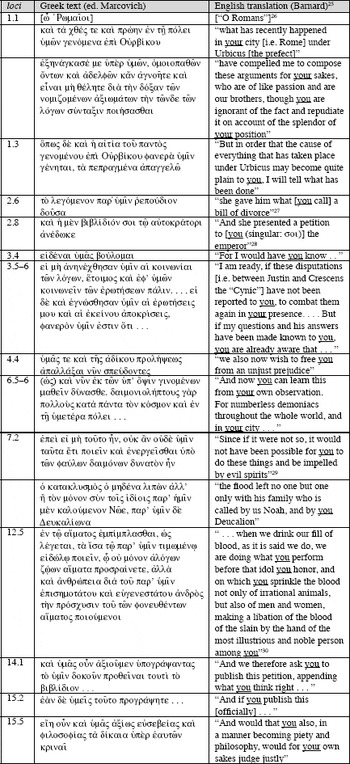
The best way to approach these questions is to go directly to the text of 2 Apol. and simply list the instances in which direct references to the addressees occur, and then try to figure out, first, who is being addressed directly in each case, and second, what is being said to the addressees.
The following table includes a list of all direct addresses in 2 Apol.:
Direct addresses in 2 Apol.

What do these references tell us? First of all, the second-person plural is applied in all instances, except one (2.8), where the second-person singular is used.
Secondly, Justin is clearly addressing outsiders. None of the references above imply an address to insiders, that is, fellow Christians. Although the address at the beginning of the text, “O Romans,” is probably a later addition, Footnote 31it fits quite well with the subsequent discourse. This is also well supported by indirect information about the addressees, as, for instance, the specific explanation in 1.2 (cited in the previous section), “we mean those who have become Christians.” Generally speaking, then, Justin's addressees in 2 Apol. are non-Christian (“pagan”) Romans.
Thirdly, and more specifically, it seems that Justin is primarily addressing the Roman authorities in his text, the emperor in particular (see esp. 2.8; 3.5–6; 14.1; 15.2, 5). It is noteworthy that Justin, rather surprisingly, switches to the second-person singular ( ) in 2.8, speaking directly to the emperor alone: “And she presented a petition to you (singular).” This sudden shift to the second-person singular suggests that the emperor himself—and not just the Roman authorities—is a primary addressee in the text.
Fourthly, it is important to observe that at some points the Roman authorities, including the emperor, are addressed not only as such but also as Romans (esp. 1.1; 7.2; 12.5). In other words, even when the authorities are directly addressed as such, the address can have a wider reference. This is a feature that we also see in some of the more indirect references to the addressees: we have already noted that when Justin refers directly to 1 Apol. with the words, “as we said before,” he nevertheless explains what it was that he had “said before” in that text, which means that he also seems to have presupposed a readership that had not read his earlier writing. To be sure, such a readership could still include the emperor and his house (e.g., if Justin suspected or knew that 1 Apol. had ended up unread in the fire), but it could also cover a wider audience that never had had the opportunity to read his 1 Apol., i.e. people outside of the imperial court. Moreover, in 12.7 Justin uses a fictitious person to utter words that, if addressed directly to the authorities, would have sounded too forthright and abusive, precisely as many of his statements in 1 Apol. had done. Justin writes: “But would that even now someone would mount a lofty rostrum, and shout with a tragic voice ( ), ‘Be ashamed (
 ), be ashamed, you who charge the guiltless with those deeds which you yourselves openly commit, and who ascribe things which refer to yourselves and to your gods to those who have no part in them. Change your minds (
 ),Footnote 32 become wise (
 ).’” The style and content of this indirect exhortation suggests a wider audience (of non-Christian Romans) than the authorities alone. That Justin was (by now)Footnote 33 aware of how to use rhetorical devices of this sort is suggested by another similar case in 2 Apol., namely, when in 2.16 he describes how a certain Christian called Lucius admonishes the praefectus urbi, expressing views and questions that clearly mirror Justin's own questions and concerns. By using Lucius as a speaker, Justin could more easily express his concerns without himself directing too strong an admonition to the Roman authorities.Footnote 34
Who, then, are the addressees of Justin's 2 Apol.? Based on the information provided by the text itself, the most probable answer is: primarily the emperor (Antoninus Pius) and the Roman authorities, but also Roman residents in general.
But what about Marcus Aurelius and Lucius Verus, whose names are included in the opening address of 1 Apol.? Were they (originally) included in the opening address of 2 Apol. as well? Nothing implies that Lucius Verus was (formally) addressed in 2 Apol. As for Marcus Aurelius, the question is more complicated. The text in 2.16, in which the Christian Lucius addresses the praefectus urbi, does in fact allude to Marcus Aurelius: “This judgment of yours, O Urbicus, does not become the Emperor Pius, nor the philosopher-son of Caesar nor the Sacred Senate” (emphasis added). These words may imply that Marcus Aurelius, too, was one of the addressees of 2 Apol. Footnote 35 However, one must have in mind that in 2.16 Justin is not addressing the recipients directly but reciting someone else's utterance in an earlier setting. To be sure, the inclusion of “the philosopher-son” may have been Justin's own invention, which, in turn, would imply that Marcus Aurelius was among the formal addressees, but there is no way of knowing that. Moreover, the fact that Justin addresses the emperor alone in 2.8, without mentioning his “philosopher-son,” seems to lessen the likelihood that Marcus Aurelius was a formal addressee of 2 Apol., together with his adoptive father. But, again, the question is very difficult.
Hence, the opening address of 2 Apol., which is missing in the extant manuscript(s), Footnote 36 may therefore have been along the following lines (compare 1 Apol. 1.1): “To the Emperor Titus Aelius Hadrianus Antoninus Pius Augustus Caesar, [and to his philosopher-son Verissimus,?] and to the Sacred Senate and all the Roman people, I, Justin, son of Priscus and grandson of Bacchius, from Flavia Neapolis in Syria-Palestine, have composed this petition.” Footnote 37 For the most part, the content and style of 2 Apol. conforms well to such an address. (In this respect, there is a major difference between 2 Apol. and 1 Apol., the latter of which would probably have made the author the laughingstock of Rome, Footnote 38 if it ever made it past the fire.) The fact that the text of codex A begins rather awkwardly with a  construction, Footnote 39 thus indicating a preceding sentence, supports the thesis that 2 Apol. originally included a proper opening address. The opening address probably fell away at some point when the Apologies were gradually being read and stored together as two volumes concerned with similar topics.Footnote 40
Is it reasonable to assume that Justin intended to address such an audience? In other words, did he actually believe that his text could reach such an audience? Can we reasonably assume that a writing of such a character and length could actually have reached the intended audience, namely, the emperor himself and the Roman authorities, and (eventually) the Romans in general? These are questions that must be addressed in combination with the question of the literary genre of 2 Apol.
The Literary Genre of the Second Apology
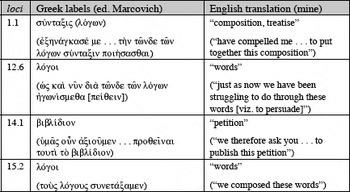
What kind of writing is 2 Apol.? Fortunately, in this case, the author provides us with ample clues about which sort of writing he wants to use as a means to address the Roman authorities and the people of Rome. Justin refers explicitly to 2 Apol. in the following ways:
Justin's own descriptions of 2 Apol.

Even though Justin applies it at the very beginning of his writing, the first of these labels,  , does not give us much information about the precise genre of the work. The label constitutes a very general description, which could be used of any (more-or-less) systematic treatise, or indeed of any composition at all. The second and fourth,
 in both cases, are of an even more general category, applying simply to 2 Apol. as a composition of “words.” There is no hint of any specific literary genre in these uses of
 .
The third label, on the other hand, provides the information we are looking for. At the close of his work, Justin writes:
And we therefore ask ( ) you to publish (
 ) this petition (
 ), appending (
 ) what you think right, that our opinions may be known to others….(14.1)
… And if you publish ( ) this [officially], we will make it manifest to all, that if possible, they may change their minds; for we composed this treatise [lit. “these words”] for this end alone (15.2). Footnote 41
It is widely recognized by scholars that Justin's choice of terms in this passage has its roots in the technical terminology used in official petitions to the imperial court.Footnote 42 In the middle of the second century c.e. such a petition was called libellus by the Romans, which was rendered in Greek as biblivdion.Footnote 43 (From the fourth century c.e. onwards, the standard Greek term was biblivon, which appears in fact to have been used by Eusebius as a description of 2 Apol.Footnote 44) Libelli typically contained personal complaints and requests relating to individual cases, which people could hand in at the imperial office “for petitions” (a libellis).Footnote 45 The officeholders would then, if appropriate, present the petition to the emperor, Footnote 46and append or subscribe ( , subscribere) an answer to it, authorized by the emperor's signature. Whereas the imperial answer was normally written in Latin, the petitions were often written in the “international” language of the time, viz. Greek.Footnote 47 The request itself properly included verbs like
 ,
 , and i
 , Footnote 48 all of which expressed inferiority on the part of the petitioner. Subscribed libelli were published (protiqevnai, proponere) at a public place, where they could be read (and copied) for a period of one month or so by anyone interested in the case.Footnote 49
In 2 Apol. 14.2 Justin explicitly calls his writing a  , requesting (
 ) that his
 be subscribed (
 ) and published (
 ).Footnote 50 That he knows precisely what is meant by this terminology is shown in 2.8, where he describes the legal procedure when a certain Christian woman responds to charges brought against her by her husband (for being a Christian): “And she submitted (
 ) a petition (
 ) to you the emperor, requesting (
 ) that first she should be allowed to arrange her affairs, and afterward make her defense against the accusation, when her affairs were set in order; and this was granted.” Footnote 51 Moreover, in 1 Apol. 29.2–3 Justin tells of a young Christian in Alexandria who submitted (
 ) a petition (
 ) to the Alexandrian prefect, asking (
 ) that permission might be given to a doctor to make him a eunuch. The prefect, on the other hand, refused to subscribe (
 ) to the petition, Justin tells us. Both of these cases describe the proper legal procedure for individuals who have some official request to make, and in both cases Justin applies the term
 for the petition concerned, using, in the latter case, the verb
 as well.
How seriously should we take Justin's use of this terminology? In light of the above (and below), I see no good reason not to take it very seriously. When he wrote 2 Apol., he composed it as a formal petition, precisely as he says himself, probably intending it to be handed in at the appropriate office in Rome, thereafter read by or before the emperor, and then, properly subscribed, published at some conspicuous place at the heart of the city.Footnote 52
It is true that the length of 2 Apol. exceeds the length of most extant libelli.Footnote 53 But 2 Apol. is not so long that it cannot have been composed and sent in as a libellus or  , regardless of its subsequent fate at the imperial court.Footnote 54Libelli could in fact be of considerable length,Footnote 55 if perhaps not as long as 2 Apol., and many extant libelli contain trivialities of various sortsFootnote 56 (which would probably have been one characteristic of 2 Apol. in the eyes and ears of the emperor). Moreover, there are features in Justin's writing that indicate that its composition was much influenced, not only by classical rhetoric, but also by the practice of letter writing. There have been some scholarly attempts to analyze 2 Apol. within the framework of rhetorical theory and praxis,Footnote 57 but the input from ancient epistolography has not been sufficiently considered. The fact is that there were considerable overlaps between letters and libelli in the ancient world which, I suggest, have significant bearings on the question of the literary genre and purpose of Justin's 2 Apol.
In addition to the imperial office at which libelli were handed in and attended to, there was in ancient Rome an office “regarding correspondence” (ab epistulis), which specifically took care of letters sent to the emperor. What was the difference between libelli and letters in this setting? At least from the second century c.e. onwards, “[a]s a general rule it is clear that while cities, provincial assemblies, Roman officials and important private persons addressed the emperor in letters, village communities and all less important individuals did so by libelli.”Footnote 58 The difference was thus of a social nature. But there was a formal difference, too: whereas letters of this type generally included fairly standardized language, libelli were mostly free from such expressions. In the words of Fergus Millar, “while libelli could be of considerable length they lacked the formal characteristics of letters.”Footnote 59 However, numerous examples of letters from antiquity, in which the function of libelli and the form of (petitionary) letters are combined,Footnote 60 indicate that the line between a libellus and a letter was not always that clear-cut.
This generic line is similarly blurred in Justin's 2 Apol., which, although a libellus, in fact includes some formal epistolary characteristics. One such characteristic is actually the request put forth in 14.2, the form of which is practically the same as that of a typical request formula in a Greco-Roman letter.Footnote 61 The request formula was a well known epistolary form in the ancient world, its most important element being the verb of request, the precise choice of which depended on the situation at hand. The verb  , for instance, expressed proper inferiority toward the letter's recipient(s), precisely as it did in a libellus. Another epistolary trait in 2 Apol. is the so-called “disclosure formula,” which we encounter in 3.4 (discussed below), the use of which may very well derive from epistolary literature. Thus, when Justin composed his
 he did so under influence from the widespread and influential discipline of epistolography (and rhetoricFootnote 62). That, in turn, explains the length of this
 : not only literary letters, many of which were composed in fictitious settings, but authentic, official letters as well could be quite long in Greco-Roman antiquity.Footnote 63
In sum, Justin's 2 Apol. is a private petition ( , libellus), presumably submitted to the imperial office a libellis in Rome, to be further handled according to proper official procedure.
The Purpose of the Second Apology
What, then, was the purpose of 2 Apol.? Why did Justin write (and submit) this petition to the emperor and (eventually) to the rest of the Roman people? What was his main concern? In order to answer these questions, we must first consider what Justin himself says about the purpose of his  . As the purpose of a writing is closely associated with its occasion, it will be necessary to look into the latter as well.
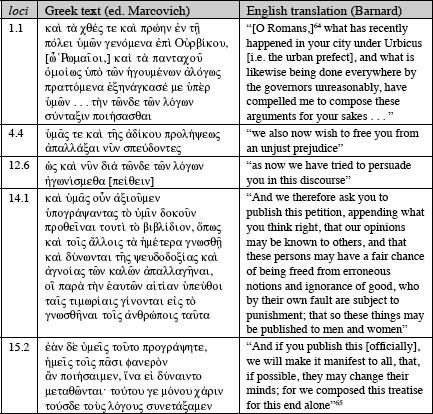
The following table lists the five instances in which Justin most clearly describes or alludes to the occasion and purpose of his writing:
Justin's references to the occasion and purpose of 2 Apol.
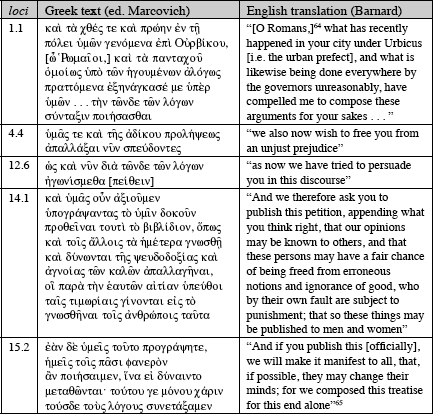
Judging from the opening of 2 Apol. (1.1), its immediate occasion seems clear enough: according to Justin, recent incidents of Christian oppression have compelled him to write his appeal to the Roman authorities. He speaks of a worldwide persecution (“everywhere”), Footnote 66 but points specifically to “recent” events in the city of Rome, which he describes in detail in the subsequent passage (2.1–20): a certain (unnamed) woman ( ) faced charges brought against her by her “pagan” husband, subsequent to her divorcing him.Footnote 67 The charge was simply that she was a Christian. The woman, on the other hand, managed to stall the whole legal procedure, Footnote 68 with the result that her (now former) husband directed his frustration against her Christian teacher, Ptolemaeus, Footnote 69 whom he then, with some trickery, dragged into court instead of (or in addition to) the woman. This Ptolemaeus, Justin tells his readers, was put into prison where he stayed “for a long period” before he “at last” was interrogated by the urban prefect, Urbicus, who needed no other ground than the man's confession of Christ before issuing his death sentence. And so Ptolemaeus, who is the primary hero (the “true Christian”) of Justin's account, was led away to be executed. Meanwhile, another “true Christian,” a certain Lucius, openly protested against Urbicus’ “irrational” judgment, receiving in return exactly the same treatment as his fellow believer, Ptolemaeus. According to Justin, still another individual, “having come forward,” was sentenced to be punished.
This rather detailed account (in Justin's text) presents the immediate occasion of the writing. And since it is stated in such plain terms, scholars have had little reason to doubt its function as such. However, my suggestion is that this very occasion is even more profoundly related to Justin's purpose with his text than scholars have seen. We shall return to this in a moment.
Whereas Justin's statements in 4.4 and 12.6 (see the list above) include only indirect allusions to the purpose of 2 Apol., both 14.1 and 15.2 state very explicitly why he wrote this particular writing. We have already discussed 14.2 in some detail, where Justin puts forth his formal request of subscription and publication, which, of course, is part of his purpose with the writing.Footnote 70 But he also expresses his wish and confidence, already hinted at in 4.4, that through publication “the others” ( ), meaning outsiders, will see and understand “our opinions” (
 , lit. “things belonging to us”), if only for their own sakes. Footnote 71 In 15.2 Justin underlines his wish that his
 become “manifest to all” (
 ), now adding a clause that states the very reason for his wish: “that, if possible, they may change their minds (
 ).” This, Justin declares, is the sole purpose of his writing (“we composed this treatise for this end alone [
 ]”). But what exactly does Justin mean by the verb
 (translated here as “change one's mind”; see also 12.7)? Some scholars have read and translated this verb as if Justin is stating that he intends to “convert” the Romans to Christianity through his writing. Footnote 72 That is probably not the case. Footnote 73 Rather, the verb in Justin's use pertains to the act and course of changing one's opinion about something and one's attitude toward it. Footnote 74 His stated purpose, then, is to persuade the Romans to change their opinion about the Christians and their attitude toward them, which appears in fact to agree very well with the content of 2 Apol. as a whole. As a (published)
 , his writing constitutes in effect a public “defense” on behalf of oppressed Christians. In this regard, 2 Apol. seems quite properly termed an “apology.” Footnote 75 As noted above, answers issued by the Roman authorities were normally written in Latin, even if the petition itself was written in Greek, which would have well suited Justin's purpose of getting the attention of Roman residents in general.
But there is more to Justin's writing than meets the eye. Immediately following Footnote 76 his description in chapter 2 of the “recent events” in Rome, Footnote 77 which outlines the occasion for the writing, Justin states: “I too ( ) therefore (
 ) am expecting to be plotted against and fixed to a rack” (3.1). Justin then devotes the rest of the chapter to describing a debate that had occurred in public between himself and a philosopher called Crescens, who had charged Justin and other Christians of atheism and impiety. Footnote 78 The subsequent chapters seem to reflect this debate between Justin and Crescens (note esp. the answers to the hypothetical questions and objections in 4.1; 5.1; 9.1), the latter of whom turns up again in Justin's text in 11.2. Footnote 79 One of Justin's concerns in these chapters is clearly to defend Christians and Christian teaching in general. But there is another aspect at work here: there is a strong personal motive behind Justin's defense as well, Footnote 80 and this personal motive may indeed reflect the primary occasion and purpose of 2 Apol. According to the text, Justin expects that his public debate with Crescens will eventually bring him into court, where, precisely as the three Christians mentioned in chapter 2, he will almost certainly be sentenced to death. Thus, because he fears for his life (and that of other Christians), he appeals to the authorities by way of a formal
 , which he expects or at least hopes will be posted in a public place, favorably subscribed by the emperor himself (see 15.5). Footnote 81 Apparently with some rhetorical awareness, he puts an abstraction of his own (coming) defense in the mouth of Lucius in 2.16: “What is the basis of this judgment? Why have you punished this man, not as an adulterer, nor fornicator, nor murderer, nor thief, nor robber, nor convicted of any crime at all, but as one who has only confessed that he is called by the name of Christian? This judgment of yours, O Urbicus, does not become the Emperor Pius, nor the philosopher-son of Caesar nor the Sacred Senate.”
That Justin was strongly driven by a personal motive when he wrote 2 Apol. is further suggested by his use of a “disclosure formula” in 3.4, “I would have you to know” ( ), the presence and implications of which seem to have been overlooked by scholars. Such formulas are very common in ancient epistolary literature, where they typically function so as to indicate that the particular topic about which the author wants his or her readers “to know” is a primary concern of the letter. Footnote 82 Like many standardized expressions, the disclosure formula was a clear indication to the reader that here, at this particular point in the text, something essential was being expressed. Ancient readers were experienced “spotters” of such textual markers. It may well be the case that Justin's use of the formula was influenced by the epistolary tradition, or perhaps by some particular letters, like, for instance, the Pauline literature. Footnote 83 How, then, would an ancient reader have understood Justin's message in 2 Apol. 3.4 as he applied the disclosure formula? An ancient reader would probably have understood that when Justin writes, “For I would have you know that I put to him [i.e. Crescens] certain questions on this subject [i.e. the Christian teaching], and questioned him, and found most convincingly that he truly knows nothing,” Justin's previous debate with Crescens played a primary role for the occasion and purpose of 2 Apol. The reader would presumably also have understood that Justin was here assuming the role of Socrates as the “questioner” par excellence (referred to in 3.6), who, as Justin reminds his readers in 10.5, was (unreasonably) charged and put to death for the very same crimes as the Christians, namely, atheism and impiety. Footnote 84 The disclosure formula revealed that the author wanted to call specific attention to the immediate context in which it was used—in this case, relating to impending charges against himself made by a publicly known opponent.
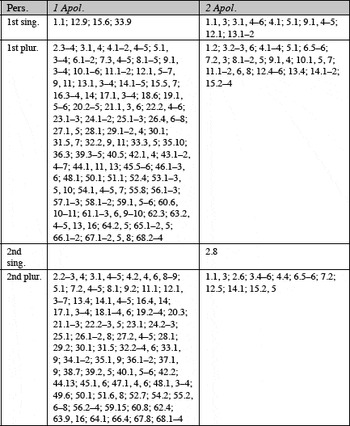
Hence, my suggestion is that the occasion and purpose of 2 Apol. was very much rooted in Justin's own personal situation at the time of writing. Are there further arguments for this reading? Indeed there are. There is yet another important difference between 2 Apol. and 1 Apol., which, I think, will support my reading that the personal aspect is a primary motive in Justin's writing. Below is a list of first- and second-person references (in verbs as well as pronouns) in 1 Apol. and 2 Apol. (ed. Marcovich):Footnote 85
First- and second-person references in 1 Apol. and 2 Apol.

What do these numbers suggest? First of all, we note immediately that there is only one occurrence of the second-person singular in the two Apologies, namely, in 2 Apol. 2.8. We have already paid some attention to this peculiar instance, namely, in relation to the question of Justin's addressees in 2 Apol., and it need not concern us here. What is more important to note in the present context is the fact that the first-person singular is by far more frequent in 2 Apol. than in 1 Apol. Here we must recall that 2 Apol. is a much shorter writing than 1 Apol. (2 Apol. is only one-fourth the length of 1 Apol.). If we compare Justin's uses of the first- and second-persons plural in light of this difference of length, we see a marked variation in his use of the first-person singular in 2 Apol. The uses of the first-person plural (approximately one-fourth as common in 2 Apol. as in 1 Apol.) and the second-person plural (approximately one-sixth as common) both roughly agree with the proportion of the lengths of the writings. By contrast, the first-person singular occurrences in 2 Apol. exceed the instances in 1 Apol. not only proportionally, but in the very number of occurrences as well. Moreover, if the occurrences listed above are considered more closely, it becomes clear that whereas the first-person singular appears only once in each listed case in 1 Apol., it is used several times in many of the listed cases in 2 Apol. (3.1, 4–6 [7x]; 9.4–5 [2x]; 12.1 [2x]; 13.1–2 [3x]). Indeed, as we saw above, Justin's only use of the phrase  in the singular (“as I said before”) is found in 2 Apol. (3.6).
Is all this just a coincidence? I think not. Whatever we may say about the precise literary genre of 1 Apol., it seems fair to say that an important purpose of that writing is precisely to present an “apology” (in the sense of a defense) on behalf of Christians and Christianity. This, I think most will agree, is something that the two writings have in common. The comparison above of Justin's uses of the first-person singular in the Apologies suggests, on the other hand, that the center of attention is brought much more closely to Justin himself in 2 Apol. His very choice of grammar indicates that when this particular writing was penned there was more (or less) at stake for Justin than his fellow Christians and Christianity in general.
In sum, an important purpose of 2 Apol. was to present to the emperor and the rest of the Roman people a defense of Christians and the Christian teaching, in order to put a stop to unjust prosecution of Christians. Justin's primary purpose, however, was to defend himself (as a Christian) against impending accusations of atheism and impiety.
Conclusion
“[W]hile there is a certain timeless character to the Christian apologists of the second century, they are deeply involved in the political and social struggles of their time and cannot be understood apart from the precise circumstances in which they are writing.”Footnote 86 Such was the thesis of Robert M. Grant's important book, Greek Apologists of the Second Century.
The present study has emphasized that this is precisely the case with Justin's 2 Apol. The literary genre and purpose of 2 Apol. was truly and deeply embedded in the author's own historical situation, apart from which the writing cannot be understood. In fact, it seems that Justin's reasons for writing 2 Apol. were even more profoundly grounded in his own personal situation than scholars have thought.
The study has argued that the literary genre of 2 Apol. is that of a private petition ( , libellus) submitted to the imperial office a libellis, in order to be subscribed by the emperor and published in the city of Rome. The stated occasion of the writing was the ongoing oppression of Christians, exemplified by particular events in Rome. But a further, underlying occasion was Justin's fear for his own life because of his Christian affiliation. The purpose, in turn, was twofold: With his (favorably, he would hope) subscribed and published “defense” of Christians and Christianity, Justin intended to persuade the Romans that their repression of Christians was utterly irrational and wrong. Another, interrelated purpose, which turned out to be the primary purpose of the writing, was to defend himself against imminent charges of atheism and impiety, the punishment of which was death. Apparently, the Martyr did not succeed.
 . Literarische Einheit und politischer Kontext von Justins Apologie,” ZNW 68 (1977) 48–66, 231–51; Charles Munier, Justin, Apologie pour les chrétiens. Introduction, texte critique, traduction et notes (SC 507; Paris: Cerf, 2006) 21–24, 34–38.
 ).
 ) and suitably (
 ) adds (
 ) the words which we quoted above, ‘So I expect myself to suffer a plot from one of those named,’ etc.” (i.e., the beginning of ch. 8 in codex A) (trans. K. Lake; LCL; Cambridge, Mass.: Harvard University Press, 1926). For the argument that Eusebius’ words imply that chapter 8 is misplaced in codex A, see Marcovich, Apologiae, 4. I follow the most usual modern division of the text in the present essay (i.e., reading ch. 8 in codex A as ch. 3). For arguments against this order, see Minns and Parvis, Apologies, 54–56.
 (1 Apol. 12.5; 21.6; 22.2; 32.11; 45.6; 54.5, 7; 56.2; 58.1; 63.4; 67.5; compare
 , 26.6);
 (61.6; 63.2; 64.2);
 (60.6; 63.16);
 (56.1; compare 33.5, 6; 55.1; 59.1, 5);
 (33.5; compare 46.2; 54.5; 63.2). See also the following potential cases:
 (31.3; 37.1; 40.1; 42.3; 43.6; 64.1);
 (43.1);
 (22.4).
 (“frankness of speech”) (see 1 Apol. 17.4), but she does not seem to have noticed that his somewhat more bold statements in 2 Apol. fall well within the frames of proper
 , even before the emperor (not so in the case of 1 Apol.).
 and
 in 2 Apol. 15.5 form an inclusio with 1 Apol. 1–3 (1.1; 2.1, 2; 3.2), and thus imply that the two writings were originally one (see, e.g., Schmid, “Inversionsphänomen,” 263; Holfelder, “
 ,” 51–60), does not carry much weight. It seems much more likely that, if anything, Justin's wish in 2 Apol. 15.5, “And would that you also, in a manner becoming piety and philosophy (
 ), would … judge justly (
 ),” alludes to 2.16 in the same writing, in which the Christian Lucius, seeing the “unreasonable judgment” (
 ) given by the urban prefect, criticized the latter for his judgment (
 ) which “does not become the Emperor Pius (
 ), nor the philosopher-son of Caesar (
 ).”
 (and to Lucius the philosopher, Caesar's natural son and Pius's adopted son, a lover of culture) are a later addition; see Apologiae, 2 and ad loc.

 in his translation. Note that I have translated the word
 as “petition,” which Barnard has rendered as “paper”; see the discussion below.
 ).
 as “be converted.” On my translation, see further below.
 ] also, in a manner becoming piety and philosophy [
 ], would for your own sakes judge justly.”)
 .
 [
 ]
 . On the writing as a
 , see below. Note that my reconstruction of the opening address is purely hypothetical. The point is that, if 2 Apol. included an opening address (which I find likely), it may have been along these lines, especially in light of Justin's use of formulaic language of this sort in the opening of 1 Apol.
 (
 ) instead of
 (Apologiae, ad loc.).
 as “change their minds.”
 ,” 248–51; Robert M. Grant, “Forms and Occasions of the Greek Apologists,” SMSR 52 (1986) 213–26 at 215–16; Peter Lampe, From Paul to Valentinus: Christians at Rome in the First Two Centuries (trans. M. Steinhauser; Minneapolis: Fortress, 2003) 268; Paul Parvis, “Justin, Philosopher and Martyr: The Posthumous Creation of the Second Apology,” in Justin Martyr and His Worlds (ed. S. Parvis and P. Foster; Minneapolis: Fortress, 2007) 22–37 at 25–26.
 are diminutives of liber and
 , respectively.
 .
 , 1.1) and “address and explanation” (
 , 68.3). For discussion of these terms, see Schoedel, “Apologetic Literature,” 75; Kinzig, “Apologie,” 304 with further references. It is worth observing that in 29.2–3 Justin speaks of a
 without implying that 1 Apol. was such a writing—yet another difference between 1 Apol. and 2 Apol.
 ) to limit the time allotted to each appealer, see Schoedel, “Apologetic Literature,” 58, who notes that “the time provided must be measured in hours rather than minutes” (see, e.g., Pliny, Ep. 2.11.14).
 ”; Charles Munier, “La structure littéraire de l’Apologie de Justin,” RevScRel 60 (1986) 34–54; idem, Apologie, 29–43. See also Hubík, Apologien, 190–94. On the rhetorical structure of libelli in the late second and early third centuries
 ) at the end of the fourth century
 ), I would gladly enlarge upon a little later in a long letter (
 ]” (37) (trans. N. W. DeWitt and N. J. DeWitt; LCL; Cambridge, Mass.: Harvard University Press, 1949).
 not as “change their minds” (my translation), but as “be converted.”
 ) to the emperor in 2.8.
 be published enclosing the emperor's statement of opinion (
 ), not about just anything, but about the (in Justin's argument) unreasonable treatment of the Christians, which would then be manifest to all.
 ), that you may not by condemning me err in your treatment of the gift the God gave you” (trans. H. N. Fowler; LCL; Cambridge, Mass.: Harvard University Press, 1914). See also 1 Apol. 8.1.
 …
 , 1.1) must refer primarily to the interrogation and execution of the three Christians, rather than to the twist between the woman and her (former) husband (both of whom, in my view, are secondary in Justin's story; contra Grant, “Woman,” and Buck, “Husband”). The phrases “for a long period” (
 , 2.11) and “at last” (
 , 2.12) suggest that some time had passed since the charges were brought against the woman.
 ) in 15.5: “And would that you also, in a manner becoming piety and philosophy, would for your own sakes judge justly!”