Introduction: O homem da mala
Recalling his early experiences as a popular musician, Tom Zé has written that he was inspired by the figure of the homem da mala (man with a suitcase), his term for the itinerant rural troubadours, or cancionistas, who he saw perform at the marketplace on Saturday in his hometown of Irará in the 1940s and 1950s. Unlike conventional entertainers who count on having a stage, a demarcated space governed by a ‘tacit accord’ between the artist and the audience, the homem da mala has to instantly transform public space into a place of performance in which ‘totality is created from nothingness’ (Zé Reference Zé2003, p. 44). The homens da mala had distinct performance strategies to address politics, social problems, and satirise everyday life in small-town Brazil. Tom Zé first performed for a mass audience in 1960 on the variety show Escada para o Sucesso (Stairway to Success) on TV Itapuã in Salvador. When he lampooned the programme with the song ‘Rampa para o Fracasso’ (Ramp to Failure), he took inspiration from the homens da mala to achieve the following effect: ‘I planned to make my body a stage set, with my pockets filled with an arsenal of small objects, symbols of the most pressing issues of the day: the illiteracy rate of 55% documented in the census, the tragedy of the drought that year, the strong cruzeiro, etc. It was a veritable scenographic cornucopia’ (ibid., p. 44).
Tom Zé has described his music as a form of imprensa cantada or jornalismo cantado, calling attention to its debt to the cancionistas who used the song form as a vehicle for commenting on current events while paying acute attention to changes in spatial and temporal contexts. The cancionistas work with an established song repertoire, introducing variations in lyrics and arrangements depending on the context and immediate situation. Likewise, many of Tom Zé's compositions are contingent and incomplete, available for topical alterations according to the context. Several of the songs analysed below were written decades ago, but have been revised and resignified to address present concerns. His work is also indebted to classical and avant-garde composition (baroque counterpoint, romanticism, duodecophonic technique, electro-acoustic experimentation, aleatory music) learned at the University of Bahia in the 1960s. In recent years, Tom Zé has theorised this aesthetics of contingency and imperfection by describing his recordings as mere versions among multiple possibilities. His live shows often seem more like rehearsals, with abrupt interruptions to explain the lyrics, make tangential commentary, or address a technical problem with the sound. He often presents his music as a work-in-progress that, despite its appearance of spontaneity, is often a planned performance strategy. His approach to musical form and performance is a unique response to his particular project of engaging simultaneously the cancionista tradition, inspired by the homens de mala, avant-garde composition, learned at the university, and pop music, his chosen profession of the last fifty years.
Tom Zé's approach to music composition and performance as imprensa cantada within the realm of pop music also entails specific ways of addressing politics, society, and artistic production in Brazil. Bearing in mind that music has played a central role in how Brazilian citizenship has been imagined and articulated (Moehn Reference Moehn2007, p. 182), this essay examines several phases of Tom Zé's career with particular attention to the figure of the citizen in his music. It is possible to trace the contested idea of citizenship in his music, from the earliest days of military rule in the mid-1960s to the present context of Brazil's uneven or ‘disjunctive’ democracy (Caldeira and Holston Reference Caldeira and Holston1998, pp. 716–17). His early career as a pop artist developed simultaneously with the rapid expansion of the mass media and culture industry in Brazil, which he observed with a measure of ambiguity and ironic distance. He was a key figure in tropicália, a cultural movement that was particularly expressive in the field of popular music, which often celebrated the power of mass media while attempting to maintain a position of critique within it. Of all the tropicalist musicians, Tom Zé was the most sceptical of mass culture in the 1960s, showing how consumption both constituted and limited modern forms of citizenship. In the 1970s, Tom Zé represented citizenship in terms of class privilege, social distinction, and political control during the period of authoritarian rule. He developed a biopolitical critique of citizenship that addressed various modern techniques for disciplining bodies, controlling populations, regulating sexuality, and establishing regimes of exclusion based on race or other markers of difference.Footnote 1
With the re-emergence of civil society and slow re-democratisation in the 1980s, leftist social movements articulated a ‘new citizenship’ in order to expand the parameters of democratic struggle (Dagnino Reference Dagnino, Alvarez, Dagnino and Escobar1998, pp. 48–50). Tom Zé seems to have perceived this conceptual shift at an early stage. Several of his compositions from the period reveal an affirmative notion of citizenship premised on the discourse of self-representation among working-class subjects claiming participation in the political process. The notion of biopower in the Foucaudian sense of social control and regulation was revised to account for individual and collective agency in political and social struggles. Tom Zé's most recent work references insurgentforms of cultural citizenship in contemporary Brazil involving historically marginalised and impoverished urban communities within the context of neo-liberal globalisation.
Consumers and citizens in the tropicalist city
The central theme of Tom Zé's first LP (1968) may be found on the back of the album cover at the beginning of a manifesto-like statement: ‘We are an unhappy people, bombarded by happiness’. Despite Brazil's international reputation for carnivalesque exuberance and its modern self-fashioning as a place of easy-going pleasure, Tom Zé's statement may be located squarely within a tradition of melancholic critique of national dilemmas (Scliar Reference Scliar2003, pp. 170–1). With its direct, matter-of-fact diction, his statement echoes the famous opening line of Retrato do Brasil (1928), Paulo Prado's canonical treatise on national character: ‘In a radiant land lives a sad people’. Prado's assertion is about the melancholic disposition, regarded as both congenital and historically determined, of ‘three sad races’ (the Portuguese, the Indian, and the African) in a sunny, tropical land. Tom Zé's opening salvo is about the false promises of media-driven consumption in a land of social inequality and frustrated desire: ‘Today, the smile is industrialised, sought after, photographed, expensive (sometimes), and marketable. It sells toothpaste, travel tickets, cold remedies, nappies, etc. And since reality has always been confused with gestures, television proves daily that nobody can be unhappy’.
In the context of cultural politics during military rule in the 1960s, Tom Zé's position of negativity was not unique. In various ways it was shared by many other prominent left-wing artists of the time who were wary of mass-mediated culture (Ricardo Reference Ricardo1991, pp. 60–4; Ridenti Reference Ridenti2000, pp. 323–34). He was, however, unique among the tropicalists, who generally embraced the culture industry, pop music, and mass-mediated youth styles. The urban context of São Paulo, then supplanting Rio as the dominant centre of mass entertainment, advertising, and cultural production, was decisive for the tropicalist project. Tom Zé's first hit, ‘São São Paulo’, received first prize at the 1968 Brazilian Song Festival of TV Record, providing him with national media exposure. The song was endearing to the middle-class paulista audience in the way that it lovingly satirised the city's hurried, work-obsessed environment from an outsider's perspective: São oito milhões de habitantes / de todo canto e nação / que se agridem cortesmente / correndo a todo vapor (‘There are eight million inhabitants / from all places and nations / who courteously trample each other / running at full steam’). We have here a snapshot of São Paulo as a global city with inhabitants from ‘all places and nations’ who experience citizenship or belonging in terms of formalised civility that masks hostility related to competition in a large modern city.
Much of his music from that period was influenced by the guitar–organ driven pop of the Jovem Guarda, the Brazilian version of rock, known as iê-iê-iê, which dominated the airwaves at that time. Between 1962–1967, Tom Zé also received training in composition at the School of Music at the University of Bahia from Hans Joachim Koellreuter, a refugee from Nazi Germany who introduced duodecophonic technique to Brazil in the 1940s, and Swiss composer and educator Ernst Widmer. He also worked with the Swiss musical iconoclast, Walter Smetak, who engaged in microtonal experiments with invented instruments made from local materials. After moving to São Paulo, he worked with several composer-arrangers connected to the Música Nova group of São Paulo, most notably Damiano Cozzella.Footnote 2 Unlike his Bahian colleagues, Caetano Veloso, Gilberto Gil and Gal Costa, his music evidenced little affinity to bossa nova, the great innovation within the samba tradition developed by singer-guitarist João Gilberto and composer-pianist Antonio Carlos Jobim in the late 1950s. Tom Zé has described his particular musical approach as a compensatory solution to his inability to master bossa nova, which so influenced the generation of artists who came of age in the 1960s under the banner of MPB – Música Popular Brasileira (Pinto Reference Pinto1999, p. 6). By 1968, when the tropicália movement was in full swing, his music was a sui generis mixture, or juxtaposition, of Brazilian iê-iê-iê, north-eastern satiric ballads, and contemporary avant-garde music. At the level of composition and arrangement, his music of this time was disjunctive, based on a dual tension between urban modernity and north-eastern tradition and between pop appeal and formal experimentation. He cultivated an image of a modern cancionista, appearing on the famous album cover of the tropicalist concept album, Tropicália, panis et circensis (1968), with a leather suitcase reminiscent of those used by the homens da mala who frequented the marketplace in Irará.
Tom Zé's aesthetics of disjuncture was a musical response to mass culture, consumption and citizenship in São Paulo. The album cover of his first LP, a pop rendering of a São Paulo commercial street with neon-like signs and billboards, features a photo of the artist framed within a television screen under the advertisement Grande Liquidação: Tom Zé (Big sale: Tom Zé). The song ‘Parque Industrial’ (Industrial Park) which was also featured on Tropicália, ou panis et circensis, places advertisement, industry, and consumption at the heart of civic life under authoritarian rule: retocai o céu de anil / bandeirolas no cordão / grande festa em toda a nação / despertai com orações / o avanço industrial / vem trazer nossa redenção (‘touch up the blue sky / streamers on a string / a great national festival / rise and hear the orations / industrial progress / has brought our redemption’).
The imperative vós verbs, the reference to stock patriotic phrases, and the staging of collective celebration are set to the music of a military band, suggesting a civic ritual of nationalism and citizenship. The festivities exult in the redemptive promise of industrial development and national progress, a discourse promoted, although certainly not inaugurated, by the military regime. In ‘Parque Industrial’, national development and integration is related directly to consumption. With obvious irony, a first person voice narrates the process of media interpellation and its intended effect: tem garota-propaganda / aeromoça e ternura no cartaz / basta olhar na parede / minha alegria num instante se refaz (‘there are publicity girls / airline stewardesses and tenderness in the billboards / merely by looking at the wall / my happiness instantly returns’). This gendered and vaguely sexualised mediascape of billboards and friendly airline stewardesses promises mobility and plenitude. The discourse of ‘Parque Industrial’ is ultimately ambiguous in that it satirises the redemptive promises of consumerism, but also reveals a measure of pride, tempered by humour, in the process of industrial development and urbanisation. Other songs on the LP are more critical of consumer culture as an insidious ideological force that indoctrinates people into a system of beliefs and values. In the song ‘Catequismo, Creme Dental, e Eu’ (Catechism, toothpaste, and me), for example, the promotion of consumer products for the management of the body (i.e. the teeth), is described as a quasi-religious doctrine backed by repressive force: catecismo de fuzil / E creme dental em toda a frente (‘catechism by gun / and toothpaste leading the way’).
Another song from his first LP outlined a countercultural critique of an overly regimented and competitive capitalist society that would prefigure some of his later compositions. ‘Não buzine que estou paquerando’ portrays the conflict between capitalist driven anxiety and the pursuit of pleasure in the city: sei que o seu relógio está sempre lhe acenando / mas não buzine que eu estou paquerando (‘I know that you're concerned with what your watch says / but don't honk because I'm flirting’). The first person voice of a motorist who is more occupied with the business of flirtation than reaching in a timely fashion his destination, responds to the frustrated honking of the hurried businessman behind him.
Canclini has argued that in complex urban societies, citizenship is frequently expressed through private consumption rather than explicit appeals to democratic values and practices (Canclini Reference Canclini2001, p. 5). In cities with profound social inequalities such as São Paulo, the inability to consume would therefore limit the exercise of full citizenship for large numbers of people. Tom Zé was acutely aware of the class implications of consumer society since vast segments of the population were either excluded from it or able to participate in it partially or sporadically. ‘Curso Intensivo de Boas Maneiras’ (Intensive course in good manners) satirises a popular radio programme that instructed its listeners how to behave and present themselves: primeira lição: deixar de ser pobre / que é muito feio (‘first lesson: stop being poor / because it's quite unsightly’).
In the early 1970s, Tom Zé's work developed in two, yet frequently interconnected directions as he attempted to maintain a presence in the market with radio-friendly pop songs, while he also experimented with new forms of musical and poetic expression. His second LP, released in 1970, featured both the pop hit ‘Jeitinho dela’ (Her little way) which enjoyed a measure of success and the tense, minimalist composition ‘O riso e a faca’ (The smile and the knife), which would later be included in the 1990 compilation produced by David Byrne. His second LP also featured Tom Zé's first song to explicitly invoke the figure of the ‘citizen’ in contemporary Brazilian society. In ‘A gravata’ (The necktie), he refers with obvious irony to a male citizen who would dare venture out into the street without a wearing a necktie: um cidadão sem a gravata / é a pior degradação / é uma coroa de lata / é um grande palavrão / é uma dama sem pudor / é stripitise mora / é falta de documento / é como sopa sem sal (‘a citizen without a tie / is the worst disgrace / it's a tin can crown / it's a big curse word / it's a lady with no shame / it's moral striptease / it's a lack of an identification card / it's like soup without salt’). In this hyperbolic satire, not wearing a tie is equated with all manner of social transgression, from the verbal-performative (using vulgar language), the sexual (a ‘shameless’ woman), and even the legal (not carrying proper identification, a serious transgression during the dictatorship). These references, delivered with evident irony, belie a coded identification with the social values of the urban youth counterculture that flourished in Brazilian cities in the early 1970s and was at odds with the values of the regime. The necktie functions as a metonym for the proper, law-abiding citizen and as a metaphor for social and political repression, as suggested in the refrain: a gravata já me laçou / a gravata já me enforcou / amém (‘the necktie has bound me / the necktie has strangled me / amen’). The ‘citizen’ in this song appears as a figure complicit with conservative social values and authoritarian rule, a critique he would further develop in subsequent recordings.
Senhor cidadão: satirising the citizen
Tom Zé's ironic depiction of the Brazilian ‘citizen’ related more generally to a critique of citizenship by left-wing intellectuals. Brazilian society maintained an ambivalent, if not contradictory relationship with liberal conceptions of citizenship, typically defined in terms of three types of rights – civil (equality before the law, fundamental liberties pertaining to speech, thought, faith, property ownership), political (participation in the political process through voting, governing or dissent), and finally social (economic welfare, access to education, health care). For much of Brazilian history, citizenship rights were not universally applied, nor did they achieve any measure of consistency or durability over time. As Roberto Schwarz has famously argued, liberal ideals of citizenship were ‘out of place’ when they were first imported to Brazil in the nineteenth century when Brazil was still heavily dependent on slave labour. Instead, liberalism took on an ornamental, almost performative function that expressed the elite's aspiration to be ‘modern’, but had little or no connection to actual social relations (Schwarz Reference Schwarz1977, pp. 22–3). In the period that followed the abolition of slavery (1888) and the establishment of a republic (1889), citizenship continued to be a privilege of a small minority who had access to civil, political, and social rights denied to others. Limited social rights would later be introduced in the 1930s during the rule of populist-authoritarian Getúlio Vargas, but basic political rights weren't established until 1945 and then were abruptly curtailed in 1964 when the military took power. As Carvalho has noted, social rights provided by the state (such as social security, health, benefits) have typically expanded during periods when civil and political rights were suppressed in Brazil (Carvalho Reference Carvalho2001, 192–3).
Citizenship was either conceived as an exclusive privilege or a limited right used for purposes of social control to maintain order and stave off more profound transformations in society. Marilena Chaui has argued that Brazil is ‘a society that came to know citizenship through a new type: the senhor-cidadão, who reserves citizenship as a class privilege, making of it a regulated and periodic concession to other social classes that can be taken away when the dominant class decides (as during dictatorships)’ (Chaui Reference Chauí1986, pp. 53–4). Chaui made these observations a year after the return to formal democracy, but the primary temporal scope of her analysis is the twenty-year period of the dictatorship (1964–1985), which she understood not as an aberration, but rather as a political model deeply rooted in Brazil's authoritarian society. Even during periods of formal democracy voting rights were restricted at different times by requirements pertaining to gender, property ownership, and literacy. With the 1964 coup, political rights were severely curtailed and after the establishment of the Fifth Institutional Act in 1968 the most basic civil rights like habeas corpus were suspended. The regime's economic programme of conservative modernisation, which emphasised the rapid development of infrastructure, communications, and industry, depended on the suppression of political and civil rights. Any talk of ‘citizenship’ in this context was either moot or inevitably associated with class privilege and social control.
Tom Zé recorded the song ‘Senhor Cidadão’ in 1972, nearly fifteen years before Chaui would apply the term in relation to class privilege. A sombre anthem, the song is about the petty existence of a model citizen in a competitive capitalist society. The recording opened with Augusto de Campos rapid-fire recitation of his 1963 poem ‘cidade/city/cite’, the first time a concrete poem had appeared on a commercial album. The poet's contribution presaged more intensive collaboration between Tom Zé and the concrete poets of São Paulo on subsequent projects. The poem consists of a single ‘visual utterance’ of 150 letters comprising the roots of thirty words arranged in alphabetical order and ending in the trilingual suffix cidade/city/cite descending vertically from the end (Perrone Reference Perrone2002, pp. 64–6). It served to frame the song within an urban context, alluding to the chaotic simultaneity of contradictory qualities of city life with prefixes such as ‘feli, tena, and viva’ that suggested exuberance and invention, and others such as ‘atro, fero, and rapa’ that denoted exclusion and violence.
The lyrics describe an anonymous male citizen engaged in a daily struggle to succeed and prosper in an urban capitalist environment, inevitably at the expense of others. In this struggle, the senhor cidadão achieves wealth and power, but ultimately leads a lonely ‘bitter life’ exploiting others, while the accuser, evidently representing the narrative voice of Tom Zé himself, claims to live a contented life without the burden of vicious competition: senhor cidadão / me diga, por quê / você anda tão triste? / não pode ter nenhum amigo / na briga eterna do teu mundo / tem que ferir ou ser ferido / o cidadão, que vida amarga (‘Mr. Citizen / tell me why / you are so sad / you have no friends / in the eternal struggle of your world / you must hurt others or get hurt / oh citizen, what a bitter life’). The refrain introduces a curious abstraction that further emphasises the burdensome weight of social forces motivating the citizen that can be reduced simply to fear: com quantos quilos de medo / se faz uma tradição? (‘with how many kilos of fear / is a tradition made?’) In this equation, fear produces ‘tradition’, taken here to mean the totality of societal and familial identifications, obligations, and privileges that constitute the bourgeois subject – the exemplary urban citizen.Footnote 3 The refrain served as the title of the live musical event for the promotion of the album. A promotional poster produced for the show featured the Tom Zé's band huddled around a weight scale. One of the musicians is wearing a necktie (again, that symbol of the proper citizen) that rests on the weight scale as if to suggest the burden of keeping up appearances. The lyrics explicitly associate citizenship in Brazil with class privilege, exploitation, and social alienation.
Tom Zé further radicalised his poetic and musical experiments on his 1973 recording Todos os Olhos (All of the eyes), an album that gained retrospective fame some twenty years later when it was revealed that the cover featured a close-up photo shot in soft focus of a green marble resting over a pink anus, producing an uncanny resemblance to a floating eyeball (Zé Reference Zé2003, p. 230). The visual gesture outwitted the government censors during the most repressive phase of military rule in Brazil while also alluding to the regime of surveillance that monitored the activity of political dissidents and left-wing artists. The inside fold-out featured Augusto de Campos's visual poem ‘Olho por olho’ (Eye for an eye) (1964), a montage of close-up photos of disembodied eyes and mouths, cut from fan magazines and other forms of mass media. Todos os olhos represented a watershed in Tom Zé's early career that staked out a radical position of marginality in relation to Brazilian society, the field of popular music, and the culture industry.
One song from this album, ‘Dodó e Zezé’, was his first experiment with a dialogic lyric structure that represented a conversation between two friends, one playing the role of the earnest neophyte and the other a wise, if somewhat inscrutable critic of modern society. As in ‘A gravata’ and ‘Senhor Cidadão’, the citizen invoked here is the integrated subject who is passively complicit with conservative society: Por que é que a gente tem que ser marginal ou cidadão? diga Zezé / É pra ter a ilusão de que pode escolher, viu Dodó? (‘Why is it that we either have to be outlaws or citizens? tell me, Zezé / It's so we have the illusion that we can choose, get it Dodó?’). The term marginal typically refers to someone who lives ‘on the margins’ or outside of the law, but with the rise of the counterculture in the late 1960s and early 1970s could also be used to describe middle-class dropouts and other people leading ‘alternative’ lifestyles. As Dodó suggests in his question, the marginal is imagined to be the opposite of the citizen, but in a context in which the rule of law is arbitrary, Zezé reminds him that citizens are routinely mistaken for and treated like outlaws.
Writing around the same time as Marilena Chaui, the anthropologist Roberto DaMatta argued that ‘citizenship’ in Brazil meant subjection to the impersonal laws of the state and its repressive social and coercive forces. Although they assign different values to the concept of citizenship, their arguments are compatible in that both refer to a hierarchical society in which principles of equality before the law and access to resources are applied differently according to personal status. If, for Chauí, being defined as a ‘citizen’ implies class privilege, for DaMatta it carries the burden of anonymity.
DaMatta's argument hinges on the notion that the citizen is essentially perceived and treated as an individual in the classic liberal sense of the term. This is a severe disadvantage in a ‘relational society’ like Brazil, which privileges the ‘person’ with a name and a face who can successfully exploit ties of kinship and friendship. It is not difficult to see how such a system could easily prejudice poor people in a class society, black people in a racially unequal society, or women in an old boy's network. DaMatta overstates the contrast between Brazil and ‘liberal’ societies like the United States, where universal principles are putatively upheld, but in fact are regularly violated as well (DaMatta Reference DaMatta1987, pp. 84–5). What interests us here is his main point that abstract principles and laws that would in theory protect and favour ‘individuals’ (or citizens) in Brazil are often used to coerce, exclude, and otherwise disfavour them. DaMatta argues that ‘… in the Brazilian case, the citizen is typically subjected to impersonal (and universal) laws, as well as to the brutal force of the police, which function to systematically and mercilessly differentiate and exploit him, making him a debased equal in a clear perversion of liberal political ideals …’ (ibid., p. 79). According to this line of reasoning, it would be futile, if not dangerous, to appeal to the lofty concept of citizenship when dealing with the authorities. In situations of routine interaction and negotiation in the public sphere it is always preferable to be treated as a person rather than as an individual, which for DaMatta is synonymous with a citizen (ibid., p. 87). In seeking help from a state agency, the person recognised as such might be promptly attended, while the citizen may very well languish for hours in a queue.
This is precisely the type of citizen represented in Tom Zé's ballad ‘Identificação’ (Identification), which refers to the state-issued documents that define a subject's legal and professional identities. In this song, the bureaucratic logic of measurement and statistics extends further, taking account of the subject's biological functions, psychological symptoms, affective needs, and consumer-driven desires. The totality of human existence is tallied up in numbers, for the purposes of state control, consumer analysis, and actuarial prediction. ‘Identificação’ presents a view of what Foucault called ‘biopower’ – that which ‘brought life and its mechanisms into the realm of explicit calculations and made knowledge-power an agent of transformation of human life’ (Foucault Reference Foucault1990, p. 143). The song was written in the waning years of military rule and appeared on his 1984 album Nave Maria. It was then rearranged in the 1990s and featured on Imprensa Cantada from 2003. Much of the humour of the song derives from the positioning of Tom Zé himself as the hapless and downtrodden citizen identified and statistically analysed in the song. Whereas in ‘Senhor cidadão’, the composer is positioned as the outsider and social critic, in ‘Identificação’ he is cast in the role of the beleaguered yet conscientious middle-class citizen who is paradoxically worn down to death by a regulatory state oriented toward the maintenance of life:
The song is divided into three parts. The first part provides a bureaucratic portrait of the individual (in DaMatta's sense) with the various numbers that identify him as a citizen, tax payer, professional, and receiver of services provided by the state.Footnote 4 The second part identifies him as a person with specific needs, desires, and pathologies, largely determined by the ubiquitous presence of mass culture (‘catechism of TV’, advertising) that produces a kind of alienation from authentic emotions (‘love impulses’, ‘spontaneous little joys’) in everyday life. Finally, the citizen is described in terms of average life expectancy in Brazil at that time – six hundred thousand hours, or about 68.5 years. The humour of the song lies in how the life expectancy of a Brazilian citizen, in this case Tom Zé himself, is reduced in hourly increments by unhealthy consumer products, unattainable media-driven desires, and daily frustrations in a bureaucratic state.Footnote 5 In ‘Identificação’ the figure of the citizen is no longer associated with privilege and exclusionary right, but fated instead to anonymity and death, the only release from the biopolitical force field (Foucault Reference Foucault1990, p. 138; Reference Foucault2003, p. 248). He is not victimised by the repressive forces of the military regime, then in its last throws, but rather by the incessant exposure to the regulatory powers of a modern state apparatus and an industrialised consumer society.
Garden of politics
The late 1970s witnessed the re-emergence of civil society revolving around oppositional journalism, renewed labour militancy that led to the founding of the Worker's Party (PT), and new social movements connected to black consciousness, feminism, gay pride, and community activism that demanded a greater role in the political process. In August 1979 political amnesty was granted to political exiles who began to return to Brazil during a period of a gradual ‘relaxation’ of authoritarianism. The new conditions allowed for more open forms of protest against military rule and produced a context for debate and self-critique within the left, as formerly silenced or marginalised groups asserted political and social rights. Under the leadership of Luiz Ignacio Lula da Silva, the PT had begun to gain power among the working classes of Greater São Paulo. Middle-class left-wing artists and intellectuals who had claimed a position of vanguardist leadership in the 1960s operated in a new terrain in which it was no longer possible to credibly represent the interests of workers and minorities. An incipient discourse of popular citizenship began to take form.
Within this context, I would like to focus here on a relatively obscure live recording of one of Tom Zé's performances in 1984, which marked a shift toward a new discourse on citizenship. By this time, Tom Zé had faded from the field of commercial Brazilian popular music with few opportunities to record albums. His fan base consisted primarily of university students and left-wing intellectuals in São Paulo state. The recording was only released in 1998 under the title No jardim da política (In the garden of politics), a metaphor for a flourishing civil society on the eve of re-democratisation. Working within the tradition of political satire, the title-track samba personalises the public realm, suggesting with humour that everyone should take a walk in the garden of politics: no jardinzinho bonitinho cheirosinho formosinho da política / o meu bem, vamos passear (‘in the pretty little nice-smelling, good-looking garden of politics / oh my love, let's go for a stroll’). The language of flirtation and seduction is mixed with the contemporary lingo of left-wing politics, culminating with a parodic reference to the discourse of gradual political opening, or ‘relative democracy’, under the presidency of General Ernesto Geisel (1974–1979): eu te peço a boquinha molhada de saliva, minha diva / você diz que essa liberdade é excessiva / e diante desta contradição ideológica / te ofereço a rosa comemorativa desta tua democracia relativa (‘I ask you for your little mouth moist with saliva, my diva / you tell me that liberty is excessive / and faced with this ideological contradiction / I offer you the commemorative rose of your relative democracy’). The Brazilian generals were able to negotiate a slow return to democratic rule by offering occasional concessions, while seeking always to maintain control of the political process. In 1984, for example, the generals managed to scuttle direct mass elections, allowing for a highly mediated return to civilian rule that ensured the participation of conservative politicians allied with military. Tom Zé's satire allegorised the abertura (political opening) as a type of seduction in which the regime is feminised, but also maintains the upper hand.
The abertura also occasioned the revival of debates within the left and, more broadly, among pro-democracy forces in general about the role of middle-class artists, intellectuals, and professionals in mobilising society. During the 1960s, many left-wing artists believed that it was both their right and responsibility to speak (or sing) on behalf of the politically inarticulate masses or to disseminate cultural products that would ‘raise consciousness’ among the people. An anti-populist critique within the left had been articulated, perhaps most caustically in Glauber Rocha's cinematic allegory Terra em transe (1967), which explored the limitations of politically engaged intellectuals in the context of a right-wing coup. Tom Zé revisited this critique in ‘Classe operária’, a ballad sung in duet with Charles Furlan at the Lira Paulistana performance. Much of the humour derives from the context of the performance in the Lira Paulistana, an underground theatre that opened in 1979 and became the most celebrated venue for the vanguarda paulistana during the 1980s. It was a gathering spot for a middle-class, university-educated community active in left-wing politics and experimental music and theatre.
Constructed as a work of ironic self-critique, Tom Zé refers to himself in the third person as a political vanguardist who is endowed with the right of representation for the mass of politically naïve workers. With obvious hyperbole and self-effacing paternalism, it is meta-song that narrates the actual performance of the ‘engaged singer Tom Zé’ who enters the stage sing about the needs of the working class:
In raising the critique of left-wing authoritarianism, he implies a parallel between those who exploit and suppress the workers and those who would defend and speak on their behalf. The audience, for example, would have likely understood the phrase o dia que virá (the coming day) as a reference to redemptive protest songs from the 1960s.Footnote 6 Judging from the slightly uncomfortable laughs he elicits at the end of the song, the wry observation about attempting to speak for the working class in order to assuage guilt seems to have hit its intended mark. As a song about citizenship and politics, ‘Classe Operária’ functions as ironic and absurdist critique, but it doesn't provide any possible response to the impasse of representation in class society.
In another song from No jardim da Política, ‘Desafio do Bóia-Fria’, Tom Zé proposes a dialogic model in which a bóia-fria (landless peasant), speaks back to a hostile patrão (boss) who opposes any change in the status quo. Dialogue is proper to the actual song form he employs, the desafio, or ‘challenge’, a Luso-Brazilian song form popular in north-eastern Brazil that involves duelling guitarist-vocalists who compete to outwit to the other while offering running commentary on society, politics, and everyday life. As a native of Irará, a poor town of the Bahian sertão, Tom Zé is better equipped than most middle-class artists of his generation to credibly represent this dialogue since his vocal delivery and accent approximate the desafio singers of the north east. The performance becomes less about speaking for the poor than about exploring the terms of social conflict in rural Brazil.
‘Desafio do Bóia-Fria’ brings to mind Foucault's observation that in a biopolitical system racism often determines whether a subject is vitally sustained or left to die by neglect or exclusion (Foucault Reference Foucault2003, pp. 254–5). The patrão justifies his opposition to civil rights based on the racial indeterminacy and otherness of the peasant. In stating his opposition to worker's rights in racial terms, the boss echoes a long discursive tradition that figures the rural mixed-race poor as sub-human degenerates.
In response, the sugar-cane worker invokes the language of legal rights, introducing a discourse of social citizenship that would support the right to register officially as a labourer to receive protection and benefits. The boss seeks to preserve an informal economy of exchange based on clientelist relations that would make the sugar-cane worker dependent on his good will and favour. The landless peasant wants to formalise a labour contract recognised by the state in order to guarantee labour rights before the law, proclaiming that his ‘true cause’ will be securing a state-issued card as a registered employee.
Note the Calibanesque logic of the argument as the peasant basically tells the boss: ‘You have created the law, but now we want to take part in a society governed by the rule of law. We must all be beneficiaries of laws, not just the privileged few who established them’. In contrast to ‘Identificação’, which portrays the bureaucratic state as inefficient and alienating, ‘Desafio’ suggests that the state may serve as a guarantor of citizenship rights in the face of traditional forms of exploitation. It is a song about the struggle for civil and social rights in a context in which caprice and authoritarianism define the relationship between the boss and his worker. In many ways, the song is optimistic about the ability of marginalised individuals to use the rule of law to defend and protect their rights in Brazil. In retrospect, ‘Identificação’ and ‘Desafio do Bóia-Fria’, which were both composed and recorded in the early 1980s, may be understood as companion pieces that reveal Tom Zé's ambivalence toward the idea of citizenship in the waning years of military rule. If, on the one hand, the modern state functions to discipline and control its citizens, while often serving them poorly, it can also provide a formal structure for social and civil rights that even the most downtrodden may use to their own advantage.
Defective androids: globalisation, biopolitics and citizenship
The two decades following the restoration of a formal democracy in 1985 witnessed a dramatic expansion of civil, social, and political rights in Brazil. The so-called ‘Citizen's Constitution’ of 1988 is widely considered to be among the most progressive in the world, enshrining as law various mechanisms for ensuring universal suffrage, protecting racial and ethnic minorities, promoting gender equality, and alleviating poverty. A wide range of social movements and non-governmental organisations, both national and international, maintain an active presence throughout rural and urban Brazil. Since 1985, Brazilians have gone to the polls five times for national presidential elections, which have been universally accepted as fair and legitimate. In 2002 and 2006, Brazilians elected Lula, the former union leader and founder of the PT, which seemed to indicate a significant national commitment to progressive social change, albeit within a reformist, gradualist paradigm. Despite these positive developments in electoral democracy with attendant social advances, civil rights are regularly abused with impunity by the state.
Brazil remains one of the most unequal class societies in the world with high indices of rural and urban poverty. Class status is also closely related to other factors such as race, as the poorest Brazilians also tend to have darker skin. In urban areas, Afro-Brazilians are particularly disadvantaged with regard to educational opportunities, employment, income, health, and just about any other index for measuring quality of life. They are also more exposed to official and extra-official violence associated primarily with the dramatic escalation of drug-trafficking in the last three decades and the formation of well-armed criminal organisations that defy official authorities in major urban areas. Globally integrated and market-oriented economic policies have expanded opportunities for some, but have also exacerbated social inequalities and degraded living conditions for many.
Within this post-dictatorial context Tom Zé experienced a period of creative and professional revival following the international success of the compilation The Best of Tom Zé (1990) and a follow-up collection of new material The Hips of Tradition (1992), both released by the New York-based label Luaka Bop under the creative direction of David Byrne. In subsequent years, he performed throughout Europe and the United States, collaborating with Chicago-based instrumental group Tortoise in 1999. The albums Com Defeito de Fabricação (1998) and Jogos de Armar (2000) were based on what the artist called the estética do arrastão (dragnet aesthetics). The organising metaphor of the arrastão, traditionally used to refer to dragnet used by fishermen, was re-signified in the early 1990s after a series of coordinated public melées that caused panic and confusion, providing the opportunity for petty thievery on the beaches of Rio de Janeiro. At the time, these incidents provoked outrage among the mostly white, middle-class inhabitants of Rio and contributed to the vilification of a predominantly black, working-class youth associated loosely with the bailes funk, a musical and performative practice somewhat akin to hip-hop and dancehall reggae. Tom Zé appropriated the arrastão metaphor to deploy what he called ‘plagio-combinations’, or juxtaposed citations of high culture from Europe and popular music from Brazil.
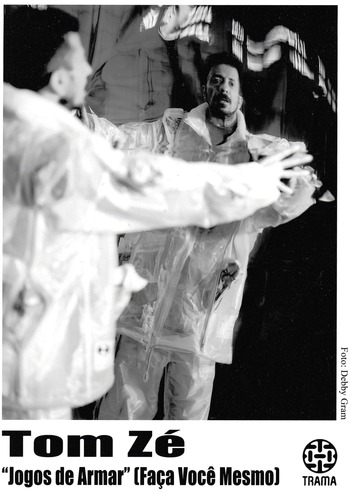
Tom Zé. Promotional photo for CD Jogos de Armar, 2000 (Debby Gram).

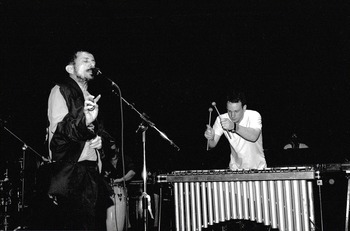
Tom Zé performs with John McIntire of Tortoise in Chicago, 1999 (Christopher Dunn).

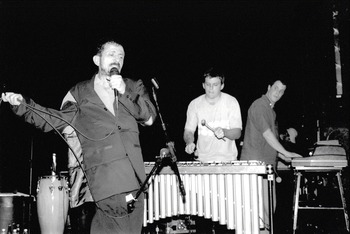
Tom Zé performs with John Herndon and Dan Bitney of Tortoise in Chicago, 1999 (Christopher Dunn).

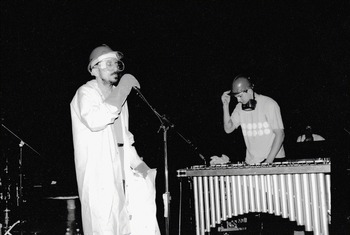
Tom Zé and John Herndon of Tortoise in Chicago, 1999 (Christopher Dunn).

In his critique of global capitalism, Tom Zé proposes the figure of the android as an emblem of a kind of dystopian biopower in which global capital exercises total disciplinary control over the citizens of a weak peripheral state. Third-world androids exist only to supply cheap labour for developed economies of the first world: ‘The third world has a huge and rapidly increasing population. These people have been converted into a kind of “android” almost always illiterate’, he writes in the liner notes. In Tom Zé's formulation, these androids are born with factory defects that allow for some measure of agency (Dunn Reference Dunn2001, p. 201; Rollefson Reference Rollefson2007, p. 311). These defects include thinking, dreaming and dancing, which makes them less pliant, even ‘dangerous’, to transnational capital interests. The android is similar to the modernist cannibal, proposed by writer Oswald de Andrade as a Brazilian figure of anti-colonial resistance, except that unlike the cannibal the android is located within a class structure determined by an international division of labour.Footnote 7
The key conceptual song of the album, ‘Esteticar’ (Aestheticate) is an arrastão, or creative appropriation, of the rural baião, a traditional accordion-based dance music from northeast Brazil that was popularised in Rio de Janeiro and São Paulo by poor, mixed-race migrants who make up a large percentage of the urban labour force – the ‘androids’ of globalisation.
Much in the same way that ‘Desafio do Bóia-Fria’ enacts a dispute between a rural peasant and his authoritarian and racist boss, ‘Esteticar’ assumes the point of view of a dark-skinned north-easterner who rebukes a presumably white paulistano with racial prejudices. The migrant is not a passive victim of neo-liberal globalisation, but rather a defiant subject who denounces social and racial discrimination. With absurd humour and erudition, the refrain describes the basic operation of arrastão aesthetics as a moment of ‘inter-semiotic translation’ between several cultural realms.
The album also addresses the meaning of citizenship from the perspective of the upper classes in São Paulo, who have increasingly retreated gated communities and heavily fortified residences. Spatial segregation and social homogeneity provide some level of security for affluent people, but also cut them off from the rest of society. Tom Zé has remarked that today in Brazil ‘the citizen inhabits two types of prison: a) the public prison called a jail; b) the private prison called fear’. To describe the social effects of spatial segregation, he has proposed the figure of the cidadão-mausoléu (citizen-mausoleum), defined as ‘o corpo onde jaz o ser’ (the body where being lies) to refer to the limiting and debilitating effects of social fear on modern urban citizens (Zé Reference Zé2003, p. 134). ‘Tangolomango’ offers a perspective on the effect of fear on the wealthy: rico hoje, coitado / é preso, todo cercado / arrodeado de grades / porteiro, guarda e alarme (‘Nowadays the rich man, poor soul / is imprisoned, totally surrounded / all fenced in / doormen, guards, and alarms). This ‘new culture of fear’ is not a response to political repression, but rather has emerged in the context of increasing urban violence and police brutality coupled with the privatisation of security and justice (Caldeira and Holston Reference Caldeira and Holston1998, p. 715).
His subsequent album, Jogos de Armar, further develops the metaphor of the arrastão. It is oriented toward social critique, denouncing inequality, political corruption, sexual exploitation of minors, and what he calls ‘globarbarisation’. As Luiz Tatit has observed, the entire album is based on a poetics of incompleteness and imperfection (in Zé Reference Zé2003, p. 224). It was conceived as an ‘attempt’, or provisional version, providing material for others to cite or ‘plagiarise’. The original Brazilian recording on the Trama label came with an auxiliary CD containing the rhythmic, melodic, and harmonic ‘cells’ of each song to facilitate new combinations and compositions. Some of these sounds were produced by a series of invented electroacoustic instruments that Tom Zé had originally constructed in 1978 and rebuilt in the late 1990s for this recording. It is a project that explicitly encourages musical citation and intertextuality, providing a model for dialogic, participatory forms of cultural production informed by contemporary sampling techniques.
Tom Zé has expressed with increased frequency his admiration for hip-hop and funk cultures of the urban peripheries, which he regards as the vanguard of musical invention in Brazil today. The a capella song ‘Cafuas, Guetos, Santuários’, dedicated to the ‘brothers of the periphery’, is an homage to hip-hop culture of São Paulo: São Paulo, São Paulo / Em algum lugar da tua violência és domingo / domingo, domingo / Em algum lugar do teu domingo tens um útero de idéias / idéias, idéias / Cafuas, guetos e santuários / Vêm hoje aqui na periferia / procurar o ouro das cabeças (‘São Paulo, São Paulo / in some violent place it's Sunday / Sunday, Sunday / In some place on Sunday you have a uterus of ideas / ideas, ideas / Shacks, ghettoes and sanctuaries / Come today to the outskirts of town to look for gold from heads’). While acknowledging the persistence of violence in the outer slums of São Paulo, which most typically victimises innocent residents, Tom Zé also represents the periphery as a place of artistic creation and intellectual vigour. Peripheral neighbourhoods have emerged as sites of new experiences in cultural citizenship and popular education through hip-hop culture (Moehn Reference Moehn2007, p. 31; Pardue Reference Pardue2007, p. 675). As the role of the state as a provider of social services has diminished, forms of community-based cultural activism have begun to fill the void (Yúdice Reference Yúdice2003, pp. 25–6).
On Jogos de Armar, Tom Zé performs multiple arrastões that resignify his own compositions, mostly overlooked songs of his repertoire from the 1970s and 1980s. The most remarkable instance of what we might call an auto-arrastão is his revision of ‘Desafio do Bóia-Fria’. In the updated version, renamed simply ‘Desafio’, the dispute is no longer between rural landowner and peasant, but rather between the doutor, or privileged ‘expert’, and the homem, or ‘common man’ with limited social and civil rights:
In ‘Desafio’, the common man appropriates the expert's biopolitical discourse, but changes its terms: social inferiority has nothing to do with ‘race’, but rather, relates to the lack of education and poor nutrition.Footnote 9 Biopolitical strategies may be used by the state, or other forces of domination, for purposes of social control, but can also be appropriated from below as people nourish and care for their own bodies as a way of restoring individual agency. Tom Zé focuses particularly on the access to protein as a key determinant of cerebral growth, creativity, and political action, suggesting a direct correlation between access to nutrition and education and the expansion of revolutionary minds (Jesus Christ's and Fidel Castro's) that would transform the Brazilian hinterlands. In narrating his autobiography, Tom Zé has emphasised his own privileged access to ‘school and protein’ as a function of sheer luck. In 1920 his father, who came from a miserably poor family, won the federal lottery, which afforded him the opportunity to marry into a progressive bourgeois family of Irará, some with ties to the Brazilian Communist Party, who believed in the value of liberal education (Porto Reference Porto1999, pp. 30–1; Zé Reference Zé2003, pp. 242–4). In this sense, Tom Zé's own artistic and political project is directly related to the context of his own childhood of relative privilege surrounded by misery in the north-eastern sertão.
In rewriting ‘Desafio’, Tom Zé also added a refrain, clearly indebted to the verbal experiments of concrete poetry, which introduces an Afro-Diasporic dimension to the song: Africará mingüê e favelará / Mérica de verme que deusará / Iocuné Tatuapé Irará (‘Africa waning slums arise / America infested will deify / Iocuné Tatuapé Irará’). He introduces suggestive neologisms based on the transformation of substantives into verbs (as in favelará) and makes references to several indigenous place names in Brazil including his hometown. The refrain refers to the forced relocation of Africans to the Americas, leading eventually to the expansion of poor, high-density urban communities, such as the favelas in Brazil. The second line is particularly striking in its reference to the Americas as the site of misery, suggested by the presence of ‘vermin’, but also of new forms of transcendence, implied by the neologism deusará, which echoes the popular expression deus dará (God will provide), while negating its implicit fatalism.
In 2000, the same year he released Jogos de Armar, Tom Zé received the Citizen-Artist award from the city of São Paulo for his musical, poetic, and performative work to promote an ethical critique and debate in Brazilian society. The award was a measure of his critical acclaim and to some extent popular success as an artist, but also of the shifting semantic terrain of citizenship in Brazilian society. By that time, various ideas of citizenship had meaning and import that were either suppressed or conceptually unavailable when he began his professional career in the mid-1960s. Teresa Caldeira and James Holston have observed that democratic citizenship is not a fixed and stable set of rules and forms of conduct that proceed in linear fashion toward ideal civility. Instead, the historic process of citizenship is ‘always becoming and unbecoming, often confusing and unstable’ (Caldeira and Holston Reference Caldeira and Holston1998, p. 717). Through his creative work, Tom Zé has reflected on what Carvalho has called the ‘long road of citizenship in Brazil’, which evident in his lyrics, but also in the formal aspects of his music, which convey an aesthetics of contingency and incompleteness. He has theorised citizenship in progressive and regressive (or conservative) dimensions in relation to national identity, consumption, mass culture, bourgeois privilege, state-sanctioned control, class-consciousness, community formation, insurgent biopolitics, anti-racist critique, and neo-liberal globalisation. Like an urban homem da mala, his musical and poetic ideas take the form of imprensa cantada, in the familiar language of everyday life, with the force of sudden and unsettling revelation.