Adenoviruses have a ubiquitous influence on human health, and the clinical manifestations of infection can affect any organ system. For patients who are immunocompromised or immunosuppressed, disseminated adenovirus can be fatal, and thus early identification, monitoring, and treatment is paramount. Unfortunately, treatment for disseminated adenovirus in immunocompromised children is not well defined. We report the case of a 9-month-old boy who was successfully treated for disseminated adenovirus infection 3 months after heart transplant.
Case report
A 9-month-old boy with hypoplastic left heart developed heart failure necessitating cardiac transplantation. Three months after transplant, he was admitted for an acute febrile illness associated with cough, transaminitis, and hyperbilirubinaemia. An abdominal ultrasound revealed biliary sludging and mild splenomegaly. His symptoms progressed to acute respiratory failure and shock requiring intensive care admission and mechanical ventilation.
Work-up was negative for Epstein–Barr virus, hepatitis A, B, and C, mycoplasma pneumoniae, cytomegalovirus, and herpes simplex virus; however, serum adenovirus polymerase chain reaction was elevated at 4.75 million copies. He also had a white blood cell count of 1.2, platelets of 112, and total bilirubin of 2.3 mg/dL. His brain natriuretic peptide was 199 pg/mL and echocardiograms throughout his hospitalisation showed well-maintained ejection fraction.
Treatment with cidofovir was started at 1 mg/kg/day three times weekly, but after two doses it was transitioned to 5 mg/kg/day once weekly, of which he received five total doses. One dose of intravenous immunoglobulin was administered early in the course at 1 g/kg. His cyclosporine was decreased to goal trough level of 100 and his mycophenolate dose was reduced by 50%. His prednisolone was continued at 0.5 mg/kg/day. He tolerated cidofovir well, with a peak creatinine of 0.31 mg/dL, and no reported side effects.
The treatment length was dictated by the serum viral load present on serum adenovirus polymerase chain reaction. At the time of discharge, his viral count decreased to 1280 copies. He was on room air, tolerating home feeds, and cardiac function remained normal. He is now 2 years post cardiac transplant and 1 year post treatment for his adenovirus infection without any signs of rejection or recurrence.
Summary
Typically, for patients who have undergone solid-organ transplant, adenovirus infection is related to the transplanted organ. Our patient, however, had evidence of multi-organ involvement without cardiac involvement. Immunocompromised patients are especially at risk for disseminated adenovirus infection.Reference Ison 1 The morbidity and mortality are high, with one retrospective review reporting deaths in 83% of immunocompromised patients.Reference Munoz, Piedra and Demmler 2
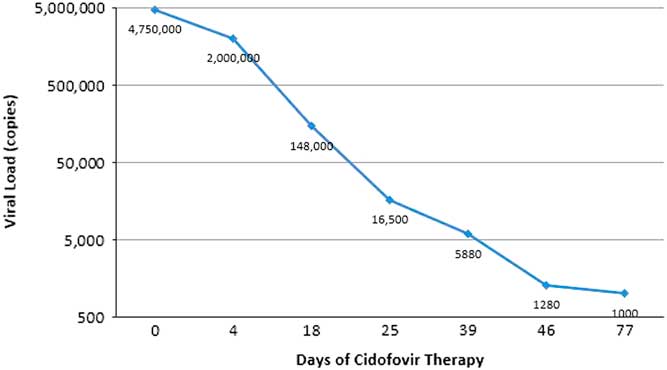
Despite primary disseminated adenovirus infection, which severely affected our patient’s liver, lung, and haematopetic systems, he was successfully treated with cidofovir, intravenous immunoglobulin, and reduction of immunosuppression (Fig 1). His regimen was tailored to adenoviral loads, white blood cell count, platelet count, and clinical response. The decrease in his viral load correlated with a decrease in clinical symptoms and improvement in clinical status, which may reflect a combination of the antiviral effect of cidofovir coupled with reduced immunosuppression and administration of intravenous immunoglobulin. He is now 1 year post infection and 2 years post transplantation, without any evidence of cellular or antibody-mediated rejection, no evidence of donor-specific antibody development, preservation of graft function, and complete recovery of end-organ dysfunction. Although isolated treatment regimens cannot prove a definitive benefit, we believe our case report, in conjunction with the successful treatment of adenovirus in both paediatric haematopoetic stem cell transplant patientsReference Yusuf, Hale and Gu 3 and paediatric liver transplant patients,Reference Carter, Karpen and Quiros-Tejeira 4 suggests that such therapies should be considered in severe cases of disseminated adenoviral infections in patients following cardiac transplantation.
Viral loads of our patient with quantitative blood adenovirus polymerase chain reaction treated with cidofovir. Day 0 of therapy represents the pre-treatment value. Cidofovir treatment was continued until day 41. On day 5 of treatment, he also received 1g/kg of intravenous immunoglobulin and his prednisone was decreased to a nadir of 25% of his maintenance dose. His cyclosporin dosing was tailored to a goal trough level of 100, and by day 12 of cidofovir treatment was at a nadir of 57% of his maintenance dose.

Acknowledgements
None.
Financial Support
This research received no specific grant from any funding agency or from commercial, or not-for-profit sectors.
Conflicts of Interest
None.
Ethical Standards
The authors assert that all procedures contributing to this work comply with the ethical standards of the relevant national guidelines on human experimentation and with the Helsinki Declaration of 1975, as revised in 2008, and has been approved by the institutional committee.
Author Contributions
All authors participated in data analysis, and interpretation, manuscript drafting and revision, and approval of the submitted manuscript.