





Delivery of holistic, person-centred care to people who are severely agitated, confused or distressed is complex within the acute general hospital setting. Reference Dickinson and Clark1,Reference Wood, Vindrola-Padros, Swart, McIntosh, Crowe and Morris2 When unwell, these patients may present with disruptive or aggressive behaviours or a risk of self-harm, Reference Nolan3–Reference James, Reichelt, Moniz-Cook and Lee5 and this can be experienced by healthcare professionals as challenging to manage. Reference Hallett6 Such behaviours often stem from unmet care and support needs, typically relating to conditions such as learning disabilities, mental illness, substance use disorders, dementia or acute delirium. Reference Dickinson and Clark1,Reference James, Reichelt, Moniz-Cook and Lee5 In a definition adopted by the Challenging Behaviour Foundation, 7 challenging behaviour has been described as ‘culturally abnormal behaviour(s) of such intensity, frequency or duration that the physical safety of the person or others is likely to be placed in serious jeopardy’. Reference Emerson and Einfeld8
Quality and safety of care
Evidence suggests that agitated, confused or distressed patients seldom receive holistic care for both their physical and emotional or behavioural needs within acute general hospital wards or emergency departments. Reference Giandinoto and Edward9 Such individuals are at elevated risk of experiencing preventable harm or adverse events in hospital, Reference Fernholm, Holzmann, Wachtler, Szulkin, Carlsson and Pukk Härenstam10 including pressure ulcers, infections due to medical care and deterioration in mental state. Reference Khaykin, Ford, Pronovost, Dixon and Daumit11–Reference Weissinger, Carthon, Ahmed and Brawner14 Multiple factors may contribute to these evidenced harms. These include difficulties in managing risks within a non-purpose-built care environment; Reference Nolan3,Reference McGinty, Thompson, Pronovost, Dixon, Guallar and Ford15 disruptions to a person’s usual psychotropic medication schedule; Reference Weissinger, Carthon, Ahmed and Brawner14 gaps in ward staff training, experience and skills; Reference Giandinoto and Edward9,Reference Forster, Coventry and Daniel16 stigmatisation; Reference Alexander, Ellis and Barrett17 risks of misdiagnosis or ‘diagnostic overshadowing’; Reference Tarver and Stuenkel18,Reference Shefer, Henderson, Howard, Murray and Thornicroft19 communication challenges; Reference Bartlett, Blais, Tamblyn, Clermont and MacGibbon20,Reference Louch, Albutt, Harlow-Trigg, Moore, Smyth and Ramsey21 or inappropriate use of the Mental Health Act, Mental Capacity Act or restrictive interventions (e.g. rapid tranquillisation). 22,23 In line with rights-based approaches to care, these findings reinforce calls for a paradigm shift away from regarding an individual as being inherently ‘challenging’. Reference Jorgensen, Nankervis and Chan24 Instead, within the acute general hospital, behaviours perceived to be challenging can be understood as ‘adaptive behaviours to maladaptive environments’. Reference Jorgensen, Nankervis and Chan24
Enhanced observation
Beyond direct input from specialist support teams in hospital (e.g. psychiatric liaison), enhanced observation may be used to support patients in at-risk groups. This intervention has been defined as provision of ‘one-to-one care and close observation’ by healthcare staff Reference Carter25 and is used ‘to support people in hospital who are considered to be at risk of safety concerns’. Reference Coyle, Wilson, Lapkin and Traynor26 In recent research, reasons identified for initiating this intervention with adult and older adult in-patients included risks of suicide or falling, agitation, and pulling at tubes and lines. Reference Solimine, Takeshita, Goebert, Lee, Schultz and Guerrero27 Within the international literature, a range of descriptors have been used to denote this intervention, including ‘constant observation’ and ‘specialling’. Reference Cook, Palesy, Lapkin and Chenoweth28 Those performing this role, typically registered nurses or unqualified nursing assistants, have been informally termed ‘specials’ or ‘sitters’. Reference Cook, Palesy, Lapkin and Chenoweth28,Reference Moyle, Borbasi, Wallis, Olorenshaw and Gracia29 In what follows, ‘enhanced observer’ is used as an umbrella term to describe clinical staff members of any background undertaking this role.
International evidence reviews have provided valuable insights into the use of this intervention in mental health hospitals Reference Ashmore30,Reference Reen, Bailey, Maughan and Vincent31 and explored its conceptualisation and deployment in acute general hospital settings. Reference Wood, Vindrola-Padros, Swart, McIntosh, Crowe and Morris2 When delivered effectively, enhanced observation can foster compassionate staff–patient interactions in acute general hospitals. Reference Wood, Vindrola-Padros, Swart, McIntosh, Crowe and Morris2,Reference Cook, Palesy, Lapkin and Chenoweth28 However, this is a costly intervention, for which there is evidenced variation in care quality and productivity and a lack of evidence-based guidance and standards. Reference Wood, Vindrola-Padros, Swart, McIntosh, Crowe and Morris2,Reference Carter25,32 Indeed, a national programme, termed ‘Enhanced Therapeutic Observations and Care’, was recently launched to support National Health Service (NHS) providers in England to drive improvements in this practice. 33 The observed variation in both the quality and effectiveness of enhanced observation, coupled with the aforementioned policy imperative, indicates a need for a systematic synthesis of international evidence on the characteristics and outcomes of safe (and unsafe) enhanced observation in the acute general hospital setting.
Objectives
The aim of this work was to comprehensively identify empirical research evidence or quality improvement reports describing quality and safety considerations in the care of agitated, confused or distressed patients receiving enhanced observation in the acute general hospital setting, to address the following question: ‘What does high-quality, safe care in an acute general hospital look like for patients receiving enhanced observation to manage agitated, confused or distressed behaviours experienced as challenging to support by staff?’
Specific objectives were:
(a) to examine the characteristics of enhanced observation provision associated with quality and safety of care for these patients, as reported by study authors; and
(b) to elucidate the quality and safety challenges experienced by this patient population, as described within the identified literature.
Method
Design
The systematic review protocol was developed prospectively and pre-registered in the Prospective Register of Systematic Reviews database on 18 December 2024 (CRD42024628762). The write-up adheres to the Preferred Reporting Items for Systematic Reviews and Meta-analyses statement. Reference Page, McKenzie, Bossuyt, Boutron, Hoffmann and Mulrow34
Eligibility criteria
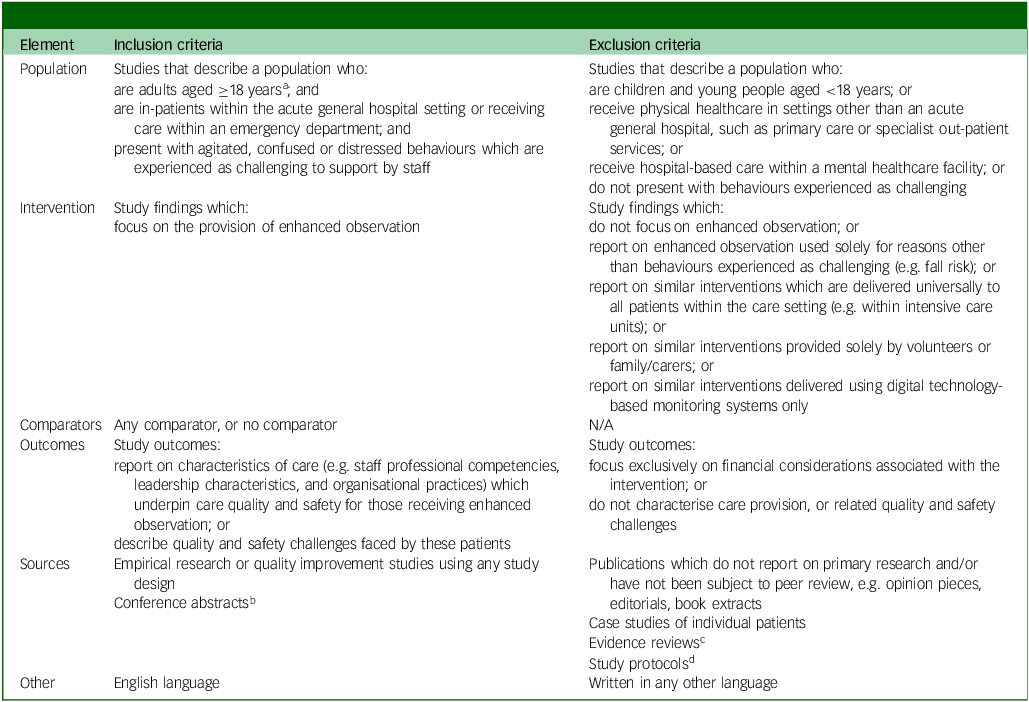
The review question, search strategy and eligibility criteria were formulated using the Population, Intervention, Comparator, Outcome framework. 35 The review population consisted of adult acute general hospital in-patients or emergency department patients who presented with agitated, confused or distressed behaviours that are experienced as challenging to support by staff, according to the following definition: ‘A person’s behaviour can be defined as challenging if it puts them or those around them at risk’. 36 Examples include aggression, self-harm or disruptiveness. 36 The intervention, enhanced observation, was defined as the practice of ‘one-to-one care and close observation’, Reference Carter25 initiated by hospital staff ‘to support people who are considered to be at risk of safety concerns’. Reference Coyle, Wilson, Lapkin and Traynor26 We also considered studies reporting on ‘cohorting’, which involves enhanced monitoring of a small ‘cohort’ of patients with similar needs in a specific area of the ward, to fall within our definition. Outcomes explored were care characteristics and challenges relating to quality and safety, comprising: (a) the features of care provision (e.g. staff competencies, leadership characteristics and organisational practices) which underpin quality and safety of care for those receiving enhanced observation; and (b) reported quality and safety challenges for these patients. Quality has been defined as encompassing clinical effectiveness, patient experience and patient safety, 37 where patient safety can be defined as ‘the avoidance, prevention and amelioration of adverse outcomes or injuries stemming from the process of healthcare’. Reference Vincent38 Full eligibility criteria are detailed in Table 1.
Overview of systematic review eligibility criteria

Table 1 Long description
The table has six columns: Element, Inclusion criteria, Exclusion criteria, Comparators, Outcomes, Sources, and Other. It details the criteria for a systematic review, including population, intervention, comparators, outcomes, sources, and other factors. The population criteria include studies describing adults aged 18 or older in acute general hospital settings or emergency departments with agitated, confused, or distressed behaviors. The intervention criteria focus on enhanced observation practices. Comparators can be any comparator or no comparator. Outcomes include characteristics of care and quality and safety challenges. Sources are empirical research or quality improvement studies. The table also specifies that the language must be English.
a. Studies containing aggregated data from mixed-age samples were included if at least 80% of participants were aged ≥18 years, or if the overall sample mean age was ≥20 years.
b. Conference abstracts reporting on relevant research were included unless a full-text published research paper by the same authors reporting on the same study findings could be identified and included instead.
c. Reference lists of relevant evidence reviews were searched, and eligible primary research studies were included.
d. For identified study protocols addressing the topic and outcomes of interest, we sought to locate published research findings where available.
Information sources and search strategy
Five bibliographic databases were searched: MEDLINE, Embase, the Health Management Information Consortium, CINAHL and PsycINFO. A preliminary search strategy was developed by academic and mental health professionals with an interest in patient safety improvement for at-risk patients. It was then refined according to feedback from medical librarians and from patients and carers, and with reference to search strategies from previous evidence reviews (Supplementary Table 1a available at https://doi.org/10.1192/bjo.2026.12130). Reference Wood, Vindrola-Padros, Swart, McIntosh, Crowe and Morris2,Reference Reen, Bailey, Maughan and Vincent31,Reference Block, Paul, Muir-Cochrane, Bellon, George and Hunter39–Reference Weissinger, Carthon and Brawner41 Searches were performed on 16 December 2024 and updated on 18 April 2026 and focused on three elements: ‘acute general hospital patients with agitated, confused, or distressed behaviours experienced as challenging to support’ (population); ‘enhanced observation’ (intervention); and ‘care characteristics and challenges relating to quality and safety’ (outcomes). To improve search yield, we also performed a supplementary search in Google Scholar focusing on the above elements, reviewing the first ten pages of results for each search string (Supplementary Table 1b). Google Scholar searches were organised by the database’s ‘relevance’ algorithm. Potentially eligible records that had not already been captured within the preceding searches of the five bibliographic databases were then exported following preliminary screening within Google Scholar. Reference lists and citations of all included papers and identified evidence reviews were also hand-searched to identify any additional eligible studies. Searches were restricted to the English language; no limits were applied on the basis of publication year or country of origin.
Selection process
Retrieved records were de-duplicated using EndNote (EndNote 2025, Clarivate, Philadelphia, USA: https://endnote.com/) and uploaded to Covidence (Covidence systematic review software; Veritas Health Innovation, Melbourne, Australia: https://www.covidence.org/) to record decision-making. Two reviewers (P.A. and S.A. or J.K.) independently screened records at title and abstract level using predefined eligibility criteria (Table 1), followed by full-text review of shortlisted texts. Reviewers were blinded to each other’s screening decisions. Disagreements were resolved through discussion and consensus, with a third reviewer (S.A. or J.K.) providing independent arbitration if necessary.
Data extraction
Data extraction tables were developed and piloted before protocol registration. Formal data extraction commenced on 2 June 2025. One reviewer (P.A.) systematically extracted the following data points from included studies: authors and publication year; country; care setting(s); main clinical population(s); study aim; design and methods; participant or sample characteristics (age, sex, ethnicity, diagnoses); and key findings. A second reviewer (S.A.) checked the extracted data for accuracy. Extracted data reflect the language used by study authors (e.g. specialling), even in cases in which this differed from terminology used by reviewers (e.g. enhanced observation).
Quality assessment
Included research studies were appraised for quality by one author (P.A.) using the Mixed Methods Appraisal Tool. Reference Hong, Fàbregues, Bartlett, Boardman, Cargo and Dagenais42 This tool contains five subscales for quality assessment of quantitative studies (randomised controlled trials, quantitative non-randomised studies, quantitative descriptive studies) and qualitative and mixed-methods studies. The Quality Improvement Minimum Quality Criteria Set was applied by the same reviewer (P.A.) for appraisal of quality improvement studies. Reference Hempel, Shekelle, Liu, Sherwood Danz, Foy and Lim43 Quality appraisal was not attempted for conference abstracts, which were included when no corresponding published full-text paper could be located. For all included research studies and quality improvement reports, a second reviewer (A.H.) cross-checked quality appraisal scores against full-text articles. Any discrepancies in scoring were discussed by the two authors (P.A. and A.H.) until a consensus was reached, with input from a third reviewer (S.A.) when required. Evidence quality was summarised, but studies were not excluded on the basis of quality.
Data synthesis
We expected the included literature to be diverse in terms of study design and the extracted data to be heterogeneous. Accordingly, to appraise the characteristics of care relating to quality and safety for the review population (objective 1), we conducted a framework-based synthesis. Reference Carroll, Booth and Cooper44,Reference Dixon-Woods45 The Humane and Comprehensive Management of Challenging Behaviour in Health and Social Care (HCMCB) instrument was used as a conceptual model to inform a preliminary evidence synthesis framework. Reference Tölli, Kontio, Partanen, Terkamo-Moisio and Häggman-Laitila46 This tool was originally designed as a measure of ethical behaviour management and comprises eight core dimensions (e.g. ‘knowledge’, ‘teamwork’, ‘organisational culture’), within which 14 factors (e.g. ‘person-centred care’, ‘humanity’, ‘best interest’) characterise care provision in the context of managing behaviours experienced as challenging to support (Supplementary Table 2). We adapted questions into descriptors and expanded a focus on physical restraint to capture a wider range of restrictive interventions. Additional descriptors were developed inductively in response to new themes or concepts identified within review data.
Data concerning quality and safety challenges (objective 2) were summarised thematically and tabulated. We did not attempt meta-analyses of quantitative findings owing to the heterogeneity of the evidence. Data synthesis was led by P.A. and iteratively revised according to discussions with co-authors (S.A. and S.T.).
Patient and public involvement
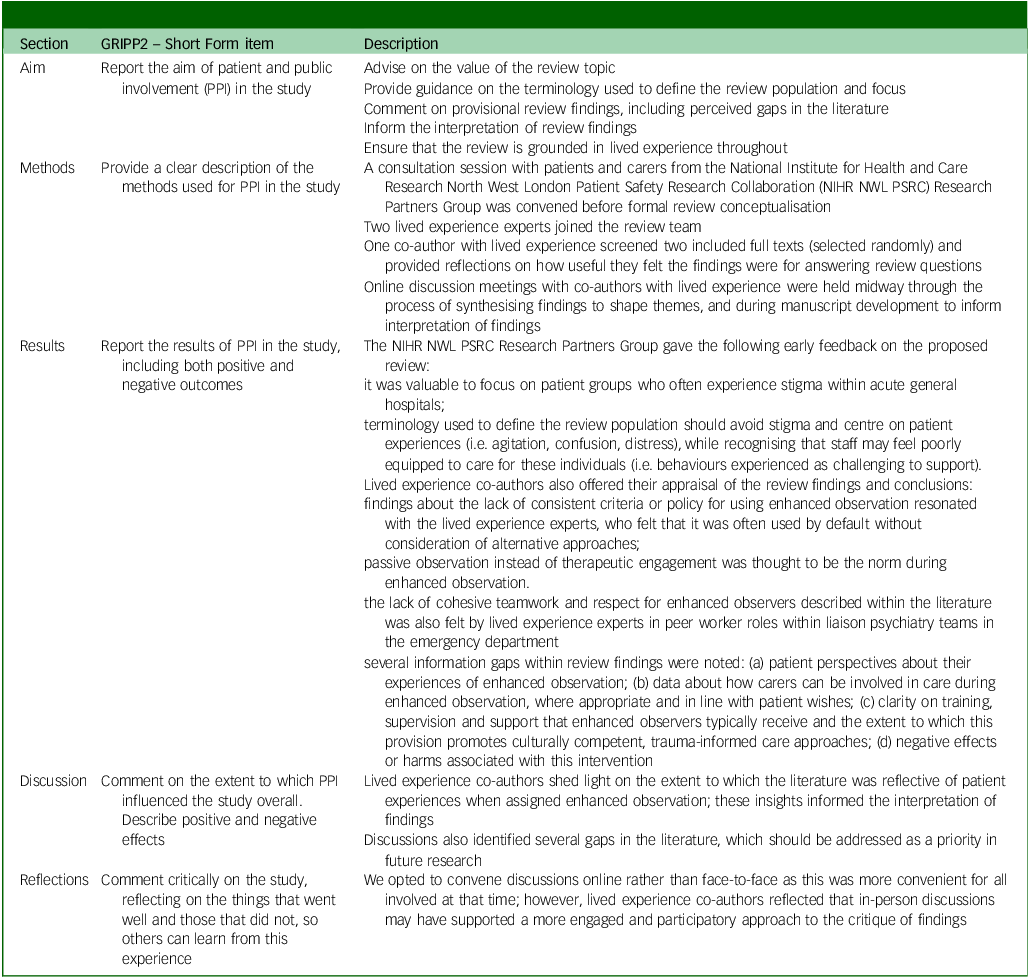
Patient and public involvement, as detailed in Table 2, was included according to the Guidance for Reporting Involvement of Patients and the Public Short Form tool. Reference Staniszewska, Brett, Simera, Seers, Mockford and Goodlad47 The National Institute for Health and Care Research (NIHR) North West London Patient Safety Research Collaboration (NIHR NWL PSRC) Research Partners Group of patients and carers gave provisional feedback on the review topic. Two co-authors with lived experience of mental health needs (C.S. and D.L.) offered expertise to strengthen the contextualisation and interpretation of review findings.
Patient and public involvement throughout the study

Table 2 Long description
A table detailing patient and public involvement in a systematic review study. The table has four sections: Aim, Methods, Results, and Discussion. Each section includes a GRIPP2 Short Form Item, a description, and a detailed explanation. The Aim section advises on the review topic and provides guidance on terminology. The Methods section describes the methods used for patient and public involvement, including consultation sessions and the roles of lived experience experts. The Results section reports the outcomes of patient and public involvement, highlighting both positive and negative aspects. The Discussion section comments on the influence of patient and public involvement on the study overall.
Results
Bibliographic database searches yielded 5384 unique records after de-duplication. These were subjected to title and abstract screening, with 191 full texts screened and 35 publications included. Hand-searching and forward and backward citation searches identified 33 additional records. We could not retrieve one of these records, so 32 records were obtained for screening, resulting in an additional 15 included texts. Fifty studies were therefore included (Fig. 1). The extracted data are summarised in Supplementary Table 3a and b.
PRISMA flow diagram detailing the study selection process. HMIC, Health Management Information Consortium.

The results are organised according to the review objectives. First, we detail findings on the characteristics of enhanced observation provision associated with quality and safety of care for people who are agitated, confused, or distressed (objective 1). Next, potential or actual quality and safety challenges experienced by these patients (objective 2) are described.
Study characteristics
Almost two-thirds of studies were conducted in the USA (n = 31, 62.0%). Eleven (22.0%) texts corresponded to Australian services, and the remaining publications were from the UK (n = 6, 12.0%) or Ireland (n = 2, 4.0%). Research studies were primarily quantitative in design, including descriptive or non-randomised studies (n = 15). Ten qualitative and ten mixed-methods research studies were also included. Most quality improvement studies adopted quantitative (n = 11) or mixed-methods (n = 4) designs. Overall, most studies described adult populations of mixed ages, for whom enhanced observation was assigned owing to mental health needs, risk of harm to self or others, agitation or confusion (n = 32, 64.0%). Other literature focused specifically on older adults (≥65 years old), with needs relating to dementia, delirium or cognitive impairment (n = 18, 36.0%).
Quality assessment
Included research and quality improvement reports varied in quality (Supplementary Table 4a–f). Qualitative studies demonstrated higher overall methodological quality, whereas quantitative non-randomised studies and quantitative descriptive studies typically contained insufficient information for assessment of sample representativeness. Mixed-methods studies often lacked adequate rationale for design selection and seldom adhered to quality standards for the quantitative and qualitative traditions encompassed. Most of the inadequacies in information presented in quality improvement reports related to reporting of project design, intervention fidelity, reach, sustainability and potential for replication. Four conference abstracts were not subjected to quality appraisal.
Characteristics of enhanced observation provision associated with quality and safety
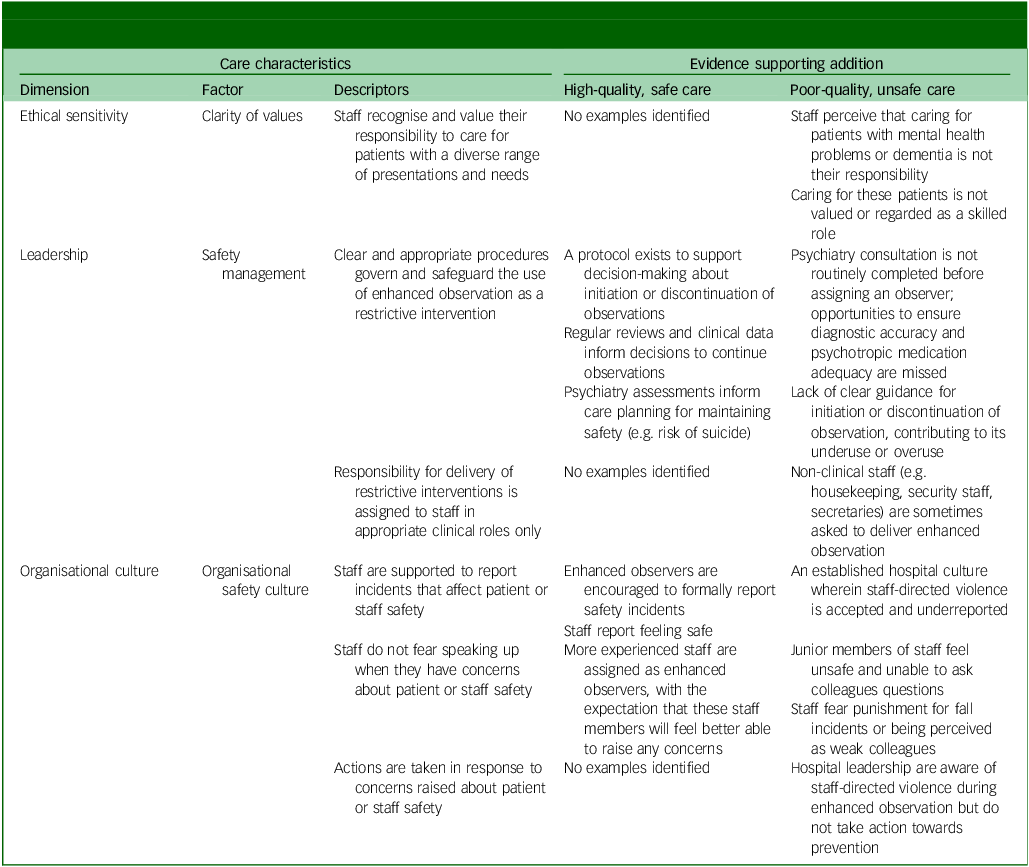
Review findings supported the relevance of the HCMCB-informed framework for understanding the characteristics of enhanced observation associated with quality and safety of care for agitated, confused or distressed patients. Existing dimensions captured much of the reviewed evidence, particularly in relation to staff knowledge, de-escalation skills, person-centred care, teamwork, leadership and organisational culture. The review also identified concepts specific to enhanced observation beyond those presented in the original framework, as summarised in Table 3. On the basis of new concepts identified within review data, one new factor (‘Organisational safety culture’) was inductively introduced into the framework under the organisational culture dimension. Six new care descriptors were also added, including (‘Clear and appropriate procedures exist to govern and safeguard the use of enhanced observation as a restrictive intervention’). Supplementary Table 5 provides illustrative examples from the reviewed literature showing how each care characteristic was associated with high-quality and safe care, or with poor-quality and unsafe care.
Characteristics of enhanced observation associated with quality and safety of care: additions to conceptual framework based on included literaturea

Table 3 Long description
A table with four columns: Dimension, Factor, Descriptors, and Evidence supporting addition. The table has multiple rows under each dimension, detailing factors and descriptors related to ethical sensitivity, leadership, responsibility for delivery of restrictive interventions, and organisational culture. Each row compares high-quality, safe care with poor-quality, unsafe care in the context of enhanced observation provision, listing specific evidence for each descriptor.
a. A framework adapted from the Humane and Comprehensive Management of Challenging Behaviour in Health and Social Care tool was used to guide evidence synthesis. Reference Tölli, Kontio, Partanen, Terkamo-Moisio and Häggman-Laitila46 This table summarises new descriptors which were introduced inductively into the framework on the basis of the included literature.
Knowledge
A range of studies explored staff knowledge about factors which can precipitate agitation, confusion or distress during enhanced observation. Reference Schroeder48–Reference Wray and Rajab-Ali56 Staff described understanding that patients could not always regulate their behaviour owing to underlying conditions, such as dementia or traumatic brain injury. Reference Schroeder48,Reference Squire and Hessler49 Several publications also suggested staff insight into patient behaviours indicative of unmet needs. Efforts to identify potential pain, sensory discomfort or hunger were described. Reference Case50,Reference Flaherty and Little52,Reference Vancil, Michael, Wagoner, Farkas, Evans and Pasley55,Reference Wray and Rajab-Ali56 Despite this apparent understanding, potentially avoidable shortfalls in care were reported nonetheless. Problems such as delaying a person’s medications were thought to exacerbate patient agitation. Reference de Jong, Weselman, Kitchen and Hill51
Skills
Skills underpinning high-quality and safe care during enhanced observation were also discussed. Reference Cook, Palesy, Lapkin and Chenoweth28,Reference Moyle, Borbasi, Wallis, Olorenshaw and Gracia29,Reference Case50–Reference Flaherty and Little52,Reference Beccaria, Hoey, Towler, Rees, Brazier and Gordon57–Reference Handley, Theodosopoulou, Taylor, Hadley, Surr and Goodman66 Studies indicated that enhanced observers showed attunement skills through timely identification of and response to signs of patient deterioration, Reference Beccaria, Hoey, Towler, Rees, Brazier and Gordon57–Reference Cook, Palesy, Chenoweth and Lapkin59 while also recognising how their own practice could provoke patients. Reference Cook, Palesy, Lapkin and Chenoweth28,Reference Moyle, Borbasi, Wallis, Olorenshaw and Gracia29,Reference Cook, Palesy, Chenoweth and Lapkin59,Reference Waszynski, Veronneau, Therrien, Brousseau, Massa and Levick60 For example, participants reflected that ineffective communication, or simply the experience of enhanced observation itself, could inadvertently cause patient distress. Reference Cook, Palesy, Lapkin and Chenoweth28,Reference Moyle, Borbasi, Wallis, Olorenshaw and Gracia29,Reference Cook, Palesy, Chenoweth and Lapkin59 Examples of poor attunement were also presented. For instance, staff had sometimes carried out invasive procedures on distressed patients without explaining what they were doing, Reference Cook, Palesy, Lapkin and Chenoweth28 suggesting that informed consent was not sought first.
Staff skills in supporting patients to regulate their actions and behaviours represented a further theme. Reference Case50–Reference Flaherty and Little52,Reference Wilkes, Jackson, Mohan and Wallis61–Reference Handley, Theodosopoulou, Taylor, Hadley, Surr and Goodman66 Efforts to enhance quality and safety included a focus on the adequacy of psychotropic medications prescribed to those under enhanced observation. Reference Case50,Reference de Jong, Weselman, Kitchen and Hill51,Reference Pinkhasov, Singh, Chavali, Legrand and Calixte63 For example, medication side-effects were considered as contributory factors to falls. Reference de Jong, Weselman, Kitchen and Hill51 Other studies described the use of pro-active medication reviews to appraise how medications contributed to agitation or delirium. Reference Case50,Reference Pinkhasov, Singh, Chavali, Legrand and Calixte63
Further literature reported on enhanced observer skills in de-escalation in response to agitation or distress. Reference Flaherty and Little52,Reference Naughton, Allen, Myers, Wills, Fehin and Jacob62,Reference Flynn, Prescott and Jinks64,Reference Northcott, Mwale, Wyatt, Series, Harrison Dening and Featherstone65 De-escalation training and individualised activity planning interventions were evaluated. Reference Naughton, Allen, Myers, Wills, Fehin and Jacob62,Reference Flynn, Prescott and Jinks64 After implementation of such initiatives, higher proportions of surveyed staff stated that they were ‘fairly confident’ or ‘extremely confident’ in using de-escalation techniques (80% v. 55% at baseline), Reference Flynn, Prescott and Jinks64 whereas mean rates of pro re nata antipsychotic prescription showed trends towards reduction (5.5% v. 9% at baseline). Although the absence of statistical testing in these studies precluded definitive assertions about the impact of interventions, further research involving ethnographic observations described positive changes in the wider ward atmosphere following effective use of activity-based de-escalation techniques. Reference Northcott, Mwale, Wyatt, Series, Harrison Dening and Featherstone65
Attitude
Staff attitudes and beliefs in relation to the provision of high-quality, safe enhanced observation were often referenced. Reference Cook, Palesy, Lapkin and Chenoweth28,Reference Moyle, Borbasi, Wallis, Olorenshaw and Gracia29,Reference Schroeder48,Reference Case50,Reference Flaherty and Little52,Reference Jones, Aylward and Jones53,Reference Vancil, Michael, Wagoner, Farkas, Evans and Pasley55,Reference Beccaria, Hoey, Towler, Rees, Brazier and Gordon57–Reference Waszynski, Veronneau, Therrien, Brousseau, Massa and Levick60,Reference Naughton, Allen, Myers, Wills, Fehin and Jacob62–Reference Waszynski, Milner, Staff and Molony74 Humanity was conveyed when participating staff expressed compassion and understanding of patients’ feelings, Reference Cook, Palesy, Lapkin and Chenoweth28,Reference Schroeder48,Reference Beccaria, Hoey, Towler, Rees, Brazier and Gordon57–Reference Cook, Palesy, Chenoweth and Lapkin59 and patients responded positively when staff showed awareness of their needs and prior life experiences. Reference Cook, Palesy, Lapkin and Chenoweth28 Efforts to achieve balance between tolerance of potentially risky behaviours by confused patients – including removal of intravenous lines – versus use of restrictive measures were also described. Reference Flaherty and Little52 However, other studies suggested an excessive use of restrictions. Reference Cook, Palesy, Lapkin and Chenoweth28,Reference Handley, Bunn and Goodman67 Examples included observations of patients being prohibited from standing up, Reference Cook, Palesy, Lapkin and Chenoweth28,Reference Northcott, Mwale, Wyatt, Series, Harrison Dening and Featherstone65 without engagement from staff to establish the source of their agitation.
Retrieved research also offered insights into person-centred enhanced observation. Reference Cook, Palesy, Lapkin and Chenoweth28,Reference Moyle, Borbasi, Wallis, Olorenshaw and Gracia29,Reference Case50,Reference Jones, Aylward and Jones53,Reference Vancil, Michael, Wagoner, Farkas, Evans and Pasley55,Reference Waszynski, Veronneau, Therrien, Brousseau, Massa and Levick60,Reference Naughton, Allen, Myers, Wills, Fehin and Jacob62–Reference Waszynski, Milner, Staff and Molony74 Some studies reported examples of staff members incorporating patient preferences into care planning, Reference Case50,Reference Jones, Aylward and Jones53,Reference Pinkhasov, Singh, Chavali, Legrand and Calixte63,Reference Handley, Theodosopoulou, Taylor, Hadley, Surr and Goodman66,Reference Broski, Eckels, Blomquist, King and Lineberry68 such as identifying familiar music to play. Reference Pinkhasov, Singh, Chavali, Legrand and Calixte63 Such findings were in sharp contrast with cases in which the enhanced observer role was passive and custodial before implementation of change initiatives, and planning of care according to therapeutic goals was not prioritised. Reference Jones, Aylward and Jones53,Reference Flynn, Prescott and Jinks64 Nevertheless, a range of interventions to support patients to engage in diversional activities were described; these aimed to avert agitation or deterioration Reference Cook, Palesy, Lapkin and Chenoweth28,Reference Waszynski, Veronneau, Therrien, Brousseau, Massa and Levick60,Reference Naughton, Allen, Myers, Wills, Fehin and Jacob62,Reference Flynn, Prescott and Jinks64,Reference Handley, Bunn and Goodman67,Reference Eeles, Thompson, McCrow and Pandy70–Reference Waszynski, Milner, Staff and Molony74 and the need for further restrictions. Reference Schoenfisch, Pompeii, Lipscomb, Smith, Upadhyaya and Dement71 Such practices were not ubiquitous according to the included research; other studies suggested limited pro-active use of de-escalation activities and little emphasis on patient engagement, with observations seemingly conducted in a task-focused manner. Reference Moyle, Borbasi, Wallis, Olorenshaw and Gracia29,Reference Northcott, Mwale, Wyatt, Series, Harrison Dening and Featherstone65
Confidence
Staff confidence in their ability to support distressed patients in the least restrictive manner, while maintaining self-control, was seldom explored within the included publications. Reference Schroeder48,Reference Flynn, Prescott and Jinks64,Reference Jin, Novik and Saravay75 There were limited descriptions of the ways in which enhanced observers remained calm and avoided provocation in difficult situations. Reference Schroeder48 However, staff confidence in positive risk-taking was addressed. Psychiatrists with consultation-liaison training seemed to be more confident in holding risk and were less likely to request enhanced observation than psychiatrists without such training. Reference Jin, Novik and Saravay75 Other literature reported that staff lacked confidence in using physical restraint, despite receiving training. Reference Flynn, Prescott and Jinks64
Ethical sensitivity
Staff ethical values, beliefs and practices relating to enhanced observation were also detailed. Reference Moyle, Borbasi, Wallis, Olorenshaw and Gracia29,Reference Squire and Hessler49,Reference Jones, Aylward and Jones53,Reference Kerr, Verner and Traynor58,Reference Wilkes, Jackson, Mohan and Wallis61,Reference Flynn, Prescott and Jinks64–Reference Handley, Bunn and Goodman67,Reference Foye, Simpson and Reynolds76,Reference Talley, Davis, Goicoechea, Brown and Barber77 Evidence from ethnographic research suggested that enhanced observation was at times used to safeguard the smooth running of ward routines, by freeing up other members of staff to undertake routine tasks. Reference Northcott, Mwale, Wyatt, Series, Harrison Dening and Featherstone65 A new descriptor was developed to reflect enhanced observers’ recognition and appreciation, or lack thereof, of their responsibility to care for people with a diverse range of needs in the acute general hospital setting. A body of literature suggested that staff disliked being allocated enhanced observation responsibilities, Reference Flynn, Prescott and Jinks64 felt that caring for people with additional needs such as mental health problems was not their responsibility, Reference Wilkes, Jackson, Mohan and Wallis61,Reference Foye, Simpson and Reynolds76 and regarded enhanced observation as an unskilled task akin to ‘babysitting’. Reference Moyle, Borbasi, Wallis, Olorenshaw and Gracia29,Reference Handley, Bunn and Goodman67
Other literature examined whether staff ethical values were aligned with patients’ best interests. Reference Squire and Hessler49,Reference Jones, Aylward and Jones53,Reference Kerr, Verner and Traynor58,Reference Northcott, Mwale, Wyatt, Series, Harrison Dening and Featherstone65,Reference Talley, Davis, Goicoechea, Brown and Barber77 Introduction of an enhanced observation framework for assessment of a person’s care needs was thought to challenge staff to reflect upon their own practice. Reference Jones, Aylward and Jones53 By contrast, further research offered examples of staff members and teams choosing not to respond to patient needs and behaviours. These studies reported on enhanced observers walking away from the person they were assigned to support, Reference Talley, Davis, Goicoechea, Brown and Barber77 or avoiding use of physical restraints despite risks of harm to staff and other patients. Reference Squire and Hessler49 In the latter example, decision-making regarding the use of enhanced observation was influenced by concerns about referrals for care placements being rejected during discharge planning, rather than being solely based on clinical need. Reference Squire and Hessler49 Finally, further research showed active deception of people with dementia during enhanced observation. Reference Northcott, Mwale, Wyatt, Series, Harrison Dening and Featherstone65 For example, nursing staff were observed to lie to a patient about the type of medication being administered (a sedative). Reference Northcott, Mwale, Wyatt, Series, Harrison Dening and Featherstone65
Teamwork
Themes of teamwork fluency during enhanced observation were central in the identified literature. Reference Moyle, Borbasi, Wallis, Olorenshaw and Gracia29,Reference Squire and Hessler49,Reference de Jong, Weselman, Kitchen and Hill51,Reference Jones, Aylward and Jones53–Reference Kerr, Verner and Traynor58,Reference Northcott, Mwale, Wyatt, Series, Harrison Dening and Featherstone65–Reference Broski, Eckels, Blomquist, King and Lineberry68,Reference Schoenfisch, Pompeii, Lipscomb, Smith, Upadhyaya and Dement71,Reference Voetelink, Trout, Murphy, Rogers, Harris and Ramagnano73,Reference Foye, Simpson and Reynolds76,Reference Concannon, Carr, Doherty, McInerney, Birrane and Kearney78–Reference Grealish, Chaboyer, Darch, Real, Phelan and Soltau83 Staff testimonies indicated gaps in information-sharing about patient needs, including risks of violence. Reference Squire and Hessler49,Reference Kerr, Verner and Traynor58,Reference Schoenfisch, Pompeii, Lipscomb, Smith, Upadhyaya and Dement71 Other studies suggested that although most surveyed enhanced observers received handovers when commencing their shift, these handovers lacked information needed to respond to crises. Reference Handley, Theodosopoulou, Taylor, Hadley, Surr and Goodman66,Reference Graham, Eaton, Jeffrey, Secher-Jorgensen and Henderson79 Moreover, a wealth of evidence indicated that enhanced observers felt poorly supported by colleagues; for instance, studies described a lack of respect Reference Schoenfisch, Pompeii, Lipscomb, Smith, Upadhyaya and Dement71,Reference Ahmed, Cayea, Tackett, Bellantoni, Massare and Ward80 and reassurance, Reference Beccaria, Hoey, Towler, Rees, Brazier and Gordon57 and non-response to calls for help. Reference de Jong, Weselman, Kitchen and Hill51 Likewise, ethnographic research described how responsibility for decision-making about enhanced observation continuation was often held by individual staff members, who feared personal reprisals should a patient come to harm after the intervention had been discontinued. Reference Northcott, Mwale, Wyatt, Series, Harrison Dening and Featherstone65
Positive examples of collaborative teamwork during enhanced observation were also identified. Several publications detailed efforts to ensure that enhanced observers felt part of a team. Reference Rachh, Wilkins, Capodilupo, Kilroy, Schnider and Repper-Delisi54,Reference Graham, Eaton, Jeffrey, Secher-Jorgensen and Henderson79 Other settings introduced opportunities for enhanced observers to share their reflections with senior nursing staff, informing decision-making about continuation versus discontinuation of enhanced observation. Reference Jones, Aylward and Jones53,Reference Voetelink, Trout, Murphy, Rogers, Harris and Ramagnano73
Tensions within clinical teams about the remit of the enhanced observer role were evident. A lack of shared responsibility for use of more person-centred care approaches was thought to shape enhanced observation practice. Reference Handley, Theodosopoulou, Taylor, Hadley, Surr and Goodman66 Studies detailed how enhanced observers were often interrupted by registered nurses and asked to attend to other patients or tasks. Reference Kerr, Verner and Traynor58,Reference Handley, Bunn and Goodman67,Reference Grealish, Chaboyer, Darch, Real, Phelan and Soltau83 Measures to address this challenge included introduction of a leadership role to oversee enhanced observer workflow. Reference Rachh, Wilkins, Capodilupo, Kilroy, Schnider and Repper-Delisi54
Leadership
Leadership practices underpinning enhanced observation quality and safety were discussed in a further body of literature, in which the management of staff competence to undertake this intervention was widely examined. Reference Cook, Palesy, Lapkin and Chenoweth28,Reference Moyle, Borbasi, Wallis, Olorenshaw and Gracia29,Reference Schroeder48–Reference de Jong, Weselman, Kitchen and Hill51,Reference Jones, Aylward and Jones53–Reference Cook, Palesy, Chenoweth and Lapkin59,Reference Wilkes, Jackson, Mohan and Wallis61–Reference Northcott, Mwale, Wyatt, Series, Harrison Dening and Featherstone65,Reference Broski, Eckels, Blomquist, King and Lineberry68,Reference Eeles, Thompson, McCrow and Pandy70–Reference Voetelink, Trout, Murphy, Rogers, Harris and Ramagnano73,Reference Graham, Eaton, Jeffrey, Secher-Jorgensen and Henderson79–Reference Shannon, Cruickshank and Grealish90 Training in de-escalation of aggression, Reference Squire and Hessler49,Reference Schoenfisch, Pompeii, Lipscomb, Smith, Upadhyaya and Dement71,Reference Ahmed, Cayea, Tackett, Bellantoni, Massare and Ward80 behaviour management Reference de Jong, Weselman, Kitchen and Hill51,Reference Cook, Palesy, Chenoweth and Lapkin59,Reference Wilkes, Jackson, Mohan and Wallis61,Reference Sinvani, Strunk, Patel, Shah, Mulvany and Kozikowski84 and caring for people with additional vulnerabilities such as dementia or cognitive impairment Reference Moyle, Borbasi, Wallis, Olorenshaw and Gracia29,Reference Jones, Aylward and Jones53 was consistently described as inadequate. Staff suggested that insufficient training and experience in enhanced observation had contributed to instances of inappropriate behaviour management, Reference Cook, Palesy, Chenoweth and Lapkin59 whereas targeted training and mentoring interventions were thought to promote positive practices. Reference Beccaria, Hoey, Towler, Rees, Brazier and Gordon57
Ambiguity in role expectations during enhanced observation was apparent, with some settings lacking definitions of staff responsibilities. Reference Wilkes, Jackson, Mohan and Wallis61,Reference Schoenfisch, Pompeii, Lipscomb, Smith, Upadhyaya and Dement71 Accordingly, several publications described introduction of structured guidance to clarify the scope of the role. Reference Jones, Aylward and Jones53,Reference Beccaria, Hoey, Towler, Rees, Brazier and Gordon57,Reference Kerr, Verner and Traynor58 Staff also reported that requirements for documenting observations and safety incidents were unclear. Reference Squire and Hessler49,Reference Kerr, Verner and Traynor58,Reference Schoenfisch, Pompeii, Lipscomb, Smith, Upadhyaya and Dement71 Efforts to address this problem were centred on streamlining of documentation templates and development of enhanced observer checklists. Reference Case50,Reference Jones, Aylward and Jones53,Reference Vancil, Michael, Wagoner, Farkas, Evans and Pasley55
Management of safety was a second focal leadership theme. Safety within the acute general hospital physical environment was thought to be undermined when emergency call bells could not be reached easily, Reference Broski, Eckels, Blomquist, King and Lineberry68 or by hazards and clutter which contributed to patient falls. Reference de Jong, Weselman, Kitchen and Hill51 Improvement initiatives concentrated on creation of calming environments with adjusted lighting, neutral colours and noise minimisation to promote healthy sleep cycles, Reference Case50,Reference Vancil, Michael, Wagoner, Farkas, Evans and Pasley55,Reference Sinvani, Warner-Cohen, Strunk, Halbert, Harisingani and Mulvany72 or removal of unnecessary or suboptimal equipment. Reference Eeles, Thompson, McCrow and Pandy70
Staffing level management was another challenge to quality and safety during enhanced observation. Reference Cook, Palesy, Lapkin and Chenoweth28,Reference de Jong, Weselman, Kitchen and Hill51,Reference Jones, Aylward and Jones53,Reference Cook, Palesy, Chenoweth and Lapkin59,Reference Wilkes, Jackson, Mohan and Wallis61,Reference Naughton, Allen, Myers, Wills, Fehin and Jacob62,Reference Broski, Eckels, Blomquist, King and Lineberry68,Reference Schoenfisch, Pompeii, Lipscomb, Smith, Upadhyaya and Dement71,Reference Graham, Eaton, Jeffrey, Secher-Jorgensen and Henderson79 Staff were routinely redeployed from different wards to fulfil enhanced observation needs. Reference Cook, Palesy, Chenoweth and Lapkin59 Other studies described how staff often undertook lengthy enhanced observation shifts without breaks. Reference Schoenfisch, Pompeii, Lipscomb, Smith, Upadhyaya and Dement71,Reference Graham, Eaton, Jeffrey, Secher-Jorgensen and Henderson79 This contributed to safety risks such as staff falling asleep, lapses in compassion or patient falls. Reference de Jong, Weselman, Kitchen and Hill51,Reference Jones, Aylward and Jones53,Reference Broski, Eckels, Blomquist, King and Lineberry68
Given these evidenced inadequacies, a new descriptor was introduced to capture the existence of procedures to govern and safeguard the use of enhanced observation within the acute general hospital setting. Studies discussed deficits in processes for initiation, continuation or discontinuation of enhanced observation, or efforts to strengthen clinical decision-making processes surrounding its deployment. Reference Jones, Aylward and Jones53–Reference Wray and Rajab-Ali56,Reference Kerr, Verner and Traynor58,Reference Cook, Palesy, Chenoweth and Lapkin59,Reference Pinkhasov, Singh, Chavali, Legrand and Calixte63,Reference Northcott, Mwale, Wyatt, Series, Harrison Dening and Featherstone65,Reference Voetelink, Trout, Murphy, Rogers, Harris and Ramagnano73,Reference Talley, Davis, Goicoechea, Brown and Barber77,Reference Rausch and Bjorklund81,Reference Torkelson and Dobal82,Reference Sinvani, Strunk, Patel, Shah, Mulvany and Kozikowski84–Reference Takatsuka, Nykamp, Speer, Benko, Bart and St Clair89 Qualitative and observational data revealed poor clarity with respect to which clinical professionals (e.g. psychiatrists, ward doctors, nursing leaders) could approve deployment of enhanced observation, when it was indicated, Reference Kerr, Verner and Traynor58,Reference Goldberg87 and when its continued use should be reviewed, Reference Northcott, Mwale, Wyatt, Series, Harrison Dening and Featherstone65 potentially driving its overuse within acute wards and emergency departments. Reference Voetelink, Trout, Murphy, Rogers, Harris and Ramagnano73,Reference Takatsuka, Nykamp, Speer, Benko, Bart and St Clair89 Several publications described introduction of standardised protocols or mandatory assessments to govern assignment of enhanced observation, leading to reductions in its use without apparent impact on safety outcomes such as rates of physical restraint or falls. Reference Vancil, Michael, Wagoner, Farkas, Evans and Pasley55,Reference Wray and Rajab-Ali56,Reference Rausch and Bjorklund81,Reference Colella, Aroh, Douglas, VanBuitenen, Galesi and Castro86
Finally, a further new descriptor concerning the types of staff member assigned enhanced observation responsibilities was inductively introduced. Non-clinical hospital staff fulfilling this role included secretaries, housekeepers, chaplains and security personnel. Reference Kerr, Verner and Traynor58,Reference Northcott, Mwale, Wyatt, Series, Harrison Dening and Featherstone65,Reference Schoenfisch, Pompeii, Lipscomb, Smith, Upadhyaya and Dement71,Reference Worley, Kunkel, Gitlin, Menefee and Conway85,Reference Shannon, Cruickshank and Grealish90 Patients were thought to be frightened and distressed about involvement of security staff. Reference Northcott, Mwale, Wyatt, Series, Harrison Dening and Featherstone65,Reference Shannon, Cruickshank and Grealish90
Organisational culture
Organisational culture was addressed as a final dimension of quality and safety in enhanced observation practice. Reference Squire and Hessler49,Reference Case50,Reference Beccaria, Hoey, Towler, Rees, Brazier and Gordon57,Reference Cook, Palesy, Chenoweth and Lapkin59,Reference Waszynski, Veronneau, Therrien, Brousseau, Massa and Levick60,Reference Pinkhasov, Singh, Chavali, Legrand and Calixte63–Reference Handley, Bunn and Goodman67,Reference Sinvani, Warner-Cohen, Strunk, Halbert, Harisingani and Mulvany72,Reference Voetelink, Trout, Murphy, Rogers, Harris and Ramagnano73,Reference Ahmed, Cayea, Tackett, Bellantoni, Massare and Ward80,Reference Grealish, Chaboyer, Darch, Real, Phelan and Soltau83–Reference Worley, Kunkel, Gitlin, Menefee and Conway85,Reference Salamon and Lennon88 Several studies discussed practical recommendations that staff had received on reducing use of enhanced observation, including provision of activity resources, Reference Flynn, Prescott and Jinks64 advice on management of pain or removal of unnecessary medical devices, Reference Salamon and Lennon88 or educational efforts to reduce medication-induced delirium. Reference Worley, Kunkel, Gitlin, Menefee and Conway85 Further studies described the involvement of family carers, or lack thereof, in decision-making about use of enhanced observation. Reference Case50,Reference Pinkhasov, Singh, Chavali, Legrand and Calixte63,Reference Handley, Theodosopoulou, Taylor, Hadley, Surr and Goodman66
Other research examined links between the culture in which enhanced observation was delivered and patient safety. Reference Case50,Reference Waszynski, Veronneau, Therrien, Brousseau, Massa and Levick60,Reference Northcott, Mwale, Wyatt, Series, Harrison Dening and Featherstone65,Reference Handley, Bunn and Goodman67,Reference Sinvani, Warner-Cohen, Strunk, Halbert, Harisingani and Mulvany72 Several interventional approaches sought to reduce situations that compromised safety during enhanced observation. Reference Case50,Reference Waszynski, Veronneau, Therrien, Brousseau, Massa and Levick60,Reference Handley, Bunn and Goodman67,Reference Sinvani, Warner-Cohen, Strunk, Halbert, Harisingani and Mulvany72 For example, individualised diversional activities and engagement were suggested as ideas to avert the need for physical restraint. Reference Waszynski, Veronneau, Therrien, Brousseau, Massa and Levick60,Reference Sinvani, Warner-Cohen, Strunk, Halbert, Harisingani and Mulvany72 Indeed, anecdotal reports of restraint reduction were discussed in some studies, Reference Waszynski, Veronneau, Therrien, Brousseau, Massa and Levick60 and statistically significant differences between the intervention group relative to matched controls were presented in other research. Reference Sinvani, Warner-Cohen, Strunk, Halbert, Harisingani and Mulvany72 Further publications suggested that similar initiatives may help to address violence or potentially harmful acts such as removal of intravenous lines. Reference Case50,Reference Handley, Bunn and Goodman67
Organisational safety culture was a final factor to be inductively introduced into the framework. Reference Squire and Hessler49,Reference Case50,Reference Beccaria, Hoey, Towler, Rees, Brazier and Gordon57,Reference Cook, Palesy, Chenoweth and Lapkin59 Some studies provided evidence that reporting of safety incidents occurring during enhanced observation was actively encouraged, with survey data suggesting improved feelings of safety among enhanced observers. Reference Case50 Other findings pointed to cultures of underreporting, despite the presence of incident reporting policies. Reference Squire and Hessler49 Moreover, reviewed literature presented mixed findings with respect to whether staff felt able to ask questions or raise concerns, Reference Squire and Hessler49,Reference Beccaria, Hoey, Towler, Rees, Brazier and Gordon57,Reference Cook, Palesy, Chenoweth and Lapkin59 with further evidence suggesting that staff regarded leadership action on safety issues as insufficient. Reference Squire and Hessler49
Quality and safety challenges
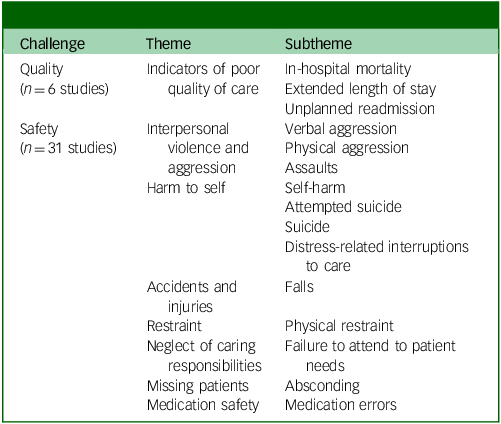
Table 4 summarises quality and safety issues identified within acute general hospitals involving people assigned enhanced observation to manage agitated, confused or distressed behaviours.
Thematic overview of identified quality and safety challenges

Table 4 Long description
The table has three columns: Challenge, Theme, and Subtheme. It lists quality and safety challenges when enhanced observation is used in acute general hospitals. The first row under Quality lists indicators of poor quality of care with subthemes including in-hospital mortality, extended length of stay, and unplanned readmission. The Safety section includes themes like interpersonal violence and aggression with subthemes such as verbal aggression, physical aggression, and assaults. Other themes under Safety include harm to self with subthemes like self-harm, attempted suicide, and suicide, and accidents and injuries with subthemes like falls. Additional themes include neglect of caring responsibilities, missing patients, and medication safety with subthemes like failure to attend to patient needs, absconding, and medication errors.
Indicators of poor quality of care
Evidenced quality issues centred on established indicators of poor-quality care, Reference Pinkhasov, Singh, Chavali, Legrand and Calixte63,Reference Haak, Gerstenberger and Reddy69,Reference Eeles, Thompson, McCrow and Pandy70,Reference Sinvani, Warner-Cohen, Strunk, Halbert, Harisingani and Mulvany72,Reference Talley, Davis, Goicoechea, Brown and Barber77,Reference Weiss, Reddy and Anton91 such as in-hospital mortality. Reference Eeles, Thompson, McCrow and Pandy70,Reference Sinvani, Warner-Cohen, Strunk, Halbert, Harisingani and Mulvany72 Specialist cohorting units focusing on delirium prevention, diversional activities or nursing staff education were used in efforts to address this challenge. Reference Eeles, Thompson, McCrow and Pandy70,Reference Sinvani, Warner-Cohen, Strunk, Halbert, Harisingani and Mulvany72 One example reported a statistically significant reduction in ward-level mortality after unit implementation. Reference Eeles, Thompson, McCrow and Pandy70 A second study yielded similar evidence of reduced in-hospital mortality among older adults with cognitive impairment admitted to the intervention unit, compared with patients matched on clinical and demographic variables. Reference Sinvani, Warner-Cohen, Strunk, Halbert, Harisingani and Mulvany72
A further body of research addressed the problem of extended length of stay in acute hospitals for those receiving enhanced observation. Reference Haak, Gerstenberger and Reddy69,Reference Eeles, Thompson, McCrow and Pandy70,Reference Sinvani, Warner-Cohen, Strunk, Halbert, Harisingani and Mulvany72,Reference Talley, Davis, Goicoechea, Brown and Barber77 Several publications reported no change in length of stay as a result of different interventional approaches. Reference Haak, Gerstenberger and Reddy69,Reference Eeles, Thompson, McCrow and Pandy70,Reference Talley, Davis, Goicoechea, Brown and Barber77 By contrast, statistically significant reductions in length of stay were achieved following the introduction of a multicomponent intervention delivered by patient engagement specialists. Reference Sinvani, Warner-Cohen, Strunk, Halbert, Harisingani and Mulvany72
Unplanned readmission to hospital was another evidenced quality issue. Reference Pinkhasov, Singh, Chavali, Legrand and Calixte63,Reference Haak, Gerstenberger and Reddy69,Reference Sinvani, Warner-Cohen, Strunk, Halbert, Harisingani and Mulvany72,Reference Weiss, Reddy and Anton91 Evaluated interventions failed to affect rates of unplanned readmissions, Reference Sinvani, Warner-Cohen, Strunk, Halbert, Harisingani and Mulvany72 or the studies did not conduct or report clearly on statistical testing. Reference Pinkhasov, Singh, Chavali, Legrand and Calixte63,Reference Haak, Gerstenberger and Reddy69 Nevertheless, introduction of a delirium checklist for enhanced observers was associated with statistically significant reductions in 30-day readmission rates. Reference Weiss, Reddy and Anton91
Interpersonal violence and aggression
Safety risks within acute care wards and emergency departments also included problems arising from violence and aggression. Reference Squire and Hessler49,Reference Case50,Reference Cook, Palesy, Chenoweth and Lapkin59,Reference Northcott, Mwale, Wyatt, Series, Harrison Dening and Featherstone65,Reference Broski, Eckels, Blomquist, King and Lineberry68,Reference Schoenfisch, Pompeii, Lipscomb, Smith, Upadhyaya and Dement71,Reference Ahmed, Cayea, Tackett, Bellantoni, Massare and Ward80,Reference Eastwood and Schechtman92 Violence or aggression was typically perpetrated by patients and directed at staff delivering enhanced observation. Incidents of verbal or physical aggression were documented in routinely collected data, Reference Eastwood and Schechtman92 and assaults involving hitting, kicking or choking were detailed in staff interviews and surveys. Reference Broski, Eckels, Blomquist, King and Lineberry68,Reference Schoenfisch, Pompeii, Lipscomb, Smith, Upadhyaya and Dement71
Harm to self
Harm to self, despite the presence of an enhanced observer, was a further theme in the included literature. Reference Case50,Reference Flaherty and Little52,Reference Wilkes, Jackson, Mohan and Wallis61,Reference Pinkhasov, Singh, Chavali, Legrand and Calixte63,Reference Northcott, Mwale, Wyatt, Series, Harrison Dening and Featherstone65,Reference Broski, Eckels, Blomquist, King and Lineberry68,Reference Talley, Davis, Goicoechea, Brown and Barber77,Reference Concannon, Carr, Doherty, McInerney, Birrane and Kearney78,Reference Kroll, Stanghellini, DesRoches, Lydon, Webster and O’Reilly93 Studies reported on self-harm, Reference Wilkes, Jackson, Mohan and Wallis61,Reference Broski, Eckels, Blomquist, King and Lineberry68,Reference Kroll, Stanghellini, DesRoches, Lydon, Webster and O’Reilly93 and attempted suicides. Reference Kroll, Stanghellini, DesRoches, Lydon, Webster and O’Reilly93 Suicides in the context of enhanced observation were also described, Reference Pinkhasov, Singh, Chavali, Legrand and Calixte63,Reference Concannon, Carr, Doherty, McInerney, Birrane and Kearney78 including an example of a person dying by suicide while awaiting transfer to mental health services under mental health legislation. Reference Concannon, Carr, Doherty, McInerney, Birrane and Kearney78 Finally, several studies referred to risks posed to patients with confusion or behavioural needs from interruption to their own treatment, for example, removal of drips, lines and tracheostomies. Reference Case50,Reference Flaherty and Little52,Reference Northcott, Mwale, Wyatt, Series, Harrison Dening and Featherstone65,Reference Broski, Eckels, Blomquist, King and Lineberry68,Reference Talley, Davis, Goicoechea, Brown and Barber77
Accidents and injuries
Accidents and injuries represented a further safety issue, with falls having occurred despite enhanced observation. Reference Cook, Palesy, Lapkin and Chenoweth28,Reference de Jong, Weselman, Kitchen and Hill51,Reference Flaherty and Little52,Reference Rachh, Wilkins, Capodilupo, Kilroy, Schnider and Repper-Delisi54–Reference Wray and Rajab-Ali56,Reference Pinkhasov, Singh, Chavali, Legrand and Calixte63,Reference Haak, Gerstenberger and Reddy69,Reference Eeles, Thompson, McCrow and Pandy70,Reference Voetelink, Trout, Murphy, Rogers, Harris and Ramagnano73,Reference Grealish, Chaboyer, Darch, Real, Phelan and Soltau83,Reference Colella, Aroh, Douglas, VanBuitenen, Galesi and Castro86,Reference Salamon and Lennon88,Reference Eastwood and Schechtman92,Reference Purvis, Kaun, McKenna, Weber Viste and Fedorov94,Reference Skowronsky, Bena and Albert95 Interventional research and quality improvement initiatives typically yielded no changes in fall rates following adaptations in the ward environment, staff training, diversional activities and delirium checklists. Reference Rachh, Wilkins, Capodilupo, Kilroy, Schnider and Repper-Delisi54,Reference Haak, Gerstenberger and Reddy69,Reference Salamon and Lennon88,Reference Skowronsky, Bena and Albert95 By contrast, other studies focusing on prevention and management of delirium reported trends towards reduction in post-implementation fall rates, although either statistical testing was not reported, or statistically significant differences were not observed in these studies. Reference Wray and Rajab-Ali56,Reference Pinkhasov, Singh, Chavali, Legrand and Calixte63,Reference Weiss, Reddy and Anton91
Restraint
Physical restraint was recognised in several texts as a risk to patient safety. Reference Flaherty and Little52,Reference Wray and Rajab-Ali56,Reference Waszynski, Veronneau, Therrien, Brousseau, Massa and Levick60,Reference Flynn, Prescott and Jinks64,Reference Sinvani, Warner-Cohen, Strunk, Halbert, Harisingani and Mulvany72,Reference Colella, Aroh, Douglas, VanBuitenen, Galesi and Castro86,Reference Salamon and Lennon88 Studies described interventions including the introduction of restraint-free cohorting rooms for people with dementia, Reference Flaherty and Little52 or protocols and justification forms to guide decision-making about initiation of observations. Reference Salamon and Lennon88 The authors reported limited use of physical restraints after implementation of these strategies, but the absence of baseline data or a comparator group prohibited comparisons with usual care. Further studies detailed a range of strategies including delirium prevention efforts, improved patient engagement, and addressing pain and discomfort. Reference Wray and Rajab-Ali56,Reference Sinvani, Warner-Cohen, Strunk, Halbert, Harisingani and Mulvany72 These indicated promising trends towards reduction in physical restraints, yet results of tests of statistical significance were seldom presented. Reference Wray and Rajab-Ali56
Neglect of caring responsibilities
Unsafe staff behaviours and practices, in which staff neglected to attend to patient needs, were the subject of further studies. Reference Moyle, Borbasi, Wallis, Olorenshaw and Gracia29,Reference Broski, Eckels, Blomquist, King and Lineberry68 Examples included staff being observed to fall asleep during enhanced observation shifts. Reference Broski, Eckels, Blomquist, King and Lineberry68 Another example involved a patient’s constipation having remained undetected over a prolonged period, while staff were seen reading magazines instead of paying attention to this individual’s needs. Reference Moyle, Borbasi, Wallis, Olorenshaw and Gracia29
Missing patients
Patients going missing, having absconded from hospital during enhanced observation, represented a further safety concern. Reference Pinkhasov, Singh, Chavali, Legrand and Calixte63,Reference Northcott, Mwale, Wyatt, Series, Harrison Dening and Featherstone65,Reference Concannon, Carr, Doherty, McInerney, Birrane and Kearney78,Reference Kroll, Stanghellini, DesRoches, Lydon, Webster and O’Reilly93 In some studies, patients returned without incident. Reference Kroll, Stanghellini, DesRoches, Lydon, Webster and O’Reilly93 However, another study reported that the patient involved unfortunately died by suicide while missing from the ward. Reference Concannon, Carr, Doherty, McInerney, Birrane and Kearney78
Medication safety
Finally, medication safety problems were also identified, although the data were limited in depth and volume. Reference Talley, Davis, Goicoechea, Brown and Barber77 The literature included a report of a medication error involving a patient assigned an observer. Reference Talley, Davis, Goicoechea, Brown and Barber77 However, details of the nature and circumstances of the error were lacking.
Discussion
To our knowledge, this is the first systematic review attempting to comprehensively distil evidence on quality and safety considerations in the acute general hospital setting for people receiving enhanced observation to manage agitated, confused or distressed behaviours. Prior structured reviews within this setting have provided a conceptual analysis of the intervention itself Reference Wood, Vindrola-Padros, Swart, McIntosh, Crowe and Morris2 or focused on specific themes surrounding its provision. These have included decision-making processes in deployment of enhanced observation Reference Stanton, Stiles, Anderson, Taylor, Vindrola-Padros and Ivany96 and ward staff experiences of its delivery. Reference Ivany and Finch97 A further systematic review described person-centred dementia care in the context of this restrictive intervention. Reference Handley, Theodosopoulou, Taylor, Hadley, Goodman and Harwood98 Other structured reviews centred narrowly on particular safety outcomes only, such as falls or suicides, without examining ethical behaviour management or offering a systems-informed analysis of the characteristics of care that underpin quality and safety outcomes. Reference Greeley, Tanner, Mak, Begashaw, Miake-Lye and Shekelle99,Reference Shekelle, Greeley and Tanner100 Our synthesis builds on previous reviews, offering novel insights into the means by which staff attitudes (e.g. ethical beliefs and person-centredness of practice) and teamwork culture shape the safety of enhanced observation practice. Moreover, our findings shed light on a wider range of quality and safety challenges which arise during enhanced observation, such as extended length of stay and interpersonal violence and aggression.
Quality and safety in enhanced observation practice
Using the HCMCB as a conceptual model to address our first objective, we found evidence that multiple care characteristics underlie quality and safety in enhanced observation practice. Reference Tölli, Kontio, Partanen, Terkamo-Moisio and Häggman-Laitila46 These can be classified broadly into individual, team and wider organisational domains. At the level of individual staff members, a considerable body of published work reported on attitudes of staff delivering enhanced observation. There was widespread evidence of problematic approaches. However, person-centred practice prevailed when staff developed individualised activity plans for distressed patients to avert escalation in a person’s presentation. Reference Pinkhasov, Singh, Chavali, Legrand and Calixte63 Meaningful activity provision has been linked to reductions in both safety incidents and containment measures in other settings, such as mental health hospitals. Reference Foye, Li, Birken, Parle and Simpson101
Collaborative teamworking during enhanced observation, or lack thereof, featured widely among extant research. Staff and patient safety was compromised by information-sharing deficits Reference Squire and Hessler49 and incivility towards or exclusion of enhanced observers by clinical teams. Reference Ahmed, Cayea, Tackett, Bellantoni, Massare and Ward80 Considering broader organisational influences on enhanced observation quality and safety, issues which fell under the responsibility of hospital leaders were described extensively. Evidenced problems included inadequacies in training provision Reference Cook, Palesy, Chenoweth and Lapkin59 and insufficient staffing levels to permit regular breaks. Reference Graham, Eaton, Jeffrey, Secher-Jorgensen and Henderson79 Such findings are consistent with the conclusions of a recent independent investigation into enhanced observation for people at risk of self-harm in acute general hospital wards in England. The report identified a lack of clarity on the competencies required of enhanced observers, with poor consideration of human factors principles in shift planning for enhanced observers to prevent hazards associated with fatigue. 32
There was an absence of research in critical areas of practice. No studies showed staff understanding of how limited treatment choice and prior trauma could contribute to agitation or distress. Reference Tölli, Kontio, Partanen, Terkamo-Moisio and Häggman-Laitila46 Equally, there was no indication that debriefing conversations were held with patients following the use of enhanced observation or other restrictive interventions. Such practices are better established within mental healthcare settings and can help to restore damaged therapeutic relationships and reduce risks of further situations arising in which restrictions are required. Reference Asikainen, Vehviläinen-Julkunen, Repo-Tiihonen and Louheranta102,Reference Butterworth, Wood and Rowe103
Quality and safety indicators, incidents and outcomes
The reviewed literature also included findings addressing our second objective, characterising quality and safety issues experienced by the review population during enhanced observation. Dominant concerns included staff-directed incidents of aggression. Reference Schoenfisch, Pompeii, Lipscomb, Smith, Upadhyaya and Dement71 Harm to self on the part of patients, even while in receipt of enhanced observation, was also described. Studies reported on self-harm or distress-related treatment interruptions to care by patients, such as removal of intravenous lines when agitated or confused. Reference Flaherty and Little52,Reference Northcott, Mwale, Wyatt, Series, Harrison Dening and Featherstone65,Reference Talley, Davis, Goicoechea, Brown and Barber77 Beyond such risks and their management, there were explicit examples of neglect of caring responsibilities, such as enhanced observers falling asleep on shift. Reference Broski, Eckels, Blomquist, King and Lineberry68
Overall, the evidence on quality and safety challenges for the review population was thought to be insufficient. The research identified was related primarily to aggression or self-harm. A preoccupation with risks presented by patients when unwell may preclude recognition and contextualisation of wider, less immediate omissions and iatrogenic harms. For instance, aggression may occur after a lack of timely nutrition or as a result of a patient being placed in an inadequate care environment. Reference Tuffrey-Wijne, Goulding, Gordon, Abraham, Giatras and Edwards104
Perhaps most striking was the lack of patient voice throughout the included literature, decades after this research need was asserted. Reference Torkelson and Dobal82 This absence was felt both in terms of understanding what high-quality, safe enhanced observation looks like, but also with respect to the quality and safety issues that affect patients receiving this restrictive intervention. Just two studies captured patient perspectives through realist or ethnographic in situ qualitative interviews; Reference Northcott, Mwale, Wyatt, Series, Harrison Dening and Featherstone65,Reference Handley, Bunn and Goodman67 one of these studies contained no direct quotes in its write-up, Reference Handley, Bunn and Goodman67 whereas the second study relied primarily on field notes. Reference Northcott, Mwale, Wyatt, Series, Harrison Dening and Featherstone65 Omission of patient perspectives may underlie the limited recognition in the published literature that enhanced observation itself can precipitate negative outcomes, Reference Moyle, Borbasi, Wallis, Olorenshaw and Gracia29,Reference Northcott, Mwale, Wyatt, Series, Harrison Dening and Featherstone65 such as heightened agitation or self-harm. Inclusion of patient narratives would be likely to expose a broader range of harms and adverse experiences, as recognised in research focusing on overlapping patient populations. Reference Averill, Bowness, Henderson and Sevdalis105,Reference Hallett, Dickinson, Eneje and Dickens106
Implications for policy, practice and research
This review provides an exhaustive overview of the present state of the research field, in terms of quality and safety considerations in enhanced observation provision for at-risk patients. The results will help to address knowledge gaps identified during a recent independent investigation of enhanced observation practice within acute general hospitals in England. For instance, investigation findings pointed to a lack of clear evidence to drive safety improvements, while acknowledging the absence of national guidelines to support front-line clinical staff. 32 This was widely echoed in the reviewed literature and is likely to contribute to unwarranted variation in practice and outcomes. Reference Carter25 Our evidence synthesis offers valuable insights from a range of international settings, rather than direct solutions for specific contexts such as the NHS. Nevertheless, our findings could be used to guide the development of evidence-informed guidelines to optimise practice, with appropriate tailoring to local settings and contexts. It is imperative that patients’ and carers’ valuable perspectives are at the centre of efforts to devise such standards, particularly given the epistemic exclusion of these perspectives in the available literature.
With respect to front-line practice improvement, culture change is warranted, for instance, promoting person-centred care through active, consistent, therapeutic delivery of enhanced observation, with provision of meaningful activities and individualised care planning. Reference Graham, Eaton, Jeffrey, Secher-Jorgensen and Henderson79 Given findings that acute general hospital staff believed that caring for people with additional needs (e.g. a mental illness) should not be their responsibility, Reference Foye, Simpson and Reynolds76 clinical leaders and hospital liaison psychiatry teams must help to engender an ethos in which diverse needs are recognised and supported by teams.
Our findings indicate pressing lines of enquiry for future research. Such research must urgently seek to address the widespread exclusion of the patient voice in relation to enhanced observation in acute general hospitals. Priorities also include advancing the evidence base on negative effects and harms associated with this intervention. Finally, research to understand how trauma-informed approaches to enhanced observation can be embedded is warranted. Research efforts should focus on robust evaluation of evidence-informed training approaches and implementation of post-restrictive intervention debriefs for people in receipt of this intervention.
Strengths and limitations
This review provides a detailed, theoretically informed synthesis of care characteristics associated with quality and safety in enhanced observation provision for agitated, confused or distressed patients. We also report on the current state of empirical evidence describing the quality and safety challenges experienced during enhanced observation. The strengths of our study include our close adherence to methodological and reporting guidance to enhance the rigour and transparency of the review. Reference Page, McKenzie, Bossuyt, Boutron, Hoffmann and Mulrow34,35 Inclusion of published research and quality improvement reports, as well as steps to improve search yield through forward and backward citation searching, improved the comprehensiveness of our findings. Indeed, this is the largest review of its type reporting on enhanced observation practice within acute general hospitals. Reference Wood, Vindrola-Padros, Swart, McIntosh, Crowe and Morris2,Reference Stanton, Stiles, Anderson, Taylor, Vindrola-Padros and Ivany96–Reference Handley, Theodosopoulou, Taylor, Hadley, Goodman and Harwood98,Reference Shekelle, Greeley and Tanner100 A key strength was our transdiagnostic focus on underserved groups presenting with agitated, confused or distressed behaviours, as individuals in these groups may be at disproportionate risk of harm within this setting. Reference Daumit, McGinty, Pronovost, Dixon, Guallar and Ford12
Limitations of our approach involve the exclusion of unpublished literature to balance search sensitivity with review feasibility, meaning that some relevant studies may not have been identified. We may also have missed research published in languages other than English. Although a second reviewer cross-checked extracted data and quality appraisal ratings against included articles for accuracy and comprehensiveness, we recognise that the methodological rigour of the review could have been strengthened had two authors performed independent data extraction and quality appraisal. This limitation stemmed from resource constraints within the review team.
Further limitations arose from the vast, heterogeneous body of primary literature on which our findings relied. The included research was diverse in terms of study design, clinical population and reported outcomes, which affected our ability to conduct a nuanced appraisal of the certainty of evidence. As noted by other authors, enhanced observation was often a secondary topic, Reference Coyle, Wilson, Lapkin and Traynor26 or costs associated with its provision formed the primary focus of publications, Reference Rausch and Bjorklund81 such that there was often insufficient detail about quality and safety in its delivery. Given these challenges, the evidence was not suited to a formal certainty assessment. Quantitative findings were too heterogeneous to support meta-analysis or meaningful judgements about consistency and precision across outcomes, whereas the findings of qualitative and mixed-methods studies varied in their adequacy and relevance to the review question. We therefore considered the limitations of the evidence narratively and framed the review implications cautiously. Moreover, with respect to the certainty of evidence, the absence of patient perspectives among the available evidence was most concerning. Nevertheless, we believe that the contributions of lived experience expert co-authors in interrogating review findings, shaping data interpretation and identifying evidence gaps strengthened this review in spite of the limitations of the available literature. The findings of the review can thus be used to inform tangible, evidence-informed improvements in enhanced observation practice.
Supplementary material
The supplementary material is available online at https://doi.org/10.1192/bjo.2026.12130
Data availability
Data availability is not applicable to this systematic review article, as no new data were created or analysed in this study.
Acknowledgements
We thank the NIHR NWL PSRC Research Partners Group for early feedback on terminology used within this review, as well as the medical librarian team of Imperial College London for feedback on our search strategy. No artificial intelligence tools were used in the preparation of this manuscript.
Author contributions
P.A.: conceptualisation, methodology, supervision, project administration, investigation, data curation, formal analysis, writing – original draft, writing – review and editing; S.A.: conceptualisation, methodology, investigation, data curation, formal analysis, writing – review and editing; J.K.: investigation, data curation, writing – review and editing; S.T.: methodology, data curation, formal analysis, writing – review and editing; R.L.: conceptualisation, methodology, writing – review and editing; C.S.: data curation, writing – review and editing; D.L.: data curation, writing – review and editing; A.H.: data curation, writing – review and editing; N.H.: conceptualisation, methodology, writing – review and editing; E.M.: conceptualisation, methodology, writing – review and editing, funding acquisition.
Funding
This research received essential funding from the NIHR NWL PSRC (ref. NIHR204292) and the NIHR Imperial Biomedical Research Centre (ref. NIHR203323). P.A. is currently supported by a Better Health & Care Hub Fellowship awarded by the Better Health & Care Hub, King’s College London. S.A. is supported by an NIHR Predoctoral Award (ref. NIHR500682). The views expressed are those of the authors and not necessarily those of the NHS, the NIHR, or the Department of Health and Social Care.
Declaration of interest
None.



 Open access


eLetters
No eLetters have been published for this article.