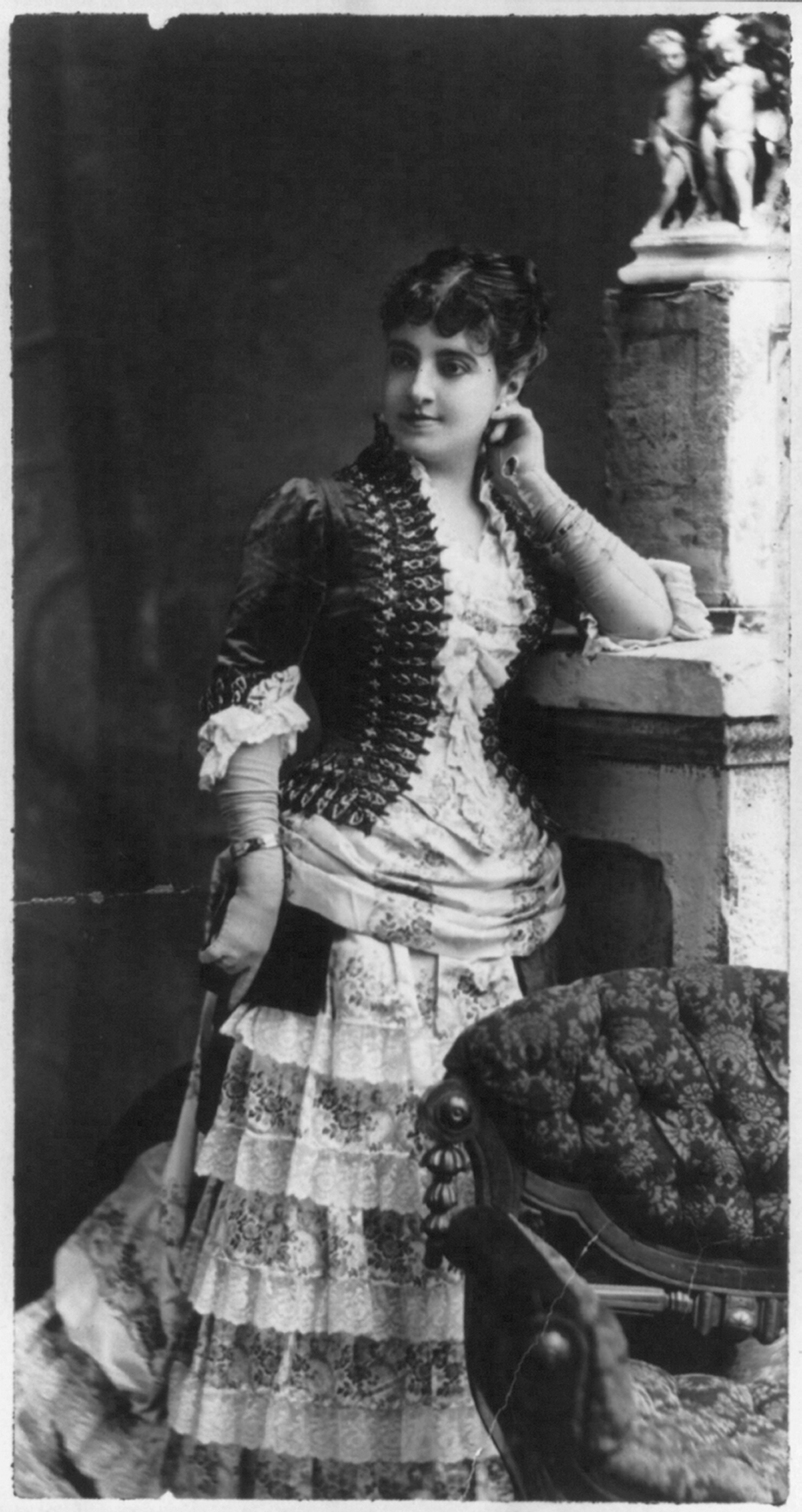
Emma Abbott (1849–1891), a proud product of the American Midwest, was the best known, most successful, and arguably the most popular opera singer in the United States during the 1880s. A native of the American heartland, “honest little Emma” was endowed with solid musical and dramatic skills and an abundance of charisma, pluck, and drive. At a time when public perception of opera in America was undergoing significant change, Abbott created an audience for it among middle-class Americans—some of them opera lovers who had become disaffected with foreign-language opera because of its increasingly elite and aristocratic image, others newcomers to opera who were attracted to performances by the charismatic Abbott. An examination of her career reveals much about operatic reception in late-century America; it also illuminates the work of a forgotten American prima donna, musical director, and cultural activist from the Gilded Age.
Opera star Emma Abbott, an undated photograph by Gilbert & Bacon of Philadelphia. Courtesy Prints and Photographs, Chicago History Museum, ICHi-50283.

As a prelude, it is important to acknowledge that Abbott's historical reputation as an artist is mixed. Some contemporary critics excoriated her and dismissed her success as “popular” (as opposed to “artistic”); many others, however, celebrated her performances and praised her as “the people's prima donna.” This difference of opinion about Abbott was consistently contradictory over the course of her entire career and has negatively informed her historical reputation. I have suggested elsewhere that Abbott ran afoul of some American music critics because of her determination to provide American audiences with opera as entertainment. Her success at doing so seriously undermined the efforts of some of the most influential critics then working in the United States—all of them ardent Wagnerians who sought to educate Americans about “good” music and, in the process, to change the public perception of opera from a component of the popular theater into an edifying, intellectual, and artistic experience.Footnote 1 Several of these critics, not coincidentally, wrote early histories of American music in which they either dismissed or ignored Abbott; this helps to explain her essential disappearance from American music historiography.Footnote 2 The principal focus of this article, however, is not Abbott's controversial reputation, but rather her success as a singer, artistic director, marketing genius, and cultural activist.
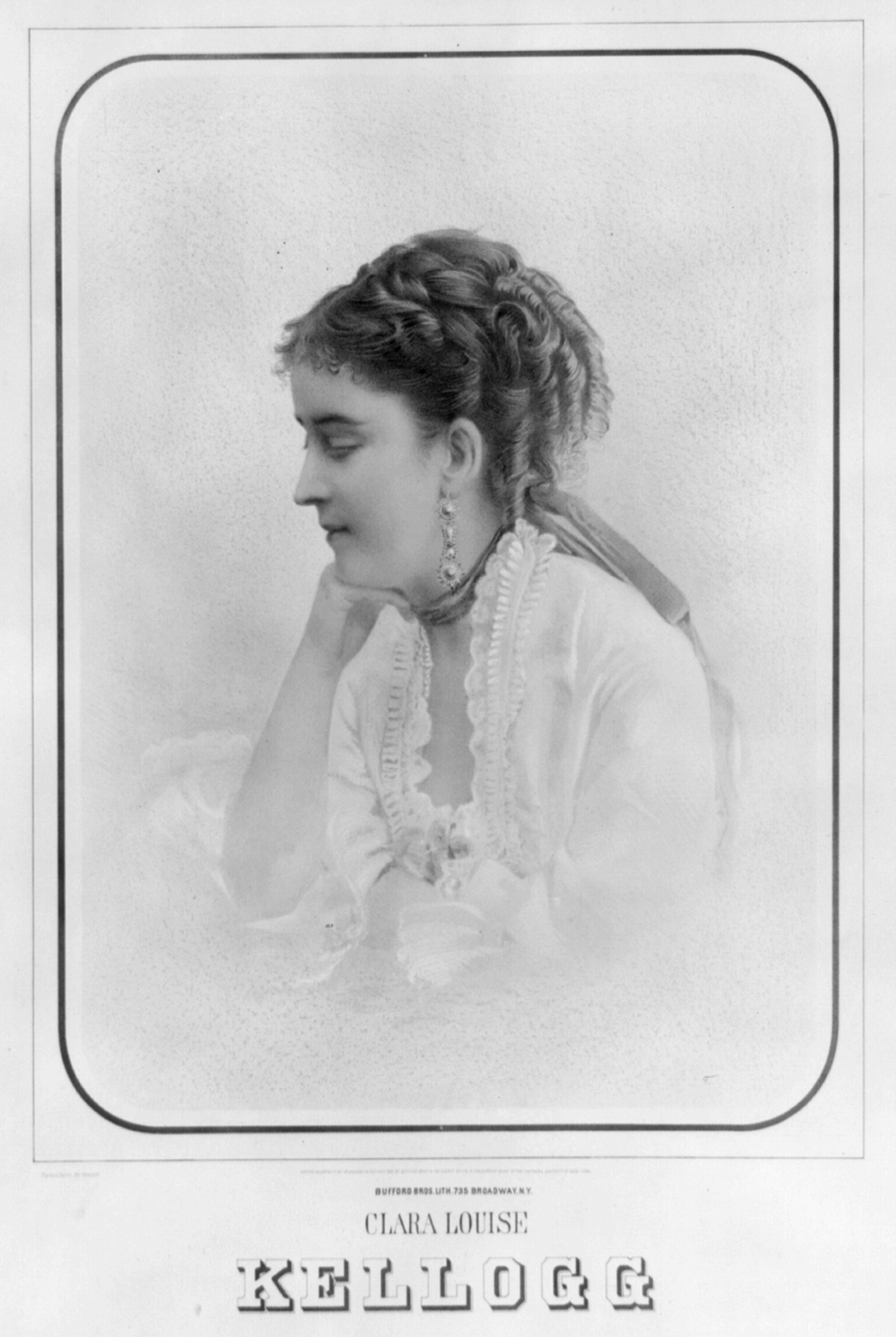
Emma Abbott grew up in Peoria, Illinois, the daughter of two transplanted New England musicians. She began performing at nine and by 1866 (when she was sixteen) was touring professionally, singing ballads, hymns, and operatic arias to her own accompaniment on guitar in churches and hotel lobbies—and then passing the hat. In the summer of 1867 she performed with the Frank Lumbard concert troupe, a Chicago-based ensemble that toured throughout the Midwest during the late 1860s; these performances netted her some regional acclaim.Footnote 3 She supported herself in this manner for several years. In 1869 she met Clara Louise Kellogg (1842–1916), the most prominent American operatic diva of the time, who was impressed with the young woman's ability and tenacity and became a mentor. Abbott subsequently moved to New York, commenced voice lessons, and secured a position as a soprano at an important church. A diminutive woman with light brown hair, sparkling blue-gray eyes, and fair complexion, Abbott was charismatic, assertive, and utterly guileless. By 1871 she had charmed a group of wealthy New Yorkers (including Horace Greeley and Henry Ward Beecher), who helped to raise funds to send her to Europe for further training.Footnote 4
Undated lithograph of Clara Louise Kellogg. Courtesy of Prints and Photographs, Library of Congress, www.loc.gov/pictures/item/2003654279.
Abbott was abroad for four years (1872–76) in Milan, Paris, and London, where she studied with some of the best contemporary vocal teachers.Footnote 5 Hardworking and ambitious, she also already knew the value of networking and of publicity. Within a year of her arrival, she had met the French composer Charles Gounod (1818–1893) as well as several prominent sopranos, including Christine Nilsson (1843–1921), Euphrosyne Parepa-Rosa (1836–1874), Anna de la Grange (1825–1905), and Jenny Lind (1820–1887). Abbott's most illustrious acquaintance during her European sojourn, however, was Adelina Patti (1843–1919), the most prominent Italian prima donna of the period, who—like Kellogg—became a mentor. Reports about Abbott in the American press during the 1870s repeatedly mention her in connection with these individuals. She already understood that linking her name with these European luminaries would give her greater credence with the American public. The stories and press notices that appeared in newspapers all over the country also included regular references to her impoverished childhood, religious faith, lack of pretention, proud identity as an American, and determination to work hard to achieve her goals. By the mid-1870s, Americans had been reading about her for almost four years, which gave her the beginnings of an appealing public persona.Footnote 6
In 1875 Abbott left Paris for London with a letter of introduction from Patti to Frederick Gye (1809–1878), manager of the prestigious Royal Italian Opera, Covent Garden. She signed with that troupe and in May 1876 made her London debut, playing the character Marie in Gaetano Donizetti's La fille du régiment. Reviews in the London press were laudatory and quite encouraging; she was described as “a genuine soprano” with a voice that was “both brilliant and expressive” and a singer who “fairly ingratiated herself” with the demanding London audience.”Footnote 7 She appeared to be on the brink of a successful career—until a story leaked out that Abbott and her new husband Eugene Wetherell had angered Gye by quarrelling with him. The contretemps had an unfortunate outcome (her removal from the company) but is nevertheless a useful illustration of the soprano's uncanny ability to surmount adversity, for several journalists seized on the incident and spun it to her advantage. In particular, Grace Greenwood, a New York Times foreign correspondent, created a nationalist context for the argument by depicting Abbott as a gifted but helpless young American “songbird” who was at the mercy of the “mighty and mysterious master of Covent Garden.” When Gye eventually released Abbott from her contract, Greenwood crowed: “A long imprisoned lark set free could not be more exultant”; she also praised the soprano as an American singer willing to stand up for her rights.Footnote 8
Abbott also rebounded by quickly signing a three-year contract with James Mapleson (1830–1901), manager of Her Majesty's Italian Opera Company, Gye's principal rival. By September 1876 Abbott was traveling with Mapleson's troupe on its annual provincial tour, appearing in the roles of Gilda (Rigoletto), Marguerite (Faust), and Marie (La Fille du Régiment) in Liverpool, Manchester, Birmingham, Cork, and Dublin. Her performances elicited almost universal critical acclaim, and Mapleson predicted “a splendid future” with his company.Footnote 9 In mid-October he assigned her one of the plum roles of the operatic repertory: Violetta in Giuseppe Verdi's La Traviata. To everyone's astonishment, she refused the character. According to her biographer, Abbott was “possessed of peculiar and decided opinions regarding right and wrong” and believed that Violetta was “a wanton [character] who was wicked simply because she loved sin.”Footnote 10 The soprano refused to budge from her moral stand, and Mapleson fired her. By early December she was headed back to New York, her hard-won Italian-opera career in tatters.
This was a major turning point for Emma Abbott. After years of hard work, the twenty-six-year-old soprano had broken contracts with two of the most important Italian opera companies in the world. How could such a young and apparently difficult prima donna hope to convince other impresarios to give her a chance? Her uphill battle was also complicated by the fact that the world of Italian opera performance in America in the 1870s was significantly different from what she had known in Europe. Finally—and perhaps most important—the economic situation in the United States in the late 1870s was disastrous, for the country was just beginning to emerge from a serious economic depression. Many elements of American society changed significantly as a result of the depression, including the reception of both foreign- and English-language opera. Because Abbott's success in the 1880s would be predicated on her responses to an American society altered by a financial crisis, it is important to examine briefly the economic situation to which she returned.
The American economy had enjoyed tremendous growth and prosperity in the years immediately after the Civil War. The country was awash in money, credit was easy, factories booming, the rail transportation system expanding. The United States was becoming more urban, and an unprecedented number of Americans, with disposable income and discretionary time, were ravenous for entertainment. Performers of all types—actors, musicians, speakers, variety entertainers, opera companies—prospered during the period 1865–1873. This all came to an abrupt end in October of the latter year.
The Panic of 1873 was the worst economic crisis that had ever hit America. Banks failed, businesses went bankrupt, and by early 1874 almost 20 percent of the workforce was unemployed. The subsequent Long Depression, which lasted into the 1880s, transformed many aspects of American culture. One manifestation was an attitude shift among working- and middle-class Americans toward easterners in general and the wealthy in particular. Americans widely believed that the owners of banks and large corporations (especially the railroads) had caused the depression. This fostered a deep suspicion of the wealthy, especially East Coast bankers, corporate executives, and factory owners. Another change was increased and widespread xenophobia, for many Americans also blamed Europeans for the panic. Suspicion and hostility were exacerbated by the post-Civil War arrival of millions of immigrants, who continued to migrate even as the jobs disappeared. The resulting antipathy toward the eastern establishment and Europeans was particularly widespread among rural and small-town-dwelling Americans in the Midwest and Far West.
More important to Abbott's story, however, is the significant impact that the panic had on the performance and reception of opera. First affected was foreign-language opera. Ticket prices for Italian opera had been going up for years, because impresarios (in response to audience requests) had been importing some of the best (and most expensive) European singers during the postwar boom years. When the bottom dropped out of the market for high-priced entertainment, the middle-class portion of the Italian-opera audience (which was still significant) became disaffected.Footnote 11 The situation, in fact, became worse when journalists learned just how expensive the foreign singers were. The press had a field day, and middle-class Americans all over the country expressed outrage about “greedy canaries” who refused to renegotiate their contracts despite the economic downturn.Footnote 12 High ticket prices, the growing anti-European sentiment, and an increasingly exclusive image of opera cultivated by wealthy operagoers all helped to fuel a belief that support for Italian opera was un-American. This marked an important turning point in the perception (and support) of Italian opera by middle-class Americans, many of whom abandoned performances by these companies. The loss of this important segment of the audience doomed most of the Italian companies in the immediate post-panic years. The other side of the coin, however, was a marked change in the reception of English-language opera—for many middle-class Americans did not simply abandon opera (in favor of variety, operetta, or opéra bouffe) but rather turned to performances in English. They discovered that English troupes presented their favorite works in a language they could understand, at prices they could afford, and without any of the aristocratic trappings so loved by the East Coast monied classes but disparaged by middle-class theatergoers. During the depths of the mid-1870s depression, in fact, English troupes—especially the Clara Louise Kellogg and Hess English Opera companies—aggressively courted this market and prospered.Footnote 13
When Abbott returned to New York in late 1876, the operatic situation she faced included a handful of barely surviving German- and Italian-language troupes and several flourishing English companies. She spent the next year (1877–78) touring in concert troupes (to reviews that were mixed but mostly positive), but her heart was still in opera. When asked if she preferred to sing in concerts, her response was emphatic. “Oh, no,” she replied, “I have been very much disappointed in not being able to organize an opera troupe . . . but [I] could not find the necessary support.”Footnote 14 By 1878, in fact, the climate for foreign-language opera in America was beginning to improve. Abbott's prospects, however, remained dismal—primarily because the enhanced prognosis for Italian-language opera was predicated on the anticipated arrival in the fall of a well-financed company from London. Unfortunately for Abbott, the troupe (which would dominate Italian-opera performance in America for the next five years) was managed by James Mapleson. Abbott, of course, had no chance of securing a position. But an alternative course of action emerged in early summer 1878, when the successful English-opera impresario Clarence Hess invited her to serve as the prima donna of his company. As a practical woman, she understood the situation. “I was educated to Italian opera and I love it dearly and hated to give it up,” she later explained. “But English opera is what the people want.”Footnote 15
She accepted Hess's offer and began immediately to remake herself into “the people's prima donna.” The Hess Opera Company, with Abbott as the star, enjoyed a successful 1878–79 season. At its conclusion, she and her husband Wetherell (who would become her manager) bought out Hess and created the Emma Abbott Grand English Opera Company.Footnote 16 Her goal was to restore opera to the popular stage, and she would be wildly successful for the next eleven and one-half years. The Abbott Company performed all over the United States and Canada, making annual visits to Philadelphia, Chicago, Washington, Cincinnati, St. Louis, and Kansas City and mounting less regular seasons in Boston, Pittsburgh, Cleveland, Montreal, Milwaukee, Atlanta, Charleston, Nashville, New Orleans, Galveston, Denver, Detroit, and elsewhere. The troupe also occasionally visited the Pacific Coast, performing in San Francisco, Portland, Seattle, and Victoria, mounting week-long seasons in most cities, singing in regular theaters, and also giving one-night stands in many small towns and hamlets between the larger venues. The company, which was asked to open some thirty-five new theaters or opera houses in the United States, never had a losing season. When she died, Abbott was reportedly a millionaire.Footnote 17
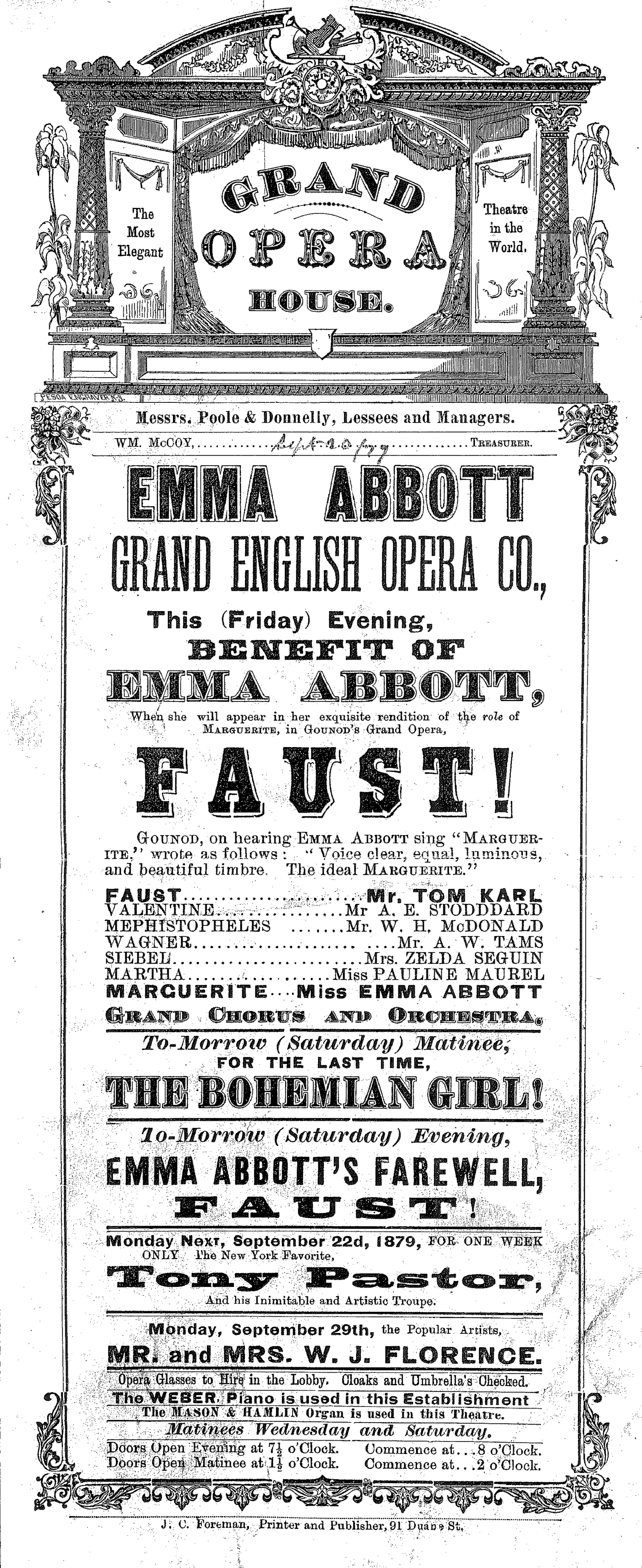
Playbill cover of the Abbott Opera Company's performance of Faust, Grand Opera House, New York City, September 19, 1879. Courtesy of Paul Glase Scrapbook Collection, Theatre Collection, Free Library of Philadelphia.
The success of the Abbott company was due to a combination of factors. Of utmost importance, of course, was her skill as a singer and an actor. Although (as mentioned) some of the more prominent establishment critics both dismissed and attacked her, there were many others who disagreed. Many of the latter—knowledgeable critics who worked in Great Britain and in some major American cities—described her voice as “clear and sweet,” flexible and cultivated, “pure as crystal, sweet and appealing,” and “bird-like.”Footnote 18 Even the Boston critic John Sullivan Dwight—surely a knowledgeable observer of the musical scene—wrote of the “remarkable purity and clear, vibrating quality” of her voice and of her “perfect intonation.”Footnote 19 Her acting was also regularly praised as “natural,” “intense and realistic,” and “vivid and powerful,” but nevertheless “refined.”Footnote 20 Other factors beyond sheer ability, however, also had an important role in the Abbott Company's remarkable success. Abbott (as artistic director) and Wetherell (business manager) seemed to know instinctively what would appeal to middle-class American theatergoers—especially those who lived in the Midwest and Far West—and their business and artistic decisions were based on this understanding. Their brilliant marketing strategy appealed to this potential audience and functioned as the basis for Abbott's successful cultural activism.
One important factor was pure business savvy, which was manifested in several ways. First, Abbott's businessman husband was a crack manager who was already being described in 1880 as “one of the shrewdest and most far-sighted opera managers in the country.”Footnote 21 Affordable ticket prices were an absolutely basic element of company policy. “People will pay willingly a reasonable price for opera,” he pointed out in an interview, and “Miss Abbott would rather sing to a full house at $1.50 a ticket than the same house half-filled at $3 a ticket.” In terms of profits, the lower price “amounts to precisely the same thing in the end.” When taking into consideration other issues, however—such as building an audience for opera—lower ticket prices had a huge impact. As he noted, an opera manager who “has the good of the people at heart” should keep ticket prices low “for the sake of developing aesthetic taste in this country.”Footnote 22 Both Abbott and Wetherell were also aware of the value of publicity and went well beyond paid advertisements by assiduously cultivating notices in the press. The soprano herself once commented that she “much preferred ridicule in the press to no printed notice at all.”Footnote 23 Interviews functioned as free publicity, and both Abbott and Wetherell made themselves available to the press on a regular basis. Such opportunities also helped Abbott to mold her public image. This worked almost magically; she was described in interviews as “warm [and] generous-hearted,” a “charming diva,” and a “gay, light-hearted, laughing creature.”Footnote 24 This ingenious approach countered one of the entrenched biases that Abbott had to overcome as a prima donna—the image of divas as self-centered, aloof, and arrogant. This included even Abbott's mentor Patti, who was described in an American periodical in 1882 as “a spoiled child” who had been making herself “as disagreeable as possible” on her tour.Footnote 25 Some of Abbott's competitors mocked her propensity for cultivating the press, but it worked. One critic pointed out, for example, that Abbot was “better known to the general public” than any “other singer on the stage except Patti.”Footnote 26 Even more important than name recognition, however, was widespread perception of the soprano as an unpretentious American singer who was a non-diva diva.
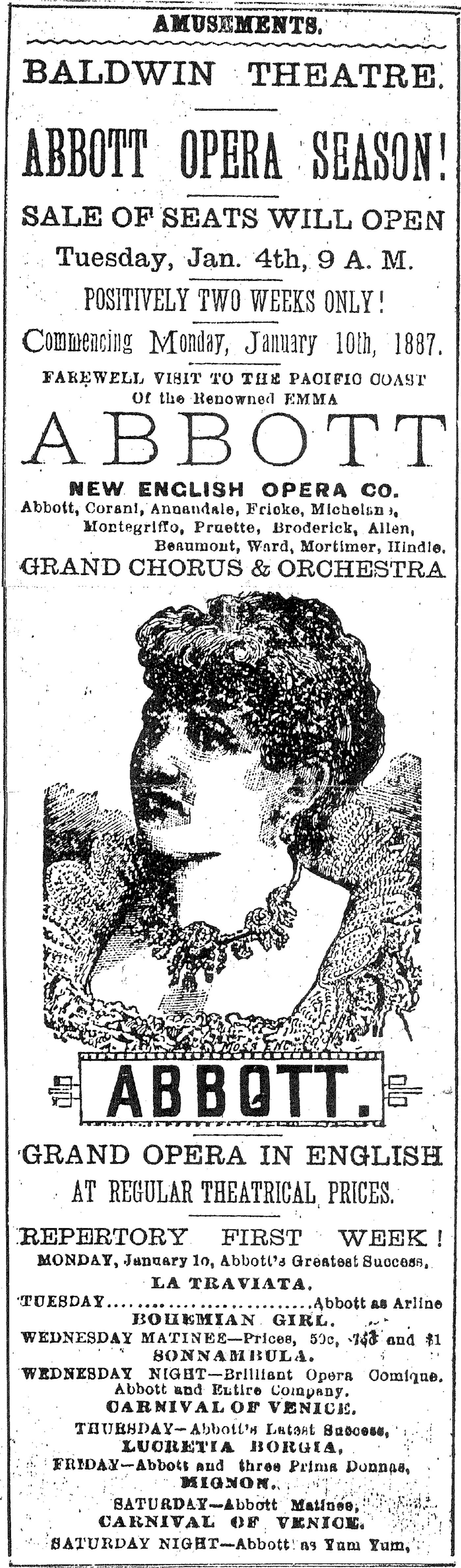
Playbill that lists repertory during a week of “Grand Opera in English at Regular Theatrical Prices” by the Abbott Opera Company at the Baldwin Theatre, San Francisco, week of January 10, 1887. Baldwin Theatre File, Courtesy of Museum of Performance + Design, San Francisco.
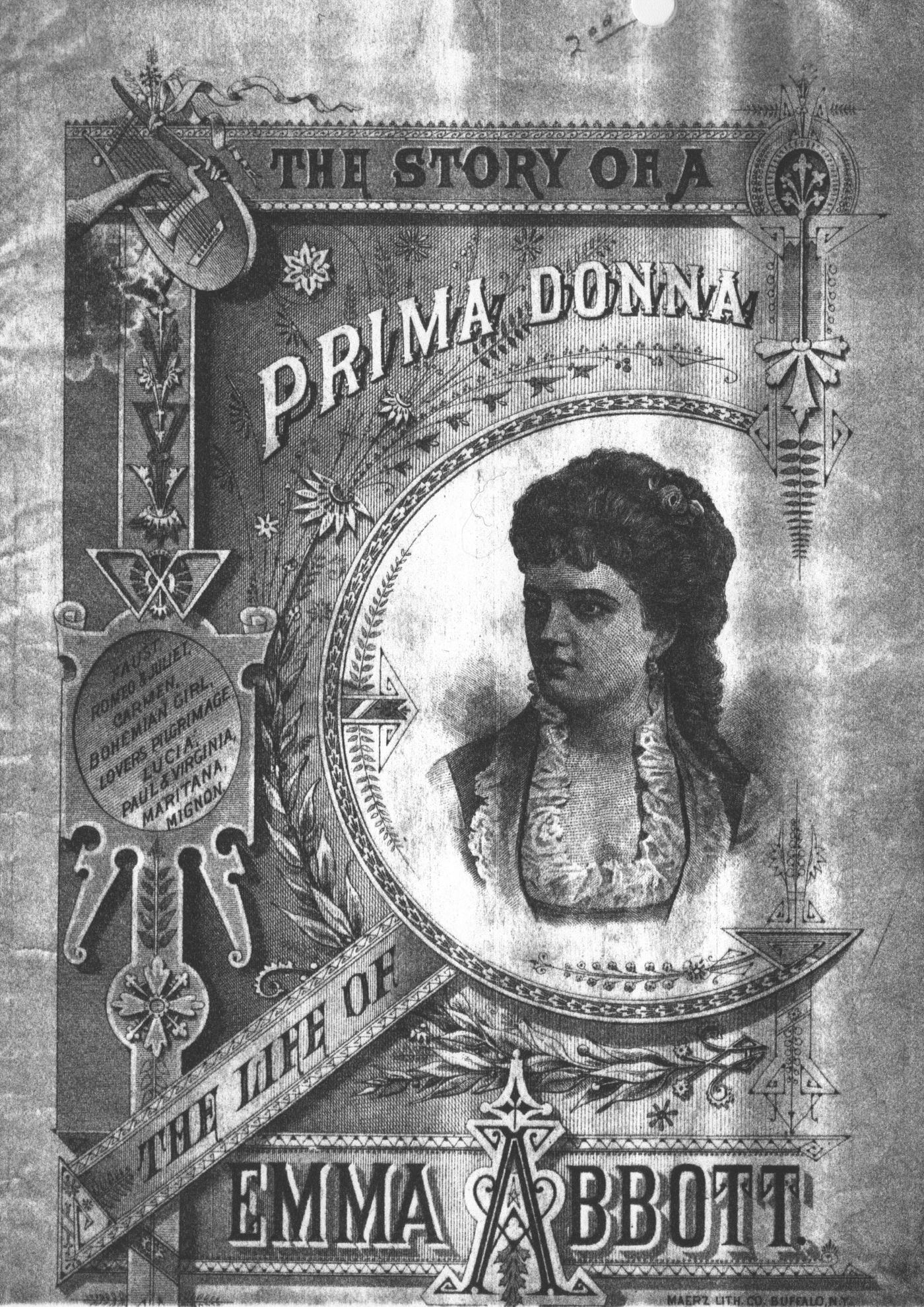
Publicity booklet distributed by the Abbott Opera Company in the early 1880s, which includes a biographical sketch of the soprano. Alice Hobbins, The Story of a Prima Donna: The Life of Emma Abbott (Buffalo, ca. 1880).
Adelina Patti, c. 1881. Courtesy of Prints and Photographs, Library of Congress, www.loc.gov/pictures/item/2004670844/.
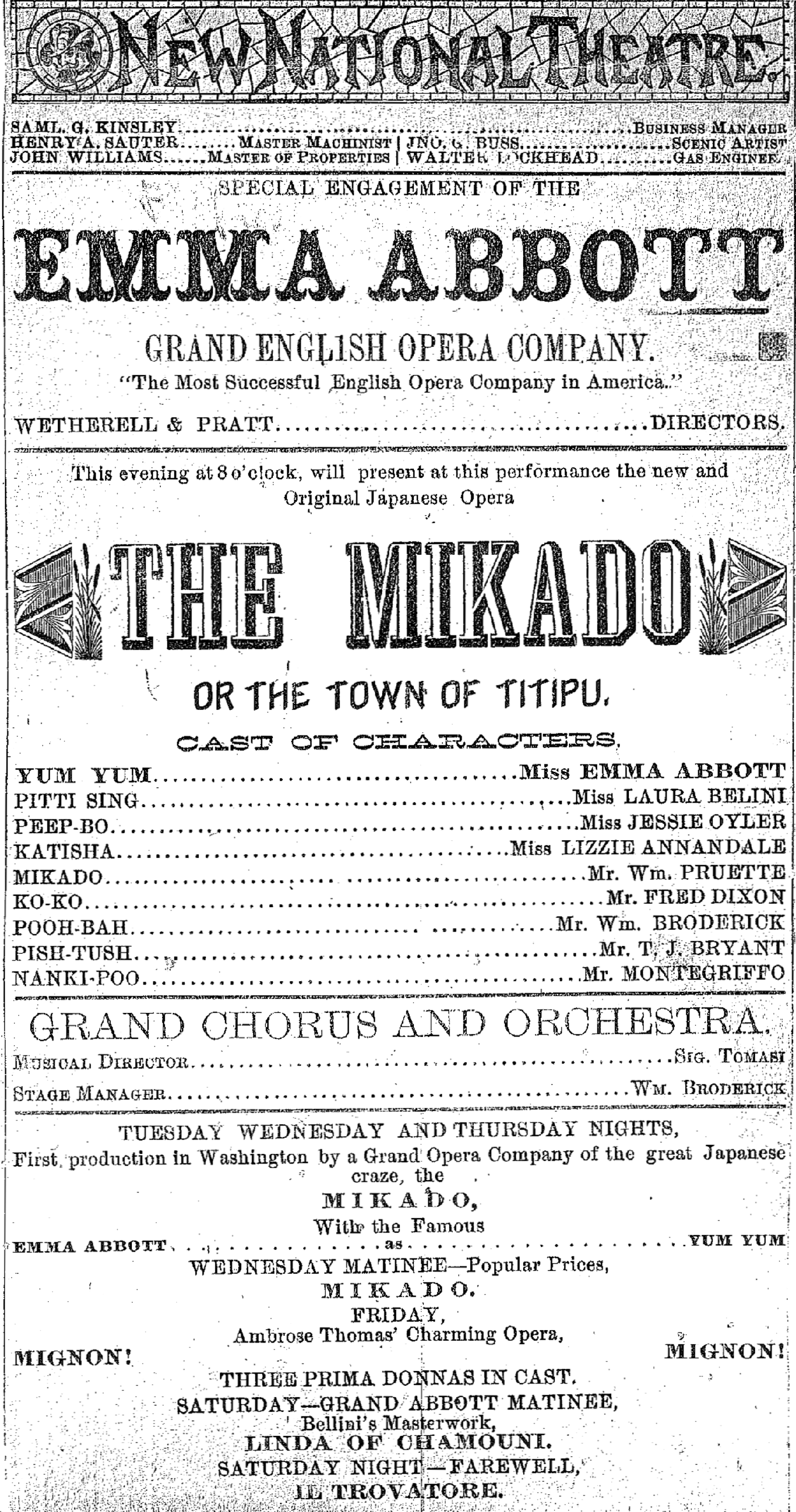
Abbott's artistic decisions were also calculated to please her audience. This included her choice of repertory. The troupe's operas were portrayed as wholesome entertainment during a time when the popular theatrical repertory was increasingly dominated by variety, operettas filled with double-entendres, and spectacles like The Black Crook, complete with scantily clad French dancers. Furthermore, the troupe chose operas that the general public wanted to hear, including works that had been part of the English-opera repertory for decades. Among these were Michael Balfe's The Bohemian Girl and William Vincent Wallace's Maritana, as well as English translations of Martha (Friedrich von Flotow), The Chimes of Normandy (Robert Planquette), Fra Diavolo (Daniel François-Esprit Auber), and La Sonnambula (Vincenzo Bellini). The troupe also incorporated a handful of more-recent operettas such as The Mikado, Iolanthe, Patience, and Yeoman of the Guard (all by Gilbert and Sullivan). Most of the operas the troupe performed, however, reflected Abbott's European training, for they were English versions of many of the standards from the Italian repertory.Footnote 27 These included Carmen (Charles Bizet), Mignon (Ambroise Thomas), Il barbiere de Siviglia (Gioachino Rossini), Paul et Virginie (Victor Massé), Faust and Roméo et Juliet (Charles Gounod), Rigoletto and Il Trovatore (Giuseppe Verdi), and La fille du Régiment, Linda di Chamoumix, and Lucia di Lammermoor (Gaetano Donizetti). During the early 1880s, in fact, Abbott's troupe performed English versions of more than half of the works mounted by the Mapleson company.Footnote 28 Abbott's repertory (eclectic by twenty-first-century standards) appealed to lovers of older English operas and fans of newer lighter operettas, as well as audience members who wanted to enjoy the more fashionable Italian fare. As one critic noted, Abbott gave the public “an opportunity to hear grand operas of the highest standard at popular prices.”Footnote 29
Playbill for The Mikado by the Emma Abbott Grand English Opera Company at the New National Theatre, Washington, March 16–18, 1886. Courtesy of Paul Glase Scrapbook Collection, Theatre Collection, Free Library of Philadelphia.
Abbott's presentation of the standard Italian repertory in English introduces the question of what, precisely, her listeners heard. Some eighteenth- and early nineteenth-century adaptations of continental works for the English-speaking stage had transformed operas into plays-with-songs. The English versions of works performed by the Caroline Richings Opera Company in the late 1860s are examples of this style of transformation. Richings (1827–1882), a British-born singer who spearheaded the revival of English-language opera on the American stage in the late 1860s, made her own translations/adaptations.Footnote 30 Her company, like Abbott's and many other troupes, sold pamphlet-sized librettos of the operas (in her case, “translated and adapted to the English Stage by Caroline Richings”) at its performances as a source of additional revenue. One such adaptation, which serves as an excellent example, is her version of Donizetti's The Daughter of the Regiment, which the soprano, in fact, did turn into a play-with-songs. Donizetti's original version, La fille du Régiment, was a French opéra-comique—a style of comic opera that included spoken dialogue. Richings retained all of Donizetti's vocal numbers (arias, ensembles, and choruses) and instrumental accompaniments and translated the French dialogue into colloquial English. In some places, however, her adaptation went further, especially in her expansion of the sergeant's role into a buffo character. The latter, in particular, transformed this opéra-comique into something more akin to a play-with-songs, or even an operetta.Footnote 31
A Caroline Richings Opera Company playbill for Daughter of the Regiment, at the Arch Street Theatre, Philadelphia, Jan. 7, 1863. Courtesy of Paul Glase Scrapbook Collection, Theatre Collection, Free Library of Philadelphia.
There has long been a general assumption among music historians that all English adaptations of the continental repertory during the nineteenth century followed this pattern. But an examination of the Abbott Company's performance materials for this same opera suggests clearly that this was not the case. In 1880 the Abbott troupe used a copy of Richings's published libretto as a promptbook for its performance; the extant document has inscribed on the inside front cover, in faded purple ink: “The Daughter / of / the Regiment / a / Comic Opera / as performed by the / Abbott Opera Co. / 1880.” The handwriting and ink match annotations and marginalia found throughout the libretto, which reveal that almost all the passages of dialogue were eliminated for the Abbott performance—crossed out with the purple-ink pen, and marked “all cut.” Abbott apparently was working with Donizetti's Italian version of the opera—in which most of the French dialogue had been compressed into sung recitative. She further transformed the work by translating the recitative into English and making it—once again—spoken dialogue.Footnote 32 Abbott's approach to this work reflects both her thorough training in the Italian repertory (which included translations of German and French operas) and the reality that by the 1880s many American operagoers were familiar with much of this repertory and as a result preferred English versions that were as close as possible to the “Italian” works that they knew.
Abbott's fidelity to Donizetti's original version in this example, however, should not suggest a generally sacrosanct approach to the written works. In fact, Abbott—like many other singers and impresarios—had no objection to changing operas to meet the needs of her audiences. For example, the length of a theatrical performance was a very important issue to middle-class operagoers, many of whom had to go to work the next morning. As a result, Abbott frequently streamlined operas that were deemed too long by making numerous short, careful, and sometimes all-but-imperceptible cuts. In her version of Victor Massé's Paul and Virginia, for example, she excised a number of repetitive segments. Sometimes the cuts were simple: for example, truncating binary-form arias by leaving one iteration of each strain—AB instead of AABB; at other times they were more drastic. In an aria sung by Paul in Act III, for example, she removed twenty-four measures in which the tenor sang reiterated assurances to his mother that he still loved her.Footnote 33 In other operas the shortening tactics were more drastic. For example, Abbott's version of Gounod's Roméo and Juliet eliminates completely the Overture-Prologue—a change that prompted praise by several critics.Footnote 34 Cuts of this nature are typical and suggest that as late as the 1880s operas were regarded by many as malleable works for the popular musical stage—more like twentieth-century musicals than untouchable texts.
The soprano's habit of interpolating songs and adding improvised fioriture also ensured her popularity. The substitution of one aria for another or the interpolation of songs was common performance practice during the first half of the century, and—although increasingly disparaged by mid-century—was not unusual during Abbott's career.Footnote 35 She complained, however, that some critics decried her interpolations but turned a blind eye to the same practice by European singers. One commentator later noted this discrepancy by admitting that Adelina Patti also engaged in the same practice. He had been present, he wrote, at a performance in 1892, when “four thousand people—the packed Metropolitan Opera House—demanded of Patti . . . just such a song.”Footnote 36 Abbott also defended this practice by noting that her interpolations frequently were in response to audience requests. “I have time and again,” she noted, “received requests signed by sometimes as many as 100 people, asking me to favor the audience with . . . some . . . familiar air. As I always try to please my audiences, is it to be wondered at that I should have complied with these requests?”Footnote 37 Abbott's practice of adding embellishments to the written melodies—trills, decorations, and cascades of notes in the old bel canto style of singing—was also a crowd-pleasing skill at which she excelled. This, too, was disparaged as “empty virtuosity” by some critics, but the practice frequently brought down the house. In general, Emma Abbott's performances were tailored to gratify and entertain her audiences; she rewarded their loyalty by paying attention to their needs and desires. As one critic noted in 1890, “The people of America appreciate more and more the care and pains that Emma Abbott and her management take in providing opera for them . . . This is one reason,” he continued, “why there has never been a losing season of Abbott opera. . . . Emma Abbott sings to the people to please them, sings to their hearts.”Footnote 38
Most of these performance techniques appealed primarily to Americans who had stopped supporting opera in the 1870s and now had to be lured back into the fold. But there was another potential segment of the audience that interested Abbott: Americans who had never attended opera performances. In order to cultivate these people, however, she first had to entice them into the theater, which she managed to do by means of her carefully constructed public persona. Abbott's ability to mold a public identity that resonated clearly with the values of late-century, middle-class Americans was extraordinary. It also illustrates the importance of such tactics in the arsenal of a cultural activist of the time.
Abbott had to overcome several entrenched biases. The first was an abiding belief in the moral turpitude of the theater, compounded by a deep conviction that women on the stage were immoral—attitudes that were particularly strong among church-going Americans in the Middle and Far West. Abbott fought these biases through both words and example, as a principled woman who was fiercely proud of her long marriage and who regularly attended religious services. Her moral reputation (assisted to no small degree by her stand about singing the role of Violetta) endeared her to churchgoers and helped to convince many of them that attending theatrical performances was respectable. One of the most famous incidents of her career illustrates her moral argument. In 1887 the company opened a new opera house in Nashville. As was her habit, Abbott participated in a religious service on Sunday morning, choosing a nearby Methodist church. Many of the congregants had attended the troupe's performances the previous week, which did not please the minister, whose sermon was on the evils of the theater in general and of theatrical people in particular. After he finished speaking, Abbott, who had been sitting unnoticed in the back, arose and defended herself and other theatrical women. She spoke briefly but pointedly, noting that during her years in the profession she had “endeavored to lead the life of a Christian woman.” Furthermore, she pointed out, many of the women in her company were the sole support of their families.Footnote 39 Her actions horrified some members of the church but were applauded by others; the incident created a national furor.Footnote 40
The second entrenched bias that Abbott had to overcome was the identity of opera as both European and (since the mid-1870s) exclusive and elite. She accomplished this in part by creating an image of herself as approachable and friendly. This already-mentioned tactic helped to deflect the negative image of foreign singers as capricious and arrogant. Her more difficult task, however, was to convince Americans to support a foreign style of musical theater that was increasingly viewed as inherently un-American because of its elitism. She did so brilliantly by honing her public persona as an unpretentious singer “from the heartland,” a woman with deep roots in Yankee New England, and a hardworking performer who was living the American dream. She had a rags-to-riches story that was as American as apple pie and enjoyed conspicuous professional success that had been achieved by dint of can-do determination and pluck. Her image as an underdog was furthermore buoyed by her history of standing up to adversaries, whether it be powerful European impresarios, disapproving Eastern critics, or self-righteous ministers. Even when in Europe she had been aware of her American image: when Adelina Patti had urged her to change her name to something more “European”-sounding, she had refused. “I told her,” she said, that “I would go ahead as Emma Abbott, and if I ever won any laurels it would be under my own simple American name.”Footnote 41 She honed her girl-next-door image and rarely disappointed her audiences by canceling performances, a practice of prima donnas that had infuriated American audiences for decades. In short, Abbott exploited the rampant anti-eastern-establishment/anti-European sentiment shared by many working- and middle-class Americans and gave them opera that she had transformed into an American theatrical form. Even those people who had never attended the theater or an opera performance were fascinated by her story and drawn to performances because of her identity.
Emma Abbott achieved her goals. She created a popular audience for English-language opera in the United States unlike any enjoyed by an American opera company before or since. Who knows how the history of American musical theater—or the place of opera in American society—might be different today had her career continued for another decade or two. But that was not to be. The Abbott juggernaut came to an abrupt end in January 1891, when the singer became ill while on tour. Because she did not want to disappoint her audience, she refused the advice of several doctors to cancel a performance. She sang, contracted pneumonia, and within days was dead at the age of 41. There were public expressions of grief all over the country; thousands attended her funeral in Chicago.Footnote 42
In the end, Abbott's success tells us much about the importance of opera to a segment of the American audience that we have assumed had no interest in it. An examination of her success and of the techniques she used help illuminate fascinating aspects of operatic performance history in the United States. As a cultural activist, she rejected the idea that culture was only for a select few. By performing the standard repertory in English, she essentially restored opera to the popular stage. As one critic wrote after her death, Abbott “accomplished a grand mission in the popularization of music; all over the great West, the South, and the Northwest, she opened what might have remained otherwise a sealed book—in the music of the standard opera.”Footnote 43 Her story is little known today, but this is undeservedly so: there is little question that she played a major role in the history of American music—and American culture.