Introduction
Parasites normally derive their nutrient requirement directly from the stored food source of their hosts (Cheng, Reference Cheng1986). Although some form of gut is present in adult trematodes, they are also able to absorb food material through the tegument (Smyth, Reference Smyth1994). The external surface of all parasitic flatworms is composed of a multifunctional syncytial tegument. This tegument is permeable to a variety of small organic solutes and allows these molecules to pass by passive diffusion or via facilitated or active transport (Dalton et al., Reference Dalton, Skelly and Halton2004). Some species have deep pits and channels, which serve the purpose. In particular, small nutrient molecules are absorbed through the tegument of the parasite.
Lipid and fatty acid requirements are different in different animals and are probably related to the need of the animal concerned. Parasitic stages of helminths do not normally use lipids as an energy reserve (Barrett, Reference Barrett1981, Reference Barrett, Arme and Pappas1983). The adult worms take up large amount of lipids for specific fatty acids and fat-soluble vitamins and the excess lipid is stored and eventually excreted (Cheng, Reference Cheng1986). Since trematodes are unable to synthesize most essential lipids they depend on exogenous lipids from tissues, fluids or the cell membrane of the host (Smyth, Reference Smyth1994).
The total lipid content of trematodes varies among species. Lipid contents have been investigated from some of the following important species: Fasciola hepatica (Hrzenjak & Ehrlich, Reference Hrzenjak and Ehrlich1975; Chappell, Reference Chappell1980); Paramphistomum microbothrium (Hrzenjak & Ehrlich, Reference Hrzenjak and Ehrlich1975; Awharitoma et al., Reference Awharitoma, Opute, Ali and Obiamiwe1990); Cotolyphoron cotolyphorum (Yusufi & Siddiqi, Reference Yusufi and Siddiqi1976); Clonorchis sinensis (Lee et al., Reference Lee, Song and Cho1977); Schistosoma mansoni (Smith & Brooks, Reference Smith and Brooks1969; Meyer et al., Reference Meyer, Meyer and Bueding1970; DiConza & Basch, Reference DiConza and Basch1976; Rumjanek & Simpson, Reference Rumjanek and Simpson1980; Furlong, Reference Furlong1991); Echinostoma trivolvis (Fried et al., Reference Fried, Rao, Sherma and Huffman1993) and Paramphistomum cervi (Vykhrestyuk & Yarygina, Reference Vykhrestyuk and Yarygina1975; Ghosh et al., Reference Ghosh, Dey and Misra2005). Major lipid classes and fatty acids were reported in these studies.
The present study was carried out on a digenetic trematode parasite P. cervi (Schrank, Reference Schrank1790) that lives in the rumen and reticulum of the common Indian goat (Capra hircus). The parasite P. cervi obviously acquires lipids and fatty acids from the rumen fluid of its host. The host also derives these components from the rumen fluid as well. Plants (the food of the host) are the source of lipids and fatty acids in the rumen fluid. Thus both the host and the parasites compete for their lipids and fatty acids from a common source, i.e. the rumen fluid. Therefore, studies on the lipids and fatty acids of host tissue, parasite and the rumen fluid would help in understanding the host–parasite relationship as well as the trophic interaction between the two partners.
The aim of the present study is to develop a comprehensive idea about the details of lipid classes and their fatty acid compositions of the trematode P. cervi and the liver of its host in comparison to that of the rumen fluid. The hypothesis of the work is that although both the host and the parasite take up lipids and fatty acids from a common source (the rumen fluid); the parasite absorbs more fatty acids than its host as its requirement is high and it is unable to synthesize fatty acids de novo.
Materials and methods
Parasitological procedures
Paramphistomum cervi (Schrank, Reference Schrank1790) belongs to the class Trematoda, subclass Digenea and order Paramphistomiformes (Roberts & Janovy, Reference Roberts and Janovy2000). Adult P. cervi were collected from the rumen and reticulum of the stomach of the common Indian goat (C. hircus), from Khardah area, district North 24 Parganas, West Bengal, India. The parasite samples were pooled from ten hosts to achieve a wet weight of 100 g. Goat liver and rumen fluid (from the same goat from which the parasites were isolated) were also collected and pooled. In total, 40 g of goat liver and 869 ml rumen fluid were taken for analysis. The goat liver samples and the worms were washed in distilled water and kept in the freezer at − 20°C for further analysis.
Extraction and fractionation of lipids
Total lipids were extracted from the samples following the method of Bligh & Dyer (Reference Bligh and Dyer1959) using methanol–chloroform (2:1, v/v), methanol–chloroform–water (2:1:0.8, v/v/v) and then again with the first solvent system. Samples were ground with the solvent, homogenized and filtered and the residue was extracted with the next solvent system. The process was repeated. Finally, three extracts were pooled, diluted with a little chloroform and enough water and the layer was allowed to separate in a separator funnel. The chloroform layer at the bottom was withdrawn and dried over anhydrous sodium sulphate. The chloroform solution of lipid was evaporated under vacuum, redissolved in distilled hexane and kept at − 20°C for future use. The total lipids of the samples were weighed in a microbalance. BHT (butylated hydroxy toluene) was added at a level of 100 mg/l to the solvent as an antioxidant.
According to Rouser et al. (Reference Rouser, Kritchevsky, Yamamoto and Marinetti1976) a portion of the total lipid of the samples was subjected to column chromatography to obtain lipid classes. Fatty acid methyl esters (FAME) of all the lipid classes were prepared by the process of transmethylation (Christie, Reference Christie2003). According to the method of Mangold (Reference Mangold and Stahl1969) fatty acid methyl esters were purified by thin layer chromatography (TLC). Gas–liquid chromatography (GLC) of fatty acid methyl esters was done on a Chemito 1000 instrument, equipped with a flame ionization detector (FID). Quantification was done by computer using specific Clarity Lite Software (Data Apex Ltd, Praha, Czech Republic).
GLC of FAME was done on a BPX-70 megabore capillary column of 30 m length and 0.53 mm internal diameter obtained from SGE, Australia. Oven temperature was programmed from 150 to 240°C with a rate of 8°C/min. Initial and final temperatures were kept isothermal for 2 min and 20 min, respectively. Nitrogen gas was used as the carrier gas and its flow rate was 6.35 ml/min.
Identifications of fatty acids were done as suggested by Ackman & Burgher (Reference Ackman and Burgher1965) using cod liver oil fatty acid methyl esters as the secondary standard and chromatographed under identical operational conditions of GLC.
Results
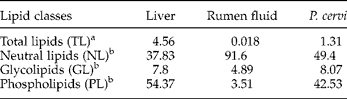
Total lipid and its major classes such as NL, PL and GL, and their fatty acids of the liver and rumen fluid of the goat C. hircus and those of its parasite P. cervi were analysed. The percentage composition of total lipid and three other lipid classes (NL, GL and PL) of goat liver, rumen fluid and P. cervi are presented in table 1.
Compositions of various classes of lipids obtained from the liver, rumen fluid of the goat and the trematode parasite Paramphistomum cervi.

a % w/w of wet tissue.
b % w/w of total lipids.
The total lipid content of the liver was 4.56% of the wet weight of the tissue, that of rumen fluid was 0.018%, and that for P. cervi was 1.31%. The percentages of lipid classes (expressed as % w/w of the total lipids) of the liver were 37.83 (NL), 7.80 (GL) and 54.37 (PL); those for rumen fluid were 91.60 (NL), 4.89 (GL) and 3.51 (PL). The percentages of NL, GL and PL of P. cervi were 49.40, 8.07 and 42.53, respectively (table 1).
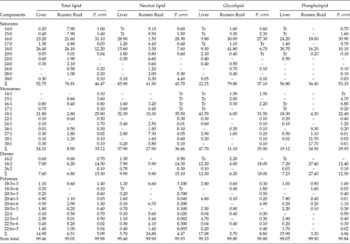
The amount of NL, GL and PL of goat liver, rumen fluid and P. cervi showed that the rumen fluid and P. cervi were rich in NL, while liver was rich in PL followed by NL. The amounts of fatty acids of TL, NL, GL and PL of the goat liver, rumen fluid and the parasite samples are compared in table 2.
Fatty acid compositions (expressed as % of total fatty acids) of total lipid (TL), neutral lipid (NL), glycolipid (GL) and phospholipid (PL) of the liver, rumen fluid and trematode parasite Paramphistomum cervi.

Total lipids
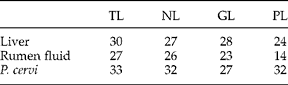
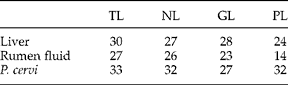
Of the 35 identified fatty acids of TL, goat liver, rumen fluid and P. cervi contained 30, 27 and 33 fatty acids, respectively (table 3). Rumen fluid contained nearly 77% saturated fatty acids (SFA), while this was 52.75% in the liver and 46.47% in the parasite. Palmitic acid (C16:0), stearic acid (C18:0), oleic acid (C18:1) and linoleic acid (C18:2) were present in higher amounts in all the three samples. The presence of eicosatetraenoic acid (C20:4n-3) was noticed in a considerable amount in the liver.
The number of fatty acids in lipid fractions obtained from the the liver of the host, rumen fluid and P. cervi.
TL, Total lipid; NL, neutral lipid; GL, glycolipid; PL, phospholipid.
The amount of 16:0, 18:1 and 18:2 fatty acids was much higher in the parasite than that of the liver. The parasite contained the maximum amount of saturates followed by monoenes, dienes and polyenes (table 2).
Neutral lipids
The numbers of identified fatty acids in NL of liver, rumen fluid and P. cervi were 27 (three as trace amount), 26 and 32 (five as trace amount), respectively (table 3). Among the fatty acid classes, the percentage of saturated fatty acids (SFA) was over 40% in all the samples under study. Among the SFA, 14:0 and 15:0 in the liver, and among the unsaturated fatty acids (UFA), 14:1, 15:1, 16:1 and 17:1 in P. cervi, were present in trace amounts. In both the liver and P. cervi 18:3n-6 was present in trace amounts. The amount of total UFA was higher than that of the saturated fatty acids in all the three samples. Among all the fatty acids, 16:0, 18:0, 18:1 and 18:2 fatty acids were recorded more in both the liver and the parasite, while 18:1 was recorded more in the rumen fluid (table 2). Eicosatetraenoic acid (20:4n-3) was present in sizeable amounts in the liver. It is interesting to note that the percentage of polyenes was much higher in the rumen fluid than in the liver and P. cervi.
Glycolipids
Twenty-eight (eight as trace amount), 23 and 27 (two as trace amount) fatty acids have been identified in the liver, rumen fluid and in P. cervi, respectively (table 3). The fatty acid components such as 16:0, 18:0, 18:1 and 18:2 predominated in all the three samples. Among the fatty acids in the GL of the liver sample, 14:0, 15:0, 17:0, 14:1, 15:1, 16:1, 17:1 and 16:2 were present in trace amounts and in P. cervi the fatty acids present in trace amounts were 17:0 and 20:0 (table 2). Eicosatetraenoic acid content in the liver was the highest among the polyenes. The percentage of saturates was exceedingly high in rumen fluid (table 2). Monoenes were nearly 50% of glycolipids of the liver. More or less equal amounts of saturates and monoenes were found in P. cervi.
Phospholipids
The numbers of identified fatty acids in the PL of the liver, rumen fluid and P. cervi were 24 (six as trace amount), 14 and 32 (one as trace amount), respectively (table 3). UFA in the rumen fluid, and SFA in the liver and P. cervi, were present in higher amounts. The amount of polyenes was highest in the liver compared with the amounts in P. cervi and the rumen fluid. Trace amounts of fatty acids of PL were 14:0, 15:0, 20:0 16:1, 17:1 and 16:2 in the liver and 14:1 in P. cervi. The main acids were palmitic (C16:0), stearic (C18:0), oleic (C18:1) and linoleic (C18:2) acids in the liver and in P. cervi, and 16:0, 18:0, 28:1, 30:1 and 18:2 acids in the rumen fluid. Among the polyenes of PL of the liver the fatty acid 20:4n-3 was present in considerable amounts compared with other polyenoic acids (table 2). The percentage of saturates in the liver and P. cervi was more than 50, while more or less equal amounts of saturates and monoenes were found in the rumen fluid.
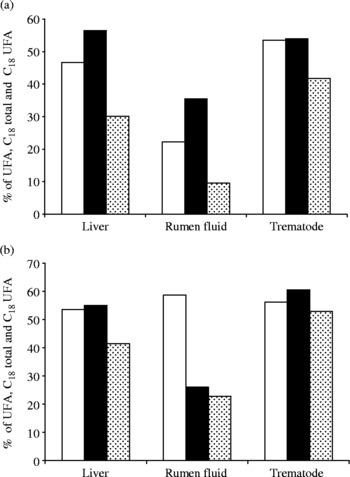
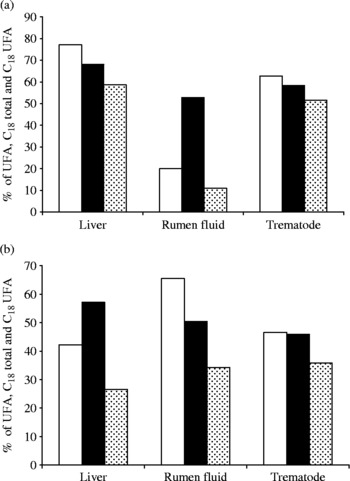
A comparison of UFA, C18 total, and C18 UFA of TL (fig. 1a), NL (fig. 1b), GL (fig. 2a) and PL (fig. 2b) of the liver, rumen fluid and P. cervi is presented. In the TL, the percentage of UFA and C18 UFA was higher in P. cervi compared with in the liver and rumen fluid while C18 total was higher in the liver followed by P. cervi and rumen fluid. In the NL, the percentage of C18 total and C18 UFA was more in P. cervi, while UFA was higher in the rumen fluid followed by P. cervi and the liver. In the GL, the liver contained higher amounts of UFA, C18 total and C18 UFA than in P. cervi and the rumen fluid. The amount of C18 UFA was higher in P. cervi in all the lipid fractions except in GL compared with the rumen fluid and the liver.
A comparison of unsaturated fatty acid (UFA) (clear), C18 total (black) and C18 UFA (stippled) in (a) total lipid and (b) neutral lipid in the liver, rumen fluid and P. cervi.

A comparison of unsaturated fatty acid (UFA) (clear), C18 total (black) and C18 UFA (stippled) in (a) glycolipid and (b) phospholipid in the liver, rumen fluid and P. cervi.

The composition of palmitic (C16:0) and stearic (C18:0) acids in the TL, NL, GL and PL of the liver, rumen fluid and P. cervi (table 4) shows that palmitic acid was higher in TL and PL in P. cervi than in the liver and the rumen fluid.
Occurrence of palmitic (C16:0) and stearic acid (C18:0) total lipid, neutral lipid, glycolipid and phospholipid in the liver, rumen fluid and P. cervi.

Discussion
Helminths take up lipids from external sources, either as fatty acids or sterols, because they have limited ability for the biosynthesis of lipids. Parasitic worms display selective mechanisms for absorption of fatty acids from their environment and incorporate these absorbed fatty acids into various lipid fractions. Undissociated fatty acids diffuse through the absorptive surface of the membrane lipid bilayer and dissociated fatty acids enter by mediated transport. The tegument helps in the absorption of cholesterol and fatty acids (Dalton et al., Reference Dalton, Skelly and Halton2004). Lipids of endoparasites, especially adult parasitic trematodes, play an important role in long-term adaptation for survival and completion of their life cycles in anaerobic conditions (Sherman, Reference Sherman1998; Sato et al., Reference Sato, Hirayama and Hirazawa2008). It has been reported that helminth parasites of humans take up lipids from the host, and that these are utilized by the parasite both for their own requirement and for evasion of host immunity (Furlong et al., Reference Furlong, Thibault, Morbelli, Quinn and Rogers1995).
The total lipid content of the rumen fluid is lower than that of the liver and P. cervi (table 1). Both the host and P. cervi absorb lipids from the rumen fluid. Thus, competition exists between the host and parasite for the total lipid of the rumen fluid. In helminths, total lipid content varies between 10 and 30% of the dry weight (Barrett, Reference Barrett1981). According to Vykhrestyuk & Yarygina (Reference Vykhrestyuk and Yarygina1975), the total lipid content of P. cervi is 4.7% (dry weight). TL is stored in the mammalian liver while trematodes do not store the lipid and hence such a difference between them is visible.
The neutral lipid content of the rumen fluid is much higher compared with those of P. cervi and the liver (table 1). In an earlier study the percentage of NL in TL of P. cervi was recorded as 39.04 (Ghosh et al., Reference Ghosh, Dey and Misra2005). Vykhrestyuk & Yarygina (Reference Vykhrestyuk and Yarygina1975) reported the percentage of NL of the total lipid of Eurytrema pancreaticum and P. cervi as 75.28 and 50.33, respectively. However, Smith & Brooks (Reference Smith and Brooks1969) and Meyer et al. (Reference Meyer, Meyer and Bueding1970) recorded that the NL fraction of S. mansoni is 50.0% of the TL. Variation in lipid contents among trematode species may be due to the state of feeding of the host. Lipid content is dependent on availability and quality of food and the state of nutrition of the host animal concerned.
The percentage of GL is very low in the rumen fluid, liver and P. cervi. Glycolipids are divided into two groups, namely, simple glycolipids and glycosphingolipids. These classes of lipids are generally present in cell membranes with carbohydrate moieties. Wuhrer et al. (Reference Wuhrer, Grimm, Dennis, Idris and Geyer2004) analysed the neutral glycosphingolipids of the liver fluke (F. hepatica) of sheep. They observed two types of neutral glycolipids in F. hepatica. In S. mansoni glycans modulate the host's immune response (Palanivel et al., Reference Palanivel, Posey, Horauf, Solbach, Piessens and Harn1996; van der Kleij et al., Reference van der Kleij, van Remoortere, Schuitemaker, Kapsenberg, Deelder, Tielens, Hokke and Yazdanbakhsh2002). In addition, the important roles of glycoconjugates in S. mansoni are their secretion into the circulation (Deelder & Kornelis, Reference Deelder and Kornelis1980; Deelder et al., Reference Deelder, vam Dam, Kornelis and Fillié1996; Hokke & Deelder, Reference Hokke and Deelder2001) and their expression in the parasite's gut or tegument (Bogers et al., Reference Bogers, Nibbeling, van Marck and Deelder1994; Khoo et al., Reference Khoo, Sarda, Xu, Caulfield, McNeil, Homans, Morris and Dell1995; van Remoortere et al., Reference van Remoortere, Hokke, van Dam, van Die, Deelder and van den Eijnden2000). Glycolipids act as membrane components and as an antigen in S. mansoni (Furlong, Reference Furlong1991). The glycolipid content of both the liver and P. cervi is very close, which indicates that the requirement and utilization of this fraction of lipid are more or less similar. Thus, both the parasite and host compete for glycolipids of the rumen fluid.
The percentage of PL in rumen fluid (3.51) is very low compared with that of the liver and P. cervi. Vykhrestyuk & Yarygina (Reference Vykhrestyuk and Yarygina1975) reported 24.72 and 49.67% of PL in the total lipid of the cattle trematodes E. pancreaticum and P. cervi, respectively. Smith & Brooks (Reference Smith and Brooks1969), Meyer et al. (Reference Meyer, Meyer and Bueding1970), DiConza & Basch (Reference DiConza and Basch1976) and Rumjanek & Simpson (Reference Rumjanek and Simpson1980) reported that the percentage of phospholipids in TL of S. mansoni was 36–37 while the percentage of phospholipid in TL of G. hominis was 12.6 (Yusufi & Siddiqi, Reference Yusufi and Siddiqi1977).
Phospholipids serve as a membrane component in animals and participate in the transport of triacylglycerol and cholesterol in animals. They also play an important role in the defence mechanism of S. mansoni (Furlong, Reference Furlong1991). Molecular species of phospholipids are important mediators of signal transduction, immune response modulation and membrane fusion. These are all important aspects of the membrane of schistosomes (Brouwers et al., Reference Brouwers, Van Hellemond, van Golde and Tielens1998). Schistosoma mansoni is capable of synthesizing phospholipids and triacylglycerols from precursors obtained from the host (Brito et al., Reference Brito, Oliveira, Oliveira, Street, Riengrojpitak, Wilson, Simpson and Oliveira2002). Similar mechanisms of phospholipid utilization might take place in gut-dwelling trematodes such as P. cervi.
Fatty acids of animals are simple in structure. They are straight chained, usually contain 16–22 carbons and may have 0–6 double bonds. Considerably more varied types of fatty acids are present in plants and are acquired by vertebrates through the food source (Misra et al., Reference Misra, Shkrob, Rakshit and Dembitsky2002). Saturated and unsaturated fatty acids ranging from 10 to 24 carbon atoms are found in the lipids of helminths. Parasitic helminths use fatty acids for biosynthetic purposes; they do not use them for energy production. Adult parasitic flatworms generally function anaerobically, deriving their energy from the catabolism of glucose and glycogen and excreting highly reduced end products (Dalton et al., Reference Dalton, Skelly and Halton2004). In a previous study, 22 fatty acids were identified from both P. cervi and goat serum (Ghosh et al., Reference Ghosh, Dey and Misra2005); however, in the present study the number of fatty acids was 33 (P. cervi) and 30 (goat liver), respectively. The differences are mainly in the number of saturated and monoene acids. Incidentally, the amounts of saturates, monoenes, dienes and polyenes in both the earlier and present studies on P. cervi are more or less close.
The predominant fatty acids of TL, NL, GL and PL in the liver, rumen fluid and P. cervi include C16:0, C18:0, C18:1 and C18:2. According to Hutchison et al. (Reference Hutchison, Turner, Grayson and White1976), C16:0 and C18:0 fatty acids represented 70% of total fatty acids in Dirofilaria immitis, D. viteae and Litomosoides carinii. However, in the earlier (Ghosh et al., Reference Ghosh, Dey and Misra2005) and present studies C16:0 and C18:0 constitute a little below 50% of the fatty acids in P. cervi, and in goat the amount is close to 50% in the liver while it is 33.04% in serum (Ghosh et al., Reference Ghosh, Dey and Misra2005). It is observed that total C18 acid is the major component of total fatty acids in P. cervi and C18 UFA dominates the total UFA. This is also observed in a cestode parasite of a poultry bird, Raillietina (Fuhrmannetta) echinobothrida (Mondal et al., Reference Mondal, Mukhopadhyay, Ghosh, Dey and Misra2009). The reason is that C18 acids are required for chain elongation to form C20 and C22 acids. This is in agreement with the fact that helminths have a higher percentage of unsaturated C18 acids than mammals. In F. hepatica and larval T. spiralis, stearic acid (C18:0) is predominant but in most parasitic helminths C18:1 (oleic acid) is the major component. The present observation is in conformity with the above contention that oleic acid is the predominant C18 acid in P. cervi.
A high amount of palmitic acid is recorded in P. cervi, because it is the principal fatty acid found at all trophic levels. As the fatty acid synthetase cycle stops at palmitate, in P. cervi C16:0 might act as a precursor for both saturated and unsaturated C18 acids.
Total lipids
The percentage of C18:1 fatty acid varies among the liver, P. cervi and rumen fluid (table 2). According to Mayes & Botham (Reference Mayes, Botham, Murray, Granner, Mayes and Rodwell2003), palmitoleic acid (C16:1) and oleic acid (C18:1) are not essential in the diet, because, at the Δ9 position of the saturated fatty acid, tissues can introduce a double bond. The fatty acids C14:1 and C26:2 are present in P. cervi but not found in the rumen fluid and host liver. The presence of these fatty acids in the parasite may be due to conversion from a precursor fatty acid.
In animal systems, the biosynthesis of n-9, n-6 and n-3 of polyunsaturated fatty acids (PUFA) is catalysed either by the microsomal chain elongation or desaturation system (Mayes & Botham, Reference Mayes, Botham, Murray, Granner, Mayes and Rodwell2003). However, such chain-elongation enzymes in parasites are of mitochondrial origin rather than microsomal source (Barrett, Reference Barrett1981). Six fatty acids such as C30:0, C17:1, C24:1, C30:1, C18:3n-6 and C20:3n-3 are present both in the liver and in P. cervi but not recorded from the rumen fluid. These fatty acids are probably products of chain elongation from precursor fatty acids. Earlier reports revealed that C18:1 and C18:2 are converted to C20:1 and C20:2 in F. hepatica through chain elongation (Barrett, Reference Barrett1981) and in S. mansoni (Brouwers et al., 1997). However, C20:0, C20:1 and C20:2 fatty acids could not be recorded in P. cervi. Christie (Reference Christie2003) elaborately explained the biosynthetic relationships among unsaturated fatty acids. Some of these steps might be followed by P. cervi.
Neutral lipids
The fatty acid C22:1 is present in P. cervi but absent in both rumen fluid and liver. In mammals, 18:1 fatty acid can be converted to 20:1 by the enzyme elongase and is then converted to 22:1 fatty acid (Mayes & Botham, Reference Mayes, Botham, Murray, Granner, Mayes and Rodwell2003). This type of elongation might occur in parasites also. However, in the present study the fatty acid C20:1 could not be detected both in the liver and P. cervi, because this fatty acid might have been converted to eicosatrienoic acid, eicosatetraenoic acid, arachidonic acid (AA) and eicosapentanoic acid (EPA).
Both in the liver and in P. cervi 16:2, 26:2, 20:3n-3, 20:4n-3 and 20:5n-3 fatty acids are present; however, they are absent in the rumen fluid. The fatty acids C20:3n-3, C20:4n-3 and C20:5n-3 can be formed from the precursor C18:3n-3 (α-linolenic acid) by elongation or desaturation (Christie, Reference Christie2003). It is seen from the present study that rumen fluid possesses the fatty acid C18:3n-3, which is absorbed both by the host and P. cervi. Fatty acids C20:3n-3, C20:4n-3 and C20:5n-3, which are formed from C18:3n-3 in the host and P. cervi, might also follow this mechanism or be obtained from the host gut through suctorial feeding.
Glycolipids
Fatty acids such as 30:1, 20:3n-3 and 20:4n-6 are recorded in P. cervi but are absent in the rumen fluid and liver. The fatty acid 30:1 in the parasite might be formed from an unsaturated precursor acid. In animals, the fatty acid 20:3n-3 is formed from the fatty acid 18:3 (ω3 family) by elongase and the fatty acid 20:4n-6 is formed from 20:3 (ω6 family) by Δ5 desaturase enzymes (Mayes & Botham, Reference Mayes, Botham, Murray, Granner, Mayes and Rodwell2003). Both the liver and P. cervi contain 30:0, 22:1, 24:1, 28:1, 22:5n-3 and 22:6n-3 fatty acids which are absent in rumen fluid. Arachidonic acid is the precursor of several classes of signal molecules, which act as messengers and local hormones. Thus, parasites might use chain-elongation processes for the production of arachidonic acid.
The fatty acid C30:0 in both the liver and P. cervi may be formed from precursor saturated acids. Barrett (Reference Barrett1981) reported that Hymenolepis diminuta could convert C16 and C18 fatty acids up to C26. In animals, the fatty acids 22:1 and 24:1 are formed from 18:1 (ω9 family) fatty acid via 20:1 (Mayes & Botham, Reference Mayes, Botham, Murray, Granner, Mayes and Rodwell2003). In the mammalian liver these fatty acids can be formed following this pathway and the parasite might also follow this strategy. However, the fatty acid C20:1 is absent both in the liver and in P. cervi. The fatty acids 22:5n-3 and 22:6n-3 in the liver and in P. cervi can be formed from 20:4n-3, because according to Christie (Reference Christie2003), C22:5n-3 and C22:6n-3 fatty acids are formed from C20:4n-3.
Phospholipids
The fatty acids 26:0, 28:0, 30:0, 15:1, 20:3n-3 and 22:4 are present in P. cervi but are absent in rumen fluid and goat liver. It can be assumed that the fatty acids 30:0 and 15:1 in P. cervi might have been formed from absorbed saturated and unsaturated acids by chain elongation. According to Barrett (Reference Barrett1981) helminth lipids usually contain small amounts of odd-numbered (C15, C17) and branched-chain acids. In animals the pathway for the synthesis of 20:3 and 22:4 fatty acids is: 18:3 → 20:3 → 20:4 → 22:4 (Mayes & Botham, Reference Mayes, Botham, Murray, Granner, Mayes and Rodwell2003). This pathway might be followed by this parasite.
The fatty acids 14:0, 15:0, 17:0, 16:1, 17:1, 22:1, 24:1, 26:2, 22:5n-3, 22:5n-6 and 22:6n-3 are absent in the rumen fluid but are present in both the liver and P. cervi, which might be formed by elongation or desaturation of the absorbed precursor acids. The route of phospholipid uptake is most likely through transportation across the tegumental membranes (Furlong et al., Reference Furlong, Thibault and Rogers1992). Acyltransferases are found in adult trematodes (Dalton et al., Reference Dalton, Skelly and Halton2004). Acyltransferases of the trematodes might help in exchanging fatty acids between neutral lipid and phospholipids (Tielens, Reference Tielens, Fried and Graczyk1997, Reference Tielens and Dalton1999). Besides this route, the trematode might have acquired fatty acids through their suctorial feeding from the host.
Endoparasites lead an opportunistic way of life and rely mainly on two strategies: energy conservation in most metabolic fronts, except for reproduction, and exaggeration of reproductive fitness. Most probably, to minimize their energy budget, parasitic adult trematodes take up nutrients through facilitated diffusion. Beta-oxidation in adult parasites does not occur significantly, although they have the genes and required enzymes and take up only those fatty acids that they utilize mainly for reproduction and other purposes, but not as an energy source. The present result shows that the number of fatty acids in all the major lipid fractions is more in P. cervi than in the host and the rumen fluid. However, the amount of fatty acids is less in the parasite than the host. The parasite competes for lipid acquisition from the rumen fluid and becomes successful in obtaining a higher number of fatty acids than its host. Fatty acids that are not available from the rumen fluid are taken from the host tissue. This proves that the parasite exploits both sources for fatty acid uptake, and absorbs, perhaps, the required amount only because it does not store lipids. Thus, the parasite competes with its host for fatty acids from the rumen fluid and absorbs as many fatty acids as it can, while the host takes up a lesser number of fatty acids from the rumen fluid, because it has the ability to synthesize some of the required fatty acids from the precursor. It can be assumed that the parasite allows the host to absorb a lower number of fatty acids but more in amount. This is also reflected from the result that the amount of SFA, especially stearic acid, is more in the host than in P. cervi. Therefore, P. cervi is opportunistic, takes double advantage of nutrient uptake and proves to be a better competitor over its mammalian host.
Acknowledgements
The authors are thankful to the Principal, R.B.C. College, Naihati for providing laboratory facilities and to Dr A. Ghosh, DRDC, Kolkata for extending help towards GLC analysis.