

It is well accepted that strong sibling relationships promote greater well-being in adulthood (cf. Cicirelli, Reference Cicirelli1989) and, for some individuals, their relationship with their sibling endures longer than any other personal relationship. However, despite the agreed-upon importance and longevity of sibling relationships over the lifespan, researchers have largely ignored the dynamics of these relationships beyond childhood. Although there is some support in the adult attachment literature that siblings are important members of adult social networks (e.g., Doherty & Feeney, Reference Doherty and Feeney2004; Pitman & Scharfe, Reference Pitman and Scharfe2010; Trinke & Bartholomew, Reference Trinke and Bartholomew1997), to date, there is no research examining the influence of attachment on sibling relationship dynamics, including conflict and cooperation. While associations between attachment and conflict have been studied in other close relationships (e.g., with romantic partners), little is known about how conflict and cooperation are managed among siblings in adulthood. Emerging adulthood may mark the beginning of many changes in an individual's life, such as moving away from the family home, attending college or university, starting a new career, or maintaining serious romantic relationships (Arnett, Reference Arnett2000). During these transitions, sibling relationships may begin to take a different form and perform new or different functions in an individual's life. In this study, we examined the measurement of attachment to siblings in emerging adulthood, as well as the influence of attachment on conflict and cooperation in sibling relationships.
Attachment Theory
Attachment theory provides a framework for understanding the way in which individuals perceive themselves and others from infancy to adulthood (Bowlby, Reference Bowlby1988). Bowlby (Reference Bowlby1969, Reference Bowlby1982) proposed that when infants are distressed, ill, or afraid, their attachment figure is sought out to provide comfort and security. An attentive caregiver who responds sensitively and appropriately to the child's needs is said to foster a positive view of the self and others, which is characteristic of secure attachment. Insensitive, unresponsive, and/or inconsistent behaviours from attachment figures are proposed to result in negative models of the self and/or others, which are characteristic of insecure attachment. Although there are several ways to assess adult attachment, including the two-dimensional approach (e.g., Brennan, Clark, & Shaver, Reference Brennan, Clark, Shaver, Simpson and Rholes1998; Fraley, Waller, & Brennan, Reference Fraley, Waller and Brennan2000; Mikulincer & Shaver, Reference Mikulincer and Shaver2007), we focused on Bartholomew's four-category model of adult attachment, which builds upon Bowlby's foundational theory — in particular, his views on internal working models of the self and other (see Bartholomew, Reference Bartholomew1990; Bartholomew & Horowitz, Reference Bartholomew and Horowitz1991; Griffin & Bartholomew, Reference Griffin and Bartholomew1994). Bartholomew's model was used for several reasons. In particular, we endeavoured to test the associations among the four categories of attachment and were interested in the influence of security. Although the Experiences in Close Relationships (ECR; Brennan et al., Reference Brennan, Clark, Shaver, Simpson and Rholes1998) dimensions have been found to have improved reliability over the four-category model, both the ECR and ECR-R are inadequate measures of attachment security (see Fraley et al., Reference Fraley, Waller and Brennan2000) and cannot, or should not, be used to assess Bartholomew's four-category model (see Mikulincer & Shaver, Reference Mikulincer and Shaver2007, p. 97, for a complete discussion of these issues).
Bartholomew (Reference Bartholomew1990) proposed the dimensions of the self (i.e., anxiety in relationships) and the other (i.e., approach or avoidance when stressed) intersected into four categories (see also Bartholomew & Horowitz, Reference Bartholomew and Horowitz1991; Griffin & Bartholomew, Reference Griffin and Bartholomew1994). Security is characterised by a positive self-model (low anxiety in relationships) and a positive other model (high approach). Researchers have found considerable support that the positive expectations of secure individuals were associated with better relationships in adulthood; however, the majority of these studies explored the relationship dynamics of romantic partners. For example, researchers have reported that in romantic relationships, secure individuals were likely to report greater interdependence and more satisfying relationships (Collins & Feeney, Reference Collins and Feeney2004; Feeney & Hohaus, Reference Feeney and Hohaus2001). Secure individuals have also been shown to have greater intimacy and warmth with friends (Bartholomew & Horowitz, Reference Bartholomew and Horowitz1991). Furthermore, the reports of secure individuals included fewer interpersonal conflicts compared to those of insecure individuals (Bartholomew, Reference Bartholomew1990; Feeney & Hohaus, Reference Feeney and Hohaus2001).
Insecure attachment is characterised by a negative self-model and/or a negative other-model. In previous studies, individuals who were highly anxious — which is characteristic of both preoccupied and fearful attachment — perceived more conflict in their romantic relationships, along with more escalated conflict (Campbell, Simpson, Boldry, & Kashy, Reference Campbell, Simpson, Boldry and Kashy2005; Simpson, Rholes, & Phillips, Reference Simpson, Rholes and Phillips1996). Conflict escalation likely resulted from the preoccupied individual's perception of conflict as a threat to their relationship whereby they felt rejected and felt the need to retaliate (Pistole & Arricale, Reference Pistole and Arricale2003). Previous research with romantic couples demonstrated that when faced with interpersonal threats, fearful individuals were highly reactive and retreated for fear of further rejection (Scharfe & Bartholomew, Reference Scharfe and Bartholomew1995). Fearful individuals also reported fighting more often with their partners and they used more ineffective arguing strategies than secure individuals (Pistole & Arricale, Reference Pistole and Arricale2003). Dismissing individuals, who are also avoidant, are said to be more controlling and hostile towards friends (Bartholomew, Reference Bartholomew1990; Bartholomew & Horowitz, Reference Bartholomew and Horowitz1991) and are less likely to voice their concerns to a partner (Scharfe & Bartholomew, Reference Scharfe and Bartholomew1995). In fact, avoidance — which is characteristic of both dismissing and fearful orientations — was associated with greater dissatisfaction with a romantic relationship, perhaps due to the higher likelihood of unresolved conflict as well as the avoidant individual's reluctance to seek support from a partner or peer (Brassard, Lucier, & Shaver, Reference Brassard, Lussier and Shaver2009; Li & Chan, Reference Li and Chan2012; Shomaker & Furman, Reference Shomaker and Furman2009). Researchers have established that the damaging characteristics of the negative self and/or other view lend themselves to challenges in the establishment and maintenance of close personal relationships.
Over the past three decades, researchers have primarily studied the effect of attachment representations on relationship dynamics in romantic relationships; however, similar associations are reported for parental and peer relationships. While some assume that romantic relationships occupy the most important relationship in adulthood (e.g., Hazan & Zeifman, Reference Hazan, Zeifman, Bartholomew and Perlman1994), a few studies exploring attachment hierarchies have provided some support that attachment to family members — in particular, mothers — continues to be important even when an individual is in a romantic relationship (Pitman & Scharfe, Reference Pitman and Scharfe2010; Trinke & Bartholomew, Reference Trinke and Bartholomew1997). One interpretation may be that attachment relationships are not limited to parents and romantic partners. As sibling relationships often blur the line between family and peers, there exists an opportunity for researchers to test whether this relationship is unique.
Alternatively, it may also be that attachment representations are organised under one overarching global working model. In fact, Overall, Fletcher, and Friesen (Reference Overall, Fletcher and Friesen2003) provided support for the notion that individuals may possess an overarching global working model of attachment and that parents, platonic friendships and romantic relationships occupy distinct domains under the global working model. If this is the case, sibling attachment would not distinctly predict sibling relationship dynamics after controlling for parent or peer attachment.
Sibling Relationships
The uniqueness of sibling relationships has been highlighted by Cicirelli (Reference Cicirelli1991) as a relationship with a distinctive shared history and longevity uncommon in other peer relationships. There is some empirical support that siblings function as attachment figures, particularly in childhood. In an experiment utilising the Strange Situation procedure, older siblings acted as a secure base for their infant siblings by creating a barrier between infant siblings and strangers (Stewart & Marvin, Reference Stewart and Marvin1984). A similar care-seeking strategy has been demonstrated with older children and adults. For example, Seibert and Kerns (Reference Seibert and Kerns2009) found that 5–11% of children studied first approached a sibling for attachment needs despite having at least one available parent. As well, attachment researchers measuring social networks have reported that 4–8% of young adults (depending on the sample) chose their siblings as their primary attachment figure over their parents or peers (Doherty & Feeney, Reference Doherty and Feeney2004; Pitman & Scharfe, Reference Pitman and Scharfe2010; Trinke & Bartholomew, Reference Trinke and Bartholomew1997). This trend continued into middle adulthood — in particular, individuals who were most likely to rely on their siblings for support were identical twins (Fraley & Tancredy, Reference Fraley and Tancredy2012), women who had sisters (Cicirelli, Reference Cicirelli1980), and older adults who were not in romantic relationships (Doherty & Feeney, Reference Doherty and Feeney2004). Similarly, in later adulthood, individuals who were single and/or childless reported stronger attachment to siblings (Doherty & Feeney, Reference Doherty and Feeney2004).
Correspondingly, Lu (Reference Lu2007) found that as siblings aged, they became a greater source of support to one another and were more likely to provide emotional or social support rather than material support. Individuals who reported receiving increased support from siblings had lower depression and loneliness scores, higher self-esteem, and increased life satisfaction (Milevsky, Reference Milevsky2005). Research has also demonstrated that support from a sibling can compensate for lower support from parents (Milevsky, Reference Milevsky2005; Voorpostel & Bleiszner, Reference Voorpostel and Blieszner2008) and this relationship played an even bigger role when individuals received little support from peers (Milevsky, Reference Milevsky2005). The behaviours modelled by parental interactions were also shown to influence sibling relationships. For example, Voorpostel and Bleiszner (Reference Voorpostel and Blieszner2008) found that siblings with more supportive parents were then more supportive of each other. Not surprisingly, researchers have found similar patterns of results when exploring the dynamics of conflict in sibling relationships.
Although there is some evidence that conflict decreased among siblings after siblings established lives apart from their family of origin (Scharf, Shulman, & Avigad-Spitz, Reference Scharf, Shulman and Avigad-Spitz2005), considerable research has demonstrated that adult sibling attachment influenced the perception of and reactions to conflict. For example, siblings of preoccupied individuals perceived more conflict in their relationships than non-preoccupied individuals (Fortuna, Roisman, Haydon, Groh, & Holland, Reference Fortuna, Roisman, Haydon, Groh and Holland2011). However, research has provided evidence that conflict is not necessarily detrimental to the sibling relationship. Conflict resolution has been found to be associated with sibling warmth (Tucker, McHale, & Crouter, Reference Tucker, McHale and Crouter2003). Predictably, siblings who had more positive relationships were more likely to reach a compromise in which both siblings were satisfied (Recchia & Howe, Reference Recchia and Howe2009). The positive effects of conflict resolution were shown in adolescent siblings, as individuals who were able to resolve conflict effectively were shown to have lower depression scores and were better adjusted, as determined by measures of self-esteem and risk-taking behaviour (Tucker et al., Reference Tucker, McHale and Crouter2003). In a 12-year study, Bedford, Volling, and Avioli (Reference Bedford, Volling and Avioli2000) found that 77% of adult respondents could name a benefit of conflict with siblings, including greater trust and communication, increased feelings of compassion, and improved parenting and grandparenting skills. Furthermore, in a study with sibling dyads, it was found that siblings who had more frequent conflict with a sister perceived less negativity in their relationships a year later (Lindell, Campione-Barr, & Bassett Greer, Reference Lindell, Campione-Barr and Bassett Greer2014). In summary, research on attachment in the family of origin has largely explored the influence of parents on children, and the effect that siblings have on one another has been mostly overlooked. Unlike romantic relationships and friendships, sibling relationships are largely involuntary, and the way that siblings react to conflict and whether or not they cooperate with one another provides greater insight into these lifelong relationships. The current study expanded upon previous research to include an exploration of the attachment in, and dynamics of, the sibling relationship, and tested the following hypotheses:
-
1. Previous research has identified greater feelings of closeness and more positive relationships with siblings depending on particular characteristics. For example, Cicirelli (Reference Cicirelli1989, Reference Cicirelli1991) and Lindell et al. (Reference Lindell, Campione-Barr and Bassett Greer2014) suggested that individuals would report higher secure attachment and increased warmth with sisters. We explored whether characteristics of the sibling relationship, such as age and gender, were associated with attachment and reported warmth.
-
2. Past research with adolescents has demonstrated moderate to high associations among attachment to parents and peers (e.g., Doyle, Lawford, & Markiewicz, Reference Doyle, Lawford and Markiewicz2009; Furman, Simon, Shaffer, & Bouchey, Reference Furman, Simon, Shaffer and Bouchey2002); therefore, it was hypothesised that sibling attachment would also be associated with other attachment reports — in particular, reports of attachment to mother, father and peer.
-
3. Based on previous research that indicated secure individuals have increased relationship quality with parents and peers, we predicted that secure attachment to a sibling would predict decreased conflict and increased cooperation with a sibling whereas insecure attachment (fearful, preoccupied or dismissing) would predict the opposite patterns.
-
4. Attachment researchers have begun to debate whether individuals have independent working models of each attachment relationship or an overarching global working model of attachment. If sibling attachment models are independent, sibling attachment would have a unique influence on sibling conflict and cooperation. If, alternatively, attachment working models are global, then sibling attachment would not have an effect on sibling relationship dynamics after accounting for the variance of attachment to family and peers (cf. Overall et al., Reference Overall, Fletcher and Friesen2003). Furthermore, individuals are expected to behave more positively in relationships where they feel warmth and affection. For example, Recchia and Howe (Reference Recchia and Howe2009) found that more positive sibling relationships resulted in more compromise. Therefore, our final hypothesis was to explore whether sibling attachment contributed uniquely to sibling conflict and cooperation after controlling for attachment to mothers, fathers and peers, as well as reported warmth in the sibling relationship.
Method
Participants
Participants were undergraduate students from a small, liberal arts university. Each participant earned 1% bonus credit in a Psychology class for participating in the study. The survey was returned by 464 participants in total and data was screened — seven participants who had no siblings were removed from the dataset and participants who did not complete at least 75% of the scale items were also removed from analyses. The final sample included 392 participants with siblings who ranged in age from 17 to 55 years (M = 20.58, SD = 5.00). The majority of participants were in their first year of study (63%), female (87%), single (53%), and Caucasian (83%). Independent t tests were run on all scales to assess differences between the 72 participants with incomplete data and 392 participants with complete data. With the exception of the warmth subscale of the Adult Sibling Relationship Questionnaire, there were no significant differences between the groups. Individuals with incomplete data reported lower warmth scores with a sibling (M = 4.08, SD = 1.42) than individuals with complete data (M = 4.50, SD = 1.33), t(452) = 2.24, p < .05.
Participants were asked to provide basic demographic information for up to five siblings, and then indicate the total number of siblings if that number exceeded five. Most participants reported having two or more siblings (57%). There were no constraints placed on the definition of a sibling — that is, participants could identify individuals as siblings regardless of biological ties. In total, participants provided descriptive data for 789 siblings. Of those, 76% were full biological siblings, 15% were half-siblings, 7% were step-siblings, and 2% were adopted siblings. Siblings' age ranged from 1 to 74 years and siblings were equally male and female.
Participants were then asked to report on relationship characteristics with the sibling closest in age, including how much time they spent together and which activities they did together. The majority of participants (52%) spent no face-to-face time with this sibling during the past week. In addition, a large percentage of participants (28%) did not contact their sibling at all during the past week. Participants who contacted or spent time with their sibling spent between 13 and 108 minutes with their sibling, engaging in four to six different activities together over the past week.
Procedure
Participants completed an online survey through a university-specific research participant pool. The university Research Ethics Board approved all methods and procedures. Participants completed the consent form, demographics section and all of the surveys online. The demographics section included questions about all of their siblings, but for the surveys, participants were asked to think about the sibling closest in age. The sibling closest in age was chosen as the target sibling to reduce potential confounding effects (e.g., choosing the sibling that one felt closest to or choosing the sibling that one had the most contact with).
Measures
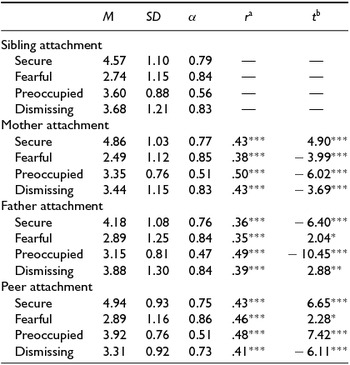
Trent Relationship Scales Questionnaire (TRSQ; Scharfe, unpublished manuscript). The TRSQ is a 40-item continuous measure of attachment composed of short statements regarding the individual's feelings and behaviour towards others. Participants completed four separate questionnaires to assess their attachment representations with mother, father, target sibling and close friends. The TRSQ includes 17 items from Bartholomew's RSQ (see Griffin & Bartholomew, Reference Griffin and Bartholomew1994) and 23 new items developed by Scharfe (unpublished manuscript). Each of the four scales includes 10 items assessing secure, fearful, preoccupied and dismissing characteristics. Participants rated how well each item described themselves on a 7-point Likert scale (1 = not at all like me to 7 = very much like me). Alphas for the preoccupied scale were low (ranging from 0.47 to 0.56), while alphas for the secure, fearful, dismissing scales were moderate to high (αs ranging from 0.73 to 0.86). See Table 1.
Means, Standard Deviations, Reliabilities of Attachment Scores with Corresponding Associations and Mean Differences between Sibling, Parent and Peer Attachment

Note: n = 392; * p < .05; ** p < .01; *** p < .001; r a is the association between sibling attachment and the corresponding relationship; t b is the difference between sibling attachment and the corresponding relationship.
Adult Sibling Relationship Questionnaire (ASRQ; Stocker, Lanthier, & Furman, Reference Stocker, Lanthier and Furman1997). To assess warmth in the sibling relationships, we administered the warmth subscale of the ASRQ. Participants reported on behaviours and feelings of affection, acceptance and similarity towards their target sibling, as well as their perception of their target sibling's behaviours and feelings of affection, acceptance and similarity towards them. Participants rated each item on a 7-point Likert scale (1 = very little to 7 = very much). Warmth demonstrated high internal reliability (α = 0.94).
Romantic Partner Conflict Scale (RPCS; Zacchilli, Hendrick, & Hendrick, Reference Zacchilli, Hendrick and Hendrick2009). The RPCS is a self-report measure of individuals' responses to conflict in romantic relationships. All questions were reworded to assess sibling relationships, and participants were asked to think of a recent conflict issue they had with their sibling. The RPCS is comprised of six subscales: Compromise, Domination, Submission, Separation, Avoidance, and Interactional Reactivity. Compromise measured aspects of collaboration and negotiation; Domination measured an individual's desire to control or win an argument; Submission measured an individual's willingness to give in to their sibling's requests; Separation measured an intention to remove oneself from the conflict with the intention to continue it later on, and for the purposes of this article we have renamed it to a perhaps more appropriate label of ‘break in fighting’; Avoidance measured an individual's tendency to not engage in conflict; and Interactional Reactivity measured verbal aggression and volatility during conflict. Participants rated each item on a 5-point Likert scale (0 = strongly disagree to 4 = strongly agree). Internal reliabilities for the subscales were high (αs ranging from 0.69 to 0.95).
Ineffective Arguing Inventory (IAI; Kurdek, Reference Kurdek1994). The IAI is an eight-item self-report that was originally developed to assess how individuals handle disagreements and solve problems in romantic relationships. Previous researchers reworded the items to assess conflict with siblings and demonstrated high internal reliability (e.g., Tucker et al., Reference Tucker, McHale and Crouter2003), and this revised wording was used in the current study to measure how individuals handle disagreements and solve problems in sibling relationships. Participants were asked how they typically think about and respond to conflict with the target sibling and rated each item on a 5-point Likert scale (1 = disagree strongly to 5 = agree strongly). High scores on the IAI indicate higher levels of ineffective conflict strategies. The scale demonstrated high internal reliability (α = 0.91).
Measure of Cooperative, Competitive, and Individualistic Attitudes (CCIA; Johnson & Norem-Hebeisen, Reference Johnson and Norem-Hebeisen1979). The CCIA is a 22-item self-report measure of social interdependence. The scale was developed for use in an educational setting and was modified for this study to assess sibling relationships. For example, the question ‘I would rather work on school work alone than with other students’ was reworded to ‘I would rather work on projects alone than with my sibling’. The Cooperative subscale measured an individual's liking to cooperate and valuing cooperation with a sibling while the Competitive subscale measured liking to compete and valuing competitive learning. Individualistic Independence measured whether or not an individual likes to work alone and values individualistic learning. Participants were asked to respond to each question while thinking about their relationship with the target sibling using a 5-point Likert scale (1 = disagree strongly to 5 = agree strongly). Internal reliability for the subscales were high (αs ranged from 0.89 to 0.94).
The Cooperative/Competitive Strategy Scale (CCSS; Simmons, Wehner, Tucker, & King, Reference Simmons, Wehner, Tucker and King1988). The cooperative subscale of the CCSS measures motives towards achieving success using cooperative strategies. The scale was developed to address global success and was modified to address sibling relationships specifically. For example, the question ‘Joint effort is the best way to achieve success’ was reworded to ‘Joint effort is the best way to achieve success with my sibling’. Participants were asked to respond to each question while thinking about their relationship with the target sibling using a 5-point Likert scale (1 = disagree strongly to 5 = agree strongly) and the reliability was high (α = 0.85).
Results
Data were first analysed to explore whether sibling characteristics were associated with attachment. Results indicated that number or age of siblings was not significantly associated with attachment to siblings. We also examined the data to explore whether attachment was associated with how often siblings contacted each other and whether they saw each other in person (as compared to sending a text or talking on the phone). Correlations revealed positive, albeit small, associations between spending time together in person and secure sibling attachment (r = .18, p < .001) and negative associations between in-person contact and fearful and dismissing attachment (r = −.15, p < .01 and r = −.21, p < .001, respectively). One-way ANOVAs were calculated to examine differences in attachment between siblings who had face-to-face contact, contact but not in person, or had no contact over the last week. Results indicated that individuals who had some contact with their sibling reported higher security (F = 16.37, p < .001), lower fearful (F = 13.72, p < .001), and lower dismissing scores (F = 15.58, p < .001).
To test the hypothesis that individuals experience greater closeness with sisters as compared to brothers, we conducted a series of t tests comparing the scores on the scales for participants whose target sibling was a sister or a brother. Hypothesis 1 was supported: Individuals who reported on their sister indicated higher secure scores (M = 4.73, SD = 1.05 vs. M = 4.42, SD = 1.14), t(388) = −2.81, p < .01, and higher preoccupied scores (M = 3.70, SD = 0.85 vs. M = 3.51, SD = 0.91), t(388) = −2.11, p < .05, as well as increased warmth (M = 4.70, SD = 1.24 vs. M = 4.31, SD = 1.40), t(388) = −2.91, p < .01, and ‘break in fighting’ (M = 1.99, SD = 0.76 vs. M = 1.79, SD = 0.95), t(388) = −2.22, p < .05. We also examined differences between sibling attachment and participant and sibling gender. One-way ANOVAs revealed that female participants with female siblings had greater secure scores (F = 3.25, p < .05) than female participants with male siblings, and greater preoccupied scores (F = 3.41, p < .05) than male participants with male siblings.
Correspondence Between Attachment Measures
To test the hypothesis that there would be correspondence in reports, attachment to siblings was compared to attachment to parents and peers. See Table 1 for correlations and t tests between the corresponding sibling and other attachment scales. Mother, father and peer attachment were all positively associated with each corresponding sibling attachment scale, with rs ranging from .35 to .50, thus providing support for Hypothesis 2. When mother and sibling attachment means were compared, mother security was greater than sibling security and correspondingly insecure attachment means were greater for siblings. Although results were significant, which is not surprising given the large sample size, all mean differences were less than half of one standard deviation. When sibling and father attachment was compared, we found similar patterns. Means for father fearful and dismissing were greater than the corresponding sibling scales, and sibling security and preoccupied were greater than the corresponding father scales. Scores for peer secure, fearful, and preoccupied were greater than the corresponding sibling scales, while the sibling dismissing scale was greater than the peer dismissing scale. Once again, all mean differences were less than one standard deviation.
Sibling Attachment, Conflict, and Cooperation
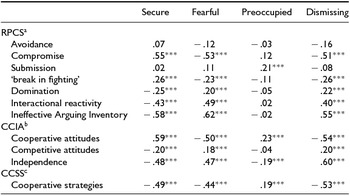
Correlations between sibling attachment and conflict and cooperation scales are presented in Table 2. The sample size was sufficient to detect at least a medium effect at p < .01 (see Cohen, Reference Cohen1992). The corrected p value controlling for the number of tests is .0011 and therefore only correlations that were significant at p < .001 will be reported. In support of Hypothesis 3, security was positively associated with compromise, ‘break in fighting’ and CCIA-cooperative attitudes, and negatively associated with domination, interactional reactivity, ineffective arguing, competitive attitudes, independence and CCSS-cooperative strategies. As expected, fearful attachment was negatively associated with compromise, ‘break in fighting’, CCIA-cooperative attitudes and CCSS-cooperative strategies, and positively associated with domination, interactional reactivity, ineffective arguing, competitive attitudes and independence. Furthermore, preoccupied was positively associated with submission, CCIA-cooperative attitudes and CCSS-cooperative strategies, and negatively associated with independence. Finally, dismissing attachment was negatively associated with compromise, ‘break in fighting’, CCIA-cooperative attitudes and CCSS-cooperative strategies, and positively associated with domination, interactional reactivity, ineffective arguing, competitive attitudes and independence.
Correlations Among Sibling Attachment and Sibling Conflict and Cooperation

Note: n = 392. The corrected p value controlling for the number of tests is 0.0011 and therefore only correlations that were significant at p < .001 will be reported. aRomantic Partner Conflict Scale; bMeasure of Cooperative, Competitive, and Individualistic Attitudes; cThe Cooperative/Competitive Strategy Scale.
***p < .001
Clearly, these findings demonstrate that attachment to siblings is predictably associated with conflict and cooperation. However, in this sample, there were medium to large associations between ASRQ-warmth and attachment (secure = 0.80, fearful = −0.64, preoccupied = 0.28, dismissing = −0.69), as well as medium to large associations with sibling attachment and the parent and peer attachment scales. Therefore, we concluded that it was necessary to further explore the associations with conflict and cooperation while controlling for warmth and other attachment relationships.
Regression Analyses
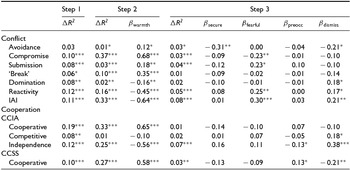
To determine the simultaneous effect of the four sibling attachment scales on conflict and cooperation with siblings, a set of 11 hierarchical regressions were calculated. To control for other attachment relationships and sibling relationship quality, mother, father and peer attachment were entered at Step 1 of the regression and warmth was entered at Step 2. To test the unique effect of sibling attachment, these scales were entered at Step 3. Therefore, Step 3 tested the unique effect of sibling attachment on conflict and cooperation, controlling for attachment to mothers, fathers and close friends, as well as the reported warmth in the sibling relationship. Each regression was calculated with the respective conflict and cooperation scale as the dependent/predictor variable. The ΔR2 and β values for each regression are presented in Table 3. Attachment to parents and peers significantly predicted each of the conflict and cooperation variables except avoidance (see Step 1). After controlling for other attachment relationships, warmth in that sibling relationship was a significant predictor of each of the variables except competitive attitudes (see Step 2). After controlling for other relationships and warmth, sibling attachment significantly predicted additional variance for avoidance, compromise, submission, interactional reactivity, ineffective arguing, independence and CCSS-cooperative strategies (see Step 3), providing support for Hypothesis 4. Fearful and dismissing attachment were significant predictors — individuals who reported high fearful attachment with their sibling reported low compromise, high submission, high reactivity and high ineffective arguing. Individuals who reported high dismissing attachment reported low avoidance, high domination, high interactional reactivity, high ineffective arguing, high independence and low levels of CCSS-cooperative strategies. In summary, the regression results suggest that sibling attachment — in particular, sibling fearful and dismissing attachment — uniquely predict conflict and cooperation among siblings.
Summary of Hierarchical Regression Analyses Predicting Conflict and Cooperation from Other Attachment, Sibling Warmth and Sibling Attachment

Note: n = 392; Step 1 includes each of the four attachment scales from mother, father, and close friend — significant βs are reported in the text and all are available upon request. preocc = preoccupied; dismiss = dismissing; ‘Break’ = Separation subscale from the RPCS; IAI = Ineffective Arguing Inventory.
*p ≤ .05, **p ≤ .01, ***p ≤ .001.
Discussion
Previous research has examined sibling relationship quality but, to our knowledge, this study is among the first to assess sibling attachment in emerging adulthood. The findings simultaneously highlight the uniqueness of the sibling relationship and contribute important knowledge to the field of attachment, specifically providing some support for the role of siblings as attachment figures. Results were consistent with previous research in that, overall, relationships with siblings were positive (Sherman, Lansford, & Volling, Reference Sherman, Lansford and Volling2006). This sample was predominantly secure and there were some indications that relationships with sisters were warmer and more secure. This study demonstrated that just as participants are able to report on their attachment to parents, peers and romantic partners, attachment to adult siblings could also be reliably measured. Past research has demonstrated that individuals have similar working models of attachment with parents, peers and partners (e.g., Doyle et al., Reference Doyle, Lawford and Markiewicz2009), and the current study extended these results to demonstrate correspondence between attachment to siblings and their reported attachment with mothers, fathers and peers.
To examine the unique effect of sibling attachment on sibling conflict and cooperation, other attachment relationships (e.g., mother, father and peer) and sibling warmth were taken into consideration and controlled for in the regression calculations. Other attachment relationships and warmth were both shown to predict nearly every conflict and cooperation variable. However, results indicated that even after controlling for the powerful effects of attachment to others and sibling warmth, sibling attachment remained a significant predictor of conflict and cooperation. These findings suggest that an individual's specific attachment to their sibling predicts the unique way they think about and react to conflict in that relationship, irrespective of their attachment to others or the amount of warmth between siblings. In particular, fearful and dismissing sibling attachment significantly predicted sibling conflict. Fearful individuals maintain a negative other-view, which results in maintaining greater physical distance in close relationships and dissuades an individual from seeking help from others (e.g., Bartholomew & Horowitz, Reference Bartholomew and Horowitz1991; Millings & Walsh, Reference Millings and Walsh2009). Fearful attachment to siblings predicted positive associations with submission and negative associations with compromise, which replicates Bartholomew and Horowitz's (Reference Bartholomew and Horowitz1991) findings that fearful individuals have a low level of involvement and a tendency to be subservient in close relationships. The positive associations between fearful and interactional reactivity and ineffective arguing is also in line with previous research — as fearful attachment is characterised by increased interpersonal problems (Bartholomew & Horowitz, Reference Bartholomew and Horowitz1991), it is not surprising that fearful individuals tend to react inappropriately to conflict with siblings.
While fearful and dismissing individuals share the negative other-view, dismissing individuals also have a positive self-model and tend to be characterised as cold and overly independent (Bartholomew & Horowitz, Reference Bartholomew and Horowitz1991). Therefore, it was not surprising that, even after controlling for parental and peer attachment as well as reported warmth in the sibling relationship, dismissing sibling attachment predicted positive associations with domination, interactional reactivity and ineffective arguing. In addition, dismissing predicted negative associations with cooperative strategies — indicating that they are less likely to be motivated to cooperate — and positive associations with both individualistic independence and competitive attitudes with siblings.
Siblings play an important role in each other's lives, whether as allies or enemies, and the sibling relationship is unique due to its involuntary nature across the lifespan. The way that siblings deal with conflict is likely different from how conflict is managed in other relationships, such as those with peers and romantic partners. In non-familial relationships, individuals may experience a decrease in willingness to cooperate as it is easier to end a friendship or romantic relationship than to end a sibling relationship. Perceptions of conflict and cooperation across relationships may also differ as previous research has shown that individuals tend to idealise their relationships with romantic partners (Barelds, Dijkstra, Koudenburg, & Swami, Reference Barelds, Dijkstra, Koudenburg and Swami2011); however, this idealisation may not occur with one's sibling.
Limitations and Future Directions
There are several limitations to the current study. As expected in a population of undergraduate students, the majority of participants in this sample were female. Although the siblings reported on were equally male and female, gender differences only emerged for separation (‘break in fighting’), where individuals with sisters were more likely to separate themselves from conflict with the intent to resolve it later than individuals with brothers. A more equal distribution of male and female participants would allow future researchers to further examine gender differences between sibling dyads of the same and opposite genders.
In addition, participants in this study were recruited from a North American university and most were Caucasian. Research has shown that siblings in non-industrialised societies often foster different and closer relationships (Cicirelli, Reference Cicirelli1994). For instance, in Melanesian, Samoan and South Asian cultures, older siblings are expected to provide substantial care to younger siblings (e.g., Ochs, Reference Ochs1982; Seymour, Reference Seymour1993; Watson-Gegeo & Gegeo, Reference Watson-Gegeo, Gegeo and Zukow1989). Researchers would do well to replicate this study with ethnically and culturally diverse samples. For example, a group of individuals who do not conform to Western ideals and traditions would shed light on the influence of culture on attachment, conflict, and cooperation with siblings.
An additional constraint of the current study was the use of measures developed and standardised with populations different from those examined in this study (e.g., romantic partners and classmates), although we note that the reliability of these conflict and cooperation measures were quite high and the associations with attachment were consistent with those reported in studies with romantic partners. The development of instruments specifically to assess sibling relationships, however, would greatly benefit the field and provide a deeper understanding of the nuanced ways that siblings relate to one another. It must also be noted that the number of measures assessing cooperation is extremely limited in the literature. While research about the dark side of relationships, including conflict, is well studied, there is a need to better understand how individuals cooperate in relationships, and we look forward to the research exploring that more positive side of relationships.
This study provides the field of intimate relationships with deeper knowledge of sibling relationships in adulthood, yet it also presents many avenues for future researchers to expand upon the findings. The first constraint to be addressed is the large number of participants who reported that they had not seen or contacted their sibling over the past week. This may have been due to the fact that many participants were living away from their families while attending university and therefore did not have the opportunity to spend time together. Furthermore, to limit reporting bias, participants were only asked about the sibling closest in age, so it is possible that participants were in greater contact with siblings other than the one they reported on. Future research is needed to explore the different combinations of sibling relationships, including gender and age effects, birth order, as well as closeness and contact between siblings.
Second, as with all close personal relationships, the relationship between two siblings is dyadic and requires the input and participation of both individuals. While this study is an important first step in examining sibling relationships in adulthood, future researchers would benefit from gathering data from sibling dyads and, in larger families, data from groups of siblings to gain a more complete picture of sibling relationships. Since an individual's attachment style is proposed to be the result of a caregiver's responsiveness, siblings with concordant or discordant attachment styles may yield different results and provide more depth to sibling attachment research. In addition, given that attachment is such a strong predictor of an individual's behaviours in times of stress, gaining reports from parents about the interactions and behaviours they observe between siblings during conflict may serve to validate sibling self-reports.
Finally, researchers should consider that the sample in this study was comprised of undergraduate students who mostly encompassed a narrow age range in early adulthood. To better understand relationships across the lifespan, future research targeting expanded age groups would be beneficial. Buhrmester and Furman (Reference Buhrmester and Furman1990) found that as siblings aged, the intensity of the sibling relationship decreased. Therefore, research with adolescents could act as a ‘baseline’ before the formative life changes of emerging adulthood take place, particularly as it pertains to conflict and cooperation. Emerging adulthood is a time of change and a sample of young adults dealing with, for example, the transition to — or from — university may provide more information about how siblings rely on one another in times of stress. Additionally, research with older adults could shed light on how siblings can support each other during the transition to parenthood, when elderly parents need care, or after parents have passed away. While research on siblings in childhood has provided a wealth of knowledge, there is a pronounced need to explore these relationships across the lifespan.