Research context
Composing has been a statutory part of a general music education in England since its inclusion to the National Curriculum for Music in 1988, meaning all young people up to the age of 14 in state education should experience composing. Following this, students may voluntarily choose to study music to gain a qualification, such as GCSE or BTEC in key stage 4 (ages 14–16), and AS and A-level in key stage 5 (ages 16–18) if the school provides the course. Although composing is often an assessed and significant part of these music examinations and is a growing field of research (Mellor, Reference MELLOR2008), classroom composing is still an under-researched area (Savage and Fautley, Reference SAVAGE and FAUTLEY2011), especially within upper secondary school music classrooms (Devaney, Reference DEVANEY2018), and is said to be the least understood area of music education (Sloboda, Reference SLOBODA1986; Winters, Reference WINTERS2012).
This exploratory research looks at the teaching and learning of composing at key stages 4 and 5 through the experiences of classroom music teachers, their students, and five prominent composer-educators who have worked in diverse educational settings. The data highlights how certain pedagogic practices have become dominant in the classroom and why it was felt that composing in the classroom does not reflect the current creative practices of living composers. The research discusses if and how the examination requirements, or the interpretation of the requirements, influence teaching and learning and may result in a potential bias towards students composing in ways associated with western classical idioms, for example, promoting the use of western classical staff notation and using western classical harmony and structural norms.
Challenges of teaching composing in the classroom
During the 1960s and 1970s in England, there was a considerable drive towards promoting creative music-making practices in the classroom (Mills, Reference MILLS2005). Composer-educators such as John Paynter, Brian Dennis and Murray Schafer promoted the idea that composing was not just confined to “the Mozarts of this world” (Spruce, Reference SPRUCE1996: 26), but instead was something everybody had the capacity to do. Although the introduction of composing into the National Curriculum for Music was heralded as: “one of the most significant developments in the history of UK music education” (Mills, Reference MILLS2005: 36) it also had “a rocky start” (p. 37).
Due to large numbers of music teachers coming from western classical performance backgrounds (Odam, Reference ODAM2000; Sheridan & Byrne, Reference SHERIDAN and BYRNE2002; Barrett, Reference BARRETT2006), many believed they lacked the necessary skills, confidence and experience to be able to teach composing (Rainbow, Reference RAINBOW and Spruce1996; NAME, 2000; Cox, Reference COX, Philpott and Plummeridge2001; Sheridan and Byrne, Reference SHERIDAN and BYRNE2002; Webster, Reference WEBSTER2003; Mills, Reference MILLS2005; Laycock, Reference LAYCOCK2005; Francis, Reference FRANCIS2012; Lewis, Reference LEWIS2012; Hickey, Reference HICKEY2012; Winters, Reference WINTERS2012). Although we have seen an increase in studies investigating composing processes (Mellor, Reference MELLOR2008), ranging from student and novice composers (Loane, Reference LOANE1984; Bunting, Reference BUNTING1988; Kratus, Reference KRATUS1989; Kennedy, Reference KENNEDY1999; Bamberger, Reference BAMBERGER2003; Fautley, Reference FAUTLEY2005; Burnard and Younker, Reference BURNARD and YOUNKER2004), to exploring the practices of professional composers (Bennett, Reference BENNETT1976; Sloboda, Reference SLOBODA1986; Collins, Reference COLLINS2005; Biasutti, Reference BIASUTTI2012), the National Association of Music Educators discovered that many teachers felt “unclear about the composing process” (2000: 8), thus highlighting a potential gap between research and practice.
It has been argued that the 1-year teacher-training courses in England do not fully prepare teachers for teaching all areas of the curriculum (Odam, Reference ODAM2000), in addition to the shortage of composing teaching resources (Mills, Reference MILLS2005; Francis, Reference FRANCIS2012; Hickey, Reference HICKEY2012). As a result, teachers have found ways of teaching composing to ensure their students pass their high-stakes examinations (Devaney, Reference DEVANEY2018). Francis (Reference FRANCIS2012) discovered that many music teachers rely on the resources published by examination boards:
Many teachers have very little personal experience of composing outside the examination system. It is easy to imagine that the existent scheme of work, the demands of the final assessment and the various books designed to help the busy teacher can become enormously influential in the conception of what composition is in school. Perhaps this is not a problem but this system does not appear to produce many people that choose to compose regularly (p. 164).
Similarly, Savage and Fautley (Reference SAVAGE and FAUTLEY2011) used the term “examination composing” (Savage and Fautley, Reference SAVAGE and FAUTLEY2011: 149) to describe this practice of composing and composing teaching.
Music teachers face a range of challenges to the successful inclusion of composing into the classroom, especially if they have not had much experience with composing themselves. Due to the culture and “busyness” of schools (Savage, Reference SAVAGE2007), as well as limited time during teacher training, and the pressures teachers face from schools to ensure students pass national examinations, there is often very little time or space for teachers to reflect “in and on action” (Schön, Reference SCHÖN1983). This can result in some teachers being were unaware of their own biases or assumptions, leading to what Mills (Reference MILLS2005) referred to as “bizarre” (p. 38) practices of composing teaching emerging.
Perceptions of the composer
Pedagogy can be driven by a teacher’s beliefs, tastes and experiences (Jenkins, Reference JENKINS1992; Soderman, Burnard & Trulsson, Reference SODERMAN, BURNARD and TRULSSON2015), therefore how they teach composing will be influenced to some extent by their own past encounters and perceptions about composers and teaching methods. Therefore, it is important to critically reflect on how composers are portrayed in society and in the media.
Although much education research and policy has promoted the universality of creativity (Craft, Reference CRAFT1997, Reference CRAFT2000, Reference CRAFT, Craft, Jeffrey and Leibling2001, Reference CRAFT2006; NACCCE, 1999; Eisner, Reference EISNER2005), Weisberg (Reference WEISBERG2010) found that the concept of the “creative genius” is still a prevalent belief within the field of music:
Musical creativity remains deeply linked to the idea of individual heroism, of the Great Composers’ individual genius. Historically, composers are described as mystical, elusive… (Burnard, Reference BURNARD2012a: 8)
The perpetuation of high art orthodoxies of Western art music continues to valorize the myth of the Great Composers and with it, the nineteenth-century Romantic-era belief that only child prodigies commit themselves to, and foster a capacity for, music creation (Burnard, Reference BURNARD2012a: 278).
Researchers highlighted how composing ability is often believed to be “exclusively confined to the exceptionally talented” (Spruce, Reference SPRUCE1996: 26) and viewed as “a specialist skill that only an elite few do” (Hickey, Reference HICKEY2012: pp. 11–12). As a result, myths about composers can emerge from “archaic traditionalist beliefs” (Burnard, Reference BURNARD2012a: 9) that are reinforced by stories about the “star players” (Thomson, Reference THOMSON and Grenfell2008: 69), such as Beethoven and Mozart (Kivy, Reference KIVY2001). These stories are often believed to be “inherently true” (Webb, Schirato and Danaher, Reference WEBB, SCHIRATO and DANAHER2002: 321), thus go unchallenged.
These narratives of the “great composer” and “genius composer” can be found throughout education policy documents and promoted by government ministers, for example the Conservative Secretary of State for Education (2010–2014) Michael Gove proclaimed:
Richard Wagner is an artist of sublime genius and his work is incomparably more rewarding – intellectually, sensually and emotionally – than, say, the Arctic Monkeys (Gove, Reference GOVE2011).
This perspective of the composer as gifted and somehow different from everyone else has been challenged with researchers highlighting how it obscures the real working practices of composers (Green, Reference GREEN1997; Lamont and Maton, Reference LAMONT, MATON and Wright2010). However, they still remain present in the media as well as within the National Curriculum (2013) and more recently the Model Music Curriculum (2021), thus perpetuating potentially damaging beliefs that composers must have natural musical talent.
Linked to this, is the view of the composer as the “heroic individual” (Burnard, Reference BURNARD and Collins2012b: 114) creating music in isolation. Education researchers have called for increased awareness into the benefits of collaborative creativity (Lucas, Reference LUCAS, Craft, Jeffrey and Leibling2001) and argue that this highly individualistic view of composing promotes a westernised “cultural belief system” (Oral, Reference ORAL, Craft, Cremin and Burnard2008: 5) which can result in the marginalisation of other forms of musical creativity (Steiner, Reference STEINER2009; Burnard, Reference BURNARD2012a). However, this romanticised nineteenth century view of the ivory tower composer has been slowly changing towards a more “socially conscious” composer whose “role is to stimulate musical creativity in others” (Laycock, Reference LAYCOCK2005: 25). Although many composers still compose individually, the creative process often has some aspect of collaboration, for example, working with the musicians they are composing for. But for other musicians and composers group and collaborative composing is essential to their practice, especially within non-western and popular music traditions (Green, Reference GREEN2002; Thorpe, Reference THORPE2012).
Although group composing practises are commonplace in the key stage 3 classroom (Glover, Reference GLOVER2000; Savage and Fautley, Reference SAVAGE and FAUTLEY2011), they are prohibited at KS4 and KS5 raising the question as to why only individual composing is allowed. At key stages 4 and 5, only the final composition (submitted as a score and recording) is marked meaning that if it were collaboratively composed, it would not be possible to accurately identify who was responsible for what part of the music. A key debate in arts education is whether the final product or the process should be assessed (Spruce, Reference SPRUCE1996; Eisner, Reference EISNER2002, Reference EISNER2005; Savage and Fautley, Reference SAVAGE and FAUTLEY2011). Assessment of an artefact or final product is often perceived as “easier to measure” (Savage and Fautley, Reference SAVAGE and FAUTLEY2011: 147) hence why it has dominated assessment practices. Allowing group composing would rely more on regular formative teacher assessment of the creative process in order to attribute the work to the different students. Although this may be a more complex assessment process, there is evidence of this taking place successfully, with education reforms in New Zealand now allowing group and collaborative composing. Therefore, assessment of the process of composing is viewed by examination boards as just as important as the final product (e.g. a score and/or recording), thus ensuring a more inclusive approach to assessment that acknowledges the cultural, social and historical heritages within the collaborative music making of indigenous peoples (Thorpe, Reference THORPE2012).
How do composers learn
Although we have already identified that there is a commonly held belief that composers have inherent musical talent, it became apparent that people also hold particular views about how composers progress and learn. The traditional method of composition teaching that Lupton and Bruce (Reference LUPTON and BRUCE2010) called a “time-honoured approach” (p. 274) is that of master-apprentice, whereby students learn their craft from experienced composers. In this practice, learning takes places through imitating other composers’ styles (sometimes referred to as pastiche composing) and learning the rules of music theory before being creative and developing their own compositional style.
The relationship between creativity and skills is hotly debated and is especially relevant in the current English education system due to the governmental move towards delivering a “knowledge-based curriculum” (Gibb, Reference GIBB2017) in schools. Some argue that a person cannot be creative until they have “mastered” a specific domain (Gardner, Reference GARDNER2006: 67), alluding to the idea that you can not break the rules without first knowing what the rules are: “learning to follow the rules must always come first” (Boden, Reference BODEN, Craft, Jeffrey and Leibling2001: 100). This fixation on teaching skills and rules is not unique to composing and can be found within other creative-based subjects such as creative writing (Grainger, Goouch, and Lambirth, Reference GRAINGER, GOOUCH and LAMBIRTH2005).
This approach to learning has been critiqued within the arts and seems to go against much research that seeks to encourage creativity play in young people (James et al., Reference JAMES, HOUSTON and NEWTON2019) whereby children learn through experience. With this focus on learning specific technical skills, Colwell (Reference COLWELL2003) warned that teachers can end up concentrating on teaching what is easily taught and assessed, for example music theory and pastiche composing, rather than fostering more general abilities such as self-expression and creativity. Fautley (Reference FAUTLEY2010) and Devaney (Reference DEVANEY2018) discuss this at length arguing that in the crusade to raise reliability in national examinations, vital aspects of the creative process have being ignored. Consequently, researchers have cautioned against the teaching of composing as “discrete” and separate skills (Lupton and Bruce, Reference LUPTON and BRUCE2010: 274), as this can result in learning becoming “fragmented” (Spruce,Reference SPRUCE1996: 175), as well as hindering and distorting the creative process (Aspin, Reference ASPIN and Ross1986). It is also important to ask who is determining what the rules of composing are, and what the social, cultural and historical norms they are based on.
The literature discussed above raises a number of complex pedagogical debates around the teaching and learning of composing but also highlights a lack of research, resources and training for teachers. As a result, pedagogical approaches to composing can be directed by assumptions and sometimes misunderstandings about composers (Winters, Reference WINTERS2012), leading to what Burnard (Reference BURNARD and Collins2012b) calls “myths” which she defines as stories about “how things came to be and therefore how they are” (p.112). This highlights how ideological beliefs about composers, which are often rooted in the western classical idiom, can influence teaching, learning and assessment practices.
Research methods
This exploratory research drew from interpretivist and constructivist research methodologies using a mixed methodology approach through case study and survey research. Taking a case study approach allowed for a combination of detailed, context-specific and in-depth data (Yin, Reference YIN2009) from within a natural setting (Punch, Reference PUNCH2009) that captured wider socio-cultural and historical influences (Stake, Reference STAKE1995). The survey captured a broader range of data from a wide and more diverse participant group with experiences from across different education settings. This allowed for investigation into the extent of the issues and to observe the “bigger picture” (Denscombe, Reference DENSCOMBE2010: 141) concerning composing in the classroom. The research adhered to the British Educational Research Association “Ethical Guidelines for Educational Research” (2011 and 2018), and gained ethical approval from the university’s ethics committee. Confidentiality of the participants was adhered to throughout and participants’ identities were anonymised. Participation was voluntary and informed consent was ongoing through the research process.
Data collection
In order to investigate how participants interpret their lived experience and “make sense of their worlds” (Denscombe, Reference DENSCOMBE2010: 96), data were collected from “the point of view of those who live it” (Schwandt, Reference SCHWANDT, Denzin and Lincoln1994: 118). The research took a multi-phased approach: (1) A nation-wide survey of key stage 4 and 5 music teachers, (2) 19 follow-up telephone interviews, (3) five case study schools, and (4) interviews with five composer-educators.
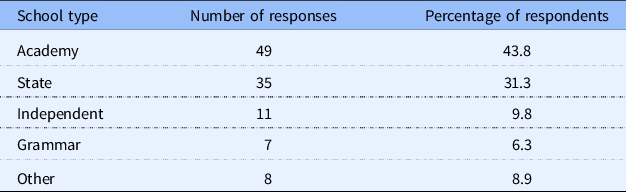
The two online surveys were divided into key stage 4 and key stage 5 and collected both qualitative and quantitative data from a total of 182 secondary music teachers (111 responses for the key stage 4 survey and 71 responses for key stage 5). Information collected from the key stage 4Footnote 1 survey indicated participants came from a range of different school types (see Table 1), with the majority offering GCSE music, and 21 respondents offering BTEC.
School types represented in the key stage 4 survey

Telephone interviews were conducted with 19 participants who had self-selected to take part in a follow-up interview after completing the survey. These participants were shortlisted through a purposive maximal sampling approach by analysing their responses to the survey questions and their school type, allowing for a wide variety of perspectives and experiences. These included eleven state and academy schools, three independent schools, two grammar schools, and one sixth form collegeFootnote 2 , across six different regions in England.
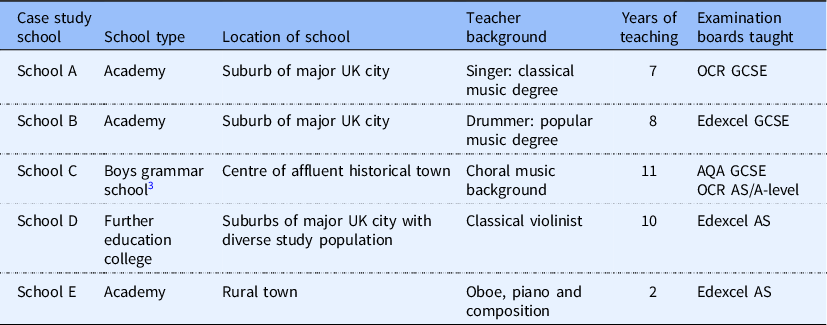
Five case study schools were selected within the West Midlands (UK) area (see Table 2).
Overview of case studies

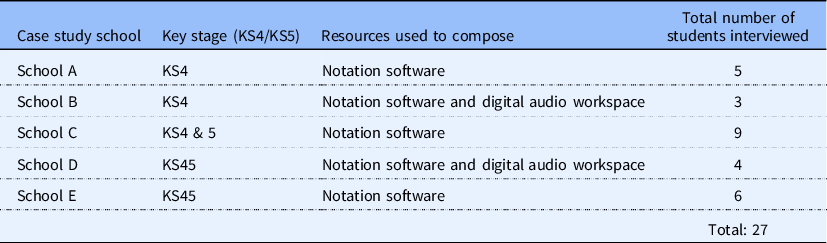
Classroom observations, semi-structured interviews with music teachers and focus group interviews with students were conducted across the five settings, allowing for “perspectives, attitudes, beliefs, views and opinions” (Punch, Reference PUNCH2009: 46) to be heard. The “information rich” (Patton, Reference PATTON2015: 264) case studies allowed for shared behaviours and issues between the sites to be investigated (Creswell, Reference CRESWELL2013: 76), as well as any differences or conflicts. The focus group interviews with students aimed to feel more ‘naturalistic’ than one-to-one interviews (Wilkinson, Reference WILKINSON and Silverman2004: 180), allowing for normative behaviours and discussions (Bloor et al., Reference BLOOR, FRANKLAND, THOMAS and ROBSON2001). In total, 27 students were interviewed as part of the research to share their experiences of composing at examination level (see Table 3).
Details of focus groups

This group of students represented different composing approaches, for example some used notation software to compose such as Sibelius, whereas others used a digital audio workspace such as LogicPro or GarageBand.
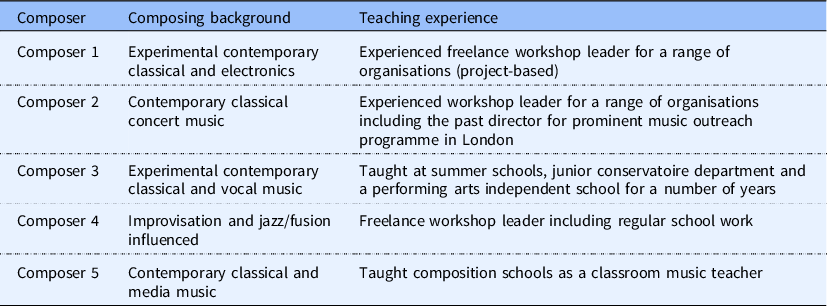
The final group of participants in the study offering a different set of perspectives were the five composer-educators. Although these participants primarily identified as composers, they had at least 5 years teaching experience in a variety of educational settings (see Table 4). These participants were identified through the networks within university research team.
Composer-educators

Data analysis
Due to the limited theoretical research in the area of composing pedagogies in upper secondary school, aspects of grounded theory were adapted and utilised throughout the research process. Developed by Glaser and Strauss (Reference GLASER and STRAUSS1967), grounded theory methodology has been contested due to its empiricism and positivist roots (Charmaz, Reference CHARMAZ2014). However, in this study, grounded theory was used as a general “research strategy” (Punch, Reference PUNCH2014: 132) and a way to generate theory that was “grounded in data” (Punch Reference PUNCH2009: 130). All interviews were audio-recorded and transcribed verbatim. Data were analysed using a line-by-line, open coding approach, becoming more “abstract” (Punch, Reference PUNCH2014: 178) with each stage of the coding process. Thematic analysis, developed by Braun and Clarke (Reference BRAUN and CLARKE2014) was utilised as a way of “identifying, analysing and reporting patterns (themes) within data” (Braun and Clarke, Reference BRAUN and CLARKE2014: 6).
Data collection and analysis was iterative and ongoing (Cohen et al., Reference COHEN, MANION and MORRISON2007: 492), thus allowing for simultaneous collection of data and analysis (Denscombe, Reference DENSCOMBE2010). As part of this process, new lines of enquiry opened up, helping guide the literature review and analysis. A reflexive diary (Gough, Reference GOUGH, Finlay and Gough2003: 22) was kept creating a sort of ‘audit trail’ (Bryman, Reference BRYMAN2016: 392) of key decision-making points within the data collection and analysis.
At a later stage of the analysis process, the concept of Burnard’s (Reference BURNARD2012a) “myths about children’s music creativities” helped to frame the findings of this research and solidify the use of the term “myths” to describe them. Although there are similarities to some of Burnard’s (Reference BURNARD2012a) findings, this study specifically focuses on the myths that have influence upon composing pedagogy within the key stage 4 and 5 classroom.
Results
This study identified three prominent beliefs about composing practices that influenced teaching, learning and assessment in the key stage 4 and 5 classroom:
-
(1) The creative musical genius: composing ability is the result of inherent musical talent
-
(2) Composing as an individual process: the act of composing and musical creativity takes place mainly in isolation and without collaboration
-
(3) Rules before creativity: progression in composing involves learning about musical rules and music theory before students can be creative and develop their musical own voice
These are defined as myths because they are fundamentally rooted in the 19th century view of the composer that promote western classical musical ideologies (Spruce, Reference SPRUCE2013) and do not reflect the diversity of musical creativity of the composers of today. In some cases, these myths influenced not only what and how students composed but also what they believed composers to be. The three myths will be discussed in detail in relation to the data collected throughout the study.
The creative musical genius
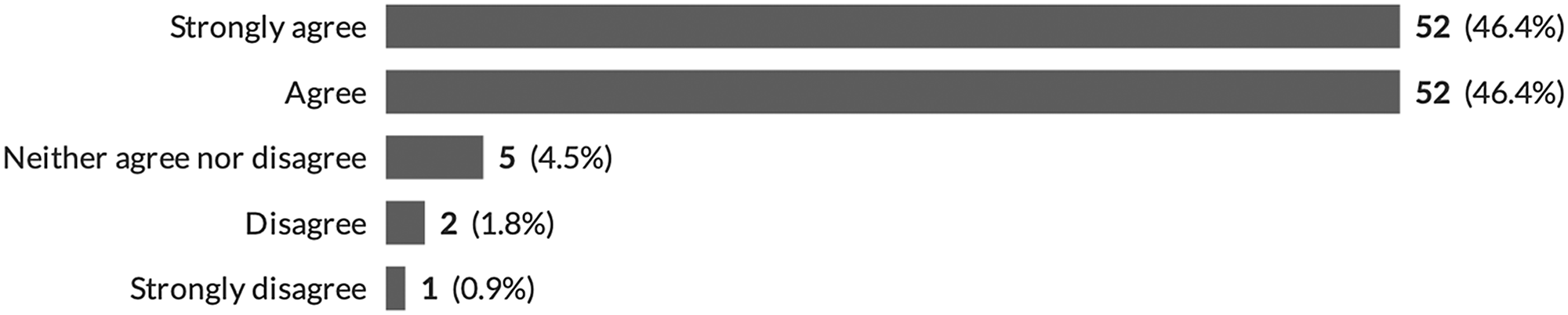
Data from this study suggests that the notion of the “creative musical genius” is still very much prevalent in schools. Many teachers and students believed that composing competence was somehow linked to natural ability. In a survey of 111 key stage 4 music teachers, 92.8% believed that some students showed a “natural aptitude” for composing (see Figure 1).
Key stage 4 teachers’ belief that some students possess a “natural aptitude” for composing.

Similar data emerged during the observations and interviews with teachers and students referring to those who were competent at composing as being a “musical genius” (student 1), having “flair” (teacher 1, 2), being “a natural” (student 2) or as one of “the lucky few” (teacher 3) that could compose. There seemed to be a polarised view that although some could compose, others could not:
-
Teacher 4: I think children always feel they can they can do it or they can’t do it
Interestingly, this led to some students debating if composing could be taught:
-
Student 3: I’m not sure if we’re meant to be taught
-
Student 4: I’m not sure how you would teach it
If students believe composing to be linked purely to natural talent, this may have a negative effect on their confidence and self-belief.
Very few students or teachers identified as a composer, saying:
-
Student 5: When you think of famous composers you think of Mozart, Beethoven. It’s more classical and baroque
-
Student 6: ...the famous composers are famous because it came naturally to them
There was a belief that composers composed large-scale “extravagant” (student 7) instrumental works, and not the sort of music they were creating:
-
Student 8: Composing is more like huge, like, ensembles and stuff
-
Student 9: You kind of link it to the massive composers that you’ve heard about that write like symphonies and all that
Instead students referred to terms such as ‘songwriter’ as more relevant and modern.
It was clear that the word “composing” held historical connotations that alluded to specific forms of composition. By continuing to associate the term only to famous western classical composers, this reinforced the ideas that becoming a composer was unobtainable for the majority of students.
Interestingly, the composer-educators in the study argued that the myth of the creative genius did not reflect real-world composing and downplayed important parts of the composing process, such as trial and error (composer 1). The “genius” narrative is also problematic as the term is often only attributed to white men, meaning that for most people “the creator of classical music is a dead white man wearing a wig” (Fuller, Reference FULLER and Copper1995: 22). Although there have been calls to include more female composers into the music exams specification (Khomami, Reference KHOMAMI2016), and to decolonise the curriculum especially since the resurgence of the Black Lives Matter movement in 2020, there continues to exist a distinct lack of role models for young women and girls, and people of colour who want to compose and create their own music.
Composing as an individual act
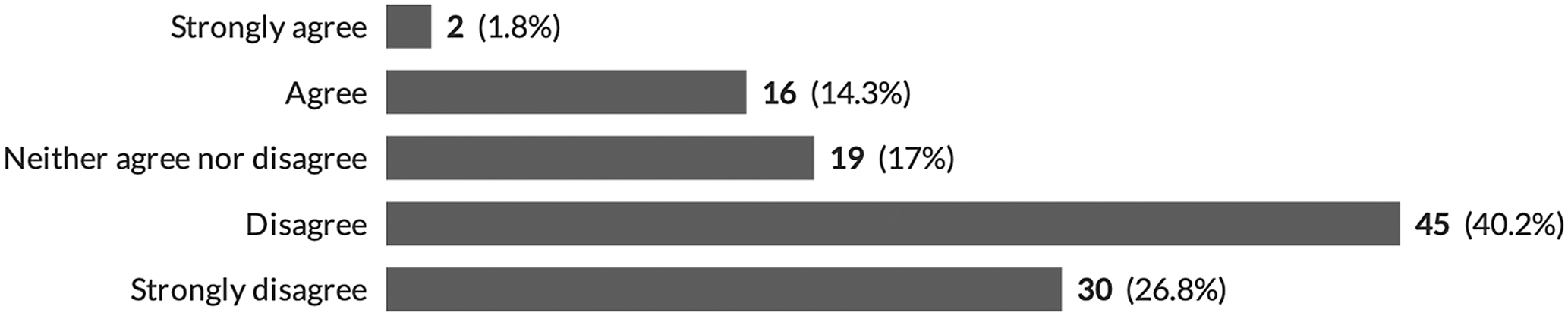
The second myth that emerged was the belief that composers compose music in isolation. Although the benefits and real-world application of group composing have been widely promoted, examination composing assessment regulations at key stages 4 and 5 prohibit group composing. As a result, dedicated time for students to compose in groups at key stage 4 was often very limited (see Figure 2).
Key stage 4 teachers’ response to the question “students work regularly in groups or with other students when composing at GCSE/BTEC”.

Knowing that time for teaching at key stage 4 is very limited, there is a danger that collaborative composing will be non-existent in some schools:
-
Teacher 5: It is hard to fit group work into lesson time when it is not easily correlated to the exam specification
-
Teacher 6: I would love to see more group work in composing at [key stage 4] but unfortunately there isn’t often enough time since they are not allowed to be assessed as a group for composing
It is clear that the high-stakes nature of the examinations and lack of time had an influence on the teachers’ decisions to prioritise independent composing over group composing.
Nevertheless, some teachers in the study expressed finding some time for group composing and the benefits of this:
-
Teacher 7: We encourage students to compose in groups at the start of the GCSE course to help them understand how to add numerous instruments to a composition
-
Teacher 8: I allow students to work in groups initially to learn harmony but then the actual compositions are done on their own
-
Teacher 9: Pupils work in groups at the start of the process to gather ideas and skills before working individually
-
Teacher 10: Often group work is better initially as it gives them the forum to discuss and try ideas out more. It is also ‘safer’ for my worried students.
But as can be seen from the quotes above, group composing was often only used as a tool to support students to become independent composers (Fautley, Reference FAUTLEY2005) rather than being valued as a practice in its own right.
Although many composers create music independently, there are also many who work collectively, collaboratively and interdisciplinary, for example, within popular music making practices (Green, Reference GREEN2002; Thorpe, Reference THORPE2012). The composer-educators in this study highlighted the importance of collaborative processes during their own composing process and some even argued that the notion of individual composing was an outdated and westernised view that only represented a small proportion of music being made in the world. Given that group and pair composing is often the main form of composing prior to key stage 4 (Glover, Reference GLOVER2000; Savage and Fautley, Reference SAVAGE and FAUTLEY2011), this sudden change in practice at key stage 4 to individual composing can cause a “code-shift” (Lamont and Maton, Reference LAMONT, MATON and Wright2010), leaving some students to feel like composing is “no longer for the likes of [them]” (p. 67). This means that students who are used to composing and creating music collaboratively (such as in a rock or pop band) are being forced to compose independently at key stages 4 and 5, leaving them at a disadvantage compared to students who are already experienced with and enjoy composing independently.
Rules before creativity
The third and final myth in this study that influenced teaching and learning was the belief that the “rules” of composition must be learnt before being creative. Music teachers in the study repeatedly purported the need for students to have a “foundation” or the “tools” of music theory and skills:
-
Teacher 11: I’m somebody who believes that you can’t be creative unless you’ve got the basic skills in the first place
-
Teacher 12: I’m a big believer in that you’ve got to have those skills to be successful
As can be viewed from language used the quotes above, this was often a strongly held belief that they felt passionately about. Elements such as “melody writing, functional harmony, modulation” (teacher 13), “theoretical understanding” (teacher 14) and “technical aspects” (teacher 15), were all listed as important for students to have in their composing “toolbox” before being given more freedom to be creative.
Linked to this was a sense that there was a correct order of teaching composing to students:
-
Teacher 16: If they haven’t got a theoretical understanding they are less successful…It’s skills development rather than the composition development…so we’ve already done it with year nine (key stage 3)
-
Teacher 17: [Key stage 3 students] respond better to direction at that age and I’m hoping…by the time you take GCSE they can then apply those rules in a more creative way
Teachers detailed how they adapted their key stage 3 (ages 11–14) curricula to reflect the requirements of GCSE, and even A-level composing, thus better preparing the students who opt to take music at key stages 4 or 5. However, knowing that only 5.95% of GCSE students in England studied music in 2017/18 (Daubney, Spruce, Annetts, Reference DAUBNEY, SPRUCE and ANNETTS2019: 15), and less than 1% (0.57%) of the total entries at A-level in 2015/16 were music (Whittaker et al., Reference WHITTAKER, FAUTLEY, KINSELLA and ANDERSON2019: 9) designing a key stage 3 curriculum to benefit such a small number of students is a concern. This high level of “washback” (Alderson and Wall, Reference ALDERSON and WALL1993), or “curriculum backwash” (Gipps and Stobart, Reference GIPPS and STOBART1993), demonstrates how influential these high-stakes examinations are to teaching and learning practices in the classroom (Alderson and Wall, Reference ALDERSON and WALL1993).
In contrast, the composer-educators in the study often valued students who were “curious”, had a “sense of uniqueness” (compose 1), who had “open ears and an open attitude” (composer 2) and could “think outside the box” (composer 3) over just technical understanding, thus highlighting potential discrepancy between what is deemed as important for emerging composers to learn:
-
Composer 4: An original voice…that’s much more interesting than somebody who is just technically adept and really good at writing symphonies just on Sibelius
Similarly, not all teachers were in agreement with the prioritising of technical ability within composing development:
-
Teacher 18: I think too many teachers are relying on the theoretical side of composition and not enough on the creative side
-
Teacher 19: I feel that creativity is sometimes stifled in favour of “ticking the right boxes”
Although many teachers in the study talked about the importance of creativity in composing, they often felt the examination system did not value creative approaches and shared stories of their more creative students doing poorly in the examination:
-
Teacher 20: Boring, formulaic compositions being moderated [marked] up and inventive ones down
-
Teacher 21: Simple, easy to understand compositions [did] best this year, while our most creative and able students had their marks brought down
-
Teacher 22: Sometimes very creative ideas aren’t recognised by the mark scheme
-
Teacher 23: ...it’s easy to get a “B” with “tick box” composing
-
Teacher 24: [Students] don’t actually have to be creative… they can get a high B, possibly an A, even if it’s the most boring piece ever
It was repeatedly noted how creative approaches to composition were deemed as “risky” in both key stage 4 and 5 assessments, whereas pieces that adhered to more formulaic processes with clear and predictable structures as well as western classical idioms were more reliable in the examination. Data from the study highlighted how receiving dramatically unexpected grades for compositions had significant negative impact on teachers’ confidence levels and many cases caused them to change or alter their teaching practice to align more closely to what they believed the examiners wanted to see. Knowing the high level of scrutiny many teachers are placed under by their schools to ensure cohorts achieve high grades, it is understandable why teachers would choose to prioritise what they believe the examination boards valued.
Concerning bias
The three myths outlined above all have roots in the western classical notion of the “composer”. This focus on western classical practices caused concern for some teachers who worried that there was a bias in the key stage 4 and 5 examination towards students who composed in conventional Western classical norms:
-
Teacher 25: Popular/Jazz styles scored lower than pastiche classical
-
Teacher 26: We have done popular songs in the past for the AS composition…but [they] scored very low, some students scoring E and U
Composing in styles linked to the western classical idiom were seen by a few teachers as being more reliable at securing predicted marks.
A similar debate emerged regarding the importance of western classical staff notation. Although many teachers wanted to encourage students to use a diverse range of notation, there was a concern, especially at key stage 5, that the examination boards preferred western classical staff notation:
-
Teacher 27: It worries me that some examiners will “look down on” other forms of notation
-
Teacher 28: I get quite stressed at the prospect of students who don’t have a score. For example, those who have used Cubase
-
Teacher 29: I am aware that there are restrictions on whether exam boards have the provision/resources available to mark work that is not notated in “western” musical notation…I would suggest that many music educators do encourage their students to work with standard “western” musical notation because it probably the “safest” musical option in compositions that are assessed by exam boards
Although this study was not able to investigate if the examination boards have an inherent bias towards western classical notation or musical styles, it was the belief from the teachers’ perspectives that they did. This created conflict in that teachers did not want to impose a cultural bias by ensuring the use of western classical styles or staff notation, but felt they needed to ensure their students’ had the best chance of securing high examination marks. These finding highlight the challenging circumstances music teachers face when teaching composing at key stages 4 and 5 in England.
Discussion
This study demonstrates how certain pedagogical practices in composing can continue to be reinforced and reproduced in the classroom. Although the composer-educators in the study highlighted different perspectives and even contested some of the myths discussed in this paper, it was apparent that many of these practices have gone relatively unchallenged and unchanged in schools for a number of potential reasons.
As raised in the literature, many music teachers’ potentially lack personal experience of composing. This is not helped by the general lack of composing pedagogy knowledge and research, or the lack of training and resources available for teachers that is not produced by the examination boards. Other barriers for music teachers are the high-stakes pressures of the current examination system. Data from this study found that many teachers felt unable to openly disputed or contest the current assessment system detailing high levels of accountability in schools as well as even sanctions (such as reducing wages and even loss of job) if grades dropped below expected standards. This is what Mansell (Reference MANSELL2007) refers to as “hyper accountability” (Mansell, Reference MANSELL2007: 14) whereby teachers “live and die” (ibid) by examination grades. As a result, it appeared that some teachers became complicit with the system that they felt was flawed and potentially biased:
-
Teacher 29: We do as we are told
-
Teacher 30: This is the realpolitik of the situation
-
Teacher 31: Unfortunately I am in a catch 22 situation
On top of this, teachers had to face unpredictability in the composing assessments. Therefore, if teachers received lower grades than expected, this could lower their confidence meaning they took fewer creative risks with their teaching in the future, leading to more teaching to the test. This, combined with limited curriculum time to cover all required assessed content, has made it difficult for teachers to justify teaching topics and skills outside of core exam specifications.
Finally, the ongoing glorification of western classical composers who are “put on a pedestal” (Hickey, Reference HICKEY2012) continue to reinforce a narrow narrative about how composers create music and learn to compose, leading to misleading expectations (Csikszentmihalyi, Reference CSIKSZENTMIHALYI1996) and misconceptions (Robinson, Reference ROBINSON2001) about the creative process. Burnard (Reference BURNARD2012a) encourages us to critically reflect on “who” is promoting “myths” in music, and what they seek to gain from this. Some argue that these myths serve an “outmoded and hierarchical value system” (p.13) which places western classical music at the “top” (Spruce, Reference SPRUCE2013), thus marginalising other musical and cultural practices (Webb, Schirato and Danaher, Reference WEBB, SCHIRATO and DANAHER2002; Yates and Millar, Reference YATES and MILLAR2016).
National examinations act as a powerful form of consecration (Grenfell and Hardy, Reference GRENFELL and HARDY2007; Soderman, Burnard and Trulsson, Reference SODERMAN, BURNARD and TRULSSON2015) influencing what and how a subject is taught in schools, as well as who goes on to continue in education, such as in higher education (Gipps and Murphy, Reference GIPPS and MURPHY1994). What is on the exam subconsciously informs students and teachers about what knowledge that is valued, and what is not. These practices may be viewed as a form of what Bourdieu refers to as “symbolic violence” whereby “social hierarchies and social inequality, as well as the suffering that they cause, are produced and maintained” (Schubert, Reference SCHUBERT and Grenfell2008: 183). In this case, the prioritising of western classical composing practises may lead to the continued disadvantage of certain students who have different cultural capital to what is deemed as high value in the examination (Sullivan, Reference SULLIVAN2002; Webb, Schirato and Danaher, Reference WEBB, SCHIRATO and DANAHER2002; Yates and Millar, Reference YATES and MILLAR2016), thus allowing the “dominant group” to remain “one step ahead” (Yates, Reference YATES, Whyte, Deem, Kant and Cruickshank1985: 212). Symbolic violence occurs when people misrecognise practices (Schubert, Reference SCHUBERT and Grenfell2008: 184), viewing them as the natural order to things (Webb, Schirato and Danaher, Reference WEBB, SCHIRATO and DANAHER2002). This means that they often become complicit in the continued discrimination (Grenfell and Hardy, Reference GRENFELL and HARDY2007). Grenfell and Hardy (Reference GRENFELL and HARDY2007) argue that myths, such as natural talent (Apple, Reference APPLE1997), play a role in legitimising privilege.
Final Remarks
The three myths outlined in this paper; the belief that only some people can become composers; the notion that being creative can only happen after students understand the “rules”; and the prohibition of group composing at examination level, all highlight how assumptions about composers, which are often rooted in 19th century perceptions of the western classical composer, continue to be promoted through teaching and assessment practices. By externalising these practices and labelling them as “myths”, it offers a way of reflecting on and critiquing current practice from a more objective standpoint rather than accepting them as inherently true. This paper opens up questions not just of what and how we should teach composing in schools, but also who is defining what knowledge and skills are valued. However, teachers often lack the space, time and support to engage in reflexivity (Savage, Reference SAVAGE2007). More needs to be done to support teachers and to bring together music educators, examination boards, policy-makers, education researchers and composers to reflect on composing teaching, learning and assessment in secondary schools. That way learning can be shared and disseminated between stakeholders to create a more joined-up approach.
There is still a lack of research into composing teaching and learning, especially at secondary level, therefore more research needs to be conducted that takes into account other diverse perspectives, for example, examination board and examiners’ experiences. This research also reinforces the influence that national examinations can have on the teaching and learning of a subject throughout the whole of a school curriculum. Other forms of composing assessment need to be considered by looking to other art forms and assessment approaches used in other countries such as New Zealand. In addition, having a greater diversity of composers and music-making practices in the curricula would allow more young people to have role models they identify with beyond the western classical norms.
Limitations of the Research
Readers should be aware of a number of limitations within the study. Firstly, there is a lack of equal female representation within the student focus group interviews: with 20 male and 7 female students. Explanation for this is that one setting was an all boys’ school and in another school the majority of the music students were male. Secondly, there is a lack of representation from examination boards. Although a small number of participants had been past examiners, the study did not collect a data from those involved in the assessment design or marking. Finally, since data were collected between 2014 and 2016, the GCSE and AS/A-level examinations have been reformed and the landscape of classroom music education has changed since.
Acknowledgments
I wish to acknowledge the generosity of the teachers, students and composers who took the time to partake in this study.