INTRODUCTION
New medical treatments, particularly in the context of incurable disease, are associated with ethical, clinical, legal, and social questions, especially with regard to the limits of medicine (Molloy, 1999). There is increasing agreement that prolongation of life might not always be an appropriate objective in itself and other considerations have to guide medical decision making at the end of life, such as the improvement of quality of life and the prevention and relief of suffering (Sepulveda et al., 2002; Van der Helde et al., 2003). Medical decision making for patients with life-threatening and incurable diseases therefore requires a balanced perception and integration of medical, ethical, psychosocial, and societal aspects.
Within this context the debate over euthanasia and assisted suicide has grown remarkably in the past years. Different surveys concerning these issues have been conducted in many countries with the aim to evaluate the attitudes of the public (Caddel & Newton, 1995; Bachman et al., 1996), physicians (Stevens & Hassan, 1994; Emanuel et al., 1996; Meier et al., 1998), nurses (Shuman et al., 1992; Asch, 1996), and patients (Graber et al., 1996; Groenewoud et al., 1997). Recent cases involving physicians who hastened their patients' death (Quill, 1991) and the fact that several countries such as the Netherlands, Belgium, and Australia (temporarily) and the state of Oregon in the United States have decriminalized direct active euthanasia (DAE) and/or physician assisted suicide (PAS) or developed related legal regulations (de Wachter, 1989; Emanuel, 1996; Ryan & Kaye, 1996) has further stimulated this debate.
Several factors associated with physicians' endorsement of PAS have been identified, such as non-Catholic religion, lack of experience in palliative care, or the patient's medical condition (e.g., terminal illness, uncontrolled pain, dependency; Duberstein et al., 1995; Bachman et al., 1996; Portenoy et al., 1997; Grassi et al., 1999). The emotional state of the physician and the burden of treating terminally ill patients have also been reported to influence attitudes toward PAS (Portenoy et al., 1997). Although reports indicate that 25–30% of physicians have symptoms of psychiatric morbidity (Deckard et al., 1994; Ramirez et al., 1996), these findings have been only partially explored with regard to these attitudes. For example, in a survey of hospital physicians, nurses, and social workers, Portenoy et al. (1997) observed that burnout is a significant variable of the willingness to endorse PAS.
In Switzerland the discussion on DAE was launched by an intervention of a member of the national parliament in 1994. He requested that DAE of terminally ill patients not be punished by law if certain conditions are respected (Ruffy, 1994, 1996; Bittel et al., 2002). This request was not supported by a majority of the parliament, with many members stating that, since 1942, Swiss law has already allowed assisted suicide in the absence of an egoistic motive. In 1997, the head of the Department of Justice and Police commissioned a working group to evaluate the legal and ethical context of DAE and related issues. This working group recommended a new legal regulation of these issues with a majority requesting the extension of the penal code by a paragraph, according to which DAE would not be persecuted anymore in exceptional cases (Sterbehilfe. Bericht der Arbeitsgruppe an das eidgenhössische Justiz-und Polizeidepartement, 1999). Again, this request was not followed by the health authorities. In 2005, the Swiss Academy of Medical Sciences modified their recommendations that assisted suicide is not a medical act by stating that in exceptional cases, the decision of a physician to assist a patient's wish to commit suicide might be considered as reconcilable with his medical practice (Medizinisch-ethische Richtlinien zur Betreuung von Patientinnen und Patienten am Lebensende, 2005). Finally, since the beginning of 2006, the University Hospital of Lausanne in Switzerland allows Exit, an association for assisted suicide, to enter the hospital and assist patients' suicide in exceptional and well-defined situations (Directive institutionelle “Assistance au suicide,” 2005).
Stimulated by these developments, this survey among health care professionals was conducted with the aim to obtain precise information concerning health professionals' attitudes toward PAS and related issues and to identify possible underlying factors modifying these attitudes.
METHODS
The survey was conducted sequentially among the three different populations.
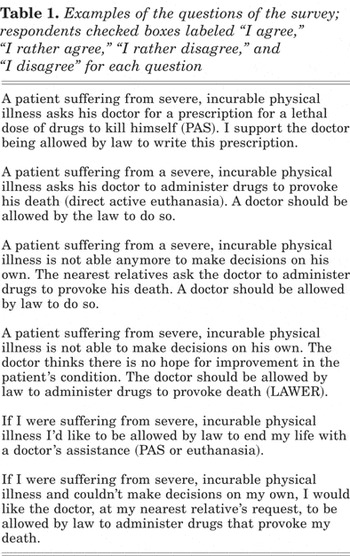
The anonymous questionnaire was first mailed in November 2000 to the 726 members of the Swiss Association of Palliative Care (SAPC). Participants were asked to indicate their positions with regard to hypothetical scenarios concerning PAS and related issues and answer sociodemographic and professional questions as well as an open question concerning the decisional bases of the answers. In addition, the definitions of frequently used terms in the debate on euthanasia were enclosed. To illustrate the method of the survey, some of the questions are shown in Table 1. The results of this first survey have been published (Bittel et al., 2002). With an overall response rate of 55.6%, questionnaires were returned from 90 physicians, 286 nurses, and 28 other palliative care professionals.
Examples of the questions of the survey; respondents checked boxes labeled “I agree,” “I rather agree,” “I rather disagree,” and “I disagree” for each question

The same questionnaire was used in 2003 to survey 148 health care professionals of the Institute of Oncology of the Italian speaking part of Switzerland (IOSI). With an overall response rate of 58.7%, questionnaires were returned from 22 physicians, 49 nurses, and 16 other health care professionals. The results reported in this article have not been published yet.
In 2005, the same survey was again conducted among first- and second-year medical students of Fribourg, a bilingual university of Switzerland, located at the border between the French- and German-speaking parts of Switzerland, with a majority of German-speaking students. Because the survey was introduced in the lectures on psycho-social medicine, the response rate reached 100%.
Data Analysis
The four possibilities of answering questions of the survey (“I agree,” “I rather agree,” “I rather disagree,” and “I disagree”) were classified into “pros” (“I agree”) and “cons” (“I disagree”) and into those who may be considered as ambivalent (“I rather agree” or “I rather disagree”) (some of the questions of the survey are illustrated in Table 1; the entire questionnaire has been published elsewhere; see Bittel et al., 2002).
RESULTS
Tables 2 and 3 and Figures 1 and 2 summarize the attitudes toward legalization of PAS and related issues of the surveyed populations.
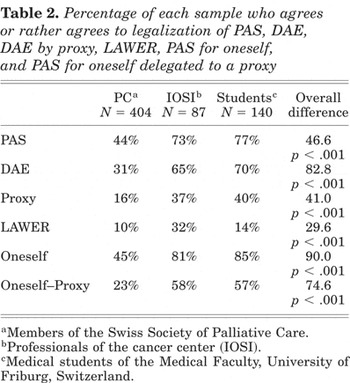
Percentage of each sample who agrees or rather agrees to legalization of PAS, DAE, DAE by proxy, LAWER, PAS for oneself, and PAS for oneself delegated to a proxy

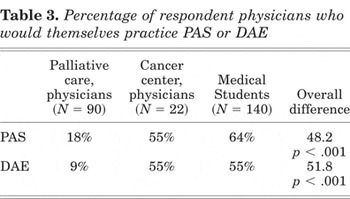
Percentage of respondent physicians who would themselves practice PAS or DAE


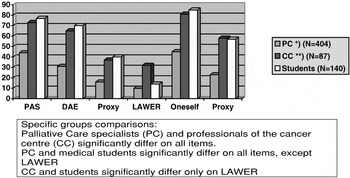
Comparison of surveyed populations.

Percentage of respondent physicians.
Among the palliative care specialists, numbers constantly decrease in favor of PAS (44%), DAE (31%), the delegation of decisions to relatives (16%), and life-terminating acts without explicit requests (LAWER) (10%). Among the professionals of the cancer center (IOSI), numbers constantly decreased from a higher level, with 73% favoring PAS, 65% DAE, 37% the delegation of decision to relatives and 32% LAWER. Among medical students, supporters constantly decreased from an even higher level, with 77% favoring PAS to 70% DAE, 40% the delegation of decision to relatives, and 14% LAWER (see Table 2 and Fig. 1).
Participants were also asked to imagine the case of their own terminal illness. Among the palliative care specialists, only about half of the respondents (45%) wished to have access to PAS and DAE, wheres 81% of the professionals of the cancer center and 85% of the medical students expressed this wish. If incompetent, only 23% of palliative care specialists would delegate the decision to a proxy, whereas 58% of the professionals of the cancer center would do so and 57% of the medical students (see Table 2).
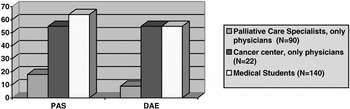
More than half of physicians of the cancer center (55%) and the medical students (64%) would practice PAS themselves and—if legalized—also DAE (55% and 55%, respectively), whereas only a minority of 18% of the palliative care physicians could imagine practicing PAS and only 9% DAE (see Table 3 and Fig. 2).
To summarize, Table 2 shows that palliative care specialists and professionals of the cancer center significantly differ on all responses; palliative care specialists and medical students also significantly differ on all responses, except LAWER, and professionals of the cancer center and medical students only differ on the question concerning LAWER.
DISCUSSION
Although the three surveys were conducted with the same questionnaire, the settings of the surveys differed. Palliative care specialists and professionals of the cancer center answered by mail and medical students during a lecture. The different settings may have not only influenced response rate, but also outcome. Nevertheless the differences between the populations are highly significant and therefore support the initial hypotheses.
Palliative care specialists indicate a significantly more restrictive attitude toward PAS and related issues than professionals of the cancer center, who themselves report a slightly more restrictive attitude than that of medical students. Palliative care specialists are traditionally more prone to reject PAS and DAE (Bittel et al., 2002). Many national and international associations of palliative care, such as the European Association of Palliative Care (EAPC), have an official position against PAS and DAE (www.eapcnet.org/publications). However, palliative care specialists are also familiar with the care of patients with severe and terminal illnesses, which may also explain the differences. Based on their experience, and this was one of the hypotheses of the survey, palliative care specialists may also know that a number of requests of PAS and DAE might disappear, when physical and/or psycho-social and spiritual suffering is alleviated. This experience may not be shared by all professionals of the cancer center and not at all by the medical students.
The attitude of medical students may be—at least to some extent—linked to their possible fears of dependency. Most young people have not been exposed yet to a personal experience of illness, and they may therefore project their “fears of the healthy” on the hypothetical scenarios mentioned in the survey. The wish for autonomy, on the other hand, somehow related to the fear of dependency, may be expressed to some degree in all three populations. The decreasing numbers of supporters for delegation of a decision for DAE to a proxy or for LAWER and the increased wish for PAS and DAE in case of an own terminal illness may illustrate this point. However, the sequential timing of the survey may also have influenced the outcome; in the last few years after the first survey, a broad political discussion about PAS and DAE has taken place in Switzerland, which may have influenced public opinion toward a more “liberal” attitude concerning these issues.
Different factors influence attitudes of health care professionals and the public toward PAS and related issues. Familiarity with the care of severely ill patients and the experience that requests for PAS are often arising in a specific context and that palliative intervention often represents an effective alternative to alleviate suffering may also explain a part of the variance observed in such surveys.