1 Introduction
(Kiparsky Reference Kiparsky and Dingwall1971, Reference Kiparsky and Fujimura1973) draws attention to cases of historical change that suggest that at least some opaque phonological process interactions are difficult to learn. In his work on Stratal Optimality Theory (Stratal OT), he further claims that independent evidence about the stratal affiliation of a process is helpful in learning an opaque interaction (Kiparsky Reference Kiparsky2000). In this paper, we develop a computationally implemented learner for a weighted-constraint version of Stratal OT, and show that for an initial set of test cases, opaque patterns are indeed generally more difficult than their transparent counterparts, and that information about stratal affiliation does make learning of an opaque pattern easier.
Our results support the viability of Stratal OT as a theory of opaque interactions (Bermúdez-Otero Reference Bermúdez-Otero1999, Reference Bermúdez-Otero2003, Kiparsky Reference Kiparsky2000; see below). However, it is not clear whether a stratal setup is the only source of opaque interactions – in fact, some cases of opacity may stem from other factors (McCarthy Reference McCarthy2007). A broader assessment of alternative theories of opacity will not be attempted in this paper; see Jarosz (Reference Jarosz2016) for work on learning opacity in the Serial Markedness Reduction framework (Jarosz Reference Jarosz2014).
In the Stratal OT approach to opacity (see especially Bermúdez-Otero Reference Bermúdez-Otero1999, Reference Bermúdez-Otero2003), grammars are chained together to produce outputs that would not be possible within a single level. For example, in the classic case of the opaque interaction between diphthong raising and flapping in Canadian English, illustrated in (1), mitre can be produced with raising in (word-level) Grammar 1 and then flapping in (phrase-level) Grammar 2. (Here and throughout, we enclose the output of the word-level grammar in // //.) As we will see below, the final candidate cannot be produced by a single OT grammar with the standard set of constraints assumed for this case (though see Pater Reference Pater2014).
-
(1)


This chaining of grammars results in a hidden structure problem (Tesar & Smolensky Reference Tesar and Smolensky2000), insofar as only the output of the final grammar, not any earlier ones, is available in the learning data. Bermúdez-Otero (Reference Bermúdez-Otero2003) develops a revision to the constraint-demotion algorithm that is specifically tailored to the problem of hidden structure in Stratal OT. In this paper, we instead apply a general approach to learning hidden structure in probabilistic OT to the specific case of chained grammars.
The variant of probabilistic OT adopted here is Maximum Entropy (MaxEnt) Grammar (Goldwater & Johnson Reference Goldwater and Johnson2003, Hayes & Wilson Reference Hayes and Wilson2008). The MaxEnt formalism has a broad basis in applied mathematics, including connectionism (Smolensky Reference Smolensky, Rumelhart and McClelland1986); see Johnson (Reference Johnson2013) for an overview, as well as Goldwater & Johnson (Reference Goldwater and Johnson2003). MaxEnt defines the probability distribution over a candidate set in a conveniently direct way: candidate probabilities are proportional to the exponential of the weighted sum of violations.
Candidate probabilities are illustrated in the tableau in (2), in which weights are indicated under constraint names (which are simplified versions of the ones used for the case study in §3.2). The weighted sum appears in the column headed ‘H’, for harmony; MaxEnt is a probabilistic version of Harmonic Grammar (Smolensky & Legendre Reference Smolensky and Legendre2006; see also the overview in Pater Reference Pater2016). The exponentiation of H appears under eɹ, and the resulting probability (obtained by normalisation of eɹ to sum to 1 across all candidates) under p.
-
(2)
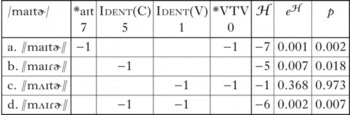
The *aɪt constraint penalises the unraised diphthong [aɪ] before a voiceless consonant, and Ident(V) penalises raising to [ʌɪ]. With *aɪt having greater weight than Ident(V), raising before a voiceless stop, as in (2c), has greater probability than the faithful (2a). *VTV penalises an alveolar stop between vowels, and Ident(C) penalises the change from stop to flap. With Ident(C) weighted higher than *VTV, the probability on flapping candidates (2b) and (2d) is lowered. Candidate (d) is the correct output in Canadian English, but it has a proper superset of the violations of (b), since flapping also satisfies *aɪt. No weighting of the constraints will give [mʌɪɾɚ] the highest probability in the tableau. In this respect, the situation is the same as in single-level OT, which cannot make (d) optimal. In MaxEnt, (d) can tie with (b); when the constraints they violate have zero weight, they are assigned equal probability (see Pater Reference Pater2016 for further discussion and references on harmonic bounding and probabilistic weighted-constraint theories). In Table VI in §3.2, we will see that [mʌɪɾɚ] can emerge from a second chained grammar with highest probability.
Our way of dealing with the hidden structure problem posed by Stratal OT is an extension of the approach to Harmonic Serialism in Staubs & Pater (Reference Staubs and Pater2016). The probability that the grammar assigns to an output form is the sum of the probabilities of the derivations that lead to it. The probability of a derivation is the product of the probabilities of each of its component steps. The probability of each step is determined by the weights of the constraints that apply at that level (word or phrase; see §2.2 for more details). We use a batch-learning approach, in which the objective is to minimise the divergence between the predictions of the grammar and the learning data, subject to a regularisation term that prefers lower weights. This is a standard approach to learning MaxEnt grammars (see e.g. Goldwater & Johnson Reference Goldwater and Johnson2003, Hayes & Wilson Reference Hayes and Wilson2008).
Jarosz (Reference Jarosz2006, Reference Jarosz2015) shows how this approach of considering every possible hidden structure in generating an overt candidate can be applied to phonology in her work on expectation maximisation with Optimality Theory. Here we follow Eisenstat (Reference Eisenstat2009), Pater et al. (Reference Pater, Staubs, Jesney and Smith2012), Johnson et al. (Reference Johnson, Pater, Staubs and Dupoux2015) and Staubs & Pater (Reference Staubs and Pater2016) in adopting a weighted-constraint variant of this general approach.
When there is hidden structure, the learner is not guaranteed to converge on the global optimum, i.e. a set of weights that best satisfy the objective function (the solution space is not guaranteed to be convex). Instead it may only find a local optimum, a set of weights that is the best within the space that the learner can explore. We provide examples of such local optima in Table III in §2.3 and Tables IX and X in §3.3.
A simple and standard way of finding a global optimum in such cases is to try different starting positions for the learner (initialisations), in the hope that one or more will allow the learner to find the global optimum. In the limit, as long as the space from which we are sampling initialisations contains points from which there is a path towards an optimal solution, this will allow the learner to find a global optimum. In our test cases, the learner always found a successful solution at least once for every dataset. A successful solution is defined here as a grammar that grants more than 0.50 probability to the overt forms that have highest probability in the learning data. Our measure of ‘ease of learning’ for the various patterns we study is the probability that a learner will be successful over a set of random initialisations.
In the next section we provide more details about our grammatical and learning theories in the context of the first test case, a relatively simple example of opaque tense–lax vowel alternations in French. In §3 we turn to the opaque interaction of diphthong raising and flapping in Canadian English, and the effect of supplying evidence to the learner of phrasal non-raising. §4 provides an exploration of the mechanisms that lead to incorrect learning of (predominantly) opaque patterns. Finally, overall conclusions and directions for further research can be found in §5.
2 Tensing/laxing in Southern French
2.1 Data and analysis
As reported by Moreux (Reference Moreux1985, Reference Moreux2006), Rizzolo (Reference Rizzolo2002) and Eychenne (Reference Eychenne2014), certain dialects of Southern French have a synchronic process which tenses mid vowels in open syllables, while laxing them in closed ones (as well as open syllables followed by a schwa syllable; we will disregard this complication, and refer the reader to Selkirk Reference Selkirk1978, Moreux Reference Moreux1985 and Rizzolo Reference Rizzolo2002 for potential explanations of this). This is conventionally called the loi de position (‘law of position’), and is illustrated in (3) (examples from Rizzolo Reference Rizzolo2002 and Eychenne Reference Eychenne2014).
-
(3)

Tensing/laxing is made opaque (is counterbled) by resyllabification across word boundaries, at least in some cases, as shown in (4b), from Rizzolo (Reference Rizzolo2002: 51), where the lax vowel //œ// is retained in the surface open syllable [pœ].Footnote 1
-
(4)

In the simulation reported here, we investigated whether our learner could deal with this simple case of opacity. This also serves as a simple case to illustrate in more detail the functioning of the learner. The data that we offered the learner consisted of exceptionless loi de position as well as exceptionless opacity through resyllabification, as in (5).
-
(5)

The constraint set that we used for this subset of real French was maximally simple, and is given in (6). Correct syllabification was taken for granted, in order to keep the constraint and candidate sets as small as possible, so that the interactions yielding opacity are easy to see.
-
(6)

The original formulation of Stratal OT (Bermúdez-Otero Reference Bermúdez-Otero1999, Kiparsky Reference Kiparsky2000) allows for three levels of derivation: a stem level, a word level and a phrase level, which all have the same constraints, but different rankings or weightings. For this problem, we will only consider two levels – a word-level and a phrase-level grammar. The word-level grammar evaluates each word individually, without regard to its neighbours in the phrase. By contrast, the phrase-level grammar, which operates on the output of the word-level grammar, does evaluate entire phrases together.
With this set-up, then, opaque interaction is obtained when word-level *[+tense]/closed and *[–tense]/open have high weight and word-level Ident(V) has low weight, while the opposite holds at the phrase level. This corresponds to activity of the loi de position at the word level, and its inactivity at the phrase level.
This latter scenario is the only option to derive this opaque interaction. As can be seen in tableau (8) below, phrase-level markedness disprefers surface [sε.ta], so that the mapping from /e/ to [ε] cannot be derived at the phrase level. At the same time, word-level markedness prefers the word-level output that does map /e/ to [ε], //sεt#a//, because the first vowel is in a closed syllable at that level, since the phrasal context is invisible. This can be seen in tableau (7a).
Activity of loi de position at the word level can be expressed with the weights in (7) (found in successful runs of the learner described in §2.2).
-
(7)

At the phrase level, giving high weight to Ident(V) and zero weight to both markedness constraints results in a probability of 1.00 for all faithful mappings. This is illustrated in (9) for the phrase-level derivation that takes place if the word-level form output is //sεt.#a//: phrase-level outputs retain the [ε] that was created by closed-syllable tensing at the word level with a probability of 1.00.
-
(8)

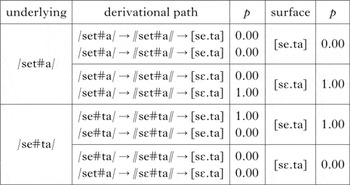
The single-stratum mappings shown in (7) and (8) are assembled into derivational paths that lead from an underlying representation (UR) to a surface representation (SR). The probability of a single derivational path is obtained by multiplying the probabilities of every step in the path, as illustrated in (9). This is because every derivational step in Stratal OT is by definition independent of earlier or later derivational steps (Bermúdez-Otero Reference Bermúdez-Otero1999, Kiparsky Reference Kiparsky2000).Footnote 2
-
(9)

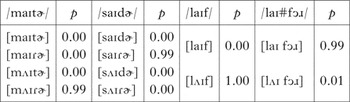
The expected probability of a surface form (more accurately, a UR/SR mapping) is the sum of the probabilities of all derivational paths that lead from the input to that surface form, as in Table I.Footnote 3 This table shows that, given the weights in (7) and (8), the desired output candidates (cf. (5)) are generated with a probability of 1.00.
Computation of expected probabilities of UR/SR mappings by summing over all derivational paths.

This serial approach does not have look-ahead capabilities: the phrase-level grammar cannot influence which mappings will be preferred at the word level, in accordance with Bermúdez-Otero (Reference Bermúdez-Otero1999). A closely related model that does have look-ahead capabilities is explored by Boersma & van Leussen (Reference Boersma and van Leussento appear), whose predictions for the same dataset would also be interesting to explore in future work.
Now that we have explained and illustrated the generation of probabilities over UR/SR mappings using the successful weights in (7) and (8), in §2.2 we will explain the structure of the learner that arrived at these weights. In §2.3 we will show how often this learner arrives at this successful set of weights within a sample of 100 runs, and what happens within that same sample when the learner does not find this analysis.
2.2 Learning
Staubs (Reference Staubs2014b) provides an implementation in R (R Core Team 2013) of a variant of the approach to learning serial grammars discussed in Staubs & Pater (Reference Staubs and Pater2016). We modified it minimally to allow different violations of the same constraint at different derivational stages, which is sometimes necessary in a stratal framework.
For instance, the constraint *[+tense]/closed in the Southern French simulation will be violated at the word level by a sequence [set#a], because even though [ta] could form a separate syllable, the word boundary between [t] and [a] makes it necessary to syllabify [t] as a coda. However, the same constraint remains unviolated at the phrase level for the same sequence, since the grammar can now look beyond word boundaries and evaluate entire phrases, so that [ta] does form a syllable: [se.ta].
Expected probabilities of UR/SR mappings are computed given sets of candidates, violation vectors and constraint weights, as described and illustrated in §2.1. In addition, the learner is also given observed probabilities of UR/SR mappings. Since we are working with categorical data, all UR/SR mappings found in the data were given a probability of 1.00, and all others a probability of 0.00. The learner then minimises the Kullback-Leibler (KL) divergence (Kullback & Leibler Reference Kullback and Leibler1951) of the expected probabilities from the observed probabilities, which is a measure of how closely the grammar has been able to fit the data; see (10).
-
(10)

Minimisation of this objective function is achieved by the L-BFGS-B method of optimisation (Byrd et al. Reference Byrd, Lu, Nocedal and Zhu1995). This is a pseudo-Newtonian batch-optimisation method, which uses approximations of the first-order and second-order derivatives of the objective function to take incremental steps towards an optimum. The ‘optim’ implementation of this method in R was used, specifying a minimum of zero on all constraint weights.
To place an upper bound on the objective function, an L2 regularisation term (Hoerl & Kennard Reference Hoerl and Kennard1970) with μ=0 and σ2=10,000 was added. This regularisation term penalises weights as they increase, keeping the optimal solution finite, and driving a constraint's weight down to zero whenever it is not helpful in the analysis.
Summarising, our algorithm calculates probabilities of derivations in Stratal MaxEnt, sums over them to get the expected probabilities of overt forms and fits the observed distribution of UR/SR mappings by minimising KL divergence.
2.3 Results
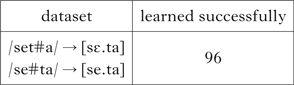
The learner described in §2.2 was run 100 times on the French loi de position data, with every run starting from random starting weights for each constraint, drawn with replacement from a uniform distribution over [0, 10]. The results are given in Table II.
Results for 100 runs for the Southern French dataset.

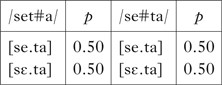
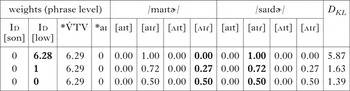
Thus opaque loi de position was learned successfully for an overwhelming majority of start weights. However, there is still a slight chance of incorrect learning, which we defined as a probability of 0.50 or less on at least one surface form that has a probability of 1.00 in the learning data (see also §1). The four unsuccessful runs yielded grammars which had free variation between tense [e[ and lax [ε], as in Table III.
UR/SR mapping probabilities for the local optimum.

This is a local optimum that arises when all constraint weights are set to zero. KL divergence from the actual data (our measure of error) is smaller for these weights than for any other weights within the weight space explored by the learner.
As will be explained in §4.1, an initially incorrect weighting at the word level leads to a tendency for the weight of phrase-level faithfulness to be lowered. At the same time, when phrase-level Ident(V) reaches zero weight, any effect of closed-syllable laxing from the word level cannot be transmitted to the final output. Once this happens, 0.50 probability for all candidates is the best possible fit to the data, and the all-zero weight version of that solution minimises the penalty on the regularisation term, which prefers smaller weights.
It could be argued that this weight set is not a local optimum in the strict sense. There is a locally available solution that is better than all-zero weights: assigning minimal weight (0+ε for any positive ε) to word-level *[–tense]/open and *[+tense]/closed, as well as phrase-level Ident(V), while keeping all other constraints at 0, will lower the objective function with respect to all-zero weights, as this will nudge the probabilities of both /set#a/ → [sε.ta] and /se#ta/ → [se.ta] slightly above 0.50. However, for the reasons outlined above, the learner cannot see this possibility when it retreats to all-zero weights.
3 Raising and flapping in Canadian English
3.1 Data
Our second case study is a classic case of opacity, attested in Canadian English (Joos Reference Joos1942, Idsardi Reference Idsardi2000 and references therein, Pater Reference Pater2014): the interaction between Canadian raising and flapping. The low-nucleus diphthongs [aɪ aʊ] raise to [ʌɪ ʌʊ] before voiceless consonants, as in (11a), and the coronal oral stops /t d/ become a voiced flap [ɾ] in a variety of contexts (De Jong Reference De Jong, van Oostendorp, Ewen, Hume and Rice2011) – among others, between two vowels if the first is stressed and the second is not, as in (11b).
The two processes display a counterbleeding interaction: the fact that flapping cancels the voicelessness of underlying /t/ does not prevent that /t/ from triggering raising. This is illustrated in (11c).
-
(11)

In addition, raising is restricted to the word domain, as illustrated in (12a), while (b) shows there is no evidence of such a restriction for flapping.
-
(12)

This fits with a stratal analysis in which raising applies only at the word level, and flapping only at the phrase level, as in (13).
-
(13)

The transparent counterpart to this pattern, claimed to be spoken by some Canadian English speakers (Joos Reference Joos1942), is a language which also has both raising and flapping, as in (11) and (12), but in which the application of flapping blocks the application of raising, as in (14), since the flap [ɾ] is not voiceless. However, the existence of this transparent dialect is disputed in later literature (Kaye Reference Kaye, Mascaró and Nespor1990). In our simulations, we use this (perhaps hypothetical) transparent dialect as a non-opaque baseline against which to compare the mainstream, opaque dialect of Canadian English.
-
(14)

In the next subsection, we investigate the learnability of the opaque and the transparent versions of the Canadian English data. We consider the contrast between opacity and transparency, and between various possible datasets.
3.2 Simulation setup
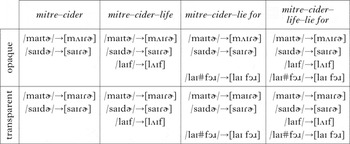
Canadian English provides at least two pieces of independent evidence regarding the stratal affiliation of the opaque raising process: evidence for its application outside the flapping context, as in (11a), and evidence for its word-boundedness, as in (12a). Based on Kiparsky (Reference Kiparsky2000), we predict the availability of such evidence to make the opaque interaction more learnable. To investigate this, we considered the four datasets in Table IV, each of which contains a subset of the relevant mappings observed in Canadian English, and provides various degrees of independent evidence for the stratal affiliation of the opaque process.
Opaque datasets for Canadian English.

Mitre–cider provides no independent evidence regarding the opaque process – its synchronic activity and stratal affiliation must be inferred from the opaque interaction. Mitre–cider–life provides evidence for the opaque process applying outside the interaction, since the [f] in life is not subject to flapping: raising must be synchronically active at some stratum. Mitre–cider–lie for provides evidence for the non-application of raising at the phrase level, since lie for does not undergo raising, despite having [f] after the diphthong across a word boundary. Finally, mitre–cider–life–lie for combines both pieces of evidence. These datasets were investigated with both an opaque and a transparent interaction between raising and flapping.
Our learner had access to the four constraints in (15). As in the Southern French case, only two derivational levels were used: a word level and a phrase level.
-
(15)

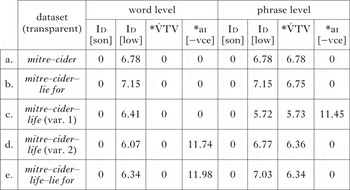
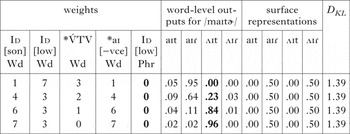
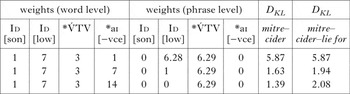
Whenever *aɪ/[–voice] is sufficiently higher-weighted than Ident[low], the raising process will be active. The flapping process is active when the weight of *V́TV is sufficiently greater than that of Ident[son].Footnote 4 The opaque interaction is captured if there is raising but no flapping at the word level, and flapping but no raising at the phrase level (see §1 on the impossibility of capturing the interaction within one stratum). This is reflected in the weights found at successful learning trials for mitre–cider–life–lie for. At the word level, *aɪ/[–voice] is weighted far above Ident[low], and *V́TV far below Ident[son]; the opposite is true of the phrase level, as shown in Table V.
Sample successful weights for opaque mitre–cider–life–lie for.

The word-level tableau in (16) shows that the weights above ensure raising but no flapping at the word level.
-
(16)

The candidates considered at the phrase level are the same as those at the word level.Footnote 5 As can be seen in the phrase-level tableaux in (17), it is essential for the generation of these probabilities that /maɪtɚ/ exhibit raising at the word level, since the phrase level must preserve diphthongs faithfully, otherwise /maɪtɚ/ will not surface with both raising and flapping (i.e. as attested [mʌɪɾɚ]).
-
(17)

The surface-form probabilities resulting from the weights in Table V match the actual opaque Canadian English data extremely closely, as shown in Table VI.
Surface form probabilities generated by Table V.

As opposed to the opaque interaction, the transparent interaction does not need to order flapping after raising. In fact, for transparent mitre–cider and mitre–cider–lie for, raising need not be represented in the grammar at all, because the raised diphthong is absent from the data – see the lack of weight on *aɪ/[–voice] at both levels in Tables VIIa and b. For transparent mitre–cider–life, raising can be represented either at the word level, by giving high weight to word-level *aɪ/[…voice] and zero weight to word-level Ident[son], as in (c) – or at the phrase level, by giving high weight to *V́TV and *aɪ/[–voice] at the phrase level, as in (d). Transparent mitre–cider–life–lie for, however, does require raising to take place at the word level, because the non-raised diphthong in /laɪ#fɔɹ/ → [laɪ fɔɹ] precludes raising at the phrase level. The weights found for this dataset are very similar to the second set of weights for mitre–cider–life, as shown in (e).
Sample weights for successful runs of various transparent datasets.

Thus the opaque interaction of raising and flapping requires word-level raising and phrase-level flapping. The transparent interaction, however, only requires flapping at the word level, while raising can be represented at either level.
Finally, the addition of both life and lie for to the transparent dataset leads to the necessity of representing raising at the word level, even though this is not otherwise required for the transparent interaction.
3.3 Results
Simulations were run as described in §2.2, except that L2 regularisation was made stronger by setting σ2 to 9,000 instead of 10,000, to prevent the learner from considering constraint weights that tend towards infinity for the opaque mitre–cider dataset.
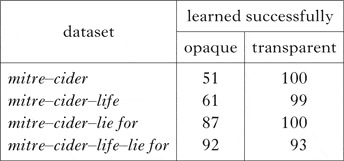
All four datasets were examined with both opaque and transparent interaction between raising and flapping. The same 100 sets of initialisations drawn with replacement from a uniform distribution over [0, 10] were used for all eight datasets. The results are given in Table VIII.
Results for 100 runs for the Canadian English dataset.

As can be seen, independent evidence regarding the opaque process yields a clear increase in learnability for the opaque cases. Evidence that the opaque process is word-bounded (lie for) has a stronger effect than evidence for independent activity of the opaque process (life).
For all transparent datasets except mitre–cider–life–lie for, performance is (almost) at ceiling. For mitre–cider–life–lie for, however, the opaque and transparent versions are learned at a near equal rate.
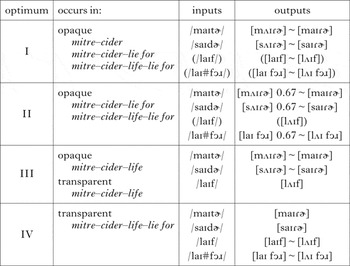
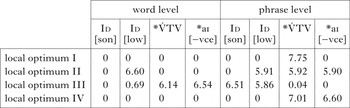
Whenever (opaque or transparent) Canadian English was not learned successfully (i.e. at least one attested SR was given a probability of 0.50 or less by the grammar), the learner ended up in one of the four local optima summarised in Table IX.
Local optima observed for the various Canadian English datasets. Parentheses indicate words that are not shared between all datasets for which this local optimum is attested.

For each underlying representation the table lists the surface representations that have a probability of more than 0.00 in that local optimum. The symbol ‘~’ will be used as a shorthand for 0.50 probability on both surface representations shown, unless indicated otherwise. Weights generating each local optimum are given in Table X.
Sample weights for local optima.

These four local optima have in common that they try to represent both processes with minimal appeal to the interaction between levels. For instance, local optima I and IV are attempts to represent the data without appealing to underlying representations, by setting all faithfulness constraints to zero.
Local optimum II does not represent the raising process at the word level, as would be necessary for any dataset involving life with a raised diphthong and lie for with a non-raised diphthong (see §3.2). This means that the vowel contrast between life and lie for has to be modelled as within-word variation.
Finally, local optimum III is a consequence of representing both raising and flapping at the word level. Since applying raising and flapping at the same level leads to lack of raising in mitre, variation between raising and non-raising is created by lowering the weight of word-level Ident[low].
As in the case of Southern French, local optima I and IV are not local optima in the narrow sense: if the weights of word-level Ident[son], Ident[low] (in the case of local optimum I) and *aɪ/[–voice] and phrase-level Ident[low] are increased by even a little, this will decrease the value of the objective function. It is this ‘bottleneck effect’ (see §4.1) that leads the learner to land in this state. However, local optima II and III are true local optima, in the sense that any neighbouring values will increase the value of the objective function.
As a final note, none of these outcomes represent opaque analyses. Local optima II and III resemble opaque analyses, since they both assign a significant amount of probability to [mʌɪɾɚ], but they crucially ignore the difference between underlying /t/ in mitre and underlying /d/ in cider, and allow unmotivated raising in both words (because the constraints that regulate raising either have a weight of 0 or are tied with competing constraints).
3.4 Summary
We have found that independent evidence about the stratal affiliation of an opaque pattern can significantly improve the learnability of the opaque interaction – especially the addition of evidence that the process does not apply at the phrase level. Furthermore, the presence of both lie and lie for makes the transparent and opaque interactions equally learnable, and in fact destroys the transparent interaction's learning advantage.
Whenever the languages are not learned successfully, this is because either phrase-level faithfulness is given zero weight, making it impossible to transfer information from the word level to the phrase level, or raising and flapping are represented at the same level when they need to be represented at different levels. We will now turn to a discussion of the ‘bottleneck effect’ (see §3.3), an obstacle posed by the current hidden structure learning problem that leads the learner away from the global optimum, as well as ways in which evidence for stratal affiliation helps the learner overcome this obstacle.
4 Difficulties in learning hidden structure
4.1 Cross-level dependencies
The relative difficulty of learning opaque interactions found in our results seems to stem from the fact that the effectiveness of the weighting on each level depends on the weights on the other level. Specifically, high weight on phrase-level faithfulness is only effective when word-level constraints are weighted appropriately, while the result of word-level weighting can only be transmitted to the surface representation when phrase-level faithfulness has a high enough weight.
We will show here how the learner fails to reach the global optimum if it finds appropriate weights only for word-level constraints or only for phrase-level faithfulness, and we will show that this scenario is more likely to occur in opaque cases than in transparent cases. Furthermore, we will show how the types of evidence for stratal affiliation of the opaque process offered by the Canadian English datasets increase the likelihood that the learner will find the global optimum.
When the learner has not found weights that generate a desirable distribution at the word level, it gets closer to its objective by lowering the weights of phrase-level faithfulness, rather than raising them. For instance, consider the weighting in Table XI, which leads to a local optimum for opaque mitre–cider.
Sample initialisation leading to local optimum for mitre–cider.

At the word level, this weighting gives a non-raised diphthong in mitre highest probability, because high-weighted *V́TV and low-weighted *aɪ/[–voice] leads to flapping, which blocks diphthong raising, as illustrated for the word-level tableau in (18).
-
(18)

At the same time, as shown in (19), it displays flapping and lack of raising on the phrase level, as desired for the opaque interaction (cf. §3.2).
-
(19)

In cases like this, KL divergence decreases (and fit to the data increases) as the weight of phrase-level Ident[low] approaches zero. As shown in (10) above, KL divergence is computed based on observed and expected probabilities. Table XII shows the observed probabilities for opaque mitre–cider, and Table XIII shows expected probabilities for various weights of phrase-level Ident[low] and the resulting KL divergence.
Observed distribution for opaque mitre–cider.

KL divergence for grammars with word-level weights as in Table XI and various weights of phrase-level Ident[low].

If the learner has assigned zero weight to phrase-level faithfulness, moving towards appropriate weights at the word level does not lower KL divergence. This is illustrated in Table XIV. Word-level and phrase-level expected probabilities are shown only for mitre, but KL divergence is computed for both mitre and cider. Phrase-level constraint weights are as given in Table XI, except for Ident[low], whose weight is set to zero.
KL divergence for mitre–cider when phrase-level Ident[low] has zero weight.

As can be seen in Table XIV, raising the weights of word-level Ident[low] and *V́TV and lowering those of word-level Ident[son] and *aɪ/[–voice] leads to a desirable result at the word level: raising and no flapping (cf. (17)). However, this information is not factored into the distribution over UR/SR mappings if phrase-level Ident[low] has a weight of 0.
At the same time, phrase-level Ident[low] has a motivation to decrease its weight until word-level outputs with a raised diphthong gain a cumulative probability of at least 0.50. The lower the weight of Ident[low], the closer the winning candidate will be to having a probability of 0.50, since setting Ident[low] to zero means that the phrase level will assign equal probability to raised and non-raised diphthongs. As long as the current word-level weights are such that the winning candidate has less than 0.50 probability, this is an improvement. In the particular case discussed here, Ident[low] will be motivated to have non-zero weight only when the raised diphthong is more likely than the non-raised diphthong at the word level, so that the probability of [mʌɪɾɚ] increases as the weight of Ident[low] increases.
This is what yields the aforementioned bottleneck effect: if the current word-level weights lead to lower probability on the attested candidate compared to all-zero weights at the word level, then phrase-level faithfulness might be set to zero before a more desirable set of word-level weights is found.Footnote 6 Thus word-level information needs to travel through the bottleneck of the phrase-level faithfulness constraints in order to have an effect on the distribution over UR/SR mappings. The bottleneck effect is not limited to just this dataset, but applies to any dataset with dependence between levels, including the Southern French case in §2.3 above and other Canadian English datasets (see §4.2 below).
4.2 Advantage from evidence for stratal affiliation
As we showed in §3.3, the addition of various kinds of evidence for the stratal affiliation of the opaque process of raising dramatically increases the likelihood that the opaque interaction will be learned.
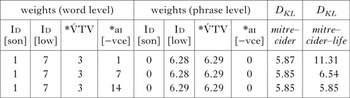
Adding life to the opaque interaction means that raising at either the word level or the phrase level will be rewarded, regardless of the weighting of the flapping constraint *V́TV. This means that increasing the weight of word level *aɪ/[…voice] leads to a sharper drop in KL divergence for opaque mitre–cider–life than for opaque mitre–cider–lie for, as shown in Table XV.Footnote 7
Correlation between the weight of word-level *aI/[–vce] and KL divergence for mitre–cider and mitre–cider–lie for.

In this way, the presence of life in the dataset means a sharp increase in the gradient of the word-level constraint *aɪ/[–voice] in a position in the weight space that would otherwise have a low gradient for that constraint. We have not studied how the exact numerical increase in the gradient of this constraint, which depends on the relative frequency of data points like life in the total corpus (we only considered a minimal corpus here), relates to learnability rates – this is a matter for future research. However, we can confidently say that the categorical presence of raising outside its interaction with flapping has a positive influence on the learnability of the interaction.
Adding lie for to the opaque interaction, as in Table XVI, means that high weight on phrase-level Ident[low] is penalised less strongly when the word-level weights do not generate the desirable candidates with high probability.Footnote 8 This is because the word lie itself contains neither a flapping nor a raising context, so that flapping and raising constraints do not interact with the identity of the diphthong at the word level. It is not necessary to determine the mutual weighting of word-level *V́TV and Ident[son] or *aɪ/[–voice] and Ident[low] to give the desirable word-level output for lie for more than 0.50 probability – non-zero weight on word-level Ident[low] is sufficient.
Correlation between the weight of phrase-level Ident[low] and KL divergence for mitre–cider and mitre–cider–lie for.

When both life and lie for are present in the dataset, the grammar must represent the raising process at the word level in order to generate lack of raising in lie for (because word-level *aɪ/[–voice] cannot see that lie for has /aɪ/ before /f/, while phrase-level *aɪ/[–voice] can). As shown in §3.2, this introduces an additional dependency between word and phrase levels for the transparent datasets: while the transparent interaction between flapping and raising does not require raising to apply before flapping, the combination of life and lie for does.
This creates a bottleneck effect for the transparent dataset, which explains the decrease in learnability for transparent mitre–cider–life–lie for. The increase in learnability for opaque mitre–cider–life–lie for, on the other hand, can be seen as the cumulative effect of life and lie for on the opaque interaction, as reviewed above.
5 Concluding remarks
We have presented here an approach to learning opaque and transparent interactions in a MaxEnt version of Stratal OT. Our goal was to investigate whether the general setup of Stratal OT – chained parallel OT grammars with independent rankings or weightings of constraints – predicts learnability differences between opaque and transparent process interactions, and also whether evidence of a process's stratal affiliation makes it easier to learn opaque interactions.
Our first case study was opaque tensing/laxing in Southern French. We found that it was learned at a high rate of accuracy, but the solution space has a local optimum – one where the grammar does not represent the phonological process at all, which yields free variation in the data.
We then looked at the opaque interaction between diphthong raising and flapping in Canadian English (Joos Reference Joos1942, Idsardi Reference Idsardi2000 and references therein). The opaque raising process also applies in contexts where flapping is irrelevant, and it does not apply across word boundaries – both of which constitute evidence for the stratal affiliation of raising.
We found that, without additional evidence for stratal affiliation, the opaque interaction was learned at a rate of about 50%, while its transparent counterpart was learned at ceiling. However, addition of this additional evidence improved the learnability of the opaque interaction to a maximum of 92%, while the learnability of the transparent interaction decreased to a similar rate. This confirms Kiparsky's prediction: evidence of the stratal affiliation of raising does improve its learnability when it is opaque. We also found that the advantage of transparent over opaque interactions is relative: the dataset with full evidence for stratal affiliation did not produce a learnability difference between the two.
Our explanation for the observed learning difficulties in this framework has to do with a bottleneck effect in the transmission of information from earlier derivational levels through faithfulness constraints. This effect makes it more difficult to find the global optimum when the learner starts with word-level weights that predict the wrong surface form. However, as shown in §4.2, this effect is mitigated for opaque Canadian English by information about an opaque process's stratal affiliation, because this information either boosts desirable word-level weightings, punishes undesirable phrase-level weightings or diminishes the bottleneck effect in general.
The two cases that we considered differ in their learnability rate. The Southern French dataset contains evidence that the opaque process (tensing/laxing) is word-bounded, making it analogous to the opaque mitre–cider–lie for dataset in the Canadian English case study. While Southern French was learned at a rate of 96%, mitre–cider–lie for was only learned at a rate of 87%. A possible explanation is that the Southern French case study did not include constraints on syllable structure, while the process that makes tensing/laxing opaque is resyllabification. We predict that the learnability of Southern French would be slightly reduced if such constraints were introduced into the simulation.
We have limited ourselves here to two case studies and one learning implementation. Other approaches to learning Stratal OT are possible too: probabilistic ranked constraint learning with expectation maximisation (Jarosz Reference Jarosz2006, Reference Jarosz2015, Reference Jarosz2016), Noisy Harmonic Grammar (Coetzee & Pater Reference Coetzee and Pater2011) or Stochastic OT (Boersma Reference Boersma1998). These might differ in their particular learning strategies, the local optima they find and the distribution over outputs generated at local optima. Nonetheless, the mechanisms responsible for the learnability differences that we found are quite general. Interdependence between phrase-level faithfulness and appropriate weighting at the word level poses a challenge for finding a grammar that generates the learning data. For this reason, we predict that other learning approaches will find results similar to ours (an early confirmation of this can be found in Jarosz Reference Jarosz2016). However, more work is needed that explores the learnability of these and other opaque interactions in other learning frameworks, including the non-serial multi-level framework in Boersma & van Leussen (Reference Boersma and van Leussento appear). Further work is also needed to examine how other cases of opacity behave in our framework. In particular, more complex interactions that involve more constraints and/or more derivational levels would be essential to test the predictions of a general advantage for transparency, and of improved learning of opacity given evidence of stratal affiliation. In addition, as pointed out in §4.2, it is important to understand how prevalent evidence for stratal affiliation must be in the data to ensure successful learning.
Finally, further research would need to be done before one could draw conclusions about the relationship of our findings to attested patterns of language learning, language change and language typology. In naturalistic language learning, we are unaware of any evidence that learners have biases toward transparent interactions, or that they find some cases of opacity easier than others. Such evidence may be difficult to come by outside the laboratory, since confounds are generally controlled for when the learning of different patterns is compared. There is some evidence that transparent interactions are easier in artificial language learning (Kim Reference Kim2012), but this line of research is only beginning. There is also evidence that opacity can be innovated by children (e.g. Dinnsen & Farris-Trimble Reference Dinnsen and Farris-Trimble2008); whether or not this is a challenge to our model or other related theories would require a detailed consideration of the constraints involved and the steps on the learning path. To apply our model to historical change would require adding the analogue of rule loss, that is the possibility of mislearning an opaque interaction as a contrast; our constraint set cannot generate this possibility. Finally, to draw conclusions about how these results fit the relative degree of typological attestation of opaque and transparent interactions, we would need not only a model that connects learning to typological attestation (see e.g. Staubs Reference Staubs2014a), but also empirical research to determine whether or not opacity is underattested.