Introduction
A general challenge in second language learning is learning new form-meaning mappings, some of which require integrating information across different levels of linguistic representation. One of those mappings is the mapping of pitch accenting to a discourse representation. At a prosodic level, pitch accents mark phrase-level prominence. Accented words tend to be produced with longer duration, greater intensity, and greater pitch excursion than unaccented words. Pitch accents affect interpretation of a sentence by interacting with the information structure of that sentence. They mark a focused entity in a discourse, evoking a set of alternatives to it (Rooth, Reference Rooth1992). Consider the sentences in (1) below.
-
(1a) Mary likes APPLES.
-
(1b) MARY likes apples.
A pitch accent on apples leads to an interpretation that Mary likes apples and not some other fruit (1a), whereas a pitch accent on Mary gives rise to an interpretation that Mary, not some other person, likes apples (1b). Thus, understanding spoken language requires using pitch accents to draw inferences about the information structure of an utterance. While pitch accents are known to play a crucial role in native language (L1) comprehension (Arnold, Reference Arnold2008; Dahan, Tanenhaus & Chambers, Reference Dahan, Tanenhaus and Chambers2002; Fraundorf, Watson & Benjamin, Reference Fraundorf, Watson and Benjamin2010, Reference Fraundorf, Watson and Benjamin2012; Gotzner, Spalek & Wartenburger, Reference Gotzner, Spalek and Wartenburger2013; Ito & Speer, Reference Ito and Speer2008; Sanford, Sanford, Molle & Emmott, Reference Sanford, Sanford, Molle and Emmott2006), less is known about their impact on second language (L2) comprehension.
Multiple factors may conspire to make it difficult for L2 learners to learn to process pitch accents as a signal to information structure. First, the mapping between prosody and information structure is not one-to-one. In certain circumstances, even given information can be accented like new information (Hirschberg, Reference Hirschberg1990; Schwarzschild, Reference Schwarzschild1999), and different pitch accents are used to signal the presence of information that contrasts with the previous discourse versus information that is merely new (Ito & Speer, Reference Ito, Speer, Augurzky and Lenertova2006; Watson, Tanenhaus & Gunlogson, Reference Watson, Tanenhaus and Gunlogson2008). In the terminology of the Competition Model of cross-linguistic differences in language acquisition and processing (Bates & MacWhinney, Reference Bates, MacWhinney and MacWhinney1987, Reference Bates, MacWhinney, MacWhinney and Bates1989), this decreases the overall validity of pitch accenting as a cue. A second reason why it might be challenging to learn to interpret pitch accents is that the mapping between pitch accents and information structure is not something explicitly taught in the L2 classroom (Braun & Tagliapietra, Reference Braun and Tagliapietra2011; Trouvain, Gut & Barry, Reference Trouvain, Gut, Barry, Trouvain and Gut2007) and is likely learned only from accumulated experience with spoken L2 input. Finally, given that there are cross-linguistic differences in how the information structure of an utterance is prosodically realized, L1 transfer is a third source of difficulty in learning L2 pitch accents. For example, while English signals a focused word by placing a pitch accent on that word, Seoul Korean lacks pitch accents and instead conveys the same information by placing a prosodic phrase boundary before the word (Jun, Reference Jun1993, Reference Jun and Jun2005; Ladd, Reference Ladd2008). And even in other languages that use pitch accents to mark focus, such as Dutch and German, the specific prosodic contours associated with focus may differ across languages (Braun, Reference Braun2006; Braun & Tagliapietra, Reference Braun and Tagliapietra2011; Cohen & ‘t Hart, Reference Cohen and ‘t Hart1967; ‘t Hart, Collier & Cohen, Reference ‘t Hart, Collier and Cohen1990). Nevertheless, because pitch accents convey useful information about the information structure of an utterance (as demonstrated by their benefits for native listeners; e.g., Dahan et al., Reference Dahan, Tanenhaus and Chambers2002; Fraundorf et al., Reference Fraundorf, Watson and Benjamin2010, Reference Fraundorf, Watson and Benjamin2012; Ito & Speer, Reference Ito, Speer, Augurzky and Lenertova2006; Watson et al., Reference Watson, Tanenhaus and Gunlogson2008), it would be valuable for L2 learners to learn to process them in spite of these challenges.
However, a recurring theoretical question in the literature on second language learning is whether native-like performance can ever be achieved by L2 learners. That is, it is debated whether L2 processing is necessarily qualitatively different from L1 processing (e.g, Clahsen & Felser, Reference Clahsen and Felser2006a, Reference Clahsen and Felser2006b; Felser & Roberts, Reference Felser and Roberts2007; Felser, Roberts & Marinis, Reference Felser, Roberts and Marinis2003; Marinis, Roberts, Felser & Clahsen, Reference Marinis, Roberts, Felser and Clahsen2005; Papadopoulou, Reference Papadopoulou2005; Papadopoulou & Clahsen, Reference Papadopoulou and Clahsen2003) or if native-like performance can be obtained with increased L2 proficiency or exposure (e.g., Frenck-Mestre, Reference Frenck-Mestre, Heredia and Altarriba2002; Hopp, Reference Hopp2006, Reference Hopp2010; Jackson, Reference Jackson2008; Jackson & Bobb, Reference Jackson and Bobb2009; Jackson & Dussias, Reference Jackson and Dussias2009). This question has been examined most extensively in the domain of syntactic processing, but in the current study, we extend it to the domain of L2 prosodic processing. More specifically, we examine whether and how L2 learners’ ability to use pitch accents for encoding relevant contrasts in a discourse differs from that of native speakers, and how this ability develops as L2 proficiency increases. Below, we first review how pitch accenting is used in L1 comprehension, and then we discuss how L2 learners might differ in the use of this information.
Processing pitch accents in L1
The ToBI (Tones and Break Indices) system for English prosodic transcription distinguishes among several types of pitch accents based on the shape of the pitch contour (Beckman & Ayers, Reference Beckman and Ayers1997). In particular, both the H* and the L+H* accents involve a high tonal target (an H*) on stressed syllables, but they differ from each other in that, in the L+H* accent, the high tonal target is preceded by a steep rise from an initial low tone (L). The L+H* accent has been argued to be associated with information that specifically contrasts with something else in the discourse whereas the H* accent is associated with new information more broadly (Pierrehumbert & Hirschberg, Reference Pierrehumbert, Hirschberg and Coehn1990). For example, in (2) below, apples is simply new information and is likely to be produced with an H* presentational accent. But in (3), apples contrasts with the previously mentioned oranges and is likely to receive an L+H* accent.
-
(2a) What does Mary like?
-
(2b) Mary likes APPLES.
-
(3c) Mary likes oranges, right?
-
(3d) Mary likes APPLES.
The contrastive interpretation of the L+H* accent is supported by an eye-tracking study by Watson et al. (Reference Watson, Tanenhaus and Gunlogson2008). In this experiment, participants viewed a computer display consisting of, for instance, a camel, a dog, a candle, and an unrelated picture. A discourse consisting of three sentences, as shown in (4) below, instructed participants how to interact with the objects.
-
(4a) Click on the camel and the dog.
-
(4b) Move the dog to the right of the square.
-
(4c) Now, move the camel/candle below the triangle.
Critically, the two possible target words in the last instruction (camel and candle) were cohort competitors for each other, rendering the unfolding acoustic input (ca –) temporarily ambiguous. The critical question was how the resolution of this ambiguity was affected by the fact that camel had been established as part of a contrast set in (4a) whereas candle had not. When the critical word in (4c) was produced with an H* accent, listeners considered both the contrastive referent (i.e., camel) and the new referent (i.e., candle). By contrast, the L+H* accent created a bias specifically towards the contrastive referent (i.e., camel), supporting the claim that the L+H* pitch accent has a contrastive reading in English. These results show that native listeners use pitch accents predictively during online processing and that expectations for upcoming referents are modulated by the type of pitch accents (see also Ito, Bibyk, Wagner & Speer, Reference Ito, Bibyk, Wagner and Speer2014; Ito & Speer, Reference Ito and Speer2008).
While the Watson et al. results have shown that the L+H* accent facilitates identifying the information status of a referent during initial online processing, other studies have demonstrated that the L+H* accent also affects later memory for a discourse. For example, Sanford et al. (Reference Sanford, Sanford, Molle and Emmott2006) had participants listen to an identical text twice with a target word (e.g., wallet) replaced by either a semantically related (e.g., purse) or unrelated (e.g., bank) word in the second presentation. Changes to a semantically related word were better detected when the target word was initially produced with an L+H* accent (e.g., The money from the WALLET had gone missing.) than when it had no pitch accent (e.g., The money from the wallet had gone missing.). To account for these results, Sanford and colleagues propose a granularity account in which an L+H* accent leads to finer-grained semantic representation of wallet. This finer-grained representation would be important in distinguishing wallet from the semantically related purse, but would not be necessary to distinguish wallet from an item in an entirely separate semantic category, such as bank. The granularity account is also supported by the presence of a mnemonic benefit of other focus-marking devices including it-cleft constructions (Birch & Garnsey, Reference Birch and Garnsey1995; Sturt, Sanford, Stewart & Dawydiak, Reference Sturt, Sanford, Steward and Dawydiak2004) and font emphasis in a written discourse (Fraundorf, Benjamin & Watson, Reference Fraundorf, Benjamin and Watson2013; Sanford et al., Reference Sanford, Sanford, Molle and Emmott2006).
Alternatively, contrastive pitch accents might benefit memory by enhancing the representation of what were salient alternatives in the discourse, thereby preventing comprehenders from confusing those alternatives with the correct information. Evidence for this contrast representation account, at least among native English listeners, comes from experiments by Fraundorf and colleagues (Reference Fraundorf, Watson and Benjamin2010, Reference Fraundorf, Watson and Benjamin2012) that probed listeners’ memory for short stories that contained pairs of contrasting items. We discuss this paradigm in detail because it provides the basis for the present study. Specifically, an initial context passage in each story, such as (5a) below, introduced two contrast sets that each had two members (e.g., British and French as one set, and Malaysia and Indonesia as the other). One of the members from each contrast set was then described in a continuation passage, as shown in (5b) below.
-
(5a) Context passage: Both the British and the French biologists had been searching Malaysia and Indonesia for the endangered monkeys.
-
(5b) Continuation passage: Finally, the British spotted one of the monkeys in Malaysia and planted a radio tag on it.
In a subsequent test phase, twenty-four hours after the study phase, participants were provided with a written probe statement about the continuation passage (e.g., The British scientists spotted the endangered monkey and tagged it.) and were asked to judge whether the statement was true or false. The probe statement could refer either to the correct item (e.g., British; a true statement that should be affirmed), to the contrastive alternative (e.g., French; a false statement that should be rejected), or to a wholly unmentioned item (e.g., Portuguese; a false statement that should be rejected). The two different types of false statements (contrastive alternative vs. unmentioned item) were used to tease apart the predictions of the granularity account and the contrast representation account. In the granularity account, contrastive accents are thought to enhance the representation of the accented word itself. Therefore, hearing the L+H* accent in the initial presentation of the story should strengthen the memory representation of the correct, accented word, and thereby benefit comprehenders’ ability to reject both the contrastive-alternative probes and the unmentioned-item probes, neither of which is the correct item. Inconsistent with this prediction, however, the L+H* accent facilitated rejection only of the contrastive alternatives and not of the wholly unmentioned probes. This finding thus supported the contrast representation account: The L+H* accent benefitted memory because it seemingly led listeners to encode the specific relevant contrast item (i.e., remembering that the French scientists did not spot the monkey), which would facilitate rejections of that contrast item, but not of other incorrect statements. (Note that the contrast representation account could also explain the change-detection results discussed above if the L+H* accent on the target word wallet led comprehenders to consider key alternatives to that word, such as purse, and thereby be more likely to notice the change from wallet to purse.)
Processing pitch accents in L2
To date, only a handful of studies have examined L2 listeners’ sensitivity to contrastive accents in L2 comprehension, finding that the way L2 listeners map pitch accents to the information structure of an L2 utterance is not exactly native-like (Akker & Cutler, Reference Akker and Cutler2003; Baker, Reference Baker2010; Braun & Tagliapietra, Reference Braun and Tagliapietra2011; Pennington & Ellis, Reference Pennington and Ellis2000). For instance, Akker and Cutler (Reference Akker and Cutler2003) have found that L2 listeners were not as efficient as native listeners in interpreting contrastive accents as signaling focus. This evidence comes from a phoneme detection task, which is sensitive to interpretation of focus: Native speakers can more rapidly detect a phoneme (e.g., /b/) within a sentence when the preceding words are spliced from a version in which a contrastive accent was placed on the target-bearing word, as compared to a version in which the contrastive accent was placed elsewhere (Cutler, Reference Cutler1976; e.g., The couple had quarreled over a BOOK they had read. vs. The couple had quarreled over a book they had READ.), or when a preceding question induced focus on the target-bearing word, as compared to a non-target word being in focus (Cutler & Fodor, Reference Cutler and Fodor1979, e.g., Which hat was the man wearing? The man on the corner was wearing the blue hat. vs. Which man was wearing the hat?). Akker and Cutler (Reference Akker and Cutler2003) extended this paradigm to test whether and how the predicted-accent and predicted-focus effects interact during native and non-native listening by orthogonally manipulating accent and focus positions in a sentence. If contrastive accents and focus were interpreted as conveying the same semantic information, there would be no additive effect of accent and focus. Indeed, native English speakers did not show an additive effect of accent and focus in phoneme detection: The predicted-accent effect was significant only when the target-bearing word was not in focus. By contrast, in the L2 group (L1-Dutch), the predicted-accent effect was significant irrespective of whether focus was induced on the target-bearing word or not. The presence of an additive effect of accent and focus in L2 listeners suggests that they were not completely insensitive to contrastive accents, but that they failed to achieve native-like efficiency in processing contrastive accents for the semantic structure of an L2 sentence.
Other studies have more explicitly queried L2 listeners’ knowledge of the mapping between accent and focus and found that L2 learners indeed show greater difficulty determining whether prosody is appropriate for the information structure of the sentence. Baker (Reference Baker2010) manipulated a question type to produce three different kinds of focus: Narrow focus (e.g., Who bought a fan?), VP broad focus (e.g., What did Kim do?), and sentence broad focus (e.g., What happened?). Different types of focus should yield different locations for the pitch accent in the answer: [KIM] bought a fan, Kim [bought a FAN], or [Kim bought a FAN], respectively. Two groups of L2 learners of English (L1-Mandarin and L1-Korean) listened to question-answer discourses. The participants’ task was to judge whether the accenting pattern of the answer matched the question. Overall, L2 learners were less accurate in judging the appropriateness of prosody compared to native listeners. Their performance also varied as a function of L2 proficiency, suggesting that L2 learners’ knowledge of the mapping between pitch accenting and information structure may be developmental in nature.
Finally, Braun and Tagliapietra (Reference Braun and Tagliapietra2011) also demonstrated roles of L2 proficiency and L1 transfer in processing contrastive accents in L2 utterances. Understanding the semantics of contrastive accents requires establishing an appropriate contrast set for the focused entity. In an earlier study (Braun & Tagliapietra, Reference Braun and Tagliapietra2010), the authors found that native speakers activate alternatives at the moment of hearing a contrastive accent. In a cross-modal naming study, native Dutch speakers listened to sentences ending with a prime word, which was produced either with or without a contrastive accent (the double-peak contour vs. the hat pattern contour; e.g., He photographed a FLAMINGO/flamingo). As soon as the prime word was heard, the participants saw a visual target that was either contrastively related (e.g., pelican) or unrelated (e.g., celebrity) to the prime. Native speakers were faster to respond to contrastively related words than to unrelated words when the prime had a contrastive accent, indicating that contrastively related words were primed by the contrastive accent (consistent with the contrast representation account). In a later study, Braun and Tagliapietra (Reference Braun and Tagliapietra2011) tested L1-German learners of Dutch on the same materials. While lower proficiency L2 learners did not show priming effects in either condition, higher proficiency L2 learners did show priming effects, with shorter lexical decision times for contrastively related words than for unrelated words. However, unlike with native Dutch speakers, priming effects were observed in both the accented (the double-peak contour) and the unaccented (the hat pattern) conditions. The authors interpreted this pattern as the L1-German learners of Dutch interpreting prosodic contours based on the mapping in their L1: In German, the hat pattern contour, which is interpreted non-contrastively in Dutch, is associated with a contrastive meaning just like the double-peak contour. The findings show that high proficiency L2 listeners can evoke a set of alternatives to the focused entity in processing L2 sentences but that their L1 may interfere with mapping pitch contours to contrastive function.
The studies discussed above suggest that L2 listeners’ processing of contrastive accents is not native-like even with increased L2 proficiency. However, little is known about exactly how L2 listeners encode contrastive accents and how this diverges from what native listeners do. One way of examining this question is to explore how contrastive accents are represented in the subsequent memory representation of an L2 discourse. Only a single study has examined mnemonic effects of contrastive accents in L2 processing. Pennington and Ellis (Reference Pennington and Ellis2000) tested L2 listeners’ memory of prosodic information of L2 sentences using a sentence recognition task. The authors had L1-Cantonese learners of English listen to 24 English sentences. The participants’ recognition memory was later tested for 48 sentences. Some of the test sentences differed from the previously heard sentences in terms of the addition or subtraction of a contrastive accent (e.g., Is HE driving the bus? / Is he driving the bus?). L1-Cantonese learners of English incorrectly judged those sentences as old about 78% of the time. Recognition accuracy was at chance (47.8%) even when L2 listeners were explicitly told to attend to prosodic cues in sentences, indicating that L2 listeners’ memory for contrastive accents was fairly poor.
However, it is difficult to interpret the Pennington and Ellis (Reference Pennington and Ellis2000) results because there was no L1-English control group to which L2 listeners’ performance could be directly compared. Although Speer, Crowder and Thomas (Reference Speer, Crowder and Thomas1993) reported that native English speakers did successfully integrate prosodic information into their sentence memory when queried with a recognition task like that used in Pennington and Ellis (Reference Pennington and Ellis2000), the test materials were different between the two studies. Thus, it is unclear whether the discrepancy between the studies reflected a difference between native and L2 listeners in terms of whether prosody is encoded in memory, or simply different test materials. Furthermore, what we know from the Pennington and Ellis (Reference Pennington and Ellis2000) results is that L2 listeners are not good at remembering accenting patterns of L2 utterances. Their results do not speak to how contrastive accents led L2 listeners to differently represent and encode the discourse itself, compared to native speakers.
Present study
The current study tests how L2 listeners use prosody to represent and encode a discourse by examining effects of contrastive accents on memory for the content of an L2 discourse. We tested L1-Korean learners of English on the same materials as used in Experiment 3 of Fraundorf et al. (Reference Fraundorf, Watson and Benjamin2010), which allowed us to directly compare L2 learners’ results to those of native speakers.
As in Experiment 3 of Fraundorf et al. (Reference Fraundorf, Watson and Benjamin2010), L1-Korean learners of English listened to discourses resembling (5) above. Each discourse began with a context passage, such as (5a), that specified two contrast sets, each consisting of two items (e.g., British and French in the first contrast set and Malaysia and Indonesia in the second). A continuation passage, such as (5b), then referred to one item from each contrast set. Participants’ memory for these discourses was later tested using a probe recognition task in which the participants were asked to judge whether the probe was true or not. The probe was either a correct or incorrect statement about one of the items in the contrast set. In the incorrect statements, the correct item was replaced either by the contrastive alternative or by an unmentioned item.
The questions at issue are whether and how the mechanism by which L2 listeners encode contrastive accents in memory differs from that of native speakers. If effects of contrastive accents on L2 listeners’ discourse representation are the same as in native listeners, we would expect the results to support the contrast representation account. That is, relative to the H* accent, the L+H* accent should help L2 listeners encode information about the contrastive alternative (what did not happen; i.e., the French scientists did not find the monkey) and thereby facilitate rejections of statements about the contrast item, but it should not contribute any benefit over and above the H* accent in rejecting statements about an unmentioned item.
Alternatively, L2 listeners’ behavior may be better described by the granularity account in which the acoustic or perceptual salience of the contrastive accent enhances L2 listeners’ representation of a focused word itself. That is, the contrastive L+H* accent may help L2 listeners better encode the correct item (what happened; i.e., the British scientists found the monkey), rather than information about a specific contrast item. On this account, the L+H* accent should facilitate L2 listeners’ rejections of all of the incorrect statements, all of which are inconsistent with the correct information. However, given the previous finding that L2 listeners can establish a contrast set upon hearing a contrastive accent (Braun & Tagliapietra, Reference Braun and Tagliapietra2011), this mechanism seems to be unlikely to underlie any potential effects of contrastive accents on L2 listeners’ memory for discourse.
The third possibility is what we call the shallow representation account: Although the contrastive accent may lead L2 listeners to consider a salient alternative (just as it does for native speakers), L2 learners may fail to fully integrate this salient alternative into memory due to the lack of cognitive resources for L2 processing. For example, L2 listeners who encounter a contrastive accent on BRITISH scientists in example (5b) may bring to mind the contrast between British scientists and French scientists. However, they would fail to integrate into their discourse representation which of the two scientists actually found the monkey versus which was the contrastive alternative.
On this account, contrastive accents would not facilitate rejection of the contrastive alternative because listeners have not fully integrated the contrasting relation into their representation of the discourse. However, having evoked the set of alternatives at all (i.e., thinking of the fact that there were British scientists and French scientists searching for the monkey) should help L2 listeners distinguish those contrasting items from a wholly unmentioned item (e.g., a German scientist). Thus, contrastive accents should facilitate rejection of an unmentioned item, but not of the contrastive alternative. In fact, because L2 listeners may bring to mind the contrastive alternative but not fully encode it as an incorrect alternative, the L+H* accent might even impair rejections of the contrastive alternative.
This shallow representation account is supported by general evidence that interpreting contrastive focus is cognitively demanding: For instance, Reichle and Birdsong (Reference Reichle and Birdsong2014) compared ERP responses to contrastive focus with those to new-information focus, using the French cleft construction (e.g., It's a HAMMER that we see on the table.). Contrastive focus and new-information focus were elicited by preceding questions (contrastive focus: It is a glass or a hammer that we see on the table? vs. new-information focus: What do we see on the table?). Both L1 and L2 readers showed an anterior negativity at the clefted noun (e.g., hammer) when it had contrastive focus rather than new-information focus. This result suggests that processing contrastive focus, which involves maintaining a set of referents in memory, is more resource-demanding than new-information focus (see also Fraundorf et al., Reference Fraundorf, Benjamin and Watson2013, for additional evidence from reading times). Further, Dekydtspotter and colleagues (Reference Dekydtspotter, Donaldson, Edmonds, Fultz and Petrusch2008, Reference Dekydtspotter, Edmonds, Fultz and Renaud2010) have demonstrated that computational resources constrain L2 learners’ sensitivity to prosody as a signal to syntactic structure; this might also be true for L2 learners’ sensitivity to prosody as a signal to contrastive focus. If processing contrastive focus is computationally demanding, L2 listeners may simply not have the capacity to do so given that they should naturally devote more resources, compared to native speakers, to processing the literal text. Consequently, a lack of cognitive resources may lead L2 listeners to evoke a salient alternative in response to an L+H* accent but fail to fully integrate it into their discourse representation.
We tested these three hypotheses in L1-Korean learners of English. As mentioned earlier, contrastive focus in Korean is marked prosodically by the presence or absence of a prosodic phrase boundary rather than by pitch accenting (Jun, Reference Jun1993, Reference Jun and Jun2005); thus, for L1-Korean learners of English, pitch accenting is not a useful cue to focus in their L1. Learning to process English contrastive accents would thereby necessitate that L1-Korean speakers learn an L2-specific intonation-function mapping, which may require extensive accumulated L2 experience (if it happens at all). Indeed, earlier studies have shown that L2 proficiency affects the development of L2 learners’ ability to interpret contrastive accents, especially when their L1 and L2 have different intonation-function mappings (Baker, Reference Baker2010; Braun & Tagliapietra, Reference Braun and Tagliapietra2011). These studies suggest that the effects of prosody on L2 discourse encoding might also be qualified by listeners’ proficiency in their L2. To examine whether and how L2 learners’ ability to use contrastive accents to encode an L2 discourse develops over time, we assessed our learners’ L2 proficiency and examined its relation to the memory effects of pitch accents.
Method
Participants
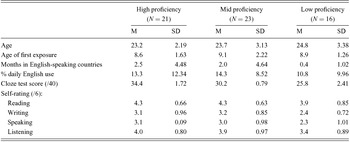
Sixty native speakers of Korean who learned English as a second language (22 females, 38 males) participated in the study for payment. All of them lived and were tested in Seoul. The participants completed a language background questionnaire reporting their age of first exposure to English, their months of residence in an English-speaking country, their percent daily use of English (self-assessed relative to their entire daily language use including reading activities), and their self-ratings of English proficiency on a scale of 1 to 6. The participants’ English proficiency was also assessed using a multiple-choice version of a cloze test (40 questions adopted from P. Dussias, Pennsylvania State University, personal communication). A reliability coefficient of the cloze test was estimated using the Kuder-Richardson Formula 20. The value of .68 indicated that the cloze test had moderate reliability. Based on the cloze test scores, the participants were divided into three proficiency groups of roughly equivalent size (high proficiency group: 32–37; mid proficiency group: 29–31, low proficiency group: 20–28). Table 1 summarizes the participants’ language background information and their cloze test scores.
Summary of the participants’ language background information (means and standard deviations).

Materials
The materials during the study phase consisted of the 36 recorded spoken discourses used in Experiment 3 of Fraundorf et al. (Reference Fraundorf, Watson and Benjamin2010). Each discourse began with a context passage, such as (5a), reproduced below. The context passage introduced two contrast sets, each consisting of two items (e.g., British and French as one set and Malaysia and Indonesia as the other). The discourse then concluded with a continuation passage, such as (5b) below, that referred to one member of each set.
-
(5a) Context passage: Both the British and the French biologists had been searching Malaysia and Indonesia for the endangered monkeys.
-
(5b) Continuation passage: Finally, the (British/BRITISH) spotted one of the monkeys in (Malaysia/MALAYSIA) and planted a radio tag on it.
All of the stories were recorded by a research assistant who was a native speaker of American English. The research assistant was trained on the different pitch accent types and produced each version of the discourse after being instructed on the desired interpretation. Across conditions, we manipulated whether each of the critical words in the continuation passage received an H* accent (indicated with regular text above) or the contrastive L+H* accent (indicated with capital letters above); see Fraundorf et al. (Reference Fraundorf, Watson and Benjamin2010, Table 5) for acoustic measures verifying differences in pitch contour, duration, and intensity between the H* and the L+H* conditions). This manipulation was done orthogonally for each of the two critical nouns in the continuation, such that a particular continuation passage could have an L+H* accent on the first critical word, on the second critical word, on both critical words, or on neither. The different versions of the discourse were created using cross-splicing so that the recordings were identical except for the critical words.
Within a particular story, it was constant which of the two words from the contrast set was mentioned in the continuation passage (e.g., in this particular story, it was always the British scientists who found the monkey). However, across stories, an equal number of target sentences referred to the member of the pair that had originally been mentioned first in the context passage (e.g., the British) as had been mentioned second in the context passage (e.g., the French).
Each story contained two different critical facts corresponding to the two critical words in the continuation (e.g., in the above example, who found the monkey and where the monkey was). These two facts were tested with separate memory probes. Thus, there were 72 total test probes in the memory test. Each critical word was tested in one of three different probe conditions: A probe that referred to the correct fact, a probe that referred to the other member of the contrast set from the original discourse, or a probe that referred to a wholly unmentioned item that had not been mentioned in any of the discourses. For example, examples (6a), (6b), and (6c) are the correct, contrast, and unmentioned probes, respectively, for the critical word British in discourse (5) above, while examples (7a), (7b), and (7c) are the same for the critical word Malaysia in (5).
-
(6a) The British scientists spotted the endangered monkey and tagged it.
-
(6b) The French scientists spotted the endangered monkey and tagged it.
-
(6c) The Portuguese scientists spotted the endangered monkey and tagged it.
-
(7a) The endangered monkey was finally spotted in Malaysia.
-
(7b) The endangered monkey was finally spotted in Indonesia.
-
(7c) The endangered monkey was finally spotted in the Philippines.
This resulted in a 2 × 3 factorial design: pitch accent type (H* or L+H*) × probe type (correct, contrast, or unmentioned). The assignment of items to conditions was counterbalanced across six presentation lists using a Latin Square design. The complete lists of stories and test probes are available in Fraundorf et al. (Reference Fraundorf, Watson and Benjamin2010).
Procedure
The experiment consisted of a study phase immediately followed by a test phase. At the beginning of the experiment, participants were instructed in English that they would be listening to short stories and their memory for the stories would later be tested.
In the study phase, participants were presented aurally with 36 stories. After each story, the computer automatically advanced to the next story with a five-second delay. Once participants had listened to all 36 stories, they proceeded to the test phase. In Fraundorf et al. (Reference Fraundorf, Watson and Benjamin2010), native English speakers’ recognition memory was tested after a 24-hour delay to prevent ceiling performance in correctly rejecting the false statements even in the baseline H* condition (thereby making it impossible to test any potential benefits of the L+H* accent over and above the H* accent). Because a ceiling performance is less worrisome for L2 learners, and indeed we were concerned that an extended retention interval might result in a floor effect for L2 learners, we tested their recognition memory immediately after the entire study phase had been completed.
In the test phase, participants saw statements about the stories that they had heard before, one at a time. Statements in the test phase were presented visually so that there were no prosodic cues present during the test phase. Participants indicated whether each statement was true or false by pressing a key on the keyboard. Participants were asked to judge the statement as being true only if it was exactly true and as being false if any part of it was false. Two statements were tested for each story.
The stories and the test statements were presented in separate randomized orders that were consistent across all administrations of a listFootnote 1 . Stimulus presentation was controlled using MATLAB and the Psychophysics Toolbox (Brainard, Reference Brainard1997; Kleiner, Brainard & Pelli, Reference Kleiner, Brainard and Pelli2007; Pelli, Reference Pelli1997) and the CogToolbox (Fraundorf, Diaz, Finley, Lewis, Tooley, Isaacs, Lam, Trude, Brown-Schmidt & Brehm, Reference Fraundorf, Diaz, Finley, Lewis, Tooley, Isaacs, Lam, Trude, Brown-Schmidt and Brehm2014).
Results
As in Fraundorf et al. (Reference Fraundorf, Watson and Benjamin2010), we used a detection-theoretic analysis to de-confound the fidelity of participants’ memory from their tendency to respond true or false. This analysis was motivated by the fact that the correct answer to the memory probes varies across conditions: For the correct probes, the correct answer is true, but for the contrast and unmentioned probes, the correct answer is false. Apparent differences across conditions in the proportion of accurate responses might thus reflect a general preference to respond true or false rather than differences in participants’ actual memory for the specific discourses. This issue can be solved by using a detection-theoretic analysis rather than proportion accuracy (Green & Swets, Reference Green and Swets1966; Macmillan & Creelman, Reference Macmillan and Creelman2005; see also Murayama, Sakaki, Yan & Smith, Reference Murayama, Sakaki, Yan and Smith2014, and Wright, Horry & Skagerberg, Reference Wright, Horry and Skagerberg2008, for applications of detection theory to multi-level models using the log odds ratio).
In a detection-theoretic analysis, the dependent variable is ‘true’ responses instead of response accuracy. This analysis allows a theoretical and statistical deconfounding of participants’ response bias (their overall tendency to respond true or false, represented by the intercept term) from their memory sensitivity (their sensitivity to whether particular probes were true or false). Specifically, if participants have some memory for the discourse, they should be less likely to give a ‘true’ response in the contrast-probe and unmentioned-probe conditions, which are false statements.
We examined L2 learners’ memory in two ways. First, the L2 learners tested here were directly compared to the native speaker data previously reported by Fraundorf et al. (Reference Fraundorf, Watson and Benjamin2010). To preview, the L+H* accent had different effects on memory for non-native speakers than for native speakers. Second, we then looked within the L2 group to test whether and how those differences were modulated by L2 proficiency.
Native versus non-native comprehenders
We first compared L2 learners’ data with those of native English speakers from Fraundorf et al. (Reference Fraundorf, Watson and Benjamin2010) to examine whether contrastive accents led L1-Korean learners of L2-English to represent the discourse differently from native English speakers.
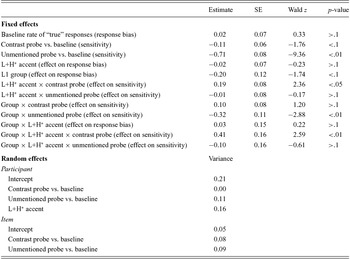
We fit a mixed logit model (Jaeger, Reference Jaeger2008) with probe type (correct vs. contrast vs. unmentioned), accent type (H* vs. L+H*), group (L1 vs. L2), and their interactions as fixed effects. As random effects, we included by-participant and by-item random intercepts, by-participant random slopes for probe type and accent type, and by-item random slopes for probe type. In this and the following models, by-participant random slopes for the interaction between the two within-subjects factors and by-item random slopes for the effect of accent type did not improve the model fit (p’s > .05) and were consequently excluded. The probe type variable was coded using effect coding to perform two planned comparisons. In the first, the rate of ‘true’ responses to contrast probes was compared to the overall (mean) rate of ‘true’ responses. In the second comparison, the rate of ‘true’ responses to unmentioned probes was compared to the overall (mean) rate of ‘true’ responses. All other variables were coded using mean-centered contrast coding, yielding tests of the main effects directly analogous to that obtained from an ANOVA.
Table 2 displays the results from the model of ‘true’ responses for both L1 and L2 listeners. Averaging across groups, there was no overall bias to respond either true or false (z = 0.33, p > .1). Further, neither accent type nor group (L1 vs. L2) had significant main effects on the rate of ‘true’ responses.
Mixed logit model of “true” responses with probe type, accent type, group (L1 vs. L2), and their interactions as fixed effects (N = 6480, log-likelihood: −4101).

Of greater importance in this paradigm is whether the contrastive L+H* accent modulated participants’ responses to the two types of false statements. The two-way accent type × contrast probe interaction was significant (z = 2.36, p < .05), indicating that – averaging across the L1 and L2 groups – the L+H* accent reduced the rate of ‘true’ responses to the contrast probes. That is, the L+H* accent led participants to be more successful at correctly rejecting the contrastive alternatives. By comparison, the accent type × unmentioned probe interaction was not significant and was numerically in the opposite direction (z = −0.17, p > .1) indicating that, averaging across all listeners, the L+H* accent conferred no benefit in rejecting the wholly unmentioned items.
Most critical, however, was whether the L1 and L2 groups differed from each other in the effects of contrastive accents on participants’ responses to false statements. Indeed, the three-way interaction among group, accent type, and contrast probe was significant (z = 2.59, p < .01), indicating that contrastive accents led L2 learners to represent the salient alternative differently from native speakers. Specifically, the positive sign of the interaction indicated that the benefit of the L+H* accent in rejecting the contrast probes was greater for the L1 group than for the comparison L2 group.
Effects of proficiency among L2 listeners
The above analysis indicated that L2 learners do not derive the same memory benefits from contrastive pitch accents as do L1 listeners. In the next analysis, we sought to further characterize the effect of pitch accents on L2 learners’ memory for a discourse as well as to test whether these effects were modulated by variation in proficiency within the L2 group.
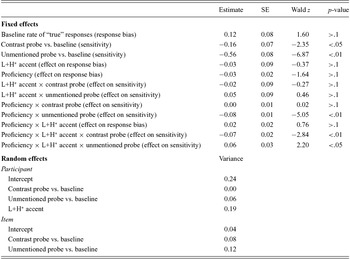
We analyzed just the L2 listeners’ data using a model with probe type (correct vs. contrast vs. unmentioned), accent type (H* vs. L+H*), proficiency (cloze test scores), and their interactions as fixed effects. We treated proficiency as a continuous variable (i.e., using the exact cloze test scores) because this analysis incorporates the full range of variation in proficiency and is more powerful (Cohen, Reference Cohen1983). Cloze test scores were mean-centered to assess the effect of the other variables at an average cloze test score.
The model of ‘true’ responses for all L1-Korean learners of English (Table 3) reveals that they did not have an overall bias to respond either true or false (z = 1.60, p > .1). Further, neither accent type nor L2 proficiency had significant main effects on the rate of ‘true’ responses. However, L2 participants made significantly fewer ‘true’ responses to each of the two kinds of incorrect probes compared to the overall rate of ‘true’ responses (contrast: z = −2.35, p < .05; unmentioned: z = −6.87, p < .01). This pattern is appropriate given that these probe types represent false statements that should not receive ‘true’ responses, and it indicates that L1-Korean learners of English had some veridical memory for the discourse. Further, L2 learners’ ability to reject unmentioned probes was modulated by L2 proficiency as revealed by a significant interaction (z = −5.05, p < .01). However, there was no effect of L2 proficiency on rejections of contrast probes (z = 0.02, p > .1).
Mixed logit model of “true” responses with probe type, accent type, proficiency, and their interactions as fixed effects (N = 4320, log-likelihood: −2737).

Fraundorf et al. (Reference Fraundorf, Watson and Benjamin2010) found that the L+H* accent enhanced native English speakers’ ability to reject the contrast probes, yielding fewer false alarms specifically to the contrast probes, consistent with the contrast representation account. However, such an effect was not observed in the L2 group (z = −0.27, p > .1), consistent with the finding above that the L1 and L2 groups differed in how the L+H* accent affected rejections of the contrast probes (i.e., the group × accent type × contrast probe interaction in Model 2). Nor did the L+H* accent improve L2 listeners’ performance in rejecting the unmentioned probes (z = 0.46, p > .1).
However, it was not the case that the L+H* accent was completely irrelevant to all L2 listeners’ performance. Rather, L2 proficiency crucially modulated the effects of the L+H* accent on rejecting the contrast probes (z = −2.84, p < .01) as well as the unmentioned probes (z = 2.20, p < .05).
Decomposition of the proficiency effects
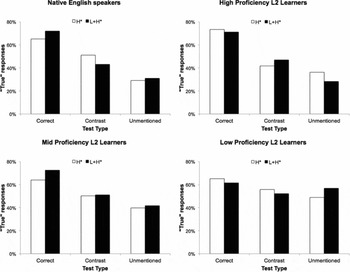
To decompose the 3-way interaction among proficiency, accent type, and rejection of either the unmentioned probes or the contrast probes, we analyzed the data separately for the high proficiency group, the mid proficiency group, and the low proficiency group, with accent type, probe type, and their interaction as fixed effects in each case. Figure 1 illustrates the mean percentages of ‘true’ responses (a hit to correct probes and a false alarm to contrast or unmentioned probes) to different probe types by accent type separately for native English speakers (Fraundorf et al., Reference Fraundorf, Watson and Benjamin2010), the high proficiency group, the mid proficiency group, and the low proficiency group. As can be seen in the figure, none of three groups of L2 learners was directly analogous to native English speakers in how contrastive accents affected their memory for discourse. We examine each of the three groups in turn.
Mean percentage of ‘true’ responses as a function of probe type and accent type for native English speakers (Fraundorf et al., Reference Fraundorf, Watson and Benjamin2010), high proficiency group, mid proficiency group, and low proficiency group. Responding true is a hit to a correct probe and a false alarm to a contrast or unmentioned probe.

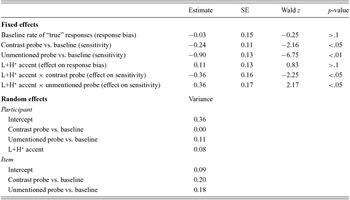
Table 4 presents the model of ‘true’ responses for the high proficiency group. High proficiency L2 learners did not show any overall preference to respond true or false (z = −0.25, p > .1), and they had an ability to correctly reject both types of false statements (contrast probes: z = −2.16, p < .05; unmentioned probes; z = −6.75, p < .01). Crucially, this ability was modulated by pitch accent type, as revealed by significant interactions between accent type and rejection of the contrast probes (z = −2.25, p < .05) and between accent type and rejection of the unmentioned probes (z = 2.17, p < .05). However, the nature of these pitch accent effects differed from those observed with native English speakers. Unlike native English speakers, the contrastive accent had a detrimental effect on rejection of the contrast probes: High proficiency learners incorrectly made more ‘true’ responses to contrast probes when the critical word was produced with an L+H* accent (47%) earlier than with an H* accent (42%), the reverse of the pattern obtained with native speakers. Instead, the contrastive accent facilitated rejection of the unmentioned probes: High proficiency L1-Korean learners were less likely to false-alarm to the unmentioned probes when the critical word was originally produced with an L+H* accent (28%) than with an H* accent (36%).
Mixed logit model of “true” responses with probe type, accent type, and their interaction as fixed effects: High proficiency L2 learners (N = 1512, log-likelihood: −903).

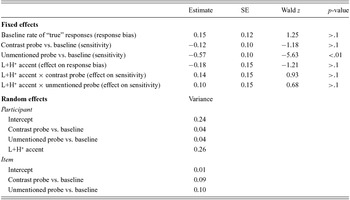
The mid proficiency group (Table 5) showed a different pattern of results. As illustrated in Figure 1, mid proficiency L1-Korean learners of English appropriately made fewer ‘true’ responses to the unmentioned probes (z = −5.63, p < .01), indicating that mid proficiency learners had some memory for the discourse. However, their rate of ‘true’ responses was not significantly lower to the contrast probes (z = −1.18, p > .1), suggesting some limits to the accuracy of their memory for L2 discourse. Further, pitch accent type did not affect mid proficiency learners’ overall rate of ‘true’ responses, nor were the interactions between accent type and probe type significant, indicating that no aspects of their responses were modulated by pitch accent type.
Mixed logit model of “true” responses with probe type, accent type, and their interaction as fixed effects: Mid proficiency L2 learners (N = 1656, log-likelihood: −1062).

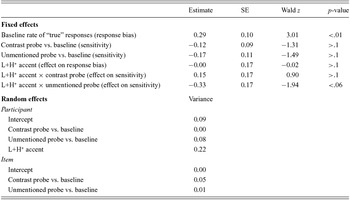
Finally, unlike high and mid proficiency L1-Korean learners of English, low proficiency L1-Korean learners (Table 6) had an overall bias to respond true, as revealed by a significant intercept parameter (z = 3.01, p < .01). Low proficiency learners failed to correctly reject each type of false statements (all p’s > .1), indicating that they had poor memory for the discourse overall. The low proficiency group also made more false alarms to the unmentioned probes when the critical word originally received an L+H* accent (57%) compared to an H* accent (49%), but this accent type by unmentioned probe interaction was only marginally significant. The interaction between accent type and contrast probe was not significant (p > .1). Thus, the data suggest that the contrastive L+H* accent yielded no mnemonic benefit for low proficiency learners’ memory for the content of a discourse, just as it yielded no benefit for mid proficiency learners.
Mixed logit model of “true” responses with probe type, accent type, and their interaction as fixed effects: Low proficiency L2 learners (N = 1152, log-likelihood: −772).

Discussion
The present study examined how L1-Korean learners of L2-English encode in memory information conveyed by contrastive accents. L2 learners listened to a series of discourses in which contrast sets were explicitly established. A critical word referring to one of the items from the contrast set was then produced either with a contrastive accent (L+H*) or with a non-contrastive accent (H*). Using a sentence probe recognition test, we tested L2 learners’ memory for those discourses. Probes referred either to the correct statement, the contrastive alternative, or a previously unmentioned item.
We used these probes to evaluate the predictions of three different accounts of how contrastive accents might affect memory for L2 discourse: The granularity account, the contrast representation account, and the shallow representation account. The granularity account proposes that an L+H* accent enhances representations of the correct, focused word itself, thereby facilitating rejections of any lure inconsistent with the true statement. By contrast, the contrast representation account proposes that the effect of the contrastive L+H* accent relative to the presentational H* accent is to promote a representation of a salient alternative in the discourse. This account predicts that an L+H* accent would facilitate rejection only of statements concerning the contrastive alternative to the true statement, not rejections of a wholly unmentioned item. Finally, the shallow representation account proposes that the L+H* accent brings to mind the set of alternatives, but because of their limited processing resources, L2 listeners fail to fully integrate into their discourse representation which is the contrastive alternative. This account predicts that the contrastive accent would help L2 listeners distinguish the general contrast set from an unmentioned item, facilitating rejection only of a wholly unmentioned item. But, it would not help (and might even harm) listeners’ ability to discriminate – within the set of alternatives – which is the correct item and which is the contrastive alternative.
Previous results with native English speakers (Fraundorf et al., Reference Fraundorf, Watson and Benjamin2010) supported the contrast representation account of L1 processing: The benefit of contrastive accents on rejecting contrastive alternatives along with the absence of an effect on rejections of the unmentioned item suggested that the effect of contrastive accents was to enhance a representation of the contrast item. Using the same materials as Fraundorf et al. (Reference Fraundorf, Watson and Benjamin2010), we found that L2 learners, however, regardless of proficiency, showed a different pattern of results from that of native English speakers. In the low and mid proficiency groups, there were no mnemonic benefits of contrastive accents whatsoever, indicating that even moderately proficient L1-Korean learners of English were not sensitive to pitch accent type. By contrast, high proficiency L1-Korean learners of English revealed some sensitivity to contrastive accents: They were better at rejecting statements about an unmentioned item when the critical word was originally produced with an L+H* accent than with an H* accent. However, the mechanism underlying the mnemonic effect of contrastive accents in this high proficiency group appears to differ from that of native speakers. For the L2 listeners, the contrastive accent did not facilitate rejections of the contrast item, which is inconsistent with the contrast representation account. It is also inconsistent with the granularity account, which predicts contrastive accents to benefit rejections of any type of false statement. Rather, the finding that contrastive accents facilitated rejection only of the statements about an unmentioned item is most consistent with the shallow representation account. High proficiency L2 learners did establish a contrast set, but they failed to integrate the salient alternative into discourse representation. This led them to be successful in rejecting an unmentioned item from outside the set of alternatives, but unsuccessful in distinguishing the focused word itself from its salient alternative. In addition to the interaction between pitch accent type and unmentioned probe, high proficiency learners showed a significant interaction between accent type and contrast probe such that contrastive accents yielded more false alarms to the contrast probes than the presentational accent. This result is also consistent with the shallow representation account; it suggests that the L+H* accent led high proficiency L2 learners to construct a contrast set, but that they did not fully integrate into memory which was the contrastive alternative, resulting in later confusions in memory.
L2 contrastive accenting processing in high proficiency learners
Previous studies have also reported that L2 learners diverge from native speakers in their sensitivity to contrastive accents in processing L2 utterances. L2 listeners often failed to appropriately map pitch contours to information structure (Baker, Reference Baker2010; Braun & Tagliapietra, Reference Braun and Tagliapietra2011) or at least were less efficient in doing so compared to native listeners (Akker & Cutler, Reference Akker and Cutler2003). Consistent with these findings, we found that the mnemonic effect of contrastive accents even in high proficiency L2 learners differed from that of native listeners. However, given that the L+H* accent did lead high proficiency L2 learners to construct a contrast set, their non-native performance is not attributable to the lack of knowledge of the mapping between the L+H* accent and contrastive focus itself, because despite the lack of a mapping between pitch accents and focus in their L1, high proficiency L1-Korean learners of English learned to associate the L+H* accent with a contrastive meaning in their L2. Rather, the seeming inability of L2 learners to fully encode the contrast suggests that the non-native performance of high proficiency learners was instead driven by their cognitive resource limitations, which prevented them from successfully incorporating this knowledge about pitch accents into their discourse representation, and not by L1 transfer arising from the L1-L2 difference in prosodic structure.
Taking a step further, the current study contributes to understanding what might underlie previous observations of non-native performance among L2 learners processing contrastive accents. The finding that even higher proficiency L2 learners failed to fully integrate information conveyed by contrastive accents into their memory representation of an L2 discourse suggests that L2 learners’ non-native processing of contrastive accents may be attributable at least in part to L2 listeners creating a shallower representation of information conveyed by contrastive accents. The shallow representation account may also explain why L1-Cantonese learners of English showed poor performance in using prosody to recognize L2 utterances in Pennington and Ellis (Reference Pennington and Ellis2000).
L2 contrastive accenting processing in lower proficiency learners
We found that there were no effects of contrastive accents on low and mid proficiency L2 learners’ encoding of L2 discourse. Two related explanations of this pattern of results are that lower proficiency L1-Korean learners of English were not successful in acquiring knowledge of the L2-specific intonation-function mapping, which is required to understand contrastive accents in English, or that they were not successful in distinguishing different pitch accent types. Such a failure to successfully identify the L+H* accent and learn its contrastive reading would not be surprising given the L1-L2 differences in prosodic structure and the relatively low validity of pitch accents as a cue.
An alternate explanation of the null effect of contrastive accenting within the low and mid proficiency groups, however, is simply that the task was too difficult for lower proficiency L2 learners. Although we did not explicitly test whether the participants were familiar with the vocabulary included in the test material, it is possible that lower proficiency L2 learners had greater difficulty processing the literal text than high proficiency L2 learners, as perhaps suggested by the overall high false-alarm rate (mid proficiency: 46%, low proficiency: 53%). Thus, the memory performance of lower proficiency L2 learners may not have been sensitive enough to capture their interpretation of contrastive accents. However, task difficulty is unlikely to wholly explain the absence of mnemonic effects of contrastive accents in the lower proficiency group. First, mid proficiency L2 learners had fewer false-alarms to the statements (41%) about an unmentioned item than about a contrast item (51%), indicating that they had some memory for discourse content, yet they still did not show a benefit of the contrastive accents. Second, the false-alarm rate was also fairly high in high proficiency L2 learners (38%) as well as in native speakers from Fraundorf et al. (Reference Fraundorf, Watson and Benjamin2010) (39%); as pointed out by Fraundorf et al. (Reference Fraundorf, Watson and Benjamin2010), probe recognition tasks requiring participants to judge the truth value of the statements often lead to a high false-alarm rate even in native speakers (e.g., Park & Reder, Reference Park, Reder and Pohl2004; Sanford & Sturt, Reference Sanford and Sturt2002). Nevertheless, there was a memory benefit from contrastive accents in both high proficiency L2 learners and native speakers. Thus, it is unlikely that the relatively high false-alarm rate is alone sufficient to account for the absence of a contrastive-accent effect among low and mid proficiency L2 learners.
The shallow structure hypothesis vs. the shallow representation account
In the domain of syntactic processing, the shallow structure hypothesis (Clahsen & Felser, Reference Clahsen and Felser2006a, Reference Clahsen and Felser2006b) proposes that there is a fundamental difference between native speakers and L2 learners in processing complex sentences in that L2 learners construct a less detailed syntactic representation, relying primarily on semantic-lexical information. Unlike the shallow structure hypothesis, the current study does not tap into syntactic processing, and it instead concerns the interaction between prosody and discourse representation. The ‘shallowness’ here is tied to the amount of cognitive resources available for integrating information across different levels. The shallow representation account assumes that there is a quantitative rather than a qualitative difference between native speakers and L2 learners in the mechanism by which pitch accents are used to represent and encode the discourse. Cognitive resources required for processing the literal text decrease with increased L2 proficiency. It is certainly a possibility that if we test L2 learners with more L2 exposure or higher L2 proficiency than those tested here, their sensitivity to contrastive accents may converge with that of native speakers by virtue of having more cognitive resources available for integrating information conveyed by contrastive accents into memory. Future research is required to examine this possibility.
Conclusion
Our data demonstrate that L2 proficiency modulates L2 learners’ sensitivity to contrastive accents in encoding L2 discourse, suggesting that L1-Korean learners can learn the L2-specific prosody-function mapping as L2 proficiency increases. Specifically, the data from both the current study and the earlier study by Braun and Tagliapietra (Reference Braun and Tagliapietra2011) demonstrate that high proficiency L2 learners can interpret contrastive accents contrastively, evoking a contrast set. However, the current data show that even high proficiency L2 learners failed to achieve a native-like ability to fully integrate information conveyed by contrastive accents into their discourse representation.