This paper reports observations suggesting that the drift of plastic debris may aid range extension or the breaching of geographic barriers to the spread of sessile marine organisms. The large barnacle Perforatus (Balanus) perforatus Bruguière has a limited south-western distribution on British coasts (Southward, Reference Southward2008) and its distribution may be expected to extend further north and east with a warming climate (Hiscock et al., Reference Hiscock, Southward, Tittley and Hawkins2004). Until recently the species was restricted to the south-west peninsula of Dorset, Devon and Cornwall and the southernmost parts of south-west Wales. In the English Channel it occurred only westwards from the Isle of Wight and the Cotentin peninsula (Crisp & Southward, Reference Crisp and Southward1958). Subsequently the range has extended eastwards to Hastings on the English side of the Channel and to Le Treport on the French side (Herbert et al., Reference Herbert, Hawkins, Sheader and Southward2003). This barnacle also occurs on ships and there have been records on floating objects far beyond the normal range, such as on the southern North Sea coasts of France, Belgium and Holland (Buizer, Reference Buizer1978; Davoult et al., Reference Davoult, Dewarumez and Glaçon1993; Kerckhof & Cattrijsse, Reference Kerckhof and Cattrijsee2001). For the Irish Sea there is also one previous out-of-range record of P. perforatus, on a plastic container washed up at Rhosneigr, Anglesey in January 1974 (E.I.S. Rees, personal observation).
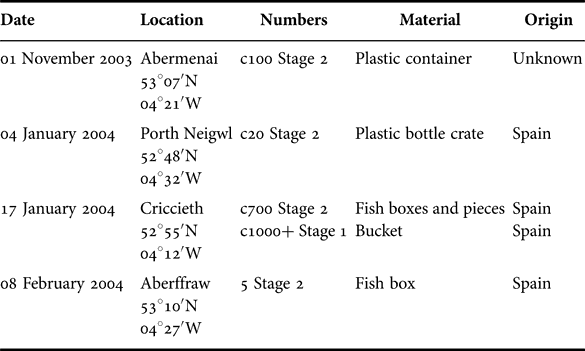
In North Wales, during the period October 2003 to February 2004, P. perforatus was found on at least 12 plastic fish boxes, buckets and other items of plastic flotsam (Table 1). These finds were all made during casual visits to four beaches, suggesting that a significant quantity of plastic flotsam carrying this warm water barnacle may have arrived on the North Wales coast. In total over 800 well-developed individuals at the pink cone stage (4–9 mm diameter) were seen. Most were dead when found, but on one plastic fish box, with about 80 P. perforatus on it, a third of those examined had soft parts still intact inside the shells. These were probably alive when the box was washed ashore in mid January 2004. At the same time and place, a plastic bucket was found which carried over 1000 very small individuals, some of which were <1 mm diameter. Where there were markings on the items of plastic flotsam carrying P. perforatus, almost all apparently came from the Galician region of north-western Spain. Fishing fleets from Spain operate very widely, but the presence in the same stranding event of several boxes originating from fishing ports in South Devon and Cornwall, but without P. perforatus on them, provides supporting evidence that the flotsam concerned had come from much further south.
Summary of Balanus perforatus on plastic flotsam in North Wales during the winter of 2003–2004. Stage 1, newly settled individuals <4 mm diameter; Stage 2, ‘pink cone’ form 5–10 mm diameter. Origins based on inscriptions on flotsam.

The finds of P. perforatus in North Wales during the winter 2003–2004 are about 100 to 130 km north of the presently known rocky shore distribution limit in Pembrokeshire. In the laboratory, P. perforatus requires sea temperatures reaching 16–17°C to induce development of larvae, but it can produce multiple broods when conditions remain favourable (Patel & Crisp, Reference Patel and Crisp1960). In south-west Britain P. perforatus begins gonad development in May and June, and embryos are brooded from July to September, with a few mature gonads still present in October (Herbert et al., Reference Herbert, Hawkins, Sheader and Southward2003). In north-west Spain they were recorded releasing larvae in August and September (Macho et al., Reference Macho, Morales and Vazquez2005).
Away from locally warmed inshore areas on southern British coasts, the critical August sea surface isotherms required for P. perforatus to produce larvae usually lie about 200 km south of where the flotsam stranded in North Wales. The mean August sea surface 16°C isotherm in the open Celtic Sea reaches just north of latitude 51°N, while the 16.5° and 17°C isotherms are near latitudes 50° and 49° respectively (Lee & Ramster, Reference Lee and Ramster1981). Mean monthly surface and bottom temperatures used for modelling by (Elliott et al., Reference Elliott, Clarke and Li1991) put the 16° isotherm at about 51.3°N in September, but it withdrew south of 47°N in October. Stratification is particularly strong in the Celtic Sea with a 4–6°C surface to bottom difference in August and with a deep surface mixed layer (Elliott & Clarke, Reference Elliott and Clarke1991). These authors also showed that in the Celtic Sea the breakdown of stratification occurs quite slowly, with the fronts usually retreating at an average of about 5 km per day.
Gill (Reference Gill2008) showed that off the north coast of Spain variable mesoscale filaments in the water masses, driven by wind conditions, can be responsible for carrying fish larvae offshore into the Bay of Biscay in some years. This could also apply to both barnacle larvae and plastic debris. Residual currents run northwards from off Ushant across the mouths of the English and Bristol Channels before setting westwards off the south coast of Ireland (Pingree & Le Cann, Reference Pingree and Le Cann1989). This flow is responsible for northwards extensions in sea surface isotherms in the Celtic Sea and it provides a credible mechanism for the northwards transport of flotsam and planktonic larvae towards the entrance to St George's Channel. The flow persists at least as long as there is stratification. The Celtic Sea front off the mouth of St George's Channel has also been shown to generate eddies (Pingree, Reference Pingree1978). Further north in St George's Channel the isohalines, in both summer and winter, provide good evidence for a generalized northward residual flow through the Irish Sea (Bowden, Reference Bowden1955). Though generally quite weak at 1–2 cm s−1 (Bowden, Reference Bowden and Massie1980), meteorological conditions can induce surges that greatly increase the northward flow. A jet current has sometimes been found on the Welsh side of St George's Channel in late summer (Horsburgh et al., Reference Horsburgh, Hill and Brown1998). A strong north-going flow across the mouth of the English Channel and the Bristol Channel has been postulated as facilitating occasional autumn/winter extensions of the range of the copepod Euchaeta hebes into St George's Channel (Southward, Reference Southward1962), and may have helped temporary colonization of shores in Devon and Cornwall by the warm-water hermit crab Clibanarius erythropus in 1959–1960 (Southward & Southward, Reference Southward and Southward1988).
Fish boxes with drainage holes in them and made of high density polypropylene only just float, so that they will drift with the surface water. Drift vector hindcasts, from the place and time in mid January where the fresh Perforatus perforatus came ashore, using rates of 2.5 and 3.5% of the wind speed, implied that this flotsam may have been in the middle of the southern end of St George's Channel at the end of December (A.J. Elliott, personal communication). Plots further back to the beginning of December, using a similar range of drift factors implied that the material could have been either in St George's Channel or in the Celtic Sea off the Bristol Channel. In autumn 2003 winds had been relatively light until early November, which may have allowed stratification in the South Western Approaches to persist for longer than usual. There was then a period with often strong south and south-westerly winds for the rest of the month which would have favoured the long distance drift of flotsam. Comparisons may be made with the drift of identifiable wreckage from a catamaran yacht that was abandoned 350 km north-west of Cape Finistere in November 1989. After 71 days it washed up in North Wales 1072 km from where it was lost. The best fit of the drift vector hindcast was 2.6% of the wind speeds (Brown, Reference Brown1991).
The development and growth of P. perforatus has been studied under controlled temperature conditions (A. Yule, personal communication). The larvae are small and at 25°C they are ready to settle in only a week after hatching. The rate was not studied at lower temperatures, but at 15°C they might still take only two weeks to the settlement stage (A. Yule, personal communication). Under laboratory conditions they also grew quite fast after settlement. Thus the small ‘pink cone’ stage individuals on the plastic fish boxes might have settled only 6–8 weeks before they were found. This implies that the settling date on the flotsam may have been after the usual settlement period of September/October recorded in south-west Britain by Patel & Crisp (Reference Patel and Crisp1960). The very small specimens found on the plastic bucket suggest settlement may have occurred even later in the year, pointing to an origin of larvae in more southern latitudes where the breeding season should last longer than in south-west England. Alternatively, this bucket may have been re-floated after some earlier stranding.
The pink cone stage barnacles on the flotsam in North Wales included about 15% that were within the size range found carrying eggs in southern England (Herbert et al., Reference Herbert, Hawkins, Sheader and Southward2003). Examination of specimens spaced more than 10 cm apart on rocks showed that they can also self-fertilize (Patel & Crisp, Reference Patel and Crisp1960). It is therefore possible that small numbers of P. perforatus attached to plastic flotsam could reproduce while drifting offshore. It would, however, require that the flotsam stays drifting in suitably warm surface water for long enough. In calm summer weather flotsam may accumulate in windrows, without washing ashore, for several months. The local circulation cells associated with fronts and internal waves favours both the accumulation of flotsam in surface slicks and concentration of the larvae of some invertebrates (Zeldis & Jillett, Reference Zeldis and Jillett1982; Shanks, Reference Shanks1983; Fevre & Bourget, Reference Fevre and Bourget1991). The cyprid larvae of Verruca stroemia have been reported concentrated in the neustonic niche in a frontal region off Ushant (Shanks, Reference Shanks1983; Fevre & Bourget, Reference Fevre and Bourget1991).
When the non-native barnacle Elminius modestus, which also has a small-sized larva, spread round the British coasts, natural dispersal seems to have been limited to 20 to 30 miles (Crisp, Reference Crisp1958). A short larval life was the reason suggested why Perforatus perforatus had not crossed St George's Channel to colonize the south coast of Ireland (Crisp & Southward, Reference Crisp and Southward1953). The vector provided by plastic flotsam could lead to this barrier being breached as well as colonization of those inshore parts of the Irish Sea where summer temperatures are high enough for the species to breed. Another warmer water barnacle, Solidobalanus fallax, was shown by Southward et al. (Reference Southward, Hiscock, Kerckhof, Moyse and Elfimov2004) to settle on plastic as an alternative to other benthic organisms, suggesting that the increasing prevalence of discarded plastic provides opportunities for dispersal.
ACKNOWLEDGEMENTS
Earlier drafts of this paper had been prepared in collaboration with Alan Southward prior to his death on 27 October 2007. Ivor Rees is most grateful to Dr Eve Southward for agreeing to the paper going forward with Alan as joint author.