Introduction
Chromosomal imbalances, gains or losses of segments and/or whole chromosomes, are common in humans. Balanced structural chromosome rearrangements are observed in the range of 1 in 500 to 1 in 1000 live births (Jacobs et al., Reference Jacobs, Melville, Ratcliffe, Keay and Syme1974; Simopoulou et al., Reference Simopoulou, Harper, Fragouli, Mantzouratou, Speyer, Serhal, Ranieri, Doshi, Henderson, Rodeck and Delhanty2003). Although both balanced reciprocal and Robertsonian translocation carriers are phenotypically normal, there is a reproductive risk of the carriers depending on the chromosomes involved, breakpoint positions, the segregation patterns and the sex of the carrier (Ford & Clegg, Reference Ford and Clegg1969; Simopoulou et al., Reference Simopoulou, Harper, Fragouli, Mantzouratou, Speyer, Serhal, Ranieri, Doshi, Henderson, Rodeck and Delhanty2003).
Preimplantation genetic diagnosis (PGD) is applied to patients with known structural chromosomal abnormalities to select a balanced or normal embryo for transfer in order to decrease the miscarriage rate, avoid transferring an embryo with unbalanced chromosomal complement and increase the pregnancy rate with a birth of a healthy child. One of the limitations of the current techniques (fluorescence in situ hybridisation or array comparative genomic hybridisation) used in PGD for translocation carriers is the inevitability of distinguishing a balanced embryo from a normal one.
Multi-centre analysis as part of the European Society of Human Reproduction and Embryology (ESHRE) consortium showed that only 27% of embryos biopsied from translocation carriers were transferable (Harper et al., Reference Harper, Wilton, Traeger-Synodinos, Goossens, Moutou, Sengupta, Pehlivan Budak, Renwick, De Rycke, Geraedts and Harton2012; Moutou et al., Reference Moutou, Goossens, Coonen, Rycke, Kokkali, Renwick, Sengupta, Vesela and Traeger-Synodinos2014). Therefore, patients with low number of oocytes and/or embryos available for PGD may even have a lower chance of an embryo transfer due to the lack of balanced/normal embryos. A new management scheme of oocyte accumulation was successfully applied for patients with low response to ovarian stimulation (Cobo et al., Reference Cobo, Garrido, Crespo, Jose and Pellicer2012). For these patients, a series of stimulation cycles were performed and the oocytes were vitrified. Oocyte accumulation was also applied to a patient undergoing PGD for translocation where the cycle resulted in a birth of a healthy child (Chung et al., Reference Chung, Son, Zhang, Ao, Tan and Holzer2012). Although this new management system is promising, oocyte vitrification is not permitted in some countries. However, a similar approach of embryo accumulation with the use of vitrification techniques would increase the number of embryos to be biopsied for PGD and may improve the chances of obtaining a balanced or normal embryo. The aim of this study was to investigate the optimum number of embryos required for PGD by FISH to increase the likelihood of obtaining a balanced or normal embryo. To maximise the chance of an embryo transfer, a new management scheme of embryo vitrification before PGD will be applied to patients with low number of embryos.
Materials and methods
PGD outcome, embryo transfer and pregnancy rates of patients undergoing PGD for both Robertsonian and reciprocal translocations were retrospectively analysed from August 2010 to June 2013 in Bahceci Assisted Reproductive Technology Centre.
Patient information
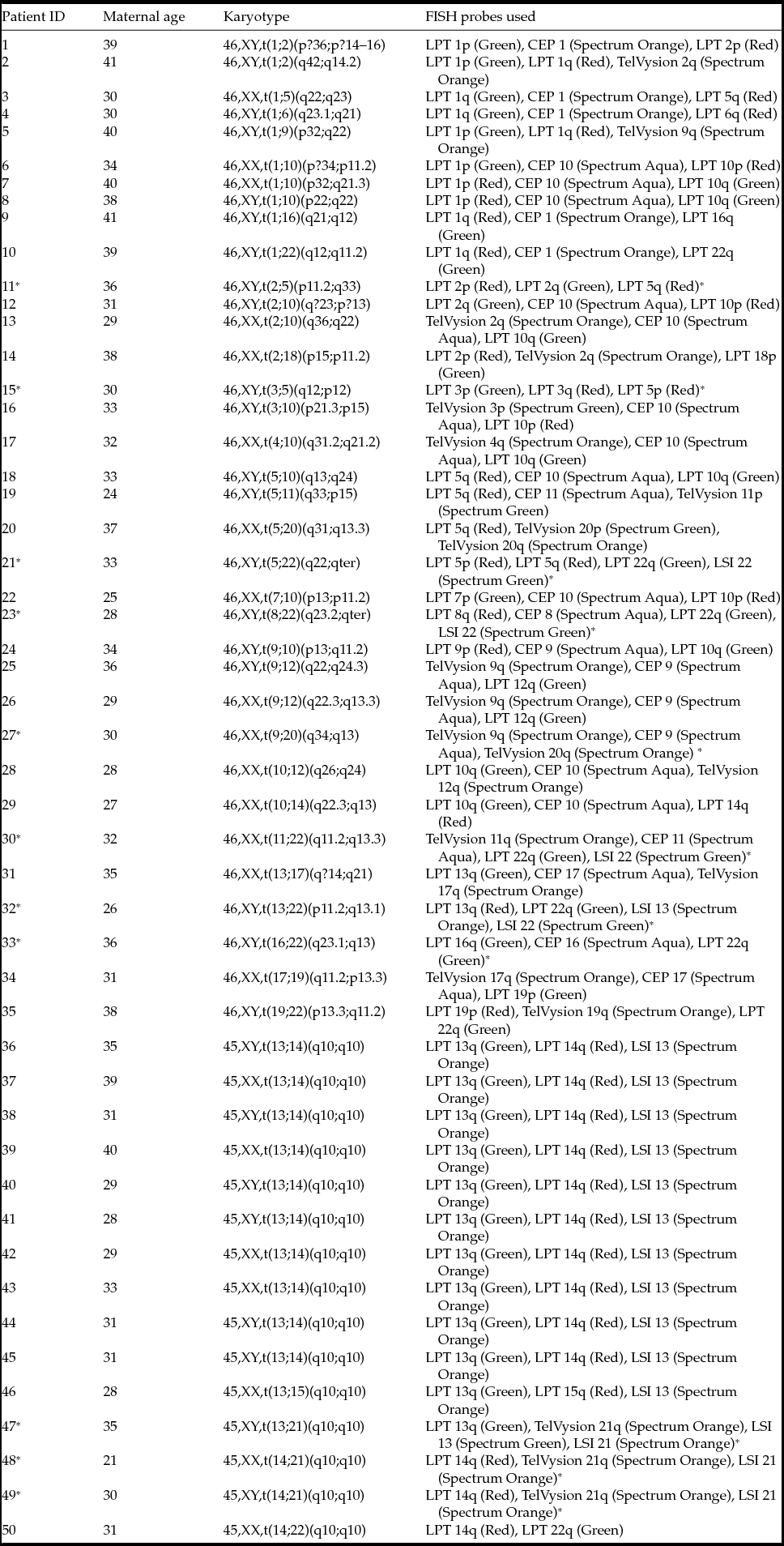
Fifty couples underwent 57 PGD cycles for reciprocal and Robertsonian translocations. Informed consent was obtained from all the couples prior to each PGD cycle. Karyotypes of all the patients were reported by clinical cytogeneticists using chromosome banding techniques (Table 1). To confirm the breakpoints of the reciprocal translocations, patients’ lymphocytes were tested by fluorescence in situ hybridisation (FISH) using three probes, a sub-telomeric specific for each translocated segment and a centromeric probe for one of the centric segments (Table 1).
List of patient information

Patient ID with the maternal age at the time of oocytes retrieval, karyotype and the list of probes used in PGD analyses are listed. All the probes were purchased from Cytocell (UK) and Abbott Molecular Inc. (USA).
*Represents two rounds of FISH analysis.
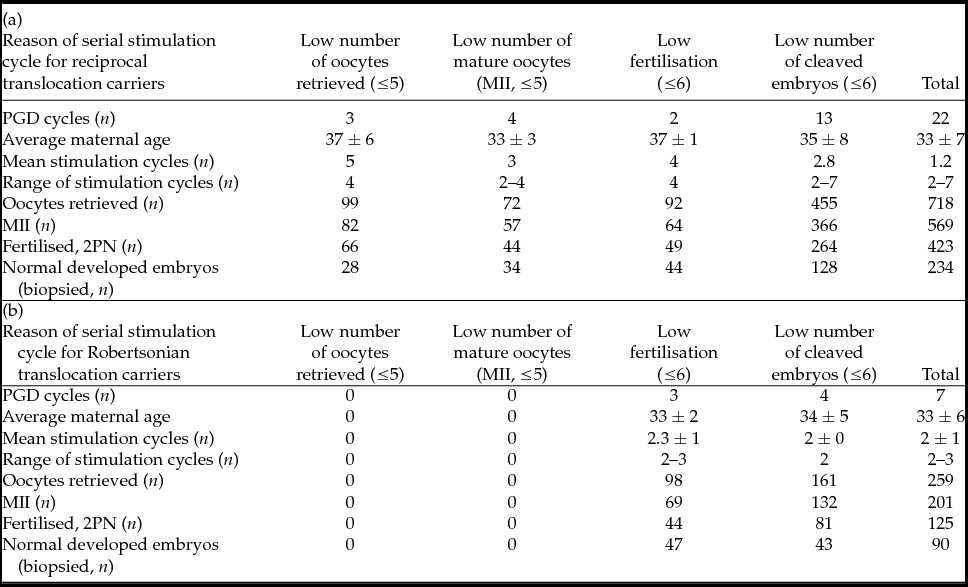
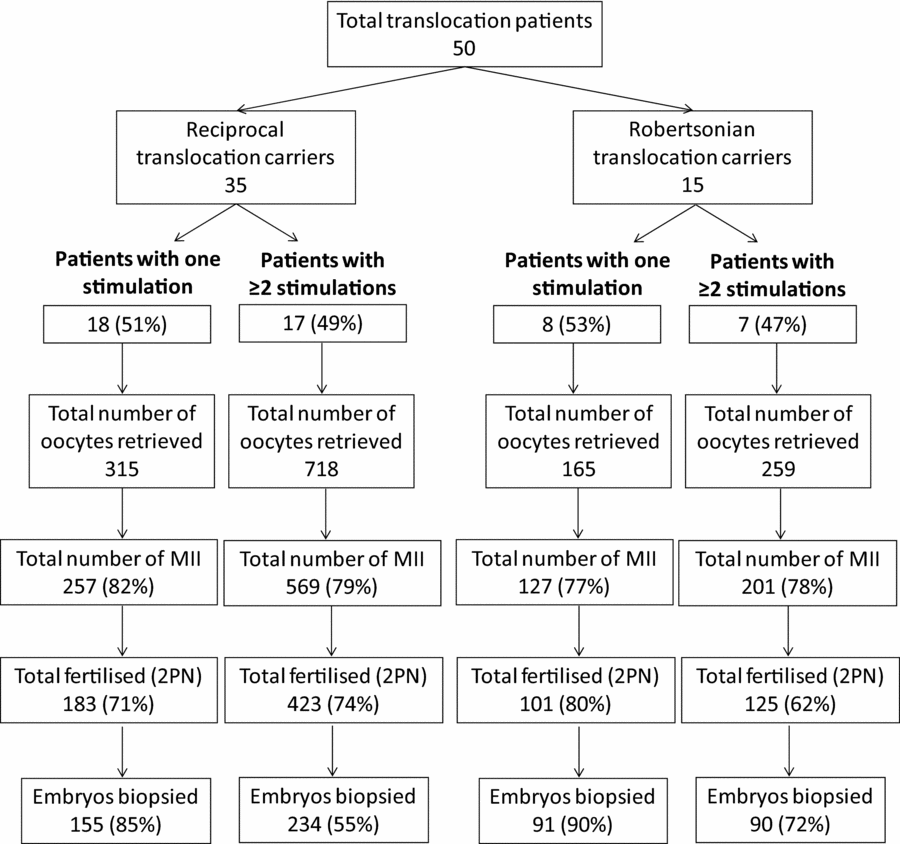
Multiple stimulation and intracytoplasmic sperm injection (ICSI) procedures were performed for 24 patients to accumulate a pool of embryos for PGD (Fig. 1). The number of stimulation cycles ranged between two to seven (Table 2).
Serial ovarian multiple stimulation cycles and outcomes. The number patients, oocytes retrieved, matured oocytes, fertilised oocytes and embryos with normal developmental stage on day 3 post fertilisation are listed for (a) reciprocal and (b) Robertsonian carriers

Details of reciprocal and Robertsonian translocation carriers according to the single and multiple ovarian stimulation cycles. The number of patients, oocytes retrieved, matured oocytes, fertilised oocytes and embryos with normal developmental stage on day 3 post fertilisation are listed according to the number ovarian stimulation cycles.

Ovarian stimulation, embryo culture
The controlled ovarian stimulation treatment was initiated on cycle day 2 as described previously (Ulug et al., Reference Ulug, Turan, Tosun, Erden and Bahceci2007). When at least two follicles reached 18 mm in diameter, human chorionic gonadotrophin (hCG) injection (5000 IU) (Ovidrelle; Merck Serono, UK) was administered in order to induce ovulation. Follicles were aspirated transvaginally 35–36 h post hCG injection (Ovidrelle, Merck Serono, Darmstadt, Germany). Oocytes were retrieved and cultured for 2 h before hyaluronidase treatment. Patients’ semen samples were processed using discontinuous colloidal silica gel gradient (PureSperm; Nidacon, Sweden) and the sperm pellet was washed twice with sperm washing medium. Only meiosis II (MII) stage oocytes were microinjected by ICSI. Injected oocytes were cultured in Single Step Media (SSM) supplemented with 10% synthetic serum (Irvine Scientific, Irvine, CA, USA) in a 5% CO2 and 5% O2 in air incubator (INB-203C, IKS International, The Netherlands). Fertilisation check was performed 16–18 h after ICSI by the observation of two pronuclei (2PN) and two polar bodies. Embryo scoring was assessed and number of cells and presence of even and uneven cells were noted. When less than five oocytes were fertilised normally, embryos were vitrified on day 2 of development.
Embryo vitrification and thawing
Vitrification was performed in modified Ham's F10-basal media containing HEPES with protein supplement in two steps. In the first step, embryos were equilibrated in equilibration solution which contains 7.5% ethylene glycol and 7.5% dimethylsulfoxide (DMSO) for 5–10 min at room temperature. The embryos were then transferred into vitrification solution containing 15% ethylene glycol and 15% DMSO with 0.5 M sucrose for 60–90 s. Embryos were immediately loaded into a carrier device and dipped into liquid nitrogen. Vitrified embryos were stored in liquid nitrogen until warming.
For warming, modified Ham's F10-basal media containing HEPES and protein supplement with different sucrose concentration was used (1 M and 0.5 M respectively). First, the carrier device was plunged immediately into 1 M sucrose for 1 min at 37°C. Embryos were then transferred sequentially in 0.5 M sucrose and incubated for 3 min. Rehydrated embryos were then transferred into pre-equilibrated embryo culture media containing 20% protein supplement for 2 h before processing for embryo biopsy.
Embryo biopsy, blastomere spreading and fluorescence in situ hybridisation
In total, 570 fresh and vitrified/warmed good quality embryos were biopsied on day 3 using a laser (Octax™, MTG, Germany) by breaching of the zona pellucida and aspiration of a single cell. Single nuclei were fixed on poly-l-lysine coated slide (Thermo Scientific, Germany) using spreading solution (0.01 N HCl/0.1% Tween 20). Both alpha satellite and sub-telomeric probes to translocated segments were used. List of probes used are shown in Table 1. Slides were washed as described by the manufacturer in 0.4× standard sodium citrate (SSC)/0.3% Tween 20 (73°C for 5 min) and 2× SSC/ 0.1% Tween 20 (room temperature for 1 min). The nuclei were counterstained with 5 μl of 150 ng/ml 4,6-diamidino-2-phenylindole (DAPI, Medimiks, Turkey) and the evaluation of nuclei were performed by two scientists.
Statistical analysis
Statistical analyses were performed by Chi square test using GraphPad prism v6. The statistical significance of embryo transfer cancellation rates due to the unavailability of a balanced embryo for transfer was evaluated. The embryo development to the blastocyst stage in vitrified/warmed and fresh embryos was analysed.
Results
Fifty patients underwent 57 PGD cycles for translocations. In order to increase the number of embryos for PGD due to low ovarian reserve and low fertilisation rates, serial ovarian stimulation and ICSI treatments (2–7 cycles) were performed for 24 patients (Fig. 1). The distribution of cycle details of these patients undergoing serial ovarian stimulation; including number of collected oocytes, mature oocytes (MII), fertilised oocytes and biopsied embryos per stimulation cycle; is shown in Table 2.
Overall, 1457 oocytes were collected from 57 cycles. Of these, 1033 were from reciprocal and 424 were from Robertsonian carriers, respectively. Sixty-four per cent (389/606) of the normally fertilised embryos from reciprocal and 80% (181/226) from Robertsonian translocation carriers were suitable for biopsy on day 3 of development.
In total, 341 embryos were frozen and the survival rate of the embryos was 86% (294/341). A final cohort of 570 fresh (276) and frozen (294) cleavage-stage embryos were biopsied. Ninety-eight per cent (560/570) of the embryos gave a diagnostic result.
The chance of finding a normal or balanced embryo was analysed for both reciprocal and Robertsonian translocation carriers. For the reciprocal translocation carriers, 16% (63/383) of the diagnosed embryos were shown to be normal or balanced for the translocation, whereas the rate of transferable embryos for Robertsonian carriers was 80% (141/177). The number of transferable embryos was double when nine or more embryos were analysed in both reciprocal and Robertsonian carriers. Overall the possibility of finding a normal/balanced embryo during PGD is significantly higher when nine or more embryos were biopsied and analysed in PGD cycles (P < 0.01).
The progression of embryo development to blastocyst stage was not affected by the vitrification and warming process. Developmental progression was reported for 149 embryos on day 5 of development. Of these embryos 70 were obtained from fresh stimulation cycles and 79 were vitrified and warmed embryos from several stimulation cycles. Overall 40% (60/149) of the embryos developed to the blastocyst stage. The rate of blastocyst development was significantly higher in the embryos that were vitrified and warmed (43%, 39/79) compared with the fresh cycles (30%, 21/70; P = 0.016).
Single and double embryo transfers were performed for 28 translocation carriers (14 reciprocal and 14 Robertsonian carriers). The overall pregnancy rates for the Robertsonian carriers were higher (50%, 7/14) compared to the reciprocal carriers (29%, 4/14). Only 7% (1/14) of the reciprocal translocation carriers with positive pregnancy results had less than nine embryos biopsied. Similarly, the positive pregnancy rates for the Robertsonian carriers were also lower (14%, 1/7) when less than nine embryos were biopsied for PGD.
Discussion
In this study, we aimed to investigate the optimum number of embryos to be biopsied in order to find a balanced or normal embryo following PGD for translocations. The ESHRE consortium reported in their XII data collection that 25% embryos were transferable for patients undergoing PGD for both reciprocal and Robertsonian translocations (Moutou et al., Reference Moutou, Goossens, Coonen, Rycke, Kokkali, Renwick, Sengupta, Vesela and Traeger-Synodinos2014) that is in agreement with the 10 years of ESHRE collected results (26% transferable embryos) (Harper et al., Reference Harper, Wilton, Traeger-Synodinos, Goossens, Moutou, Sengupta, Pehlivan Budak, Renwick, De Rycke, Geraedts and Harton2012). These collective data illustrate that there is a low chance of finding a balanced or normal embryo for transfer from patients undergoing PGD for translocations.
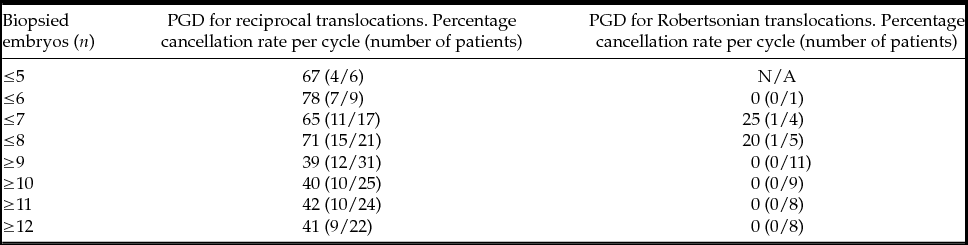
In our study we have shown that higher number of embryos biopsied for PGD increases the chances of finding a normal or balanced embryo and more importantly increases the pregnancy rates for both reciprocal and Robertsonian translocation carriers. Our results indicate that when there are less than nine embryos biopsied for PGD, the likelihood of finding a balanced embryo is considerably reduced and the cycle cancellation rate for embryo transfer is significantly increased (P < 0.05; Table 3). A recent study also showed that for each additional embryo biopsied, there is a 13% higher chance of a live birth (Scriven et al., Reference Scriven, Flinter, Khalaf, Lashwood and Ogilvie2013). Therefore, for patients with low number of embryos available for PGD, serial cycles of ovarian stimulation, ICSI and vitrification procedures should be advised especially as high rates of embryo survival were observed following embryo vitrification (Chi et al., Reference Chi, Luo, Yin, Hong, Ruan, Huang, Duan and Tong2013; Van Landuyt et al., Reference Van Landuyt, Van De Velde, De Vos, Haentjens, Blockeel, Tournaye and Verheyen2013). In this study, embryo vitrification did not have an adverse impact on the implantation and pregnancy outcomes and previous studies also showed that transferring a cryopreserved embryo did not impair the neonatal outcome (Liu et al., Reference Liu, Teng, Fu, Li, Zheng and Sun2013). This system of embryo accumulation for patients with small number of embryos will not only reduce the psychological discomfort of patients but also encourage them to carry on with the assisted reproductive technology treatments to increase their cohort of embryos for PGD and therefore their chances of becoming pregnant.
Cancellation rates of embryo transfer details. The cancellation rates relative to number of embryos biopsied per patient are listed

The main limitation of this study was the small sample size and the technique used for the diagnosis. Although with the advancing technologies, 24 chromosome screening by array comparative genomic hybridisation (aCGH) has been used in PGD for translocations, FISH is still being widely used. One of the main reasons for this is that although aCGH is very sensitive, the detection rate of the translocated segments varies depending on the breakpoints. In this study, one of the translocated segments for 24% of the patients could not be detected with even a higher resolution aCGH platform (24Sure+, BlueGnome) due to the position of the breakpoints and therefore the diagnosis was not preferred to be performed using aCGH. In addition to this, using aCGH is an added cost for the patients. Therefore, in some countries FISH is still the preferred method of choice in PGD for translocations.
The outcome of this study might have been different if a comprehensive chromosomal screening analysis was performed, as aneuploidies of other chromosomes not involved in the translocation are detected in the embryos. Therefore the implantation and pregnancy rates of the patients might not be significantly increased and even a larger cohort of embryos might be needed to obtain a transferable embryo. It should also be noted that the risk of aneuploidies detected in the embryos depends on the medical history of the couple as well as the maternal age. Hence, the embryo accumulation approach is useful and it could prove to be more beneficial once a comprehensive chromosome screening method is tested.
In conclusion, the current study showed that the chances of finding a balanced or normal embryo increases significantly when the number of embryos available for biopsy is more than nine (P < 0.05). Accumulation of embryos before PGD is an effective strategy for patients with low number of oocytes and embryos available for biopsy.