


Introduction
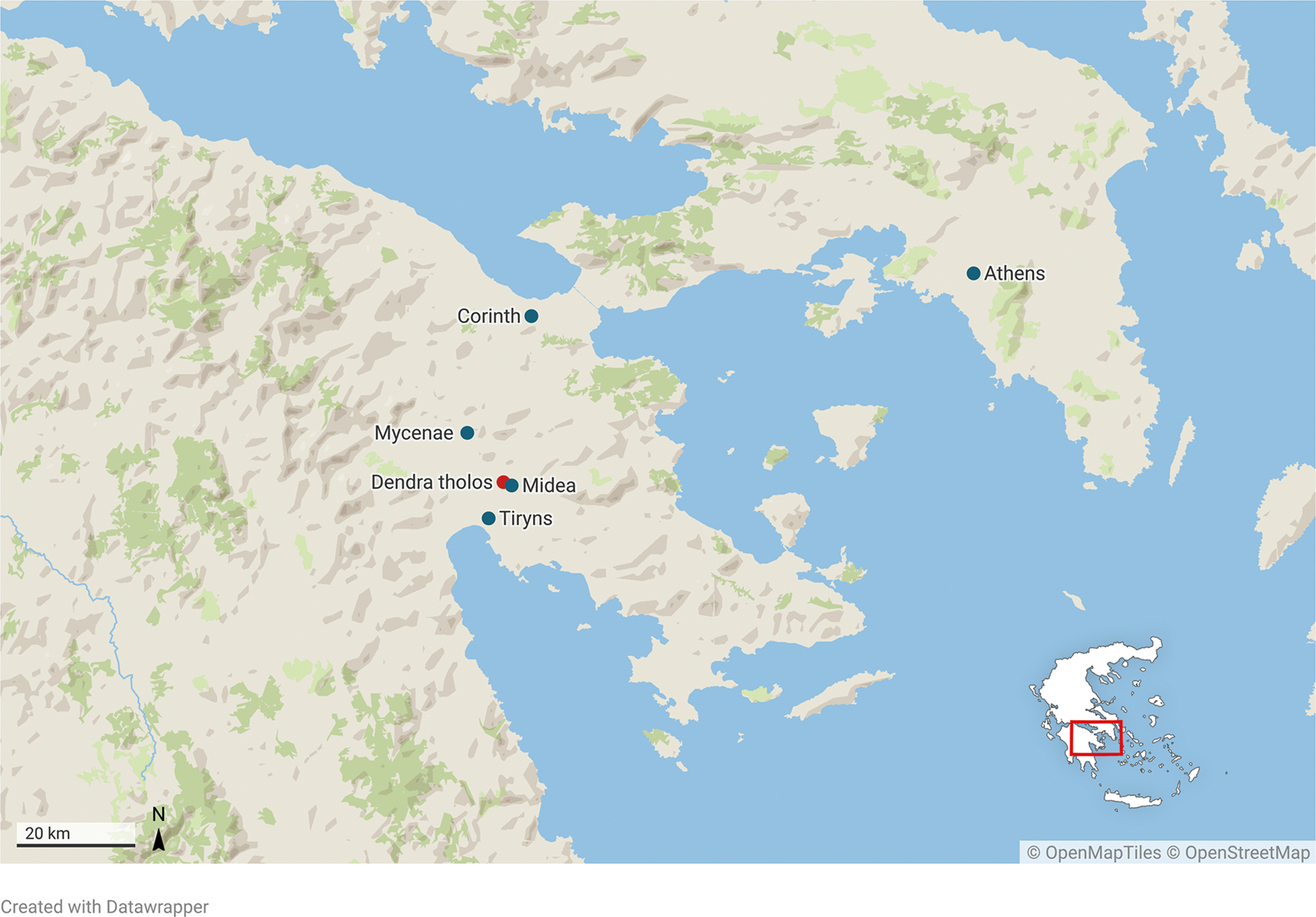
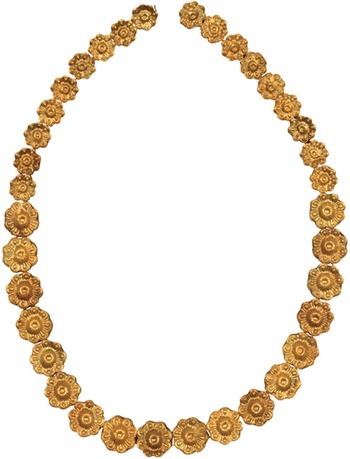
Three undisturbed burials were found underneath the floor of the tholos tomb at Dendra in the southern Peloponnese (Fig. 1). Towards the end of July in 1926, Axel Persson and his team—wearied after three weeks of excavation and with the chamber floor of the tholos found robbed—turned their attention to the four pits underneath the floor (Persson Reference Persson1931, 13). At a depth of 1.5 m, in a pit on the east side of the chamber, a human femur appeared in the earth. Gold rosettes appeared soon afterwards, associated with the neck and chest of the skeleton. Their presence at the back of the neck, underneath the vertebrae that attach the skull to the spine, indicated that these rosettes formed part of a necklace, worn by the corpse when it was deposited in the tomb (Fig. 2). Gold pendants, in the shape of spirals, were found around the torso of the skeleton, reconstructed as a belt.
Map of the Dendra tholos and other key sites.
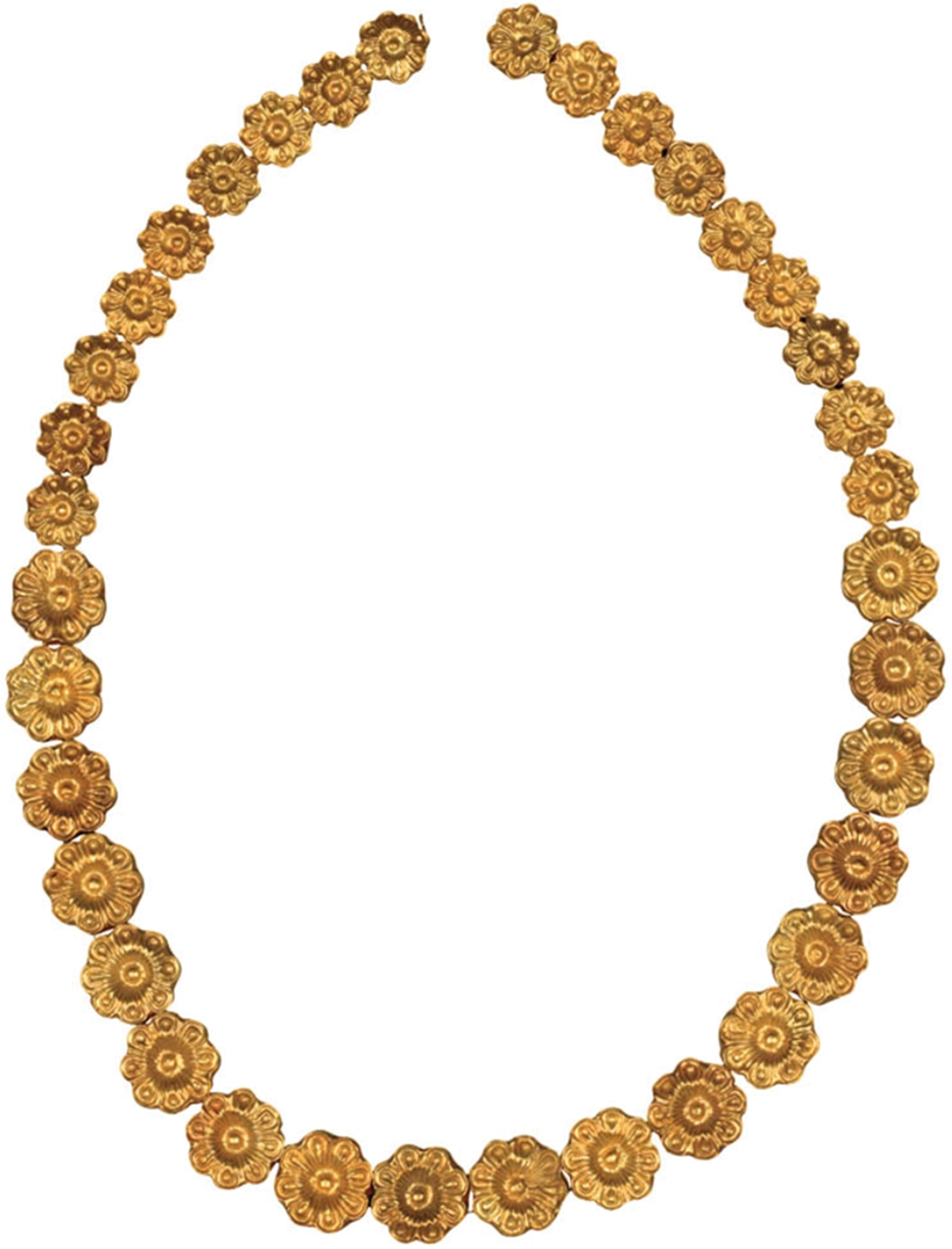
Gold necklace with rosette-shaped beads from Pit III in the Dendra tholos, HNAM inv. no. Π 7342. (Photographic Archive of the Hellenic National Archaeological Museum, Athens. © Hellenic Ministry of Culture – Hellenic Organization of Cultural Resources Development (H.O.C.RE.D.).)
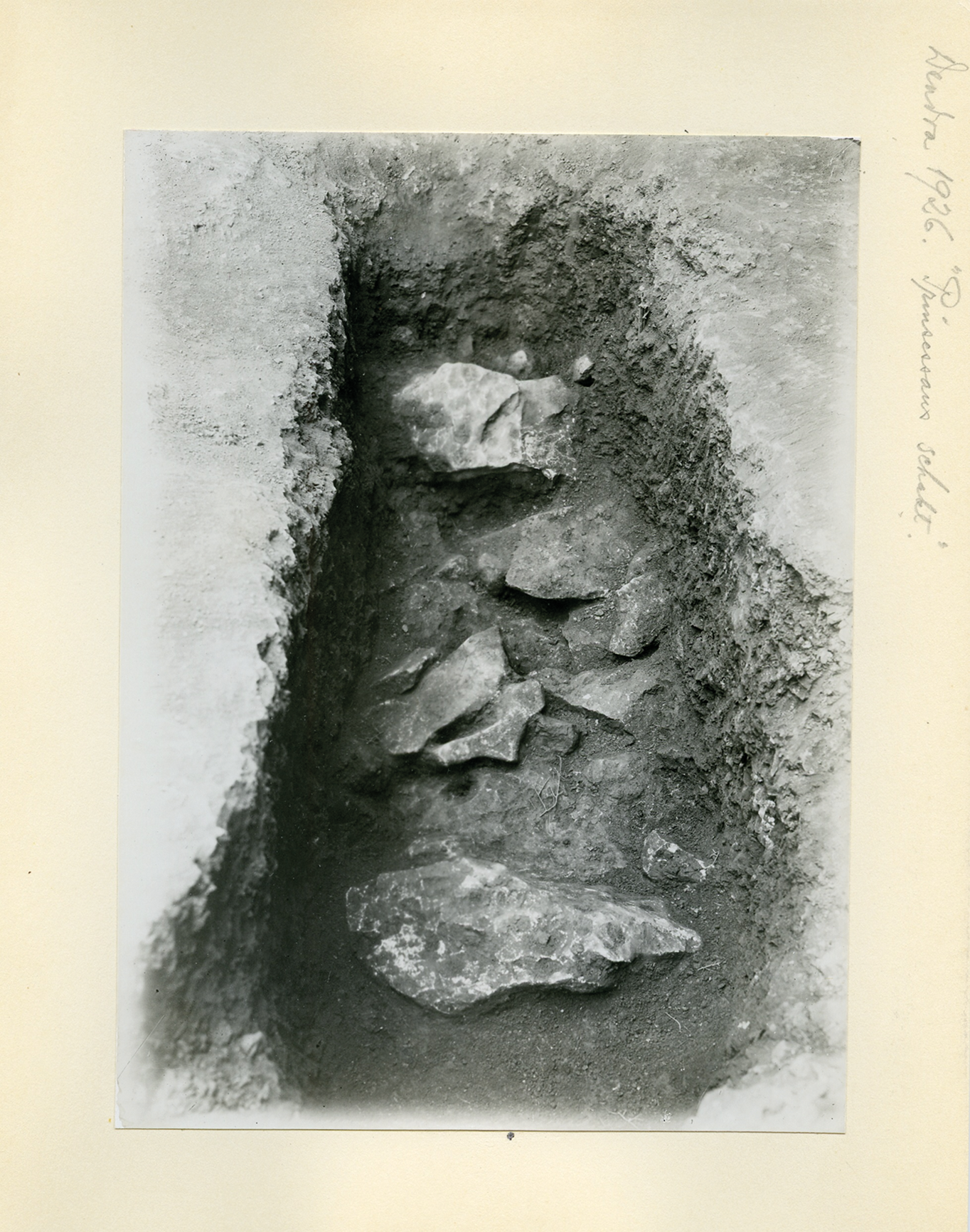
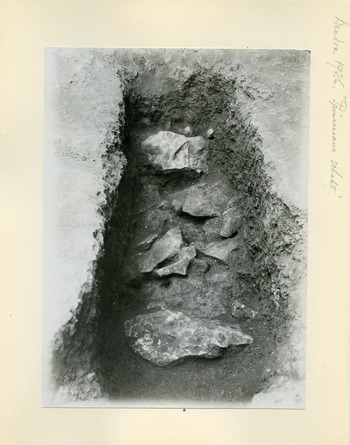
At the end of the early Mycenaean period, around 1400 bce, this corpse was deposited inside the tomb at Dendra.Footnote 1 The pit was prepared, and the dead body washed, dressed and adorned with objects, before it was taken to the tomb. The procession to the tomb (most probably from the nearby settlement at Midea) could have been a public event or the corpse could have been accompanied by dedicated mourners, either family members or the wider community (Cavanagh & Mee Reference Cavanagh and Mee1998, 107–8; on Dendra: Persson Reference Persson1931, 69–70; Schallin Reference Schallin and Murphy2016, 90). It is difficult to tell from the extant evidence. But once there, the dead body and its associated objects were carefully deposited inside the pit and enclosed with stone slabs, which concealed the burial from view and preserved it as a closed context (Fig. 3). The corpse, underneath the earth, was left to decompose, before the collapse of the tomb hundreds of years later and its eventual rediscovery by Persson.
The cover slabs above Pit III in the tholos tomb in the Mycenaean cemetery at Dendra. (Photograph: courtesy of the Swedish Institute at Athens. © Hellenic Ministry of Culture – Hellenic Organization of Cultural Resources Development (H.O.C.RE.D.).)
After the spectacular finds of this first burial—which Persson described as ‘a little princess’—he turned his attention to the pit on the west side of the chamber (Persson Reference Persson1931, 14). The first objects were uncovered 0.75 m below the floor of the tomb, the earliest hints of a spectacular double burial. The pit contained two extended skeletons, which Persson identified as a man and woman, adorned with hundreds of objects made from precious metals and semi-precious stones. But these bodies too, once adorned, were enclosed underneath the earth by stone slabs. The flesh of the corpse was left to decompose while the objects—or at least some of the objects—preserved their material splendour.
The sequence of activities described above derives from recent work on Mycenaean funerary ceremonies: these burials, and similar contexts, have been used to reconstruct the nature of funerary performances (Boyd Reference Boyd2002; Cavanagh & Mee Reference Cavanagh and Mee1998, 103–19; Kontorli-Papadopoulou Reference Kontorli-Papadopoulou1995; on Dendra: Schallin Reference Schallin and Murphy2016). The socio-economic dimension of the mortuary sphere has also dominated studies of the Dendra tholos. Where Persson interpreted these burials as members of the royal family at Midea, recent scholars have understood deposition as a proxy for social status (on Dendra: Konstantinidi-Syvridi Reference Konstantinidi-Syvridi, Eder and Zavadil2021; Schallin Reference Schallin and Murphy2016; elsewhere: Voutsaki Reference Voutsaki2010 and contributions in Eder & Zavadil Reference Eder and Zavadil2021; for a critique of this model: Brück & Fontijn Reference Brück, Fontijn, Fokkens and Harding2013; Wolpert Reference Wolpert, Barrett and Halstead2004). The deposition of objects, often imported from Crete or the eastern Mediterranean, acted as a form of conspicuous consumption, intended to remove ‘exotic’ objects from circulation and to emphasize the status of the deceased. In this article, I put forward a different approach, which focuses on the burial as a creative action. I therefore advocate for an artistic approach to burial, centred around the twin concepts of curation and aesthetics, to show that within the early Mycenaean mortuary sphere, the act of deposition created hybrid artworks that combined the corpse with other materials and so mediated the dead through these materials.
This description of the tomb as artwork is not one that most prehistorians would endorse, with its representational focus, its aestheticization of the putrefied corpse and its shift away from the economic implications of these acts of deposition. But the artistic lens outlined here offers an alternative area of study for mortuary archaeologies, one rooted in the creative manipulation of materials in tandem with the remains of the human body. It is a lens that emphasizes the visual and sensory impact of the deposition for the mourners, as one response to loss and the emotions that accompany it. I aim to show, with reference to the Dendra tholos in particular, that art—a concept often set aside in mortuary studies—can open up new avenues of exploration for these contexts.
Towards an artistic approach
The Dendra tholos is not unique. People in the early Mycenaean period—a term typically used to refer to the material culture of mainland Greece between c. 1700 and 1400 bce—were often buried with hundreds or even thousands of objects. These burials were deposited inside monumental tombs, from the famous Shaft Graves at Mycenae to the numerous chamber and tholos tombs dotted across mainland Greece. These tombs were often used for collective burials, and revisited on multiple occasions, so that the material splendour of the deceased remained in the consciousness of successive generations.
These burials represent a radical transformation of previous practices (Crowley Reference Crowley and Laffineur1989; Malafouris Reference Malafouris, Renfrew, Boyd and Morley2015; Voutsaki Reference Voutsaki, Norstein and Selesvold2024; Wright Reference Wright, Barrett and Halstead2004). Between c. 2100 and 1700 bce on mainland Greece, most burials took place in simple cists or pits with few objects (Alden Reference Alden2000; Dickinson Reference Dickinson, Touchais, Touchais, Voutsaki and Wright2010; Milka Reference Milka2023). Most often, the body was deposited in a contracted position inside the grave, with one or two ceramic vessels placed close to the head. The early Mycenaean period, then, sees not only a shift from contracted to extended inhumations, and from individual to collective burials, but also a massive increase in the number of objects deposited with the dead. It also witnesses the slow introduction of secondary burial treatment, where tombs were reopened and earlier burials disarticulated, with the human remains and their associated objects moved into pits underneath the floor or to one side of the chamber.
Where traditional approaches have focused on socio-economic parameters of analysis, recent Mycenaean scholarship has effected a shift in emphasis, seen in the development of osteoarchaeological approaches and in the increased use of theories of materiality, as one part of the broader material turn within the humanities. First, osteoarchaeological work has focused attention on the human body as an important source of information about Mycenaean populations (Schepartz et al. Reference Schepartz, Stocker, Davis, Klaus, Harvey and Cohen2017; Shelton Reference Shelton2023; Smith et al. Reference Smith, Dabney and Pappi2017). It has also developed methods for the reconstruction of the treatment of the corpse in burial (Moutafi Reference Moutafi2021; Moutafi & Voutsaki Reference Moutafi and Voutsaki2016; Papakonstantinou Reference Papakonstantinou2023). Second, work on the materiality of the mortuary sphere has provided an important framework for the examination of objects deposited with the dead (see contributions in Nilsson Stutz & Tarlow Reference Nilsson Stutz and Tarlow2013; also Fahlander & Oestigaard Reference Fahlander and Oestigaard2008; for the Mycenaean period: Gillis Reference Gillis and Aslaksen2016; Malafouris Reference Malafouris, Renfrew, Boyd and Morley2015; Phillips Reference Phillips, Marini and Tzortzopoulou-Gregory2024). Materiality has also been used to emphasize the notion of performance, to recentre the ritual dimension of these tomb contexts (Boyd Reference Boyd2014; Dakouri-Hild & Boyd Reference Dakouri-Hild and Boyd2016; Harrell Reference Harrell2014).
The artistic approach advocated here draws on these developments to emphasize the role of the human corpse as an essential material element of the burial context. It therefore unites work on bodies with work on objects, in its focus on the aesthetic dimensions of the tomb context as a whole and the role of the burial as an intentional and curated composition. Although the notion of burial as representation is commonplace in mortuary studies, it is often used to refer to the metaphorical representation of the person, i.e. the commemoration of the deceased and the formation of their identity (Cavanagh & Mee Reference Cavanagh and Mee1998, 108–11; Parker Pearson Reference Parker Pearson1999, 65–98). I want to ask what it means, instead, to take this idea seriously as a methodological premise. How can art—and art-historical approaches—offer another way to think about the relationships between people and objects within the mortuary sphere?
The term ‘art’ has proved controversial in archaeological discourse, however (Robb Reference Robb2017 for an overview; also Watts & Knappett Reference Watts and Knappett2022). Traditions of connoisseurship, in particular, have problematized the relationship between art and archaeological research by promoting a version of art-historical analysis that valorizes the formal qualities of an object over its broader social and material contexts. The term ‘art’ is of course implicated in Western discourse. I use it here not to elevate the Mycenaean world to a strictly Western definition of art, nor to identify certain objects as art: rather, I am interested in ‘art’ as one way to recentre the study of creative practice as essential even for contexts that at first view belie this focus on artistic action.
In some cases, the art-historical interest in the consumption and interpretation of an object by its viewers can also seem at odds with the archaeological preoccupation with the production of an object. In the same manner, the traditional art-historical focus on representation at the expense of other material qualities can undermine the archaeological focus on the materiality of an object (Elkins Reference Elkins, McHugh and Aloi2021; Swenson & Cipolla Reference Swenson and Cipolla2021 for a recent attempt to reconcile representation with materiality; Yonan Reference Yonan2011). However, art-historical work of the last few decades has branched out into discussions about embodiment, human experience and the mechanics (or the semiotics) of representation, issues that are directly relevant for studies of archaeological material. The key question, for the purposes of this article, is therefore how to integrate these recent developments in art theory into the study of archaeological material.
Robb has offered one answer to this question. He identifies three distinct uses of the term ‘art’ in archaeological and anthropological research: as a general concept, as a description of a modern Western set of concepts, institutions and practices, and as an archaeological material category (Robb Reference Robb2017, 588). Art therefore refers to a wide variety of objects and ideas: there is no unanimous definition or critique of the term. To combat this lack of theorization, Robb proposes a definition of artworks as ‘powerful objects’ that ‘harness aesthetic reflexes to particular tasks’—a definition that promotes questions such as ‘how art acts’ and what it does (Robb Reference Robb2017, 595). This definition draws on Gell’s seminal Art and Agency to focus attention on the active agency of artworks (Gell Reference Gell1998; on his influence: Chua & Elliott Reference Chua and Elliott2015; Osborne & Tanner Reference Osborne and Tanner2007).
Trever (Reference Trever2022) has offered another answer to the question in her work on ‘archaeo art history’. This approach, developed in relation to Moche mural art in South America, combines a broad definition of art-historical inquiry with archaeological data. It reflects an ‘interest in image making, pictorial meaning, and visual response’ that takes precedence over ‘art historical commitments to connoisseurship or to etic aesthetic criteria’ (Trever Reference Trever2022, 8). This approach is committed to the creativity of people in the past, as manifested in the specific materialities of objects and contexts. It emphasizes the haptic and experiential aspects of an artwork as well as the visual, and is therefore situated within the broader context of anti-iconocentric approaches to prehistoric art in northern Europe, as seen in studies of ancient rock art in particular (Herva & Ikäheimo Reference Herva and Ikäheimo2002; Sjöstrand Reference Sjöstrand2017).
Within the field of Greek prehistory too, Knappett’s recent book Aegean Bronze Age Art: Meaning in the making aims to place anthropological approaches in dialogue with art-historical ideas (Knappett Reference Knappett2020, 3). Knappett characterizes artworks as creative actions, which include to model, to imprint, to combine, to contain and to fragment. This approach examines the creativity inherent in the production and use of specific objects, and so mediates between an artwork’s local effects and its wider affinities (also Watts & Knappett Reference Watts and Knappett2022, 6). Knappett draws on theories of materiality to frame this approach as one that emphasizes the constitutive role of material culture in human thought, where meaning is created and layered through different material processes (Knappett Reference Knappett2020, 23, 27).
In its development of an artistic approach to burial, this article follows Knappett in his characterization of artworks as creative actions. An artistic approach, as I understand it, is one that emphasizes the creative actions that surround objects and contexts: not only the creative actions behind the object (as in its production), but also the creative actions in front of the object, such as its selection for inclusion within an assemblage and its deposition within a specific context. I therefore include curation, which I define as the combined actions of selection and deposition that created the burial context, as another example of creative action. The notion of curation as creative action, in this context, serves to emphasize the artistic impulses behind mortuary deposition, its performative and conceptual nature.Footnote 2 It frames the tomb as an intentional composition, designed to create certain visual and sensory impressions for the mourners.
My approach, in essence, therefore centres on the characterization of the burial itself as an artistic action.Footnote 3 I am interested in art as an interpretative lens, which opens up new approaches and asks new questions of the material evidence (DeMarrais & Robb Reference DeMarrais and Robb2013; Perkins & Morphy Reference Perkins and Morphy2006). How was death transformed into visual experience for people in the past? What shaped and directed the viewer’s perception of the tomb context? These questions connect the specific materiality of objects and contexts with their reception and interpretation. In their examination of consumption as a form of production, they also undermine the dichotomy between these two actions. The deposition of an artwork is itself an act of creation, which produces an artwork in a different form.
In order to implement this approach with respect to the early Mycenaean material evidence, I combine these ideas with the notion of aesthetics, as developed in anthropological research. The anthropological concept of aesthetics mediates between the philosophical and art-historical definitions of the term, and so avoids both its universal and its particular connotations (Elkins Reference Elkins and Elkins2004). It is a close cousin of art, inseparable (in some sense) from modern ideas about the value of artworks, but it is essential in reframing the material properties—and importantly, the material qualities—of artworks as essential to the viewer’s experience. From the 1990s, anthropologists have reconceptualized aesthetics in terms of sensory perception and experience, in an attempt to shift the focus from the traditional connotations of the term (such as beauty and value) towards an interest in the use and evaluation of objects (for an overview: Skeates Reference Skeates2017). Coote and Shelton, for example, in the volume Anthropology, Art, and Aesthetics, use the term ‘aesthetics’ to describe the nature of human perception (Coote & Shelton Reference Coote and Shelton1992). These scholars understand the perception and evaluation of the material world as essential elements in the construction of broader world-views. Morphy developed these ideas in his definition of aesthetics as ‘the effect of the physical properties of objects on the senses and the qualitative evaluation of those properties’ (Morphy Reference Morphy1994, 258). This definition prioritizes the relations between people and objects, as effected in the deployment of specific material properties.
The 2001 World Archaeology volume on ‘Archaeology and Aesthetics’ discusses the application of these ideas to archaeological research. Gosden, for example, uses aesthetics to focus on ‘the formal qualities of objects’ designed to create certain effects for the viewer (Gosden Reference Gosden2001, 165). In the same volume, Pollard formulates the notion of depositional aesthetics (Pollard Reference Pollard2001). He proposes that material deposits in the British Neolithic acted as artworks, where their impact resided ‘in the act of performance and in the aesthetic effect of the resulting composition’ (Pollard Reference Pollard2001, 328). Rather than focus on the indexical power of objects and images, these studies examine the role of visual effects in the creation of meaning, and so theorize the link between material properties and cultural systems of interpretation (on this link, Bennet Reference Bennet2021, 3). These approaches zoom in on the specific nature of objects and contexts, in order to ask what kind of impact an object has on its environment and its viewers (also Kapsali & Phillips Reference Kapsali and Phillips2022).
This definition of aesthetics as the perception and evaluation of material properties within specific contexts focuses attention on the impact of material properties on the viewer. The creation, selection and use of objects and images within tomb contexts created specific visual and sensory impressions for people in the past, which in turn shaped their interpretations and experiences of these contexts. These ideas characterize the artistic approach adopted here, which aims to connect the material properties of objects with people’s experiences of these properties. In other words, the selection and deposition of specific material properties within early Mycenaean burial contexts created certain effects for the viewer, which shaped their experiences of the burial context, and therefore also their memories of the deceased, their attitudes towards death, and their interpretations of ritual action.
In sum, this approach centres around the use of art—seen in terms of curation and aesthetics—as an analytical tool. In its definition of art as creative action, it allows us to access past modes of thinking with and through bodies and objects, in a way applicable to mortuary contexts across time and space. I want to take a step backwards, to start from the specific nature of the deposition, which includes the selection of objects with specific material properties, the placement of these objects in relation to the body of the deceased, and the impression of the tomb context created through these actions. As this article will demonstrate, these methods prove productive for the examination of early Mycenaean (and other) burials. They reframe the study of these mortuary contexts as the study of aesthetic engagement, and unite bodies and objects within the composition of the burial as a whole.
Case study: the Dendra tholos
The three undisturbed burials in the Dendra tholos provide an excellent example for the artistic approach set out above, thanks to their preservation of the relations between specific bodies and objects.Footnote 4 I have chosen to focus on the Dendra tholos to show, first, that there is still more to learn about even well-known burial contexts, and second, that there is no need to rule out this kind of artistic analysis for burials that have not been excavated or documented according to today’s standards. In my discussion of the tomb context, I focus on the choices and experiences of the mourners—the people who created and viewed the burial context—to examine the aesthetic resonances of the burials in more detail.
The Dendra tholos, in use in the Late Helladic IIIA1 period, is one of the latest contexts on mainland Greece that could plausibly be taken to reflect early Mycenaean burial practices. It represents the increased formalization of burial practices over the course of the early Mycenaean period, after an initial phase of experimentation at the start of the Late Bronze Age (Boyd Reference Boyd, Schallin and Tournavitou2015; Voutsaki Reference Voutsaki2010). Constructed close to an existing chamber tomb cemetery, the Dendra tholos seems to be associated with the contemporary Mycenaean settlement at Midea (Persson Reference Persson1931, 3–4). The tomb, as is standard, comprises three parts: a vaulted chamber (the eponymous tholos, around 7.30 m in diameter), a dromos (the entrance corridor, 17.90 m in length) and a stomion (the doorway, 3.40 m in height), which was found blocked with a wall at the time of excavation (Pelon Reference Pelon1976, 178–80; Persson Reference Persson1931, 19–22). A later burial found in a niche in the stomion, 2 m above the Mycenaean floor level, dates to around 1050 bce and seems to be associated with the collapse of the structure at this time (Persson Reference Persson1931, 11). The corpse was seemingly lowered into the tomb via a hole in the collapsed roof, deposited above the accumulated debris.
On the chamber floor, underneath the debris, Persson found scattered human bones and various small finds, such as beads and seals. Their haphazard distribution, combined with the absence of any more substantial finds, could indicate that the chamber had been robbed in antiquity, as Persson believed (Reference Persson1931, 12). Persson also reports that the chamber floor was covered with a thin layer of white plaster (Reference Persson1931, 12). It therefore seems probable that there were once burials on the chamber floor, but it is difficult to tell whether these burials were disarticulated in the Mycenaean period, as seen in some contemporary tomb contexts, or robbed at a later date.
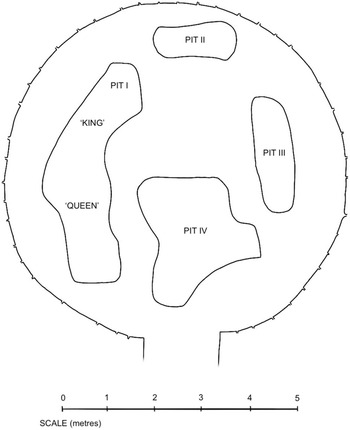
Persson uncovered more secure burial evidence underneath the chamber floor, which yielded four pits cut into the plaster layer (Fig. 4). On the northern side of the chamber, Pit II (1.5 m by 0.5 m by 0.7 m) contained mixed human and animal bones deposited alongside beads, metal fragments and a large stirrup jar. Pit IV (2.0 m by 2.0 m by 1.2 m) was located close to the entrance of the tomb and contained only beads alongside fragments of ivory and glass. Persson interpreted Pits II and IV as sacrificial deposits, but the remains could also represent redeposited material from burials on the chamber floor, as the result of secondary treatment. I exclude these two pits from the analysis offered below, in part due to spatial constraints, in part because the mixed nature of the deposits makes it difficult to understand the relations between bodies and objects.
Plan of the chamber and stomion of the Dendra tholos, with the four pits underneath the floor of the tomb. (After Persson Reference Persson1931, 28, fig. 22. Note that Persson does not include any information about the orientation of the burials in Pits I and III.)
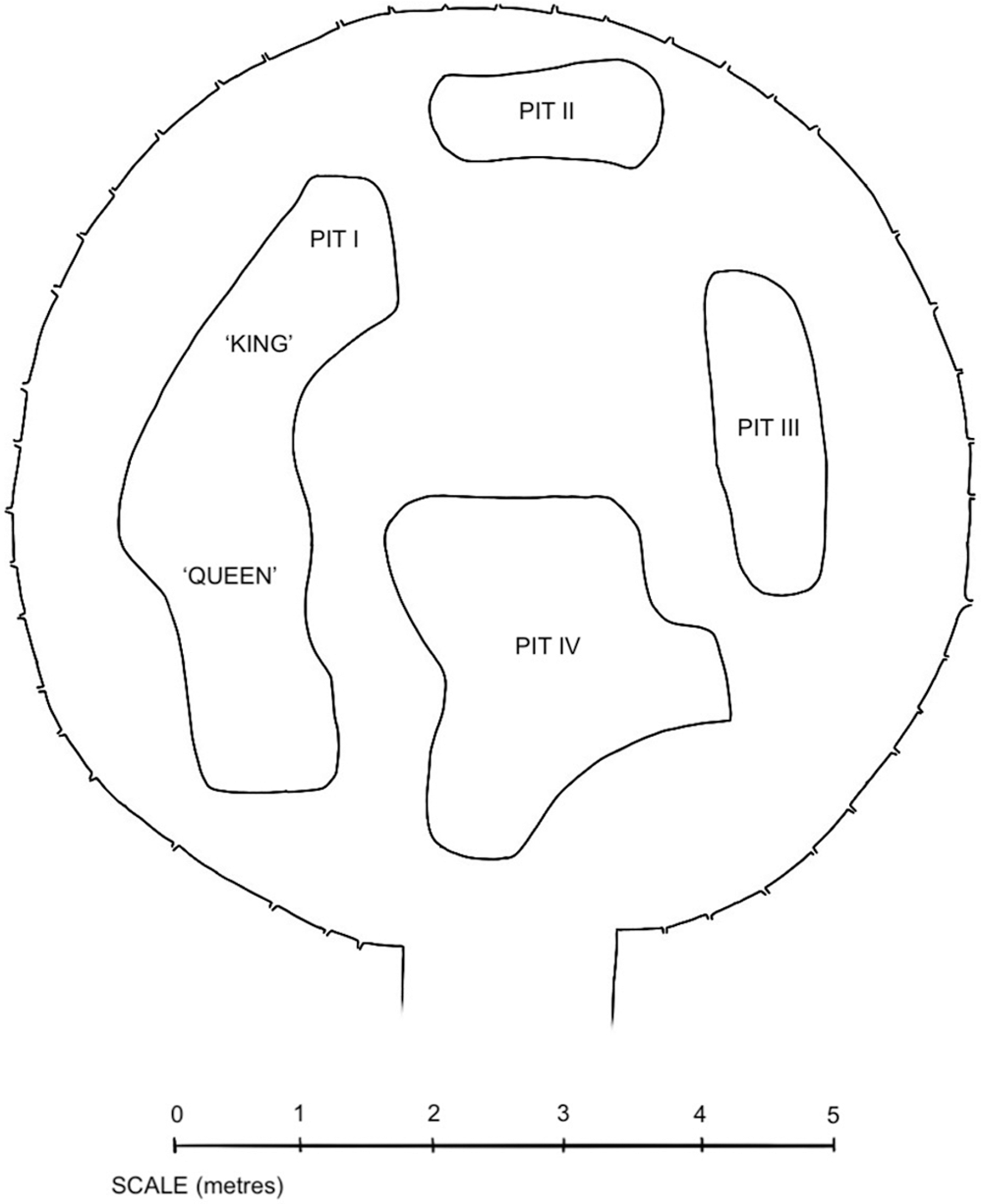
In contrast to these deposits, Pits I and III both contained undisturbed burials, which preserve the relations between bodies and objects as initially deposited. Pit I (5.0 m by 1.0 m by 1.5 m) was located on the west side of the chamber and contained two extended inhumations furnished with rich object assemblages. Pit III (2.3 m by 0.8 m by 1.7 m) contained one extended inhumation, the ‘princess’ described above. These pits are unusually deep and very narrow. They were cut into the earth and enclosed with stone slabs, with sediment used to fill the space between. Persson also reports that the three burials rested on a thin layer of white plaster, and that the Princess was associated with a layer of blue sediment (Persson Reference Persson1931, 13, 17–18). As with the chamber floor, this report seems to indicate some kind of preparation of the burial surface and its associated sediment. The skeletal remains from these burials were examined by Carl Fürst, who identified the two skeletons in Pit I as an adult male and an adult female, and the skeleton in Pit III as an adolescent female (Fürst Reference Fürst1930, 78–81). On this basis, Persson labelled these burials the King, the Queen and the Princess, identifications that persist in scholarship today. However, the skeletal remains have not been reexamined according to modern osteological techniques, so these designations should be used with caution.
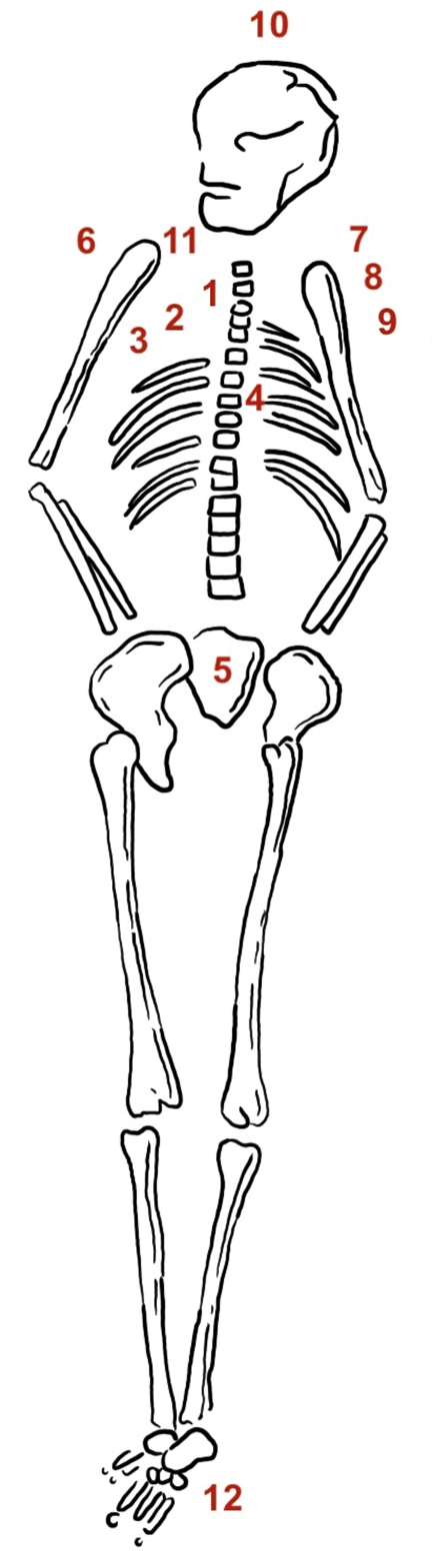
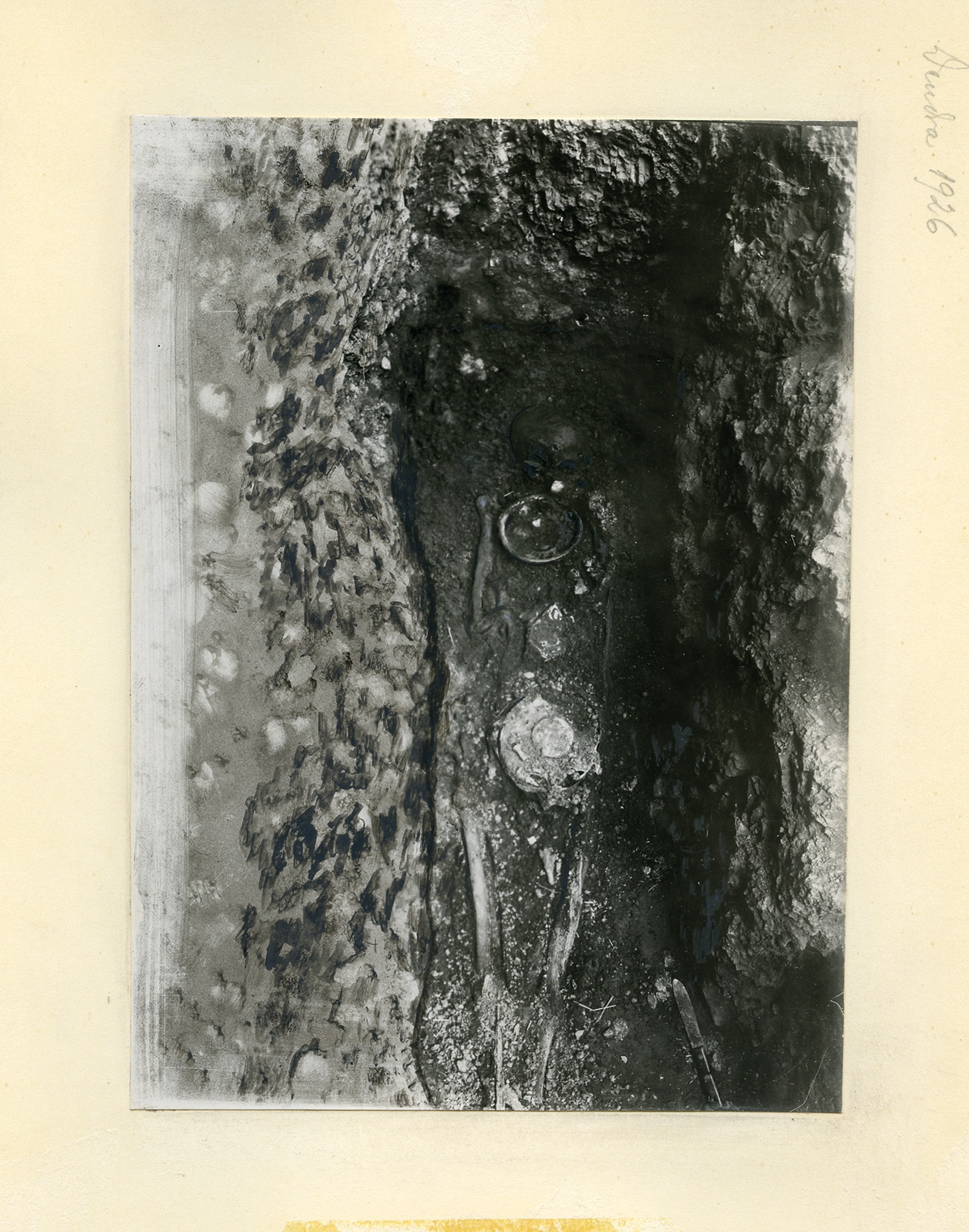
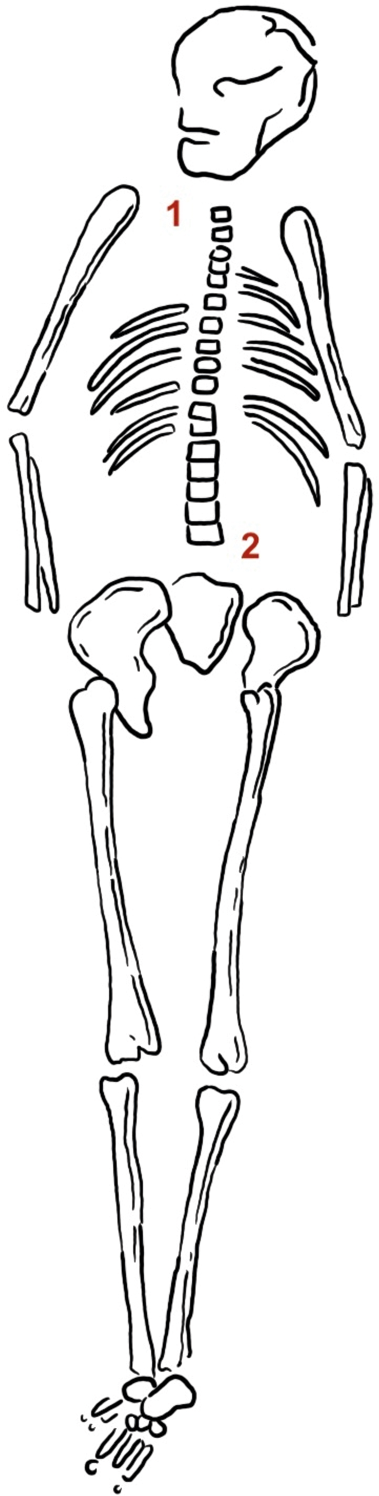
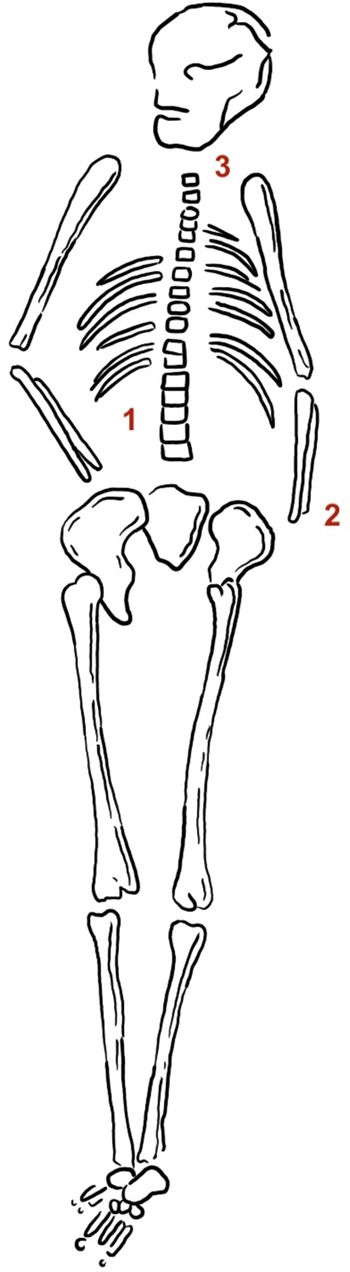
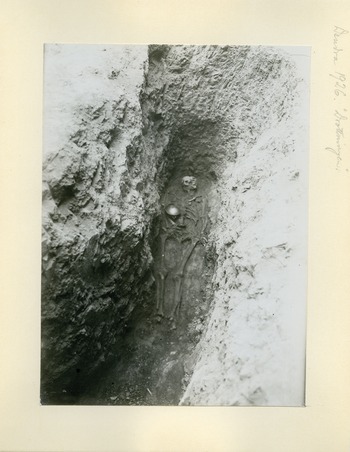
The presumed male burial in Pit I was deposited with the most objects (Figs 5 & 6). The body was extended on its back with the hands brought together on the pelvis. Glass ornaments in the shape of curls and plaques, some decorated with figurative motifs, were found around the head of the skeleton, reconstructed by Persson as a version of a boar’s tusk helmet.Footnote 5 In addition, two semi-precious beads, made from rock crystal and agate, were found near the neck, probably worn as pendants. On the chest of the skeleton was a golden cup decorated with octopuses, which contained six seals made from hard and semi-precious stones and four metal rings (see Hurwit Reference Hurwit1979 on the octopus cup; see the Corpus der Minoischen und Mykenischen Siegel for the seals: CMS I 182–183 and CMS I 185–188; also Sakellariou Reference Sakellariou1964, 208–9, 211–14). Three silver vessels were further down on the chest: a shallow cup with a golden rim, a goblet decorated with deer and hounds and a cup with leaping bull motifs. A bronze box was found on the pelvis and another box, made from wood with bronze attachments, was found underneath the cover slabs in the sediment layer above the body. Persson includes little information about the exact positions of these objects, however, such as whether the cups stood upright or inverted.
Plan of the presumed male skeleton (the so-called King) and associated objects in Pit I in the Dendra tholos. (1) Gold octopus cup with 6 seals and 4 metal rings inside; (2) silver goblet; (3) silver cup; (4) gold and silver cup; (5) bronze box; (6) Type B sword with gold-embellished hilt; (7) Type A sword with ivory pommel and gold-embellished hilt; (8) Type B sword with gold-embellished hilt; (9) Type C sword with ivory and gold embellishments; (10) glass ornaments, reconstructed as a helmet; (11) two pendants, made from agate and rock crystal; (12) Type C sword, four spearheads, two bronze knives, two lead horns.
The presumed male burial in Pit I in the tholos tomb in the Mycenaean cemetery at Dendra. Some objects can be seen in situ on the skeleton. (Photograph: courtesy of the Swedish Institute at Athens. © Hellenic Ministry of Culture – Hellenic Organization of Cultural Resources Development (H.O.C.RE.D.).)
Several weapons were also found with this burial (Sandars Reference Sandars1963, 121, 123–4, 144–5). A sword, its hilt embellished with a technique known as gold embroidery (Konstantinidi-Syvridi et al. Reference Konstantinidi-Syvridi, Papadimitriou, Goumas and Kontaki2022), was on the right side of the torso, and three more swords, embellished with gold ornaments and semi-precious stones, were on the left side. Persson reports that the hilts of these four swords rested directly on the shoulder bones of the skeleton (Persson Reference Persson1931, 34–6). At the feet of the skeleton were four spearheads, two bronze knives, a pair of lead horns and another shorter sword. Close to these objects and in between the two burials in Pit I, Persson also found an ostrich egg decorated with glass and precious metals, a steatite lamp, a gold necklace and glass beads (Persson Reference Persson1931, 37–8).
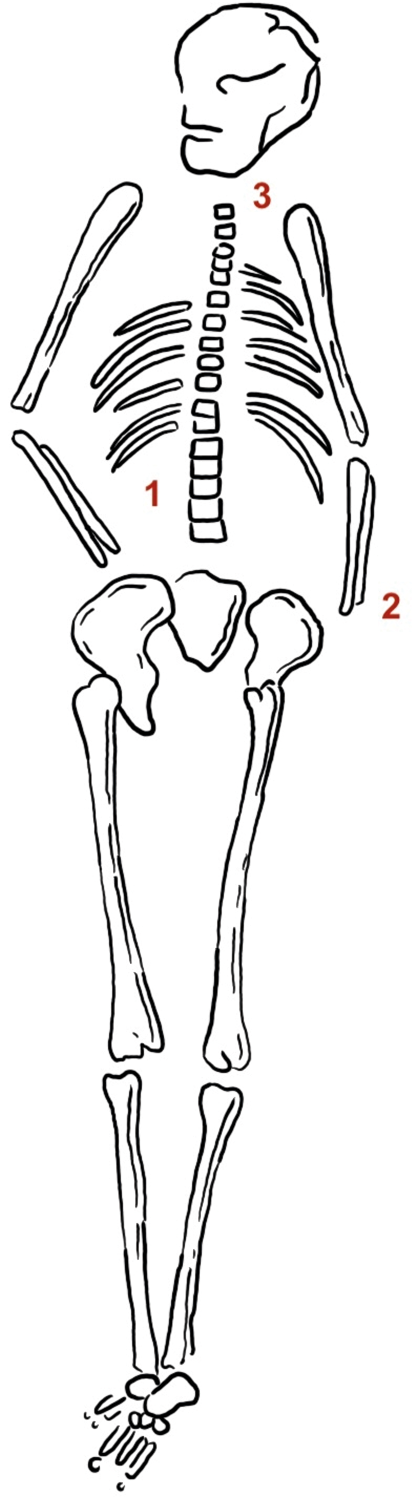
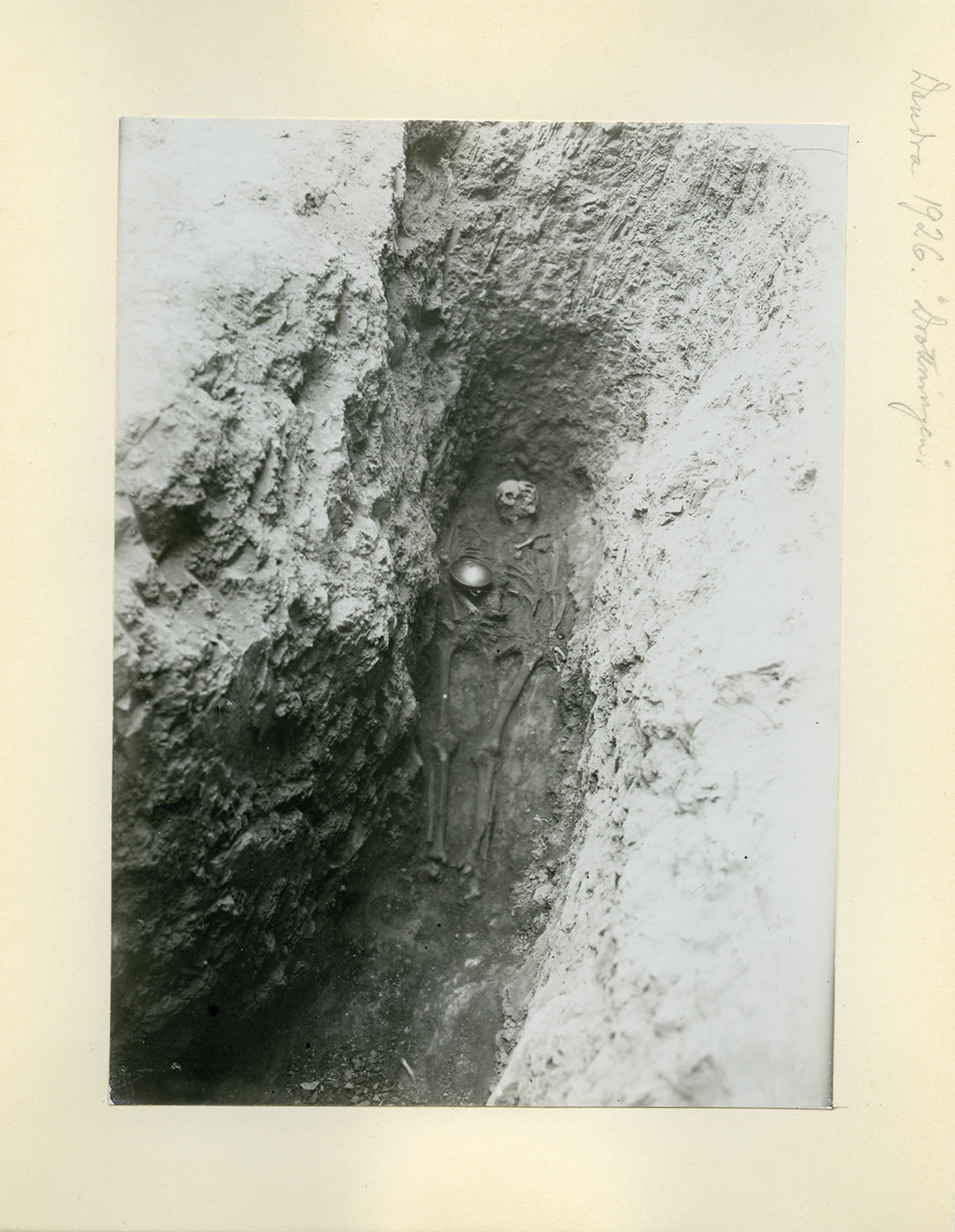
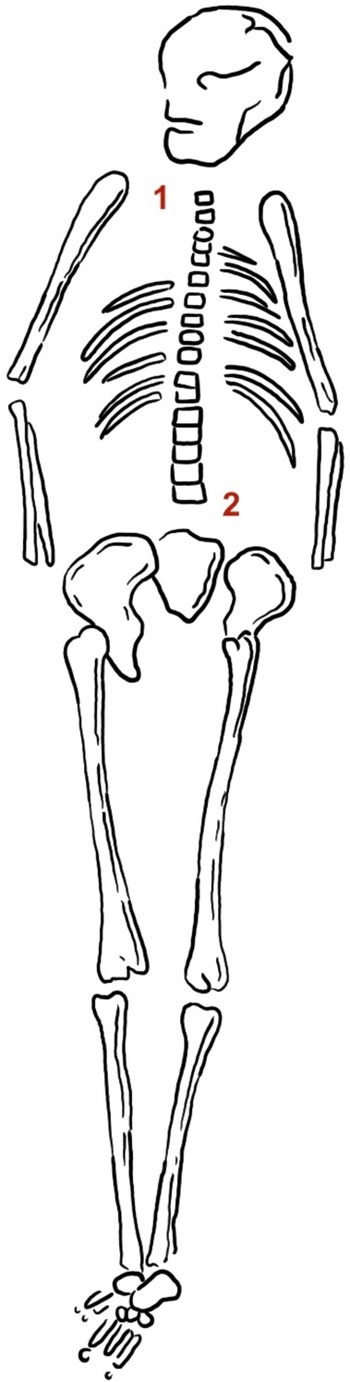
The presumed female skeleton in Pit I was laid out on her back with the left arm extended and the right arm bent so that the hand rested on the chest (Figs 7 & 8). The burial was furnished with just three objects: a gold and silver cup inlaid with bucrania on the chest of the skeleton, a carnelian seal near the left wrist (engraved with two boars, see CMS I 184; also Drakaki Reference Drakaki, Cavanagh, Cavanagh and Roy2010, 61–2; Sakellariou Reference Sakellariou1964, 210), worn as a bracelet, and a miniature golden pyxis near the neck, worn as a pendant (Persson Reference Persson1931, 38-9). The presumed female skeleton in Pit III was furnished in a similar manner with just two intact objects: gold rosettes, reconstructed as a necklace, and more gold ornaments around the waist, reconstructed as a belt (Fig. 9). Beads (made from gold and faience) were found scattered around the body.
Plan of the presumed female skeleton (the so-called Queen) and associated objects in Pit I in the Dendra tholos. (1) Gold and silver cup with inlaid bucrania; (2) carnelian sealstone with two boars; (3) miniature gold box, worn as a pendant.
The presumed female burial in Pit I in the tholos tomb in the Mycenaean cemetery at Dendra. The metal cup and carnelian sealstone can be seen in situ on the skeleton. (Photograph: courtesy of the Swedish Institute at Athens. © Hellenic Ministry of Culture – Hellenic Organization of Cultural Resources Development (H.O.C.RE.D.).)
Plan of the presumed female skeleton (the so-called Princess) and associated objects in Pit III in the Dendra tholos. (1) Gold rosette necklace; (2) gold belt with spiral pendants.
Most of the objects found with these three burials were therefore deposited in direct contact with the deceased. In each case, specific objects were placed in relation to the corpse, so that the body was surrounded and adorned with objects. Persson even noted that, during the excavation of the presumed male skeleton in Pit I, the skeleton was so covered with objects that he could barely see the bones underneath (Persson Reference Persson1931, 17). In other words, the impression of the deceased was mediated through the assemblage, for the ancient viewer as well as the modern archaeologist. These bodies were covered, adorned and aestheticized through the selection and deposition of specific objects and images.
Curating the dead
These three burials, taken together, showcase a preference for specific materials. Precious metals, for example, were deposited with each of the three burials. In Pit I, metal vessels take the place of ceramic: no ceramic vessels were included in this deposition, despite their ubiquity in early Mycenaean tombs elsewhere in the Peloponnese (Cavanagh & Mee Reference Cavanagh and Mee1998; Konstantinidi-Syvridi & Paschalidis Reference Konstantinidi-Syvridi, Paschalidis, Schallin and Tournavitou2015). Comparable contexts include the richer tombs in Grave Circle A at Mycenae and the Grave of the Griffin Warrior at Pylos, which contained several metal vessels but no ceramics.Footnote 6 In these rich tomb contexts, where people had access to metal vessels, these objects were chosen over their ceramic counterparts. At Dendra, the absence of ceramics from Pits I and III—despite their presence in Pit II and on the chamber floor—seems to support the idea of an intentional process of selection.
The three burials also indicate an interest in semi-precious stones, such as carnelian and agate, and in valuable man-made materials such as glass. These materials—as well as the precious metals mentioned above—are mostly imported (Laffineur Reference Laffineur1990, 251–63).Footnote 7 Glass and carnelian were most likely imported from the eastern Mediterranean in the early Mycenaean period, for example, and silver was probably sourced from Transylvania (Burns Reference Burns2010, 73–9; Stos-Gale Reference Stos-Gale, Meller, Risch and Pernicka2014 on silver; Pieniążek Reference Pieniążek2016 on carnelian). Gold was also imported, from the eastern Mediterranean or from northern Europe. These materials must have been valued, at least in part, for their ‘exotic’ associations: conspicuous consumption models hold that these materials testify to the trade contacts of the deceased and so act as another way to emphasize status (Burns Reference Burns2010; Dickinson Reference Dickinson1977; Voutsaki Reference Voutsaki, Urton and Papadopoulos2012). But the preference for some imported materials over others raises the question of alternative motivations. The selection of metal vessels over ceramic, for example—when imported ceramics were both accessible and identifiable as ‘exotic’ objects—could indicate that these objects were also valued for their specific visual and material properties.
The visual and material properties of these objects include the colour of the materials. Studies of colour are rare in the Mycenaean period—and in Aegean prehistory more broadly—but Gillis has emphasized the importance of colour in her work on the Mycenaean cemeteries at Berbati, Asine and Dendra (Gillis Reference Gillis and Tournavitou2015; Reference Gillis and Aslaksen2016). Gillis divides colour into hue (colour in its conventional sense, as red, blue, or yellow) and shine (reflective qualities or brightness) (after Gage Reference Gage1999). She argues that shine was a more important factor than hue in the selection of objects for deposition at these three cemeteries (Gillis Reference Gillis and Tournavitou2015, 525–6).
This interest in shininess seems to hold true in the three intact burials from the Dendra tholos, insofar as the materials selected for deposition are consistently characterized by their shiny surfaces. This observation can to some extent make sense of the eschewal of ceramic vessels in these burials. But these materials are defined by their vibrant and colourful surfaces as much as by their shine. Although it is impossible to identify any consistent selection of specific hues across these burials, we can point to a specific interest in the selection and combination of different colours and materials. One example is the wooden box from Pit I, which is adorned with bronze attachments, a shinier material used to cover the wood underneath (Persson Reference Persson1931, 31). This adornment indicates an interest in the combination of materials, and also a preference for the visual qualities of the bronze over the wood. The four swords in Pit I were also adorned with other materials, with ivory and agate pommels or with gold sheets and glass inlays (Kaltsas Reference Kaltsas2007, 124–5; Persson Reference Persson1931, 34–6). We can start to construct a hierarchy of materials from the specific ways that some materials were used to conceal or elaborate others, a preference for bronze over wood, for example, and for gold over bronze.
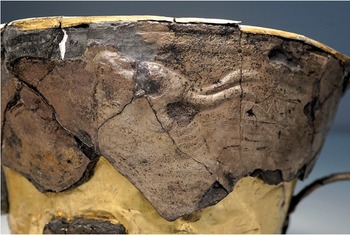
This combination of different materials, and different metals in particular, is also seen with two of the cups found in Pit I, one on the breast of the presumed female, the other on the chest of the male. Both cups have two layers, a silver exterior and a gold interior, and represent bulls on their surfaces, the former inlaid with gold, the latter without metal inlay (Fig. 10) (Persson Reference Persson1931, 33–4, 38). These cups seem to demonstrate an aesthetic interest in the same kind of material juxtaposition. Another example is the combination of metals in three of the rings found with the male burial. These objects layer—from the inside out—iron, copper, lead and silver (Fig. 11) (for similar examples: Konstantinidi-Syvridi Reference Konstantinidi-Syvridi, Eder and Zavadil2021, 509; Poursat Reference Poursat2014, 108). Only the silver is visible in their finished form, but the combination of these different metals speaks to the same kind of material interests seen in the boxes, swords and cups from the tomb (see also Konstantinidi-Syvridi Reference Konstantinidi-Syvridi, Eder and Zavadil2021, 508 on the symbolic potential of these combinations).
Silver cup with an interior gold layer from Pit I in the Dendra tholos, HNAM inv. no. Π 7340. (Photographic Archive of the Hellenic National Archaeological Museum, Athens. © Hellenic Ministry of Culture – Hellenic Organization of Cultural Resources Development (H.O.C.RE.D.).)

Metal ring from Pit I in the Dendra tholos, HNAM inv. no. Π 7346. (Photographic Archive of the Hellenic National Archaeological Museum, Athens. © Hellenic Ministry of Culture – Hellenic Organization of Cultural Resources Development (H.O.C.RE.D.).)

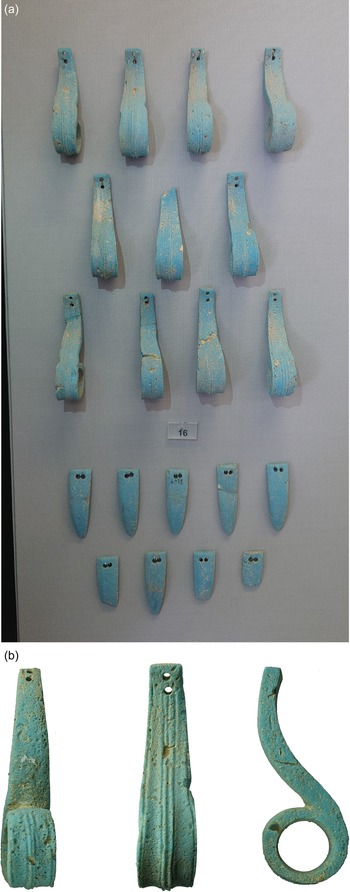
It is important that combination, in this context, can also be understood as transformation. The addition of bronze to the wooden box or the addition of ivory to the bronze swords are material choices that create new and hybrid objects. The Dendra tomb also evidences another kind of transformation, not the adornment of one material with another but the representation of one material in another. The glass ornaments found around the head of the male burial, imitating a boar’s tusk helmet, provide an especially useful example (Fig. 12) (Persson Reference Persson1931, 36). They replace animal remains—i.e. the boar’s tusks—with fabricated objects and so remake the helmet in a new form, characterized by the colourful hues of the ornaments rather than the white of the boar’s tusks. These objects could indicate some preference for the material properties of the ornaments over those of the tusks. They also seem to showcase, as above, an interest in the transformation from the natural to the man-made and from the mundane to the brilliant.
The glass ornaments from Pit I in the Dendra tholos, HNAM inv. no. Π 7369. (12a, top) As shown on display in the Hellenic National Archaeological Museum; (12b, bottom) close-up view. (Photographic Archive of the Hellenic National Archaeological Museum, Athens. © Hellenic Ministry of Culture – Hellenic Organization of Cultural Resources Development (H.O.C.RE.D.).)

As Wace noted in 1932, however, there are not enough ornaments to reconstruct an entire helmet (Wace Reference Wace1932, 193). Instead, the plaques could have been sewn onto leather or another textile, so that they covered only the front of the helmet, the section visible from above. The ornaments, in other words, do not replicate the entire form of the helmet, but only the most visible sections. They therefore reflect an interest in the aesthetics of the deposition from the position of an external viewer, the person looking down at the body in the pit. This mode of presentation emphasizes the importance of the visual impression over the material reality: the deposition was not so much invested in the exact form of the object, in its precise replication, but in its visual appearance. In other words, the helmet was intended to be viewed within the specific space of the tomb, in relation to the body of the deceased and the rest of the deposition.
The boar’s tusk helmet is often taken as a symbol of the male warrior elite in the early Mycenaean period (Molloy Reference Molloy2012; Morris Reference Morris, Hägg, Nordquist and Persson1990). It is found across numerous early Mycenaean mortuary contexts, often associated with male skeletons and worn on the head for burial. In the Dendra tholos, the choice to transform the helmet in particular is therefore important not only because it transforms the concept of the object itself, but also because it transforms the image of the warrior. The helmet, in its original form, is made from animal tusks, which come to symbolize the success of the hunt and the martial prowess of the helmet’s wearer (Anderson Reference Anderson2024, 247–58). The version of the helmet seen in the Dendra tholos, in its substitution of tusks for ornaments, eschews this reference and so refuses their indexical force. It therefore shows that warrior identity is not only associated with specific actions (such as the hunt) or with specific object types (such as the helmet and the swords), but also with specific material properties (such as colour and shine). It reveals the warrior as an identity not only associated with materials but constructed via materials (also Treherne Reference Treherne1995). It is the representation—and therefore the transformation—of the helmet that comes to the fore here, more than the prototype.
Key to the artistic approach adopted in this article is that the material transformations described above—the consistent interest in shinier and more colourful objects—can also be seen in the act of deposition, in the adornment of the dead body with these objects. The deposition of objects in direct contact with the deceased means that the burial makes the corpse, too, shinier and more colourful, in the way that it combines, and in some sense overwrites, the flesh of the body with the splendour of the materials. Seen from this perspective, the deposition of these objects also makes the corpse more durable. The materials chosen for deposition are for the most part those that weather decay and decomposition: the golden cup will remain on the breast of the presumed male skeleton long after his flesh has disappeared.
To think about the burial as representation in this manner is also to reveal the role of these objects as devices intended to mediate the transformation of the deceased. Thanks to the conditions within the tomb—the dark interior of the chamber combined with the deep and narrow pits—these devices are both sensory and visual in nature. The dead bodies must have been lowered into the pits, then specific objects deposited afterwards: we can reconstruct a complex depositional operation characterized by specific sounds and actions, visible from the doorway or from torches carried by the mourners. Adorned with objects at the bottom of the pits, the bodies would have sparkled under the light of the torches, which enhanced the shiny effect of the burial. It is also possible that some aspects of the burial were assembled outside the tomb first, that the bodies and their associated objects were put on display before their final deposition. The assemblage must also have been visible during the funerary ceremony, as part of the procession to the tomb, for example. The colourful and shiny objects would stand out for people watching the procession from a distance, and these glimpses of the body combined with objects must have remained in the minds of the mourners long after their deposition. These different opportunities for the presentation of the body therefore created different types of visual impressions and interpretations.
It is in the space of the tomb, however, that bodies and objects truly meld. Where the corpse provides the canvas for deposition, the tomb acts as the frame that effects its transformation into an image. In the Dendra tholos, for example, the nature of the pits means that the mourners would look down on the bodies from above, with a bird’s-eye view of the extended corpse and its associated objects. Other senses, such as touch, must have been involved in the act of deposition, but the small size of the pits means that these burials were accessible only by eye once deposited, at least before the pits were sealed. The ideal viewer for these depositions is therefore the mourner inside the tomb. While it is possible to reconstruct different states or levels of viewership, such as the viewpoint of the person observing the funerary procession from a distance, it seems that the full impact of the burial was reserved for the people who carried out the act of deposition. It is difficult to know who these people were, but the size of the tomb indicates a restricted group, perhaps only close family members, and the wealth of the burials indicates elite members of early Mycenaean society.
The deposition of specific materials and colours therefore came to characterize the dead bodies in the tomb: objects were used to aestheticize and transform the corpse. These objects, in other words, turned the dead body into an artwork in its own right, defined by the bright colours and shiny surfaces of its associated materials. The nature of this artwork is different in each case, however. The presumed male skeleton in the Dendra tholos was almost completely covered with objects, but the adornment of the two presumed female skeletons ensured that the bodies of the deceased remain visible. These objects mediate the impression of the dead for the mourners to different extents, but in each case, they structure the viewer’s interpretation of the burial and direct them towards certain ideas. The curation of the burial as an artwork, in a visual medium, therefore also ensures that the image of the burial endures in the minds of its viewers long after the pits were sealed with stone slabs.
Representing the body
The section above has emphasized the connection between acts of combination, transformation and representation in the early Mycenaean mortuary sphere. It has focused on the specific nature of the deposition, with reference to the material preoccupations seen in the curation of the burial and the aesthetic choices made by the mourners. It has therefore explained how the bodies of the dead were transformed in deposition. I now want to explore why these transformations took place, to think further about the different functions of representation in the mortuary sphere.
First, these transformations provide the body with a specific material presence. The deposition of objects in direct contact with the dead, as seen with each intact burial in the Dendra tholos, means that the objects came to substitute for the bodies of the dead as their flesh decomposed. It is important that in the Dendra tholos, the objects deposited on the body also maintain an iconic resemblance to the corpse. The four swords found with the presumed male skeleton, for example, were deposited with their hilts on the shoulders and their blades on the arms of the corpse. The specific placement of the weapons therefore creates a visual echo of the shoulder in the sword hilt and the arm in the bronze blade. These objects remake the body in specific material form, intended to be viewed within the context of the tomb. In the Dendra tholos, the particular iconic resemblance between the objects and the corpse emphasizes their substitutive role, where the swords take the place of the shoulders. This material substitution was effective due to the objects’ association with the body when whole, and we could speculate, due to their association with the body in life.
The material transformation of the corpse therefore matters as a counter to the inevitable processes of decay and decomposition. But the burials in Pits I and III in the Dendra tholos do not seem to have been reopened at a later date, in contrast to the burials on the chamber floor of the tomb and in contrast to other contemporary tomb contexts. In the Shaft Graves at Mycenae, for example, or the tholos tombs at Routsi in Messenia, the burials were revisited after the initial act of deposition, sometimes moved around to make space for more bodies and sometimes subject to secondary burial treatment (on the Shaft Grave form: Boyd Reference Boyd, Schallin and Tournavitou2015; Konstantinidi-Syvridi & Paschalidis Reference Konstantinidi-Syvridi and Paschalidis2019; on Routsi: Korres Reference Korres and Steinmann2018). In these tombs, each time the deceased was viewed, the objects appeared in their same resplendent materialism, but the flesh of the body was slowly eaten away. Decomposition (or transformation over time) was therefore built into the burial from the start, as an important and inevitable aspect of this representational mode. These three burials at Dendra were not revisited, but the bodies would nonetheless have decayed as the objects remained. We can assume that the people behind the burial would have considered this process of decomposition in their selection and deposition of objects. It is the recreated corpse, overlaid with objects and materials, that stayed in the minds of the mourners after the pits were sealed.
Second, these transformations provide the body with an iconic presence. In other words, to understand this kind of curation as an artistic action, or to understand the creation of the burial context as a form of representation, is also to understand the material presence of the dead as an iconic presence. By iconic presence, I mean that the deposition of objects on and around bodies turns the burial into a picture, a new form of material and creative expression that bears a resemblance to the corpse but remakes it in different materials (Belting Reference Belting2011, ch. 4). The corpse, when combined with objects within the space of the tomb, is transformed into a representation, an aestheticized version of itself. This version of representation can be compared to the transformation of the boar’s tusk helmet, described above, in which the tusks take on a new material form. In the case of the helmet, the representation then takes the place of the represented object, as here, the burial comes to take the place of the corpse.
This iconic presence is important because it emphasizes the relations between the burial and the mourners. The visual dimension of the burial comes to the fore in the Dendra tholos, where the space of the tomb dictates a specific relationship between the deposition and the viewer positioned above the pits. The notion of an iconic presence also showcases the specific impact of the burial on the viewer. As the corpse becomes representation, as it transitions from the real space of the tomb into the pictorial space of the burial, it is moved into another conceptual realm and so distanced from the mourner. The burial therefore comes to mediate the horror of the corpse and the emotions associated with loss. The mourners can remember the aestheticized dead, and the final image of the burial can then circulate in the minds of the mourners, even after the tomb is sealed shut. This reconstruction explains the effort made to present the body in a particular way, even when it was only viewed once: it is precisely the curated impact— both visual and mental—of the burial that allows it to be viewed only once, and thereafter remain in the minds of the mourners.
It is also important, in this context, that the objects from the Dendra tholos do not preserve many images of the human body, at least when compared to other rich early Mycenaean burials, such as the Vapheio cist or the Grave of the Griffin Warrior. The only extant human representations from the Dendra tholos are preserved on the plaques from the helmet found with the male burial. Some seem to show a human figure seated on the back of a bull and some show a lion apparently confronting a human figure. Persson identified these scenes as representations of Classical Greek myths: Europa and the bull and Bellerophon and the chimaera (Persson Reference Persson1931, 121–3). Although these specific identifications seem improbable, the plaques do seem to represent intricate human–animal compositions with potential narrative implications. They complicate the nature of the helmet further, as a representation made from representations. In this sense, they also provide another layer of material mediation, where the impression of the corpse is refracted not only via specific colours and materials, but also via specific images and their associated stories.
It is therefore possible to locate early Mycenaean artistic practice in the curation of objects and bodies as part of the burial. This idea is important for a period without any sculptural tradition, and without an extended history of figurative art. In this context, the notion of the body as image provides a new locus of creative action, seen in the curation of the tomb context rather than in the production of objects. This approach reveals the role of curation as an important artistic action at this time, an addendum to Knappett’s Late Bronze Age examples above (Knappett Reference Knappett2020: to model, to imprint, to combine, to contain, to fragment, and here, to curate). It also reveals the role of these burials as hybrid sculptures, offering a new art-historical narrative for the early Mycenaean period.
More broadly, a focus on the combined material and iconic presence of the corpse showcases the role of the burial as an artwork, with human bodies as the canvas for deposition. We can then examine the composition of this artwork—the specific selection of objects based on the perception of their visual and material properties. This artistic approach, centred around the twin concepts of curation and aesthetics, is relevant for burials across time and space, as well as other types of structured deposition. As shown above, it is possible to trace choices in how to preserve the body in material form, to identify an interest in its reinvention as colourful, vibrant and durable. The combination of objects and dead bodies, and the specific nature of this curation, transforms the dead body into an artwork characterized by these specific material properties. The key here is that this kind of analysis can be applied not only to objects, but also to contexts, to the deposition as a whole. The combination of objects and bodies acts as the intended composition, where the focus of the burial is the resultant picture of the corpse and its associated objects.
Conclusion
In conclusion, this article has put forward its own version of the ‘archaeo art history’ proposed by Trever, in its development of an artistic approach to mortuary contexts. The analysis presented here is one attempt to reintroduce the notion of art—and its associated approaches—as important analytical tools for archaeological research, even for periods without textual evidence. This approach, as shown above, has broader repercussions for studies of the mortuary sphere. It emphasizes the transformation of the dead via the material construction of the burial, to focus on the provision of an iconic presence for the corpse as one way to mediate emotion and loss. It therefore understands burial contexts as complex processes of image-making centred around the figure of the deceased. It is also an approach that locates creative action in the combination and deposition of specific objects with the dead. This article has focused on the early Mycenaean period, in an attempt to reframe the artistic production of this period in terms of curation. In its focus on the concentration of artistic action in the mortuary sphere, however, it has also revealed the intrinsic connection between art and emotion, and between death and creation, across time and space. I have used this approach in relation to one specific case study—the three intact burials in the Dendra tholos—but it can also be productively applied to other burial contexts both in the early Mycenaean world and further afield, to compare and contrast their aesthetic choices and expressions.
Acknowledgements
This paper presents work undertaken for my doctoral thesis, which was funded by the UK Arts and Humanities Research Council (reference no. 2261361). This work was also supported by the British School at Athens. Tania Gerousi and Niki Papakonstantinou at the British School at Athens expertly handled the acquisition of permissions. I am grateful to the Hellenic National Archaeological Museum and the Ephorate of Antiquities of the Argolid for permission to reproduce photographs, and to Jenny Wallensten and Georgia Galani at the Swedish Institute at Athens. I thank Eleni Konstantinidi-Syvridi in particular, for her help with both the text and the images. Comments from Sofia Voutsaki, Yannis Galanakis, Tulsi Parikh, and the anonymous reviewers also improved this article immeasurably. Many thanks are also due to John Robb and the CAJ editorial team. Any errors, of course, remain my own.




 Open access

