Introduction
‘We need to know what a legally capable child looks like.’
This statement prompted a ripple of amusement among attendees of an All-Party Parliamentary Group for Public Legal Education at the UK Houses of Parliament in October 2016.Footnote 1 Exactly why people were laughing was unclear. Perhaps they found it absurd to think of a child as legally capable, or ridiculous to suggest we might be interested in helping them become so. But in any case, the suggestion – and the reaction to it – provided the impetus for an extended period of interdisciplinary research, reflection, and discussion to explore the question of what a legally capable child ‘looks like’. Most recently, this has taken place in the context of an action research project (Fortitude) funded by the European Research Council, which has aimed to improve children and young people’s legal capability through the development and evaluation of game-based learning interventions.Footnote 2
For the purposes of this research, and more generally in the field of public legal education (PLE), the term ‘legal capability’ is used to describe a person’s ability to deal effectively with law-related issues which they encounter in their everyday life. A number of frameworks have been developed internationally to describe in more detail what legal capability ‘looks like’ for adults, and the child-focused framework presented in this paper has been influenced and informed to some extent by this scholarship. However, we argue these existing tools are insufficient to meet the needs of children and young people (‘children’ hereafter). And so the framework we present here breaks new ground, not only because of its focus on children, but because we have radically reconceptualised legal capability, drawing on a range of interdisciplinary theories.
We begin this paper by explaining why legal capability is relevant for children, and why this new framework is necessary. We then go on to demonstrate how it moves beyond ‘justiciable issues’ and rejects a law-first approach, yet remains closely relevant to the access to justice agenda for children. The framework itself is then introduced, and we explain why and how key concepts such as ‘baseline’ legal capability, and ‘flipping IRAC’ are fundamental to its approach. Within this discussion, we also set out our hypotheses concerning children’s abilities to learn through and across contexts, and the development of their confidence through learning interventions based on this framework. After addressing the wider significance of this learner-centred approach, we conclude by summarising our hopes for the further application and development of this framework, in the context of the critical realist paradigm which has shaped this research.
1. Why legal capability is relevant for children
Views on whether or not legal capability is relevant for children depend on: (i) how we conceptualise legal capability; and (ii) how we conceptualise children. It is argued that when legal capability is conceptualised along the lines described in this paper, it is highly relevant for children. But to avoid a circular argument, even if we just take the current, broad view of legal capability as a person’s ability to deal effectively with law-related issues which they encounter in their everyday life, then it is nonetheless relevant for children for both theoretical and practical reasons.
From a theoretical perspective, it is widely recognised by scholars in the fields of sociology and childhood studies that the ideas that we hold concerning children and childhood are socially constructed.Footnote 3 Or in other words, ‘the immaturity of children is a biological fact of life but the way in which this immaturity is understood and made meaningful is a fact of culture’.Footnote 4 As Kay Tisdall argues, ‘children can be socially constructed as human beings … as social actors in the present, expressing agency and competence’.Footnote 5 However, partly due to an overly-simplistic yet enduring understanding of Jean Piaget’s ‘ages and stages’ model of cognitive development,Footnote 6 there has been a tendency for professionals to conceptualise children as ‘human becomings’ whose ability to actively participate in society can be achieved only when they reach adulthood.Footnote 7 Based on this view, the idea of children being legally capable is laughable. But based on a social constructionist view, it is possible.
From a practical point of view, children of all ages encounter law-related issues in their everyday lives. Visa debit cards are available to children from the age of 6Footnote 8 and in evidence submitted to the House of Commons, one provider reported that 1 in 5 children aged 10–12 in the UK has one of these cards.Footnote 9 Research conducted by Ofcom indicates that ‘nearly all children (99%) now spend time online’ and that 90% of children own a mobile phone by the age of 11.Footnote 10 We argue that it is vital for children to be given an opportunity to understand and exercise their legal rights as consumers in these situations, with and without adult support. People of any age can be held responsible for their own torts, which is relevant knowledge for all children, and particularly those who bully, or who are experiencing bullying.Footnote 11 And of course, from the age of 10 children are criminally responsible, but research shows that many children hold inaccurate knowledge concerning police powers.Footnote 12
In all circumstances, children are rights-holders under the United Nations Convention on the Rights of the Child (UNCRC), but their levels of knowledge remain concerningly low.Footnote 13 This is an issue of importance for all children, but especially for those experiencing rights violations. One of the pressing questions we have sought to address in this research is ‘how does someone know when a problem is a problem?’. As demonstrated by the death of four-year-old Daniel Pelka in 2012, the question is particularly acute for children who may be suffering abuse which is being normalised by their apparent ‘caregivers’. Daniel was starved, severely abused, and eventually murdered by his mother and her partner but attended school during this period of abuse. At school, Daniel appeared hungry and was often found scavenging in bins for food. However, Daniel’s mother’s explanations for this behaviour were accepted by the school and there is no record of anyone talking directly to Daniel about his life at home or the reasons for his apparent hunger.Footnote 14
Of course, we recognise that adults have safeguarding responsibilities towards children, particularly in school.Footnote 15 However, we know that adults in schools, and in the community, can fail to identify a problem and intervene effectively.Footnote 16 And so in these situations, any intervention to prevent mistreatment or abuse may depend on the child themselves reporting the problem and seeking help. As explained further in Section 3 of this paper, knowledge of the UNCRC has a critical position in our framework, with a particular emphasis on Article 12.Footnote 17 In this respect, our approach aligns with Gerison Lansdown’s view that:
Only if children can speak out about the violence or abuse they face, does it become possible to challenge it and end impunity for those who seek to hurt children. The right to participate is not only fundamental to children’s dignity, and sense of self-esteem and self-efficacy, but is also a vital dimension of their protection.Footnote 18
2. Drawing on and beyond existing legal capability frameworks
(a) Existing frameworks
The framework we propose in this paper is influenced and informed by existing legal capability frameworks for adults. For example, we conceptualise legal capability as comprising knowledge, skills and confidence, and this categorisation derives from a basic framework first proposed by Jones in 2010, in a publication for the Public Legal Education Network.Footnote 19 Jones’ framework has been highly influential, both in the UK and internationally.Footnote 20 Subsequent legal capability frameworks have continued to reference the three dimensions Jones identified,Footnote 21 but use varying terminology to describe the ‘confidence’ dimension, including ‘attributes’,Footnote 22 ‘attitudes’,Footnote 23 and ‘competence/psychological readiness’.Footnote 24 The term ‘personal characteristics and circumstances’ has been proposed as a broader term to include but replace ‘confidence’Footnote 25 and an additional fourth category of ‘resources’ has also been proposed by Pleasence and Balmer.Footnote 26
These subsequent frameworks have increased in complexity. For example, in the context of developing a framework for evaluating PLE, in 2011, Collard et al suggested there are four domains which describe ‘at a high level what a legally capable person might reasonably be expected to know and be able to do when faced with common issues’.Footnote 27 Mapped against these four domains, Collard et al provide a matrix of 22 more specific skills and qualities which they suggest are needed in order for a person to deal effectively with a law-related issue they may encounter in their everyday life.Footnote 28 More recently, in 2019, when reporting their findings of an exploratory legal capability study in Australia, Balmer et al set out a legal capability framework which includes multiple discrete elements within the broad categories of knowledge, skills, attributes and resources/environment, and mapped against four stages: recognition of issues; information/assistance; resolution; and wider influence and law reform.Footnote 29 Whilst they differ in terminology, these four stages map to those set out by Collard et al in 2011 and reflect the access to justice agenda which has driven the development much of the work in this field.
(b) Moving beyond justiciable issues and rejecting a law-first approach
Linked to this access to justice agenda, adult legal capability frameworks have tended to focus on people’s ability to deal effectively with ‘justiciable issues’ or, in other words, those issues for which a formal legal remedy is available.Footnote 30 Indeed, McDonald goes so far as to describe legal capability as referring to ‘the personal characteristics or competencies required to effectively and purposefully function in the legal sphere, including purposeful use of law and legal institutions’.Footnote 31
For the purposes of a child-centred framework, we consider this ‘law first’ approach unrealistic. As McDonald acknowledges, even where a formal legal remedy is (at least in principle) available to someone, the extent to which they will be able to access this legal remedy is contingent not only on their own level of legal capability, but also on several external factors, including their access to financial resources.Footnote 32 The point is magnified in relation to children because a person under 18 will normally require an adult ‘litigation friend’ to initiate and conduct proceedings on their behalf.Footnote 33 Then, as Wade Mansell observes, ‘even when access is granted all parties are manifestly not equal’ due to the potential for just one side to be represented, and/or be represented by more experienced (and so usually more expensive) legal counsel.Footnote 34
In contrast, as Olatokun notes, ‘Some of the greatest gains in legal rights are achieved by using the law outside of the courtroom’Footnote 35 and we argue that for children especially, legal capability is best understood as a person’s ability to deal effectively with law-related issues which they encounter in their everyday lives, in the context of their everyday lives. In other words, they do not need to be able to access legal institutions or ‘enter the legal world’ to be legally capable. Rather, a legally capable child will possess legal knowledge concerning the issues they encounter in their everyday life, and they will have developed the skills and level of confidence they need to deal with these effectively.
Designing a legal capability framework which focuses solely on justiciable issues, and which takes a ‘law first’ perspective is also problematic from a theoretical point of view. As scholars in the field of critical legal pluralism emphasise, ‘law is a construction of human beings’Footnote 36 but we tend to reify concepts such as law and legal institutions as ‘things’ (and perhaps as the only things) which we can ‘go to’ to find a solution to our problems. This theme is taken up by Wintersteiger and Mulqueen in the PLE context, as they challenge the assumption that ‘legal problems always require legal solutions’ and argue that ‘In order to work toward a demystification of law that seeks to make law visible in some way to potential rights holders, there is also a need to ensure its place in the wider rubric of relations and social orders is neither reified nor romanticised.’Footnote 37 Mindful of this, in designing this framework, we have adopted a position which, as Wintersteiger and Mulqueen propose, ‘decentres’ the law, and deliberately pulls back from presenting an idealised ‘knights in shining armour’ view of law and legal institutions.
(c) Continued relevance to the access to justice agenda
This does not mean that we have rejected the access to justice agenda in relation to children. On the contrary, we recognise the global importance of access to justice for all people, including children, as reflected in Target 16.3 of the United Nation (UN)’s Sustainable Development Goals.Footnote 38 It is argued that the development of children’s legal capability set out in this framework can be viewed as integral to the attainment of this goal, functioning at ‘ground level’ to build children’s individual and collective capacity to identify rights violations, and to seek help to pursue effective remedies from an early age.Footnote 39
This claim is based on two distinctive features of the framework presented in this paper. First, it has been designed to reflect not only what attributes children need to demonstrate in order to be legally capable, but also how these attributes can be developed. So with regard to legal and rights knowledge, for example, it focuses on developing children’s understanding, rather than on the attainment of abstract knowledge. Secondly, it places children’s lived experiences at its centre, and focuses their learning on these experiences, before moving on to more generic topics. The distinctive significance of these features is recognised in the literature. For example, the UN High Commissioner for Human Rights includes ‘child rights education’ as well as being able to ‘access relevant information’ as steps to children’s legal empowerment in their report on access to justice for children.Footnote 40 And in their guidance on the UN approach to justice for children, the UN Secretary General includes ‘Ensuring child rights education and legal awareness for all children.’Footnote 41 This guidance also advocates ‘Drawing on child participation projects (or establish such projects if not available) to ensure that children are involved from the outset in identifying legal matters important to them.’Footnote 42
3. Introducing a framework for developing children’s legal capability
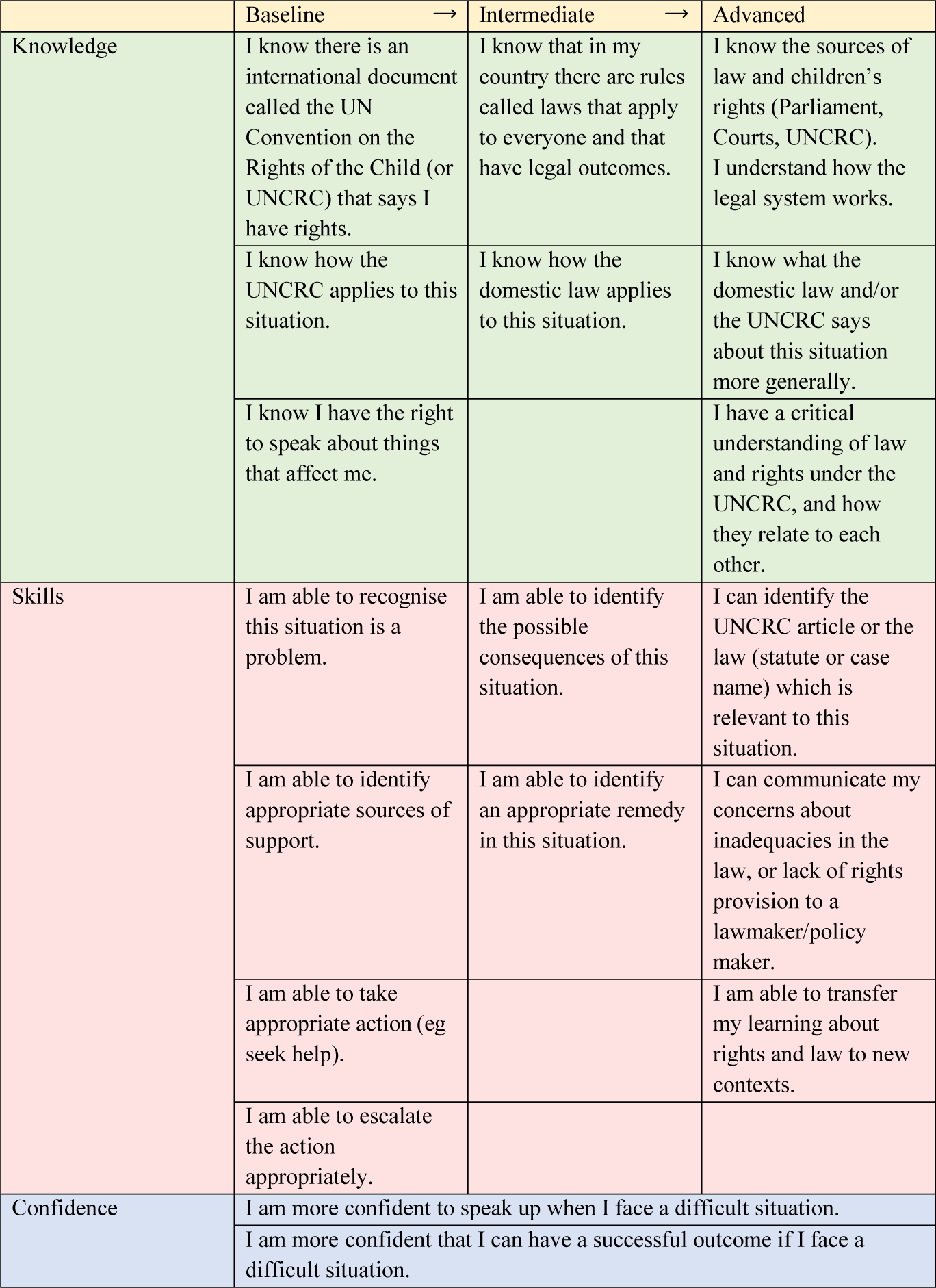
As illustrated in Figure 1 below, the framework we propose for developing children’s legal capability is relatively simple when compared to multidimensional adult-focused frameworks. However, a radical reconceptualisation of legal capability underpins this apparent simplicity. It consists of three levels (baseline, intermediate and advanced) which are incremental. Linking to our reliance on sociological theories rather than traditional developmental models of children’s capabilities, we attach no specific age ranges to these levels. Rather, the framework is designed to be applied flexibly in light of the evolving capacities of each child, in line with Article 5 of the UNCRC.
A legal capability framework for children.

(a) Baseline legal capability
One of the most important aspects of the framework we introduce in this paper is the concept of baseline legal capability. It is relevant for all children, including very young children and children with additional learning needs, and envisages that when they are faced with a difficult situation, they will know how the UNCRC applies to the situation, and they will be able to recognise that the situation is a problem. They will also know that they always have the right to speak about things that affect them.Footnote 43 They will have sufficient confidence to seek help from an appropriate person and if help is not then forthcoming, they will escalate. At baseline level, this is what a legally capable child looks like.
(i) Knowledge
The learning outcomes relating to knowledge at baseline level are limited to:
-
• I know there is an international document called the UN Convention on the Rights of the Child (or UNCRC) that says I have rights.
-
• I know how the UNCRC applies to this situation.
-
• I know I have the right to speak about things that affect me.
Generic knowledge concerning the existence of the UNCRC is made meaningful through learning interventions which focus only on applied UNCRC rights. There is no reference to specific article numbers at this stage. This is because, as already explained in this paper, we have ‘decentred’ law and legal institutions when designing this framework, and this means that we do not require a legally capable child to possess abstract knowledge about them.
We term this direction of learning as ‘flipping IRAC’ because it represents a significant disruption to the approach which we, as law teachers, commonly advise law students to take when addressing legal hypothetical problems.Footnote 44 ‘IRAC’ is an acronym which refers to:
-
• Issue (identify the problem);
-
• Rule (identify the relevant legal rule/s);
-
• Apply (consider how the rule might apply to the problem);
-
• Conclude (come to a decision as to how the rule is most likely to apply).
On this model, the expectation is that the learner will draw on their general knowledge of the law in a given area, identify which specific legal rules are relevant, and use legal reasoning to determine how these rules apply. This ability to move from the general to the specific is also evident as an expectation in adult-focused legal capability frameworks, as they tend to assume that through acquisition of general knowledge about law and the legal system, the learner will develop to ability to ‘recognise and frame’Footnote 45 the legal dimensions of problems they encounter in their everyday lives.
We do not make this assumption in this framework. We instead propose that the child will begin by learning about how the UNCRC applies to a range of situations which they may encounter in their everyday life. For example, in relation to a scenario where they cannot use their local park because the equipment is broken, a legally capable child will know they have a right to play in their local park. Or for a child who is being bullied by a classmate in school, they will know that they have a right to be protected from being hurt by this classmate. The only general legal or rights knowledge they are expected to possess at this stage is that they always have a right to speak about things that affect them. This right is self-explanatory and requires no deductive reasoning on the child’s part. This, we suggest, is as far as they need to go in terms of their required level of knowledge at baseline level. Crucially then, for a child experiencing neglect or abuse from a ‘caregiver’, they will be legally capable if they know that they have a right to be protected from being hurt or neglected by this ‘caregiver’, and that they have a right to speak up about it.
(ii) Skills
The learning outcomes relating to skills at this level are:
-
• I am able to recognise that this situation is a problem.
-
• I am able to identify appropriate sources of support.
-
• I am able to take appropriate action (eg seek help).
-
• I am able to escalate the action appropriately.
As stated earlier in the paper, one of the pressing questions we have sought to address in this research is ‘how does someone know when a problem is a problem?’. Drawing on the work of Paolo Freire (1921–1997), we propose the answer may lie with ‘education for critical consciousness’.Footnote 46 Freire proposed a model of education which provides learners with opportunities to critically reflect on their social reality, and act to transform it (so-called ‘praxis’).Footnote 47 In other words, this form of education creates an environment whereby the learner (including a young child) can become conscious that their subjective reality is objectively unjust. Freire’s seminal work The Pedagogy of the Oppressed, was published over 50 years ago but as Nancy Flowers observes, ‘it continues to inform the practice of human rights educators around the world’.Footnote 48 Informed by transformative human rights education scholarship, and in particular by the work of Monisha Bajaj,Footnote 49 we propose that providing children with the opportunity to gain a basic, contextualised understanding of their human rights (in the form of the UNCRC) represents a simple yet significant baseline for the legal knowledge dimension of legal capability. So, for a young child who is experiencing mistreatment or abuse, learning about their specific right to be protected from harm (under Article 19) provides them with an opportunity to understand that their situation is not ‘normal’. This new understanding motivates them to seek help, and to disrupt the ‘culture of silence’ which prevails before this realisation occurs.Footnote 50
At this level, identifying an appropriate source of support and taking appropriate action is most likely to equate to seeking help from an adult they trust, by telling them about the problem they are experiencing. It is hoped that the child will then receive help and support to address the problem effectively. However, the inclusion of the ability to escalate reflects the possibility that for a variety of reasons, help may not always be immediately forthcoming. Of course, this needs to be managed sensitively, as it is important that children retain confidence in the willingness of adults to help and support them. In practical terms, this means that scenarios devised for learning about escalation will refer to the problem persisting, rather than to the adult refusing to help, or ignoring the child. Phrases such as ‘some adults are better able to help than others’ can also be useful.
(iii) Confidence
Confidence was one of the three dimensions of legal capability identified in Jones’ 2010 foundational report,Footnote 51 and subsequent frameworks have continued to include the dimension of confidence, albeit using varying terminology. In this framework, we propose confidence as comprising three main components: self-efficacy; collective efficacy; and self-determination. Research led and influenced by Albert Bandura (1925–2021) suggests that the extent to which a person is likely to act is linked to their belief in their ability to complete a task or achieve a goal (self-efficacy), and for groups, their shared belief (collective efficacy). A body of research also establishes that people (including children) are intrinsically motivated to act when three basic psychological needs are met. These are: autonomy (freedom of choices); competence (mastery); and relatedness (sense of belonging), known collectively as self-determination.Footnote 52
In the framework, we position applied legal/rights acknowledge, and a continued emphasis on the child’s right to speak up in matters that affect them, as instrumental in initiating and developing children’s self/collective efficacy, and self-determination. The literature establishes that experiencing a ‘small win’ in one situation increases the child’s confidence that this will happen again in other situations – hence the learning objectives relating to the dimension confidence run across each of the levels (baseline to advanced), and are expressed simply as:
-
• I am more confident to speak up when I face a difficult situation.
-
• I am more confident that I can have a successful outcome if I face a difficult situation.
To test this hypothesis, we have developed a psychometric scale to measure children’s levels of self-efficacy, collective efficacy, and self-determination (separated into autonomy, competence and relatedness), linked to the UNCRC. This has been applied at pre- and post-intervention stages in our empirical research and has potential for application in other contexts, following further development.Footnote 53
(b) Intermediate level
Each of the elements identified at baseline level remain relevant at this next level, and the learning outcomes relating to confidence remain the same.
(i) Knowledge
At this stage, however, knowledge of domestic law is introduced. Importantly, this is still in applied terms, with knowledge of domestic law again being made meaningful through learning interventions which focus on applied legal knowledge attached to scenarios which reflect children’s lived experiences. Hence the learning outcomes are:
-
• I know that in my country there are rules called laws that apply to everyone and that have legal outcomes.
-
• I know how the domestic law applies to this situation.
The reasons for this approach have already been explained with regard to the UNCRC at baseline level. However, domestic law can also be incorporated into escalation scenarios to emphasise the seriousness of a problem, and the child’s right to speak up in the situation. So for example, domestic law can be accommodated within a scenario where the child has told an adult they trust that they are being pushed and hurt by a schoolmate, but the bullying has continued. Provided they have reached baseline level, the child already knows that they have the right to be protected from being hurt by this person. At intermediate level they learn that it is also against the law for the person to push them and hurt them. Within this level, they are also expected to gain an understanding of their responsibilities under the law, in situations involving joint enterprise for example.
(ii) Skills
Additional learning outcomes this level are:
-
• I am able to identify the possible consequences of this situation.
-
• I am able to identify an appropriate remedy in this situation.
This first outcome reflects the expectation that with increased knowledge comes an accurate appreciation of the potential negative consequences of wrongdoing. The second reflects the expectation that at this level there may be situations where children consider it appropriate to act themselves (individually or collectively) to resolve a problem, rather than relying solely on adult help to do this.
This is illustrated powerfully by Bajaj’s descriptions of the impacts of human rights education (HRE) in schools in India.Footnote 54 In the following example, a group of students describe how HRE was instrumental in them recognising and successfully addressing a rights violation:
In the school mid-day meal scheme, the food was not good – there were insects, flies, and stones in the food. Before reading HRE, we used to take those insects out and then eat since we are not getting any food from home. The teacher also didn’t care about the noon meal scheme, what’s going on, he did not bother about that. But after going to the training, after teaching this HRE to us, we learnt about the basic right to food, right to clothing, right to have clean water. What we did one day in sixth [standard], we got the food from the cook. We brought the food to her and said, ‘See this food, insects and stones are there, how can one eat this food? We won’t have this food; we also have rights. We should have clean food and water. But you are not providing clean or good food for us.’ Then, what she told us was, ‘I am working for the past 27 years. No one has ever asked me any single question. You children are asking me like this?’ We told her, ‘Yes, we have the right. See this book.’ We also complained to the headmaster. She had to realize the mistake she was doing. Now we are getting noon meal from her and we are having good meals.Footnote 55
Of course, it is recognised that when children take action to address a problem themselves, this will not always be successful. Bajaj illustrates this powerfully in in relation to the example cited above. She explains ‘in this case, student success was predicated on a responsive and supportive headmaster, not a given factor in every school. In another case, the headmaster, rather than supporting the students’ demands against the cook, beat the children who were complaining and threatened to expel them.’Footnote 56 In such situations, the options available to children in terms of escalating the problem are likely to be very limited, and this scenario provides a striking example of how the development and practical implementation of children’s legal capability is heavily dependent on the actions and attitudes of adults in positions of authority in their social world.
(c) Advanced level
(i) Knowledge
Notably, it is only at this level that children are expected to know about the sources of law, the legal system, and the different types of law (all of which, of course, are human creations). And it is also only at this stage that they are expected to develop a more generalised understanding of UNCRC and domestic law provisions. Hence the knowledge learning outcomes are:
-
• I know the sources of law and children’s rights (Parliament, Courts, UNCRC).
-
• I understand how the legal system works.
-
• I know what the domestic law and/or the UNCRC says about this situation more generally.
-
• I have a critical understanding of law and rights under the UNCRC, and how they relate to each other.
Effectively then, in this framework we utilise situated learning as the springboard from which the learner can find out about the UNCRC, the domestic law and legal institutions more generally, but possessing this broader knowledge is not a prerequisite to legal capability. Nevertheless, once they have reached this level, we accommodate the possibility that some children may develop a sophisticated understanding of the relationship between legal and UNCRC rights, as reflected in the fourth learning outcome.
(ii) Skills
In conjunction with the skills developed at earlier levels, two additional learning outcomes at this level are:
-
• I can identify the UNCRC article or the law (statute or case name) which is relevant to this situation.
-
• I can communicate my concerns about inadequacies in the law, or lack of rights provision to a lawmaker/policy maker.
These reflect the expectation that at this level the child’s ability to act independently includes an ability to identify for themselves which legal or UNCRC provision is relevant to their situation. Just as at intermediate level, it is recognised that there may be situations where children consider it appropriate to act themselves (individually or collectively) to resolve a problem, but this is now based on their more generic legal and rights knowledge. And coupled with this more sophisticated and critical understanding, is the development of their ability to communicate their concerns to a relevant person or body. This is the point at which children’s legal capability most closely aligns with access to justice in the formal sense. However, for reasons already explained in Section 2(b) of this paper, we stop short of including the ability to initiate or navigate legal proceedings as a skill, even at this most advanced level. Rather, we envisage engagement with legal professionals (or other relevant sources of legal advice and support) as part of the incremental development of the baseline skills of identifying appropriate sources of support, and taking appropriate action.
The third and final additional skills outcome at this level is:
-
• I am able to transfer my learning about rights and law to new contexts.
Studies into adult legal capability suggest that even when problems are recognised as legal problems, people tend not to transfer legal knowledge across domains to solve other legal problems.Footnote 57 This inability negatively affects the steps people take (if they take any steps at all) to address their problem.Footnote 58 This suggests that in the context of legal capability, people generally lack the capability to transfer knowledge and skills. However, research into moral development and social cognitive domain theory indicates this is not necessarily always the case. Sitting in contrast to legal capability research, as well as noting the young age that people start this process of moral development, social cognitive domain theorists observe that children will recognise elements of their original experience and transfer their knowledge and skills when making decisions in other contexts.Footnote 59 Indeed, they propose that children ‘actively interpret … experiences and reflect upon them’,Footnote 60 even going so far to change their reasonings when justifying decisions about similar situations to reflect upon the context or physical domain the experience occurred within.Footnote 61
Studies evaluating moral judgement highlight that it is not the experience itself that is used to help formulate judgements, but rather the effect the experience has upon themselves or others.Footnote 62 For example, examining children in play-settings, Nucci and Nucci highlight how children respond to similar experiences, forming connections to the ‘intrinsic features of the acts’ when reflecting upon past experiences to form new decisions.Footnote 63 Nucci and Nucci also note that children do not alter their judgements or how they formulate decisions based on socio-physical domains; rather, it is what occurs during these events that is transferred and affects their decision-making.Footnote 64 When considered in light of legal capability research, the findings of these psychology-based studies suggest that children have the ability to transfer knowledge – and indeed commonly do so in order to make decisions and solve problems. If this is true, then it is proposed that the learning they acquire about and through specific situations should – in principle – be capable of being applied in other contexts.
4. The wider significance of a learner-centred approach
When designing this legal capability framework, we have conceptualised the legally capable child as a learner, rather than a potential litigant, and so rather than focusing on what we consider they need to know about the law, or be able to do to ‘access the law’, we have focused primarily on the issues they encounter in their everyday lives, and what they need to know or be able to do to deal with them effectively. We argue that this approach can also be applied more widely to the design of learning interventions for adults in the PLE sphere. Indeed, to some extent the RIPPLE project (Rights in Practice Public Legal Education) is an example of this, as the interests and problems of a group of service-users directly informed the design and delivery of the PLE sessions and resources provided to them.Footnote 65
It would also be good to see the concept of baseline legal capability adapted and included in adult-focused legal capability frameworks, to reflect the diverse needs and abilities of all people, including those who have low literacy levels and/or limited communication skills. We know that ‘the burden of unresolved legal problems falls more heavily on the socially excluded who are less likely than the average citizen to take any action or seek help with their problems’,Footnote 66 and that vulnerable groups tend to experience poor outcomes in relation to legal problems they encounter.Footnote 67 Arguably then these people are in most need of effective PLE to improve their legal capability, yet this is often framed as something they can never achieve.
For example, Collard et al’s framework states that a legally capable person ‘Has the communication skills and confidence to explain a law-related issue and ask and answer questions about it.’Footnote 68 More generally, in their description of what people need to be legal capable, and drawing on the existing literature, Coumarelos et al suggest:
At the most elementary level, they must have adequate literacy, language, communication and information-processing skills … Literacy, in particular, is seen as a vital capacity, without which understanding and invoking one’s legal rights can be very limited… In addition, people must have ‘functional literacy’ – that is, the information-processing skills required to locate, understand and act on information or advice in a problem-solving or goal-oriented way.Footnote 69
This problem has been partly recognised in the literature. For example, Balmer et al have cautioned that ‘[a] public legal education intervention that relies solely on a target group’s ability to read materials and information will continue to exclude the illiterate’.Footnote 70 And they acknowledge that for some vulnerable groups, PLE interventions which focus on signposting to advice might be most useful. Nevertheless, they continue to describe these groups in terms of them having ‘little knowledge of their rights and low legal capability’.Footnote 71
The importance of accommodating diverse abilities is to some extent recognised by Forell and McDonald in their framework for the provision of community legal education and information (CLEI) for adults in Australia.Footnote 72 It supports providers of community legal education in determining ‘whether to use certain CLEI strategies, when, for whom and to what end’ and actively encourages providers to adapt their approaches ‘to meet the needs of different users’.Footnote 73 However, there remains more work to be done in this area.
Conclusion
In this paper, drawing on literature from the fields of childhood studies, sociology, social psychology, critical pedagogy and human rights education, we have set out a framework of legal capability which ‘decentres’ the law and legal institutions, and instead places the learner, and their particular needs and circumstances, at its centre. At the same time, we have demonstrated how this approach can still be considered integral to progressing the access to justice agenda for children.
We have set out our ‘upside down’ model of learning, which leaves until last all of the knowledge that we (as legal educators) would normally expect to include first, explaining why and how we consider this the most effective approach to developing children’s legal capability. We have highlighted the role that children’s rights knowledge can play in helping a learner to develop critical consciousness, and we have argued that for some children in some situations, dealing effectively with a law-related issue may be limited to gaining a basic understanding of their UNCRC rights, identifying a problem as a problem, seeking help to remedy the problem, and escalating if necessary. This addresses the conundrum we identify in the adult-focused literature, where legal capability is conceptualised as something which those most need of effective PLE can never achieve.
Much of the research underpinning this paper has taken place in the context of a project that aims to improve children’s legal capability, through the development of game-based interventions. Theories of play suggest that play and games can be effective modes of learning,Footnote 74 and can help to build a sense of community,Footnote 75 and so we consider this a particularly suitable approach. It is also possible to accommodate all of the learning within a game. This means that no prior training is required for teachers, which addresses their concerns that they are ill-equipped to teach in these areas.Footnote 76 However, the framework has been designed to be applied to a range of methods of delivery, and not only for game-based learning.
Lastly, we present this framework as the first but definitely not the last word on this subject. This is partly because, in line with scholars working in analogous fields,Footnote 77 we have adopted critical realism as our research paradigm, and this requires us to recognise that ‘Researchers’ views about the nature of knowledge and its construction inevitably influence their research aims, approaches and outcomes.’Footnote 78 Moreover, critical realism accepts that knowledge itself can be flawed and therefore challenged. It is also because we recognise that there is still much more work to do in this area, particularly in relation to exploring the implications for adults, and defining their responsibilities towards children, in enabling them to develop their legal capability. In theoretical terms, this work includes a further exploration of children’s legal capability within a wider ecological model.Footnote 79 In practical terms, it is clear that the development and practical implementation of children’s legal capability is heavily dependent on the actions and attitudes of adults in positions of authority in their social world, which can vary considerably. For this reason, we propose that the most effective way to develop children’s legal capability will be through its inclusion in school curricula, for example in England within existing PSHE (personal, social, health and economic) education.