


Introduction
Schistosomiasis is one of the most important neglected tropical diseases (NTDs), affecting more than 250 million people worldwide, with over 90% of infections occurring in sub-Saharan Africa (World Health Organization 2026). Urogenital schistosomiasis, caused by Schistosoma haematobium, is transmitted through contact with freshwater containing cercariae released by infected snails of the genus Bulinus. In East Africa, important intermediate hosts belong predominantly to the Bulinus africanus species group, including Bulinus nasutus, Bulinus globosus, and Bulinus africanus (Mazigo et al. Reference Mazigo, Nuwaha, Kinung’Hi, Morona, De Moira, Wilson, Heukelbach and Dunne2012). Chronic infection can result in haematuria, urinary tract pathology, kidney damage, and an increased risk of bladder cancer (McManus et al. Reference McManus, Dunne, Sacko, Utzinger, Vennervald and Zhou2018). School-aged children are particularly vulnerable to schistosomiasis because of frequent contact with contaminated freshwater during recreational and domestic activities. Tanzania bears a substantial schistosomiasis burden and has been reported to rank second after Nigeria among endemic countries in sub-Saharan Africa. A recent systematic review and meta-analysis of studies conducted in Tanzania between 2013 and 2023 estimated an overall pooled schistosomiasis prevalence of 26.4%, highlighting the continued public health importance of the disease in the country (Mbugi et al. Reference Mbugi, Laizer, Chacha and Mbega2024).
Tanzania remains one of the countries with the highest burden of schistosomiasis in sub-Saharan Africa. Although school-based mass drug administration (MDA) with praziquantel has substantially reduced schistosomiasis morbidity in many endemic areas, transmission and reinfection continue because treatment alone does not prevent repeated exposure to contaminated freshwater (Mbugi et al. Reference Mbugi, Laizer, Chacha and Mbega2024). Consequently, the World Health Organization (WHO) recommends integrating preventive chemotherapy with health education, improved water, sanitation, and hygiene (WASH), and environmental measures to achieve sustainable control.
Knowledge of schistosomiasis and water-contact behaviours influence the risk of infection and reinfection among school-aged children. Previous studies have shown that inadequate knowledge, continued freshwater exposure, and poor WASH conditions contribute to persistent transmission in endemic communities (Angelo et al. Reference Angelo, Kinung’Hi, Buza, Mwanga, Kariuki and Wilson2019; Liu et al. Reference Liu, Hu, Saleh, Wang, Xue, Wu, Yang and Huang2023; Vere et al. Reference Vere, ten Ham-Baloyi, Ochola, Oyedele, Mduluza and Melariri2026). Assessing these factors alongside laboratory-confirmed infection is therefore important for informing integrated schistosomiasis control strategies that integrate preventive chemotherapy with health education, WASH, and behavioural interventions (Cho et al. Reference Cho, Lee, Mazigo, Salamba and Cha2025). Although schistosomiasis has been widely studied in Tanzania, much of the epidemiological evidence has been generated from endemic rural and lakeshore communities, particularly in north-western Tanzania, while comparatively fewer studies have examined transmission in urban settings where environmental conditions and water-contact patterns may differ (Lee et al. Reference Lee, Cha, Cho, Musiba, Marwa and Mazigo2023; Mbugi et al. Reference Mbugi, Laizer, Chacha and Mbega2024). In Mbeya Urban District, school-based MDA with praziquantel has been implemented for several years as part of the national schistosomiasis control programme. However, recent data on the prevalence of laboratory-confirmed S. haematobium infection and associated knowledge and behavioural risk factors among primary school children in this urban setting remain limited (Mazigo et al. Reference Mazigo, Mwingira, Zinga, Uisso, Kazyoba, Kinung’hi and Mutapi2022; Nazareth et al. Reference Nazareth, Lupenza, Zacharia and Ngasala2022).
Although both intestinal and urogenital schistosomiasis are endemic in Tanzania, with recent evidence indicating a higher pooled prevalence of Schistosoma mansoni than S. haematobium nationally (Mbugi et al. Reference Mbugi, Laizer, Chacha and Mbega2024), contemporary epidemiological data on urogenital schistosomiasis among school-aged children in Mbeya Urban District remain limited. The present study was specifically designed to address this evidence gap by focussing on S. haematobium infection and its associated knowledge and behavioural risk factors among primary school children in an urban setting. Accordingly, the study aimed to determine the prevalence of laboratory-confirmed S. haematobium infection and assess knowledge and behavioural risk factors associated with urogenital schistosomiasis among primary school children in Mbeya Urban District, Tanzania. The findings will provide evidence to support the strengthening of integrated schistosomiasis prevention and control strategies in Tanzania and similar endemic settings.
Materials and methods
Study design
A school-based cross-sectional analytical study was conducted among primary school children in selected schools in Mbeya Urban District, Tanzania. The study aimed to determine the prevalence and parasitological characteristics of laboratory-confirmed S. haematobium infection, assess knowledge of urogenital schistosomiasis, and identify sociodemographic, behavioural, and environmental factors associated with infection.
Study area
The study was conducted in selected primary schools in Mbeya Urban District, Mbeya Region, southwestern Tanzania. Mbeya Urban is one of the five districts of Mbeya Region and had an estimated population of 542,000 according to the 2022 Tanzania Population and Housing Census (Tanzania National Bureau of Statistics 2023). The district is characterised by a mixture of urban and peri-urban communities and contains several natural and man-made freshwater bodies, including rivers, streams, dams, shallow wells, and boreholes. These water sources support domestic, recreational, and agricultural activities that may expose school-aged children to urogenital schistosomiasis.
Mbeya Urban District is among the districts targeted for preventive chemotherapy against schistosomiasis through the Tanzania National Neglected Tropical Diseases Control Programme, which implements periodic school-based MDA with praziquantel for school-aged children (Ministry of Health, Community Development, Gender, Elderly and Children 2021). As the present study was conducted following repeated rounds of school-based MDA, it provides post-MDA evidence on the prevalence, infection intensity, and determinants of Schistosoma haematobium infection among primary school children. The findings contribute to the monitoring and evaluation of schistosomiasis control efforts and provide evidence to inform integrated control strategies in urban settings.
Study population
The study population comprised primary school children enrolled in selected government and private primary schools in Mbeya Urban District, Tanzania. Eligible participants completed an interviewer-administered questionnaire and provided a urine specimen for laboratory examination of S. haematobium infection.
Eligibility criteria
Children enrolled in the selected government and private primary schools in Mbeya Urban District who were present during the data collection period were eligible to participate. Participation required written informed consent from a parent or legal guardian, child assent, completion of the interviewer-administered questionnaire, and provision of a urine specimen for laboratory examination of S. haematobium infection. Children were excluded if parental or guardian consent or child assent was not obtained, they were absent during the data collection period, were unable or unwilling to provide a urine specimen, had incomplete questionnaire or laboratory data, or were acutely ill and unable to participate in the study procedures.
Sample size
The minimum sample size was determined using the Cochran formula for estimating a single population proportion in a cross-sectional study (Cochran Reference Cochran1977). In the absence of recent prevalence estimates of urogenital schistosomiasis among primary school children in Mbeya Urban District, a prevalence of 50% was assumed to maximise the sample size, with a 95% confidence level (Z = 1.96) and a 5% margin of error. The calculated minimum sample size was 384 participants. No adjustment was made for clustering (design effect) or anticipated non-response.
Sampling procedure
A multistage sampling technique was used. In the first stage, 10 government and private primary schools were selected from Mbeya Urban District using a simple random (lottery) method. In the second stage, lists of eligible pupils were obtained from each participating school, and children who met the eligibility criteria were selected using simple random sampling based on the school registers. The number of pupils selected from each school varied according to the number of eligible pupils available during data collection, resulting in a total sample of 384 participants.
Data collection tools
Data were collected using a structured interviewer-administered questionnaire and laboratory examination of urine specimens. The questionnaire was adapted from previously published schistosomiasis studies and WHO guidelines and reviewed to ensure content relevance to the study objectives. It was translated into Swahili, the national language and the language commonly used in the study area, and pretested among primary school children from a non-participating school to assess clarity, comprehension, and appropriateness of the questions. Minor modifications were made based on feedback from the pretest before the questionnaire was used for data collection. The questionnaire collected information on participants’ sociodemographic characteristics, knowledge of urogenital schistosomiasis, freshwater exposure and other behavioural and environmental risk factors, previous history of schistosomiasis, participation in MDA, and sources of schistosomiasis-related health information.
Laboratory data were obtained through parasitological examination of urine specimens for the detection of Schistosoma haematobium eggs and assessment of microhaematuria. Egg counts were recorded as the number of eggs per 10 mL of urine and were used to classify infection intensity according to WHO criteria as light infection (1–49 eggs/10 mL urine) or heavy infection (≥50 eggs/10 mL urine).
Urine sample collection and laboratory examination
Each participant was provided with a clean, wide-mouthed, screw-capped plastic container and instructed to provide approximately 20–30 mL of the terminal portion of urine. Urine samples were collected between 10:00 and 14:00 hours, when S. haematobium egg excretion is typically highest. Immediately after collection, 2 mL of 10% formaldehyde was added to each specimen to prevent bacterial growth and egg hatching. The specimens were stored in a cold box and were transported to the laboratory at Mbeya Zonal Referral Hospital (MZRH), where laboratory analyses were performed.
Parasitological examination was performed using the standard urine filtration technique. Briefly, 10 mL of well-mixed urine was drawn into a syringe and passed through a 12-μm polycarbonate membrane filter (Millipore®). The membrane was mounted on a clean microscope slide and examined under a light microscope (×40 objective) by trained laboratory personnel for the presence of S. haematobium eggs. Participants with one or more S. haematobium eggs detected in 10 mL of urine were classified as infected, and egg counts were recorded as the number of eggs per 10 mL of urine. Infection intensity was classified according to WHO criteria as light infection (1–49 eggs/10 mL of urine) or heavy infection (≥50 eggs/10 mL of urine). In addition to egg detection, urine specimens were examined microscopically for the presence of red blood cells (microscopic haematuria), which was recorded as present or absent.
Quality assurance was maintained through standardised laboratory procedures. Laboratory personnel received standardised training before sample processing. Positive and doubtful slides were independently re-examined by a second experienced microscopist, and any discrepancies were resolved by consensus. Standard operating procedures were followed throughout specimen collection, laboratory processing, and microscopic examination.
Data management and statistical analysis
Data were entered into Microsoft Excel 2019, cleaned, and exported to Stata version 18.0 (StataCorp 2023) for statistical analysis. Data cleaning involved checking for completeness, consistency, duplicate entries, missing values, and outliers before analysis. Descriptive statistics were used to summarise participants’ sociodemographic characteristics, knowledge of urogenital schistosomiasis, behavioural risk factors, and laboratory findings. Categorical variables were summarised as frequencies and percentages, while continuous variables were summarised using appropriate measures of central tendency and dispersion. The prevalence of laboratory-confirmed Schistosoma haematobium infection was estimated with corresponding 95% confidence intervals (95% CIs).
Associations between categorical variables and laboratory-confirmed S. haematobium infection were initially assessed using Pearson’s chi-square test. Univariable logistic regression analysis was performed to estimate crude odds ratios (CORs) and 95% CIs for factors associated with infection. Variables with a p-value < 0.20 in the univariable analysis, together with variables considered epidemiologically important (age group, sex, parent/guardian education, head of household occupation, previous schistosomiasis diagnosis, and swimming in rivers or ponds), were included in the multivariable logistic regression model. Adjusted odds ratios (AORs) with 95% CIs were calculated to identify factors independently associated with laboratory-confirmed S. haematobium infection. Statistical significance was defined as a two-sided p-value < 0.05.
Knowledge scores were generated by assigning one point for each correct response across the five knowledge domains (awareness, exposure source, transmission route, symptoms, and prevention). Participants who answered 4–5 domains correctly were classified as having good knowledge, those answering 3 domains correctly as having moderate knowledge, and those answering 0–2 domains correctly as having poor knowledge.
Ethical considerations
Ethical approval for this study was obtained from the Research and Publication Committee of the University of Dar es Salaam, Mbeya College of Health and Allied Sciences (UDSM-MCHAS) (Reference No. CJL-2022-04-05345). Administrative permission to conduct the study was obtained from the Regional Administrative Secretary (RAS) of Mbeya Region, the Mbeya Urban District Council, and the administrations of the selected government and private primary schools. Written informed consent was obtained from the parents or legal guardians of all participating children before enrolment, and written assent was obtained from each child before data collection. Participation was entirely voluntary. Participants and their parents or legal guardians were informed about the study objectives, procedures, potential risks and benefits, and their right to decline participation or withdraw from the study at any time without penalty or loss of benefits to which they were otherwise entitled. To protect confidentiality, no personal identifiers were recorded on the questionnaires or laboratory forms. Each participant was assigned a unique identification number, and all study records were stored securely and were accessible only to the research team. Children diagnosed with S. haematobium infection were referred to the appropriate health authorities for treatment in accordance with the Tanzania National Neglected Tropical Diseases Control Programme guidelines (Ministry of Health, Community Development, Gender, Elderly and Children 2021). The authors assert that all procedures contributing to this work comply with the ethical standards of the relevant national and institutional committees on human experimentation and with the Helsinki Declaration of 1975, as revised in 2008.
Results
Characteristics of the study participants
A total of 384 primary school children were enrolled in the study. The participants had a mean age of 12.0 ± 1.0 years (median: 12 years; interquartile range (IQR): 12–13 years), and the majority were female. Most participants attended government schools and nearly half had parents or guardians with tertiary education. More than half of the participants reported involvement in farming activities, whereas participation in fishing activities was less common. The sociodemographic characteristics of the study participants are presented in Table 1.
Sociodemographic characteristics of the study participants (N = 384)

Table 1. Long description
The table consists of three columns: Characteristic, Category, and n (%).
* Age (years): Mean plus or minus S D is 12.0 plus or minus 1.0. Median (I Q R) is 12 (12–13). Range is 9–14.
* Age group (years): 9–11 years includes 92 (24.0%). 12–13 years includes 274 (71.4%). 14 years includes 18 (4.7%).
* Sex: Male includes 184 (47.9%). Female includes 200 (52.1%).
* School type: Government includes 358 (93.2%). Private includes 26 (6.8%).
* Parent/guardian education: No formal education includes 6 (1.6%). Primary education includes 71 (18.5%). Secondary education includes 117 (30.5%). Tertiary education includes 190 (49.5%).
* Head of household occupation: Government employee includes 215 (56.0%). Private-sector employee includes 102 (26.6%). Entrepreneur includes 50 (13.0%). Unemployed includes 17 (4.4%).
* Participation in farming activities: Yes includes 216 (56.3%). No includes 168 (43.7%).
* Participation in fishing activities: Yes includes 75 (19.5%). No includes 309 (80.5%).
Footnote: Data are presented as number (%) unless otherwise indicated. S D stands for Standard deviation; I Q R stands for interquartile range.
Data are presented as number (%) unless otherwise indicated. SD, Standard deviation; IQR, interquartile range.
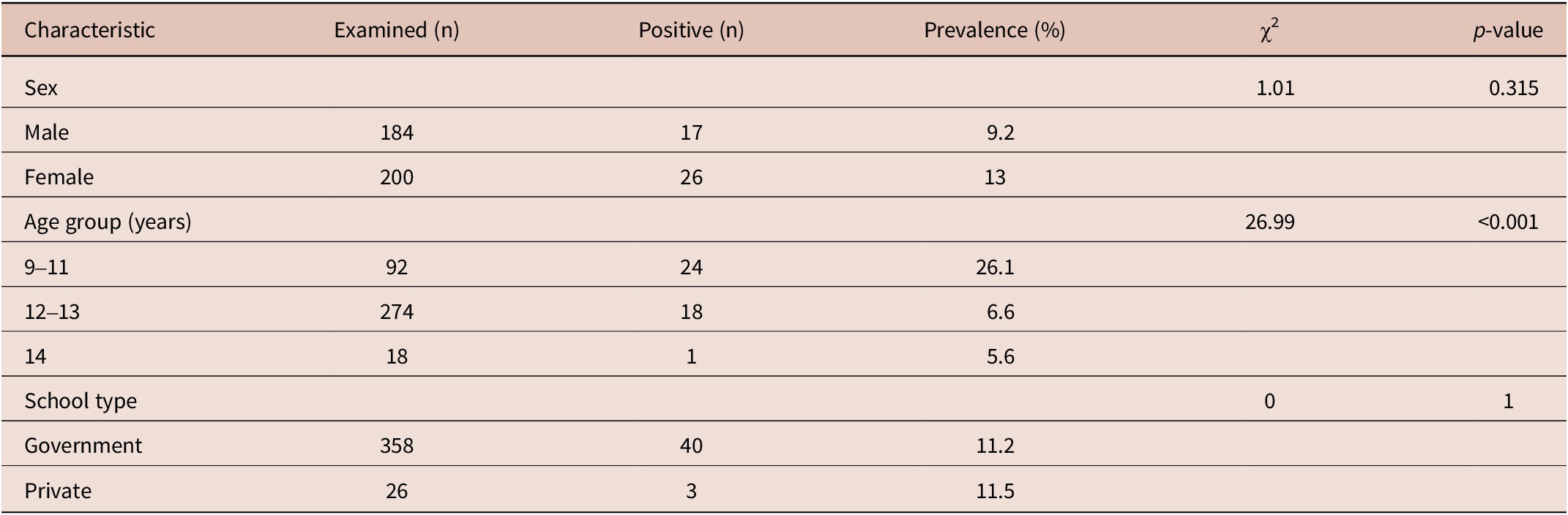
Laboratory examination of urine specimens identified S. haematobium infection in 43 of the 384 primary school children examined, corresponding to an overall prevalence of 11.2%. Infection prevalence differed significantly across age groups (χ² = 26.99, p < 0.001), with the highest prevalence observed among children aged 9–11 years (26.1%). No significant differences in infection prevalence were observed according to sex (χ2 = 1.01, p = 0.315) or school type (χ2 = 0.00, p = 1.000) (Table 2).
Prevalence of laboratory-confirmed urogenital schistosomiasis according to selected demographic characteristics (N = 384)

Table 2. Long description
The table presents data for a total sample size of N = 384.
Columns from left to right are: Characteristic, Examined (n), Positive (n), Prevalence (%), chi-squared (chi super 2), and p-value.
* Sex: chi super 2 is 1.01, p-value is 0.315.
- Male: 184 examined, 17 positive, 9.2% prevalence.
- Female: 200 examined, 26 positive, 13% prevalence.
* Age group (years): chi super 2 is 26.99, p-value is less than 0.001.
- 9 to 11: 92 examined, 24 positive, 26.1% prevalence.
- 12 to 13: 274 examined, 18 positive, 6.6% prevalence.
- 14: 18 examined, 1 positive, 5.6% prevalence.
* School type: chi super 2 is 0, p-value is 1.
- Government: 358 examined, 40 positive, 11.2% prevalence.
- Private: 26 examined, 3 positive, 11.5% prevalence.
Footnote: P-values were obtained using Pearson’s chi-square test.
P-values were obtained using Pearson’s chi-square test.
Parasitological characteristics of urogenital schistosomiasis
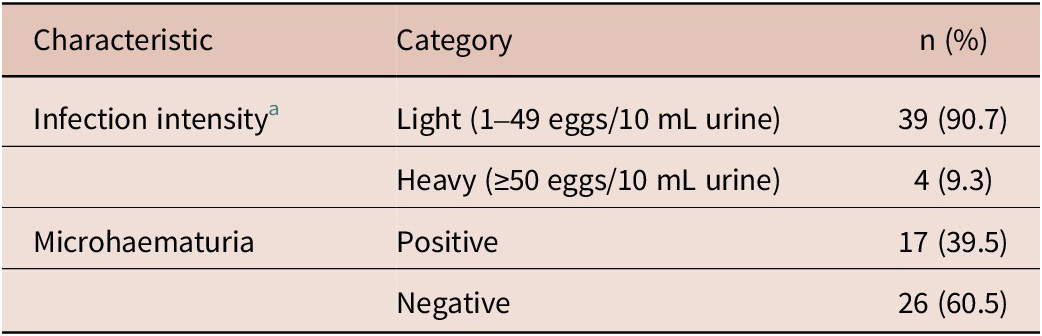
Among the 43 S. haematobium-infected children, 39 (90.7%) had light-intensity infections, whereas 4 (9.3%) had heavy-intensity infections according to the WHO classification based on egg counts. Microhaematuria was detected in 17 (39.5%) of infected children. The parasitological characteristics of infected participants are summarised in Table 3.
Parasitological characteristics of laboratory-confirmed Schistosoma haematobium infection among infected primary school children (n = 43)

Table 3. Long description
The table consists of three columns: Characteristic, Category, and n (%).
* Infection intensity (classified by W H O criteria):
- Light (1 to 49 eggs per 10 m L urine): 39 (90.7%).
- Heavy (greater than or equal to 50 eggs per 10 m L urine): 4 (9.3%).
* Microhaematuria:
- Positive: 17 (39.5%).
- Negative: 26 (60.5%).
a Infection intensity was classified according to the World Health Organization (WHO) criteria based on the number of Schistosoma haematobium eggs per 10 mL of urine.
School-level distribution of urogenital schistosomiasis
Laboratory-confirmed S. haematobium infection was detected in all ten participating schools. School-specific prevalence ranged from 5.3% to 18.4%, with the highest prevalence recorded in S10 and the lowest in S7. Most infections were of light intensity, while heavy-intensity infections were identified only in S1, S3, and S10 (Table 4).
School-level distribution of laboratory-confirmed Schistosoma haematobium infection and infection intensity among primary school children (N = 384)

Table 4. Long description
The table contains six columns: School, Examined n, Positive n, Prevalence percent, Light infection n, and Heavy infection n.
* S 10: 38 examined, 7 positive, 18.4 percent prevalence, 5 light, 2 heavy.
* S 1: 39 examined, 6 positive, 15.4 percent prevalence, 5 light, 1 heavy.
* S 2: 39 examined, 5 positive, 12.8 percent prevalence, 5 light, 0 heavy.
* S 6: 38 examined, 4 positive, 10.5 percent prevalence, 4 light, 0 heavy.
* S 8: 38 examined, 4 positive, 10.5 percent prevalence, 4 light, 0 heavy.
* S 9: 38 examined, 4 positive, 10.5 percent prevalence, 4 light, 0 heavy.
* S 3: 39 examined, 4 positive, 10.3 percent prevalence, 3 light, 1 heavy.
* S 4: 39 examined, 4 positive, 10.3 percent prevalence, 4 light, 0 heavy.
* S 5: 38 examined, 3 positive, 7.9 percent prevalence, 3 light, 0 heavy.
* S 7: 38 examined, 2 positive, 5.3 percent prevalence, 2 light, 0 heavy.
* Total: 384 examined, 43 positive, 11.2 percent prevalence, 39 light, 4 heavy.
Light-intensity infection is defined as 1 to 49 eggs per 10 m L of urine, and heavy-intensity infection as greater than or equal to 50 eggs per 10 m L of urine.
Light-intensity infection was defined as 1–49 eggs per 10 mL of urine, and heavy-intensity infection as ≥50 eggs per 10 mL of urine.
Behavioural and environmental practices
Behavioural and environmental practices related to urogenital schistosomiasis among the study participants are summarised in Supplementary Table S1. Most children reported never swimming in rivers or ponds (84.1%), not drinking water from rivers or ponds (98.4%), and consistently wearing shoes (87.2%). Most participants also reported receiving praziquantel during the most recent MDA campaign (82.2%) and school-based health education on schistosomiasis (93.8%).
Factors associated with laboratory-confirmed urogenital schistosomiasis
In the univariable logistic regression analysis, age group, household-head occupation, previous schistosomiasis diagnosis, and knowledge level were significantly associated with the odds of laboratory-confirmed S. haematobium infection (Table 5). Compared with children aged 9–11 years, those aged 12–13 years had significantly lower odds of infection (COR = 0.20, 95% CI: 0.10–0.39; p < 0.001). Children from households headed by unemployed individuals had more than fourfold higher odds of infection than those from households headed by government employees (COR = 4.15, 95% CI: 1.41–12.19; p = 0.010). Similarly, children who reported a previous diagnosis of schistosomiasis had higher odds of current infection (COR = 2.65, 95% CI: 1.12–6.28; p = 0.027). Compared with children with good knowledge, those with moderate knowledge had significantly higher odds of infection (COR = 5.85, 95% CI: 1.36–25.11; p = 0.018), whereas poor knowledge was not significantly associated with infection (COR = 3.30, 95% CI: 0.70–15.54; p = 0.131). No statistically significant associations were observed for sex, school type, parent/guardian education, freshwater-contact behaviours, sanitation practices, or preventive treatment variables. Variables with p < 0.20 in the univariable analysis, together with variables considered epidemiologically important, were entered into the multivariable logistic regression model.
Univariable logistic regression analysis of factors associated with laboratory-confirmed urogenital schistosomiasis among primary school children (N = 384)

Table 5. Long description
The table consists of four columns: Variable, Category, C O R (95% C I), and p-value.
- Age group (years): 9 to 11 is the Reference. 12 to 13 has a C O R of 0.20 (0.10 to 0.39) with a p-value less than 0.001. 14 has a C O R of 0.17 (0.02 to 1.32) with a p-value of 0.09.
- Sex: Male is the Reference. Female has a C O R of 1.47 (0.77 to 2.80) with a p-value of 0.245.
- School type: Government is the Reference. Private has a C O R of 1.04 (0.30 to 3.61) with a p-value of 0.955.
- Parent or guardian education: Tertiary is the Reference. No formal or Primary has a C O R of 0.99 (0.45 to 2.16) with a p-value of 0.97. Secondary has a C O R of 0.48 (0.21 to 1.11) with a p-value of 0.088.
- Household-head occupation: Government employee is the Reference. Entrepreneur has a C O R of 0.66 (0.22 to 1.99) with a p-value of 0.462. Private-sector employee has a C O R of 0.65 (0.28 to 1.49) with a p-value of 0.306. Unemployed has a C O R of 4.15 (1.41 to 12.19) with a p-value of 0.01.
- Participation in farming: No is the Reference. Yes has a C O R of 0.88 (0.47 to 1.67) with a p-value of 0.699.
- Participation in fishing: No is the Reference. Yes has a C O R of 0.78 (0.33 to 1.83) with a p-value of 0.569.
- Swimming in rivers or ponds: No is the Reference. Yes has a C O R of 0.67 (0.25 to 1.78) with a p-value of 0.42.
- Swimming exposure: Not regular is the Reference. Regular has a C O R of 1.61 (0.34 to 7.63) with a p-value of 0.545.
- Drinking river or pond water: No is the Reference. Yes has a C O R of 1.60 (0.18 to 14.03) with a p-value of 0.671.
- Washing clothes or utensils in rivers: No is the Reference. Yes is not estimable.
- Shoe wearing: Always is the Reference. Not always has a C O R of 0.67 (0.23 to 1.98) with a p-value of 0.473.
- Toilet use: Always is the Reference. Not always has a C O R of 0.97 (0.48 to 1.97) with a p-value of 0.941.
- Ever treated for schistosomiasis: No is the Reference. Yes has a C O R of 0.91 (0.46 to 1.79) with a p-value of 0.783.
- Praziquantel during the latest M D A: Yes is the Reference. No has a C O R of 1.07 (0.47 to 2.41) with a p-value of 0.877.
- Previous schistosomiasis diagnosis: No is the Reference. Yes has a C O R of 2.65 (1.12 to 6.28) with a p-value of 0.027.
- School health education: No is the Reference. Yes has a C O R of 0.88 (0.25 to 3.07) with a p-value of 0.835.
- Knowledge level: Good is the Reference. Poor has a C O R of 3.30 (0.70 to 15.54) with a p-value of 0.131. Moderate has a C O R of 5.85 (1.36 to 25.11) with a p-value of 0.018.
Abbreviations: COR, crude odds ratio; CI, confidence interval; MDA, mass drug administration.
a Swimming exposure was dichotomised as regular (daily/weekly) versus not regular (occasionally/never).
b Odds ratio not estimable because no laboratory-confirmed infections occurred among children reporting washing clothes or utensils in rivers or ponds (complete separation).
c ‘Not always’ combined sometimes, rarely, and never.
d ‘Not always’ combined sometimes, rarely, and never.
Factors independently associated with laboratory-confirmed urogenital schistosomiasis
After adjustment for potential confounders, age group, household-head occupation, and previous schistosomiasis diagnosis remained independently associated with the odds of laboratory-confirmed Schistosoma haematobium infection (Table 6). Compared with children aged 9–11 years, those aged 12–13 years had significantly lower odds of infection (AOR = 0.17, 95% CI: 0.08–0.35; p < 0.001). Although children aged 14 years also had lower odds of infection, this association was not statistically significant (AOR = 0.18, 95% CI: 0.02–1.52; p = 0.115).
Multivariable logistic regression analysis of factors associated with laboratory-confirmed Schistosoma haematobium infection among primary school children (N = 383)

Table 6. Long description
The table consists of four columns: Variable, Category, A O R (95% C I), and p-value.
* Age group (years): 9 to 11 is the Reference. 12 to 13 has an A O R of 0.17 (0.08 to 0.35) with p less than 0.001. 14 has an A O R of 0.18 (0.02 to 1.52) with p equals 0.115.
* Sex: Male is the Reference. Female has an A O R of 1.28 (0.62 to 2.62) with p equals 0.507.
* Parent or guardian education: No formal or Primary is the Reference. Secondary has an A O R of 0.49 (0.17 to 1.46) with p equals 0.202. Tertiary has an A O R of 1.17 (0.48 to 2.87) with p equals 0.725.
* Household-head occupation: Government employee is the Reference. Entrepreneur has an A O R of 0.71 (0.21 to 2.38) with p equals 0.577. Private-sector employee has an A O R of 0.65 (0.17 to 2.45) with p equals 0.519. Unemployed has an A O R of 5.92 (1.16 to 30.32) with p equals 0.033.
* Swimming in rivers or ponds: No is the Reference. Yes has an A O R of 0.60 (0.21 to 1.74) with p equals 0.347.
* Previous schistosomiasis diagnosis: No is the Reference. Yes has an A O R of 4.15 (1.52 to 11.33) with p equals 0.005.
Abbreviations: A O R stands for adjusted odds ratio; C I stands for confidence interval.
Abbreviations: AOR, adjusted odds ratio; CI, confidence interval.
Outcome: Laboratory-confirmed Schistosoma haematobium infection (Yes/No).
Variables included in the multivariable model were selected based on p < 0.20 in the univariable analysis and epidemiological relevance.
One participant with missing data following recording of ‘Not sure’ responses was excluded from the multivariable analysis.
Household socioeconomic characteristics were also associated with infection. Children from households headed by unemployed individuals had significantly higher odds of laboratory-confirmed infection than those from households headed by government employees (AOR = 5.92, 95% CI: 1.16–30.32; p = 0.033). No significant associations were observed among children from households headed by entrepreneurs or private-sector employees. A previous diagnosis of schistosomiasis was independently associated with current infection. Children reporting a previous history of schistosomiasis had more than fourfold higher odds of laboratory-confirmed infection than those without a previous diagnosis (AOR = 4.15, 95% CI: 1.52–11.33; p = 0.005). After adjustment for potential confounders, sex, parent/guardian education, and reported swimming in rivers or ponds were not independently associated with laboratory-confirmed infection.
Most participants (93.8%) had heard of schistosomiasis. Approximately four-fifths (79.7%) correctly identified exposure to contaminated freshwater as the main source of infection, while 69.0% correctly identified skin contact with contaminated freshwater as the route of transmission. Knowledge was highest regarding blood in urine as a symptom (78.9%) and avoiding swimming or bathing in rivers or ponds as an important preventive measure (73.7%). Overall, 45.3% of participants demonstrated good knowledge of urogenital schistosomiasis, whereas 37.5% and 17.2% had moderate and poor knowledge, respectively (Table 7). Detailed responses to the individual knowledge questions are presented in Supplementary Table S2, while the reported sources of schistosomiasis information are summarised in Supplementary Table S3. Teachers/school health education was the most frequently reported source of information (86.2%), followed by parents/guardians (45.6%) and community health workers (39.1%).
Knowledge of urogenital schistosomiasis among primary school children (N = 384)

Table 7. Long description
The table consists of three columns: Knowledge domain, Correct response, and n (percent).
* Awareness: Had heard of schistosomiasis; 360 (93.8 percent).
* Transmission: Contact with contaminated freshwater identified as the main route of transmission; 265 (69.0 percent).
* Symptoms: Blood in urine identified as a symptom; 303 (78.9 percent).
* Prevention: Avoiding swimming or bathing in rivers and ponds identified as a preventive measure; 283 (73.7 percent).
* Overall knowledge level:
- Good: 174 (45.3 percent).
- Moderate: 144 (37.5 percent).
- Poor: 66 (17.2 percent).
Footnotes indicate that overall knowledge was assessed using five core domains. Good knowledge is defined as a score greater than or equal to 80 percent, moderate as 60 to 79 percent, and poor as less than 60 percent. Percentages for individual domains do not sum to 100 percent because multiple responses were allowed.
a Overall knowledge was assessed using five core knowledge domains (awareness, transmission, symptoms, prevention, and knowledge of the source of infection). Participants scoring ≥80% were classified as having good knowledge, those scoring 60–79% as having moderate knowledge, and those scoring <60% as having poor knowledge.
Discussion
The present study found an overall prevalence of laboratory-confirmed S. haematobium infection of 11.2%, indicating that urogenital schistosomiasis remains a public health concern among primary school children in Mbeya Urban District despite ongoing control efforts. Although this prevalence is lower than that reported from many highly endemic areas of Tanzania before the widespread implementation of preventive chemotherapy, it demonstrates that local transmission persists (Mazigo et al. Reference Mazigo, Mwingira, Zinga, Uisso, Kazyoba, Kinung’hi and Mutapi2022). The relatively low prevalence may, in part, reflect the cumulative impact of repeated school-based MDA with praziquantel, which has been shown to substantially reduce schistosomiasis prevalence and infection intensity among school-aged children in endemic settings (Chiombola et al. Reference Chiombola, Mwangoka, Baumba, Mkombe, Kreibich, Kasang, Fuss, Mueller, Sabuni and Mazigo2025; Mazigo et al. Reference Mazigo, Mwingira, Zinga, Uisso, Kazyoba, Kinung’hi and Mutapi2022). However, because praziquantel is effective against adult worms but does not prevent reinfection, continued exposure to contaminated freshwater is likely to sustain transmission (Kittur et al. Reference Kittur, King, Campbell, Kinung’hi, Mwinzi, Karanja, N’Goran, Phillips, Gazzinelli-Guimaraes, Olsen, Magnussen, Secor, Montgomery, Utzinger, Walker, Binder and Colley2019). More than 90% of infected children had light-intensity infections, while heavy infections were uncommon. This finding is encouraging because schistosomiasis-related morbidity is closely associated with infection intensity. Nevertheless, even light-intensity infections contribute to continued transmission and may adversely affect children’s health and educational outcomes if left untreated (McManus et al. Reference McManus, Dunne, Sacko, Utzinger, Vennervald and Zhou2018). Variation in prevalence between schools further reflects the focal nature of schistosomiasis transmission, which is influenced by environmental conditions, freshwater exposure, and local ecological factors. These findings support continued surveillance and integrated control strategies that combine preventive chemotherapy with improved WASH, health education, and environmental management.
Microhaematuria was detected in 39.5% of children with laboratory-confirmed S. haematobium infection. Clinically, microhaematuria is an important manifestation of urogenital schistosomiasis and indicates urinary tract involvement. However, its absence in more than half of infected children suggests that haematuria alone may not identify all infections, particularly where light-intensity infections predominate, as observed in the present study. Epidemiologically, this finding highlights the limitations of relying solely on haematuria as an indicator of infection and supports the continued use of parasitological or other sensitive diagnostic approaches for surveillance and case detection in endemic settings (Mazigo et al. Reference Mazigo, Mwingira, Zinga, Uisso, Kazyoba, Kinung’hi and Mutapi2022).
The present study identified age group, head of household occupation, and previous schistosomiasis diagnosis as independent predictors of laboratory-confirmed S. haematobium infection. Children aged 9–11 years were significantly more likely to be infected than older children, consistent with findings from Tanzania (Mazigo et al. Reference Mazigo, Mwingira, Zinga, Uisso, Kazyoba, Kinung’hi and Mutapi2022). Younger children are more likely to engage in recreational and domestic activities involving contact with contaminated freshwater and may be less likely to consistently adopt protective behaviours, thereby increasing their risk of infection (Mazigo et al. Reference Mazigo, Nuwaha, Kinung’Hi, Morona, De Moira, Wilson, Heukelbach and Dunne2012). These findings suggest that younger school-aged children should remain a priority group for preventive chemotherapy, health education, and interventions aimed at reducing exposure to infested water bodies.
Children with a previous history of schistosomiasis had more than fourfold higher odds of current infection. This finding most likely reflects repeated exposure and reinfection rather than treatment failure, as praziquantel effectively eliminates adult worms but does not protect against subsequent exposure to cercariae in contaminated freshwater (Kittur et al. Reference Kittur, King, Campbell, Kinung’hi, Mwinzi, Karanja, N’Goran, Phillips, Gazzinelli-Guimaraes, Olsen, Magnussen, Secor, Montgomery, Utzinger, Walker, Binder and Colley2019). Similarly, children from households headed by unemployed individuals had significantly higher odds of infection than those from households headed by government employees, suggesting that socioeconomic disadvantage may increase exposure through reduced access to safe water, sanitation, and other preventive resources. Similar associations between lower socioeconomic status and an increased risk of schistosomiasis have been reported in previous studies from sub-Saharan Africa (Njikho et al. Reference Njikho, Quan, Mbonane and Van Wyk2023). However, this finding should be interpreted cautiously because the estimate was based on a relatively small number of participants in the unemployed category, resulting in a wide confidence interval. In contrast, sex, parent or guardian education, and reported swimming in rivers or ponds were not independently associated with infection after adjustment for confounding factors. The absence of these associations suggests that exposure is influenced by multiple behavioural and environmental factors beyond those measured in this study.
Overall, 45.3% of participants demonstrated good knowledge of urogenital schistosomiasis, while 37.5% had moderate knowledge and 17.2% had poor knowledge. Most participants recognised exposure to contaminated freshwater as an important source of infection, identified blood in urine as a characteristic symptom, and correctly reported avoiding swimming or bathing in rivers and ponds as an important preventive measure. These findings are consistent with studies from Tanzania and other schistosomiasis-endemic settings in sub-Saharan Africa, which have shown that repeated school-based MDA, coupled with health education, can improve knowledge and awareness of schistosomiasis among school-aged children (Mazigo et al. Reference Mazigo, Nuwaha, Kinung’Hi, Morona, De Moira, Wilson, Heukelbach and Dunne2012; Nazareth et al. Reference Nazareth, Lupenza, Zacharia and Ngasala2022). Despite the observed level of knowledge, laboratory-confirmed infection remained evident, indicating that knowledge alone is insufficient to prevent infection where children continue to be exposed to contaminated freshwater. Similar observations have been reported in Tanzania and other schistosomiasis-endemic settings, where environmental, behavioural, and socioeconomic factors constrain the translation of knowledge into protective practices despite repeated health education and MDA (Grimes et al. Reference Grimes, Croll, Harrison, Utzinger, Freeman and Templeton2014; Nazareth et al. Reference Nazareth, Lupenza, Zacharia and Ngasala2022). These findings reinforce the need for integrated schistosomiasis control strategies that combine preventive chemotherapy with sustained health education, improved WASH services, and interventions that reduce contact with cercariae-infested freshwater.
Strengths and limitations
A major strength of this study was the laboratory confirmation of S. haematobium infection using the standard urine filtration technique, which reduced the likelihood of outcome misclassification. The inclusion of children from both government and private primary schools and the use of multivariable logistic regression also strengthened the reliability and generalisability of the findings within the study area.
The study has several limitations. Its cross-sectional design precludes causal inference between the identified risk factors and infection. Behavioural information was self-reported and may therefore be subject to recall and social desirability bias. In addition, environmental and malacological factors that influence transmission were not assessed. Finally, the relatively small number of infected participants resulted in wide confidence intervals for some regression estimates, particularly for head of household occupation, and these findings should therefore be interpreted with caution.
Conclusion
This study found that urogenital schistosomiasis remains a public health concern among primary school children in Mbeya Urban District, despite ongoing school-based MDA. Although the overall prevalence was relatively low and most infections were of light intensity, evidence of continued transmission highlights the need for sustained control efforts. Younger age, previous schistosomiasis diagnosis, and head of household occupation were independently associated with laboratory-confirmed S. haematobium infection, while 45.3% of participants demonstrated good knowledge of the disease. These findings indicate that preventive chemotherapy alone is insufficient to interrupt transmission. Strengthening integrated control strategies that combine MDA with health education, improved WASH, and measures to reduce exposure to contaminated freshwater is essential. Particular attention should be directed towards younger school-aged children and socioeconomically disadvantaged communities to reduce reinfection and support Tanzania’s efforts to eliminate schistosomiasis as a public health problem.
Supplementary material
The supplementary material for this article can be found at http://doi.org/10.1017/S0022149X26102387.
Acknowledgements
The authors sincerely thank the RAS of Mbeya Region, the Mbeya Urban District Council, and the administrations of the participating government and private primary schools for granting permission and facilitating this study. We are especially grateful to the head teachers and teachers of the participating schools for their invaluable cooperation and assistance in coordinating study activities during data collection. We also thank the parents or legal guardians and the children who participated in the study for their willingness and cooperation. Finally, we acknowledge the laboratory personnel and research assistants for their technical support during specimen processing, laboratory analysis, and data collection.
Financial support
This research received no specific grant from any funding agency in the public, commercial, or not-for-profit sectors.
Competing interests
The authors declare no conflicts of interest.
Ethical standard
Ethical approval for this study was obtained from the Research and Publication Committee of the University of Dar es Salaam, Mbeya College of Health and Allied Sciences (UDSM-MCHAS) (Reference No. CJL-2022–04–05345). Administrative permission to conduct the study was obtained from the Regional Administrative Secretary (RAS) of Mbeya Region, the Mbeya Urban District Council, and the administrations of the selected government and private primary schools. Written informed consent was obtained from the parents or legal guardians of all participating children before enrolment, and written assent was obtained from each child before data collection. Participation was entirely voluntary. Participants and their parents or legal guardians were informed about the study objectives, procedures, potential risks and benefits, and their right to decline participation or withdraw from the study at any time without penalty or loss of benefits to which they were otherwise entitled. To protect confidentiality, no personal identifiers were recorded on the questionnaires or laboratory forms. Each participant was assigned a unique identification number, and all study records were stored securely and were accessible only to the research team. Children diagnosed with Schistosoma haematobium infection were referred to the appropriate health authorities for treatment in accordance with the Tanzania National Neglected Tropical Diseases Control Programme guidelines. The authors assert that all procedures contributing to this work comply with the ethical standards of the relevant national and institutional committees on human experimentation and with the Helsinki Declaration of 1975, as revised in 2008.
Author contribution
Theresia Estomih Nkya (TEN): Conceptualisation, methodology, formal analysis, supervision, project administration, visualisation, writing – original draft; writing – review and editing.
Claud Joster Luvanda (CJL): Investigation, data collection, laboratory analysis, data curation, validation, and writing – review and editing.
Data availability
The datasets generated and analysed during the current study are available from the corresponding author on reasonable request.



 Open access

