Antimicrobial therapy is used in approximately 56% of inpatients in US hospitals.Reference Fridkin, Baggs and Fagan 1 Unfortunately, antimicrobial therapy is inappropriate in approximately half of cases.Reference Dellit, Owens and McGowan 2 – Reference Hecker, Aron, Patel, Lehmann and Donskey 4 Negative consequences of inappropriate antimicrobial use include clinical failure,Reference Micek, Welch and Khan 5 , Reference Kollef, Sherman, Ward and Fraser 6 adverse drug events,Reference Classen, Pestotnik, Evans and Burke 7 and excessive costs.Reference Dellit, Owens and McGowan 2 Regardless of appropriateness, all antimicrobial use establishes selective pressure that contributes to the relentless emergence of resistance in a broad array of pathogens.Reference Smolinski, Hamburg and Lederberg 8 – 11 Antimicrobial stewardship programs have been introduced to improve antimicrobial therapy, but in most cases improvements are modest.
In a previous study, we found that use of a computer decision support system (CDSS) for antimicrobial therapy embedded within our hospital’s electronic medical record system was associated with optimal antimicrobial use.Reference Filice, Drekonja and Thurn 12 A secondary hypothesis was that a portion of inappropriate antimicrobial courses would result from inaccurate initial diagnoses of infectious or potentially infectious conditions when providers initiated antimicrobial therapy. Despite a benefit associated with decision support, 62% of antimicrobial courses were still inappropriate, and the most common reason was that providers did not make an accurate initial diagnosis of infectious or potentially infectious conditions. Diagnostic errors are defined as wrong, missed, or delayed diagnoses when the opportunity existed to make a correct diagnosis.Reference Graber, Franklin and Gordon 13 Here, we describe in detail these diagnostic errors and their relationship to inappropriate antimicrobial use.
METHODS
The Minneapolis Veterans Affairs Medical Center (MVAMC) is a 279-bed academically affiliated hospital. Inpatients who received systemic antimicrobial drugs during the study period, October 2007 to September 2008, for therapy rather than prevention were identified from the Veteran’s Administration (VA) electronic medical record system.Reference Filice, Drekonja and Thurn 12 A “course” was defined as 1 or more consecutive doses of systemic antimicrobials administered to an inpatient. Overall, 4,338 separate antimicrobial courses were given to 3,180 patients. We reviewed 1,011 randomly selected medical records to identify 500 cases with at least 1 evaluable antimicrobial course. For patients with multiple courses, we randomly selected 1 course for evaluation. All randomizations were conducted using computer-generated random numbers.Reference Filice, Drekonja and Thurn 12
Data Extraction
Cases were assigned randomly to a pharmacist or nurse who was trained to extract information about the syndrome or disease that led to antimicrobial use (index condition).Reference Filice, Drekonja and Thurn 12 Extractors recorded verbatim the provider diagnosis for the index condition at the time antimicrobial therapy was initiated (provider diagnosis). For each antimicrobial given during the period of treatment for an index condition, extractors recorded the drug, dosage, route, and duration. Extractors determined from provider notes whether each antimicrobial was ordered to treat the index condition or an unrelated condition. Audits showed that clinical information was extracted uniformly and reproducibly for 97% of major clinical details and 89% of all clinical details, which compares favorably with rates found in similar studies.Reference Filice, Drekonja and Thurn 12 , Reference Schwartz, Wu and Lyles 14 Antimicrobials ordered to treat the index condition constituted the “index course.”
Accuracy of Provider Diagnoses of Index Conditions
Four physician reviewers, each board-certified in internal medicine and infectious diseases (ID), judged the accuracy of provider diagnoses, the quality of the evidence supporting the diagnoses, and the appropriateness of antimicrobial courses. These reviewers were trained beforehand regarding specific criteria. Case summaries containing a clinical narrative and relevant data but without potentially biasing information (patient and provider identifiers, CDSS use, ID consultation, and outcomes) were distributed randomly to 2 of the 4 reviewers.
In 109 cases (22%), providers used abbreviations or imprecise terms for diagnoses. In these cases, reviewers read extracted notes carefully to discern the actual syndrome or condition the providers were considering, and this term was recorded separately from the verbatim provider terms. This refined term was substituted for the abbreviation or imprecise term as “provider diagnosis.” For example, if a provider wrote “UTI,” reviewers determined whether the provider meant cystitis, complicated cystitis, pyelonephritis, or something else.
Based on data available to providers at the time, infectious disease literature, guidelines, textbooks, and reviewer professional judgment, reviewers independently classified these provider diagnoses as correct, indeterminate, incorrect, or a sign or symptom consistent with an infectious disease (eg, fever, leukocytosis, infiltrate)Reference Hecker, Aron, Patel, Lehmann and Donskey 4 , Reference Filice, Drekonja and Thurn 12 rather than a specific syndrome or disease. Cases were classified as indeterminate when the evidence supporting the diagnosis was unclear or lacking. In contrast, diagnoses were classified as incorrect when the evidence disproved the diagnosis or clearly supported an alternative diagnosis.
According to prespecified criteria, reviewers rated the quality of evidence supporting each provider diagnosis as good, moderate, weak, or not supportive. For this rating, reviewers considered all documented relevant information, including signs and symptoms, laboratory results, and images. If the evidence supporting the provider diagnosis was moderate or good, reviewers accepted the provider diagnosis as correct.
As reported in the parent study,Reference Filice, Drekonja and Thurn 12 reviewers independently judged the index course appropriate or notReference Hecker, Aron, Patel, Lehmann and Donskey 4 , Reference Linkin, Fishman and Landis 15 for what reviewers determined to be the correct initial diagnosis, considering drug selection, route, dose, and duration. Criteria for appropriateness, in order of priority, were the following: (1) whether treatment followed CDSS recommendations, (2) alternatives consistent with published guidelines, high-quality evidence, and antimicrobial susceptibility patterns, and (3) reasonable alternatives, given specific circumstances.Reference Schwartz, Wu and Lyles 14 , Reference Linkin, Fishman and Landis 15 Adjustments to antimicrobial therapy based on clinical response and test results were considered.Reference Braykov, Morgan and Schweizer 16 Reviewers ignored trivial errors (eg, 1–2-day deviations from recommended treatment durations) that were otherwise clinically appropriate.
Statistical Analysis
The dependent variable was the initial provider diagnosis. Group characteristics were described with means, standard deviations, medians, interquartile ranges, and proportions. The Mann-Whitney U test and contingency tables with χ2 or Fisher’s exact tests were used to compare groups. Logistic regression was used to measure the relationship between diagnostic accuracy and independent variables (Statistical Program for the Social Sciences for Windows, version 19, Chicago, IL). Potential variables were selected based on literature about predictors of diagnostic errors and their relevance to the study hypothesis.
The MVAMC institutional review board considered this analysis exempt under Title 38 Code of Federal Regulations 16.101(b).
RESULTS
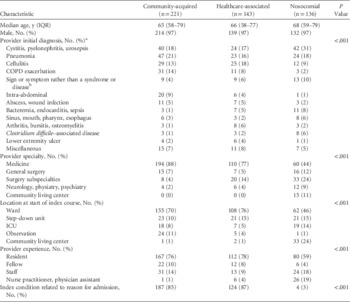
Of the 1,011 records randomly selected for review, 511 antimicrobial courses did not qualify for inclusion, leaving 500 cases with 1 evaluable index course each.Reference Filice, Drekonja and Thurn 12 The median age of the 500 subjects was 66 years (interquartile range, 58–78), and 97% were male. Index conditions, specialty of the primary providers, hospital location, and provider experience all varied significantly in relation to whether index conditions were community-acquired, healthcare-associated, or nosocomial (Table 1).
Baseline Patient Characteristics for Index Cases in Relation to Origin of Infection

note. Data are no. (column % for group) unless otherwise indicated. IQR, interquartile range.
a Because there were 99 intended initial provider diagnoses, these were grouped into similar categories.
b Signs and symptoms were leukocytosis (n=12), fever ± chills (n=9), pyuria (n=3), bacteruria (n=1), cough (n=1), diarrhea (n=1), enterocutaneous fistula (n=1), hemoptysis (n=1), infiltrate (n=1), abdominal pain (n=1).
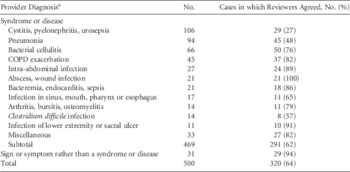
At the time antimicrobial courses were started, providers assigned the index conditions in 469 of the 500 cases (94%) to 88 discrete syndromes or diseases. In 10 of these cases, providers listed 2 separate possible index conditions, and in 1 case, the provider listed 3 separate possible index conditions. In 31 (6%) cases, providers assigned index conditions to 1 of 11 signs or symptoms rather than to syndromes or diseases (Table 1, footnote). After review of the evidence available to providers at the time of initial diagnosis, reviewers classified the index conditions into 125 discrete conditions. Considering the 469 cases in which providers assigned syndromes or diseases, reviewers considered the provider diagnosis for the index condition correct in 291 cases (62%), clearly incorrect in 156 cases (31%), and indeterminate in 22 cases (4%). For the most common diagnostic categories, the agreement between providers and reviewers ranged from 29 of 106 cases of cystitis, pyelonephritis, or urosepsis (27%) to 21 of 21 cases of abscess or wound infection (100%) (Table 2). For example, in 76 cases the provider diagnosis was cystitis, but reviewers agreed in only 10 cases (13%). In the other 66 cases, the reviewer diagnoses were pyuria (n=19), bacteruria (n=12), leukocytosis (n=6), confusion (n=5), asymptomatic bacteruria (n=5), weakness (n=2), urinary frequency (n=2), abdominal pain (n=2), hypotension (n=2), hematuria (n=2), fever (± chills) (n=2), sepsis (n=1), gastritis (n=1), colovesical fistula (n=1), dysuria (n=1), delirium (n=1), congestive heart failure (n=1), and catatonia (n=1).
Initial Provider Diagnoses of Index Conditions and Proportions in Which Reviewers Agreed

NOTE. P<.001 for entire array. COPD, chronic obstructive pulmonary disease.
a The 93 discrete initial provider diagnoses were grouped into similar categories.
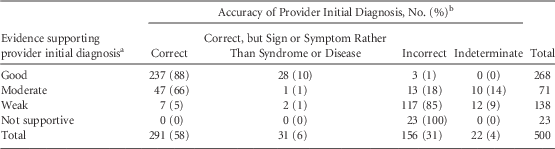
For all 500 cases, the accuracy of the provider diagnosis was closely associated with the strength of the supporting clinical evidence available to the provider at the time (Table 3). That is, the provider diagnosis was correct in 284 of 310 cases (92%) with good or moderate evidence but in only 7 of 159 cases (4%) in which the evidence was judged weak or not supportive (P<.001).
Strength of Evidence Supporting Provider Initial Diagnosis of Index Condition by Accuracy of the Diagnosis

Note. P<.001 for entire array, adjusted for small numbers in some cells.
a Strength of evidence judged by reviewers.
b Row percentage.
Factors Possibly Related to Diagnostic Accuracy
The provider diagnosis was more likely to be correct when the index condition was related to the reason for hospital admission (225 of 315, 71%) rather than unrelated (66 of 185, 36%; P<.001). When the index condition was unrelated to the reason for admission, it was apparent at the time of admission in 48 cases (26%) and later during the hospital stay in 137 cases (74%). The accuracy of the provider diagnosis was similarly poor whether or not the index condition was apparent at time of admission (data not shown).
In multivariable analysis, the odds ratio of a correct provider diagnosis was 4.3 (95% confidence interval [CI], 2.2–8.5) for cases in which the index condition was related to the reason for admission rather than unrelated (Table 4). In contrast, the odds of a correct provider diagnosis were lessened when a provider’s diagnosis fell into 1 of the 2 largest diagnostic categories, “pneumonia” or “cystitis, pyelonephritis, or urosepsis.” Specifically, the odds ratio of a correct provider diagnosis was only .18 (95% CI, .10–.32) for cases in which the provider diagnoses fell into categories of “cystitis, pyelonephritis, or urosepsis” compared with cases in other diagnostic categories. Similarly, the odds ratio of a correct provider diagnosis was only .39 (95% CI, .22–.70) for cases in which the initial provider diagnosis was pneumonia compared with cases in other diagnostic categories.
Variables Associated with Correct Provider Initial Diagnosis in Multivariable AnalysisFootnote a

NOTE. Index condition, provider initial diagnosis of condition that to an antimicrobial course.
a Variables included the following: whether the reason for admission was related to the index condition; onset of index condition (community-associated, healthcare-associated, nosocomial); primary team (medicine, general surgery, surgery subspecialties, other); community living center, intensive care unit, observation unit, step-down unit, ward); and category of provider diagnosis of index condition (cystitis, pyelonephritis, or urosepsis, pneumonia, cellulitis, chronic obstructive pulmonary disease exacerbation, other). Omnibus Test of Model Coefficients P<.001; Nagelkerke R 2=0.299, Cox and Snell R 2=0.22; Hosmer Lemeshow test P=.6.
Relation to Antimicrobial Appropriateness
As reported previously,Reference Filice, Drekonja and Thurn 12 for the question of antimicrobial appropriateness, each individual reviewer was compared with the other 3 reviewers combined. Agreement ranged from 69% to 72% in these comparisons, and inter-rater reliability κ statistics ranged from .33 to .42. Cases in which the 2 reviewers disagreed on any point were adjudicated by a third reviewer, which was necessary for the main outcome in 172 cases (34%).
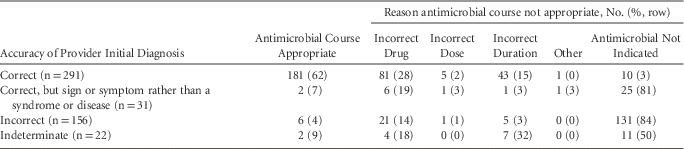
Antimicrobial courses were considered appropriate in 191 of 500 cases (38%) overall, but appropriateness varied in relation to diagnostic accuracy. When provider diagnoses were correct, courses were appropriate in 181 of 291 cases (62%); when diagnoses were incorrect or indeterminate or when providers were treating a sign or symptom rather than a syndrome or disease, courses were appropriate in only 10 of 209 cases (5%) (P<.001, Table 5).
Reasons that Antimicrobial Courses Were Not Appropriate According to Accuracy of Provider Initial Diagnosis

NOTE. Percentages sum to >100% because some courses involved multiple errors.
Among the 309 cases in which antimicrobial courses were considered inappropriate, the reasons for this assessment varied by diagnostic accuracy. In 81 of 111 cases (73%) with correct diagnoses and inappropriate courses, the antimicrobial(s) selected were determined to be inappropriate. In contrast, in 166 of 198 cases (84%) with diagnoses that were incorrect or indeterminate or when providers were treating a sign or symptom rather than a syndrome or disease, antimicrobial therapy was not indicated at all.
DISCUSSION
The results of this study emphasize the substantial importance of diagnostic accuracy for optimal inpatient antimicrobial use and avoidance of overtreatment. Of the 291 cases in which the provider diagnosis was correct, 62% of antimicrobial courses were appropriate, compared with only 5% of the 209 cases in which the diagnosis was incorrect, indeterminate, or a sign or symptom rather than a syndrome or disease. Cases without correct initial provider diagnoses accounted for 199 of 309 cases (64%) in which antimicrobial courses were not appropriate. Diagnostic errors were more common in this study than in previous studies unrelated to antimicrobial use. In a recent systematic review, diagnostic errors were estimated to occur in 10%–15% of inpatient cases.Reference Berner and Graber 17 This finding suggests that there may be greater room for improvement in diagnostic accuracy for suspected infections than with other inpatient conditions.
Diagnostic accuracy was closely associated with the quality of clinical evidence available to providers at the time they made their initial diagnosis. Good clinical evidence was available for 237 of 291 cases (81%) with a correct provider diagnosis, compared with only 3 of 156 cases (2%) with an incorrect provider diagnosis. A potential limitation of this analysis is that strength of clinical evidence and diagnostic accuracy were judged by the same reviewers and, thus, were not independent.
According to dual process theory, human decisions, including those about diagnosis, fall into 2 categories.Reference Croskerry, Singhal and Mamede 18 – Reference Kahneman 20 Many diagnostic errors result from the use of an intuitive process (termed type I). Several heuristics, which are experience-based techniques for problem solving, are common in intuitive processes and tend to produce characteristic types of errors.Reference Graber, Franklin and Gordon 13 , Reference Croskerry, Singhal and Mamede 18 , Reference Mamede, van Gog and van den Berge 19 , Reference Croskerry 21 – Reference Barlow, Nathwani and Myers 23 The alternative to the type I process is the analytical process (type II), which is more reliable, safer, and more effective but is also are slower and more resource intensive.
Several factors favor the use of type I decision making in inpatient settings. For example, providers who care for inpatients are often fatigued, sleep deprived, and/or suffering from cognitive overload.Reference Croskerry, Singhal and Mamede 18 , Reference Chinburapa, Larson, Brucks, Draugalis, Bootman and Puto 22 Inpatients often have multiple complex problems, and task complexity often leads to poor decisions.Reference Chinburapa, Larson, Brucks, Draugalis, Bootman and Puto 22 We found that provider diagnoses were more likely to be correct if the index condition was related to the reason for admission. Patients admitted to inpatient teams in our hospital have been referred for admission by other providers who often have already arrived at a diagnosis, even if only preliminarily. Additionally, multiple inpatient team members, and often consultants, contribute to diagnostic decisions for problems that lead to hospital admission, and providers may take more time and give more thought to these decisions (ie, type II reasoning). In contrast, when diagnosing conditions unrelated to the reason for admission, providers often work alone and may spend less time and effort (ie, a type I process).
In teaching hospitals, decisions regarding antimicrobial prescribing frequently are made by resident physicians who have the least clinical experience and minimal personal experience with adverse drug effects and often must decide with minimal support. They have learned that severe, rapidly progressive infections can occur, but they may lack sufficient knowledge and experience to understand the probability that a severe, rapidly progressive infection is actually present in an individual case.Reference Barlow, Nathwani and Myers 23 – Reference Hulscher, Grol and van der Meer 25 Antimicrobial use is heavily shaped by cultural and economic factors related to deeply held beliefs about bodily integrity and invasion.Reference Avorn and Solomon 24 – Reference Steinman, Landefeld and Gonzales 26 Antimicrobials have been labeled drugs of fear in that fear of bad outcomes, however unlikely, leads to antimicrobial overuse despite associated risks, including adverse effects in individual patients and relentless increases in antimicrobial resistance generally.Reference Kunin, Tupasi and Craig 27 – Reference Drekonja, Okoye, Kuskowski and Johnson 31 Resident physicians often must later explain and justify antimicrobial decisions to a peer or more senior physician, which predisposes them to use the commission bias heuristic in which active intervention is preferred over watchful waiting.Reference Croskerry 21
Diagnostic accuracy was relatively poor when the provider diagnosis fell into 1 of the 2 most common diagnostic groups: “pneumonia” or “cystitis, pyelonephritis, or urosepsis.” Because these conditions are common, physicians may be more likely to diagnose quickly and without much thought (using type I reasoning) and, for example, the availability heuristic.Reference Croskerry 21 The actual conditions identified by reviewers in cases in which providers diagnosed “cystitis” (see the Results section) seem to reflect a lack of adherence to strict diagnostic criteria. Signs and symptoms that are compatible with these diagnoses are common, but many of them do not have good predictive value. If providers feel pressured to make some kind of diagnosis for a new sign or symptom or feel a need to act without a high degree of accuracy, overdiagnosis and unnecessary treatment can result.
Because antimicrobial therapy decisions are complex and involve many different facts and pressures, ideal antimicrobial stewardship programs incorporate multiple complimentary strategies.Reference Avorn and Solomon 24 , Reference Hulscher, Grol and van der Meer 25 , Reference Kunin, Tupasi and Craig 27 This study provides support for the concept that providers should learn and operationalize strategies such as cognitive debiasingReference Croskerry, Singhal and Mamede 32 that encourage type II reasoning. Emerging literature suggests that feedback about diagnostic accuracy might be provided to clinicians to help them learn to refine decision-making processes and avoid obvious errors.Reference Croskerry and Nimmo 33 – Reference Pelaccia, Tardif, Triby and Charlin 35
Types of antimicrobial errors varied considerably according to the accuracy of the provider diagnosis. In 74% of cases with an inappropriate antimicrobial course despite a correct provider diagnosis, providers selected the wrong antimicrobial(s). Stewardship strategies can help with drug selection, as we reported in our analysis of the impact of a CDSSReference Filice, Drekonja and Thurn 12 and presumably could be of benefit in these cases. In contrast, in 84% of cases with an inappropriate antimicrobial course and a provider diagnosis that was incorrect, indeterminate, or a sign or symptom rather than a syndrome or disease, antimicrobial therapy was not indicated. These cases in which the provider diagnosis was incorrect, indeterminate, or a sign or symptom rather than a syndrome or disease and in which antimicrobial therapy was not indicated amounted to 166 (33%) of the entire 500-case sample. The major challenge in such cases is to help providers know when antimicrobial therapy is not indicated or to provide support for providers who suspect it may not be necessary but are uncomfortable withholding antimicrobial therapy, and successful strategies might substantially decrease unnecessary and potentially harmful antimicrobial use.
Study limitations include, first, the fact that expert judgments about antimicrobial appropriateness are known to be variable.Reference Schwartz, Wu and Lyles 14 , Reference Linkin, Fishman and Landis 15 The inter-rater agreement in this study was similar to that reported previously in studies of antimicrobial appropriateness.Reference Schwartz, Wu and Lyles 14 , Reference Linkin, Fishman and Landis 15 Second, our cases were diverse, and judgments were complex, involving diagnostic accuracy and appropriateness of initial and subsequent antimicrobial choices, dose, route, and duration. Third, bias is inevitable in a retrospective analysis in which many clinical details are known.Reference Graber, Franklin and Gordon 13 Fourth, the study was conducted in a VA hospital with a preponderance of male patients, which might have constrained the diversity of diagnoses, and the generalizability of the findings to other populations. Fifth, the index conditions were so heterogenous that it was not possible to determine accurately the effect of diagnostic accuracy or antimicrobial appropriateness on patient outcomes.
This study highlights the impact of diagnostic accuracy on the appropriateness of antimicrobial therapy and provides a detailed analysis of types and predictors of diagnostic errors and their relationship to types of inappropriate antimicrobial use. These findings suggest that more research is needed to elucidate mechanisms of diagnostic errors related to antimicrobial prescribing. They also suggest that antimicrobial stewardship programs could increase their impact if they were designed to help providers make accurate initial diagnoses and to help providers know when antimicrobial therapy can be safely withheld.Reference McDonald, Matesic and Contopoulos-Ioannidis 36
Acknowledgments
Financial support: This study was funded by the Department of Veterans Affairs.
Potential conflicts of interest: Dr. Johnson has received research grants and contracts from ICET, Merck, Rochester Medical, Syntiron, and Tetraphase for work unrelated to this project. No other disclosures were reported.