As the coronavirus spread in 2020, the lack of material preparedness for the health crisis was glaring. Masks, gloves, and ventilators were in short supply in hospitals, and preexisting stockpiles were quickly overextended and reused (Alcaraz et al. Reference Alcaraz, Le Coq, Pourchez, Thomas, Chazelet, Boudry and Barbado2022; Ma et al. Reference Ma, Shan, Zhang, Zhang, Li, Yang and Chen2020; Mackenzie Reference Mackenzie2020). In a matter of weeks, face masks went from an esoteric form of medical equipment to a simultaneously ubiquitous and scarce technology in bottomless demand. Within just a few months, the production of personal protective equipment (PPE) in the United States ramped up on an industrial scale—and it was further encouraged at home—relying on diverse production techniques that ranged from sewing machines to 3D printers (Gierthmuehlen et al. Reference Gierthmuehlen, Kuhlenkoetter, Parpaley, Gierthmuehlen, Köhler and Dellweg2020; Swennen et al. Reference Swennen, Pottel and Haers2020). As mask production in particular rose steeply across the country, the distribution and use of face coverings molded to the complex political landscape of the country.
The short- and long-term signatures of COVID-19 will persist in social memory, the archaeological record (Magnani et al. Reference Magnani, Magnani, Venovcevs and Farstadvoll2022; Schofield et al. Reference Schofield, Praet, Townsend and Vince2021), on hard drives (@Viral_Archive), and museum shelves (Science Museum Group 2020). Examining how masks were made and used is essential to understanding the pandemic itself. Using current analytical frameworks to consider the materiality of the event in the future, anthropologists may excavate or turn to museum collections to determine the meanings behind mask production. Even a well-accessioned phenomenon such as COVID-19 will be reflected by relatively narrow samples of material culture housed in institutional drawers. Despite the contemporary ubiquity of these objects, researchers interested in reflecting on the crisis may face a constrained sample of cataloged or discarded things. They will confront time-averaged and curated assemblages.
The limitations of established material analyses overlook new digital data and methodologies afforded to contemporary scholars. The availability of digital records on material culture provides the means to approach larger-scale social phenomena on a fine temporal scale. To demonstrate the potential of digital methods to reinterpret the materiality of COVID-19, we present a case study detailing home face-mask production across the United States between July 2020 and May 2021. We explore linkages between mask efficacy and politics across space and over time, demonstrating how increased politicization manifests materially in the short term and decreases in visibility in time-averaged assemblages. We analyze the linkage between politics and mask efficacy on a national scale, arguing that politicization of masks reduced their efficacy and mitigated attempts to slow the spread of disease.
Material Culture Studies
Anthropological interest in the material world has ebbed and flowed since the late nineteenth and early twentieth centuries, when objects were foundational to the formation of the field. Material culture was equally important to early scholarly attempts to chart cultural evolution (e.g., Morgan Reference Morgan1877), as it was to later models of Boasian particularism, which established regions or “culture areas” based in part on the local historical context of technology and practice (Boas Reference Boas1896). Scholars interested in both past and contemporary societies used similar types of data and methodologies, and anthropologists could frequently be found excavating or conducting ethnography. Through fieldwork and collection, museum shelves were filled with objects from around the world, mapping human variation through material culture.
In the early twentieth century, a growing split between anthropological subfields relegated materiality to the domain of archaeologists, leaving large museum collections outside of the scope of mainstream social anthropology, which came to prioritize fieldwork (see Hicks Reference Hicks2010). Archaeologists continued to devise new means to map and analyze the remains of past societies. Their physical observations of artifacts contributed to large-scale datasets that revealed changes in technological industries over space and time. However, launching from ethnoarchaeological foundations (see, for instance, Binford Reference Binford1978; Hodder Reference Hodder1982), it was in the latter part of the twentieth century that archaeological and social anthropological interests would begin to realign through material culture (for an earlier example, see Appadurai Reference Appadurai1986; for a later example, Miller Reference Miller2005).
From these foundations, contemporary archaeology has gained momentum (Buchli and Lucas Reference Buchli and Lucas2001; Harrison and Breithoff Reference Harrison and Breithoff2017; Harrison and Schofield Reference Harrison and Schofield2010). In an emergent field integrating interdisciplinary, sometimes anthropological perspectives, scholars have often focused on the insidious material manifestations of the twentieth and twenty-first centuries: relics of war (González-Ruibal Reference González-Ruibal2008), traces of the displaced (McGuire Reference McGuire2020), sea drift on northern shores (Pétursdóttir Reference Pétursdóttir2020), and the ubiquitous plastic waste that chokes land and ocean (Schofield et al. Reference Schofield, Wyles, Doherty, Donnelly, Jones and Porter2020). These approaches were elaborated through COVID-19, considering the material consequences of the pandemic on natural and social worlds, from the scale of individuals to broader ecosystems. Through their own experiences of the pandemic, Angelo and colleagues (Reference Angelo, Britt, Brown and Camp2021) established archaeological practice as means of coping with broadly experienced social upheaval (Camp et al. Reference Camp, Heath-Stout, Wooten, Barnes, Surface-Evans, Komara and Scott2022). Others explored the intersections of state sovereignty and the memorialization of the crisis through material culture (Magnani et al. Reference Magnani, Venovcevs, Farstadvoll and Magnani2021, Reference Magnani, Magnani, Venovcevs and Farstadvoll2022). Schofield and colleagues (Reference Schofield, Praet, Townsend and Vince2021) considered the deleterious impacts of pandemic waste and its rapid influx into global ecosystems.
More Stuff, More Data
Mirroring a proliferation of stuff, information reflecting the material world is increasing exponentially. An era of big data, typified by more files and more computing power, has expanded through popular imagination and archaeology (see, for instance, Huggett Reference Huggett2020). Anthropologists have at their disposal a suite of technologies to analyze things at increasing scale. Rapidly shrinking and improving computer hardware facilitates the capture of material subjects ranging from individual objects to landscapes in multiple dimensions (Magnani et al. Reference Magnani, Douglass, Schroder, Reeves and Braun2020). Machine learning, the process by which computer models are trained via input data to make predictions about digital subjects, is burgeoning in the analysis of geospatial and object-based data (Bickler Reference Bickler2021) and, for example, may be used to predict archaeological site locations (Castiello and Tonini Reference Castiello and Tonini2021). Massive aggregates of archaeological finds (e.g., Cooper and Green Reference Cooper and Green2017) and geospatial data alike can now be collected and analyzed en masse, revealing not only broader patterns in human settlement but also the need for new ethical considerations about how big data might be used (VanValkenburgh and Dufton Reference VanValkenburgh and Dufton2020). Conversations about digital-data ownership emerge in parallel at all scales, from material culture (Magnani et al. Reference Magnani, Guttorm and Magnani2018) to larger geospatial archives (Gupta et al. Reference Gupta, Blair and Nicholas2020).
Given that we now occupy a world of big data, archaeologists are beginning to appreciate its potential. Still, few attempts have been made to turn the power of computing on contemporary material culture or cultural heritage. As notable exceptions, we point to the work of Bonacchi and colleagues, who have combed through millions of social media posts on Facebook and Twitter, to analyze the complex heritage landscapes that developed online surrounding Brexit (Bonacchi et al. Reference Bonacchi, Altaweel and Krzyzanska2018) and the discovery of the prehistoric human remains discovered in the UK known as “Cheddar Man” (Bonacchi and Krzyzanska Reference Bonacchi and Krzyzanska2021). Other scholars have used similarly creative approaches to unpack the digital intersections of capitalism and cultural heritage. For instance, Altaweel and Hadjitofi have studied antiquities sold on eBay through text analysis to understand the location and material properties of cultural heritage sold on the platform (Altaweel and Hadjitofi Reference Altaweel and Hadjitofi2020). With these groundbreaking approaches in mind, such perspectives have rarely been applied to study material datasets, and none have considered their change over time. Scholars have so far been limited to an analysis of their physical observations of objects, or aggregates of physical observations derived from excavated or collected materials.
Together with positive advances in the study of materiality, scholars have the potential to create and analyze new types of datasets in a digital era in order to reveal the broader patterns and politics of material culture on a scale that once took months, years, or lifetimes of research. Developing and analyzing digitally generated datasets of material culture for the first time, we apply our approach to consider the ongoing coronavirus pandemic. We focus on home mask production, which jumped from nonexistence to a cottage industry, generating millions of masks nearly overnight. Simultaneously, the sociopolitical response to the pandemic became a push and pull between political parties and rural, urban, and scientific communities. Considering the impacts of these politics on mask efficacy and production, we map the distribution and social meaning of homemade masks over space and time across the United States. We show how time-averaged assemblages drown out nuanced political signals, and we examine how the politicization of masks decreased their efficacy in disease mitigation.
Efficacy in Politics and Production
The first cases of COVID-19 were recorded in the United States by January 15, 2020, and deaths and hospitalizations began to spike in March (Centers for Disease Control and Prevention [CDC] 2022). As the pandemic spread across the United States, shortages of medical-grade masks and other personal protective equipment exacerbated the crisis. Shortages were so acute that methods to reuse medical masks in the health-care sector became frequently explored and practiced (see Alcaraz et al. Reference Alcaraz, Le Coq, Pourchez, Thomas, Chazelet, Boudry and Barbado2022; Ma et al. Reference Ma, Shan, Zhang, Zhang, Li, Yang and Chen2020; Mackenzie Reference Mackenzie2020). With these overextended and limited supplies in mind, early on, the CDC warned against the use of medical-grade masks to avoid the depletion of limited reserves critical for health-care workers (CDC 2020).
On April 3, 2020, the CDC shifted recommendations and encouraged mask use (see CDC [2020] for new recommendations for face coverings that appeared updated on April 4, 2020). Yet, with limited supplies of medical-grade masks, impromptu solutions were needed. With growing mask requirements on a national level and a lack of a premade supply, the foundation was laid for the emergence of a massive cottage industry. Medical and material scientists interested in COVID-19 quickly tested the effectiveness of diverse media. This work examined materials ranging from shirts to towels and different numbers of layers of materials available in home production contexts, along with their potential to mitigate transmission (Rogak et al. Reference Rogak, Sipkens, Guan, Nikookar, Figueroa and Wang2021; Wilson et al. Reference Wilson, Abney, King, Weir, López-García, Sexton, Dancer, Proctor, Noakes and Reynolds2020). In dialogue with this scientific research, homemade face masks spread quickly, both physically and to political consciousness around the country within a matter of weeks (see, for instance, Goldberg et al. Reference Goldberg, Gustafson, Maibach, Ballew, Bergquist, Kotcher, Marlon, Rosenthal and Leiserowitz2020). As their production spread throughout the United States, their manufacture and use reflected the complex political landscape before a national election.
While the scientific community issued guidance on mask use and production, their regulation and use became quickly politicized in the context of the 2020 election, pitting scientific recommendations against political party. Although Donald Trump issued a lackluster endorsement of face coverings following the shift in CDC guidance on April 3—simultaneously indicating he would not wear a mask himself—he bluntly criticized then presidential candidate Joseph Biden as early as May for appearing masked (Fazio Reference Fazio2021). Whereas in July the president bent his knee to social pressure, wearing and recommending masks in certain contexts, on the campaign trail, he continued to espouse contradictory and semicommitted advice, endorsing the health benefits of mask wearing at times and undermining use at others (Gore et al. Reference Gore, Kiely, Robertson and Rieder2020). Mask use became inextricably linked with Republican refusal, despite the fact that after hosting a series of large, unmasked events, Trump fell ill with COVID-19 by the end of September. In January 2022, as soon as Biden was sworn in as president, he quickly signed executive orders to require face mask use on federal lands and interstate transportation systems (see Fazio Reference Fazio2021).
Actions by state leaders intersected and amplified behaviors of American citizens, who have experienced heavy levels of political polarization in recent decades (see, for instance, Boxell et al. Reference Boxell, Gentzkow and Shapiro2021). It is in this partisan landscape during the COVID-19 pandemic that mask use became highly divisive. Although mask usage was relatively high throughout the United States on average, national polling revealed a significant difference between the masking behavior of Democrats versus Republicans between April and June 2020; Democrats were often 30% more likely to have worn a mask in the previous week (Brenan Reference Brenan2020). Polls conducted by the Pew Research Center in August and September 2020 revealed broader attitudes toward both the coronavirus and masking. Compared to Democrats, Republicans consistently reported lower levels of concern for either falling ill with, or spreading, COVID-19. These attitudes influenced outlooks on masks. For Republicans, masks were ranked as one of the most inconvenient aspects of the pandemic and were more likely to be considered ineffective. On the other hand, Democratic survey respondents were far more likely to be (1) concerned that others were not wearing masks and (2) less critical of their utility in mitigating the spread of the virus (Van Kessel and Quinn Reference Van Kessel and Quinn2020).
Although mask use has been widely politicized, mask production remains less well addressed on a national scale. If masks were contested by some and not others, but worn by a majority, does a divide in opinions on mask use manifest in spaces of making as well? Observing how masks were produced and sold across the country provides fine-tuned temporal perspectives on the shifting political landscape through the coronavirus pandemic in the United States.
Methodology
To study the burgeoning face-mask cottage industry, we collected data using Alura, a market analysis application specifically designed to analyze the craft sales website Etsy. Founded in 2005, Etsy is used by over four million artisans and vendors, and it represents sellers of homemade products internationally (Chevalier Reference Chevalier2021). Typically, Alura is used by craft sellers to identify and analyze market trends to support the improved sale or development of products. It allows users to search products and export the resulting data in bulk, such as vendor location, item price, and vendor-tagged attributes of objects.
Using the market analysis program, we searched masks according to makers’ geographical locations, limiting queries to adult masks. We recorded data from the United States in four different instances, beginning in July 2020—intentionally coinciding with both the US presidential election and the presidential inauguration—and continuing into late spring 2021, when mask mandates initially began to lift. For each state in each instance, we exported a spreadsheet of sellers and their associated data, generating a total of 200 tables to support our analysis (i.e., four time slices for each of the 50 states).
We then cleaned all of the text data associated with each product—titles describing the products, along with any tags that were associated with them—so that text associated with each product consisted exclusively of lowercase, English-language words, without punctuation or any other extraneous characters. We finally concatenated all of this data into a single CSV file, denoting each product's associated state and date on which the product data was collected. This CSV file and all of the Python 3.9.7 code necessary to fully reproduce the analyses and figures from this study are available in the GitHub repository for this article (data and code available through Clindaniel [Reference Clindaniel2022] and archived via Zenodo).
To facilitate text analysis, we used Python's Natural Language Toolkit (NLTK) package to tokenize and lemmatize the text data for each product (Bird et al. Reference Bird, Klein and Loper2009). Then, searching object tags and titles within the dataset, we identified terms associated with efficacious mask production via a list generated from the CDC's guidance on mask use and production (CDC 2021). We additionally identified another set of keywords associated with the manufacture of intentionally ineffective masks (see, for example, Segall Reference Segall2020). Finally, we compiled a list of terms associated with the manufacture of unintentionally ineffective masks, such as those involving exhalation valves (Thebault and Fritz Reference Thebault and Fritz2020). Some of these terms were discarded in the analysis because they did not show up among terms used by producers.
We counted the number of products that contained at least one of the terms in each list (e.g., products associated with efficacious mask production and those associated with the manufacture of intentionally ineffective masks). Where multiple words were necessary to describe a term—such as “nose” paired with “wire” to designate nose wires—we used NLTK to construct bigrams (two-word pairings that appear adjacent to each other in the text) to identify products that contained these two-word pairings.
Finally, we computed the total percentage of products that employed terms from a given list at each time instance and in each state by using Python's Pandas and GeoPandas packages to group the data and associate them with spatial locations (Jordahl et al. Reference Jordahl, Van den Bossche, Fleischmann, Wasserman, McBride, Gerard and Tratner2020; McKinney Reference McKinney, van der Walt and Millman2010). This made it possible to explore spatiotemporal patterns in mask production and also compare resulting percentages across sets of states (for instance, those who voted for Trump vs. those who voted for Biden).
Effective Mask Production
Political Difference
What does an average mask made in a Democratic versus Republican state look like? Long-term data, collected over a year of the pandemic, reveal new perspectives on the relationships between effective mask production and political polarization in the United States. Although attitudes toward masks (Van Kessel and Quinn Reference Van Kessel and Quinn2020) and frequency of use (Brenan Reference Brenan2020) have strong political associations, the intersections between these attitudes and mask production remain unexamined on a national scale.
We consider effective production according to recommendations published by medical researchers and health advisories (see CDC 2021). Masks adhering to these guidelines are composed of multiple layers, they contain specific materials such as cotton, and they have a capacity for added filtration, among other characteristics that allow for a snug or adjustable fit. When a mask maker includes these features in a product, we suggest they are participating in a community of practice in which higher social value is attributed to disease mitigation.
An analysis of the distribution of effective mask properties between July 2020 and May 2021 across the United States—from the election season to the inauguration of the new president—reveals significant variation in production according to political leaning (compare Figure 1 with Figure 2). A greater number of disease-mitigating attributes are associated with masks made in states where electoral votes were counted for Joseph Biden. These blue states are associated with more effective mask production on average (63% of masks invoked effective vocabularies), whereas those that voted Republican in the 2021 election produced less effective masks (53%). Although a strong majority of states above the median efficacy voted for Biden in the 2020 election (17/25), an equal proportion of the electoral votes (17/25) from states below the fiftieth percentile in effective mask production went to Trump. Over the course of nearly a year of the pandemic, it is clear that a strong but not exclusive association exists between political affiliation and levels of effective mask production.
State-level electoral map of the 2020 US presidential election. (Color online)

Distribution of effective mask properties from between July 2020 and May 2021, indicating higher rates of disease-mitigating characteristics in Democrat-leaning states. (Color online)

Attitudes toward the coronavirus, levels of effective mask production and social distancing, and state policies all intersect and contribute on some level to the spread or mitigation of disease. Our time-averaged dataset further hints at these convergences, revealing the politics of production in individual states and their association with state-wide masking laws. Low rates of effective mask making, such as in Republican states, are further associated with more relaxed public health measures. On the low end of the spectrum, just 38% of South Dakota's masks are associated with disease-mitigating attributes. Throughout the pandemic, South Dakota was one of the few states without a mask mandate. The lowest rates of efficacy were also seen in West Virginia (mandate July 6, 2020–June 20, 2021), Alaska (no mandate), Alabama (mandate July 16, 2020–April 9, 2021) and Rhode Island (mandate May 8, 2020–July 6, 2021). On the opposite end of the spectrum, 80% of masks produced in Colorado evoked a functional vocabulary. On the higher end of the effective range, Colorado is followed by Nebraska (no mandate), California (June 18, 2020–present), New Mexico (May 16, 2020–present), and New York (April 15, 2020–present). With the exception of Nebraska, which never had a mask mandate, California, New Mexico, and New York adopted relatively conservative measures that are still in place, in some form, at the time of writing (summer 2021). In locations where masks were less effective, policies were also less likely to encourage mask use.
Politics therefore not only provide explanations for the broader attitudes toward masks during the pandemic as established by national polls and the ways state-level health precautions were enacted but also have implications for how effectively personal protective equipment was produced overall. These differences are visible on a coarser, time-averaged scale not only across the country but in the case of individual states, where higher or lower levels of disease-mitigating mask attributes are more or less common on average depending on a state's political leaning.
Political Change
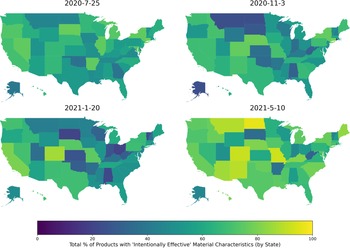
Although meaningful variation manifests in time-averaged data, stronger relationships between partisan politics and material culture emerge when change in production is observed over time (Figure 3). On a national scale, increasing political polarization led to an overall decrease in mask efficacy. Looking further at differences between Republican- and Democratic-held states, divisiveness is associated with not only decreasing mask efficacy overall but a growing divide between the efficacy of masks produced in blue and those produced in red states.
Mask efficacy viewed in time slices between July 2020 and May 2021, responding negatively to increased polarization independent of state political affiliation. (Color online)

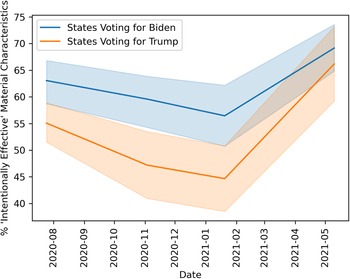
Analyzing shifts in mask production over time reveals how politicization negatively influenced efforts to produce effective products nationally, independent of political leaning (Figure 4). In July 2020, when both the coronavirus and disease mitigation strategies were relatively fresh, high-ranking Republicans resisted endorsing health advisories and appeared without masks at public events. Nonetheless, after months of questioning the CDC and refusing to appear masked, Trump briefly recommended their use (Gore et al. Reference Gore, Kiely, Robertson and Rieder2020). At this time, the average mask efficacy across the United States averaged just above 59% within our sampled data. As the election season moved into full swing, and as Trump held unmasked events and criticized Biden for wearing a mask (see, again, Gore et al. Reference Gore, Kiely, Robertson and Rieder2020), our data reveals plummeting national efficacy across the board into November. On the day of the election, just over 53% of masks evoked vocabulary associated with disease mitigation, whereas on the day of the inauguration, this number sank even lower—to less than 51%. On the first day of the Biden administration, a quick difference in tone was evident when an executive order was signed requiring masks in areas of federal jurisdiction (e.g., interstate transport, federal properties). Months later, by May 2021, masks associated with effective characteristics became increasingly prevalent across the board, jumping to nearly 68%. How the political party in charge approached the crisis appeared to influence material culture nationally, regardless of a state's voting habits.
Line graph demonstrating change in intentionally effective mask attributes over time. Political polarization decreases efficacy globally, and lower rates of disease-mitigating materials are present in Republican-held states. (Color online)

Although political polarization decreased mask efficacy across the country, differences between red and blue states become more nuanced when analyzed diachronically. With gaps in effective production present between red and blue states in July 2020, which is when we began to collect data, division continued to grow through the general election and inauguration, while mask efficacy generally decreased independent of political affiliation. This decrease is indexed in our data, which show a reduction in features that confer added disease protection—such as multiple layers—and other elements that ensure a snug fit (e.g., nose wires and other adjustable components). Our data further reflect the impacts of a political cooling following the swearing in of the new president. We consider presidential approval ratings by opposite party as a proxy for political heating up and cooling: prior to the election, Trump enjoyed a 3%–6% approval rating by Democrats. During the study period, Biden's Republican approval was significantly higher, from 8%–12% (Gallup 2022). Following Biden's assumption of power, the gap between red and blue states closed, reaching an all-time low. The changing material properties captured by our study (e.g., the increasing spread of CDC-sanctioned materials, fits, and improved filtration capacities that occur over time) suggest that mask effectiveness improved nationally as the gap between Republican- and Democratic-leaning states decreased and became statistically indistinguishable. This suggests that politicization may have influenced mask production negatively across the board, although to a greater degree in red states. Following the election of a new president who actively encouraged masking, efficacy improved substantially to all-time highs by May 2021, and division reached an all-time low.
Returning to observe the five most effective and ineffective states over time reveals unique trajectories of production over the course of the pandemic. States that manufactured the least effective masks followed similar patterns, typified by quick decreases in efficacy in response to political stressors and by slow recoveries that either never or just marginally exceeded initial levels of efficacy. In the bottom tenth percentile, initially high rates of efficacy witnessed over the summer of 2020 decreased precipitously approaching the election. A slow recovery occurred following the election and inauguration, although rates of efficacy in some of these states—including South Dakota, Alabama, and West Virginia—never reached their previous July highs. In these cases, it appears as if the politicization of mask use was irreparably correlated with inefficacious mask production.
By contrast, the states with the most effective producers on average retained greater stability over the course of pandemic, demonstrating general increases in efficacy and occasionally less steep decreases from July 2020 to May 2021. Four out of five of these states were carried by Biden in 2020, and in the fifth state, Nebraska, electoral votes were split between candidates. Although Colorado saw steady increases in efficacy overtime, New York and Nebraska had mild to moderate decreases in efficacy between the presidential election and inauguration. Apparently less volatile than the most anti-mask states, such states were not completely insulated from decreases in efficacy documented nationally.
Capitalizing on Conscientiousness: Learning Effective Production
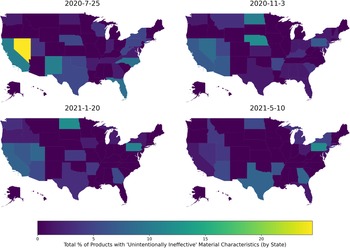
There was a downward trend in overall mask efficacy until after Biden was sworn in. Over time and independent of these decreases, some ineffective attributes were selected against by mask makers and/or consumers across the country (Figure 5). This transformation likely reflects the intersection of consumer education (e.g., growing awareness of buyers about what makes an effective mask) and growing knowledge of producers seeking to make more effective and sellable products. As scientific research and awareness of desirable mask characteristics spread across the country, some traits that rendered masks unintentionally ineffective decreased in production and sale. Masks that fall into this category include those with valves and those with a loose fit or thin materials. These materials might have been included stylistically or to facilitate air flow in ways that contradicted health advisories. However, such features would not have necessarily been deployed to render masks intentionally ineffective (see our next section, Intentionally Ineffective Mask Production).
Prevalence of unintentionally ineffective attributes viewed in time slices between July 2020 and May 2021, showing global decreases independent of political leaning. (Color online)

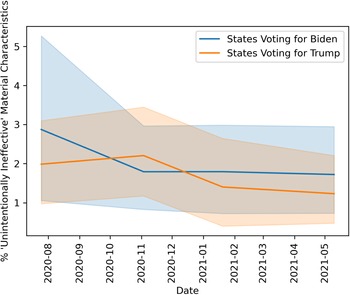
With the highest rates of unintentionally ineffective mask production starting in May 2020 in states such as Nevada, California, North Carolina, Florida, and New Mexico, the characteristics associated with this category increased in rarity over time. Ultimately, and independent of political leaning, levels of unintentionally ineffective traits stabilized at less than 2% of masks for sale by November 2020. For instance, producers stopped using terms associated with exhalation valves, as their associated inefficacy became more widely recognized. A winnowing of unintentionally ineffective attributes over the course of our study shows that despite a sensitivity to partisan politics, some mask attributes associated with unintentional inefficacy were selected against by makers or consumers over the course of the pandemic—independent of politics (Figure 6).
Line graph demonstrating a general decrease in unintentionally ineffective mask attributes over time, revealing no significant difference in characteristics associated with political party. (Color online)

Whereas data spanning a year of the pandemic coarsely elucidates the sociopolitics of effective mask production across the United States, time averaging flattens the variation that allows us to understand the intersection of politics and the pursuit of effective public health strategies. Although political signals of material culture are not entirely drowned out, they are weakened and lose association with particular events. Periods of political polarization correspond to the decreased production of effective masks in some cases and increased efficacy in fewer cases, although at a much slower rate. This suggests the political work of mask production on both sides of the partisan divide, although it indicates with particular strength the power of negative politicization on material culture. To begin to expose social and political variables that encourage effective mask production, it is beneficial to understand the observed data from narrow time slices.
Ineffective Mask Use
Although rates of mask efficacy correspond to national politics, they may be interpreted as participation in specific communities of practice rather than active attempts to damage public health. On the other hand, our data reveal how some makers actively undermined the containment of disease through ineffective mask production. Through the pandemic, media coverage of flagrantly ineffective products became widespread; reports of individuals who visibly cut holes in their masks were relatively commonplace, and conflicts broke out between retail employees, who were often made responsible for enforcing regulations and engaging with dissenting customers (MacFarquhar Reference MacFarquhar2020).
In this section, we examine how some makers intentionally produced less effective products as a form of dissent against public health regulations. Closely examining masks sold nationally, some producers went out of their way to manufacture ineffective face coverings. To render a mask either nonfunctional or less functional, producers used specific materials or attributes either visibly or invisibly. Such makers created products that would neither protect wearers nor others in their proximity. Instead, their masks provided little more than visible compliance with laws requiring face coverings.
Makers achieved inefficacy using a number of production techniques and materials. For instance, some used highly breathable fabrics, including mesh, lace, or other materials in a single layer. Such masks may appear effective and allow wearers to move around without drawing social ire, yet they simultaneously contest public health codes. Others produced masks that not only intentionally flouted the intentions of mask mandates to reduce the spread of disease but also publicly broadcast opposition to them. Some of these masks were made with a loosely knit crocheting technique showing visible holes or with clearly transparent meshes that signaled a mask's uselessness. In our analysis, we examined a suite of characteristics and vocabulary associated with intentional inefficacy, including the following terms: mesh, crochet, single layer, protest, anti-mask, and compliance.
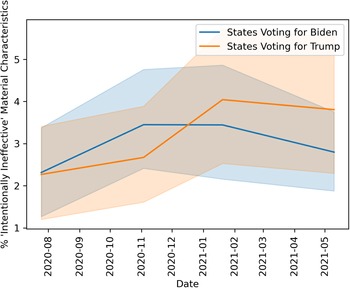
Unlike rates of overall mask efficacy, no correlation exists between political affiliation and the production of intentionally ineffective masks. On average, our data suggest insignificant differences between states where electoral votes went to Biden and those where they went to Trump (Figures 7 and 8). For instance, looking at states where the most ineffective masks were produced, our data reveal that of the five that produced no intentionally ineffective masks, four were carried by Trump in the 2020 election. Of those states that produced the most intentionally ineffective masks, four out of five were also Republican leaning. Despite lacking causal linkage with the directionality of electoral votes at a given moment, rates of ineffective mask production across the country demonstrate association with major political events over time. Whereas just over 2% of masks were ineffective across the country in July 2020, marginal increases were seen through Joe Biden's inauguration, when the rates peaked closer to 4%, followed by a decrease into spring 2021.
Line graph demonstrating change in intentionally ineffective mask attributes over time, at first glance, reveals lack of linkage between political party and production. (Color online)

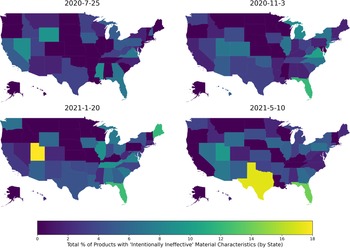
Distribution of intentionally ineffective mask properties from between July 2020 and May 2021. States where political ideologies clashed with masking mandates manifested in the intentional production of less functional masks. (Color online)

Looking closely at the distribution of intentionally ineffective masks reveals an interesting pattern at the extreme ends of production: here, we compare states that produced no such masks whatsoever with those that manufactured the most ineffective face coverings. Of the Republican states in which no ineffective masks were produced, no state-wide mask mandates were ever implemented. These include Alaska, Missouri, Nebraska, and North Dakota. In these social contexts, no state-level requirements to wear masks meant that producers never activated masks as a political vehicle of dissent. Conversely, the top four out of five ineffective mask producers were also in Republican states; of these, only one had no state-wide mask mandate (Florida). In these locations, state-level mandates clashed with perceptions of whether and how frequently masks should be used (see Brenan Reference Brenan2020). In this way, masks took on the most politically active roles in states where local sensibilities about public masking clashed with health mandates.
Capitalizing on Dissent: Learning Ineffective Production
A time-averaged assemblage of intentionally ineffective masks reveals the political work of anti-mask production in cases where states had mask mandates (Figure 8). Sharpening our analysis, however, to account for change over time allows us to understand the transforming distribution of physical properties that undermined the containment of the disease (Figure 9). Of the multitude of ineffective attributes, we looked more closely at two categories of masks: (1) those that used mesh, a material that intentionally rendered products breathable; and (2) “anti-mask” masks, which relied on a suite of characteristics to protest regulations. We suggest that the use of mesh and the sometimes overlapping making of “anti-mask” products cultivated dissent against COVID-19 policies. Documenting the change and spread of these attributes, it is possible to infer shifting patterns of opposition to public health guidelines.
Prevalence of intentionally ineffective attributes viewed in time slices between July 2020 and May 2021 show processes of learning and social selection against nonfunctional mask qualities. (Color online)

Anti-Masks
Some makers intentionally produced masks without functional purpose. Anti-mask, also known as “compliance,” masks spread across the country, apparently as a form of political protest against public health recommendations. Such face coverings allowed wearers to comply with the letter of the law while actively undermining attempts to mitigate disease transmission.
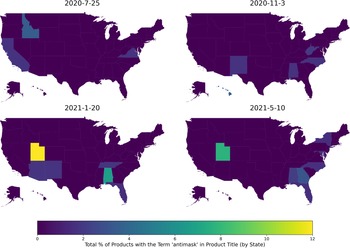
Over the course of our study between July 2020 and May 2021, producers in 15 states made masks marketed as anti-mask products. Of these states, seven supported Biden in electoral votes, whereas the other eight were Republican leaning. In the case of anti-mask manufacture, no clear associations between politics and production are evident. Utah, Alabama, Hawaii, Idaho, and New Mexico had the highest rates of production, ranging from just less than 1% to under 5% of all products sold in each respective state (Figure 10). Our long-term data demonstrate the ubiquity of anti-mask production independent of politics.
Distribution of anti-mask properties averaged between July 2020 and May 2021 demonstrates no clear association of politics with the material attributes in question. (Color online)

On the other hand, returning to an analysis of change over time provides the means to understand the nature of anti-mask spread. A year's worth of data observed in time slices reveals that anti-mask products were relatively common, albeit at relatively low percentages across the country. In July 2020, three states—California, Virginia, and Idaho—contained protest mask production. Production expanded slowly but steadily, increasing by one state through each of our data collection periods between November 2020 and January 2021, to a maximum of seven states by May 2021. By May, producers in New York, Florida, Maryland, North Carolina, Alabama, Georgia, and Utah were manufacturing anti-masks. Despite the fact that the number of anti-mask producing states increased over time, the average of total products sold during each sampling period in individual states remained between approximately 2% and 4% (Figure 11). In other words, anti-masks constituted a relatively small portion of masks produced in any given state, although the number of states making them increased.
Prevalence of anti-mask attributes viewed in time slices between July 2020 and May 2021 reveals the short-lived nature of their production in most instances, possibly due to social selection. (Color online)

Anti-mask production became increasingly widespread with time. However, our analysis also demonstrates that the making of anti-masks was short lived in most places, which is potentially explained by social controls exerted against anti-masking behaviors. Despite a net increase across the country in production sites of anti-masks, such material culture was more rarely recorded over multiple instances of data collection in the same location. None of the states where anti-masks originated before July 2020 were represented months later in November. In the most extreme cases, Utah and New Mexico were represented in two instances of data collection, whereas Alabama was represented in three. We suggest that even though anti-mask sentiments were increasing across the country independent of political orientation, local social pressures selected against the long-term production of material culture co-occurring with these dissenting perspectives.
Mesh Masks
Whereas some masks explicitly broadcast their inefficacy as a form of protest, others were made with breathable materials conferring little protection, though not necessarily advertising this fact. The latter “mesh” masks spread over the course of the pandemic. Their properties allowed for freer airflow to and from the nose and mouth, thereby providing less protection for both users and those around them. Following the production of these masks allows us to understand how certain mask traits spread over time through independent innovation or learning. At the same time, the observed variation may indicate (to some degree) the randomness of production profiles that typify large-scale, decentralized production.
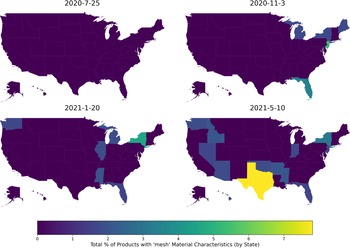
Mesh masks were not present in our initial survey on July 25, 2020, despite the fact that our first instance of data collection represented the heat of the summer when breathability might have been most desirable (Figure 12). Still, alongside cooling temperatures and the election, mesh masks emerged most visibly in northern states, including New Jersey, where over 5% of total products sold used mesh. Approximately 2% of makers in New York, Michigan, and Maine were producing mesh masks at this time. In parallel, such masks were recorded in one southern state, Florida, where they comprised over 3% of products sold. As mask making and wearing spread, makers found ways to produce masks composed of materials that complied with laws but further facilitated hyper breathability.
Prevalence of mesh masks viewed in time slices between July 2020 and May 2021 reveals cultural diffusion and/or innovation of mask features across the United States. (Color online)

By the time the Biden administration took over in January 2021, mesh mask production had spread farther afield in the South to include Mississippi, West to include Washington, and Midwest to include Illinois, while it had contracted in the Northeast, where mesh masks were only produced in New York at a rate of just under 5%. The spread of makers using mesh continued through May 2021 to a high of 13 states. At this point, the use of this material spread to include Arizona and Nevada in the Southwest, and Hawaii in the Pacific, in addition to all other regions except the West Coast.
Although politics are not explicitly linked to the making of intentionally ineffective masks, their production demonstrates the spread of certain traits across the country as the pandemic continued. Whether or not these materials spread through independent innovation or diffusion is unclear. Even though it is fair to suggest some level of local innovation, we must also assume that makers had some familiarity with other producers online and in person. Like the expansion of effective mask attributes, producers around the nation began making intentionally ineffective masks with greater frequency.
Conclusion
In a digital era, anthropological approaches to big datasets have the power to reshape an understanding of the material world. The study of material culture has occupied scholars for centuries, more recently establishing the foundations of our field. For just as long, scholars interested in “things” have been largely limited by the observation of physical objects. The approach presented in this manuscript extends the study of materiality into new digital domains so as to understand the distribution of objects on an unprecedented scale. With new sources of data, we may not only observe vast areas of material culture with the click of a mouse but also consider their transformations over time. Such datasets are comparable to broad-scale archaeological or ethnographic collections, acquired over decades or centuries of extensive excavation and accessioning.
Articulating with the work of our colleagues—including Bonacchi, Krzyzanska, Altaweel, and Hadjitofi—this article demonstrates the potential of digital anthropological approaches to material culture by providing novel insights into an ongoing global health crisis. Whereas recent research has shown the intersections of political orientation and attitudes toward mask use (Van Kessel and Quinn Reference Van Kessel and Quinn2020), our analysis reveals the centrality of politics in some domains of effective mask production. Our study demonstrates how politicization physically resulted in less effective mask making, thereby decreasing possibilities for containing the spread of the pandemic across the country. At the same time, the production of intentionally ineffective masks occurred without strong political associations. Political polarization not only negatively influenced policy and local behaviors needed to contain the virus but also likely contributed to the spread of disease by supporting conditions for ineffective mask production. Given that our article only covers portions of 2020 and 2021, future analyses of material datasets may cast a critical gaze on how subsequent waves of the pandemic were handled.
We suggest that to understand such political signals manifesting in contemporary material culture, it is critical to analyze diachronic transformation. Whereas time-averaged data obscures political signals that may manifest in material-spatial samples, focusing on change reveals the direct impact of politicization on mask efficacy. For instance, whereas Republican states tended to produce less effective masks on average over the course of our study, an examination of changes over time in Democrat-held regions reveals that politicization also negatively impacted mask efficacy across the country. Although time-averaged assemblages drown out political meaning, diachronic perspectives on mask production derived from data-scraping internet sources—invisible with other anthropological approaches—provide new perspectives on the politics and production of masks.
Adequately harnessed and further refined, we believe such approaches can provide a powerful tool kit to study human behavior and culture more broadly. This article relied on a marketing tool to scrape relatively small datasets manually. We anticipate, however, an outgrowth of methods to analyze diverse subjects with greater temporal and spatial precision, including events as they occur and in their aftermath (see also Magnani et al. Reference Magnani, Venovcevs, Farstadvoll and Magnani2021). Growing internet archives, coupled with machine learning techniques for parsing them, will provide new materials to approach events not just as they unfold but long after the fact. Of course, we also believe that these methodologies are informative ways to reflect on current events. In particular, we will seek to integrate such analyses with ethnographic components (see Magnani and Magnani Reference Magnani and Magnani2020). In the reported case, such integration would lead to better elucidation of the desires of individual makers, materials, and supply chains. Just as the internet reshaped our relationships with material culture as individuals and communities, it also provides the opportunity to advance our understandings of material distributions and meanings.
How will anthropologists and archaeologists accommodate digital records in the study of materiality and human behavior moving forward? We turn back to the growing body of work by Bonacchi and Krzyzanska (Reference Bonacchi and Krzyzanska2019), who have also begun to reflect critically on the power of big data and new digital datasets to approach meanings and makings of heritage. Big data methodologies, turned on material datasets derived from the internet and other repositories, have substantial implications for how we view human intersections with the material world—past, present, and political.
Acknowledgments
We would like to acknowledge the anonymous peer reviewers who contributed to the improvement of this article.
Data Availability Statement
All data for this manuscript are available via Zenodo at DOI:10.5281/zenodo.5943312.
Competing Interests
The authors declare none.